1. Introduction
Numerous branches of nonlinear science including plasma physics, geochemistry, solid-state physics, fluid mechanics [
1,
2,
3,
4], optical fibres, nuclear physics and chemical physics have been studied through nonlinear evolution equations (NLEEs) [
5,
6,
7,
8]. The travelling-wave solution for NLEEs executes a number of analytical and numerical techniques to get an exact solution for these NLEEs [
9,
10,
11,
12,
13,
14,
15]. Recently, a variety of external stimulations including random disturbances have been involved in changing physical systems.
A stochastic differential equation (SDE) is a differential equation that has one or more stochastic processes as its terms, with the solution being another stochastic process. SDEs are used to simulate a variety of phenomena, including stock prices and physical models subject to thermal fluctuating. Consequently, SDEs have emerged and gained a lot of significance in modelling phenomena in atmospheric science, fluid mechanics, oceanography, chemistry, physics and biology [
16,
17].
The fractional derivative models are used for the accurate modelling of those systems that require an accurate modelling of the damping. The advantages of fractional derivatives are their flexibility and nonlocality. These derivatives can approximate real data with a greater flexibility than classical derivatives because they are of fractional order. Moreover, they consider nonlocality, which classical derivatives are unable to achieve. However, a number of significant phenomena such as anomalous diffusion, electrochemistry, acoustics, image processing and electromagnetism are represented by fractional derivative. Fractional models are more precise than integer models. In general, it is more challenging to obtain an exact solution of SDEs with fractional derivatives than classical ones. As a result, we considered the following SFDSW equations given as [
18]:
where
,
and
for
are nonzero constant.
is the standard Brownian motion,
is noise strength, and
is a conformable derivative for
The remaining manuscript is arranged as follows: In
Section 2, we explain the properties and definitions of standard Brownian motion and also discuss Hirota’s bilinear method. In
Section 3, we obtain the wave equation for the SFDSW equation. In
Section 4 and
Section 5, we introduce the solution for the cross-kink rational solution and periodic cross-rational solution, respectively; we also examine the homoclinic breather in
Section 6, M-shaped rational wave solution in
Section 7, M-shaped rational wave solution with one kink and two kink waves in
Section 8 and
Section 9, respectively. Moreover, we obtain the M-shaped rational interaction with rogue and kink waves and the M-shaped rational interaction with periodic and kink waves in
Section 10 and
Section 11. In
Section 12, we address results and discussion.
Section 13 presents the conclusion of the paper.
2. Preliminaries
Now, we discuss the properties and definitions of a conformable derivative and standard Brownian motion. The definition of a conformable derivative is given as:
Definition 1 ([
19])
. The conformable derivative with order ω of is given as: Theorem 1 ([
19])
. Suppose that are ω differential functions, Some properties of the conformable derivative are given as:
- 1.
- 2.
- 3.
- 4.
, K is constant.
Definition 2 ([
20])
. A stochastic system is a standard Brownian motion if - 1.
,
- 2.
, is a continuous function of t;
- 3.
is independent for ;
- 4.
With the variance and mean 0, has a normal distribution.
Lemma 1 ([
20])
. for
Hirota’s Bilinear Method
Hirota invented a method in 1971 to obtain multisoliton solutions of integrable nonlinear evolution equations. A particularly simple manifestation of multisoliton solutions was desired, therefore the aim was to convert existing variables into new ones. Hirota’s method was the quickest to provide results to find soliton solutions [
21].
The standard definition of Hirota’s bilinear operators was first introduced by Hirota as:
This type of equations can typically be made bilinear by including a new dependent variable, such as or .
3. Wave Transformation for SFDSW
For SFDSW Equations (1) and (2), we use the following wave transformation to build the wave equation [
18]:
where
U and
V are real functions. Inserting Equation (
3) into Equations (1) and (2), we have
By using Equation (
4) into Equations (
1) and (
2), we get
and we have
Integrating Equation (
9), we obtain
where
C is a constant. Inserting Equation (
11) into Equation (
10), and utilizing Equation (
9), we obtain
Integrating Equation (
12), we have the following wave equation
where
and
To find the bilinear form of Equation (
13), we substitute the following transformation for various solutions [
22]:
Now, we study the following wave solution by using Equation (
15):
4. Cross-Kink Rational Wave Solution
We use the following ansatz for the cross-kink rational wave [
23]:
Substitute Equation (
16) into Equation (
15). By equating the coefficients of
and
to zero, we have some values for the wave solution:
Putting Equation (
17) into Equation (
16) and by using them Equation (
14), we obtain
Putting Equation (
18) into Equation (
11) yields
Inserting Equations (18) and (19) into Equation (
3), we have
where
,
.
5. Periodic Cross-Rational Wave Solution
For periodic cross-rational waves, we utilize the given ansatz [
24,
25]:
Using Equation (
22) into Equation (
15) and zeroing the coefficients of
and
, we get some values for the periodic cross-rational wave solution:
Putting Equation (
23) into Equation (
22) and then inserting into Equation (
14), we obtain
Inserting Equation (
24) into Equation (
11) yields
where
.
Substituting Equations (24) and (25) into Equation (
3), we get
where
,
,
and
6. Homoclinic Breather Wave Solution
For homoclinic breather pulses, we use the following ansatz [
26,
27]:
Putting Equation (
28) into Equation (
15), and setting the coefficients of
and
to zero, we obtain the following for the homoclinic breather wave solution:
Using Equation (
29) into Equation (
28) and then using into Equation (
14), we have
Inserting Equation (
30) into Equation (
11) yields
Inserting Equation (
30) into Equation (
31) and then into Equation (
3), we get the solution for Y and
,
where
and
.
7. M-Shaped Rational Wave Solution
For the M-shaped rational wave solution, we use the following transformation [
28]:
Using Equation (
34) into Equation (
15), we get the following values for the solution:
Using Equation (
35) into Equation (
34) and then inserting into Equation (
14), we get
By using Equation (
36) into Equation (
11), we have
Substituting Equation (
36) into Equation (
37) and then into Equation (
3), we have the solution for Y and
,
8. M-Shaped Rational Wave Solution with One Kink Wave
For an M-shaped rational wave solution with one kink wave, we assume the following
f [
29]:
Using Equation (
40) into Equation (
15) and setting the coefficients of
and
to zero, we have some values for the wave solution:
Evaluating Equation (
41) into Equation (
40) and then putting the result into Equation (
14), we have
Substituting Equation (
42) into Equation (
11), we get
Evaluating Equations (42) and (43) into Equation (
3), we obtain the solutions given below
where
9. M-Shaped Rational Wave Solution with Two Kink Waves
For the M-shaped rational wave solution with two kink waves, we assume the following ansatz [
30]:
Inserting Equation (
46) into Equation (
15) and setting the coefficients of
to zero, we get some values for the wave solution:
Putting Equation (
47) into Equation (
46) and then inserting into Equation (
14), we get
Inserting Equation (
48) into Equation (
11) yields
Then, putting Equations (48) and (49) into Equation (
3), we obtain
10. M-Shaped Interaction with Rogue and Kink Waves
For the M-shaped interaction with rogue and kink waves, we assume the following
f [
29]:
By using Equation (
52) into Equation (
15) and setting the coefficients of
and
to zero, we are left with some values for the wave solution:
Putting Equation (
53) into Equation (
52) and then into Equation (
14), we have the solution
where
,
and
Evaluating Equations (54) and (55) into Equation (
3), we obtain
where
,
,
,
,
.
11. M-Shaped Interaction with Periodic and Kink Waves
For the M-shaped interaction with periodic and kink waves, we use the given transformation [
31,
32,
33]:
By using Equation (
58) into Equation (
15) and by comparing the coefficients of
and
, we get some values for the wave solution:
After inserting Equation (
59) into Equation (
58) and then inserting into Equation (
14), we get
where
By putting Equations (
60) and (
61), we have the following solutions
where
,
,
and
.
12. Results and Discussion
Some researchers worked on the governing model such as Askar et al., who used the (G’/G)-expansion method to find exact solutions for the fractional–stochastic Drinfel’d–Sokolov–Wilson equations [
18]. Qin and Yan worked on the applications of the coupled Drinfel’d–Sokolov–Wilson equation and also used an improved F-expansion method to find exact doubly periodic solutions in terms of the rational formal Jacobi elliptic function of nonlinear partial differential equations [
34].
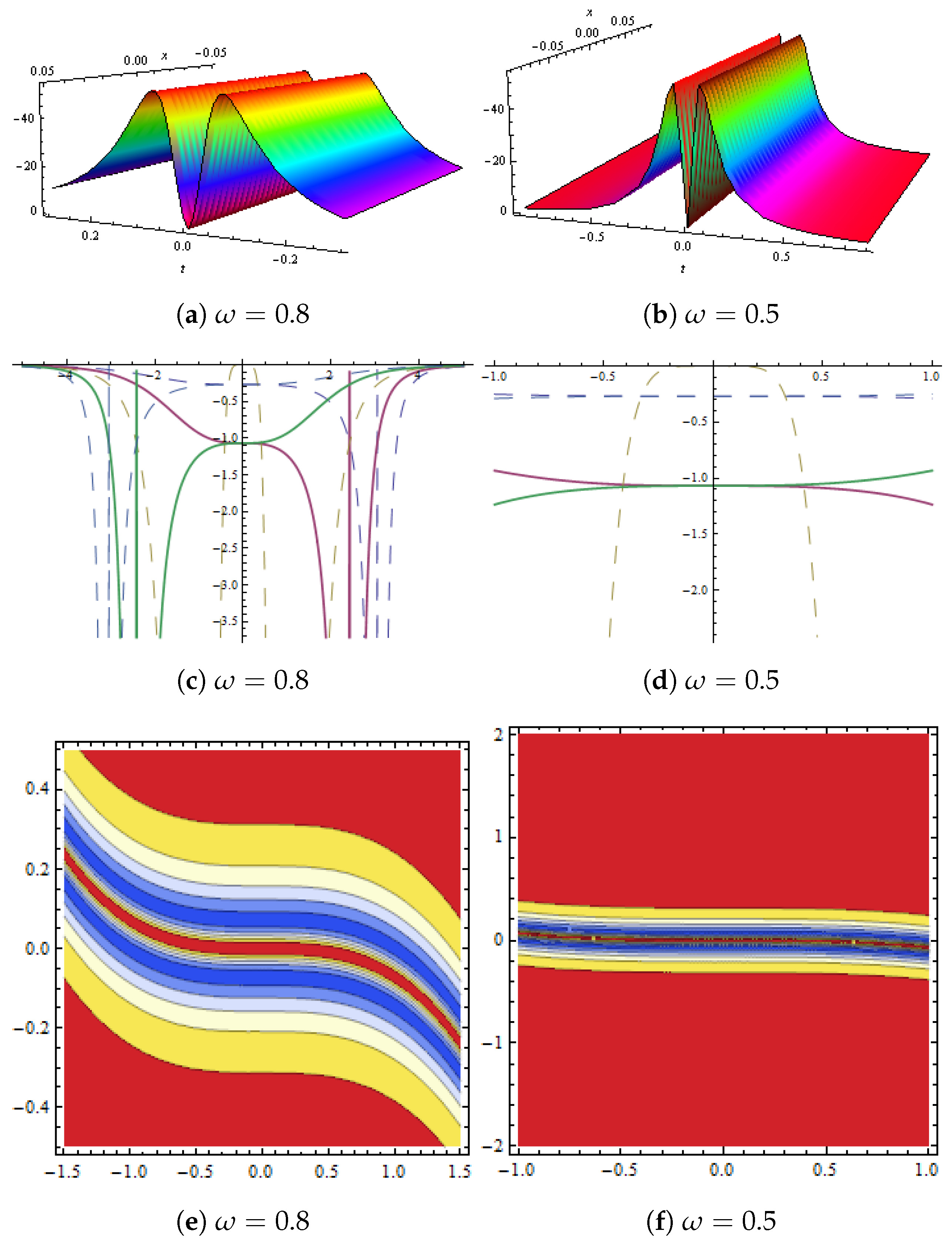
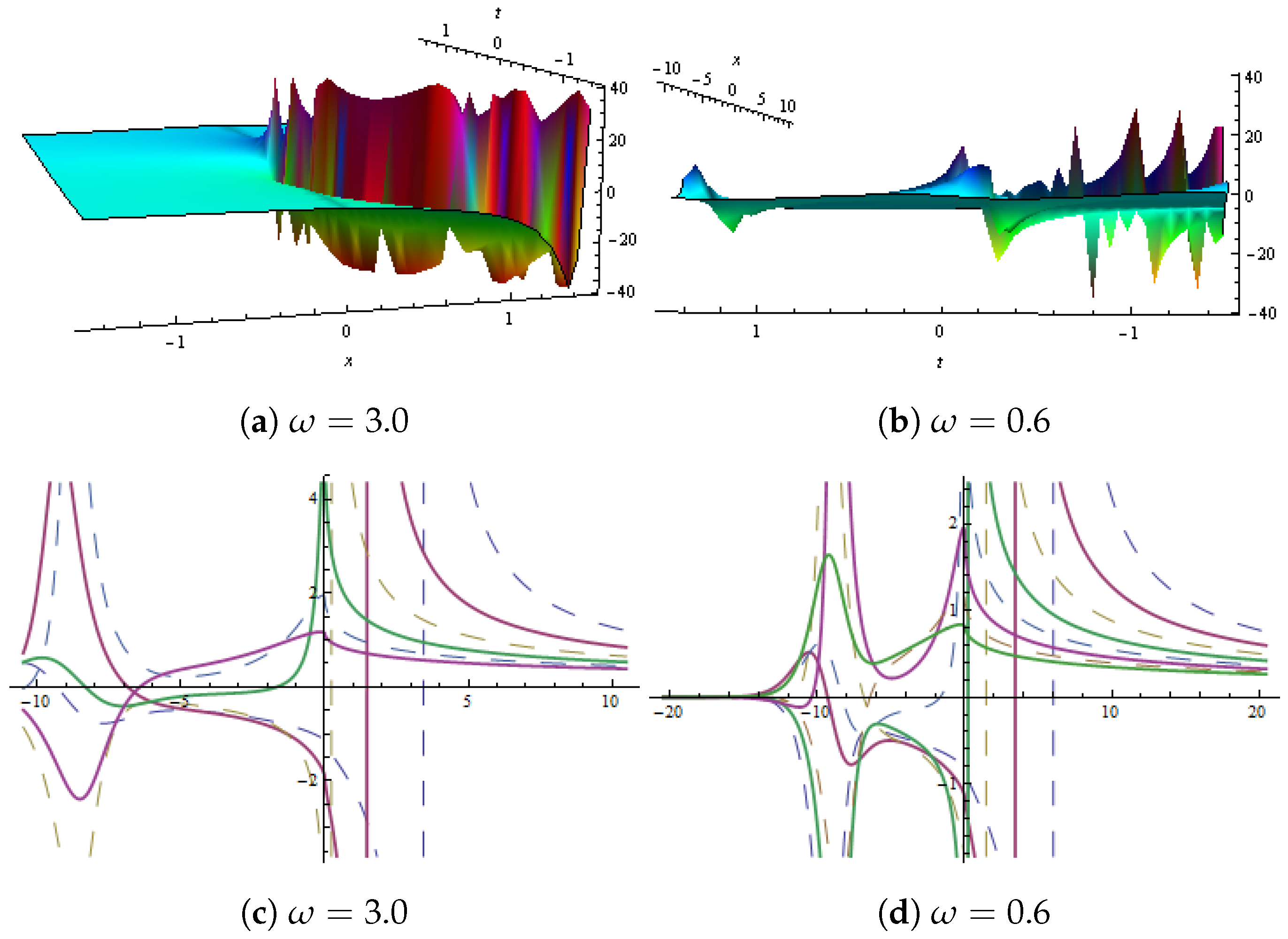
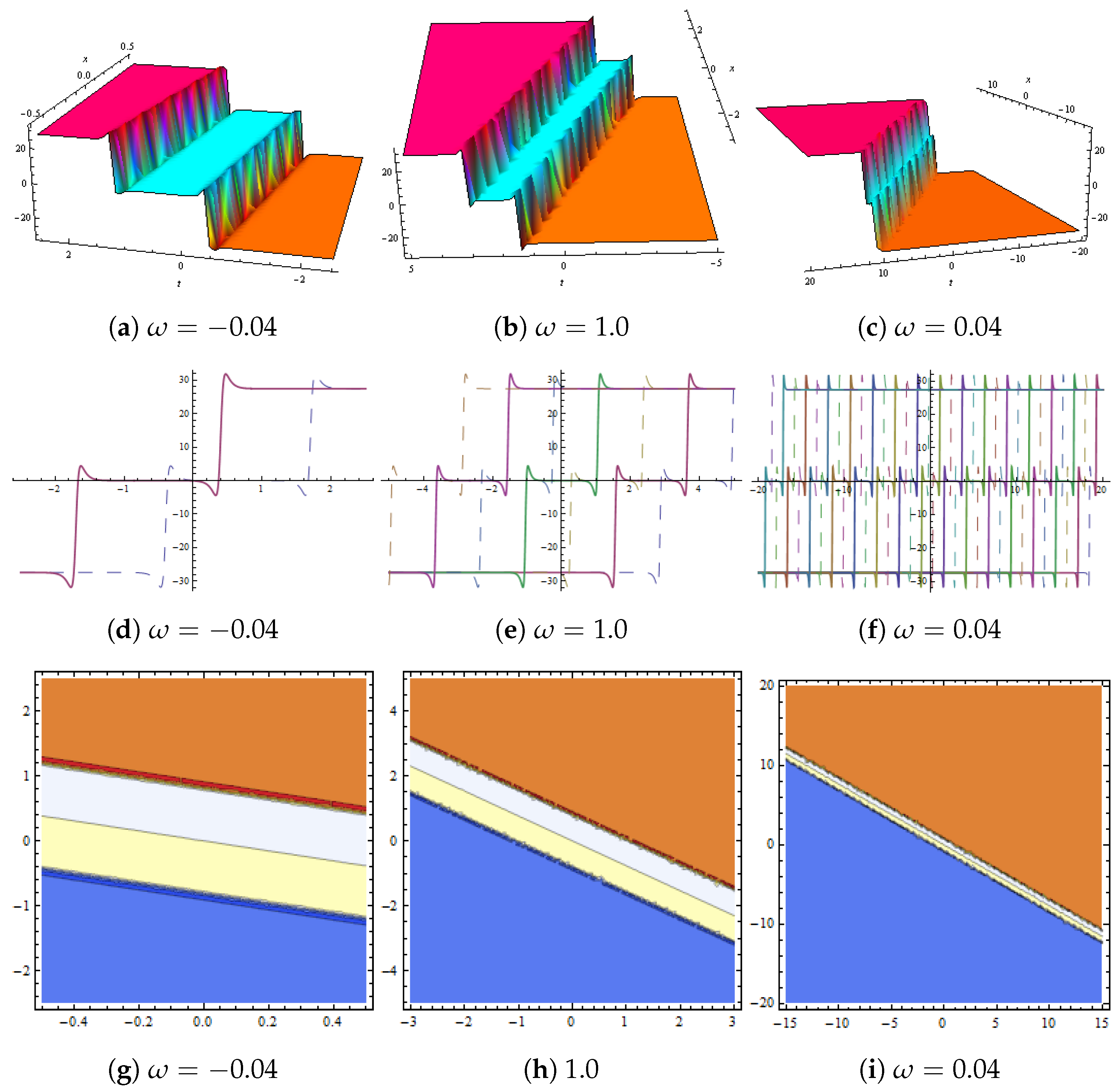
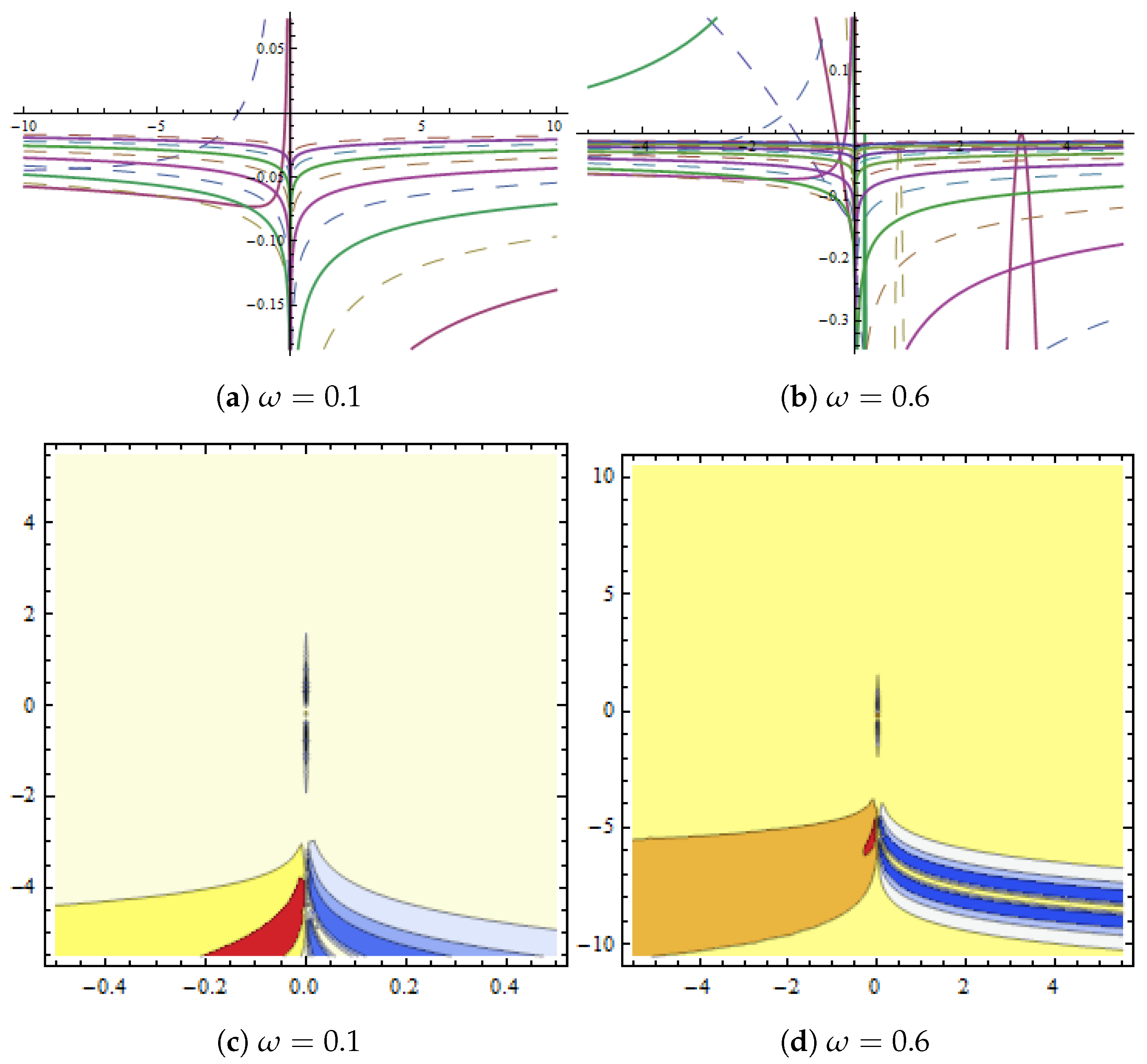
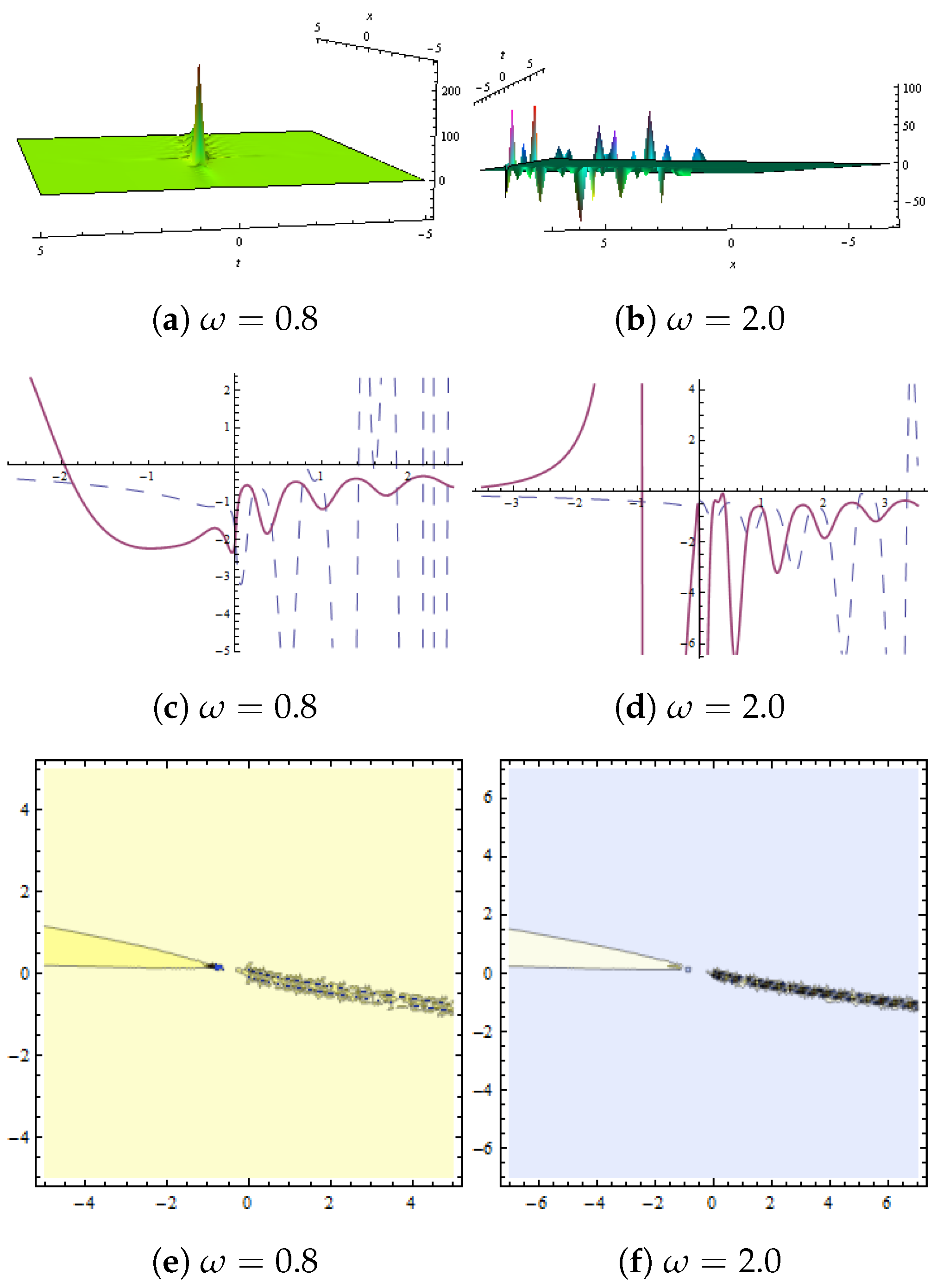
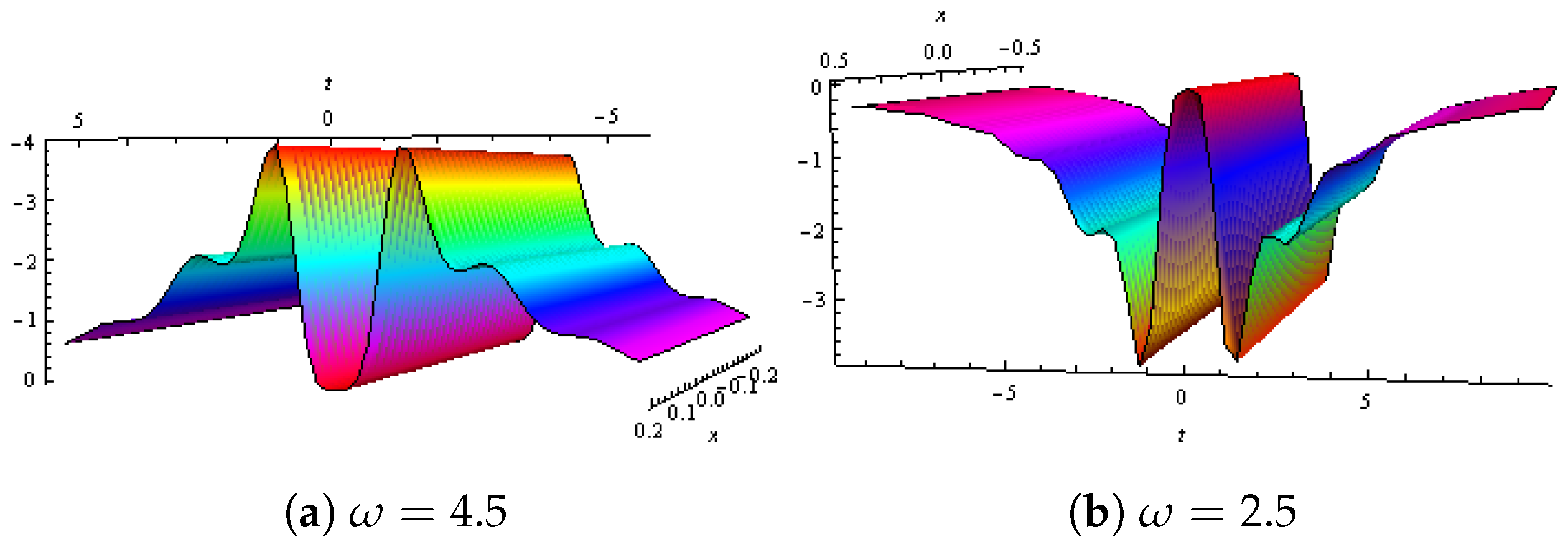
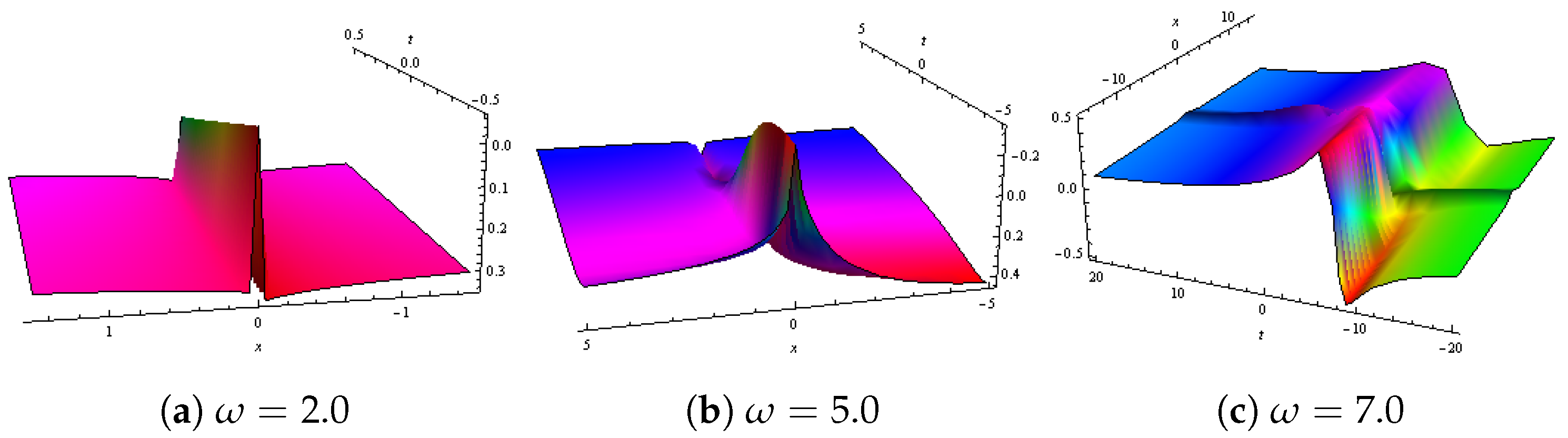
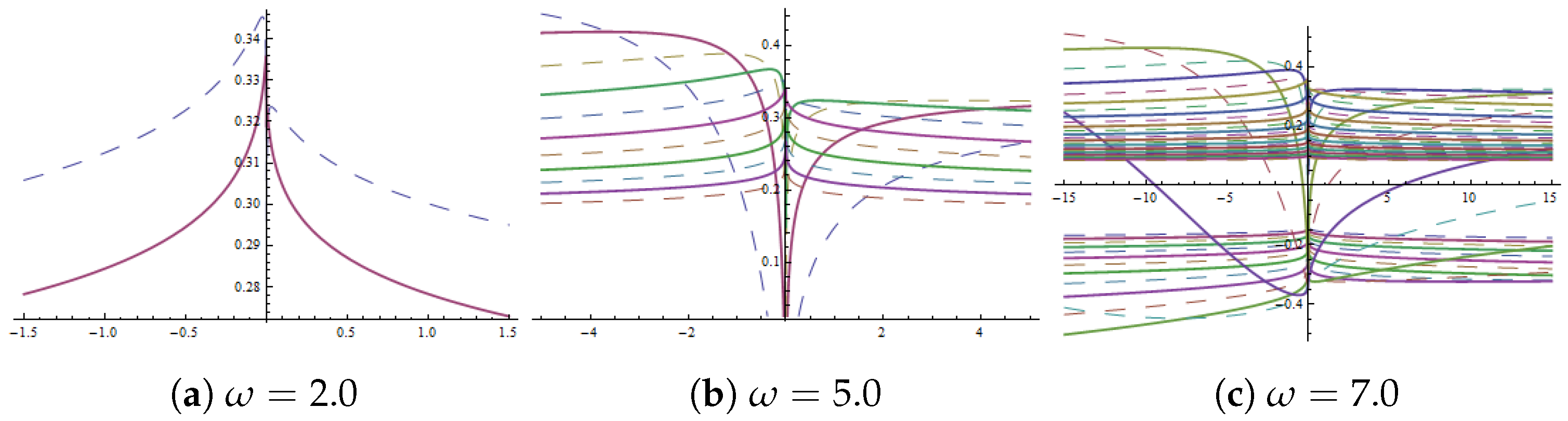
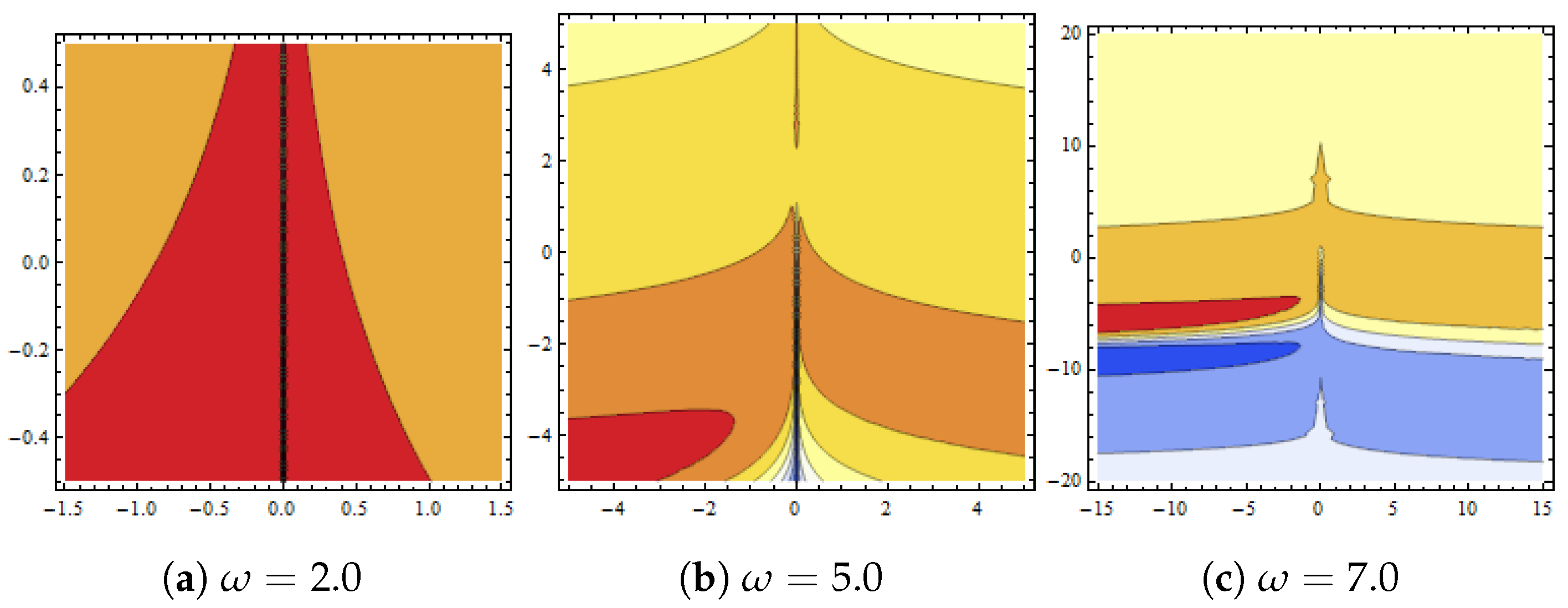
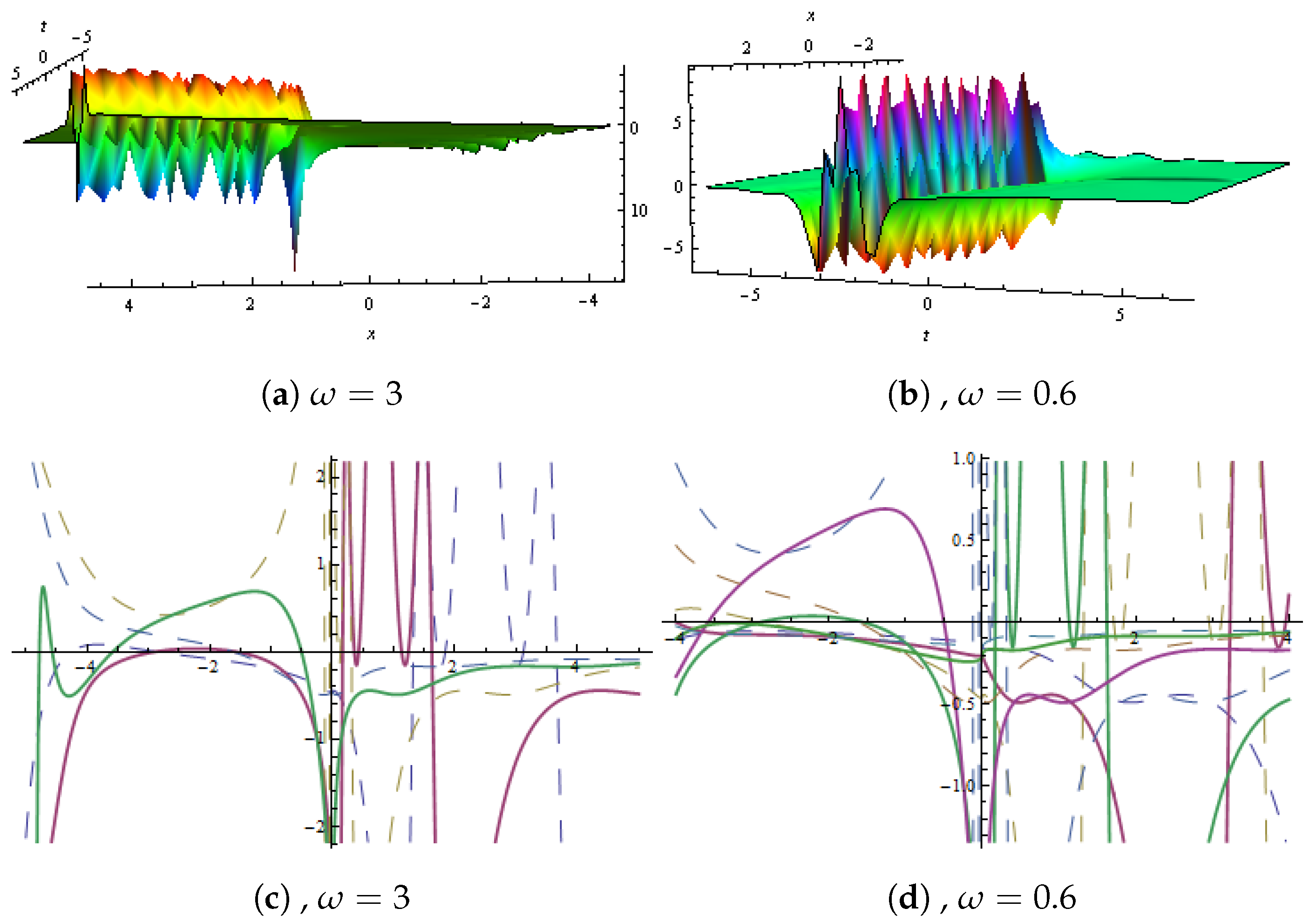
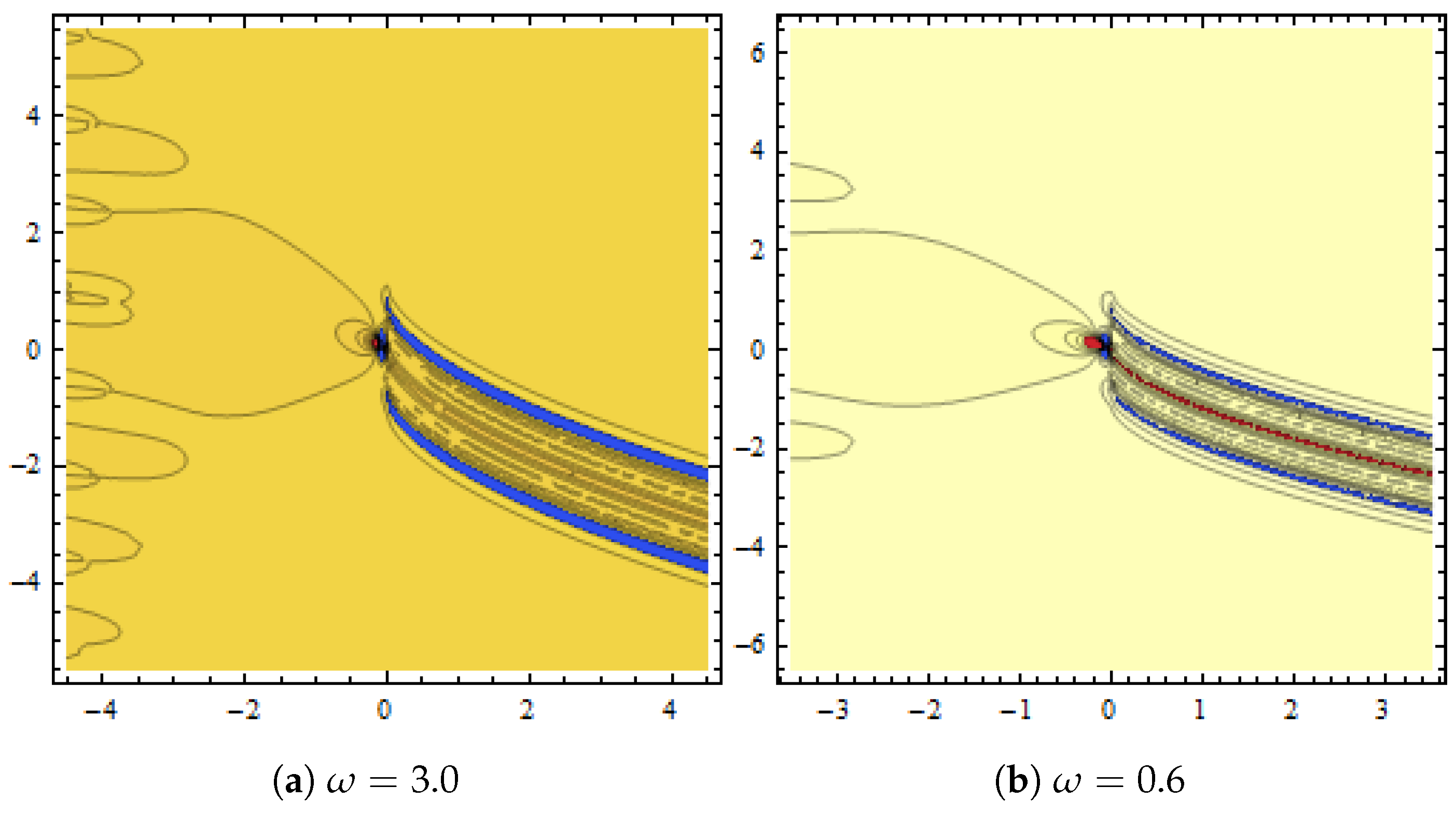
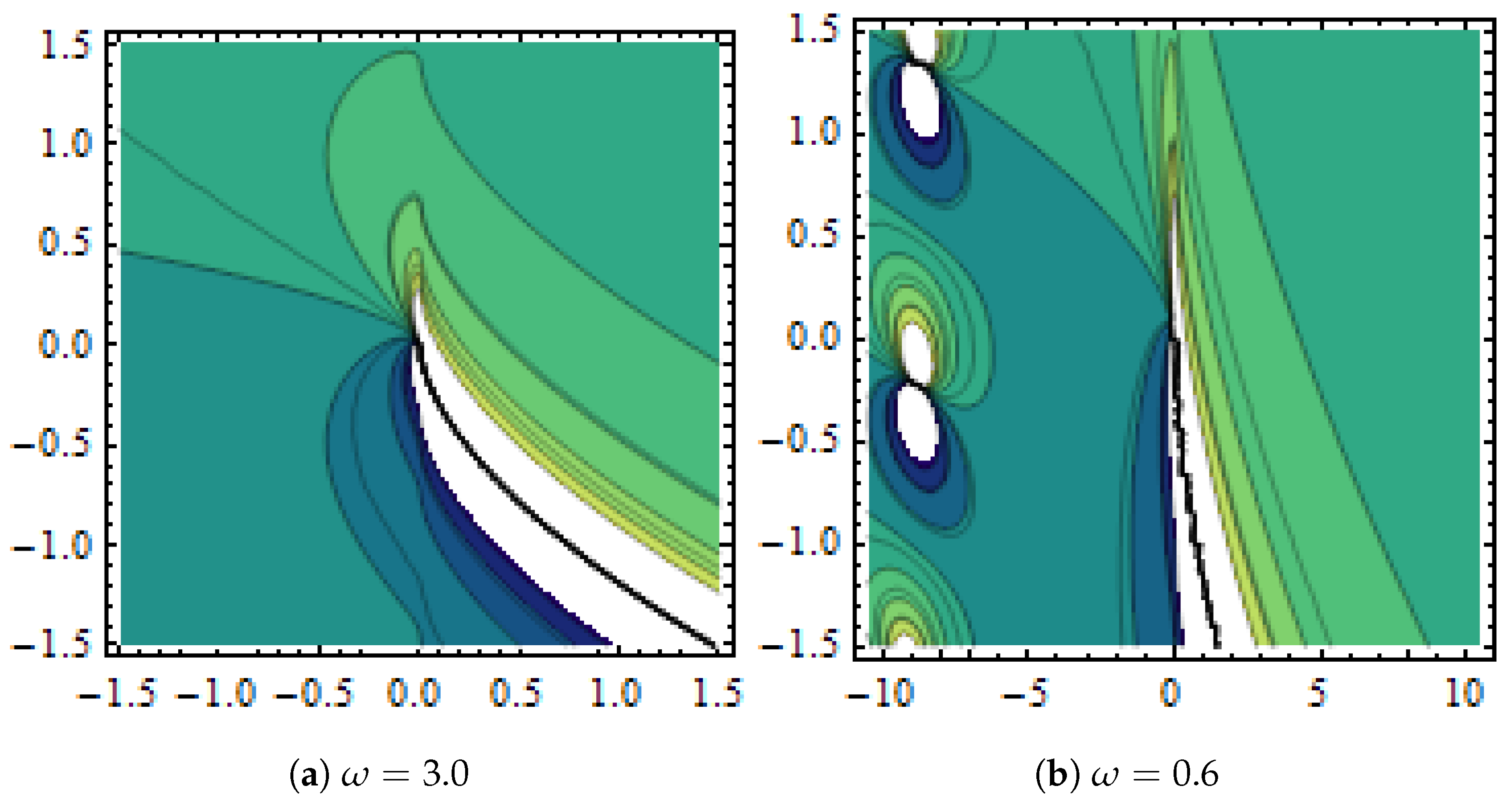
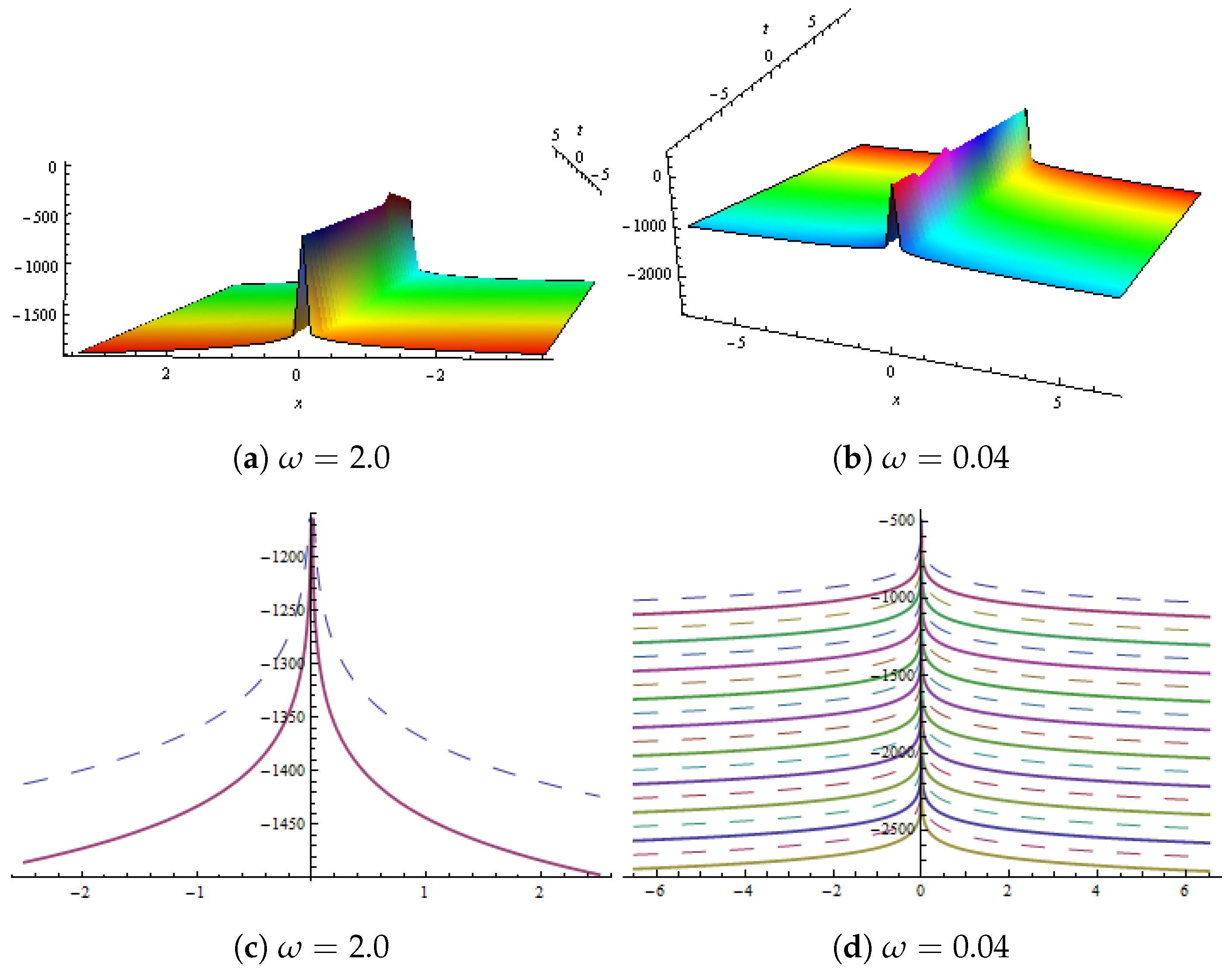
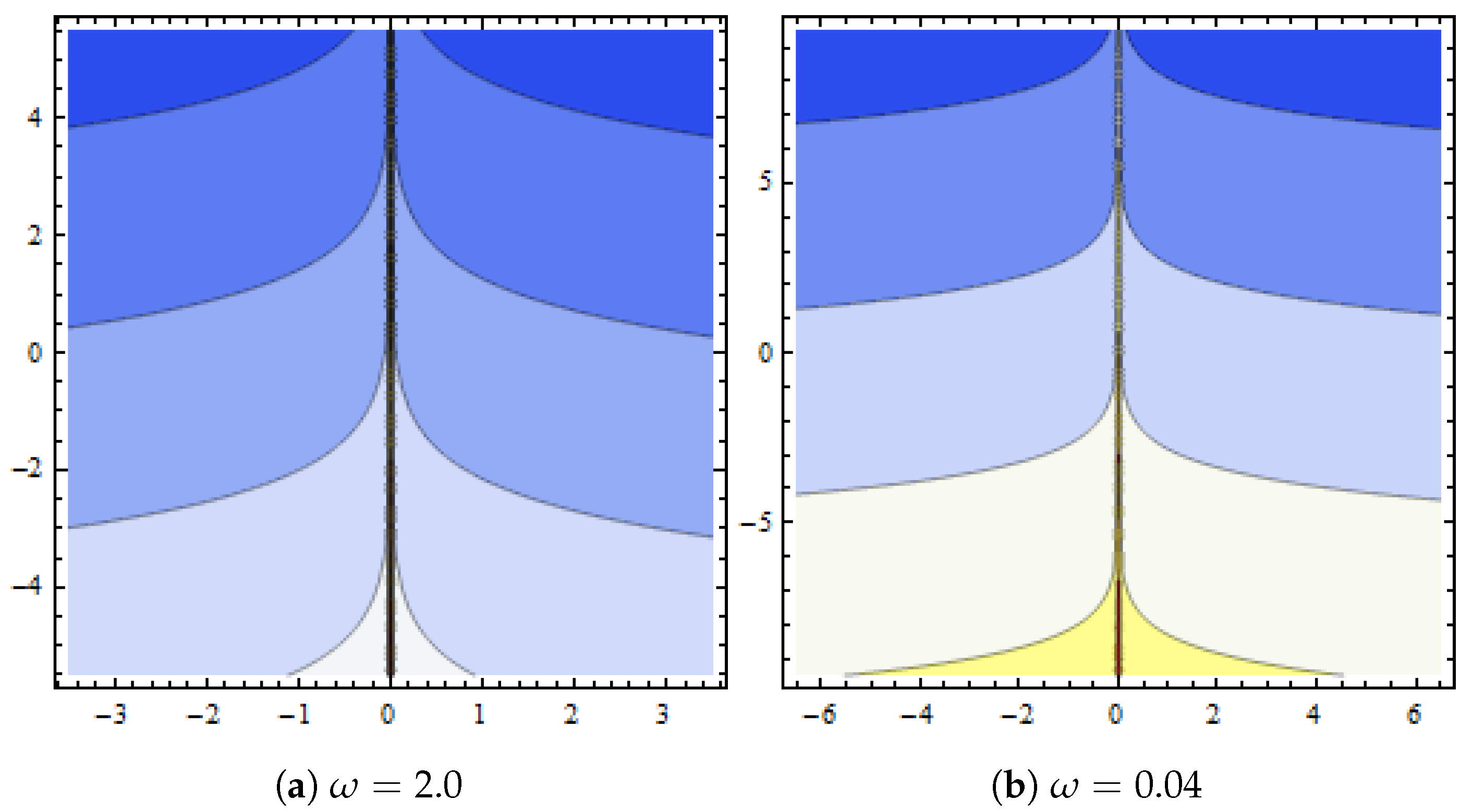
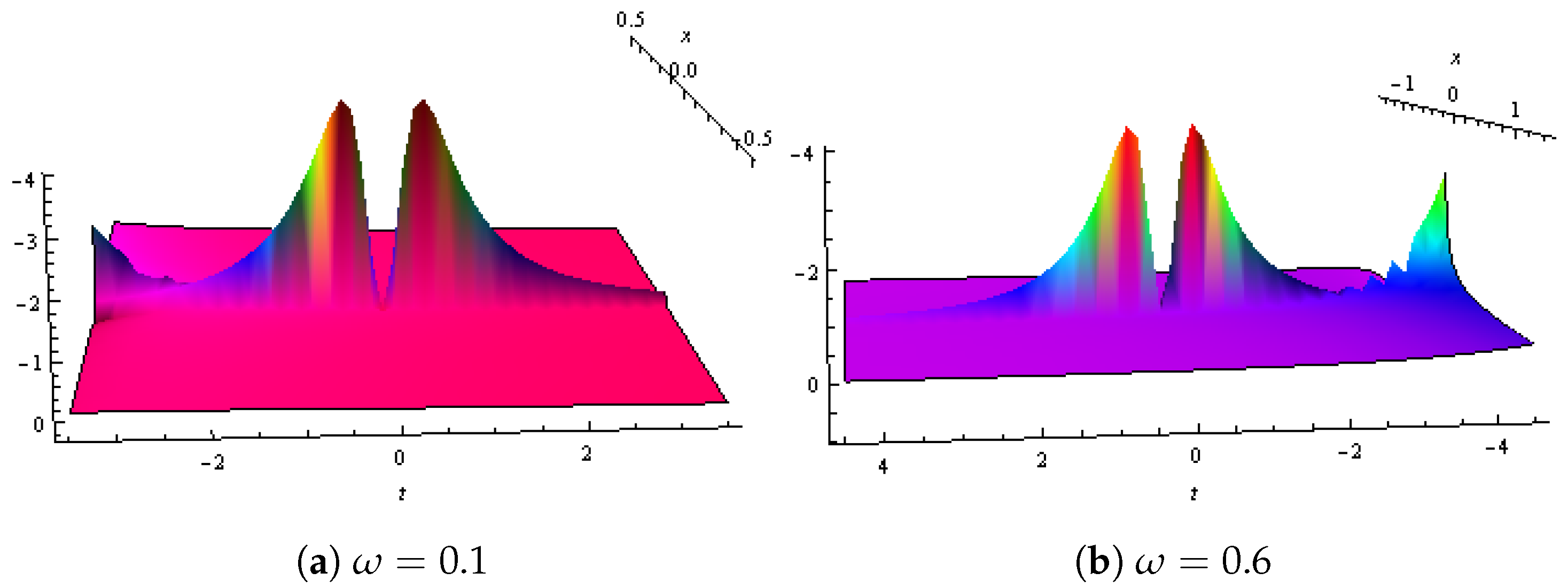
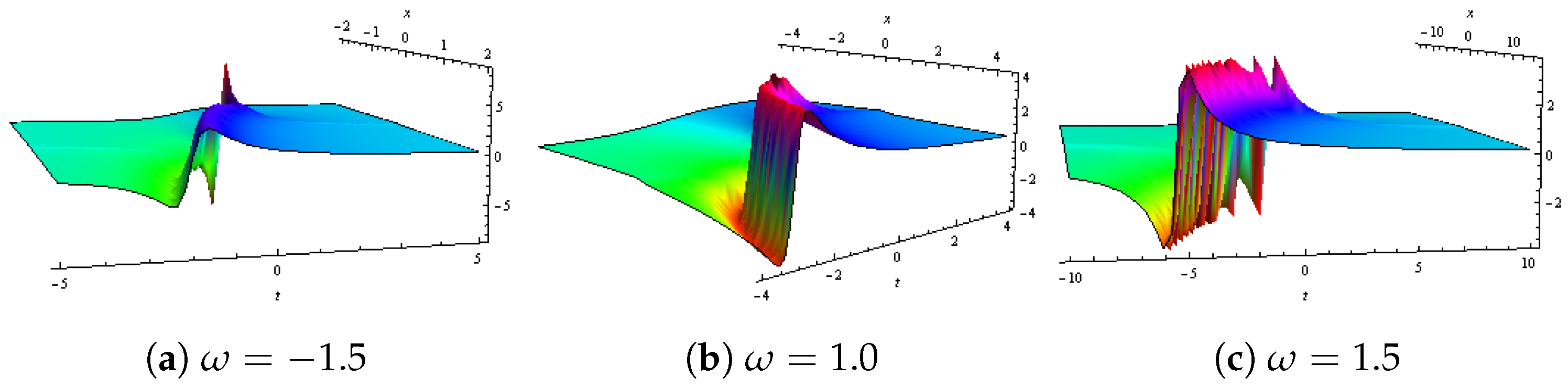
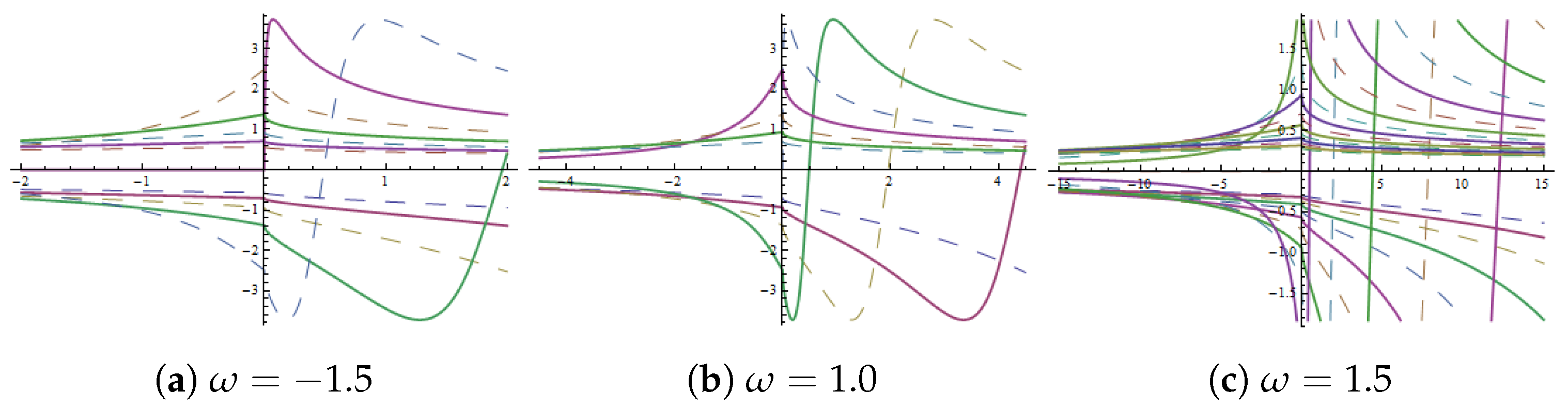
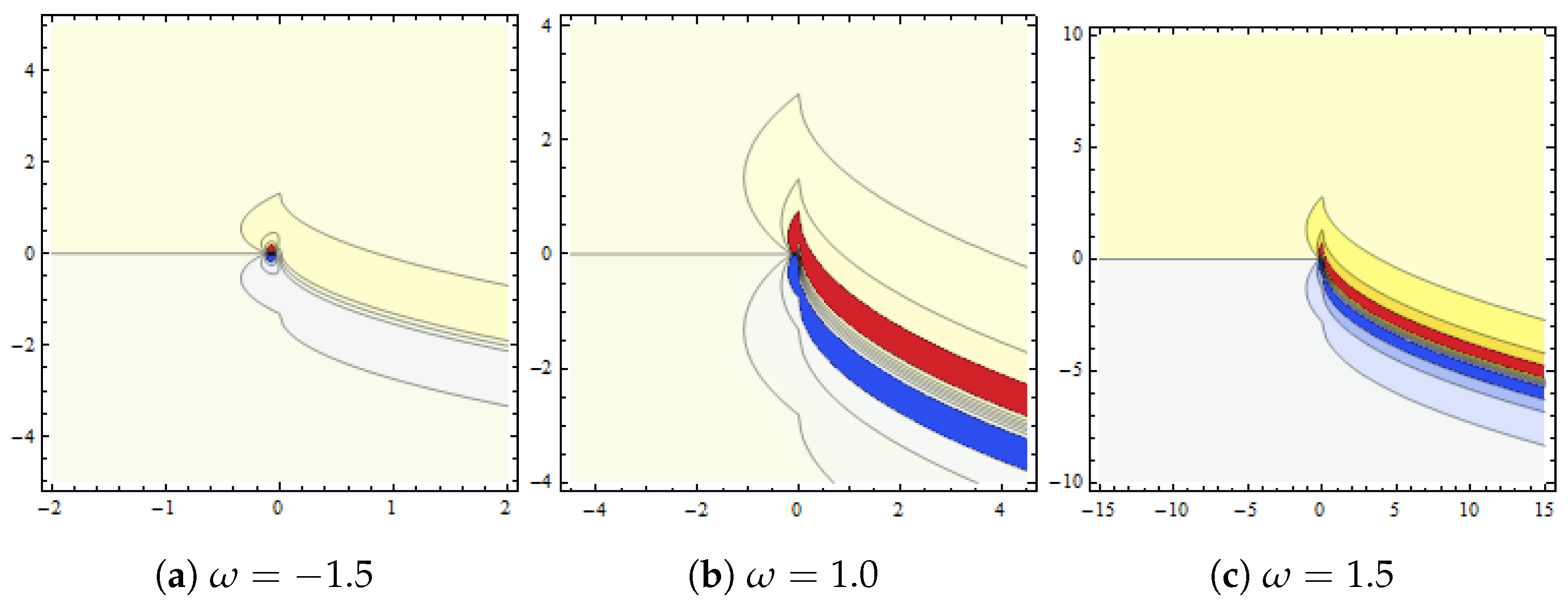
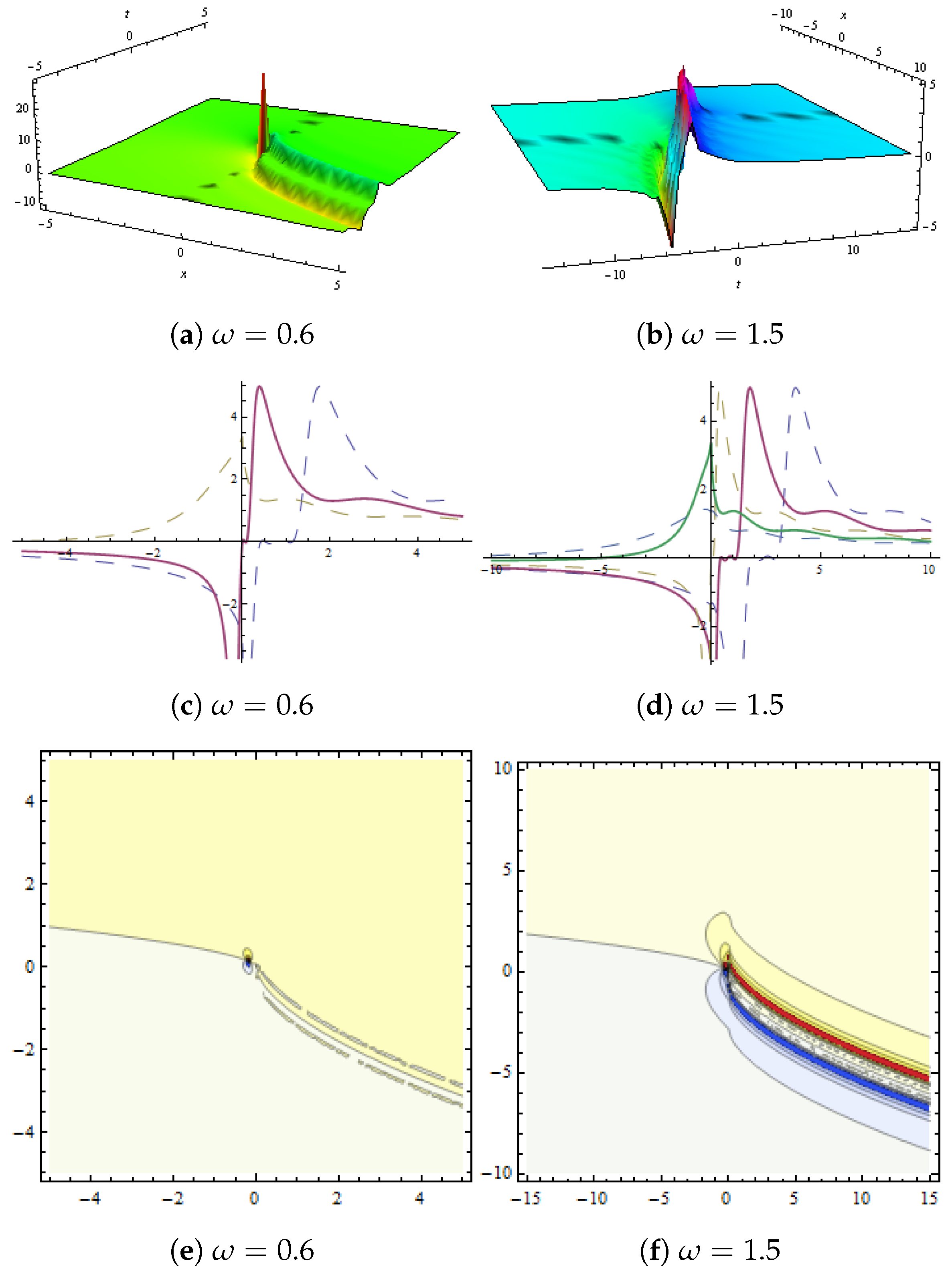
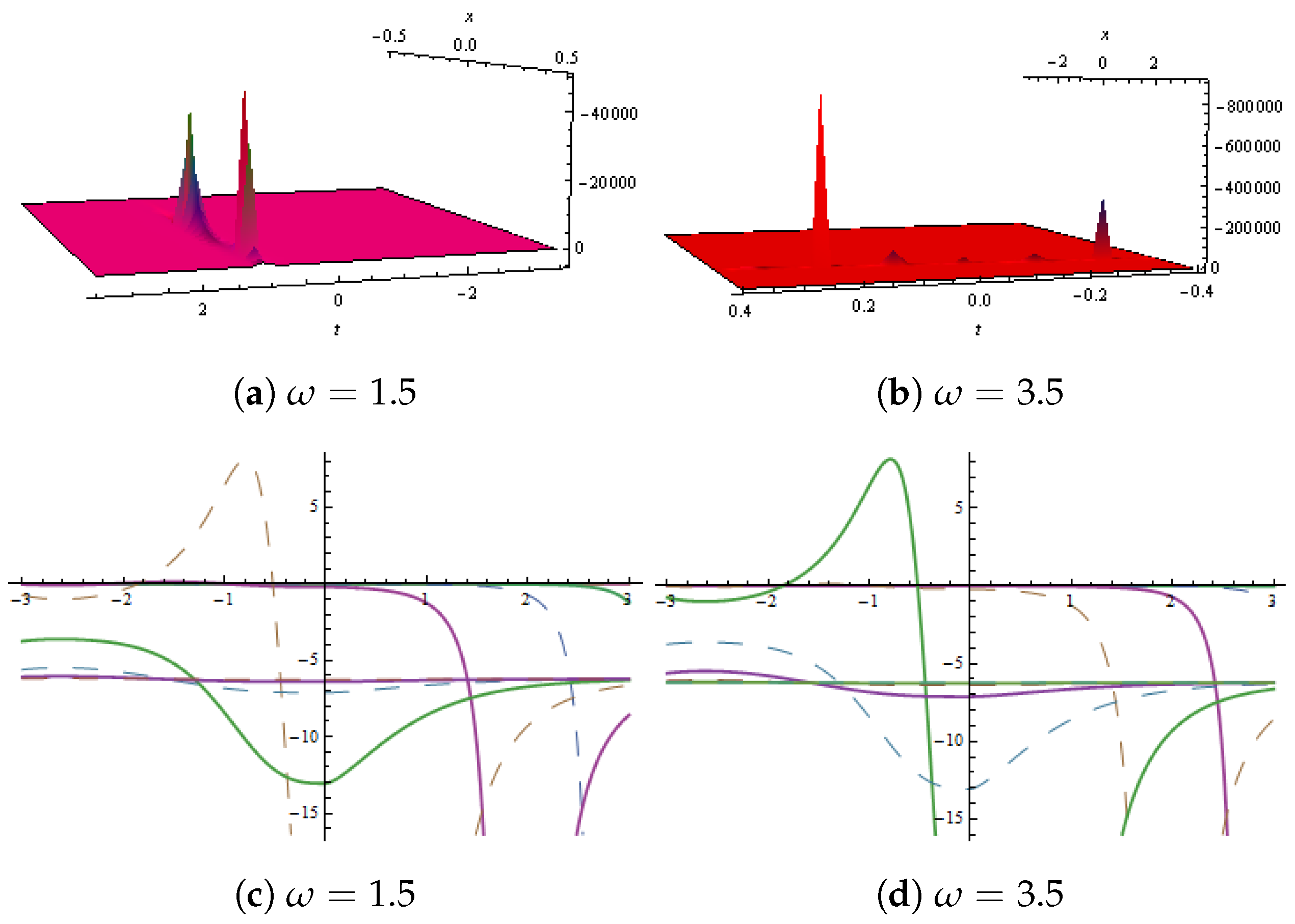
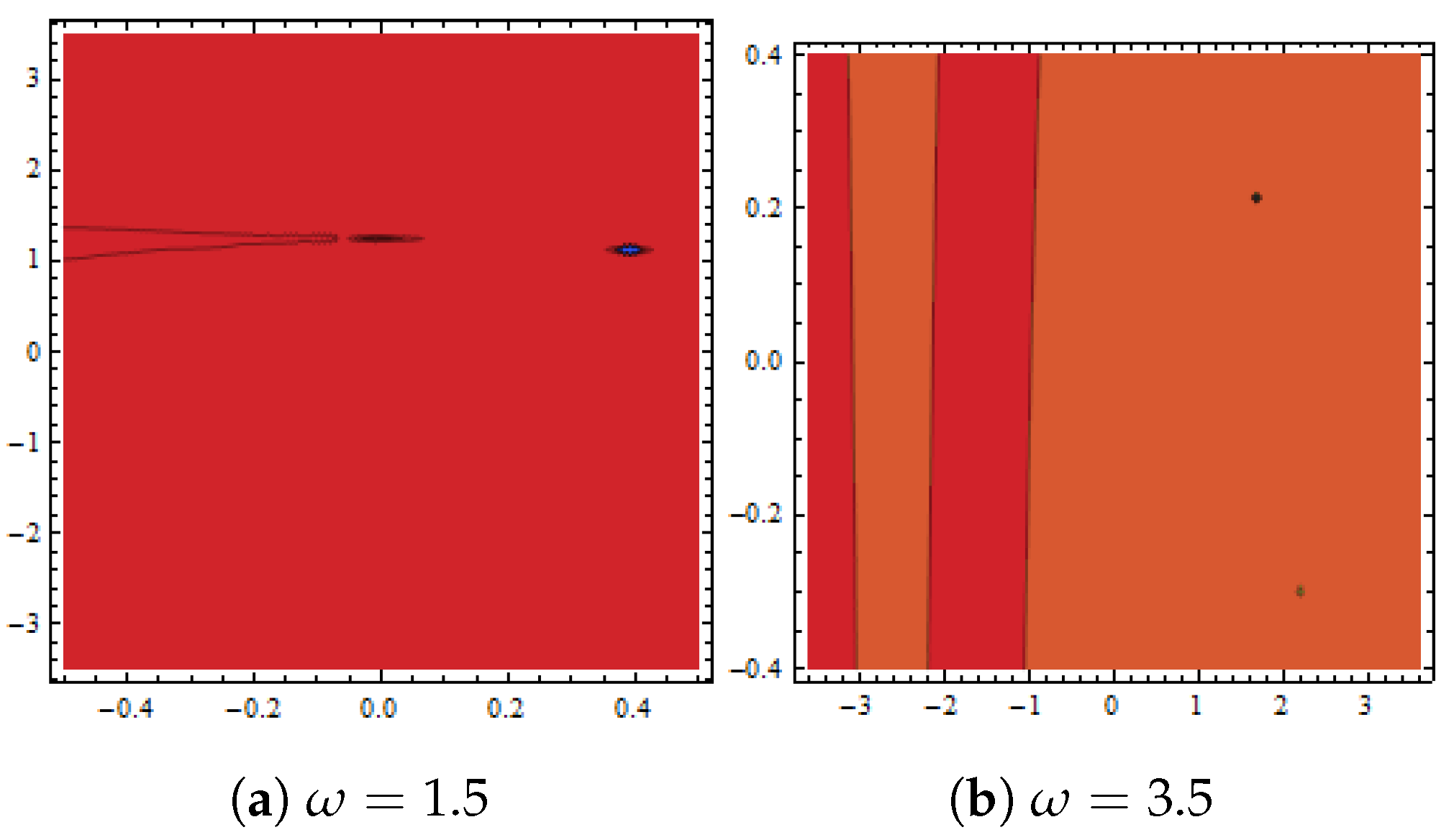
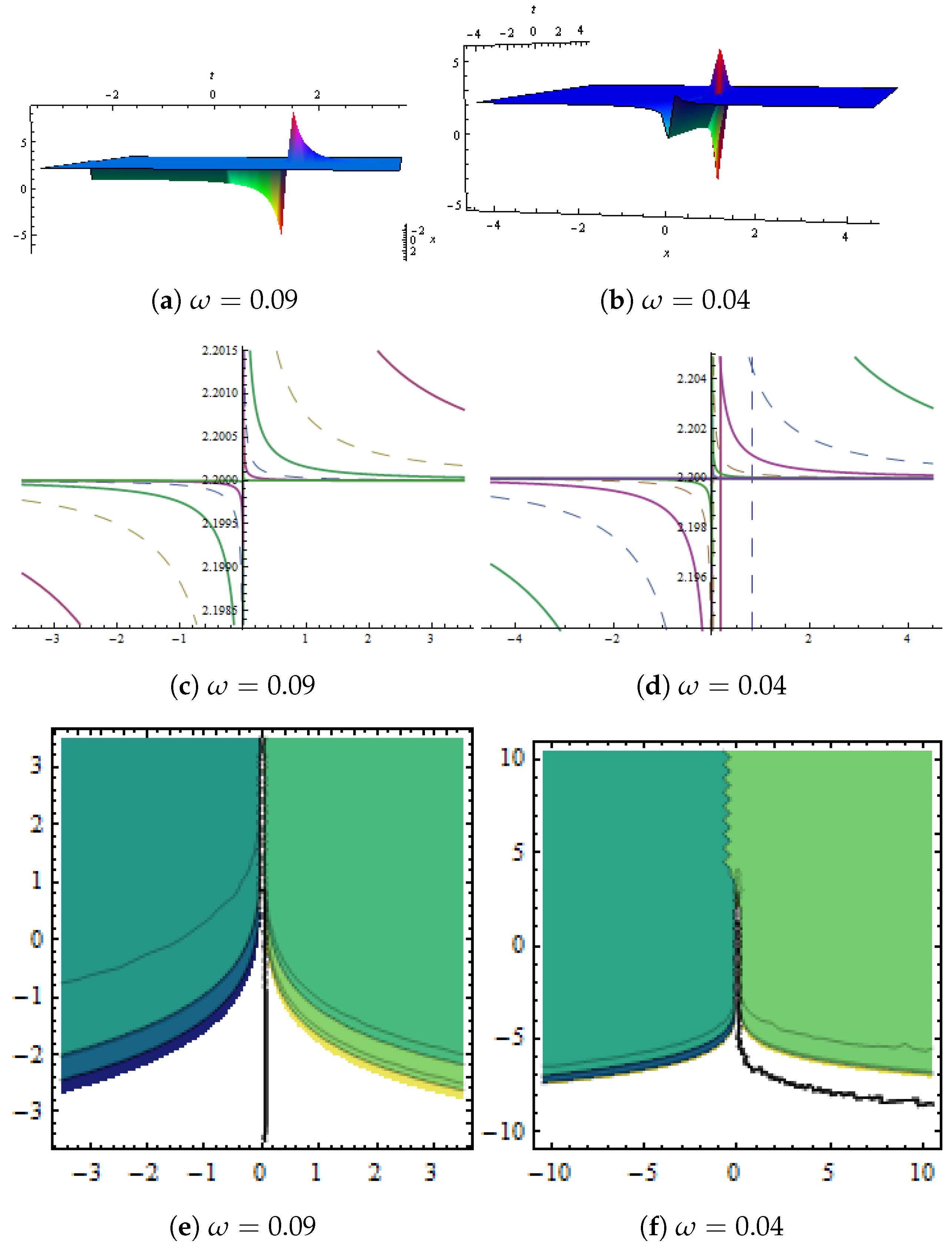
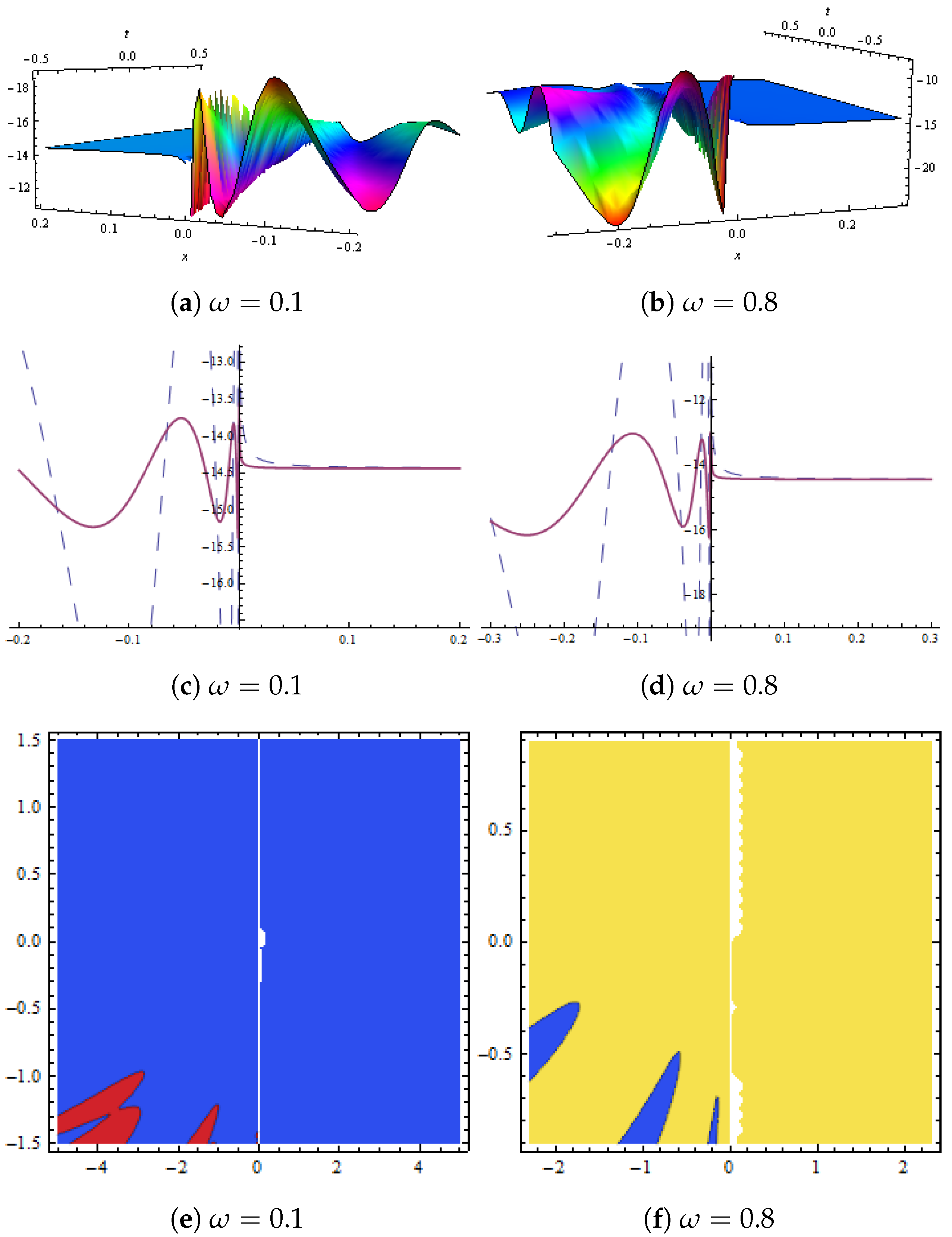
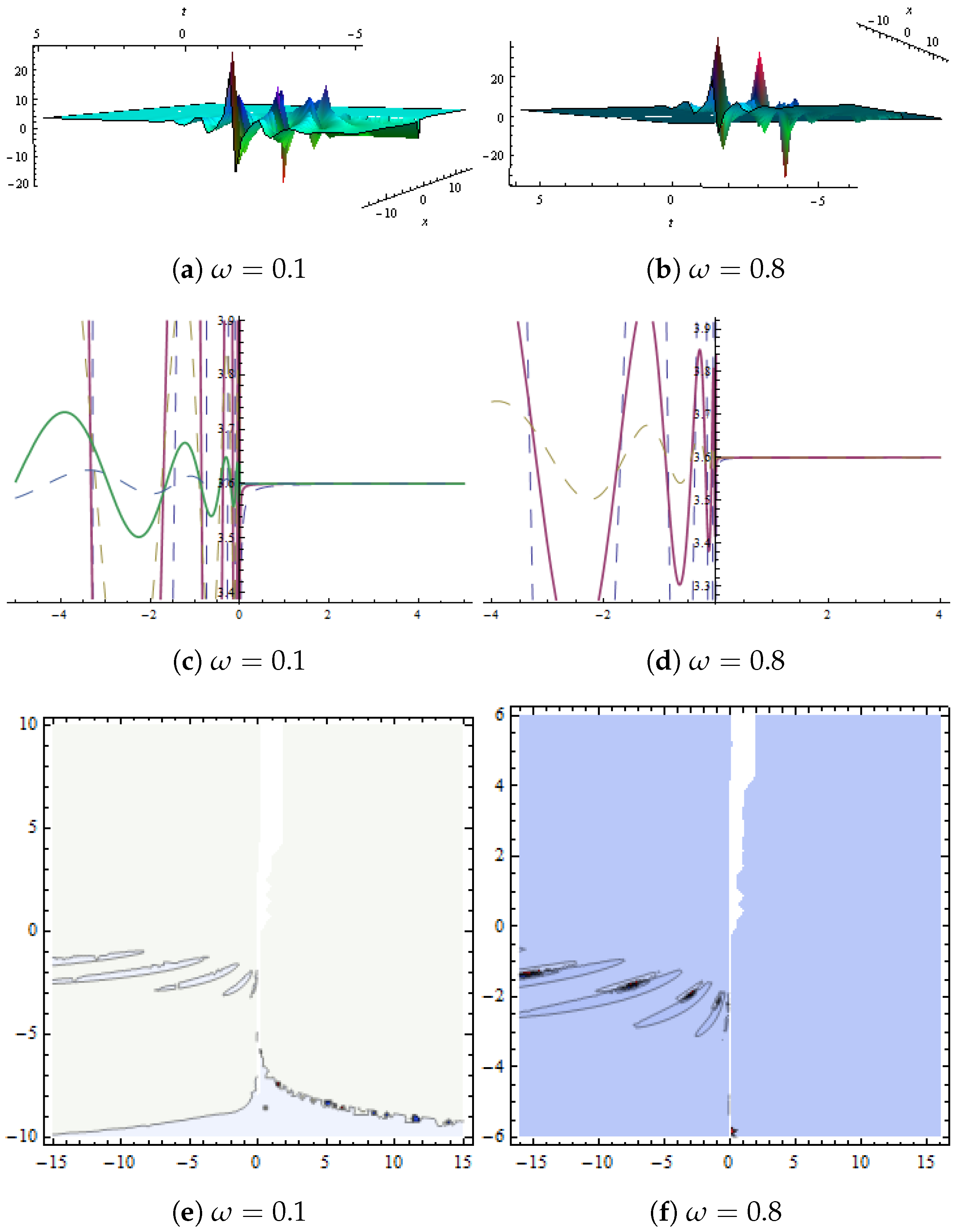
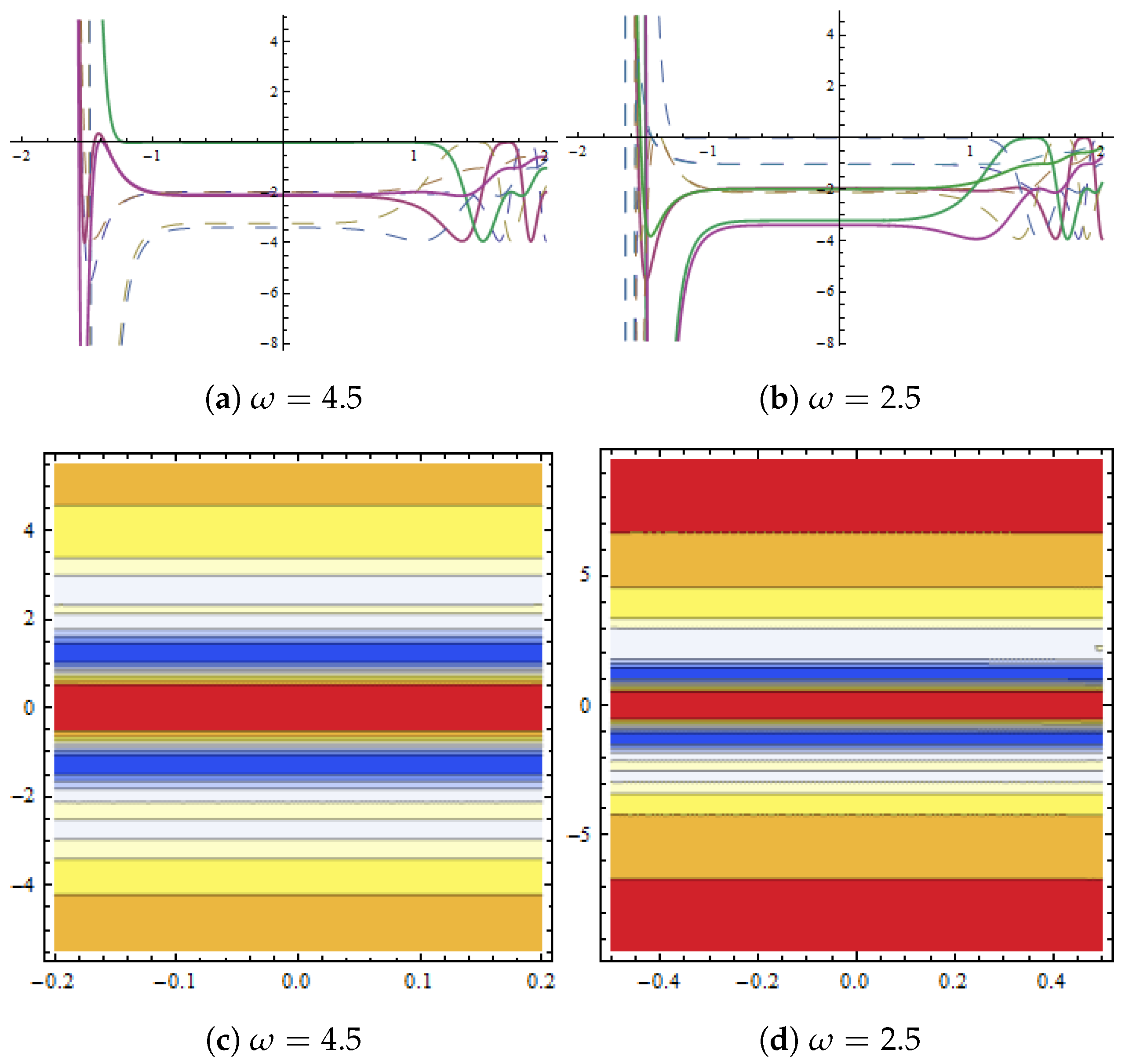
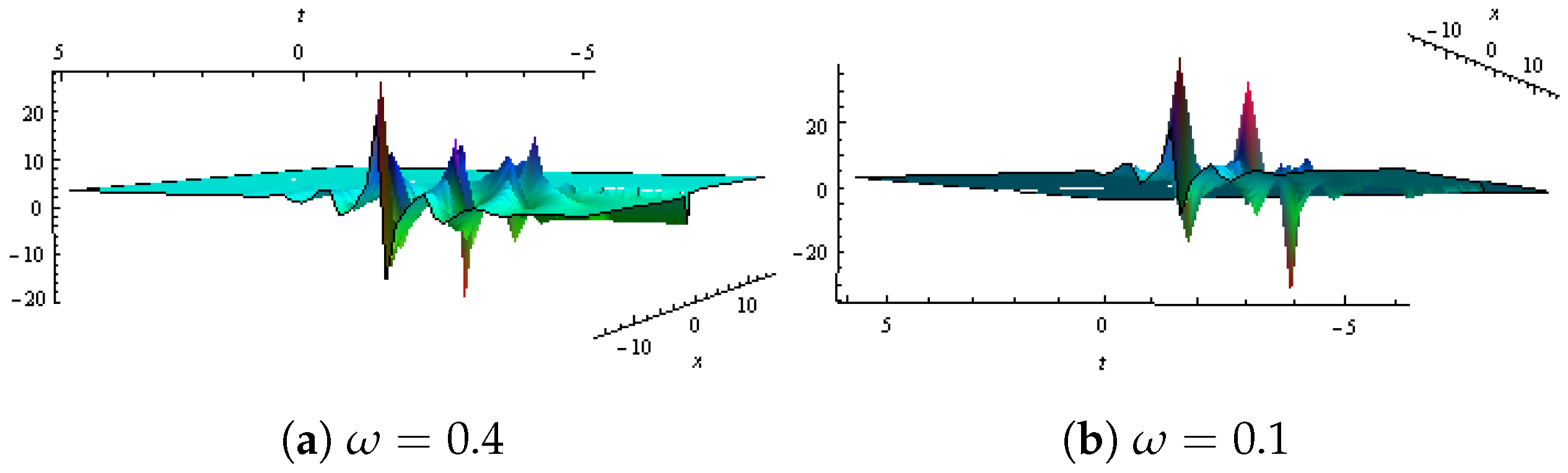
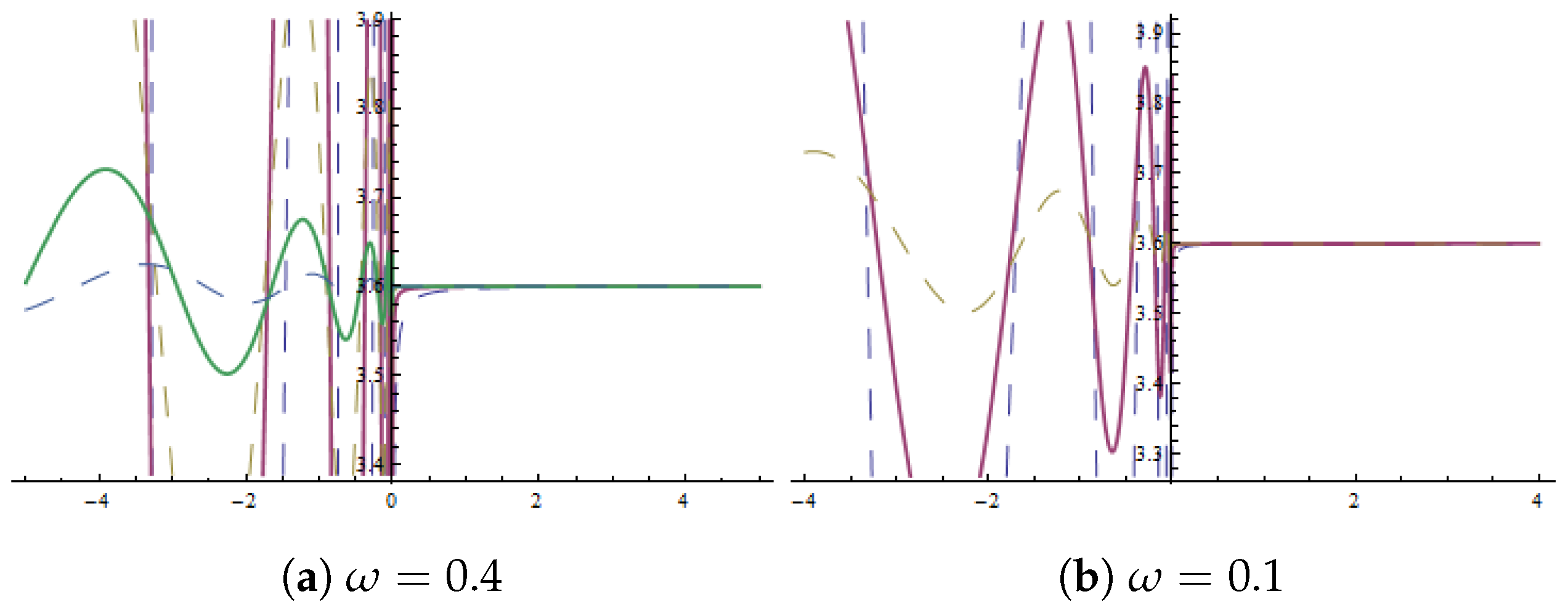
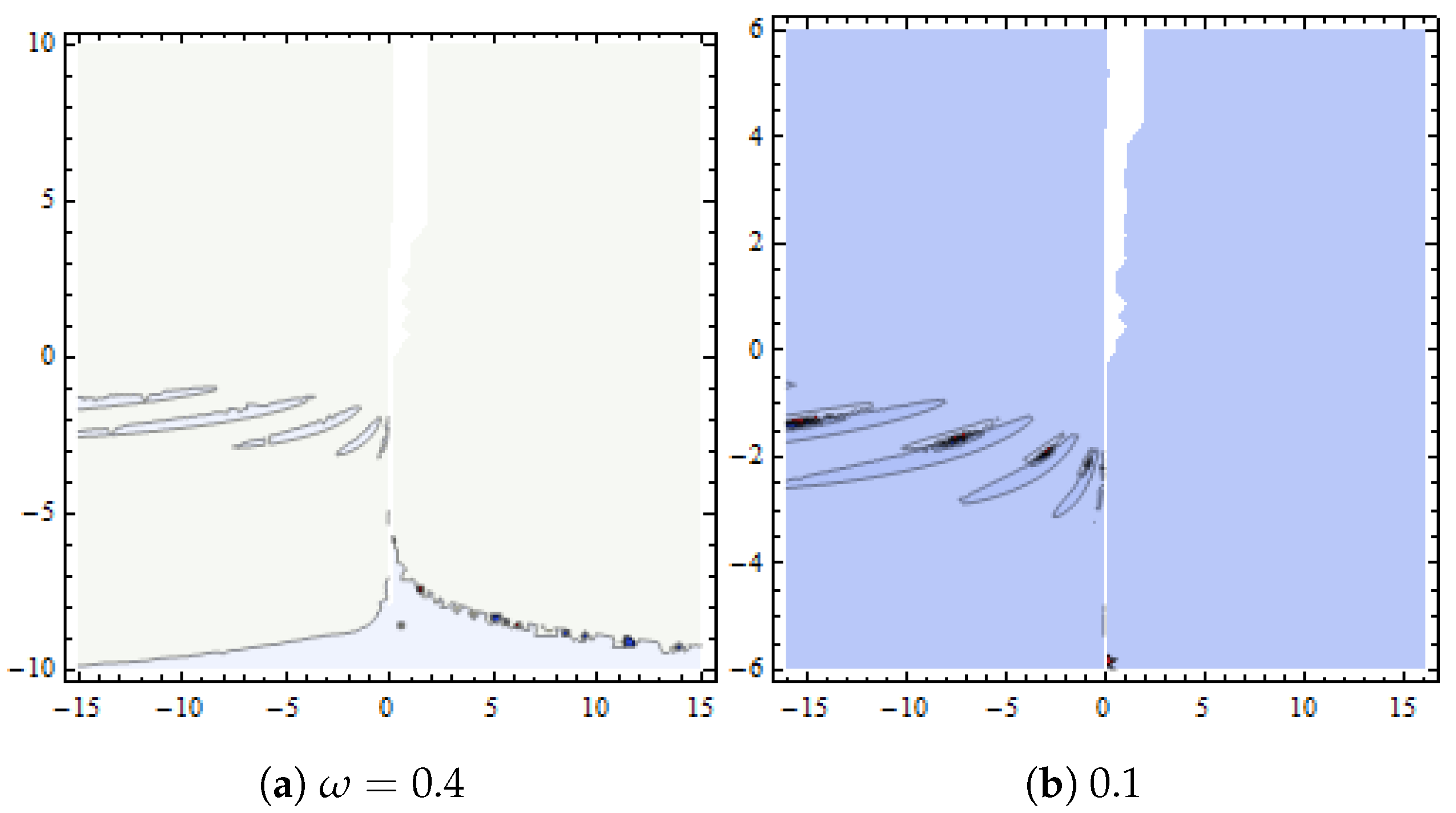
By selecting the appropriate values for the parameter, we were able to generate the desired types of solution that indicated a wave discrepancy. In
Figure 1,
Figure 2,
Figure 3,
Figure 4,
Figure 5,
Figure 6,
Figure 7,
Figure 8,
Figure 9,
Figure 10,
Figure 11,
Figure 12,
Figure 13,
Figure 14,
Figure 15,
Figure 16,
Figure 17,
Figure 18,
Figure 19,
Figure 20,
Figure 21,
Figure 22,
Figure 23,
Figure 24,
Figure 25,
Figure 26,
Figure 27 and
Figure 28, we presented 3D, 2D, contour plots, respectively. In
Figure 1, the M and W shape waves appeared with bright and dark faces. In
Figure 2, we obtained a bright face and after some time, bright–dark faces appeared; in
Figure 3 and
Figure 4, we represented 2D and contour plots of this wave solution by using the values
and
. According to Equations (
26) and (
27), the periodic waves produced in
Figure 5,
Figure 6,
Figure 7 and
Figure 8 varied in amplitude. In
Figure 9,
Figure 10 and
Figure 11, we can see one stripe soliton propagating at different times. The MSR solution was shown in
Figure 12,
Figure 13,
Figure 14,
Figure 15 and
Figure 16, where M-shaped waves appeared with bright–dark faces. In
Figure 17a and
Figure 18a, one kink wave appeared and after some time, that one kink wave changed into the M-shaped wave shown in
Figure 17b and
Figure 18b for Equation (
44) and the remaining figures for that solution showed the 2D and contour plots. The MSR solution with two kink waves in
Figure 19,
Figure 20 and
Figure 21 with bright and dark faces was derived from Equations (50) and (51). For Equations (56) and (57) and Equations (62) and (63), the M-shaped interactions with RK and PK with some M-shaped dark and bright faces are shown in
Figure 22,
Figure 23,
Figure 24,
Figure 25,
Figure 26,
Figure 27 and
Figure 28.
13. Conclusions
In this paper, we explored some wave solutions for stochastic–fractional Drinfel’d–Sokolov–Wilson. These equations are used in applied sciences, plasma physics, population dynamics, surface physics and mathematical physics. The obtained solutions were better and more useful and efficient for understanding a variety of significant physical phenomena. We acquired different types of solutions such as the periodic cross-rational wave solution, cross-kink rational wave solution, homoclinic breather wave solution, M-shaped rational wave solution, M-shaped rational wave solution with one kink wave, M-shaped rational wave solution with two kink waves, M-shaped interaction with rogue and kink waves, M-shaped interaction with periodic and kink waves. We also represented these wave solutions graphically.
Author Contributions
Conceptualization, S.T.R.R.; Methodology, S.T.R.R.; Writing—review & editing, S.A.M.A.; Supervision, A.R.S. All authors have read and agreed to the published version of the manuscript.
Funding
This research received no external funding.
Data Availability Statement
Not applicable.
Acknowledgments
The authors extend their appreciation to the Deanship for Research and Innovation, Ministry of Education in Saudi Arabia for funding this research work through the project number: IFP22UQU4290491DSR141.
Conflicts of Interest
The authors declare no conflict of interest.
References
- Sahoo, S.; Ray, S.S.; Abdou, M.A.M.; Inc, M.; Chu, Y.M. New Soliton Solutions of Fractional Jaulent-Miodek System with Symmetry Analysis. Symmetry 2020, 12, 1001. [Google Scholar] [CrossRef]
- Chu, Y.M.; Khan, M.S.; Abbas, M.; Ali, S.; Nazeer, W. On characterizing of bifurcation and stability analysis for time fractional glycolysis model. Chaos Solitons Fractals 2022, 165, 112804. [Google Scholar] [CrossRef]
- Li, R.; İlhan, O.A.; Manafian, J.; Mahmoud, K.H.; Abotaleb, M.; Kadi, A. A Mathematical Study of the (3+1)-D Variable Coefficients Generalized Shallow Water Wave Equation with Its Application in the Interaction between the Lump and Soliton Solutions. Mathematics 2022, 10, 3074. [Google Scholar] [CrossRef]
- Zhang, H.; Manafian, J.; Singh, G.; Ilhan, O.A.; Zekiy, A.O. N-lump and interaction solutions of localized waves to the (2 + 1)-dimensional generalized KP equation. Results Phys. 2021, 25, 104168. [Google Scholar] [CrossRef]
- Zhang, M.; Xie, X.; Manafian, J.; Ilhan, O.A.; Singh, G. Characteristics of the new multiple rogue wave solutions to the fractional generalized CBS-BK equation. J. Adv. Res. 2022, 38, 131–142. [Google Scholar] [CrossRef]
- Samraiz, M.; Mehmood, A.; Iqbal, S.; Naheed, S.; Rahman, G.; Chu, Y.-M. Generalized fractional operator with applications in mathematical physics. Chaos Solitons Fractals 2022, 165 Pt 2, 112830. [Google Scholar] [CrossRef]
- Huang, L.; Manafian, J.; Singh, G.; Nisar, K.S. Mahyuddin K.M. Nasution, New lump and interaction soliton, N-soliton solutions and the LSP for the (3 + 1)-D potential-YTSF-like equation. Results Phys. 2021, 29, 104713. [Google Scholar] [CrossRef]
- Gu, Y.; Zia, S.M.; Isam, M.; Manafian, J.; Hajar, A.; Abotaleb, M. Bilinear method and semi-inverse variational principle approach to the generalized (2+1)-dimensional shallow water wave equation. Results Phys. 2023, 45, 106213. [Google Scholar] [CrossRef]
- Seadawy, A.R.; Rizvi, S.T.R.; Mustafa, B.; Ali, K.; Althubiti, S. Chirped periodic waves for an cubic quintic nonlinear Schrödinger equation with self steepening and higher order nonlinearities. Chaos Solitons Fractals 2022, 156, 111804. [Google Scholar] [CrossRef]
- Seadawy, A.R.; Ahmad, S.; Rizvi, S.T.R.; Ali, K. Various forms of lumps and interaction solutions to generalized Vakhnenko Parkes equation arising from high-frequency wave propagation in electromagnetic physics. J. Geom. Phys. 2022, 176, 104507. [Google Scholar] [CrossRef]
- Rizvi, S.T.R.; Seadawy, A.R.; Farrah, N.; Ahmad, S. Application of Hirota operators for controlling soliton interactions for Bose-Einstien condensate and quintic derivative nonlinear Schrödinger equation. Chaos Solitons Fractals 2022, 159, 112128. [Google Scholar] [CrossRef]
- Seadawy, A.R.; Bilal, M.; Younis, M.; Rizvi, S.T.R.; Althobaiti, S.; Makhlouf, M.M. Analytical mathematical approaches for the double chain model of DNA by a novel computational technique. Chaos Solitons Fractals 2021, 144, 110669. [Google Scholar] [CrossRef]
- Seadawy, A.R.; Younis, M.; Baber, M.Z.; Iqbal, M.S.; Rizvi, S.T.R. Nonlinear acoustic wave structures to the Zabolotskaya Khokholov dynamical model. J. Geom. Phys. 2022, 175, 104474. [Google Scholar] [CrossRef]
- Jia, H.X.; Zuo, D.W.; Li, X.H.; Xiang, X.S. Breather, soliton and rogue wave of a two-component derivative nonlinear Schrödinger equation. Phys. Lett. 2021, 405, 127426. [Google Scholar] [CrossRef]
- Rizvi, S.T.R.; Younis, M.; Younis, B.; Ahmad, M.O. Exact optical solitons in (n+1)dimensions under anti cubic law of nonlinerity. Optik 2018, 156, 479–486. [Google Scholar]
- Prévôt, C.; Röckner, M. A Concise Course on Stochastic Partial Differential Equations. Lect. Notes Math. 2007, 1905, 105–148. [Google Scholar]
- Imkeller, P.; Monahan, A.H. Conceptual stochastic climate models. World Sci. 2002, 2, 311–326. [Google Scholar] [CrossRef]
- Al-Askar, F.M.; Cesarano, C.; Mohammed, W.W. The Analytical Solutions of Stochastic-Fractional Drinfel’d-Sokolov-Wilson Equations via (G’/G)-Expansion Method. Symmetry 2022, 14, 2105. [Google Scholar] [CrossRef]
- Khalil, R.; Al Horani, M.; Yousef, A.; Sababheh, M. A new definition of fractional derivative. J. Comput. Appl. Math. 2014, 264, 65–70. [Google Scholar] [CrossRef]
- Calin, O. An Informal Introduction to Stochastic Calculus with Applications; World Scientific Publication Co. Pte. Ltd.: Singapore, 2015; p. 332. [Google Scholar]
- Hirota, R. Exact solution of the Korteweg-de Vries equation for multiple collisions of solitons. Phys. Rev. Lett. 1971, 27, 1192–1194. [Google Scholar] [CrossRef]
- Yang, J.Y.; Ma, W.X.; Qin, Z. Lump and lump-soliton solutions to the (2+1)-dimensional Ito equation. Anal. Math. Phys. 2018, 8, 427–436. [Google Scholar] [CrossRef]
- Seadawy, A.R.; Rizvi, S.T.; Ashraf, M.A.; Younis, M.; Hanif, M. Rational solutions and their interactions with kink and periodic waves for a nonlinear dynamical phenomenon. Int. J. Mod. Phys. 2021, 35, 2150236. [Google Scholar] [CrossRef]
- Rizvi, S.T.R.; Seadawy, A.R.; Ashraf, M.; Younis, M. Breather, multi-wave, periodic-cross kink, M-shaped and interactions solutions for perturbed NLSE with quadratic cubic nonlinearity. Opt. Quantum Electron. 2021, 53, 631. [Google Scholar]
- Manafian, J.; Ivatloo, B.M.; Abapour, M. Breather wave, periodic, and cross-kink solutions to the generalized Bogoyavlensky-Konopelchenko equation. Math. Methods Appl. Sci. 2020, 43, 1753–1774. [Google Scholar] [CrossRef]
- Seadawy, A.R.; Rizvi, S.T.R.; Ashraf, M.A.; Younis, M.; Khaliq, A.; Balwanu, D. Rogue, multi-wave, homoclinic breather, M-shaped rational and periodic-kink solutions for a nonlinear model describing vibrations. Results Phys. 2021, 29, 104654. [Google Scholar]
- Ahmed, S.; Seadawy, A.R.; Rizvi, S.T.R. Study of breathers, rougue waves and lump soliton for the nonlinear chains of atoms. Opt. Quantum Electron. 2022, 54, 320. [Google Scholar] [CrossRef]
- Ahmed, I.; Seadawy, A.R.; Lu, D. M-shaped rational solitons and their interaction with kink waves in the Fokas–Lenells equation. Phys. Scripta 2019, 94, 055205. [Google Scholar] [CrossRef]
- Ashraf, F.; Seadawy, A.R.; Rizvi, S.T.R.; Ali, K.; Ashraf, M.A. Multi-wave, M-shaped rational and interaction solutions for fractional nonlinear electrical transmission line equation. J. Geom. Phys. 2022, 177, 104503. [Google Scholar] [CrossRef]
- Ali, I.; Seadawy, A.R.; Rizvi, S.T.R.; Younis, M.; Ali, K. Conserved quantities along with Painleve analysis and Optical solitons for the nonlinear dynamics of Heisenberg ferromagnetic spin chains model. Int. J. Mod. Phys. B 2020, 34, 2050283. [Google Scholar] [CrossRef]
- Faridi, W.A.; Asjad, M.I.; Toseef, M. Analysis of propagating wave structures of the cold bosonic atoms in a zig-zag optical lattice via comparison with two different analytical techniques. Opt. Quantum Electron. 2022, 54, 773. [Google Scholar] [CrossRef]
- Ren, B.; Lin, J.; Lou, Z.M. A new nonlinear equation with lump-soliton, lump-periodic, and lump-periodic-soliton solutions. Complexity 2019, 2019, 4072754. [Google Scholar] [CrossRef]
- Rizvi, S.T.R.; Seadawy, A.R.; Younis, M.; Ali, K.; Iqbal, H. Lump-solition, lump-multisoliton and lump periodic solutions of generalized hyperelastic rod equation. Mod. Phys. 2021, 35, 2150188. [Google Scholar]
- Qin, Z.X.; Yan, Z.H. An improved F-expansion method and its application to coupled Drinfel’d-Sokolov-Wilson equation. Commun. Theor. Phys. 2008, 50, 309–314. [Google Scholar]
| Disclaimer/Publisher’s Note: The statements, opinions and data contained in all publications are solely those of the individual author(s) and contributor(s) and not of MDPI and/or the editor(s). MDPI and/or the editor(s) disclaim responsibility for any injury to people or property resulting from any ideas, methods, instructions or products referred to in the content. |
© 2023 by the authors. Licensee MDPI, Basel, Switzerland. This article is an open access article distributed under the terms and conditions of the Creative Commons Attribution (CC BY) license (https://creativecommons.org/licenses/by/4.0/).