1. Introduction
Exactly solvable models play an important role in quantum mechanics. Firstly, they are interesting in themselves as models of real physical systems. Secondly, exactly solvable models serve as reliable zero approximations in constructing perturbation theory. However, the number of currently known exactly solvable models is very limited [
1,
2,
3], and the possibilities of perturbation theory in quantum physics are also limited.
The exact solvability criteria are very strict and require obtaining the entire spectrum of the Hamiltonian in closed form for all potential parameter values in closed form. This requirement often leads to insurmountable difficulties in finding new exact solutions. In this regard, recent research has focused on finding models for which the spectral problem can be precisely solved—either for a small portion of the spectrum rather than the entire spectrum or for specific values of potential parameters rather than all possible values. In the first case, the models are called quasi-exactly solvable (QES) [
4,
5,
6,
7], and in the second case, they are called conditionally exactly solvable (CES) [
8,
9,
10]. Obviously, such models are no less useful than exactly solvable ones. They can also be used to model real physical situations as well as in perturbation theory.
The main approaches for solving Q(C)ES models in quantum mechanics are the polynomial ansatz for the wave function [
11,
12], the canonical point transformation [
13], and the factorization method [
14,
15,
16,
17]. Note that there are types of QES potentials for which the Schrödinger equation is reduced to the Heun equation, whose analytical solutions are expressed in terms of the Heun confluent functions. In this case, the spectrum can be calculated numerically from the corresponding Wronsky determinant [
18].
The most effective tool for finding solutions to exactly solvable and conditionally exactly solvable models is the factorization method, which was introduced by Schrödinger [
19,
20,
21] and later developed by Infield and Hull [
1]. The introduction of supersymmetric quantum mechanics (SUSYQM) by Witten [
22] and the concept of shape invariance by Gendenstein [
23] have greatly improved the method [
24,
25,
26].
In a paper [
27], a novel approach was proposed that led to the further development of the factorization method to enable its improvement in the search for new exact and conditional solutions of the Schrödinger equation. Within the framework of the new approach, it becomes possible to largely unify and algorithmize the factorization method. In [
27], we demonstrated the possibilities of a new factorization method algorithm by calculating the spectrum of exactly solvable and conditionally exactly solvable models with potentials in the form of a single-function Laurent polynomial. We found the conditions for the values of the coefficients of the potential and the form of the potential-generating function under which it is possible to obtain an unconditionally exact solution.
In this study, we continued the development of a new factorization method algorithm for solving the spectral problem of the Schrödinger equation and generalized it to the case when the potential is constructed as a polynomial of several functions. The main idea of the generalization is based on the previous one. The isospectral condition is imposed on the family of partner Hamiltonians, which leads to a recurrent equation that relates the superpotentials and energies of excited states to the ground state. The superpotential of the ground state satisfies the Riccati equation, which relates it to the potential. The superpotential is constructed as a linear combination of potential-generating functions, one of which satisfies the Riccati equation, and the others satisfy the Bernoulli equation. This again allowed us to obtain a closed system of difference equations for the parameters of superpotentials and energy eigenvalues, which admits an exact solution. However, in the general case, as will be shown, the spectral problem is conditionally exactly solvable. This generalization of the algorithm significantly expands the possibilities of using the factorization method in the search for new models that allow an exact solution.
2. Unification of the Factorization Method
Consider a one-dimensional problem and represent the Hamiltonian in the following form:
where the potential is represented through a dimensionless function
,
x0 is the characteristic length scale, and
m is particle mass. It is convenient to represent the Hamiltonian (1) in dimensionless form:
where
u =
x/
x0 is the dimensionless coordinate.
The main idea of the factorization method is to represent the Hamiltonian in the following form
where the operators
a and
a+, which are called ladder operators, have the following structure
The function φ
0(
x), which is called the superpotential, satisfies the Riccati equation
The superpotential makes it possible to determine the wave function of the ground state
where
A is the normalization constant. The next step in SUSYQM theory is the construction of the partner Hamiltonian
The Hamiltonians partners
h and
are related by the relationship
. This relationship leads to the following connection of the partner potentials
and
:
The SUSYQM procedure is iterated and generates a hierarchy of partner Hamiltonians.
Here,
where the functions
are found from the following recurrent equation:
Equation (11) is enough to determine the full spectrum of the Hamiltonian and the desired superpotential.
In [
27], we proposed a unified algorithm for applying the factorization method to obtain the full spectrum of the Hamiltonian with a potential in the form of a Laurent polynomial for a single function
f(
u)
where
wk are the constant coefficients, and the function
f(
u) satisfies the Riccati equation with constant coefficients
where κ
m (
m = 1,2,3) are the constant coefficients. The algorithm is based on the representation of the superpotential φ
n(
u) in the form of the following
ansatz
where α
nk are the constant coefficients,
n = 0,1,2,… The form of superpotential (14) completely depends on the form of potential (12). Substituting superpotential (14) into Equations (5) and (11), and potential (12) into Equation (5), considering (13), and then equating the coefficients at the same powers of the function
f leads to an algebraic system of equations for the coefficients of the superpotentials (14) and energies of the eigenstates (see Equation (45) in [
27]). These systems of equations make it possible to find the full energy spectrum and coefficients of the superpotential for given values of
N and the coefficients
wk (
k = −2
N, …, 2
N), κ
m (
m = 0,1,2). For arbitrary
N, in the general case, as shown in [
27], the potential of the form (12) is conditionally exactly solvable, since the number of equations for determining the coefficients of the superpotential exceeds the number of unknown coefficients. Excessive equations lead to constraint conditions on the coefficients of potential (12). However, in the case of
N = 2, in special cases, for potential (12) it is possible to obtain unconditional exact solutions [
27], which coincide with all known, by now, exact solutions. Note that the general form of the energy spectrum does not depend on the order
N of the Laurent polynomial in (12) but is determined by the form of the differential equation for the potential generating function
f(
u).
In the following sections, we demonstrate that the method in [
27] can also be generalized to the case of a multiplicity of potential generating functions. This generalization significantly expands the class of potentials, admitting an exact solution for the spectrum.
3. Generalization of the Unified Algorithm of the Factorization Method to the Case of Two Potential-Generating Functions
We begin the generalization by constructing a unified calculation scheme for the factorization method, which allows us to calculate the energy spectrum of the Hamiltonian with the potential formed by two linearly independent functions
and
,
Again, as in the scheme proposed by us in [
27], let function
satisfy the Riccati equation with constant coefficients
and the second function
satisfy the Bernoulli equation of the form
where
are the constant coefficients. Then, Equation (17) admits an exact analytical solution in quadratures
where constant
C is found from the boundary conditions. Since function
f0(
u) satisfies the Riccati equation with constant coefficients (16), with an appropriate choice of dimensionless coordinate, the following set of elementary functions for it becomes possible:
When
, the function
f1(
u) has the form
Table 1 presents possible types of function
f1(
u) obtained from Equation (18) for each elementary function
f0(
u) from set (19).
Below, we show that, by generalizing the approach developed in [
27] to the case of two linearly independent potential-generating functions satisfying differential Equations (16) and (17), it is possible to construct an exact energy spectrum for new, nontrivial potentials (
Table 1).
For potential (15), we accept the following
ansatz for the superpotentials:
Assuming that the full set of functions
is linearly independent, substituting the function
into Equation (5), and then equating the coefficients at the same powers of the functions
and
, we find the following system of equations for determining the coefficients of the superpotential and the energy of the ground state:
To determine the eigenvalues and coefficients of the superpotential of the excited states, we substitute
from (21) into Equation (11) and again equate the coefficients at the same powers
and
. Finally, after some algebraic manipulations, we obtain a system of equations.
Note that in the general case, the number of equations for determining the superpotential parameters in Equations (22) and (23) exceeds the number of unknowns. This leads to constraints on the potential parameters. Thus, the case of two independent potential-forming functions, in the general case, leads to conditionally exactly solvable potentials. However, in the special case, when
, the problem is reduced to an unconditionally exactly solvable. The system of difference Equations (22) and (23) allows the exact analytical solution
Thus, in the case when the complete set of functions is linearly independent, there are two constraint conditions on the potential parameters. Although it is not required, we selected possible parameters w11 and q01 as dependent ones.
As an example of applying the solutions obtained above, consider the mixed Hellman–Morse potential
For this potential, we choose
. Then, from (15), (16) and (17), we obtain
We substitute the found parameters (26) into (24) and obtain expressions for the energy spectrum, superpotential coefficients, and constraint conditions on the potential parameters
As can be seen from (27), the potential spectrum coincides with the spectrum of the hydrogen-like potential and does not depend on the Yukawa and Morse potential parameters given in (25). The reason for this, apparently, is the constraint conditions on the parameters λ and b (see (27))
Next, consider the case when the set of functions
is not completely linearly independent. In this case, the number of equations that impose constraint conditions on the parameters of the potential can be reduced to one. We search for the linear relationship between these functions using the first integral of the system of differential Equations (16) and (17):
Table 2 shows possible cases leading to a linear relationship related to the selected set of functions.
From
Table 2, it can be seen that it is sufficient to consider only two cases of linear dependence:
In the first case, the systems in Equations (22) and (23) are reduced to one equation that takes the form
Despite the complexity of the equation system, it is amenable to an exact analytical solution.
When solving the system of equations, we set
(see
Table 2).
As an example, consider a potential of the form
The exact solution for this potential is found in [
3,
24]. For this potential, we choose the potential-generating functions
, which are related by the dependence of the form (29):
. As a result, for potential (33) we obtain the following values for the input parameters:
Substituting these parameters into solutions (32), we obtain
There are no constraints on the parameters of the potential, so potential (33) is unconditionally exactly solvable.
Next, consider case (30). The system of equations in this case is also solvable and has the form
The system of Equation (36) again admits an exact solution that has the form
As an example, consider the soft-core Coulomb potential in three dimensions
The exact solution for this potential in terms of the wave -function ansatz is considered in [
12,
28]. Here, we present results for this potential that are different from the results given in these papers. For this potential, we choose
, which are connected by relationship:
. For potential (38), we obtain the following values for the input parameters
We substitute parameters (39) into solutions (37) and obtain
Comparing the results (40) with those [
12] for potential (38), we see that there is a difference in the constraint conditions for excited states. To determine the true constraint condition, apparently, it is necessary to perform a numerical solution of the Schrödinger equation. We note that in [
15,
16,
17], using a numerical solution of the Schrödinger equation for some potentials, it was shown that the results of the wave-function ansatz method used in [
12] do not agree with the numerical results for all excited states, in contrast to the superpotential ansatz method, which was used in this study.
Using the example of the soft-core Coulomb potential (38), we discuss the physical meaning of the results obtained. Potential (38) was proposed in [
29] for modeling Coulomb screening in an atom. The authors of [
29], using potential (38), within the framework of nonperturbative analysis, found approximate values for the energies of atoms, which are in excellent agreement with the experimental results.
Potential (38) at
is a simple model of Coulomb screening with a repulsive center. In this case, screening is provided by introducing an additional effective charge equaling
Here,
is a characteristic energy scale,
, and
is a screening parameter in dimensionless units.
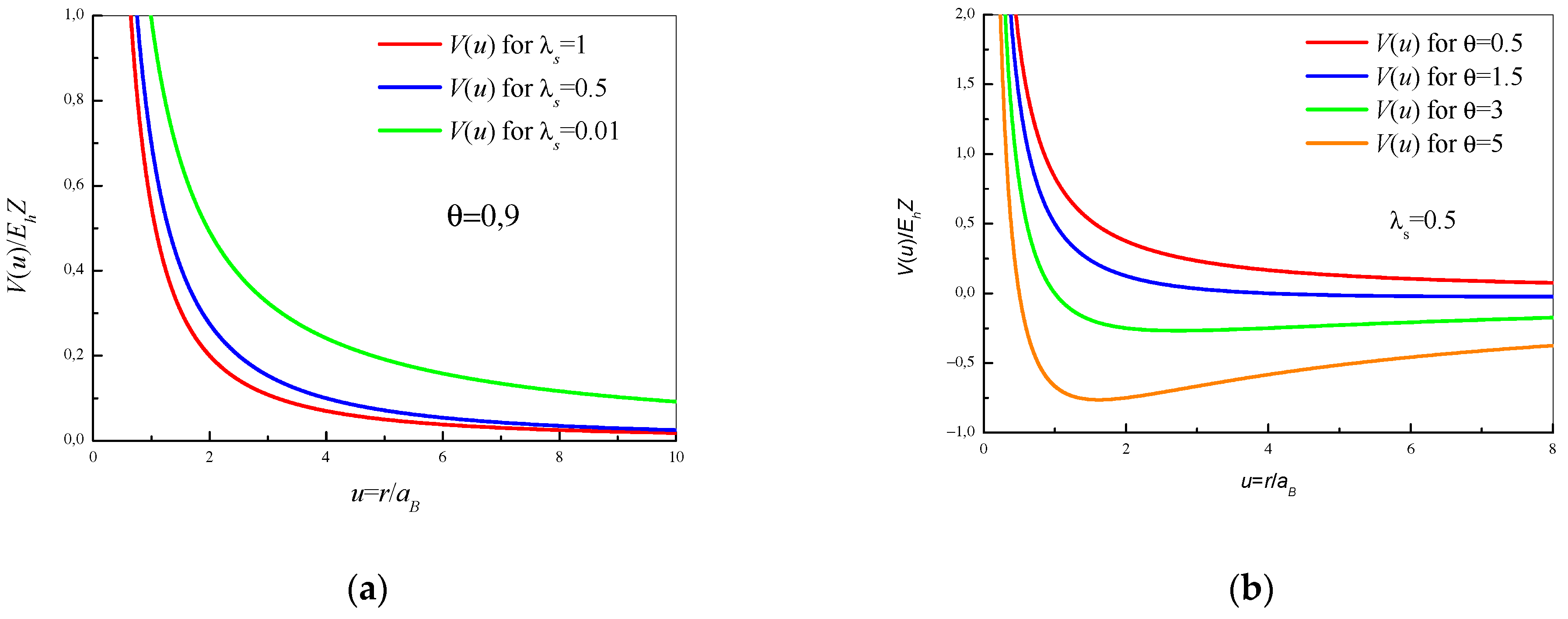
Figure 1 shows the graphs of potential (41) for different values of the screening parameter
and the parameter is equal to
. As can be seen in
Figure 1b, potential (41) at
has a characteristic minimum at
. The exact energy spectrum for potential (41) follows from (40):
But, for certain values, for example, the
parameter, which are found from the constraint condition (see (40)),
Therefore, for the ground state and the first excited state, from (42) and (43), we obtain
For
s states, from (42) and (43), we obtain
n = 0,1,2,…,
nm=
.
The results for the soft-core Coulomb potential (screened Coulomb potential) (42)–(46) are required in plasma physics to compare the approximate values of energy levels obtained for potential (41), for example, using perturbation theory with respect to the screening parameter or an accurate estimate of the screening parameter from experimental data.
Note that it is required to include
in (38) when modeling screening in atoms having an attractive center. In this case, the exact solution is only feasible for a negative screening parameter value, as is evident from the constraint condition in (40). This difficulty can be overcome, for example, in case
, representing the screened Coulomb potential (41) in the form
where
is the Hartree energy, and α is the fine structure constant. Potential (47) also admits an exact solution via the algorithm described in [
27] with one potential-generating function
f(
u) =
u or via the algorithm presented in this article by choosing
f0(
u) = 1/
u and
f1(
u) =
u. In this case, the problem is also conditionally exactly solvable, and the energy spectrum and the constraint condition have the form
Note that potentials (41) and (47) are special cases of a more general screened Coulomb potential taken in the form
which was proposed in [
30] to analyze screening effects. As demonstrated in [
27], the spectral problem also enables one to obtain a conditionally exact solution within the unified approach based on the factorization method if the series in (49) is approximated using a finite polynomial.
4. Generalization of Unified Algorithm of Factorization Method to the Case of Many Independent Potential-Generating Functions
The aforementioned approach for using the factorization method in the situation of two independent potential-generating functions allows for the generalization to any number of potential-generating functions. One of these generalizations is shown below.
Let the potential be formed from an arbitrary number of
N + 1 independent functions
and has the form
and the functions
satisfy the system of differential equations of the form
The choice of differential equations in the form (51) is due to the possibility of an exact analytical solution of system (51) in quadratures. Indeed, let us rewrite the system of Equation (51) in the form
Then, for each
k (
k = 1, 2, …,
N), we have the Bernoulli equation, which admits a solution in quadratures
where
Ck are constants, which are found from the boundary conditions.
In accordance with the algorithm described in the previous section, for the superpotential, we take the following ansatz
Finally, one can obtain the following system of equations for calculating the coefficients of the superpotential and the energy spectrum by substituting the superpotential (54) into Equations (5) and (11) and then equating the coefficients at the functions
under the assumption that the entire set of functions
is linearly independent
From the resulting system of Equation (55), it can be seen that, to determine N + 2 unknown parameters of the superpotential αk,n, βn (k = 0, 1, 2,…, N), for each n. we have N(N + 1)/2 + 2N + 2 equations. Therefore, in the general case, the number of equations that impose constraints on the parameters of the potential is N(N + 1)/2 + N.
Before presenting the solution of the system in Equation (53) in the general case, let us consider its solution in the particular case, when
. In this case, as it follows from (55), we obtain
Next, we present solutions to the system in Equation (55) in the general case
As it can be seen from (57b), the general shape of the energy spectrum coincides with the shape of the spectra (24b).
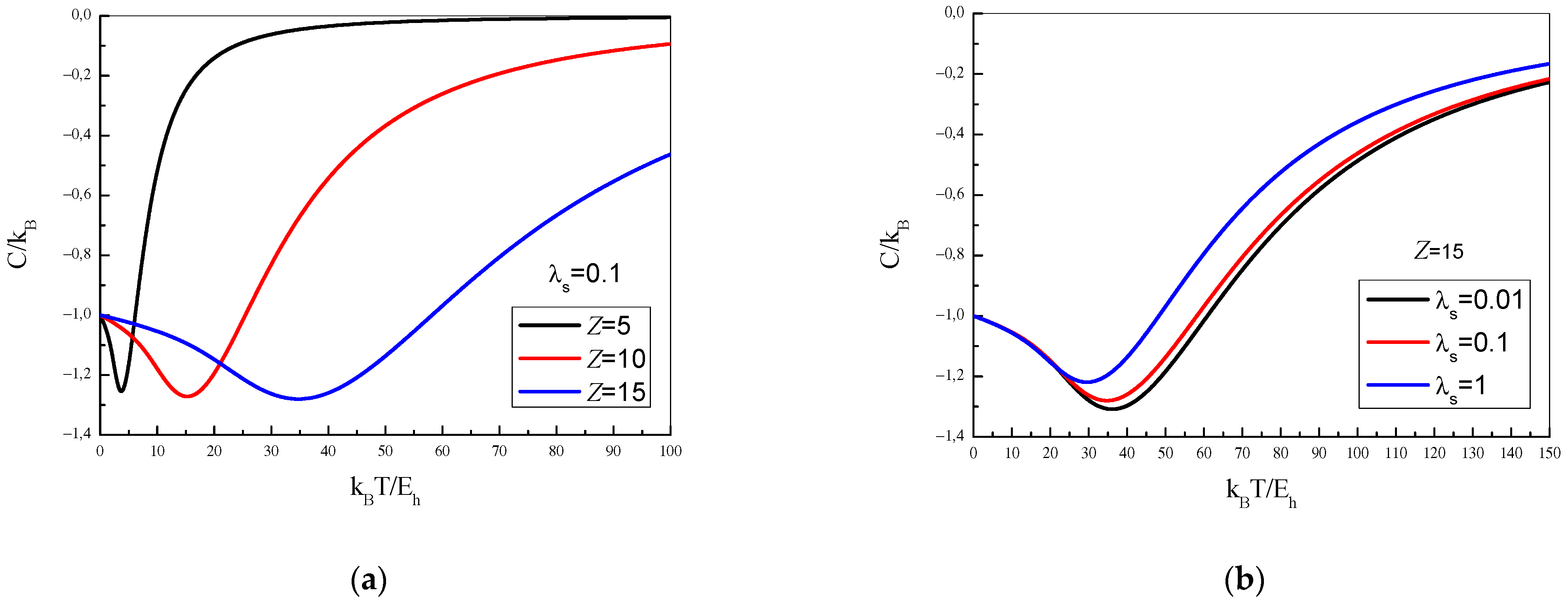
The analytical expression for the energy spectrum of model systems allows one to accurately investigate their thermodynamic properties (see
Appendix A).