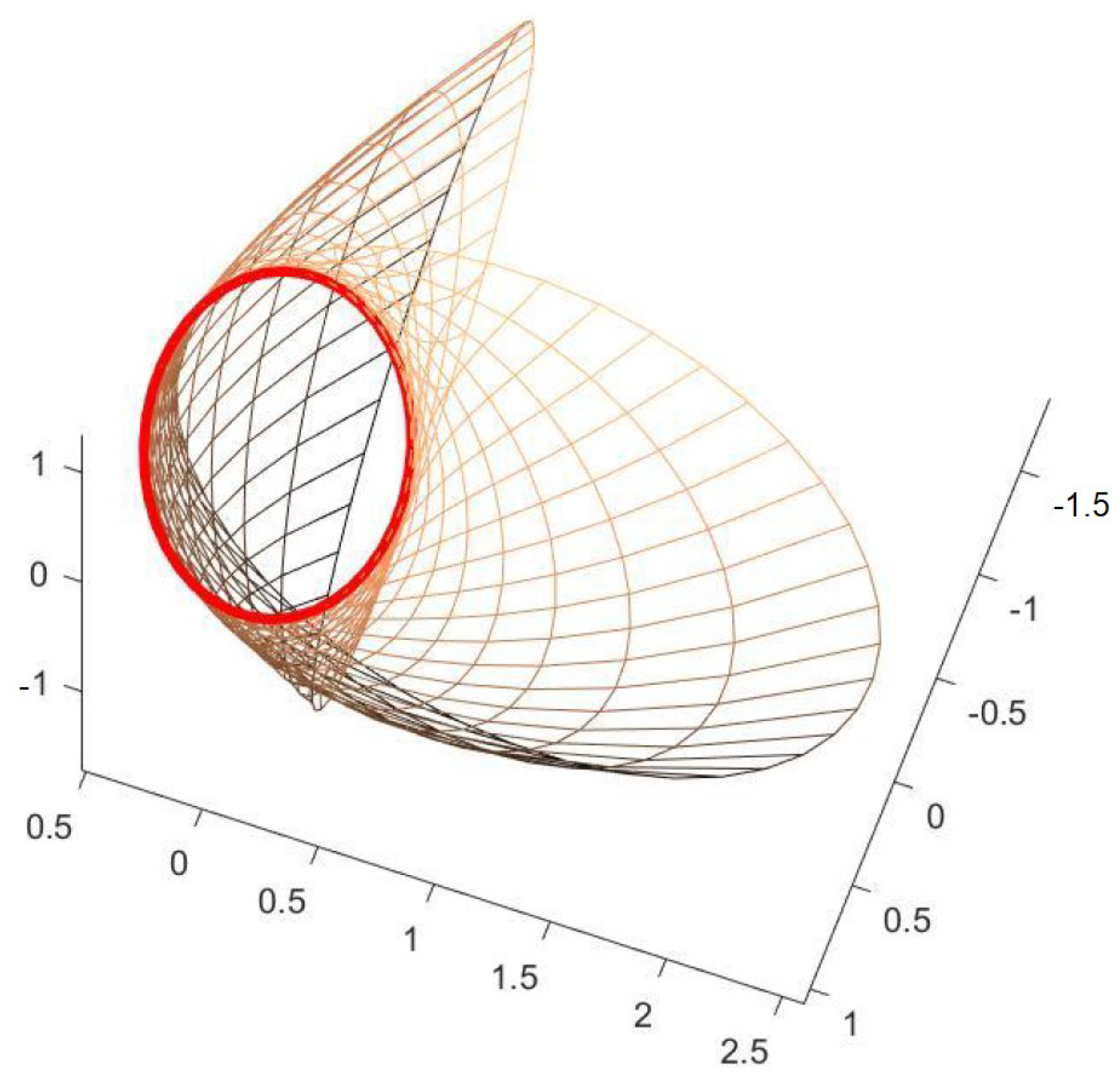
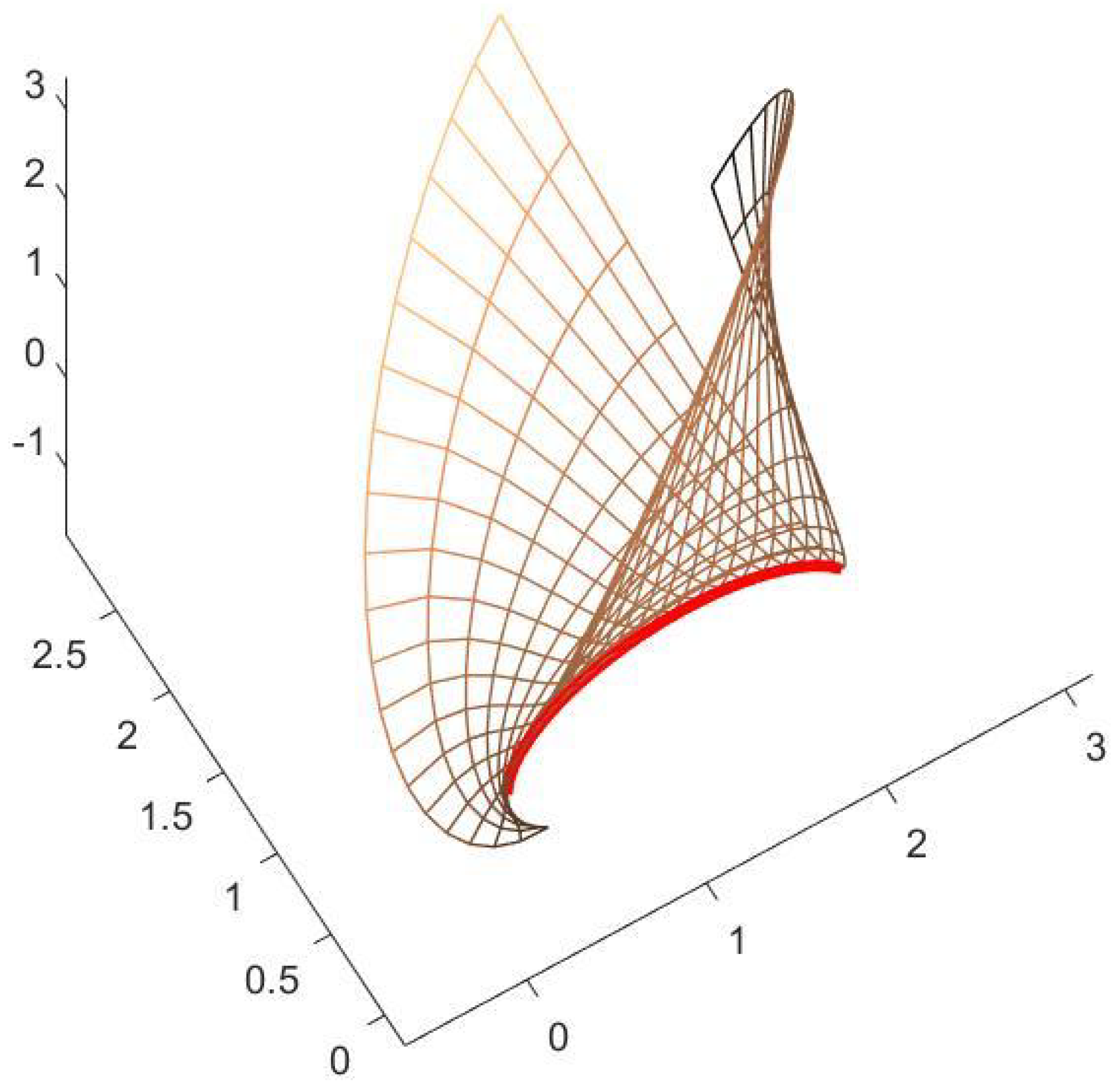
1. Introduction
Surfaces in the Euclidean 3-space constructed or defined by curves are classical subjects in differential geometry [
1]. Canal surfaces, ruled surfaces, surfaces of revolution and translation surfaces are all attractive objects applied extensively in geometric modeling and engineering. People tend to focus on the regular part and pay little attention to the singular points. However, singular points are essential in real life, such as the edges of some objects. In the cross-subject method, the singularity theory of surfaces has a wide range of applications such as physical optics, computer-aided geometric design and kinematics [
2,
3]. Therefore, it is necessary to explore the singular properties of surfaces.
The classification of singularities has a vital position in the singularity theory [
4]. It has become an interesting area for many geometers. In 1985, Mond carried out a detailed study on the singularity classification of the mapping from the Euclidean plane to the Euclidean 3-space [
5]. After Mond’s classification, many geometers made great contributions to the singularity theory of surfaces in different spaces [
6,
7,
8]. The decision theorem of singular points and geometric properties of fronts were investigated via flat surfaces in hyperbolic 3-space [
9] and maximal surfaces in Lorentz-Minkowski 3-space [
10]. For the classification of singular points of surfaces, it is common to use the unfolding theory of functions. Subsequently, Fukunaga and Takahashi explored another method to study singular surfaces [
11]. They defined a smooth surface with a moving frame as the framed surface and gave criteria for singular points of the framed surface. Using this powerful tool, some researchers have studied the singular properties of different singular surfaces in recent years [
12,
13,
14,
15].
In this paper, we investigate a new class of surfaces called the surfaces of osculating circles, which are the sets of osculating circles at all points of regular curves. In [
16], the authors studied the geometric properties of regular surfaces of osculating circles and gave a classification of these surfaces under some conditions on their curvature. However, surfaces of osculating circles may be singular. If singular points exist on these surfaces, we cannot define the normal vector fields at singular points. Therefore, we define the framed surfaces of osculating circles and obtain the geometric features of singular points. Then, we analyze the types of singular points that appear on the surfaces of osculating circles.
As far as we know, no one has ever considered the singular part of the surfaces of osculating circles. Based on this motivation, we analyze the singular properties of these surfaces to differentiate from previous research and provide a wider perspective for future work. The brief organization of the present paper is as follows. We review the notion of the surfaces of osculating circles in the Euclidean 3-space and discuss singular points of these surfaces in
Section 3. In
Section 4, we define the framed surfaces of osculating circles and calculate the basic invariants and curvature. We also present the main classification theorem of singular points of this paper (Theorem 1) in this section. Finally, we show several singular surfaces of osculating circles as examples in
Section 5, which have cuspidal edges and cuspidal cross-caps.
All maps and manifolds we consider here are differentiable of class .
2. Preliminaries
Let be the Euclidean 3-space with the inner product , where , . We define the unit sphere in by , where is the norm of . We denote = . Let be a curve, and the arc–length is . The tangent vector with respect to s is = and . We define three unit vectors as , and , where “×” denotes the vector product of two vectors. Then, the Frenet-Serret formula is as follows:
where
is the curvature function and
is the torsion function.
We review the theory of framed surfaces (cf. [
11]). The framed surface is a great generalization of regular surfaces and frontals, at least locally.
Definition 1 ([
11])
. We say : is a framed surface if and for all , where and . We say is a framed base surface if there exists : such that is a framed surface. Definition 2 ([
11])
. We define : is a Legendre surface if and for all . A Legendre surface is called a Legendre immersion if is an immersion. We define as a frontal (respectively, a front) if there exists such that is a Legendre surface (respectively, a Legendre immersion). We denote
; then, we can construct the moving frame along
as
. Thus, we have:
where
are called
basic invariants of
. By the integrability conditions, we have
[
11]. We define the curvature
of a framed surface
by
According to the above definition,
p is a regular point of
if and only if
. If
is a regular surface, the first and second fundamental invariants are given by
The Gauss curvature and mean curvature of the framed surface are expressed as
We use the following definition and proposition in our paper.
Definition 3 ([
6])
. A non-degenerate singular point p is the k- if for all and , where denotes the i- order directional derivative by . Proposition 1 ([
11])
. Assume that is a framed surface and . Then () is a Legendre immersion around p if and only if . For more details, see [
7,
11].
4. Surfaces of Osculating Circles as Framed Base Surfaces
In this section, we define a framed surface of . Then, we investigate the singular points of this surface using the criterion for a framed surface. For generic singular points of a frontal from to , we show that contains cuspidal edges and cuspidal cross-caps whose normal forms are and . Cuspidal lips, cuspidal beaks, and Chen-Matsumoto-Mond singular points with normal forms and , respectively, do not appear on the surface of osculating circles.
Definition 5. Let be a regular curve and be a surface of osculating circles generated by . If there exists a smooth function such that and , where and , then we have a framed surface . We call the framed surface of osculating circles and denote the framed base surface as for short.
Let
Therefore, we have
From Equations (1) and (2), the basic invariants of
are given by
We denote
. Since
, we have
The curvature
of
is given by
On the basis of the above results, we get the following propositions.
Proposition 4. Let be a framed surface of . We denote and as the sets of singular points of ; then, we have
- (1)
If ,
- (a)
since , is not an immersion (a regular surface) around p;
- (b)
is a Legendre immersion around p if and only if or .
- (2)
If ,
- (c)
is an immersion (a regular surface) around p;
- (d)
is a Legendre immersion around p.
Proposition 5. Let be a regular surface of osculating circles. The fundamental invariants are expressed as Proposition 6. The Gauss curvature K and the mean curvature H of the regular surface are From Proposition 6, we can easily have the following results.
Corollary 1. The regular surface is developable if and only if .
Corollary 2. The regular surface is minimal if and only if .
In order to analyze the singular properties of the OFB surface and simplify the proof process of Theorem 1, we give the following lemma to recognize whether or not the OFB surface is a front.
Lemma 1. Let be a framed surface of . If p is a singular point of , the OFB surface is a front near p if and only if .
Proof. According to Proposition 4, the OFB surface is a front around p if and only if or . Since and , then we have the result. □
For a map germ
,
is a singular point of
f. We say
p is of co-rank
if and only if
[
19]. For the purpose of discussing the types of singular points, it is necessary to calculate the co-rank of the singular points that appear on the OFB surfaces.
Lemma 2. Let be a framed surface of . If is a singular point of , the OFB surface is parametrized by a co-rank one singular point at .
Proof. According to Proposition 2,
p is a singular point of the OFB surface
if and only if
, where
. Next, we show that the type of the singular point
p is of co-rank one. By a direct calculation, we have
Therefore, the rank of the differential of is equal to one, which means that the co-rank of the singular point is one. □
Now, we review the related definitions of non-degenerate singular points briefly. More details are in [
8,
9]. Let
be a frontal of Legendre surface
. Then, there exists a smooth function
on
U, which is called a
discriminant function, such that
.
If the exterior derivative does not vanish at a singular point p, we call the singular point p non-degenerate. Parameterizing the singular point set, we have the singular curve satisfying . Then, we can choose a null vector field along satisfying , where . Using the null vector field as a tool, we can identify the types of singular points that appear on .
Proposition 7. Let be a framed surface of . The singular point p of is non-degenerate if and only if .
Proof. Since
p is a singular point of
, we define the density function as
Then and Therefore, the singular point p of is non-degenerate if and only if , which completes the proof of this proposition. □
Corollary 3. Let be a framed surface of . The singular point p of is degenerate if and only if or .
There are only the first kind singular points on the OFB surfaces, which are illustrated by the following proposition. Especially, the OFB surfaces have neither swallowtail singular points nor cuspidal butterfly singular points.
Proposition 8. Let be a framed surface of . Singular points of the OFB surface are all the first kind.
Proof. Since
by Definition 3, the singular points of
are all the first kind. □
The above propositions are all in preparation for the following theorem. According to the criteria of the types of singular points on the framed surfaces (Theorem 4 in [
11], Proposition 1.3 in [
9], and Theorem 1.4 in [
10]), we have the following conclusions.
Theorem 1. Let be the surface of osculating circles generated by . We assume that is a framed surface of osculating circles and , where .
- (1)
If , then is a cuspidal edge at if and only if or .
- (2)
If , , then is a cuspidal cross-cap at if and only if or .
Proof. Because of
the null vector field
is defined as
Suppose
is a non-degenerate singular point of
. By the definition of the OFB surface, we have
Since , then we have satisfy one of the following conditions:
- (A)
and , or
- (B)
, and .
For Case (A), since
, we have
; that is,
We know
is a singular point of
if and only if
. According to the implicit function theorem, there exists a
function
s with the condition
such that the singular curve is
. By a straight calculation, we have
and
For Case (B), by the above conditions,
Then, we can also give the singular curve
as
. Therefore, we have
and
Thus, we complete the proof of assertions (1) and (2). □
If the singular point , then , which means the singular point p is degenerate. Then, the OFB surface at such a singular point cannot be the cuspidal edge, swallowtail, or cuspidal cross-cap.
Next, we consider other singular points with co-rank one. Izumiya, Saji, and Takahashi first gave the criteria for cuspidal lips and cuspidal beaks in [
20].
Proposition 9. Let be the OFB surface. For cuspidal lips and cuspidal beaks, neither of them appears on .
Proof. Let
be a degenerate singular point of
. By Lemma 2, we get
p is a co-rank one singular point. Hence,
that means
. According to Theorem 3.2 in [
7], cuspidal lips and cuspidal beaks do not appear on
. □
If p is a co-rank one singular point of , then there exist two linearly independent vector fields near p such that . A function is defined by
Proposition 10. Let be the OFB surface. Then, Chen-Matsumoto-Mond singular points do not appear on .
Proof. Let
be a co-rank one singular point of
. The function
is defined as
, where
. Then, we have
By a direct calculation, we have
p is a critical point of
. Additionally,
Thus, we get
. According to Theorem 2.2 in [
21], Chen-Matsumoto-Mond singular points do not appear on
. □