
Abstract
In this paper, based on the E. Study map, direct appearances were sophisticated for one-parameter hyperbolic dual spherical locomotions and invariants of the axodes. With the suggested technique, the Disteli formulae for the axodes were acquired and the correlations through kinematic geometry of a timelike line trajectory were provided. Then, a ruled analogy of the curvature circle of a curve in planar locomotions was expanded into generic spatial locomotions. Lastly, we present new hyperbolic proofs for the Euler–Savary and Disteli formulae.
MSC:
53A04; 53A05; 53A17
1. Introduction
Line trajectory has a close association with spatial locomotions and has thus established achievements in robot kinematics and mechanism designs. In instantaneous locomotions, it is advantageous to examine the essential possesses of the line trajectory from the notions of the ruled surface in differential geometry [1,2,3,4]. In the context of spatial locomotions, the instantaneous screw axis ) of a mobile body tracing a couple of ruled surfaces, are named the mobile and immobile axodes, with as their usual tracing in the movable space and in the steady space, respectively. Through the locomotion, the axodes glide and roll relative to each other in a certain procedure, such that the tangential alliance among the axodes is constantly maintained on the entire length of the two matting tracings (one being in each axode), which simultaneously set the at any instant. Therefore, the investigation of a one-parameter spatial locomotion and axodes is of magnificent importance in several subjects such as mathematics, physics, and engineering. In view of kinematics, the axodes supply valuable details on the attitude of items as they proceed through space. One of the prime reasons for examining the axodes of one-parameter spatial locomotions is to understand the geometric and kinematic characteristics of mobile items. The axodes can be employed to characterize the trajectory, velocity, and acceleration of an item as it is mobile through space, providing perceptions into its physical behavior. Furthermore, they can be utilized to form mathematical samples of mobile frameworks, which can be utilized to resolve and optimize complex engineering frameworks [4,5,6,7,8,9]. Moreover, the axodes can be utilized to characterize the geometry of ruled surfaces, such as their curvature functions. This association among the axodes and ruled surfaces has significant implementations in subjects such as computer graphics, architecture mechanism designs, and robot kinematics [7,8,9,10].
Rather unexpectedly, dual numbers have been exercised to study the locomotion of a line space; their manifestation can even be the supplementary restful instruments for this end. In the theory of dual numbers, the E. Study map concludes that the set of the dual points on dual unit sphere in the dual 3-space is in bijection with set of all directed lines in Euclidean 3-space . Via this map, a one-parameter set of points (a dual curve) on dual unit sphere matches to a one-parameter set of directed lines (ruled surface) in [1,2,3,4,5,6,7]. In the Minkowski 3-space , Lorentzian metric can have one of three Lorentzian causal characters; it can be positive, negative, or zero, while the metric in the Euclidean 3-space can only be positive definite. Therefore, the kinematic and geometric clarifications can be further meaningful in [11,12,13].
This study is as follows. Section 2 shows how to design the E. Study map by the dual numbers and dual Lorentzian vectors manners. In Section 3, the hyperbolic dual spherical movements are explained in a short form. As a consequence, the invariants of the hyperbolic locomotions are gained to reveal the intrinsic properties of the axodes. Then, for the axodes, new proofs for Euler–Savary, and Disteli’s formulae were acquired. Furthermore, the axodes are utilized to search the timelike line trajectory based on the Blaschke frame. In addition, the invariants of a timelike line trajectory and their monarchies are derived that of the axodes for a new proof of the Disteli formulae.
2. Basic Concepts
In this section, we give a short synopsis of the dual numbers theory, and dual Lorentzian vectors [11,12,13,14,15]. If and are real numbers, the term is named a dual number. Here, is a dual unit subject to , Then, the set
simultaneously with the Lorentzian inner product
is titled dual Lorentzian 3-space . Thereby, a point has dual coordinates . If , the norm of is explained by
Thus, is a spacelike (timelike) dual unit vector if ). It is evident that
The hyperbolic and Lorentzian (de Sitter space) dual unit spheres, respectively, are:
and
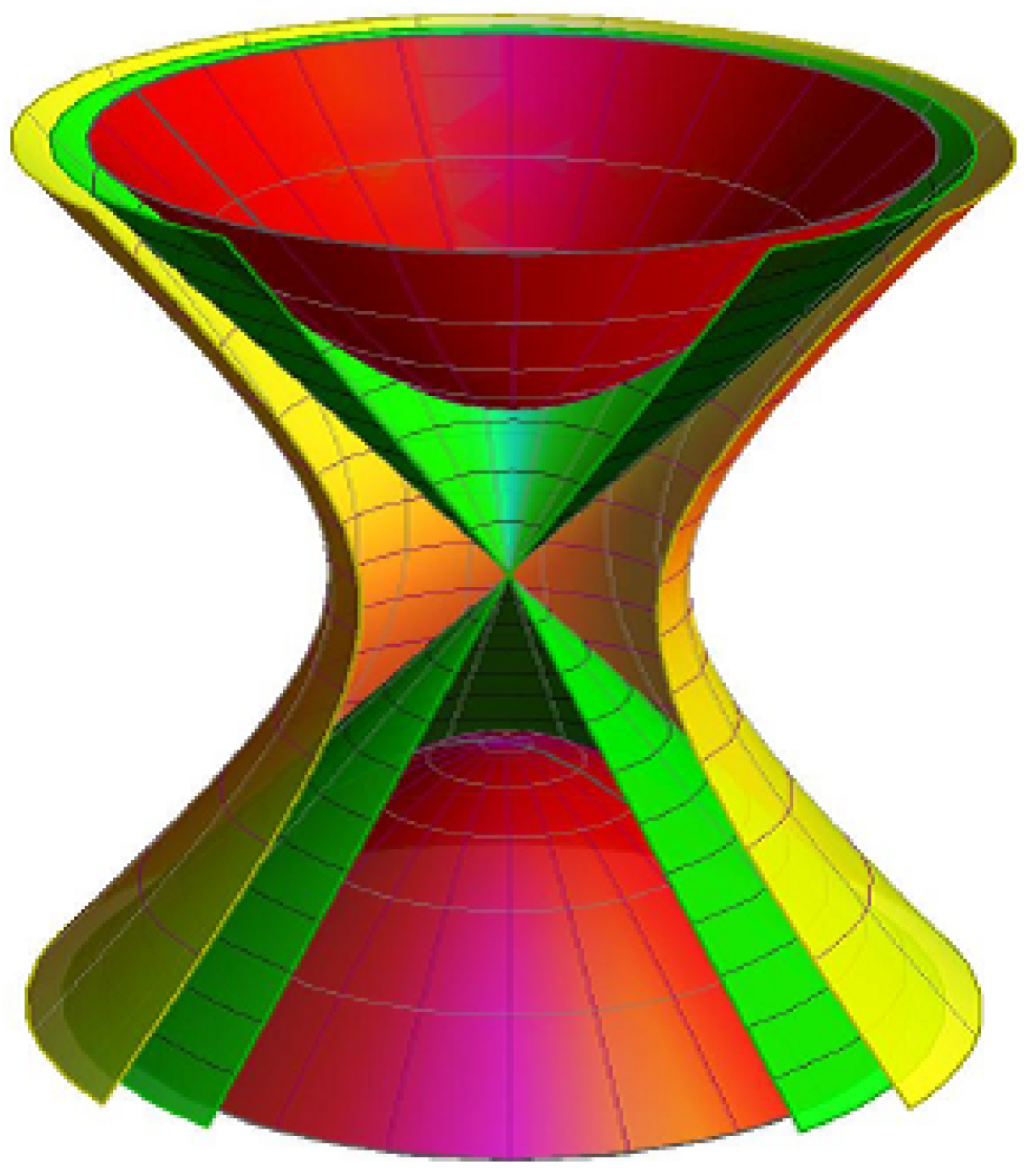
Then, the E. Study map concludes that the ring shaped hyperboloid is in bijection with the set of spacelike lines, the common asymptotic cone is in bijection with the set of null-lines, and the oval shaped hyperboloid is in bijection with the set of timelike lines (see Figure 1).
Figure 1.
The dual hyperbolic and dual Lorentzian unit spheres.
In view of the E. Study map, a smooth curve at the dual unit sphere (or ) can locally be spacelike, timelike or null (lightlike), if all of its tangent vectors are spacelike, timelike or null (lightlike), respectively. The smooth curve (or ) matches a timelike ruled surface in Minkowski 3-space . Similarly, the smooth dual curve on matches a spacelike or timelike ruled surface in . are specified with the rulings of the surface and, from now on, we do not distinguish among ruled surface and its clarifying dual curve.
Definition 1.
For any two (non-null) dual vectors and in , we have [11,12,13,14,15]:
- (i)
- If and are two spacelike dual vectors, then
- •
- If they specify a spacelike dual plane, there is a single dual number ; , and such that . This number is the spacelike dual angle through and .
- •
- If they specify a timelike dual plane, there is a single dual number such that , where or via or , respectively. This number is the central dual angle through and .
- (ii)
- If and are two timelike dual vectors, then there is a single dual number such that , where or via and have different time-direction or the same time-direction, respectively. This dual number is the Lorentzian timelike dual angle through and .
- (iii)
- If is spacelike dual, and is timelike dual, then there is a single dual number 0 such that , where or via or . This number is the Lorentzian timelike dual angle through and .
3. One-Parameter Hyperbolic Dual Spherical Locomotions
Let us consider that and are two hyperbolic dual unit spheres with as a mutual center. Let {}={(timelike)} and {}={(timelike),,} be two orthonormal dual coordinate frames strictly attached to and , respectively. We assume that is steady, whereas the elements of the set are functions of a real parameter (say, time). Then, we say that are movables relative to the steady hyperbolic dual unit sphere The explanation of this is as follows: strictly attached with movables over strictly attached with . This locomotion is named a one-parameter dual spherical locomotion, and will symbolized by If and correlate with the hyperbolic line spaces and , respectively, then correlate with the one-parameter hyperbolic spatial locomotion Hence is the movable space relative to the steady space . Since and has the same orientation, one frame is gained by using another when rotated about . By letting , and assuming the dual matrix , it then follows that the signature matrix , explaining the inner product of dual Lorentzian 3-space , is specified by
Thus, the dual matrix has the characteristics , and . Therefore, we have
which shows it is an orthogonal matrix. This result signs that when a one-parameter hyperbolic spatial locomotion is described in , we can acquire a correlate hyperbolic dual orthogonal matrix , where are dual functions of one variable . As the set of real hyperbolic orthogonal matrices, the set of hyperbolic dual orthogonal matrices, symbolized by , form a group with matrix multiplication as the group procedure (real hyperbolic orthogonal matrices are subgroup of hyperbolic dual orthogonal matrices). The identity element of is the unit matrix. Since the center of the hyperbolic dual unit sphere in should rest constant, the transformation group in (the image of hyperbolic locomotions in the Minkowski 3-space does not contain any translations. Thus, in order to performs the Lorentzian locomotions in , we can state the next theorem:
Theorem 1.
The group of all one-parameter hyperbolic spatial locomotions in -space is in bijection with the group of hyperbolic dual orthogonal matrices in -space.
To have a component of the dual Lie algebra of the dual group , we take a hyperbolic dual curve of such dual matrices such that is the identity. By making the derivative of Equation (1) with respect to t, we acquire:
If we set , we see that , i.e., the matrix is a skew-adjoint matrix. Thus, via Theorem 1, the dual Lie algebra of the dual Lorentzian group is the dual algebra of skew-adjoint dual matrices
As a result, we may write the vectors from in two forms as skew-adjoint matrix dual matrices or as vectors. In what follows, we will employ both of these possibilities according to which of the two will be more advantageous in the specified case.
Let and symbolize a timelike dual unit vector indicated in and , respectively. Then,
The inverse transformation is
Taking the differentiation of Equation (2) with respect to t, we obtain
So, for fixed in , we may realize
Expressing Equation (4) in , and employing Equation (2), we have
so that
Once again, expressing Equation (4) in and transforming it to by Equation (2), the result can be equated once more with Equation (4) to yield
so that
Then, from the above two equations, we have
3.1. Spatial Kinematics and Invariants of the Axodes
Through , the spacelike dual curve (polode) is the position of the instantaneous screw axis ) on . This position is timelike movable axode in -space. This axode is traced by the as viewed from the movable space , and let us indicate this surface by . Further, the on is also a spacelike dual curve (polode) . This curve also symbolizes the unmovable spacelike axode . This axode is traced by those timelike lines in -space which at some instant matching with a timelike line in the movable space having zero dual velocity. It is worth noting that is the dual angular speed of the locomotion . and match the rotation locomotions and the translation locomotions of , respectively. Throughout the locomotion , at any instant , the pitch may be designated by
Corollary 1.
For a one-parameter hyperbolic dual spherical locomotion , the tangent vectors of the movable and unmovable spacelike polodes are linked by
Proof.
Without loss of generality, we set the variable as the canonical variable of , i.e., . Then:
Further, we have:
and
Furthermore, we acquire:
From the equation , we gain . Substituting into the expression for , we attain:
□
Equation (9) contains only first-order derivatives of (, f); it is a first-order ownership of the timelike axodes, particularly is its dual unit speed. Furthermore, we have that:
which leads to and can be replaced by . Thus, the mutual dual arc-length parameter is . Therefore, the mutual distribution parameter of the timelike axodes is
Hence, we have the following:
Corollary 2.
For a one-parameter hyperbolic dual locomotion , the spacelike polode curves roll without slipping over each other. By using E. Study map, the timelike axodes contact each other along and rolls around the in the first-order (Figure 2).
Figure 2.
Typical portions of axodes.
3.2. Euler–Savary Formula for the Timelike Axodes
In the context of planar locomotions, at each point of a smooth curve, there occurs only one curvature circle of the curve. The center and radius of this circle can be specified by the Euler–Savary formula, if the place of the point is specified in the movable plane. In different types of geometry, the Euler–Savary formula had been generalized for a line trajectory, i.e., the construction of the Disteli formulae [4,5,6,7,11,12,13]. Therefore, we now shall look to the Euler–Savary and Disteli formulae for the timelike axodes by utilizing the equipment just acquired above. Then, as in spherical geometry, we set a hyperbolic Blaschke frame of the polodes , as:
With the dual unit vectors , , and three alternately orthogonal lines appear, and their intersection is the mutual central point on the timelike axodes (, f); and , respectively, are the central normal and the central tangent. Then, the Blaschke formula is:
where is the Darboux vector. , and are Blaschke invariants of the timelike axode . We shall disregard the pure translational locomotions, i.e., . Furthermore, we disregard zero divisors, that is, .
Under the condition , the timelike Disteli-axis (striction axis or curvature axis) is pointed as:
If is the Lorentzian timelike dual angle (radius of curvature) through , and , then
Here,
is the dual geodesic curvature of the timelike axode . Then,
Equation (16) is an unprecedented hyperbolic dual spherical Euler–Savary formula (compared with [1,2,3,4,5]). The two Disteli’s axes and can be looked as envelopes of the spacelike polodes. From the real and dual parts of Equation (16), respectively, we obtain:
and
Equations (17) and (18) are new Disteli formulae of hyperbolic spatial locomotions for the timelike axodes. Note that , h and are invariants of the choice of the reference point.
Velocity and Acceleration for a Timelike Line Trajectory
Through the one-parameter hyperbolic spatial locomotion , each constant timelike line of the -space, generally, creates a timelike ruled surface in the -space, symbolized by () and its creator by . In kinematics, this timelike ruled surface is named the timelike line trajectory. Then, we may write as
where are its dual coordinates with respect to the axode . Timelike line trajectories with specific values of velocity and acceleration have several characteristics in kinematics. Hence, the first derivative of with respect to is
Thus, if is a constant in , we have , i.e.,
Substituting Equation (21) into Equation (20) and facilitating it, we rewrite Equation (20) as
where is the relative dual geodesic curvature. For the kinematic significance of , one more expressions of can be gained by Equation (12), which is
From Equations (22), and (23), it follows that
which implies the kinematic meaning of . By differentiating Equation (22) with respect to once more and simplifying it, we obtain
3.3. Euler–Savary and Disteli Formulae for ()
We now shall derive a ruled analogy of the concept of the curvature circle of a timelike line trajectory by using the completely obtained equipment. To obtain this, we set a spacelike circle on the hyperbolic dual unit sphere by the equation
where is a specified Lorentzian timelike dual angle (dual spherical radius of curvature) and is a constant timelike dual unit vector which locates the spacelike circle’s center. Equation (26) describes a timelike linear line congruence (it is specified by two linear equations of the Plucker coordinates) [1,2,3,4,5]. Furthermore, the osculating spacelike circle should have touch of at least second-order with the curve if the following equations are holds:
Then, the first and the last two equations, respectively, describe the timelike linear line congruence of the timelike trajectory of and its Disteli’s axis . The noteworthiness of the Disteli’s axis is that it is the axis of osculating helicoidal timelike surface of the trajectory of ().
For researching the geometrical ownership of , the Blaschke frame is set up as follows:
where
At any instant, it is clear from Equations (22) and (28) that
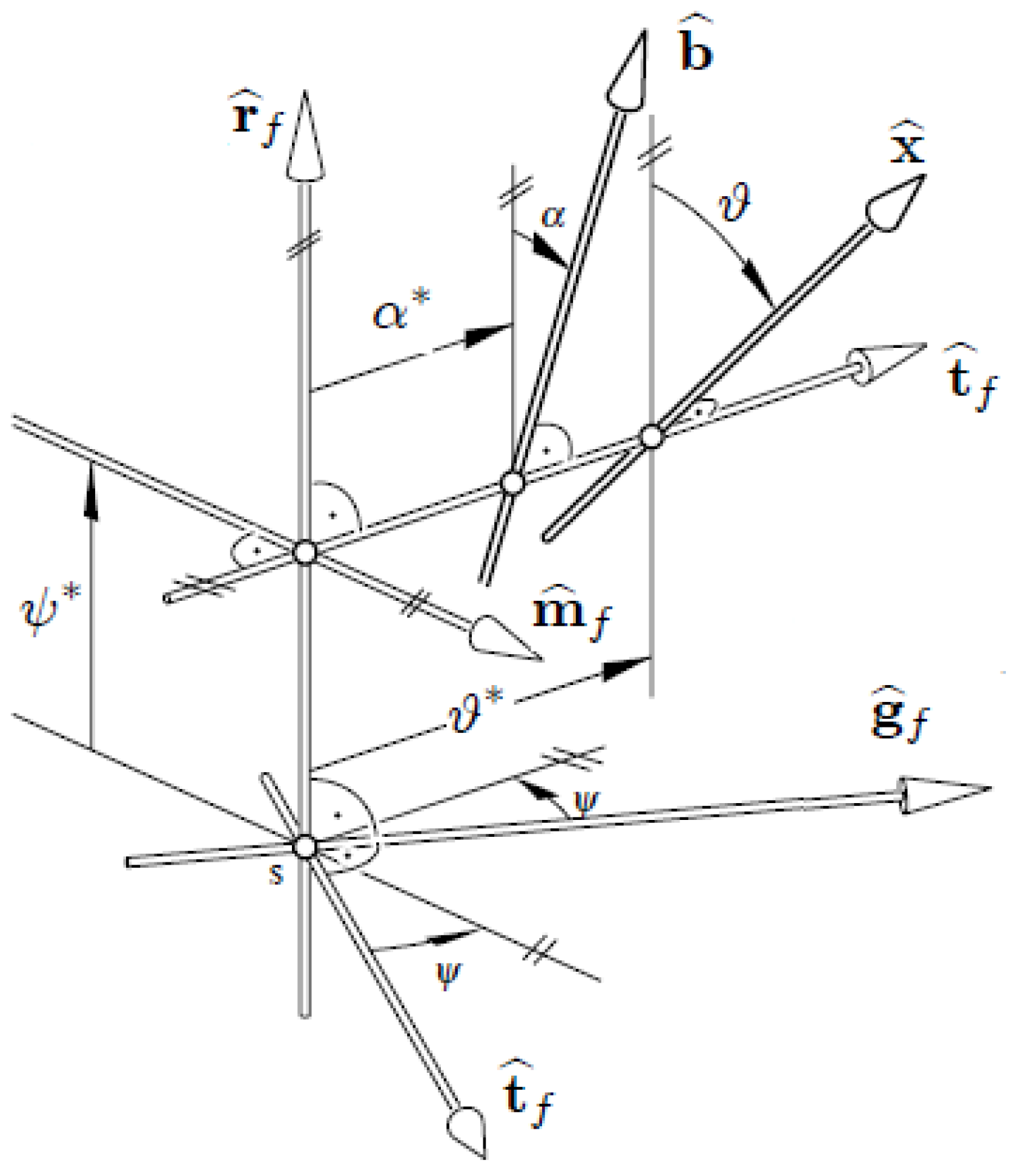
For the Euler–Savary and Disteli formulae for the timelike line , we locate regarding to by its intercept distance , metrical on the and the angle , metrical regarding to . We specify the dual angles and , which assign the locations of and on . These dual angles all result regarding the (see Figure 3). The dependent agreement rules that the signs and are via the right-hand screw rule with the thumb pointing on ; the sense of is such that . are specified with the thumb in the orientation of the . Since is a timelike dual unit vector, we can write the following form:
Similarly, the timelike Disteli’s axis is
Substituting from Equations (25) and (32) into the third equation of Equation (27) produces
Into Equation (33), we substitute from Equation (31) to acquire
This is precisely the dual extension of the Euler–Savary equation from ordinary spherical kinematics. Furthermore, by the real and the dual parts of (34), respectively, we obtain
and
The hyperbolic spherical Euler–Savary equation in Equations (35) and (36) are Disteli formulae of hyperbolic spatial kinematics. As the angles and are known, Equation (36) gives the correlation through and in terms of and and the second-order invariant . Via Figure 3, the sign of (+ or −) in Equation (36) designates that the locations of the Disteli’s axis are situated on the positive or negative orientation over the mutual central normal .
Figure 3.
Illustrationsof and the Disteli-axis .
On the other hand, we can obtain (34) as follows: combining Equations (28) and (31), with notice to Equation (22), we have
Further, the Blaschke formula is:
where
By Equations (32) and (37), moreover, we have:
Note that = is the dual radius of curvature of . It follows from the derivatives of Equation (40) that:
The timelike dual unit vector is too named the evolute of . Therefore, the dependent condition should be fulfilled
which leads to
This equation assigns the correlation among the dual spherical curvature and the dual radius of curvature . By Equation (41), we also attain
Furthermore, from Equations (40), (42) and (43), a simple calculation displays that:
Moreover, we have
Thus, we obtain
Upon substitution of Equation (45) into Equation (44), we have Equation (34), as claimed. However, we can derive a further version of the dual Euler–Savary formula in Equation (34) as follows: from Equations (39) and (42) one readily finds
This is a hyperbolic dual spherical Euler–Savary formula for the spacelike dual curve , which matches a timelike ruled surface and its osculating spacelike circle in terms of the dual angle as well as the second-order invariant . By the real and the dual parts, respectively, we obtain
and
The above two equations are Disteli’s formulae of a timelike line trajectory. Via Figure 3, the signal of (+ or −) in the last equation signalizes that the place of the timelike Disteli’s axis is on the + or − orientation of the central normal at the central point . Since the central points of are on the normal plane, the Disteli’s formulae can be displayed in the timelike plane (or ). Thus, any random point on the timelike plane is displayed as central point of the timelike line trajectory whose generators are the timelike oriented line and the radius can be defined by Equation (46); its length is the line segment from to the point on the timelike plane . Further, the central point is in the orientation of if and in the opposite orientation of if . The central point can be on the if ( and on the timelike Disteli’s axis if . In the latter case, the central point can be pointed by letting in Equation (46), which is simplified as a linear equation
Equation (47) is linear in the position coordinates and of the timelike oriented line . Therefore, for a one-parameter hyperbolic spatial locomotion the timelike lines in a steady orientation in -space lie on a timelike plane. The line L will convert its location if has various values but is steady. However, a set of lines envelope a spacelike curve on the timelike plane . Further, the attitude of the timelike plane is various if the parameter of a timelike line has various values but is steady. Therefore, the set of all timelike lines L specified by Equation (47) is a timelike line congruence for all values of .
At the end of this section, we want to derive another hyperbolic dual Euler–Savary formula for the timelike axodes as follows: substituting , , and into Equation (34), we find
which is a dual Euler–Savary formula. By the real and the dual parts, respectively, we find
and
as claimed.
Corollary 3.
For a one-parameter hyperbolic dual locomotion , the common correlation of timelike axodes is specified by dual Euler–Savary Formula (48).
4. Conclusions
The main interest of this work is to address one-parameter hyperbolic spatial locomotions in view of the E. Study map. Then, new proofs for Euler–Savary and Disteli’s formulae were deduced. In addition, a ruled identification of the curvature circle for a timelike line trajectory has been realized. The geometrical distinctive of the line trajectory are examined, which include the Euler–Savary analogue for the line trajectory and the osculating conditions of the curvature circle. Our calculations in this paper can contribute to the field of hyperbolic spatial kinematics and have practical applications in mechanical mathematics and engineering. In future work, we plan to study some implementations of kinematic-geometry of one-parameter hyperbolic spatial movement merge with singularity theory, submanifold theory, etc., in [5,9,16,17,18,19] to search additional outcomes and theorems concerning with symmetric properties of this topic.
Author Contributions
Methodology, A.A.A. and R.A.A.-B.; Formal analysis, A.A.A. and R.A.A.-B.; Writing—original draft, A.A.A. and R.A.A.-B. All authors have read and agreed to the published version of the manuscript.
Funding
This research was funded by Princess Nourah bint Abdulrahman University Researchers Supporting Project number (PNURSP2023R337).
Data Availability Statement
Our manuscript has no associated data.
Acknowledgments
The authors would like to acknowledge the Princess Nourah bint Abdulrahman University Researchers Supporting Project number (PNURSP2023R337), Princess Nourah bint Abdulrahman University, Riyadh, Saudi Arabia.
Conflicts of Interest
The authors declare that they have no conflict of interest regarding the publication of this paper.
References
- Bottema, O.; Roth, B. Theoretical Kinematics; North-Holland Press: New York, NY, USA, 1979. [Google Scholar]
- Karger, A.; Novak, J. Space Kinematics and Lie Groups; Gordon and Breach Science Publishers: New York, NY, USA, 1985. [Google Scholar]
- Stachel, H. Instantaneous Spatial Kinematics and the Invariants of the Axodes; Technical Report 34; Institute fur Geometrie, TU Wien: Wien, Austria, 1996. [Google Scholar]
- Pottman, H.; Wallner, J. Computational Line Geometry; Springer: Berlin/Heidelberg, Germany, 2001. [Google Scholar]
- Abdel-Baky, R.A.; Al-Solamy, F.R. A new geometrical approach to one-parameter spatial motion. J. Eng. Math. 2008, 60, 149–172. [Google Scholar] [CrossRef]
- Tosun, M.; Gungor, M.A.; Okur, I. On the one-Parameter Lorentzian spherical motions and Euler–Savary formula. Sep. J. Appl. Mech. 2007, 74, 972–977. [Google Scholar] [CrossRef]
- Al-Ghefari, R.A.; Abdel-Baky, R.A. Kinematic geometry of a line trajectory in spatial motion. J. Mech. Sci. Technol. 2015, 29, 3597–3608. [Google Scholar] [CrossRef]
- Aslan, M.C.; Sekerci, G.A. Dual curves associated with the Bonnet ruled surfaces. Int. J. Geom. Methods Mod. Phys. 2020, 17, 2050204. [Google Scholar] [CrossRef]
- Alluhaibi, N. Ruled surfaces with constant Disteli-axis. AIMS Math. 2020, 5, 7678–7694. [Google Scholar] [CrossRef]
- Abdel-Baky, R.A. On the curvature theory of a line trajectory in spatial kinematics. Commun. Korean Math. Soc. 2019, 34, 333–349. [Google Scholar]
- Gungor, M.A.; Ersoy, S.; Tosun, S. Dual Lorentzian spherical movements and dual Euler–Savary formula. Eur. J. Mech. A/Solids 2009, 28, 820–826. [Google Scholar] [CrossRef]
- Alluhaibi, N.A.; Abdel-Baky, R.A. On the kinematic-geometry of one-parameter Lorentzian spatial movement. Int. J. Adv. Manuf. Tech. 2022, 121, 7721–7731. [Google Scholar] [CrossRef]
- Li, Y.; Alluhaibi, N.; Abdel-Baky, R.A. One-parameter Lorentzian dual spherical movements and invariants of the axodes. Symmetry 2022, 14, 1930. [Google Scholar] [CrossRef]
- Walfare, J. Curves and Surfaces in Minkowski Space. Ph.D. Thesis, K.U. Leuven, Faculty of Science, Leuven, Belgium, 1995. [Google Scholar]
- O’Neil, B. Semi-Riemannian Geometry Geometry, with Applications to Relativity; Academic Press: New York, NY, USA, 1983. [Google Scholar]
- Li, Y.; Aldossary, M.T.; Abdel-Baky, R.A. Spacelike circular surfaces in Minkowski 3-space. Symmetry 2023, 15, 173. [Google Scholar] [CrossRef]
- Li, Y.; Chen, Z.; Nazra, S.H.; Abdel-Baky, R.A. Singularities for timelike developable surfaces in Minkowski 3-space. Symmetry 2023, 15, 277. [Google Scholar] [CrossRef]
- Zhang, X.; Zhang, J.; Pang, B.; Zhao, X. An accurate prediction method of cutting forces in 5-axis flank milling of sculptured surface. Int. J. Mach. Tools Manuf. 2016, 104, 26–36. [Google Scholar]
- Calleja, A.; Bo, P.; Gonzalez, H.; Barton, M.; Norberto, L.; de Lacalle, L. Highly accurate 5-axis flank CNC machining with conical tools. Int. J. Adv. Manuf. Technol. 2018, 97, 1605–1615. [Google Scholar]
Disclaimer/Publisher’s Note: The statements, opinions and data contained in all publications are solely those of the individual author(s) and contributor(s) and not of MDPI and/or the editor(s). MDPI and/or the editor(s) disclaim responsibility for any injury to people or property resulting from any ideas, methods, instructions or products referred to in the content. |
© 2023 by the authors. Licensee MDPI, Basel, Switzerland. This article is an open access article distributed under the terms and conditions of the Creative Commons Attribution (CC BY) license (https://creativecommons.org/licenses/by/4.0/).