
Abstract
Synthetic drugs are taking the place of traditional drugs and have made headlines giving rise to serious social issues in many countries. In this work, a synthetic drug transmission model incorporating psychological addicts with two time delays is being developed. Local stability and exhibition of Hopf bifurcation are established analytically and numerically by taking the combinations of the two time delays as bifurcation parameters. The exhibition of Hopf bifurcation shows that it is burdensome to eradicate the synthetic drugs transmission in the population.
Keywords:
synthetic drugs transmission; time delays; Hopf bifurcation; local stability; period solutions MSC:
34C23
1. Introduction
In recent years, synthetic drugs which consist of a variety of psychoactive substances such as cocaine and marijuana compounds, are more and more popular due to the fact that they mainly appear in public places of entertainment frequented by young people. Synthetic drugs can bring about serious deleterious effects on a user’s Central Nervous System (CNS) and make the users excited or inhibited [1]. Therefore, synthetic drugs are more addictive compared with traditional drugs. On the other hand, the manufacturing method of synthetic drugs is relatively simple and they are also easy to obtain. Accordingly, this leads to a sharp rise in the number of synthetic drug users around the globe. In China, for example, synthetic drug abuse had ranked first by the end of 2017 [2]. It is much worse that infectious diseases especially the spread of AIDS can be caused by synthetic drug abuse. In order to maintain social order, it is extremely urgent to control the spread of synthetic drug abuse.
A mathematical modelling approach has been utilized to solve social issues extensively since heroin addiction was considered an infectious disease [3]. Liu et al. [4,5] studied a heroin epidemic model with bilinear incidence rate. Ma et al. [6,7,8] discussed dynamics of a heroin model with nonlinear incidence rate. Yang et al. [9,10] considered an age-structured multi-group heroin epidemic model. There have been also some works about giving up smoking models [11,12,13,14,15,16], and drinking abuse models [17,18,19,20]. Motivated by the aforementioned works, some synthetic drug transmission models have been formulated by scholars. In [21], Das et al. proposed a fractional order synthetic drugs transmission model and decided stability of the model and formulated the optimal control of the model. In [22], Saha and Samanta proposed a synthetic drugs transmission model considering general rate. They proved local and global stability of the model and presented sensitivity analysis. Taking into account the relapse phenomenon in synthetic drug abuse, Liu et al. [23] formulated a delayed synthetic drugs transmission model with relapse and analyzed stability of the model. Based on the work by Ma et al. [24] and in consideration of the effect of psychology and time delay, Zhang et al. [25] established the following synthetic drugs transmission model with time delay:
where denotes the number of the susceptible population at time t, is the number of the psychological addicts at time t, is the number of the physiological addicts at time t and is the number of the drug-users in treatment at time t. A is the constant rate of entering the susceptible population; is the contact rate between the susceptible population and the psychological addicts; is the contact rate between the susceptible population and the physiological addicts; d is the natural mortality of all the populations; is the escalation rate from the psychological addicts to the physiological addicts; is the treatment rate of the psychological addicts; is the treatment rate of the physiological addicts; is the relapse rate of the drug-users in treatment. The symbol is the relapse time period of the drug-users in treatment. Zhang et al. analyzed the effect of the time delay due to the relapse time period of the drug-users in treatment on the model (1).
Clearly, Zhang et al. considered that a drug-user in treatment usually needs a certain interval to become a physiological addict again. Likewise, we believe that both the psychological addicts and the physiological addicts need a period to accept treatment and come off drugs. In fact, the dynamical model with multiple time delays has been somewhat fruitful. Kundu and Maitra [26] formulated a three species predator-prey model with three delays and obtained the critical value of each time delay where the Hopf-bifurcation happened. Ren et al. [27] proposed a computer virus model with two time delays and found that a Hopf bifurcation may occur depending on the time delays. Xu et al. [28] investigated the influence of multiple time delays on bifurcation of a fractional-order neural network model through taking two different delays as bifurcation parameters. Motivated by the work above, we investigate the following synthetic drug transmission model with two time delays:
where is the time delay due to the relapse time period of the drug-users in treatment and is the time delay due to the period that both the psychological addicts and the physiological addicts need to accept treatment and come off drugs.
The outline of this work is as follows. In the next Section, a series of sufficient criteria are derived by choosing four different combinations of the two time delays as bifurcation parameters. Moreover, direction and stability of the Hopf bifurcation are explored under the case when and in Section 3. Numerical simulations are demonstrated to examine the validity of our theoretical findings in Section 4. Section 5 ends our work.
2. Positivity and Boundedness of the Solutions
Considering and . The initial conditions for the model (2) are
where , , ; and , where is the Banach Space of continuous functions from to .
It can be observed that all the solutions of the model (2) with the above initial conditions (3) are defined on and remain positive . We prove this by utilizing provided methods of Bodnar [28] and Yang et al. [29]. For this purpose we present the following result.
Theorem 1.
All the solution of model (2) with the positive initial condition (3) are positive for all .
Proof.
It is easy to verify for system (2) that by choosing that implies that for all . Hence, , for all .
Now, we let . Suppose that there exists such that and , and for , and , , and , for all , then we have
Note that therefore not always holds (in this case for any initial condition). Therefore, we have a contradiction with . Therefore, for all .
Similarly, we assume that there exists such that and , and for , and , and for all , then we have
Then, therefore, does not always hold, which is a contradiction. Therefore, for all . Using the same method we obtain for all . Therefore, the solution is positive for . By induction, we can show that the solution is positive for . Therefore, we deduce that the solution of the system (2) is positive under the given initial conditions (3) for all . □
Denote , then in view of the equations of the model (2), we obtain
Solving Equation (4), yields
Accordingly, for , then we can know that and .
Conclusively, the set
is a bounded feasible region as well as positively invariant under the model (2).
3. Exhibition of the Hopf bifurcation
In this section, we shall explore the impact of the time delay and according to analysis of the distribution of the roots of associated characteristic equations, and using a similar process about delayed systems in [30,31,32,33].
According to the computation by Zhang et al. [25], we conclude that if the basic reproductive number then the model (2) is provided with a unique synthetic drug addiction equilibrium point , where
and
The linearized section of the model (2) around the synthetic drug addiction equilibrium point is
with
Then, we can obtain the corresponding characteristic equation about the synthetic drug addiction equilibrium point as follows
where
Case 1., Equation (7) equals
with
Following the work by Ma et al. [24] and the Routh-Hurwitz theorem, it can be seen that if , , and , the model (2) is locally asymptotically stable.
Case 2. and , Equation (7) becomes
with
Let be a root of Equation (9), then
It follows from Equation (10) that
with
Denote , then
Distribution of the roots of Equation (12) has been discussed by Li and Wei [34]. Next, we suppose that Equation (12) has at least one positive root such that ensuring that Equation (9) has a pair of purely imaginary roots . For , from Equation (10), we have
where
By Equation (9), one has
Further,
where and . It is apparent that if holds, then the sufficient conditions for the appearance of a Hopf bifurcation at are satisfied. In conclusion, we have the following results in accordance with the Hopf bifurcation theorem in [35].
Theorem 2.
If , then of the model (2) is locally asymptotically stable whenever ; while the model (2) exhibits a Hopf bifurcation near when and a group of periodic solutions appear around .
Remark 1.
Actually, it should be pointed out that the impact of the time delay has been analyzed in [25]. In what follows, we shall further analyze the impact of the time delay and the combinations of the time delay and , which has been neglected in [25].
Case 3. and , Equation (7) equals
with
Multiplying by on left and right of Equation (16), then
Let be a root of Equation (17), then
where
Then, one has
with
Then, one can obtain the following relation about
It can be concluded that if we know all the values of parameters in the model (2), then all the roots of Equation (19) can be obtained with the help of Matlab software package. Therefore, we suppose that Equation (19) has at least one positive root such that Equation (17) has a pair of purely imaginary roots . For , we have
Differentiating Equation (17) with respect to ,
where
Thus,
with
Therefore, if then . In conclusion, we have the following theorem.
Theorem 3.
If , then of the model (2) is locally asymptotically stable whenever ; while the model (2) exhibits a Hopf bifurcation near when and a group of periodic solutions appear around .
Case 4. and . Let be a root of Equation (7), then
where
Based on Equation (23), we obtain
where
Then, we have the following relation about
Similarly, we suppose that Equation (24) has at least one positive root such that Equation (7) has a pair of purely imaginary roots . For , we have
Differentiating Equation (7) with respect to , we have
where
Further
with
Clearly, if then . Then, we have the following theorem.
Theorem 4.
If and , then of the model (2) is locally asymptotically stable whenever ; while the model (2) exhibits a Hopf bifurcation near when and a group of periodic solutions appear around .
Case 5. and . Multiplying on both sides of Equation (7), one can find
Let be a root of Equation (7), then
where
Accordingly, one has
with
Then, one has
Next, we suppose that Equation (30) has at least one positive root such that Equation (28) has a pair of purely imaginary roots . For , we have
Differentiating Equation (28) regarding and substituting , we have
where
Then, we can see that if then . Thus, we have the following theorem.
Theorem 5.
If and , then of the model (2) is locally asymptotically stable whenever ; while the model (2) exhibits a Hopf bifurcation near when and a group of periodic solutions appear around .
4. Stability of the Periodic Solutions
In this section, we examine direction and stability of the Hopf bifurcation at for the case and . Denote , , , , and . Suppose that in this section. Thus, the model system (2) becomes Equation (33) in :
where
and
with
Thus, there exists function of and for fulfills
In fact,
For ,
Then system (33) equals
For ,
and
an inner product form is defined in this form with .
Denote that is the eigenvector of related with and is the eigenvector of related with , respectively. Then,
In view of Equation (42), one has
Next, we can get the coefficients as follows by means of the method proposed in [35]:
with
where
with
Then,
Theorem 6.
For system (2), if , then the Hopf bifurcation at is supercritical (subcritical for ); if , then bifurcating periodic solutions showing around are stable (unstable for ); if , then bifurcating periodic solutions showing at increase (decrease for ).
5. Numerical Example
In this section, we shall adopt a numerical example by extracting the same values of parameters as those in [25] to certify our obtained analytical results in previous sections. Then, the following numerical example model system is obtained:
from which one has and the unique synthetic drug addiction equilibrium point .
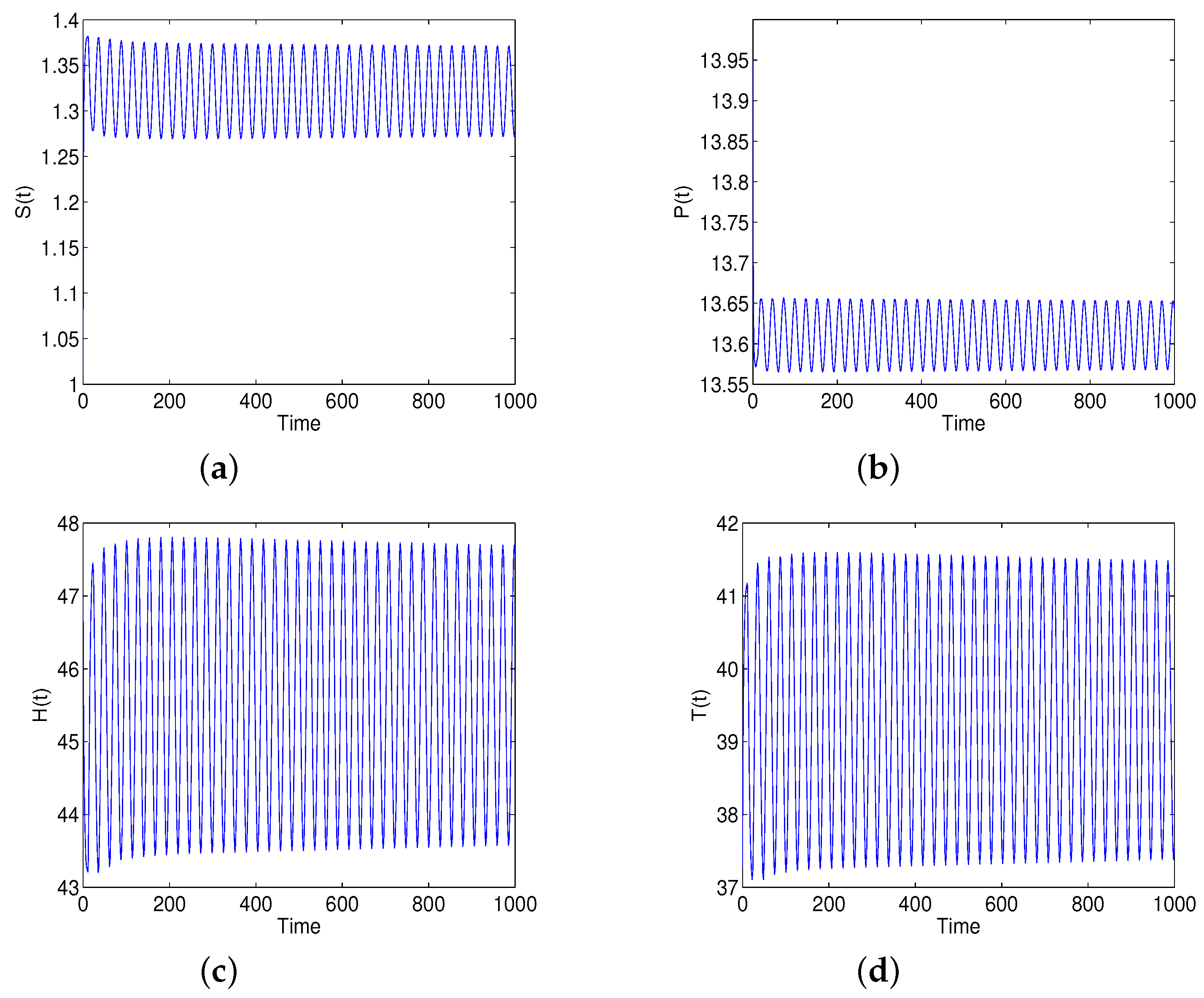
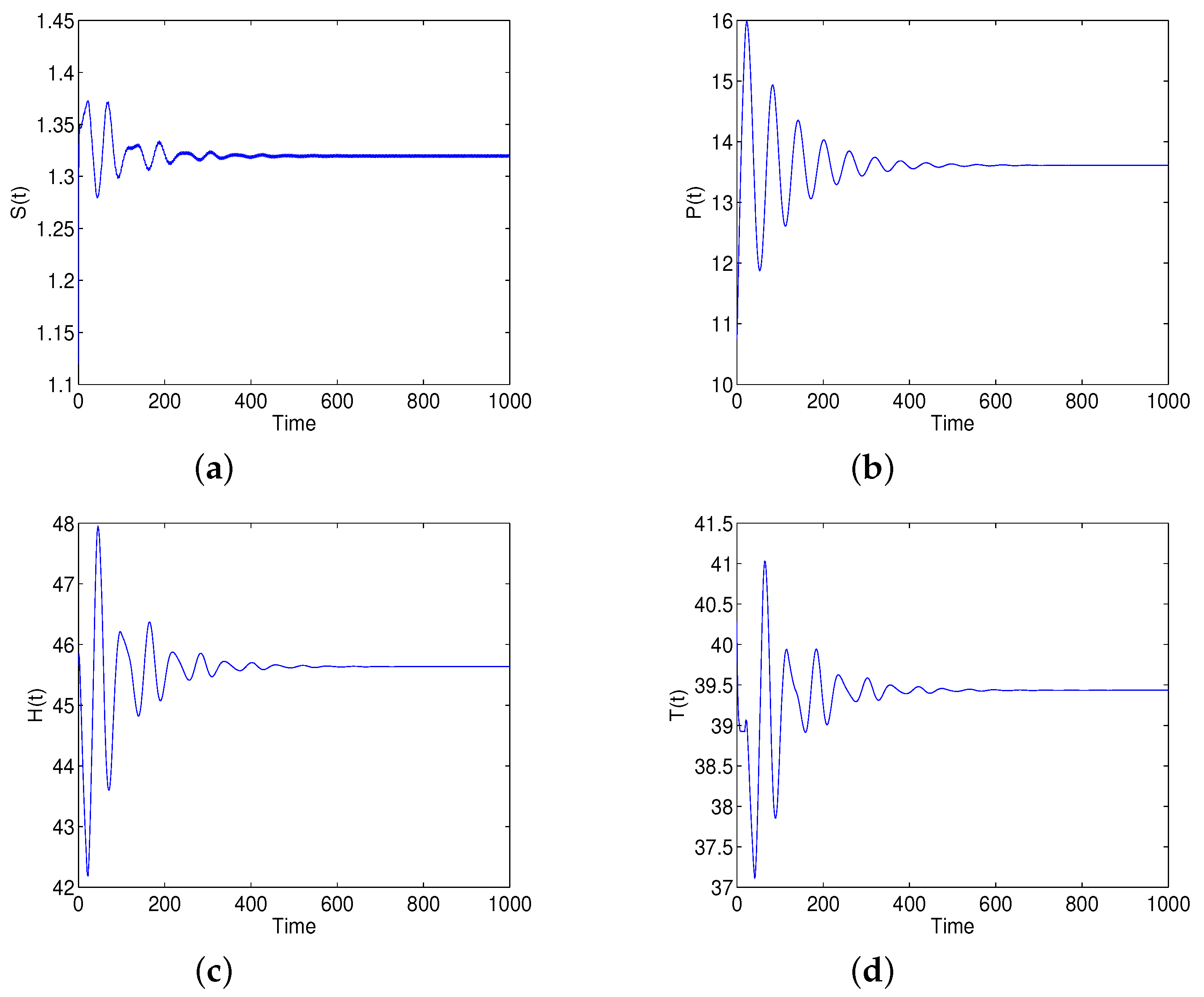
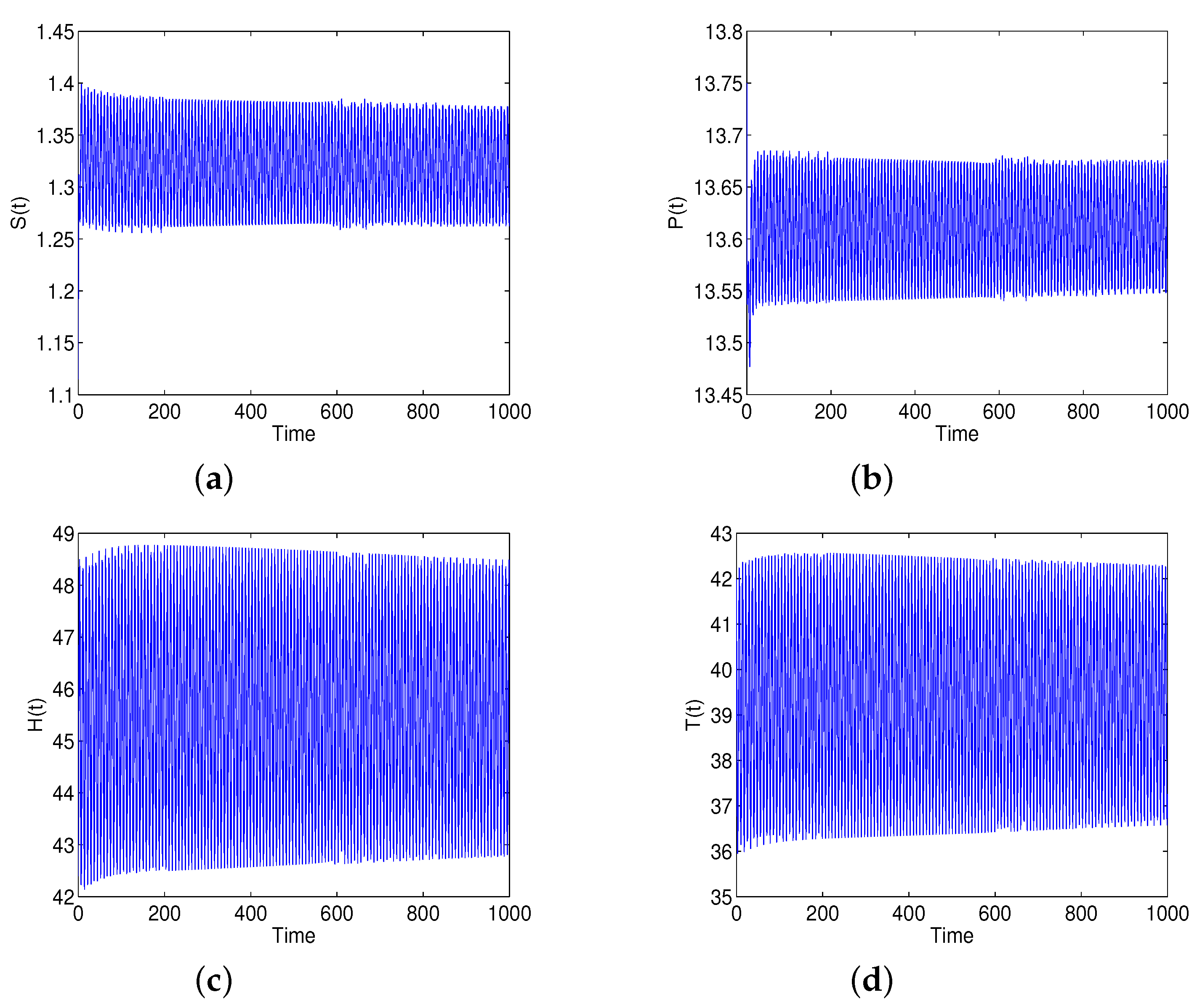
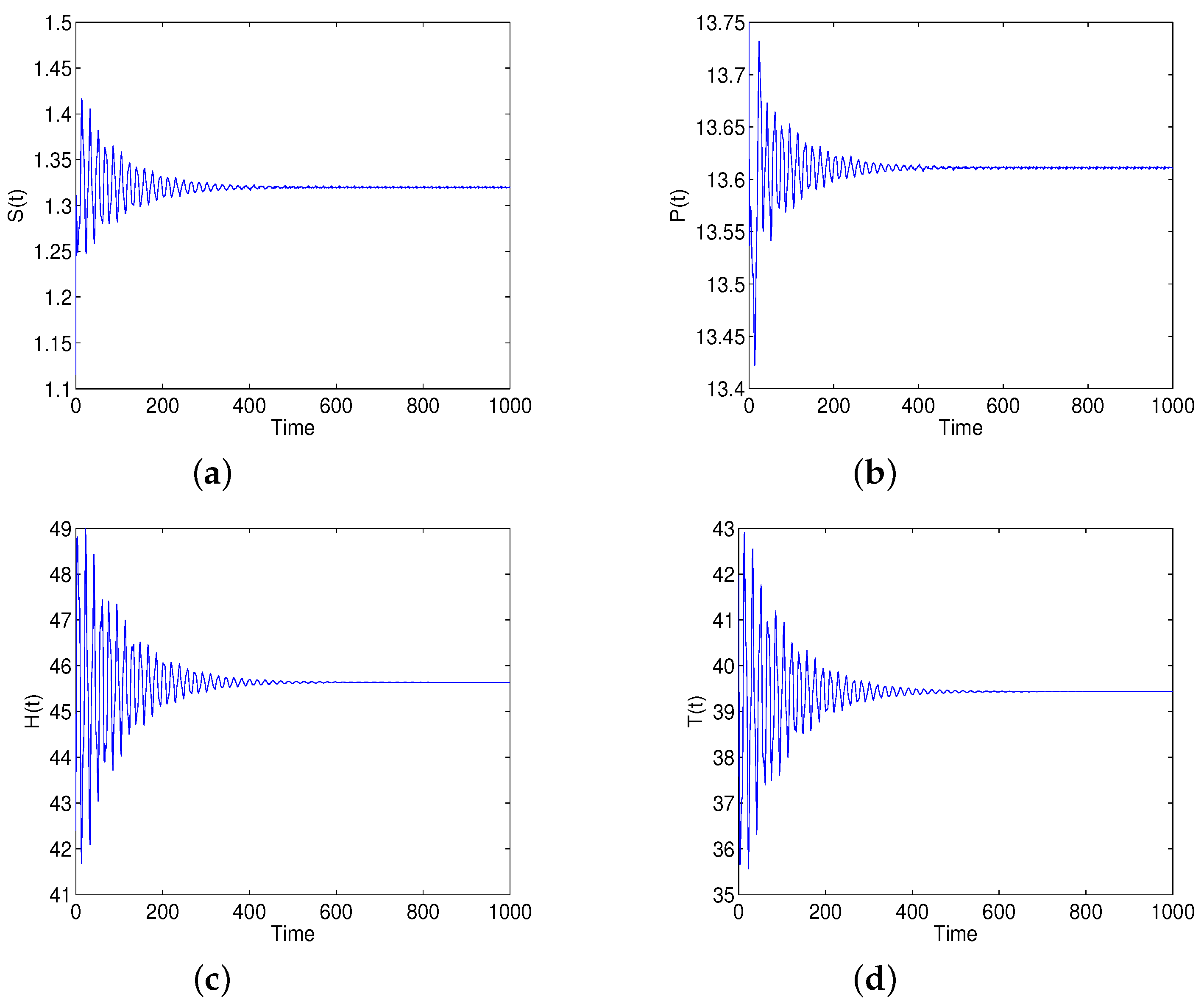
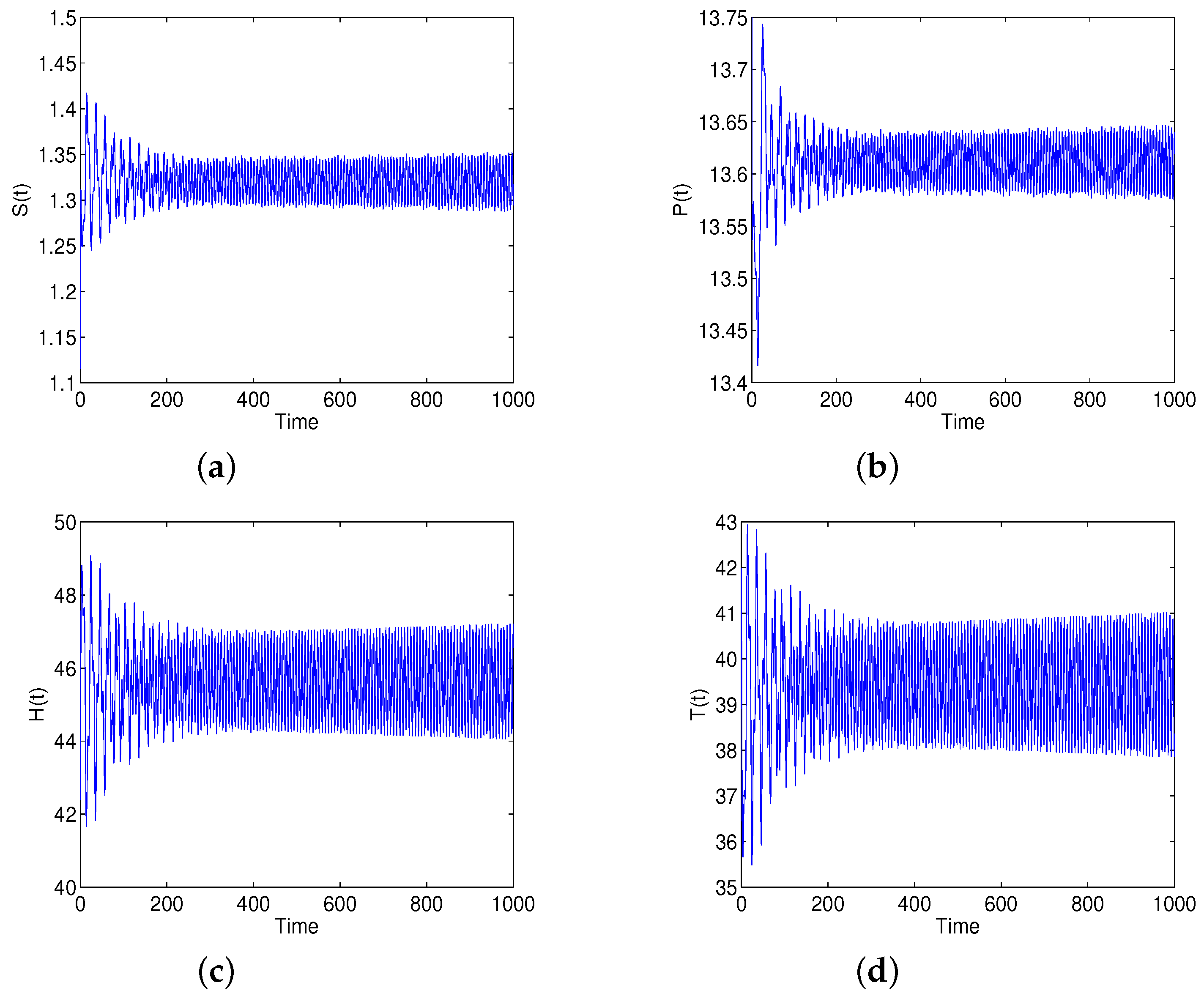
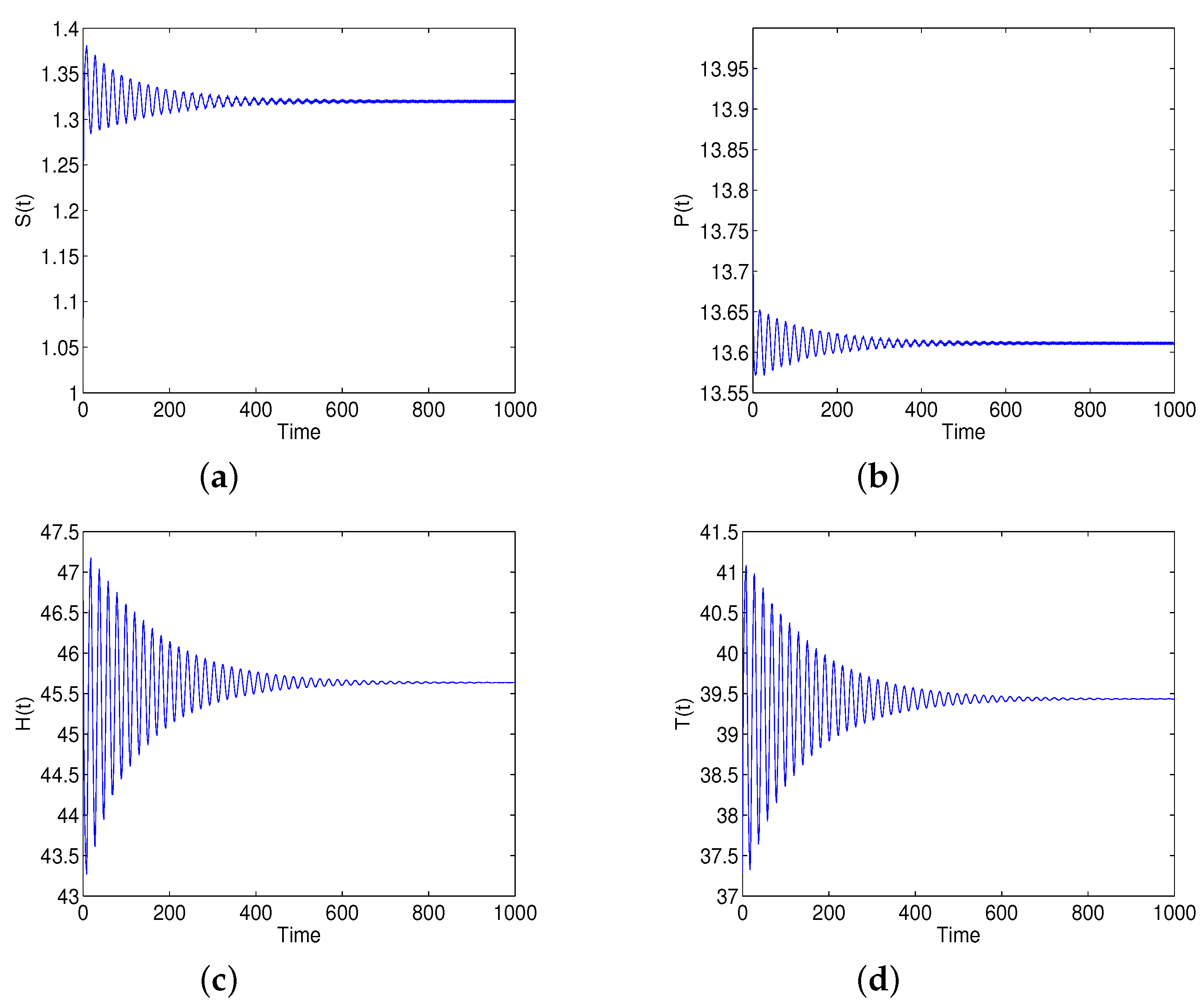
For the case when and , one has and . In line with Theorem 1, is locally asymptotically stable in the interval . Figure 1 shows the local asymptotical stability of the model system (47). Whereas, Figure 2 shows the exhibition of a Hopf bifurcation at .
Figure 1.
The time plot of (a) susceptible population, (b) psychological addicts, (c) physiological addicts and (d) drug-users in treatment for with , , , , , , and .
Figure 2.
The time plot of (a) susceptible population, (b) psychological addicts, (c) physiological addicts and (d) drug-users in treatment for with , , , , , , and .
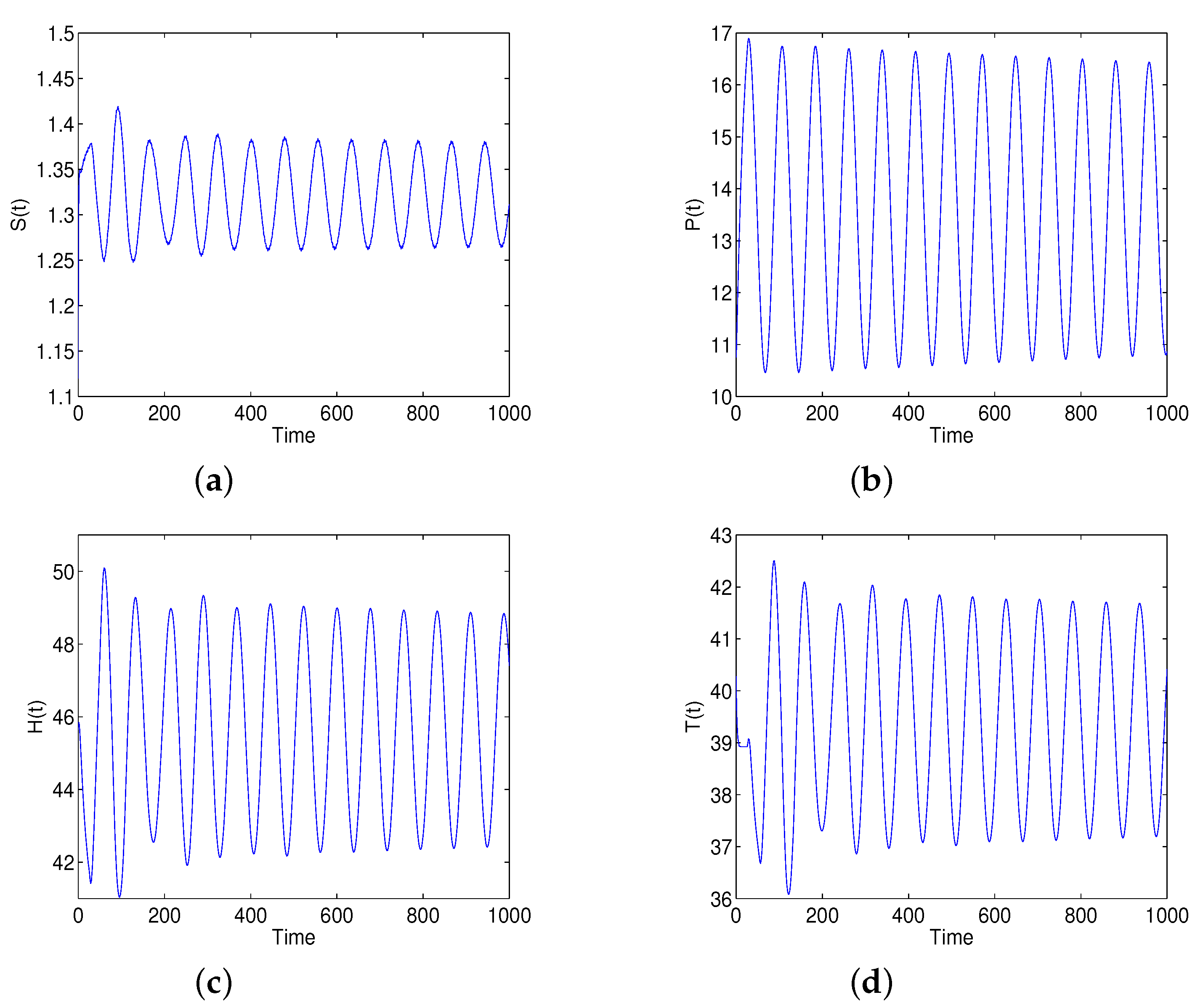
For and , we have and based on some calculations. It can be observed that the model system (47) is locally asymptotically stable around based on some calculations. It can be observed that the model system (47) is locally asymptotically stable around when , which is depicted in Figure 3. Nevertheless, loses its stability and the model system (47) experiences a Hopf bifurcation as the value of crossed . The loss of stability dynamics of for is shown in Figure 4.
Figure 3.
The time plot of (a) susceptible population, (b) psychological addicts, (c) physiological addicts and (d) drug-users in treatment for with , , , , , , and .
Figure 4.
The time plot of (a) susceptible population, (b) psychological addicts, (c) physiological addicts and (d) drug-users in treatment for with , , , , , , and .
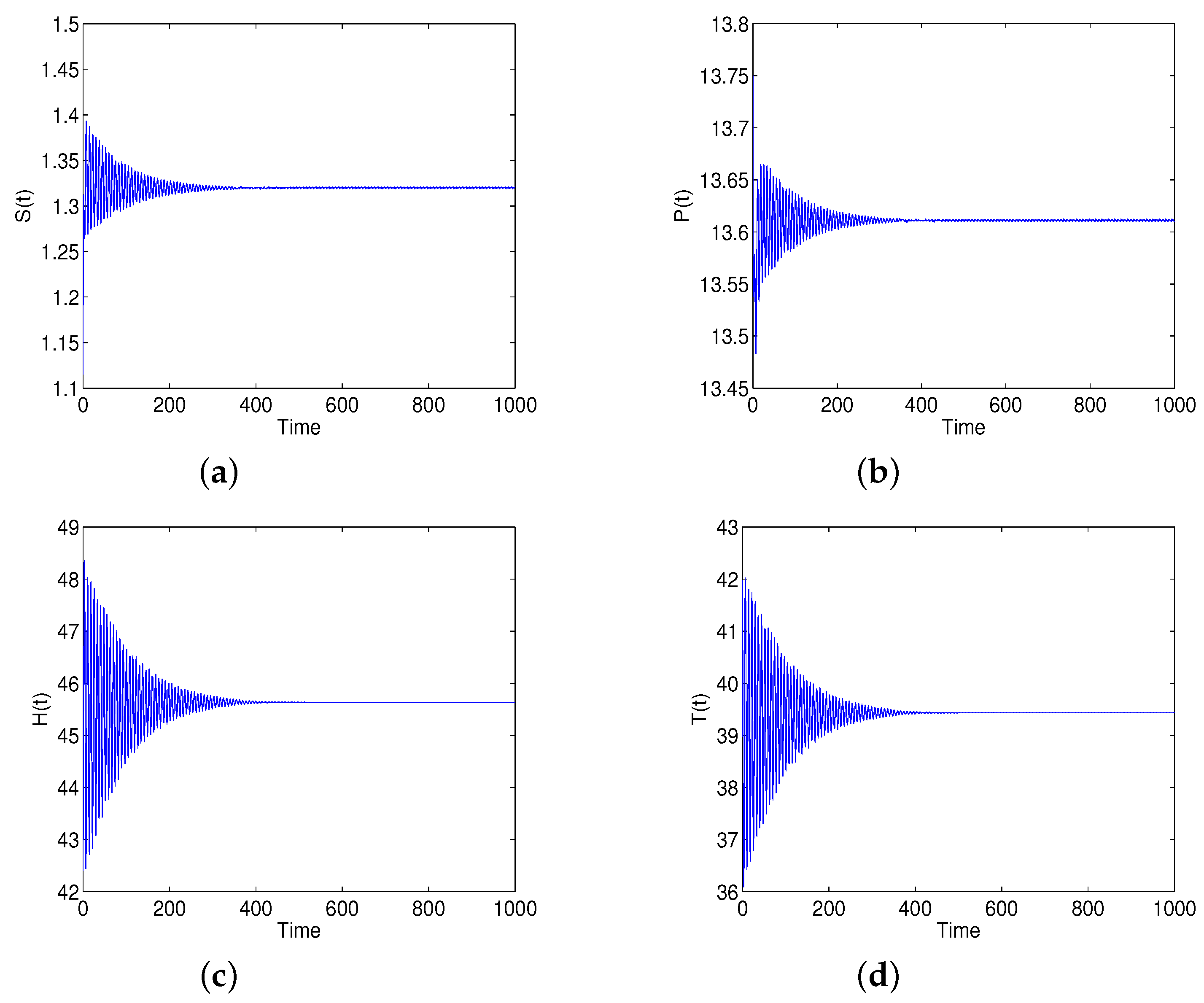
For and and supposing as a parameter, we obtain and through some computations. In such a case, the model system (47) is locally asymptotically stable when but as passes through the model system (47) exhibits a Hopf bifurcation and the model system (47) loses stability. This property is depicted in Figure 5 and Figure 6 for and , respectively.
Figure 5.
The time plot of (a) susceptible population, (b) psychological addicts, (c) physiological addicts and (d) drug-users in treatment for and with , , , , , , and .
Figure 6.
The time plot of (a) susceptible population, (b) psychological addicts, (c) physiological addicts and (d) drug-users in treatment for and with , , , , , , and .
For and and supposing as a parameter, we get and . The model system (47) is locally asymptotically stable for and unstable for . Stability and instability behavior of the model system (47) is presented in Figure 7 and Figure 8 for different values of , respectively.
Figure 7.
The time plot of (a) susceptible population, (b) psychological addicts, (c) physiological addicts and (d) drug-users in treatment for and with , , , , , , and .
Figure 8.
The time of (a) susceptible population, (b) psychological addicts, (c) physiological addicts and (d) drug-users in treatment plot for and with , , , , , , and .
In addition, for and , we obtain and . Thus, we have , and . Based on the Theorem 5, we can see that the Hopf bifurcation at is supercritical; the bifurcating periodic solutions showing around are stable, and the bifurcating periodic solutions showing around are decreasing.
6. Conclusions
In this study, a synthetic drug transmission model with two time delays is proposed by introducing the time delay due to the period that both the psychological addicts and the physiological addicts need to accept treatment and come off drugs into the formulated model by in [25]. Through regarding the combinations of the two time delays as bifurcation parameters, sufficient criteria for local stability and exhibition of Hopf bifurcation are established. A crucial value point at which a Hopf bifurcation appears is calculated. Particularly, direction and stability of the model are explored with the aids of the normal form theory and center manifold theorem. Compared with the work in [25], we not only consider the impact of the time delay () due to the relapse time period of the drug-users in treatment on the model system (2) but also the time delay () due to the period that both the psychological addicts and the physiological addicts need to accept treatment and come off drugs on the model system. The results obtained in this study are supplements of the work in [25].
Author Contributions
All authors (H.Z., A.Z., A.W., Z.Z.) have equally contributed to this paper. All authors have read and agreed to the published version of the manuscript.
Funding
This research was supported by National Natural Science Foundation of China (12061033).
Institutional Review Board Statement
Not applicable.
Informed Consent Statement
Not applicable.
Data Availability Statement
Not applicable.
Conflicts of Interest
The authors declare no conflict of interest.
References
- Creagh, S.; Warden, D.; Latif, M.A.; Paydar, A. The new classes of synthetic illicit drugs can significantly harm the brain: A neuro imaging perspective with full review of MRI findings. Clin. Imaging J. 2018, 2, 000116. [Google Scholar]
- China’s Drug Situations Report in 2017. Available online: http://www.nncc626.com/2018-06/26/c_129901052.htm (accessed on 24 February 2022).
- White, E.; Comiskey, C. Heroin epidemics, treatment and ODE modelling. Math. Biosci. 2007, 208, 312–324. [Google Scholar] [CrossRef] [PubMed]
- Liu, J.L.; Zhang, T.L. Global behaviour of a heroin epidemic model with distributed delays. Appl. Math. Lett. 2011, 24, 1685–1692. [Google Scholar] [CrossRef]
- Huang, G.; Liu, A.P. A note on global stability for a heroin epidemic model with distributed delay. Appl. Math. Lett. 2013, 26, 687–691. [Google Scholar] [CrossRef]
- Liu, X.N.; Wang, J.L. Epidemic dynamics on a delayed multi-group heroin epidemic model with nonlinear incidence rate. J. Nonlinear Sci. Appl. 2016, 9, 2149–2160. [Google Scholar] [CrossRef]
- Ma, M.J.; Liu, S.Y.; Li, J. Bifurcation of a heroin model with nonlinear incidence rate. Nonlinear Dyn. 2017, 88, 555–565. [Google Scholar] [CrossRef]
- Djilali, S.; Touaoula, T.M.; Miri, S.E. A heroin epidemic model: Very general non linear incidence, treat-age, and global stability. Acta Appl. Math. 2017, 152, 171–194. [Google Scholar] [CrossRef]
- Yang, J.Y.; Li, X.X.; Zhang, F.Q. Global dynamics of a heroin epidemic model with age structure and nonlinear incidence. Int. J. Biomath. 2016, 9, 1650033. [Google Scholar] [CrossRef]
- Wang, J.L.; Wang, J.; Kuniya, T. Analysis of an age-structured multi-group heroin epidemic model. Appl. Math. Comput. 2019, 347, 78–100. [Google Scholar] [CrossRef]
- Alzaid, S.S.; Alkahtani, B.S.T. Asymptotic analysis of a giving up smoking model with relapse and harmonic mean type incidence rate. Results Phys. 2021, 28, 104437. [Google Scholar] [CrossRef]
- Sun, C.X.; Jia, J.W. Optimal control of a delayed smokingmodel with immigration. J. Biol. Dyn. 2019, 13, 447–460. [Google Scholar] [CrossRef] [PubMed]
- Rahman, G.U.; Agarwal, R.P.; Din, Q. Mathematical analysis of giving up smoking model via harmonic mean type incidence rate. Appl. Math. Comput. 2019, 354, 128–148. [Google Scholar] [CrossRef]
- Rahman, G.U.; Agarwal, R.P.; Liu, L.L.; Khan, A. Threshold dynamics and optimal control of an age-structured giving up smoking model. Nonlinear Anal. Real World Appl. 2018, 43, 96–120. [Google Scholar] [CrossRef]
- Ucar, S.; Ucar, E.; Ozdemir, N.; Hammouch, Z. Mathematical analysis and numerical simulation for a smoking model with Atangana-Baleanu derivative. Chaos Solitons Fractals 2019, 118, 300–306. [Google Scholar] [CrossRef]
- Hu, X.M.; Pratap, A.; Zhang, Z.Z.; Wan, A.Y. Hopf bifurcation and global exponential stability of an epidemiological smoking model with time delay. Alex. Eng. J. 2022, 61, 2096–2104. [Google Scholar] [CrossRef]
- Zhang, Z.Z.; ur Rahman, G.; Nisar, K.S.; Agarwal, R.P. Incorporating convex incidence rate and public awareness program in modelling drinking abuse and novel control strategies with time delay. Phys. Scr. 2021, 96, 114006. [Google Scholar] [CrossRef]
- Huo, H.F.; Chen, Y.L.; Xiang, H. Stability of a binge drinking model with delay. J. Biol. Dyn. 2017, 11, 210–225. [Google Scholar] [CrossRef][Green Version]
- Xiang, H.; Zhu, C.C.; Huo, H.F. Modelling the effect of immigration on drinking behavior. J. Biol. Dyn. 2017, 11, 275–298. [Google Scholar] [CrossRef][Green Version]
- Sharma, S.; Samanta, G.P. Analysis of a drinking epidemic model. Int. J. Dyn. Control 2015, 3, 288–305. [Google Scholar] [CrossRef]
- Das, M.; Samanta, G.; Sen, M.D.L. Stability analysis and optimal control of a fractional order synthetic drugs transmission model. Mathematics 2021, 9, 703. [Google Scholar] [CrossRef]
- Saha, S.; Samanta, G.P. Synthetic drugs transmission: Stability analysis and optimal control. Lett. Biomath. 2019, 6. [Google Scholar] [CrossRef]
- Liu, P.; Zhang, L.; Xing, Y. Modelling and stability of a synthetic drugs transmission model with relapse and treatment. J. Appl. Math. Comput. 2019, 60, 465–484. [Google Scholar] [CrossRef]
- Ma, M.J.; Liu, S.Y.; Xiang, H.; Li, J. Dynamics of synthetic drugs transmission model with psychological addicts and general incidence rate. Phys. Stat. Mech. Appl. 2018, 491, 641–649. [Google Scholar] [CrossRef]
- Zhang, Z.Z.; Yang, F.F.; Xia, W.J. Influence of time delay on bifurcation of a synthetic drug transmission model with psychological addicts. Adv. Differ. Equ. 2020, 144, 15. [Google Scholar] [CrossRef]
- Kundu, S.; Maitra, S. Dynamical behaviour of a delayed three species predator-prey model with cooperation among the prey species. Nonlinear Dyn. 2019, 92, 627–643. [Google Scholar] [CrossRef]
- Ren, J.G.; Yang, X.F.; Yang, L.X.; Xu, Y.H.; Yang, F.Z. A delayed computer virus propagation model and its dynamics. Chaos Solitons Fractals 2012, 45, 74–79. [Google Scholar] [CrossRef]
- Bodnar, M. The nonnegativity of solutions of delay differential equations. Appl. Math. Lett. 2000, 13, 91–95. [Google Scholar] [CrossRef]
- Yang, X.; Chen, L.; Chen, J. Permanence and positive periodic solution for the single species nonautonomus delay diffusive model. Comput. Math. Appl. 1996, 32, 109–116. [Google Scholar] [CrossRef]
- Xu, C.J.; Liao, M.X.; Li, P.L.; Guo, Y.; Xiao, Q.M.; Yuan, S. Influence of multiple time delays on bifurcation of fractional-order neural networks. Appl. Math. Comput. 2019, 361, 565–582. [Google Scholar] [CrossRef]
- Duan, D.F.; Niu, B.; Wei, J.J. Local and global Hopf bifurcation in a neutral population model with age structure. Math. Methods Appl. Sci. 2019, 42, 4747–4764. [Google Scholar] [CrossRef]
- Wang, Y.J.; Fan, D.J.; Wei, J.J. Stability and bifurcation analysis in a predator-prey model with age structure and two Delays. Int. J. Biurcation Chaos 2021, 31, 2150024. [Google Scholar] [CrossRef]
- Wang, L.X.; Niu, B.; Wei, J.J. Dynamical analysis for a model of asset prices with two delays. Phys. Stat. Mech. Appl. 2016, 447, 297–313. [Google Scholar] [CrossRef]
- Li, X.L.; Wei, J.J. On the zeros of a fourth degree exponential polynomial with applications to a neural network model with delays. Chaos Solitons Fractals 2005, 26, 519–526. [Google Scholar] [CrossRef]
- Hassard, B.D.; Kazarinoff, N.D.; Wan, Y.H. Theory and Applications of Hopf Bifurcation; Cambridge University Press: Cambridge, UK, 1981. [Google Scholar]
Publisher’s Note: MDPI stays neutral with regard to jurisdictional claims in published maps and institutional affiliations. |
© 2022 by the authors. Licensee MDPI, Basel, Switzerland. This article is an open access article distributed under the terms and conditions of the Creative Commons Attribution (CC BY) license (https://creativecommons.org/licenses/by/4.0/).