1. Introduction
Differential equations (DE) are crucial for understanding real-life problems and phenomena, or at the very least for knowing the characteristics of the solutions to the equations resulting from modeling these phenomena. However, DEs, such as the ones presented, that are utilized to address real-world issues may not be explicitly solvable, i.e., may not have closed-form solutions. Only equations with simple forms accept the solutions supplied by explicit formulae. In recent decades, different models of DEs have been established in various fields, which have led to stimulate research in the qualitative theory of DEs. Qualitative properties of differential equations have received a lot of attention, such as existence, oscillation, periodicity, boundedness, stability; see for example [
1,
2].
Neutral differential equations (NDE) are a type of functional differential equation in which the highest derivative of the unknown function appears with and without delay. The qualitative analysis of such equations has a lot of practical use in addition to its theoretical value. This is due to the fact that NDEs appear in a variety of situations, such as problems involving lossless transmission lines in electric networks (as in high-speed computers, where such lines are used to interconnect switching circuits), the study of vibrating masses attached to an elastic bar, and the solution of variational problems with time delays; see Hale [
2].
The essence of oscillation theory is to establish conditions for the existence of oscillatory (non-oscillatory) solutions and/or convergence to zero, studying the laws of distribution of the zeros, obtaining lower limits for the separation between successive zeros, and considering the number of zeros of each given span, as well as looking at the relationship between the oscillatory properties of solutions and corresponding oscillatory processes in a system. The oscillation theory has become a significant numerical mathematical tool for many disciplines and high technologies. The subject of finding oscillation criteria for certain functional DEs has been a highly active study area in recent decades, and the monographs by Agarwal et al. [
3,
4] and Győri and Ladas [
5] contain many references and descriptions of known results.
Let us denote the composition of two functions
f and
g by
, that is,
. Consider the NDE of the form
where
is an even natural number,
and
in
,
q in
,
,
,
,
,
,
,
, and
. By a proper solution of (
1), we mean a real-valued function
x in
with
and
x satisfies (
1) on
. In this paper, we study the asymptotic and oscillatory behavior of solutions of (
1) in the non-canonical case, that is
Jacob Robert Emden (1862–1940), a Swiss astrophysicist, and Sir Ralph Howard Fowler (1889–1944), an English astronomer, are the namesakes of the famous Emden–Fowler equation. Fowler investigated the equation to explain many fluid mechanics phenomena [
6]. Since then, there has been a surge of interest in generalizing this equation and using it to explain a variety of physical processes [
7,
8]. Equation (
1) is a generalization of the Emden–Fowler equation in the higher-order and the neutral case.
Studying the qualitative behavior of solutions to differential equations is of great importance, especially in the case of an inability to find a solution to differential equations. On the other hand, numerical studies are important in understanding, analyzing and interpreting different phenomena (see, for example, [
9,
10]).
In 2011, Zhang et al. [
11] presented conditions that ensure the convergence of non-oscillatory solutions to zero of the equation
where
and
are ratios of odd positive integers. Zhang et al. [
12] provided criteria for oscillation of all solutions of (
2). Using the comparison technique, Baculíková [
13] investigated the oscillation of the solutions of the equation
where
and
for
Moaaz and Muhib [
14] studied the oscillation of (
2) and presented improved results in [
12,
13].
On the other hand, the study of the oscillatory behavior of solutions of second-order delay differential equations was recently developed. To track this development, see [
15,
16,
17,
18,
19]. Baculíková [
15] established the monotonic properties of nonoscillatory solutions of the linear equation
in the delay and advanced cases. He provided criteria for oscillation, which improved the results in [
16]. For the NDE
Bohner et al. [
18] and Moaaz et al. [
19] verified the oscillatory behavior of this equation in the non-canonical case.
On the other hand, the study of the asymptotic behavior of delay differential equations in the non-canonical case differs greatly from the canonical case. The possibilities of signs of derivatives of positive solutions are more in the non-canonical case, and this opens the way for the use of different approaches and methods to exclude positive solutions. Anis and Moaaz [
20] presented oscillation criteria for the equation
and Moaaz et al. [
21] verified the oscillatory behavior of (
4) in the canonical case.
The main objective of this study is to find the new monotonic properties of a class of positive solutions of (
1) in the non-canonical case. Then, we improve these properties by establishing them in an iterative nature. By using these properties, we can obtain an iterative criterion that ensures that there are no solutions in the class of the positive solutions under study. The results in this paper extend the approach used in [
15] for the higher order as well as the neutral equations. Finally, we test the effect of this improvement on a special case of (
1).
Lemma 1. Lemma 2.2.3 of [3]. If is in with derivatives up to order of constant sign, for , and , then there is a such thatfor all and . 2. Main Results
Naturally, the qualitative study of the solutions of the NDDs begins with the classification of the signs of the derivatives of the function
Assume that
x is a positive solution to Equation (
1). Since
and
, there is a
such that
and
are positive for all
. Thus,
and
. Taking into account Lemma 2.2.3 in [
3], the following are the possible cases, eventually:
Here, we define the class
ℑ as the set of all positive solutions of (
1) with
satisfying
. Further, we define the functions
and
Q by
and
Lemma 2. Assuming that x belongs to ℑ, we obtain the following cases, eventually:
Proof. As a result of the facts that
and
, we get that
and
. Thus, it follows from (
5) that
and therefore,
is proved.
Using Lemma 1 with
and
, we obtain
for all
. Next, Equation (
1), with
becomes
Since
is a positive decreasing function, we conclude that
converges to a non-negative constant, and this with (
6) gives
This also confirms the positivity of the numerator of the derivative of
, or otherwise,
This completes the proof. □
Lemma 3. Assuming that x belongs to ℑ and
there are and such thatwe obtain, for , where .
Proof. First of all, since x belongs to ℑ, we can say that in Lemma 2 are satisfied for all , with large enough. Now, since is a positive decreasing function, we conclude that converges to a non-negative constant, let us say l.
If we assume that
, then there is a
with
for
, which with
gives
for all
. Thus, from
, we get
which with
gives
If we integrate the previous inequality from
to
, then we obtain
Since
as
, there is a
such that
for all
. Hence, (
7) becomes
for all
. By integrating the above inequality from
to
, we obtain
and therefore
, which is a contradiction. Then,
.
Next, from
and
, we have
By integrating this inequality from
to
and using the fact that
, we obtain
As a result of
as
, there is a
such that
for
. Therefore, we have
and then
Now, we have that is a positive decreasing function. Then, converges to a non-negative constant, let us say k.
Suppose that
. Hence,
for
, where
and is large enough.
From
, we see that the function
is positive. Moreover,
From
,
and
, we get
which with (
12) gives
Since
and
, we obtain
, and then (
14) becomes
Using (
9) and (
10), we conclude that
Then, the function defined in (
11) is a positive decreasing function that converges to a non-negative constant. Furthermore, if we integrate the last inequality from
to
∞, then we obtain
which is a contradiction. This implies that
.
Finally, we have
which with (
13) gives
By integrating this inequality from
to
∞ and using
, we obtain
Then
which means that
is increasing. This completes the proof. □
If , we can improve the properties in Lemma 3, as stated in the following result.
Lemma 4. Assume that x belongs to ℑ and holds. Ifand there exists an increasing sequence defined bywith , and , then, eventually, Proof. First of all, since x belongs to ℑ, we can say that in Lemma 2 are satisfied for all , with being large enough. Furthermore, from Lemma 3, we have that hold.
Now, assume that
, and
Next, we will prove
and
for
. As in the proof of Lemma 3, we arrive at (
13). Integrating (
13) from
to
and using
and
, we obtain
Using
, we have that
which, with (
16), results in
Then Proceeding exactly as in the proof of and , we can verify that and hold.
Next, if
, then we define
As in the proof of the case for , we can prove and for , and so on. The proof is complete. □
Theorem 1. Assume that and hold. If there exists a positive integer m such that for some , then the class ℑ is empty, where is defined as in Lemma 4.
Proof. Assume the contrary, that x belongs to ℑ. From Lemma 4, we have that the functions and are decreasing and increasing for , respectively. Then, , which is a contradiction. The proof is complete. □
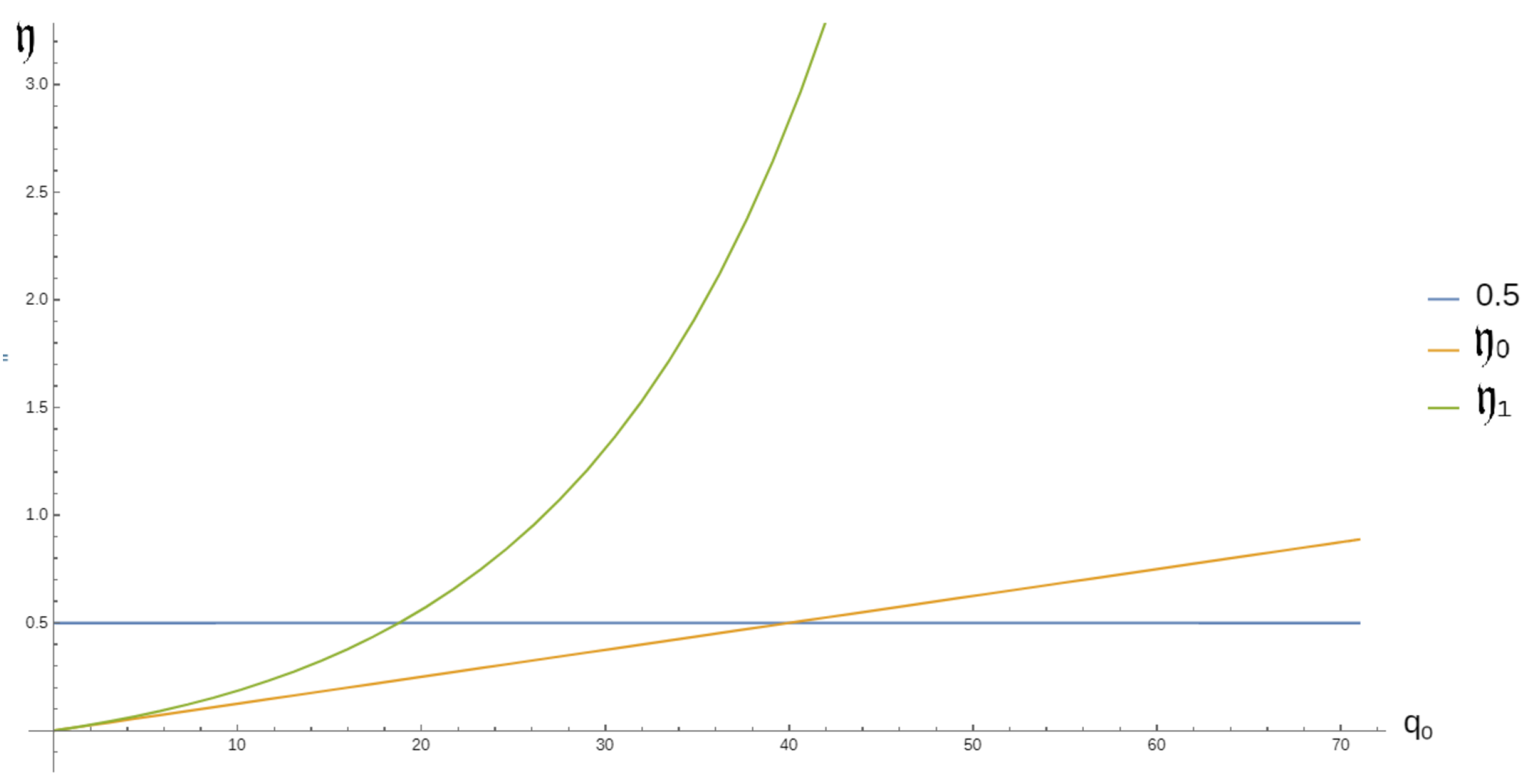
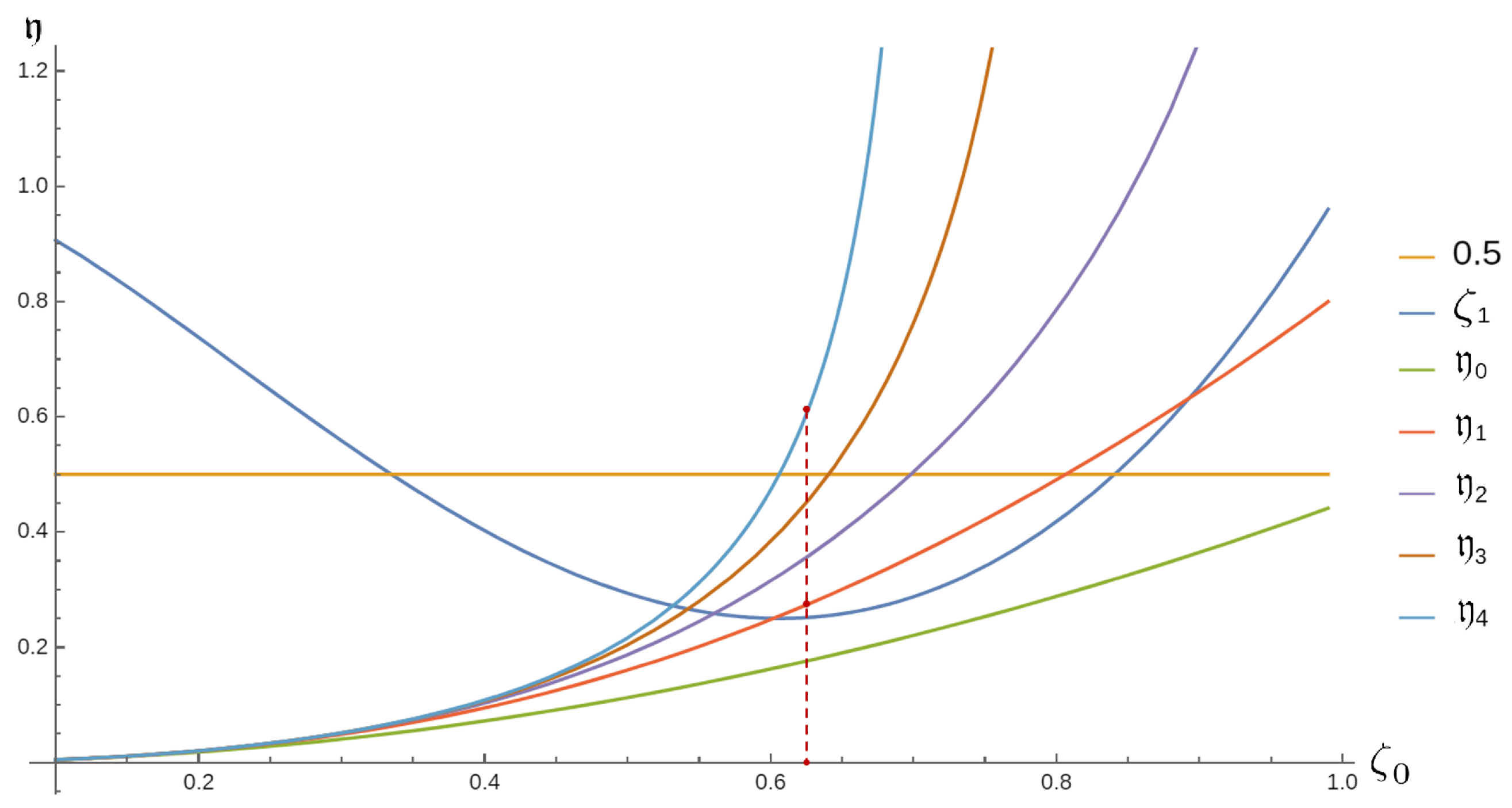
Example 1. Consider the NDEwhere and . By comparing (1) and (17), we note that and . It is easy to verify thatand Now, we define the sequence aswithwhere . Special case 1: Consider the NDE We note that (18) holds. If we set , then and(see Figure 1). We note that for all , while for all Special case 2: Consider the delay equationwhere . If we set , then and(see Figure 2). We note that if , then . Moreover, for Theorem 2. Assume that and hold. If there exists a positive integer m such thatthen the class ℑ is empty, where is defined as in Lemma 4. Proof. Assume the contrary, that x belongs to ℑ. From Lemma 4, we have that hold.
Now, we define the function
From
, we obtain
. Then, from the definition of
, we arrive at
Using Lemma 3, we obtain that
hold. From
and
, we arrive at
which, with (
21), gives
It follows from
that
for
. Hence,
is a positive solution of the differential inequality (
22). However, from Theorem 2.1.1 in [
22], condition (
20) guarantees that (
22) is oscillatory. This contradiction completes the proof. □
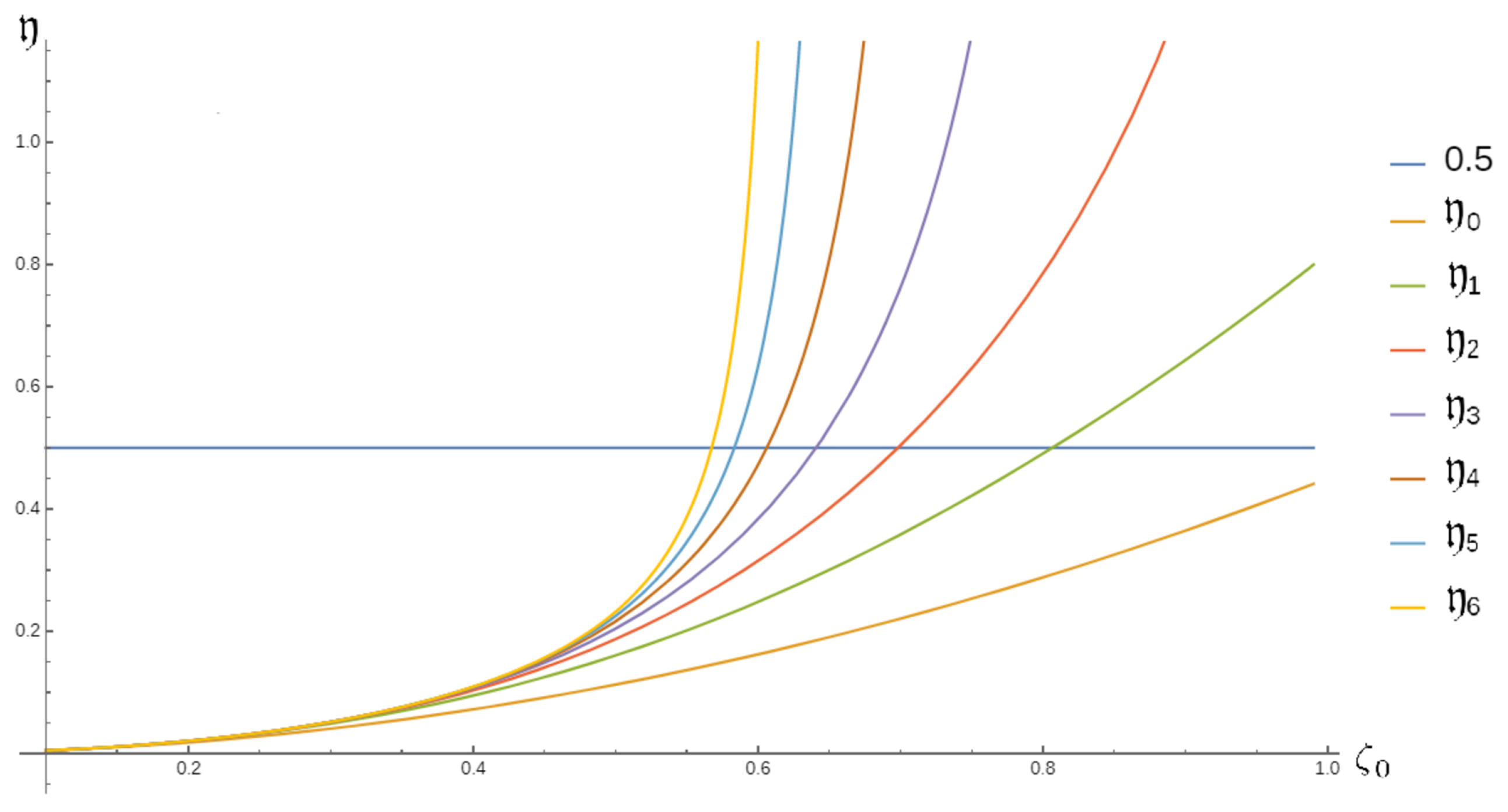
Example 2. Consider the NDE (17). If (18) andhold, then, from Theorem 2, the class ℑ is empty. For the special case (19), condition (23) reduces to Remark 1. Consider the NDE (19). We note that, with fewer iterations, condition checks that class ℑ is empty, compared to condition . For example, if , then we have that for and ; however, (see Figure 3). Remark 2. In the non-canonical case, Li and Rogovchenko [23] used the principle of comparison to obtain criteria for oscillation of all solutions of Applying the results in [23] to Equation (1), we obtain that ℑ is empty if ,and there exists a withsuch that Note that in this paper, we have obtained a new criterion without requiring the existence of the unknown functions ϱ and without requiring the condition in (24).