New Fundamental Results on the Continuous and Discrete Integro-Differential Equations




Abstract
1. Introduction
2. Basic Results
- (A1)
- The functionalis locally Lipschitz ini.e., for every compactandthere is a with such that:for all and
- (A2)
- is a continuous functional such that it is one sided locally Lipschitz in i.e.,
- (A3)
- There are four strictly increasing functions ω, , , with value 0 at 0 such that:andand Then, the trivial solution of FDE (3) is uniformly asymptotically stable.
3. Analysis of Solutions by LKF Method
- (C1)
- (C2)
- forwhere
- (C3)
- where such that for all
- (C4)
- where such that for all
- (C5)
- Let such thatandfor whereIt should be noted that throughout the proofs of Theorems 3–5 and Corollary 1 as a basic tool, we utilize the LKF defined by:in which we choose σ in the proof.The first new result, i.e., the UAS result, is given by Theorem 3.
4. Numerical Applications
5. Contributions
- (1)
- The systems of this paper, i.e., the continuous and discrete systems of IDDEs (2) and IDDEs (4), extend and improve the continuous and discrete system of IDDEs (1), which were studied by Crisci et al. ([14], Theorem 2.2). This is the first contribution of this paper.
- (2)
- In Crisci et al. ([14], Theorem 2.2), the LKFwas constructed and used as a main tool to prove Theorem 1, i.e., Theorem 2.2 of Crisci et al. ([14], Theorem 2.2). In this paper, we define a novel LKF, such asto prove the UAS of the trivial solution of the unperturbed system (4). Here, the LKF was also used to prove Corollary 1, Theorems 4 and 5. The LKF is different from the LKF V of Crisci et al. ([14], Theorem 2.2). Next, the LKF can lead more suitable conditions related to Theorems 3–5. This is the second contribution of this paper.
- (3)
- In the paper of Crisci et al. ([14], Theorem 2.2), the AS of the trivial solution of system (1) is proved by the LKF method, see Theorem 1. In this paper, instead of the AS result, we proved the UAS of the trivial solution of the unperturbed system (4) by Theorem 3. The UAS implies the AS; however, on the contrary, the AS does not imply the UAS. Our result, Theorem 3, is stronger than Theorem 1, i.e., Crisci et al. ([14], Theorem 2.2). This is the third contribution of this paper.
- (4)
- In this paper, we used the LRM method to prove the ES and instability of the trivial solution of the continuous and discrete unperturbed system of IDDEs (4) via the LF defined by:In the relevant literature, we did not find a paper on the properties of solutions of continuous and discrete perturbed system of IDDEs (2) and unperturbed system of IDDEs (4), where the LRM method is used as a basic technique to prove those kinds of results. Here, the effectiveness of the LRM can be seen from Theorems 6 and 7. This is the fourth contribution of this paper.
- (5)
- Crisci et al. ([14], Theorem 2.2) investigated the AS of the trivial solution of the continuous and discrete system of IDDEs (1). In this paper, we discussed the UAS, US, ES, instability of the trivial solution, integrability of non-trivial solutions of the continuous and discrete scalar unperturbed system (4) as well as the boundedness of non-trivial solutions at infinity of the continuous and discrete scalar perturbed system of IDDEs (2), which includes and extends the continuous and discrete system of IDDEs (1). Thus, we establish five new results and a corollary on the fundamental properties of solutions. This is the fifth contribution of this paper to the topic of the paper and the qualitative theory of solutions.
- (6)
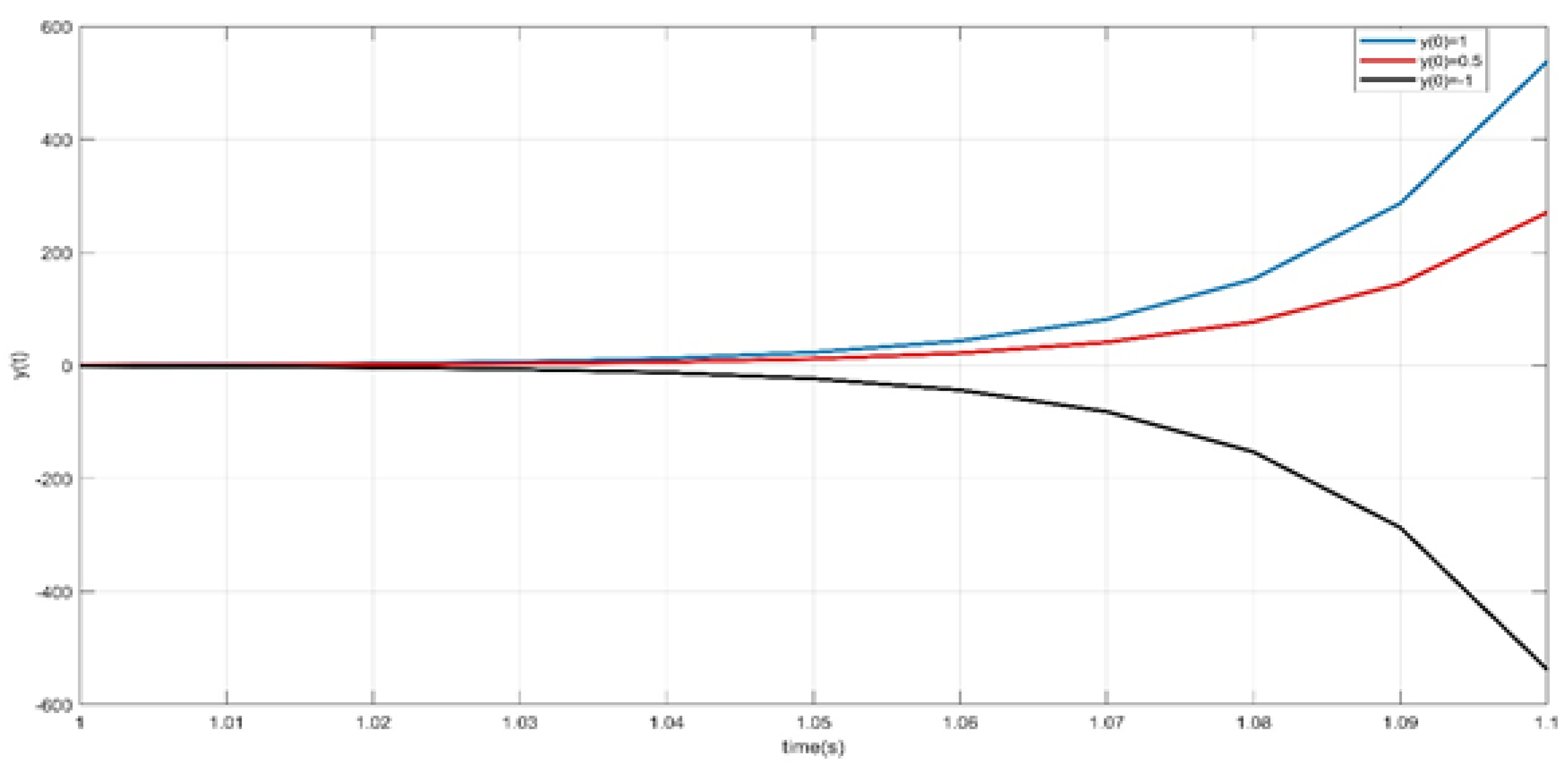
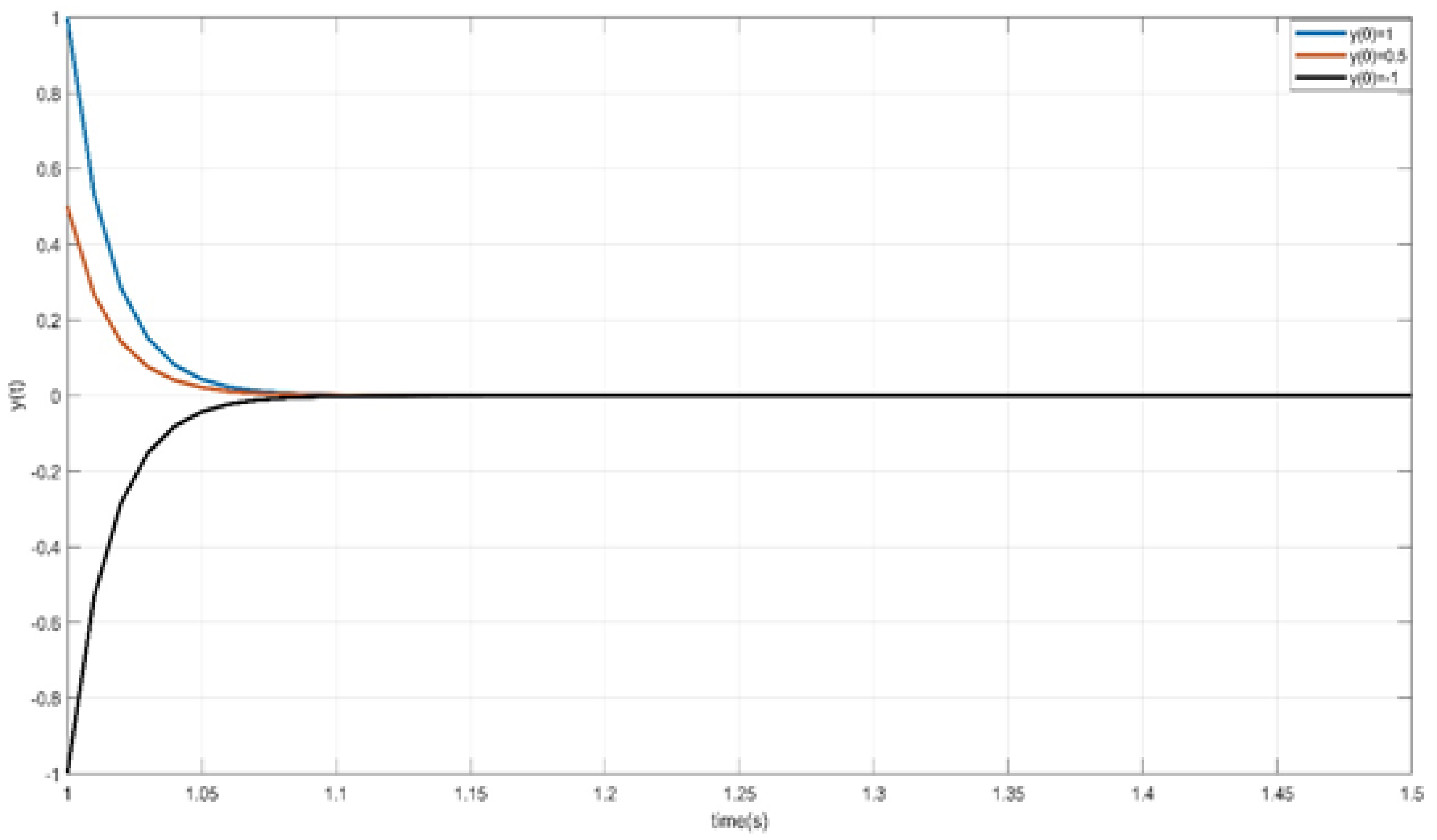
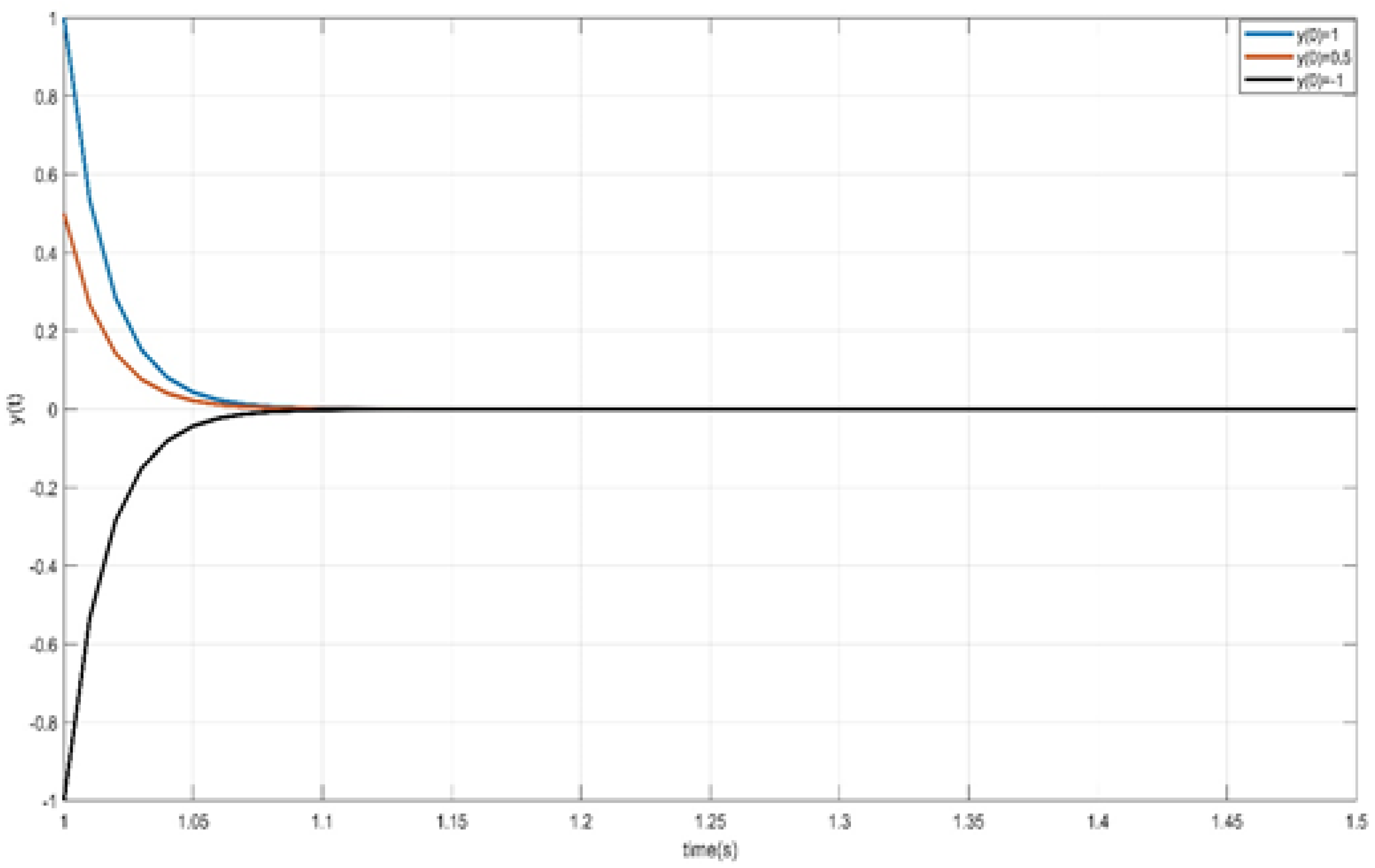
- In Crisci et al. ([14], Theorem 2.2), no examples were given as an application of Theorem 1. Here, in particular cases of the continuous and discrete systems (2) and (4), we constructed three examples and solved them by MATLAB software. The conditions of Theorems 3–7 are held by Examples 1–3. Hence, the applications of Theorems 3–7 were provided. This is the sixth contribution of this paper.
- (7)
- In this paper the boundedness theorem, Theorem 5, was proved the use of Gronwall’s inequality was not needed. Hence, Theorem 5 has less restrictive conditions.
6. Conclusions
Author Contributions
Funding
Institutional Review Board Statement
Informed Consent Statement
Data Availability Statement
Acknowledgments
Conflicts of Interest
References
- Burton, T.A. Volterra Integral and Differential Equations, 2nd ed.; Mathematics in Science and Engineering; Elsevier B.V.: Amsterdam, The Netherlands, 2005. [Google Scholar]
- Burton, T.A. Stability and Periodic Solutions of Ordinary and Functional Differential Equations; Corrected Version of the 1985 Original; Dover Publications, Inc.: Mineola, NY, USA, 2005. [Google Scholar]
- Corduneanu, C.; Sandberg, I.W. Volterra equations and applications. In Stability and Control: Theory, Methods and Applications; Gordon and Breach Science Publishers: Amsterdam, The Netherlands, 2000; Volume 10. [Google Scholar]
- Lakshmikantham, V.; Rama Mohan Rao, M. Theory of integro-differential equations. In Stability and Control: Theory, Methods and Applications; Gordon and Breach Science Publishers: Lausanne, Switzerland, 1995; Volume 1. [Google Scholar]
- Rahman, M. Integral Equations and Their Applications; WIT Press: Southampton, UK, 2007. [Google Scholar]
- Wazwaz, A.M. Linear and Nonlinear Integral Equations. Methods and Applications; Springer: Heidelberg, Germany, 2011. [Google Scholar]
- Ahmad, S.; Rao, M.R.M. Stability of Volterra diffusion equations with time delays. Appl. Math. Comput. 1998, 90, 143–154. [Google Scholar] [CrossRef] [Scilit]
- Alahmadi, F.; Raffoul, Y.; Shuruq, S. Boundedness and stability of solutions of nonlinear Volterra integro-differential equations. Adv. Dyn. Syst. Appl. 2018, 13, 19–31. [Google Scholar]
- Appleby, J.A.D.; Reynolds, D.W. On necessary and sufficient conditions for exponential stability in linear Volterra integro-differential equations. J. Integral Equ. Appl. 2004, 16, 221–240. [Google Scholar] [CrossRef] [Scilit]
- Berezansky, L.; Braverman, E. Exponential stability of systems of vector delay differential equations with applications to second order equations. J. Math. Anal. Appl. 2021, 504, 125566. [Google Scholar] [CrossRef] [Scilit]
- Bhaskar, T.; Gnana, D.; Devi, J.V. Nonuniform stability and boundedness criteria for set differential equations. Appl. Anal. 2005, 84, 131–143. [Google Scholar] [CrossRef] [Scilit]
- Bohner, M.; Tunç, O. Qualitative analysis of integro-differential equations with variable retardation. Discret. Contin. Dyn. Syst. Ser. B 2022, 27, 639–657. [Google Scholar] [CrossRef] [Scilit]
- Bohner, M.; Tunç, O.; Tunç, C. Qualitative analysis of Caputo fractional integro-differential equations with constant delays. Comput. Appl. Math. 2021, 40, 214. [Google Scholar] [CrossRef] [Scilit]
- Crisci, M.R.; Kolmanovskii, V.B.; Russo, E.; Vecchio, A. Stability of continuous and discrete Volterra integro-differential equations by Liapunov approach. J. Integral Equ. Appl. 1995, 7, 393–411. [Google Scholar] [CrossRef] [Scilit]
- Cubiotti, P.; Yao, J.-C. On the Cauchy problem for a class of differential inclusions with applications. Appl. Anal. 2020, 99, 2543–2554. [Google Scholar] [CrossRef] [Scilit]
- Du, X.T. Stability of Volterra integro-differential equations with respect to part of the variables. Hunan Ann. Math. 1992, 12, 110–115. (In Chinese) [Google Scholar]
- Du, X.T. Some kinds of Liapunov functional in stability theory of RFDE. Acta Math. Appl. Sin. (Engl. Ser.) 1995, 11, 214–224. [Google Scholar] [CrossRef] [Scilit]
- Furumochi, T.; Matsuoka, S. Stability and boundedness in Volterra integro-differential equations. Mem. Fac. Sci. Eng. Shimane Univ. Ser. B Math. Sci. 1999, 32, 25–40. [Google Scholar]
- Graef, J.R.; Tunç, C. Continuability and boundedness of multi-delay functional integro-differential equations of the second order. Rev. Real Acad. Cienc. Exactas Fis. Nat. Ser. A Mat. 2015, 109, 169–173. [Google Scholar] [CrossRef] [Scilit]
- Gopalsamy, K. A simple stability criterion for a linear system of neutral integro-differential equations. Math. Proc. Camb. Philos. Soc. 1987, 102, 149–162. [Google Scholar] [CrossRef] [Scilit]
- Jin, C.; Luo, J. Stability of an integro-differential equation. Comput. Math. Appl. 2009, 57, 1080–1088. [Google Scholar] [CrossRef] [Scilit]
- Ke, T.D.; Obukhovskii, V.; Wong, N.C.; Yao, J.-C. On a class of fractional order differential inclusions with infinite delays. Appl. Anal. 2013, 92, 115–137. [Google Scholar] [CrossRef] [Scilit]
- Lakshmikantham, V.; Rama Mohan Rao, M. Stability in variation for nonlinear integro-differential equations. Appl. Anal. 1987, 24, 165–173. [Google Scholar] [CrossRef] [Scilit]
- Mahfoud, W.E. Boundedness properties in Volterra integro-differential systems. Proc. Am. Math. Soc. 1987, 100, 37–45. [Google Scholar] [CrossRef] [Scilit]
- Nieto, J.J.; Tunç, O. An application of Lyapunov–Razumikhin method to behaviors of Volterra integro-differential equations. Rev. Real Acad. Cienc. Exactas Fís. Nat. Ser. A Mat. 2021, 115, 197. [Google Scholar] [CrossRef] [Scilit]
- Ping, Y.; Jifa, J. On global asymptotic stability of second order nonlinear differential systems. Appl. Anal. 2002, 81, 681–703. [Google Scholar] [CrossRef] [Scilit]
- Pinto, M. Stability of nonlinear differential systems. Appl. Anal. 1992, 43, 1–20. [Google Scholar] [CrossRef] [Scilit]
- Raffoul, Y. Exponential stability and instability in finite delay nonlinear Volterra integro-differential equations. Dyn. Contin. Discret. Impuls. Syst. Ser. A Math. Anal. 2013, 20, 95–106. [Google Scholar]
- Rao, M.R.M.; Raghavendra, V. Asymptotic stability properties of Volterra integro-differential equations. Nonlinear Anal. 1987, 11, 475–480. [Google Scholar]
- Rao, M.R.M.; Srinivas, P. Asymptotic behavior of solutions of Volterra integro-differential equations. Proc. Am. Math. Soc. 1985, 94, 55–60. [Google Scholar] [CrossRef] [Scilit]
- Tunç, C.; Tunç, O. On the stability, integrability and boundedness analyses of systems of integro-differential equations with time-delay retardation. Rev. Real Acad. Cienc. Exactas Fís. Nat. Ser. A Mat. 2021, 115, 115. [Google Scholar] [CrossRef] [Scilit]
- Tunç, C.; Tunç, O. New results on the qualitative analysis of integro-differential equations with constant time-delay. J. Nonlinear Convex Anal. 2022, 23, 435–448. [Google Scholar]
- Tunç, O.; Tunç, C.; Wang, Y.; Yao, J.-C. New and improved criteria on fundamental properties of solutions of integro–delay differential equations with constant delay. Mathematics 2021, 9, 3317. [Google Scholar] [CrossRef] [Scilit]
- Tunç, O.; Atan, Ö.; Tunç, C.; Yao, J.-C. Qualitative analyses of integro-fractional differential equations with Caputo derivatives and retardations via the Lyapunov–Razumikhin Method. Axioms 2021, 10, 58. [Google Scholar] [CrossRef] [Scilit]
- Vanualailai, J.; Nakagiri, S. Stability of a system of Volterra integro-differential equations. J. Math. Anal. Appl. 2003, 281, 602–619. [Google Scholar] [CrossRef] [Scilit]
- Xia, Z.; Wang, D.; Wen, C.F.; Yao, J.C. Psuedo asymptotically periodic mild solutions of semilinear functional integro-differential equations in Banach spaces. Math. Methods Appl. Sci. 2017, 40, 7333–7355. [Google Scholar] [CrossRef] [Scilit]
- Wang, K. Uniform asymptotic stability in functional-differential equations with infinite delay. Ann. Differ. Equ. 1993, 9, 325–335. [Google Scholar]
- Wang, Q. The stability of a class of functional differential equations with infinite delays. Ann. Differ. Equ. 2000, 16, 89–97. [Google Scholar]
- Wang, Q.Y. Asymptotic stability of functional differential equations with infinite time-lag. J. Huaqiao Univ. Nat. Sci. Ed. 1998, 19, 329–333. [Google Scholar]
- Wang, L.; Du, X.T. The stability and boundedness of solutions of Volterra integro-differential equations. Acta Math. Appl. Sin. 1992, 15, 260–268. [Google Scholar]
- Wang, Z.C.; Li, Z.X.; Wu, J.H. Stability properties of solutions of linear Volterra integro-differential equations. Tohoku Math. J. 1985, 37, 455–462. [Google Scholar] [CrossRef] [Scilit]
- Weng, P.X. Asymptotic stability for a class of integro-differential equations with infinite delay. Math. Appl. 2001, 14, 22–27. [Google Scholar]
- Zhang, Z.D. Asymptotic stability of Volterra integro-differential equations. J. Harbin Inst. Tech. 1990, 4, 11–19. [Google Scholar]
- Zhuang, W. Existence and uniqueness of solutions of nonlinear integro-differential equations of Volterra type in a Banach space. Appl. Anal. 1986, 22, 157–166. [Google Scholar] [CrossRef] [Scilit]

Publisher’s Note: MDPI stays neutral with regard to jurisdictional claims in published maps and institutional affiliations. |
© 2022 by the authors. Licensee MDPI, Basel, Switzerland. This article is an open access article distributed under the terms and conditions of the Creative Commons Attribution (CC BY) license (https://creativecommons.org/licenses/by/4.0/).
Share and Cite
Tunç, O.; Tunç, C.; Yao, J.-C.; Wen, C.-F. New Fundamental Results on the Continuous and Discrete Integro-Differential Equations. Mathematics 2022, 10, 1377. https://doi.org/10.3390/math10091377
Tunç O, Tunç C, Yao J-C, Wen C-F. New Fundamental Results on the Continuous and Discrete Integro-Differential Equations. Mathematics. 2022; 10(9):1377. https://doi.org/10.3390/math10091377
Chicago/Turabian StyleTunç, Osman, Cemil Tunç, Jen-Chih Yao, and Ching-Feng Wen. 2022. "New Fundamental Results on the Continuous and Discrete Integro-Differential Equations" Mathematics 10, no. 9: 1377. https://doi.org/10.3390/math10091377
APA StyleTunç, O., Tunç, C., Yao, J.-C., & Wen, C.-F. (2022). New Fundamental Results on the Continuous and Discrete Integro-Differential Equations. Mathematics, 10(9), 1377. https://doi.org/10.3390/math10091377