Article

Discriminative Nonnegative Tucker Decomposition for Tensor Data Representation

1
School of Mathematical Sciences, Guizhou Normal University, Guiyang 550025, China
2
School of Mathematical Sciences, Xiamen University, Xiamen 361005, China
*
Author to whom correspondence should be addressed.
These authors contributed equally to this work.
Mathematics 2022, 10(24), 4723; https://doi.org/10.3390/math10244723
Submission received: 7 November 2022 / Revised: 5 December 2022 / Accepted: 8 December 2022 / Published: 12 December 2022

Abstract

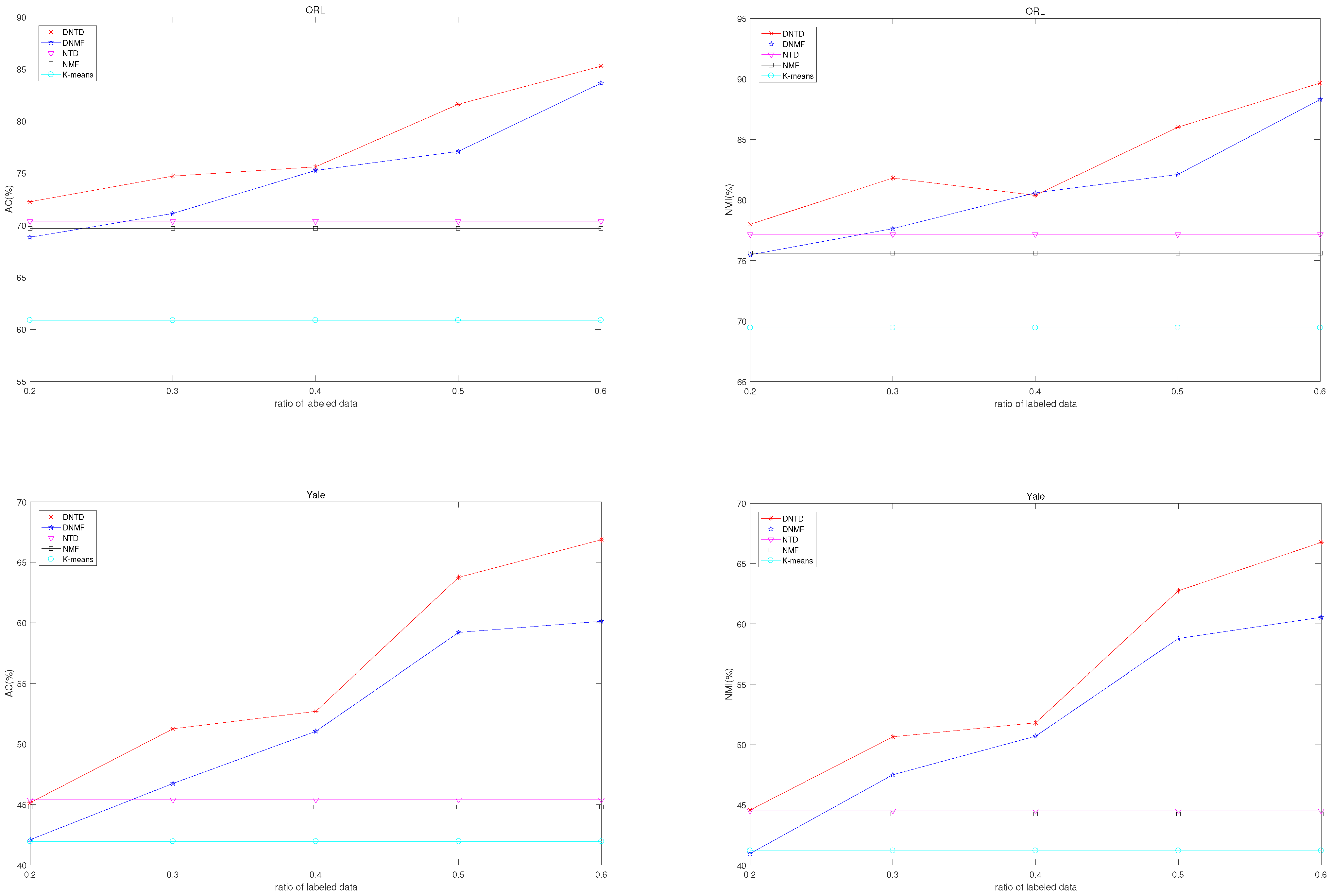
Nonnegative Tucker decomposition (NTD) is an unsupervised method and has been extended in many applied fields. However, NTD does not make use of the label information of sample data, even though such label information is available. To remedy the defect, in this paper, we propose a label constraint NTD method, namely Discriminative NTD (DNTD), which considers a fraction of the label information of the sample data as a discriminative constraint. Differing from other label-based methods, the proposed method enforces the sample data, with the same label to be aligned on the same axis or line. Combining the NTD and the label-discriminative constraint term, DNTD can not only extract the part-based representation of the data tensor but also boost the discriminative ability of the NTD. An iterative updating algorithm is provided to solve the objective function of DNTD. Finally, the proposed DNTD method is applied to image clustering. Experimental results on ORL, COIL20, Yale datasets show the clustering accuracy of DNTD is improved by 8.47–32.17% and the normalized mutual information is improved by 10.43–29.64% compared with the state-of-the-art approaches.
Keywords: tensor factorization; nonnegative Tucker decomposition; label information; dimension reduction; clustering tensor factorization; nonnegative Tucker decomposition; label information; dimension reduction; clustering