Abstract
In two-color strong field ionization of atoms, dynamical characteristics such as ionization rate and electron trajectory depend heavily on the relative phase of the strong fundamental field and its second harmonic. The phase-of-the-phase spectroscopy method reveals the oscillation of the photoelectron momentum distribution with the relative phase of the two-color field, and the relative phase contrast and its phase are usually obtained by the fitting process. Instead, we apply the generalized Bessel function to the strong field approximation and derive analytical expressions for the first- and second-order relative phase contrast and phase-of-the-phase spectra. Our analytical results are in good agreement with fitting-based ones, but calculating them is much less computationally intensive. We illustrate the advantage of using generalized Bessel functions in two-color phase-of-the-phase spectroscopy of argon.
Keywords:
photoelectron momentum distribution; strong field approximation; phase-of-the phase; generalized Bessel function MSC:
78M25
1. Introduction
The photoelectron momentum distribution (PMD) generated by laser interaction with atoms and molecules contains a wealth of dynamical information such as ionization time and electron motion, and its interference pattern is extremely dependent on the specifics of laser pulses and targets [1,2,3,4,5,6,7,8,9,10]. In particular, accurate information about the amplitude and phase of the electron emission associated with the waveform can be obtained by changing the relative phase of the two-color field [11,12,13,14,15,16,17,18,19]. A simple and feasible method of analyzing the spatio-temporal information contained in the PMD is urgently needed. Recently, phase-of-the-phase (PP) spectroscopy has been proposed as a powerful tool to analyze the dynamical information [20,21,22]. The photoelectron yield is an observable depending on two variables: the momentum and the the relative phase between the fundamental field with frequency and its second harmonic with frequency 2 [23,24]. In this paper, we assume a linearly polarized two-color field , where the vector potential has the form
Here, is the envelope of the laser, is the ratio between the 2 and components. As the tunable parameter changes periodically, Fourier analysis can be used to find for each final momentum . Truncating the series at the second-order terms [19,25],
where and are the first- and second-order relative phase contrast (RPC) spectra, respectively. It can be seen that the contribution to the yield with momentum at a given order follows a co-cosine curve as the frequency difference is modulated; its amplitude is the RPC at that order, and its phase is related to the periodic photoelectron signal modulation to , denoted as a quantity , the PP at that order [26,27].
The details of RPC and PP spectra are extremely sensitive to the shape of the targets and laser fields. PP spectra contain a lot of ultrafast spatio-temporal dynamical information. For this reason, PP spectroscopy is a powerful and a widely investigated method of exploring the potential dynamics of strong fields, often used to distinguish different types of signal contributions, such as the weights of long and short orbitals or the contribution of different time windows to electron ionization [28]. Other important applications are the detection of attosecond time delay in Freeman resonance states [29] and the re-trapping resonance scattering mechanism to accurately interpret the time delays measured in non-perturbation above threshold ionization (ATI) regions [30]. In addition, recent studies have shown that PP spectroscopy can also be used to analyze the photoemission process induced by strong fields in bulk density media with atomic impurities [31].
The completion of the PP spectroscopy process requires as many PMDs in different relative phases as possible, which is very time-consuming. The use of semi-classical models offers an alternative. While these are usually solved by numerical fitting, some may be amenable to analytical solution [32,33]. However, there are still relatively few. In Ref. [34], a characteristic checkboard pattern in the ATI spectra of xenon has been demonstrated. In this paper, we focus on deriving the mathematical expressions of PP spectroscopy to the second order in the strong field approximation (SFA). In the framework of SFA, the first-order Fourier expansion is insufficiently accurate to identify the underlying dynamics. Therefore, an extension to the second order is necessary. For this purpose, we adopt the generalized Bessel function to SFA and extend the derivation of the Fourier component of PP spectroscopy to the second order. The use of generalized Bessel function in practice does not require so much data, which greatly saves the computational cost.
The rest of the paper is organized as follows: In Section 2, the SFA method is briefly introduced. In Section 3, applying the generalized Bessel function to SFA, we derive analytical expressions for first- and second-order RPC and PP spectra. In Section 4, the change of strong field ionization of Ar atom with relative phase in a two-color linearly polarized laser field has been analyzed by the SFA method. It sounds odd to say PP spectra are obtained by PP spectroscopy that would seem to be the obvious way one would obtain them. Meanwhile, we present the result of analytical expressions. Finally, some conclusions from our work are presented in Section 5. We also include some technical details in Appendix A. (Atomic units are used unless noted otherwise.)
2. Theoretical Method
In this section, we apply the SFA [35,36,37,38] to photoelectron interference in the case of the vector potential in Equation (1). The simplest form of SFA accounts only for the so-called “direct” electrons, which are bound to the atom up to the detachment time and at later times just move in the laser field without any further interaction with the parent atom. Thus, the probability amplitude of transition from the bound state to a continuum state with asymptotic momentum can be written as [39]
Here,
is the Gordon–Volkov state, i.e., a solution to the time-dependent Schrödinger equation [40,41,42] with no Coulomb potential. The action during the transition process is written as
where is the ionization potential. Using the saddle-point approximation (SPA), the transition amplitudes in Equation (3) can be approximated by [43]
where satisfies the saddle point equation
3. Derivation of RPC and PP
The generalized Bessel function is very useful in the analytical treatment of strong-field processes, especially in the case of linearly polarized laser fields [44,45,46,47,48,49,50,51,52,53,54]. In this section, we will elaborate on the PP spectroscopy method in the framework of SFA theory. Applying the generalized Bessel function in the SFA, analytical expressions for the first- and second-order RPC and PP can be obtained.
3.1. First Order RPC and PP
In the SFA framework, with the 1s state chosen to be the initial state, the transition matrix element from the initial state to the final state can be written as [46]
Neglecting the term in Equation (9) and substituting it into Equation (8), then using the generalized Bessel function [55,56,57,58,59,60] and its recursive relation (see Appendix A for more details), Equation (8) can be rewritten as
where the two parameters of the generalized Bessel function have values of
with the ponderomotive energy
For the term in the integral of Equation (10), one can use its Taylor series expansion, and the first two terms can be rewritten as . Then, we have split in two terms,
The first part of Equation (12) is denoted by
We now focus on the second part of Equation (12) and write it further as the sum of the six terms, i.e.,
As a brief illustration for the simplification of Equation (14), we take the first term. Denoting this term by and setting , we obtain
Using the same method for the remaining five terms of Equation (14), we have
The probability is given by
Setting , substituting Equation (17) into Equation (18) and ignoring the higher order term that contributes very little to the sum, we have
Next, we use the property of the generalized Bessel function to eliminate the terms of and and to rewrite Equation (19) as
Here, we can see that Equation (20) has the same form as Equation (2) truncated to the first order, which is expressed as
with
and
Therefore, one obtains analytic expressions for and as the first order RPC and PP derived from the generalized Bessel function, respectively.
3.2. Second Order RPC and PP
We will now extend the first-order derivation to second order. Truncating the term of the integral in Equation (10) to the third term after Taylor expansion splits into three terms. The first two terms are the same as those of Equation (12). The third term can be expressed as
Considering and inserting Equation (13), Equations (16) and (25), we can obtain the expression of the expanded to the second order as follows:
By substituting Equation (26) into Equation (18) and ignoring the higher order perturbation terms, the PMD truncated to second order expansion can be expressed as
Here, we define as
and
4. Results and Discussion
In our work, we study the ionization of Ar atom () in a two-color field consisting of a strong 800-nm () and a weak 400-nm (2) laser field with different phases. The strong laser intensity is , and in Equation (1), where is the vector potential of the laser pulse. The envelope rises linearly for two periods, then remains constant for four periods, and falls linearly for the last two periods.
For the wave function in Equation (22) and (28), we choose the as the initial state. For hydrogen-like atoms, this can be expressed as , where is the characteristic momentum of a bound electron, and is the normalization coefficient. The Gaussian distribution with approximates the delta function in Equation (22) and (28) [34].
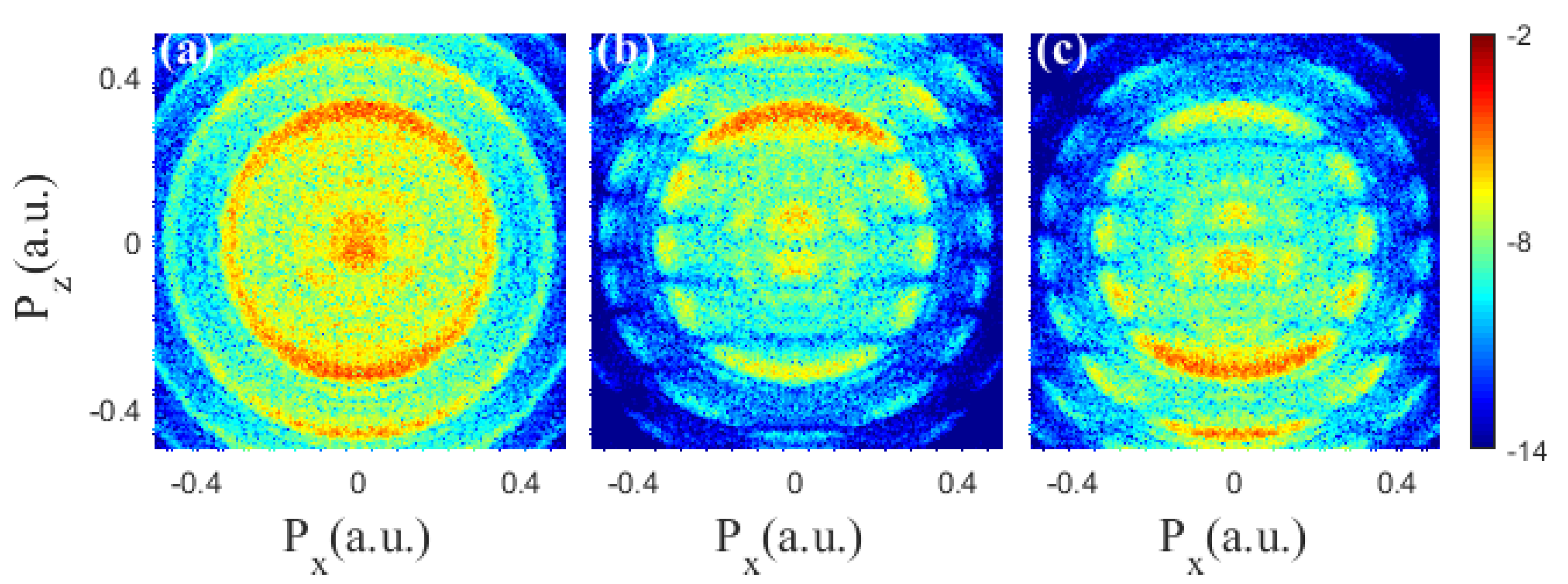
In Figure 1, we show the PMDs calculated by SFA of the Ar atom at relative phase , and respectively. The ATI circles are clearly visible with different . The PMDs show an obvious left-right symmetry regardless of the relative phase. Two of the PMDs, namely those with a relative phase difference of , exhibit up-down reversal because the addition of the weak component 2 destroys the symmetry of the laser pulse, making the PMD asymmetric along the laser polarization direction . In particular, the ATI circle moves periodically in the direction of the laser’s polarization as the relative phase changes.
Figure 1.
PMDs of Ar atom obtained by solving SFA in the parallel two—color fields with the relative phases (a), (b) and (c), respectively.
Next, we focus on the use of the generalized Bessel function to represent PP spectroscopy results directly, which we do in two ways. In the first method, we use its infinite series expansion, i.e., . In the second method, we use its tunneling-approximation form, which frequently arises in the analytical processing of strong-field processes [46]:
Here, .
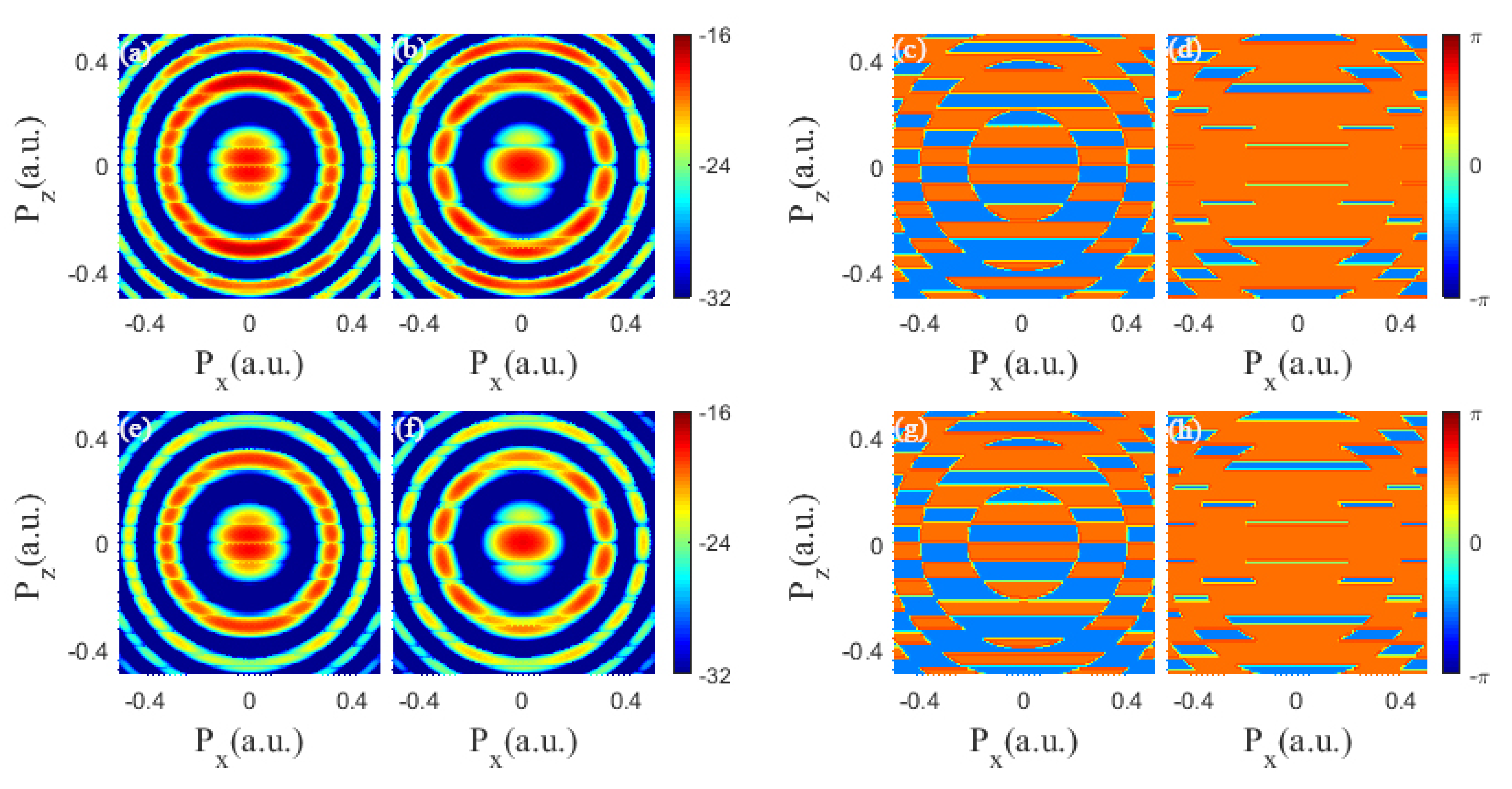
We use the above two methods to obtain the analytical results. Figure 2a,b and Figure 2e,f are the analytical first and second order RPC spectra obtained by the above different generalized Bessel functions, respectively. Figure 2c,d and Figure 2g,h are the corresponding first- and second-order PP spectra. One can see that the choice of generalized Bessel function makes almost no difference. The PMDs vary significantly with the relative phase, as shown in Figure 1. Physically, this means that the electron motion changes. The first- and second-order components of the RPC and PP spectra decouple the physical quantities of the ionization process and visualize them with attosecond accuracy. The phase value of the PP spectra can reflect the electron–ionization time delay. In general, the second-order RPC spectra is weaker than the first-order, but both show reflection symmetry around the direction of laser polarization . As the modulation of the relative phase is periodic, the RPC contains the amplitude information of the PMDs for each relative phase. The PP spectra range from − to . Structurally, there is a phase shift of at the origin of in the first-order PP spectra that corresponds to two electron emissions within half a laser cycle. The second-order PP spectra exhibit symmetry along .
Figure 2.
Top: RPC spectra (first order (a); second order (b)) obtained by infinite series expansion of the generalized Bessel function, with corresponding PP spectra [first order (c); second order (d)]; Bottom: RPC spectra (first order (e); second order (f)) obtained using the strong—field—tunneling approximation of the generalized Bessel function, with corresponding PP spectra [first order (g); second order (h)].
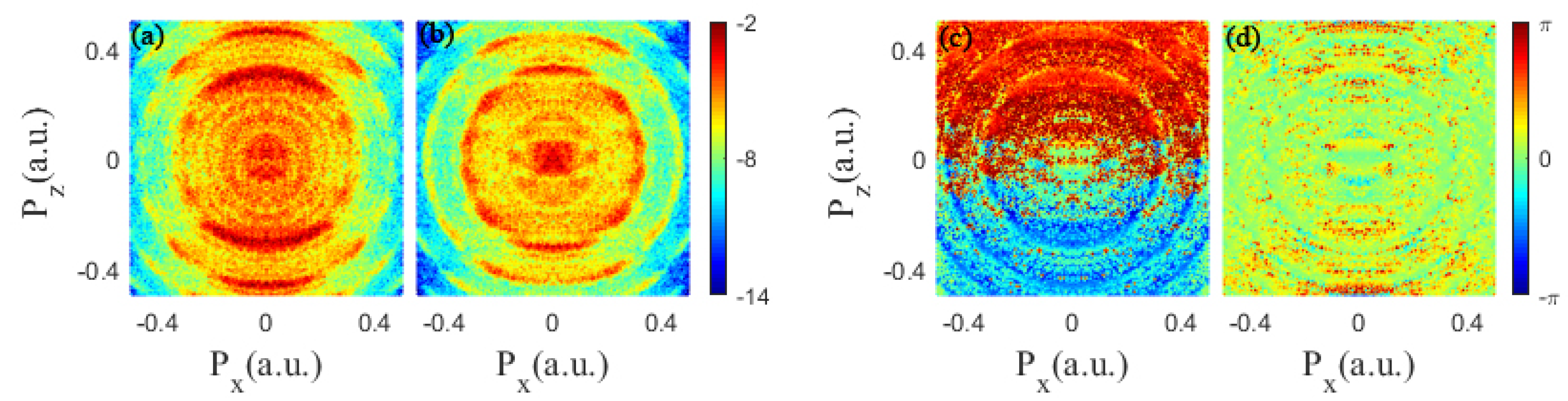
To verify the correctness of the analytical results, we show the first- and second-order RPC and PP spectra fitted by Equation (2), which are determined by a series of PMDs for various relative phases (see Figure 3). We scan the relative phases from 0 to in steps of 0.1. The fitting RPC spectra have a clear ATI ring structure, as do the analytical spectra. The analytical results contain the amplitude information of yield oscillations with phases. The phase flip characteristic of the first-order PP spectra and the phase symmetry characteristic of the second-order PP spectra on the positive and negative axis of are reflected in Figure 3c,d, respectively. However, compared with the analytical PP spectra, the fitted results have a rich high-precision structure. Two reasons explain these differences: (1) there are many parameters that determine the structure of PMDs needed for fitting, among them laser intensity I, wavelength , laser period T, and relative phase . However, T is not included in the analytical derivation, resulting in the loss of spectral information. (2) the values of , obtained by the generalized Bessel function calculation are real, and the PP cannot be represented by Equations (22) and (28). To reflect its symmetry characteristics, we set , depending on the sign of . Therefore, this treatment leads to the loss of information, and accurate extraction of physical information is very difficult to achieve. Our goal in the future will be to achieve an accurate separation of real and imaginary parts and analytically express the PP spectra of the fine structure.
Figure 3.
Left: First—order RPC (a) and PP (b) spectra obtained by fitting a series of momentum spectra with relative phase changes from 0 to ; and the other parameters were the same as Figure 1. Right: Idem, second—order RPC (c) and PP (d) spectra.
In terms of computational time, using the analytical expression is much faster than fitting. In the SFA, calculating the PMD of 20 million trajectories in a single relative phase takes nearly two days, a computation which must then be repeated for all the relative phases. By contrast, the first generalized Bessel function method takes less than 20 h, and the second only a few minutes. This proves the feasibility and superiority of solving for the RPC and PP analytically. However, many parameters in the SFA method are not reflected in the generalized Bessel function method, such as laser period and envelope shape. It is necessary to include these parameters in the analysis method in the future.
5. Conclusions
To conclude, we have used the SFA theory to study photoemission of Ar atoms in a two-color linearly polarized laser. The photoelectric yield oscillates periodically with the relative phase of the two-color field, and the underlying physical mechanism of the oscillation can be revealed by the PP spectroscopy method. Two important quantities, RPC and PP, are used to characterize the oscillations of the fitted curve. Applying the generalized Bessel function to SFA, we derive first- and second-order analytical expressions for both RPC and PP, respectively. The analytical RPC and PP spectra are consistent with the fitted results in terms of structure and strength. The analytical expressions found in this work avoid the requirement of large amounts of data for fitting, and provide a new approach to the investigation of strong field dynamics by PP spectroscopy. It is worth noting that, compared with the continuous scanning of PMD in a series of relative phases through SFA, RPC and PP can be obtained through fitting, and it is easier to directly solve the analytic expression. The time of analytical solution can be said to be negligible compared to the fitting calculation. At the same time, it is possible to obtain analytical spectra with attosecond time resolution for real-time detection and control of electronic dynamic processes.
Author Contributions
Conceptualization, W.Y.; methodology, X.H.; software, X.H.; validation, X.S.; formal analysis, X.H.; investigation, X.H.; resources, X.H.; data curation, X.H.; writing—original draft preparation, X.H.; writing—review and editing, W.Y., F.J., S.B. and X.S.; visualization, X.H.; supervision, W.Y.; project administration, W.Y.; funding acquisition, W.Y., F.J., S.B. and X.S. All authors have read and agreed to the published version of the manuscript.
Funding
This research was supported by the National Natural Science Foundation of China (Grants Nos. 12074240, 91950101, 12204135, 12204136, 12264013, and 12104285), the Hainan Provincial Natural Science Foundation of China (Grant No. 122CXTD504 and 122QN217), and the Sino-German Mobility Programme (Grant No. M-0031).
Data Availability Statement
The data that support the findings of this study are available from the corresponding authors, upon reasonable request.
Conflicts of Interest
The authors declare no conflict of interest.
Appendix A. General Properties of the Generalized Bessel Function Jn (u,v)
The generalized Bessel function is defined either by the integral form [46]
or by the equivalent infinite series representation
Here, is the ordinary Bessel function, n is the integer order, and are two arguments. To facilitate numerical calculation, the sum of Equation (A2) can be written as
for even n, or in the form
for odd n. The future direct results obtained from Equations (A1) and (A2) are
Similarly, the standard recursive relation of the generalized Bessel function can be obtained from Equations (A1) and (A2), as follows:
and
An integration by parts in Equation (A1) yields
Two important theorems can be proved from Equation (A1). One is that
which corresponds directly to the generating function relation for the Bessel functions. The other theorem is
which is analogous to Neumann’s addition theorem for the Bessel functions.
References
- Huppert, M.; Jordan, I.; Baykusheva, D.; Conta, A.V.; Worner, H.J. Attosecond Delays in Molecular Photoionization. Phys. Rev. Lett. 2016, 117, 093001. [Google Scholar] [CrossRef] [PubMed]
- Locher, R.; Castiglioni, L.; Lucchini, M.; Greif, M.; Gallmann, L.; Osterwalder, J.; Hengsberger, M.; Keller, U. Energy-dependent photoemission delays from noble metal surfaces by attosecond interferometry. Optica 2015, 2, 405–410. [Google Scholar] [CrossRef]
- Schultze, M.; Fiess, M.; Karpowicz, N.; Gagnon, J.; Korbman, M.; Hofstetter, M.; Neppl, S.; Cavalieri, A.L.; Komninos, Y.; Mercouris, T. Delay in photoemission. Science 2010, 328, 1658–1662. [Google Scholar] [CrossRef]
- Muller, H.G. Reconstruction of attosecond harmonic beating by interference of two-photon transitions. Appl. Phys. B 2014, 74, s17–s21. [Google Scholar] [CrossRef]
- Paul, P.M.; Toma, E.S.; Breger, P.; Mullot, G.; Auge, F.; Balcou, P.; Muller, H.G.; Agostini, P. Observation of a train of attosecond pulses from high harmonic generation. Science 2001, 292, 1689–1692. [Google Scholar] [CrossRef]
- Itatani, J.; Quere, F.; Yudin, G.L.; Ivanov, M.Y.; Krausz, F.; Corkum, P.B. Attosecond streak camera. Phys. Rev. Lett. 2002, 88, 173903. [Google Scholar] [CrossRef]
- Zuo, R.X.; Trautmann, A.; Wang, G.; Hannes, W.R.; Yang, S.; Song, X.H.; Meier, T.; Ciappina, M.; Duc, H.T.; Yang, W.F. Mapping band structures with neighboring-atom-collisions in solid high harmonic generation. Ultrafast Sci. 2021, 2021, 9861923. [Google Scholar] [CrossRef]
- Zhang, C.J.; Yang, W.F.; Song, X.H.; Xu, Z.Z. Carrier-envelope phase dependence of the spectra of reflected few-cycle laser pulses in the presence of a static electric field. Phys. Rev. A 2009, 79, 043823. [Google Scholar]
- Yang, W.F.; Gong, S.Q.; Niu, Y.P.; Jin, S.Q.; Xu, Z.Z. Enhancement of four-wave mixing induced by interacting dark resonances. J. Phys. B At. Mol. Opt. 2005, 38, 2657. [Google Scholar]
- Song, X.H.; Gong, S.Q.; Yang, W.F.; Jin, S.Q.; Feng, X.L.; Xu, Z.Z. Coherent control of spectra effects with chirped femtosecond laser pulse. Opt. Commun. 2004, 236, 151. [Google Scholar]
- Eicke, N.; Brennecke, S.; Lein, M. Attosecond-Scale Streaking Methods for Strong-Field Ionization by Tailored Fields. Phys. Rev. Lett. 2020, 124, 043202. [Google Scholar] [CrossRef]
- Klunder, K.; Dahlstrom, J.M.; Gisselbrecht, M.; Fordell, T.; Swoboda, M.; Guenot, D.; Johnsson, P.; Caillat, J.; Mauritsson, J.; Maquet, A. Probing single-photon ionization on the attosecond time scale. Phys. Rev. Lett. 2011, 106, 143002. [Google Scholar] [CrossRef]
- Eckle, P.; Pfeiffer, A.N.; Cirelli, C.; Staudte, A.; Dorner, R.; Muller, H.G.; Buttiker, M.; Keller, U. Attosecond lonization and Tunneling Delay Time Measurements in Helium. Science 2008, 322, 1525–1529. [Google Scholar] [CrossRef]
- Kraus, P.M.; Tolstikhin, O.I.; Baykusheva, D.; Rupenyan, A.; Schneider, J.; Bisgaard, C.Z.; Morishita, T.; Jensen, F.; Madsen, L.B.; Wörner, H.J. Observation of laser-induced electronic structure in oriented polyatomic molecules. Nat. Commun. 2015, 6, 7039. [Google Scholar] [CrossRef]
- Zherebtsov, S.; Süßmann, F.; Peltz, C.; Plenge, J.; Betsch, K.J.; Znakovskaya, I.; Alnaser, A.S.; Johnson, N.G.; Kübel, M.; Horn, A.; et al. Carrier–envelope phase-tagged imaging of the controlled electron acceleration from SiO2 nanospheres in intense few-cycle laser fields. New J. Phys. 2012, 14, 075010. [Google Scholar] [CrossRef]
- Neppl, S.; Ernstorfer, R.; Cavalieri, A.L.; Lemell, C.; Wachter, G.; Magerl, E.; Bothschafter, E.M.; Jobst, M.; Hofstetter, M.; Kleineberg, U.; et al. Direct observation of electron propagation and dielectric screening on the atomic length scale. Nature 2015, 517, 342–346. [Google Scholar] [CrossRef]
- Würzler, D.; Eicke, N.; Möller, M.; Seipt, D.; Sayler, A.M.; Fritzsche, S.; Lein, M.; Paulus, G.G. Velocity map imaging of scattering dynamics in orthogonal two-color fields. J. Phys. B At. Opt. Phys. 2018, 5, 015001. [Google Scholar] [CrossRef]
- Zipp, L.J.; Natan, A.; Bucksbaum, P.H. Probing electron delays in above-threshold ionization. Optica 2014, 1, 361–364. [Google Scholar] [CrossRef]
- Natan, A.; Zipp, L.J.; Bucksbaum, P.H. Disentangling Ionization Processes by Two-Color Phase Contrast Strong Field Photoelectron Spectroscopy. In Proceedings of the International Conference on Ultrafast Phenomena (© OSA, 2016; p. UM2B.6.), Santa Fe, NM, USA, 17–22 July 2016. [Google Scholar]
- Skruszewicz, S.; Tiggesbaumker, J.; Meiwes-Broer, K.H.; Arbeiter, M.; Fennel, T.; Bauer, D. Two-Color Strong-Field Photoelectron Spectroscopy and the Phase of the Phase. Phys. Rev. Lett. 2015, 115, 043001. [Google Scholar] [CrossRef]
- Tan, J.; Zhou, Y.; Xu, S.; Ke, Q.; Liang, J.; Ma, X.; Cao, W.; Li, M.; Zhang, Q.; Lu, P. Analyzing the electron trajectories in strong-field tunneling ionization with the phase-of-the-phase spectroscopy. Opt. Express 2021, 29, 37927–37944. [Google Scholar] [CrossRef]
- Tulsky, V.A.; Krebs, B.; Tiggesbäumker, J.; Bauer, D. Revealing laser-coherent electron features using phase-of-the-phase spectroscopy. J. Phys. B At. Mol. Opt. 2020, 53, 074001. [Google Scholar] [CrossRef]
- Henkel, J.; Lein, M. Analysis of electron trajectories with two-color strong-field ionization. Phys. Rev. A 2015, 92, 013422. [Google Scholar] [CrossRef]
- Tan, J.; Zhou, Y.; He, M.; Chen, Y.; Ke, Q.; Liang, J.; Zhu, X.; Li, M.; Lu, P. Determination of the Ionization Time Using Attosecond Photoelectron Interferometry. Phys. Rev. Lett. 2018, 121, 253203. [Google Scholar] [CrossRef] [PubMed]
- Braß, J.; Milbradt, R.; Villalba-Chávez, S.; Paulus, G.G.; Müller, C. Two-color phase-of-the-phase spectroscopy applied to nonperturbative electron-positron pair production in strong oscillating electric fields. Phys. Rev. A 2020, 101, 043401. [Google Scholar] [CrossRef]
- Tulsky, V.A.; Almajid, M.A.; Bauer, D. Two-color phase-of-the-phase spectroscopy with circularly polarized laser pulses. Phys. Rev. A 2018, 98, 053433. [Google Scholar] [CrossRef]
- Würzler, D.; Skruszewicz, S.; Sayler, A.M.; Zille, D.; Möller, M.; Wustelt, P.; Zhang, Y.; Tiggesbäumker, J.; Paulus, G.G. Accurate retrieval of ionization times by means of the phase-of-the-phase spectroscopy, and its limits. Phys. Rev. A 2020, 101, 033416. [Google Scholar] [CrossRef]
- Tan, J.; Li, Y.; Zhou, Y.; He, M.; Chen, Y.; Li, M.; Lu, P. Identifying the contributions of multiple-returning recollision orbits in strong-field above-threshold ionization. Opt. Quantum Electron. 2018, 50, 57. [Google Scholar] [CrossRef]
- Gong, X.C.; Lin, C.; He, F.; Song, Q.Y.; Lin, K.; Ji, Q.Y.; Zhang, W.B.; Ma, J.Y.; Lu, P.F.; Liu, Y.Q.; et al. Energy-resolved ultrashort delays of photoelectron emission clocked by orthogonal two-color laser fields. Phys. Rev. Lett. 2017, 118, 143203. [Google Scholar] [CrossRef]
- Song, X.H.; Shi, G.L.; Zhang, G.J.; Xu, J.W.; Lin, C.; Chen, J.; Yang, W.F. Attosecond time delay of retrapped resonant ionization. Phys. Rev. Lett. 2018, 121, 103201. [Google Scholar] [CrossRef]
- Krebs, B.S.; Tulsky, V.; Kazak, L.; Zabel, M.; Bauer, D.; Tiggesbaumker, J. Phase-of-the-Phase Electron Momentum Spectroscopy on Single Metal Atoms in Helium Nanodroplets. J. Phys. Chem. Lett. 2022, 13, 1526–1532. [Google Scholar] [CrossRef]
- Liu, X.W.; Zhang, G.J.; Li, J.; Shi, G.L.; Zhou, M.Y.; Huang, B.Q.; Tang, Y.J.; Song, X.H.; Yang, W.F. Deep Learning for Feynman’s Path Integral in Strong-Field Time-Dependent Dynamics. Phys. Rev. Lett. 2020, 124, 113202. [Google Scholar] [CrossRef]
- Huo, X.Q.; Yang, W.F.; Dong, W.H.; Jin, F.C.; Liu, X.W.; Zhang, H.D.; Song, X.H. Review on typical applications and computational optimizations based on semiclassical methods in strong-field physics. Chin. Phys. B 2022, 31, 033101. [Google Scholar] [CrossRef]
- Almajid, M.A.; Zabel, M.; Skruszewicz, S.; Tiggesbäumker, J.; Bauer, D. Two-color phase-of-the-phase spectroscopy in the multiphoton regime. J. Phys. B At. Mol. Opt. 2017, 50, 194001. [Google Scholar] [CrossRef]
- Bauer, D.; Milošević, D.B.; Becker, W. On the validity of the strong field approximation and simple man’s theory. J. Mod. Opt. 2006, 53, 135–147. [Google Scholar] [CrossRef]
- Bauer, D.; Milošević, D.B.; Becker, W. Strong-field approximation for intense-laser–atom processes: The choice of gauge. Phys. Rev. A 2005, 72, 023415. [Google Scholar] [CrossRef]
- Milošević, D.B.; Paulus, G.G.; Bauer, D.; Becker, W. Above-threshold ionization by few-cycle pulses. J. Phys. B At. Mol. Opt. Phys. 2006, 39, R203–R262. [Google Scholar] [CrossRef]
- Popruzhenko, S.V. Keldysh theory of strong field ionization: History, applications, difficulties and perspectives. J. Phys. B At. Mol. Opt. Phys. 2014, 47, 204001. [Google Scholar] [CrossRef]
- Feng, Y.D.; Li, M.; Luo, S.Q.; Liu, K.; Du, B.J.; Zhou, Y.M.; Lu, P.X. Semiclassical analysis of photoelectron interference in a synthesized two-color laser pulse. Phys. Rev. A 2019, 100, 063411. [Google Scholar] [CrossRef]
- Bauer, D.; Koval, P. Qprop: A Schrödinger-solver for intense laser–atom interaction. Comput. Commun. 2006, 174, 396–421. [Google Scholar] [CrossRef]
- Cormier, E.; Lambropoulos, P. Above-threshold ionization spectrum of hydrogen using B-splinefunctions. J. Phys. B At. Mol. Opt. Phys. 1997, 30, 77–91. [Google Scholar] [CrossRef]
- Mosert, V.; Bauer, D. Photoelectron spectra with Qprop and t-SURFF. Comput. Physics Commun. 2016, 207, 452–463. [Google Scholar] [CrossRef]
- Jašarević, A.; Hasović, E.; Kopold, R.; Becker, W.; Milošević, D.B. Application of the saddle-point method to strong-laser-field ionization. J. Phys. A Math. Theor. 2020, 53, 125201. [Google Scholar] [CrossRef]
- Bauer, J. Comment on ‘Generalized Bessel functions in tunnelling ionization’. J. Phys. A Math. Gen. 2005, 38, 521–525. [Google Scholar] [CrossRef]
- Reiss, H.R.; Krainov, V.P. Generalized Bessel functions in tunnelling ionization. J. Phys. A Math. Gen. 2003, 36, 5575–5585. [Google Scholar] [CrossRef]
- Reiss, H.R. Effect of an intense electromagnetic field on a weakly bound system. Phys. A 1980, 22, 1786–1813. [Google Scholar] [CrossRef]
- Reiss, H.R.; Krainov, V.P. Further ‘comment on ‘Generalized Bessel functions in tunnelling ionization”. J. Phys. A Math. Gen. 2005, 38, 527–529. [Google Scholar] [CrossRef]
- Vanne, Y.V.; Saenz, A. Quasistatic limit of the strong-field approximation describing atoms and molecules in intense laser fields. Phys. Rev. A 2007, 75, 063403. [Google Scholar] [CrossRef]
- Jin, F.C.; Tian, Y.Y.; Chen, J.; Yang, Y.J.; Liu, X.J.; Yan, Z.C.; Wang, B.B. Nonsequential double ionization of helium in IR+XUV two-color laser fields: Collision-ionization process. Phys. Rev. A 2016, 93, 043417. [Google Scholar] [CrossRef]
- Jin, F.C.; Yang, H.H.; Zhang, H.D.; Wang, B.B.; Yang, W.F. Influence of polarization directions of the IR+XUV two-color laser fields on angle-resolved photoelectron energy spectrum. Opt. Express 2021, 29, 10726–10736. [Google Scholar] [CrossRef] [PubMed]
- Long, S.; Becker, W.; McIver, J.K. Model calculations of polarization-dependent two-color high-harmonic generation. Phys. Rev. A 1995, 52, 3. [Google Scholar] [CrossRef]
- Milošević, D.B.; Ehlotzky, F.; McIver, J.K. Electron-atom ionizing collisions in the presence of a bichromatic laser field. Phys. Rev. A 1997, 56, 5. [Google Scholar] [CrossRef]
- Milošević, D.B.; Ehlotzky, F. S-matrix theory of above-threshold ionization in a bichromatic laser field. J. Phys. B At. Mol. Opt. 1999, 32, 1585–1596. [Google Scholar] [CrossRef]
- Pazdzersky, V.A.; Koval’, A.V. Angular photoelectron spectra for atom ionization in an intense two-colour laser field. J. Phys. B At. Mol. Opt. 2005, 38, 3945–3952. [Google Scholar] [CrossRef]
- Al-Jarrah, A.; Dempsey, K.M.; Glasser, M.L. Generalized series of Bessel functions. J. Comput. Appl. Math. 2002, 143, 1–8. [Google Scholar] [CrossRef]
- Cesarano, C.; Assante, D. A note on Generalized Bessel Functions. Int. J. Math. Model. Methods Appl. Sci. 2013, 7, 625–629. [Google Scholar]
- Dattoli, G.; Chiccoli, C.; Lorenzutta, S.; Maino, G.; Torre, A. Generalized Bessel Functions and Generalized Hermite Polynomials. J. Math. Anal. Appl. 1993, 178, 509–516. [Google Scholar] [CrossRef]
- Dattoli, G.; Giannessi, L.; Mezi, L.; Torre, A. Theory of Generalized Bessel Functions. Nuovo C. B 1990, 105, 327–348. [Google Scholar] [CrossRef]
- Hu, X.; Wang, H.; Guo, D.S. Phased Bessel functions. Can. J. Phys. 2008, 86, 863–870. [Google Scholar] [CrossRef]
- Korsch, H.J.; Klumpp, A.; Witthaut, D. On two-dimensional Bessel functions. J. Phys. A Math. Gen. 2006, 39, 14947–14964. [Google Scholar] [CrossRef]
Publisher’s Note: MDPI stays neutral with regard to jurisdictional claims in published maps and institutional affiliations. |
© 2022 by the authors. Licensee MDPI, Basel, Switzerland. This article is an open access article distributed under the terms and conditions of the Creative Commons Attribution (CC BY) license (https://creativecommons.org/licenses/by/4.0/).