Article

Synthetic Data Generator for Solving Korean Arithmetic Word Problem

Department of Computer Engineering, Chosun University, Gwangju 61452, Korea
*
Author to whom correspondence should be addressed.
Mathematics 2022, 10(19), 3525; https://doi.org/10.3390/math10193525
Submission received: 29 August 2022 / Revised: 21 September 2022 / Accepted: 22 September 2022 / Published: 27 September 2022

Abstract

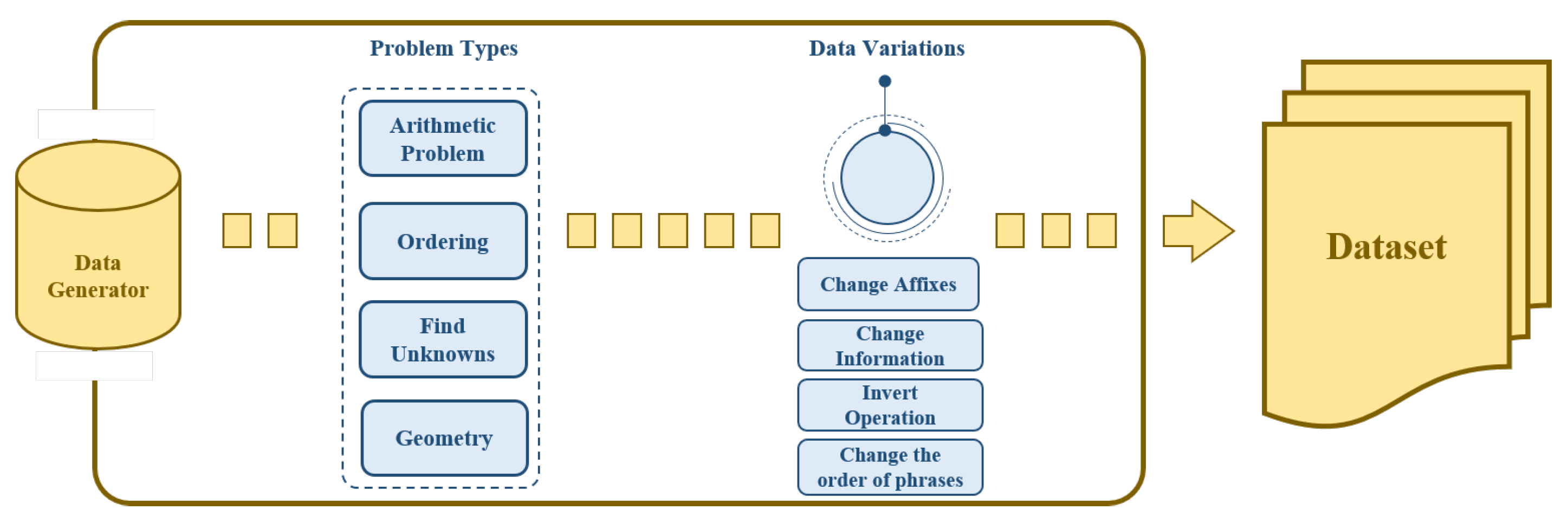
A math word problems (MWPs) comprises mathematical logic, numbers, and natural language. To solve these problems, a solver model requires an understanding of language and the ability to reason. Since the 1960s, research on the design of a model that provides automatic solutions for mathematical problems has been continuously conducted, and numerous methods and datasets have been published. However, the published datasets in Korean are insufficient. In this study, we propose a Korean data generator for the first time to address this issue. The proposed data generator comprised problem types and data variations. Moreover, it has 4 problem types and 42 subtypes. The data variation has four categories, which adds robustness to the model. In total, 210,311 pieces of data were used for the experiment, of which 210,000 data points were generated. The training dataset had 150,000 data points. Each validation and test dataset had 30,000 data points. Furthermore, 311 problems were sourced from commercially available books on mathematical problems. We used these problems to evaluate the validity of our data generator on actual math word problems. The experiments confirm that models developed using the proposed data generator can be applied to real data. The proposed generator can be used to solve Korean MWPs in the field of education and the service industry, as well as serve as a basis for future research in this field.
Keywords: math word problem; natural language processing; Korean data generator; Transformer; machine learning math word problem; natural language processing; Korean data generator; Transformer; machine learning