Abstract
An adaptive fuzzy iterative learning control (ILC) algorithm is designed for the iterative variable reference trajectory problem of nonlinear discrete-time systems with input saturations and unknown control directions. Firstly, an adaptive fuzzy iterative learning controller is constructed by combining with the fuzzy logic system (FLS), which can compensate the loss caused by input saturation. Then, the discrete Nussbaum gain technique is adopted along the iteration axis, which can be embedded to the learning control method to identify the control direction of the system. Finally, based on the nonincreasing Lyapunov-like function, it is proven that the adaptive iterative learning controller can converge asymptotically when the number of iterations tends to infinity, and the system signals always remain bounded in the learning process. A simulation example verifies the feasibility and effectiveness of the learning control method.
Keywords:
adaptive fuzzy iterative learning control; saturated input; unknown control direction; discrete Nussbaum gain; fuzzy logic system (FLS) MSC:
93B47
1. Introduction
In the practical system of industrial production, the system input always encounters saturation constraints to some extent, leading to an undesirable control effect. For example, due to the physical limitations of the control torque gyroscope, reaction flywheel, and reaction thruster of the spacecraft actuator, an input saturation problem always exists in the spacecraft attitude control system [1], the control rudder surface is constrained by physical devices and the deflection angle is limited when the fighter is performing large maneuvers [2], and so on. Some nonlinear dynamic inversion methods have been developed to deal with the nonaffine pure-feedback nonlinear systems with input saturations [3]. Using neural network to estimate nonlinear function, reference [4] introduced command filtering technology to solve the problem of “computational complexity” in traditional backstepping, and introduced a compensation mechanism to solve the problem of filtering error and reduces the impact of input saturation. A novel input saturated control approach is proposed in [5] based on the Kalman filter framework. For the quadrotor unmanned aerial vehicles, which has bounded uncertainties and input constraints, a novel adaptive barrier function-based nonsingular terminal sliding mode control approach is proposed in [6]. Moreover, some novel adaptive control methods were proposed for the systems with nonlinear input characteristics, such as the riser systems [7,8], the flexible string systems [9], and the nonlinear fractional order multi-agent systems [10]. Additionally, researchers have paid much attention to the actuator failure problem, with fruitful results [11,12,13].
In reality, the control direction of the control system is often affected by various uncertain factors, and the control direction affects the operation direction of the system. Therefore, the control direction has a great impact on the control performance. Many systems cannot know their control direction in advance, such as flexible manipulators in [14] and the hypersonic vehicles in [15], so it is very crucial to design the correct identification method of control direction. For the systems with unknown control directions, a Nussbaum gain technique-based adaptive fuzzy control has been introduced to address the tracking control of multi agent systems in [16]. With the help of the Nussbaum gain technique, a filter-based recursive tracker was developed in [17].
At the same time, many systems in the real process operate repeatedly. For example, the expressway ramp system in [18], the electromechanical servo system in [19], and parametric nonlinear system in [20]. However, the repeatability is not taken into account in the above literatures [3,4,5,6,7,8,9,10,11,12,13,14,15,16,17]. Up to now, many scholars have applied iterative learning contro (ILC) to solve the tracking control of repeated systems with saturation constraints, because of the leaning ability and simple structure of ILC. For linear systems with saturation constraints, as in references [21,22], the problem can be transformed into a linear constrained quadratic programming problem and a convex quadratic programming problem. For nonlinear systems, the authors in [13,14,15,16,17,18,19,20,21,22,23,24,25] designed adaptive ILC schemes by introducing saturation functions. The speed trajectory tracking problem for high-speed trains with input saturations is solved by an adaptive ILC in [26]. An adaptive ILC controller is designed based on the command filter adaptive backstepping method, where an auxiliary system is established to overcome the control difficulty caused by input saturation [27]. Considering the iteration and time dependent constraint, the authors have designed a novel adaptive ILC to achieve the leader-follower formation tracking control of the nonlinear multi agent systems [28]. In addition, a constrained ILC was designed for the high-speed rack feeder, which subject to the saturation characteristic [24]. The ILC methods proposed in [21,22,23,24,25,26,27,28,29] have achieved good control results in different systems, but they require control direction information in controller design or convergence analysis. Therefore, they are not always feasible for systems with unknown control directions.
The Nussbaum gain technique is the main method to solve the ILC problem in systems with unknown control directions. After the concept of continuous-time Nussbaum gain was proposed in [30], scholars have designed several adaptive ILC algorithms based on Nussbaum gain technique for parameterized nonlinear systems with unknown control directions [31,32,33,34,35]. After the Nussbaum gain concept was extended to discrete-time systems in [36], Yu et al. used the n-step prediction method to estimate the future states of the system, then established the corresponding adaptive ILC method to settle the unknown control direction [37]. For nonparametric nonlinear systems, in addition to transforming the systems to compact structures, the adaptive ILC developed to the systems with unknown control directions discussed not only the randomly varying initial errors, but also the randomly varying reference trajectories [38,39]. However, the systems considered in the above adaptive ILC methods have neglected the input saturations of the real systems.
In this study, the iterative variable reference trajectory problem for nonlinear discrete-time systems with input saturation and unknown control direction is discussed, analyzed, and verified. Firstly, an adaptive fuzzy iterative learning controller is designed, which consist of the adaptive item and fuzzy logic system (FLS) to compensate the loss caused by input saturation. Then, the Nussbaum gain technique is adopted in the iteration domain and embedded to the adaptive learning algorithm to identify the control direction of the system. Finally, using the nonincreasing Lyapunov-like function, we show that the adaptive iterative learning controller can make the tracking error converge asymptotically when the number of iterations tends to infinity, and the system signals always remain bounded in the learning process. To the best of our knowledge, this is the first time to discuss the adaptive ILC design for the nonlinear systems with saturated inputs and unknown control directions. Moreover, several uncertain varying factors, including random iterative initial errors, iteration-varying reference trajectories, and external disturbances, are investigated. Therefore, the adaptive fuzzy ILC design proposed in this study has a wide range of practical scenarios. A simulation example validates the feasibility and effectiveness of the learning control method.
2. Problem Description
2.1. System Model and Input Saturation Model
Consider the following ILC problem for nonlinear discrete-time systems with input saturation:
where and refer to the number of iterations and discrete-time instants, respectively. For , correspond to the system state vectors, and are unknown nonlinear functions, and , , represent the system input, output, and external disturbance, respectively. In addition, there exists an unknown constant that makes . That is to say, the iteration-varying is a bounded exteral disturbance. The saturated input model is given as:
where is the input to the saturated nonlinearity and μ is a specific boundary value that determines the upper limit of the control signal. It comes from physical constraints or artificial limiters.
It is assumed that the nonlinear SISO system (1) with input saturation (2) needs to track the iterative variable trajectory on The purpose of this study is to propose an adaptive fuzzy ILC method to determine the control signal , so that the plant (1) under randomly initial error can still track the randomly varying trajectory on when the number of iteration approaches to infinity.
Remark 1.
It can be seen from the nonlinear SISO system (1) that the system input cannot determine or influence the output at the initial time until t ≥ m. Therefore, the tracking on instants is not included in our control objective.
Assumption 1.
Let ; for each fixed t∈{0, 1, …, Tm}, not only do we not know the control gain , but we also do not know the sign of its value. However, for all k, the sign is iteratively invariant and there are two constants , such that:
Remark 2.
In fact, in many real dynamic systems, the control gains are bounded. Except for , the unknown nonlinear functions appearing in the system dynamics are not affected by a restriction such as the one in (3). Therefore, it is generally assumed that the control gain with the iteration-invariant feature of the control direction is bounded in adaptive ILC literatures [23,24,25,26,27,28,29]. Different from this kind of literature [23,24,25,26,27,28,29], the control direction of this study is unknown, so the key to completing the tracking task is to correctly identify the control direction.
2.2. Nussbaum Gain Function
Let is a discrete sequence, then:
where the constant T0 is positive. Based on the sequence {w(k)}, the discrete Nussbaum gain function F(w(k)) is defined as:
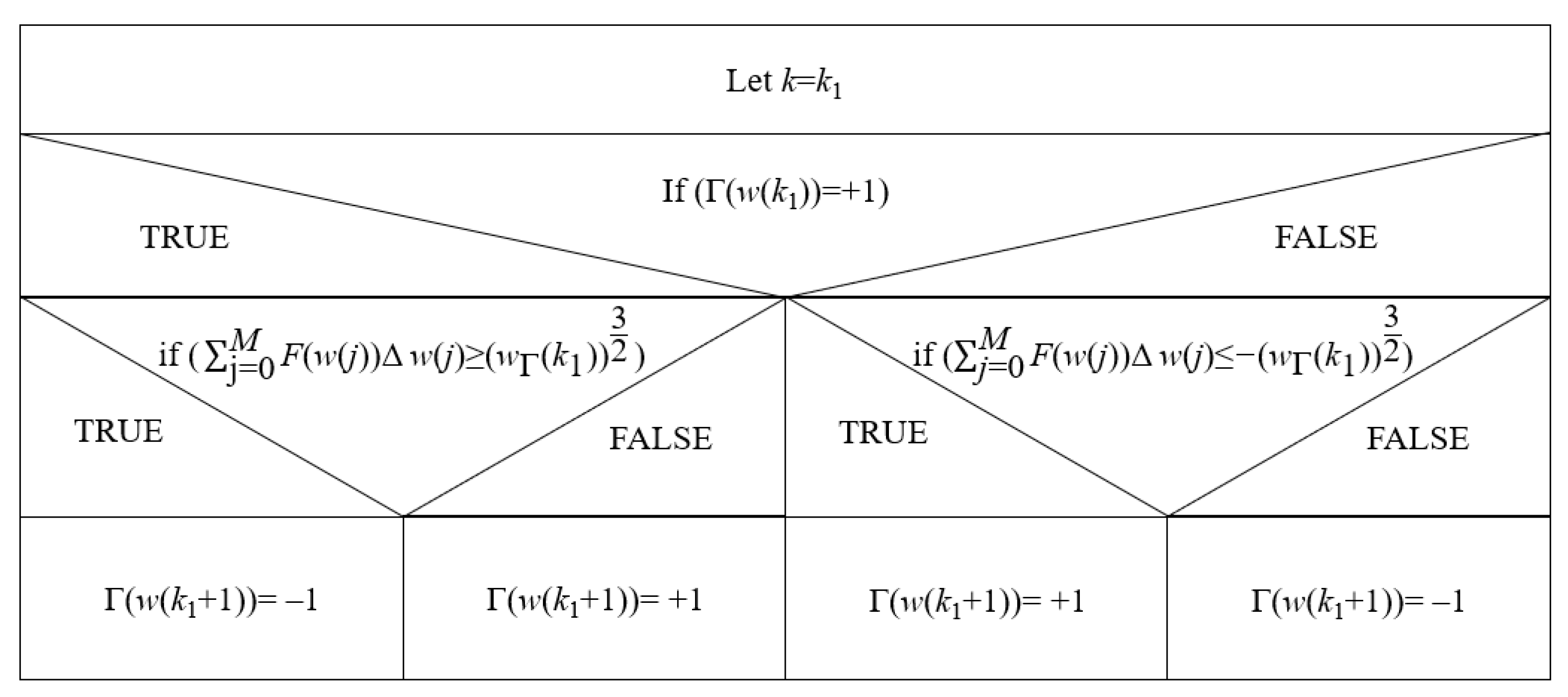
where . Γ(w(k)) is a sign function, either take 1 or take −1, and the default initial value is 1. Then, the value of Γ(w(k)) is determined by the following algorithm described in Figure 1.
w(0) = 0, w(k) ≥ 0, |Δw(k)| = |w(k+1) − w(k)| ≤ T0, (k = 0, 1, …)
Figure 1.
The selection law of Γ(w(k)).
When k→+∞, it can be found from the definition (5) of discrete Nussbaum gain F(w(k)) and the selection law of Γ(w(k)) that if the sequence {w(k)} is convergent, the discrete Nussbaum gain F(w(k)) converges to a constant [38]. Therefore, the control direction can be recognized by the sign of the discrete Nussbaum gain F(w(k)).
2.3. Approximation Based on Fuzzy Systems
The knowledge base constructed by the fuzzy reasoning rule set is as follows [40]:
where the input of FLS is z = [z1 z2 … zq]T ∈ Ωz ⊂ Rq, and the output is ∈ R. Fuzzy sets Bij and Dj (i = 1,2, …,q, j = 1,2, …, M) correspond to fuzzy membership functions and respectively. M refers to the fuzzy rules number.
FLS with single valued fuzzification, product inference engine, and central average defuzzifier can be expressed as:
where and W = [w1 w2 … wM]T represents the parameter vector; S(z) = [s1(z) s2(z) … sM(z)]T denotes the fuzzy basis function vector.
Obviously, based on the definition in (6), we obtain:
where .
Reference [40] proved that for any given compact set and any
> 0, continuous nonlinear function p(z), there exists the following FLS form:
2.4. The System Transformation
In order to facilitate the design of adaptive fuzzy ILC controllers for systems with input saturation and unknown control direction, the nonlinear SISO system (1) is rewritten and deformed as:
where , and can refer to Appendix A of [39]. and have the same range for i = 1,2, …, 𝑚 − 1. Therefore, the boundedness of can be achieved from Assumption 1. Moreover, due to the boundedness of the external disturbance , the boundedness of is guaranteed. That is to say, there exists a constant such that:
Substitute (2) into (8), we obtain:
where:
Define:
From (11) and (2):
Clearly, it can be known that μ in (2) and 0 < ≤ |q(t,k)| ≤ in (3) are bounded, so that, when , is nonzero and bounded. Moreover, according to (12), and have the same sign.
3. Adaptive Fuzzy ILC Design and Analysis
In order to carry out the design of the adaptive fuzzy ILC controller, first, we define the tracking error as , according to (8):
If in input saturation (2) and no external disturbance exist in system (1) with . As a result, we obtain 0. In addition, on the basis of (12), we have:
Using the implicit function theorem, there exists the ideal control signal as follows:
where . According to (13) and (15), when and , we can obtain:
However, due to the unknown characteristics of , , and μ related in the input saturation (2), the ideal control signal cannot be obtained, so FLS is used to approximate it.
For the established FLS, , , and denote fuzzy basic function vector, the optimal fuzzy parameter vector, and approximation error, respectively. Since the optimal fuzzy parameter vector in (16) is unknown, , which denotes the estimation of at the k-th iteration, is used to estimate iteratively. Based on the framework of (16), the adaptive fuzzy ILC law is appropriately designed as:
where represents the estimation of , which is set in (20). Next, and are used to represent the estimation error of the k-th iteration of and .
According to (15) and the mean difference value theorem, (13) is transformed to:
is defined in (12) and , .
Define ; thus, with the help of the boundedness of , we have two unknown constants and that meet
Remark 3.
In allusion to the description in Section 2.4, although the signs of in (16) and are unknown, they have the same constant sign for every as . Therefore, in the proposed adaptive fuzzy ILC algorithm, the discrete Nussbaum gain technique can be applied to recognize the unknown sign of , so as to determine the sign of .
Substituting (16) and (17) into (18), we obtain:
where , due to , , in (3), in (2) and in (9), we can obtain:
Therefore:
where refers to the definition of as , and is an unknown constant. Here, we can easily find from the definition that is an unknown constant related to saturated input (2). An additional adaptive term in the control signal in the fuzzy controller (17) is used to estimate , thus compensating for the influence of the saturated input (2).
For the fuzzy controller (17), when k = 0,1,2, …, the parameter adaptive law is designed as:
where , .
where .
where .
Among them, the design parameter is a constant. The discrete Nussbaum gain is updated in the iterative direction at time . > 0 is the threshold of in (28). That is, only if , then the adaptive update laws (22)–(24) will be carried out. M is the number of fuzzy rules in (16). With (24), (26) and (27), there is:
From (28) and (27), we can obtain:
Therefore, is a discrete Nussbaum gain relative to k according to (4).
Theorem 1.
For the nonparametric nonlinear SISO system (1) with input saturation (2) and unknown control direction, design the adaptive fuzzy ILC controller (17) and the adaptive update laws (22)–(28), then, under assumption 1, we can ensure that:
(1) When, the ILC tracking errorcan converge to a small region around zero as, that is:
where the design parameter> 0 and the threshold>0 are defined in the adaptive update laws (22)–(28), and.
(2) The discrete Nussbaum gain will eventually converge to a function relative to t, meanwhile, all system signals remain bounded.
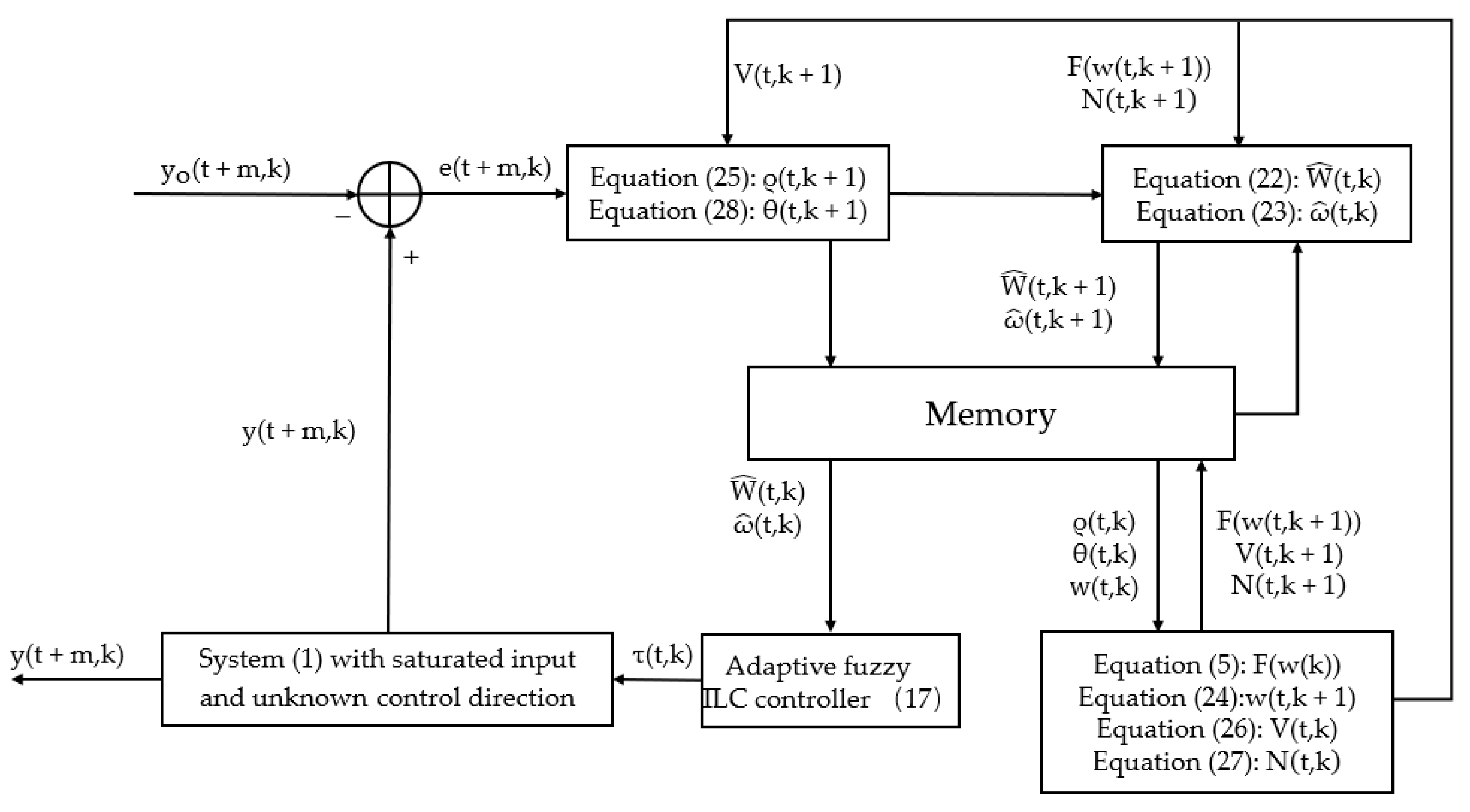
The Proof of Theorem 1 is presented in the Appendix A, and the control block diagram is given in Figure 2.
Figure 2.
Control block diagram.
Remark 4.
Theorem 1 indicates that the bounded convergence of the tracking error : can be achieved. Obviously, the size of the convergence boundary of is determined by the design parameter, , the given threshold , and . Therefore, for the adaptive ILC scheme in practical application, the choice of control parameters and is balanced between the control parameters , , and FLSto achieve better tracking profiles. In addition, the size of the convergence boundary of tracking error is also influenced by the external disturbance and the established FLS.
4. Simulation Results
In this section, one example is applied to illustrate the applicability of the obtained adaptive fuzzy ILC. Considering the existence of input saturation and unknown control direction in system (1), we have:
where , is the iteration variable external disturbance. The saturation input is constructed as:
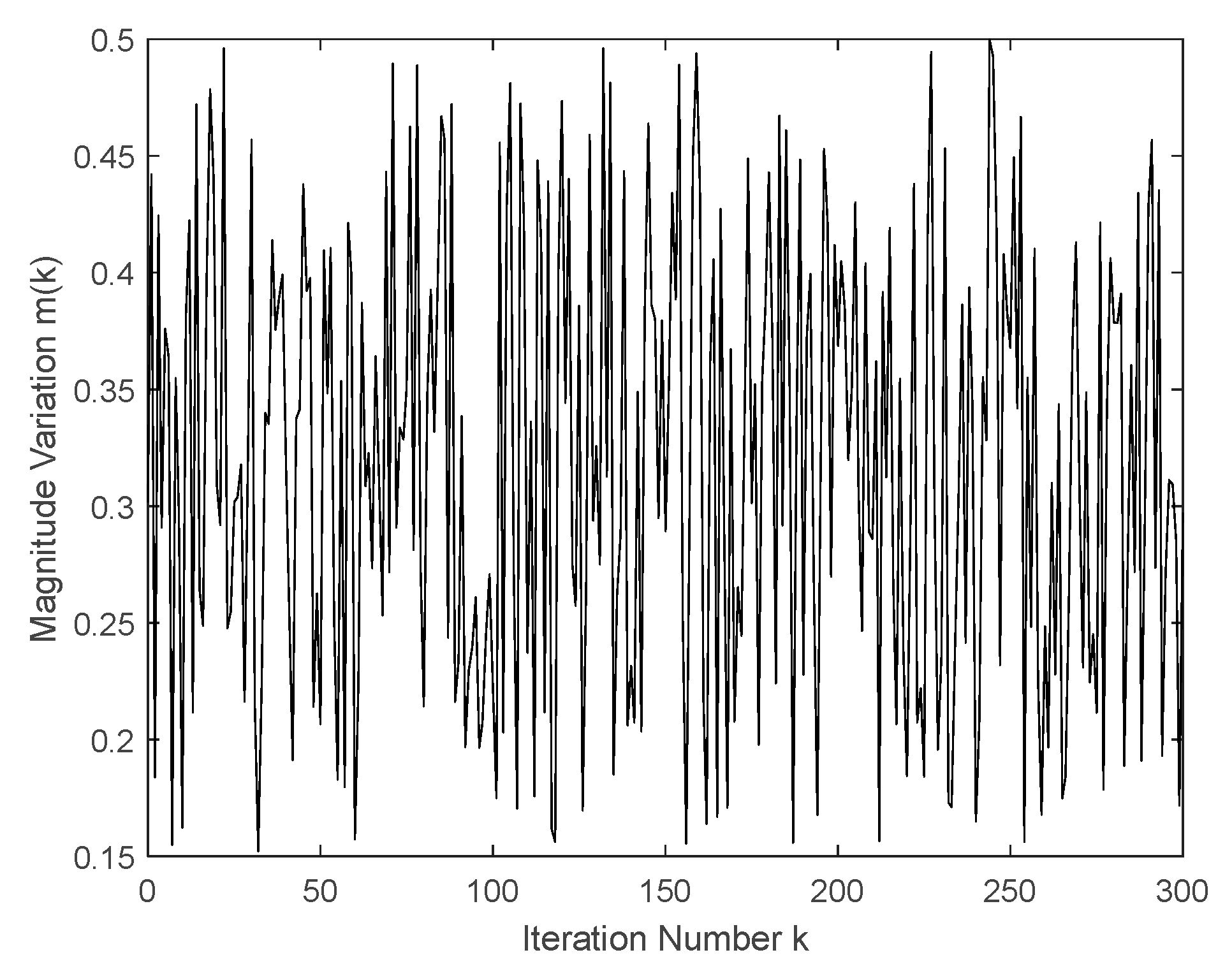
where . The saturation model (32) is only used for simulation, and will be unknown for the designer. The iterative variable reference trajectory of system (31) is , For more details, we can see from Figure 3. The initial states . It should be checked that the initial errors will change iteratively when the reference trajectories vary randomly.
Figure 3.
The randomly varying factor m(k) in .
One can conclude with the nonlinear discrete-time system (31) that and . Accordingly, we have . While from the definition of the Nussbaum gain function in (5), we can obtain that the default initial value of the sign function in is , , although according to in (24). Therefore, we can find that the initial sign of the Nussbaum gain function of is opposite to the real control direction of the controlled system (31).
In the following simulations, the developed adaptive fuzzy ILC controller (17) with adaptive updating laws (22)–(28) is used to complete the tracking tasks of system (31) with input saturation (32) and unknown control direction. In terms of Theorem 1, the design parameters and are taken as and . Meanwhile, the number of FLS rules is M = 5, the corresponding input vector is . Therefore, the FLS in (17) is constructed as , the membership functions corresponding to the input are as follows:
The following tracking error square sum index is used to evaluate the accuracy of ILC tracking:
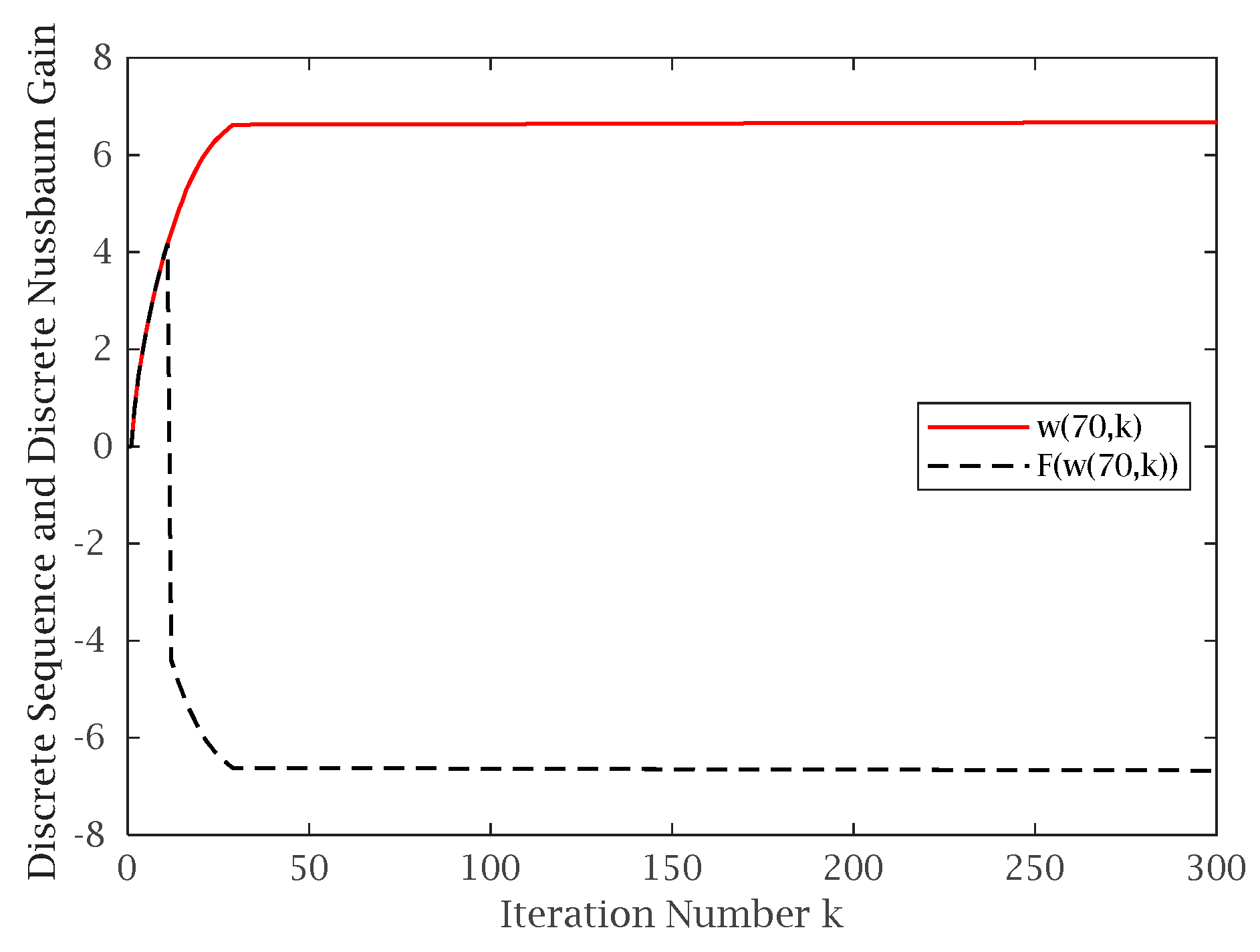
Figure 4 shows the discrete sequence and discrete Nussbaum gain sequence at t = 70. Obviously, from Figure 4, we can notice that the value of discrete Nussbaum gain turns out to be negative, making it consistent with the correct control direction of system (31) at about 20 iterations.
Figure 4.
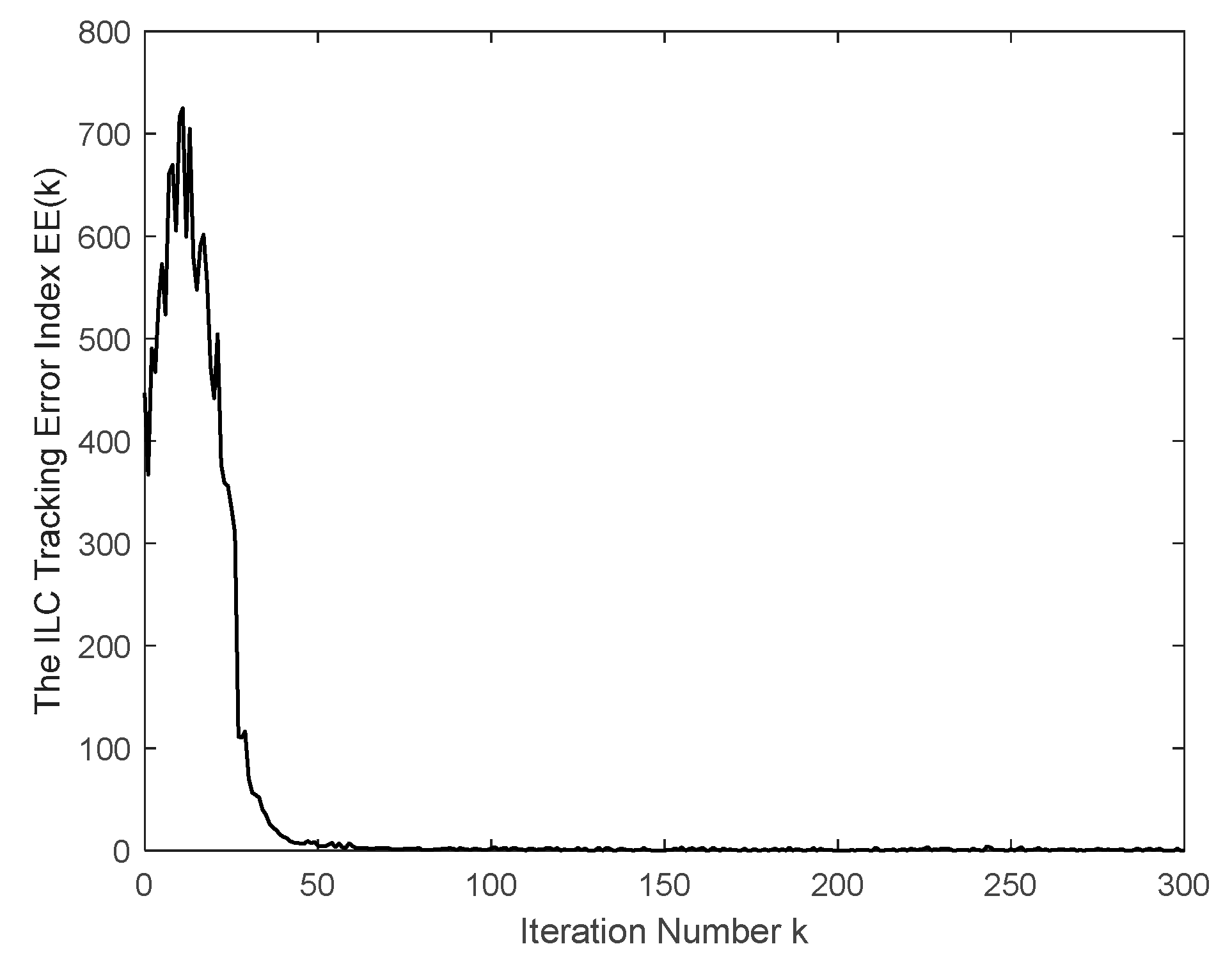
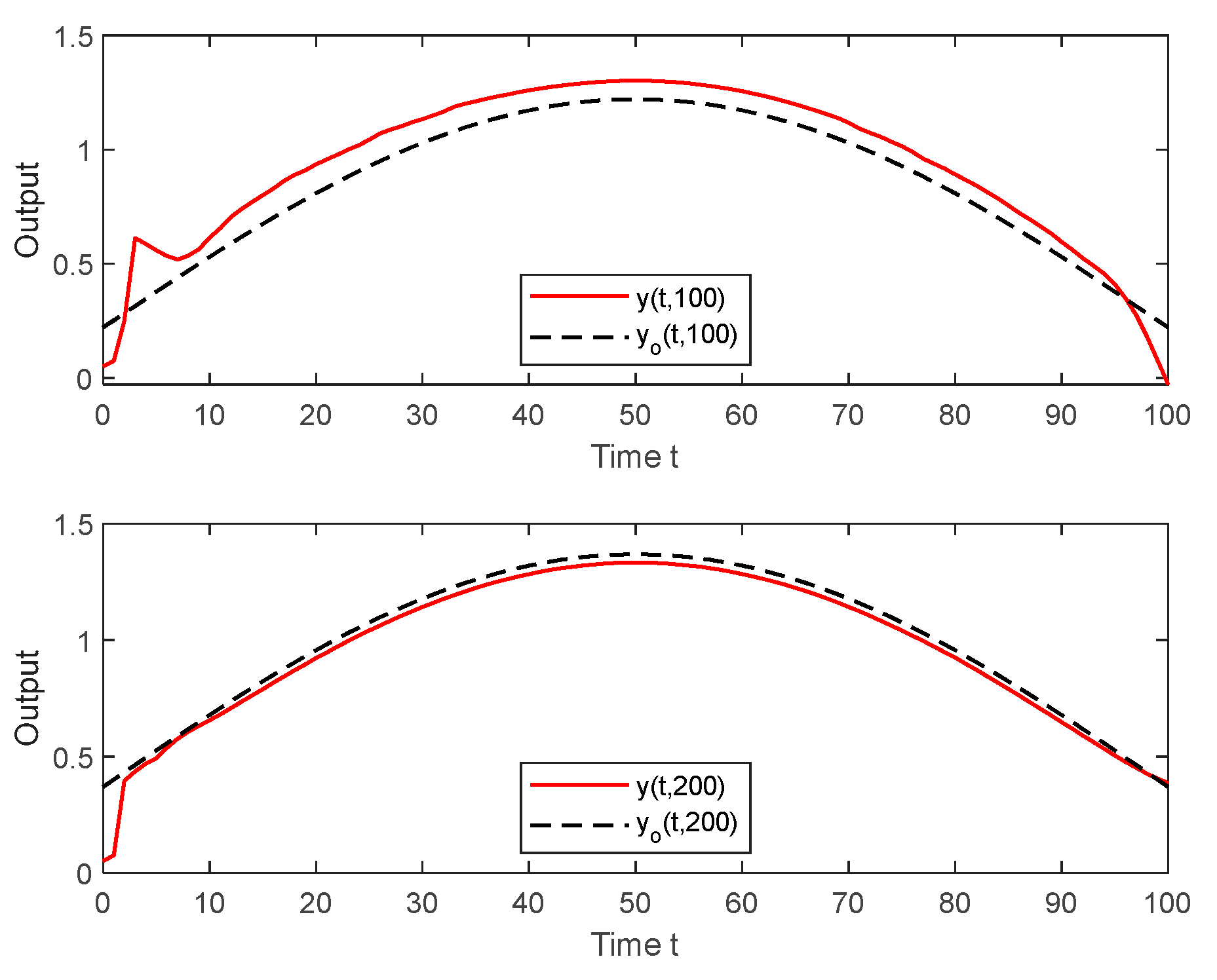
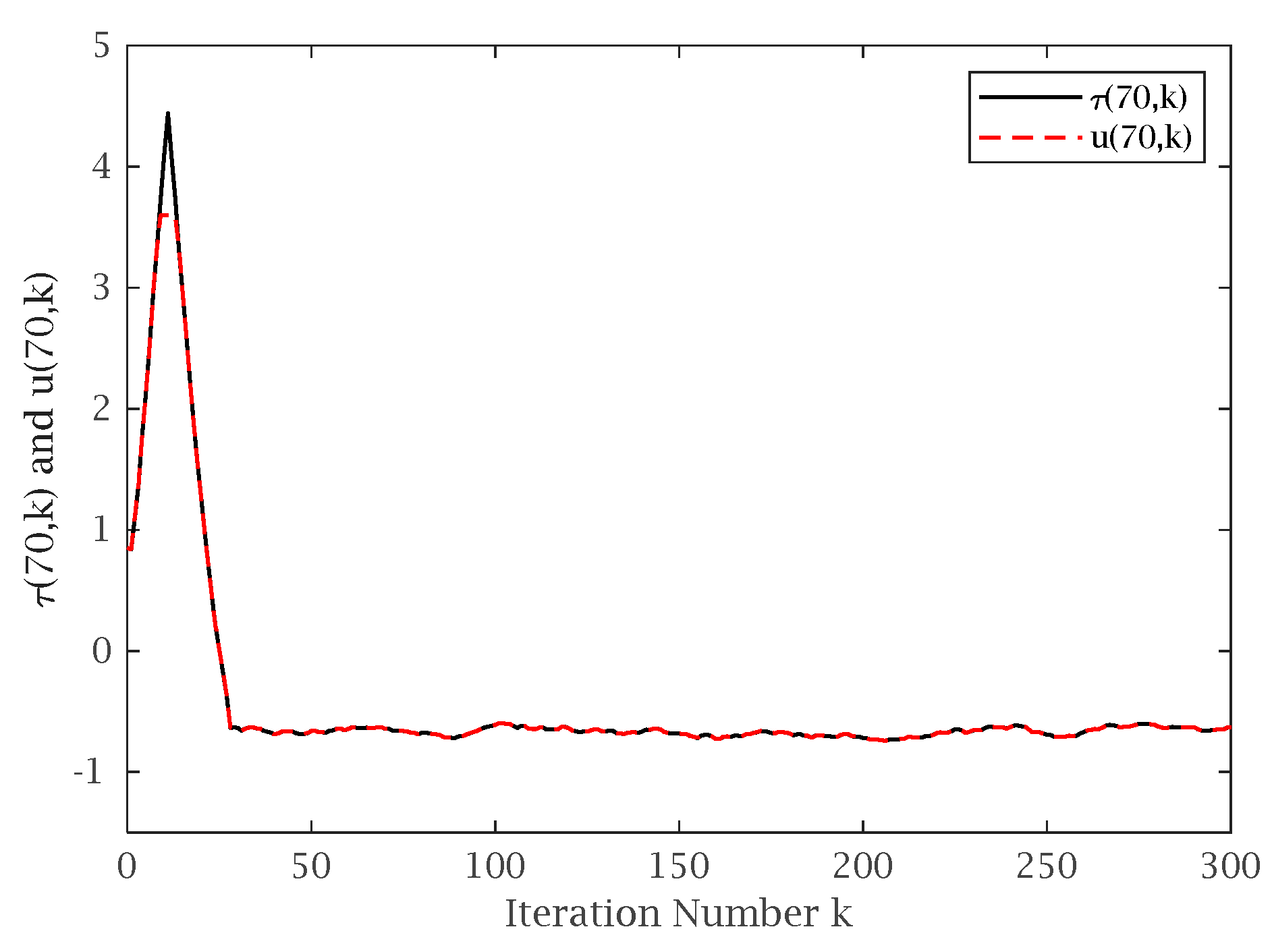
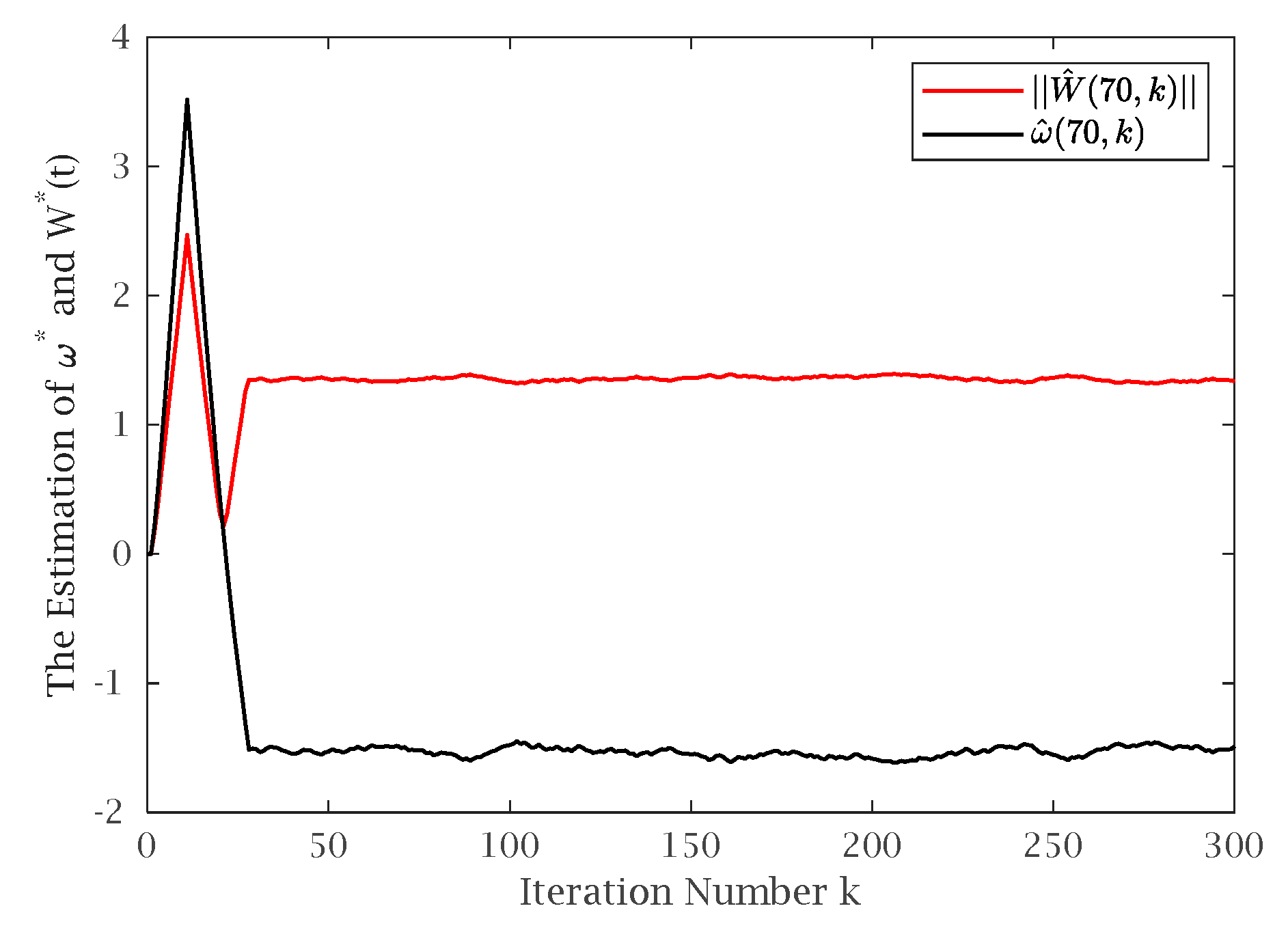
Discrete sequence and discrete Nussbaum gain sequence at t = 70. The iterative tracking error index EE(k) under different iterations is plotted in Figure 5. We can find that at the beginning of the iteration, the error index EE(k) increased significantly due to the control direction of the system (31) has not been correctly judged. After the control direction of the system (31) is correctly identified, the iterative tracking error index EE(k) begins to decrease. Figure 4 and Figure 5 validate that the discrete Nussbaum gain F(w(t,k)) can modify the sign accordingly to accommodate the unknown control direction, and show the effect of the Nussbaum gain function to efficiently identify the right control direction. Figure 6 exhibits the system output and the reference trajectory at 100th and 200th iterations, respectively. It can be observed that the system output can track the reference trajectory as the iteration increase. Figure 7 shows and of the input saturation (32) at t = 70. Figure 8 exhibits the corresponding estimation of and when t = 70.
The simulation results in Figure 4, Figure 5, Figure 6, Figure 7 and Figure 8 verify the effectiveness of the proposed approach. In the presence of the input saturation and unknown control direction, the adaptive learning method fulfils that the Nussbaum gain function identifies the control direction correctly, the system output tracks the reference trajectory to a small region, and all the system signals are bounded.
Figure 5.
Tracking error index EE(k) of different iterations.
Figure 6.
The tracking curves of iteration 100 and iteration 200, respectively.
Figure 7.
and of the input saturation (32) at t = 70.
Figure 8.
Estimation of parameters and at t = 70.
5. Conclusions
In real life, the performance of a repetitive operating system may be affected by input saturation, and thus, loses stability. In this study, an adaptive fuzzy ILC algorithm is proposed for a class of nonlinear discrete systems with input saturations and unknown control directions under the conditions of randomly varied initial error, reference trajectory and external disturbance. In this algorithm, FLS is constructed to estimate the ideal control signal, while an adaptive fuzzy iterative learning controller is designed to compensate the loss caused by input saturation. Then, the discrete Nussbaum gain technique is applied to identify the unknown control direction along the iteration axis. After theoretical analysis and simulation verification, the conclusions are as follows: when the number of iterations tends to infinity, the ILC tracking error can converge to an adjustable residual set except the initial time, and the system signals can remain bounded in the adaptive ILC process. In addition, some interesting research, such as unknown control direction system combined with actuator failure, will be our future research direction.
Author Contributions
Conceptualization, P.X. and Y.-S.W.; methodology, Q.-Y.X. and P.X.; validation, K.W.; writing—original draft, W.-Y.H., Q.-Y.X. and C.-T.Z. All authors have read and agreed to the published version of the manuscript.
Funding
This research is supported in part by the National Natural Science Foundation of China under Grant 61903096 and 62103159, in part by the Guangdong Basic and Applied Basic Research Foundation under Grant 2020A1515110414, and in part by the Key field project of colleges and universities in Guangdong Province (Artificial Intelligence) under Grant 2019KZDZX1042.
Data Availability Statement
Not applicable.
Conflicts of Interest
The authors declare no conflict of interest.
Appendix A. Proof of Theorem 1
The Proof of Theorem 1 will be divided into two parts.
Part I: Assume that the constructed FLS can cover a large enough compact set so that the inputs and outputs of the adaptive learning system are within the FLS approximation. First, from the definition of V(t,k) in (26) and N(t,k) in (27), we obtain:
According to (19) and (25), we obtain that:
Then, we can obtain:
Define a nonnegative function:
Then, we take the difference of :
Considering that , from (22), we obtain:
At the same time, we can also obtain from (23) that:
Using (A5) and (A6), and then considering from (28), (A4) becomes:
Substituting (A1) and (A2) into (A7), we obtain:
According to (28), when , can be obtained from (26). Then, according to and in (21), we can obtain:
Note that when , (28) means . Together with (A9), for any value of , there has:
Substitute (A10) into (A8) and consider that , there is:
where , is a constant. Note that , is guaranteed by (30). According to the property of Nussbaum gain, we obtain that is still a discrete Nussbaum gain function. Sum both sides of (A11) and in (30), then:
Part II: Based on the boundedness and increasing property of discrete sequence , we obtain:
From (7), we have . Therefore, according to (A13), it is obtained that:
Given that:
we can obtain:
Based on the in (25), there is . Let , and use (A15), it yields:
Namely:
Finally, it can be seen from (A15) that is bounded. Additionally, the boundedness of is obviously achieved if we notice that the desired output and the tracking error in (A16). Moreover, considering , it can be obtained that is also bounded, because of the boundedness of , , and . Following the similar analysis, the boundedness of system input and states , are obtained from the definition of input saturation (2) and system (1). Theorem 1 is proved.
References
- Wang, L.; Guo, Y.; Ma, G.; Liu, W. Overview of input saturation in spacecraft attitude control. J. Astronaut. 2021, 42, 11–21. [Google Scholar]
- Zhou, Z.; Shao, S.; Hu, W. Dynamic surface control of fighter in large maneuver under input saturation. J. Beijing Univ. Aeronaut. Astronaut. 2021, 47, 247–254. [Google Scholar]
- Yang, H.; Pei, H. Nonlinear dynamic inverse control for a class of input saturated nonaffine non-linear systems. Control Theory Appl. 2021, 38, 425–432. [Google Scholar]
- Xu, Y.; Yu, J.; Cui, Y.; Yu, J.; Liu, J. PMSM command filter discrete control considering input saturation. Small Spec. Electr. Mach. 2021, 49, 50–55. [Google Scholar]
- Zhang, X.; Fang, Y.; Zhang, X.; Jiang, J.; Hua, H. Input saturation control of rotor UAV based on error state Kalman filter estimation. Robot 2020, 42, 394–405. [Google Scholar]
- Alattas, K.A.; Vu, M.T.; Mofid, O.; El-Sousy, F.F.M.; Fekih, A.; Mobayen, S. Barrier function-based nonsingular finite-time tracker for quadrotor UAVs subject to uncertainties and input constraints. Mathematics 2022, 10, 1659–1674. [Google Scholar] [CrossRef]
- Zhao, Z.; He, X.; Ren, Z.; Wen, G. Boundary adaptive robust control of a flexible riser system with input nonlinearities. IEEE Trans. Syst. Man Cybern. Syst. 2019, 49, 1971–1980. [Google Scholar] [CrossRef]
- Zhao, Z.; Liu, Y.; Zou, T.; Hong, K.-S.; Li, H.-X. Robust adaptive fault-tolerant control for a riser-vessel system with input hysteresis and time-varying output constraints. IEEE Trans. Cybern. 2022, 52, 1–12. [Google Scholar] [CrossRef]
- Zhao, Z.; Ren, Y.; Mu, C.; Zou, T.; Hong, K.-S. Adaptive neural-network-based fault-tolerant control for a flexible string with composite disturbance observer and input constraints. IEEE Trans. Cybern. 2021, 51, 1–11. [Google Scholar] [CrossRef]
- Mohammadzamani, F.; Hashemi, M.; Shahgholian, G. Adaptive neural control of non-linear fractional order multi-agent systems in the presence of error constraints and input saturation. IET Control Theory Appl. 2022, 16, 1283–1298. [Google Scholar] [CrossRef]
- Mohammadzamani, F.; Hashemi, M.; Shahgholian, G. Adaptive control of nonlinear time-delay systems in the presence of output constraints and actuators faults. Int. J. Control 2021, 94, 1–13. [Google Scholar] [CrossRef]
- Janbazi, V.; Hashemi, M. Design of disturbance observer based on adaptive-neural control for large-scale time-delay systems in the presence of actuator fault and unknown dead zone. Int. J. Adapt. Control Signal Process. 2021, 35, 285–309. [Google Scholar] [CrossRef]
- Nazemorroaya, E.; Hashemi, M. Adaptive sliding mode controller design for the bipartite consensus tracking of multi-agent systems with actuator faults and disturbances. Int. J. Autom. Control 2022, 16, 288–302. [Google Scholar] [CrossRef]
- Li, X.; Shen, D.; Xu, J.X. Adaptive iterative learning control for MIMO nonlinear systems performing iteration-varying tasks. J. Frankl. Inst. 2019, 356, 9206–9231. [Google Scholar] [CrossRef]
- Li, L.; Cao, F.; Liu, J. Vibration control of flexible manipulator with unknown control direction. Int. J. Control 2020, 94, 2690–2702. [Google Scholar] [CrossRef]
- Ye, H.; Jiang, B. Adaptive switching control for hypersonic vehicle with uncertain control direction. J. Frankl. Inst. 2020, 357, 8851–8869. [Google Scholar] [CrossRef]
- Deng, X.; Zhang, X. Adaptive fuzzy tracking control of uncertain nonlinear multi-agent systems with unknown control directions and a dead-zone fault. Mathematics 2022, 10, 2655–2673. [Google Scholar] [CrossRef]
- Yun, H.; Yoo, S. Tracking control strategy using filter-based approximation for the unknown control direction problem of uncertain pure-feedback nonlinear systems. Mathematics 2020, 8, 1341–1357. [Google Scholar]
- Pang, M.; An, S. Decentralized lane changing and speed guidance methods for expressway and adjacent intersections. J. Transp. Syst. Eng. Inf. Technol. 2019, 19, 168–175. [Google Scholar]
- Chen, Q.; Cao, Y.; Wu, C. Adaptive sliding mode control of electromechanical servo system based on variable speed reaching law. Control Decis. 2022, 37, 1067–1073. [Google Scholar]
- Mishra, S.; Topcu, U.; Tomizuka, M. Iterative learning control with saturation constraints. In Proceedings of the American Control Conference, St. Louis, MO, USA, 10–12 June 2009; pp. 943–948. [Google Scholar]
- Mishra, S.; Topcu, U.; Tomizuka, M. Optimization-based constrained iterative learning control. IEEE Trans. Control Syst. Technol. 2011, 19, 1613–1621. [Google Scholar] [CrossRef]
- Zhang, J.; Meng, D. Convergence analysis of saturated iterative learning control systems with locally Lipschitz nonlinearities. IEEE Trans. Neural Netw. Learn. Syst. 2020, 31, 4025–4035. [Google Scholar] [CrossRef] [PubMed]
- Zhang, R.; Hou, Z.; Chi, R.; Ji, H. Adaptive iterative learning control for nonlinearly parameterised systems with unknown time-varying delays and input saturations. Int. J. Control 2015, 88, 1133–1141. [Google Scholar] [CrossRef]
- Zhang, R.; Hou, Z.; Ji, H.; Yin, C. Adaptive iterative learning control for a class of non-linearly parameterised systems with input saturations. Int. J. Syst. Sci. 2016, 47, 1084–1094. [Google Scholar] [CrossRef]
- Ji, H.; Hou, Z.; Zhang, R. Adaptive iterative learning control for high-speed trains with unknown speed delays and input saturations. IEEE Trans. Autom. Sci. Eng. 2016, 13, 260–273. [Google Scholar] [CrossRef]
- Hocine, B.; Abdesselem, B.; Hachemi, C. Adaptive iterative learning control of nonlinearly parameterised strict feedback systems with input saturation. Int. J. Autom. Control 2018, 12, 251–270. [Google Scholar]
- Jin, X. Nonrepetitive leader-follower formation tracking for multiagent systems with LOS range and angle constraints using iterative learning control. IEEE Trans. Cybern. 2019, 49, 1748–1758. [Google Scholar] [CrossRef]
- Chu, B.; Rauh, A.; Aschemann, H.; Rogers, E.; Owens, D.H. Constrained iterative learning control for linear time-varying systems with experimental validation on a high-speed rack feeder. IEEE Trans. Control Syst. Technol. 2021, 30, 1834–1846. [Google Scholar] [CrossRef]
- Nussbaum, R.D. Some remarks on a conjecture in parameter adaptive control. Syst. Control Lett. 1983, 3, 243–246. [Google Scholar] [CrossRef]
- Chen, H.; Jiang, P. Adaptive iterative learning control for nonlinear systems with unknown control gain. J. Dyn. Syst. Meas. Control 2004, 126, 916–920. [Google Scholar] [CrossRef]
- Jiang, P.; Chen, H.; Bamforth, L.C. A universal iterative learning stabilizer for a class of MIMO systems. Automatica 2006, 42, 973–981. [Google Scholar] [CrossRef]
- Xu, J.; Yan, R. Iterative learning control design without a priori knowledge of the control direction. Automatica 2004, 40, 1803–1809. [Google Scholar] [CrossRef]
- Yu, M.; Ye, X.; Qi, D. Repetitive learning control for triangular systems with unknown control directions. IET Control Theory Appl. 2011, 5, 2045–2051. [Google Scholar] [CrossRef]
- Zhang, C.; Li, J. Adaptive iterative learning control of non-uniform trajectory tracking for strict feedback nonlinear time-varying systems with unknown control direction. Appl. Math. Model. 2015, 39, 2942–2950. [Google Scholar] [CrossRef]
- Mudgett, D.R.; Morse, A.S. Adaptive stabilization of a discrete linear system with an unknown highfrequency gain. IEEE Trans. Autom. Control 1985, 30, 798–799. [Google Scholar] [CrossRef]
- Yu, M.; Wang, J.; Qi, D. Discrete-time adaptive iterative learning control for high-order nonlinear systems with unknown control directions. Int. J. Control 2013, 86, 299–308. [Google Scholar] [CrossRef]
- Xu, Q.-Y.; Li, X.-D. HONN-based adaptive ILC for pure-feedback non-affine discrete-time systems with unknown control directions. IEEE Trans. Neural Netw. Learn. Syst. 2020, 31, 212–224. [Google Scholar] [CrossRef]
- Xu, Q.-Y.; Li, X.-D. Adaptive fuzzy ILC of nonlinear discrete-time systems with unknown dead zones and control directions. Int. J. Syst. Sci. 2018, 49, 1878–1894. [Google Scholar] [CrossRef]
- Wang, L.X. Adaptive Fuzzy Systems and Control; Prentice-Hall: Englewood Cliffs, NJ, USA, 1994. [Google Scholar]
Publisher’s Note: MDPI stays neutral with regard to jurisdictional claims in published maps and institutional affiliations. |
© 2022 by the authors. Licensee MDPI, Basel, Switzerland. This article is an open access article distributed under the terms and conditions of the Creative Commons Attribution (CC BY) license (https://creativecommons.org/licenses/by/4.0/).