2. Preliminaries
Some related concepts of general overlap functions are reviewed first.
Definition 1 ([
16,
17])
. Given a mapping GO: , if for any , GO meets the requirements below, then GO is called a general overlap function (briefly, ):(GO1) GO is commutative;
(GO2) when or ;
(GO3) ;
(GO4) GO has a monotonically increasing nature;
(GO5) It meets continuity.
Definition 2 ([
17])
. Given a on denoted as GO, if for arbitrary it satisfies , then it is called inflationary. Definition 3 ([
17])
. Given an inflationary on denoted as GO, the binary mapping on is defined asfor any , it is called the residuated implication induced by GO. In fuzzy logic, the commonly used aggregation operator is the t-norm, which is defined below.
Definition 4 ([
4,
5])
. Given a binary mapping T on , when for any , T meets the requirements below, it is called a t-norm:(T1) T is commutative;
(T2) T meets associativity;
(T3) T is a monotonically increasing property, that is, when ;
(T4) T has 1 as the unit element, that is, .
Evidently, a continuous t-norm is a GOF by definition. Next, we present some notions of existing algebraic structures for analysis later.
Definition 5 ([
3,
24])
. Given an algebra , if it meets the requirements below, then it is called a residuated lattice:(L1) is a bounded lattice;
(L2) is a commutative monoid;
(L3) The pair meets the residuation principle, that is, for arbitrary , when and only when .
Definition 6 ([
1,
2,
25])
. Given a residuated lattice , when for arbitrary , it meets the requirements below, it is called a BL-algebra:(BL1) (divisibility);
(BL2) (prelinearity).
Definition 7 ([
9])
. Given an algebra , when for arbitrary , it meets the requirements below, it is called a non-associative residuated lattice:(naL1) is a lattice with 0 as the lower bound and 1 as the upper bound;
(naL2) is a commutative groupoid with 1 as unit element, that is, L is a nonempty set, ∗ is a commutative binary operator with unit element 1 on L;
(naL3) satisfies the residuation principle.
Definition 8 ([
9])
. Given a non-associative residuated lattice , it is called a naBL-algebra when for arbitrary , it meets the following requirements:(naBL1) ;
(naBL2) (α-prelinearity)
(naBL3) (β-prelinearity)
The filter is a vital portion in logical algebra, especially in constructing a quotient algebra. Here, we state the definition of filters of non-associative residuated lattices.
Definition 9 ([
9])
. Given a non-associative residuated lattice , and a nonempty set , F is called a filter of L if it satisfies the following:(1) For arbitrary , if and , then ;
(2) For arbitrary , ;
(3) For arbitrary and , , where At the end of this part, we look back at the conception of inflationary pseudo-general residuated lattices proposed in [
23], as well as a few properties they satisfy and the definition of a special class of weak inflationary pseudo-BL-algebras they contain.
Definition 10 ([
23])
. An algebra of type (2, 2, 2, 2, 2, 0, 0), where ∗ is an inflationary binary operator, that is, the result of operation ∗ between any element on L and 1 is greater than or equal to the element, is known as an inflationary pseudo-general residuated lattice (for short, named ) when it satisfies the following conditions:(PL1) is a bounded lattice;
(PL2) is a groupoid, that is, a binary operator ∗ defined on a nonempty set L;
(PL3) when and only when , when and only when , for arbitrary .
Proposition 1 ([
23])
. Given an , for arbitrary , it meets the requirements below:(PL4) , ;
(PL5) If , then and ;
(PL6) , ;
(PL7) , ;
(PL8) , ;
(PL9) ;
(PL10) when or ;
(PL11) and .
Definition 11 ([
23])
. An is known as a weak inflationary pseudo-BL-algebra (briefly, weak inflationary PBL-algebra) when for arbitrary , it meets the requirements below:(WIPBL1) If , ;
(WIPBL2) .
3. Inflationary BL-Algebras and Weak Inflationary BL-Algebras
In this part, we introduce the definition of weak inflationary BL-algebras and explore their properties. Let us first review the definition of inflationary BL-algebra (see [
17]).
Definition 12 ([
17])
. Given an algebra , where the operator ∗ is inflationary, it is an inflationary general residuated lattice (briefly ) when it holds that:(A1) is a lattice with 0 as the lower bound and 1 as the upper bound;
(A2) The commutative binary operator ∗ is defined on the nonempty set L;
(A3) satisfies the residuation principle.
Proposition 2. Given an , for arbitrary , it meets the requirements below:
(A4) when ;
(A5) when ;
(A6) when ;
(A7) ;
(A8) ;
(A9) ;
(A10) ;
(A11) ;
(A12) ;
(A13) ;
(A14) if and only if for each ;
(A15) If , then ;
(A16) are comparable and ;
(A17) when .
Proof. The above certificates of (A4)–(A6) and (A9)–(A16) are detailed in [
17]. With regard to (A7) and (A8), because an IGRL is also an IPGRL, it meets (PL6) and (PL7) according to Proposition 2.11, and at this time,
. As for (A17), if
, then
by the residuation principle. By (A16), we can obtain
. □
Definition 13 ([
17])
. Given an , it is an inflationary BL-algebra (briefly IBL-algebra) when it meets the followng conditions:(IBL1) ;
(IBL2) (general prelinearity).
In Lemma 5.1 of [
17], it is considered that the inflationary GOF meets (BL1). In fact, this is not true. We provide two examples below.
Example 1.(1) Given the operator GO: defined as , it satisfies (GO1)∼(GO5), that is, the function GO is a . Moreover, since , GO is inflationary. Then, we can obtain its residuated implication as follows:It is clear that when , , there is and , but , that is, it does not satisfy divisibility. (2) Given the operator GO: defined as , it is a . Since , it is inflationary. The residuated implication induced by it is formulated as:When , , there is and , but , that is, it does not satisfy divisibility. Therefore, we can know that the algebra
composed of the minimization operator ∧, maximization operator ∨, inflationary GOF ∗, and its residue → of Proposition 5.2 of [
17] is not necessarily an inflationary BL-algebra. Therefore, we consider a broader inflationary BL-algebra, which we call weak inflationary BL-algebra.
Next, we provide the definition of weak inflationary BL-algebra.
Definition 14. Given an , it is a weak inflationary BL-algebra (briefly weak IBL-algebra) when for arbitrary , it satisfies the conditions below:
(W1) If , then (general divisibility);
(W2) .
Example 2. We take the mapping GO in Example 1 (1) as the operator ∗ and the residuated implication induced by it as the operator →, for arbitrary , , , thereby the lattice satisfies (A1)∼(A3), that is, it is an . By definition, we obtain that when , thereby , that is, L satisfies general divisibility. Since it is clear thatL satisfies general prelinearity. Thus, is a weak IBL-algebra. Evidently, every IBL-algebra is a weak IBL-algebra. In addition, we find that the inflationary general overlap functions satisfying divisibility actually have 1 as the unit element, and the derivation process is as follows.
Proposition 3. Given an inflationary , if it satisfies divisibility, then it has 1 as the unit element.
Proof. Suppose that the operator ∗ is an inflationary GOF satisfying divisibility. Since , that is, , and by divisibility. Because , according to residuation principle, there is , that is, . Therefore, , that is, the operator ∗ has 1 as the unit element. □
Therefore, the general prelinearity satisfied by the inflationary general overlap functions satisfying divisibility amounts to prelinearity. We know that the non-associative t-norms that can form naBL-algebra are included in the general overlap functions with unit element 1. In addition, there exist residuated lattices satisfying divisibility and prelinearity but not a naBL-algebra under non-total order. Examples are as follows.
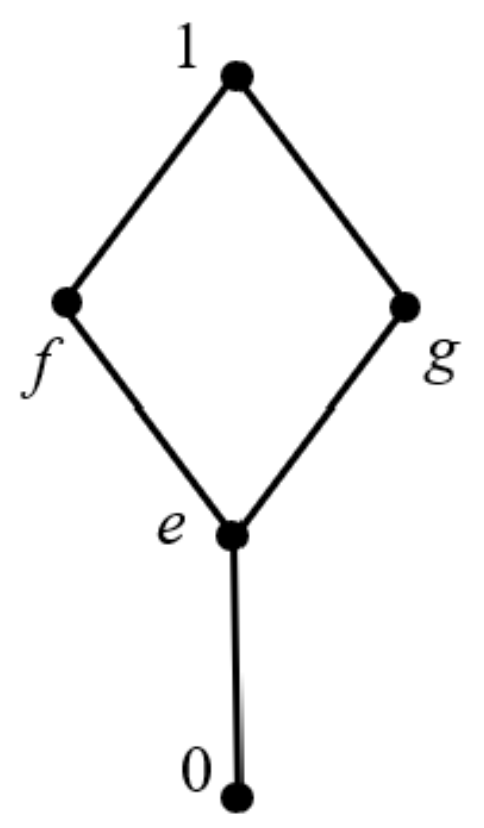
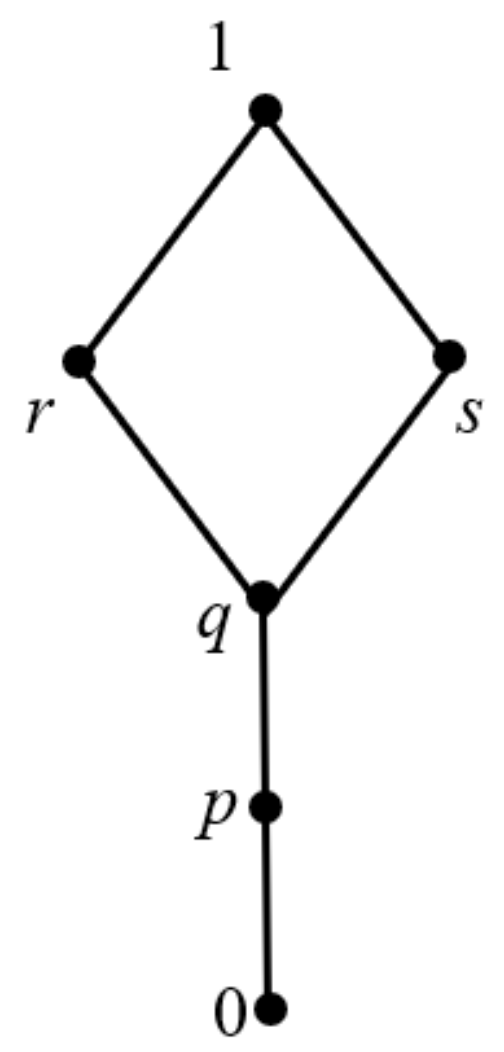
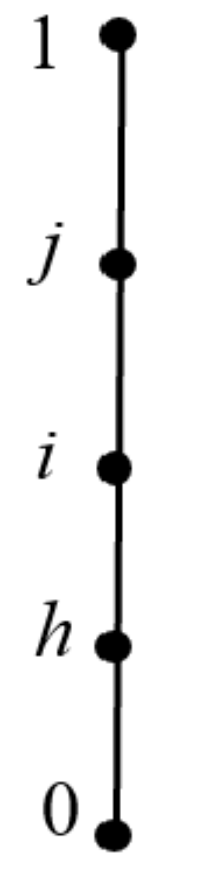
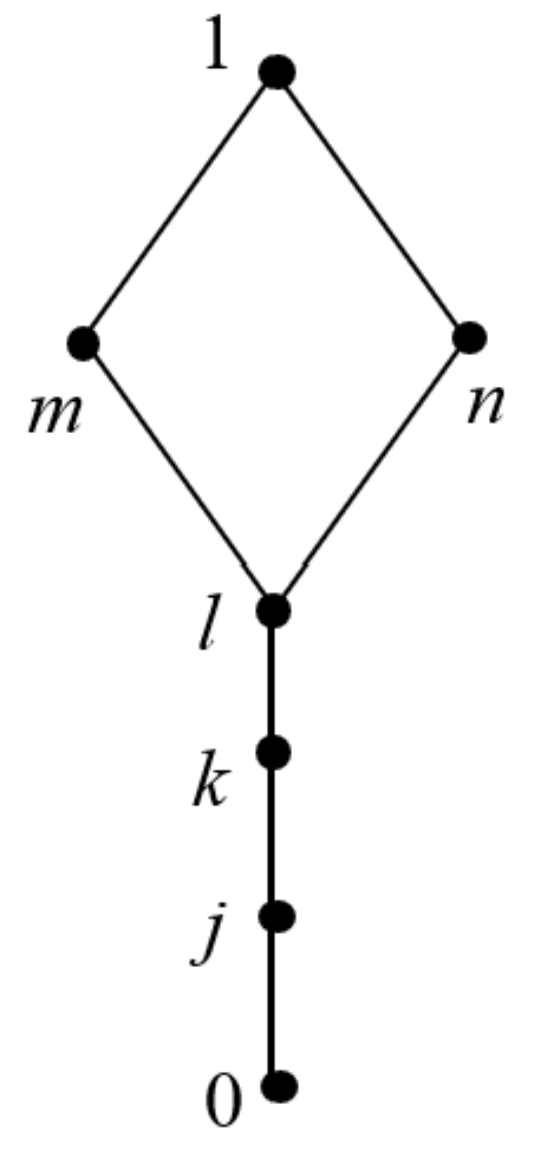
Example 3. (1) Given a lattice L, the structure is as shown in Figure 1. Two operations, ∗ and →, of it are shown below: Then, is an IBL-algebra but not a naBL-algebra, where .
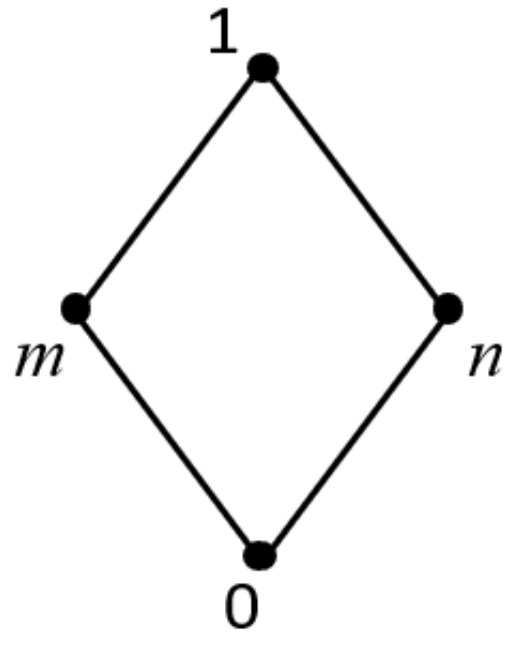
(2) Given a lattice L, the structure is as shown in Figure 2. Two operations, ∗ and →, are shown below: Then, is an IBL-algebra but not a naBL-algebra, where .
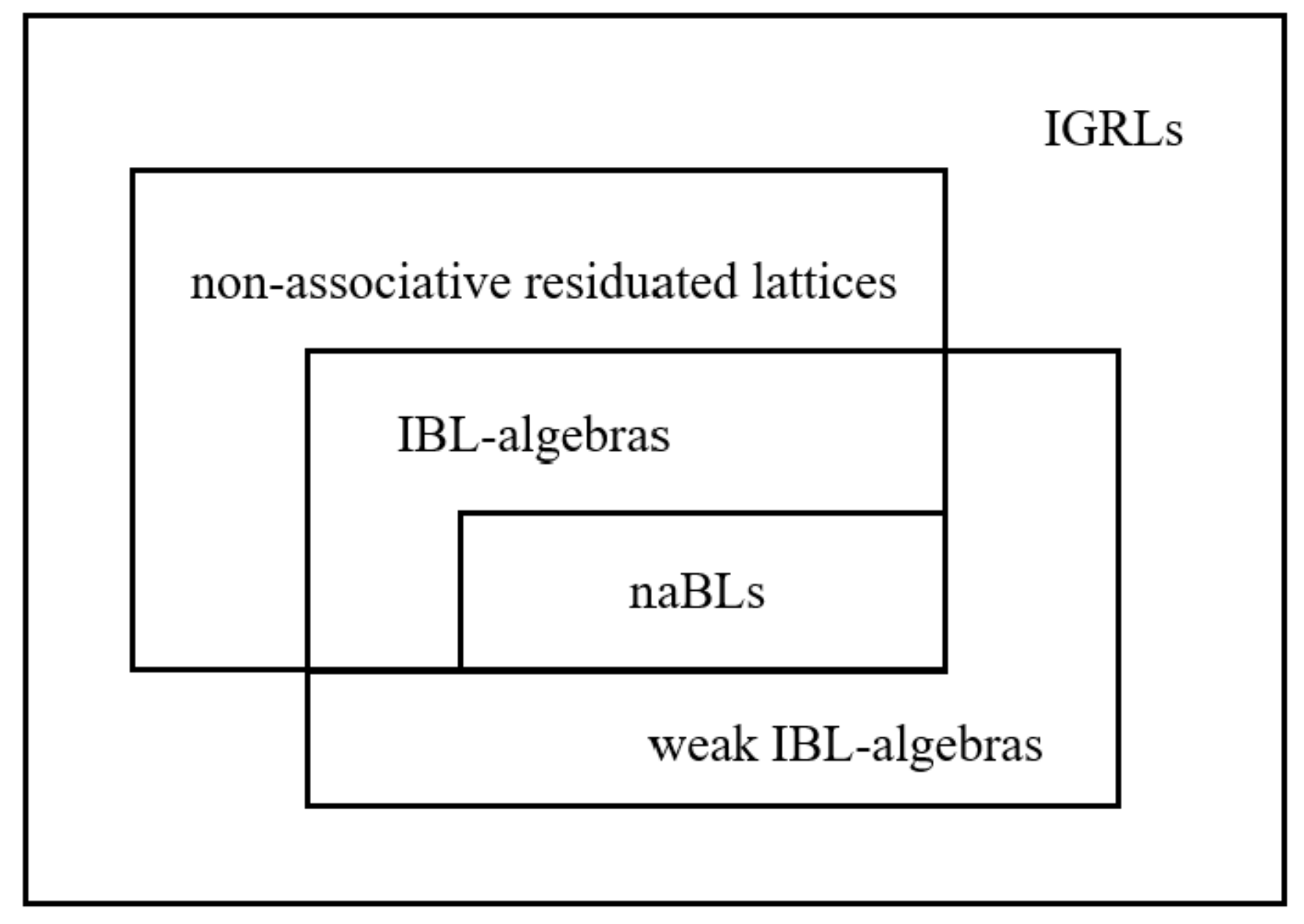
Thus, we can obtain the diagram shown in
Figure 3. Among them, naBL-algebras can be obtained from non-associative t-norms. The operators corresponding to IBL-algebras are inflationary general overlap functions with unit element 1, while weak IBL-algebras no longer require the corresponding operators to have a unit element.
In
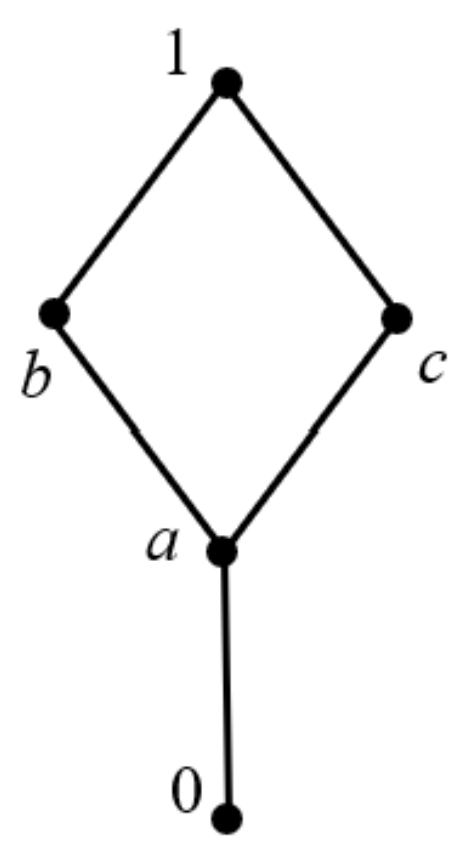
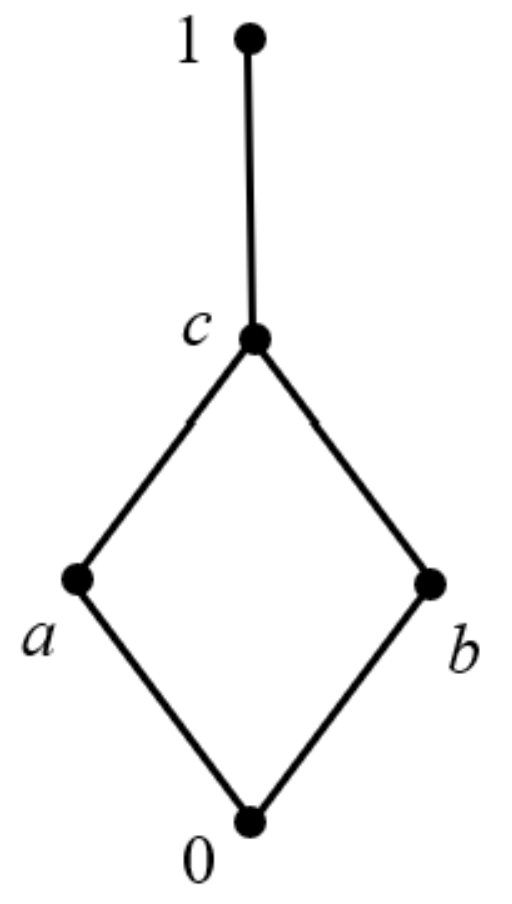
Figure 3, specific examples corresponding to several types of algebra are as follows: I The two algebraic structures in Example 3 are IBL-algebras, but not naBLs. II The algebraic structure in Example 2 is a weak IBL-algebra, but not an IBL-algebra. III The algebraic structure in (1) of Example 4 is a non-associative residuated lattice, but not an IBL-algebra. IV The algebraic structure in (2) of Example 4 is an IGRL, but it is neither a non-associative residuated lattice nor a weak IBL-algebra.
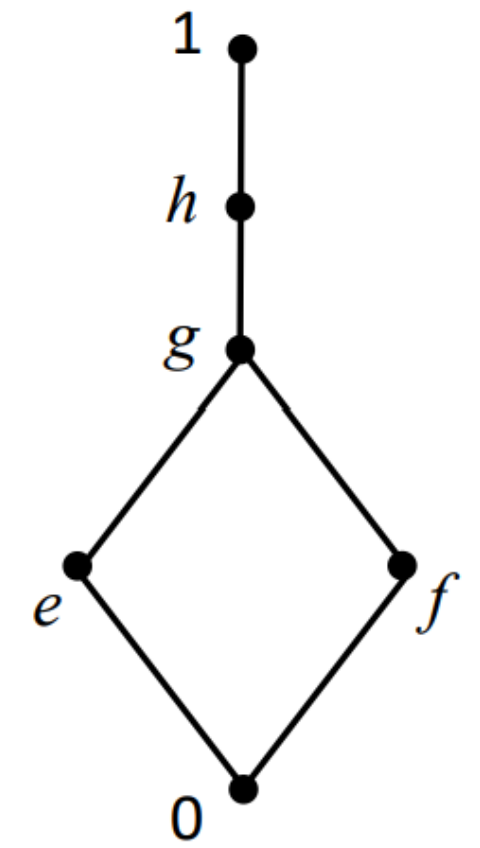
Example 4. (1) Given a lattice L, the structure is as shown in Figure 4. Two operations, ∗ and →, of it are shown below: (2) Given a lattice L, the structure is as shown in Figure 5. Two operations, ∗ and →, are shown below: Next, we discuss some properties of weak IBL-algebras. Because the weak IBL-algebras are a class of IGRL, they satisfy the properties that are satisfied by IGRL, which will not be repeated here.
Proposition 4. Let be a weak IBL-algebra; then, for arbitrary , it meets the requirements below:
(W3) If , then ;
(W4) ;
(W5) when ;
(W6) ;
(W7) when and only when .
Proof. (1) If , then , and by the residuation principle, we have that . Since the operator ∗ is inflationary, . Thus, by general divisibility, .
(2) By (A10) and (A11), .
(3) By (A10) and (A11), it is evident.
(4) By (A10), it is clear that . Since , it is obvious that .
(5) Suppose that the operator ∗ has 1 as the unit element. It is clear that , and thereby, according to the residuation principle, . Because for arbitrary , . Conversely, assume , in that way . By the residuation principle, . Since operator ∗ is inflationary, we have , that is, the operator ∗ has 1 as the unit element. □
Remark 1. If the operator ∗ of an , which is total order and has 1 as unit element, then the general divisibility it satisfies is divisibility, and the general prelinearity it satisfies is actually prelinearity. Because (by A16) when ∗ with unit element 1; then, it meets (BL1) when , and when also holds by general divisibility. In addition, if , then , that is, operator ∗ satisfies prelinearity.
Lemma 1. Given an inflationary on , it meets general divisibility.
Proof. Assume that the operator ∗ is an inflationary GOF. If , then we have that . Since ∗ is continuous, there is meets , then . Hence, by the residuation principle, . Since by (A4), , and by (A11), , . Thus, the inflationary GOF meets general divisibility. □
The following proposition shows that every inflationary GOF and its residuated implication can induce a weak IBL-algebra.
Proposition 5. Given that the operator ∗ is an inflationary on , → is the residue of ∗, taking ∧ as the minimization operation and ∨ as maximization operation. Therefore, the algebra is a weak IBL-algebra.
Proof. It is clear that the algebra
L has 0 as the lower bound and 1 as the upper bound; the operator ∗ is inflationary and commutative on
. By the definition of the residuated implication and continuity of ∗, the operators ∗ and → satisfy (A3), that is, the algebra
L is an IGRL. Then, according to Lemma 1 and Lemma 5.2 of [
17], the algebra
L satisfies general divisibility and general prelinearity. Thus, the algebra
is a weak IBL-algebra. □
4. The naBL-Filters, Weak Inflationary BL-Filters, and Quasi-IBL-Filters of IGRL
In this section, we discuss the filters of IGRL, including the particularity of naBL-filters, weak inflationary BL-filters, and quasi-IBL-filters.
The definition of filters of IGRL in [
17] is given first below.
Definition 15. Given an , F is a set of at least one element on L and . F is called a filter of L when it meets:
(F1) If are taken to meet as well as , and it holds that ;
(F2) If , then ;
(F3) If , then ;
(F4) for arbitrary ;
(F5) For any , as well as , , .
Remark 2. It is clear that the filter F of an also meets the properties below:
(F6) ;
(F7) When we take an arbitrary satisfying , there is .
In fact, (F5) of Definition 15 can be replaced by another equivalent expression. We give the following proposition.
Proposition 6. Given an L and a filter F of L, the two conditions below are equal in value:
(1) For arbitrary , , it holds that , where , ;
(2) For any , it holds that , that is, , meets as well as , such that ( and , and are not necessarily equal).
Proof. (1) ⇒ (2) Assume that for any and , and . Taking , and , and by the residuation principle it holds that . Taking , . Hence, by the residuation principle, , as well as .
(2) ⇒ (1) Assume that for any and , satisfying . Then, it is obvious that according to (A6), and by (A10) it holds that . Therefore, according to (F1). On the other side, because satisfying , according to (A6) and (A10). Thus, by (F1) we have that . □
Next, the naBL-filter of IGRL is studied. We first provide a definition below.
Definition 16. Given an , and a filter F of it, for arbitrary , when F meets the requirements below, it is known as an naBL-filter:
(F8) ;
(F9) , , where , .
Example 5. Given the lattice L, as shown in Figure 6, two operations, ∗ and →, are shown below: Then, is obviously an . It satisfies divisibility, α-prelinearity, and β-prelinearity, that is, it is also an naBL-algebra (). After verification, satisfies (F1)∼(F5), and further, it satisfies (F8) and (F9), so it is an naBL-filter. However, are not naBL-filters of L.
Some properties of the naBL-filters are as follows.
Proposition 7. Given an , and a naBL-filter F of it, then for arbitrary , it holds that:
(1) ;
(2) If , then ;
(3) ;
(4) If , then , ;
(5) If , then ;
(6) If , then ;
(7) when L is distributive.
Proof. (1) By (A6) and (A11), we obtain that . Therefore, since by (F8), it is clear that according to (F1).
(2) If , according to (A5) and (A14), . Then, according to (1) and (F1), it holds that .
(3) By (F2) and (F9), it is evident.
(4) According to Lemma 4.3 of [
16], for arbitrary
,
. Then, by (A9) we have that
. Since
,
by (F2) and (F9). Therefore, by (F1), it is clear that
. Similarly,
.
(5) If , by (A14), we have that . Then, by (A6). Therefore, by (F1) and (F8), . (On the other side, if , by (A4), thus according to (A6), (F8), and (F1).
(6) If , then for arbitrary , by (5). Since by (A8), it is clear that according to (A5). Therefore, by (F1) .
(7) Since by (F1) and (F5), and . Thus, by (F3), . □
Proposition 8. Given an L and an naBL-filter F of L, if G is a filter of L such that , then G is also an naBL-filter.
Proof. Since F is an naBL-filter of L, F meets (F8) and (F9). Because , we can obtain and , for arbitrary , that is, G satisfies (F8) and (F9). Therefore, G is also an naBL-filter of L. □
Next, we discuss the role of naBL-filters of IGRL in generating naBL-algebras.
Theorem 1. Given an , and a filter F of it, then the conditions below are equal in value:
(1) L is an naBL-algebra;
(2) {1} is an naBL-filter of L, and the operator ∗ has 1 as the unit element.
Proof. (1) ⇒ (2) Assume that L meets (naBL1)–(naBL3), that is, when taking an arbitrary , and , . Obviously, {1} is a filter on IGRL, because by (F4), , that is, {1} satisfies (F8). Because as well as , {1} satisfies (F9). Thus, {1} is an naBL-filter of L. Since the operation ∗ meets , according to divisibility, . On the other hand, it holds that by the residuation principle, and ; hence, . Consequently, we can get , that is, the operator ∗ has 1 as the unit element.
(2) ⇒ (1) Assume that {1} satisfies (F8) and (F9), that is, it is an naBL-filter. Then, and for arbitrary , that is, L satisfies -prelinearity and -prelinearity. Moreover, . By (A15), . If operator ∗ has 1 as the unit element, then by (A4), we obtain , and according to (A11), . Therefore, for arbitrary , that is, L satisfies divisibility. Hence, L is an naBL-algebra. □
Corollary 1. Given an , each filter of it is an naBL-filter and ∗ has 1 as unit element when and only when it is an naBL-algebra.
Proof. It is obvious that {1} is a naBL-filter of L when all filters on IGRL are naBL-filters. By Proposition 8, it holds that all filters on IGRL are naBL-filters when {1} is an naBL-filter, so all filters of L being naBL-filters is equivalent to {1} being an naBL-filter on IGRL. Thus, each filter of L is an naBL-filter, and when and only when L is an naBL-algebra according to Theorem 1. □
In addition, the quotient structure of IGRL is also important content. The definition of quotient algebra constructed by a filter of IGRL has been given in [
17], as follows.
Definition 17. Given an and a filter F of L, the relation is defined as: and ; then, is a relation satisfying congruence on L (see [17] for details). For an IGRL
L, the equivalent class of
is written as
, the quotient set
is an IGRL, and
is formulated as
,
is formulated as
,
is formulated as
, and
is formulated as
; the partial order is written as
iff
(see [
16] for details).
After that, we have the following theorem.
Theorem 2. Given an , all filters of L are naBL-filters and the operator ∗ has 1 as the unit element when and only when the quotient structure meets (naBL1)∼(naBL3).
Proof. (⇒) Assume all filters of L are naBL-filters and the operator ∗ has 1 as unit element; by Corollary 1, we have that L meets (naBL1)∼(naBL3). Thereby, when we take arbitrary , , and . Since , , it holds that , that is, the quotient set meets divisibility. Similarly, we have that meets -prelinearity and -prelinearity. Therefore, satisfies (naBL1)∼(naBL3).
(⇐) If meets (naBL1)∼(naBL3), then , , . Therefore, by definition we have that , and on L, that is, L is an naBL-algebra. It is clear that {1} is an naBL-filter of L, and the operator ∗ has 1 as the unit element according to Theorem 1. Since for arbitrary filter F of L, , F is an naBL-filter of L by Proposition 8. □
Corollary 2. Given an , {1} is an naBL-filter of L, and the operator ∗ has 1 as the unit element when and only when the quotient structure meets (naBL1)∼(naBL3).
Example 6. Given the lattice L and operators on it provided in Example 5, L is an . It is clear that the operator ∗ has 1 as the unit element, and {1}, {j, 1}, {0, h, i, j, 1} are filters of L. Since {1} meets (F8) and (F9) for arbitrary , {1}, {j, 1}, {0, h, i, j, 1} are naBL-filters of L. We take , and obtain the quotient set . The operators ⊛ and → of are defined as below: Then, the algebra is an . Since it meets (naBL1)∼(naBL3), is an naBL-algebra.
Then, we can give the concept of weak inflationary BL-filters similar to naBL-filters of IGRL.
Definition 18. Given an , and a filter F of it, for arbitrary , F is called a weak inflationary BL-filter (briefly weak IBL-filter) if it meets the conditions below:
(F10) If , then ;
(F11) .
Example 7. Given the L as in Example 5, is evidently a filter of L. Since it meets (F10) and (F11), it is a weak IBL-filter of L.
Obviously, when F is a weak IBL-filter of IGRL L, and G is a filter of L satisfying , G also meets (F10) and (F11). Then, we obtain the theorem below.
Theorem 3. Given an , and a filter F of L, the requirements below are equal in value:
(1) L is a weak IBL-algebra;
(2) Each filter of L is a weak IBL-filter;
(3) {1} meets (F10) and (F11).
Proof. (1) ⇒ (2) Assume that L meets (W1) and (W2); then, for arbitrary , when , as well as . If , by (F4), . By (F6), , so F meets (F10) and (F11), that is, F is a weak IBL-filter of L.
(2) ⇒ (3) Since {1} is a filter on IGRL, by (2) we can get that {1} is a weak IBL-filter on IGRL.
(3) ⇒ (1) Assume that {1} is a weak IBL-filter of L, then when , and . Therefore, we have that when , , and it is clear that L satisfies general prelinearity. On the other side, by (A15) we can obtain when . Since by (A11), we have that , when . Thus, L satisfies general divisibility. Therefore, L is a weak IBL-algebra. □
The relationship between the naBL-filters and the weak IBL-filters of IGRLs is analyzed as follows.
Proposition 9. Given an . If all filters of L are naBL-filters, and ∗ has a unit element of 1, then all filters of L are weak IBL-filters.
Proof. It is clear by Corollary 1 and Theorem 3. □
The inverse of the above proposition does not necessarily hold. We give the following example.
Example 8. We take the lattice in Example 3 (1) as L. It is clear that L is an , and {1} is a weak IBL-filter of it, that is, all filters of L are weak IBL-filters. However, is not an naBL-filter because it does not satisfy (F9), for instance, .
Finally, a new class of filters is also studied in this part. The quasi IBL-filter of IGRL is defined as follows.
Definition 19. Given an L and a filter F on it, F is called a quasi IBL-filter when F meets (F10).
Example 9. Given the lattice shown in Figure 7, two operations, ∗ and →, are as detailed below: Then, L is an , and it is clear that is a quasi IBL-filter of L.
It is obvious that every weak IBL-filter and naBL-filter of IGRL is a quasi IBL-filter. Some of the properties they satisfy are given below.
Proposition 10. Given an , and a quasi IBL-filter F of it, for arbitrary satisfying , the requirements below are true:
(1) ;
(2) ;
(3) if ∗ is associative;
(4) ;
(5) ;
(6) if .
Proof. (1) There is when by (A6). Thus, by (F1).
(2) When , there is . Then, by (A4) and (A6), we have that . Therefore, by (F1).
(3) By (A10), ; then, . If , that is, the operator ∗ is associative, then . By (A11), , thereby . By the residuation principle, it is clear that . Therefore, , and by (F1).
(4) Because the operator ∗ is inflationary, that is, , by (A6), (2), and (F1), .
(5) Similar to the above, we can get according to (1).
(6) If , by (A14) we have that . Then, by (A6), . Therefore, by (F1) and (F10), . □
It is clear that for an IGRL, {1} is a quasi IBL-filter of L when and only when all filters of L are quasi IBL-filters. The proof will not be repeated. The equivalent conditions for an IGRL to form a weak IBL-algebra through quasi IBL-filters are as follows.
Proposition 11. Given an , which is total order, every filter of L is a quasi IBL-filter when and only when L is a weak IBL-algebra.
Proof. (1) In total order, there is or for arbitrary . Then, according to (A16), we have that or , that is, , so L satisfies general prelinearity under total order. If all filters of L are quasi IBL-filters, then when . According to (A15), it is clear that . Since, by (A11), we have , it is clear that , that is, L satisfies general divisibility. Therefore, L is a weak IBL-algebra. (2) Suppose that L is a weak IBL-algebra; by Theorem 3, we have that all filters of L are weak IBL-filters. It then holds that all filters of L are quasi IBL-filters. □
5. Filters and Weak Inflationary Pseudo BL-Filters of IPGRL
In this section, we mainly study filters of IPGRLs. The exact definition of filters is given as follows.
Definition 20. Let be an . A nonempty set is called a filter of L when it meets the following conditions:
(F1) when , satisfying ;
(F2) When we take , there is ;
(F3) If , then ;
(F4) For all , ;
(F5’) If , , then and , where , , , ;
(F6’) If , for arbitrary , , ; if , for arbitrary , , such that , .
Additionally, G is called the normal filter when it meets:
(F7’) iff for arbitrary .
Example 10. Given the lattice , as shown in Figure 8, the operators ∗, →, and ⇝ are defined as below, respectively: L is an . It is clear that and are filters of L. However, is also a normal filter, and is not. In addition, , are not filters of L.
Some properties of filters are revealed as follows.
Proposition 12. Given an L and a filter F of L, it meets requirements below:
(F8’) .
(F9’) , for any .
(F10’) For arbitrary , (i) , , such that and , , such that (ii) , , which meets and , , such that .
Proof. (1) Since the filter F is a nonempty set, at least one element belongs to it. We suppose that there is such that . Due to and , by (F1) it holds that . Therefore, F satisfies (F8’).
(2) According to (PL9), . By (F8’), it is clear that and ; thus, F satisfies (F9’).
(3) We prove that (F10’) is equivalent to (F5’). (F10’) ⇒ (F5’) If , , , such that by (i), (PL5) and (PL8), then by (F1) we have that . It is clear that , satisfying , so . Analogously, we have and . (F5’) ⇒ (F10’). For arbitrary , , we take and , then by (PL3). Taking , obviously there is iff iff . Similarly, we can get (). □
Proposition 13. Let be an . Given a filter , it meets statements below:
(1) when s, ;
(2) when s, .
Proof. (1) By (F2), if s, . Since satisfies (PL4), , and according to (F1).
(2) Similarly, since according to (PL4), it is clear that s, (by F2) (by F1). □
Lemma 2. Let be an . Then, for arbitrary , it holds that:
(1) , ;
(2) , .
Proof. (1) By (PL4), it holds that . Thereby, . Similarly, .
(2) By (PL4), it holds that . Similarly, it is clear that . □
Corollary 3. Let be an . Given a filter , for arbitrary , when and only when , when and only when .
Proof. (1) We verify that . (i) Assume that . We take . Then, according to (PL3). By Lemma 2, , where according to (F5’). Since according to (PL3), we have by (F1). () Assume that , . According to (PL3), it holds that iff iff . Since by Lemma 2, and according to (PL3), where , so by (F1) .
(2) Analogously, . □
The quotient algebras obtained by filters of IPGRLs are discussed below.
Proposition 14. Given an and a normal filter F of it, and given defined as iff , , the relation is a congruence relation.
Proof. (i) We first verify that is an equivalent relation of IPGRL. (1) By (F3), , so it satisfies reflexivity. (2) It is clear that it satisfies symmetry according to the definition. (3) Suppose and ; by definition, it holds that , and , . According to (F2) and (F5’), ; thus, it is clear that according to Lemma 2. Then, by (PL3), we have that , that is, by (F1). Similarly, it holds that . Therefore, it satisfies transitivity.
() We verify that is congruent regarding five operations on L. Suppose that , . (1) It is obvious that and . Then, by Lemma 2 we have (by PL4) (by PL4). Since the existence of makes according to (F6’), it holds that , by (PL3), , thus by (F7’). Analogously, we have . Thus, . (2) According to (F3), it holds that . Since (by PL5) (by PL6), and by (F1), . Analogously, . Therefore, . (3) Since , analogously, . Hence, . (4) Since , by (F6’), there exists , such that , then by (PL3), we have , that is, according to (F1). Analogously, we can obtain ; thus, . In addition, , because by Lemma 2, and it holds that according to (PL3). Therefore, by (F1) , and similarly, , that is, . At last, we can get according to transitivity. (5) Suppose , , because , , by (F6’), , it holds that . Then, by (PL3) we obtain , that is, according to (F1). Similarly, . Thus, . On the other hand, it is clear that , according to Lemma 2, , so by (PL3), ; then, by (F1) . Analogously, . Hence, . Afterwards, it is clear that according to transitivity. Therefore, is congruent with respect to operations ∗, ∨, ∧, →, and ⇝. □
Definition 21. Given an , a normal filter I of L, and the congruence relation , when and only when , . When taking an arbitrary , we define as the equivalent classes of x concerning , and the quotient structure as , and we define some operations of as follows: is formulated as , is formaluted as , is formulated as , is formulated as , is formulated as , and .
Proposition 15. Let be an . G is a normal filter of L. The congruence relation iff , . Then, the quotient structure meets (PL1)∼(PL3).
Proof. It is clear that is the lower bound and is the upper bound of . For arbitrary , by (F3) , and , that is, . Assume that , . Then, we verify that . Since , according to (F6’) there exists that meets ; then, by (PL5). Since by (F2) and on the basis of (PL3), by (F1). Therefore, by (PL4), it is obvious that , i.e., . By (PL11), , so according to (F8’). Then, by definition; thus, ⊛ is inflationary. Since (by Corollary 3) and (by Corollary 3) , it satisfies (PL3). Therefore, the quotient set meets (PL1)∼(PL3). □
At the end of this part, we describe the concept of weak inflationary pseudo BL-filters of IPGRLs and characterize the sufficient and necessary conditions for an IPGRL to form a weak inflationary pseudo-BL-algebra.
Definition 22. Given the lattice is an , and a filter F, if F meets the requirements below for arbitrary , then it is called a weak inflationary pseudo-BL-filter (briefly WIPBL-filter):
(F11’) If , and ;
(F12’) and .
Remark 3. If H is a WIPBL-filter of an L, and G is a filter on satisfying , then G also meets (F11’) and (F12’).
Example 11. Given a lattice L, as shown in Figure 9, the three operators ∗, →, and ⇝ are defined as follows, respectively: Then, L is an . It is clear that is a normal filter on . Since for arbitrary , and when , and , {1} satisfies (F11’) and (F12’). Therefore, {n, 1} is a WIPBL-filter. In addition, {m, 1} and {l, m, n, 1} are also WIPBL-filters of L.
Theorem 4. Given the lattice is an , the requirements below are equal in value:
(1) L is a weak inflationary PBL-algebra;
(2) Each filter of L is a WIPBL-filter;
(3) {1} is a WIPBL-filter of L.
Proof. (1) ⇒ (2) Assume that L is a weak inflationary PBL-algebra; then, for arbitrary , it meets (WIPBL1) and (WIPBL2). Suppose F is a filter on the lattice; then, . By (F4), and if . Therefore, F satisfies (F11’), since , F satisfies (F12’). Thus, all filters of L are WIPBL-filters.
(2) ⇒ (3) Evidently, {1} is a filter on the lattice, so {1} is a WIPBL-filter of L by (2).
(3) ⇒ (1) Assume that {1} is a WIPBL-filter of L; then, it meets (F11’) and (F12’). By (PL10), , if . Since , by (PL4), for arbitrary when , that is, L satisfies general 2-divisibility. On the other hand, it is clear that L satisfies general 2-prelinearity. Thus, L is a weak inflationary PBL-algebra. □
Proposition 16. Given the lattice is an , and G is a normal filter on . Suppose that {1} is a WIPBL-filter of L; then, it holds that the quotient algebra meets (WIPBL1) and (WIPBL2).
Proof. It holds that L is a weak inflationary pseudo-BL-algebra according to Theorem 4. Moreover, G is also a WIPBL-filter by Remark 3. It is clear that the quotient set is an IPGRL by Proposition 15. Since if , , then , and for arbitrary , , the IPGRL satisfies (WIPBL1) and (WIPBL2). Hence, the quotient structure is a weak inflationary pseudo-BL-algebra. □
Example 12. Given the lattice L and the operators in Example 11, L is an , and is a normal filter of L. Since {1} is a WIPBL-filter of L, we can obtain that the following binary operators on quotient algebra : It is clear that is a weak inflationary pseudo-BL-algebra.