Abstract
Singularly perturbed 2D parabolic delay differential equations with the discontinuous source term and convection coefficient are taken into consideration in this paper. For the time derivative, we use the fractional implicit Euler method, followed by the fitted finite difference method with bilinear interpolation for locally one-dimensional problems. The proposed method is shown to be almost first-order convergent in the spatial direction and first-order convergent in the temporal direction. Theoretical results are illustrated with numerical examples.
Keywords:
delay differential equations; 2D parabolic equations; fractional step method; convection diffusion problems MSC:
34K26; 35B25; 65M22; 65M50; 65N22
1. Introduction
Differential equations with small or large parameters can be used to describe a variety of applied practical problems, including the theory of boundary layers. For example, the shock waves occurring in gas motions, edge effects when elastic plates deform, etc. These mathematical problems are very difficult (or even impossible) to solve exactly, so approximate solutions are necessary. It is possible to obtain an approximation of the solution through perturbation methods. Basically, these methods aim to solve a simpler problem (as a first approximation) and systematically improve the approximate solution.
When using finite difference or finite element methods on equally spaced grids and allowing the perturbation parameter tend to zero, boundary layers produce inaccurate numerical solutions. The most popular method for overcoming this difficulty is to construct uniformly valid numerical methods on layers adapted to the mesh. There are several uniformly valid methods available in the literature, for instance, to cite a few (see Refs. [1,2] and the references therein). As pointed out in Ref. [3], the direct discretization of the singularly perturbed 2D parabolic differential equations leads to a pentadiagonal linear system of equations. This problem is exceedingly complex to solve computationally. We use the fractional step method in order to reduce the computation cost. At each time level, the fractional step method leads to the tridiagonal system of algebraic equations. Several types of research have been conducted recently on the fractional step method, such as Refs. [4,5,6] and the references therein.
Singularly perturbed delay differential equations (SPDDEs) are a class of perturbation problems with at least one delay or deviating argument. This type of problem occurs frequently in the modelling of various types of physical and biological problems. For example, the neuronal variability and its theoretical analysis have been modelled as delay parabolic equations [7,8]. Asymptotic analyses for 1D stationery SPDDEs have been well studied by Lange and Miura [9]. Several numerical methods for SPDDEs of 1D stationery problems have been reported in the literature, such as Refs. [10,11,12,13] and the reference therein. The numerical method for 1D parabolic equations was initiated by Ref. [14] and it gained the interest of many researchers. Das and Natesan [15] presented computing techniques for solving 2D time SPDDEs. Ref. [16] presented some applications and existence results for partial delay differential equations. The modelling of option pricing, to generalize the celebrated Black–Scholes equation with suitable weight, led to the 2D parabolic differential equations with space shift [17]. We consider discontinuous convection and source terms in 2D parabolic SPDDEs in this article, as mentioned in the abstract. This problem exhibits interior layers at and and, due to the presents of the shift in space, the boundary layers occurs at and . The existence results pertaining to the parabolic equation with discontinuous coefficients are addressed in Ref. [18]. The method presented in this article is a combination of the layers adopted technique and linear interpolations. The interpolation term takes care of the delay arguments. The proposed method is validated theoretically and numerically to be uniformly convergent in both space and time by considering some numerical examples.
The constant C is generic positive, that is, it is independent of the perturbation parameter as well as the discretization parameters N and M throughout the paper. For convenience, it is assumed that the number of mesh points in the spatial domains and are same, that is, N and the index set for any positive integer It is conventional to assume for the convection coefficient problem that for practical purposes. Further, to measure the error bounds and derivative bounds, we use the following norm
The article is organized as follows: the problem is considered in Section 2. The fractional implicit Euler method for time derivative and locally 1D problems are presented in Section 3. In the same section, the stability results and derivative estimates of the locally one-dimensional problems are presented. Section 4 presents the numerical method for the considered problem. The discretizations incurred by the errors are estimated in Section 5. Numerical validations through some test example problems are done in Section 6. Finally, in Section 7, some concluding remarks are made.
2. Statement of Continuous Problem
Motivated by the works of Refs. [7,17], we consider the following two-dimensional singularly perturbed parabolic differential equations: We find u such that
where , , the functions are sufficiently differentiable and bonded on , are sufficiently differentiable and bounded on their respective domains . In addition, we assume that,
Let and be two differential operators, , then the differential operator defined in (1) can be written as .
3. Time Domain Discretization and Stability Analysis
3.1. Discretization of Time Domain
The time domain is discretized uniformly with step length , where M is a positive integer. Then we have the uniform mesh in the temporal direction
3.2. An Alternating Direction Implicit Method
Let us assume that Now, we discretize the IBVP (1)–(3) using the fractional implicit Euler method and obtain the following semidiscrete scheme on the time levels :
let , then
let , then
where is the exact solution of u at the time level , and .
If the exact solution of the problem (1) is known at , then we have the following semi-discrete scheme: let , then
let , then
Solving the problem (1)–(4) is more computationally expensive than solving lower-dimensional problems. As a result, we used the ADI scheme to divide the two-dimensional problem into two sets of one-dimensional problems in order to decrease the computing cost and to have an efficient numerical solution.
3.3. Stability Results and Derivative Estimates
This section presents the maximum principles for the above-mentioned locally one dimensional problems. Further, with regard to the applications of the maximum principle, we estimate the solution derivative bounds and local and global truncation errors in the temporal direction.
The test functions
are used in the following lemmas and sections.
Lemma 1.
Let be a function satisfying and then
Proof.
The proof is by construction and similar to Refs. [12,13]. It is shown that and . By using the argument given by Ref. [12], Theorem 3.1, one can prove this lemma. □
Similar to the above lemma and using the test function , we can prove the following lemma.
Lemma 2.
Let be a function satisfies and then
One can prove that the solutions of (5) and (6) are stable and unique if they exist. Further, they are bounded from Lemmas 1 and 2.
Lemma 3.
Assume that Then where , In addition, where the global error
Proof.
The proof is similar to that of Refs. [4,6]. For that, one can express
First by the application of Lemma 1 then by Lemma 2, we have To prove the second part, consider
making use of the arguments given in Ref. [4], we have , which concludes the proof. □
From the above lemma, we can conclude that the semidiscretization process is uniformly convergent of order In the rest of the sections it is assumed that,
Let the solution be decomposed as for obtaining the sharp bounds on the derivatives. Further, let the decomposition of the regular component be , leading the desired bounds on the derivatives. The functions satisfy the following problems:
and the functions and satisfy the following boundary-value problems (BVPs):
and
where the square bracket operation denotes the jump discontinuity It is assumed that
Theorem 1.
Let be the solution of the problem (5) and let k be a nonnegative integer, then the regular and singular components satisfy the following bounds on the derivatives
Proof.
We show that by integrating the differential Equations (9)–(11), and using the argument presented in Refs. [13,19], and Lemma 1, we have Successive differentiation of Equations (9)–(11), we have . From the Lemma 1, we see that and are bounded, hence . Let us assume that Now define the barrier functions
It is easy to show that and on From the results of Ref. [19], we have Using the following barrier functions
we prove that Further the successive differentiation’s leads the desired results. □
In a similar manner, one can decompose as and , satisfy the following BVPs:
and we have the following result.
Theorem 2.
Let be the solution to the problem (6), then its regular and singular components satisfy the following bounds on the derivatives
4. Discrete Problem
4.1. Spatial Domain Discretization
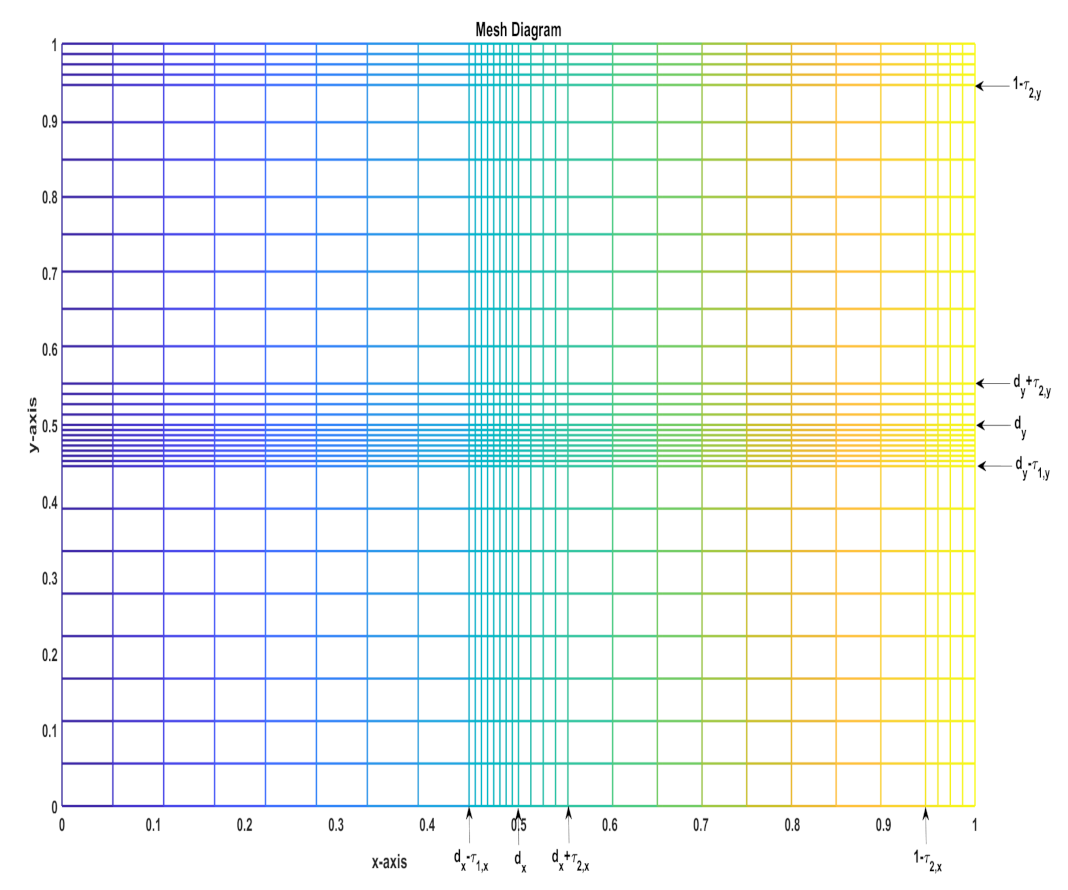
From Theorems 1 and 2, we observe that the IBVP (1)–(3) exhibits twin interior layers along the lines and and weak boundary layers along and . Let N be the number of mesh points in both spatial x and y directions. As the mesh defined in Ref. [13], we define the mesh points in both x and y directions, which is given in the following: let , , and . Using the transition parameters , we partitioned the domains and as follows:
On each sub-domains , respectively, we place mesh points with mesh sizes , , , , . In the same manner the mesh points in are defined. Now let us denote the mesh sizes to be and and define the mesh , and , The mesh distribution is depicted in the Figure 1.
Figure 1.
Mesh points distribution.
4.2. The Finite Difference Schemes
On the meshes and , we define the following finite difference schemes.
fix ,
fix ,
where and are the standard finite difference operators,
, ,
, , are the nodal points such that and The above two difference operators and satisfy the following discrete maximum principles.
Note: Let us denote the difference operators and In the following we use the above difference operators. Further, the test functions and are also used.
4.3. Discrete Stability Results
Lemma 4.
Let the mesh function be , satisfies , and , then for all
Proof.
Making use of the test mesh function and the arguments given in Ref. [13], Lemma 6.1, the lemma can be proved. □
Lemma 5.
Let the mesh function be , satisfies , and , then for all
Using the above two Lemmas 4 and 5, we can have the following discrete stability results.
Lemma 6.
Let be a numerical solution defined by (16), then
Lemma 7.
Let be a numerical solution defined by (17), then
5. Error Computation
Analogous to the continuous solution, the numerical solution is decomposed into smooth and singular components. The solution is decomposed as satisfy the following difference equations:
Similarly, the solution is decomposed as and they satisfy the following difference equations:
Note: The error estimate in each time level is proved in the following way:
- Step 1 : First we estimate the absolute difference of U and V;
- Step 2 : We estimate the error bound of the regular component, that is ;
- Step 3 : To estimate the error bound of the singular component in the entire domain, first we estimate in the outer region and then using the estimate of , we estimate in the inner layer region;
- Step 4 : Using the triangle inequality, we estimate the error bound of the numerical solution in each time level.
Proof.
Fix j. Let us consider the mesh function
where , and
It is easy to show that and by the arguments of [13], we have
By the Lemma 4, we have Hence the proof of the lemma. □
Proof.
Now, we see that
from the results given in Refs. [2,21,22], we have Using the following barrier function
we can see that , and From the Lemma 4, we have the desired result. □
Proof.
By the triangle inequality, Theorem 1, Lemmas 8 and 9, we have
where . Hence Therefore To prove the result inside the inner region, we consider the following mesh function
where , Then we have, Further Now,
for a suitable choice of At the point , we have From the Lemma 4, we have , . Therefore □
Proof.
The proof follows from the above two lemmas. □
Lemma 12.
Proof.
We see that, and .
Similar to the proof of Lemma 8, we can prove the following,
Let and be the solutions of (14) and (20), then similar to Lemma 9, we have
and Then by a suitable barrier function one can prove that Similar to the Lemma 11, we estimate
Hence and Using the barrier function
where , we prove that Hence the proof. □
Proof.
We prove the theorem on each time level . We know that , , and .
with the successive applications of Lemmas 6 and 7 and the iteration in n, we prove that
Using the following barrier functions
and from Lemmas 6 and 7, we can prove that
It is observed that . Using the following barrier functions
where
, we prove that and . By the triangle inequality, we have the desired results. □
Proof.
The error can be obtained from the following
From Lemma 3, Theorem 3 and Ref. [6], Theorem 1, we have
which completes the proof. □
6. Numerical Validation
Two examples are presented in this section to validate the theoretical results presented in this article. The exact analytical solutions to the test problems are unknown, therefore we use the double mesh principle to calculate the maximum point-wise error and computational order of convergence. For fixed M, we define
where and are the numerical solutions at the node with mesh sizes and , respectively, is maximum over for fixed N.
Example 1.
Consider the 2D parabolic PDE (1) with discontinuous source and convection coefficients with the following data:
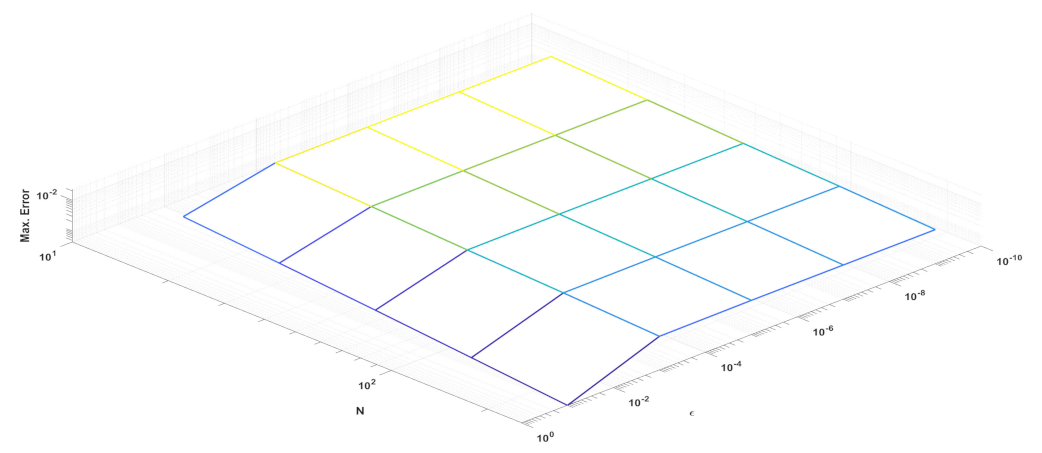
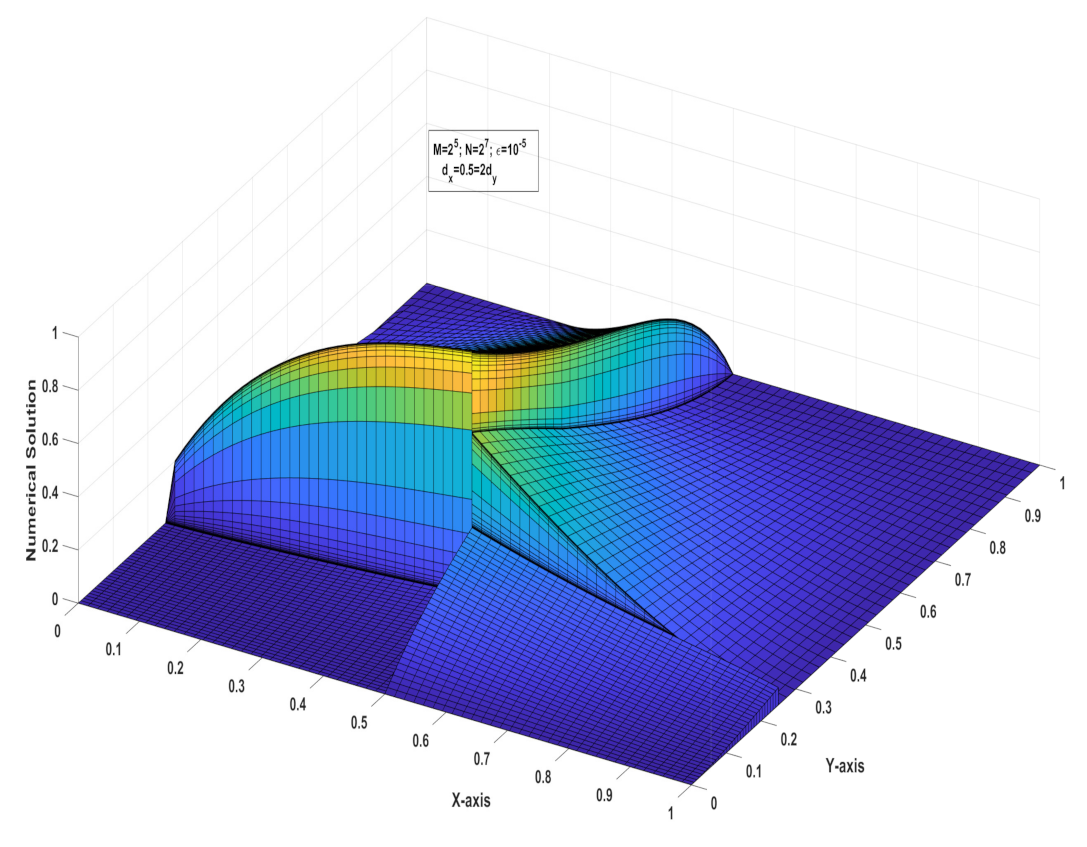
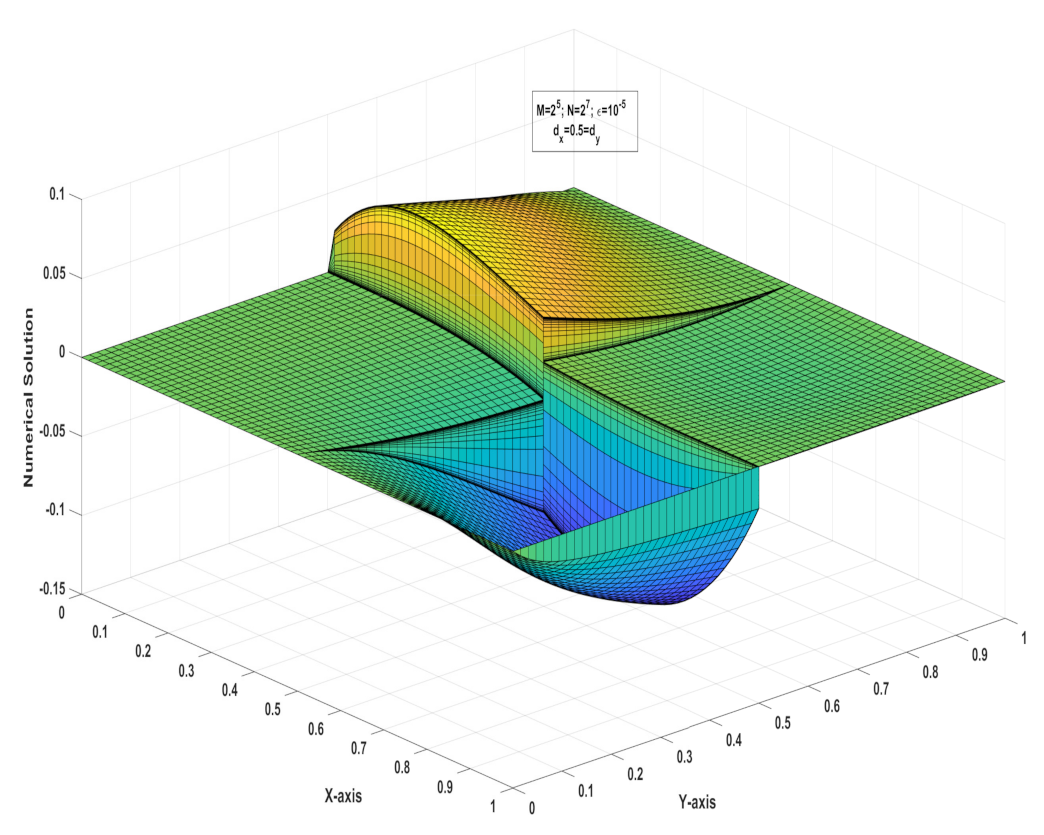
Table 1 presents the maximum pointwise error and the order of convergence corresponding to Example 1. Figure 2 and Figure 3 depict the numerical solution and pointwise maximum error of the problem studied in Example 1, respectively.
Table 1.
Maximum error and order of convergence for the Example 1 with .
Figure 2.
Numerical solution of Example 1 for fixed .
Figure 3.
Maximum error of Example 1.
Example 2.
Consider the 2D parabolic PDE (1) with discontinuous source and convection coefficients with the following data:
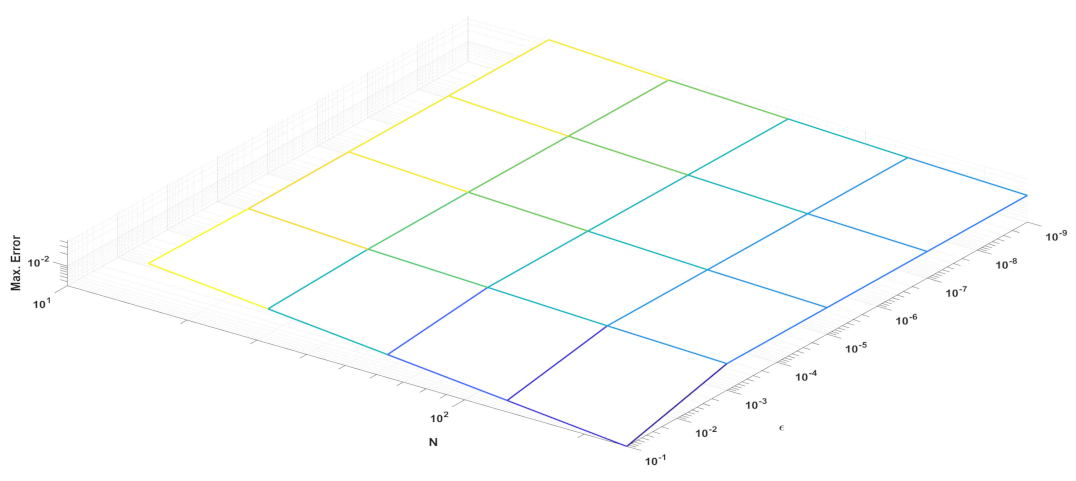
The maximum pointwise error and the order of convergence corresponding to Example 2 are given in Table 2. Figure 4 and Figure 5 display the numerical solution and pointwise maximum error of Example 2, respectively.
Table 2.
Maximum error and order of convergence for the Example 2 with .
Figure 4.
Numerical solution of Example 2 for fixed .
Figure 5.
Maximum error of Example 2.
7. Concluding Remarks
This article discusses singularly perturbed 2D parabolic delay differential equations with discontinuous convection coefficients and source terms. As pointed out in Ref. [3], the fractional step method results in low-cost computation for 2D problems. Therefore, we first apply the fractional implicit Euler method for the time derivative. Then the higher dimensional problem is reduced to lower dimensional problems. In fact, we get system of uncoupled equations. Each equation is a singularly perturbed differential equation with a discontinuous convection coefficient and source term. As discussed in Ref. [13], we discretized the spatial domains in the same manner, such as . On each mesh we apply the difference scheme It is proved that the present method is of almost first-order convergence in space and time. Figure 2 and Figure 4 represent the test problems solutions stated in Examples 1 and 2, respectively, we see that, the layers occurs at the points and . Table 1 and Table 2 present the maximum pointwise errors of the test example problems. It is also worth noting that when the parameter drops, the maximum pointwise error grows and stabilizes. It is assumed that the number of mesh points in the time direction is . From Figure 3 and Figure 5 we see that the maximum pointwise error decreases as N increases. The present method works for the problems with any delay arguments of size In Example 1 we assumed that , whereas in Example 2 we assumed that

Author Contributions
Methodology, V.S.; software, V.S.; formal analysis, S.N.; investigation, S.N.; writing—original draft preparation, V.S.; writing—review and editing, S.N. All authors have read and agreed to the published version of the manuscript.
Funding
This research received no external funding.
Institutional Review Board Statement
Not applicable.
Informed Consent Statement
Not applicable.
Data Availability Statement
Not applicable.
Acknowledgments
The authors are thankful for the DST-SERB for providing the fund under the scheme TARE, File No. TAR/2021/000053. The authors wish to acknowledge the referees for their valuable comments and suggestions, which helped to improve the presentation.
Conflicts of Interest
The authors declare no conflict of interest.
References
- Roos, H.G.; Stynes, M.; Tobiska, L. Robust Numerical Methods for Singularly Perturbed Differential Equations; Springer: Berlin, Germany, 2008. [Google Scholar]
- Miller, J.J.H.; O’Riordan, E.; Shishkin, G.I. Fitted Numerical Methods for Singular Perturbation Problems. In Error Estimates in the Maximum Norm for Linear Problems in One and Two Dimensions; World Scientific Publishing Co., Pte., Ltd.: Singapore, 2012. [Google Scholar]
- Clavero, C.; Jorge, J.C. A fractional step method for 2D parabolic convection–diffusion singularly perturbation problems: Uniform convergence and order reduction. Numer. Algorithms 2017, 75, 809–826. [Google Scholar] [CrossRef]
- Clavero, C.; Jorge, J.C.; Lisbona, F.; Shishkin, G.I. An alternating direction scheme on a nonuniform mesh for reaction–diffusion parabolic problem. IMA J. Numer. Anal. 2000, 20, 263–280. [Google Scholar] [CrossRef][Green Version]
- Mukherjee, K.; Natesan, S. Parameter-uniform fractional step hybrid numerical scheme for 2D singularly perturbed parabolic convection–diffusion problems. J. Appl. Math. Comput. 2019, 60, 51–86. [Google Scholar] [CrossRef]
- Majumdar, A.; Natesan, S. Parameter-uniform numerical method for singularly perturbed 2-D parabolic convection-diffusion problem with interior layers. Math. Meth. Appl. Sci. 2022, 45, 3039–3057. [Google Scholar] [CrossRef]
- Stein, R.B. A theoretical analysis of neuronal variability. Biol. J. 1965, 5, 173–194. [Google Scholar] [CrossRef]
- Musila, M.; Lansky, P. Generalized Stein’s model for anatomically complex neurons. BioSystems 1991, 25, 179–191. [Google Scholar] [CrossRef]
- Lange, C.G.; Miura, R.M. Singularly perturbation analysis of boundary-value problems for differential-difference equations. SIAM J. Appl. Math. 1982, 42, 502–530. [Google Scholar] [CrossRef]
- Amiraliyev, G.M.; Cimen, E. Numerical method for a singularly perturbed convection-diffusion problem with delay. Appl. Math. Comput. 2010, 216, 2351–2359. [Google Scholar] [CrossRef]
- Kadalbajoo, M.K.; Sharma, K.K. Numerical treatment of boundary value problems for second order singularly perturbed delay differential equations. Comput. Appl. Math. 2005, 24, 151–172. [Google Scholar] [CrossRef]
- Subburayan, V.; Ramanujam, N. An Initial Value Technique for Singularly Perturbed Convection–Diffusion Problems with a Negative Shift. J. Optim. Theory Appl. 2013, 158, 234–250. [Google Scholar] [CrossRef]
- Subburayan, V. A parameter uniform numerical method for singularly perturbed delay problems with discontinuous convection coefficient. Arab J. Math. Sci. 2016, 22, 191–206. [Google Scholar] [CrossRef]
- Ansari, A.R.; Bakr, S.A.; Shishkin, G.I. A parameter-robust finite difference method for singularly perturbed delay parabolic partial differential equations. J. Comput. Appl. Math. 2007, 205, 552–566. [Google Scholar] [CrossRef]
- Abhishek, D.; Natesan, S. Parameter-uniform numerical method for singularly perturbed 2D delay parabolic convection–diffusion problems on Shishkin mesh. J. Appl. Math. Comput. 2019, 59, 207–225. [Google Scholar]
- Wu, J. Theory and Applications of Partial Functional Differential Equations; Springer: New York, NY, USA, 1996. [Google Scholar]
- Briani, M.; Chioma, C.; Natalini, R. Convergence of numerical schemes for viscosity solutions to integro-differential degenerate parabolic problems arising in financial theory. Numer. Math. 2004, 98, 607–646. [Google Scholar] [CrossRef]
- Ladyzenskaja, O.A.; Solonnikov, V.A.; Ural’ceva, N.N. Linear and Quasi-Linear Equations of Parabolic Type; American Mathematical Soc.: Providence, RI, USA, 1968. [Google Scholar]
- Farrell, P.A.; Hegarty, A.F.; Miller, J.J.H.; O’Riordan, E.; Shishkin, G.I. Global maximum norm parameter-uniform numerical method for a singularly perturbed convection-diffusion problem with discontinuous convection coefficient. Math. Comput. Model. 2004, 40, 1375–1392. [Google Scholar] [CrossRef]
- Poole, G.; Boullion, T. A survey on M-Matrices. SIAM Rev. 1974, 16, 419–427. [Google Scholar] [CrossRef]
- Zadorin, A.I. Approaches to constructing two-dimensional interpolation formulas in the presence of boundary layers. J. Phys. Conf. Ser. 2022, 2182, 2–9. [Google Scholar] [CrossRef]
- Süli, E.; Mayers, D.F. An Introduction to Numerical Analysis; Cambridge University Press: Cambridge, UK, 2003. [Google Scholar]
Publisher’s Note: MDPI stays neutral with regard to jurisdictional claims in published maps and institutional affiliations. |
© 2022 by the authors. Licensee MDPI, Basel, Switzerland. This article is an open access article distributed under the terms and conditions of the Creative Commons Attribution (CC BY) license (https://creativecommons.org/licenses/by/4.0/).