Article

Federated Learning-Inspired Technique for Attack Classification in IoT Networks
by
Tariq Ahamed Ahanger
1,*,
Abdulaziz Aldaej
1,
Mohammed Atiquzzaman
2,
Imdad Ullah
1 and
Muhammad Yousufudin
1
1
College of Computer Engineering and Sciences, Prince Sattam Bin Abdulaziz University, Al-Kharj 11942, Saudi Arabia
2
School of Computer Science, University of Oklahoma, Norman, OK 73019, USA
*
Author to whom correspondence should be addressed.
Mathematics 2022, 10(12), 2141; https://doi.org/10.3390/math10122141
Submission received: 29 April 2022 / Revised: 8 June 2022 / Accepted: 16 June 2022 / Published: 20 June 2022
(This article belongs to the Special Issue Mathematical Methods for Computer Science)

Abstract

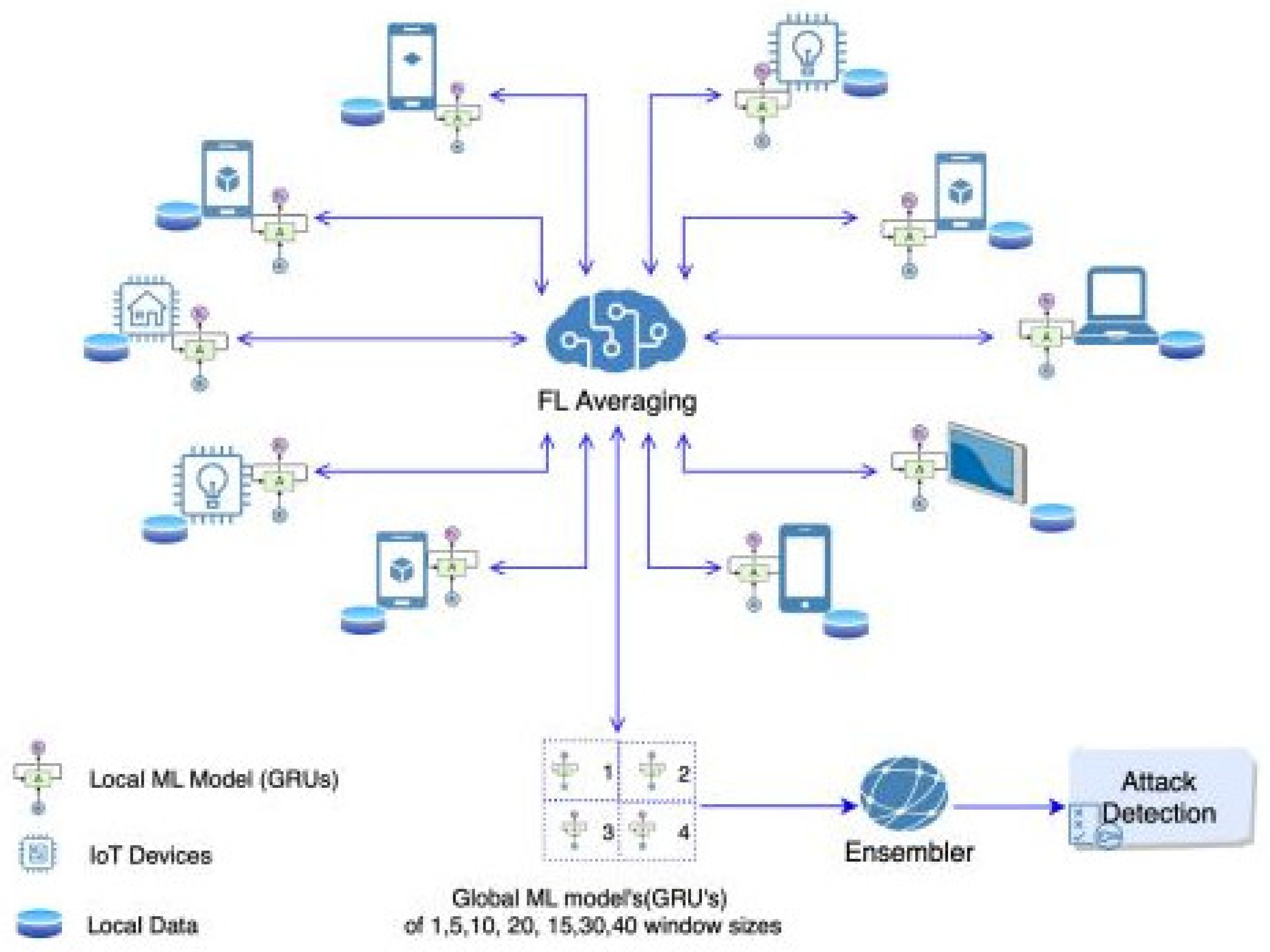
More than 10-billion physical items are being linked to the internet to conduct activities more independently and with less human involvement owing to the Internet of Things (IoT) technology. IoT networks are considered a source of identifiable data for vicious attackers to carry out criminal actions using automated processes. Machine learning (ML)-assisted methods for IoT security have gained much attention in recent years. However, the ML-training procedure incorporates large data which is transferable to the central server since data are created continually by IoT devices at the edge. In other words, conventional ML relies on a single server to store all of its data, which makes it a less desirable option for domains concerned about user privacy. The Federated Learning (FL)-based anomaly detection technique, which utilizes decentralized on-device data to identify IoT network intrusions, represents the proposed solution to the aforementioned problem. By exchanging updated weights with the centralized FL-server, the data are kept on local IoT devices while federating training cycles over GRUs (Gated Recurrent Units) models. The ensemble module of the technique assesses updates from several sources for improving the accuracy of the global ML technique. Experiments have shown that the proposed method surpasses the state-of-the-art techniques in protecting user data by registering enhanced performance measures of Statistical Analysis, Energy Efficiency, Memory Utilization, Attack Classification, and Client Accuracy Analysis for the identification of attacks.
Keywords: federated learning; security; DDoS attack; Internet of Things federated learning; security; DDoS attack; Internet of Things