

The ‘Concept-As-a-Tool’ Strategy for Familiarizing Young Children with the Idea of Sustainability


Abstract
1. Introduction
1.1. Rationale of the Study
1.2. Theoretical Background
1.2.1. Theoretical Suggestions
1.2.2. Objectives and Research Questions
- Which design theory could emerge from the design of a learning environment that aims to promote the idea of sustainability in early childhood education?
- To what extent do children’s learning outcomes provide support for the proposed design theory?
2. Materials and Methods
2.1. Shaping a Design Theory
- Design principle 1: The learning environment should encourage children to detect environmental problems, allow them to look for possible solutions and plan actions to implement these solutions, in the context of exploring possible scenarios for the future. The 1st design principle concerns the overall structure of LE3, and it is connected to all its LOs.
- Design principle 2: The learning environment should include a broad question to guide it as a whole (‘overall question’), as well as a series of partial questions, each addressed in a specific session and having an answer that can lead to the next one (‘central questions’). The 2nd design principle concerns the overall structure of LE3 and is connected to all its LOs.
- Design principle 3: The learning environment should include activities that support the active participation of the children (“hands on/minds on” activities) according to the principles of constructivism. The 3rd design principle is connected to LO8 of ‘LE3-forest’, as well as to LO2-4 and LO6 of ‘LE3-decompsition/recycling’.
- Design principle 4: The learning environment should apply the notion of ‘didactic transposition’ for the concepts it introduces. The 4th design principle concerns the overall structure of LE3, and it is connected to all its LOs.After the implementation of LE2, a new fifth ‘design principle’ concerning the concept of sustainability was added for the design of LE3, which is outlined as follows:
- Design principle 5: The learning environment should facilitate children to approach the concept of sustainability as a decision-making tool. More specifically, the learning environment should support children to become familiar with the idea of taking into account all three dimensions (environment, society, economy) when investigating problems of environmental/socio-economic interest in scenarios adapted to their abilities. The 5th design principle relates to (a) LO10 of ‘LE3-forest’, (b) LO9 of ‘LE3-decomposition/recycling’, and (c) LO6 of ‘LE3-intro’. Moreover, it should be noted that integrating this new principle into our design was crucial for the articulation of our design theory, as explained later in the paper.
2.2. Exploring the Utility of the Design Theory: RC3/LE3
2.2.1. Overview of the Learning Environment-3
2.2.2. The Data Collection
2.2.3. The Data Analysis
3. Results
3.1. Results for RQ1
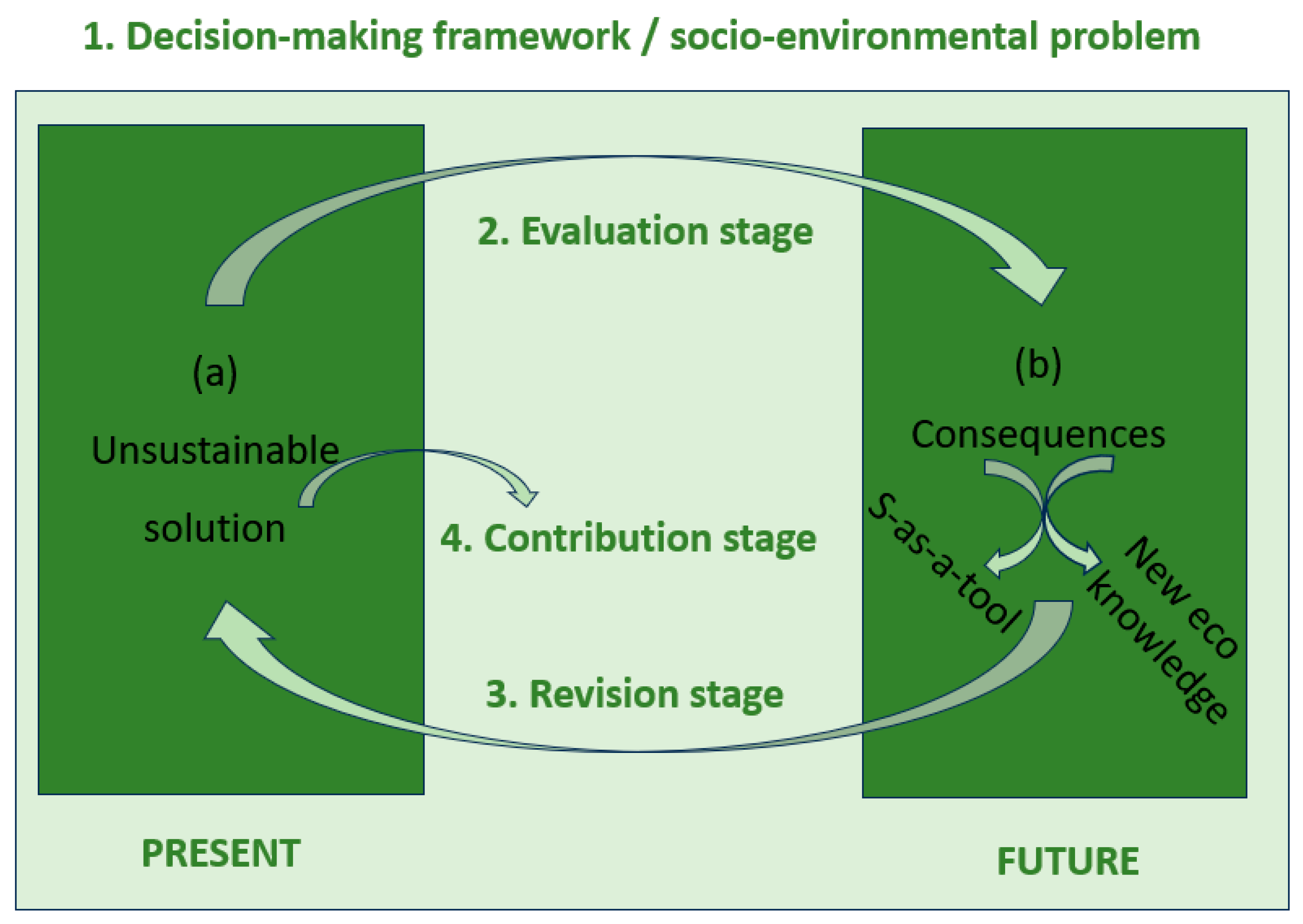
The Design Theory
- Framework(s): A socio-environmental problem (or more) within the understanding potential of young children, and an unsustainable decision made for the solution can provide the necessary framework(s). The problem needs to be understood as such by the children themselves.
- Evaluation stage/shift to the future: The unsustainable decision enters an evaluation process which is based on projecting its consequences into the future. Children detect the future consequences for both humans and the environment, allowing the concept of sustainability to emerge as a tool. In addition, future consequences raise ‘how’ or ‘why’ questions for children, thus providing opportunities to build new ecological knowledge.
- Revision stage/return to the present: The ecological knowledge built in the previous stage is used now, as children explore other solutions or corrective actions, returning to the present.
- Stage of focus on individual contribution: The solutions or corrective actions resulting from the previous stage are further explored here, with the aim of highlighting specific ways in which children can make a personal contribution, the value of this contribution and the power it gives them.
3.2. Results for RQ2
3.2.1. Children’s Pre/Post Understanding of the Target Ecological Concepts
3.2.2. Children’s Pre/Post Understanding of the Target Socio-Environmental Concepts
4. Discussion
Limitations and Future Research
5. Conclusions
Author Contributions
Funding
Institutional Review Board Statement
Informed Consent Statement
Data Availability Statement
Conflicts of Interest
Appendix A. The Learning Objectives

| Learning Objectives (LO) | ||
|---|---|---|
| Ecological ideas | LO1 | A forest is a home to many animals (habitat). |
| LO2 | Forests have a beneficial impact on the abiotic environment and human life; their function is anti-heat, anti-flood, anti-wind, anti-noise, pro-air (forest value). | |
| LO3 | Living things are connected in food chains; when one relationship in a food chain breaks, the others are affected too (food chain). | |
| LO4 | The green bin’s garbage is transferred to the landfill and buried in the soil, where they are ‘eaten’ by small or really tiny animals called decomposers and disappears; on the contrary, artificial garbage cannot be eaten and remains in the soil (decomposition). | |
| Socio-environmental ideas | LO5 | Present actions have future effects (present–future). |
| LO6 | Local environmental problems have global effects (local–global). | |
| LO7 | Everyone needs to act for the environment; individual action is an important part of collective action (individual–collective). | |
| LO8 | Humans have no right to decide against nature (human–nature equality). | |
| LO9 | Humans have no right to decide against fellow humans (human–human equality). | |
| LO10 | Recycling process: garbage separation, garbage transfer, landfill operation, recycling operation. | |
| LO11 | Everyday practices for the environment and fellow humans: consuming responsibly, donating to fellow humans, things we do not need but they can be useful to them, avoiding products in small packages, recycling, protecting forests. | |
| LO12 | Sustainability as a decision-making tool in socio-environmental issues (sustainability). | |
Appendix B
Appendix B.1. The Learning Environment: Introductory Part
| Sessions | Educational Activities | LO |
|---|---|---|
| 1. Present solutions and future effects |
| LO2 LO5 |
| 2. Equality |
| LO5 LO6 LO9 |
| 3. The ‘local–global’ connection |
| LO1 LO8 |
| 4. Individual and collective action and future effects |
| LO3 LO8 |
| 5.‘Sustainability‘ as a decision tool about socio-environmental issues |
| LO5 LO6 LO11 |
Appendix B.2. The Learning Environment: Forest Part
| Sessions | Educational Activities | LO |
|---|---|---|
| 6. ‘Nice-city now’: Present solutions and future effects |
| LO2 LO5 |
| 7. ‘Nice-City in the future’: nearby cities protest |
| LO5 LO6 LO9 |
| 8. ‘Nice-City in the future’: forest animals protest for losing home |
| LO1 LO8 |
| 9. ‘Nice-City in the future’: forest animals protest for losing food |
| LO3 LO8 |
| 10. ‘Possible Solutions’: current collective plans for future recovery and prevention |
| LO5 LO6 LO11 |
Appendix B.3. The Learning Environment: Decomposition/Recycling Part
| Sessions | Educational Activities | LO |
|---|---|---|
| 11. Present solutions and future effects regarding waste management: Is all garbage the same? What happens with different kinds of garbage? |
| LO5 |
| 12. Here is what happens |
| LO4 LO10 |
| 13. The different routes of waste depending on their synthesis, and the recycling factory |
| LO10 |
| 14. The recycling bin of a friend |
| LO11 |
| 15. Individual and collective action in favor of the environment and fellow-humans’ well-being |
| LO5 LO7 LO11 |
Appendix C
Appendix C.1. The Interview Protocol: Forest Part
| Question | What Does It Require? | What Does It Probe? |
|---|---|---|
| Q1 |
| LO5 |
| Q2 |
| LO5 |
| Q3 |
| LO6 |
| Q4 |
| LO9 |
| Q5 |
| LO1 |
| Q6 |
| LO8 |
| Q7 |
| LO11 |
| Q8 |
| LO2 |
| Q9 |
| LO7 |
| Q10 |
| LO3 |
Appendix C.2. The Interview Protocols: Decomposition/Recycling Part
| Question | What Does It Require? | What Does It Probe? |
|---|---|---|
| Q1 |
| LO10 |
| Q2 |
| LO10 |
| Q3 |
| LO10 |
| Q4 |
| LO4 |
| Q5 |
| LO10 |
| Q6 |
| LO10 |
| Q7 |
| LO11 |
| Q8 |
| LO11 |
| Q9 |
| LO11 |
| Q10 |
| LO11 |
| Q11 |
| LO12 |
Appendix D
Appendix D.1. Examples of Children’s Pre/Post Responses in Their Words: Ecological Concepts
| Concepts | Responses |
|---|---|
| Habitat | ‘If people cut the trees, the little bird will have no home to live and raise their babies’ (‘transitional’ pre-response): ‘The animals will lose their home and their food.’ […] ‘Animals have trees for home […] many animals live in one tree. And if people cut them (the trees), then all these animals will not have a place to stay […] they will not have food because they eat from the trees with fruit.’ (‘informed’ post-response) |
| Forest value | ‘Yes, we must take care of the forest. Because it’s good.’ (‘naïve’ pre-response): ‘Yes, we must take care of it, because when we have it (the forest) we don’t get flooded when it rains […] because the roots of the trees hold the water … it doesn’t reach the city. […] And the trunks and leaves are like a curtain […] it doesn’t let the strong wind and the loud noise pass […] we have peace. […] And they (the trees) also give us the clean oxygen out of their leaves and take the carbon dioxide in them […] and don’t let it make the warm blanket in the air, so we don’t get warm. We must take care of the forest and not harm it […] for all these’ (‘informed’ post-response) |
| Food chain | ‘The rabbits and the foxes will not will be ok […] If the rabbits are lost, the grass will be the same and no one will eat it. […] And the fox will want to find rabbits but they will not have any […] If the fox is killed then the rabbits will be happy because no one will be chasing them and they will live in peace. […] And the grass will be eaten by the rabbits, like always’ (‘naïve’ pre-response): ‘If the grass is gone then the rabbits will die of hunger. […] And the foxes will die of hunger because all the rabbits have also died of hunger […] they have nothing to eat. […] If the hunter kills all the rabbits, the foxes die because they don’t have food to eat. The grass will become very big because there are no rabbits to eat it. […] If the foxes disappear then the rabbits will make many babies but no one will eat them and there will be too many. […] I think the grass will become very-very little if there are so many rabbits to eat it.’ (‘informed’ post-response) |
| Decomposition | ‘These (shows the pictures of the strawberry, the egg and the broccoli) will be very dirty if they go to the landfill. They will be disgusting! […] this (shows the pictures of the glass bottle) will break […] and this (shows the pictures of the doll) will be so dirty that no one will want to play with it. […] The can will be filled with dirt.’ (‘naïve’ pre-response’): ‘If these (shows the pictures of the broccoli, the egg and the strawberry) go to the landfill and bury there, the decomposers will eat them […] they are very small animals that live in the soil. […] These (shows the pictures of the glass bottle, the soda can and the doll) the decomposers cannot eat them, […] if they go to the landfill they will stay there forever. […] we shouldn’t send garbage made by artificial materials to the landfill […] Because they stay there forever and fill it up. […] We must send only garbage made by natural materials […] the decomposers eat these, and the landfill will never be full.’ (‘informed’ post-response) |
Appendix D.2. Examples of Children’s Pre/Post Responses in Their Words: Socio-Environmental Concepts
| Concepts | Responses |
|---|---|
| Connections | |
| Present–future connection | ‘No, nothing will happen in the future [if they cut down trees from the nearby forest]. I think they should cut the forest because they don’t have enough houses. Where will they live?’ (‘naïve’ pre-response). ‘If they cut down the forest now, a lot of bad things will come […] they’ll get flooded when it rains […] they’ll get hot […] they won’t have clean oxygen. Τhey won’t sleep well at night […] it will have noise, […] and it’s going to be too windy in their city […] And the animals will not have a home and food if the forest is gone … they will have a bad future.’ (‘informed’ post-response). |
| Local–global connection | ‘The other cities are far from the cut down forest… they will have fresh air. […] Dirty air doesn’t go there.’ (‘naïve’ pre-response). ‘It doesn’t matter that the other cities are far from the cut forest. They will not have clean oxygen too […] because the Earth is one. […] what happens in one part of the Earth goes to other parts. […] They will all have the same problems. […] the air will be dirty everywhere […] Because the earth is one […] everyone will have the same problems in the future.’ (‘informed’ post-response). |
| Individual–collective action | ‘Look! (points to the picture) there are so many people who go to plant trees… there is no need for this child to go too. […] He can go for a ride with his friends on his bicycle’ (‘naïve’ pre-response). ‘This child should go and help too. […] everyone must help. He has to go too. […] It is not fair that everyone works and he does nothing and goes for a walk … he also wants to have a good future. […] And it will be even faster if there are more people! The kid should also go plant trees and not go for a walk. […] He can go for a walk after this.’ (‘informed’ post-response). |
| Equality | |
| Equality between humans | ‘They don’t need to care about other people. […] They are not their friends. […] They are strangers.’ (‘naïve’ pre-response). ‘Yes […] they must think a lot about other people […] even if they live far away. […] They have no right to harm the future and the beautiful life of others […] we are all equal. […] No one must do things that harm others.’ (‘informed’ post-response). |
| Equality between humans and nature | ‘They shouldn’t care about animals. […] Animals will find a home elsewhere.’ (‘naïve’ pre-response). ‘They must think about the animals too. Because we are equal to animals too. […] we should not create problems for them […] they have right for a good future […] and a home and food. […] These are rights of the animals…people should not spoil them’ (‘informed’ post-response). |
| Recycling Process | |
| Garbage separation | ‘The egg goes with the bottle because when we eat it (the egg), we drink water (from the bottle) […] These (shows the pictures of the soda cans) go with the broccoli and the strawberry […] when we eat them, we drink soda. […] the doll alone. It doesn’t fit anywhere.’ (‘naïve’ pre-response). ‘These (shows the pictures of the strawberry, broccoli and egg) go together because they are natural materials […] and we throw them in the green bin to go to the landfill […] to be eaten by the decomposers. […] The doll, and these (shows the pictures of the bottle and the soda cans) go together because they are artificial materials […] we throw them in the blue bin to go to the recycling factory to become new again.’ (‘informed’ post-response). |
| Garbage destination | ‘We throw our rubbish in the dustbin at home […] then we go and throw it all in the green bin.’ (‘naïve’ pre-response). ‘First, we separate them (the garbage) into natural materials and artificial materials […] in our home. […] Then we throw natural materials into the green bin […] the garbage man takes them to the landfill […] and we throw artificial materials into the blue bin and the other garbage man takes them to the recycling factory. […] In the landfill the natural materials are eaten by the decomposers. In the recycling factory the artificial materials become new again.’ (‘informed’ post-response). |
| Landfill operation | ‘The landfill is a place we go on vacation’ (‘naïve’ pre-response). ‘A landfill is a large place […] with a lot of soil […] the decomposers live in this soil. […] the garbage man leaves there the garbage of natural materials. They can be eaten by the decomposers… so the place gets empty and does not fill up.’ (‘informed’ post-response). |
| Recycling factory operation | ‘I don’t know what recycling is. […] I’ve never heard that before.’ (‘naïve’ pre-response). ‘Recycling is the factory where the garbage man takes the artificial materials that we throw in the blue bin. […] There they become new again and we can use them again. […] There they separate them into glass, aluminium, plastic, and paper […] recycling is very good because it helps us have a good future, […] this way the landfill is not filled with artificial materials that cannot be eaten by the decomposers.’ (‘informed’ post-response). |
| Adoption of everyday practices for the environment and fellow humans | |
| Recycling | ‘He does it right (points to the picture of the child who throws all the rubbish in the green bin). […] It is more correct to throw everything (all types of garbage) in the green bin […] that bin is for garbage. […] When the green bin is full, we will throw them (all types of garbage) in the blue one.’ (‘naïve’ pre-response). ‘It is better to separate his garbage into natural materials that he throws in the green bin and man-made materials that he throws in the blue bin. […] the garbage that are for the green bin will go to the landfill and be eaten by the decomposers […] the other garbage from the blue bin will go to the recycling factory and be new […] and we will use them again. […] Who does this, helps us all have a better future […] the landfill will not overflow.’ (‘informed’ post-response). |
| Waste reduction with less purchases | ‘We can buy all these (points to all the pictures with toys and chocolates) if our mom will let us. […] It is not bad to have a lot of toys. […] He better take many things. His mom allows it’ (‘naïve’ pre-response). ‘Better get just one of each. […] One toy and only one chocolate. […] If he gets all that, then when he eats them, he’ll make too much garbage […] the recycling factory might not keep up. […] And everything that the factory doesn’t manage to make new, it will be sent back to the landfill. […] And we will have the same problem again […] because these are man-made materials and they shouldn’t go to the landfill […] they fill it and it overflows. […] Because the decomposers don’t eat them! […] it’s better to take less things and to make less garbage. […] This is the best.’ (‘informed’ post-response). |
| Waste reduction with larger packages’ | ‘Better get these (points to the picture of the four small cans of juice) for everyone to drink their own. […] Not the big one because it will run out quickly’ (‘naïve’ pre-response). ‘He better get the one big juice. […] Because everyone will drink, and he won’t make too much garbage […] and the recycling factory will have time to make everything new, and we’ll have a good future. […] If he takes all these (points to the picture of the four small cans of juice), they will go to the factory and it won’t have time to do it all new […] they will be sent back to the landfill […] we will have a bad future. […] So, he’d better take only the one big juice.’ (‘informed’ post-response). |
| Donations of used goods to economically weaker fellow humans who need practical support | ‘It is better to throw away the old toy […] he doesn’t want it anymore. […] We clean our room of toys we don’t play anymore. […] He must throw it away.’ (‘naïve’ pre-response). ‘He should give it to his friend! […] Because he will make less garbage if he doesn’t throw it away… and he will make his friend very happy, […] if she doesn’t have many toys. […] Because all children must have toys to play […] We are all equal. Every child must have toys […] We must help the recycling factory to make all the garbage new […] They do not go back to the landfill. […] This way we will have a good future.’ (‘informed’ post-response) |
| Forest protection | ‘I think that they can’t rebuild the forest. They cut down the trees. […] Now they will be without a forest forever.’ (‘naïve’ pre-response). ‘They can rebuild the forest all together. […] Take seeds and put them in the ground […] and water them until they grow and become big trees again. […] They will have a forest and their future will be nice again […] because they will have fixed the problems that came because they had cut down the forest. […] And they must never again cut it down, nor burn it, nor pollute it with garbage. […] They should take care of it […] become guardians of the forest’ (‘informed’ post-response). |
| Recycling as necessary solution | ‘There is no problem to throw all our garbage to the landfill. […] This is the place for them. […] We should take them all there.’ (‘naïve’ pre-response). ‘Yes, […] It is a problem if we take all the garbage to the landfill because we will not have a good future. […] Only natural materials go to the landfill, […] because these can be eaten by the decomposers and they empty the landfill. […] If we also send man-made materials there, the decomposers cannot eat them […] this will be a big problem […] because they will stay there forever and they will overflow the landfill more and more. […] The solution is to separate man-made materials from natural […] and put them in the blue bins to go to the recycling factory and become new. […] The landfill will not fill up and we will have a clean and beautiful future.’(‘informed’ post-response). |
| Sustainability | |
| Sustainability | ‘I think… they should build the park […] they have jobs there […] money to buy food, […] they should build it.’ (‘naïve’ pre-response). ‘They have to think the environment and the animals and the money and their health… and then they can build it […] to have a good future. […] they can build it far away from the forest […] the animals will not be scared […] If they make rules, they can build it and be ok and have money to live.’ (‘informed’ post-response). |
Appendix E
Appendix E.1. Wilcoxon Signed-Rank Test Results for the Target Ecological Concepts
| Concept | Z | p | r | HL Estimate | 95% CI |
|---|---|---|---|---|---|
| Habitat | 4.52 | <0.001 | 0.83 | 1.0 | [1.0, 1.5] |
| Forest value | 4.96 | <0.001 | 0.91 | 2.0 | [1.5, 2.0] |
| Food chain | 4.92 | <0.001 | 0.90 | 1.5 | [1.5, 2.0] |
| Decomposition | 5.40 | <0.001 | 0.99 | 2.0 | [2.0, 2.0] |
Appendix E.2. Wilcoxon Signed-Rank Test Results for the Target Socio-Environmental Concepts
| (a) | |||||
| Concept | Z | p | r | HL Estimate | 95% CI |
| Future | 5.07 | <0.001 | 0.93 | 2.0 | [2.0, 2.0] |
| Present–future | 4.98 | <0.001 | 0.91 | 2.0 | [1.5, 2.0] |
| Local–global | 5.01 | <0.001 | 0.91 | 1.5 | [1.0, 1.5] |
| Individual–collective action | 4.75 | <0.001 | 0.87 | 1.0 | [1.0, 1.0] |
| Equality between humans | 4.86 | <0.001 | 0.89 | 1.5 | [1.0, 1.5] |
| Equality between humans and nature | 4.96 | <0.001 | 0.91 | 1.5 | [1.5, 2.0] |
| (b) | |||||
| Concept | Z | p | r | HL Estimate | 95% CI |
| Garbage separation | 5.26 | <0.001 | 0.96 | 2.0 | [2.0, 2.0] |
| Garbage destination | 5.04 | <0.001 | 0.92 | 2.0 | [2.0, 2.0] |
| Landfill operation | 5.15 | <0.001 | 0.94 | 2.0 | [2.0, 2.0] |
| Recycling operation | 5.40 | <0.001 | 0.99 | 2.0 | [2.0, 2.0] |
| (c) | |||||
| Concept | Z | p | r | HL Estimate | 95% CI |
| Recycling | 5.26 | <0.001 | 0.96 | 2.0 | [2.0, 2.0] |
| Less purchases | 5.32 | <0.001 | 0.97 | 2.0 | [2.0, 2.0] |
| Donation of used objects | 4.69 | <0.001 | 0.90 | 1.5 | [1.0, 2.0] |
| Packages | 5.30 | <0.001 | 0.99 | 2.0 | [2.0, 2.0] |
| Recovery and preventive plan | 4.85 | <0.001 | 0.89 | 1.5 | [1.5, 1.5] |
| Recycling as a solution | 5.26 | <0.001 | 0.96 | 2.0 | [2.0, 2.0] |
| (d) | |||||
| Concept | Z | p | r | HL Estimate | 95% CI |
| Sustainability | 5.17 | <0.001 | 0.96 | 2.0 | [2.0, 2.0] |
References
- Ardoin, N. M., & Bowers, A. W. (2020). Early childhood environmental education: A systematic review of the research literature. Educational Research Review, 31, 100353. [Google Scholar] [CrossRef] [Scilit] [PubMed]
- Ärlemalm-Hagsér, E. (2013). Respect for nature—A prescription for developing environmental awareness in preschool. Center for Educational Policy Studies Journal, 3(1), 25–44. [Google Scholar] [CrossRef] [Scilit]
- Bächtold, M. (2013). What do students “construct” according to constructivism in science education? Research in Science Education, 43(6), 2477–2496. [Google Scholar] [CrossRef] [Scilit]
- Biber, K., Cankorur, H., Güler, R. S., & Demir, E. (2023). Investigation of environmental awareness and attitudes of children attending nature centred private kindergartens and public kindergartens. Australian Journal of Environmental Education, 39(1), 4–16. [Google Scholar] [CrossRef] [Scilit]
- Boersma, K., & Waarlo, A. J. (2009). On the theoretical input and output of ‘design research’ in biology education. In M. Hammann, A. J. Waarlo, & K. Boersma (Eds.), The nature of research in biological education: Old and new perspectives on theoretical and methodological issues (pp. 463–479). CD-ß Press. [Google Scholar]
- Campbell, C., & Speldewinde, C. (2022). Early childhood STEM education for sustainable development. Sustainability, 14(6), 3524. [Google Scholar] [CrossRef] [Scilit]
- Caniglia, G., Lüderitz, C., von Wirth, T., Fazey, I., Martín-López, B., Hondrila, K., & Lang, D. J. (2021). A pluralistic and integrated approach to action-oriented knowledge for sustainability. Nature Sustainability, 4(2), 93–100. [Google Scholar] [CrossRef] [Scilit]
- Chevallard, Y. (1985). La transposition didactique. La Pensee Sauvage. [Google Scholar]
- Collado, S., Rosa, C. D., & Corraliza, J. A. (2020). The effect of a nature-based environmental education program on children’s environmental attitudes and behaviors: A randomized experiment with primary schools. Sustainability, 12(17), 6817. [Google Scholar] [CrossRef] [Scilit]
- Cutter-Mackenzie, A., & Edwards, S. (2013). Toward a model for early childhood environmental education: Foregrounding, developing, and connecting knowledge through play-based learning. The Journal of Environmental Education, 44(3), 195–213. [Google Scholar] [CrossRef] [Scilit]
- David, M. E. (2007). Changing the educational climate: Children, citizenship and learning contexts? Environmental Education Research, 13(4), 425–436. [Google Scholar] [CrossRef] [Scilit]
- Davis, J. (2009). Revealing the research ‘hole’ of early childhood education for sustainability: A preliminary survey of the literature. Environmental Education Research, 15(2), 227–241. [Google Scholar] [CrossRef] [Scilit]
- Davis, J., & Elliott, S. (2023). Young children and the environment: Early education for sustainability (3rd ed.). Cambridge University Press. [Google Scholar]
- Davis, J. M. (2022). Sustainability in early childhood education. In S. Faircloth (Ed.), Oxford bibliographies in education. Oxford University Press. [Google Scholar] [CrossRef] [Scilit]
- Debrah, J. K., Vidal, D. G., & Dinis, M. A. P. (2021). Raising awareness on solid waste management through formal education for sustainability: A developing countries evidence review. Recycling, 6(1), 6. [Google Scholar] [CrossRef] [Scilit]
- Dimitriou, A., & Christidou, V. (2007). Pupils’ understanding of air pollution. Journal of Biological Education, 42(1), 24–29. [Google Scholar] [CrossRef] [Scilit]
- Driver, R., Asoko, H., Leach, J., Mortimer, E., & Scott, P. (1994). Constructing scientific knowledge in the classroom. Educational Researcher, 23(7), 5–12. [Google Scholar] [CrossRef]
- Duhn, I. (2012). Making ‘place’ for ecological sustainability in early childhood education. Environmental Education Research, 18(1), 19–29. [Google Scholar] [CrossRef] [Scilit]
- Duit, R., Gropengießer, H., Kattmann, U., Komorek, M., & Parchmann, I. (2012). The model of educational reconstruction: A framework for improving teaching and learning science. In D. Jorde, & J. Dillon (Eds.), Science education research and practice in Europe (pp. 13–37). Sense Publishers. [Google Scholar] [CrossRef] [Scilit]
- Elliott, J. (2012). An introduction to sustainable development. Routledge. [Google Scholar]
- Elliott, S., Ärlemalm-Hagsér, E., & Davis, J. (2020). Researching early childhood education for sustainability. Routledge. [Google Scholar]
- Elliott, S., & Davis, J. (2009). Exploring the resistance: An Australian perspective on educating for sustainability in early childhood. International Journal of Early Childhood, 41(2), 65–77. [Google Scholar] [CrossRef] [Scilit]
- Elliott, S., & Davis, J. (2018). Moving forward from the margins: Education for sustainability in australian early childhood contexts. In G. Reis, & J. Scott (Eds.), International perspectives on the theory and practice of environmental education: A reader (pp. 163–178). Springer. [Google Scholar] [CrossRef] [Scilit]
- Engdahl, I., & Furu, A. C. (2022). Early childhood education: A vibrant arena in the complex transformation of society towards sustainability. International Journal of Early Childhood, 54(1), 1–12. [Google Scholar] [CrossRef] [Scilit] [PubMed]
- Ergazaki, M., & Andriotou, E. (2010). From “forest fires” and “hunting” to disturbing “habitats” and “food chains”: Do young children come up with any ecological interpretations of human interventions within a forest? Research in Science Education, 40(2), 187–201. [Google Scholar] [CrossRef] [Scilit]
- Ergazaki, M., Zogza, V., & Grekou, A. (2009). From preschoolers’ ideas about decomposition, domestic garbage fate and recycling to the objectives of a constructivist learning environment in this context. Review of Science, Mathematics and ICT Education, 3(1), 99–121. [Google Scholar] [CrossRef]
- Ferguson, T., Roofe, C., & Cook, L. D. (2021). Teachers’ perspectives on sustainable development: The implications for education for sustainable development. Environmental Education Research, 27(9), 1343–1359. [Google Scholar] [CrossRef] [Scilit]
- Fien, J., & Tilbury, D. (2002). The global challenge of sustainability. In D. Tilbury, R. B. Stevenson, J. Fien, & D. Schreuder (Eds.), Education and sustainability: Responding to the global challenge (pp. 1–12). IUCN. [Google Scholar]
- Fosnot, C. T. (2013). Constructivism: Theory, perspectives, and practice. Teachers College Press. [Google Scholar]
- Gavrilas, L., Papanikolaou, M. S., & Kotsis, K. T. (2024). The views of preschool educators on the development of environmental awareness through distance education. Interdisciplinary Journal of Environmental and Science Education, 20(3), e2411. [Google Scholar] [CrossRef] [Scilit]
- Griggs, D., Stafford-Smith, M., Gaffney, O., Rockström, J., Öhman, M. C., Shyamsundar, P., & Noble, I. (2013). Policy: Sustainable development goals for people and planet. Nature, 495(7441), 305–307. [Google Scholar] [CrossRef] [Scilit] [PubMed]
- Hadzigeorgiou, Y., Prevezanou, B., Kabouropoulou, M., & Konsolas, M. (2011). Teaching about the importance of trees: A study with young children. Environmental Education Research, 17(4), 519–536. [Google Scholar] [CrossRef] [Scilit]
- Hedefalk, M., Almqvist, J., & Östman, L. (2015). Education for sustainable development in early childhood education: A review of the research literature. Environmental Education Research, 21(7), 975–990. [Google Scholar] [CrossRef] [Scilit]
- Hicks, D., & Holden, C. (2007). Remembering the future: What do children think? Environmental Education Research, 13(4), 501–512. [Google Scholar] [CrossRef] [Scilit]
- Huggins, V., & Evans, D. (2018). Early childhood education and care for sustainability: International perspectives. Routledge. [Google Scholar]
- Iliopoulou, I. (2016). How young children think they can act for the environment: The case of forest and waste. Education, 46(3), 249–263. [Google Scholar] [CrossRef] [Scilit]
- Institute of Educational Policy. (2022). Curriculum for early childhood education (2nd ed.). Available online: https://ean.auth.gr/wp-content/uploads/2024/10/programma_spoudwn_2022.pdf (accessed on 18 August 2026). (In Greek)
- Iskos, E., & Karakosta, S. (2015). Not just a walk in the park: Case study of a Greek preschool located on an educational farm. Canadian Journal of Environmental Education, 20, 46–62. [Google Scholar]
- Kahriman-Ozturk, D., Olgan, R., & Guler, T. (2012). Preschool children’s ideas on sustainable development: How preschool children perceive three pillars of sustainability with the regard to 7R. Educational Sciences: Theory and Practice, 12(4), 2987–2995. [Google Scholar]
- Kasimati, M. C., & Ergazaki, M. (2019). Συνδυάζοντας τη βιολογική εκπαίδευση με την εκπαίδευση για την αειφορία: Aνατροφοδότηση από τον 2ο κύκλο έρευνας μιας αναπτυξιακής μελέτης με παιδιά προσχολικής ηλικίας. In P. Pantidos (Ed.), O ρόλος των Φυσικών Επιστημών στην Προσχολική Εκπαίδευση (pp. 479–499). Εκδόσεις Νέων Τεχνολογιών. (In Greek) [Google Scholar]
- Kasimati, M. C., & Ergazaki, M. (2020). Combining biology education and education for sustainability in preschool: Insights from the 2nd cycle of a design research. In B. Puig Mauriz, P. Blanco Anaya, M. J. Gil Quílez, & M. Grace (Eds.), Biology Education Research: Contemporary Topics and Directions (pp. 335–348). Servicio de Publicaciones, Universidad de Zaragoza. [Google Scholar]
- Kattmann, U., Duit, R., & Gropengießer, H. (1996, March 31–April 3). Educational reconstruction–bringing together issues of scientific clarification and students’ conceptions. Annual Meeting of the National Association for Research in Science Teaching (NARST), St. Louis, MO, USA. Available online: https://www.researchgate.net/profile/Ulrich-Kattmann/publication/271958515_Educational_Reconstruction_-_Bringing_together_Issues_of_scientific_clarification_and_students_conceptions_NARST_1996/links/54d731660cf25013d036c802/Educational-Reconstruction-Bringing-together-Issues-of-scientific-clarification-and-students-conceptions-NARST-1996.pdf (accessed on 18 August 2026).
- Klaassen, C. W. J. M. (1995). A problem-posing approach to teaching the topic of radioactivity. CD-ß Press. Available online: http://hdl.handle.net/1874/637 (accessed on 18 August 2026).
- Korfiatis, K. J., & Tunnicliffe, S. D. (2012). The living world in the curriculum: Ecology, an essential part of biology learning. Journal of Biological Education, 46(3), 125–127. [Google Scholar] [CrossRef] [Scilit]
- Kos, M., Jerman, J., Anžlovar, U., & Torkar, G. (2016). Preschool children’s understanding of pro-environmental behaviours: Is it too hard for them? International Journal of Environmental and Science Education, 11(12), 5554–5571. [Google Scholar]
- Lam, D. P., Hinz, E., Lang, D. J., Tengö, M., von Wehrden, H., & Martín-López, B. (2020). Indigenous and local knowledge in sustainability transformations research: A literature review. Ecology & Society, 25(1), 3. [Google Scholar] [CrossRef] [Scilit]
- Li, Y., Zhao, Y., Huang, Q., Deng, J., Deng, X., & Li, J. (2024). Empathy with nature promotes pro-environmental attitudes in preschool children. PsyCh Journal, 13(4), 598–607. [Google Scholar] [CrossRef] [Scilit] [PubMed]
- Lijnse, P. L., & Klaassen, C. W. J. M. (2004). Didactical structures as an outcome of research on teaching-learning sequences. International Journal of Science Education, 26(5), 537–554. [Google Scholar] [CrossRef] [Scilit]
- Mackey, G. (2012). To know, to decide, to act: The young child’s right to participate in action for the environment. Environmental Education Research, 18(4), 473–484. [Google Scholar] [CrossRef] [Scilit]
- Maidou, A., Plakitsi, K., & Polatoglou, H. (2019). Knowledge, perceptions and attitudes on education for sustainable development of pre-service early childhood teachers in Greece. World Journal of Education, 9(5), 1–15. [Google Scholar] [CrossRef] [Scilit]
- McKenney, S., & Reeves, T. C. (2018). Conducting educational design research (2nd ed.). Routledge. [Google Scholar] [CrossRef] [Scilit]
- Otto, S., & Pensini, P. (2017). Nature-based environmental education of children: Environmental knowledge and connectedness to nature, together, are related to ecological behaviour. Global Environmental Change, 47, 88–94. [Google Scholar] [CrossRef] [Scilit]
- Palmer, J., Suggate, J., & Matthews, J. (1996). Environmental cognition: Early ideas and misconceptions at the ages of four and six. Environmental Education Research, 2(3), 301–329. [Google Scholar] [CrossRef] [Scilit]
- Petkou, D., Kounani, A., Tsiouni, M., & Afedoulidou, E. (2025). Can sustainable schools influence environmental consciousness and behavior in early childhood? The perspectives of early childhood educators. Education Sciences, 15(7), 916. [Google Scholar] [CrossRef] [Scilit]
- Pramling Samuelsson, I. (2011). Why we should begin early with ESD: The role of early childhood education. International Journal of Early Childhood, 43(2), 103–118. [Google Scholar] [CrossRef] [Scilit]
- Pramling Samuelsson, I., & Kaga, Y. (2008). The contribution of early childhood education to a sustainable society. UNESCO. Available online: https://unesdoc.unesco.org/ark:/48223/pf0000159355 (accessed on 18 August 2026).
- Ravanis, K. (2010). La transformación didáctica: De las materias académias a las prácticas escolares. In G. Pappas (Ed.), Actas de congreso “La lengua griega en América Latina” (pp. 143–149). Universidad de Patras. [Google Scholar]
- Reid, A., & Scott, W. (2006). Researching education and the environment: Retrospect and prospect. Environmental Education Research, 12(3–4), 571–587. [Google Scholar] [CrossRef] [Scilit]
- Robert, K. W., Parris, T. M., & Leiserowitz, A. A. (2005). What is sustainable development? Goals, indicators, values, and practice. Environment: Science and policy for sustainable development, 47(3), 8–21. [Google Scholar] [CrossRef] [Scilit]
- Sakellariou, M., & Banou, M. (2022). Play within outdoor preschool learning environments of Greece: A comparative study on current and prospective kindergarten educators. Early Child Development and Care, 192(6), 887–903. [Google Scholar] [CrossRef] [Scilit]
- Salvia, A. L., Leal Filho, W., Brandli, L. L., & Griebeler, J. S. (2019). Assessing research trends related to sustainable development goals: Local and global issues. Journal of Cleaner Production, 208, 841–849. [Google Scholar] [CrossRef] [Scilit]
- Saviano, M., Barile, S., Spohrer, J. C., & Caputo, F. (2017). A service research contribution to the global challenge of sustainability. Journal of Service Theory and Practice, 27(5), 951–976. [Google Scholar] [CrossRef] [Scilit]
- Shutaleva, A., Nikonova, Z., Savchenko, I., & Martyushev, N. (2020). Environmental education for sustainable development in Russia. Sustainability, 12(18), 7742. [Google Scholar] [CrossRef] [Scilit]
- Smidt, S. (2018). Early childhood education and care for a shared sustainable world: People, planet and profits. Routledge. [Google Scholar]
- Somerville, M., & Williams, C. (2015). Sustainability education in early childhood: An updated review of research in the field. Contemporary Issues in Early Childhood, 16(2), 102–117. [Google Scholar] [CrossRef] [Scilit]
- Spiteri, J. (2018). Why we should start early with ESD for lifelong learning. In W. Leal Filho, M. Mifsud, & P. Pace (Eds.), Handbook of lifelong learning for sustainable development (pp. 109–128). Springer. [Google Scholar] [CrossRef] [Scilit]
- Taimur, S., & Sattar, H. (2020). Education for sustainable development and critical thinking competency. In W. Leal Filho, A. M. Azul, L. Brandli, P. Özuyar, & T. Wall (Eds.), Quality education (pp. 238–248). Springer International Publishing. [Google Scholar] [CrossRef] [Scilit]
- Tobin, K. G. (Ed.). (2012). The practice of constructivism in science education. Routledge. [Google Scholar] [CrossRef] [Scilit]
- Vodopivec, J. L., & Šindic, A. (2025). Early childhood education for sustainability in preschools with eco-programs: Implementation and learning outcomes. Journal of Baltic Science Education, 24(1), 133–148. [Google Scholar] [CrossRef] [Scilit]
- Wooltorton, S., Collard, L., Horwitz, P., Poelina, A., & Palmer, D. (2020). Sharing a place-based indigenous methodology and learnings. Environmental Education Research, 26(7), 917–934. [Google Scholar] [CrossRef] [Scilit]
- Zguir, M. F., Dubis, S., & Koç, M. (2021). Embedding education for sustainable development (ESD) and SDGs values in curriculum: A comparative review on Qatar, Singapore and New Zealand. Journal of Cleaner Production, 319, 128534. [Google Scholar] [CrossRef] [Scilit]
- Zidny, R., Sjöström, J., & Eilks, I. (2020). A multi-perspective reflection on how indigenous knowledge and related ideas can improve science education for sustainability. Science & Education, 29(1), 145–185. [Google Scholar] [CrossRef] [Scilit]

| Concept | Pre-Responses | Post-Responses | ||||
|---|---|---|---|---|---|---|
| Naïve | Transitional | Informed | Naïve | Transitional | Informed | |
| Habitat | 6/30 | 18/30 | 6/30 | 0/30 | 0/30 | 30/30 |
| Forest Value | 30/30 | 0/30 | 0/30 | 2/30 | 5/30 | 23/30 |
| Food Chain | 22/30 | 7/30 | 1/30 | 0/30 | 2/30 | 28/30 |
| Decomposition | 30/30 | 0/30 | 0/30 | 0/30 | 1/30 | 29/30 |
| Concept | Pre-Responses | Post-Responses | ||||
|---|---|---|---|---|---|---|
| Naïve | Transitional | Informed | Naïve | Transitional | Informed | |
| Future | 27/30 | 1/30 | 2/30 | 0/30 | 2/30 | 28/30 |
| Present–Future | 26/30 | 3/30 | 1/30 | 0/30 | 4/30 | 26/30 |
| Local–Global | 13/30 | 17/30 | 0/30 | 0/30 | 4/30 | 26/30 |
| Individual–Collective | 4/30 | 26/30 | 0/30 | 1/30 | 3/30 | 26/30 |
| Equality Between Humans | 15/30 | 15/30 | 0/30 | 0/30 | 4/30 | 26/30 |
| Equality Between Humans and Nature | 20/30 | 10/30 | 0/30 | 0/30 | 1/30 | 29/30 |
| Concept | Pre-Responses | Post-Responses | ||||
|---|---|---|---|---|---|---|
| Naïve | Transitional | Informed | Naïve | Transitional | Informed | |
| Garbage Separation | 27/30 | 3/30 | 0/30 | 0/30 | 0/30 | 30/30 |
| Garbage Destination | 22/30 | 8/30 | 0/30 | 0/30 | 0/30 | 30/30 |
| Landfill Operation | 25/30 | 5/30 | 0/30 | 0/30 | 0/30 | 30/30 |
| Recycling Operation | 29/30 | 1/30 | 0/30 | 0/30 | 0/30 | 30/30 |
| Concept | Pre-Responses | Post-Responses | ||||
|---|---|---|---|---|---|---|
| Naïve | Transitional | Informed | Naïve | Transitional | Informed | |
| Recycling | 29/30 | 1/30 | 0/30 | 0/30 | 2/30 | 28/30 |
| Less Purchases | 30/30 | 0/30 | 0/30 | 0/30 | 2/30 | 28/30 |
| Donation of Used Goods to Fellow Humans | 15/30 | 15/30 | 0/30 | 0/30 | 3/30 | 27/30 |
| Packages | 30/30 | 0/30 | 0/30 | 1/30 | 1/30 | 28/30 |
| Recovery and Preventive Plan | 17/30 | 13/30 | 0/30 | 1/30 | 3/30 | 26/30 |
| Recycling as a Solution | 28/30 | 2/30 | 0/30 | 0/30 | 1/30 | 29/30 |
| Concept | Pre-Responses | Post-Responses | ||||
|---|---|---|---|---|---|---|
| Naïve | Transitional | Informed | Naïve | Transitional | Informed | |
| Sustainability | 28/30 | 2/30 | 0/30 | 0/30 | 3/30 | 27/30 |
Disclaimer/Publisher’s Note: The statements, opinions and data contained in all publications are solely those of the individual author(s) and contributor(s) and not of MDPI and/or the editor(s). MDPI and/or the editor(s) disclaim responsibility for any injury to people or property resulting from any ideas, methods, instructions or products referred to in the content. |
© 2026 by the authors. Licensee MDPI, Basel, Switzerland. This article is an open access article distributed under the terms and conditions of the Creative Commons Attribution (CC BY) license.
Share and Cite
Kasimati, M.-C.; Ergazaki, M. The ‘Concept-As-a-Tool’ Strategy for Familiarizing Young Children with the Idea of Sustainability. Educ. Sci. 2026, 16, 1354. https://doi.org/10.3390/educsci16091354
Kasimati M-C, Ergazaki M. The ‘Concept-As-a-Tool’ Strategy for Familiarizing Young Children with the Idea of Sustainability. Education Sciences. 2026; 16(9):1354. https://doi.org/10.3390/educsci16091354
Chicago/Turabian StyleKasimati, Maria-Christina, and Marida Ergazaki. 2026. "The ‘Concept-As-a-Tool’ Strategy for Familiarizing Young Children with the Idea of Sustainability" Education Sciences 16, no. 9: 1354. https://doi.org/10.3390/educsci16091354
APA StyleKasimati, M.-C., & Ergazaki, M. (2026). The ‘Concept-As-a-Tool’ Strategy for Familiarizing Young Children with the Idea of Sustainability. Education Sciences, 16(9), 1354. https://doi.org/10.3390/educsci16091354