Citizenship Education in Engineering Degree Programs: An Analysis of the Academic Literature

 ,
,  ,
,  ,
, 
Abstract
1. Introduction
2. Theory and Practice of Citizenship Education
2.1. Social Learning and Citizenship Education in Engineering Programs
2.2. University and Citizenship Education: Approaches, Competencies, and Areas
2.2.1. Teaching
2.2.2. University–Society Relation
2.2.3. Knowledge Production and Dissemination
2.2.4. Political Participation and University Life
3. Method
3.1. Systematic Literature Review Using PRISMA 2020
3.1.1. Databases and Search Strategies
3.1.2. Inclusion and Exclusion Criteria
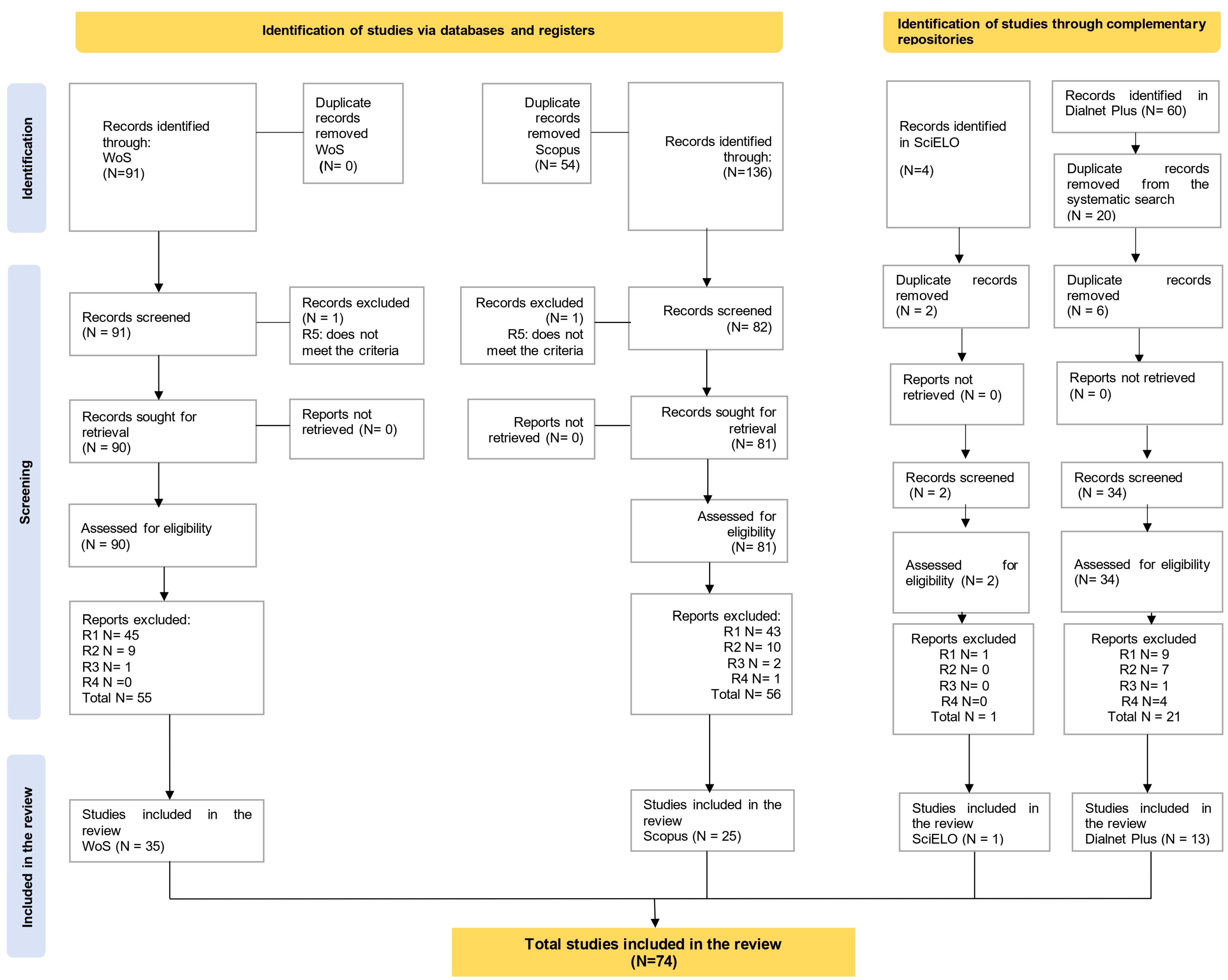
3.1.3. Article Selection and Data Extraction Process
3.1.4. Quality Assessment
3.2. Corpus Analysis
4. Results
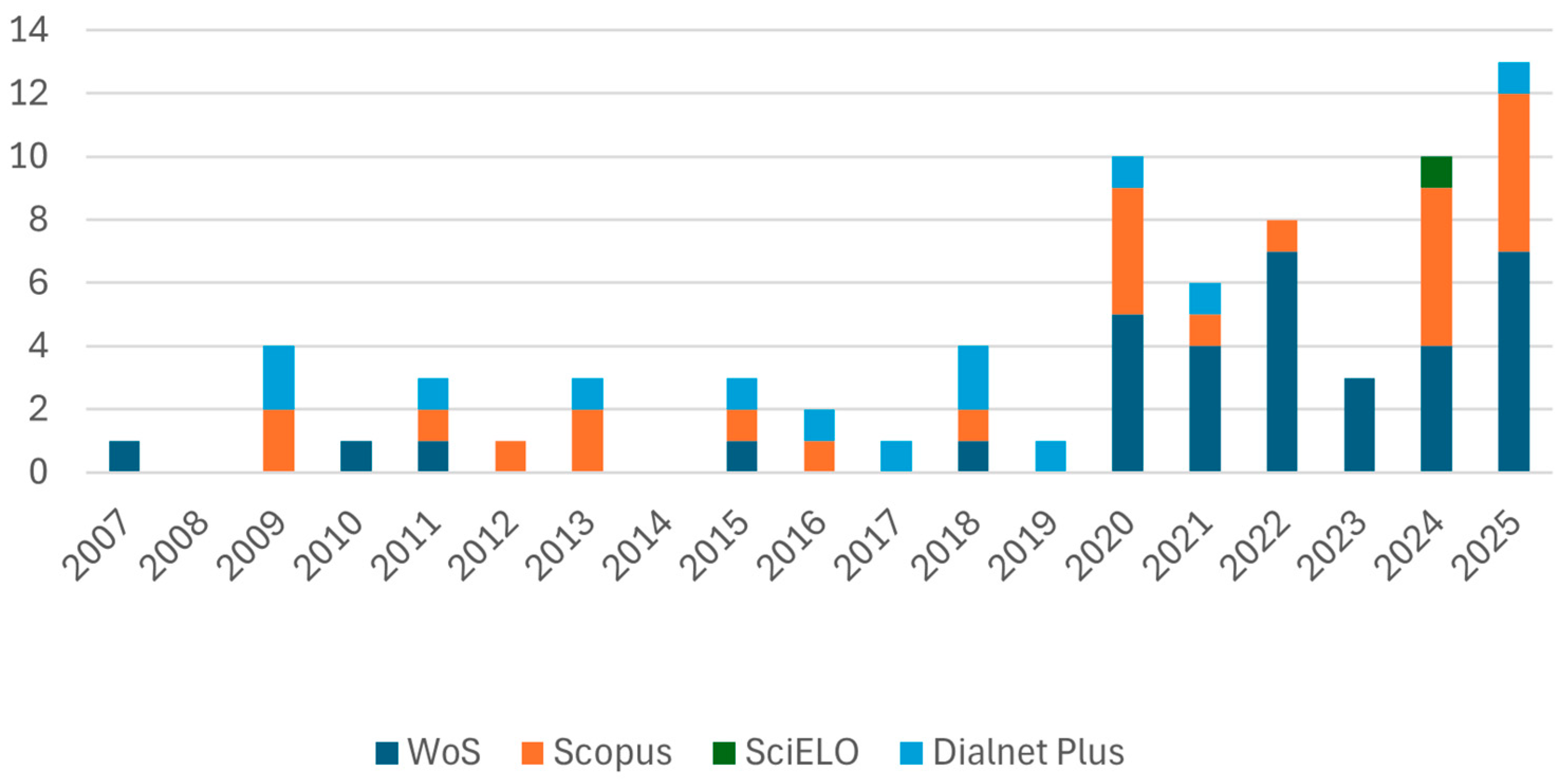
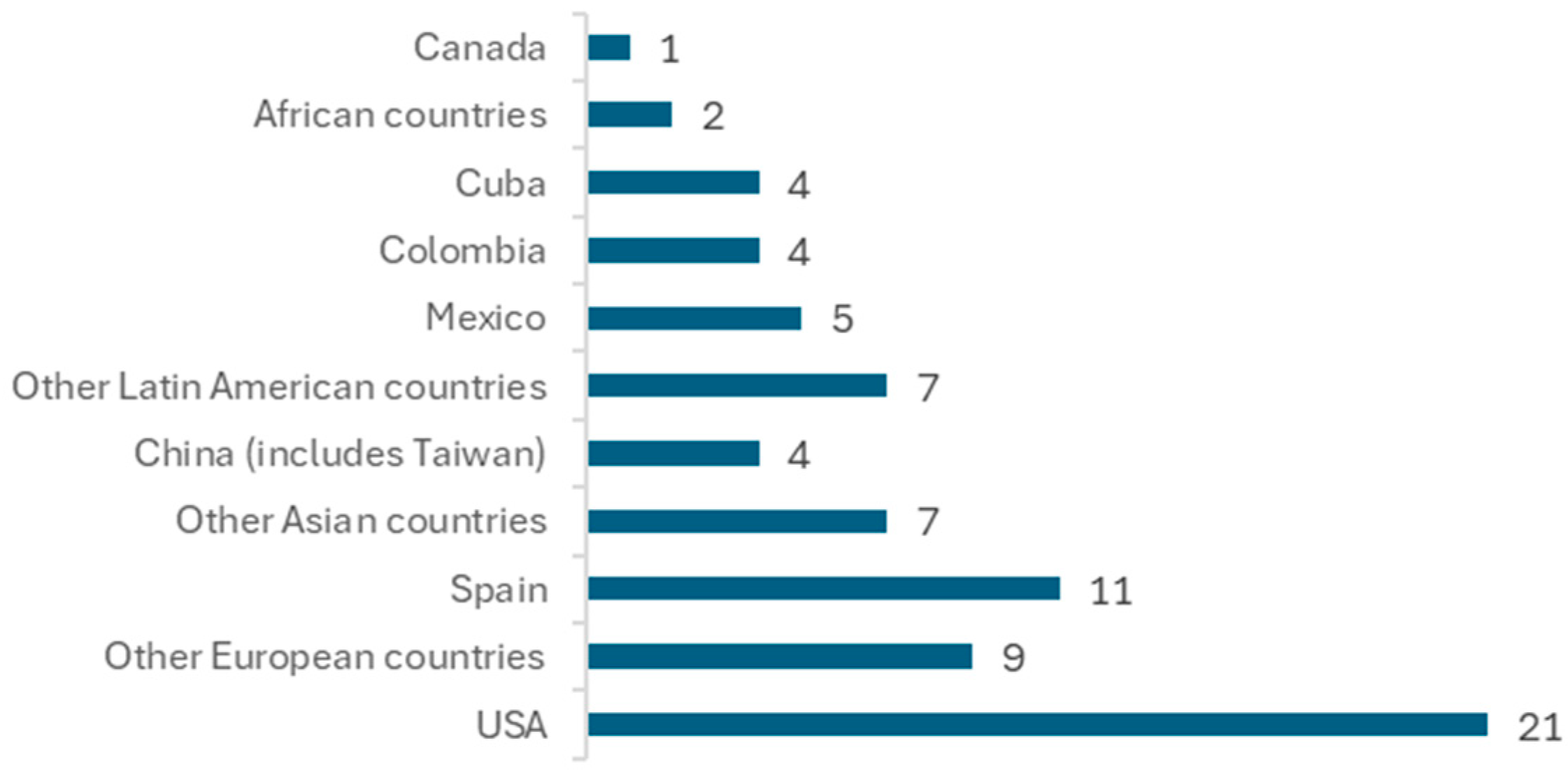
4.1. Descriptive Frequencies of the Corpus
4.2. Trends in Citizenship Education in Engineering Education
Beyond technical prowess, skills such as critical thinking, teamwork, communication, leadership, management, and entrepreneurship are essential for the modern workforce and solving twenty-first-century problems… must develop: self-knowledge and management, innovative entrepreneurship, social intelligence, ethical and civic engagement, reasoning for complexity, communication, and digital transformation.(p. 1)
- (a)
- Professional competencies or soft skills, either to argue their importance (Mikhailov et al., 2022) or to develop instruments to measure students’ acquisition of these competencies or their attitudes toward learning them (Byrne et al., 2020; Hadisantono et al., 2020).
- (b)
- The management of the USR in their own university contexts (Belkbir, 2024; R. Hernández & Saldarriaga, 2009; Poma et al., 2025).
- (c)
- The implementation of SL experiences with emphasis on students’ personal and professional development (Arias, 2025; Bielefeldt et al., 2011; B. Muñoz et al., 2021; Fabregat et al., 2025a, 2025b).
- (d)
- The development of professional responsibility and personal ethics in specific areas: environmental (Celdrán et al., 2018; Oral et al., 2021; Pan & Hsu, 2022), global (Bourn, 2011; Kulturel, 2020), and digital (Georgopoulou et al., 2025; Palacios et al., 2021).
Along with other critical scholars of engineering education, we argue that embedding social justice frameworks into engineering education, including sensibility around difference, power, and privilege, is required in order for engineering to meet the great sustainability and equity challenges of our time.(p. 1)
- (a)
- Civic and political engagement as democratic and transformative agency (not merely as a personal professional attribute), in which issues such as the political dimension of technical decisions and the overcoming of their supposed neutrality have been addressed (Morgan et al., 2020); the relationship between university experiences and political engagement (Lin & Hess, 2022a; Ro et al., 2022), in which engineering programs are those that most strongly foster a culture of disengagement; and the validation of a scale to assess civic awareness, which includes the assessment of community engagement (Hess et al., 2021; Lin & Hess, 2022a).
- (b)
- The implementation of SL educational experiences that explicitly consider social justice or critical pedagogy to question the structural causes of inequalities (Wesner et al., 2025), promote civic professionalism based on transformative educational experiences (Graeff & Wood, 2021), foster community participation (Cabral & Delgado, 2017), and propose social peace as a goal of engineering (Hinds et al., 2020).
- (c)
- The curriculum as a tool for transformation: a proposal that starts from a macro-ethical notion that perceives ethics as a collective and structural responsibility—not just an individual one. This line is addressed both from a theoretical perspective (Zouda, 2018) and from the analysis of the results and challenges of concrete experiences of curricular transformation in engineering (Wolff et al., 2025; Monteiro et al., 2016).
- (d)
- Approaching socioscientific and sociotechnical problems so that the student critically analyzes the social and environmental impact of their professional work, thereby fostering the will to act (Goggins & Hajdukiewicz, 2022; Hwang et al., 2023) and a hybrid imagination that enables the critical articulation of technical and social thinking (Jamison & Mejlgaard, 2010).
…la necesidad de acudir al legado de lo mejor del pensamiento de sus líderes emblemáticos, y por otro transmitir a través de la instrucción el arsenal de criterios en busca de valores cívicos y del bienestar social que ambos autores proponen en sus obras, refiriéndonos específicamente, a los aportes de Ernesto Guevara de la Serna (1928–1967) y Fidel Castro Ruz (1926–2016).(p. 157)
- (a)
- The civic commitment of future professionals, expressed in terms of attitudes and citizen behaviors, as illustrated by Chang et al. (2023), who studied the relationship between civic self-efficacy and the implementation of citizen actions in Taiwan, and Lin and Hess (2022a), who investigated the factors that influence the civic commitment of first-year students in the United States.
- (b)
- The curricular integration of professional ethics, which addresses its incorporation into the professional profile. Along these lines is the concern of Terrones and Rocha (2024) about ethics in the context of trustworthy artificial intelligence, as well as the educational experience of Namasivayam and Moganakrishnan (2018), which promoted ethics and civic engagement in engineering through community service activities.
- (c)
- University Social Responsibility, conceived as an institutional framework that enables the organization of citizenship education in these engineering programs (Poma et al., 2025; R. Hernández & Saldarriaga, 2009).
- (d)
- The political commitment of engineers, a more recent (2020–2025) yet increasingly relevant aspect, which, from the perspective of SJ, aims to overcome the culture of disengagement by addressing SSIs (Hwang et al., 2023) and SL based on a critical community-engaged pedagogy (Wesner et al., 2025).
4.3. Gaps
- (a)
- The area of political participation and university life is entirely absent, while the democratization of knowledge remains a largely unexplored dimension.
- (b)
- The literature is heavily concentrated in the US and, to a lesser extent, in Spain. However, many countries, especially those in the Global South, are underrepresented or entirely absent. It should be noted that more than half of the Latin American articles were found in the SciELO and Dialnet Plus databases; despite their inclusion, only 24.3% (n = 18) of the analyzed corpus is written in Spanish.
- (c)
- There is a scarcity of longitudinal studies on the impact of CE, since, in this regard, only the studies of Garibay (2015) and Pan and Hsu (2022) are available, and, as a retrospective assessment, the work of Knox and Nairn (2025) is also of note.
- (d)
- There are few studies that include the postgraduate level in some way, and only in the studies of Zaragoza et al. (2025) and Goggins (2012) does this level play a more prominent role.
- (e)
- Despite its importance, there are few studies on the role of teachers or their perceptions of CE.
- (f)
- Gender dimensions are insufficiently explored; only Wesner et al. (2025), Garibay (2015), and Byrne et al. (2020) have included them in some way.
- (g)
- There is a notable gap regarding the effects of CE on the communities with which the programs interact. For example, studies on SL tend to investigate the impact on students, but not on other stakeholders.
- (h)
- Studies are concentrated in a limited set of engineering careers, leaving others underrepresented—like agronomy, mining, and artificial intelligence—or unexplored —like nuclear, robotics, and biotechnology.
- (i)
- There is limited research on CE conducted at the postgraduate level (present, to varying degrees, in only five articles of the corpus)
5. Discussion
6. Conclusions
Author Contributions
Funding
Institutional Review Board Statement
Informed Consent Statement
Data Availability Statement
Conflicts of Interest
Abbreviations
| CE | Citizenship Education |
| SJ | Social Justice |
| USR | University Social Responsibility |
| SL | Service-Learning |
| PjBL | Project-Based Learning |
| PrBL | Problem-Based Learning |
| ABET | Accreditation Board for Engineering and Technology |
| EUR-ACE | European Accreditation of Engineering Programmes |
| AICTE | All India Council for Technical Education |
| COIL | Collaborative Online International Learning |
| SSI | Socioscientific Issues |
References
- Abate, S., & Orellano, V. (2020). Temas controversiales en acción. Trayectorias Universitarias, 6(11), 33. [Google Scholar] [CrossRef] [Scilit]
- ABET. (2024). Criteria for accrediting engineering programs, 2025–2026. Available online: https://www.abet.org/accreditation/accreditation-criteria/criteria-for-accrediting-engineering-technology-programs-2025-2026/ (accessed on 25 March 2026).
- Abrahamse, A., Johnson, N., Levinson, N., Medsker, L., & Pearce, J. (2015). A virtual educational exchange: A north–south virtually shared class on sustainable development. Journal of Studies in International Education, 19(2), 140–159. [Google Scholar] [CrossRef] [Scilit]
- Andrijcic, E., Mohan, S., Litzler, E., Han, R. J., Amekudzi-Kennedy, A., Webster, D., Haas, K., & Woolard, C. (2025). Fixing the potholes on the road to academic success: A curriculum for engineering educators to create and sustain meaningful change. Education Sciences, 15(11), 1509. [Google Scholar] [CrossRef] [Scilit]
- Andryukhina, L., Guzanov, B., & Anakhov, S. (2023). Engineering thinking: Vectors of development in the context of the transformation of the scientific picture of the world. Education and Science Journal, 25(8), 12–48. [Google Scholar] [CrossRef] [Scilit]
- Arias, J. (2025). Community service and professional development in civil engineering: Experiences and reflections of university students. Asian Journal of University Education, 21(1), 313–330. [Google Scholar] [CrossRef] [Scilit]
- Avilés, C. (2016). Responsables, sostenibles y universitarios como vía de lucha contra el cambio climático: El caso de la escuela técnica superior de ingeniería de montes, forestal y del medio natural (UPM). Revista de Responsabilidad Social de la Empresa, 24, 195–215. [Google Scholar]
- Azahares, O. (2019). Estrategia didáctica para la dinámica interdisciplinar de la formación de los profesionales del perfil minero-metalúrgico. REFCALE: Revista Electrónica Formación Y Calidad Educativa, 7(3), 13–27. [Google Scholar]
- Azahares, T., Ferrer, E., Ramírez, M., Arce, J., & Ramírez, Y. (2011). La formación integral del ingeniero minero metalúrgico en su vínculo con la sociedad. Cuadernos de Educación y Desarrollo, 3(23), 5. [Google Scholar]
- Álvarez, P., Muela, A., & Larrea, I. (2024). Influence of internship, service learning and student mobility programmes on the development of critical thinking disposition in higher education. Social Sciences & Humanities Open, 10, 101006. [Google Scholar] [CrossRef] [Scilit]
- Belkbir, R. (2024). Integrating the 6Cs in Moroccan higher education: A framework for inclusive AI learning design. Arab World English Journal, 15(3), 217–234. [Google Scholar] [CrossRef] [Scilit]
- Benjumea, M., Gutiérrez, A., Jaramillo, O., Mesa, A., & Pimienta, A. (2011). Formación ciudadana y educación para la ciudadanía: Aproximaciones conceptuales y mínimos compartidos. Revista Temas, 5, 211–224. [Google Scholar] [CrossRef] [Scilit]
- Berndt, A., & Paterson, C. (2009). Complementing business case studies with humanitarian case studies: A means of preparing global engineers. IEEE Transactions on Professional Communication, 52(4), 398–410. [Google Scholar] [CrossRef] [Scilit]
- Bielefeldt, A., Dewoolkar, M., Caves, K., Berdanier, B., & Paterson, K. (2011). Diverse models for incorporating service projects into engineering capstone design courses. International Journal of Engineering Education, 27(6), 1206–1220. [Google Scholar]
- Bordin, L. (2026). Desencontros entre orientações para uma perspectiva sociotécnica de educação em engenharia e sua materialidade no currículo e nas práticas educativas. Currículo sem Fronteiras, 26, e2269. [Google Scholar] [CrossRef] [Scilit]
- Bosman, L., Daut, E., Van Winkle, R., & Ricco, G. (2020). Integrating digital civics into the engineering technology classroom. Journal of Engineering Technology, 37(2), 20–32. [Google Scholar]
- Bourn, D. (2011). From internationalisation to global perspectives. Higher Education Research & Development, 30(5), 559–571. [Google Scholar] [CrossRef] [Scilit]
- Braun, V., & Clarke, V. (2006). Using thematic analysis in psychology. Qualitative Research in Psychology, 3(2), 77–101. [Google Scholar] [CrossRef] [Scilit]
- Braun, V., & Clarke, V. (2021). Thematic analysis: A practical guide. SAGE. [Google Scholar]
- Budak, U., & Damar, S. (2025). Research trends and emerging areas of interest from 2004 to 2024 in science education. Journal of Turkish Science Education, 22(4), 625–654. [Google Scholar] [CrossRef] [Scilit]
- Byrne, Z., Weston, J., & Cave, K. (2020). Development of a scale for measuring students’ attitudes towards learning professional skills. Research in Science Education, 50(4), 1417–1433. [Google Scholar] [CrossRef] [Scilit]
- Cabral, R., & Delgado, F. (2017). El programa de aval ciudadano: Una aproximación universitaria hacia la formación ciudadana y comunitaria. Revista Educación, Política y Sociedad, 2(1), 92–105. [Google Scholar] [CrossRef] [Scilit]
- Cabrera, M. (2020). Relevancia de las competencias ciudadanas en construcción de civilidad en educación superior. Educación y Humanismo, 22(38), 1–24. [Google Scholar] [CrossRef] [Scilit]
- Calderíus, M., & Martínez, N. (2012). Consideraciones del proceso de formación ciudadana del estudiante universitario. Didasc@lia: Didáctica y Educación, 3(3), 139–158. [Google Scholar]
- Castellví, J., Marolla, J., & Escribano, C. (2023). La investigación cualitativa. In D. Ortega (Ed.), ¿Cómo investigar en didáctica de las ciencias sociales? (pp. 57–78). Octaedro. Available online: https://octaedro.com/libro/como-investigar-en-didactica-de-las-ciencias-sociales/ (accessed on 13 March 2026).
- Cea, P., González, F., & Muñoz, M. (2015). Aprendizaje servicio en ingeniería civil de la UCSC: Experiencia del curso de topografía. RIDAS. Revista Iberoamericana de Aprendizaje Servicio, 1, 132–137. [Google Scholar]
- Cech, E. (2013). Culture of disengagement in engineering education? Science, Technology & Human Values, 39(1), 42–72. [Google Scholar] [CrossRef] [Scilit]
- Cech, E., & Finelli, C. (2024). Learning to prioritize the public good: Does training in classes, workplaces, and professional societies shape engineers’ understanding of their public welfare responsibilities? Journal of Engineering Education, 113(2), 407–438. [Google Scholar] [CrossRef] [Scilit]
- Celdrán, D., Montaño, F., & Cervantes, A. (2018). Alfabetización ambiental de los alumnos de la carrera de agronomía de la facultad de ingeniería y ciencias agropecuarias (fica) de la universidad nacional de San Luis, Villa Mercedes, Argentina. DELOS: Desarrollo Local Sostenible, 11, 1–16. [Google Scholar]
- Chang, D., You, J., & Chang, A. (2023). College students’ civic engagement efficacy and their implementing effects in selected STEM programs. Sage Open, 13(4), 21582440231220128. [Google Scholar] [CrossRef] [Scilit]
- Chans, G., Valle, A., Salas, S., Caratozzolo, P., & Camacho, C. (2025). Exploring transversal competencies in engineering students through international experiences. Frontiers in Education, 9, 1457796. [Google Scholar] [CrossRef] [Scilit]
- Chávez, D., & Norzagaray, C. (2021). Construyendo ciudadanía en la universidad: Una propuesta para la convivencia y resolución de conflictos. Revista Vértice Universitario, 23(92), 28–37. [Google Scholar] [CrossRef] [Scilit]
- Colmenares, M., & Armas, M. (2011). Investigación y responsabilidad social en la universidad Venezolana. Revista de Artes y Humanidades UNICA, 12(1), 52–67. [Google Scholar]
- Cordeiro, C. (2021). Brazilian grassroots engineering: A decolonial approach. European Journal of Engineering Education, 46(5), 690–706. [Google Scholar] [CrossRef] [Scilit]
- Council of Europe. (2018). Reference framework of competences for democratic culture. Council of Europe Publishing. Available online: https://www.coe.int/en/web/campaign-free-to-speak-safe-to-learn/reference-framework-of-competences-for-democratic-culture (accessed on 4 March 2026).
- Creswell, J. W., & Plano-Clark, V. L. (2018). Designing and conducting mixed methods research (3rd ed.). SAGE. [Google Scholar]
- Cuevas, M., Peña, M., Mondragón, E., & Camacho, C. (2024). Incorporating vertical collaboration to address sustainable development goals. Frontiers in Education, 9, 1246889. [Google Scholar] [CrossRef] [Scilit]
- Dastgir, G., & Bakhsh, K. (2022). Social justice in higher education: Revisited practices and grievances. Global Social Sciences Review, 7(2), 57–65. [Google Scholar] [CrossRef] [Scilit]
- De Araújo, V., & Massao, C. (2019). Controvérsias sociotécnicas: Uma proposta didática para o ensino de engenharia. Revista Ibero-Americana de Estudos em Educação, 14(2), 526–542. [Google Scholar] [CrossRef] [Scilit]
- Delahoz, E., Herrera-Fontalvo, T., & Zuluaga, R. (2020). Evaluación de la productividad académica de las competencias ciudadanas. Formación Universitaria, 13(5), 27–34. [Google Scholar] [CrossRef] [Scilit]
- DeWaters, J., & Kotla, B. (2023). Growing the entrepreneurial mindset in first-year engineering students. International Journal of Engineering Pedagogy, 13(7), 24–49. [Google Scholar] [CrossRef] [Scilit]
- Dewoolkar, M., George, L., Hayden, N., & Neumann, M. (2009). Hands-on undergraduate geotechnical engineering modules. Journal of Professional Issues in Engineering Education and Practice, 135(4), 161–175. [Google Scholar] [CrossRef] [Scilit]
- Disi, R., & Mardones, R. (2021). Enseñando con actitud: ¿Cuán efectiva ha sido la formación ciudadana en Chile? Education Policy Analysis Archives, 29, 15. [Google Scholar] [CrossRef] [Scilit]
- Escudero, C. (2020). El análisis temático como herramienta de investigación. La Trama de la Comunicación, 24(2), 89–100. [Google Scholar] [CrossRef] [Scilit]
- Eugenio, C., Acurio, J., Monga, D., & Olovacha, W. (2025). Responsabilidad social universitaria en la Provincia de Cotopaxi. RECIMUNDO, 9, 174–187. [Google Scholar] [CrossRef] [Scilit]
- Eustaquio, M., Clemente, R., Joaquín, M., Manaois, F., Alih, C., & Tulawie, A. (2025). Reimagining pedagogy through cultural narratives. International Journal on Culture, History and Religion, 7(SI2), 262–277. [Google Scholar] [CrossRef] [Scilit]
- Fabregat, A., Brosa, D., Balsells, O., Ismael, V., Huera, F., & Pàmies, R. (2025a). Analysis of a methodology for engineering education based on service-learning projects. International Journal of Mechanical Engineering Education, 03064190251366122. [Google Scholar] [CrossRef] [Scilit]
- Fabregat, A., Mayolas, A., Balsells, O., Ismael, V., Huera, F., & Pàmies, R. (2025b). Inspiring engineering education: Service learning in manufacturing projects. International Journal of Mechanical Engineering Education, 54(3), 696–711. [Google Scholar] [CrossRef] [Scilit]
- Flemming, K., Booth, A., Hannes, K., Cargo, M., & Noyes, J. (2018). Cochrane qualitative and implementation methods group guidance series—Paper 6: Reporting guidelines for qualitative, implementation, and process evaluation evidence syntheses. Journal of Clinical Epidemiology, 97, 79–85. [Google Scholar] [CrossRef] [Scilit] [PubMed]
- García, F., Vega, R., & Vallaeys, F. (2022). Ética, desarrollo sostenible y responsabilidad social desde la docencia. Emerging Trends in Education, 4(8), 48–61. [Google Scholar] [CrossRef] [Scilit]
- Garibay, J. (2015). STEM students’ social agency and views on working for social change. Journal of Research in Science Teaching, 52(5), 610–632. [Google Scholar] [CrossRef] [Scilit]
- Garrido, M. (2022). Diagnóstico de la formación ciudadana en los perfiles de egreso y modelo educativo de las universidades del estado (Informe Final). CUECH. Available online: https://ethos.uestatales.cl/item/diagnostico-de-la-formacion-ciudadana-en-los-perfiles-de-egreso/ (accessed on 17 March 2026).
- Georgopoulou, M., Troussas, C., Krouska, A., & Sgouropoulou, C. (2025). Digital literacy in higher education: Examining university students’ competence in online information practices. Computers, 14(12), 528. [Google Scholar] [CrossRef] [Scilit]
- Gewirtz, S., & Cribb, A. (2002). Plural conceptions of social justice: Implications for policy sociology. Journal of Education Policy, 17(5), 499–509. [Google Scholar] [CrossRef] [Scilit]
- Goggins, J. (2012). Engineering in communities: Learning by doing. Campus-Wide Information Systems, 29(4), 238–250. [Google Scholar] [CrossRef] [Scilit]
- Goggins, J., & Hajdukiewicz, M. (2022). The role of community-engaged learning in engineering education for sustainable development. Sustainability, 14(13), 8208. [Google Scholar] [CrossRef] [Scilit]
- González, B. (2018). Las estrategias educativas para la formación ciudadana según su alcance y sentido. Revista Perspectivas: Estudios Sociales y Educación Cívica, 17, 1–18. [Google Scholar] [CrossRef] [Scilit]
- González, M., López, R., & Ortiz, G. (Eds.). (2020). Formación ciudadana en estudiantes universitarios. Editorial Terracota. [Google Scholar]
- Graeff, E., & Wood, A. (2021). Undergraduate engineering education as civic professionalism. The Good Society, 30(1–2), 76–95. [Google Scholar] [CrossRef] [Scilit]
- Gumede, N., & Tladi, B. (2023). Socio-technical systems: Using actor-network theory to make the social more tangible in a technical space. The South African Journal of Industrial Engineering, 34(3), 140–155. [Google Scholar] [CrossRef] [Scilit]
- Hadisantono, H., Rowe, G., & Giacaman, N. (2020). Extending assessment of engineering professional skills to include the local Indonesia higher education competency. Australasian Journal of Engineering Education, 25(1), 90–102. [Google Scholar] [CrossRef] [Scilit]
- Herkert, J. (2005). Ways of thinking about and teaching ethical problem solving: Microethics and macroethics in engineering. Science and Engineering Ethics, 11, 373–385. [Google Scholar] [CrossRef] [Scilit] [PubMed]
- Hernández, H., & López, J. (2014). La participación estudiantil como estrategia de formación ciudadana para la educación en valores en el nivel superior. Revista de Comunicación de la SEECI, 35, 43–58. [Google Scholar] [CrossRef] [Scilit]
- Hernández, R., & Saldarriaga, A. (2009). Gestión de la responsabilidad social universitaria: Caso escuela de ingeniería de antioquía–eia. Dyna, 76(159), 237–248. [Google Scholar]
- Hess, J., Lin, A., Fore, G., Hahn, T., & Sorge, B. (2021). Testing the civic-minded graduate scale in science and engineering. International Journal of Engineering Education, 37(1), 44–64. [Google Scholar]
- Hinds, T., Buch, N., Delgado, V., & Morgan, J. (2020). Development of a peace engineering initiative within a first-year engineering program. Journal of Engineering Education Transformations, 33, 112–117. [Google Scholar] [CrossRef] [Scilit]
- Hwang, Y., Ko, Y., Shim, S., Ok, S., & Lee, H. (2023). Promoting engineering students’ social responsibility and willingness to act on socioscientific issues. International Journal of STEM Education, 10(11), 11. [Google Scholar] [CrossRef] [Scilit] [PubMed]
- Jamison, A., & Mejlgaard, N. (2010). Contextualizing nanotechnology education: Fostering a hybrid imagination in Aalborg, Denmark. Science as Culture, 19(3), 351–368. [Google Scholar] [CrossRef] [Scilit]
- Juhl, J., & Buch, A. (2019). Transforming academia: The role of education. Educational Philosophy and Theory, 51(8), 803–814. [Google Scholar] [CrossRef] [Scilit]
- Knox, R., & Nairn, R. (2025). Twenty-five years of domestic service learning and community engagement projects: A framework for state-funded university environmental capstone classes. Journal of Civil Engineering Education, 151(3), 1653–1660. [Google Scholar] [CrossRef] [Scilit]
- Kulturel, S. (2020). Person-centered analysis of factors related to STEM students’ global awareness. International Journal of STEM Education, 7(1), 40. [Google Scholar] [CrossRef] [Scilit]
- Lamancusa, J. (2006). Design as the bridge between theory and practice. International Journal of Engineering Education, 22(3), 652–658. [Google Scholar]
- León, F. (2020). Competencias ciudadanas: Análisis crítico y pautas para la formación profesional. Controversias y Concurrencias Latinoamericanas, 12(21), 369–388. [Google Scholar]
- Lin, A., & Hess, J. (2022a). Understanding influences on engineering students’ civic engagement in high school and the first year of college. IEEE Transactions on Education, 65(3), 287–296. [Google Scholar] [CrossRef] [Scilit]
- Lin, A., & Hess, J. (2022b). Validating the civic-minded graduate scale with first-year engineering students using mixed methods. Michigan Journal of Community Service Learning, 28(1), 29–62. [Google Scholar] [CrossRef] [Scilit]
- López, D., & Mejía, L. (2017). Una mirada a las estrategias y técnicas didácticas en la educación en ingeniería: Caso ingeniería industrial en Colombia. Entre Ciencia e Ingeniería, 11(21), 123–132. [Google Scholar] [CrossRef] [Scilit]
- Manjarrés, A., & Pickin, S. (2021). Aprendizaje-servicio y agenda 2030 en la formación de ingenieros de la tecnología inteligente. Revista Diecisiete: Investigación Interdisciplinar para los Objetivos de Desarrollo Sostenible 4, 59–82. [Google Scholar] [CrossRef] [Scilit]
- Manjarrés, A., Pickin, S., Alonso, H., & Rodriguez-Fernández, N. (2020). Virtu@l-ApS: Technological support for virtual service-learning. RIED: Revista Iberoamericana de Educación a Distancia, 23(1), 85–109. [Google Scholar] [CrossRef] [Scilit]
- Mardones, R. (2021). Estado del arte sobre enfoque de formación ciudadana en educación superior. CUECH. Available online: https://ciudadania.uestatales.cl/wp-content/uploads/2021/07/Estado-del-arte-sobre-enfoque-de-formacion-ciudadana-en-educacion-superior-1.pdf (accessed on 8 July 2026).
- Martín, D., Bombaerts, G., Horst, M., Papageorgiou, K., & Viscusi, G. (2023). Pedagogical orientations and evolving responsibilities of technological universities: A literature review of the history of engineering education. Science and Engineering Ethics, 29(6), 40. [Google Scholar] [CrossRef] [Scilit] [PubMed]
- Martínez, M. (2006). Formación para la ciudadanía y educación superior. Revista Iberoamericana de Educación, 42, 85–102. [Google Scholar] [CrossRef] [Scilit]
- Mazorra, J., Lumbreras, J., Ortiz, I., Díaz, C., Carretero, A., Egido, M., Gesto, B., Mancebo, J., Pereira, D., Sierra, M., Vignote, S., Moreno, J., & Mataix, C. (2016). Using the project based learning (PBL) methodology to assure a holistic and experiential learning on a master’s degree on technology for human development and cooperation. International Journal of Engineering Education, 32(5), 2204–2217. [Google Scholar]
- Mazzurco, A., & Daniel, S. (2020). Socio-technical thinking of students and practitioners in the context of humanitarian engineering. Journal of Engineering Education, 109(2), 243–261. [Google Scholar] [CrossRef] [Scilit]
- McAlister, A., & Lilly, S. (2023, June 25–28). Integrating technical and social issues in engineering education: A justice-oriented mindset. ASEE Annual Conference & Exposition, Baltimore, MD, USA. [Google Scholar] [CrossRef] [Scilit]
- McLaughlin, J., Chen, E., Lake, D., Guo, W., Skywark, E., Chernik, A., & Liu, T. (2022). Design thinking teaching and learning in higher education: Experiences across four universities. PLoS ONE, 17(3), e0265902. [Google Scholar] [CrossRef] [Scilit] [PubMed]
- Mesa, A., & Benjumea, M. (2011). La educación para la ciudadanía en la educación superior. Unipluriversidad, 11(1), 85–96. [Google Scholar] [CrossRef] [Scilit] [PubMed]
- Mieles, M., Tonon, G., & Alvarado, S. (2012). Investigación cualitativa: El análisis temático para el tratamiento de la información desde el enfoque de la fenomenología social. Universitas Humanística, 74, 195–226. [Google Scholar]
- Mikhailov, A., Tikhonov, A., & Margarov, G. (2022). The value potential of an engineer in a high-tech environment and digitalization of the economy. Wisdom, 21(1), 86–92. [Google Scholar] [CrossRef] [Scilit]
- Mina, L. W. (2013). Rhetoric of place: Pedagogy of sustainability in the technical writing class. International Journal of Sustainability Education, 8(3), 41–50. [Google Scholar] [CrossRef] [Scilit]
- Molina, A., Ponce, C., & Rubalcaba, C. (2023). Ciudadanía y educación: Una aproximación al campo de conocimiento. Revista Latinoamericana de Estudios Educativos, 53(1), 201–228. [Google Scholar] [CrossRef] [Scilit]
- Monteiro, F., Leite, C., & Rocha, C. (2016). The influence of engineers’ training models on ethics and civic education components in engineering courses in Portugal. European Journal of Engineering Education, 42(2), 156–170. [Google Scholar] [CrossRef] [Scilit]
- Morgan, D., Davis, K., & López, N. (2020). Engineering political fluency: Identifying tensions in the political identity development of engineering majors. Journal of Engineering Education, 109(1), 107–124. [Google Scholar] [CrossRef] [Scilit]
- Morillas, M. (2006). Competencias para la ciudadanía: Reflexión, decisión, acción. Narcea. [Google Scholar]
- Muñoz, A., Tejedor, V., & Lafuente, M. (2022). Preparing vulnerable populations for science literacy and young adults for global citizenship through service learning. Sustainability, 14, 6775. [Google Scholar] [CrossRef] [Scilit]
- Muñoz, B., Blanco, S., & Alberti, M. (2021). Impact of service-learning on the motivation of engineering and high school students. International Journal of Engineering Education, 37(4), 1060–1070. [Google Scholar]
- Namasivayam, S., & Moganakrishnan, J. (2018). Linking professional conduct for undergraduate engineering with civic engagement through teaching and learning. Journal of Engineering Science and Technology, 13(2), 421–434. [Google Scholar]
- Nascimento, M., & Morais, E. (2020). The show must go on II: Statistics in (engineering) higher education. Open Education Studies, 2(1), 214–219. [Google Scholar] [CrossRef] [Scilit]
- Nicolescu, B. (2012). Transdisciplinarity: The hidden third, between the subject and the object. Human & Social Studies, 1(1), 13–28. [Google Scholar] [CrossRef] [Scilit]
- Nowell, L., Norris, J., White, D., & Moules, N. (2017). Thematic analysis: Striving to meet the trustworthiness criteria. International Journal of Qualitative Methods, 16(1), 1609406917733847. [Google Scholar] [CrossRef] [Scilit]
- Obregón, E., Hernández, D., & Trujillo, J. (2024). Experiencias de las clases prácticas en el departamento de enseñanza militar de la CUJAE. Referencia Pedagógica, 12(2), 186–201. [Google Scholar]
- Oktaviani, L., Aulia, U. Y., Murdiono, M., & Suharno, S. (2024). Strengthening the critical thinking skill through the six-hat thinking model in Pancasila education. Journal of Education and Learning, 18(4), 1272–1278. [Google Scholar] [CrossRef] [Scilit]
- Oral, H., Eren, Ö., Yay, A., & Saygin, H. (2021). Environmental citizenship perception and behavior among university engineering students in the Marmara region of Turkey. Environment, Development and Sustainability, 23(3), 3638–3652. [Google Scholar] [CrossRef] [Scilit]
- Ortiz, A. (2020). Estrategia didáctica para el desarrollo de valores cívicos en egresados de la educación superior. REFCALE: Revista Electrónica Formación y Calidad Educativa, 8(3), 155–174. [Google Scholar]
- Özkan, D. S. (2025). Sociotechnical curricular approaches for a culture of engagement in engineering: Students navigating power and equity. Engineering Studies, 18(1), 56–81. [Google Scholar] [CrossRef] [Scilit]
- Page, M., McKenzie, J., Bossuyt, P., Boutron, I., Hoffmann, T., Mulrow, C., Shamseer, L., Tetzlaff, J., Akl, E., Brennan, S., Chou, R., Glanville, J., Grimshaw, J. M., Hróbjartsson, A., Lalu, M. M., Li, T., Loder, E. W., Mayo-Wilson, E., McDonald, S., … Moher, D. (2021). The PRISMA 2020 statement: An updated guideline for reporting systematic reviews. PLoS Medicine, 18(3), e1003583. [Google Scholar] [CrossRef] [PubMed]
- Palacios, J., Fuster, D., Rodríguez, J., Ávila, G., & Fernández, C. (2021). Alfabetización digital universitaria en estudiantes de ingeniería en tiempos de pandemia. Nexo Revista Científica, 34(6), 1562–1574. [Google Scholar] [CrossRef] [Scilit]
- Pan, C.-T., & Hsu, S.-J. (2022). Longitudinal analysis of the environmental literacy of undergraduate students in eastern Taiwan. Environmental Education Research, 28(10), 1452–1471. [Google Scholar] [CrossRef] [Scilit]
- Pleasants, J. (2024). Engineering for whom? Investigating how engineering students develop and apply technoskeptical thinking. Engineering Studies, 16(3), 159–183. [Google Scholar] [CrossRef] [Scilit]
- Poma, L., Churampi, R., Robles, Z., Molina, A., Matos, T., Villazana, E., Quispe, M., & Perez, F. (2025). Linking university social responsibility programs to comprehensive student training in the Peruvian context. Decision Science Letters, 14(4), 919–930. [Google Scholar] [CrossRef] [Scilit]
- Ponsa, P., Amante, B., Roman, J., Oliver, S., Díaz, M., & Vives, J. (2009). Higher education challenges: Introduction of active methodologies in engineering curricula. International Journal of Engineering Education, 25(4), 799–813. [Google Scholar]
- Ramirezparis, X. (2009). La lúdica en el aprendizaje de las matemáticas. Zona Próxima: Revista del Instituto de Idiomas de la Universidad del Norte, 10, 138–145. [Google Scholar] [CrossRef] [Scilit]
- Ro, H., Fernandez, F., & Bergom, I. (2022). How can STEM disciplines support political engagement? Examining student characteristics and college experiences. Education Policy Analysis Archives, 30, 53. [Google Scholar] [CrossRef] [Scilit]
- Romero, O., & Mejía, S. (2013). Conocimiento de la constitución colombiana y de la actitud hacia la participación política en estudiantes de ingeniería. Cultura, Educación y Sociedad, 4(1), 21–39. [Google Scholar]
- Salinas, D., Palma, J., & Vilalta, E. (2024). Integrating circular supply chains into experiential learning: Enhancing learning experiences in higher education. Sustainability, 16(23), 10789. [Google Scholar] [CrossRef] [Scilit]
- Santos, M., Ferraces, M., Mella, I., & Vázquez, A. (2020). University, civic-social competences, and the labour market. Revista Española de Pedagogía, 78(276), 213–232. [Google Scholar] [CrossRef] [Scilit]
- Sánchez, A., & Silva, M. (2022). Formación ciudadana en universidades de alto desarrollo académico en la ciudad de México. Revista de la Educación Superior, 51(202), 1–25. [Google Scholar]
- Siller, T., & Durkin, J. (2013). University-industry partnership to develop engineering students’ professional skills. International Journal of Engineering Education, 29(5), 1166–1171. [Google Scholar]
- Sinha, S., Thomas, H., & Kulka, J. (2007). Integrating ethics into the engineered construction curriculum. Journal of Professional Issues in Engineering Education and Practice, 133(4), 291–299. [Google Scholar] [CrossRef] [Scilit]
- Sudhakar, H. (2025). Sustainability education: Cultivating environmental awareness and action through campus carbon sequestration studies. International Journal of Sustainability in Higher Education, 26(6), 1450–1472. [Google Scholar] [CrossRef] [Scilit]
- Terrones, A., & Rocha, M. (2024). El valor de la ética aplicada en los estudios de ingeniería en un horizonte de inteligencia artificial confiable. Sophia: Colección de Filosofía de la Educación, 36, 221–245. [Google Scholar] [CrossRef] [Scilit]
- Thompson, J., & Philipp, T. (2023). Interdisciplinarity. In P. Thorsten, & T. Schmohl (Eds.), Handbook of transdisciplinary learning (pp. 195–203). De Gruyter. [Google Scholar] [CrossRef] [Scilit]
- United Nations. (2015). Transforming our world: The 2030 agenda for sustainable development. Available online: https://sdgs.un.org/2030agenda (accessed on 3 April 2026).
- Valdivié, D., Ubals, J., & Véliz, M. (2023). Formación ciudadana y participación social de los estudiantes universitarios. Compromiso y propuestas para la práctica. Revista Conrado, 19(90), 400–407. [Google Scholar]
- Vallaeys, F. (2014). La responsabilidad social universitaria: Un nuevo modelo universitario contra la mercantilización. Revista Iberoamericana de Educación Superior, 5(12), 105–117. [Google Scholar] [CrossRef] [Scilit]
- Vallaeys, F., & Álvarez, J. (2019). Hacia una definición latinoamericana de responsabilidad social universitaria. Educación XX1, 22(1), 93–114. [Google Scholar] [CrossRef] [Scilit]
- Vallaeys, F., De la Cruz, C., & Sasia, P. (2009). Responsabilidad social universitaria: Manual de primeros pasos. McGraw-Hill. [Google Scholar]
- Veugelers, W., De Groot, I., Llomovatte, S., & Naidorf, J. (2017). Higher education, educational policy and citizenship development. Education and Society, 35(1), 27–42. [Google Scholar] [CrossRef] [Scilit]
- Wesner, A., Kadir, K., & Cushing, L. (2025). Educating socially responsible engineers through critical community-engaged pedagogy. Education Sciences, 15(10), 1330. [Google Scholar] [CrossRef] [Scilit]
- Wolff, K., Hattingh, T., & Smith, L. (2025). Global challenges, local responses: Exploring curriculum reform in south African engineering education. Journal of Engineering Education, 114(3), e70006. [Google Scholar] [CrossRef] [Scilit]
- Worthington, D., Graham, B., Gilliard, H., & Kelp, N. (2024). Development of a scale to measure planned behavior in inclusive science communication: Validity evidence in undergraduate STEM students. CBE—Life Sciences Education, 23(4), ar48. [Google Scholar] [CrossRef] [Scilit] [PubMed]
- Yuan, X. (2024). Virtual practice teaching of civics classes in colleges and universities in the context of big data technology. Applied Mathematics and Nonlinear Sciences, 9(1), 1–16. [Google Scholar] [CrossRef] [Scilit]
- Yue, W. (2024). Exploring the teaching mode of civics and politics of implicit courses in applied colleges and universities under the background of industry-teaching integration. Applied Mathematics and Nonlinear Sciences, 9(1), 1–15. [Google Scholar] [CrossRef] [Scilit]
- Zahid, G., & Neary, S. (2023). Faculty members’ perceptions of internationalization of curriculum: Globalization and localization, a comparative study. Asian Education and Development Studies, 12(2–3), 166–180. [Google Scholar] [CrossRef] [Scilit]
- Zaragoza, S., Lorenzo, D., Couse, A., & Fragela, F. (2025). Dual hackathon based on immersive simulation: A multidisciplinary approach for engineering training and emergency management. IEEE Access, 13, 61958–61971. [Google Scholar] [CrossRef] [Scilit]
- Zea, H. R. (2023). Desafíos en la enseñanza de ingeniería en el siglo XXI. Revista Colombiana de Tecnologías de Avanzada (RCTA), 1(41), 42–49. [Google Scholar] [CrossRef] [Scilit]
- Zouda, M. (2018). Issues of power and control in STEM education: A reading through the postmodern condition. Cultural Studies of Science Education, 13(4), 1109–1128. [Google Scholar] [CrossRef] [Scilit]



| Thematic Block | Keywords | UNESCO | ERIC | IEEE |
|---|---|---|---|---|
| Area | Engineering | ✓ | ✓ | ✓ |
| Institutional context | Higher education | — | ✓ | — |
| Universities | ✓ | ✓ | ✓ | |
| Colleges | ✓ | ✓ | ✓ | |
| Phenomenon of study | Citizenship education | ✓ | ✓ | — |
| Civic education | ✓ | — | — |
| String | Search Strategy | Database |
|---|---|---|
| 1 | (Engineering) AND ((Citizenship education) OR (Civic education)) AND ((Higher education) OR (Universities) OR (Colleges)) | WoS |
| 1 | (TITLE-ABS-KEY (Engineering) AND TITLE-ABS-KEY (Citizenship education) OR TITLE-ABS-KEY (Civic education) AND TITLE-ABS-KEY (Higher education) OR TITLE-ABS-KEY (Universities) OR TITLE-ABS-KEY (Colleges)) AND PUBYEAR > 1995 AND PUBYEAR < 2026 AND (LIMIT-TO (DOCTYPE, “ar”)) AND (LIMIT-TO (LANGUAGE, “English”) OR LIMIT-TO (LANGUAGE, “Spanish”)) | Scopus |
| 1 | (Engineering) AND ((Citizenship education) OR (Civic education)) AND ((Higher education) OR (Universities) OR (Colleges) * | SciELO |
| Search | Disciplinary Area | Phenomenon of Study | Institutional Context |
|---|---|---|---|
| 1 | Engineering | Citizenship education | Universities |
| 2 | Engineering | Citizenship education | Higher education |
| 3 | Engineering | Citizenship education | Colleges |
| 4 | Engineering | Civic education | Universities |
| 5 | Engineering | Civic education | Higher education |
| 6 | Engineering | Civic education | Colleges |
| Code | Criteria | Inclusion Criteria | Exclusion Criteria |
|---|---|---|---|
| R1 | Disciplinary scope | Studies focused on engineering education in higher education, encompassing practical experiences, empirical research, or theoretical discussions involving students or academic staff. | Studies not related to engineering or not situated in higher education contexts. |
| R2 | Phenomenon of study | Studies addressing citizenship education, including theoretical discussions, empirical research, or educational experiences with an explicit civic or social dimension. | Studies focused exclusively on soft skills (e.g., teamwork, communication) without an explicit civic or societal dimension. |
| R3 | Study type | Theoretical and empirical studies (qualitative, quantitative, or mixed methods), as well as educational or institutional experiences and instructional proposals (primary studies). | Systematic reviews or bibliometric studies (as they are secondary studies). |
| R4 | Document type | Articles published in peer-reviewed academic journals. | Editorials, conference abstracts, book reviews, book chapters, theses, and conference proceedings. |
| R5 | Language | Studies published in English or Spanish. | Studies published in languages other than English or Spanish. |
Disclaimer/Publisher’s Note: The statements, opinions and data contained in all publications are solely those of the individual author(s) and contributor(s) and not of MDPI and/or the editor(s). MDPI and/or the editor(s) disclaim responsibility for any injury to people or property resulting from any ideas, methods, instructions or products referred to in the content. |
© 2026 by the authors. Licensee MDPI, Basel, Switzerland. This article is an open access article distributed under the terms and conditions of the Creative Commons Attribution (CC BY) license.
Share and Cite
Salinas-Valdés, J.J.; López-Jiménez, K.; Ortega-Sánchez, D.; Campos-Campos, M.; Orellana-Fonseca, C.E. Citizenship Education in Engineering Degree Programs: An Analysis of the Academic Literature. Educ. Sci. 2026, 16, 1317. https://doi.org/10.3390/educsci16081317
Salinas-Valdés JJ, López-Jiménez K, Ortega-Sánchez D, Campos-Campos M, Orellana-Fonseca CE. Citizenship Education in Engineering Degree Programs: An Analysis of the Academic Literature. Education Sciences. 2026; 16(8):1317. https://doi.org/10.3390/educsci16081317
Chicago/Turabian StyleSalinas-Valdés, Juan José, Katherine López-Jiménez, Delfín Ortega-Sánchez, Marlys Campos-Campos, and Cristian Eduardo Orellana-Fonseca. 2026. "Citizenship Education in Engineering Degree Programs: An Analysis of the Academic Literature" Education Sciences 16, no. 8: 1317. https://doi.org/10.3390/educsci16081317
APA StyleSalinas-Valdés, J. J., López-Jiménez, K., Ortega-Sánchez, D., Campos-Campos, M., & Orellana-Fonseca, C. E. (2026). Citizenship Education in Engineering Degree Programs: An Analysis of the Academic Literature. Education Sciences, 16(8), 1317. https://doi.org/10.3390/educsci16081317