1. Introduction
Addiction is one of the most harmful social problems many western nations are facing today (
McLellan, 2018). Research into addiction and recovery estimates that as of 2019, 1.34 billion people worldwide consume harmful quantities of alcohol (
Institute for Health Metrics and Evaluation, 2024), with the World Health Organisation (WHO) attributing over 3 million deaths annually to alcohol and drug consumption (
WHO, 2024). The scale of this issue and the need for a global response informed the 2015 United Nations (UNs) Sustainable Development Goals (SDGs), with goal 3.5 aiming to “strengthen the prevention and treatment of substance abuse, including narcotic drug abuse and harmful use of alcohol” (
WHO, 2024).
As we fast approach 2030, this goal is nowhere near being met. In fact, global drug use not only persists but has increased. Research by the UN Office on Drugs and Crime (UNODC) advises that in the decade between 2011 and 2021 the number of individuals with drug use disorders grew by a startling 45%. This matter, according to the UN, impacts multiple human and social goals (
UNODC, 2023) and they allude to the vicious cycle of “inequality and social and economic disparities driving, and driven by, addiction” (
UNODC, 2023).
Although an estimated one person in five is in treatment (
UNODC, 2023), there is a tendency for people who have addiction to be treated as “others” by non-addicts and by powerful social institutions (
Granfield & Cloud, 1999). Correlated challenges such as low educational attainment and unemployment further compound the issue (
Wharakura et al., 2022), and while the problem of addiction impacts all sections of society, research has established that it disproportionately impacts individuals with lower socioeconomic status (SES) (
Boeri et al., 2016;
Altekruse et al., 2020). As a result, this can be considered a social justice issue.
Looking back at the literature on the early history of modern treatment for addiction, the late 1990s heralded a shift away from medicating individuals with pharmacological interventions to approaches that focused on their “recovery” (
White & Cloud, 2008). Seminal studies by Granfield and Cloud in 1999 held that individuals possessed internal and external assets upon which they could call on to recover from addiction. Framing these assets as RC, Granfield and Cloud proposed that higher levels of RC could facilitate a “natural recovery” from addiction.
Cloud and Granfield (
2008) later expanded their theory, acknowledging the possibility that individuals could develop elements of RC with a view to increasing their chances of addiction recovery through the growth of internal and external assets. The authors of this study went so far as to suggest that increases in RC “can spark turning points that end addiction” (
Cloud & Granfield, 2008), and therefore it is to be expected that various strategies to enhance RC have been explored in the literature. That being said, the role of higher education achievement on development of RC in individuals in recovery remains under-researched (
Keane, 2011;
Best, 2014;
Jason et al., 2021;
Best & Hennessy, 2021). According to
Keane (
2011), at the time of writing, no studies existed on the role of higher education achievement on the development of RC in individuals recovering from addiction. There is therefore a gap in the existing knowledge.
This issue matters for individuals and societies because of the broad socio-cultural and economic benefits associated with achievement of HE (
OECD, 2022), which include socio-economic stability and enhanced well-being (
Palmisano et al., 2021). This research is important because participation in HE may influence the development of individual’s RC which can aid long-term recovery (
Best & Hennessy, 2021). However, as stated, despite its potential importance, I was unable to locate an abundance of the literature on the subject matter. This paper will therefore add to existing knowledge by conducting a qualitative review of the collaboration, probing its suitability for the achievement of individual, national and global social justice goals.
Many of those in the addiction recovery centre are early school leavers who faced significant educational disadvantage. Most have been out of formal education for a significant period of time and potentially had negative experiences of engaging with formal education in the past. With this in mind, the research problem is the multifaceted nature of addiction recovery, which includes physical (health) and psychological healing, along with social restoration for the individual. The purpose of the study is to review an ongoing collaborative project where HE programmes are delivered to people recovering from addiction to determine whether the achievement of HE may influence the development of resources, which could ultimately affect sustained sobriety.
This paper considers how the principles of RC as conceptualised by Granfield and Cloud are reflected in the collaborative project and whether the findings indicate the need for further research into the role of HE attainment in the development of RC and its contribution to sustained recovery.
2. Recovery Capital Literature
Authors
Hart (
1998),
Tight (
2019) and
Snyder (
2023) suggest that a review of the literature is important to identify what is already known on the research topic so that the reader is clear on the existing knowledge. There is a dearth of the literature about RC and it is acknowledged in existing publications that further studies are needed to fully understand the concept, the “ingredients” (
Laudet & White, 2008) and the impact of enhancing individuals’ RC on sustained recovery from addiction (
Laudet & White, 2008;
Keane, 2011;
Best & Hennessy, 2021). Researchers Granfield and Cloud first proposed the concept of RC in their 1999 book
Coming Clean; Overcoming Addiction without Treatment, suggesting an alternative to “disease-based” approaches.
Proposing that individuals can recover from addiction without formal treatment or participation in community or self-help group-based programmes, such as the 12-step programme, the concept of RC was a key finding of their US-based study (n = 46), adding weight to their proposal that social dynamics play a crucial role in individuals’ ability to “naturally” recover without treatment, and supporting their proposition that recovery success is connected to the recovering person’s social status (
Granfield & Cloud, 1999).
Choosing to only interview individuals who had achieved a sustained (+1 year) “natural” recovery, while disregarding the contribution of four original participants who had recovered using formal treatment,
Granfield and Cloud (
1999) acknowledged the homogeneity of their study participants, the majority of whom were college educated, from professional backgrounds and none of whom had “major mental health problems” or were embedded in the “street subculture that surrounds substance use” (
Keane, 2011). Thus, the authors established that the participants already possessed rich internal and external resources from which they could draw to initiate and sustain their recovery, i.e., they possessed RC (
Granfield & Cloud, 1999).
Later, Laudet and White’s larger study in 2006 concurred with the concept that RC assists with recovery from addiction and furthermore proposed its relevance in forecasting sustained sobriety. Following their US-based study, which occurred over a two-year period on persons addicted to crack or heroin (n = 353), the authors held that sustained recovery could be predicted or expected where individuals have greater baseline levels of RC. This baseline, according to the authors, provided a sound rationale for the difference between those who sustain recovery (individuals with greater levels of baseline RC) and those who relapse (individuals with lower levels of baseline RC) (
Laudet & White, 2008).
However,
White and Cloud (
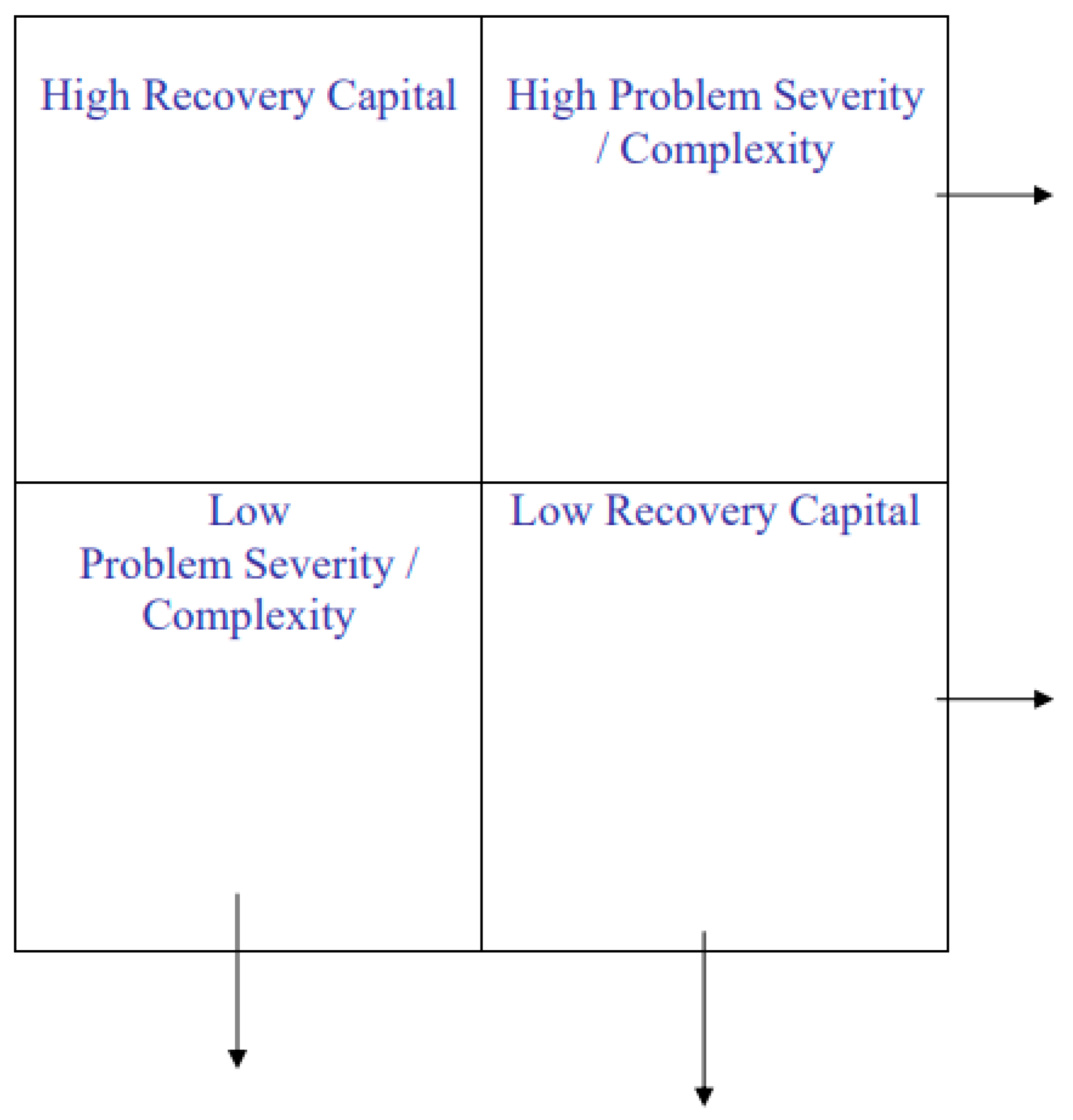
2008) argued an alternative perspective, suggesting in their 2008 paper that those with low RC could in fact recover from addiction. The authors proposed that recovery is possible if, and only to the extent that, the severity or complexity of the addiction corresponds to the level of RC held by the person, as shown in
Figure 1. Therefore, according to
White and Cloud (
2008), people with low RC can successfully recover from addiction, but only if the severity and complexity of their addiction is correspondingly low. The application of this hypothesis therefore infers that there is more of a requirement to develop RC in people who have “high problem severity/complexity” addiction and low RC.
In an additional study in 2006 by Laudet and White, RC was classified under a number of psychosocial factors pertaining to the relationship between behavioural and social factors. These factors include social supports, spirituality, life meaning and religiousness. However, in a distinct departure from the concept of RC by conceptual authors
Granfield and Cloud (
1999), researchers Laudet, Morgen and White (
Laudet et al., 2006) attribute self-help supports, such as the 12-step affiliation, as a critical factor in recovery, citing peer support and the expectations of contemporaries as social elements that impact behavioural outcomes which aid recovery and, crucially, encourage sustained sobriety.
A novel finding in the Laudet and White study was the importance of the individual’s stage of recovery when specific interventions or supports were actioned, with varying supports and interventions supporting better outcomes for individuals depending on their stage of recovery—under 6 mths, under 18 mths; 18–36 mths; over 3 years, etc. (
Laudet & White, 2008). This suggests that both the stage of recovery and the timing of interventions are key considerations for determining the most effective approach for supporting the development of RC. However, despite this finding, the authors caution against assuming homogeneous recovery experiences for all those in recovery, emphasising the need to factor in the dynamic nature of recovery and the heterogeneity of each person’s recovery journey (
Laudet & White, 2008).
In fact, Laudet and White’s study also lacked diversity in their sample group, mostly inner-city ethnic minority members, something the authors flagged themselves as a limitation. Interestingly, the issue of homogenous research participants also arose in the work of seminal authors Granfield and Cloud, albeit in contrast—their 1999 research study participants were well-educated and employed with established networks of social support. Despite this limitation, Laudet and White referenced the difficulty categorising all the relevant RC “ingredients”, both internal and external, that a person recovering utilises, recommending the need to identify the key elements if recovery maintenance is to be more fully understood (
Laudet & White, 2008).
Moos and Moos (
2007) also sought to identify the factors or ingredients of RC, proposing the concept of “protective resources” that act to “compensate for lack of treatment or amplify the positive influence of treatment” (
Moos & Moos, 2007). Based on a longitudinal study
Moos and Moos (
2007) described how the presence of these protective resources, classified under three broad categories, could again be a predictor of sustained recovery. Proposing “ingredients” under the categories “self-efficacy and approach-coping skills”, “behavioral economics” and “social control theory” (
Moos & Moos, 2007), the authors held that recovery amounts to more than just abstinence; rather, it is about building a life that supports sobriety.
However, despite the wide variety of elements or ingredients identified and examined in the longitudinal study, the role of education, along with some other elements, was not deeply analysed due to the seeming lack of association between it and other variables which led the authors to conclude that it held no significance at a baseline level on long-term recovery (
Moos & Moos, 2007). Certainly,
Keane’s (
2011) appears to be the first, and one of the only, existing study on the importance of adult educational achievement on individual’s RC.
Based in Ireland,
Keane’s (
2011) research, conducted through interviews with 20 individuals who reported to be in recovery, found that engaging in adult education emerged as a key beneficial factor. Keane’s data subjects were again homogenous, all from disadvantaged socio-economic groups, with low prior educational attainment and the author advising that participants were caught in “multiple recoveries” and relapses (
Keane, 2011). A key finding in Keane’s study, where the participants attended colleges independently of their recovery environment, was the role of attending adult education for enhancing individual’s social capital through the formation of new friendships developed outside of the addiction recovery network.
Also referenced in
Keane’s (
2011) research is the notion that people in recovery perceive social “space” between their world and the world of college and education, with the author proposing that early school leaving and low familial value on education leads to this perception of a chasm between social worlds (
Keane, 2011). The author holds the importance of real-life experience of adult and HE as vital to “changing perceptions and reducing the real and/or imagined social space” (
Keane, 2011).
Finally, Keane proposes that achievement of adult education can lead to increases in the other forms of capital as proposed by Cloud and Granfield. Cultural capital they propose can be enhanced through the acceptance and promotion of recovery-oriented values, physical capital, for instance, through gainful employment following qualification, and human capital through educational achievement itself and, for example, through an increased “sense of self” and sense of well-being (
Keane, 2011). Keane’s research concludes with a sense of bewilderment as to the lack of research on the vital role of adult education in addiction recovery outcomes.
Following Keane’s research,
Best and Lubman (
2012) take an encouragingly optimistic perspective on addiction recovery, highlighting education and training as among the most significant predictors of improved quality of life in their 2012 paper “The recovery paradigm: A model of hope and change for alcohol and drug addiction”. Referencing major improvements in mental health recovery in modern times, they strongly recommend that “basic enablers” are met, including information on accessing education opportunities (
Best & Lubman, 2012).
Best and Hennessy (
2021) follow suit holding that some RC variables are more important than others and should be “scored” as such when weighing up their strength. They reference the interconnected domains of capital, suggesting that education is of such importance that it impacts across domains to positively affect RC development.
Despite Keane’s research on the impact of education on RC, and the proliferation of research on Collegiate Recovery Programmes (CRPs) in colleges in the US and more recently in Canada, Australia and the UK, they are based on research carried out on individuals who have already taken the initial step to attend HE. To date, there appears to be no literature, either Irish or internationally, on the concept of developing RC through HE participation delivered within the recovery setting and journey. This therefore constitutes a gap in the knowledge and provides an opportunity to add to the knowledge of RC.
2.1. Theoretical Framework
“Recovery capital is not equally distributed across individuals and social groups. Members of historically disempowered groups often seek recovery from addiction lacking assets that are taken for granted by those seeking recovery from a position of privilege” (
White & Cloud, 2008).
Recovery Capital has its origins in concepts proposed by French sociologist
Bourdieu (
1985) who theorised on social topology, power dynamics and inequality in society (
Bourdieu, 1985;
Granfield & Cloud, 1999;
Claridge, 2015). Breaking with Marxist theory, Bourdieu not only recognised the inequality perpetuated by ownership of possessions but proposed that capital extends beyond the traditional notion of financial or economic assets owned by individuals. He expanded the notion of capital as extended through social relationships (
Hilgers & Mangez, 2015) and held that the value of capital is determined by “power relations that impose themselves on all who enter the field” (
Bourdieu, 1985). Bourdieu proposed four dimensions of capital in his seminal work:
Social capital, which the author links to the influence of social structures on individuals based on the “society in which they operate” (
Poder, 2011), emphasises the competitive advantage bestowed by membership of certain social groups (
Bourdieu, 1985), usually those belonging to the “dominant class” (
Allard, 2005). According to
Siisiäinen (
2003) the advantage of social capital is that it can have “a multiplication effect on the influence of other forms of capital”.
2.2. Cultural Capital
Bourdieu held that cultural capital in the form of non-financial resources such as cultural knowledge, education and skills again confers advantage to individuals who possess it, and once more aligns access to this form of capital with generational advantage or disadvantage (
Bourdieu, 1985). The author proposes that cultural capital can be distributed as follows:
- (1)
Embodied—intrinsic properties determined by “class” (
Bourdieu, 1985) which operate at an almost subconscious level, and which are recognised and valued by groups, individuals or organisations with similar traits.
- (2)
Objectified—likened to holding “the aces in a game of cards” (
Bourdieu, 1985), represents the “material properties” (
Bourdieu, 1985) that individuals hold which signify, and in some cases “legally guarantee” (
Bourdieu, 1985), their position and power status.
- (3)
Institutionalised—the formal recognition of capital by institutions. Here Bourdieu holds that education, for example, a college degree, is formally recognised by institutions and can be converted into other forms of capital, for instance, economic, in the case of job opportunities and salary (
Ramsey, 2024).
While Bourdieu proposed that individuals possess inherent traits and “cultural competences” as a result of their social origin,
Granfield and Cloud (
1999) took this further in relation to the impact of cultural capital on RC. The acceptance and promotion of recovery-oriented values within communities and institutions plays a significant role according to the authors, where cultural capital can either facilitate recovery by promoting abstinence and reintegration or hinder it through stigma and discrimination (
Granfield & Cloud, 2001). The authors further hold that achievement of higher education, for example, is culturally intergenerational within families.
2.3. Economic Capital
Like cultural capital, economic capital has its own forms of existence according to
Siisiäinen (
2003). It primarily represents physical forms of capital such as money, property, cars, shares and other forms of capital that can be easily converted into cash if needed. As detailed above, Bourdieu holds that this form of capital is influenced by the other forms of capital due to the advantages they confer towards economic success or advantage.
2.4. Symbolic Capital
According to
Bourdieu (
1985) this form of capital is “commonly called prestige, reputation, renown, etc.”, and he proposes that it is gained through the ways in which the other forms of capital are valued, perceived “and recognised as legitimate” by other individuals. He refers to the “statistical link” (
Bourdieu, 1985) between symbolic capital and the other forms of capital to emphasise its influence in the field.
Holding that each field, or social arena, has its own rules and regards different forms of capital more highly than others, Bourdieu proposed that the value of capital held by individuals within varying arena could bestow power advantage to those individuals, depending on the field occupied and the type of capital held. Thus, he argued that the root cause of persistent social inequality stems from disparities in social capital and cultural capital (
Bourdieu, 1985). As discussed, social capital, Bourdieu proposed, affects accomplishment because of the resources or assets, actual or potential, which are accessible to individuals or groups, due to the social group into which they are born (
Edgerton & Roberts, 2014). Meanwhile, cultural capital, such as educational attainment, is embedded in the individual’s social origin and “cultural competences”, which can be embodied, objectified, or institutionalised (
Bourdieu, 1985).
Aligning with Bourdieu’s theory, other scholars agree that social and cultural capital, in the form of experience, knowledge, behaviour, attitudes, and connections, are determining factors in intergenerational inequality in educational attainment, with those who have low social and cultural capital at a disadvantage (
Sullivan, 2001;
Grenfell, 2009;
Edgerton & Roberts, 2014) in the “competition” of life (
Bourdieu, 1985). Authors
Edgerton and Roberts (
2014) also agree and suggest that, when possessed, these forms of capital are at heart, hidden forms of economic capital due to their propensity to generate wealth, for example, academic achievement and access to job opportunities and “more elite professional and social circles” (
Edgerton & Roberts, 2014).
In 1999 the authors Granfield and Cloud were first to connect Bourdieu’s capital theory with their concept of RC, illustrating the benefits that social relationships and membership of certain social groups had on participants’ recovery from addiction (
Granfield & Cloud, 1999;
Laudet & White, 2008). Their study of individuals recovering from addiction heralded the decline of a “deficit” (
Behave Health, 2025)-based model, or one based on clinical interventions, such as medicalisation, (
White & Cloud, 2008) to one focused on how the assets held by individuals could be used to ameliorate recovery from addiction (
Granfield & Cloud, 1999).
According to the literature, RC consists of a “body of resources” (
Cloud & Granfield, 2008), both internal and external as discussed, and although researchers differ on the composition and levels of capital required (
Hennessy, 2017), according to Cloud and Granfield they can be broadly categorised into the following four interconnected domains that involve the individual factors: social capital, cultural capital, physical capital and human capital. Details of the domains according to
Cloud and Granfield (
2008) and their association with Bourdieusian theory are as follows.
2.5. Social Capital
Aligned with the relational emphasis of Bourdieu’s concept of social capital, RC theory proposes that social capital significantly enhances recovery outcomes due to the valuable resources that accrue from robust social networks and supportive relationships, including family, friends and peers.
2.6. Physical Capital
Again, this domain can be broadly aligned with Bourdieu’s concept of economic capital which includes assets such as money and property. In terms of RC, this element typically represents aspects such as access to stable housing, employment, and healthcare services. A study by
Laudet and White (
2008) emphasised the importance of this domain, demonstrating that physical capital provides the stability necessary for individuals to focus on their recovery journey.
2.7. Human Capital
Encompassing elements such as education, personal health and other intrinsic qualities such as confidence, hope and resilience, research has demonstrated that individuals with higher levels of human capital are more likely to achieve long-term recovery (
Laudet & White, 2008). This domain does not neatly align to Bourdieu’s categories of capital detailed earlier; however, its principles thread throughout.
Education is clearly aligned with the cultural capital and the human capital components of RC as defined; however, according to the research, “individual-level” elements extend into the mesolevel, effecting across the domains (
Hennessy, 2017). For example, educational attainment enhances human capital, which influences employment, salary and physical capital prospects, in the form of secure housing and healthcare. Therefore, enhancement of one element of capital may have a transformational impact on other elements, and consequently, the individual.
However, as suggested by
Best and Hennessy (
2021), these outcomes do not manifest equally across all elements. Some factors, such as education, may yield a more significant overall impact across all domains due to the broad range of associated benefits that it bestows. The collaborative project is an example of a collective effort to enhance RC across all domains by providing educational opportunities to marginalised individuals who are recovering from addiction and generating the associated “individual level” and mesolevel outcomes that follow.
3. Research Design and Methodology
Research, according to (
Creswell & Guetterman, 2019) is a “process of steps used to collect and analyse information to increase our understanding of a topic or issue”. The goal of this paper is to understand a collaborative project between a mid-sized university in Ireland and an addiction recovery organisation to gain a deep and rich understanding of the complexities involved in the development of RC through on-site HE provision in the recovery setting. Having considered the complexity of the social phenomenon, a qualitative research methodology, which is historically aligned with research in the social sciences, was deemed to be an appropriate methodology for this analysis.
Case study analysis is gaining greater recognition for its value in research, having previously been considered a precursor for the exploratory stage of a subsequent research method (
Yin, 2014). Yin highlights this important methodological evolution in the literature whereby research previously described simply as “case studies” is now recognised as “case study research”, acknowledging the development of case study research as a rigorous research approach.
Yin (
2009) explains how case study research “arises out of a desire to understand complex social phenomena” and is the “study of the particularity and complexity of a single case” (
Stake, 1995). This is highly applicable to the collaboration being examined in this study.
Therefore, a descriptive case study methodology, informed by qualitative documentary analysis, was selected for this study with a view to producing a structured means of examining how the principles of RC, as conceptualised by Granfield and Cloud, are potentially instigated within a real-world setting. This approach allows for the use of secondary data analysis to evaluate the extent to which these principles are evident.
Yin (
2018) asserts that researchers will orient their case study research based on their own epistemological leanings and the descriptive case study method provides the pragmatic approach that this researcher values as a bridge between theory and practice.
Each research method comes with its own strengths and limitation. In the first instance, research focusing on a single case study can restrict the validity of the findings. The findings of a single work may result in lack of depth, according to
Hart (
2018), who recommends incorporating a broad range of the literature for a robust review; however, the author does acknowledge that in research, review of a single piece of work can be important. This proposition is supported by
Nickels et al. (
2022), who suggest that “single case studies are a powerful tool for developing, testing and extending theories”.
A further limitation of this study is the lack of empirical research and findings. There is also the potential for researcher bias and the need to mitigate bias is well-understood, where a reflexive approach is recommended (
Jamieson et al., 2023). The application of evidence from the published outcomes of the collaboration, rigorously analysed using RC as an interpretative framework, strengthens the methodology and lessens the opportunity for researcher bias. However, in saying that it is also acknowledged that the unique perspective of the researcher should carry with it the opportunity to enrich analysis of the case study and the relevant literature (
Olmos-Vega et al., 2022) as long as this perspective is disclosed.
Yin (
2009) suggests moving past historically biassed hierarchical research method stereotypes to instead match the methods being used with the type of research question being asked. Case study research is particularly suited to examining contemporary phenomena in a real-world context. The strength of this research approach is its capacity to draw on “a full variety of evidence” (
Yin, 2009) including publicly available documents and reports. This flexibility provides an opportunity for the researcher to examine artefacts analysed through the theoretical lens of RC, for any elements of RC developed through the collaboration under study.
An additional caution on this paper is any implication that recovery, or education in recovery, follows a linear trajectory. The documentary evidence examined did not delve into the complexities or the tensions that may exist between addiction recovery and education, including non-linear progression and setbacks. This aspect presents an important avenue for future research which would require the gathering of primary empirical data from research participants.
As stated, this study adopts a descriptive case study approach to examine the selected case study within its real-world context. Three publicly available documents formed the primary dataset for analysis (below). The documents and reported outcomes and impact were analysed using RC as a deductive analytical lens. Evidence relating to the elements of the RC framework were identified and interpreted.
SETU—Tiglin Collaboration Report 2023–2025
Tiglin Annual Report 2023 and 2024
Using Granfield and Cloud’s RC domains, the publicly available documentary data were mapped and the findings triangulated with available scholarly research detailed in the literature.
4. Findings and Discussion
Addiction recovery is a complex process that requires more than just the cessation of substance use (
McLellan, 2018). It is acknowledged in the literature that modern treatment has shifted to a recovery-focused model (
White & Cloud, 2008). According to
Cloud and Granfield (
2008), recovery necessitates the development of RC—a concept which the authors propose is composed of social capital, cultural capital, physical capital, and human capital. The role of achieving a HE qualification on individuals’ RC would benefit from further research (
Keane, 2011;
Jason et al., 2021;
Best & Hennessy, 2021).
Tiglin is an organisation with registered charitable status, with locations dotted around the east coast of Ireland. The organisation aims to help people to “build a life beyond addiction through residential and aftercare programmes” (
Tiglin Challenge Limited, 2022), taking a whole-of-person approach to addiction recovery. SETU is a newly formed university located in the southeast of Ireland. The university was created when two legacy HEIs merged in May 2022. With campuses in Carlow, Wexford, Waterford and Wicklow, the university has a total student population of 19,000 students, with both former HEIs having a long and proud history of access and widening participation.
Recognising the need to engage initially with the students within their own setting and through partners they know and trust, SETU provides access to HE programmes, on-site in the residential setting, during the addiction recovery program. This approach aligns with the belief expressed by
Best and Laudet (
2010) that the principles of recovery are best experienced in a real-life setting. Creating an enjoyable learning experience and fostering critical thinking skills are recognised as essential for learner engagement, particularly as previous formal learning may have been considered a negative experience.
Both
Laudet and White (
2008) and
Moos and Moos (
2007) maintain that there is difficulty identifying all the relevant RC ingredients, with the former suggesting that they need to become known to fully understand sustained sobriety, and the latter suggesting that RC supports a more wide-ranging life change beyond abstinence. From the perspective of this paper, it would have been beneficial if the data gathered by Moos and Moos in their 2007 study provided a deeper analysis of the role of education, which could have added further perspectives to this paper.
Informed through a dialogic approach with Tiglin management, SETU provides programmes aligned with the needs of the specific student population to cover other aspects of Moos and Moos stated ingredients such as delivery of a Certificate in Critical and Ethical Thinking in a Changing World, Certificate in Communication along with the requisite support around group work, how to conduct valid research, IT, academic writing and time management skills.
4.1. The Contribution of Higher Education to Social Capital
Exploring the first domain of RC, social capital, which Cloud and Granfield propose, significantly enhances recovery outcomes due to beneficial and robust social networks and supportive relationships. As discussed earlier, researchers
Laudet and White (
2008) cite peer support and the expectations of contemporaries as social elements that impact behavioural outcomes which aid recovery and crucially encourage sustained sobriety. As stated in Tiglin’s 2024 Annual Report “peer support” encouraged the “students” “to work their way through”. Further evidence of the benefit of social capital development was presented in the SETU—Tiglin collaboration report which suggests that peer support within the learning environment was a factor which lead to course completion rates of up to 98% as reported by
SETU (
2025).
The delivery of HE programmes to a confined group onsite in a residential setting contrasts with
Keane’s (
2011) study.
Keane (
2011) emphasised the positive aspects of attending college for growth of social networks and supports, along with debunking the notion of differences that recovering addict learners felt was between themselves and “typical” college students. The collaboration, however, highlights the value of peer support within the recovery group setting. It does not require individuals to already possess sufficient “capital” to transition from addiction to HE. Instead, it supports them to build that capital within and throughout their recovery journey.
As discussed earlier,
Laudet and White (
2008) suggest that the stage of recovery and the timing of interventions are key considerations for determining the most effective approach for supporting the development of RC. These elements in the existing collaboration present potential opportunities for future research, specifically to explore whether undertaking HE within the residential setting and recovery journey has a different impact on social capital compared with attending college independently, as in
Keane’s (
2011) study, or attending college independently while concurrently participating in a collegiate recovery programme.
The presence and extent of social capital outside of the class group setting is unknown. What is known is that addiction can disrupt familial and peer relationships (
Nimtz et al., 2014) to the extent that much needed supportive networks are broken. This is not a factor which is exposed or explored a part of the collaboration and is therefore a known limitation. However, what is documented in the Tiglin Annual Report is that several individuals progress to the Tiglin aftercare centre following residential recovery, due to the risk that a return to their prior social networks could have a counterproductive effect on sobriety. As stated, this aspect is outside the scope of this paper.
4.2. The Contribution of Higher Education to Cultural Capital
Granfield and Cloud (
2001) suggest that the second RC domain, cultural capital, is broader than Bourdieu’s cultural capital theory, as it relates to addiction recovery. The authors hold that HE achievement is embedded within family cultural histories, with privileged groups and individuals more likely to reach this achievement. Evidence from Tiglin’s 2023 and 2024 Annual Reports demonstrate that the majority of recovering residents are socio-economically disadvantaged. Their lack of HE to date and their propensity to be early school leavers (
Tiglin Challenge Limited, 2024) is a manifest of Granfield and Cloud’s cultural capital theory. Therefore, their baseline level (
Laudet & White, 2008) of cultural capital is low.
Applying White and Cloud’s Recovery Capital/Problem Severity Matrix, the model indicates that sustained recovery can be achieved, even if RC is low and “problem severity” is high, through the development of additional RC. Support work and onsite teaching within the collaboration is evidence of increased efforts to develop RC and raise the low baseline. According to
Granfield and Cloud (
2001), cultural capital plays a pivotal role in acceptance and promotion of recovery-oriented values within communities. This is evident in the collaboration, where many individuals progress to employment in the Tiglin organisation, or the community, following recovery (
Tiglin Challenge Limited, 2023), an outcome that clearly demonstrates societal reintegration within that community, but an aspect which is explored further below in relation to stigmatisation.
In fact the “type of capital” and its “value” within specific “fields”, as proposed by
Bourdieu (
1985), can lead to pressure on individuals recovering from addiction to continue with the culture that “surrounds substance use” (
Keane, 2011) once they return home following treatment. Through aftercare and re-integration housing, Tiglin proivdes individuals with the opportunity to avoid returning to the environment where their addiction developed and to instead extend their exposure to cultural capital that embraces recovery, academic achievement and reintegration.
4.3. The Contribution of Higher Education to Physical Capital
As stated, the socio-economic profile of many the recovering individuals participating in the collaboration is low. Many of those participating in the collaborative project have experienced incarceration, homelessness and unemployment (
Tiglin Challenge Limited, 2023) and therefore their baseline level (
Laudet & White, 2008) of physical capital can be considered low. Knowing the importance of this domain in providing the stability necessary for individuals to focus on recovery, Tiglin accommodates its residents in suitable residential housing during their addiction recovery and afterwards if desired.
Physical capital, in the form of IT equipment (laptops) and visual display screens, has been supplied to Tiglin by SETU to support course delivery, assignment writing and development of digital literacy skills (
SETU, 2025). The achievement of HE qualification may also impact physical capital through job opportunities and resulting wages, in addition to offering the potential to secure housing. However, it is important to note that assumptions concerning potential employment prospects ignores the external social stigma that can impact such opportunities, regardless of any self-reported enhancements to “self-stigma” claimed by recovering addicts and ex-prisoners.
According to
Copenhaver et al. (
2007) the “real or perceived” stigma faced by former inmates can impact their “social identity” and prevent these individuals from seeking social and professional opportunities. Further research carried out by
Clarke and Allen-McCombs (
2025) emphasises the consequences of labelling and stigmatising language when it comes to societal reintegration. The authors propose that person-centred terminology such as “returning citizen” rather than “ex-offender” can have a positive impact on the perceived worth of these individuals (
Clarke & Allen-McCombs, 2025).
Based on their research, the authors find that social stigma is additionally interconnected with difficulties faced with economic, social and physical reintegration. They suggest that interventions at macro-level are needed to reduce this external stigma and encourage active reintegration of these returning citizens (
Clarke & Allen-McCombs, 2025). This element has not been explored further for this paper but offers a further research opportunity and lens through which to consider macro factors that affect societal reintegration in the future.
4.4. The Contribution of Higher Education to Human Capital
Best et al. (
2015) hold that long-term recovery is achievable for individuals with higher levels of human capital. The final domain of RC is clearly relevant to the collaborative project as elements such as increased confidence, hope and resilience are developed. Documented survey findings in SETU’s collaboration report and detailed in Tiglin’s 2024 Annual Report state that 98% of respondents to an anonymised survey agreed that completion of a HE course “had a positive impact on their confidence and belief in their abilities” (
SETU, 2025).
In terms of reducing the potential of social desirability bias in the reported findings, which is a reported risk, particularly in the collection of surveyed data on “socially sensitive” issues (
Grimm, 2010;
Nederhof, 1985), the collaboration report advises that the survey was conducted anonymously and was on administered on a self-directed basis. Additionally, the survey findings indicate that options to report negative impact or low skill development were made available to respondents, further reducing the risk.
5. Conclusions
Addiction remains a global issue which negatively impacts individuals, societies and communities. The problem continues to grow despite national and international approaches to address it through medical interventions, policy innovations and approaches through the criminal justice systems. Therefore, the shift by countries towards a recovery mindset is a promising development. RC theory offers significant potential in advancing recovery treatment and builds on Bourdieu’s earlier theory of social and cultural capital. The breath of the literature on RC does not currently reflect the significant impact that practical application of its findings could provide and there are opportunities to address the gaps in the knowledge on how RC theory could support effective treatment that would have long-term impact.
As stated, the documentary evidence referenced above was analysed using the RC framework as a deductive coding structure. Relevant data within the document sources were categorised according to the RC domains below, which enabled the reported outcomes of the collaboration to be interpreted through an established theoretical lens (
Table 1).
Table 2 presents an overview of the impacts reported through the anonymous survey conducted by SETU with Tiglin service users, as reported in the SETU—Tiglin Collaboration Report 2023–2025. Of the reported 315 service users from Tiglin who completed HE-validated programmes, there were 59 respondents to the anonymous survey, which equates to a response rate of 18.73%. While this is an acceptable representative sample size, it must be acknowledged that anything lower than 100% response rate, an issue which can occur in voluntary surveys, can lead to non-response bias in the research findings (
Bethlehem & Bakker, 2014). Therefore, findings could be strengthened by higher response rates or acknowledgement of the impact of non-response (
Groves & Peytcheva, 2008).
Of the respondents, 20 identified as female and 38 as male. A total of 98% reported a positive impact on their self-confidence and 83% reported a positive impact on their overall well-being, including stress levels and sense of fulfilment.
Table 3 illustrates the skills developed as a direct result of participation in higher education, as reported by Tiglin service users in the anonymous survey conducted by SETU.
The findings are that the collaborative project is aligned with the broad principles of RC and theory on social and cultural capital by Bourdieu. As demonstrated in the published survey, 98% of residential service users who undertook a higher education course during their recovery from addiction stated that it had a positive impact on their confidence and belief in their abilities and 83% said that it had a positive impact on their sense of well-being. This aligns with RC theory in which it is proposed that elements such as education are critical for developing self-efficacy and a sense of purpose (
Cloud & Granfield, 2008). There is an opportunity for further research on the long-term impact of HE achievement on participants’ social, cultural, physical and human capital.
The project adopts a collaborative approach to treatment, with the addiction recovery centre, focusing on elements of RC development. Social Capital is fostered through the supportive social networks within the recovery centre and peer support amongst participants, while cultural capital is enhanced through acceptance and promotion of recovery-oriented values both within the recovery community and the wider community, exemplified by community interaction with the Tiglin Greystones Coffee shop (
Tiglin Challenge Limited, 2024). This approach aligns with
Granfield and Cloud’s (
2001) theory that society and institutions play a significant role and can either facilitate recovery by promoting abstinence and reintegration or hinder it through stigma and discrimination.
One key limitation noted in writing the paper lies in its reliance on a single case study, along with the research method used, which may be prone to researcher bias, despite triangulation against published secondary data. Using additional or alternative research methods to collect primary data, such as surveys and interviews, would strengthen the validity of the findings and perhaps give broader and/or deeper insight into the subject matter.
This paper has exposed opportunities to carry out further research on several elements of RC, such as the contribution of peer support in HE achievement, particularly within a residential recovery setting, an element that has never been explored previously. The stage of recovery in conjunction with the timing of the educational intervention could also be further explored to assess the suitability of the existing course delivery timeframe and its longitudinal impact. Finally, the recommendation by
Best and Hennessy (
2021) that some “ingredients” of RC should be scored higher than others, in other words, valued more highly, could form the basis of future national and international research into the impact of HE achievement on RC and long-term addiction recovery outcomes.