Article

Identity Formation of Precollege Women in Quantum Information Science and Technology

by
Michele Darienzo
1,2 and
Angela M. Kelly
1,3,*
1
Institute for STEM Education, Stony Brook University, Stony Brook, NY 11794, USA
2
Brookhaven National Laboratory, Upton, NY 11973, USA
3
Department of Physics and Astronomy, Stony Brook University, Stony Brook, NY 11794, USA
*
Author to whom correspondence should be addressed.
Educ. Sci. 2026, 16(8), 1222; https://doi.org/10.3390/educsci16081222
Submission received: 5 May 2026 / Revised: 20 July 2026 / Accepted: 26 July 2026 / Published: 3 August 2026
(This article belongs to the Special Issue Paving the Way for Quantum Education in K-12)

Abstract

The rapid increase in technological advancements in quantum information science and technology (QIST) necessitates a diverse workforce. The need for understanding how students, especially young women, develop QIST identity is an important consideration in career aspiration formation. With no existing framework for QIST identity development, this qualitative longitudinal exploratory case study combined aspects of identity frameworks in the QIST-adjacent fields of physics, computer science, engineering, and mathematics into a new framework to identify factors influencing QIST identity development for precollege women. This framework was inductively generated from the analysis of 20 interviews with women from a high school QIST outreach program that was developed by university quantum researchers. The first round of interviews (N = 14) was conducted two to four weeks after the conclusion of the QIST workshops and focused on student attitudes towards QIST, while the second round of interviews (N = 6) was conducted six to eighteen months later and focused on emerging elements of the QIST identity framework. Analysis of the interviews showed that the proposed framework, which included performance/competence, interest, recognition, and sense of belonging—found in identity frameworks of QIST-adjacent fields—required the addition of (1) normative comparison, (2) positional advantage, and (3) career expectancy.

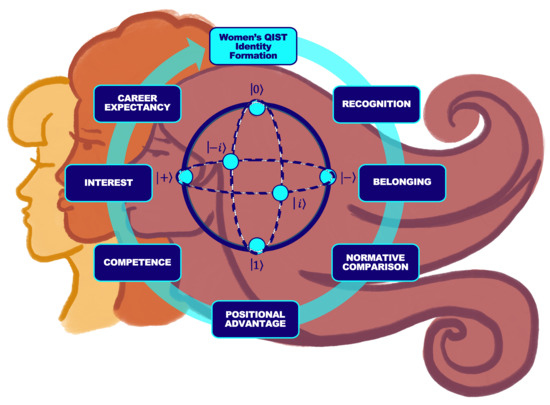
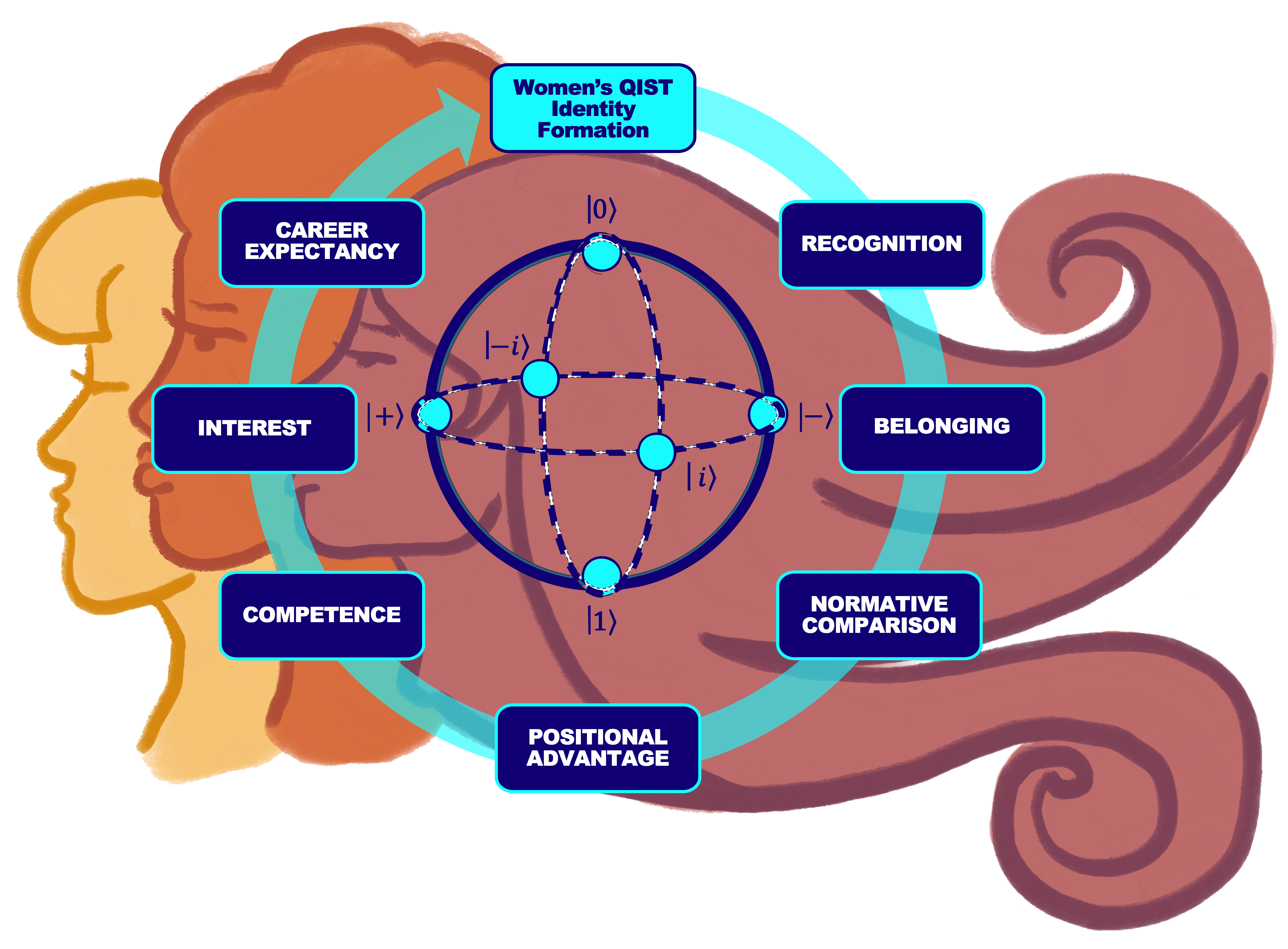
Graphical Abstract

1. Introduction

With the current growth in quantum information science and technology (QIST), there is a need to facilitate quantum literacy and inspire precollege students to pursue post-secondary QIST study and vocations (NSTC, 2018; Ruane et al., 2025). A well-prepared, diverse QIST workforce will drive technological advancement and accelerate discoveries that improve the global condition (QED-C, 2025a). Recent breakthroughs in areas such as quantum sensing have the potential to transform healthcare, geospatial navigation, mineral exploration, and telecommunications (QED-C, 2025b). The U.S. National Quantum Initiative aims to “empower the full spectrum of talent… to build capacity and generate the quantum-literate workforce that will implement the results of these [quantum] breakthroughs” (NSTC, 2024, p. 16). However, precollege students typically have limited awareness of quantum academic pathways, and few opportunities to engage in QIST learning that inspires interest, motivation, and self-concept (Darienzo et al., 2024; Plunkett et al., 2020). As QIST industries expand and qualified talent is limited (QED-C, 2026), it is important to understand how students early in the academic pipeline identify with the field and develop career interest. Lack of diverse participation in science, technology, engineering, and mathematics (STEM) disciplines may limit innovation, productivity, and sustainability (National Academies of Sciences, Engineering, and Medicine, 2020).
Women may be specifically targeted in these workforce development efforts, as they constitute approximately 50% of the overall population but are less represented in QIST-adjacent fields. Although there are limited demographic data for the QIST workforce, the lack of women in QIST-adjacent fields suggests that a disparity may exist. For example, only 15% of authors publishing in physics in 2020 were women, along with 16% in computer science, 15% in mathematics, and 18% in engineering (Huang et al., 2020), indicating that a similar pattern might be expected in QIST, an integration of these four major disciplines. Earlier in the academic pipeline, women have earned a lower share of undergraduate degrees in physics (25%), mathematics and computer science (28%), and engineering (24%) when compared to men (Mulvey & Nicholson, 2025; NSB, 2022). Research has identified persistent gender disparities in mathematically intensive fields that may be perceived as requiring brilliance (Leslie et al., 2015); this trend may also be attributed to differences in career interests and preferences (Ceci & Williams, 2015). This pilot study explored how specific outreach strategies may relate to emerging QIST interest and identity formation in women.
This qualitative exploratory case study examined the preliminary QIST identity development of high school women (grades 10–12, approximate ages 15–18) participating in a one-week QIST outreach program that was developed by university physics faculty. Longitudinal interviews were conducted to elicit insights into their retrospective academic trajectories and how QIST participation influenced their perceived positioning within the field. This exploration generated a newly developed QIST identity framework that combines constructs from previous studies on identity development in QIST-adjacent fields with emergent affective constructs. This framework offers preliminary considerations for diversifying the future QIST workforce and fostering QIST literacy, which is here defined as “a basic understanding of the core principles of quantum science, extending from foundational concepts in classical and quantum physics to the tenets of quantum information processing, and of how these principles relate to real-world applications” (De La Cruz et al., 2026).
This work provides a model for characterizing high school students’ QIST identity formation, which may inform future work on improving accessibility in the field. The research questions for the present study are: (1) How might QIST identity be operationally defined for precollege women? (2) How is QIST identity consistent with and differentiated from prior STEM identity frameworks? (3) How might QIST outreach programs be designed to promote women’s QIST identity formation?

1.1. Precollege QIST Gender Studies

To maximize the diversity of the future QIST workforce, it is important to provide opportunities for precollege experiences that are designed to encourage interest in the field (NSTC, 2018). At the time of the present study, there was little research on the differences between the success or interest of men and women in QIST after completing QIST-related programs, although there has been a steadily increasing range of studies that assessed QIST programs for high school students (Darienzo & Kelly, 2024). A Google Scholar search for the terms “gender in quantum information science and technology” and “gender in quantum” in July of 2025 yielded only four studies relevant to the assessment of gender differences in QIST programming for high school students (Adegoke, 2012; Julita et al., 2020; Kelly et al., 2025b; Nita et al., 2021), and one study of a quantum-themed exhibition designed for the general public (Faletic et al., 2023). This suggests the need for additional research on how women perceive themselves in QIST, an emerging field with a projected 27% annual growth rate to $2.2B in 2027 (QED-C, 2025b).
Prior research in precollege quantum physics has largely focused on quantitative measures of students’ QIST knowledge development, with few publications addressing gender differences in these measures. One study compared traditional and interactive quantum physics courses for high school students in Africa, reporting that men scored higher than women on the pre-test. Men’s post-test scores increased more than women’s in the lecture course, while women saw greater gains in the interactive course (Adegoke, 2012). Julita et al. (2020) examined the mathematics performance of high school students in Indonesia who completed a quantum course utilizing creative problem solving, finding no significant differences when comparing men and women. Nita et al. (2021) found no gender-based performance differences among secondary students in the United Kingdom who completed a quantum-themed game called Quantum Odessey. Kelly et al. (2025b) analyzed attitudinal outcomes from a week-long quantum outreach program; data indicated an overall increase in career aspiration formation and self-concept, with analysis of covariance indicating no differences in gains between women and men. An extension of this work found that there were also no gender differences in knowledge gains in classical physics, quantum physics, and quantum computing concepts and skills (De La Cruz et al., 2026). Lastly, Faletic et al. (2023) assessed survey data from two quantum exhibitions in Italy, Quantum Technologies for Everyone and Italian Quantum Weeks; results suggested that visitors with more background knowledge generally were more interested and wanted to share their experiences with others, with similar scores for men and women. These quantitative studies suggest that more research is needed to understand how students develop QIST interest and engagement at the precollege level, which may lead to QIST career aspiration formation and post-secondary study. The focus of the present study is women due to their low representation in the physical sciences, computer science, mathematics, and engineering (NSB, 2022).

1.2. Women’s Identity Development in QIST-Adjacent Fields

The observed gender gap in select STEM fields may be due to latent psychosocial factors that are not easily measured. One strategy for determining the source of this gap is to develop a framework for identity in QIST, an interdisciplinary field that includes concepts, skills, and practices from physics, mathematics, computer science, and engineering (Johnson, 2021). Identity development in QIST-adjacent fields may be hindered by the notion that they require innate intelligence, which may be a barrier to diverse participation (Leslie et al., 2015; Rosenberg et al., 2024). In addition to this fixed mindset perception (Kalender et al., 2022), women’s identification with QIST may be conceptualized through identity development research in QIST-adjacent fields.
Although there is overlap among factors in identity frameworks for the QIST-adjacent fields of physics, computer science, mathematics, and engineering, there are some notable differences. Many of these frameworks build upon a STEM identity framework for women designed by Carlone and Johnson (2007), who identified three thematic elements: recognition, performance, and competence. Recognition is operationally defined as the extent to which others (e.g., teachers, classmates, and family members) acknowledge the STEM ability of the student (Hazari et al., 2010; Kalender et al., 2019; Nehmeh & Kelly, 2021). Competence refers to a student’s perceived level of knowledge about a certain topic, while performance focuses on a student’s ability to demonstrate this knowledge to others (Carlone & Johnson, 2007). In women’s physics identity research, Hazari et al. (2010) built on this framework by adding a fourth factor—interest, which Carlone and Johnson (2007) had omitted because it was assumed that their participants already had an interest in science. Interest refers to wanting to understand and learn more about physics (Hazari et al., 2010), combined with having positive feelings associated with this desire to learn (Kalender et al., 2019).
This women’s identity model from Hazari et al. (2010) was tested by Cass et al. (2011) as a possible mathematics identity framework and found to be a predictor of career aspiration formation in engineering. Cass et al. (2011) also included the combination of performance and competence, similar to Kalender et al.’s (2019) physics identity framework, which combined performance and competence into a single category, competency belief. Competency belief had previously been described as a combination of a student’s confidence in their own ability to solve physics problems and understand disciplinary content (Carlone & Johnson, 2007). In a further analysis of Cass et al.’s (2011) framework, performance/competence was shown to lead to interest and recognition independently as part of mathematics identity (Cribbs et al., 2015).
Methods to foster recognition, performance/competence, and interest were identified in several studies of computer science identity (Beyer, 2014; Çakır et al., 2017; Scott et al., 2023; Shaw & Kafai, 2020), which mainly focused on women specifically. There have been several successful strategies for developing women’s interest in computer science, including engagement in culturally relevant activities (Shaw & Kafai, 2020) and highlighting the positive societal effects of computer science (Çakır et al., 2017). To improve feelings of performance/competence, it has also been helpful to scaffold tasks, providing small successes throughout the problem-solving process to increase self-efficacy (Çakır et al., 2017). This may be due to the cognitive complexity of computational tasks that many students attempt in isolation (Scott et al., 2023), which are often less positive for women who value interpersonal interactions (Beyer, 2014).
Shortly after the adoption of similar frameworks for women’s physics identity (Hazari et al., 2010; Kalender et al., 2019), mathematics identity (Cass et al., 2011), and computer science identity (Mahadeo et al., 2020; Taheri et al., 2018), a general engineering identity framework focusing on recognition, performance/competence, and interest was developed (Godwin et al., 2013; Godwin & Lee, 2017; Patrick et al., 2018). While measuring these three factors in identity frameworks for mathematics (Boaler et al., 2000; Miller-Cotto & Lewis, 2020), computer science (Peters & Pears, 2013; Wong, 2016), and engineering (Revelo et al., 2019; Rhode et al., 2019), several studies identified sense of belonging as another important factor in identity development. Sense of belonging describes the intensity of belief that one fits into their field of study (Peters & Pears, 2013); this may be facilitated by a learning environment that is both gender-neutral and positive, thus making students feel confident and adequate (Wong, 2016). In the case of mathematics identity, it was found that an increased sense of belonging and performance within a group had positive effects (Boaler et al., 2000; Miller-Cotto & Lewis, 2020). In the case of engineering, students who belong to a community of engineers have often experienced both recognition (Revelo et al., 2019) and an increased sense of belonging in the field (Rhode et al., 2019). Notably, Godwin et al.’s (2016) work in engineering identity development surfaced a fourth factor beyond recognition, performance/competence, and interest. This factor, agency beliefs, described students recognizing the relationship between engineering and relevance to their own lives (Godwin et al., 2016). Research has also shown that those who feel confident in tinkering, design, and analysis are more likely to have stronger engineering identity (Choe et al., 2019). These two ideas, however, may overlap with the concepts of interest performance/competence, as they both foster an increase in positive feelings in these areas.
In studies about mathematics identity, methods for fostering a sense of belonging included the presence of a mathematics teacher who demonstrated strong mathematics identity and enjoyment in the field, as well as teachers who provided opportunities to solve mathematical problems that were socially relevant (Anderson et al., 2015). For a sense of belonging in computer science, instructors have been urged to broaden the perception of a “computer science person” beyond someone who is male and wears glasses (Shaw & Kafai, 2020), since early gendered perceptions of who belongs in computer science may contribute to disparities in the field (Lagesen, 2007; Master et al., 2021). It is also important for traditionally underrepresented students to feel as though people who look like them can be successful in mathematics (Miller-Cotto & Lewis, 2020). This role model association contributes to shared social identity, the perception of career attainability, and the expectancy of what life may be like in a STEM career (Gladstone & Cimpian, 2021).
Based on these studies, it can be concluded that the main overarching factors for women’s identity development in the QIST-adjacent fields of physics, computer science, mathematics, and engineering are recognition, performance/competence, interest, and sense of belonging.

1.3. Overcoming Challenges to QIST Identity Development in Women

Research in women’s identity development in QIST-adjacent fields has identified several tensions and barriers to belonging. Studies have shown that women tend to experience lower self-efficacy than men in mathematically intensive fields such as engineering, physics, and computer science (Koul et al., 2011; Leslie et al., 2015). Many women have experienced implicit bias, negative stereotypes, and stereotype threat, which may result in physiological stress that diminishes academic performance (Marchand & Taasoobshirazi, 2013). Negative self-perceptions may also result from academic social atmospheres characterized by authoritarian teacher-centered instruction, unwelcoming learning environments, and lack of effective pedagogy (Maries et al., 2025).
When applying STEM identity frameworks to women, it is important to consider that there are often gender differences in STEM-related parental support, educator support, and prior experiences (Chen et al., 2020; Hazari et al., 2008; Revelo et al., 2019). Computer science identity research has suggested the importance of learning environments that facilitate comfort and confidence (Rhode et al., 2019). However, this may be challenging since faculty in QIST-adjacent fields are more often men (Wong, 2016), and the lack of women role models may discourage young women from envisioning careers in these fields (Shaw & Kafai, 2020). Another strategy for encouraging women to pursue QIST-adjacent fields is to communicate the societal benefits; this has been described as an important aspect of STEM identity development in women (Kelly, 2016). Sense of belonging may also be improved by building social cohesion with others in STEM, facilitating resilience, and providing adequate support from members of the STEM community (Dost, 2024; Nehmeh & Kelly, 2021).

1.4. Conceptual Framework

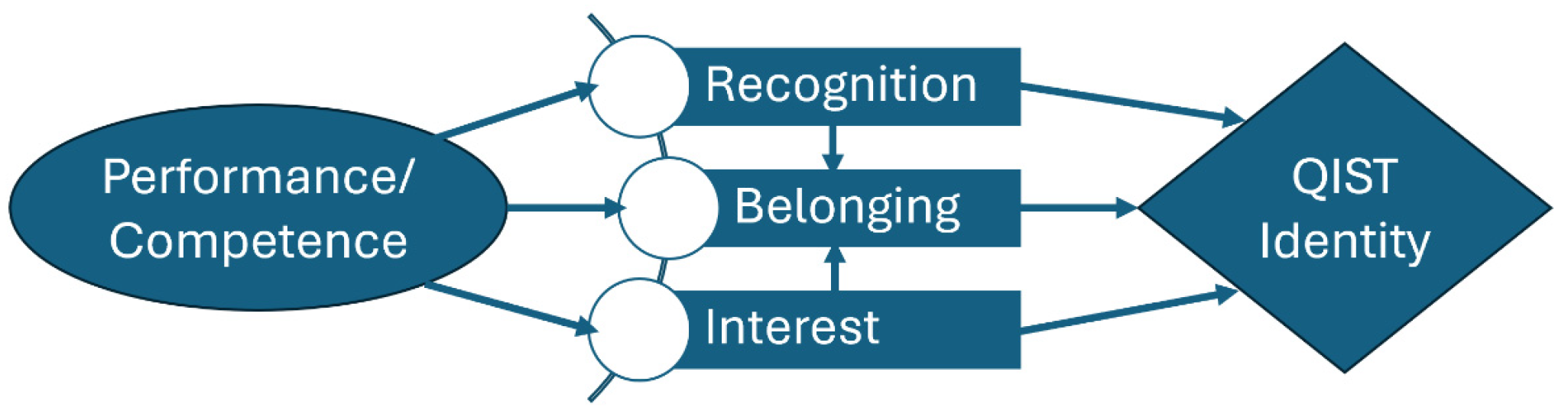
QIST is a combination of physics, computer science, mathematics, and engineering, and there is overlap among identity frameworks in these QIST-adjacent fields. The conceptual framework of this study was developed by selecting common aspects of each to propose a single QIST identity framework, which has been largely missing from QIST education research to date. This also considers factors that relate to diminished female identity in these QIST-adjacent subject areas when compared to men. This preliminary QIST identity conceptual framework for women is based on the expansion of Carlone and Johnson’s (2007) framework articulated by Hazari et al. (2010) and Kalender et al. (2019), which were tested in QIST-adjacent disciplines, as well as the sense of belonging factor that arose in several studies (Anderson et al., 2015; Peters & Pears, 2013). Consequently, the conceptual framework for this study includes four identity factors. The first, performance/competence, is here defined as a student’s personal judgment of their own QIST ability and understanding of related disciplinary content (Carlone & Johnson, 2007). Research has shown that this construct often facilitates interest, recognition, and sense of belonging; these relationships are based upon those established in studies in physics, computer science, mathematics, and engineering identity development (Cribbs et al., 2015; Kalender et al., 2019). Student interest is the degree of one’s desire to learn about QIST along with a positive view of the subject (Hazari et al., 2010; Kalender et al., 2019). Recognition is the extent to which students’ QIST performance/competence is seen and affirmed by others (Hazari et al., 2010; Kalender et al., 2019; Nehmeh & Kelly, 2021)—this may include peers both in and out of school, parents, teachers, and the QIST experts that students encountered in the outreach program. Both interest and recognition may lead to a sense of belonging in QIST, which is the intensity of the belief that one feels part of a QIST community of learners (Peters & Pears, 2013). The flow of these four factors into QIST identity, represented in Figure 1, is novel in this study and was inductively explored via qualitative analysis of interviews with precollege women who engaged in QIST outreach.

2. Materials and Methods

This qualitative exploratory longitudinal case study (Creswell & Creswell, 2023) examined the QIST identity development of high school women via interviews after their participation in the QIST Outreach Program, a 25-h outreach program that was run twice each year in 2023–2024 (N = 131, n = 59 women (45%), n = 72 men (55%)), with sessions alternating between a research university in the Northeast United States and an urban informal science institution. Several of these analyses were longitudinal in nature, with follow-up interviews conducted up to 18 months after participation. All interviews were analyzed using constructs identified in the review of the literature on identity development in QIST-adjacent fields, as well as through grounded theory, allowing the researchers to inductively generate factors influencing QIST identity development (Strauss & Corbin, 1997). Institutional Review Board approval was secured for the study (Stony Brook University IRB #2022-00244). High school women provided voluntary assent and their guardians provided written consent.

2.1. QIST Outreach Program

This research analyzed the experiences of 15 high school women who self-selected into the QIST Outreach Program, a week-long program that introduced QIST content and skills through in-depth exploration of classical physics, quantum physics, and quantum computing. This program was designed and taught by a theoretical quantum physicist (male), an experimental quantum physicist (male), and a physics education researcher (female), all of whom were physics faculty members at a research university. The program was also staffed by a rotating group of 12 graduate teaching assistants (four women, ten men), two undergraduate teaching assistants (both women), and QIST professionals employed in industry (three women, one man). The 25-h program was designed to: (1) provide engaging and challenging QIST experiences for high school students in grades 10–12 (approximately aged 15–17 years old); (2) facilitate QIST literacy; and (3) inform students of QIST career opportunities and academic pathways that may prepare them for the QIST workforce.
The QIST Outreach Program featured lectures, demonstrations, simulations, and hands-on practical experiences in classical physics, quantum physics, and quantum computing, as well as laboratory visits, museum exhibit exploration, panels with graduate students and quantum physicists in the field, and workshops on academic preparation for QIST-adjacent majors and careers (for additional technical program details, see Schneble et al., 2025). The program topics were largely consistent with recent publications identifying core concepts that should be taught in secondary quantum physics curricula, including wave interference, superposition of quantum states, quantum measurement, probability amplitudes, and Schrödinger’s cat (Bitzenbauer et al., 2025; National Q-12 Education Partnership, 2023). However, the present program also included classical physics concepts since most students had not taken a physics course prior to their enrollment. Topics, activities, and approximate instructional times are summarized in Table 1.
The outreach program was also designed with pedagogical strategies to optimize and facilitate QIST understanding, affective domains, and identity formation. The pedagogical strategies included elements consistent with best practices in prior research on QIST secondary outreach programs. Many researchers have suggested multiple representations of complex QIST concepts to high school students to facilitate learning, including hands-on activities, paper and pencil tasks, board games, computer-based simulations, and IBM Composer (Angara et al., 2020, 2022; Hughes et al., 2022; Satanassi et al., 2021; Walsh et al., 2022). The use of multiple representations has been shown to improve science process skills (Gizaw & Sota, 2023), which may lead to increased performance and competence. Students were exposed to QIST role models (both men and women) through interactions with their instructors, graduate and undergraduate student assistants, quantum physicists in an AMO laboratory, and panels of quantum scientists (Schneble et al., 2025). There were several formal and informal opportunities for students to learn about academic and career pathways into quantum disciplines. Interactions with role models in the physical sciences have been shown to improve career expectancy and aspirations, self-efficacy, and resilience for women in male-dominated environments (Koul et al., 2011; Richman et al., 2011). Prior quantitative research from program participants indicated students’ increased QIST career aspirations formation (Kelly et al., 2025b). They also increased their knowledge of classical physics, quantum physics, and quantum computing, regardless of their prior academic coursetaking in mathematics, chemistry, physics, and computer science (De La Cruz et al., 2026). The present study sought to explore qualitative insights into how students’ affective and cognitive domains influenced QIST identity formation. The longitudinal research design was implemented to capture temporal shifts that may explain how these women conceptualized QIST learning and their future engagement in the field.

2.2. Data Collection

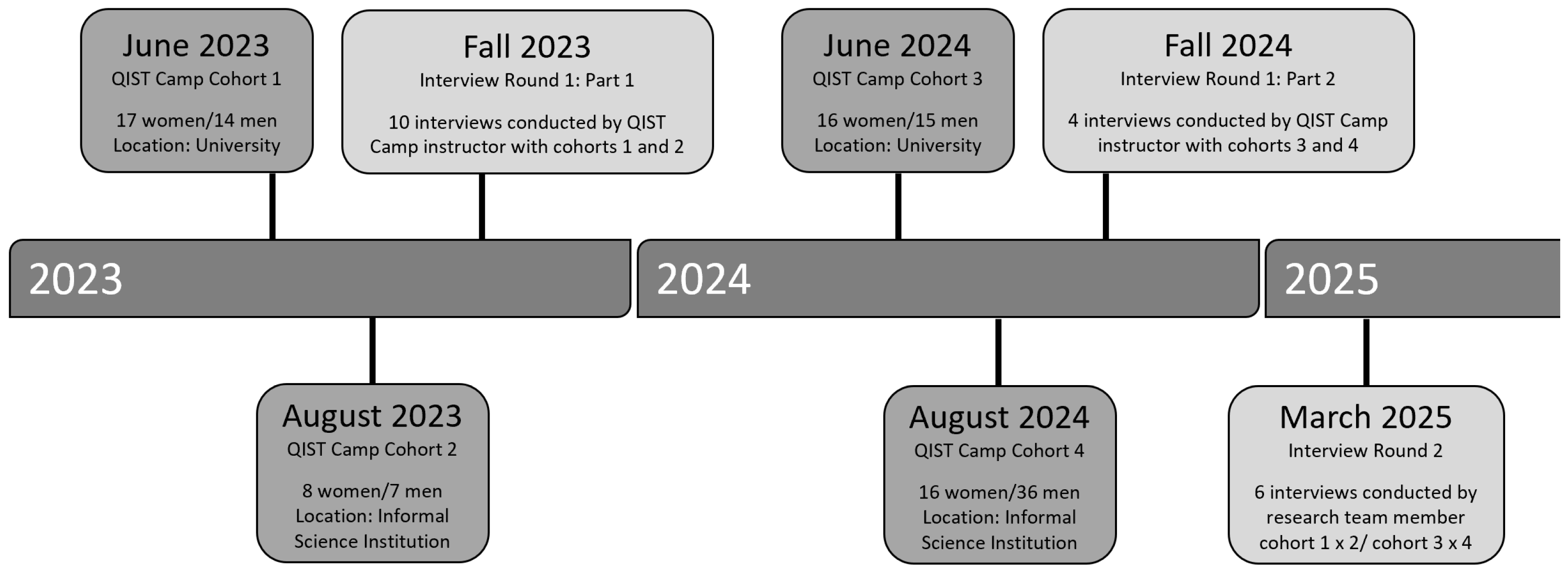
To assess the development of QIST identity in high school women, 14 interviews were conducted two to four weeks after the workshops, and an additional six delayed post-interviews were conducted six to 18 months later (five were from the original group of 14, and one was a new participant). The students self-selected after recruitment letters were sent to all participants. These interviews were initially analyzed using a provisional coding scheme (Saldaña, 2009), which focused on QIST identity development that originated in the review of the literature. After applying this coding scheme, the researchers found that some newly surfaced aspects of QIST identity development required more in-depth exploration; consequently, six follow-up interviews were conducted six to 18 months following participation in the QIST Outreach Program (depending on the year they participated). The semi-structured protocol was developed based on factors affecting identity development in QIST-adjacent fields (see Supplementary Materials). The total number of interviews was 20, with 14 conducted in round one and six conducted in round two. All interviews were conducted via video conference. The timing for the interviews and each cohort of the QIST Outreach Program is illustrated in Figure 2. The initial round of interviews was conducted by one of the QIST Outreach Program faculty instructors (the second author), and the second round of interviews was conducted by the first author, both of whom were women physics education researchers. Recordings were transcribed verbatim.

2.3. Coding Process

The researchers developed a provisional coding strategy, with the initial codes based upon prior research in identity development in QIST-adjacent fields (Saldaña, 2009). From this research, four coding categories were defined to correspond with the conceptual framework: (1) confidence in QIST performance/competence, (2) interest, (3) recognition, and (4) sense of belonging. Axial codes were then identified within these categories (e.g., in the recognition category, axial codes included recognition from educators, peers, family, and self). Two researchers independently applied these codes with elements of grounded theory (Strauss & Corbin, 1997), allowing for the addition of new codes as the researchers worked collaboratively to achieve >90% interrater reliability in 25% of the transcripts. The researchers met three times to compare their codes and adjust the coding scheme to capture constructs that were formative in students’ QIST identity. Agreement was calculated based upon the presence or absence of open and axial codes per segment; disparities were resolved through extended discussions until consensus was reached. The final coding scheme was developed and applied to all 20 interviews (see Supplemental Materials), with additions from the first interrater check and second interrater check marked as 1 and 2, respectively.
The initial axial and open code descriptions were developed based on questions from existing surveys that addressed three of the factors from the theoretical framework: performance/competence, interest, and recognition. Performance/competence was broken down into two areas: ability confidence, which refers to how confident a student feels in their own QIST abilities (Kalender et al., 2019), and persistence, which describes determination to succeed (Patrick et al., 2018). Interest was divided into the level of enjoyment of QIST and the desire to learn more about QIST concepts and research. Recognition was identified by the source: educators (including teaching assistants), peers (including those outside of their QIST class), family, and self. For sense of belonging in QIST, the codes were based on influence factors for women in QIST-adjacent fields. This included teaching strategies such as interactive activities, conceptual scaffolds, multiple representations, and emphasis on potential QIST societal relevance (Çakır et al., 2017). Other codes related to creating a positive learning environment that was gender-neutral (Wong, 2016), having a teacher with a strong QIST identity and level of enjoyment (Anderson et al., 2015), and providing a sense of community in QIST (Revelo et al., 2019). The newly generated codes focused on factors influencing QIST confidence, including normative comparisons, the desire for positional advantage, and developing career expectancy. These constructs are defined in detail in the Findings (Section 3.6).

2.4. Study Participants

The fifteen interviewed students had varying grade levels and prior experiences in mathematics, science, and computer science coursework. At the time of the QIST Outreach Program, five students had completed 9th grade, four had completed 10th grade, and six had completed 11th grade. Most had completed chemistry and at least Algebra 2/Trigonometry, yet less than one-third had taken physics, computer science, and science research coursework. Participants’ academic backgrounds, as well as the timing of their workshop participation and follow-up interviews, are summarized in Table 2. All students were given pseudonyms to protect confidentiality.

3. Findings

The interviews with the women participants revealed several insightful themes contributing to QIST identity formation. The students first specified whether they identified as a QIST person and provided reasons for this belief. The remaining themes are organized by the factors in the proposed QIST identity conceptual framework (performance/competence, interest, recognition, and sense of belonging). This is followed by a section describing other factors that surfaced in students’ discussions of their experiences in QIST outreach, including normative comparisons, positional advantage, and career expectancy.

3.1. Identification as a QIST Person

During both rounds of interviews, students were asked whether they viewed themselves as a “QIST person,” thus providing insight into their level of QIST identity development. Of the fifteen interviewees, three did not specify whether they identified as a QIST person (Jess, Rose, Summer); six considered themselves a QIST person (Arlene, Belle, Fran, Hilda, Jill, Judy) but with varying degrees of confidence. These students were generally older and had all taken Chemistry and at least Algebra 2/Trigonometry. Six others expressed that they would not define themselves as a QIST person (Alli, Alyssa, Betty, Cathy, Kylie, Yazmin)—half of these students were entering grade 10 and had less exposure to advanced science and mathematics coursework. There was also one student (Belle) who described a decrease in QIST identity over time when she said, “When I did the program in the summer, I think I did. But now, after taking AP Physics, I don’t think so.” She explained that AP Physics is “one of the most challenging classes I’ve taken in my entire life” despite her perceived success in the QIST Outreach Program. Conversely, Arlene and Jill provided the strongest positive responses, with Arlene stating in her delayed post-interview:
Before I did the program, I would definitely say I had an interest in it. But after I got—I’d say maybe after 15 min of sitting down and having [QIST instructor] with a few of the professors speaking, I would definitely say that QIST is something that I’m definitely interested in, and I’ve now become a QIST kid.
This differed from some positive responses because others provided more tentative affirmations of being a QIST person, such as Fran stating, “I think I kinda do in some ways. Because, like, science is, like, still in my life. So, I think—I’d say yes, yeah,” and Hilda stating, “Yeah, I think so. I’m planning on majoring in electrical and computer engineering and it’s, like, pretty related to QIST.”
In addition to this hesitance, some students took more time to identify as a QIST person—Fran and Judy both changed their responses from negative to positive between the first and second interviews. Immediately after participating in the QIST Outreach Program, Judy stated, “At this moment, I don’t want to say fully. I want to say I’m beginning to, but with my level of knowledge, I wouldn’t call myself a quantum person yet.” However, during the second interview, which took place over a year later, Judy expressed more confidence in QIST: “I would say fairly so… more than the average person. I’ve definitely learned about the quantum information sciences. I’ve had that exposure and I got the opportunity to kind of really learn about it during my most formative year in high school.” This illustrates that the initial situational interest of participating in QIST outreach may translate to sustained interest as students form emerging QIST identities. These data illustrate the temporal nature of QIST identity development, which may change over time as students become more proficient in QIST-adjacent disciplines.

3.2. Performance/Competence

Many interviewees shared positive responses about their understanding of QIST and their ability to explain aspects of it to others, yet they expressed less confidence in solving QIST-related problems. For example, Arlene felt confident in understanding QIST, stating, “Once I understand some of, like, the big concepts, I can then focus on the smaller concepts that make everything, kind of like a puzzle, fall into place. So, it kinda works out for me.” She was able to explain QIST to her sister such that “she went from not understanding quantum physics at all to understanding enough to where she knows about the wave particle theorem.” However, despite these positive responses, when asked about her confidence in solving QIST problems, she stated,
I would say I’m somewhat confident, only because… while I did that QIST program, I only did, like, a few other searches on my own. But there haven’t been any other programs that I’ve been involved in, unfortunately, that I was able to further my education with a professor or with a research team.
This suggests that opportunities for sustained engagement in QIST may increase confidence in QIST understanding. Since these opportunities are rare at the precollege level, identity formation may be constrained until students participate in more QIST-related activities.
Other students cited a lack of continuing experience in QIST in the months following the QIST Outreach Program as the main reason for this lack of confidence, with Fran sharing,
It’s been, like, almost a year since I’ve taken the workshop… if it was, like, decoding, I feel like I could do it, because I was really anxious in that topic. But for the other topics, I don’t think I could actually solve them.
Even though these students had some concerns about their QIST problem-solving abilities, they and several others expressed confidence that they could pursue a QIST-related career in the future. Fran and Hilda agreed with another student’s sentiments that their level of interest in QIST made it more approachable as a career, with Belle saying, “I think I could, yes…because even though it’s hard, it is—it is interesting. Because, like, the topics and the concepts, they’re real, but they are so abstract that they almost seem unreal.” Arlene felt that she would need to work hard to reach this goal:
I do think that if I do wanna do anything in terms of, like, furthering my career or education academically with quantum science or QIST, I do think I could do it. It might take a little bit of extra grit, but I think I could do it.
Judy shared, “I just need a little more support and a little more help in solving those really hard STEM problems,” and Yazmin pointed out that “I think if I just re-learn some fundamentals of quantum science, I could be able to because I learned kind of quickly over the summer camp.” These statements reflected the students’ confidence in believing they could overcome learning obstacles and master QIST topics and skills, indicating emergent QIST identities; however, their positive statements were often given with hesitancy, such as comments about needing additional training. Overall, these women suggested some level of comfort with the ambiguity of learning more advanced QIST topics.
Despite some apprehension at the beginning of the outreach program, all women expressed at least some positive feelings related to performance and competence by the end of the program. According to several students, reasons for this included pedagogical strategies such as multiple representations and hands-on activities. Yazmin explained:
I like to see the visuals when I learn. So, it was really helpful, because a lot of times, the teachers were just speaking and explaining the concepts. But then, when they brought out the model, I was able to understand more.
However, even with these hands-on experiences, some students in the delayed post-interviews expressed declining confidence over time since they did not have further experiences in QIST, in part because their STEM classes in school did not address these topics.

3.3. Interest

After completing the QIST Outreach Program, many women expressed that they were interested in QIST study and careers, but their reasons varied. Alli, Alyssa, Arlene, and Rose all viewed QIST as an important emerging field that is growing. Alli explained:
A friend told me about it and it sounded kind of interesting. And I thought I would learn about it because I thought it would be kind of important in the future and probably used a lot in the future.
Arlene concurred with this sentiment by stating, “Quantum science is going to be our future, so I think that having that would be super beneficial.” Rose also cited the future, observing that “I can definitely see how that can help because quantum physics… it’s like an introduction to our future where we can rely on technology to make predictions or even solutions.” In addition to QIST being important in the future, Alyssa also felt that it would be a possible career option:
I guess it’s something that in the future it seems to be very prominent, and it seemed like a good choice to at least learn about it so I can see if I might want to do it in the future as a career.
Several other women were interested in QIST careers because of the real-world applications they learned about in the QIST Outreach Program. For example, Jill said, “I feel like I like this type of real world stuff and actually applying math and science together, I really like that part.” Judy also enjoyed learning about applications and was particularly interested in how QIST could help people and improve the world:
When I heard that quantum physics could somehow apply to environmental aspects, I was really excited about that…now I’m thinking because I used to want to do something with engineering or civil engineering, structural types, buildings. But now I’m thinking maybe going into the quantum field and somehow developing it to benefit our world, benefit our Earth better. That would be a really great path and definitely interested me.
This aligns with research in QIST-adjacent fields of physics, computer science, and engineering, which concluded that providing examples of societal benefits encourages young women to build a stronger identity in respective disciplines (Burks et al., 2019; Çakır et al., 2017).
Other students were surprised by the breadth of potential QIST applications, including clean energy and chemical processes for producing fertilizers, which were presented as anchoring phenomena during instruction. Alyssa reflected on clean energy and stated, “I think that was really cool. It was, I remember reading it was the gas leaks were invisible but somehow using quantum mechanics they could detect it with really good accuracy.” Hilda expressed similar thoughts: “I didn’t really know that fertilizers were such a good application for quantum, and I didn’t realize that there was so much you could do with it and I thought it was really interesting.” Because these students found topics that interested them and appealed to their aspirations to improve society and the human condition, their desire to learn also increased.
Several students shifted their academic intentions because of their experiences. Belle shared that learning about QIST led her to expand her career options:
Originally I always was like, oh, I’ll do, I’ll go the medical route and then maybe I’ll pick up a few political science classes. I’m interested in that. But now I was like, okay, I really quantum mechanics and I like quantum, so I want to do something with that, too.
Jill shared that she increased her interest in the QIST-adjacent field of physics: “I would say that physics, I wasn’t really sure if I wanted to continue that, but I’m definitely sure now I want to.” Other students also talked about how the QIST Outreach Program was a gateway that inspired continued QIST study; for example, Judy expressed: “I feel like with the camp, everything I learned, just every new thing that I’ve learned, I got ten other questions about this thing, about how much deeper it could be.”

3.4. Recognition

Throughout the QIST Outreach Program, there were opportunities for program faculty and staff to recognize student accomplishments, which boosted confidence for many. Several participants expressed satisfaction after getting positive feedback on their group presentations, with Belle stating that one of the instructors “said we were good at presenting” and Judy sharing a similar sense of recognition from experts in the room:
While presenting to the grad students… one, they acknowledged what I was saying, and, two, they kind of provided their own input, too, which further solidified what I already had in mind. And I felt like ‘Oh, wow, this can actually work. What I’m saying is actually feasible.’
This external validation, especially coming from those already working towards or immersed in a career, has been shown to improve students’ identity development in QIST-adjacent fields (Nehmeh & Kelly, 2021).
In addition to receiving positive feedback, students also expressed feelings of recognition when they overcame a struggle because of the encouraging words of an instructor or teaching assistant. Arlene explained:
They expressed how it was normal for you to not understand when you first looked at it. Because I’m one of those students where, once I see it, I understand it, and it kind of clicks in my mind. This was something that didn’t click right away, and I thought something was wrong with me.
Then, after the above conversation with the instructor, Arlene shared:
I didn’t code it completely, and I thought I did—I thought half of it was missing. But then, I showed it to [the instructor, who] actually expressed that I did do it right, and that was the first time, ever, that a student actually did get it—who wasn’t an undergraduate student—get it right the first try.
Recognition facilitated Arlene’s confidence in her QIST ability. This involved working in safe spaces where challenge and sometimes failure were expected and successes were celebrated, which encouraged her further. This was also the case for Fran, who stated, “I asked a question when I had problems, even when I was, like, struggling, when I finally got something, he’d go, ‘Oh, my God, yes! Good job!’ and everything.” This praise was very important to Fran: “I feel like his encouragement and his attitude about it, it kind of, like, kept me more in, kind of built my confidence.”
Students also expressed feelings of recognition from other sources, including their families and peers. Arlene shared how her family members “…were actually telling me that, hey, that you actually can do this. And when you’re given such an opportunity of learning something such as quantum science, you’re like, oh, just maybe I can do it,” thus facilitating her confidence. Yazmin felt recognition when she helped others, establishing her competence and sense of leadership. Rose also felt recognition when a teaching assistant, or near peer, helped her accomplish a task:
A student helped me when we were doing the single and double slits because they showed me how to do it and what was right. And it was just really helpful to have somebody that I guess isn’t a professor to help me go through each step.
These experiences suggest that there were opportunities for peer recognition for both those who helped others (who experienced positional authority) and those who were being helped (who increased confidence through the support of experts).

3.5. Sense of Belonging

Students cited several reasons for their comfort with the learning environment of the QIST Outreach Program, including interactions with the instructors, the teaching assistants, and their peers; the level of gender neutrality in the cohort; and the teaching methods employed. The instructors and teaching assistants were frequently described as enthusiastic about QIST and easily approachable. Fran commented on their level of excitement and how it increased her interest, stating, “they were very, like, passionate about it, and I think, like, I’m, like, trying to keep going, to learn more about [QIST].” Yazmin expressed, “I think they really enjoyed it, and this made me enjoy it more, too…he [quantum experimentalist] was really excited to talk about his lab.” Belle expressed her admiration for the enthusiasm of the instructors as they shared their expertise:
Most of the TAs [teaching assistants] are very interested in the topic, and although they weren’t social, like, when you asked them a question, you could tell, like, this was something they were passionate about. Like, they would go in depth and explain the concepts to you.
This level of enthusiasm and passion made the instructors more approachable. Judy pointed out the benefit of having teaching assistants provide alternative explanations of concepts:
So sometimes if you’re too scared to ask a professor for help, asking a grad student and their knowledge and skills really, they know how to explain it to a level where you can understand it. So that was really helpful.
In addition to the instructors and teaching assistants, students’ peers in the program contributed to a more positive learning environment. According to Arlene, her peers made her feel welcome after she first felt apprehensive:
I was wary, but then, after we kind of started discussing the topic and we all kind of realized that, like—hey, like, we’re not gonna make fun of each other, we’re not gonna judge each other, it was kind of that kind of no man’s land mindset. We all kind of melded together as friends, and then, we all ended up working together really well.
This newly formed sense of community facilitated students’ comfort with the QIST content; for example, Yazmin stated, “I thought a lot of stuff was difficult, but I just asked my—like, the friends I made, and they really helped explain one-on-one.” Peer collaboration was made possible by the physical layout of the classroom, which was designed to encourage collaboration as students sat in groups of eight at round tables. This was shared by Belle, as she stated, “because we all sit on, like, a circular table, it’s easier to talk to people. So, that made me feel comfortable.” Rose took advantage of this circular seating to meet new people, allowing her to experience a greater degree of socialization within the QIST learning community:
It was a great way to socialize with other people from different schools. And because a lot of the kids, they were older than I was, it was great for me to experience other kids with more experience that also took physics. So that was very interesting.
Many of the women also felt comfortable with their peers because the ratio of women to men was higher than they had seen in other STEM learning environments. According to Hilda,
I did notice that, like, compared to my classes in school, this workshop had, like—like, a lot more girls. Like… compared to, compared to my classes in school. Because in my current math class, there’s only, like, me and one other girl, and that’s, like, all the girls.
This higher representation of women was also encouraging to Fran, who said,
I really liked learning, like, seeing other…women there, too, made me feel even more like I’m not the only person, like, interested about this, and I could do it. And then, being around that, it put me at ease, since it was a male-dominated subject.
In addition to being among other women peers, it was noted by two students that having women as instructors and teaching assistants was positive. The women expressed they learned a great deal from all the experts in the room while particularly appreciating the presence of women instructors. This suggests the importance of female role models who engage in some aspects of instruction. Summer expressed gratitude for the undergraduate female teaching assistants who helped facilitate the lab activities.
However, despite many students discussing the importance of female peers and teaching assistants, Judy expressed that level of motivation was more important than gender parity:
I don’t think I really gave a second thought to how gender was playing a role in my learning experience. But I definitely would say that my experience at QIST, being in an environment with equally as motivated people was much more positive than my experience at the engineering summer camp, where about half…the class was motivated.
Finally, many women identified teaching methods that made them feel more comfortable with QIST and facilitated a greater sense of QIST belonging. In particular, they described the importance of scaffolding to aid in understanding of complex topics. Rose discussed how logical conceptual progression was part of the structure of the lectures, saying that “it was just kind of like, well here’s step one, step two and step three and this is how it works. And that just gave you an outlook and just a view on what the lecture was about.” Then if a student needed help with a topic, the instructors provided one-on-one scaffolding, in which Arlene shared,
They were able to go step by step through certain things that I didn’t understand, which I thought was very nice of them. And they would continuously ask me the questions over and over again to make sure that I understood the topic and I was able to build on that.
For the most part, these pedagogical techniques helped students understand complex topics in QIST; however, when Jill still had trouble understanding the coding taught in the QIST Outreach Program, she stated, “I felt I needed some more of a lower level first to get to the higher level,” suggesting that further scaffolding would moderate this challenge.

3.6. Additional Factors

In addition to the four provisional factors of the QIST identity conceptual framework, students also discussed aspects of normative comparison, positional advantage, and career expectancy. These themes were elicited by applying elements of grounded theory (Strauss & Corbin, 1997) in coding their responses. These constructs contribute to the newly generated QIST identity framework, which expands upon previous works by considering domains that may be more evident and influential in emerging, integrated scientific fields such as QIST.

3.6.1. Normative Comparison

Precollege students often ponder a series of comparisons when forming STEM-related career aspirations (Gearns et al., 2024), which was evident when the students in the present study were asked about their confidence in learning/understanding QIST and in solving QIST problems. Some women discussed normative comparisons, here defined in two orientations—first, women mentioned external performance comparisons to their peers, and second, they shared internal comparisons related to their own abilities in other areas of STEM. Although previous STEM identity frameworks included performance/competence more broadly, normative comparison specifies a reference frame for themselves and others. For example, Jess compared her own experiences in STEM with other students when she stated:
I was talking to some kids that took physics and they were like, oh yeah, I know it all. I took physics or chemistry, and I was like, oh, well I didn’t take any of those courses, so this is my first time learning about any of this. It was definitely harder for me.
Alyssa felt similarly, stating that those who had already taken physics would have an advantage. This suggests that students often judge their own ability to succeed based on the academic capital they possess in the form of prior coursework. The QIST Outreach Program experience also served as a way to increase student confidence in learning physics after the workshop, as explained by Hilda:
Last year, I took physics, AP Physics 1 and 2, and then there was, like, a brief unit about quantum. And I feel like I have, like, because I did this program, I kind of have, like—like, a better understanding than some of the other kids in my class.
In addition to normative comparisons to others, some women also compared their abilities in QIST to their own performance in other STEM subjects. For example, Alyssa expressed more confidence in life sciences than in quantum:
I want to focus more on living science, biology, and such since I feel like that’s my best part. It’s why I really understand a lot and I like researching that on my own too….so I guess it’s because for biology I do research sometimes on my own, especially a few years before, so I kind of understand more in depth of the topics. While for quantum mechanics, I never really looked into it, so I didn’t really fully understand it. I didn’t understand it until I went into a summer program and since I wasn’t a hundred percent sure about some parts, I don’t feel like I’m confident in that area.
Alyssa’s comfort in biology exceeded her comfort level in quantum science, which is often consequential in how students choose their post-secondary study and careers. Notably, prior coursetaking in physics did not predict students’ QIST knowledge outcomes in this program (De La Cruz et al., 2026), which indicates students’ perceptions may be more important than measured competence in how they envision themselves in certain fields. Based on the students’ comparative comments about themselves and others, there was often a connection between their level of confidence and their normative comparisons.

3.6.2. Positional Advantage

Many women also discussed academic positional advantage, or advanced status in their educational pursuits. Their exposure to QIST, along with direct discussion of academic pathways by program instructors, helped them envision what courses they should take in the future to optimize their preparedness for QIST-related careers. This construct extends the notion of recognition in prior STEM identity frameworks by characterizing QIST knowledge as academic capital rather than external validation. For example, several women described plans to take advanced physics courses in high school. Summer had already intended to take a physics course, but she explained that the QIST Outreach Program prepared her for this when she stated:
I learned all these new notes and all these new concepts, so I think it’s definitely gonna help me going forward, ‘cause I also plan on taking AP Physics C in my senior year, so I think it definitely overlaps.
Others like Alyssa and Jess decided to add physics to their future course plans because of their QIST Outreach Program experiences. Alyssa explained, “I still haven’t figured out exactly what I want to do for high school and college, so I might actually change a few things, add physics and such,” while Jess shared, “I found it really interesting doing the camp. So now after that I was like, oh, okay, well maybe I would actually really like taking AP Physics.”
In addition to enrolling in physics in high school, some students also talked about exploring more options for QIST learning. Cathy explored other informal education workshops and explained, “I think IBM also has, like, another camp that’s, like, a virtual camp. And it’s with high school students.” Betty, who also expressed no interest in studying QIST further, described the importance of exposure to the topic in her statement:
Because even though, like, I personally will not be going into quantum physics, it’s still a STEM course, so I think that if someone is interested in STEM, they should take that course just because that could like, open up and see if there’s other fields in STEM that like, they may be better at.
Hilda echoed this notion in her explanation of why she applied to the QIST Outreach Program, stating,
Let’s say it was more because I didn’t know much about quantum concepts before the camp, and I wanted to learn something new that I didn’t really know much about. And I thought it would be a really good way to expose myself to this area of physics.
Overall, the women felt that learning about QIST would put them at an advantage in their future QIST-adjacent education endeavors and was something they had not seen in their traditional classrooms. Many expressed a desire to expand their knowledge in QIST, as Kylie explained:
I kind of just wanted to expand on the knowledge in that area. And I was also looking for a more hands-on approach to the subject itself. And I also kind of just wanted a different environment to learn something since I am going to be going into college soon. I just wanted to get a feel of the way an actual college professor would teach a class.
In addition to a preview of the college experience, Judy felt that it was possible that some women might feel the experience was helpful for getting into a good college. She explained, “I’m going to be really honest with you. I feel like the thing with girls is that we’re really trying to boost up our college resume. I see it in all my friends,” thus supporting the idea that positional advantage is something that many consider when deciding to pursue a QIST learning experience.

3.6.3. Career Expectancy

Another important part of the QIST learning experience was career expectancy, or one’s beliefs about future experiences in a quantum profession, and whether this profession is attainable and consistent with their values (Eccles & Wigfield, 2024). This extends the notion of social belonging—a more immediate affective domain in prior STEM identity frameworks—to a more forward-thinking positioning in a community of practice. For example, Judy felt that it was important to meet students pursuing a degree in quantum, so they might understand the expectancy of that career path: “I think talking to the grad students and being able to talk to people who actually are working towards that field was helpful in understanding what is required to really be able to break into that field.” Several students also explained that visiting a QIST laboratory was a positive experience. It was valuable for Rose because it provided both QIST career and general college expectancy:
When we had a tour, we went into a lab, those are parts of college experiences that high schoolers would not have. It could really help you make a decision of which field you wanted to go into when you reached college.
Cathy agreed with this notion and explained her reasons for enjoying the lab tour when she stated:
Another, like, thing that I really loved about the camp was, like, it was a short portion of it but it was like visiting the laboratory. I really liked that part because it’s like you can actually see what college students and the grad students and the professors are working on.
For Cathy, the laboratory gave her a sense of what her life would be like if she worked in a quantum experimental laboratory, which has been shown to influence career expectancy, aspiration, and persistence (Nehmeh & Kelly, 2018, 2021). Kylie provided a different perspective, as she felt it was important because it was something new and impressive:
I’ve never seen anything like that, and the fact that you guys can actually work with atoms in the space and do stuff for them, that was a really cool part…and I feel like that was really motivating because I didn’t even know some of that stuff was possible.
Exposure to a working laboratory in an emerging field provided an experience that was both novel and informative about a prospective career in quantum science. Career expectancy may be an important aspect of QIST identity formation as women consider what their lives will be like if they work in the field.
Students were asked about their thoughts on why the QIST Outreach Program had more women than was typical in QIST-related fields, and why women might be less likely to pursue QIST-related careers. This led to the identification of several factors that these women believed negatively affected the number of women in certain areas of STEM, and potentially QIST identity. Betty believed women might be discouraged “…because of the way others perceive you if you go into the field.” Alli suggested, “A lot of the time in schooling or in the workplace, a lot of women experience sexism and people are discouraging women from going into STEM fields a lot.”
Others perceived that many STEM fields were male-dominated which discouraged women from entering them. This lack of representation was also prevalent in STEM extracurriculars, as Summer explained,
I’m going to try out for our school science Olympiads, and our school also does have a robotics club, but this is a problem that I’m planning on overcoming, but it’s all male-dominated, and the teacher is also a male. So, I haven’t really found an opportunity to connect with anyone who’s currently in it, or get an opportunity to let myself in.
Judy also came to expect a gender disparity in certain fields: “Not many people choose anything related to physics, especially girls, they don’t choose anything related to physics, and I see a lot of more guys choose physics, chemistry, statistics.” Belle provided a possible reason for the lack of women in these fields by stating,
It’s easier for a man to pursue these careers as opposed to a woman… woman’s careers are shorter, but they kind of stop in the middle, have children, and so maybe that’s why they’re not able to pursue these careers.
Because of some of these expectations, Cathy had concerns about participating in the QIST Outreach Program. She said, “I was actually scared that there would be more guys there than girls. I was like, ‘Hopefully there’s more girls there,’” but she was pleasantly surprised by the nearly even representation of men and women. This communicated that QIST participation is accessible regardless of gender identification.
When asked about why they thought this gender gap was missing from the QIST Outreach Program, many responded with positive feedback about how women were now more likely to overcome gender disparities. Kylie felt that sustained efforts targeted toward encouraging women to enter STEM fields were increasing confidence and agency, stating:
I think we’re starting to see a shift like that with the different percentages where our generation specifically, we’ve been advertised to be more drawn to STEM fields because there’s such a large difference. And I think it’s really getting to us now because we’re like, oh, we just can’t let this happen. So now, girls, because we’re being more encouraged to go into STEM fields, I think all that advertisement is actually doing something.
Summer talked about her own determination when she said,
Even though I personally know we’re underrepresented, I think that shouldn’t hinder me to explore more and put myself out there… even though I’m a woman, I can still—I’m more than capable to be on par or even above my male peers.
Arlene felt that this increase in women was due to the growth in opportunities to learn more about a field, stating, “when they actually pique their interest and start learning, they understand what they’re doing, it gives them the opportunity of thinking, oh wait, maybe I can do this because that’s something I went through.” This suggests it is important to introduce women to QIST careers and encourage their feelings of adequacy and success. Several of the women commented on their own underrepresentation in QIST-related fields; however, they generally felt that the QIST intervention communicated accessibility and belonging through a welcoming, student-centered learning environment.

4. Discussion

The student interviews demonstrated that four factors (performance/competence, interest, recognition, and sense of belonging) identified in prior research on identity formation in the QIST-adjacent fields of physics, computer science, mathematics, and engineering also applied to their QIST identity formation. Many of the women expressed confidence in their ability to understand QIST content and solve QIST-related problems, suggesting positive self-assessment of their performance/competence (Godwin & Lee, 2017). Women also described their interest in QIST topics and their future relevance in improving society (Patrick et al., 2018; Taheri et al., 2018), with some sharing their reasons for participating in QIST outreach and others focusing on their desire to learn more; all expressed their interest with positive feelings (Kalender et al., 2019). Many women agreed with the notion proposed by Çakır et al. (2017) that providing scaffolding for complex topics improved their QIST self-efficacy. Several women described positive feelings when their QIST potential was recognized by peers and teachers (Cass et al., 2011; Godwin et al., 2013). The women’s responses also supported the addition of a sense of belonging as an important factor in the framework (Peters & Pears, 2013; Rhode et al., 2019), as most discussed feeling welcome in the QIST learning environment, with value placed on the importance of learning about QIST applications for improving global conditions (Çakır et al., 2017; Chen et al., 2020). These four factors (performance/competence, interest, recognition, and sense of belonging) contributed to precollege women’s emerging QIST identities.
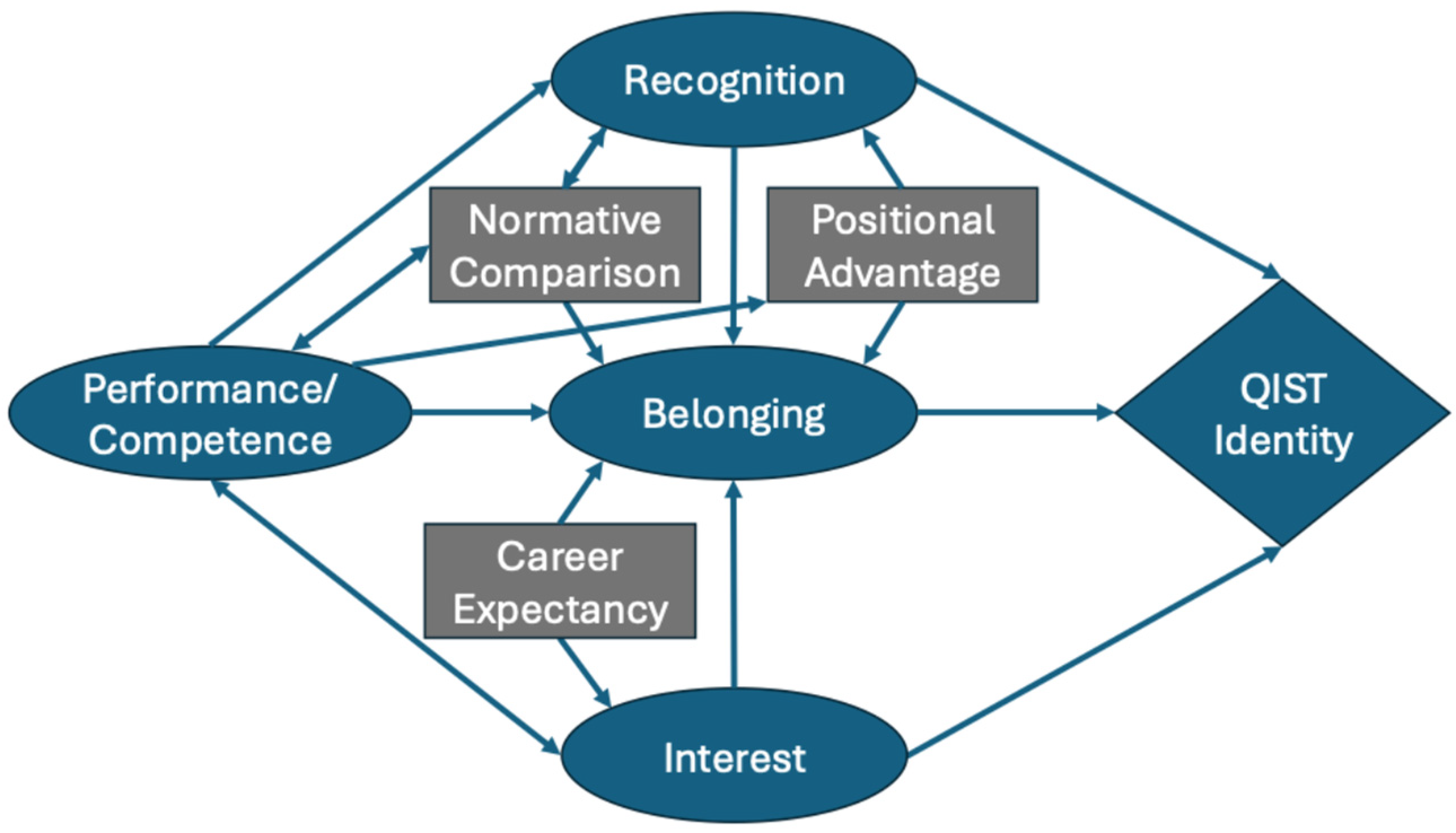
The newly generated conceptual framework for QIST identity maintains the initially proposed flow of performance/competence to recognition and interest (Carlone & Johnson, 2007; Hazari et al., 2010; Kalender et al., 2019), to a sense of belonging (Anderson et al., 2015; Peters & Pears, 2013; Rhode et al., 2019; Taheri et al., 2018), and then to QIST identity; however, the framework also includes normative comparison, career expectancy, and positional advantage. As shown in Figure 3, students expressed how performance/competence led to recognition, a sense of belonging, and often interest, although the last relationship may be bidirectional. It was important for them to feel as though they could learn QIST concepts and skills in order to form a sense of QIST identity. Recognition made them feel as part of the QIST community of learners as they worked alongside QIST experts. QIST interest also facilitated a shared sense of belonging among peers, which further facilitated QIST identity.
The three additional factors (normative comparison, positional advantage, and career expectancy) may be particularly relevant for women’s identity formation in largely unfamiliar and integrated fields such as QIST, where they have limited exposure and opportunities for active engagement. Normative comparison refers to the tendency to compare one’s own abilities to the ability level of others within the same social circle (Bandura, 1997), or in the case of this study, within the same QIST outreach program. Normative comparison also includes internal judgments of their own abilities in QIST compared to other disciplines. Normative comparisons with others often influenced their feelings of performance/competence, at least when they first began the QIST Outreach Program or were learning a new topic. Normative comparison had bidirectional relationships with performance/competence and recognition, and this construct also facilitated sense of belonging. For some women, their self-efficacy was initially lower because others had a stronger background; however, their level of performance/competence and feelings of recognition increased when they succeeded. Several received help from their peers, thus improving their QIST self-efficacy and sense of agency, and they felt recognized when those peers praised their work.
Students’ confidence in their performance/competence, as well as their access to QIST learning and QIST-adjacent coursework, led to discussions of positional advantage, in which the students felt a sense of privilege, distinction, and recognition in participating in QIST programming. Positional advantage may lead to an increase in a student’s motivation to pursue additional learning opportunities about a particular topic to further accessibility to related careers (Basu & Barton, 2005). Many students discussed their plans to take more courses in physics, and some expressed interest in pursuing QIST as a career option. This aligned with the connections between student science knowledge and their continuing interest in science evidenced in Basu and Barton (2005). Several also expressed that the QIST Outreach Program provided them with unique knowledge outside of their own school curricula, thus preparing them for a future QIST-related career. This specialized knowledge is important as students formulate academic plans that are consistent with their career intentions (Gearns et al., 2024). Positional advantage also contributed to sense of belonging in QIST.
Finally, students identified experiences that affected their QIST career expectancy, such as visiting a quantum laboratory, working with a diverse group of instructors, engaging in discourse with QIST professionals, and interacting with near-peer undergraduate and graduate students. Career expectancy has been defined as the effect that authentic experiences in a particular field, such as meeting individuals in the process of pursuing a QIST degree, may have on the career intentions of a student (Masson et al., 2016; Smit et al., 2020). Students also appreciated seeing how much the QIST experts and graduate students enjoyed what they were doing, which was described by Anderson et al. (2015) as important for fostering a greater sense of belonging and interest. The students expressed positive views of women entering QIST and QIST-adjacent fields, which influenced their interest and sense of belonging. Many discussed that they observed gender parity and positivity in the learning environment, so they felt more confident in their ability to pursue what may be perceived as a male-dominated career, consistent with research suggesting the importance of these constructs (Rhode et al., 2019; Wong, 2016). It was also important that students observed positive role models, which data from the present study indicated could be men or women, although the presence of women was noticed and valued. This allowed them to envision themselves in QIST careers in the future.

4.1. Implications for Policy and Practice

Based on women’s feedback about their QIST experiences and the explanatory QIST identity framework, it is important to consider several factors when designing QIST educational experiences for high school students. QIST informal and formal programs should be characterized by: (1) a positive learning environment (Leslie et al., 2015; Wong, 2016); (2) content that is scaffolded with increasing conceptual complexity (Çakır et al., 2017); (3) experiences with QIST experts and students in peripheral communities of practice to boost career expectancy and interest (Anderson et al., 2015; Nehmeh & Kelly, 2021); (4) information about what courses would be helpful in pursuing a QIST career to provide positional advantage (Basu & Barton, 2005; Gearns et al., 2024), and (5) activities relating to the benefit of QIST to society (Chen et al., 2020). It is also important to include experiences that will encourage students to share knowledge and support each other through effective group collaboration (i.e., discourage negative normative comparisons); pursue advanced STEM coursework and additional QIST learning opportunities to expand their knowledge and skills (i.e., encourage positional advantage); and introduce QIST researchers and recent advancements in their fields (i.e., provide career expectancy in quantum sensing, quantum communication, quantum computing, etc.). These additions to QIST programs could lead to further increases in performance/competence, recognition, interest, and sense of belonging for students as they develop their QIST skills, therefore promoting QIST identity and career aspiration formation.
These programmatic characteristics should be contextualized and aligned with recent initiatives promoting QIST education and workforce development early in the STEM pipeline, such as the United Nations recently designating 2025 as the International Year of Quantum Science and Technology (International Year of Quantum Science and Technology Partners, 2024). Federal reports have focused on making QIST careers more accessible with multiple entry points in the academic continuum, starting with K-12 education (NSTC, 2018, 2024). At the high school level, exposure could begin with outreach programs, teacher professional learning, the incorporation of core QIST concepts in existing courses, and the formation of new quantum courses that are responsive to the rapidly evolving nature of the field (Kelly et al., 2025a; National Q-12 Education Partnership, 2023). Core design principles of these educational efforts should reflect the need for welcoming learning environments, exposure to role models, consideration of cognitive load, socially relevant anchoring phenomena, and explicit communication of QIST academic pathways and careers (Anderson et al., 2015; Çakır et al., 2017; QED-C, 2025a; Rhode et al., 2019; Wong, 2016).

4.2. Study Limitations

This study had a small sample size of students who self-selected into the quantum outreach program and therefore may not be representative of the general population of high school women in the United States. There were 15 interviews from 131 total participants in the QIST Outreach Program in 2023–2025. In the initial round of interviews, the students already knew the interviewer, who was the physics education expert who taught the workshop with quantum physicists. Although there may be confirmation bias in the student responses, it may also have provided a level of comfort to students when responding to the interview questions. Effort was also made to minimize socially desirable responses because of the existing relationship between the interviewer and interviewees by clearly stating at the beginning of each interview that the responses would remain confidential and would only be used to report program outcomes, thus having no effect on future opportunities. The two researchers who conducted the interviews and analyzed the data acknowledge their potential biases as Caucasian women physics education researchers and physics educators. During the coding process they had extended discussions to mitigate their prior conceptions and beliefs that arose from their experiences as underrepresented participants in their respective fields.

5. Conclusions

The emerging QIST identity framework was based on the QIST-adjacent identity development literature in the fields of physics, mathematics, computer science, and engineering, which initially included four factors (performance/competence, interest, recognition, and sense of belonging) and subsequently required modification to include women’s normative comparisons, positional advantage, and career expectancy. This novel, innovative framework is timely and necessary given the rapid expansion of quantum technologies and the need for a diverse, well-prepared QIST workforce (NSTC, 2018, 2024; QED-C, 2025a, 2025b). The QIST Outreach Program provided a positive learning experience that engaged students in QIST content, skills, and practices, while introducing them to career options that most had not previously considered. Future formal and informal QIST educational programs may provide similar learning environments and pedagogical strategies to inspire precollege students to pursue QIST careers. Furthermore, the QIST identity framework might be deductively tested to measure student outcomes in future QIST educational interventions.

Supplementary Materials

The following supporting information can be downloaded at: https://www.mdpi.com/article/10.3390/educsci16081222/s1.

Author Contributions

Conceptualization, M.D. and A.M.K.; methodology, M.D. and A.M.K.; validation, M.D. and A.M.K.; formal analysis, M.D. and A.M.K.; investigation, M.D. and A.M.K.; data curation, M.D. and A.M.K.; writing—original draft preparation, M.D. and A.M.K.; writing—review and editing, M.D. and A.M.K.; visualization, M.D. and A.M.K.; supervision, A.M.K.; project administration, A.M.K.; funding acquisition, A.M.K. All authors have read and agreed to the published version of the manuscript.

Funding

This research was funded by the National Science Foundation under Award No. 2148467. Any opinions, findings and conclusions or recommendations expressed in this material are those of the authors and do not necessarily reflect the views of the National Science Foundation.

Institutional Review Board Statement

The study was conducted in accordance with the Declaration of Helsinki, and the protocol was approved by the Institutional Review Board of Stony Brook University (#2022-00244) on 25 May 2022. Informed consent for participation was obtained from all subjects involved in the study.

Data Availability Statement

The datasets presented in this article are not readily available because of Institutional Review Board restrictions. Requests to access the datasets should be directed to the Corresponding Author.

Conflicts of Interest

The authors declare no conflicts of interest.

References

  1. Adegoke, B. A. (2012). Impact of interactive engagement on reducing the gender gap in quantum physics learning outcomes among senior secondary school students. Physics Education, 47, 462. [Google Scholar] [CrossRef]
  2. Anderson, A., Valero, P., & Meaney, T. (2015). “I am [not always] a maths hater”: Shifting students’ identity narratives in context. Educational Studies in Mathematics, 90, 143–161. [Google Scholar] [CrossRef]
  3. Angara, P. P., Stege, U., & MacLean, A. (2020, October 12–16). Quantum computing for high-school students: An experience report. 2020 IEEE International Conference on Quantum Computing and Engineering (QCE) (pp. 323–329), Denver, CO, USA. [Google Scholar] [CrossRef]
  4. Angara, P. P., Stege, U., MacLean, A., Müller, H. A., & Markham, T. (2022). Teaching quantum computing to high-school-aged youth: A hands-on approach. IEEE Transactions on Quantum Engineering, 3, 1–15. [Google Scholar] [CrossRef]
  5. Bandura, A. (1997). Self-efficacy: The exercise of control. W. H. Freeman. [Google Scholar]
  6. Basu, S. J., & Barton, A. C. (2005). Developing a sustained interest in science among urban minority youth. Journal of Research in Science Teaching, 44(3), 466–489. [Google Scholar] [CrossRef]
  7. Beyer, S. (2014). Why are women underrepresented in computer science? Gender differences in stereotypes, self-efficacy, values, and interests and predictors of future CS course-taking and grades. Computer Science Education, 24(2–3), 153–192. [Google Scholar] [CrossRef]
  8. Bitzenbauer, P., Ubben, M. S., Anttila, D., Bondani, M., Chiofalo, M. L., Faletic, S., Goorney, S., Greinert, F., Müller, R., Koupilová, Z., Malgieri, M., Merzel, A., Pol, H. J., Popsiech, G., Stadermann, H. K. E., Weissman, E. Y., & Krijtenburg-Lewerissa, K. (2025). Expert perspectives on the future of quantum physics education at the secondary level. Physical Review Physics Education Research, 21(2), 020157. [Google Scholar] [CrossRef]
  9. Boaler, J., William, D., & Zevenbergen, R. (2000, March 26–31). The construction of identity in secondary mathematics education. International Mathematics Education and Society Conference, Montechoro, Portugal. Available online: https://eric.ed.gov/?id=ED482654 (accessed on 19 July 2026).
  10. Burks, G., Clancy, K. B. H., Hunter, C. D., & Amos, J. R. (2019). Impact of ethics and social awareness curriculum on the engineering identity formation of high school girls. Education Sciences, 9(4), 250. [Google Scholar] [CrossRef]
  11. Carlone, H. B., & Johnson, A. (2007). Understanding the science experiences of successful women of color: Science identity as an analytic lens. Journal of Research in Science Teaching, 44(8), 1187–1218. [Google Scholar] [CrossRef]
  12. Cass, C. A. P., Hazari, Z., Cribbs, J., Sadler, P. M., & Sonnert, G. (2011, October 12–15). Examining the impact of mathematics identity on the choice of engineering careers for male and female students. 2011 Frontiers in Education Conference (FIE) (pp. F2H-1–F2H-5), Rapid City, DS, USA. [Google Scholar] [CrossRef]
  13. Ceci, S. J., & Williams, W. M. (2015). Why so few women in mathematically intensive fields? In R. A. Scott, & S. M. Kosslyn (Eds.), Emerging trends in the social and behavioral sciences (pp. 1–12). Wiley. [Google Scholar] [CrossRef]
  14. Chen, C., Sonnert, G., & Sadler, P. (2020). The effect of fist high school science teacher’s gender and gender matching on students’ science identity in college. Science Education, 104(1), 75–99. [Google Scholar] [CrossRef]
  15. Choe, N. H., Martins, L. L., Borrego, M., & Kendall, M. R. (2019). Professional aspects of engineering: Improving prediction of undergraduates’ engineering identity. Journal of Professional Engineering Education and Practice, 145(3), 04019006. [Google Scholar] [CrossRef]
  16. Creswell, J. W., & Creswell, J. D. (2023). Research design: Qualitative, quantitative, and mixed methods approaches (6th ed.). Sage. [Google Scholar]
  17. Cribbs, J. D., Hazari, Z., Sonnert, G., & Sadler, P. M. (2015). Establishing an explanatory model for mathematics identity. Child Development, 86(4), 1048–1062. [Google Scholar] [CrossRef] [PubMed]
  18. Çakır, N. A., Gass, A., Foster, A., & Lee, F. J. (2017). Development of a game-design workshop to promote young girls’ interest towards computing through identity exploration. Computers and Education, 108, 115–130. [Google Scholar] [CrossRef]
  19. Darienzo, M., & Kelly, A. M. (2024, September 15–16). Review of literature on quantum information science and technology programs for high school students. IEEE Quantum Science and Engineering Education Conference (QSEEC24) (pp. 96–103), Montreal, QC, Canada. [Google Scholar] [CrossRef]
  20. Darienzo, M., Kelly, A. M., Wei, T. C., & Schneble, D. (2024). Students’ attitudes toward quantum information science and technology in a high school outreach program. Physical Review Physics Education Research, 20(2), 020126. [Google Scholar] [CrossRef]
  21. De La Cruz, R., Kelly, A. M., Wei, T. C., & Schneble, D. (2026). Academic and demographic factors and precollege student knowledge of classical physics, quantum physics, and quantum computing in university-based outreach. EJP Quantum Technology, 13, 73. [Google Scholar] [CrossRef]
  22. Dost, G. (2024). Students’ perspectives on the ‘STEM belonging’ concept at A-level, undergraduate, and postgraduate levels: An examination of gender and ethnicity in student descriptions. International Journal of STEM Education, 11, 12. [Google Scholar] [CrossRef]
  23. Eccles, J. S., & Wigfield, A. (2024). The development, testing, and refinement of Eccles, Wigfield, and colleagues’ situated expectancy-value model of achievement performance and choice. Educational Psychology Review, 36(2), 51. [Google Scholar] [CrossRef]
  24. Faletic, S., Bitzenbauer, P., Bondani, M., Chiofalo, M., Goorney, S., Krijtenburg-Lewerissa, K., Mishina, O., Müller, R., Pospiech, G., Ercan, I., Malgieri, M., Merzel, A., Michelini, M., Onorato, P., Pol, H., Santi, L., Seskir, Z. C., Sherson, J., Stadermann, H. K. E., … Zabello, O. (2023). Contribution from pilot projects in quantum technology education as support action to quantum flagship. arXiv. [Google Scholar] [CrossRef]
  25. Gearns, R., Kelly, A. M., & Bugallo, M. F. (2024). High school counseling practices related to students’ post-secondary STEM participation. The Career Development Quarterly, 72(1), 2–17. [Google Scholar] [CrossRef]
  26. Gizaw, G., & Sota, S. S. (2023). Improving science process skills of students: A review of literature. Science Education International, 34(3), 216–224. [Google Scholar] [CrossRef]
  27. Gladstone, J. R., & Cimpian, A. (2021). Which role models are effective for which students? A systematic review and four recommendations for maximizing the effectiveness of role models in STEM. International Journal of STEM Education, 8, 59. [Google Scholar] [CrossRef] [PubMed]
  28. Godwin, A., & Lee, W. C. (2017, June 24–28). A cross-sectional study of engineering identity during undergraduate education. 2017 ASEE Annual Conference & Exposition, Columbus, OH, USA. [Google Scholar] [CrossRef]
  29. Godwin, A., Potvin, G., Hazari, Z., & Lock, R. (2013, October 23–26). Understanding engineering identity through structural equation modeling. 2013 IEEE Frontiers in Education Conference (FIE) (pp. 50–56), Oklahoma City, OK, USA. [Google Scholar] [CrossRef]
  30. Godwin, A., Potvin, G., Hazari, Z., & Lock, R. (2016). Identity, critical agency, and engineering: An affective model for predicting engineering as a career choice. Journal of Engineering Education, 105(2), 312–340. [Google Scholar] [CrossRef]
  31. Hazari, Z., Sadler, P. M., & Tai, R. H. (2008). Gender differences in the high school and affective experiences of introductory college physics students. The Physics Teacher, 46(7), 423–427. [Google Scholar] [CrossRef]
  32. Hazari, Z., Sonnert, G., Sadler, P. M., & Shanahan, M. C. (2010). Connecting high school physics experiences, outcome expectations, physics identity, and physics career choice: A gender study. Journal of Research in Science Teaching, 47(8), 978–1003. [Google Scholar] [CrossRef]
  33. Huang, J., Gates, A. J., Sinatra, R., & Barabási, A. L. (2020). Historical comparison of gender inequality in scientific careers across countries and disciplines. Proceedings of the National Academy of Sciences, 117(9), 4609–4616. [Google Scholar] [CrossRef] [PubMed]
  34. Hughes, C., Isaacson, J., Turner, J., Perry, A., & Sun, R. (2022). Teaching quantum computing to high school students. The Physics Teacher, 60(1), 187–189. [Google Scholar] [CrossRef]
  35. International year of quantum science and technology partners. (2024). Available online: https://quantum2025.org/ (accessed on 19 July 2026).
  36. Johnson, T. W. (2021, December). APS hosts quantum crossing event to educate students about quantum careers. APS News. Available online: https://www.aps.org/publications/apsnews/202112/quantum.cfm (accessed on 19 July 2026).
  37. Julita, J., Darhim, D., & Herman, T. (2020). Mathematical strategic thinking ability using quantum learning based on creative problem solving in terms of high school students’ gender. Journal of Physics: Conference Series, 1477, 042045. [Google Scholar] [CrossRef]
  38. Kalender, Z. Y., Marshman, E., Schunn, C. D., Nokes-Malach, T. J., & Singh, C. (2019). Why female science, technology, engineering, and mathematics majors do not identify with physics: They do not think others see them that way. Physical Review Physics Education Research, 15(2), 020148. [Google Scholar] [CrossRef]
  39. Kalender, Z. Y., Marshman, E., Schunn, C. D., Nokes-Malach, T. J., & Singh, C. (2022). Framework for unpacking students’ mindsets in physics by gender. Physical Review Physics Education Research, 18(1), 010116. [Google Scholar] [CrossRef]
  40. Kelly, A. M. (2016). Social cognitive perspective of gender disparities in undergraduate physics. Physical Review Physics Education Research, 12(2), 020116. [Google Scholar] [CrossRef]
  41. Kelly, A. M., Schneble, D., & Wei, T. C. (2025a, August 31–September 5). Outcomes of an international year of quantum K-12 educational leadership conference. IEEE Quantum Science and Engineering Education Conference (QSEEC25), Albuquerque, NM, USA. [Google Scholar] [CrossRef]
  42. Kelly, A. M., Wei, T. C., Schneble, D., & Darienzo, M. (2025b). Exploratory factor analysis of a precollege quantum information science and technology survey: Exploring career aspiration formation and student interest. EJP Quantum Technology, 12, 11. [Google Scholar] [CrossRef]
  43. Koul, R., Lerdpornkulrat, T., & Chantara, S. (2011). Relationship between career aspirations and measures of motivation toward biology and physics, and the influence of gender. Journal of Science Education and Technology, 20(6), 761–770. [Google Scholar] [CrossRef]
  44. Lagesen, V. A. (2007). The strength of numbers: Strategies to include women into computer science. Social Studies of Science, 37(1), 67–92. [Google Scholar] [CrossRef]
  45. Leslie, S. J., Cimpian, A., Meyer, M., & Freeland, E. (2015). Expectations of brilliance underlie gender distributions across academic disciplines. Science, 347(6219), 262–265. [Google Scholar] [CrossRef] [PubMed]
  46. Mahadeo, J., Hazari, Z., & Potvin, G. (2020). Developing a computing identity framework: Understanding computer science and information technology career choice. ACM Transactions in Computing Education, 20(1), 1–14. [Google Scholar] [CrossRef] [PubMed]
  47. Marchand, G. C., & Taasoobshirazi, G. (2013). Stereotype threat and women’s performance in physics. International Journal of Science Education, 35(18), 3050–3061. [Google Scholar] [CrossRef]
  48. Maries, A., Li, Y., & Singh, C. (2025). Challenges faced by women and persons excluded because of their ethnicity and race in physics learning environments: Review of the literature and recommendations for departments and instructors. Reports on Progress in Physics, 88(1), 015901. [Google Scholar] [CrossRef] [PubMed]
  49. Masson, A. L., Klop, T., & Osseweijer, P. (2016). An analysis of the impact of student-scientist interaction in a technology design activity, using the expectancy-value model of achievement related choice. International Journal of Technology and Design Education, 26, 81–104. [Google Scholar] [CrossRef]
  50. Master, A., Meltzoff, A. N., & Cheryan, S. (2021). Gender stereotypes about interests start early and cause gender disparities in computer science and engineering. Proceedings of the National Academy of Sciences, 118(48), e2100030118. [Google Scholar] [CrossRef] [PubMed]
  51. Miller-Cotto, D., & Lewis, N. A. (2020). Am I a “math person”? How classroom cultures shape math identity among Black and Latinx students. OSF Preprints. [Google Scholar] [CrossRef]
  52. Mulvey, P., & Nicholson, S. (2025). Percent of bachelor’s, master’s and doctorates in physics earned by women, classes 1991 through 2023. American Institute of Physics. Available online: https://www.aip.org/statistics/percent-of-bachelors-masters-and-doctorates-in-physics-earned-by-women-classes-1991-through-2023 (accessed on 19 July 2026).
  53. National Academies of Sciences, Engineering, and Medicine. (2020). Promising practices for addressing the underrepresentation of women in science, engineering, and medicine: Opening doors. National Academies Press. [Google Scholar] [CrossRef] [PubMed]
  54. National Q-12 Education Partnership. (2023). QIS key concepts for early learners: K–12 framework. National Q-12 Education Partnership. Available online: https://q12education.org/learning-materials/learning-materials-framework (accessed on 19 July 2026).
  55. National Science and Technology Council (NSTC). (2018). National strategic overview for quantum information science. NSTC. Available online: https://www.quantum.gov/wp-content/uploads/2020/10/2018_NSTC_National_Strategic_Overview_QIS.pdf (accessed on 19 July 2026).
  56. National Science and Technology Council (NSTC). (2024). National quantum initiative supplement to the president’s FY 2025 budget. NSTC. Available online: https://www.quantum.gov/wp-content/uploads/2024/12/NQI-Annual-Report-FY2025.pdf (accessed on 19 July 2026).
  57. National Science Board (NSB). (2022). Science and engineering indicators 2022: Higher education in science and engineering (NSB-2022-3). National Science Foundation. Available online: https://ncses.nsf.gov/pubs/nsb20223/ (accessed on 19 July 2026).
  58. Nehmeh, G., & Kelly, A. M. (2018). Women physicists and sociocognitive considerations in career choice and persistence. Journal of Women and Minorities in Science and Engineering, 24(2), 95–119. [Google Scholar] [CrossRef]
  59. Nehmeh, G., & Kelly, A. M. (2021). Facilitating the self-determination of undergraduate women in physics: The role of external validation. Research in Science & Technological Education, 39(3), 306–327. [Google Scholar] [CrossRef]
  60. Nita, L., Chancellor, N., Smith, L. M., Cramman, H., & Dost, G. (2021). Inclusive learning for quantum computing: Supporting the aims of quantum literacy using the puzzle game quantum Odessey. arXiv. [Google Scholar] [CrossRef]
  61. Patrick, A., Borrego, M. J., & Seepersad, C. C. (2018, June 24–27). A combined model for predicting engineering identity in undergraduate students. 2018 ASEE Annual Conference & Exposition, Salt Lake City, UT, USA. [Google Scholar] [CrossRef]
  62. Peters, A. K., & Pears, A. (2013, March 21–24). Engagement in computer science and IT—What! A matter of identity? 2003 IEEE Learning and Teaching in Computing and Engineering (pp. 114–121), Macau, China. [Google Scholar] [CrossRef]
  63. Plunkett, T., Frantz, T. L., Khatri, H., Rajendran, P., & Midha, S. (2020, October 12–16). A survey of educational efforts to accelerate a growing quantum workforce. 2020 IEEE International Conference on Quantum Computing and Engineering (pp. 330–336), Denver, CO, USA. [Google Scholar] [CrossRef]
  64. Quantum Economic Development Consortium (QED-C). (2025a). Connecting the dots: Quantum learning through experiential activities and practice. SRI International. Available online: https://quantumconsortium.org/publication/connecting-the-dots-quantum-learning-through-experiential-activities-and-practice/ (accessed on 19 July 2026).
  65. Quantum Economic Development Consortium (QED-C). (2025b). State of the global quantum industry 2025. SRI International. Available online: https://quantumconsortium.org/publication/2025-state-of-the-global-quantum-industry-report/ (accessed on 19 July 2026).
  66. Quantum Economic Development Consortium (QED-C). (2026). State of the global quantum industry 2026. SRI International. Available online: https://quantumconsortium.org/publication/2026-state-of-the-global-quantum-industry-report/ (accessed on 19 July 2026).
  67. Revelo, R. A., Omitoyin, J., Cardona, M., Nazempour, R., & Darabi, H. (2019, October 16–19). Engineering identity profiles of low-SES, high-achieving incoming engineering students. 2019 IEEE Frontiers in Education Conference (pp. 1–4), Covington, KY, USA. [Google Scholar] [CrossRef]
  68. Rhode, J., Musselman, L., Benedict, B., Verdín, D., Godwin, A., & Kirn, A. (2019). Design experiences, engineering identity, and belongingness in early career electrical and computer engineering students. IEEE Transactions on Education, 62(3), 165–172. [Google Scholar] [CrossRef]
  69. Richman, L. S., VanDellen, M., & Wood, W. (2011). How women cope: Being a numerical minority in a male-dominated profession. Journal of Social Issues, 67(3), 492–509. [Google Scholar] [CrossRef]
  70. Rosenberg, J. L., Holincheck, N., & Colandene, M. (2024). Science, technology, engineering, and mathematics undergraduates’ knowledge and interest in quantum careers: Barriers and opportunities to building a diverse quantum workforce. Physical Review Physics Education Research, 20(1), 010138. [Google Scholar] [CrossRef]
  71. Ruane, J., Kiesow, E., Galatsanos, J., Dukatz, C., Blomquist, E., & Shukla, P. (2025). The quantum index report 2025. MIT Initiative on the Digital Economy, Massachusetts Institute of Technology. Available online: https://qir.mit.edu/wp-content/uploads/2025/06/MIT-QIR-2025.pdf (accessed on 19 July 2026).
  72. Saldaña, J. (2009). The coding manual for qualitative researchers. Sage. [Google Scholar]
  73. Satanassi, S., Fantini, P., Spada, R., & Levrini, O. (2021). Quantum computing for high school: An approach to interdisciplinary in STEM for teaching. Journal of Physics: Conference Series, 1929, 012053. [Google Scholar] [CrossRef]
  74. Schneble, D., Wei, T. C., & Kelly, A. M. (2025). Quantum information science and technology secondary outreach: Conceptual progressions for introducing principles and programming skills. American Journal of Physics, 93(1), 88–97. [Google Scholar] [CrossRef]
  75. Scott, D., Zou, A., Jacob, S. R., Richardson, D., & Warschauer, M. (2023). Comparing boys’ and girls’ attitudes toward computer science. Journal of Computer Science Integration, 6, 1. [Google Scholar] [CrossRef]
  76. Shaw, M. S., & Kafai, Y. B. (2020, June 19–23). Charting the identity turn in K-12 computer science education: Developing more inclusive learning pathways for identities. International Conference of the Learning Sciences (pp. 114–121), Nashville, TN, USA. Available online: https://repository.isls.org//handle/1/6306 (accessed on 19 July 2026).
  77. Smit, R., Robin, N., & De Toffol, C. (2020). Explaining secondary students’ career intentions for technology and engineering jobs using an expectancy-value model. Frontiers in Education, 5, 39. [Google Scholar] [CrossRef]
  78. Strauss, A. L., & Corbin, J. M. (1997). Grounded theory in practice. Sage. [Google Scholar]
  79. Taheri, M., Ross, M., Hazari, Z., Weiss, M., Georgiopoulos, M., & Christensen, K. (2018, October 3–6). A structural equation model analysis of computing identity sub-constructs and student academic persistence. 2018 IEEE Frontiers in Education Conference (pp. 1–7), San Jose, CA, USA. [Google Scholar] [CrossRef]
  80. Walsh, J. A., Fenech, M., Tucker, D. L., Riegle-Crumb, C., & La Cour, B. R. (2022). Piloting a full-year, optics-based high school course on quantum computing. Physics Education, 57(2), 025010. [Google Scholar] [CrossRef] [PubMed]
  81. Wong, B. (2016). ‘I’m good, but not that good’: Digitally-skilled young people’s identity in computing. Computer Science Education, 26(4), 299–317. [Google Scholar] [CrossRef]
Figure 1. Conceptual framework.
Education 16 01222 g001
Figure 2. Timeline of the QIST Outreach Program cohorts and interviews.
Education 16 01222 g002
Figure 3. Revised QIST identity framework.
Education 16 01222 g003
Table 1. Summary of QIST disciplinary topics and activities.
QIST
Domain
Concepts/SkillsActivities
Classical and
Quantum Physics
(8 h)
Electromagnetic
spectrum; classical and quantum behavior of light (superposition,
interference, diffraction, polarization,
photoelectric effect); quantum basis of the physical world; wave–particle duality; single-particle superposition for atoms & photons; “which-way
information” and
quantum interference; quantum coherence in macroscopic objects.
  • Observing and predicting wave interference and diffraction with PhET simulations.
  • Creating slit interference devices with a human hair.
  • Measuring light intensity with two to three polarizing filters and interpreting Malus’s law graphically.
  • Comparing diffraction and polarization for classical waves and quantum particles (photons).
  • Making predictions of, and experimentally observing, interference patterns with a Mach-Zehnder interferometer.
  • Discussions of entanglement in Schrödinger’s cat and its extension to Wigner’s friend.
  • Students also observed “quantum” at work in an atomic, molecular, optical (AMO) research laboratory at the university or visited interactive light exhibits at the informal science institution.
Quantum
Computing
(10 h)
Superposition and
entanglement; the
Poincaré and Bloch spheres; basic quantum gates; connections
between quantum
concepts and the
mathematics of
vectors and matrices; single and multiple qubit circuits; unitary evolution and
measurement; quantum key distribution; Moore’s law and the limitations of classical computing; Bell’s
inequality and the 2022 Nobel Prize (Aspect, Clauser, Zeilinger).
  • Building a Bloch sphere model.
  • Performing Mathematica simulations of a single qubit in various orientations.
  • Playing Qubit Touchdown.
  • Comparing classical and quantum gates.
  • Building single and multiple qubit circuits with IBM Composer and observing probabilities of outcomes, including circuits describing Schrödinger’s cat and Wigner’s friend.
  • Sending coded messages to each other as an illustration of cryptography.
  • Performing tests of Bell’s inequality in hands-on activities using computation and IBM Composer.
  • Exploring potential quantum computing scenarios and future applications and use cases.
QIST
Career
Pathways
(2 h)
The four pillars of quantum information science (computing, simulation, sensing, communication) as
career guidelines;
academic pathways to pursue QIST careers; potential quantum
computing scenarios and future applications and use cases.
  • Panels/discussions with graduate students about their developing interest in QIST study.
  • Panels/discussions with career scientists to discuss career trajectories in quantum fields.
  • College application workshop with university admissions staff.
  • Information on optimal elective science and mathematics high school coursework for pursuing careers in STEM, as well as information on majors in QIST-adjacent fields.
Group Work
(5 h)
All of the above topics.
  • Students worked in groups of three to five to prepare 15–20-min presentations on a topic of their choice, including an interactive component with questions for their peers.
Table 2. Summary of student grade level, prior coursetaking, and interview timing.
StudentGradeAttendInterviewTaken
Chemistry
Taken PhysicsTaken Sci
Research
Taken Comp SciHighest Level
Mathematics Completed
Alli102024Fall 24xxxxAlgebra 1/Geometry
Alyssa102023Fall 23xxYesxAlgebra 1/Geometry
Arlene *122024Fall 24/Sp 25YesYesYesxCalculus
Belle *122024Fall 24/Sp 25YesxxxCalculus
Betty122023Fall 23YesxxYesAlgebra 2/Trig/Pre-Calc
Cathy122023Fall 24YesxYesxAlgebra 2/Trig/Pre-Calc
Fran *112024Fall 24/Sp 25YesxxYesAlgebra 2/Trig/Pre-Calc
Hilda *112023Fall 23/Sp 25YesxxYesAlgebra 2/Trig/Pre-Calc
Jess102023Fall 23xxxxAlgebra 1/Geometry
Jill122023Fall 23YesYesxxCalculus
Judy *112023Fall 23/Sp 25YesYesxxAlgebra 2/Trig/Pre-Calc
Kylie122023Fall 23YesYesYesYesAlgebra 2/Trig/Pre-Calc
Rose102023Fall 23xxxxAlgebra 1/Geometry
Summer112023Fall 23YesxxYesAlgebra 2/Trig/Pre-Calc
Yazmin **102024Sp 25xxxxAlgebra 1/Geometry
* Students who participated in the first and second rounds of interviews. ** Student who did not participate in the first round of interviews, but did participate in the second round. Sp = Spring.
Disclaimer/Publisher’s Note: The statements, opinions and data contained in all publications are solely those of the individual author(s) and contributor(s) and not of MDPI and/or the editor(s). MDPI and/or the editor(s) disclaim responsibility for any injury to people or property resulting from any ideas, methods, instructions or products referred to in the content.