1. Introduction: Setting the Scene
In a world of constant change, driven by population growth and demographic transition, social polarisation is often discussed in relation to contact between cultural and ethnic groups, where values, belief systems, and cultural customs may shift in complex, context-dependent ways (
Kertz-Welzel, 2021). The cultural landscape of tertiary education has evolved to meet the needs of a changing population, whereby cultural pluralism, social justice, and inclusion are integral to society and to higher education.
Countries such as Australia and Spain are characterised by multicultural societies, where tertiary educators are expected to adopt reflexive approaches to preparing students for diverse educational contexts. While European contexts highlight a critical need to integrate multicultural perspectives into teacher education (
Acquah & Commins, 2013), similar concerns are evident in Australia, where the integration of culturally and linguistically diverse learners into educational systems remains an ongoing challenge (
Saha, 2019). This has contributed to a growing emphasis on multicultural education that foregrounds students’ diverse cultural, linguistic, and ethnic identities (
Ngozi et al., 2024;
Banks, 2009).
However, rather than being understood as a neutral or uncontested project, intercultural education operates within broader debates about power, knowledge, and representation. Rather than simply acknowledging diversity, critically informed intercultural praxis requires engagement with complexity, disagreement, and relational learning that extends beyond cultural awareness alone (
Deardorff, 2010). Intercultural competence, however, has been criticised for framing intercultural learning as an individualised and measurable set of skills, potentially obscuring structural inequalities, historical positioning, and power relations embedded in intercultural encounters. From this perspective, competence-based approaches risk depoliticising culture by prioritising adaptability and understanding over critical engagement with how knowledge is legitimised and authority is constructed.
To directly address these limitations, our framework moves beyond competence-based conceptions of intercultural learning by shifting the analytical focus from the development of individualised capacities to the relational and mediated processes through which intercultural understanding is constructed. While intercultural competence models have been widely adopted in higher education, they have also been critiqued for their tendency to individualise intercultural learning and to frame it as a measurable set of skills, thereby underemphasising the structural, relational, and socio-political conditions in which cultural knowledge is produced and validated (
Deardorff, 2010;
Banks, 2015;
Mansouri, 2017). Such approaches risk depoliticising culture by prioritising adaptability and functional understanding over critical engagement with issues of power, representation, and legitimacy in intercultural encounters (
Kertz-Welzel, 2021;
Ladson-Billings, 1995). In response, our approach conceptualises interculturality as an emergent, dialogic, and situated process embedded in pedagogical relationships and sustained through collaborative meaning-making. In this sense, learning is not treated as the accumulation of internalised competence, but as a co-constructed and context-dependent practice shaped through interaction, mediation, and reflexive engagement with cultural difference (
Vygotsky, 1978;
Lave & Wenger, 1991;
García & Wei, 2014). Essentially, this reframing reintroduces questions of power, representation, and authority into intercultural learning, positioning educators not as neutral facilitators of competence development but as active mediators of meaning, identity formation, and cultural negotiation within situated educational contexts (
Cochran-Smith, 2004;
Hess, 2019;
Westerlund et al., 2017).
Within this context, culturally responsive pedagogy emphasises connections between curriculum, students’ lived experiences, and community knowledge (
Gay, 2018;
Ladson-Billings, 1995). In music education, this provides a particularly significant lens, as music embodies diverse cultural traditions, values, and forms of expression. However, culturally responsive approaches must also be read critically, particularly given that Western classical traditions continue to dominate music curricula, often shaped by colonial histories. Scholars have therefore called for pedagogical approaches that actively interrogate cultural power and ethical representation in music education (
Schippers, 2009;
Karlsen, 2012).
Broadening students’ understandings of diverse musical practices can support intercultural understanding, yet intercultural music education has also been framed as a political act requiring co-constructed curricula (
Treacy & Westerlund, 2019;
Westerlund et al., 2022). While incorporating varied musical practices can foster more inclusive learning environments (
Lind & McKoy, 2016), such integration raises ongoing ethical and pedagogical challenges, particularly regarding authenticity and representation. Consequently, scholars emphasise the importance of engaging with culture bearers and community musicians to ensure more contextually grounded and ethically informed learning experiences (
Hess, 2019;
Karlsen & Westerlund, 2010;
N. R. Nethsinghe, 2013). In using the term culture bearer (
Bolden & O’Farrell, 2019), we do not imply that any individual can fully or authoritatively represent an entire culture. Rather, we refer to individuals whose lived experiences and ongoing participation in particular cultural and musical practices enable them to share situated forms of knowledge within educational contexts.
Authenticity has long been a contested concept in music education. It has variously been associated with faithful representation of musical traditions, engagement with culture bearers, contextual understanding, and the transmission of culturally situated practices (
Schippers, 2009;
N. R. Nethsinghe, 2013). However, such perspectives also raise important questions regarding who has legitimacy to represent musical knowledge, how authenticity is negotiated across educational contexts, and whether authenticity should be understood as a fixed attribute of musical traditions or as a relational process shaped through interaction and interpretation. In this paper, we adopt the latter perspective, viewing authenticity as something that emerges through dialogue, mediation, and context-sensitive engagement with musical practices.
Against this backdrop, this paper draws on a long-standing transnational collaboration between tertiary music educators in Spain and Australia within initial teacher education (ITE) programs. Using collaborative autoethnography informed by a sustained programme of intercultural teaching and previously published research, we examine how intercultural musical encounters can support culturally responsive pedagogy and foster intercultural competence among pre-service teachers.
Accordingly, the purpose of this paper is to draw on our sustained collaborative intercultural practice and broader programme of research to develop a conceptual framework for culturally responsive music education in initial teacher education. In doing so, the paper seeks to contribute to ongoing debates around cultural ownership, authenticity, and inclusion in higher education, while offering practical insights for preparing teachers for increasingly diverse educational contexts.
Unlike existing approaches that primarily emphasise intercultural competence, cultural representation, or the inclusion of culture bearers, the framework proposed here foregrounds intercultural music education as a relational, dialogic, and mediated pedagogical process. In doing so, it offers a conceptual extension to current models by positioning collaborative partnerships, relational authenticity, and educator mediation as mutually constitutive dimensions of culturally responsive music teacher education.
2. Methodological Stance
Collaborative autoethnography (CAE) is a qualitative research approach undertaken by two or more researchers who draw on their personal and professional experiences to examine shared cultural phenomena (
Lapadat, 2017;
Bartleet & Ellis, 2009;
Chang et al., 2013;
Sum et al., 2025). Our study draws from ethically approved collaborative and independent projects conducted across Deakin University and the University Jaume I of Castellón (Spain). Ethics approval was granted by the Deakin Human Ethics Advisory Group and through the University Jaume I of Castellón ethics approval process. The broader program of work also includes funded research initiatives undertaken at the University Jaume I of Castellón. The growing use of collaborative autoethnography in music education reflects its capacity to capture the complexity of teaching, learning, identity formation, and collaborative practice through the systematic examination of shared lived experience (
Joseph et al., 2024;
Pellegrino, 2015;
Rementeria Arnaiz et al., 2026).
Our CAE process involved iterative cycles of individual and collaborative reflection over 10 years. We independently generated reflective notes following teaching, curriculum design, and intercultural engagement activities, which were then regularly shared. These reflections formed the initial dataset when we met to discuss fortnightly online. In comparing our interpretations, we identified convergences and divergences and refined emerging insights through dialogic exchange.
To clarify the nature of our “dialogic data,” our analysis drew on multiple interconnected sources. The primary dataset for this study comprised our collaborative autoethnographic materials, including individual reflective journals written by each author following teaching sessions, fieldnotes produced during and after intercultural teaching activities, and documented records of online and face-to-face planning meetings (including written meeting notes and selected audio-recorded discussions where consent permitted). These materials formed the basis of our collaborative reflection and thematic interpretation, consistent with approaches to collaborative autoethnography that emphasise dialogue, reflexivity, and co-construction of meaning (
Chang et al., 2013). In addition, we incorporated anonymised qualitative materials from prior related studies, including student reflective responses and questionnaire data, which were used as contextual and dialogic resources rather than as primary data sources for the present analysis (
Braun & Clarke, 2006). Rather than treating these materials as separate datasets, they were brought into analytic dialogue, enabling comparison across time, context, and pedagogical setting (
Cooper & Lilyea, 2022).
As a qualitative approach, researchers collectively analyse their autobiographical notes to understand the sociocultural phenomena reflected in their personal experiences (
Chang et al., 2013). Within this broader program of work, CAE provides an appropriate methodological framework for examining our sustained intercultural collaboration in ITE.
CAE enables researchers to collectively analyse autobiographical reflections, professional practices, and shared experiences to gain insight into sociocultural phenomena (
Chang et al., 2013). This approach supports the co-construction of meaning through dialogue, reflexivity, and iterative analysis, thereby enhancing both rigour and interpretive depth. Initial coding was conducted individually by each author before being shared and collaboratively refined through online discussion. Themes were developed through iterative comparison of coded reflections and agreed upon through consensus, ensuring that multiple positionalities were represented in the final interpretive account. Themes were selected based on three explicit criteria: (1) recurrence across multiple data sources (including reflective journals, fieldnotes, meeting records, and anonymised materials from prior studies), (2) consistency of interpretation across both researchers’ independent coding, and (3) thematic stability across iterative analytic cycles. Interpretive validity was ensured through a process of dual independent coding followed by negotiated comparison, in which convergences and divergences were systematically examined rather than prematurely resolved. This was further supported through ongoing reflexive dialogue and peer debriefing between the two authors, enabling interpretations to be continuously tested, refined, and re-articulated throughout the analytic process.
Thematic development followed an iterative and collaborative process of negotiated coding (
Braun & Clarke, 2006;
Clarke & Braun, 2017). Codes generated independently were compared and discussed in cyclical meetings, where convergence and divergence were explicitly examined rather than resolved prematurely. Themes were retained when they demonstrated recurrence across multiple data sources and interpretive stability across both researchers’ readings, while remaining sensitive to contextual variation and positionality (
Milner, 2007;
Bourke, 2014). This process functioned as a form of interpretive validation grounded in dialogue and reflexivity rather than statistical verification (
Lapadat, 2017). (see
Table 1).
CAE is particularly suited to studies that foreground researcher voices while situating individual narratives within broader educational, cultural, and institutional contexts (
Ellis et al., 2011). In this study, CAE allows us to interrogate our pedagogical practices, examine tensions emerging from intercultural teaching, and reflect on how our positionalities shape our work in culturally responsive music education.
This paper forms part of a broader program of collaborative inquiry that has evolved. Rather than modifying our established research design, we draw on collaborative reflection grounded in our ongoing qualitative positioning and enriched by insights generated through previous studies involving student questionnaires, reflective activities, and educator interviews. These data are not treated as discrete datasets, but rather as dialogic materials that inform our shared interpretation and reflexive analysis. To enhance interpretive credibility, we engaged in sustained peer debriefing and reflexive dialogue throughout the research process. Disagreements in interpretation were treated as analytically productive rather than problematic, contributing to deeper conceptual refinement (
Chang et al., 2013;
Lapadat, 2017). In addition, we maintained an informal audit trail consisting of reflective memos, coding iterations, and meeting summaries, which enabled us to trace the evolution of interpretations over time and across contexts (
Cooper & Lilyea, 2022).
This approach aligns with CAE’s emphasis on layered interpretation, where researcher narratives are considered relationally and contextually. Thematic analysis (
Braun & Clarke, 2006;
Clarke & Braun, 2017) has been consistently used in our previous research exploring intercultural music education and student perceptions, enabling continuity across our broader research program. Consistent with CAE approaches, we also considered the temporal dimension of our shared work. As
Cooper and Lilyea (
2022) suggest, layering thematic insights across autobiographical timelines can deepen understanding of how personal and professional experiences intersect with broader sociocultural contexts. This process enabled us to identify recurring themes across our collaborative practice, while remaining attentive to the needs, experiences, and contexts of different student cohorts.
The conceptual dimensions presented in this paper emerged through this iterative process of reflection, dialogue, and synthesis across our shared experiences, previously published studies, and collaborative interpretations developed over time. Through this methodological approach, the study foregrounds reflexivity, collaboration, and dialogic interpretation, allowing us to examine how intercultural musical encounters contribute to culturally responsive pedagogy in ITE. The following section situates the authors and their collaborative relationship, providing contextual grounding for the reflections that inform this study.
3. Situating the Authors and Their Collaborative Journey
The authors are tertiary educators who collectively bring 42 years of experience in higher education. Author One (Alberto) is a native Spanish speaker from Castelló de la Plana (Spain) and currently works at a Spanish university. Author Two (Dawn) is from South Africa and has been working at a university in Melbourne (Australia) for the past 25 years. Since 2015, we have collaborated in a sustained transnational partnership driven by a shared commitment to culturally responsive music education in ITE. As academics and cultural bearers, our senior roles influence how musical and cultural knowledge is represented in teacher education, particularly through shaping curricula, selecting repertoire, and framing cultural narratives that inform how future educators engage with diverse musical traditions.
Over the past decade, our collaborative work across Spain and Australia has generated a sustained programme of intercultural teaching, dialogue, and scholarship within ITE. Through a range of educational and research initiatives, we have facilitated intercultural musical encounters with numerous cohorts of pre-service teachers across diverse educational contexts. As part of this collaboration, Alberto has introduced various Spanish musical traditions to ITE students in Australia, while Dawn has shared African and Australian musical practices with students in Spain. These collaborations have taken multiple forms, including face-to-face exchanges, virtual workshops, hybrid learning initiatives, intercultural drumming experiences, collaborative song-based projects, and international professional learning activities. Early collaborations involved the “See, Listen and Share” project, which connected institutions in Australia and Spain through culturally situated song-learning experiences delivered both in person and through synchronous online environments. Subsequent iterations expanded to include colleagues from Sri Lanka, the United States and China, additional cohorts, diverse musical traditions, and evolving pedagogical approaches such as flipped learning, collaborative online international learning, and hybrid delivery models. Over time, this work broadened to include a wider international network of educators acting as cultural bearers, sharing our musical practices as authentically as possible, grounded in our lived experiences and shaped by our cultural heritage. This has facilitated authentic musical encounters across continents, informing ongoing reflection on intercultural teaching practices and pedagogies and contributing to a growing body of work on intercultural music education. These experiences, documented across multiple publications (see, for example,
Cabedo-Mas et al., 2023;
Joseph et al., 2020,
2024;
Joseph & Cabedo-Mas, 2021), represent a coherent line of inquiry grounded in intercultural collaboration, educator reflexivity, and commitment to meaningful engagement with cultural diversity.
Looking back across this collaborative journey, several observations have consistently shaped our understanding of intercultural music education. Meaningful intercultural learning appears to be fostered through sustained collaborative partnerships that create opportunities for dialogue, reciprocity, and shared meaning-making across cultural and geographical boundaries. At the same time, recurring questions surrounding authenticity, cultural ownership, representation, and appropriation have prompted us to reconsider conventional understandings of authenticity in music education and move towards more relational and context-sensitive perspectives. Our experiences have also highlighted the crucial role of educators in preparing, mediating, and extending intercultural encounters, supporting learners in navigating cultural differences while developing their own pedagogical identities.
These experiences have not been without tensions. Challenges related to language, cultural sensitivity, technological mediation, and the risk of superficial or tokenistic representations of culture have required continual reflection and adaptation. Rather than being viewed solely as obstacles, these tensions have often served as productive sites for professional learning, prompting us to refine our pedagogical approaches and deepen our understanding of the ethical dimensions of intercultural music education.
Emerging from this collaborative journey, our ongoing reflections, and insights generated through our broader programme of research, this paper examines ways in which intercultural musical encounters, shaped through our roles as educators and cultural mediators, can foster cultural competence and critical reflection among pre-service teachers. Culture serves as the central analytical lens, while recognising that cultural and racial dimensions of identity and education often intersect. A detailed examination of race is beyond the scope of this study. We contend that critical reflective practice challenges both educators and learners in developing intercultural awareness and a sense of belonging where inclusion is the norm in contemporary educational settings. We argue that ITE programmes should include culturally responsive music education and intercultural musical encounters, as they can foster cultural competence and critical reflection among pre-service teachers. In this, we hope to address a significant lacuna in the literature and offer timely, theoretically and pedagogically grounded insights that can be enacted with ITE programs and across educational settings.
The following section develops three interrelated conceptual dimensions that have emerged from this sustained collaborative practice: (1) collaborative partnerships as a foundation for culturally responsive teaching, (2) relational authenticity, and (3) the educator’s role as mediator of intercultural learning.
4. Thinking Forward: Towards a Framework for Intercultural Music Education
4.1. Collaborative Partnerships: Culturally Responsive Teaching
Building on our sustained intercultural collaborations, we contend that culturally responsive music education in ITE is not simply a matter of diversifying repertoire, but of reconfiguring pedagogical relationships through collaborative praxis. Meaningful intercultural engagement, we argue, emerges through dialogic and sustained partnerships in which educators move beyond isolated interventions towards co-constructed teaching and learning processes.
Essentially, we acknowledge that concepts such as “culture bearer,” “non-Western music,” and “intercultural praxis” can risk implying that cultures are fixed, coherent, or uniformly represented through individual practitioners. In practice, however, musical traditions and cultural identities are internally diverse, historically situated, and shaped through ongoing processes of exchange, hybridity, and transformation. From this perspective, cultural knowledge is not understood as residing in a single authoritative voice, but as being continually negotiated through relational, contextual, and dialogic forms of engagement. This also raises important questions about how legitimacy to represent musical knowledge is constructed, and how such representation is always partial, situated, and ethically mediated within educational contexts. This perspective also resonates with contributions from ethnomusicological and applied ethnomusicological scholarship, which have long emphasised the importance of contextual understanding, community engagement, and culturally situated approaches to musical learning and transmission.
As music educators situated across diverse global contexts, our sustained, dialogic collaboration has enabled deep listening, reciprocal learning, and a collective interrogation of how music education might be reimagined to more fully engage with cultural heritage, preservation, and transformation. Looking forward, such forms of collaboration point towards the need for pedagogical models that are intentionally relational, reflexive, and grounded in shared inquiry. These approaches require careful planning and coordination, not only in their initial design, whether through face-to-face encounters or digitally mediated spaces, but also in how they are sustained over time. In this context, technology should be understood not merely as logistical support, but as a pedagogical tool that can foster flexibility and cultivate meaningful and authentic learning environments (
Joseph & Akombo, 2022;
Mellizo et al., 2023;
Shofiyyah & Miharja, 2025).
Central to such partnerships is an ongoing attentiveness to educator positionality (
Cochran-Smith, 2004). As practitioners with different cultural backgrounds, linguistic repertoires, accents, and musical traditions, we have come to recognise that these differences do not simply shape teaching, but they also constitute an essential resource for learning. Rather than seeking to neutralise difference, culturally responsive praxis invites educators to work with and through these positionalities, making them visible within the learning process. In doing so, students are no longer positioned as passive recipients of knowledge, but as active participants engaging with multiple situated perspectives, critically reflecting on issues of culture, identity, and representation. For example, rather than asking students to reproduce a musical tradition as it was presented, we frequently invited them to compare the cultural assumptions embedded in different musical practices, discuss how these related to their own musical experiences, and collaboratively negotiate appropriate ways of representing them within future classroom contexts. These discussions often prompted students to question whose perspectives were being privileged, how musical knowledge was being authorised, and what responsibilities teachers assume when mediating cultural traditions.
Looking forward, this also suggests the need to design learning environments that intentionally invite students into processes of critical self-reflection. In engaging with songs and musical practices from diverse cultural contexts, students are encouraged to consider their own identities in relation to others (
Banks, 2015), and to develop more nuanced understandings of the interrelationships between music, culture, language, and genre. For instance, reflective prompts invited students to consider how their own musical backgrounds shaped their interpretations of unfamiliar repertoire and how these interpretations might influence their future teaching practices. Such pedagogical approaches move beyond surface-level inclusion towards deeper forms of intercultural engagement, where difference is not merely acknowledged but explored, negotiated, and understood from multiple perspectives.
Within this framing, collaborative partnerships function not only as a means of connecting geographically dispersed educators but also as a transformative pedagogical approach. They open spaces for dialogic engagement that challenge dominant epistemologies and reposition both educators and learners within a shared and evolving space of inquiry. This involves actively valuing multiple ways of knowing music through embodied practice, cultural transmission, and relational understandings of learning alongside formal theoretical approaches. Notably, this is not only a pedagogical shift but also a shift in student thinking, as it seeks to unsettle entrenched Western-centric assumptions that have historically shaped how music is defined, learned, and valued. As such, culturally responsive teaching in music education can be understood as a dynamic and situated praxis. It is sustained through collaboration, reflexivity, and a commitment to engaging meaningfully with cultural diversity in contemporary music education.
4.2. Relational Authenticity: Beyond Representation
When teaching music that encompasses songs, instruments, and different genres from diverse geographical and cultural contexts, the notion of authenticity raises important pedagogical and ethical concerns. Within multicultural classrooms, authenticity has often been framed either as the teacher’s ability to transmit musical practices they are personally familiar with, or through engagement with a culture bearer, an individual embedded within and actively participating in a musical tradition. Such individuals are frequently positioned as capable of offering “respectful representation” of musical knowledge and practice (
Szego, 2005, p. 212). However, this framing also draws attention to the mediating role of educators in translating and recontextualising musical knowledge across cultural boundaries, rather than assuming the unproblematic transmission of tradition.
Building on our collaborative work, we argue that such perspectives, while valuable, remain limited if authenticity is understood solely in representational terms. Looking forward, there is a need to reconceptualise authenticity as a relational and situated process. We advocate for one that emerges through interaction, dialogue, and shared meaning-making between educators, students, and musical practices.
In our teaching, each author drew upon their own cultural and geographical background as a basis for instruction, positioning themselves as both practitioner and mediator. During the collaborative exchange, this role extended to facilitating communication and comprehension in linguistically diverse settings. For instance, when Dawn delivered instruction in English, Alberto helped translate the content into Spanish to support student understanding. However, this mediation extended beyond literal translation. Musical concepts, culturally specific expressions, and pedagogical examples were frequently discussed collaboratively to ensure that their meanings remained meaningful within the Spanish educational context. At times, students themselves contributed alternative interpretations, questioned particular expressions, or suggested culturally equivalent examples, prompting further dialogue about how musical ideas might be understood differently across contexts. This process reflects translanguaging pedagogies in which meaning is actively co-constructed across languages rather than constrained within a single linguistic system (
García & Wei, 2014). Conversely, in contexts where Alberto taught Anglo-Australian students, difficulties related to accent and linguistic nuance occasionally arose. Rather than merely repeating the content, these moments frequently became opportunities to unpack culturally embedded assumptions, clarify terminology, and compare how apparently similar musical concepts carried different meanings within the participants’ respective educational and cultural traditions.
In both cases, the authors functioned as intercultural pedagogical mediators, supporting not only the transmission of musical knowledge but also its contextual interpretation. Meaning was therefore negotiated rather than transmitted, with linguistic clarification frequently leading to broader discussions about cultural assumptions, pedagogical choices, and alternative ways of interpreting musical practices. This approach aligns with broader conceptions of culturally responsive pedagogy, in which educators actively negotiate meaning across linguistic and cultural boundaries to enhance accessibility and engagement (
Gay, 2018;
Ladson-Billings, 1995;
Schippers, 2009;
Westerlund et al., 2017). Importantly, such mediation contributes to what we conceptualise as relational authenticity: a form of authenticity that does not reside in fixed cultural ownership or perfect replication, but in the meaningful, dialogic, and context-sensitive engagement with musical practices. Within this framing, authenticity is co-constructed through interaction, shaped by context, and sustained through reflexive awareness of difference.
Teaching multicultural music, therefore, involves more than introducing students to new repertoire; it entails supporting them in developing new understandings of culture, people, and pedagogy. Looking forward, such approaches highlight the importance of designing learning environments in which authenticity is not treated as a static benchmark, but as an evolving pedagogical process. This requires educators to move beyond concerns of ‘getting it right’ towards fostering informed, respectful, and critically engaged encounters with cultural diversity. For instance, when students initially engaged with unfamiliar musical traditions through simplified or surface-level interpretations, we intervened through structured dialogue and contextual framing activities that encouraged them to interrogate assumptions and re-listen to the material more critically. In doing so, relational authenticity becomes a guiding principle for culturally responsive music education—one that foregrounds dialogue, mediation, and the shared construction of meaning across cultural and linguistic boundaries.
4.3. Sustaining Intercultural Learning Through Educator Mediation
While the involvement of cultural bearers plays a crucial role in facilitating authentic intercultural musical encounters, our work suggests that such experiences, in themselves, are not sufficient to ensure meaningful and lasting learning. Rather, it is the educator who remains in the classroom who assumes a central role in sustaining, deepening, and transforming these encounters into pedagogically significant experiences. Looking forward, this requires a reconceptualisation of the educator not merely as a facilitator of access to cultural knowledge, but as an active mediator of meaning across musical, cultural, linguistic, and pedagogical boundaries.
In this sense, intercultural music education can be understood as a process that unfolds across three interconnected phases: preparation, mediation, and re-elaboration. Before engaging with a cultural bearer, educators play a key role in activating students’ prior knowledge and creating conceptual bridges that enable new learning to be meaningfully integrated. Drawing on constructivist perspectives, learning is not the passive absorption of information, but an active process of meaning-making grounded in prior experience (
Piaget, 1970;
Bruner, 1996).
Preparing students through contextual information, readings, listening activities, and guided inquiry allows them to approach unfamiliar musical practices with greater openness and interpretive capacity, laying the groundwork for relational forms of understanding.
During the intercultural encounter itself, the educator assumes the role of mediator, supporting communication, scaffolding understanding, and facilitating dialogue. This includes navigating linguistic differences, clarifying cultural meanings, and ensuring that students remain actively engaged in the learning process. From a sociocultural perspective, learning is inherently mediated through interaction (
Vygotsky, 1978) Within these exchanges, meaning is co-constructed through dialogue, interpretation, and shared engagement rather than treated as a fixed attribute of the musical material or the cultural bearer.
However, it is in the post-encounter phase that the educator’s role becomes particularly critical. Once the cultural bearer is no longer present, there is a risk that the experience remains isolated, episodic, or superficially understood. Sustaining intercultural learning, therefore, requires intentional pedagogical strategies that support students in revisiting, reinterpreting, and appropriating their experiences. Drawing on theories of situated learning (
Lave & Wenger, 1991), knowledge becomes meaningful when learners can integrate new experiences into their own evolving practices. It is precisely in this phase that students move from exposure towards ownership, negotiating how unfamiliar musical practices can be understood, adapted, and made meaningful within their own cultural and pedagogical frameworks.
Our previous work on the “Four-Step Flip” model offers one possible framework for structuring this process in contemporary educational contexts, particularly within hybrid and digitally mediated environments (
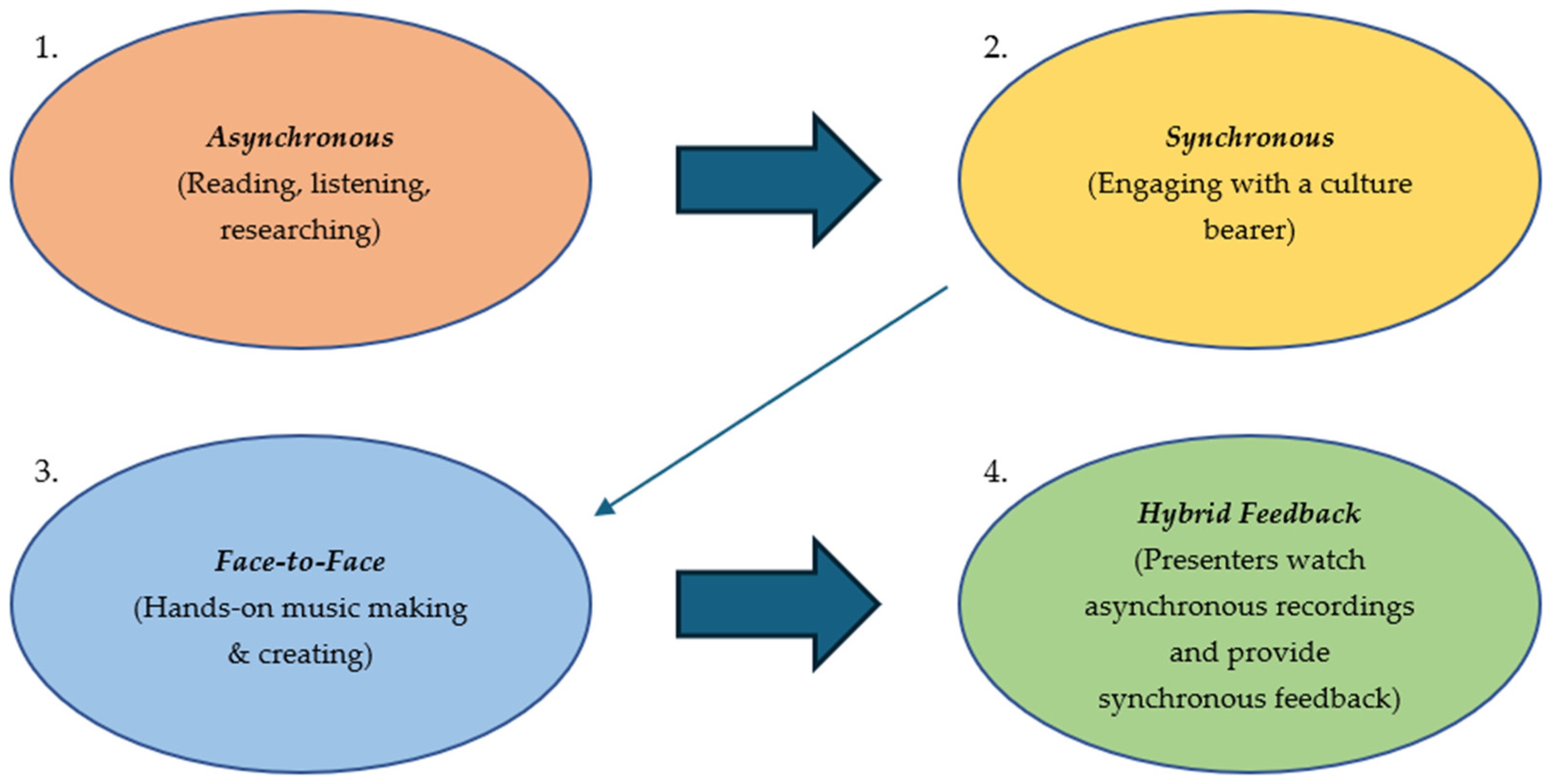
R. Nethsinghe et al., 2023). This model, comprising asynchronous preparation, synchronous engagement with cultural bearers, face-to-face collaborative music-making, and hybrid feedback, provides a scaffolded approach that extends learning beyond the initial intercultural encounter (see
Figure 1). Viewed through the conceptual framework developed in this paper, the Four-Step Flip model provides a practical structure through sustained engagement with cultural bearers. Collaborative partnerships support continuity across the different phases, shared meaning-making develops through participation and dialogue, and educator facilitation helps learners interpret, contextualise, and extend their intercultural musical experiences.
Crucially, it creates space for students to merge unfamiliar cultural perspectives with their own through active music-making, collaboration, and reflection. In doing so, the model supports the development of relational authenticity by enabling students not only to engage with musical traditions but to reinterpret and transform them in contextually meaningful ways.
From a praxial perspective (
Elliott & Silverman, 2015), such processes are essential for developing musical understanding, as they emphasise learning through doing, creating, and participating. In our collaborative experiences, students engaged in re-creating and re-imagining songs introduced by cultural bearers, incorporating elements from their own musical backgrounds while maintaining connections to the original context. For example, intercultural song-learning activities sometimes invited participants to reinterpret songs introduced by cultural bearers through the musical resources and practices with which they were already familiar. In some cases, students explored alternative accompaniments, incorporated instrumental textures associated with their own musical traditions, or adapted performance formats to suit their local educational contexts. For instance, after learning a traditional song introduced by a cultural bearer, some groups chose to retain its melodic structure and cultural narrative while experimenting with alternative accompaniments using instrumental resources that were familiar within their own musical backgrounds. Rather than treating these adaptations as purely creative decisions, the activity became an opportunity to discuss which musical elements could be transformed without undermining the cultural integrity of the piece and which elements carried particular cultural, historical, or symbolic significance. Students were encouraged to justify their artistic choices, compare different interpretations, and reflect on where they perceived the boundary between respectful reinterpretation and cultural appropriation. These processes frequently generated discussion about the boundaries between respectful adaptation and cultural appropriation, encouraging participants to consider which musical elements could be transformed and which carried particular cultural significance. Rather than seeking either exact replication or unrestricted fusion, such activities created opportunities to negotiate how cultural continuity, creative reinterpretation, and ethical responsibility might coexist within intercultural music-making.
These processes of hybridisation and reinterpretation should therefore not be understood as a loss of authenticity, but as expressions of relational authenticity in practice: moments in which students actively negotiate meaning across cultural boundaries. In line with a World Music Pedagogy perspective (
Campbell, 2018), meaningful engagement with music from diverse cultures involves not only attentive and engaged listening, but also enactive participation and creative extension, where learners can reinterpret and transform musical material in ways that are contextually meaningful while still acknowledging its cultural origins. From this standpoint, students’ reworking of musical practices can be understood as a form of respectful and situated engagement, in which musical understanding is deepened through processes of participation, reinterpretation, and cultural dialogue.
Looking forward, this highlights the importance of designing intercultural music education not as a series of isolated encounters, but as a sustained pedagogical process that supports the transition from exposure to understanding, and from understanding to transformation. Educators play a crucial role in helping students navigate cultural complexity, engage critically with difference, and develop culturally responsive practices for their future classrooms. For example, when technological constraints limited students’ engagement with online cultural resources, we restructured the task to include guided listening, contextual scaffolding, and paired reflective dialogue, thereby reducing the risk of superficial or tokenistic engagement with the musical material. It is through this sustained process that relational authenticity can emerge as a guiding principle for culturally responsive music education.
5. Concluding Reflections: Towards Transformative Intercultural Music Education
This CAE has sought not only to document experiences but to contribute to meaningful changes within ITE and broader educational contexts. As a methodological approach, CAE enables the articulation of situated, reflexive, and dialogic knowledge that can challenge taken-for-granted assumptions and open new possibilities for pedagogical transformation (
Lapadat, 2017). In this sense, our work is grounded in the belief that critically examining our own practices can inform more ethically and pedagogically responsive approaches to intercultural music education.
At the same time, we acknowledge the contextual nature of this work. Our reflections are situated between two educators working across two institutional settings and multiple cohorts over time. As with other collaborative autoethnographic accounts, the perspectives presented here are necessarily partial and shaped by the authors’ particular professional, cultural, and educational experiences. While collaborative dialogue and reflexive analysis helped us interrogate and challenge our individual assumptions throughout the research process, the framework inevitably reflects our own interpretive lenses and researcher subjectivities. Therefore, it should be understood as a situated and context-dependent conceptual contribution rather than a universally applicable model. Furthermore, while the framework developed in this paper has been informed by a broader programme of intercultural teaching and research, it does not incorporate direct participant perspectives within the present manuscript. While the scale of this work does not allow for generalisation in a traditional empirical sense, it offers a rich and theoretically informed account of sustained intercultural engagement in music teacher education. Accordingly, rather than claiming generalisability, we encourage readers to consider the transferability of the framework in relation to their own educational, cultural, and institutional contexts.
Importantly, while we propose relational authenticity, mediated pedagogies, and collaborative partnerships as a conceptual framework, we also recognise that these are not frictionless or fully resolved practices. Our approach remains shaped by ongoing tensions that cannot be fully eliminated but must instead be worked through pedagogically. For instance, the role of the educator as mediator risks recentering authority in ways that may unintentionally reproduce hierarchical knowledge structures, even while seeking to decentre them. Similarly, processes of “translation” and “translanguaging” can enhance accessibility, but may also involve loss, simplification, or reinterpretation of culturally specific meanings in ways that are not always recoverable.
However, mitigating these risks requires educators to approach translation and translanguaging not as processes of replacing one linguistic expression with another, but as opportunities for negotiated interpretation. In practice, this involves situating translated terms, musical concepts, and cultural expressions within their broader historical, social, and performative contexts rather than presenting simplified equivalents as complete representations of meaning. Such approaches may involve drawing on multiple sources of knowledge, including narratives from culture bearers, contextual explanations, and student interpretations, while creating opportunities for dialogue about how meanings shift across cultural settings. Where culturally specific concepts lack direct linguistic equivalents, acknowledging ambiguity and exploring the limits of translation can become an important pedagogical strategy rather than a problem to be resolved.
Within tertiary music education, this also requires making mediation itself visible as part of the learning process. Rather than positioning the educator’s interpretation as authoritative, educators can invite students to examine how meanings are constructed, whose perspectives are foregrounded, and what may be transformed through processes of adaptation. Such approaches do not eliminate the possibility of misunderstanding or simplification; however, they create more reflexive spaces in which cultural meanings are explored collaboratively and where students develop greater awareness of the ethical responsibilities involved in representing musical practices beyond their original contexts.
Likewise, collaborative partnerships across unequal institutional, linguistic, and geopolitical contexts are not neutral; they are shaped by asymmetries in resources, academic capital, and cultural legitimacy. These conditions raise ongoing ethical questions about who gets to define authenticity, how cultural knowledge is validated, and what forms of transformation are considered legitimate within educational settings. Rather than resolving these tensions, we view them as constitutive of intercultural music education itself. In this sense, relational authenticity is not a stable outcome but a continually negotiated and sometimes contested process, requiring sustained reflexivity and critical attentiveness from both educators and learners.
As such, this paper contributes to ongoing debates by foregrounding practice-based insights that illuminate how culturally responsive music education can foster inclusion, belonging, and critical awareness in increasingly diverse educational contexts (
Gay, 2018;
Ladson-Billings, 1995). Building on the reflections presented throughout this paper, we propose a conceptual framework for intercultural music education in initial teacher education grounded in three interrelated dimensions. First, collaborative partnerships provide the conditions for culturally responsive teaching by creating opportunities for dialogue, reciprocity, and shared meaning-making across cultural and geographical boundaries (
Banks, 2009). Second, relational authenticity reframes authenticity as a dynamic and co-constructed process that emerges through interaction, mediation, and context-sensitive engagement rather than through fixed notions of cultural ownership or representation (
Campbell, 2018;
Hess, 2019). Third, educators play a crucial mediating role in sustaining intercultural learning by supporting learners in interpreting, revisiting, and transforming intercultural experiences in ways that are pedagogically meaningful and ethically informed (
Bourke, 2014).
Together, these principles offer a conceptual framework that extends existing approaches to intercultural music education by shifting the focus from representation and individual competence towards relational engagement, educator mediation, and sustained pedagogical processes. Rather than presenting these dimensions as separate pedagogical strategies, we conceptualise them as interdependent mechanisms through which intercultural learning is negotiated, contextualised, and sustained over time.
Looking forward, there is significant scope for extending this work across disciplines and contexts. Future research might explore how similar approaches are enacted within other areas of the arts education as well as in different cultural and institutional settings. Further inquiry could also examine the impact of intercultural arts practices in fostering social cohesion, inclusion, and a sense of belonging in higher education and beyond (
Burnard et al., 2018).
We also advocate for sustained critical engagement among educators, researchers, and practitioners across diverse educational and professional contexts. Such engagement is essential for interrogating the complex relationships between music, culture, and pedagogy, and for developing pedagogical and curricular frameworks that are responsive to contemporary realities (
Ajani, 2024;
Westerlund et al., 2017). Through collaborative dialogue, there is potential to co-construct new forms of knowledge, strengthen international networks, and challenge dominant discourses and reductive understandings of cultural difference.
In this paper, we have argued for a reconceptualisation of intercultural music education as a relational, dialogic, and ethically grounded practice. By drawing on sustained collaborative experiences and foregrounding concepts such as relational authenticity, cultural mediation, and collaborative praxis, we seek to contribute to more nuanced and transformative approaches to teacher education.
In a world marked by complexity and change, music continues to remind us of its unique capacity to bring people together, foster understanding, and inspire meaningful transformation. These intercultural encounters, when carefully mediated, critically engaged, and pedagogically sustained, generate new possibilities for teaching while fostering positive coexistence among learners.