Article

Mathematics for the Arts and the Arts for Mathematics: Promoting Soft Skills Through the STEAM Approach in Early Childhood Education

1
Department of Subject Specific Didactics, Universitat de Girona, 17004 Girona, Spain
2
Department of Applied Didactics, Universidade de Santiago de Compostela, 15782 Santiago de Compostela, Spain
*
Author to whom correspondence should be addressed.
Educ. Sci. 2026, 16(8), 1207; https://doi.org/10.3390/educsci16081207
Submission received: 10 June 2026 / Revised: 10 July 2026 / Accepted: 13 July 2026 / Published: 29 July 2026
(This article belongs to the Special Issue Bridging Mathematics and the Arts: Interdisciplinary Approaches)

Abstract

This article links Mathematics and the Arts through the STEAM approach to highlight the potential of this interdisciplinary approach in early childhood education. From this perspective, the aim is to present the design and implementation of the STEAM activity, We Build Trees with Cuisenaire Rods, and to analyse how soft skills are promoted within a group of 18 five-year-old pupils. Using the Thick Description approach and an analytical model, it has been identified that: (1) Mathematics and the Arts maintained an ongoing dialogue throughout the sequence of seven tasks included in the STEAM activity; (2) the STEAM activity contributed to the development of soft skills such as critical and creative thinking, problem-solving, collaboration and teamwork, technological and digital literacy, curiosity and autonomy, and design and design thinking. We conclude that, from the interdisciplinary STEAM perspective, the Arts are not an instrumental discipline serving Mathematics, nor is Mathematics merely a setting for working on art; rather, both disciplines enrich one another to promote soft skills in early years education.

1. Introduction

Early years education curricula in most countries promote interdisciplinarity in one way or another through various organisational structures (Alsina et al., 2025). On the one hand, some curricula are organised around areas related to children’s experience and development: personal knowledge and autonomy, understanding of the environment, etc. These areas are addressed through learning proposals that are meaningful and relevant to children (e.g., Spain, Portugal, or most Latin American countries). On the other hand, other curricula are structured around key areas of learning: language and literacy, numeracy skills, aesthetics and creative expression, etc. These key areas aim to foster balanced development through an integrated learning approach, enabling children to establish meaningful connections between their learning experiences and real life (e.g., Australia, the United States, or Singapore). In addition, some of these curricula explicitly refer to the integrated STEM approach (Science, Technology, Engineering and Mathematics) or STEAM (including the A for the Arts and Humanities) to emphasise an interdisciplinary pedagogical approach (García-Fuentes et al., 2022).
This article adopts the integrated STEAM approach by enabling the development of a range of 21st-century soft skills (soft skills), such as critical thinking, creativity, and complex problem-solving. In addition, it promotes other skills such as active learning, as students participate in real-world projects, transforming memorisation into experiential learning; collaboration and communication, as it fosters teamwork and the ability to communicate ideas effectively; innovation and design, as the inclusion of the arts enhances lateral thinking and design thinking, allowing technology not only to be used but also to be understood and questioned; and inclusion, as it seeks to engage diverse groups, such as girls and minorities, in traditionally technical fields (Rodrigues-Silva & Alsina, 2023a). From this perspective, Alsina (2022) focuses on promoting STEAM literacy for all students as a value. This has the fourfold purpose of: (1) providing them with tools that enable them to identify and apply both key knowledge and ways of doing, thinking, speaking, and feeling in Science, Engineering, Technology, the Arts, and Mathematics, in a more or less integrated manner; (2) enabling them to understand, decide, and/or act in the face of complex problems; (3) enabling them to construct creative and innovative solutions, making use of personal synergies and available technologies; and (4) encouraging critical, reflective thinking grounded in values.
However, many early years education teachers have not received solid training, either conceptually or pedagogically, in the STEAM approach. As a result, although contemporary curriculum guidelines promote the integration of knowledge and interdisciplinarity, embedding this approach in classroom practice remains a challenge, as evidenced by various literature reviews (Ata Aktürk & Demircan, 2017; DeJarnette, 2018; Rodrigues-Silva & Alsina, 2023b; Su et al., 2025; Wahyuningsih et al., 2020).
One of the major challenges faced by teachers is that the integration of disciplines does not sufficiently consider the “A” in STEAM, thereby excluding the contributions of the Arts and Humanities (Ata Aktürk & Demircan, 2017; DeJarnette, 2018). This reflects, on the one hand, the still ongoing debate in the literature between STEM and STEAM (Rodrigues-Silva & Alsina, 2023b) and, on the other, the fact that some early years education curricula refer exclusively to the STEM approach—without considering the Arts and Humanities—as is the case in Spain (Alsina & Salgado, 2025).
However, some authors argue that the Arts and Humanities can contribute to the development of a range of soft skills (DeJarnette, 2018). Therefore, this article addresses the following research question: what soft skills are promoted during the implementation of a STEAM activity in an early years education classroom? To answer this question, and in line with other recent studies that provide guidance and strategies for implementing the STEAM approach in early years education (Alsina & Salgado, 2025; Zamalloa et al., 2025), the aims of this article are: (1) to design and implement a STEAM activity consisting of a sequence of tasks that primarily integrate the Arts and Mathematics, alongside science and technology; and (2) to analyse the soft skills that are activated during the implementation of the tasks.

2. Theoretical Framework

Given the focus of the study, on the one hand, an analysis is carried out of the STEAM approach and the progressive integration of the arts into early years education; and, on the other hand, soft skills are linked to this educational stage.

2.1. From STEM to STEAM in Early Years Education: Challenges and Opportunities from the Inclusion of the Arts

STEM originally emerged as a policy-driven initiative with economic and military objectives. Some authors, for example, associate the origins of STEM with the historical milestone of the launch of the Sputnik satellite by the Soviet Union in 1957, the first human-made object to orbit a celestial body, the Earth. In the context of the highly significant and polarised political landscape of the Cold War, this scientific achievement resonated internationally and prompted a response from the United States: an urgent focus on training innovative professionals capable of achieving the country’s desired technological and economic superiority (Zollman, 2012). It was not until the 1990s that the acronym STEM was formally established by the National Science Foundation (NSF) to refer to the fields of Science, Technology, Engineering, and Mathematics. From that point onwards, it was progressively introduced into education to break down subject boundaries and promote teaching through real-world problem solving (Rodrigues-Silva & Alsina, 2023a, 2023b).
In 2007, during the Americans for the Arts–National Policy Roundtable, STEAM education emerged as a new pedagogy “to help counter the increasing emphasis on STEM subjects and the decline of arts education in the United States over the previous decade” (Perignat & Katz-Buonincontro, 2019, p. 32). However, although the incorporation and interpretation of the meaning of the “A” have not yet been theoretically agreed upon, it is increasingly accepted that STEAM represents a broader interdisciplinary approach that includes the Arts and Humanities (Lin & Tsai, 2021).
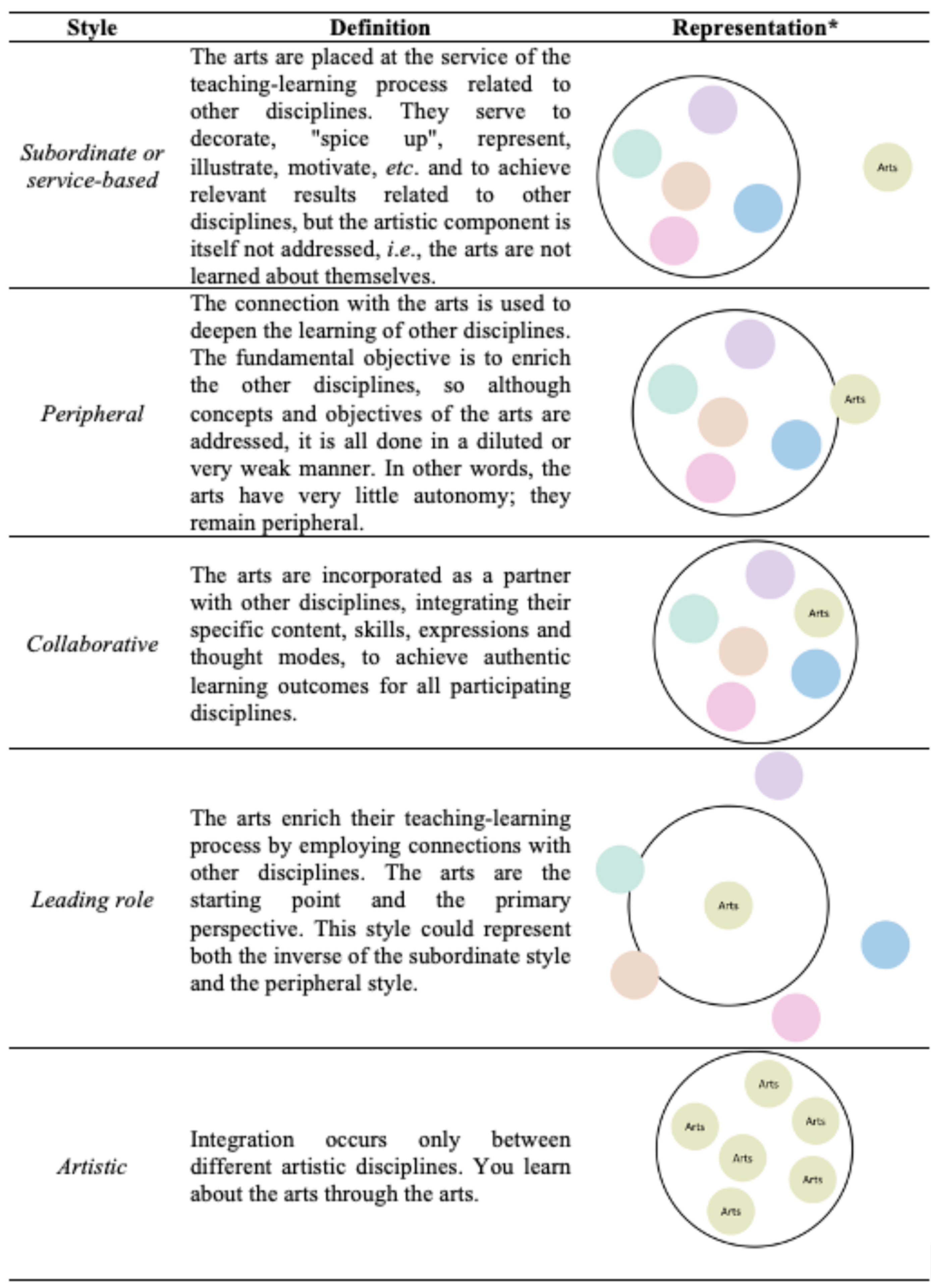
The inclusion of the “A” in the STEAM acronym therefore reflects a response to the need to foster a deeper and more holistic understanding of the world among students, in line with current societal demands. However, this integration has generated several challenges, highlighting that both the undervaluation of the Arts and their instrumentalization are the main factors hindering integration. It should also be noted that this situation is further influenced by insufficient teacher training (especially in the early stages of schooling) and limited research on the assessment of arts-based learning (DeJarnette, 2018). From this perspective, Sanz-Camarero et al. (2025) define five styles of arts integration based on the prominence of the arts in education: Subordinated (arts as a tool), Peripheral (marginal arts presence), Collaborative (interdisciplinary partnership), Leading Role (arts as central), and Artistic (education as artistic inquiry). These styles classify how artistic elements are incorporated into curricular content, ranging from peripheral inclusion to fully integrated artistic processes (Figure 1).
In school practice, when the Arts are included in integrated approaches or models, they often appear subordinated to other disciplines, stripped of their own disciplinary content and considered only in terms of the contribution they make to the learning of other subjects or the motivation they may provide for such learning. Considering this instrumentalization, findings such as the frequent use of drawing and painting as the most common artistic disciplines in integration proposals can be understood, precisely because their popularity makes them the most technically accessible resource for “decorating” learning (Sanz Camarero, 2023).
In response to these challenges, DeJarnette (2018) notes that educators play an essential role as agents of change by designing and implementing approaches that demonstrate how the integration of the Arts not only enriches other disciplines, but also that learning in the Arts enriches education in a balanced and diverse way. From this perspective, she argues that a genuine integration of the Arts with other disciplines, without undervaluing any of them, already from early years education, has the potential to bring about a cultural shift in the way we approach problems and construct knowledge. Recognising and making the most of the qualities and perspectives that the Arts bring to education is essential in this process.

2.2. Introducing Soft Skills into 21st-Century Early Years Education

Soft skills are defined in early years education as a set of socio-emotional abilities, personality traits and executive functions that are essential for interacting with one’s environment and for self-regulating one’s own learning (Rafiq-uz-Zaman, 2025). In the current literature, these skills transcend the traditional division between the cognitive and the non-cognitive; they are conceptualised as dynamic and flexible structures that predict academic success and social adaptability from the earliest years of life (Dimitrova, 2018; Laureta, 2018).
Within the STEAM approach, soft skills act as the integrating core that unifies traditionally isolated disciplines. When working within this interdisciplinary model in early childhood, children do not passively acquire technical concepts. On the contrary, authors such as Perales and Aróstegui (2024) highlight that the STEAM approach at an early age generates markedly positive effects on creativity, scientific thinking and socio-emotional development, transforming the classroom into a space for inquiry and active play.
From this perspective, the success of this technical framework does not depend solely on the mastery of hard sciences, but on its synergy with soft skills. Skills such as critical thinking, assertive communication, empathy and teamwork act as essential catalysts for innovation, as they promote scientific co-design and the joint resolution of contemporary issues (Spyropoulou et al., 2025).
For our study, a specific set of six soft skills has been selected; this choice is based strictly on the developmental milestones of early childhood (3 to 6 years) and the demands of interdisciplinary tasks (Álvarez et al., 2025; Ata Aktürk & Demircan, 2017; Berman, 2023; DeJarnette, 2018; Johnston et al., 2022; Luen et al., 2024; Rodrigues-Silva & Alsina, 2023a, 2023b; Su et al., 2025; Veziroglu-Celik et al., 2025; Wahyuningsih et al., 2020): critical and creative thinking; problem-solving; collaboration and teamwork; technological and digital literacy; curiosity and autonomy; design and design thinking. These six soft skills have been organised into three perspectives: cognitive and problem-solving, relational and intrapersonal.
From a cognitive and problem-solving perspective, Lupión-Cobos et al. (2026) point out that the combination of critical and creative thinking is directly stimulated. Scientific inquiry tasks and the analysis of basic mathematical relationships require young pupils to formulate rudimentary hypotheses, sequence actions and compare visual or physical evidence, thereby laying the foundations for elementary analytical reasoning. At the same time, the explicit inclusion of the artistic component (Arts) lends the process essential flexibility; art serves as a means of expression, personalisation and original creation that transforms science into something meaningful for pupils (Spyropoulou et al., 2025). When faced with STEAM design tasks, such as building a physical structure, pupils engage problem-solving skills by trying out various strategies, correcting themselves in the face of physical errors and playfully restructuring their existing mental models (Luen et al., 2024).
From a relational perspective, the STEAM approach requires high levels of collaboration and teamwork (Berman, 2023). Through teacher guidance and corner or project-based work, early years pupils learn to coordinate their motor skills, negotiate the use of manipulatives and articulate shared ideas through spoken and gestural language (Veziroglu-Celik et al., 2025). This interaction is qualitatively enriched by incorporating technological and digital literacy, which at these early ages should move away from passive screen use. Technology in early childhood education takes on pedagogical significance when it translates into the instrumental use of tangible devices that facilitate the interactive co-construction of knowledge and introduce pupils to the technological languages of the 21st century in an ethical and safe manner (Johnston et al., 2022).
Furthermore, from an intrapersonal perspective, STEAM activities foster curiosity and autonomy. Regarding curiosity, Roussou et al. (2025) demonstrate that teachers draw on biological, physical or aesthetic phenomena in the environment as a catalyst for instructional design. Furthermore, by engaging in challenges based on direct experimentation, children progressively develop autonomy: for example, in emotional self-regulation when faced with frustration if a design fails, proactivity in making independent decisions whilst carrying out experiments, and the agency they assume over their own learning process through structured free play (Ba Akhlagh et al., 2026).
Finally, Álvarez et al. (2025) point out that the practical integration of the Arts, Science, Mathematics and Technology is best achieved within the methodological framework of design and design thinking. Although adapted to the developmental capabilities of young children, design thinking promotes an iterative cycle that begins with empathy towards a specific need, continues with visual ideation and culminates in the creation of meaningful physical prototypes. In this context, artistic practices cease to be merely superficial decorative elements and become tools for scientific representation and engineering (Johnston et al., 2022). In this way, design thinking acts as the integrating link that simultaneously mobilises critical thinking, technological skills, social collaboration and creative expression in the resolution of a single meaningful challenge.
These skills are directly linked to the two fundamental objectives of this research: on the one hand, the planned sequence of tasks requires the explicit integration of the Arts and Mathematics alongside science and technology. To successfully complete this learning circuit, the children are required to draw on their curiosity and autonomy when selecting materials. At the same time, they make their first steps in technological and digital literacy and design thinking to bring their physical and virtual ideas to life and communicate them; on the other hand, the tasks in the sequence serve as the ideal experimental setting for gathering empirical data. By proposing open-ended challenges that lack a single correct answer, situations of cognitive conflict and material obstacles arise. These critical milestones allow us to observe and record in real time the unfolding of critical and creative thinking, the children’s problem-solving strategies in the face of design failures, and the internal dynamics of collaboration and teamwork that pre-primary pupils show when sharing common goals.

3. Materials and Methods

A qualitative methodology was adopted under a descriptive approach (McMillan & Schumacher, 2001), as it was necessary to examine soft skills within an activity consisting of a sequence of tasks implemented in a classroom of Spanish five-year-old children. The activity, entitled “We Build Trees with Cuisenaire Rods”, was designed within a STEAM framework. In this setting, the sequence of tasks was designed based on the observation of trees and knowledge of Cuisenaire rods.

3.1. Sample

The STEAM activity was implemented by the class teacher with a group of 18 Spanish five-year-old children. This class group is enrolled in a public early childhood and primary education school located in Galicia. The profile of this group is characterised by a strong continuity in their educational pathway, as almost all participants, except for two pupils, were continuously enrolled in the same school and with the same class teacher since the age of three. This prior relationship fostered the climate of trust necessary for the observation. The teacher acted as a researcher-designer, taking responsibility for adapting the STEAM sequence to the specific classroom context, based on her prior observation of the pupils’ interests in the natural environment. During the implementation, her role was that of a facilitator and mediator, posing guiding questions to encourage reflection without directing the answers.
In terms of diversity, the group includes one pupil with special educational needs associated with Autism Spectrum Disorder (ASD). This classroom context makes the proposal an ideal setting for the application of the STEAM approach, since, as noted in the theoretical framework, one of the key strengths of this integrated approach is the promotion of inclusion in education and the participation of diverse groups. From this perspective, the principles of inclusive mathematics education based on equity have been considered, providing the necessary support to ensure that every pupil succeeds (National Council of Teachers of Mathematics [NCTM], 2014).
At the methodological and organisational level, the classroom is arranged into learning corners, and pupils are usually taught in grouped arrangements. It is also important to note that the pupils were already familiar with, and had previously worked with, hands-on mathematical materials before this sequence. This prior familiarity represents a significant advantage for the development of the second phase of the teaching sequence, in which the challenge of “building” the observed trees using Cuisenaire rods is proposed.

3.2. Design of the STEAM Activity

Considering the first objective of the study, the STEAM activity has been designed with reference to the framework for integrating the Arts proposed by Sanz-Camarero et al. (2025). Specifically, the design is based on the collaborative approach (interdisciplinary partnership), which is an approach in which the Arts and other STEAM disciplines are linked on an equal level. From this perspective, the Arts do not merely serve as auxiliary tools for teaching Mathematics, Science or Technology, but rather connect real concepts and objectives between the two fields. In this way, the Arts and non-artistic subjects mutually enrich one another in the teaching-learning process to promote a deep understanding of reality, overcoming the traditional compartmentalisation of teaching.
Table 1 presents the structured design of the STEAM activity, broken down into phases and tasks. Specifically, it provides a description of the seven tasks carried out by the pupils and explicitly identifies how the different disciplines of the STEAM approach are integrated. Specifically, the activity has been designed in a realistic context focused on integrating the Arts and Mathematics, while also introducing science and technology.
The STEAM activity was carried out over a period of one and a half weeks. Each session lasted approximately 30–40 min, except for the first and final sessions (assemblies), which lasted 50–60 min.

3.3. Data Analysis

In order to record the intervention and all the data necessary for a detailed analysis of the interactions, various qualitative recording tools were used during the implementation:
-
Video recordings: full recordings of the seven tasks (approximately 5 h of footage), made by the teacher, providing a detailed record of the dialogues and processes.
-
Visual records: photographs documenting both the exploration process in the playground and the final products.
-
Pupils’ work: individual record sheets containing the children’s graphical representations and numerical calculations.
-
Transcripts: key dialogues from the videos were transcribed in full by the authors to accurately identify the emergence of soft skills.
Based on these data, soft skills within the STEAM activity were analysed considering the Thick Description approach (Geertz, 1973) and the analytical model proposed by Powell et al. (2003). On the one hand, the Thick Description approach is a qualitative research method that involves explaining not only human behaviour, but also its precise cultural context, so that such behaviour is meaningful to someone outside that culture. Specifically, this approach has four characteristics: (1) Deep contextualization, describes the setting, the participants and social interactions in as much detail as possible; (2) Search for intentionality, seeks to capture the meaning behind every action or word; (3) Dual perspective, analyzes reality by combining the community’s internal view with the researcher’s interpretation; (4) Interpretative analysis, is not limited to collecting statistical data; it seeks to unravelling structures of meaning. On the other hand, the analytical model proposed by Powell et al. (2003) is structured into seven stages: (a) purposeful viewing; (b) description of video data; (c) identification of critical events; (d) transcription; (e) coding; (f) construction of the argument; and (g) narrative composition. These interactive and non-linear stages made it possible to examine the soft skills developed by early childhood education students.
According to this, during the first three stages, the video recordings were viewed repeatedly and segmented into five-minute intervals. Based on this, a record was created with time stamps and brief descriptions of specific episodes considered relevant to the study (critical events). Once an overview of the implementation of the STEAM activity in the classroom had been obtained, the process continued with the transcription and coding of the critical events, with the aim of examining in depth the manifestations of social skills throughout all phases of the activity.
A deductive approach was used in the coding phase, applying a categorisation system to analyse the initial presence of soft skills in the pupils’ actions, based on the dimensions described in the theoretical framework (Álvarez et al., 2025; Ata Aktürk & Demircan, 2017; Berman, 2023; DeJarnette, 2018; Johnston et al., 2022; Luen et al., 2024; Rodrigues-Silva & Alsina, 2023a, 2023b; Su et al., 2025; Veziroglu-Celik et al., 2025; Wahyuningsih et al., 2020): cognitive (critical and creative thinking; problem-solving); relational (collaboration and teamwork; technological and digital literacy); and intrapersonal (curiosity and autonomy); along with design skills and design thinking (Table 2):

3.4. Ethical Considerations

This study was conducted in accordance with international ethical protocols for research involving children. Written informed consent was obtained from the parents or legal guardians of the 18 participating children, authorising both their participation in the STEAM activity and the recording of images and videos for research purposes. To ensure anonymity and confidentiality, pseudonyms or initials (e.g., Boy D, Girl N) were used in all transcripts and subsequent data analyses, in compliance with current data protection regulations.

4. Results

In accordance with the objectives of the study, first, the design and implementation of the STEAM activity “We Build Trees with Cuisenaire Rods” is described, in which the Arts and Mathematics are primarily integrated alongside science and technology; and second, the presence of the soft skills activated during the implementation of the tasks is analysed.

4.1. Implementation of the STEAM Activity

The implementation of the activity is presented below, following the phases outlined in Table 1.

4.1.1. Phase 0: Introduction

To contextualise the STEAM activity, the teacher first initiates a classroom discussion with the whole group to talk about the children’s prior knowledge of trees (what types of trees they know, what they are like, what characteristics they have, etc.):
Teacher: Today we are going to think about the trees we see every day in the park or in the street. What are they like? What parts do they have?
Boy D: They have a very strong trunk! It’s brown, hard, and inside it has wood.
Girl N: And they have very long branches that reach high up. My grandfather has an apple tree and red apples grow on the branches.
Teacher:Apples are so good!
Girl Y:Not all of them have fruit. In the playground we have lots of trees and they don’t have apples or any fruit.
Boy Ma: Now it’s cold and some trees in the park are bare because all the leaves have fallen onto the ground.
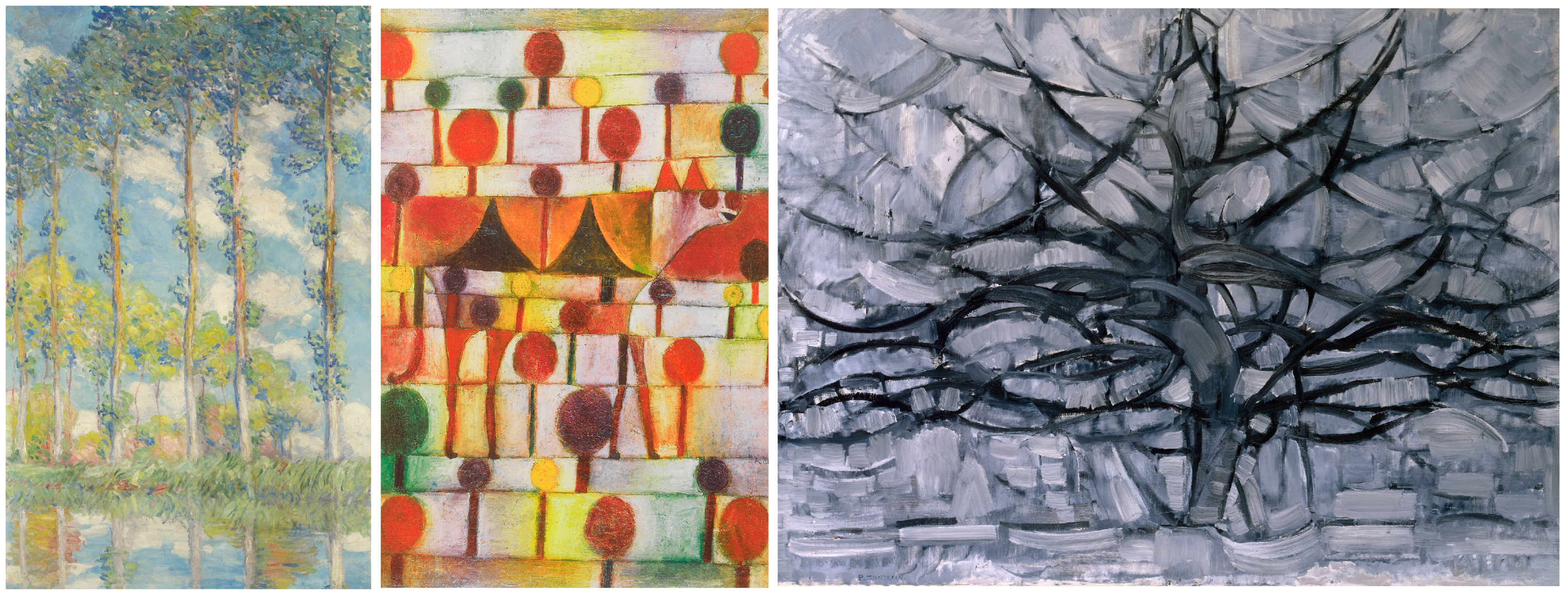
After eliciting the children’s prior knowledge about trees, the teacher proposes viewing images of different types of trees and artistic representations of trees by conducting an Internet search. Figure 2 shows some examples of artistic creations (works by Monet, Klee and Mondrian, respectively).
Teacher: (Shows images of artistic works featuring trees on the digital board).
Look at this painting. Does it look like the trees you know?
Girl L: That tree has magical colours! It has circles instead of normal leaves.
Boy E: And the trunk of that other one isn’t brown, it’s blue and purple! It looks like a tree from a storybook.
Boy Ma:And that one has rainbow branches! That’s the nicest one!
As the transcript above shows, the children observe artistic representations and begin to distinguish nuances, shapes, and textures, identifying which elements are “real” and which are creative interpretations (such as a blue trunk or circles instead of leaves). This also enables them to introduce new concepts (tones, styles, proportions) to explain the differences they notice. In addition, by contrasting similarities and differences, they begin to discover that a tree can be represented in multiple ways without losing its essence. The fact that they accept that a tree can have “unreal” colours also allows them to start developing their ability to accept ideas beyond conventional representations.

4.1.2. Phase 1: Exploration

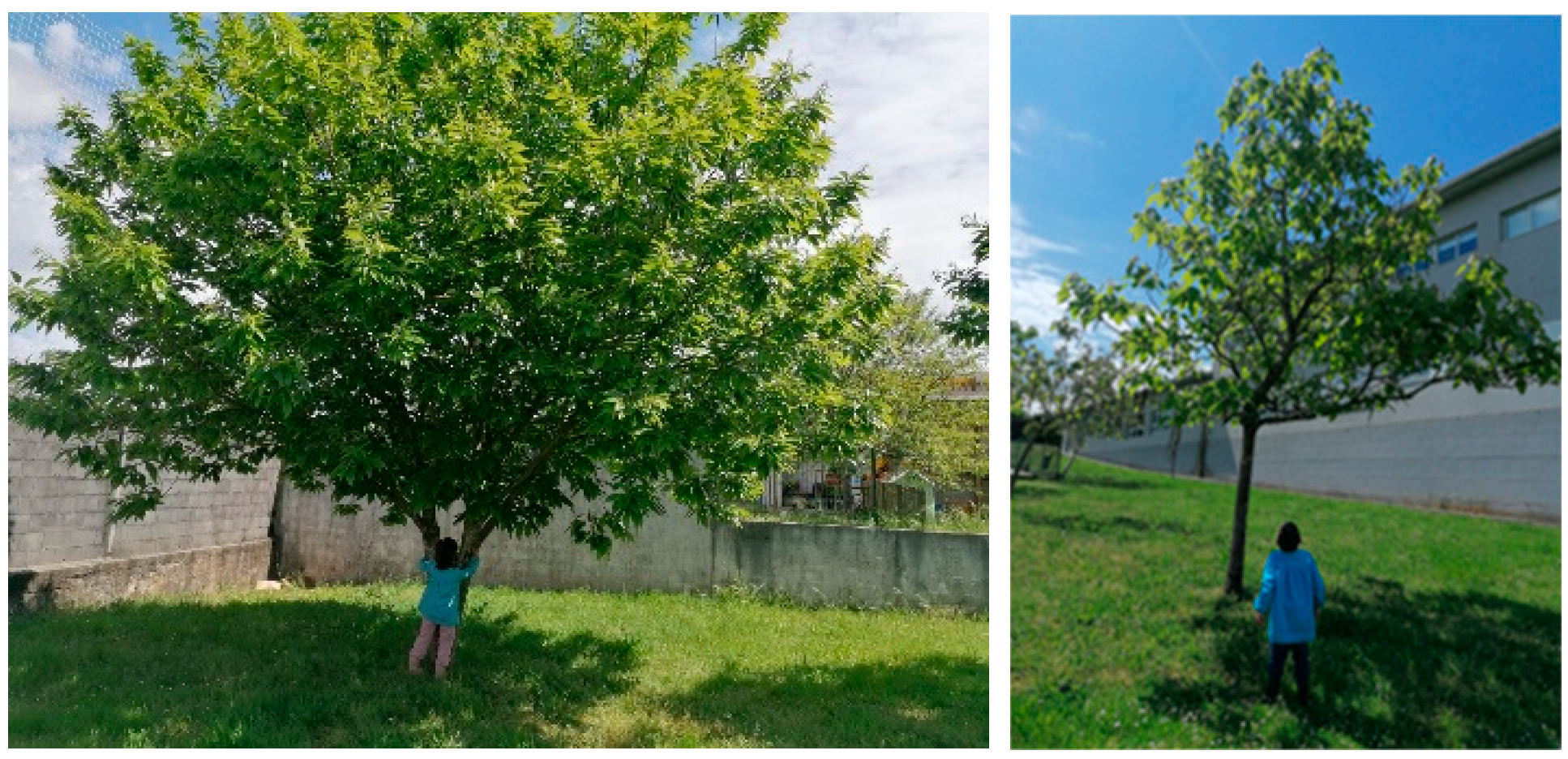
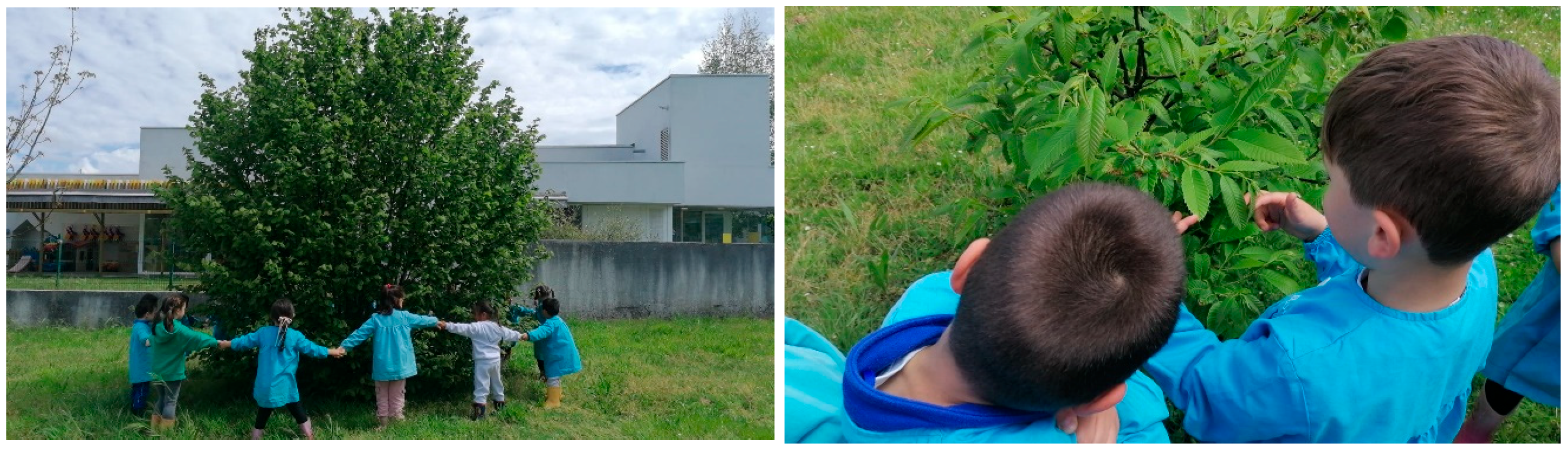
This phase begins with a trip to the school playground to observe the trees in the immediate surroundings (Figure 3).
During the exploration, the group analyzes the most visible characteristics of the trees: height, trunk thickness, presence or absence of leaves, and crown shape, among others, and discusses the differences between them. In addition, the children take photographs to create a visual record that can later be used in the classroom to compare the observations made and enrich collective reflection (Figure 4). During this process, the Arts emerge as the children explore the use of different angles, framing and compositional techniques whilst taking their photographs, enabling them to capture a variety of artistic perspectives rather than merely producing a descriptive record. This initial aesthetic intention fosters a curious and selective eye, whereby the child decides which aspect of the tree they wish to emphasise through the lens. This initial sensory and experiential approach lays the foundation for connecting real-world observation with subsequent mathematical work.

4.1.3. Phase 2: Representation

Building on the experiences from the initial phases, the second phase focuses primarily on representation through a range of tasks: manipulative representation, graphic representation, calculation of the numerical value represented by each tree, and finally, a creative challenge involving equivalences (compositions and decompositions).
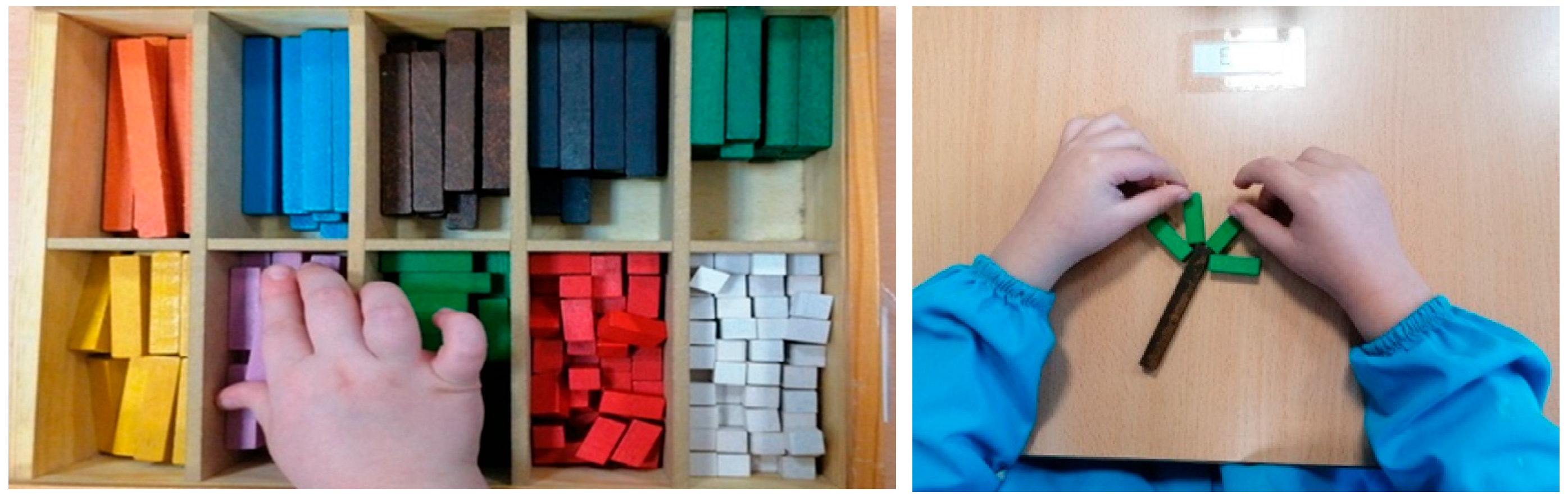
To promote manipulative representation (Task 1 of Phase 2), each child is asked to select a specific set of Cuisenaire rods, with the maximum number limited, and is then given the challenge of “constructing” one of the trees observed using them (Figure 5).
As shown in Figure 5, on the one hand, the task enables each child’s artistic creation to emerge through symbolic expression and creative intention, transforming a mathematical material into a personal visual language. At this stage, it is possible to distinguish between different artistic approaches: a conceptual representation (“I draw the tree in green and brown because I know that’s what trees look like”), a representation based on observation (“I draw the trees using the colours I actually see in the playground”) and a more expressive representation (“I draw the trees according to what I feel or wish to express, beyond what I see”). This distinction is closely linked to the choice of colours of the Cuisenaire rods selected by each child; whilst some might initially tend to use only green and brown rods due to stereotypes, others feel free to explore a wider colour palette to convey their individual vision, thereby imbuing the structure with meaning. And, on the other hand, the task encourages mathematical thinking in terms of proportion, height, and the different parts of the tree, fostering number inclusion and conservation through manipulation.
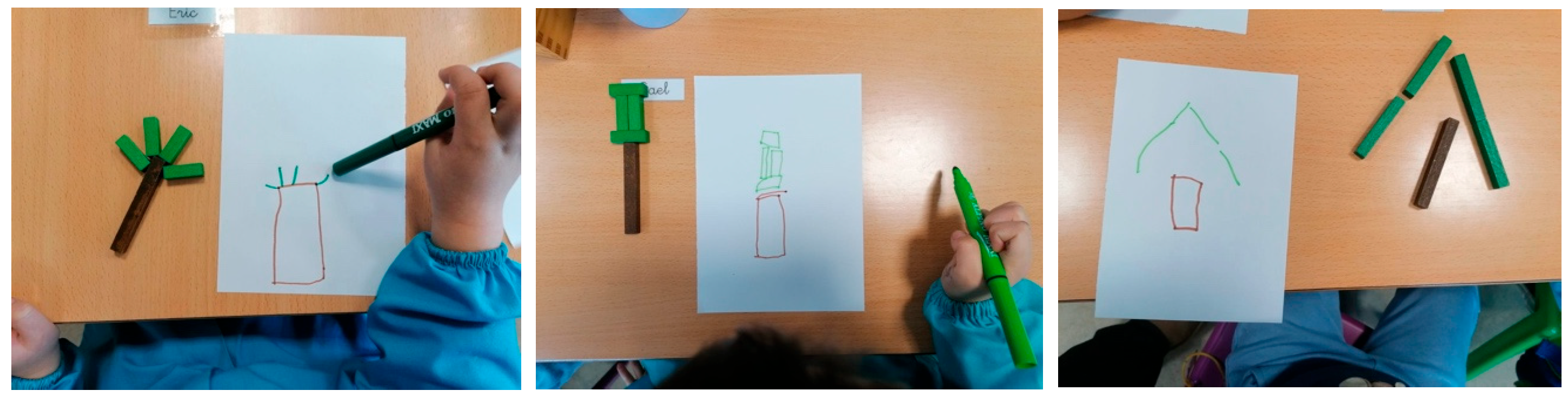
Once the manipulative representation is complete, the activity moves on to graphic representation (Task 2 of Phase 2). On paper, each child draws the tree they constructed using the rods, incorporating details that connect the sensory experience with symbolic representation (Figure 6).
This step consolidates the sequence from the real tree to the model created with rods, and from there to graphic representation. In this way, it reinforces both symbolic expression and creative intention by transforming the Cuisenaire rods into a visual language, as well as the understanding of number using these rods as a tool for describing and structuring reality.
In the following task (Task 3 of Phase 2), each child is asked to observe the tree constructed with Cuisenaire rods and is presented with the question: “What is the value of my tree?” To answer this question, the activity focuses on the numerical value associated with each rod, so that pupils calculate the total by adding together the partial values of each piece used. This process can be carried out in two complementary ways:
-
By comparison with smaller rods, decomposing each piece into equivalent units to understand the part–whole relationship.
-
With the support of a calculator, used as an exploratory tool to introduce the symbolic representation of number and verify the pupils’ hypotheses.
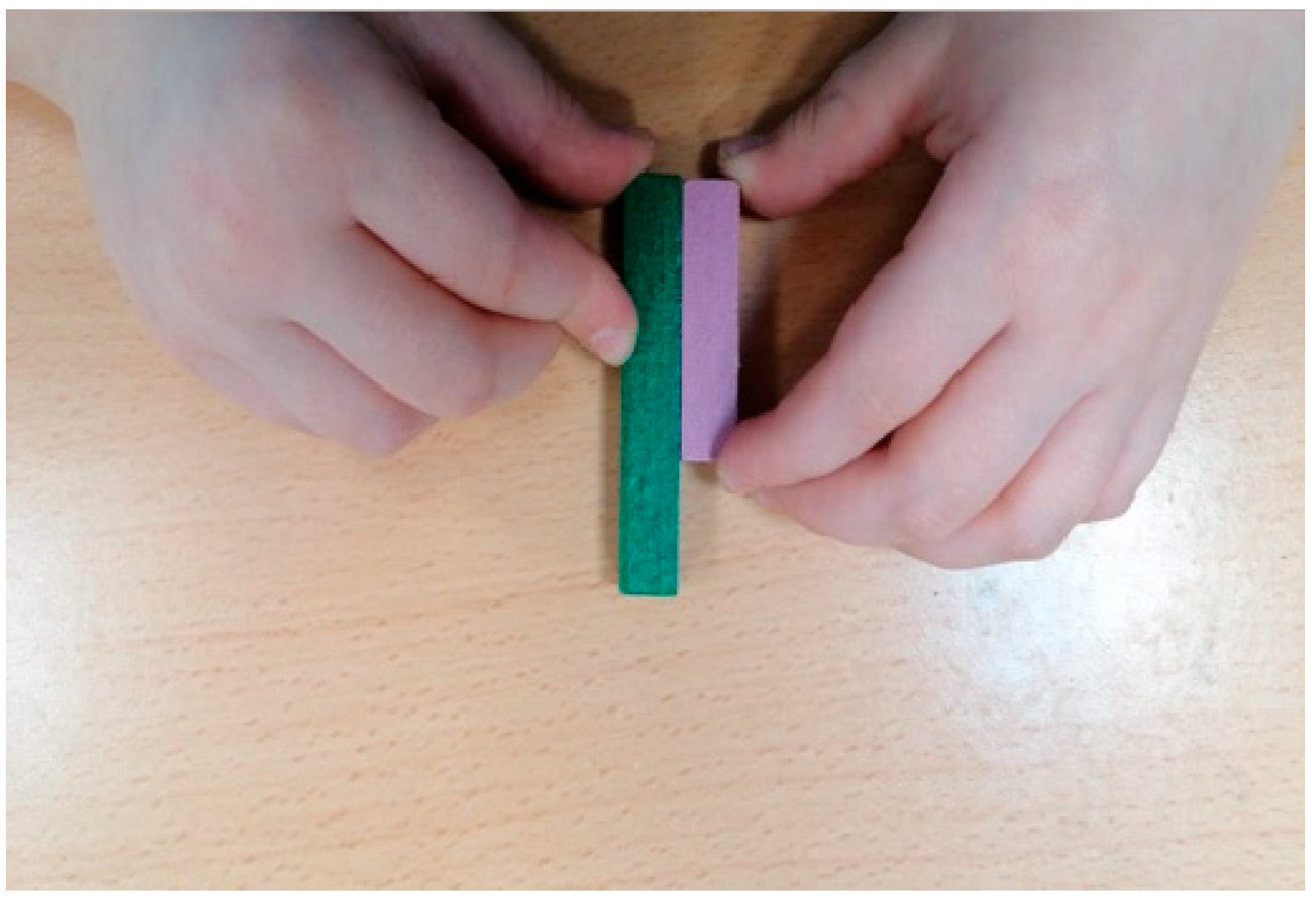
This activity enables a deeper understanding of number inclusion and conservation, as the children observe that some values are contained within others and that the total value remains constant (Figure 7).
In the final task of the second phase, the pupils are presented with a creative and mathematical challenge: to “dress up” their tree. To do this, they must replace each rod used with another rod or combination of rods of equal value, while maintaining the numerical structure of the original tree. This transformation requires them to search for equivalences, decompose numbers, and verify that the total value remains unchanged.
During the process, the children record the changes made on paper, noting the partial values and checking the total either by comparison with smaller rods or by using the calculator once again:
-
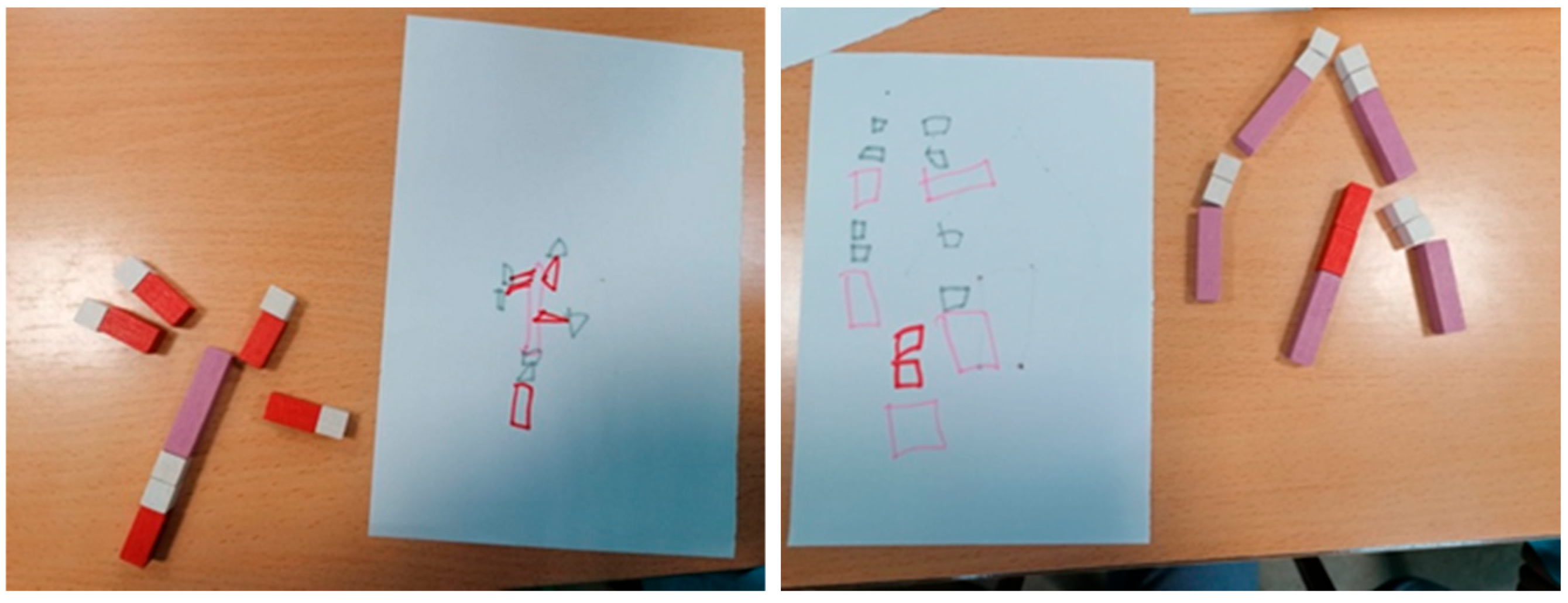
Example A (Figure 8, left): one pupil decomposed the four branches of her tree, initially shown as light green bars (3), then as red and white bars (2 + 1).
-
Example B (Figure 8, right): one pupil replaced the crown made up of two orange rods (each with a value of 10) with a symmetrical arrangement of one pink rod, one white rod, one pink rod, and one white rod (4 + 1 + 4 + 1). In the trunk, he replaced the dark green rod (6) with one pink rod and one red rod (4 + 2), although he later added another red rod by mistake (the teacher intervened to correct the error by asking guiding questions).
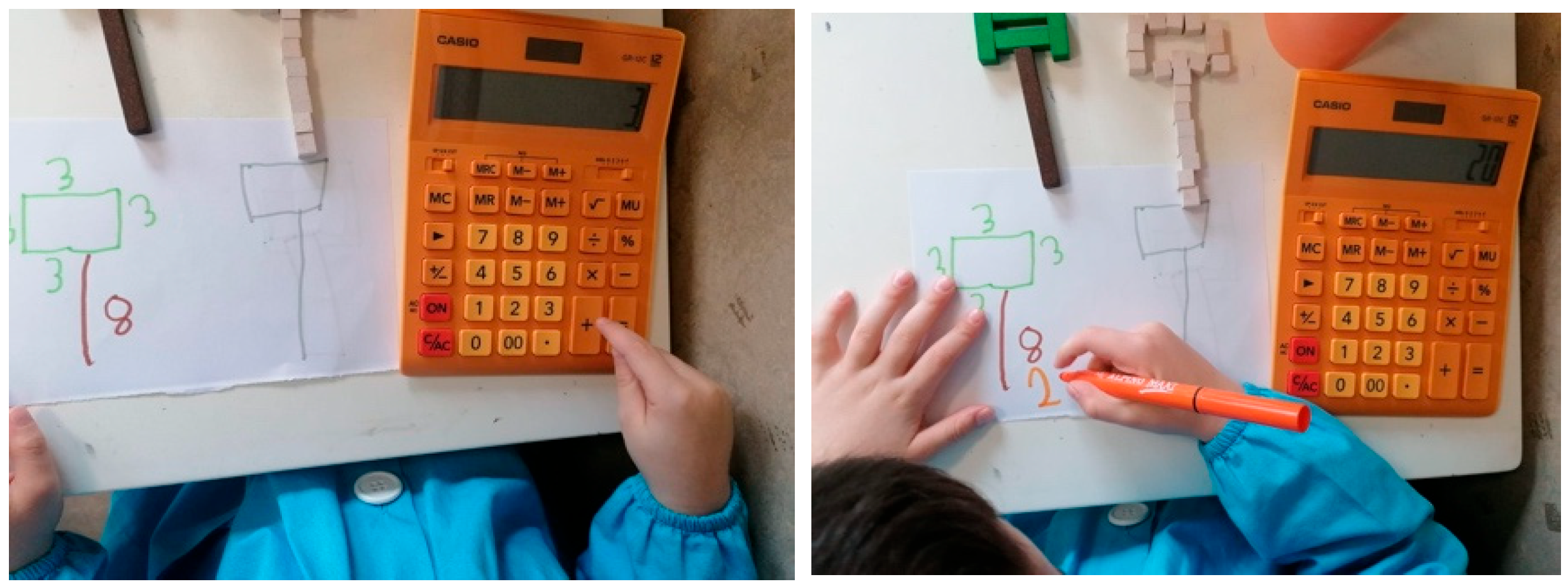
In addition, Figure 9 shows the written record on paper and the use of the calculator, where a child verifies that the sum of the original tree (one brown rod with a value of 8 plus four light green rods with a value of 3) is identical to that of the “dressed up” tree (20 white cubes):
8 + 3 + 3 + 3 + 3 = 20 = 1 + 1 + 1 + 1 + 1 + 1 + 1 + 1 + 1 + 1 + 1 + 1 + 1 + 1 + 1 + 1 + 1 + 1 + 1 + 1
This final task of Phase 2 consolidates the presence of the Arts in the design of the rod-based trees through the symbolic capacity to transform a logical material into a personal representation. As noted, this is expressed through abstraction, in which the child assigns meaning to geometric shapes, and through intuitive aesthetic composition, by playing with colour, balance, and proportion when substituting one rod for another. These elements of visual language—colour, composition and proportion—directly affect the meaning of the image. By replacing rulers of one colour or size with others, the children observe how the overall character of their representation changes, realising that an artistic choice in composition can transform the perception and meaning of their tree. This is not merely a matter of numerical equivalence, but an aesthetic decision in which the visual balance of the new structure conveys a different intention to the original. In essence, the Arts emerge when the child stops seeing numbers and instead projects their inner world and creative intention, turning a technical exercise into a unique visual expression. In addition, it also reinforces the understanding that a number can be represented in multiple ways without losing its identity, strengthening the notion of conservation and flexibility in numerical thinking.

4.1.4. Phase 3: Reflection

The sequence concludes with a whole-class assembly in which each child shares the process they followed: how they observed their tree, how they represented it with rods, how they calculated its value, and how they “dressed it up” while maintaining numerical equivalence.
This space lets them compare strategies, identify similarities and differences, and verbalise the reasoning used. The collective discussion fosters metacognition and helps pupils realise, on the one hand, that “transforming” rods into trees enables children to understand that art is not only about drawing, but also about the ability to look at reality with new eyes and give it a personal form; and, on the other hand, it supports the discovery that numbers are a flexible tool that can be used to describe, transform, and represent reality in multiple ways without losing their meaning.

4.2. Analysis of the Presence of Soft Skills in the STEAM Activity

Based on the implementation of the activity “We Build Trees with Cuisenaire Rods”, the children’s dialogues were analysed to identify how the categories in Table 2 are manifested. Table 3, Table 4, Table 5, Table 6, Table 7 and Table 8 present the evidence identified for each of the six soft skills:

4.2.1. Critical and Creative Thinking

As shown in Table 3, this soft skill is mainly evident in the final task of Phase 2, as the children are required to think beyond conventional approaches when faced with the challenge of “dressing up” their tree. From a mathematical point of view, this requires them to search for equivalences and replace rods without altering the total value.
From an artistic perspective, this substitution promotes a deep understanding of visual rhythm and geometric composition. By replacing a long piece with several short ones, pupils experiment with the fragmentation of form and colour contrast, transforming a uniform block into a dynamic pattern.
Likewise, in the final assembly, critical thinking is activated when pupils compare strategies with their peers, identify differences, and verbalise both the mathematical reasoning and the aesthetic intentions behind their creations (linking numerical play with the use of colour in painting).
Table 3. Critical and creative thinking.
Phase/TaskEvidence
Phase 2.
Creative challenge and equivalences by replacing the original rods with equivalent ones while maintaining the same total value.
Boy M: I’m going to dress up my trunk! I had the long brown rod that’s worth 8, and I’m replacing it with two pink rods. Since the pink one is worth 4, if I put 4 and 4 it measures the same as the 8 one. It’s different, but it has the same value!
Girl R: I had an orange rod worth 10 for my tall trunk. I changed it for three light green rods worth 3 and one white one worth 1. Now my tree looks like a ladder.
Boy D: My tree was worth 10 because it only had one orange rod. I changed it for a bunch of red ones worth 2. I put… one, two, three, four, and five red ones.
Phase 3.
Assembly 2. Whole-class discussion in which the pupils explain how they observed, represented, calculated, and “dressed up” their tree.
Teacher: After everything we’ve done this week, what new things have you discovered while building and dressing up the trees?
Boy E: I discovered that with maths pieces we can also make drawings and super nice artist-like things, not just use them for counting.
Girl L: Me too, and I dressed up my tree like a painting, with lots of colours.
Girl Da: Me too, like a rainbow.
Girl S: I learned that trees can be dressed up as different numbers.
Girl L: With different, very nice colours.
Teacher: How?
Girl S: If my tree was worth 12, I could remove big pieces and put lots of smaller ones instead. I used to think that if I put more, the number would be bigger, but no, it’s the same, always the same, not less either.
Teacher: But some of you had 15, others 26 or 20. Why?
Girl Y: Because it depends on the pieces.

4.2.2. Problem-Solving

This is clearly manifested in two tasks of Phase 2: manipulative representation and Calculation of the numerical value. In particular, the children apply mathematical knowledge to real-life situations by taking on the challenge of “building” the observed tree and translating it into a numerical structure using rods. Artistically, this process represents the transition from observing nature to the stylisation of form. Children act as sculptors: they solve problems relating to physical balance, volume and three-dimensionality as they decide how to arrange the pieces in space. In addition, they solve a specific mathematical problem when determining the total “value” of their tree through the addition of parts or the decomposition of rods, which, from an aesthetic point of view, amounts to balancing the large-scale proportions of the work (Table 4).
Table 4. Problem-solving.
Phase/TaskEvidence
Phase 2.
Manipulative representation. Construction of a model of the observed tree using a limited set of Cuisenaire rods
Boy Da: To make my trunk, I’m going to use the orange rod and the brown one. I put them together vertically, so the tree is very tall and doesn’t break.
Girl L: I put two red rods down here, but lying flat on the ground. They are roots and this way it drinks from the soil.
Phase 2.
Calculation of the numerical value of the tree constructed by adding up the values of the Cuisenaire rods.
Teacher: Now that you have your trees, how much do their pieces add up to?
Boy E: Let’s see… My orange trunk is a 10. And I added two red branches; each one is 2.
Teacher: And how can we find the exact total?
Boy E: I’m going to measure it. I put small white rods next to it. Let’s see… I put 10, and then 2, and then another 2. Fourteen white ones fit! My tree is worth 14.

4.2.3. Collaboration and Teamwork

This is evident in moments of collective exchange, specifically in Phase 1 and Phase 3. During the initial exploration, the group actively discusses the differences observed in the environment. This skill is consolidated in the final assembly, a space dedicated to communication where they share their process, contrast ideas, and jointly construct meaning through collective reflection.
From an artistic perspective, collaboration acts as a catalyst for aesthetic co-creation and visual dialogue. Students not only share mathematical data, but also harmonise their approaches to composition and framing, collectively validating the artistic value of their work and transforming the classroom into a cooperative learning workshop (Table 5).
Table 5. Collaboration and teamwork.
Phase/TaskEvidence
Phase 1.
Outdoor activity in the school playground to observe and to take photographs of trees.
Girl Ma: I’m going to take a photo of this leaf on the ground because it has a heart shape and spiky edges, but I’m not sure.
Teacher: Ask someone.
(Girl Ma approaches Girl L).
Girl Ma: Can you help me take a photo?
(Girl L takes the tablet).
Girl L: Click! I saved it.
Phase 3.
Assembly 2. Whole-class discussion in which the pupils explain how they observed, represented, calculated, and “dressed up” their tree.
Boy Ma: What I liked most was going out as a group to take photos in the playground, because I could take pictures of whatever I wanted and they helped me, and I have them all here.
Boy D: Me too.
Teacher: Really?
Boy Ma: Can I show them to my mum?

4.2.4. Digital and Technological Literacy

This category is mainly evident in Phase 1 and in Tasks 3 and 4 of Phase 2. As shown in Table 6, at first, pupils become familiar with the use of technological tools by taking photographs of the environment to create a visual record. Later, they use the calculator not only to carry out calculations, but also as an exploratory tool to verify their hypotheses about the value of the trees and to check equivalences.
From an artistic perspective, digital devices are no longer mere calculating machines but have become tools for artistic expression. The tablet is used to capture textures and details from the natural world, whilst the calculator acts as an instrument of formal validation, ensuring that modifications to the geometric composition of the trees continue to adhere to a precise mathematical structure (Table 6).
Table 6. Digital and technological literacy.
Phase/TaskEvidence
Phase 1.
Outdoor activity in the school playground to observe and to take photographs of trees.
Boy A: Teacher, look, look, take a photo of the thick part (the trunk).
Girl La: I’m going to take a photo of the bark. It has wrinkles and bumps.
Teacher: Really?
Girl La: Lots, here and here and here and here …
Phase 2.
Calculation of the numerical value of the tree constructed by adding up the values of the Cuisenaire rods.
Girl D: The calculator said so.
Teacher: Shall we check it?
Girl D: The brown, the yellow, and the green one.
Teacher: How many brown ones?
Girl D: One.
Teacher: How many yellow ones?
Girl D: One.
Teacher: How many green ones do you have?
Girl D: Two.
Teacher: So?
Girl D: Plus, three more.
Teacher: Check it with the calculator and write it on the paper.
Girl D: It’s the biggest one, for sure.
Phase 2.
Creative challenge and equivalences by replacing the original rods with equivalent ones while maintaining the same total value.
Girl S: The crown of my tree was green, four light green ones, which is 3 plus 3 plus 3 plus minus 3 (original creation of Example A in Figure 8).
Teacher: How much is that?
Girl S: I don’t know, can I use the calculator?
Teacher: Yes.
Girl S: (The child uses the calculator and answers) 12.
Teacher: What else did you do?
Girl S: I changed the trunk. I replaced the brown one of 8 with one pink, one red, and two white ones.
Teacher: And how much is all of that?
Girl S: Same, 8 (places it next to the brown rod and adjusts the pieces).

4.2.5. Curiosity and Autonomy

Table 7 presents some transcripts showing that the promotion of active learning is activated from Phase 1, with the outdoor exploration of the immediate environment through a sensory-based approach. At the same time, autonomy is evident throughout Phase 2, as each child is free to select their own set of rods and the order in which to build their model, as well as to independently check (using calculators or smaller rods) whether the value remains constant.
Artistically, curiosity triggers an aesthetic and phenomenological perception of trees, in which qualities such as size, height and colour are experienced physically. Autonomy translates into free artistic expression: pupils make independent decisions regarding colour selection (colour palettes) and spatial arrangement to evoke personal artistic narratives, moving from the mere copying of nature to visual metaphor (Table 7).
Table 7. Curiosity and autonomy.
Phase/TaskEvidence
Phase 1.
Outdoor activity in the school playground to observe and to take photographs of trees.
Boy A: Teacher, come and see this tree! The trunk is super thick! I can’t hug the trunk, my arms don’t reach, I need someone else.
Girl C: The one I’m looking at is thinner, but it is very tall. I think it’s higher than the school roof!
Girl A: It almost reaches the clouds, Girl C. But come and try to hug this one.
(Girl C moves closer to Boy A and together they hug the tree).
Phase 2.
Manipulative representation. Construction of a model of the observed tree using a limited set of Cuisenaire rods
Boy A: I’m going to put lots of light green rods on top as leaves, because spring is coming. Oh! And this brown rod is the trunk, because it doesn’t bend like this.
Girl Y: Mine is an autumn tree. That’s why it doesn’t have green rods. I’ve put red, yellow, and orange rods in the crown, and some white one’s underneath because those are the leaves that fell from it.
Phase 2.
Graphic Representation. Representation on paper by drawing the tree built with the rods.
Boy E: With maths pieces we can also make drawings and super nice artist-like things, not just use them for counting.
Girl L: Me too, and I dressed up my tree like a painting, with lots of colours.
Girl Da: Me too, like a rainbow.
Phase 2.
Calculation of the numerical value of the tree constructed by adding up the values of the Cuisenaire rods.
Girl D: I’m doing it with the calculator. First, I type an 8 for my brown trunk. Then I press the plus button. Then I put a 5 for my yellow crown, and another plus for the green branch worth 3. I press equals and the screen shows 16!
Teacher: 16?
Girl D: Yes.
Teacher: Are you sure?
Phase 2.
Creative challenge and equivalences by replacing the original rods with equivalent ones while maintaining the same total value.
Teacher: I’ve been looking at the very different trees you have created in the recording sheet (examples in Figure 8). Who can explain how they managed to “dress up” their tree without changing its total value?
Boy Aa: I changed the trunk. It used to be one orange rod worth 10. But I wanted my trunk to have stripes, so I removed it and looked for other pieces. I used three red rods and white ones. A red is 2, so if I put 2 and 2 and 2, the tree is the same. It didn’t grow.
Teacher: And how many white ones?
Boy Aa: 1, 2, 3 and 4.
Teacher: And so?
Boy Aa: 2 plus 2 plus 2 plus 1 plus 1 plus 1 plus 1, ten.

4.2.6. Design and Design Thinking

This final soft skill is developed in an initiatory way in the first two tasks of Phase 2. Although the engineering process is a complex skill, the first signs of it can be identified when pupils use the rods as construction blocks to design a scaled model of the real tree, considering proportions and different parts of the tree.
From an artistic perspective, this skill involves sculptural thinking and three-dimensional design problem-solving (prototyping). Children grapple with the laws of mass balance, the visual comparison of magnitudes, and the translation of an abstract concept (a number or the idea of a tree) into a real, physical object. They learn to adjust scale relationships through trial and error using the modelling materials available to them. (Table 8).
Table 8. Design and design thinking.
Phase/TaskEvidence
Phase 2.
Graphic Representation. Representation on paper by drawing the tree built with the rods.
Boy L: First, I counted how much my tree was worth, 26 (10 + 10 + 6 for the trunk). I had a green trunk (6), and a crown with two orange rods. Then I thought about dressing it up with colours. I removed the orange one and put pink, white, pink, white (for the two orange rods). For the trunk I used one pink and one red rod (Example B in Figure 8).
Teacher: And how much is that?
Boy L: 4 and 2, that makes 6.
Teacher: And then?
Boy L: Then I wrote it on the paper and afterwards I put it into the calculator to check it. Then I entered the numbers into the calculator and pressed plus, and it came out the same.
Phase 2.
Calculation of the numerical value of the tree constructed by adding up the values of the Cuisenaire rods.
Boy E: The pink one is less than the green one.
Teacher: Are you sure?
Boy E: Yes, look, and he puts them together (Figure 7).
Teacher: So how much is your tree worth?
Boy E: The pink one is 4, but the green one is more.
Teacher: How much more?
Boy E: Four and a little bit.
Teacher: Find that little bit.
Boy E: Another pink one goes over (takes white cubes), one and two. The green one is 4 and 1 and.
Teacher: Write it down.
The data identified show that the integration of the Arts is based on various artistic concepts, processes and forms of visual language: for example, observation in the first two phases of the STEAM activity, when pupils observe and take photographs of trees outdoors; composition, when in phase 2 they replace the original rods with equivalent ones whilst maintaining the same total value; creative expression or colour, when in phase 2 the students draw the tree built with the rods on paper; proportion or aesthetic decision-making, when in phase 2 they construct a model of the observed tree using a limited set of Cuisenaire rods; symbolism, when the students interpret the rods as tree trunks, etc. These artistic concepts, processes and forms of visual language have contributed to learning and the development of soft skills in conjunction with Mathematics, through a collaborative approach. This reinforces the idea that the Arts has played an equally substantial—not merely instrumental—role within the STEAM activity implemented.

5. Discussion

In this article, Mathematics and the Arts have been connected through the STEAM approach to highlight the potential of this interdisciplinary framework in early years education. To this end, the implementation of the activity “Building Trees with Cuisenaire Rods” was analysed with a group of 18 five-year-old children.
A first finding is that, through a collaborative style (Sanz-Camarero et al., 2025), Mathematics and the Arts maintained a dialogue throughout the sequence of seven tasks, reinforcing the idea that the genuine integration of these disciplines, already from early years education onwards, has the potential to bring about a cultural shift in the way we approach problems and construct knowledge (DeJarnette, 2018). From this perspective, although the material used to carry out the tasks consisted of Cuisenaire rods, which are manipulatives designed to promote understanding of numbers and arithmetic (Cuisenaire, 1952), art emerged in the construction of the trees in the following ways:
-
Abstraction and symbolism: The children did not simply see coloured rods but instead assigned meaning to shape. For example, a brown rod could represent the trunk and the green rods the leaves, constituting an act of artistic symbolisation in which reality is reinterpreted through geometric forms. As regards graphic representation, it has been observed that the process of transferring the three-dimensional model with slats onto paper is not a simple copy, but rather a complex ‘translation of artistic languages’. Pupils must make decisions about how to represent the volume and the overlapping of the rulers in a two-dimensional plan, which strengthens their capacity for visual synthesis. This process goes beyond the function of mere recording to become an exercise in interpretation, in which the child selects which essential features of their construction they wish to retain in the drawing.
-
Aesthetic composition: When deciding where to place each piece, the children intuitively applied principles of balance, proportion, and colour. They sought to make their creation “look good”, demonstrating a sensitivity to visual harmony. Furthermore, using the rulers as a creative material shows how art can be made from simple pieces. As the shapes and colours are already defined, children strive to find new ways of depicting their tree. This illustrates that creativity does not depend on having lots of materials, but on knowing how to combine simple pieces to create something new and meaningful.
-
Narrative and inner world: In some cases, the design was accompanied by a story. The tree could become the refuge of an imaginary animal (for example, a bird) or part of a forest, turning the construction into a window into the child’s inner world and emotions.
-
Ephemeral art: The value lies in the creative process and in the experience of manipulation (in this case, using Cuisenaire rods) to create something new rather than in the permanence of the artistic creation. Furthermore, during the closing assembly, the group discussion enabled the pupils not only to explain their mathematical processes, but also to act as ‘art critics’. As they observed their classmates’ creations, they were able to evaluate and discuss the aesthetic choices made by others.
In addition, the tasks encouraged the children to think in mathematical terms of proportion, height, and the different parts of the tree, fostering number inclusion and conservation through manipulation. In this way, the rods functioned as a bridge between the perception of the real tree and its translation into a numerical structure, allowing each decision (which rod to use, how many, and in what order) to carry mathematical meaning (Cuisenaire, 1952; Gattegno, 1953, 1954, 1955).
A second finding of the study is that the implementation of the activity has enabled the initial development of various soft skills (Rodrigues-Silva & Alsina, 2023a). Taking into account the literature on this issue as set out in the theoretical framework, we have identified some evidence that has an impact on students’ cognitive, relational and intrapersonal aspects. Specifically, the following have been identified: Critical and creative thinking, since in several tasks the children analysed problems (Spyropoulou et al., 2025), thought beyond conventional approaches, formulate hypotheses (Lupión-Cobos et al., 2026) and found original and innovative solutions (for example, when they were given a creative challenge consisting of designing equivalent creations to the original ones, which involved performing numerical compositions or decompositions with the rods). Problem-solving, by activating problem-solving skills and teaching a variety of strategies, self-correcting their physical errors or playfully restructuring their pre-existing mental models (Luen et al., 2024) or, more specifically, addressing real-life problem situations through the practical application of numerical knowledge (for example, calculating the numerical value represented by their rod constructions). Collaboration and teamwork, by promoting joint work (Berman, 2023), effective communication (Veziroglu-Celik et al., 2025), and shared decision-making (for example, when taking photographs of the trees). Digital and technological literacy, through the instrumental use of technological tools which, according to Johnston et al. (2022), facilitate the co-construction of knowledge and introduce pupils to the technological languages of the 21st century in an ethical and safe manner (for example, tablets to take photographs or calculators to perform simple calculations). Curiosity and autonomy, by encouraging active learning, experimentation, and interest (Ba Akhlagh et al., 2026) in exploring new artistic and mathematical knowledge across all tasks (for example, viewing artistic representations of trees, designing their own creations, etc.). And, in a very initiatory manner (Álvarez et al., 2025), design and design thinking, by incorporating artistic creativity and engineering to design solutions (for example, creating new trees that represent the same value but with different rods). And inclusion, by promoting participation for all children according to their abilities (National Council of Teachers of Mathematics [NCTM], 2014).

6. Conclusions

From the perspective of teachers’ professional development, this article concludes that the integration of the Arts within STEAM, based on an interdisciplinary partnership (Sanz-Camarero et al., 2025), involves designing and implementing activities that demonstrate how not only does the Arts enrich other disciplines, but also how learning through the Arts enriches education in a balanced and diverse way (DeJarnette, 2018; Sanz-Camarero et al., 2025). Within this framework, the presentation and analysis of the STEAM activity “Building Trees with Cuisenaire Rods” has provided an example that may serve to model professional practice in designing STEAM activities in early years education, in line with previous publications (Alsina, 2022; Alsina & Salgado, 2025; Zamalloa et al., 2025).
The main limitation of this study is that the analysis of soft skills was based on seven tasks from a single STEAM activity implemented with a group of 18 five-year-old children. As the study was carried out in a single class of 18 children at a single school, readers should be cautious when applying the findings to other educational contexts. Therefore, in the future, these findings should be consolidated by designing and implementing additional activities. Nevertheless, these initial results suggest that within the STEAM approach in early years education, Art is neither an instrumental discipline serving Mathematics nor a context in which to teach the Arts through Mathematics. In contrast to this view, both disciplines mutually enrich one another to promote soft skills such as creativity, critical thinking, complex problem-solving, collaboration, and effective communication. In addition, curiosity, logical reasoning, experimentation, and design are also fostered, all of which are essential skills for the 21st century.

Author Contributions

Conceptualization, Á.A. and M.S.; Methodology, Á.A.; Resources, M.S.; Writing—Original Draft Preparation, Á.A.; Writing—Review & Editing, Á.A. and M.S.; Funding Acquisition, Á.A. All authors have read and agreed to the published version of the manuscript.

Funding

This research was funded by AGAUR grant number 2021 SGR 00767 and European Project MARIAN—Integrating Montessori and Creative Technologies for Enhanced Math Education in Multicultural Schools. The APC was funded by MDPI.

Institutional Review Board Statement

The study was conducted in accordance with the Declaration of Helsinki, and the protocol was approved by the Ethics Committee of European Project MARIAN—Integrating Montessori and Creative Technologies for Enhanced Math Education in Multicultural Schools (CEBRU0092-25 v.5-12-2025) on [5 December 2025] for studies involving humans.

Informed Consent Statement

Informed consent was obtained from all families of the subjects involved in the study.

Data Availability Statement

The original contributions presented in this study are included in the article. Further inquiries can be directed to the corresponding author.

Acknowledgments

The authors would like to express their thanks to the teachers and students who took part in this research.

Conflicts of Interest

The authors declare no conflicts of interest.

References

  1. Alsina, Á. (2022). Itinerarios didácticos para la enseñanza de las matemáticas (3–6 años). Editorial Graó. [Google Scholar]
  2. Alsina, Á., Cuida, A., & Novo, M. L. (2025). El currículo de educación infantil: Explorando su uso en la formación inicial para enseñar matemáticas. Edma 0-6: Educación Matemática en la Infancia, 14(2), 29–59. [Google Scholar] [CrossRef] [Scilit]
  3. Alsina, Á., & Salgado, M. (2025). STEAM en educación infantil: Impacto de la investigación en la escuela. Quadrante, 34(2), 7–32. [Google Scholar] [CrossRef]
  4. Ata Aktürk, A., & Demircan, H. Ö. (2017). A review of studies on STEM and STEAM education in early childhood. Ahi Evran Üniversitesi Kırşehir Eğitim Fakültesi Dergisi (KEFAD), 18(2), 757–776. [Google Scholar]
  5. Álvarez, W. O., Orozco, H. L., & Rodríguez, M. D. (2025). Research perspectives on teacher training in the STEAM approach: Trends, challenges, and recommendations. Scientific Culture, 11(3.2), 42–57. [Google Scholar] [CrossRef]
  6. Ba Akhlagh, S., Aljohani, A. H., Alharthi, M. J., Gahwaji, N. M., Albadi, N. M., & Knaus, M. (2026). Professional development to inspire, support, and extend STEM-related learning. Behavioral Sciences, 16(1), 127. [Google Scholar] [CrossRef] [Scilit] [PubMed]
  7. Berman, T. (2023). STEAM learning centers: A tool for early childhood education. Voices of Reform, 6(1), 106–119. [Google Scholar] [CrossRef] [PubMed]
  8. Cuisenaire, G. (1952). Les nombres en couleurs. Nouveau procédé de calcul par la méthode active, applicable à tous les degrés de l’école primaire. Duculot-Roulin. [Google Scholar]
  9. DeJarnette, N. K. (2018). Implementing STEAM in the early childhood classroom. European Journal of STEM Education, 3(3), 18. [Google Scholar] [CrossRef] [Scilit] [PubMed]
  10. Dimitrova, K. (2018). Formation of soft skills in preschool and primary school age—An important factor for success in a globalizing world. Knowledge International Journal, 28, 909–914. [Google Scholar] [CrossRef] [Scilit]
  11. García-Fuentes, O., Raposo-Rivas, M., & Martínez-Figueira, M. E. (2022). STEAM en educación infantil: Un análisis de contenido del currículum oficial. Profesorado, Revista de Currículum y Formación del Profesorado, 26(3), 505–524. [Google Scholar] [CrossRef] [Scilit]
  12. Gattegno, C. (1953). Numbers in colour. Bulletin of the Association for Teaching Aids in Mathematics, 1, 12–13. [Google Scholar]
  13. Gattegno, C. (1954). Les nombres en couleurs de Cuisenaire. Moniteur des Instituteurs et des Institutrices Primaires, 72(11), 162–163. [Google Scholar]
  14. Gattegno, C. (1955). Les nombres en couleurs de Georges Cuisenaire. Mathematica & Paedagogia, 4, 17–22. [Google Scholar]
  15. Geertz, C. (1973). Thick description: Toward an interpretive theory of culture. In C. Geertz (Ed.), The interpretation of cultures: Selected essays (pp. 3–30). Basic Books. [Google Scholar]
  16. Johnston, K., Kervin, L., & Wyeth, P. (2022). STEM, STEAM and makerspaces in early childhood: A scoping review. Sustainability, 14(20), 13533. [Google Scholar] [CrossRef] [Scilit]
  17. Laureta, B. (2018). Soft skills and early childhood education: Strange bedfellows or an ideal match? He Kupu, 5(3), 28–34. [Google Scholar]
  18. Lin, C.-L., & Tsai, C.-Y. (2021). The effect of a pedagogical STEAM model on students’ project competence and learning motivation. Journal of Science Education and Technology, 30(1), 112–124. [Google Scholar] [CrossRef] [Scilit]
  19. Luen, L. C., Guo, Y., & Jian, L. (2024). The pedagogical significance of STEAM toys for preschoolers. International Journal of Academic Research in Progressive Education and Development, 13(1), 2146–2154. [Google Scholar] [CrossRef] [Scilit]
  20. Lupión-Cobos, T., Alarcón-Orozco, M. M., Caracuel-González, M., & Blanco-López, Á. (2026). Development of critical thinking in pre-service early childhood education teachers using scientific inquiry practices in STEM projects. Education Sciences, 16(2), 330. [Google Scholar] [CrossRef] [Scilit]
  21. McMillan, J. H., & Schumacher, S. (2001). Research in education. A conceptual introduction (5th ed.). Addison Wesley Longman. [Google Scholar]
  22. National Council of Teachers of Mathematics [NCTM]. (2014). Principles to actions: Ensuring mathematical success for all. NCTM. [Google Scholar]
  23. Perales, F. J., & Aróstegui, J. L. (2024). The STEAM approach: Implementation and educational, social and economic consequences. Arts Education Policy Review, 125(2), 59–67. [Google Scholar] [CrossRef] [Scilit]
  24. Perignat, E., & Katz-Buonincontro, J. (2019). STEAM in practice and research: An integrative literature review. Thinking Skills and Creativity, 31, 31–43. [Google Scholar] [CrossRef] [Scilit]
  25. Powell, A. B., Francisco, J. M., & Maher, C. A. (2003). An analytical model for studying the development of learners’ mathematical ideas and reasoning using videotape data. Journal of Mathematical Behavior, 22(4), 405–435. [Google Scholar] [CrossRef] [Scilit]
  26. Rafiq-uz-Zaman, M. (2025). STEAM: A contemporary concept and a set of early childhood education. Journal of Childhood Literacy and Societal Issues, 4(1), 122–140. [Google Scholar] [CrossRef] [Scilit]
  27. Rodrigues-Silva, J., & Alsina, Á. (2023a). Conceptualising and framing STEAM education: What is (and what is not) this educational approach? Texto Livre-Linguagem e Tecnologia, 16, e44946. [Google Scholar] [CrossRef] [Scilit]
  28. Rodrigues-Silva, J., & Alsina, Á. (2023b). STEM/STEAM in early childhood education for sustainability (ECEfS): A systematic review. Sustainability, 15, 3721. [Google Scholar] [CrossRef] [Scilit]
  29. Roussou, A. M., Argyrakou, C. C., & Milakis, E. D. (2025). Integrating STEAM and theatrical methods in early childhood environmental education: A framework for holistic learning. International Journal of Geography, Geology and Environment, 7(2), 19–42. [Google Scholar] [CrossRef] [Scilit]
  30. Sanz Camarero, R. (2023). Aportes para cambiar el papel de las artes en la educación integrada: Análisis, reflexiones y propuestas didácticas [Ph.D. thesis, Universidad de Burgos]. Repositorio Institucional de la Universidad de Burgos (RIUBU). Available online: http://hdl.handle.net/10259/9045 (accessed on 1 June 2026).
  31. Sanz-Camarero, R., Ortiz-Revilla, J., & Greca, I. M. (2025). The place of the arts within integrated education. Arts Education Policy Review, 126(1), 38–49. [Google Scholar] [CrossRef] [Scilit]
  32. Spyropoulou, N., Mathiopoulos, K., & Kameas, A. (2025). “We believe in STEAVeziroM education, but we need support”: In-service teachers’ voices on the realities of STEAM implementation. Education Sciences, 15(10), 1300. [Google Scholar] [CrossRef] [Scilit]
  33. Su, J., Yim, I. H. Y., Wegerif, R., & Wah Chu, S. K. (2025). STEAM in early childhood education: A scoping review. Research in Science & Technological Education, 43(2), 495–511. [Google Scholar]
  34. Veziroglu-Celik, M., Ozkaya, S., Kacar, G., & Senturk, Z. E. (2025). STEAM in early childhood: An analysis towards teachers’ and children’s perspectives. Early Childhood Education Journal, 54, 1027–1039. [Google Scholar] [CrossRef] [Scilit]
  35. Wahyuningsih, S., Nurjanah, N. E., Rasmani, U. E. E., Hafidah, R., Pudyaningtyas, A. R., & Syamsuddin, M. M. (2020). STEAM learning in early childhood education: A literature review. International Journal of Pedagogy and Teacher Education (IJPTE), 4(1), 33–44. [Google Scholar] [CrossRef] [Scilit]
  36. Zamalloa, T., Salgado, M., & Berciano, A. (2025). How to promote scientific practices in early childhood education: The teachers’ role. International Journal of Science and Mathematics Education, 23, 2975–2995. [Google Scholar] [CrossRef] [Scilit]
  37. Zollman, A. (2012). Learning for STEM literacy: STEM literacy for learning. School Science and Mathematics, 112(1), 12–19. [Google Scholar] [CrossRef] [Scilit]
Figure 1. Five styles of Arts integration (Sanz-Camarero et al., 2025).
Education 16 01207 g001
Figure 2. Examples of artistic creations with trees. Source: https://goo.su/PWB1A (left); https://goo.su/dJlGn (centre), https://goo.su/VzdLhab (right). “URLs accessed on 29 June 2026”.
Education 16 01207 g002
Figure 3. Observation of trees in the school playground. Source: authors.
Education 16 01207 g003
Figure 4. Photographs of the trees in the playground. Source: authors.
Education 16 01207 g004
Figure 5. Representation of trees using Cuisenaire rods. Source: authors.
Education 16 01207 g005
Figure 6. Graphic representation of the trees. Source: authors.
Education 16 01207 g006
Figure 7. Comparing and contrasting the value of each rod. Source: authors.
Education 16 01207 g007
Figure 8. Example A (left) and Example B (right). Source: authors.
Education 16 01207 g008
Figure 9. Graphical record on paper and calculation using a calculator. Source: authors.
Education 16 01207 g009
Table 1. Design of the STEAM activity.
PhaseTaskSTEAM Discipline *
Phase 0. Presentation Dialogue in the classroom to discuss prior knowledge about treesScience: Observation of the biological and physical characteristics of trees (tree shape, leaf shape, etc.).
Arts: Observation of artistic representations of trees, such as paintings and sculptures.
Phase 1. ExplorationOutdoor activity in the school playground to observe and take photographs of trees.Science: Direct observation of the natural environment and analysis of the biological and physical characteristics of trees.
Technology: Use of devices (tablets) for taking photographs and creating a visual record.
Arts: Taking photographs to convey personal perspectives (visual art).
Mathematics: Initial exploration of magnitudes (height, thickness, shape).
Phase 2. RepresentationManipulative representation. Construction of a model of the observed tree using a limited set of Cuisenaire rodsArts: Process of designing and constructing a model that represents reality.
Mathematics: Work on proportion, height, and tree parts, supporting number conservation and inclusion through manipulation.
Graphic Representation. Representation on paper by drawing the tree built with the rods.Arts: Use of drawing and graphic expression to connect lived experience with paper-based representation.
Mathematics: Transition from manipulative representation to symbolic representation and spatial structuring.
Calculation of the numerical value of the tree constructed by adding up the values of the Cuisenaire rods.Technology: Use of a calculator as a support tool to verify hypotheses.
Mathematics: Understanding part–whole relationships, mathematical calculation (addition of partial values), inclusion, and conservation of numerical value.
Creative challenge and equivalences by replacing the original rods with equivalent ones while maintaining the same total value.Technology: Verification of results again using the calculator.
Arts: Creative and imaginative challenge of transforming (“dressing up”) the initial structure.
Mathematics: Search for equivalences, numerical decomposition, and consolidation of the notion of conservation and flexibility in numerical thinking.
Phase 3. ReflectionAssembly 2. Whole-class discussion in which the pupils explain how they observed, represented, calculated, and “dressed up” their tree.Linguistics (cross-curricular to STEM): Promotion of communication and collective reflection.
Arts: Presentation of artistic creations.
Mathematics: Verbalisation of reasoning processes.
* The presence of the Arts and Mathematics is highlighted in bold.
Table 2. Analysis categories.
Soft SkillConceptualisation
Critical and creative thinkingAbility to analyse problems, think beyond conventional approaches, and find original and innovative solutions.
Problem-solvingFocus on resolving real-world situations through the practical application of theoretical knowledge.
Collaboration and teamworkPromotion of collaborative work, effective communication, and shared decision-making, all of which are essential in the workplace.
Technological and digital literacyFamiliarisation with technological tools and their use for research and creation.
Curiosity and autonomyPromotion of active learning, experimentation, and interest in exploring new knowledge.
Design and design thinkingIncorporation of artistic creativity and engineering to prototype and design solutions.
Disclaimer/Publisher’s Note: The statements, opinions and data contained in all publications are solely those of the individual author(s) and contributor(s) and not of MDPI and/or the editor(s). MDPI and/or the editor(s) disclaim responsibility for any injury to people or property resulting from any ideas, methods, instructions or products referred to in the content.