1. Introduction
In early childhood education, this binary approach can be applied to statements concerning the properties used to group objects or classify them into categories. Thus, statements such as “this object is red,” “it is a frog,” or “it is full” can be regarded as either true or false, in accordance with the principle of bivalence (
DeVidi & Solomon, 1999).
Although this approach, grounded in classical set theory and bivalent logic, is appropriate for many educational situations, it has limitations when children are required to interpret properties that can be satisfied to different degrees. For example, expressions such as
slightly dirty,
quite tall, or
not completely finished illustrate situations in which a property is not simply present or absent but only partially satisfied, showing that the principle of bivalence is not always sufficient to describe reality (
Kosko, 1994).
The possibility that both the degree of membership of an element in a set and the truth value of a statement may take intermediate values between the two binary extremes was formalized mathematically through fuzzy set theory (
Zadeh, 1965) and later through fuzzy logic (
Zadeh, 1975).
Kosko (
1994) popularized this approach through the term
fuzzy thinking, describing it as a form of reasoning that more closely reflects the way adults ordinarily interpret reality.
Research on the development of fuzzy thinking in children remains an emerging field. Early studies focused primarily on determining whether children were capable of accepting truth values other than strictly binary ones.
Zazkis (
1995), for example, reported situations in which students spontaneously described mathematical statements as
half true and half false, thereby demonstrating a multivalent interpretation of truth. The same study reports the case of a seven-year-old child who described a statement as
true but not quite true, suggesting that this type of reasoning may emerge at relatively early ages.
Along similar lines,
Delli Rocili and Maturo (
2013,
2015) developed educational activities aimed at exploring children’s ability to interpret situations that cannot be resolved exclusively through bivalent logic. Their findings show that children in the first years of primary education are able to distinguish among true statements, false statements, and intermediate situations.
Evidence also comes from research on children’s categorization. In his study of gradual transformations between biological categories,
Keil (
1989) reported the case of a child who spontaneously described an exemplar as
part lion, part tiger, expressing partial membership in two categories. Subsequently,
Rhodes and Gelman (
2009), acknowledging this possibility, incorporated an intermediate response category (
sort of) into their studies and showed that it was frequently used by five-year-old children. Nevertheless, these studies generally interpreted such responses in terms of typicality or conceptual flexibility rather than explicitly analysing them as degrees of membership.
In recent years, a line of research has emerged that investigates the development of fuzzy thinking in children between four and eight years of age (
Viladevall et al., 2025,
2026). The findings indicate that the ability to express partiality linguistically in gradual situations emerges earlier than previous research had suggested. From the age of four, many children make meaningful use of expressions such as
a little,
almost,
quite, and
very when these are presented in familiar and understandable contexts, and this ability becomes progressively consolidated around the age of five.
The use of language expressing partiality represents only one dimension of fuzzy thinking. Fuzzy set theory and fuzzy logic presuppose additional principles that also play a role in this type of reasoning and should therefore be considered to understand its overall development. For this reason, a conceptual framework that makes these principles explicit is needed to guide future research on the development of fuzzy thinking in early childhood.
The present study builds on a conceptual framework initially formulated in
Viladevall et al. (
2026). The framework is now reviewed and expanded from an educational perspective through a review of relevant literature, integrating theoretical contributions into a broader conceptual synthesis.
The resulting framework provides a basis for examining which principles of fuzzy thinking can be developed during early childhood. However, before future empirical studies can investigate these principles, children need opportunities to explore them in educational contexts. Since grouping, classification, and logical reasoning activities in early childhood and the first years of primary education continue to be based predominantly on classical set theory and binary logic, children should also have opportunities to explore, understand, and verbalize the principles of fuzzy thinking in classroom settings. Otherwise, the absence of particular manifestations of these principles in future empirical studies would not necessarily indicate a developmental limitation but could instead reflect a lack of educational experiences that foster their development and expression. Addressing this need requires educational resources that make these principles accessible through contextualized situations. Accordingly, the aims of this conceptual study are to review and extend the existing framework of fuzzy thinking from an educational perspective and to explore the potential of picture books as artistic mediators of its principles. This proposal is illustrated through a picture book specifically designed to mediate the first two principles of the conceptual framework.
2. Principles of Fuzzy Thinking Relevant to Education
Fuzzy set theory (
Zadeh, 1965) and, subsequently, fuzzy logic (
Zadeh, 1975) extend classical set theory and bivalent logic by allowing both the degree of membership of an element in a set and the truth value of a statement to take intermediate values, representing partial degrees of membership or truth. From this perspective, classical set theory and bivalent logic, which are based exclusively on the values 0 and 1, corresponding respectively to non-membership (or falsity) and complete membership (or truth), become special cases.
With regard to the membership of an object or living being in a set, this approach makes it possible to describe situations in which categories do not have precise boundaries. Consider, for example, the set of frogs. In classical set theory, a tadpole with legs must necessarily be classified either as a frog or as not a frog. In contrast, fuzzy set theory allows certain living beings to satisfy the property of
being a frog only partially and to be assigned an intermediate degree of membership (
Figure 1,
Figure 2 and
Figure 3). For example, in
Figure 3, an observer may decide that the being represented has a membership degree of 0.8, indicating a high degree of membership in the set of frogs.
Such an extension overcomes the limitations of binary classification traditionally illustrated by the Sorites paradox, in which a sequence of small successive changes makes it impossible to identify an exact boundary between two categories (
Kosko, 1994).
From an educational perspective, the relevance of fuzzy thinking in early childhood lies not so much in the formal mathematical treatment of fuzzy sets as in the conceptual principles that children may gradually understand and construct throughout the early educational stages. This focus on conceptual development complements initiatives developed at different educational levels to introduce fuzzy set theory and fuzzy logic, including kindergarten (
Janković, 2019;
Janković & Magzan, 2020) and primary and secondary education (
Blanco-Fernández et al., 2016;
García-Honrado, 2012,
2013;
Trillas & García-Honrado, 2019).
An initial framework emerged in the context of the development and validation of an instrument for assessing fuzzy thinking in early childhood (
Viladevall et al., 2026). During this process, observations and discussions with experts in fuzzy sets and fuzzy logic brought to light several considerations concerning distinct aspects of fuzzy thinking that could be involved in the situations addressed by the instrument. These considerations contributed to the subsequent formulation of the four principles included in this initial framework. Following its publication, further scholarly discussions with these experts suggested additional aspects of fuzzy thinking that could potentially be considered as principles. These discussions motivated the revision and expansion of the framework undertaken in the present study.
Both the principles of the initial framework and the additional principles considered in the present revision were examined in relation to the theoretical literature on fuzzy sets and fuzzy logic. For each principle, at least one theoretical formulation, discussion, or argument supporting its conceptual content was sought. Sources were considered relevant when they directly addressed the principle or a conceptually equivalent property, even if they did not formulate it in educational terms or use the same terminology. The search prioritized contributions by Zadeh, Trillas, Gil-Aluja, and Kosko (
Zadeh, 1965,
1975;
Trillas & Eciolaza, 2015;
Trillas, 2017,
2018;
Gil-Aluja, 2004;
Kosko, 1994), authors who have played a particularly significant role in developing and interpreting the conceptual foundations of fuzzy set theory and fuzzy logic. The theoretical formulations identified in these sources were compared with the proposed principles and used to refine their formulation and conceptual scope.
The purpose of this procedure was not to conduct an exhaustive review of the literature or to determine how frequently each principle had been addressed, but rather to establish its theoretical grounding before reinterpreting it from an educational perspective. This procedure resulted in the six-principle framework presented below.
The principles have been formulated on the basis of properties commonly used in grouping and classification activities. This decision reflects the fact that such activities constitute some of the most common mathematical experiences during the early educational stages and provide particularly accessible contexts for illustrating these principles.
In this context, the principles describe characteristic properties of fuzzy sets, that is, of the membership functions associated with the properties used to define them. Nevertheless, these same principles can also be formulated in terms of degrees of truth when the object of analysis is a statement.
Principle 1. Properties may exhibit intermediate degrees of membership.
Membership in a set should not necessarily be interpreted dichotomously. Between the complete satisfaction of a property and its complete absence, intermediate degrees of membership may exist (
Zadeh, 1965,
1975). During the early years, these degrees may initially be expressed through linguistic labels such as
not at all,
a little,
quite,
almost, or
completely.
Figure 4 illustrates this first principle through a sequence in which an apple is progressively eaten. The illustrations represent different degrees of membership in the fuzzy set defined by the property of
being an apple. The sequence represents a discretization of a process that could conceptually contain infinitely many intermediate situations between the two extremes. This representation provides a visual intuition for why, in Zadeh’s formulation, the membership degree of an element in a fuzzy set is represented by any value within the closed interval [0,1], where 1 indicates complete membership and 0 indicates complete non-membership.
Principle 2. Every degree of membership simultaneously implies a degree of non-membership, and vice versa.
When a property is only partially satisfied, membership and non-membership coexist to different degrees.
Kosko (
1994) conceptualizes this idea in terms of simultaneously being and not being, while
Gil-Aluja (
2004) refers to it as the principle of gradual simultaneity. From an educational perspective, this principle can be explored through situations in which the same property can be simultaneously partially satisfied and partially not satisfied.
The sequence presented in
Figure 4 also illustrates this principle. The illustrations represent a gradual decrease in the degree of membership in the fuzzy set defined by the property of
being an apple. At the same time, a degree of membership in the fuzzy set defined by the property of
not being an apple is also represented.
Principle 3. Different elements may share the same degree of membership.
A membership function does not necessarily establish a one-to-one correspondence between objects and membership degrees.
Trillas and Eciolaza (
2015), for example, illustrate a membership function for the property big in which different values are assigned the same membership degree. Thus, distinct elements may share the same degree of membership in a fuzzy set.
Figure 5 illustrates this principle using the property of
being full. Social conventions or contextual factors may lead a container to be considered full before it reaches its maximum capacity. For example, in wine service, a glass is commonly regarded as full when it contains one third of its capacity, leaving the remaining space to facilitate oxygenation and enhance the perception of aromas. In this context, any glass reaching or exceeding this conventional threshold has a membership degree of 1 in the fuzzy set defined by the property.
A second situation arises when the number of available linguistic labels is smaller than the number of objects to be classified.
Figure 6 illustrates this idea using the property of
being circular. If the observer uses only three membership levels—not circular, partially circular, and circular—different objects necessarily share the same degree of membership. This situation shows that a membership degree describes the extent to which a property is satisfied but does not uniquely identify the object that possesses that property. From an educational perspective, this also raises the question of how many distinct membership levels children may be able to differentiate and use meaningfully at different ages.
Principle 4. The assignment of membership degrees may depend on the person making the classification.
For many real-world properties—such as
being young,
being attractive,
being pleasant, or
smelling good—the assigned degree of membership depends on the person making the classification.
Trillas (
2017) formalizes this observer dependence by allowing different individuals to associate different qualitative meanings, and consequently different measures, with the same predicate. Fuzzy set theory provides a particularly suitable framework for representing this variability without requiring a single classification to be considered correct.
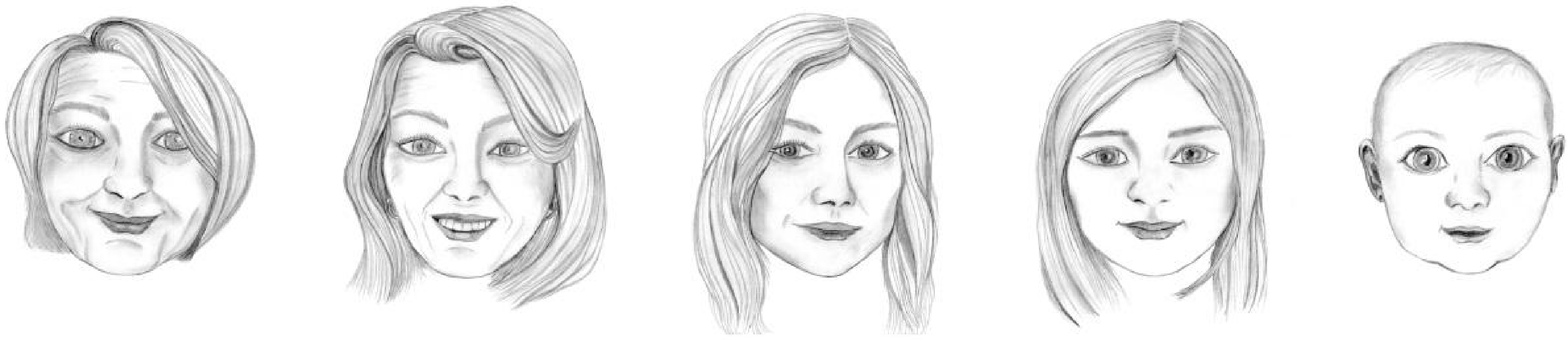
Figure 7 illustrates this principle through a sequence of faces representing different degrees of membership in the fuzzy set defined by the property of
being young. For example, an adolescent may consider a thirty-year-old person to be only slightly young, whereas an eighty-year-old person may assign the same individual a much higher degree of youth. The same individual may therefore receive substantially different membership degrees depending on the observer.
Principle 5. Extreme membership degrees may not be represented by any real object.
The existence of intermediate membership degrees does not require the extreme values of a property to be instantiated within the universe of discourse.
Trillas (
2018) notes that, for an imprecise predicate, maximal or minimal elements may not exist and, consequently, the corresponding measure may not attain the values 1 or 0. This means that, in educational contexts, the extreme degrees of a property need not necessarily be represented by actual objects in the available universe of discourse.
Figure 8 illustrates this principle using the property of
being clean. The sequence represents different degrees of cleanliness of a person’s hands, ranging from very dirty to very clean. Nevertheless, absolute cleanliness may be regarded as an ideal state that is rarely, if ever, achieved in practice. Likewise, there is no need for an instance of completely dirty hands to exist. The property can therefore be represented gradually without requiring its extreme membership degrees to correspond to real objects.
Principle 6. The assignment of membership degrees may depend on the available knowledge about the object.
The meaning associated with a property is not necessarily fixed.
Trillas (
2018) notes that, over time, a predicate may move from one universe of discourse to another and may consequently acquire different meanings. Since membership degrees reflect the meaning attributed to a property within a given context, changes in the available knowledge may lead to a reassessment of membership.
For many years, for example, spider behaviour was interpreted primarily as instinctive. However, experimental studies on Araneus diadematus showed that these animals are capable of modifying their behaviour through experience by associating vibrational stimuli with pleasant or unpleasant consequences (
Bays, 1962;
Holden, 1975). These findings contributed to a broader understanding of their cognitive abilities, leading to a reinterpretation of their behaviour as largely instinctive, but not entirely so. In fuzzy-set terms, the degree assigned to the property of
being instinctive may therefore change as new knowledge becomes available.
From an educational perspective, this principle highlights that membership judgments are open to revision as knowledge about an object increases.
3. Picture Books as Artistic Mediators for the Construction of Fuzzy Thinking Principles
The principles presented in the previous section are not intended to exhaust all educationally relevant aspects of fuzzy thinking, but rather to provide a conceptual framework for future educational research on the development of this type of thinking during early childhood. This function can be related to the learning trajectories approach, which connects research on children’s mathematical thinking and conceptual development with learning goals and instructional activities (
Clements & Sarama, 2009,
2025;
Simon, 1995). A learning trajectory consists of three interconnected components: a clear learning goal (the destination), a developmental progression of levels of thinking (the rungs), and instructional tasks (the teacher’s guidance to help the child move from one level to the next). For teachers, this approach can be understood as providing a detailed map of children’s mathematical thinking. Rather than offering the same instructional activity to all children, teachers can observe children’s current level of thinking, identify where they are within the developmental progression, and provide an appropriate task or question to support movement toward the next level. Recent studies have applied this approach across different mathematical domains (
Kutaka et al., 2024;
Orçan Kaçan & Kimzan, 2025;
Wu, 2022).
Although the present study does not propose a learning trajectory for fuzzy thinking, the learning trajectories approach offers a useful starting point for situating its educational contribution. The principles identified in the previous section may help specify potential learning goals, while the educational resources considered below may provide contexts for investigating how children’s understanding of these principles develops.
Therefore, investigating children’s progressive understanding of these principles during early childhood requires providing them with opportunities to explore their conceptual meaning through accessible educational experiences. Such experiences are not intended to replace traditional binary classification activities, but rather to broaden the range of mathematical situations children encounter, including those in which gradual classification is meaningful.
In early childhood mathematics, contextualization can help connect mathematical ideas with situations that are meaningful to children. Children’s literature offers one way of doing so (
Bresser, 1995;
Burns & Sheffield, 2004;
Furner, 2018). Within literary resources, the present study focuses on picture books because of their potential to foster motivation, active participation, and the understanding of mathematical concepts when integrated into carefully designed educational activities (
Jennings et al., 1992;
van den Heuvel-Panhuizen et al., 2009;
Zhang et al., 2023).
They are especially relevant in this respect because they are multimodal resources in which meaning is constructed through the interaction of different semiotic modes, particularly verbal and visual representation (
Crawford et al., 2024;
Kress, 2010;
Pantaleo, 2018;
Pantaleo & Walker, 2017). This interaction is particularly significant in mathematics because research with young children has shown the educational importance of coordinating different modes of representation in the construction of mathematical meaning (
Björklund & Palmér, 2022;
Elia et al., 2010).
However, understanding these works as multimodal resources should not lead us to regard them solely as teaching tools.
Bryant (
1918) emphasizes the character of a story as a work of art. This artistic conception remains present in contemporary scholarship, which recognizes picture books as an art form in which words and illustrations work together to create meaning (
Crawford et al., 2024;
Pantaleo & Walker, 2017). In fact, they may constitute one of children’s earliest experiences of art (
Wong et al., 2021). Consequently, the educational value of a picture book does not arise simply from using the story as a vehicle for introducing mathematical content, but also from the artistic quality of its literary language and illustrations.
The relevance of the artistic dimension is also supported by recent research on the intersections between mathematics and the arts, which argues that the educational value of the arts lies in generating new ways of representing and understanding mathematical ideas (
Gailiunas & Fenyvesi, 2019). Illustrations are therefore not merely decorative elements, but actively contribute to the construction of mathematical meaning (
Harriss & Segerman, 2022;
Portaankorva-Koivisto & Havinga, 2019). More broadly, artistic representation does not simplify mathematical concepts, but makes them perceptible through narrative and visual forms that facilitate their exploration and understanding while preserving their mathematical nature.
Taken together, these considerations suggest that a picture book can be understood as an artistic mediator that creates conditions for the construction of abstract mathematical principles through narrative and visual representations rooted in everyday experiences, allowing mathematics to be encountered as part of an artistic experience. Picture books do not replace mathematical experience, nor do they directly transmit mathematical concepts. Rather, consistent with research emphasizing the value of guided and playful educational experiences in early mathematics (
Clements & Sarama, 2026), when appropriately integrated into educational practice, they can create opportunities for children to explore, discuss, and progressively develop an understanding of these principles in contexts that are familiar and meaningful to them.
It is precisely this mediating function that justifies considering picture books as educational resources capable of supporting the development of fuzzy thinking principles during the early years. This potential is not limited to works originally designed with an explicit mathematical purpose, as other picture books may also contain mathematical content and support mathematical learning (
Splinter et al., 2023). In particular, many children’s books already incorporate situations of graduality expressed through natural language (
Kronenbergs, 1985;
Langley, 1991;
Southey, 1837). Expressions such as
a little,
almost,
too much,
quite,
very, and
not completely frequently appear in children’s stories and provide valuable opportunities for introducing and developing the language of graduality associated with the first principle of fuzzy thinking.
The educational value of many traditional stories, however, lies not only in their language. Their illustrations often depict continuous processes that are difficult to interpret from a purely binary perspective. The growth of a tree (
Long, 2015), the gradual consumption of an apple (
Carle, 1987), or the metamorphosis of a caterpillar into a butterfly (
Carle, 2022) constitute visual sequences that can foster the construction of conceptual images of fuzzy thinking principles.
Beyond identifying stories that naturally incorporate situations of graduality, it is also possible to design picture books deliberately conceived to act as mediators of the principles identified in the conceptual framework. Consequently, the framework not only provides a structure for investigating which principles of fuzzy thinking may be constructed during early childhood, but may also guide future work aimed at identifying and designing picture books that function as specific mediators for each of these principles.
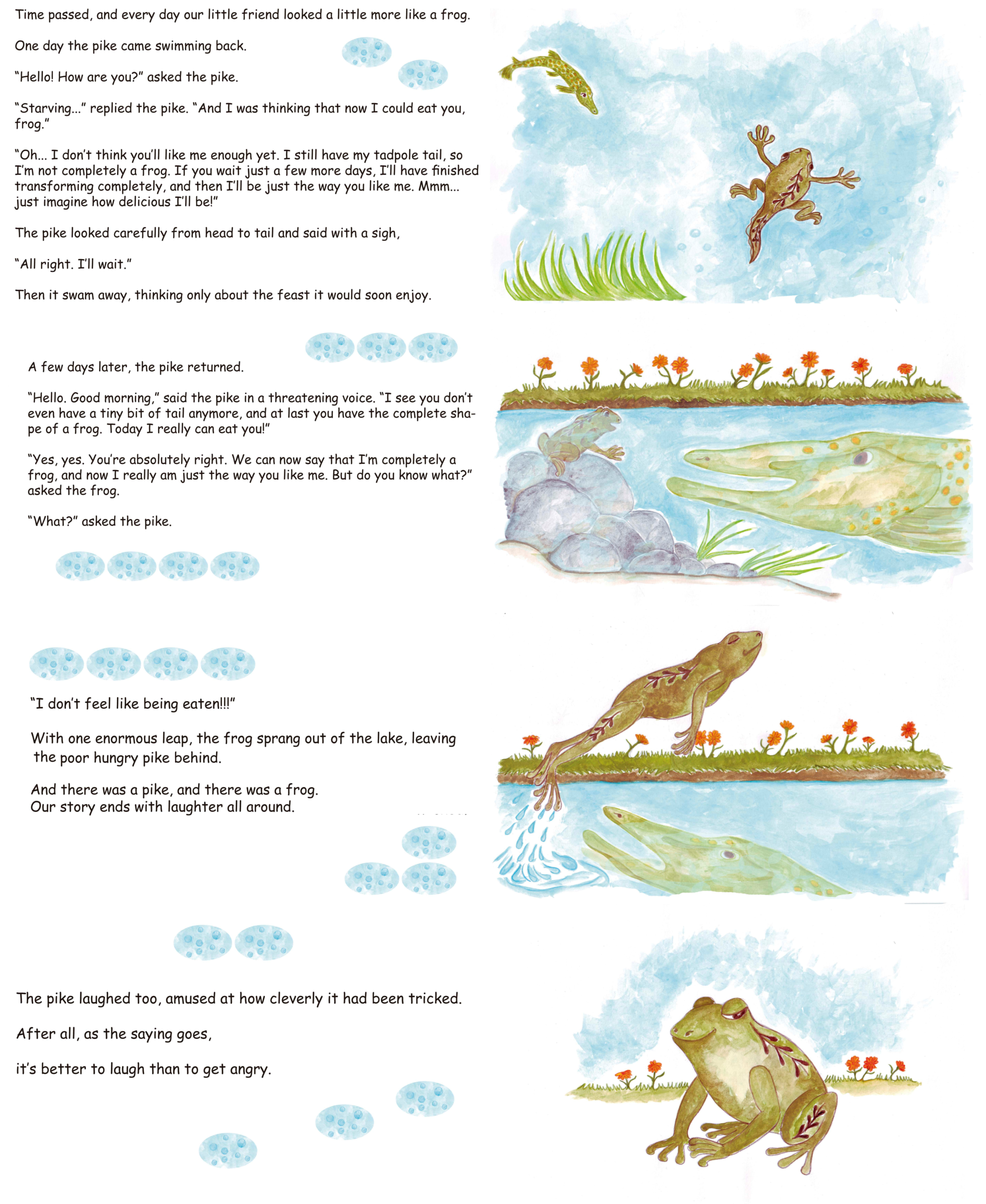
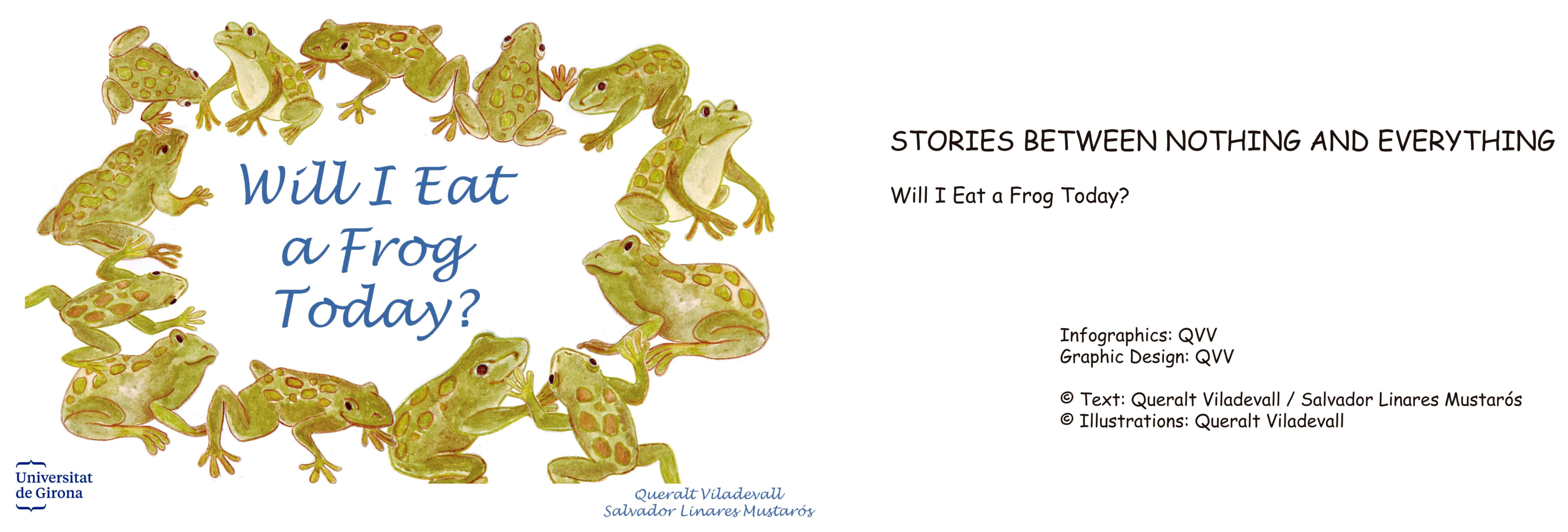
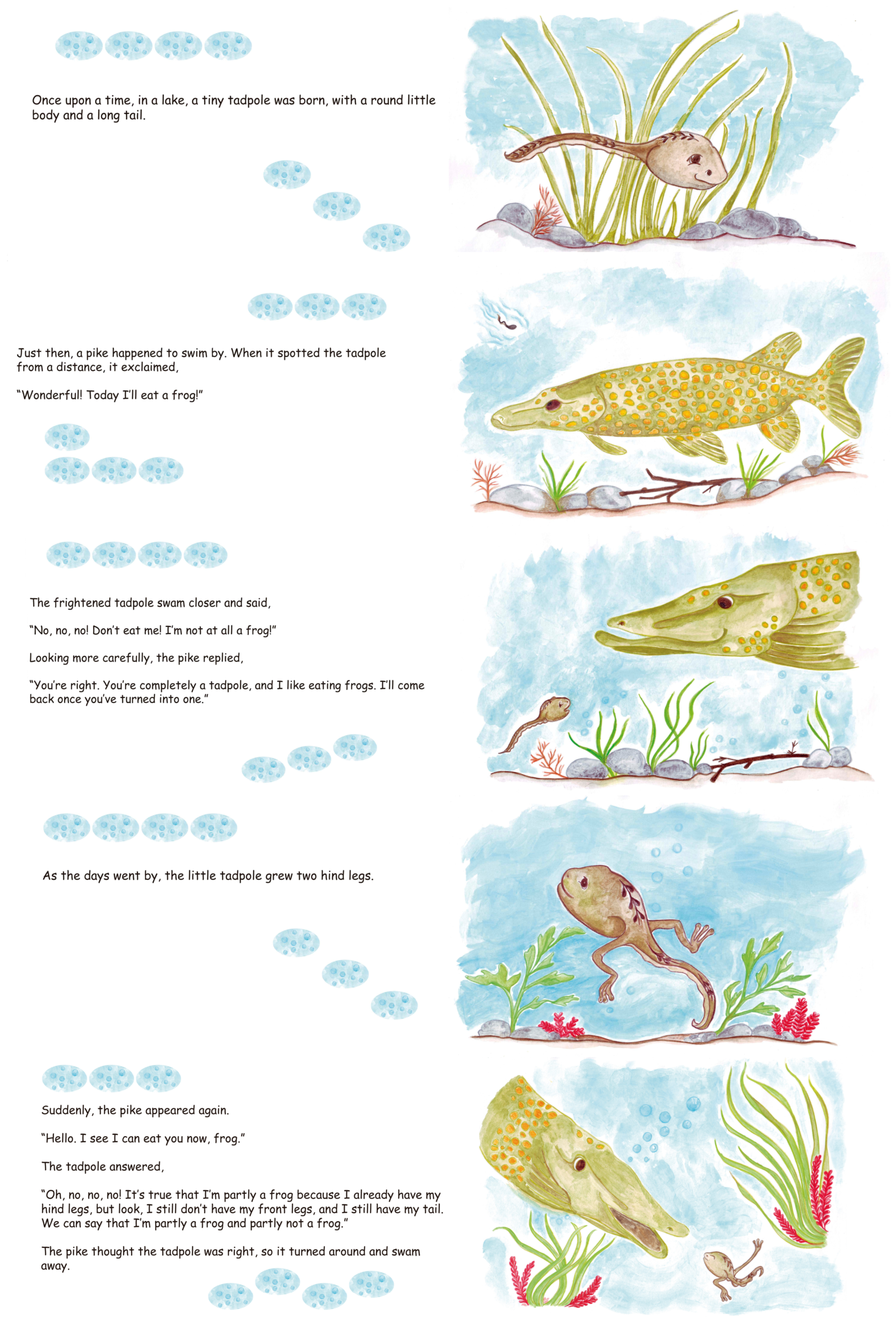
Will I Eat a Frog Today? (see
Appendix A) illustrates this approach. It was deliberately designed so that both its narrative and its illustrations function as artistic mediators of the first two principles of the conceptual framework. The story uses the metamorphosis of a tadpole into a frog as a natural example of gradual transformation. At the beginning of the story, the protagonist is classified as
not at all a frog; later, an intermediate situation is presented in which the same character describes itself as
partly a frog and partly not a frog; finally, the transformation culminates in the classification
completely a frog.
The progression allows children, on the one hand, to explore the idea that a property may be satisfied to different degrees through a three-level structure consisting of not at all a frog, partly a frog, and completely a frog. On the other hand, it explicitly illustrates the coexistence of membership and non-membership when the protagonist states that it is partly a frog and partly not a frog. This second aspect introduces the principle of gradual simultaneity through children’s everyday language, without requiring any mathematical terminology.
The illustrations play an equally important role. Each double-page spread visually represents a stage of the metamorphosis, making visible the morphological changes that justify the expressions used by the characters. Graduality is not explained; it is observed. Verbal language and visual representation work together to support the construction of mathematical meaning. In this way, the picture book becomes an artistic mediator that can contribute to the initial construction of the principles identified in the conceptual framework before their formal mathematical treatment.
4. Discussion
This article reconceptualizes fuzzy thinking in early childhood from an educational perspective and, in doing so, makes three contributions to research on fuzzy thinking in early childhood education, each of which opens new avenues for future research.
The first contribution consists of reviewing, expanding, and reinterpreting, from an educational perspective, the conceptual framework initially developed by
Viladevall et al. (
2026), shifting the focus from the mathematical formalization of fuzzy set theory to the progressive construction of the concepts that underpin it. Accordingly, the principles of the framework provide a foundation for examining children’s conceptual development and for designing future educational resources. This interpretation can be situated within the learning trajectories approach (
Simon, 1995). The six principles may contribute to identifying potential conceptual learning goals whose development and interrelationships can subsequently be investigated empirically (
Clements & Sarama, 2025).
Furthermore, the proposed framework can complement the existing line of research aimed at introducing fuzzy set theory and fuzzy logic into educational settings (
Blanco-Fernández et al., 2016;
García-Honrado, 2012,
2013;
Janković, 2019;
Janković & Magzan, 2020;
Trillas & García-Honrado, 2019). At the same time, it can extend the line of research concerned with understanding how fuzzy thinking develops in children. To date, empirical studies have focused almost exclusively on the first principle (
Delli Rocili & Maturo, 2013,
2015;
Viladevall et al., 2025).
The recent development and validation of a graduality rubric as an assessment instrument (
Viladevall et al., 2026) may offer a means of investigating children’s understanding of these principles.
The second contribution is the proposal of picture books as artistic mediators of the fuzzy thinking principles identified in the conceptual framework. This perspective extends previous research highlighting the educational potential of children’s literature for mathematics learning (
Bresser, 1995;
Burns & Sheffield, 2004;
Furner, 2018) by explicitly incorporating the development of fuzzy thinking. The mediating role proposed here should not be understood as arising solely from the mathematical content embedded in a story. Rather, picture books offer a multimodal environment in which narrative and visual representations interact in the construction of meaning (
Crawford et al., 2024;
Kress, 2010;
Pantaleo, 2018). This mediating role is consistent with research showing the relevance of coordinating different modes of representation in young children’s mathematical meaning-making (
Björklund & Palmér, 2022;
Elia et al., 2010). From this perspective, the artistic dimension is not secondary to the mathematical purpose: literary and visual representations constitute part of the means through which abstract mathematical ideas may become perceptible and open to exploration, while allowing mathematics to be encountered within an artistic experience. In doing so, the proposal opens a new line of research aimed at identifying existing picture books that may spontaneously function as artistic mediators of different principles of fuzzy thinking, while guiding the deliberate design of new picture books specifically conceived for this purpose.
The third contribution is the presentation of
Will I Eat a Frog Today? as an example of the deliberate design of a picture book in which both the narrative and the illustrations have been conceived to function as mediators of the first two principles of the conceptual framework. It illustrates how the framework can guide the intentional design of educational resources and demonstrates one possible way of incorporating fuzzy thinking into children’s literature, complementing classic stories that already allow some principles of graduality to be explored, such as The Story of the Three Bears (
Southey, 1837), The Three Billy Goats Gruff (
Langley, 1991), and Pieci kaķi (
Kronenbergs, 1985). More broadly, this contribution extends research on the design of literary resources by illustrating how picture books can be deliberately conceived to address each of the principles proposed in this study.
5. Conclusions
This study provides an educational interpretation of fuzzy thinking in early childhood through a conceptual framework comprising six principles grounded in the theoretical literature on fuzzy sets and fuzzy logic. These principles may provide a basis for identifying and designing a variety of situations in which different manifestations of fuzzy thinking can be explored, facilitating both research into its development during childhood and, at later educational stages, the formal introduction of the mathematical concepts that underpin it. From this perspective, fuzzy thinking is not intended to replace binary thinking, which remains appropriate for many mathematical situations, but to broaden children’s reasoning by enabling them to engage with situations involving the acceptance of partial membership and other manifestations of fuzzy thinking. This study also proposes picture books as mediators in knowledge construction that may make these principles accessible through the multimodal interaction of narrative and illustration (
Björklund & Palmér, 2022;
Elia et al., 2010), while allowing mathematics to be encountered as part of an artistic experience.
The framework provides a starting point rather than an established developmental model. From the perspective of learning trajectories (
Clements & Sarama, 2025;
Simon, 1995), the six principles may contribute to identifying potential conceptual learning goals for fuzzy thinking. Future research should investigate how children’s understanding of each of these principles develops, paying particular attention to whether some of them emerge simultaneously or whether relationships of precedence exist among them. The picture book specifically designed in this study to mediate the first two principles of the framework, Will I Eat a Frog Today?, provides a concrete resource whose educational potential should be empirically examined in classroom contexts. Research should also consider how narrative, visual representation, teacher mediation, and classroom interaction contribute to this process.
These considerations delimit the educational implications that can currently be drawn from the study. Although the framework may provide teachers and researchers with a conceptual basis for identifying situations in which fuzzy thinking can be explored and for designing educational resources that complement traditional binary classification activities, it is the evidence generated by future empirical research on the development of these principles and on effective ways of supporting children’s understanding of them that may ultimately inform curriculum design, teacher education, classroom implementation, and assessment practices in early mathematics education.
Finally, the artistic dimension constitutes an essential component of the proposed use of picture books to explore the principles of fuzzy thinking. Narrative allows fuzzy thinking principles to be situated within situations that unfold over time, while illustration can make gradual transformations perceptible without requiring their formal verbalization. This multimodal interaction enables verbal and visual meanings to contribute jointly to the construction of mathematical meaning (
Björklund & Palmér, 2022;
Elia et al., 2010). In this way, abstract mathematical ideas may become perceptible and open to exploration, while mathematics can be encountered as part of an artistic experience rather than as isolated mathematical content.