3. Methods
This research was initially a part of a larger integrative review designed to examine a body of literature related to equity-oriented principal preparation. Integrative review allows for the simultaneous analysis of experimental and theoretical research to define concepts, construct theories, identify gaps, and analyze other issues of note within a body of literature (
Whittemore & Knafl, 2005). While systematic reviews or meta-syntheses typically include empirical articles only, an integrative review can include articles that are empirical, conceptual, theoretical, and other systematic reviews. Given that research exploring equity-oriented principal preparation is a still-growing field, an integrative review allowed us to cast a wider net toward expanding knowledge about this body of work. For the purposes of this review, we conceptualized equity-oriented principal preparation as consisting of preparation efforts that center on the development of principals capable of meeting the needs of historically marginalized student populations.
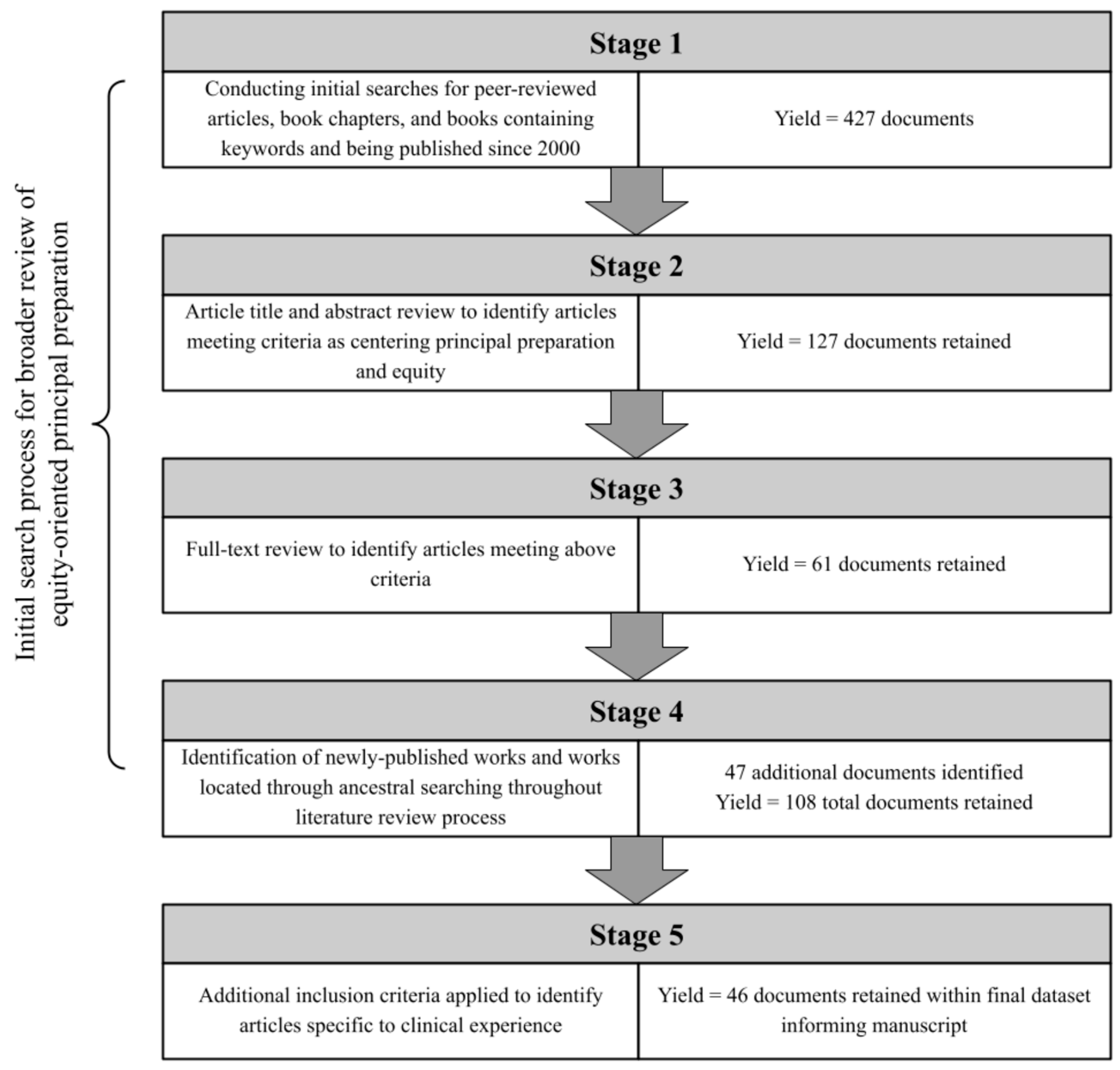
We provide an overview of the literature search process in
Figure 2. We initiated data collection for this broader integrative review in 2022 by conducting a search using combinations of broad keywords—such as “equity,” “justice,” “leadership,” “principals,” “preparation,” and “schools”—within the university’s library search engine, which indexes several major scholarly databases (e.g., ProQuest, EBSCOHost, ERIC, JSTOR). To ensure comprehensive coverage of the literature, in 2024 and again in 2025 we expanded the search to include studies that addressed equity-related concerns without necessarily employing the term “equity.” For example, we used search terms that combined principal preparation keywords (as listed above) with keywords such as “anti-racist,” “inclusive,” “culturally-responsive,” “English language learners (ELLs),” “multilingual,” “LGBTQIA,” “students with disabilities,” and several additional keyword combinations to capture a diverse set of equity-oriented leadership approaches and historically marginalized populations. In this way, within this study we conceptualized “equity” in its relation to principal preparation within the broadest possible terms, thus using this search to capture “a wide range of possible sources in an attempt to identify potentially relevant studies” (
Hallinger, 2013, p. 134). We then supplemented this process by entering the same sets of key terms into Google Scholar and cross-referencing the results. The search was limited to peer-reviewed journal articles, book chapters, and books published in English since 2000 that focused on U.S. contexts. It is important to note that this linguistic and geographical selection approach may have resulted in the exclusion of studies or accountings on innovative equity-oriented clinical approaches that have been explored or taken root in other national contexts. Given that this research utilized an integrative review methodology, the types of documents sought out within this search consisted of empirical studies, conceptual/theoretical pieces, other systematic reviews of the literature, and more descriptive accountings of preparation programs’ approaches. These initial searches yielded 427 publications for review.
After reviewing article titles and abstracts, we selected 127 works for further analysis. In this process we excluded sources that did not have both a clear preparation and equity focus. There were several examples of pieces that were identified by the initial search that examined school leadership more broadly, providing only a brief mention of preparation, typically within implications sections. Given that these pieces did not examine principal preparation and only provided commentary on it as an afterthought, such pieces were eliminated. Similarly, while our search terms were equity-centered, in some cases pieces were identified through the search that examined principal preparation but not where equity-oriented aims were more directly explored. Such pieces did not provide insights into the mechanisms of principal preparation for equity, the focus of this work. We also excluded leadership preparation at levels other than the school-building level (e.g., the preparation of superintendents). We also excluded case studies from the Journal of Cases in Educational Leadership (given their primarily pedagogical intent) and dissertations. Full-text reviews led to the removal of an additional 66 pieces. As we continued our literature review through spring 2026, we identified 47 additional works—either newly published or located through ancestral searches—resulting in a final dataset of 108 sources that collectively inform our understanding of equity-centered preparation program design.
For this article, we engaged in additional abstract screening to identify articles in which the clinical experience was discussed either exclusively or as one of several PPP features. As a part of this exclusion, we excluded articles that discussed course-embedded, clinically enacted work tasks when these tasks were largely treated in the article as a course-based pedagogical approach. From the original 108 articles, we identified 46 articles that attended to issues of equity within the context of the clinical experience.
These 46 articles were notable in several ways. Eight of the articles were conceptual and literature-based, while the remainder represented descriptive and empirical examinations of principal preparation programs’ work. Amongst these 46 articles, the majority (n = 43) tend to provide shorter discussions of equity-oriented clinical experiences within a broader discussion that includes additional program facets (e.g., curriculum, pedagogy, assessment, supports for aspirants). While these articles provide important insights, this corpus of literature lacks comprehensiveness and depth in its treatment of the clinical experience. Only three identified articles foreground the clinical experience, specifically, as the key area for inquiry (
Butcher et al., 2025;
Figueiredo-Brown et al., 2015;
Young et al., 2022. Even so, these more focused articles often tend to treat one or two elements of the clinical design (e.g., including a discussion of key clinical work tasks, but no discussion of clinical dosage, structure, or developmental supports provided) rather than provide a more complete accounting of clinical experience design elements. As a result, the overall nature of this body of literature is that can be characterized as more piecemeal in nature for considering a full array of issues relevant to the clinical experience design. This is consistent with
Stone-Johnson and Wright’s (
2020) observation in their own literature review that research tends to center classroom instruction rather than the internship. The 46 articles include descriptive accountings of individual programs’ designs, empirical studies that investigate how aspects of the clinical experience shape outcomes, and several conceptual and literature-based pieces that contain recommendations for equity-oriented clinical experiences.
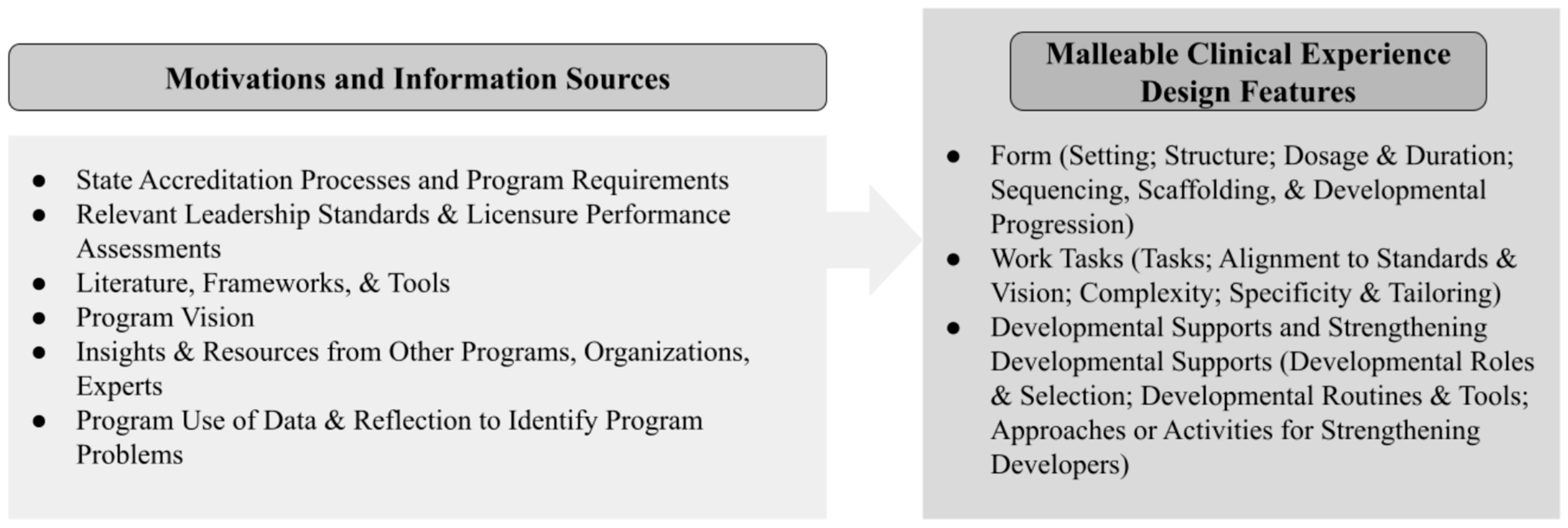
After finalizing this dataset of 46 articles, we engaged in a full review of all articles through which we recorded notes in a spreadsheet database documenting key information for each piece. First, our annotations included article characteristics, such as the author, title, year, methodology, context, empirical nature, and any reported impacts. Second, we used our conceptual framework to guide an initial round of deductive coding associated with information sources and clinical experience design features. Each dimension provided in
Figure 1 represented a column in the spreadsheet, providing a structured scaffold for systematic extraction of data across all 46 articles. For example, we had individual columns in which we extracted information from articles related to such things as dosage and duration of the clinical experience, setting of the clinical experience, and sequencing of the clinical experience. This extraction process allowed us to isolate extracted data from each column (e.g., clinical experience structure) and then look across this corpus of data to identify key themes. For example, looking across data extracted related to the clinical experience structure, we identified three key structuring approaches (detailed in the findings) that were present in the literature. In this way, this analytic process allowed us to synthesize themes in approaches and findings across this fragmented body of literature. As we engaged in this deductive coding, we occasionally identified additional inductive categories for annotation where specific key areas of inquiry emerge. For example, as we inductively coded articles related to motivations for clinical design and redesign, we surfaced additional motivating factors including features of the state or regional context. Once annotations were complete, we coded the annotations within and sometimes across related columns to identify emergent patterns and themes. The resulting themes are presented in the Findings section below.
Finally, it is important to note that within this review we do not seek to make claims about the impact of clinical experience designs on leadership aspirant learning or PK-12 student outcomes. The majority of studies included within our review do not treat issues of impact. Further, given that this is an integrative review, some of the pieces upon which we draw are more conceptual in nature, grounded in prior work on exemplary principal preparation. These help us to build the body of knowledge around equity-oriented clinical experiences, but it cannot speak to impact. Future research should further investigate the impacts of equity-oriented clinical designs.
4. Findings
In the following sections we provide several areas of findings related to equity-oriented clinical experiences as represented within the literature. First, we discuss factors that motivated and sources that informed clinical designs for equity-oriented aims. Then, we consider the design of the clinical experience for equity-oriented aims through three broad design features: (a) the format or form of equity-oriented clinical experiences, (b) equity-oriented clinical work tasks or experiences, and (c) the developmental supports associated with equity-oriented clinical experience.
4.1. Factors Motivating and Resources Informing Equity-Oriented Clinical Experience Program Design
Across the published accountings from programs that had in some way designed the clinical experience for equity-oriented aims, explicit discussions of factors that motivated and informed the clinical design tend to be overlooked or referenced largely in passing. When discussed, these factors and resources are commonly revealed in an overly general manner rather than in explicit relation to the clinical experience or activities. This tended to occur within accountings that reported on multiple program elements (e.g., recruitment, coursework, clinical experience). Although the insights that follow are more piecemeal in nature, they do shed light on an array of motivations and information sources likely to be vital to equity-oriented clinical design efforts. We extract and discuss below two areas of consideration related to the motivations and resources underlying equity-oriented clinical designs: (a) the factors that motivated equity-oriented attention to the clinical experience, and (b) the information sources and resources that informed how that attention was operationalized. As we elaborate below, these motivations and resources are rarely discussed in isolation; programs more commonly drew on a combination of internal and external sources as they engaged in equity-oriented clinical design work.
4.1.1. Motivating Factors for Embedding Equity into the Clinical Experience
Roughly half of the reviewed articles shed light on factors that were apparent motivators for equity-oriented considerations by programs. State leadership standards (
Biolchino, 2024;
Fusarelli & Fusarelli, 2024), changes to state preparation program requirements (
Liou et al., 2017;
Trujillo & Cooper, 2014), program accreditation processes (
Gilson & Etscheidt, 2022), and state principal licensure performance assessments (
Biolchino, 2024) are discussed as aspects of the state policy context that motivated equity-oriented design attention. In several instances, the state or regional context more generally played a motivating role. Shifts in student demographics (including racial, linguistic, and/or socioeconomic) appeared to motivate equity-oriented attention within at least one clinical experience (
Butcher et al., 2025). Racial hostilities in at least one state were attributed to the generation of a “leadable moment” with respect to one program’s equity-oriented program design work (
Liou & Hermanns, 2017, p. 667). Additionally, programs were oftentimes motivated to take equity-oriented actions following their use of data and/or reflection to understand equity-oriented program problems or limitations (
Baecher et al., 2016;
Barakat et al., 2021;
Boske, 2012;
Casale & Leggett, 2024;
Herman et al., 2022;
S. R. Leggett et al., 2023).
1 4.1.2. Sources of Information Shaping Equity-Oriented Clinical Experience Design
This literature surfaces a set of information or resources that were useful to the design of equity-infused clinical experiences. Although individual information sources were apparent in several instances, a combination of sources were oftentimes revealed. We focus these findings on presenting an array of sources that emerged as useful to these efforts.
To begin, the state and local demographic context surrounding a program can be an important source of information that shapes how a program operationalizes and acts upon issues of equity. This is prevalent across several descriptive accountings that are revealing of equity-oriented clinical designs (e.g.,
Baecher et al., 2016;
Callahan et al., 2019;
S. R. Leggett et al., 2023;
Liou & Hermanns, 2017). Such information might, for example, encourage attention to issues of racial or linguistic diversity as clinical work is prioritized for aspirant attention (
Callahan et al., 2019;
Liou & Hermanns, 2017).
Relevant leadership standards or competencies and new state licensure performance assessments encouraged and informed equity-oriented clinical designs. Both leadership standards and licensure performance assessments provide information of value to the identification or selection of high-value clinical work and the design of clinically enacted work tasks (
Biolchino, 2024;
Fusarelli & Fusarelli, 2024;
Herman et al., 2022;
Yamashiro et al., 2022). Designed work tasks that aspirants must undertake in the clinical setting ensure that aspirants have an opportunity to experience leadership work elemental to the state-level assessments that will be encountered to gain principal licensure (
Biolchino, 2024;
Wright et al., 2020).
In several instances, program visions that identify a small set of key leadership practices to be cultivated through the program experience were vital sources of information to the clinical design.
Callahan et al. (
2019), for example, advance a vision for linguistically oriented educational leadership and illustrate how this vision shaped aspects of the clinical design. Like leadership standards and state licensure performance assessments, some programs have used these visions to identify clinical work for prioritized attention or for the design of clinically enacted work tasks that aspirants undertake during their clinical experience (
Callahan et al., 2019;
Eslinger, 2023;
Herman et al., 2022;
Liou & Hermanns, 2017).
Several frameworks and assorted resources/literature are apparent as sources of information for equity-oriented clinical designs. Frameworks like the Quality Measures Toolkit (
EDC, 2023) and various Innovation Configuration (IC) Frameworks generated by the CEEDAR Center (
CEEDAR Center, n.d.) are examples of tools that programs have used to identify aspects of the program that would benefit from equity-oriented design attention or to inform the clinical experience design (
Casale & Leggett, 2024;
Herman et al., 2022;
S. R. Leggett et al., 2023;
Wright et al., 2020)
2. Programs have also drawn on a range of materials to inform equity-oriented clinical designs. These include federal laws, regulations, and civil rights case law (e.g., IDEA, the Equal Educational Opportunities Act); technical assistance resources; and the literature elaborating equity-oriented issues (e.g., language as a resource;
Scanlan & López, 2012,
2014), key within-school equity practices (e.g., equity audits;
Harris & Hopson, 2008;
Palmer et al., 2019), and equity-oriented leadership practices (e.g., culturally responsive leadership;
Khalifa, 2020; social justice leadership;
Frattura & Capper, 2007) (see, e.g.,
Baecher et al., 2016;
Biolchino, 2024;
Callahan et al., 2019;
Callahan & Hopkins, 2017;
Casale & Leggett, 2024;
Eslinger, 2023;
Gilson & Etscheidt, 2022;
S. R. Leggett et al., 2023).
This body of work reveals an array of individuals and organizations that have proven to be a critical source of information to equity-oriented clinical efforts. Sometimes individuals within a program prove to be important sources of information, because they have deep expertise in various equity-oriented areas (
Liou & Hermanns, 2017). Equally important are faculty members from other departments within a college, such as faculty with ELL or special education expertise (
Baecher et al., 2016;
Callahan et al., 2019). District partners are also regularly cited as providing vital information. Oftentimes, leaders within the district provide information about equity-oriented district needs and concerns that would benefit from preparation attention (
Casale & Leggett, 2024;
Eslinger, 2023;
Jones & Ringler, 2017;
S. Leggett et al., 2022). Other preparation programs, consultants, and mentors also figure prominently as resources to this work (
Barakat et al., 2021;
S. R. Leggett et al., 2023).
4.2. Form or Format of Equity-Oriented Clinical Experiences
Across the assembled literature, we also found piecemeal discussions of the format or form of equity-oriented clinical experiences. That is, most of the published accountings—even the few that report more specifically on the clinical experience—do not draw explicit attention to a more complete set of features associated with the form or format of clinical experience to consider whether or how these features have or may be acted upon for equity-oriented aims. When such discussions are included, they oftentimes provide a rather surface-level or partial treatment of features elemental to the clinical setting’s format or form. We extract and discuss below four areas of consideration related to the form and format of equity-oriented clinical experiences: (a) the setting(s); (b) the structure; (c) the dosage and duration; and (d) the sequencing, scaffolding, or developmental progression. As we elaborate below, some, but not all, of these aspects of the clinical experience appear to have been more commonly treated as malleable features of equity-focused clinical designs.
4.2.1. Clinical Experience Setting
Across this literature there tends to be inconsistent attention to the clinical setting as a point of discussion and a malleable mechanism in the design of equity-oriented clinical experiences. Nevertheless, several issues emerge when the clinical setting is given more explicit consideration for equity-oriented clinical designs. First, some attention is given to aspirant placement in schools that are demographically diverse, identified as “high needs”, and/or led by principals identified as more effective veteran leaders (
Barakat et al., 2021;
Butcher et al., 2025;
Fusarelli & Fusarelli, 2024;
Eslinger, 2023;
Roegman et al., 2021).
Second, when aspirants begin their clinical work in their current work setting, there is some evidence of additional school placements (as many as three;
Eslinger, 2023) to broaden the experience of aspirants (
Barakat et al., 2021;
Gordon et al., 2016;
Herman et al., 2022;
Palmer et al., 2023). In at least one instance, this shift in school setting is undertaken in a sequential manner where a three-semester internship sequence engages aspirants in their initial school for two semesters and moves them to a different school for the final semester of their clinical experience (
Barakat et al., 2021). Third, there is some attention to observations and interactions beyond the actual clinical setting, particularly within schools and with principals identified as highly productive or successful (
Callahan et al., 2019;
Fusarelli & Fusarelli, 2024;
Hernandez & Marshall, 2009).
3 In one instance, for example, this allowed aspirants to see culturally and linguistically diverse schools and observe the kinds of instructional and assessment practices that were critical to student success (
Callahan et al., 2019). Fourth, there is some attention to additional supplemental experiences that extend beyond the school, including those that engage aspirants in interactions and interviews with parents, community members, and business owners or involve more immersive community-based experiences (
Barakat et al., 2021;
Fierro & Rodríguez, 2006;
Fusarelli & Fusarelli, 2024;
Jones, 2023;
Pounder et al., 2002).
4.2.2. Clinical Experience Structure
Across this body of literature, there is piecemeal discussion of the clinical structure and little clear evidence that programs have acted upon the clinical structure for equity-oriented aims. Consistent with the more general literature on the clinical experience, there is evidence of three structuring approaches that have or could be used independently or in a more combined fashion for clinical designs that attend to equity-oriented interests: (a) residency-based structuring that typically engages an aspirant on a full-time basis for a set number of weeks (as a short intensive experience), a semester, a year, or even 15 months to two years (e.g.,
Butcher et al., 2025;
Palmer et al., 2019); (b) multi-semester clinical experiences that occur in connection to some type of clinical course or university-based clinical supervision (
Barakat et al., 2021;
Butcher et al., 2025;
Gordon et al., 2016;
Jones & Ringler, 2021;
Merchant & Garza, 2015); and (c) clinical experiences that are delivered or enhanced through course-embedded clinically enacted work tasks (
Butcher et al., 2025;
Gordon et al., 2016;
Merchant & Garza, 2015;
Palmer et al., 2023;
Phillips et al., 2023;
Trujillo & Cooper, 2014;
Young et al., 2022).
4 To illustrate the latter approach, aspirants in one program engaged in a special education law course that expected students to complete clinically enacted work, which involved attending IEP and LRE meetings within a school setting (
Palmer et al., 2023).
4.2.3. Dosage and Duration of the Clinical Experience
Although this body of literature tends to pay less explicit attention to the clinical dosage, these articles reveal considerable variability in the dosage for equity-infused clinical designs. This may be tied to variability in state policy expectations related to clinical dosage (
Anderson & Reynolds, 2015), vague policy language within states that allows for variability (
Bastian & Drake, 2023), or instances where state policy (e.g.,
Fusarelli & Fusarelli, 2024) or other external funding has generated the opportunity for higher dosage experiences to be introduced as programs have engaged in equity-focused design efforts
5. As an illustration, some clinical experiences required roughly 1000 h (
Figueiredo-Brown et al., 2015;
Gordon et al., 2016;
Jones, 2023;
Jones & Ringler, 2017,
2021). Several articles specified a lower number of required hours, such as the University of Washington program requiring 360 h and the University of Connecticut requiring 540 h (
Herman et al., 2022). Additionally, the clinical experience duration is frequently described in months or years, oftentimes ranging from 10 to 15 months to as long as 3 years (
Eslinger, 2023;
Fusarelli & Fusarelli, 2024;
Liou & Hermanns, 2017;
Palmer et al., 2019,
2023). Some articles reported clinical experience duration as occurring across semesters or credit hours, with some taking place in as short as a semester with others spanning as many as 18 credit hours (
Barakat et al., 2021;
Butcher et al., 2025;
Gordon et al., 2016;
Herman et al., 2022;
Lochmiller & Chesntut, 2017;
Merchant & Garza, 2015).
There is some limited evidence of programs acting to increase the clinical experience dosage as equity-oriented clinical efforts were pursued. In one instance, for example, a program specified that aspirants must complete at least 50 h of their clinical work on activities that targeted special education programming (
Gilson & Etscheidt, 2022). However, this remained a largely overlooked area across this body of work.
4.2.4. Sequencing, Scaffolding, and Developmental Progression of the Clinical Experience
Although considerations related to the sequencing and scaffolding of clinical experience are rather infrequent in the body of reviewed work, several broad insights can be extracted. Equity-oriented clinical experiences might be designed to allow an aspirant to “gradually experience and comprehend a school leader’s scope and sequence of work” (
Eslinger, 2023, p. 23). Moreover, they might be explicitly designed to move beyond shadowing and place aspirants in charge so that aspirants experience the “full weight of responsibility” (
Fusarelli & Fusarelli, 2024, p. 6).
Several more explicit sequencing or scaffolding considerations for equity-oriented pursuits can be gleaned, some of which make explicit sequencing or scaffolding connections between courses and the clinical experience. Attention has been given to the sequencing of clinical experience in ways that directly build from learning within an academic course. That is, some equity-oriented clinical activities were reported as following experiences within courses that were either foundational in nature (
Fierro & Rodríguez, 2006) or where the course provided a “safe space” for initial practice attempts (
Yamashiro et al., 2022, p. 41). In some instances, a course used one or more case studies either as a scaffold to clinical work or as a complement to ensure that aspirants have an opportunity to encounter certain issues that may not otherwise be accessible in their clinical settings (
S. Leggett et al., 2022). Oftentimes, the work within the clinical experience is expected to progressively deepen exploration of a practice experience (
Baecher et al., 2016;
Butcher et al., 2025;
Gordon et al., 2016;
Herman et al., 2022;
Jones, 2023;
Jones & Ringler, 2017;
Liou & Hermanns, 2017;
Yamashiro et al., 2022;
Young et al., 2022). For example, aspirants in one program initially used a classroom observation tool focused on instructional strategies for use with ELL as they observed videos of classroom instruction in their instructional leadership class. This learning preceded their use of this tool in their clinical setting as an aspect of their clinical work (
Baecher et al., 2016). In contrast, there is also evidence of some sequencing between the academic and clinical settings that is more cyclical in nature, moving back and forth between course-based learning, clinical work, and some form of structured reflections on both course and field-based learning experiences (
Fierro & Rodríguez, 2006).
In contrast, sometimes equity-oriented sequencing considerations occurred within the clinical experience more specifically. In these instances, there is some attention to increasing the complexity of the clinical experience over time. For example, several articles reveal that some equity-infused clinical experiences have been designed to progress towards a more sustained, data-based and/or action-oriented project as a culminating experience (
Fusarelli & Fusarelli, 2024;
Gooden et al., 2018;
Jones, 2023;
Jones & Ringler, 2017;
Liou & Hermanns, 2017). In other instances, reports focus on the multi-semester sequencing of a set of discrete clinical work tasks, each elemental to a more complete or complex area of equity-oriented leadership work (e.g.,
Biolchino, 2024;
Butcher et al., 2025;
Callahan et al., 2019).
4.3. Equity-Oriented Clinical Experiences or Work Tasks
Across this literature we also noted varied and piecemeal attention to the clinical work or work tasks as explicit points of consideration in relation to the design of equity-oriented clinical experiences. Nevertheless, in comparison to the form or format of the clinical experience, there is more evidence that clinical work tasks have been and could be considered as programs engaged in equity-oriented clinical designs. In the section that follows we discuss (a) the types of clinical work tasks or activities emphasized for equity-oriented pursuits, and (b) task alignment to relevant leadership standards or program visions, (c) task complexity, and (d) task specificity or tailoring.
4.3.1. Types of Clinical Experience Work Tasks and Activities
To begin, equity-oriented clinical work has been broadly described or categorized and also reported by discrete tasks. A broader representation of equity-oriented work receiving focal attention is evidenced by
Gilson and Etscheidt (
2022), for example, as they describe a required area of clinical work as occurring “within the special education arena” (p. 47). Additionally,
Butcher et al. (
2025) examined aspirant work across four broad types of equity-oriented topics: (a) access, (b) achievement, (c) identity, and (d) power. Although aspirants reported all four types of activities within their clinical experiences regardless of the structuring of the clinical experience, aspirants reported more attention to work relating to access or achievement and less attention to work relating to identity and power (
Butcher et al., 2025).
A broad assortment of studies has paid attention to equity-oriented work tasks, and several work tasks have been emphasized for equity-oriented aims. Although equity audits are most commonly discussed, they varied notably in their level of description and substance.
S. Leggett et al. (
2022), for example, name without detailed elaboration three audits in their descriptions of course-embedded and clinically enacted work: (a) a special education audit, (b) an equity audit, and (c) a family and community engagement audit. In contrast, more detailed accountings of expansive equity audits are present (e.g.,
Callahan et al., 2019,
Fierro & Rodríguez, 2006;
Gordon et al., 2016;
Palmer et al., 2019,
2023). Work by
Callahan et al. (
2019), for example, documents an equity audit that encouraged aspirants to examine faculty and staff demographics, the school’s programs and services, and student learning outcomes. Aspirants were then expected to work with the mentor principals to “target and address a specific equity issue” that emerged from the audit (p. 298).
In addition to equity audits, there is recurring evidence of equity-oriented action research activities that involve some combination of literature review, data collection and/or analysis, planning, and action.
Butcher et al. (
2025), for example, broadly report on a series of action-research projects focused on instructional leadership work connected to four internship courses. Although some data analysis appeared to be targeted, such as analysis of discipline rates for students with disabilities (
Gilson & Etscheidt, 2022), some analysis appeared to be more expansive in relation to any equity-oriented gap and aspirants were also expected to facilitate learning within a teacher group to address the gap (
Biolchino, 2024). In contrast, work by
Liou and Hermanns (
2017) provides a useful illustration of the combined use of literature and data collection to shed new light on within-school circumstances and challenges.
Another type of clinical work that has figured more prominently in equity-oriented designs is equity-focused instructional observation and interaction. These activities have given aspirants experience with the use of tailored observational tools (e.g., evidence-based practices that have been recognized as vital for ELLs;
Baecher et al., 2016) and targeting specific teachers, such as teachers of special education students and those of ELLs (
Baecher et al., 2016,
Gilson & Etscheidt, 2022). These instructional data collection experiences have also been coupled with follow-up interactions with teachers to more deeply consider the unique student learning needs of such students (
Fierro & Rodríguez, 2006).
Beyond these more commonly cited work tasks, there was some minor treatment of discrete tasks of value for developing leadership for inclusion. These work tasks included observing or leading IEP meetings, facilitating MTSS teams or teacher teams that are considering student accommodations, examining and critiquing special education district policies and practices, and shadowing and interacting with district personnel tasked with special education leadership (
Gilson & Etscheidt, 2022).
4.3.2. Clinical Experience Work Task Alignment to Standards and Program Vision
The literature documents a clear pattern of aligning clinical and internship work tasks to external leadership standards, state performance assessments, and program-level theories of action, though the nature and depth of that alignment varies across programs. Several articles describe clinical experiences structured around state performance assessments, particularly in California, where programs redesigned internship tasks to mirror the three-cycle Cal-APA (
Biolchino, 2024;
Wright et al., 2020). In Texas,
Butcher et al. (
2025) similarly describe action research projects tied directly to state leadership domains, with culminating projects requiring equity-focused work such as equity audits and budget analyses.
Herman et al. (
2022) document such alignment as a broader pattern across UPPI programs, noting that participating institutions aligned clinical experiences to state standards, assessments, and internal program frameworks. Beyond external mandates, some programs describe a more internally driven logic in which internship tasks are tethered to a distinctive program vision or theory of action.
Young et al. (
2022) discuss alignment of clinical work to both a profile of the graduate and equity-focused program-level standards, while
Fusarelli and Fusarelli (
2024) describe a redesign in which courses were intentionally sequenced so that clinical experiences built on prior coursework and incorporated applied leadership, community engagement, and data interpretation tasks.
4.3.3. Complexity of Clinical Experience Work Tasks
Although several of the reported tasks focus on aspirant observation of focal leadership practices (e.g.,
Gilson & Etscheidt, 2022), there is evidence that many of the focal equity-oriented experiences and tasks are more complex in nature.
Herman et al. (
2022) explicitly document a shift in UPPI programs away from aspirant observation and shadowing toward active, practice-based work, with many programs introducing complex projects requiring candidates to address a genuine need within their school. These tasks often require engagement over an extended period of time, interactions with assorted individuals within the school, the collection and analysis of data, and some facilitation or leadership efforts done individually or in collaboration with mentor principals (
Eslinger, 2023;
Liou & Hermanns, 2017;
Yamashiro et al., 2022). Equity audits, described above, are among the most frequently cited examples of such complexity, appearing across a range of programs where candidates gather and analyze school or district data, identify disparities, and develop action plans in response (
Fusarelli & Fusarelli, 2024;
Gooden et al., 2018;
Harris & Hopson, 2008).
Palmer et al. (
2023) describe a particularly layered version of this work, in which candidates conduct equity audits tracking race and gender subgroups and then provide ongoing instructional support to teachers through multiple observation and conferencing cycles with quarterly progress monitoring.
Liou and Hermanns (
2017) similarly describe action research projects in which candidates identify an equity-focused problem of practice, conduct a literature review, and implement a change initiative. Taken together, these examples suggest that more complex clinical work tasks are being introduced, and they oftentimes move aspirants from inquiry and data collection through analysis and into action.
4.3.4. Specificity and Tailoring of Clinical Experience Work Tasks
Although largely piecemeal in nature, some evidence emerged related to the level of prescription or tailoring of clinical work and work tasks within the context of equity-oriented clinical designs. Although none of the assembled articles provides a deliberate and complete accounting of clinical experience work, we do gain some important insights about how prescription or tailoring might occur to support equity-oriented purposes. While
Fusarelli and Fusarelli (
2024, p. 5) note the “haphazard” nature of some clinical experiences in which work tasks are more random, across this corpus of literature we note a small set of articles that discuss more structured clinical experiences involving at least one or a small set of required equity-focused work tasks (e.g.,
Barakat et al., 2021;
Biolchino, 2024;
Butcher et al., 2025;
Gilson & Etscheidt, 2022;
Liou & Hermanns, 2017;
Palmer et al., 2019). In one instance, aspirants had the ability to select a newly designed equity-oriented work task, a targeted observation of ELL instruction, from a small assortment of classroom observation tasks (
Baecher et al., 2016).
The tailoring of tasks occurred through several approaches. Oftentimes, it resulted from required tasks that were enacted in a manner most relevant to or within the aspirant’s clinical setting (e.g.,
Butcher et al., 2025;
Callahan et al., 2019;
Eslinger, 2023;
Liou & Hermanns, 2017). This meant that aspirants could make decisions about specific equity-oriented issues or challenges that would receive their attention based on needs or areas of emphasis within the clinical setting. In at least one instance, aspirant pre-assessment shaped the tailoring of work tasks (
Reis & Smith, 2013).
4.4. Developmental Supports for Equity-Oriented Clinical Experiences
Across the assembled literature, we noted piecemeal attention to clinical experience, developmental supports, or efforts germane to strengthening those supports. When such issues are discussed, they are generally treated in a rather brief or superficial manner. We discuss below several considerations in each of the following areas: (a) developmental roles associated with the clinical experience and selection of individuals into these roles, (b) key developmental support routines, and (c) approaches or activities for strengthening developers.
4.4.1. Developmental Roles Associated with the Clinical Experience and Selection of Individuals
Although this body of literature points to several individuals serving as developmental supports for equity-oriented clinical experiences, we learn much less about whether or how these roles were or could be acted upon for equity-oriented aims. Consistent with literature on the clinical experience more generally, mentor principals and clinical supervisors were commonly engaged to support equity-oriented clinical experiences (e.g.,
Figueiredo-Brown et al., 2015;
Merchant & Garza, 2015;
Reis & Smith, 2013). Consistent with the literature on innovative preparation programs, evidence revealed some minor attention to the introduction of leadership coaches, which likely occurs by shifting away from a clinical supervision model, as a supplement to the developmental supports provided by mentor principals (e.g.,
Fusarelli & Fusarelli, 2024;
Gilson & Etscheidt, 2022). What is noteworthy to report is that the use of course-embedded and clinically enacted work tasks, one structural approach to the clinical experience, generated an important secondary benefit of expanding the individuals providing developmental supports for the clinical experience and work by engaging academic program faculty in the role of providing aspirant feedback on clinical work (
Jones, 2023;
S. Leggett et al., 2022;
Merchant & Garza, 2015).
The literature provides only sparse and largely passing treatment of PPP processes for selecting mentors and coaches.
Young et al. (
2022) address mentor selection by calling for the development of mentors for culturally sustaining mentoring approaches.
Herman et al. (
2022) provide the most explicit account, documenting that UPPI programs moved toward a deliberate process of nominating, vetting, and selecting mentor principals who had demonstrated effectiveness as leaders. Expectations for mentor principals also became more substantive, with mentors required to participate actively in meetings with both the university coach and the candidate (
Herman et al., 2022). Notably, attention to the selection of individuals into developmental roles remains one of the least developed threads in this literature, with most articles simply noting the presence of a mentor principal or coach without elaborating the criteria or processes by which individuals were identified or chosen.
4.4.2. Key Developmental Support Routines
Several more formalized routines are evidenced in this body of literature that have potential for shaping or strengthening the developmental supports that aspirants encounter during equity-oriented clinical experiences. Specifically, we noticed several routines that systematized developmental interactions between aspirants and others in relation to clinical work. There is some evidence of interaction routines occurring during mentors’ and/or clinical supervisors’/coaches’ meetings (e.g., clinical supervisor/coach, mentor, or both coach and mentor in collaboration) with aspirants that (a) systematize supports for goal setting or planning or (b) provide opportunities for joint work, feedback, and practice assessment or evaluation (
Butcher et al., 2025;
Callahan et al., 2019;
DeMatthews et al., 2020;
Fusarelli & Fusarelli, 2024;
Gilson & Etscheidt, 2022). In several instances, interactions occurred through writing and in relation to journaling activities. These routines prompted aspirants to reflect on an equity-oriented clinical experience and receive faculty or coach feedback as a vehicle for promoting self-awareness and learning from a practice experience (
Jones, 2023;
S. Leggett et al., 2022;
Wright et al., 2020). In addition to interactions with individuals in more formalized development roles (e.g., mentor, coach, program faculty), there is also some modest evidence of peer interaction routines, oftentimes in smaller groups, for making sense of or critically reflecting upon specific clinical experiences (
Eslinger, 2023;
Gilson & Etscheidt, 2022;
Gordon et al., 2016;
Jones & Ringler, 2021;
Phillips et al., 2023).
4.4.3. Approaches for Strengthening Developmental Supports
Although receiving limited attention across this body of articles, there are several insights that can be gained regarding approaches that demonstrate potential for informing or developing those in support roles and/or promoting better coordination of supports provided by multiple individuals in development roles (e.g., mentor principals and coaches). For example, there is some attention given to the provision of formal training on such issues as diversity, equity, or culturally sustaining mentoring to those in developmentally supportive roles (
Butcher et al., 2025;
Figueiredo-Brown et al., 2015;
Young et al., 2022). As the routines in the prior section reveal, routines that engage both a mentor principal and coach are likely to have potential for helping both individuals gain a better understanding of aspirant development and developmental needs that could in turn inform their supports of and work with aspirants (
Gilson & Etscheidt, 2022). These routines also have potential for improving the coordination of supports provided by two supportive individuals (
Young et al., 2022).
5. Discussion
We began this paper by taking the position that promoting the development of equity-oriented leadership practices is a relevant strategy for driving more equitable school improvement efforts. Given the importance of the clinical experience to principal preparation (
Bastian et al., 2025;
Crow & Whiteman, 2016;
Cunningham et al., 2019;
Orr, 2011;
Rangel et al., 2025;
Winn et al., 2016), considering how it might be designed for equity-oriented aims is critical work for leveraging preparation as a pathway of impact on equity-oriented school improvement. This paper offers insights from a systematic review of literature to inform these sorts of efforts moving forward.
Our analysis of this literature sheds light on factors that have motivated programs to design clinical experiences for equity-oriented aims and an assortment of knowledge sources that informed such efforts. Importantly, findings reveal key features of the clinical experience that, to date, have emerged as more malleable in such design considerations and provide design illustrations that could prove useful to preparation programs undertaking such reorientation efforts. In the section that follows we briefly discuss key findings and their utility or importance before drawing attention to several broad implications and recommendations for future research.
With respect to the form or format of the clinical experience, there appear to be several features and considerations that have garnered more explicit equity-oriented design attention. There is, for example, some modest attention to the selection of the clinical setting, based on certain within-school factors (e.g., high-needs schools, schools led by principals identified as effective), as well as the movement of aspirants into additional school settings, beyond their current school, as their primary clinical experience setting (
Barakat et al., 2021;
Butcher et al., 2025;
Eslinger, 2023;
Fusarelli & Fusarelli, 2024;
Gordon et al., 2016;
Herman et al., 2022;
Palmer et al., 2023). There is also attention to additional purposefully selected school settings that supplement and extend beyond the primary clinical setting. Thus, our work draws important attention to the potential of such supplemental settings, which are selected to ensure that all aspirants have an opportunity to observe specific kinds of schools and/or practices that are critical to equity-oriented endeavors (e.g., schools that are culturally and linguistically diverse; specific kinds of instructional practices) and to interact with leaders and teachers within these purposefully selected settings (
Callahan et al., 2019;
Fusarelli & Fusarelli, 2024). On the other hand, some clinical experiences have extending into the community for interactive or immersive activities with parents and the broader community (
Barakat et al., 2021;
Fierro & Rodríguez, 2006;
Fusarelli & Fusarelli, 2024;
Jones, 2023;
Pounder et al., 2002)—demonstrating the context surrounding the school as a potential resource of value as equity-oriented clinical settings are conceptualized.
Some modest attention has been given to the sequencing and scaffolding of the clinical experience for equity-oriented aims. Two considerations were most visible. First, some sequencing explicitly links an initial course-embedded learning experience, perceived to be foundational or where the classroom context created a safer exploratory space, to a subsequent clinical experience (
Baecher et al., 2016;
Fusarelli & Fusarelli, 2024;
Maloney & Garver, 2020). Second, some sequencing occurs exclusively within the clinical experience in ways that either successively engage aspirants in a series of work tasks elemental to a broader area of leadership work or where more complex leadership work is slated near the end of the clinical experience (
Eslinger, 2023;
Fusarelli & Fusarelli, 2024;
Trujillo & Cooper, 2014). In this way, our work draws attention to the consideration of developmental learning progressions as learning experiences are conceptualized and how such considerations might intersect with or be supported within the clinical experience.
Attention to clinical experience work figures more prominently in discussions of equity-oriented clinical designs, and our analysis generates insights about the nature and type of work tasks that aspirants could undertake. First, evidence suggests that some settings have aligned these tasks to state principal performance assessments (
Biolchino, 2024;
Butcher et al., 2025;
Wright et al., 2020), state standards (
Herman et al., 2022) or to program visions or theories of action (
Young et al., 2022). Second, our analysis reveals a movement away from clinical work that is largely unspecified in nature to work that is more specified, targeting one or more equity-oriented work tasks and also providing some tailoring of tasks to context and/or aspirant interests and needs (
Butcher et al., 2025;
Eslinger, 2023;
Gordon et al., 2016;
Herman et al., 2022;
Palmer et al., 2019;
Yamashiro et al., 2022). Third, some of the emphasized tasks demonstrate greater levels of complexity and duration (e.g., length of time for task engagement) through clinical work that necessitates interactions with others and the use of data (e.g.,
Eslinger, 2023;
Herman et al., 2022;
Liou & Hermanns, 2017;
Yamashiro et al., 2022). In this way, our work generates an assortment of insights related to the nature and types of work tasks that could be targeted with equity-oriented aims in mind. Fourth, prior research that examines the impact of clinical experience draws attention to the importance of work that focuses on school improvement and instructional leadership (
Darling-Hammond et al., 2007;
Orr & Orphanos, 2011). Our analysis sheds light on the nature of such work when issues of equity are prioritized. We find that equity-oriented clinical work tends to engage aspirants in school improvement and instructional leadership work that is anchored to specific equity targets, structured to move aspirants from data-based inquiry into action, and tethered to equity-centered frameworks or standards that give that work normative direction (
Alford & Hendricks, 2018;
Butcher et al., 2025;
Liou & Hermanns, 2017;
Palmer et al., 2019,
2023;
Yamashiro et al., 2022). Although these insights are likely to be valuable, an additional consideration is vital. Given that mentor principals have considerable influence over aspirant access to and authority for clinical work (
Cosner & De Voto, 2023), concurrent actions that encourage aspirant access to and authority for these work tasks (
Cosner & De Voto, 2023) are likely to be necessary to ensure that aspirants gain relevant experience with specified tasks.
Developmental supports associated with the clinical experience represent a comparatively underdeveloped area of equity-oriented clinical design. Although mentor principals, clinical supervisors, and leadership coaches are identified as developmental roles (e.g.,
Figueiredo-Brown et al., 2015;
Fusarelli & Fusarelli, 2024;
Gilson & Etscheidt, 2022;
Merchant & Garza, 2015;
Reis & Smith, 2013), the equity-oriented dimensions of selection into these roles, such as attention to mentor identity, representation, and culturally sustaining approaches to mentoring, receive rather limited attention (
Herman et al., 2022;
Young et al., 2022). Our work does draw attention to several routines used by mentors or coaches that have potential for systematizing key developmental supports including (a) supports for goal setting or planning or (b) opportunities for joint work, feedback, and practice assessment or evaluation (
Butcher et al., 2025;
Callahan et al., 2019;
DeMatthews et al., 2020;
Fusarelli & Fusarelli, 2024;
Gilson & Etscheidt, 2022). Drawing attention to these routines is of value, because it makes visible the potential of such routines for systematizing the kinds of developmental interactions that have been regarded as “high quality” (
De La Garza et al., 2026).
Although fewer insights can be directly extracted in relation to the development of those in developmental support roles, our findings draw important attention to two issues. First, meetings and meeting routines that systematize interactions between multiple support roles (e.g., mentor principal, leadership coach) are likely to hold a developmental opportunity for those occupying those roles (
Gilson & Etscheidt, 2022), a point identified in prior research (
Cosner & De Voto, 2023). These routines also hold potential to enhance the coordination of development supports provided across multiple support roles (
Cosner & De Voto, 2023). Given the mentor principals are commonly recognized as less well equipped to support aspirant development (
Cosner & De Voto, 2023), our findings may support efforts to combat these limitations.
Stepping back to consider the motivations for and information sources to equity-oriented designs, we noted a broad array of motivating factors and information sources. Motivators ranged from factors within and beyond the program (e.g.,
Baecher et al., 2016;
Biolchino, 2024,
Boske, 2012;
Butcher et al., 2025). Information sources were equally varied (e.g.,
Baecher et al., 2016,
Callahan et al., 2019;
Liou & Hermanns, 2017). Considering how to harness or leverage these factors to motivate equity-oriented design would be vital if such work is to be undertaken more broadly across the field.
Some of the findings have particular relevance to state departments of education in their efforts to motivate and shape program design—both for equity-oriented aims and more generally. Study findings, for example, point to an array of factors within the state policy context that appeared to motivate equity-oriented program design. Program accreditation processes, principal licensure performance assessments, and changes to program requirements are aspects of a state’s policy apparatus that have potential for encouraging program change (e.g.,
Biolchino, 2024;
Gilson & Etscheidt, 2022). Considering each of these aspects of a state’s policy apparatus would likely be relevant areas of consideration for state departments of education.
But a word of caution is also warranted for states that might limit their attention to these more traditional policy approaches. Work by
Cosner (
2026) underscores the limitations of preparation program design and improvement when it remains largely externally motivated. This work helps us to understand the power and potential of internally motivated program improvement efforts, which are undertaken because of a program’s internal orientation to collectively learn and occur through a program’s ongoing use of processes of improvement (
Cosner, 2026). What additional approaches might be relevant to encourage and support internal motivations and efforts? First, states can invest funds in the design of data systems that would be vital to internal program improvement efforts (
Cosner, 2026). They can also collaborate with other partner organizations (e.g., EDC, Coucil of Chief State School Officers; CCSSO) and invest funds to support state-wide preparation program learning communities, like those that have been enacted in a handful of states such as Texas and Delaware, that could offer tangible support for program improvement (
Cosner, 2026).
There are also some key insights that are more specifically related to program requirements that might be considered as states act to better harness principal preparation as a mechanism of impact on equity-oriented school improvement. Attention to the selection of clinical settings and mentor principals as well as clinical dosage in state program requirements would be areas for consideration. However, it would seem critical to jointly act upon these issues because increasing the clinical dosage in settings that lack opportunity to observe and learn from schools and principals that have demonstrated equity-oriented successes has the potential to challenge rather than support these equity-oriented aims. Careful consideration of the kinds and nature of work tasks that aspirants undertake during the clinical setting to ensure that their experience includes engagement with high-leverage equity-oriented work tasks would also be a particularly relevant consideration. Similarly, given that university–district partnerships and partnership quality tend to shape where aspirants are placed, who serves as mentors, and what leadership work aspirants encounter (
Abdelrahman et al., 2022), requirements for such partnerships and partnership development supports could prove vital.
Our findings make several additional contributions. Broadly, our analysis provides a comprehensive framework for considering the design of the clinical experience—one that could be used generally and for equity-oriented aims by those designing or empirically examining clinical experiences within principal preparation. Building from prior work that considers the clinical experience design (
Anderson & Reynolds, 2015;
EDC, 2023;
Rangel et al., 2025), our analysis makes visible a broader array of clinical experience design features and considerations and sheds important light on those features and considerations that are likely to be vital to the reconstruction of the clinical experience for equity-oriented aims, in particular.
Lastly, our analysis sheds important light on several critical limitations in this body of literature that should inform future research. All of the articles that we reviewed, even those that focused more explicitly on the clinical experience, failed to provide a more comprehensive accounting of clinical experience design features and considerations. Given this finding, we amplify prior conclusions offered by
Darling-Hammond et al. (
2022) in our assertion that the field will benefit from future descriptive and empirical work that pays careful attention to a more complete accounting of clinical experience design features and considerations, in general, and as equity-oriented clinical designs are more specifically explored. Additionally, published accountings that more fully elaborate a complete range of clinical experience design features are critical. Knowledge generation about the clinical experience, both in general and for equity-oriented aims, is a vital area for future study.