1. Introduction
Preschool children develop oral language and early literacy skills in interactions with others and in the context of everyday home activities, with parents playing one of the most proximal and influential roles in this development (
van Kleeck et al., 2006;
Vygotsky, 1978). Among home activities that promote preschoolers’ oral language and early literacy skills, shared book reading and conversations about past events (reminiscing) are some of the most well-studied (
A. G. Bus et al., 1995;
Dowdall et al., 2020;
Mol et al., 2008;
Waters et al., 2019;
Wu & Jobson, 2019). Parents mediate the gap between children’s current knowledge and skills, and the content of books or conversations, and this mediation facilitates children’s literacy development (
Vygotsky, 1978). A large body of research indicates that preschoolers whose parents engage in shared book reading or reminiscing have larger vocabulary and phonological knowledge and are better at telling and retelling stories and explaining and predicting events in a story (
A. G. Bus et al., 1995;
Dickinson & Tabors, 2001;
Fivush et al., 2006;
Florit & Cain, 2011;
Peterson et al., 1999). This is because both home activities require the use of decontextualized talk, that is, talk about things that are absent, abstract, or fantastical, which inherently demands a more complex vocabulary and syntax and is key to reading comprehension and oral narrative skills (
M. Rowe, 2013;
Wei et al., 2025). Consequently, family literacy interventions have focused on either shared book reading or reminiscing to enhance preschoolers’ literacy skills (
A. G. Bus et al., 1995;
Dowdall et al., 2020;
Mol et al., 2008;
Waters et al., 2019;
Wu & Jobson, 2019).
Dialogic reading (DR) is one of the most extensively studied shared book-reading interventions (
Whitehurst et al., 1988;
van Steensel et al., 2011). In DR, parents learn strategies to share books in an interactive manner, by pausing during reading, prompting children with questions, and engaging them in discussion across repeated readings of a book. Meta-analytic work has found that DR interventions have positive impacts on children’s expressive and receptive vocabulary (
Dowdall et al., 2020). Positive effects on children’s narrative quality (e.g., use of internal states talk in story retelling) have also been documented (
Lever & Sénéchal, 2011;
Zevenbergen et al., 2003). Elaborative reminiscing (ER) has also been thoroughly studied (
Fivush et al., 2006;
Salmon & Reese, 2016;
Wareham & Salmon, 2006). In ER, parents learn strategies to talk about personal past events in an elaborative manner, by asking questions, making comments, and providing evaluative feedback (e.g., praise) that invites the child to contribute to the story and builds upon the information provided by the child. Prior work suggests that ER has positive impacts on preschoolers’ expressive vocabulary and narrative quality; for example, children’s use of context-setting descriptors in storytelling (
Peterson et al., 1999;
Reese & Newcombe, 2007;
Reese et al., 2010). Thus, DR and ER have similar positive effects on preschoolers’ expressive vocabulary and narrative skills and offer alternative entryways to promote literacy development.
While there are many synergies between DR and ER, these two sets of strategies have rarely been integrated in prior literacy interventions. There are several reasons why integrating DR and ER strategies into a single intervention makes sense, particularly for some populations, like Latinos, the target population of this study. First, Latino parents place a strong value on oral storytelling for social, moral, and cultural reasons (
Caspe, 2009). Oral storytelling, including reminiscing, is a main vehicle for Latino parents to transmit their cultural beliefs, to foster their children’s identity, and to enact cultural values such as
familismo, being loyal and respectful to your family (
Valdés, 1996). Second, Latino parents interact with their preschoolers differently depending on the home literacy activity. When asked to share a book with their children, Latino parents are more likely to adopt the role of the sole narrator, reading the text for the child without pausing or asking questions or making comments during the reading, and the child adopts the role of an active audience (
Caspe, 2009;
Goldenberg et al., 2001;
Melzi & Caspe, 2005;
Melzi et al., 2011). This is in contrast with what DR expects from parents and children, which is a more of an interactive role, in which they engage in a conversation about the text. In contrast, when asked to reminisce about a past event, Latino parents are more likely to adopt the role of the audience and encourage their children to take the lead in narrating by asking questions and making comments that elicit children’s contributions to the story. In reminiscing activities, the child becomes the narrator with the support of the parent, which is more aligned with DR’s expectations. Thus, integrating ER and DR strategies might be a conceptually grounded and culturally appropriate way for family literacy programs to empower Latino parents to support their preschoolers’ literacy development.
To our knowledge, only one study has integrated DR and ER strategies into a single intervention (
Reese et al., 2023). The six-week intervention drew upon features of DR and ER including repeated readings, open-ended questions and comments of increasing demand levels, and evaluative feedback (e.g., praise) on children’s contributions. Families received 12 books (2 per week) and were asked to read each book three times. Books contained embedded prompts that encouraged parents to ask questions or make comments about the story. Prompts were of increasing demand over three successive readings. After completing the three readings, families were encouraged to engage in a reminiscing conversation related to the book’s theme. The intervention had positive effects on the quality of parent–child talk at the immediate post-test (e.g., predicting, evaluating, and connecting the book’s topic to a child’s experience;
Riordan et al., 2022) and preschoolers’ retelling skills and narrative quality at the one-year follow-up (e.g., use of internal states talk in story retelling;
Reese et al., 2023). The intervention targeted families in New Zealand from diverse socioeconomic and racial/ethnic backgrounds. Thus, it remains an open question whether integrating DR and ER extends to different populations, such as Latino families in the United States, and whether these findings generalize to the use of e-books rather than traditional print books.
1.1. Why Use E-Books?
Media use has become ubiquitous in children’s lives. Many parents buy tablets for their young children, but many schools provide tablets for children too, particularly in the 5 to 8 age range, to support children’s learning at home (
Mann et al., 2025). In the U.S., 40% of 2-year-olds and 58% of 4-year-olds have their own tablet (
Mann et al., 2025). Of these families that report a child who has or uses a tablet or laptop, 13% say that the school provided the device. Children’s media use in the U.S. varies by racial/ethnic and socio-economic groups. Children from low-income households (less than USD 50,000 average income per year) spend almost twice as much time with screens (3:48 vs. 1:52 h daily) relative to their peers from higher-income households (USD 100,000 or more average income per year;
Mann et al., 2025). Latino children aged 0 to 8 spend a similar amount of time (1:42 min) with mobiles as Black children (1:54 min) but significantly more time relative to White children (0:51min). Overall, 42% of parents report engaging in co-using apps or games with their children on a tablet or smartphone (
Mann et al., 2025).
E-books, including digital storybooks, storybook apps, digital books, and electronic storybooks, are a digital form of books that have similar features to traditional print books, including turning pages, as well as digital features that enhance the reading experience, such as word pronunciation, audio narration, text highlighting, and gamification (
Dore et al., 2018). A meta-analysis evaluated the effects of e-books with interactive features versus print books on literacy skills in children ages 3 to 8 (
Savva et al., 2021). The study found positive effects of e-books with interactive features on expressive and receptive vocabulary but not on story comprehension, relative to print books (see
A. Bus et al., 2026 for similar findings). However, when adult scaffolding was factored in, print books outperformed e-books with interactive features. Specifically, print books with adult scaffolding had larger positive effects on child vocabulary outcomes, relative to e-books with interactive features but no adult scaffolding (
Savva et al., 2021; see
Strouse et al., 2013 for similar findings). This result highlights the important role that parents play in book sharing. E-books are meant to support adult–child interactions during book sharing rather than replacing them (
Dore et al., 2018;
Korat & Shneor, 2019). Prior work suggests that adults scaffold children’s learning through e-books in three main ways: (1) by directing children’s attention to important story content; (2) by providing opportunities for children to practice skills or retrieve information as they read the story; and (3) by providing social feedback, which helps children interpret story content (
Strouse et al., 2013). Another meta-analysis examined which features of e-books had more positive impacts on adult–child interactions, focusing on children ages 2 to 7 (
Mathers et al., 2025). The study found that embedding conversation prompts into e-books was particularly effective in enhancing adult–child language interactions, reflected in longer conversations, more diverse vocabulary use, and more cognitively challenging language, a finding that is in line with prior work (
Booton et al., 2023;
Troseth et al., 2020). In our own previous research, we embedded DR prompts into an intelligent e-book app for reading comprehension, grounded in embodied cognition, and found that the DR prompts appeared to increase parent question-asking behavior in a shared book reading session without any question support (
Chennupati et al., 2025).
Taken together, prior work indicates that e-books are a promising context for promoting children’s literacy development, but that parents should be actively involved in this activity. Furthermore, embedding conversational prompts into e-books seems to be particularly helpful in enhancing the type of adult–child conversations that we know matter for children’s literacy skills. Based on this research, this study piloted a new family literacy program for Latino preschoolers that relied on a storybook app with embedded conversational prompts and examined whether app use related to gains in child literacy outcomes.
1.2. Latino Children’s Literacy
Roughly, 14.4 million (29%) students in public schools in the U.S. are of Latino origin (
National Center for Education Statistics, 2024), and about 62% of them are dual language learners (
Park et al., 2018). A strong predictor of literacy development is vocabulary (
Castro et al., 2011). Dual language learners’ vocabulary is distributed across languages, as they acquire two sets of vocabulary knowledge and experience word exposure and word usage in each language (
Conboy & Thal, 2006). Hence, it is not surprising that Latino children score lower in English vocabulary scores at school entry and have lower rates of English vocabulary growth relative to monolingual English preschoolers, but when their English and Spanish vocabulary knowledge are jointly considered, these differences disappear (
Mancilla-Martinez et al., 2018). Another important predictor of literacy development is narrative abilities, the ability to tell and retell stories (
Griffin et al., 2004). Latino children make substantial improvements in their narrative abilities during preschool, and these abilities predict their expressive vocabulary (
Uccelli & Paez, 2007), reading comprehension, and decoding skills through third grade (
Miller et al., 2006).
1.3. Current Study
This is a pilot study of
Cuéntame Cuentos (in English “Tell Me Stories”), a family literacy program that integrated DR and ER prompts to support Latino preschoolers’ literacy skills. The program builds on our prior work at Arizona State University, in which the EMBRACE app and its intelligent features were developed and tested, as well as a companion parent-facing interface of the app (
Walker et al., 2017;
Lekshmi Narayanan et al., 2021;
Sanabria et al., 2022;
Gómez et al., 2023;
Chennupati et al., 2025). In this study, we adapted the parent-facing interface of the app, a bilingual book-reading application designed for Latino families, with stories available in both English and Spanish featuring Latino children, family routines, and culturally relevant themes. For example, one of the stories portrayed a family preparing for a wedding, including cooking together and shopping for ingredients, highlighting everyday Latino family routines and cultural traditions. The original parent-facing interface of the app targeted older children and contained conversational prompts intended to facilitate DR. We adapted the previously authored stories and DR prompts and added the ER prompts. The overall aim of the study was to examine how conversational prompt engagement during app use related to gains in child literacy outcomes. We used conversational prompt engagement during app use as a proxy for parent–child interaction and operationalized engagement through three measures: frequency, uniqueness, and duration of prompt use. We addressed three research questions to explore preliminary evidence of the program’s potential:
Is the total number of conversational prompts revealed during app use related to gains in child literacy outcomes?
Is the number of unique conversational prompts revealed during app use related to gains in child literacy outcomes?
Is the average time spent in conversational prompts related to gains in child literacy outcomes?
2. Materials and Methods
2.1. Participants
Forty-two parent–child dyads (40 mother–child dyads and 2 father–child dyads) were initially recruited from the city of [name masked] through partnerships with community organizations, non-profit agencies, churches, and pediatric clinics serving Latino families. These community partners assisted with advertising the study and identifying eligible families, who were then invited to participate. All participants self-identified as Latino and had at least one child between the ages of three and five years. Two dyads (father–child dyads) were missing all app-use data due to technical issues and, thus, were excluded from the sample. Therefore, the final analytical sample size was 40. The mean age of the children was 55.12 months (
SD = 10.03), and 52.5% were girls. All parents were mothers and 70% had earned a GED (General Educational Development) diploma or higher; GED is a high school equivalency credential in the United States. Most parents were immigrants from Mexico (25%), Guatemala (18%), Venezuela (13%), Colombia (10%) or another Spanish-speaking country (33%). Two parents (1%) preferred not to disclose their country of origin. See
Table 1 for additional descriptive statistics on demographic characteristics.
2.2. Study Design and Procedures
This pilot study used a pre–post test design whereby all participants received the intervention. The study protocol was approved by the Institutional Review Board at the University of Pittsburgh (STUDY22060032). The pre-test involved a 90-minute session where two researchers visited each family’s home to administer parental and child assessments (see the
Section 2.4 below). During the pre-test, one researcher individually assessed the child on their literacy skills, while the other researcher administered surveys to the parent about family demographics and home literacy practices. Assessments were conducted in the parent’s/child’s preferred language (Spanish or English), determined by asking them beforehand. The order of child assessments was counterbalanced within the session. Once all data were collected, the researcher showed the parent how to use the study-provided Chromebooks and the pre-installed app and both researcher and parent watched a 10-minute video overview explaining Dialogic Reading (DR) and Elaborative Reminiscing (ER) strategies. The researcher encouraged the parent to ask questions about the app and/or the DR and ER strategies immediately following the video.
The intervention period consisted of six weeks, during which time parents and children were instructed to use the app together at least twice per week and to read the storybooks several times. To maintain high levels of compliance, parents received a weekly phone call to remind them of study procedures, which doubled as an opportunity to troubleshoot any app-related problems. The app automatically logged usage data locally on the device. These data were downloaded during the post-test session.
The post-test took place the week after the intervention period, and it involved the same measures and procedures as the pre-test, except for the demographics survey and ER/DR strategies overview video. Participants were paid with a USD 90 gift card for their study involvement and were informed that they were being given the Chromebook to keep.
2.3. App Description
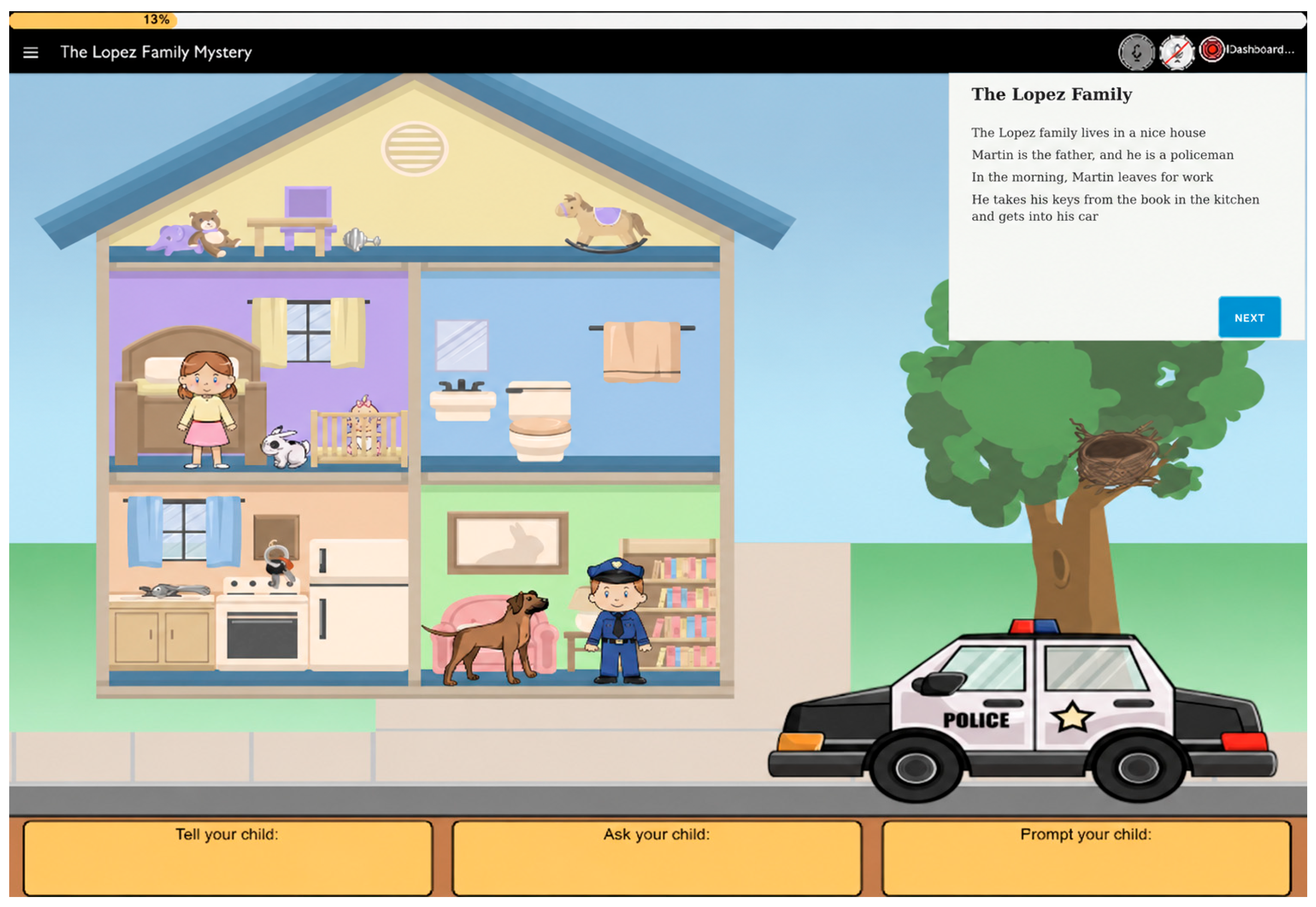
The app presented text and images like a child’s picture book, but on a touchscreen device (Chromebooks, see
Figure 1). The app included three interactive storybooks for preschool-aged children:
The Best Farm,
The Lopez Family Mystery, and
A Celebration to Remember. Each storybook was organized into multiple chapters.
The Best Farm consisted of seven chapters,
The Lopez Family Mystery included six chapters, and
A Celebration to Remember contained six chapters. Across the three storybooks, the app provided a total of 19 chapters. For
The Best Farm and
The Lopez Family Mystery, each chapter comprised two pages, whereas chapters in
A Celebration to Remember ranged from three to five pages in length (see
Table S1).
The app had embedded conversational prompts to encourage parents and children to talk about the storybook content. There were three types of prompts, and each page included all three prompt types. To view a prompt, caregivers clicked on the corresponding prompt button, which revealed the prompt text; they could then click the button again to hide the prompt.
Statement Prompt: Parent is encouraged to go beyond the content of the page (e.g., “Tell your child: the names of some animals on the farm”).
Question Prompt: Parent is encouraged to ask a question related to the page (e.g., “Ask your child: What are the animals doing?”).
Elaborative Reminiscing Prompt: Parent is encouraged to relate the story to a personal experience (e.g., “Prompt your child: Tell me about a time when you saw animals [for example, at the zoo, the store, the park, the yard]”).
These first two types of prompts (statements and questions) aimed to facilitate DR, while the last prompt aimed to facilitate ER. Parents were encouraged to use the app at least twice and to read the storybooks several times. However, we did not prescribe how many times the storybooks, chapters or pages should be read, or the prompts should be revealed. Given that parents were encouraged to read each storybook more than once, we developed three sets of conversational prompts for each prompt type (statements, questions, and elaborative reminiscing prompts), one for each potential reading, with the second and third sets designed to be of increased cognitive demand relative to the first set (for a similar procedure, see
Reese et al., 2023). For example, during the first reading of a
Celebration to Remember, an elaborative reminiscing prompt invited parents to ask children, “Tell me about a time you prepared for a big event.” During the second and third readings, the prompts increased in emotional and reflective complexity; for example, “Tell me about a time when you went to an event, and it made you happy” or “Tell me about a time when you were sad that you had to prepare something.” As a result, families encountered varied and more challenging conversational prompts if they read a storybook more than once. Parents were aware that if they read the same storybook more than once, they would get a new set of conversational prompts embedded in the text. See
Table S2 for examples of conversational prompts.
Table S3 presents the number of conversational prompts designed for each type (i.e., statement, question, or elaborative reminiscing prompt) across the storybooks.
2.4. Measures
2.4.1. App-Use Predictors
Number of total conversational prompts. Total number of conversational prompts revealed by dyads to reveal them, across all stories during app use.
Number of unique conversational prompts. Distinct conversational prompts clicked on by dyads to reveal them, across stories during app use, regardless of how many times each conversational prompt was clicked.
Average conversational prompt time. This variable was calculated by dividing the total time spent on all conversational prompts by the total number of prompts. Time starts from the on-clicking of the conversational prompt until the next action (e.g., clicking on another prompt, or clicking to the next story page), and was aggregated to the dyad level. Total prompt time was defined as the cumulative time dyads spent on each conversational prompt they accessed across stories. Given that the app is designed to support DR and ER, both of which emphasize interactive, back-and-forth exchanges between the dyad, we prioritized average prompt time over total reading time. This variable captures the depth and duration of engagement per conversational prompt, reflecting how much time a dyad spent engaging in decontextualized talk (e.g., discussing, elaborating on, or reflecting about the prompt), rather than simply how long they used the app overall.
2.4.2. Child Literacy Skills
Expressive Vocabulary. Two items taken from the International Development and Early Learning Assessment were used (IDELA;
Save the Children, 2017;
Pisani et al., 2015). The researcher asked the child to name foods that can be bought at a supermarket and then to name animals they knew. For each prompt, the child was encouraged to generate as many responses as possible. If a child paused for five seconds or more, the researcher encouraged the child to continue by saying: “Can you think of any others?” If the child named more than 10 foods or animals, they were asked to stop. A total score was calculated as the proportion of correct responses out of a maximum of 20 points (10 points for foods and 10 for animals). Prior research has demonstrated strong internal consistency and reliability for this measure (Cronbach’s α = 0.77; test–retest reliability
r = 0.79; intraclass correlation coefficient [ICC] = 0.88;
Pisani et al., 2015). In addition, Latino children’s performance on these items positively relates to performance on standardized measures of vocabulary, letter–word identification, and emergent writing (
Leyva et al., 2023).
Story Comprehension. The researcher read an unfamiliar storybook to the child. Half of the children were read
Hemi’s Pet at pre-test and
Hemi and the Shortie Pyjamas (
de Hamel, 1987,
1996) at post-test, and the other half of children received the opposite order of presentation of books. The researcher and the child looked at the book together and turned the pages as the researcher read. After the reading of the story, the researcher asked the child six open-ended comprehension questions focusing on characters, plot, and emotional inferences. The Online
Supplementary Material (Table S4) lists the questions used. Children’s answers were audio-recorded and later transcribed and scored for accuracy. Each correct response was given 1 point, with a maximum score of 6 points per book at pre-test and post-test (see
Reese et al., 2023 for a similar procedure). To check for consistency, 20% of the audio-recordings were transcribed and scored by more than one research assistant and the remaining 80% were independently transcribed and scored. The average inter-rater reliability for both transcription and scoring was ≥0.80.
Story Retelling. After asking the story comprehension questions, the researcher introduced a puppet, explaining that the puppet had been hiding in a bag and had not heard the story. The researcher then asked the child to retell the story to the puppet. The researcher prompted the child by saying, “Here, I can help you start. It’s called _____ (book title),” and then turned the pages of the book as the child narrated. Using the puppet’s voice, the researcher praised the child’s responses and encouraged further narration until the child either stopped responding or indicated that the story was finished. The researcher was trained to use a standardized set of prompts, with a maximum of two “empty” prompts per page such as “Oohhh,” “Mmm,” and “Tell me more” (see
Reese et al., 2023 for a similar procedure).
Children’s retellings were audio-recorded. Like the story comprehension task, 20% of the audio-recordings of retellings were transcribed by more than one research assistant and the remaining 80% were independently transcribed. We coded for three features: word types, word tokens, and story memory. Word types are a measure of lexical diversity and represent the total number of unique words produced by the child during the retelling, defined as uninflected word roots (
MacWhinney, 2000). Word tokens are a measure of lexical volume and represent the total number of words produced by the child during the retelling, regardless of repetitions (
MacWhinney, 2000). Both word types and word tokens were automatically calculated using the Child Language Analysis (CLAN) software (
MacWhinney, 2000). Children received credit for every word produced, regardless of the language used (e.g., English or Spanish). Story memory was scored by researchers, with 20% scored by more than one research assistant and the remaining 80% were scored by one research assistant. To score for story memory, each child’s utterance was compared to the text. The child received 1 point for correctly recalling the gist of each proposition. The total number of possible propositions was 39 for
Hemi’s Pet and 60 for
Hemi and Shortie Pyjamas. Child’s story memory units were summed to create a total score at pre- and post-test.
2.4.3. Demographic Information
Parents completed a survey reporting family demographic information, including the child’s age and gender, parents’ highest level of education, family income, whether parents were born in the United States, and the primary language spoken at home.
2.4.4. Covariates
The app tracked several usage metrics for each parent–child dyad. Although these metrics were not the primary focus of the present study, they could influence the outcomes of interest. Therefore, we included them as control variables in the analyses. Here we used four variables: number of books read (each book representing a complete story), number of chapters read per book, number of times dyads logged into the app, and the total reading time.
2.5. Missing Data
We had complete data at pre- and post-test on children’s expressive vocabulary, story comprehension, and two measures of children’s story-telling (word types and word tokens). For story memory, there was 5% missing data at the pre-test and 0% missing data at post-test. We dealt with missing data using pairwise deletion. We had 11 children who completed the story comprehension task and the story memory task and received a score of 0 both at pre- and post-test because they provided no answer or answered: “I don’t know.” Thus, while the tasks were administered, the children did not engage in them due to being shy or distracted. Hence, for these two outcomes (story comprehension and story memory), our analytical sample was 29.
2.6. Data Analytic Approach
Previous research has suggested that the association between engagement, as measured by time on task, and learning outcomes may be nonlinear. Specifically, moderate levels of engagement may be most beneficial, whereas extended time spent on a task may indicate that learners are struggling, disengaged, or unable to progress effectively (
Aghajari et al., 2020). Therefore, we estimated both linear and quadratic models to examine potential curvilinear associations between app use and children’s literacy outcomes.
Based on prior recommendations, a sample size of at least 25 participants is considered adequate for regression analyses, granted regression assumptions are not violated (
Jenkins & Quintana-Ascencio, 2020). We first tested linear relations between each app-use predictor and children’s literacy scores at post-test, controlling for children’s pre-test literacy scores and covariates. See Preliminary Analyses in the
Section 3 for more information on how covariates were selected. Next, we examined nonlinear associations using quadratic regression models. Although piecewise regression was initially considered, the analytic sample size for two of the outcomes (
N = 29) was underpowered for this approach, which typically requires a minimum of 40 participants (
Ryan & Porth, 2007). Importantly, we evaluated the assumptions for each final regression model including homoscedasticity, normality of residuals, multicollinearity, and influential observations. Results of these model diagnostics (i.e., residual plots, Q–Q plots, variance inflation factors, and Cook’s distance) indicated no major violations of regression assumptions. All analyses were conducted using R (version 4.4.1;
R Core Team, 2024).
4. Discussion
Parents play a central role in the development of preschoolers’ literacy skills (
van Kleeck et al., 2006;
Vygotsky, 1978). In this pilot study of a storybook app with embedded conversational prompts, we aimed to encourage Latino parents to engage in conversations with their children about the story content, following DR strategies, and conversations that went beyond the story content, following ER strategies. These DR and ER strategies are known to benefit children’s literacy development (
A. G. Bus et al., 1995;
Dowdall et al., 2020;
Mol et al., 2008;
Waters et al., 2019;
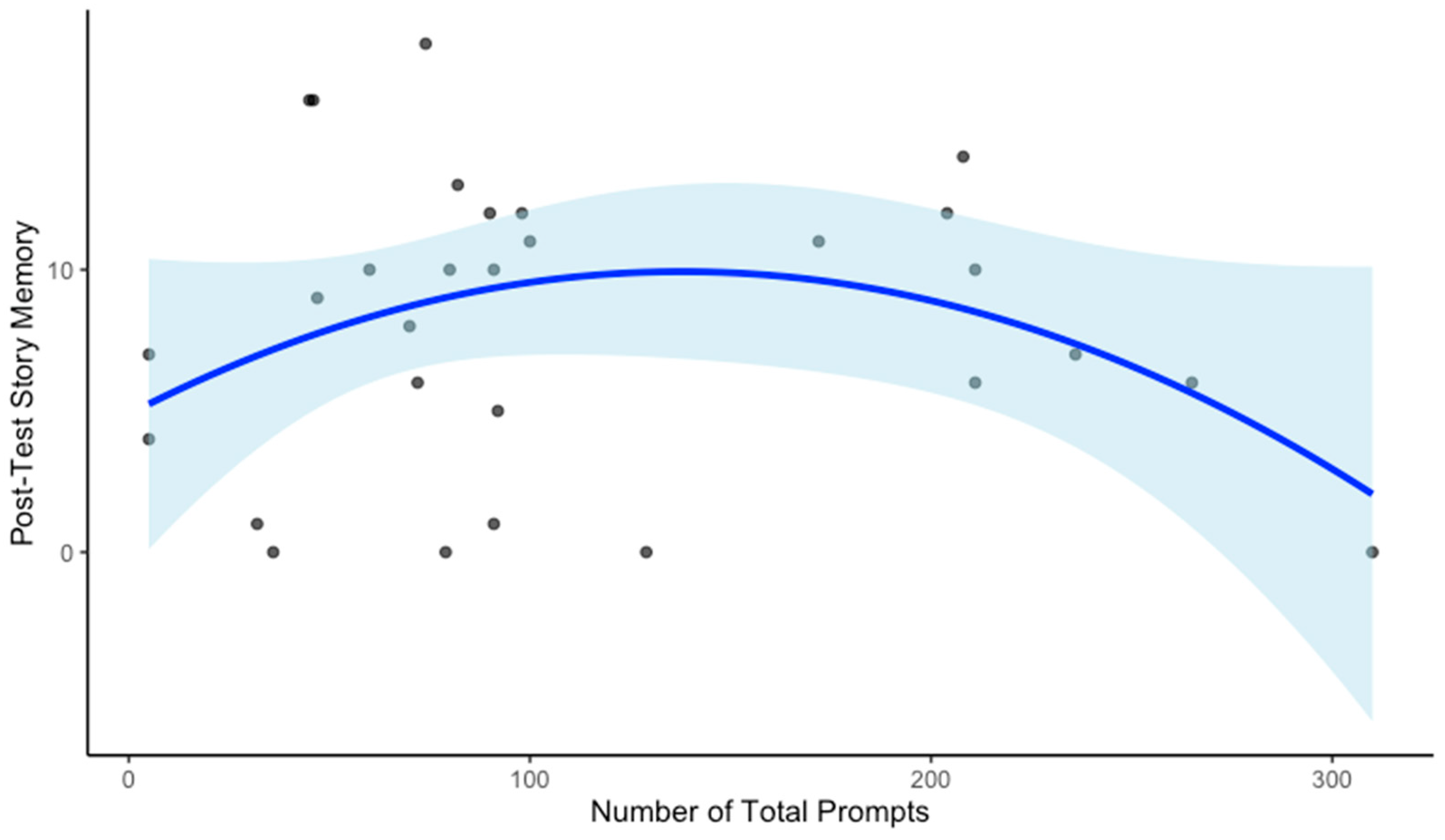
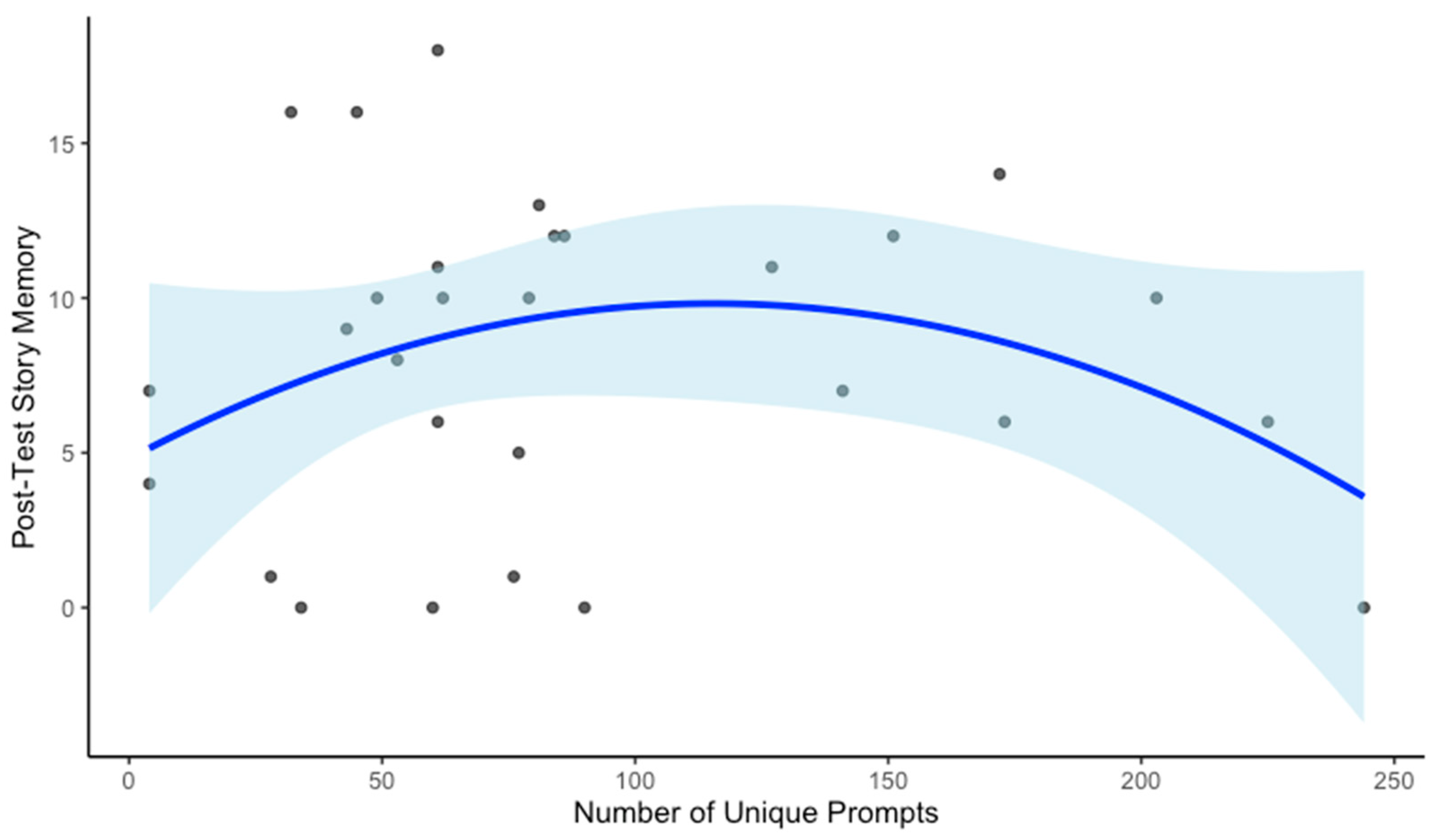
Wu & Jobson, 2019). Given the pilot nature of the study, we explored preliminary evidence of the program’s potential by examining associations between conversational prompt engagement and gains in Latino preschoolers’ literacy outcomes. Conversational prompt engagement was used as a proxy for parent–child interaction. We found positive associations between the total number and variety of conversational prompts (i.e., unique prompts) revealed by the dyad and gains in one measure of children’s story retelling skills (story memory), but these associations were quadratic, rather than linear. Moderate levels of total number and variety of conversational prompts revealed were positively associated with advanced children’s story memory. In contrast, very high or very low levels of total number and variety of conversational prompts revealed were associated with less advanced children’s story memory. No associations were observed for average time spent on conversational prompts. Furthermore, no associations were found between conversational app engagement and other measures of children’s literacy outcomes.
This study contributes to the literature on digital family literacy interventions by underscoring the importance of considering not only whether parents and children engage with app-based conversational prompts but also their level of engagement. We observed a nonlinear association—specifically, an inverted U-shaped association—between total and variety of conversational prompts revealed and child story retelling skills. There are at least two plausible interpretations for this pattern of association. One interpretation might be that extended time spent on a task beyond a certain threshold may reflect unproductive cognitive effort, such that learners are either struggling without making progress or have become disengaged (
Aghajari et al., 2020). Another interpretation is a digital saturation effect: excessive engagement in digital tools is likely to overwhelm the users and produce a cognitive overload (
Chounta & Carvalho, 2019). While these might be plausible explanations for the observed inverted U-shaped association, caution should be exercised. Given that this study employed a one-group pretest–post test design, improvements in children’s outcomes at post-test cannot be confidently attributed to the intervention. For example, families who accessed a very large number of conversational prompts may have differed systematically from other families in ways unrelated to the intervention, which could have contributed to the observed associations. Nonetheless, it is encouraging that our findings align with prior work integrating DR and ER strategies whereby positive associations with preschoolers’ story retelling skills were reported (
Reese et al., 2023). This suggests that an intervention integrating DR with ER strategies might be promising, not only for New Zealand families of preschoolers (the target population of prior work) but also Latino families in the U.S.
We found that the average time spent on conversational prompts was not associated with gains in children’s literacy skills, unlike the number and variety of conversational prompts revealed. This result makes sense given that the number and variety of conversational prompts likely reflect children’s great exposure to diverse linguistic input and opportunities for practicing language skills in interactions with others, a central mechanism through which parents support children’s literacy development (
Reese et al., 2010;
M. L. Rowe, 2008;
Sénéchal & Young, 2008). However, moderate time spent on conversational prompts may not necessarily indicate higher-quality conversations.
Finally, we found no associations between conversational prompt engagement and gains in Latino preschoolers’ expressive vocabulary, story comprehension outcomes, and other story retelling skills (word types and word tokens). These findings contrast with prior work documenting positive associations between engagement in DR (
Dowdall et al., 2020) and ER strategies (
Peterson et al., 1999;
Reese & Newcombe, 2007;
Reese et al., 2010) and children’s expressive vocabulary and positive associations between e-book engagement and expressive vocabulary (
Savva et al., 2021;
A. Bus et al., 2026). It is possible that the expressive vocabulary assessment we used was not sensitive to changes in children’s expressive vocabulary skills. Prior work used standardized assessments, which are more comprehensive of children’s overall vocabulary knowledge, whereas we used a non-standardized assessment that focused on animal and food vocabulary knowledge. However, our findings are aligned with previous work whereby no associations between e-books engagement and children’s story comprehension skills were found (
Savva et al., 2021;
A. Bus et al., 2026).
4.1. Limitations
Some limitations should be considered when interpreting the study findings. First, because we used a pre–post test design, rather than experimental, no causal inferences can be drawn. The observed associations between app use and child outcomes should be interpreted as preliminary and descriptive. To establish causal pathways between app use and child literacy outcomes, future research should use randomized controlled trials. Second, the sample size was relatively small, which limits statistical power and we estimated multiple regression models, which may increase the risk of Type I error, overfitting the models, and reducing the stability of parameter estimates. Replication with larger samples is needed to increase confidence in the findings and strengthen modeling of nonlinear patterns. Third, participants were primarily immigrant families from low-income backgrounds, coming mostly from Mexico, Guatemala, Venezuela, and Colombia. Caution should be exercised when generalizing the findings to other Latino populations in the United States. Fourth, we relied on indices of conversational prompt engagement (e.g., the total number and variety of prompts revealed) as indirect indicators of parent–child interactions during app use. Although these metrics captured engagement with the app, they did not directly assess whether and how parents implemented the ER and DR strategies in response to the prompts. Future research should directly assess the extent to which parents implement ER and DR strategies to better understand how variability in parental use of these strategies relates to children’s literacy skills. Fifth, we did not incorporate measures of families’ experiences with the app, including parents’ perceptions of its usability and acceptability. Collecting this information is important to better align the program with parents’ needs and preferences during the pilot phase and before evaluating its efficacy using experimental designs. Finally, we examined a limited set of literacy skills (i.e., expressive vocabulary, story comprehension, and story retelling skills). Future studies should include a broader range of literacy measures (e.g., letter–word identification and phonological awareness), as shared book reading has also been linked to those literacy skills (
Sim & Berthelsen, 2014).
4.2. Implications for Digital Family Literacy Interventions
Our work highlights the importance of designing digital family literacy interventions that prioritize parents and encourage them to jointly engage with apps together with their children. Digital family interventions are not all designed equally (
Hirsh-Pasek et al., 2015). Our job as researchers and developers is to design conceptually grounded and culturally appropriate digital tools in a way that empowers parents, rather than replace them, in supporting their children’s learning (
Dore et al., 2018;
Korat & Shneor, 2019). For example, digital tools that encourage family to create their own stories, like our elaborative reminiscing conversational prompts did, may foster not only literacy development but also family closeness and wellbeing (
Fivush et al., 2006;
Salmon & Reese, 2016;
Wareham & Salmon, 2006). Digital tools should also consider parents’ digital learning needs. Parents are not necessarily technology-savvy and might need time to get familiar with how to use the app in ways that are educational and beneficial for their children’s learning (
Barr, 2019). Researchers should provide families with best practices on uses and misuses of digital tools to foster a “family media culture,” for example, by using the American Academy of Pediatrics (AAP) Family Media Use Plan (
Garrido et al., 2026).
Finally, our findings suggest that designers should consider strategies that support high-quality interactions, such as curating appropriate prompts, incorporating guidance for parents on how to extend or adapt prompts into richer conversations, and reducing cognitive load. Understanding in real-time how parents use prompts could inform how the system adaptively supports parent–child reading (
Chennupati et al., 2025). As generative AI becomes more widely used, it may open new opportunities for how a system might employ AI to support parent–child reading, such as generating appropriate example prompts in the moment based on the parent–child conversations. However, it also raises new considerations with respect to privacy during app use, and ensuring that the AI supports the parents, rather than replacing them.



 ,
,