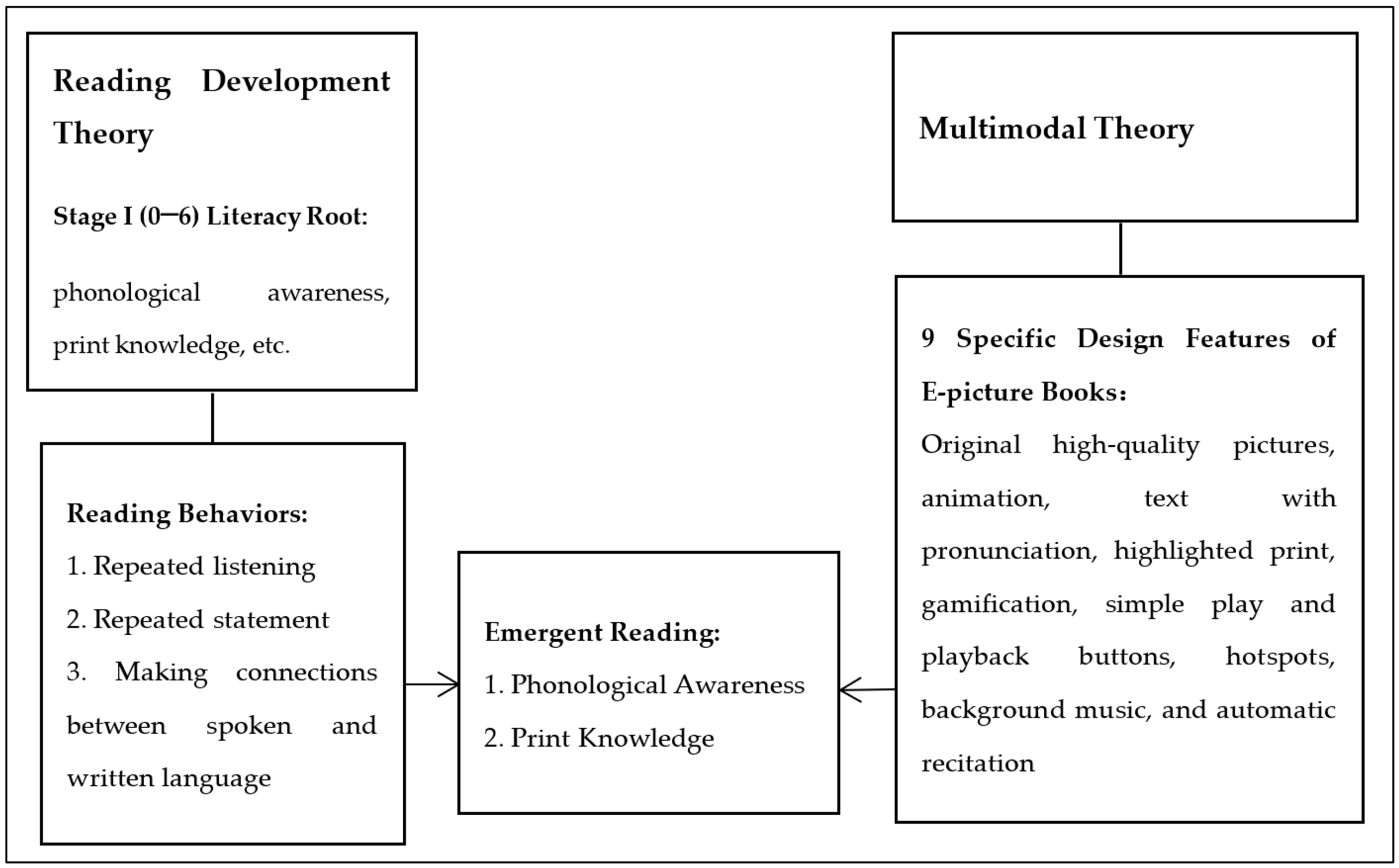
To address research question 2, we analyzed observational data collected during the four-week intervention period and semi-structured interview data gathered from six preschoolers in the e-picture-book group after the intervention.
3.2.1. How Do the SDFs Support Chinese 5-Year-Old Preschoolers’ PA?
Our observations revealed that five SDFs—simple play and playback buttons, automatic recitation, text with pronunciation, highlighted print, and hotspots—elicited behaviors supportive of PA development.
Table 9 presents the types and frequencies of these behaviors across the two e-picture books.
The semi-structured interview protocol consisted of nine questions designed to explore how the five SDFs supported PA in preschoolers. In accordance with the methodology outlined by
Miles et al. (
2014), the data were analyzed through coding and categorization. Observation and interview data were merged for triangulation and then organized and coded according to the five SDF types. Data segments with similar meanings were assigned the same code.
These codes were then grouped into four categories, from which two overarching themes emerged.
Theme 1: Auditory Learning
Auditory learning refers to the ways in which SDFs, particularly simple play and playback buttons, automatic recitation, text with pronunciation, highlighted print, and hotspots, help preschoolers acquire PA-related knowledge and skills through repeated, focused listening and sound manipulation (e.g., identifying syllables, onsets, rhymes, and tones). This theme comprises two categories.
Category 1. Enhanced Listening
Features such as simple play and playback buttons, text with pronunciation, highlighted print, and hotspots encouraged preschoolers to repeatedly click the screen to listen to specific sentences and pronunciations. As shown in
Table 9, “repeated clicking to listen” was the most frequent behavior observed (with 124 occurrences across both books). Hotspots and text-with-pronunciation features elicited repeated-listening behavior among all six children, with hotspots generating the highest number of clicks. The simple play and playback buttons triggered this behavior in only two children (C1 and C6). An example is provided below:
The e-picture book automatically flipped to ant rowing. She clicked on the small river twice and then the playback button but quickly switched to the next page. (C6E2T3)
Other children (C1 and C2) expressed similar enjoyment in clicking hotspots to hear sounds or using playback buttons to listen to sentences again. In contrast, the automatic recitation feature, while providing a consistent model of correct pronunciation, did not elicit repetitive listening behavior during the observation period. Nevertheless, most children (C1, C2, C4, C5, and C6) stated in the interviews that they enjoyed the narration and found the volume appropriate.
Category 2. Manipulating Pronunciation
Features such as highlighted print and hotspots helped the preschoolers manipulate pronunciation, particularly in tasks involving splitting and distinguishing sounds. For instance, Child 5 made the following note during an interview:
“I can recognize these words. I will connect three words and click on them.”
By isolating and emphasizing each character, he could break words into smaller syllables, improving his ability to manipulate sounds in rhyming or blending tasks. Similarly, Child 2 responded to another interview question by saying:
“I like it. Because I want to hear what he is saying.”
This interaction helped him distinguish between different sounds, thereby supporting his phonological awareness.
Theme 2: Phonetic Practice
This theme highlights how features such as automatic recitation, text with pronunciation, highlighted print, and hotspots in e-picture books encourage preschoolers to practice pronunciation and engage in oral language behaviors. These interactions help them focus on and manipulate the words and sentences within the story. This theme is divided into two categories.
Category 3. Repeatedly Practicing Pronunciation
The “text with pronunciation” and “highlighted print” features prompted the preschoolers to repeat words during reading. Examples from the observation records are given below:
She repeatedly clicked on the title of the book and then said aloud, “A Taste of the Moon.” (C1E1T1)
After listening to the sentence, he repeated, “They still can’t get the moon.” (C5E1T1)
As Child 1 and Child 5 repeated the title and phrases, their pronunciation and fluency improved. This repetitive practice helped them enhance their pronunciation, solidify their understanding of word sound structures, and ultimately enhance their PA.
Category 4. Strengthening Oral Expression
The observations showed that the preschoolers’ oral expression frequently involved questioning, describing, and predicting. These activities helped them improve pronunciation, including recognizing syllables, onsets, rhymes, and tones in Chinese characters, thereby enhancing their phonetic skills.
The automatic recitation feature allowed the preschoolers to see pictures and words while hearing their pronunciation. Child 1 and Child 2 described images while listening to the automatic reading of e-picture book 2:
She said happily, “The rainbow-colored flower is not dead.” (C1E2T3)
He listened and said, “It’s snowing.” (C2E2T3)
By narrating what they saw or heard, the children practiced using language to express their thoughts, reinforcing both phonetic and vocabulary skills. In addition, hotspots were the most engaging feature with respect to encouraging preschoolers to speak. This interactive element kept all six children engaged and allowed Child 1, Child 2, and Child 3 to predict sounds and words based on context, reinforcing phonetic practice through repetition and prediction. A sample observation is given below:
He repeatedly clicks on the little fish to make it swim and talk. The child looks up and says, “The moon is fake.” (C2E1T1)
Overall, the preschoolers enjoyed the click-and-turn functionality in the e-picture books, which provided them with more opportunities to speak and practice oral expression.
3.2.2. How Do the SDFs Support Chinese 5-Year-Old Preschoolers’ PK?
The observations revealed that two SDFs—text with pronunciation and highlighted print—were particularly effective in enhancing preschoolers’ print knowledge by causing them to engage with the text in meaningful ways. These features encouraged behaviors that support PK, such as saying something again and repeated clicking to listen.
Table 10 reports the frequency of these behaviors across the two e-picture books.
Based on a comparison of positive reading behaviors, Child 2 and Child 5 were selected as key examples for the use of “text with pronunciation” in supporting PK, while Child 1 and Child 5 were chosen for “highlighted print”. Three interview questions addressed these two SDFs to further examine their role in supporting PK. Data from observations and interviews were triangulated, coded, and categorized, leading to the identification of two key themes.
Theme 3: Repetitive Practice
Repetitive practice with text-with-pronunciation and highlighted print features encouraged the preschoolers to engage with the text repeatedly, e.g., by listening to the same text multiple times or repeating words. This practice strengthened their ability to recognize characters and increased their awareness of character structure.
The observations showed that both SDFs prompted preschoolers to actively interact with the text through behaviors such as repeatedly clicking on text or clicking the screen. Three children (C1, C2, and C6) clicked on highlighted print four times, and all six children clicked on text 27 times to hear how it should be pronounced. C1, C2, and C5 repeated the text six times, and two children (C1 and C5) repeated highlighted print twice. The following is an illustrative observation:
The child wrapped his hand around the tablet, opened the picture book, listened to the book title on the cover, and repeated the book title, “The Rainbow Flower again”. (C5E2T4)
By repeatedly listening to the pronunciation while seeing the corresponding text, Child 5 better internalized the connection between sounds and symbols. This is especially beneficial for Chinese preschoolers, helping them recognize the unique shapes and sounds of Chinese characters. In an interview, Child 5 confirmed this:
Researcher: Did you read these Chinese characters while listening to this story?
Child 5: I can recognize these words. I will connect three words and click on them.
Researcher: How do you think e-picture books can help you recognize this Chinese character?
Child 5: I can also draw it and have the e-book read it out.
This finding aligns with observational data showing that the children used the tablet to repeatedly click and listen in order to learn how to pronounce unfamiliar characters. However, most of the preschoolers (C2, C3, C4, C5, and C6) clicked quickly without fully listening to the text, sometimes casually touching the screen rather than intentionally engaging with the text.
Theme 4: Auditory–Visual Integration
Auditory–visual integration in e-picture books refers to the combination of auditory (sounds and spoken words) and visual (written text and images) information to help preschoolers better understand the meanings of Chinese characters. This integration is crucial for developing PK, as it helps children connect the sounds they hear with the words they see, thereby enhancing character recognition.
This theme emerged from the interview responses. Some children (C1, C5, and C6) indicated that they could combine pronunciation with the text in the e-picture books. For instance, Child 1 stated the following:
Yes, I can find these words. When I click them, they can produce pronunciations.
This shows that Child 1 was able to easily follow along with the text while listening to the pronunciation, supporting both auditory and visual learning.
In contrast, other preschoolers (Children 2, 3, and 4) sometimes relied on the accompanying pictures to infer the meaning of unfamiliar words. Note the example below:
Researcher: How do you think e-picture books can help you recognize this Chinese character?
Child 2: Guess, look at the shape and guess.
Child 3: Look at the painting there, there is an elephant there, and there is an elephant next to this character.
Child 4: You can look at the pictures next to these words. Guess from the picture.
While these children made use of visual cues to infer word meanings, such guesses were often approximate, and the children did not always consciously attempt to memorize the characters.
Highlighted print also played an important role in integrating auditory and visual information. When a character was highlighted, it drew the child’s attention, making it easier to focus on specific information. For example, Child 1 noted the following:
Yes, I can find these words (the highlighted print). When I click them, they can produce pronunciations.
In this case, the highlighted print served as a bridge between the visual representation of a character and its corresponding sound, helping Child 1 actively engage with the text and associate the characters with their correct pronunciations.