2.1. Higher Education’s Impact on Economic Development
At the theoretical level, the mechanism by which higher education drives regional economic development unfolds primarily through two core pathways: talent supply and technological innovation. These two pillars interact synergistically and together form the critical driving force for economic growth (
Bertoletti et al., 2022).
In terms of talent supply, higher education boosts population agglomeration and attracts population inflow through expanded enrollment and improved educational quality, exerting a positive effect on the upgrading of industrial structures (
Xiao et al., 2023). Human capital theory posits that higher education cultivates high-caliber talents, enhances the knowledge and skill levels of the labor force, and thereby drives productivity growth and economic expansion. Existing studies have confirmed a positive correlation between the development of higher education institutions and the level of regional human capital (
Schultz, 1961;
Orlando et al., 2019). Regional economic growth theory further emphasizes that, as an integral component of the regional innovation system, higher education fuels technological progress and industrial upgrading, driving regional economic development.
J. L. Yang (
2023) used cross-country data to verify that the relative scale of higher education plays a significant role in promoting the construction of major global talent hubs and innovation highlands.
Wu (
2022) pointed out that the quality of higher education must be based on a certain quantity. The continuous expansion of higher education in China has consolidated the foundation for building a strong country concerning human resources. This theoretical logic can be summarized as “the expansion of higher education scale→increase in talent supply→improvement of labor productivity→economic growth”.
In the realm of technological innovation, higher education institutions, as the cradle of original innovation, elevate the level of regional human capital through research and development (R&D) activities (
Abel & Deitz, 2012) and drive technological transformation and industrial evolution. Schumpeter’s innovation theory stresses that technological innovation is a pivotal driver propelling a country’s economic development to a higher stage, with higher education serving as the core engine of technological innovation. Neoclassical growth theory identifies capital and labor as the fundamental factors of economic development, a theory further advanced by Romer, who emphasized that knowledge accumulation and technological innovation are the core elements of economic development (
Romer, 2010), while human capital is the key to enabling technological innovation. Technological innovation not only directly boosts productivity and raises the potential economic growth rate, but also fosters new economic growth poles, which gradually evolve into strategic pillar industries (
Yi, 2018) and expand the space for economic growth. From the perspective of policy evolution, China has consistently emphasized the “coordination between the innovation chain and the industrial chain”. Evolving from “organic connection” and “precision docking” to “seamless integration”; this reflects the deepening integration mechanisms of education, science and technology, and industry. The theoretical logic can be summarized as “expansion of higher education scale→agglomeration of scientific and technological innovation resources→technological transformation and industrial upgrading→economic growth”.
The rapid development of the new round of scientific and technological revolution and industrial transformation has created unprecedented opportunities for education, strengthening the key role of higher education in gathering innovation factors and leading industrial transformation.
2.2. Relationship Between Higher Education and Economic Development
Existing studies have generally recognized that higher education, as a core carrier of knowledge creation, talent cultivation, and scientific and technological R&D, exerts a multi-path radiating effect on economic development. Based on different research perspectives, the relevant research results can be categorized into the following three types.
The first type focuses on how higher education influences economic development through scientific and technological innovation. For example, Zhao (
L. Zhao et al., 2025) highlighted that enhancing higher education institutions is key for knowledge innovation and achievement transformation, which can help improve the overall innovation level of the country. Tian and Li (
Tian & Li, 2024) revealed through a comparative study of higher education between China and the United States that the agglomeration of higher education has a significant promoting effect on regional innovation and is coordinated with the socioeconomic development of regions. Zhou et al. (
G. L. Zhou et al., 2023) confirmed that raising the agglomeration level of high-quality educational resources in central cities can enhance innovation capacity and construct a regional innovation system. From the perspective of the digital economy, Sun and Wan (
J. H. Sun & Wan, 2024) demonstrated the mediating role of scientific and technological innovation in the process of higher education affecting regional economic development.
The second type centers on the impact of higher education on economic development through the industrial structure. Education acts as a booster for industrial upgrading; the expansion of educational scale and the improvement of educational quality will exert a stronger radiating and driving effect on the quality improvement and efficiency enhancement of regional economies (
Xu et al., 2025).
Q. Yang and Omar (
2026) have found that educational quality and structural investment are important drivers of the talent chain performance. The service industry and knowledge-intensive activities play a significant role in absorbing highly skilled labor and supporting regional industries. Better synchronization of educational reform and industrial upgrading is conducive to achieving sustainable development goals.
Lv et al. (
2023) compared the development of higher education and industry between China and Germany and found that China’s industrial development level lags behind its higher education system, suggesting that the leading function of higher education in industrial structure upgrading should be strengthened. Studies have shown a mismatch between the scale of higher education and the industrial and economic structures in China, indicating that higher education should not only adapt to economic development but also take a leading role in it.
The third type emphasizes the coupling and coordinated development of education, science and technology, talent, and the economy. Gao and Hai (
Gao & Hai, 2024) argued that the coupling and coordination of higher education, talent, scientific and technological innovation, and the regional economy help unleash the advantages of human capital and form a pattern where talent innovation drives economic development. Liu and Yao (
Y. L. Liu & Yao, 2025) confirmed that optimizing the structure of general and vocational education and improving the degree of coupling and coordination with high-quality economic development can narrow the gap in regional economic development. Based on the observational data from Denmark, Akcigit et al. (
Akcigit et al., 2023) profoundly revealed the coupling logic among education, technology and talent, emphasizing that only through the innovative combination of education and technology policies can sustainable economic growth be achieved.
Overall, existing studies have revealed the impact of higher education on economic development from different dimensions, providing a solid theoretical and empirical basis for understanding the relationship between the two. However, most research results are limited to the analysis of a single perspective (e.g., scientific and technological innovation, industrial structure, talent cultivation) or coupling and coordination, lacking in-depth analysis of all factors and exploration of the influence mechanisms among them. Methodologically, most studies rely on theoretical deduction or partial empirical analysis, and there is a lack of simultaneous verification of the multi-path mediating mechanisms.
2.3. Operational Framework: From the Knowledge Triangle to the Integration of Four Chains
The Knowledge Triangle model proposed in the EU’s Lisbon Strategy provides a classic framework for understanding the socioeconomic functions of higher education. In the knowledge ecosystem featuring the coordinated development of education, research, and innovation, higher education undertakes the functions of cultivating innovative talents and conducting cutting-edge scientific research, and is closely related to national innovation (
Maasen & Stensakerb, 2011). The three elements do not follow a linear progressive relationship, but form an organic whole of mutual empowerment and circular reinforcement. Education provides talent reserves for research and industrial development, research supplies the sources and momentum for innovation, and innovation transforms knowledge into practical products, services, and business models to enhance economic and social value. However, this model implicitly embeds talent within the function of education and fails to highlight the value-added effect of talent as an independent factor. Meanwhile, it does not incorporate industry as an independent component into the analytical framework, making it difficult to reveal the whole process of transforming innovative achievements into actual productive forces.
The report to the 20th National Congress of the Communist Party of China systematically planned the work of education, science and technology, and talent development for the first time (
Chang et al., 2025). The integrated promotion of educational development, scientific and technological innovation, and talent cultivation holds a crucial strategic position in the construction of a new development pattern. By integrating educational, scientific, and technological resources and innovating the talent training system (
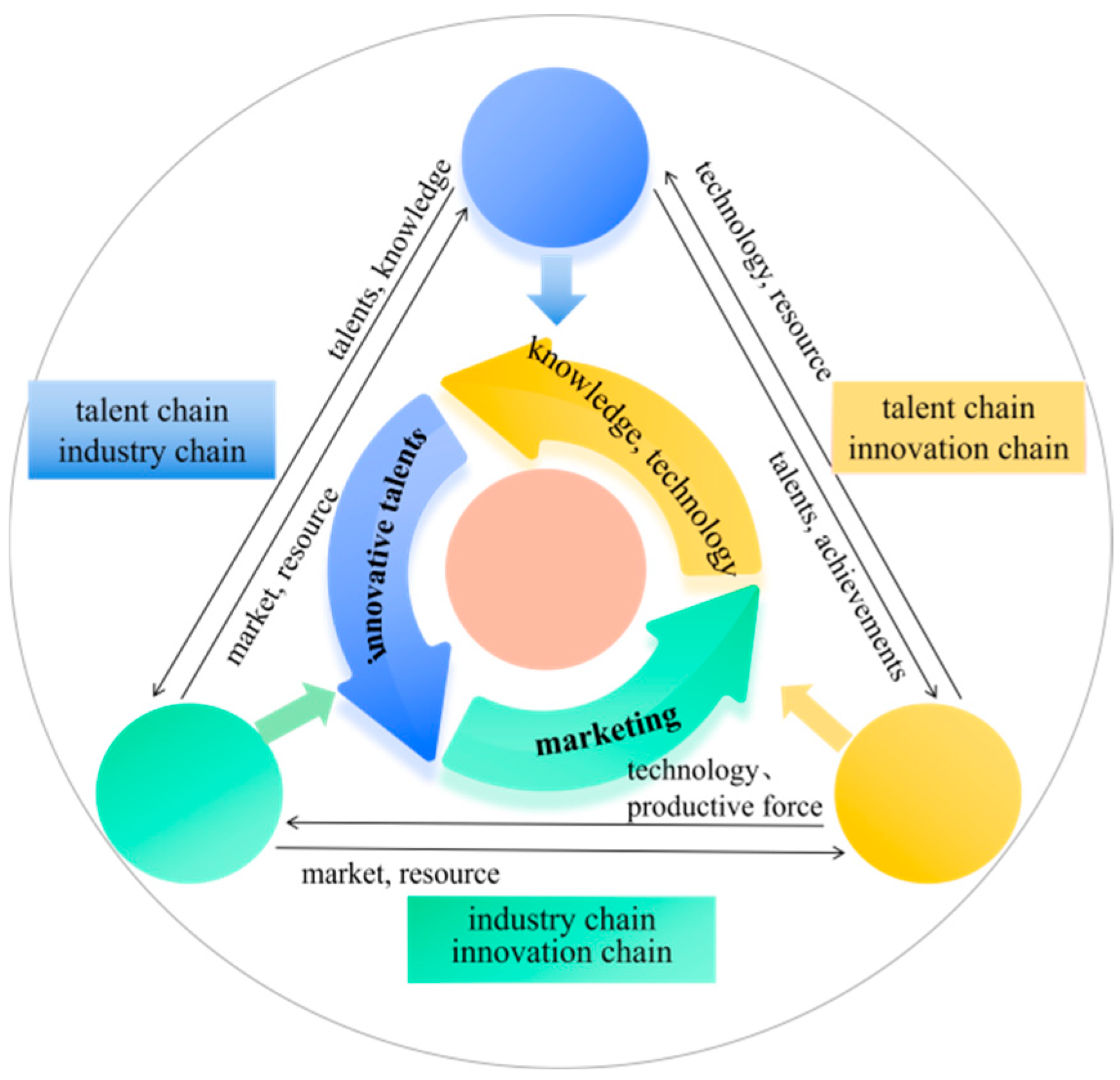
Du et al., 2024), human capital can be promoted to accumulate and transform efficiently and provide impetus for economic growth. Based on the above theoretical context and the national trinity strategy, an operational framework of “education, talent, science and technology, and industry” (
Figure 1) was constructed. Inheriting the core idea of the co-evolution of the Knowledge Triangle, this framework expands along two dimensions. It elevates talent from a function implicit in education to an independent analytical dimension, emphasizing its flow and value-added role among education, science, technology, and industry. It upgrades industry from a terminal recipient of innovation to a closed-loop feedbacker, revealing the mechanism through which industry feeds back resources to education and science and technology. The core operational logic of the framework is depicted as follows.
The framework uses the talent chain as the engine to build a human capital support system for the industry: relying on discipline construction, higher education cultivates general talents to consolidate the industrial foundation. Through the integration of science and education, as well as industry and education, it trains skilled talents to meet industrial demands. By implementing bachelor–master–doctoral integrated programs and customized high-level talent projects, it fosters top innovative talents to lead industrial upgrading. Industry then transforms from labor-intensive to knowledge-intensive, driving economic growth.
The framework uses the innovation chain as the driving force to lead industrial technological transformation: universities provide theoretical support for technological innovation in basic research. Through joint laboratories, engineering research centers, and other platforms, they transform research results into feasible technical solutions. With the support of national university science parks, technology transfer offices, and other institutions, they accelerate the transformation of achievements into real productive forces. Scientific and technological innovation can enhance industrial total-factor productivity through knowledge and technology spillover effects, support the construction of a modern industrial system, and ultimately achieve economic growth.
The framework uses the industrial chain as the carrier to form a closed loop of coordinated development: tax revenue growth and market demand generated by industrial development feed back into investment in education, science, and technology. On the one hand, industry provides educational technology products and practical venues for universities, promoting the precise alignment of talent cultivation with industrial needs. On the other hand, it offers market-oriented channels for scientific and technological achievements and guides the direction of scientific and technological research. Innovative achievements diffuse through the industrial chain, continuously strengthening industrial competitiveness.
This framework regards education, talent, science and technology, and industry as an organic whole, reveals the mechanism by which higher education, as a key hub, drives regional economic development through multi-chain integration, and provides a theoretical basis for empirical analysis.
2.4. Research Hypotheses
Based on the above theories and operational framework, three sets of core hypotheses are proposed.
Hypothesis H1 (talent supply path). Controlling for other factors, the expansion of higher education scale improves the level of talent supply, thereby promoting regional economic growth.
Hypothesis H2 (scientific and technological innovation path). Controlling for other factors, the expansion of higher education scale drives regional economic growth by promoting the agglomeration of scientific and technological resources.
Hypothesis H3 (industrial development path). Controlling for other factors, the expansion of higher education scale boosts economic growth by promoting the expansion of industrial scale.
Economic growth depends not only on external factors but also on internal knowledge accumulation and human capital within the economic system (
Ding et al., 2024), which are eventually transformed into GDP growth through technological innovation and improved production efficiency. On the one hand, the expansion of higher education scale directly affects the structure of talent supply and increases the proportion of highly skilled labor in a region; meanwhile, high-quality talent can facilitate the transformation of scientific and technological achievements (
Q. L. Liu et al., 2025). On the other hand, knowledge creation and scientific and technological R&D achievements help enterprises break through traditional production boundaries, accelerate technological iteration, and achieve cross-field and cross-industry integrated innovation. University clusters can also attract the agglomeration of upstream and downstream supporting enterprises, reshaping productive forces and production relations (
Song & Zhang, 2024).
In addition, during the preparation of this manuscript, generative artificial intelligence was used solely to assist with English language translation and polishing to improve linguistic accuracy and readability. All research content, data analysis, interpretations, and arguments in this paper are original and independently completed by the authors themselves.