Article

From Affordance to Autonomy Risk: A Dual-Pathway Model of Pedagogical Integration of Agentic AI in Higher Education Teaching

1
Amrita School of Business, Amrita Vishwa Vidyapeetham, Amritapuri, Kollam 690525, India
2
Amrita School of Business, Amrita Vishwa Vidyapeetham, Amaravati 522503, India
3
Graduate Institute of Library and Information Science, National Chung Hsing University, Taichung City 402202, Taiwan
4
Amrita School of Computing, Amrita Vishwa Vidyapeetham, Amritapuri, Vallikavu, Clappana 690525, India
*
Author to whom correspondence should be addressed.
Educ. Sci. 2026, 16(7), 1161; https://doi.org/10.3390/educsci16071161
Submission received: 12 June 2026 / Revised: 15 July 2026 / Accepted: 16 July 2026 / Published: 20 July 2026
(This article belongs to the Special Issue AI in Higher Education: Advancing Research, Teaching, and Learning)

Abstract

Agentic artificial intelligence (AAI) systems—capable of autonomously executing multi-step instructional tasks with minimal human oversight—are reshaping higher education while exposing the limitations of adoption- and continuance-centred models that treat value and risk as independent predictors. In an environment of widespread AI availability, the more meaningful question concerns how deeply educators integrate delegation-capable systems into teaching, assessment, and instructional workflows. Drawing on affordance theory, institutional theory, and automation risk perspectives, this study develops and tests a dual-pathway framework that conceptualises pedagogical integration as a dynamic value–risk trade-off embedded within institutional and contextual conditions. Survey data from 338 higher-education educators across Global North and South contexts, all of whom underwent a structured screening process to verify exposure to agentic rather than conventional generative AI systems, were analysed using PLS-SEM with robustness and endogeneity checks. The model explains substantial variance in pedagogical integration (R2 = 0.619), pedagogical value (R2 = 0.621), and autonomy risk (R2 = 0.615). Institutional AI capability is positively associated with pedagogical value and negatively associated with autonomy risk, whereas perceived AI complexity shows the opposite pattern. Higher pedagogical value is also associated with lower perceived autonomy risk (β = −0.445, p < 0.001), suggesting that educators may interpret system autonomy as a manageable pedagogical feature rather than solely as a source of concern. Regulatory clarity weakens the complexity–risk relationship, while AI legitimacy strengthens the value–integration relationship. Given the cross-sectional design, findings should be interpreted as associative rather than causal.

1. Introduction

Agentic artificial intelligence (AAI) is distinguished by its capacity to autonomously execute multi-step tasks, representing a notable leap forward in educational technologies (Cetinkaya & Krämer, 2026; J. Wang et al., 2025). For the purpose of this study, AAI refers specifically to systems capable of autonomous multi-step task execution with limited real-time human intervention, thereby distinguishing them from conventional prompt-response generative AI systems. Unlike traditional generative AI tools that primarily respond to user prompts, AAI systems operate with greater autonomy, fundamentally transforming human–technology interactions in educational contexts. This transition from assistive technologies to delegation-capable systems introduces new considerations for educators, who must assess not only the pedagogical benefits of AI but also the implications of transferring aspects of instructional control to intelligent agents (Shulner-Tal et al., 2025). Consequently, conventional technology evaluation frameworks centred on functionality, efficiency, or ease of use provide only a partial explanation of how AAI becomes embedded within higher education teaching practices. Although educators are increasingly experimenting with AAI tools, consistent and meaningful pedagogical integration remains uneven (Baig & Yadegaridehkordi, 2025; Zheng et al., 2025).
The distinction between initial experimentation and meaningful pedagogical integration is particularly important, as engagement driven by novelty does not necessarily translate into sustained instructional embedding. In an environment where AI capabilities are increasingly integrated into browsers, learning management systems, and productivity platforms, the question of whether educators continue to use AI has become less informative than understanding how deeply, reliably, and pedagogically AAI is integrated into teaching, assessment, and instructional decision-making (Cukurova, 2026; Silalahi et al., 2026). This shift redirects scholarly attention from adoption and continuance towards integration depth, emphasising how educators incorporate AAI into their professional practices rather than merely whether they use it (Singh & Paiva, 2025).
Pedagogical integration entails deeper cognitive, behavioural, and institutional commitments and is especially consequential in educational settings where technology directly influences teaching quality, student outcomes, and professional accountability. Existing research on AI in higher education has largely focused on initial acceptance through constructs such as perceived usefulness, perceived ease of use, and behavioural intention (Feng et al., 2025; Khanfar et al., 2025), as well as continuance intention as conceptualised by the Expectation Confirmation Model for IS (Bhattacherjee, 2001). While these perspectives provide important insights, they generally assume that positive expectation confirmation is sufficient for continued use and often treat enabling and constraining influences as independent factors. In the context of AAI, however, the issues of autonomy and instructional delegation introduce a fundamentally different evaluative challenge. AAI provides enabling affordances, including instructional automation and pedagogical augmentation, while simultaneously raising concerns regarding autonomy, accountability, and data privacy (Pikhart & Al-Obaydi, 2025; Park, 2026).
This duality suggests that pedagogical integration emerges not from isolated evaluations of benefits and risks, but from their dynamic interplay (W. Li, 2025). Nevertheless, prior studies have tended to examine these dimensions separately, offering limited insight into how they jointly shape sustained instructional engagement. To address this gap, the present study develops a mechanism-based framework that explains pedagogical integration through two interconnected pathways: a value pathway and a risk pathway. The value pathway captures educators’ evaluations of pedagogical benefits, whereas the risk pathway reflects concerns associated with delegating instructional responsibilities to autonomous systems. These pathways are further shaped by institutional support and regulatory environments, which represent important contextual conditions influencing educators’ experiences with AAI (Erdmann & Toro-Dupouy, 2025; Liu, 2025). By integrating these elements, the study offers a process-oriented perspective on pedagogical integration in agentic AI contexts (Anomah, 2025).
The study also considers broader institutional and societal influences. Regulatory clarity may reduce uncertainty by providing governance structures, while perceived AI legitimacy reflects the extent to which AAI use is regarded as professionally appropriate and socially endorsed (Colonna, 2026; Şen et al., 2026). These contextual conditions shape how educators evaluate the value–risk trade-off and, consequently, their willingness to embed AAI within instructional practice (Alfiras et al., 2025; García-López & Trujillo-Liñán, 2025). Pedagogical integration is therefore conceptualised as a dual-evaluation process situated within institutional and normative environments. Building on this discussion, the present study addresses the following research questions:
RQ1: 
How do institutional capability and perceived complexity jointly shape educators’ evaluations of AAI systems in terms of pedagogical value and autonomy-related risk?
RQ2: 
How do perceived pedagogical value and perceived autonomy risk interact to shape the depth and consistency of pedagogical integration of AAI into instructional practice in higher education?
RQ3: 
How do contextual boundary conditions, such as regulatory clarity and AI legitimacy, moderate the relationships within the value–risk mechanism governing pedagogical integration of AAI?

Contributions of the Study

This study makes four principal contributions to the emerging literature on agentic AI in higher education. First, it shifts the analytical focus from continuance intention towards pedagogical integration, emphasising the depth, consistency, and instructional embedding of AAI within teaching practice. Second, it develops a dual-pathway value–risk framework that conceptualises pedagogical integration as the outcome of interconnected evaluations of pedagogical benefits and autonomy-related concerns rather than treating these dimensions as independent predictors. Third, the study integrates affordance theory, institutional theory, and automation risk perspectives into a unified explanatory framework, thereby providing a more comprehensive understanding of educators’ interactions with delegation-capable AI systems. Finally, by drawing on a diverse international sample of higher-education educators and employing multiple robustness checks, including invariance, marker-variable, and endogeneity assessments, the study offers evidence across varied institutional contexts while acknowledging the limitations associated with purposive online recruitment.
The remainder of this paper is structured as follows. The next section presents the theoretical framework and hypothesis development, followed by the research methodology and empirical results. The paper concludes with a discussion of theoretical and practical implications, limitations, and directions for future research.

2. Theoretical Background

The integration of agentic artificial intelligence (AAI) into higher education raises theoretical questions that extend beyond traditional explanations of technology acceptance and continuance. While established information systems frameworks provide valuable insights into post-adoption behaviour, the autonomous and delegation-capable nature of AAI introduces additional considerations related to institutional support, pedagogical value, and autonomy-related risk. Accordingly, this section first situates the study in relation to the Expectation Confirmation Model for IS (ECM-IS) and then develops an integrated framework that combines affordance theory, institutional theory, and automation risk perspectives to explain pedagogical integration in agentic educational contexts.

2.1. Extending ECM-IS to Agentic Educational Contexts

The Expectation Confirmation Model for IS (ECM-IS; Bhattacherjee, 2001) has long served as a dominant lens for explaining post-adoption continuance, positing that satisfaction—arising from the confirmation of pre-use expectations and perceived usefulness—drives continued use. ECM-IS has been productively extended to e-learning, mobile applications, and, more recently, to generative AI tools in higher education (Baig & Yadegaridehkordi, 2025; Silalahi et al., 2026; Zheng et al., 2025). However, several characteristics of agentic AI suggest that ECM-IS, in isolation, provides only a partial explanation of how educators integrate delegation-capable systems into instructional practice.
First, ECM-IS conceptualises technology primarily as a passive instrument whose value is evaluated through expectation confirmation. AAI, by contrast, functions as an active delegate that executes multi-step tasks with limited human oversight (Shulner-Tal et al., 2025; J. Wang et al., 2025). This shifts the evaluative emphasis from whether a system meets user expectations to whether educators perceive autonomous instructional delegation as pedagogically appropriate and manageable. Second, ECM-IS focuses largely on satisfaction as a unidimensional affective evaluation, whereas engagement with agentic systems involves simultaneous assessments of enabling affordances and autonomy-related concerns. Although risk is not a central structural component within ECM-IS, it becomes increasingly salient in contexts characterised by delegated decision-making and instructional autonomy (Parasuraman & Riley, 1997; Park, 2026). Third, ECM-IS primarily emphasises individual-level cognitive evaluations and provides limited consideration of institutional, regulatory, and legitimacy conditions that shape the acceptable use of autonomous technologies. In higher education, where instructional accountability is embedded within organisational structures, such contextual influences are particularly important (Colonna, 2026; Erdmann & Toro-Dupouy, 2025).
The present framework therefore extends ECM-IS in two important respects. First, it reconceptualises the focal outcome from continuance intention or repeated usage to pedagogical integration, referring to the depth, consistency, and instructional embedding of AAI within teaching, assessment, and workflow delegation. This shift reflects the contemporary reality that AI technologies are increasingly embedded within educational environments, making differences in integration practices more meaningful than simple distinctions between use and non-use (Cukurova, 2026; Saleem, 2026). Second, the framework supplements expectation confirmation with a dual value–risk mechanism in which institutional capability and perceived complexity jointly influence pedagogical value and autonomy risk, which are subsequently associated with pedagogical integration. In this sense, the proposed approach complements rather than replaces ECM-IS, extending continuance perspectives to accommodate the distinctive characteristics of delegation-capable AI systems in educational settings.
To operationalise this extension, the study integrates theoretical perspectives that capture the enabling opportunities, contextual conditions, and potential constraints associated with agentic AI. The following section develops an integrated affordance–institutional–risk framework that explains how these dimensions jointly shape educators’ pedagogical integration of AAI.

2.2. An Integrated Affordance–Institutional–Risk Framework

Building on this extension of ECM-IS, the present study employs an integrated theoretical framework that combines affordance theory, institutional theory, and automation risk perspectives to explain pedagogical integration of AAI in higher education (Kang et al., 2025). Together, these perspectives capture the enabling, contextual, and constraining dimensions of technology evaluation that are particularly relevant to systems characterised by autonomous, multi-step task execution and reduced human oversight (Kellogg et al., 2020).
Affordance theory provides the foundational lens for understanding how educators perceive the action possibilities offered by AAI systems (Gibson, 1977). Rather than focusing exclusively on technological features, it emphasises the interaction between system capabilities and user goals. Within higher education, AAI affords autonomous task execution, instructional augmentation, and greater interaction efficiency (Feng et al., 2025). These affordances emerge through user interpretation and contextual enactment, shaping educators’ evaluations of teaching effectiveness, workload reduction, and instructional quality (Xu et al., 2025). Such evaluations contribute to perceived pedagogical value, which represents an important enabling mechanism associated with pedagogical integration (Üzüm et al., 2025). However, affordances alone are insufficient to explain educators’ engagement with AAI. The autonomous nature of these systems introduces a parallel evaluative dimension centred on risk, as increasing system independence may generate uncertainty regarding outcomes, accountability, and instructional control (Parasuraman & Riley, 1997). In educational settings, these concerns relate to execution errors, data privacy, and the potential erosion of instructional authority (Park, 2026). Accordingly, perceived autonomy risk constitutes a constraining mechanism that operates alongside perceptions of value, suggesting that educators evaluate AAI through an ongoing balancing process between benefits and potential concerns (Z. Li & Zhang, 2025).
Institutional theory situates these evaluations within broader organisational and societal environments (DiMaggio & Powell, 1983). Institutional AI capability, encompassing infrastructure, training opportunities, governance mechanisms, and policy support, plays a central role in shaping both value and risk perceptions (Erdmann & Toro-Dupouy, 2025). Supportive institutional environments facilitate the realisation of pedagogical affordances while reducing uncertainty through formal oversight and guidance, whereas weaker institutional contexts may impede meaningful integration (Denford et al., 2025). Integrating these perspectives results in a dual-pathway framework in which institutional and system-level factors are associated with pedagogical integration through enabling (value) and constraining (risk) processes (Anomah, 2025). Perceived AI complexity further influences this mechanism by limiting the realisation of affordances and increasing uncertainty, making it a central evaluative factor rather than merely a usability concern (Cetinkaya & Krämer, 2026).
Finally, contextual boundary conditions further refine the proposed framework. Regulatory clarity may reduce ambiguity and weaken the relationship between complexity and perceived autonomy risk by providing formal guidance for AI use (Colonna, 2026). Similarly, AI legitimacy may strengthen the association between perceived pedagogical value and pedagogical integration by reinforcing the social and professional acceptance of agentic technologies within educational settings (Şen et al., 2026). Collectively, these elements capture the interplay among affordances, risks, institutional capabilities, and normative contexts that shape pedagogical integration of AAI in higher education (García-López & Trujillo-Liñán, 2025).

3. Hypotheses Development

Drawing upon affordance theory, institutional theory, and perspectives on automation risk, the proposed relationships elucidate the manner in which institutional enablers and system-level perceptions shape educators’ evaluations of agentic AI. These evaluations, in turn, are associated with the pedagogical integration of AAI (DiMaggio & Powell, 1983; Parasuraman & Riley, 1997). The hypotheses are organised around a dual-pathway mechanism that encompasses both value and risk channels, extending to mediation and moderation effects that capture the complexity of AAI integration decisions within higher education contexts (Feng et al., 2025; Pikhart & Al-Obaydi, 2025).

3.1. Institutional AI Capability and Perceived Pedagogical Value

Institutional AI capability refers to the extent to which an institution furnishes the requisite infrastructure, training, policies, and organisational support that enable educators to effectively engage with AAI systems, characterised by their capacity to autonomously execute multi-step tasks (Erdmann & Toro-Dupouy, 2025). Rooted in institutional theory, environments rich in resources help alleviate structural barriers to adoption, particularly in contexts where system autonomy and delegation require heightened oversight (DiMaggio & Powell, 1983; Islam et al., 2026). Access to technical support, explicit guidelines, and training empowers educators to comprehend and utilise the autonomous capabilities of AAI, including independent task execution (Liu, 2025; Mai, 2024). This support facilitates the realisation of pedagogical benefits such as time savings, enhanced teaching quality, and improved student interaction (Xu et al., 2025). Consequently, stronger institutional support is expected to be associated with more favourable evaluations of the pedagogical contributions of AAI. Thus, we hypothesise that:
H1. 
Institutional AI capability positively influences perceived pedagogical value.

3.2. Institutional AI Capability and Perceived Autonomy Risk

Institutional support is pivotal in the effective deployment of AAI systems, significantly influencing perceptions of the risks associated with autonomous task execution (Denford et al., 2025; Anomah, 2025). Institutional frameworks that establish clear governance structures, data protection protocols, and oversight mechanisms directly address the autonomy-related concerns educators face when delegating instructional tasks to AAI (Colonna, 2026). By communicating transparent policies regarding the use of AAI, ensuring compliance with privacy regulations, and providing training on the safe and responsible integration of autonomous systems, institutions equip educators with the knowledge and confidence necessary to manage delegation effectively (García-López & Trujillo-Liñán, 2025). This institutional assurance may reduce uncertainties related to execution errors, data misuse, and loss of instructional control (Park, 2026). Consequently, stronger institutional capability is expected to be associated with lower perceived autonomy risk. Thus, we hypothesise that:
H2. 
Institutional AI capability negatively influences perceived autonomy risk.

3.3. Perceived AI Complexity and Perceived Pedagogical Value

Perceived AI complexity encompasses the cognitive and operational challenges that educators face when attempting to comprehend, configure, and manage AAI systems, which are characterised by their capacity to autonomously perform multi-step tasks (Xing & Jiang, 2025). Unlike simpler technologies, AAI requires users to set objectives, manage iterative workflows, and oversee autonomous processes (Shulner-Tal et al., 2025). When educators find these systems cognitively demanding, their ability to effectively engage with and utilise AAI affordances may be constrained, thereby diminishing their confidence in the systems’ instructional utility (Khanfar et al., 2025). Affordance theory suggests that realising value depends on users’ ability to purposefully interact with system capabilities (Xu et al., 2025). Consequently, high perceived complexity may limit perceived improvements in teaching efficiency, quality, and student interaction (C. Wang et al., 2026). As a result, greater complexity is expected to be associated with lower perceived pedagogical value. Thus, we hypothesise that:
H3. 
Perceived AI complexity negatively influences perceived pedagogical value.

3.4. Perceived AI Complexity and Perceived Autonomy Risk

In addition to influencing value perceptions, complexity may also intensify the risk assessments associated with autonomous AAI systems that operate with limited transparency (Shulner-Tal et al., 2025). When educators encounter difficulties in comprehending how AAI processes inputs or autonomously executes multi-step tasks, their capacity to anticipate, monitor, and rectify system behaviour may be constrained (Xing & Jiang, 2025). This cognitive opacity can generate uncertainty and unpredictability, thereby increasing concerns regarding reliability, accountability, and control over delegated instructional processes (Pikhart & Al-Obaydi, 2025). Perspectives on automation risk suggest that challenges in forming accurate mental models of system behaviour are important precursors to perceived risk (Parasuraman & Riley, 1997; Kellogg et al., 2020). In educational contexts, where instructional quality and data integrity are paramount, such opacity assumes particular significance (Abdelazim et al., 2025). Consequently, increased perceived complexity is expected to be associated with heightened autonomy-related risk. Thus, we hypothesise that:
H4. 
Perceived AI complexity positively influences perceived autonomy risk.

3.5. Perceived Pedagogical Value and Perceived Autonomy Risk

The relationship between perceived pedagogical value and perceived autonomy risk reflects a significant cognitive trade-off in educators’ evaluations of AAI systems, which are distinguished by their capacity to execute tasks autonomously (Feng et al., 2025). When educators develop strong positive beliefs regarding the instructional benefits of AAI—such as workload reduction, improvements in teaching quality, and enhanced student outcomes—these evaluations may influence how they perceive the risks associated with delegating instructional tasks to autonomous systems (C. Wang et al., 2026). Higher perceived pedagogical value may be associated with lower perceptions of autonomy-related risk, as educators who recognise substantial instructional benefits may be more likely to view autonomous functionalities as manageable trade-offs rather than purely as threats (Üzüm et al., 2025; Abdelazim et al., 2025). Consequently, positive pedagogical evaluations may correspond to lower levels of perceived autonomy-related concern. Thus, we hypothesise that:
H5. 
Perceived pedagogical value negatively influences perceived autonomy risk.
Although alternative sequencing is plausible, and perceptions of autonomy-related risk may also shape evaluations of pedagogical value, the present study adopts a theory-driven ordering in which educators first evaluate the instructional benefits afforded by AAI before forming broader assessments of autonomy-related concerns. This ordering is consistent with affordance theory, which emphasises how perceived action possibilities and pedagogical utility inform subsequent evaluations of technology use (Gibson, 1977; Xu et al., 2025). Nevertheless, future longitudinal and experimental research should compare competing causal structures to examine how value and risk perceptions co-evolve over time.

3.6. Perceived Pedagogical Value and Pedagogical Integration of AAI

Perceived pedagogical value encompasses educators’ belief that AAI systems, with their autonomous and multi-step execution capabilities, improve instructional effectiveness, support teaching outcomes, and alleviate the burden of routine tasks (Feng et al., 2025; Xu et al., 2025). Such positive evaluations constitute an important motivational basis for sustained engagement with AAI (Baig & Yadegaridehkordi, 2025). From an affordance perspective, pedagogical integration represents the behavioural realisation of enacted affordances, whereby educators who perceive stronger instructional value are more likely to embed AAI within their teaching practices (C. Wang et al., 2026). Unlike initial adoption, which may be driven by experimentation or institutional mandates, pedagogical integration reflects a more deliberate and routinised commitment to AI-assisted teaching grounded in experienced benefits (Silalahi et al., 2026). Consequently, higher perceived pedagogical value is expected to be associated with greater frequency, consistency, and instructional embedding of AAI over time. Thus, we hypothesise that:
H6. 
Perceived pedagogical value positively influences pedagogical integration of AAI.

3.7. Perceived Autonomy Risk and Pedagogical Integration of AAI

Perceived autonomy risk encompasses educators’ concerns regarding the delegatory implications of AAI systems, including apprehensions about execution errors, student data exposure, and the erosion of instructional authority when tasks are performed autonomously (W. Li, 2025). These perceptions may discourage sustained engagement with AAI by reducing confidence in the reliability and appropriateness of integrating autonomous systems into professional teaching practices (Pikhart & Al-Obaydi, 2025). Perspectives on automation risk suggest that heightened concerns about system independence may prompt users to reduce reliance on delegated processes and maintain greater manual control (Parasuraman & Riley, 1997). In educational settings, where errors directly affect student outcomes and professional accountability, such concerns assume particular significance (Oc et al., 2025). Consequently, higher perceived autonomy risk is expected to be associated with lower levels of pedagogical integration of AAI. Thus, we hypothesise that:
H7. 
Perceived autonomy risk negatively influences pedagogical integration of AAI.

3.8. Mediation by Perceived Pedagogical Value

Perceived pedagogical value is posited as an important mediating mechanism through which institutional AI capability and perceived AI complexity are associated with the pedagogical integration of AAI systems characterised by autonomous, multi-step task execution (Feng et al., 2025; Xu et al., 2025). Institutional resources and support may influence pedagogical integration by shaping how educators evaluate the instructional benefits of AAI, particularly its capacity to autonomously perform pedagogical tasks and support teaching outcomes (Erdmann & Toro-Dupouy, 2025). Similarly, the cognitive demands imposed by complex AAI systems may constrain educators’ ability to realise these benefits, thereby reducing perceived instructional value and subsequent integration into practice (Cetinkaya & Krämer, 2026). This mediated perspective reflects a cognitive evaluation process in which institutional and system-level conditions influence perceptions of value, which are, in turn, associated with pedagogical integration behaviours (Zheng et al., 2025). Thus, perceived pedagogical value serves as an important explanatory pathway linking enabling conditions to pedagogical integration. Therefore, we hypothesise that:
H8. 
Perceived pedagogical value mediates the effects of institutional AI capability and perceived AI complexity on pedagogical integration of AAI.

3.9. Mediation by Perceived Autonomy Risk

Perceived autonomy risk is posited as a secondary mediating mechanism, representing the risk-oriented pathway through which antecedent conditions are associated with the pedagogical integration of AAI systems that operate with autonomous decision-making capabilities (Abdelazim et al., 2025). Institutional AI capability may reduce autonomy-related concerns by establishing governance structures, oversight mechanisms, and safeguards that help manage the uncertainty associated with delegating instructional control to agentic systems (Denford et al., 2025). Conversely, perceived AI complexity may heighten autonomy-related concerns by constraining educators’ ability to comprehend and monitor how AAI executes multi-step tasks, thereby increasing perceptions of unpredictability and loss of control (J. Wang et al., 2025). Perceived pedagogical value may also be associated with lower autonomy-related concerns when educators interpret system autonomy as supporting, rather than undermining, instructional objectives (Feng et al., 2025). In each instance, pedagogical integration is expected to be indirectly associated with these antecedents through the intermediate evaluation of autonomy-related concerns. Thus, we hypothesise that:
H9. 
Perceived autonomy risk mediates the effects of institutional AI capability, perceived AI complexity, and perceived pedagogical value on pedagogical integration of AAI.

3.10. Moderation Effects

3.10.1. Regulatory Clarity as a Moderator

Regulatory clarity pertains to educators’ perception of the presence of well-defined, accessible, and actionable legal and policy frameworks governing the use of AAI systems in educational contexts (Colonna, 2026; Alfiras et al., 2025). In situations where regulatory environments are ambiguous, uncertainty surrounding AAI may increase, as educators lack formal guidance for managing autonomous task execution and its implications (Z. Li & Zhang, 2025). Under such conditions, perceived AI complexity may become more strongly associated with autonomy-related concerns, as educators must independently interpret both the technical and governance dimensions of AAI systems (Shulner-Tal et al., 2025). Conversely, when regulatory clarity is high, structured guidelines may help educators interpret and manage the implications of system autonomy, thereby reducing uncertainty (Yan & Liu, 2025). Consequently, regulatory clarity is expected to weaken the positive association between perceived AI complexity and perceived autonomy risk. Thus, we hypothesise that:
H10a. 
Regulatory clarity weakens the positive relationship between perceived AI complexity and perceived autonomy risk.

3.10.2. AI Legitimacy as a Moderator

AI legitimacy pertains to the degree to which the integration of AAI systems into educational practices is perceived as socially endorsed, professionally appropriate, and normatively accepted (Zagami, 2026). When AAI is broadly regarded as a legitimate component of teaching practice, educators who recognise strong pedagogical value may be more likely to translate these evaluations into sustained pedagogical integration (Kang et al., 2025). Social endorsement may reduce the psychological and reputational concerns associated with delegating instructional tasks to autonomous systems, thereby supporting behavioural commitment (Zheng et al., 2025). Conversely, when legitimacy is low, educators may hesitate to integrate AAI into their instructional practices despite perceiving instructional benefits, owing to concerns about professional norms and peer evaluation (Park, 2026). Consequently, AI legitimacy is expected to be positively associated with the translation of perceived pedagogical value into pedagogical integration by reinforcing the social acceptability of autonomous instructional support. Thus, we hypothesise that:
H10b. 
AI legitimacy strengthens the positive relationship between perceived pedagogical value and pedagogical integration of AAI.
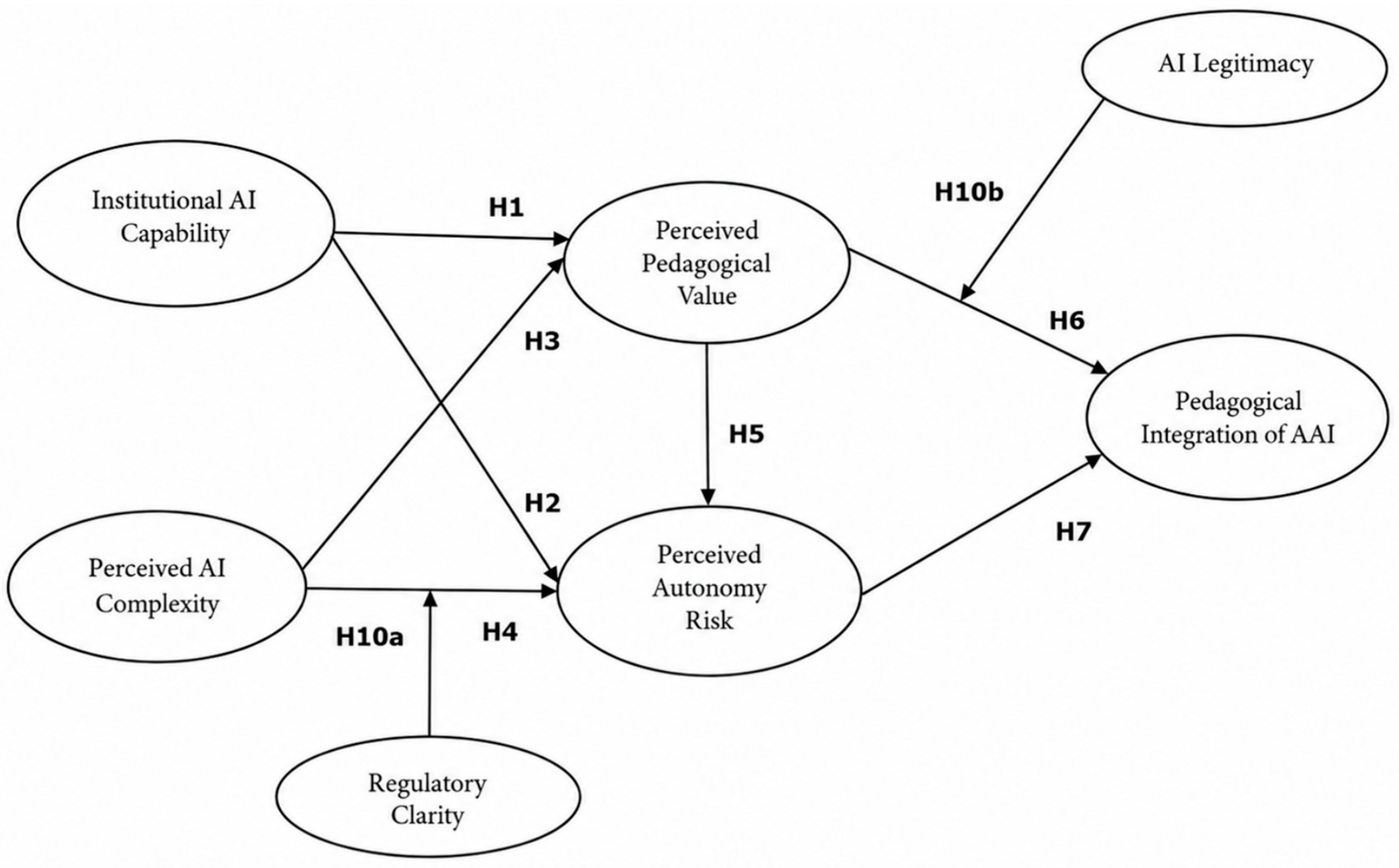
Figure 1 below presents the proposed conceptual model.

4. Research Methodology

4.1. Research Design and Data Collection

This study employs a cross-sectional survey design to examine the mechanisms underlying the pedagogical integration of agentic artificial intelligence (AAI) systems in higher education. Given the emergent and complex nature of AAI—characterised by autonomous multi-step task execution, workflow delegation, and limited real-time human intervention—a survey-based approach facilitates the systematic examination of educators’ perceptions, evaluations, and integration practices across diverse institutional and geographic contexts. The design is particularly appropriate for investigating cognitive evaluations, such as perceived pedagogical value and perceived AI complexity, alongside autonomy-related concerns that constitute the proposed affordance–institutional–risk framework.
Consistent with the cross-sectional nature of the data, the findings should be interpreted as associative rather than causal, and the temporal ordering among constructs remains theoretically motivated rather than empirically established. While the proposed framework is grounded in established theoretical perspectives, future longitudinal and experimental studies are necessary to validate the directionality and evolution of these relationships over time.
Data were collected through an online questionnaire administered to higher education educators across multiple countries. Recruitment was conducted through academic mailing lists, professional LinkedIn networks, faculty communities, and scholarly conferences where discussions on educational technology and AI-enabled teaching practices were prevalent. No monetary or non-monetary incentives were offered for participation, thereby reducing the possibility of participation motivated primarily by external rewards.
The study employed purposive sampling to target educators with varying degrees of exposure to AAI-enabled instructional systems. Although this approach ensured the inclusion of respondents familiar with autonomous and semi-autonomous educational technologies, it also introduces the possibility of self-selection bias. Specifically, educators who are digitally confident, interested in AI, or early adopters of emerging technologies may be overrepresented in the sample. Accordingly, the findings should be interpreted as reflecting informed evaluations among educators with at least some exposure to AAI rather than as representative of the entire higher education population.
The questionnaire was pre-tested with a small group of academics to ensure clarity, contextual relevance, and content validity, particularly with respect to concepts involving autonomous task execution and instructional delegation. Minor refinements were incorporated prior to full deployment. A total of 364 responses were initially obtained. Following the implementation of the study’s screening procedures and standard data-quality checks, 26 responses were excluded because respondents did not satisfy the conceptual and behavioural filter requirements designed to verify meaningful exposure to AAI systems. The final analytical sample therefore comprised 338 valid responses.
The final sample demonstrates considerable international diversity. Respondents represented both Global North and Global South contexts, with 60.1% and 39.9% of participants, respectively. Countries represented in the Global North included the United States, Canada, the United Kingdom, Germany, Sweden, the Netherlands, and Australia. Global South participants were drawn from India, Brazil, South Africa, Kenya, Nigeria, Indonesia, Vietnam, the Philippines, Thailand, and the United Arab Emirates. For analytical purposes, these countries were subsequently aggregated into the regional categories reported in Table 1. This diverse composition provides broader contextual representation while acknowledging the limitations associated with purposive online recruitment.
Although participants varied in their levels of engagement with AI technologies, all retained respondents reported at least minimal validated exposure to AAI systems capable of autonomous or semi-autonomous task execution, ensuring the substantive relevance of their evaluations and perceptions.

4.1.1. AAI Exposure, Screening, and Sample Validation

Given the conceptual ambiguity between conventional artificial intelligence, generative AI (GenAI), and agentic artificial intelligence (AAI), a structured multi-stage screening procedure was implemented to ensure that respondents possessed a clear understanding of AAI and had meaningful exposure to its distinctive functionalities. This procedure was designed to minimise construct contamination and enhance the internal validity of the study.
For the purposes of this research, minimal exposure to AAI referred to direct experience with at least one of the following functionalities: (1) autonomous workflow execution; (2) AI agents capable of multi-step task completion; (3) delegation of instructional or administrative tasks to AI systems; (4) AI assistants with autonomous decision-support capabilities; or (5) systems capable of independently sequencing and completing interconnected activities with limited real-time human intervention. Examples of such systems included ChatGPT 5 Operator, AutoGPT, Claude Projects and Artifacts, Perplexity Labs, Microsoft Copilot Agents, Gemini Agents, and Manus AI. These examples were illustrative rather than exhaustive and served primarily to help respondents distinguish agentic systems from conventional prompt-response generative AI tools.
The screening protocol consisted of four sequential stages. First, respondents completed an awareness check designed to assess familiarity with AAI concepts. Second, a conceptual differentiation exercise required participants to correctly distinguish AAI systems from conventional generative AI tools based on characteristics such as autonomy, delegation, and multi-step execution. Third, respondents reported their usage status, distinguishing between current users, previous users, and individuals with no direct experience. Finally, behavioural verification items assessed actual engagement with agentic functionalities, including workflow delegation, autonomous execution, and independent task sequencing. Of the 364 initial responses, 26 were excluded because they did not satisfy one or more of these filter requirements, including failures on conceptual differentiation items, inconsistencies between reported awareness and behavioural exposure, or insufficient evidence of meaningful engagement with agentic functionalities. Consequently, the final sample comprised 338 respondents with validated exposure to AAI systems.
Although precise exclusion counts were not retainable for each individual screening stage, all removed cases failed at least one of the predefined criteria relating to awareness, conceptual differentiation, usage status, or behavioural verification. The final analytical sample therefore included only respondents who demonstrated validated exposure to agentic AI through both conceptual understanding and observable engagement with autonomous or semi-autonomous functionalities, thereby ensuring the substantive relevance and internal validity of the study. Respondents were retained only if they correctly identified the defining characteristics of agentic AI, reported either current or prior use, and demonstrated at least one verified behavioural interaction involving autonomous or semi-autonomous task execution. Individuals reporting only intentions to use or no direct experience with agentic AI were excluded from the final analytical sample.
Importantly, respondents who had never used AAI systems or whose experience was limited solely to conventional prompt-based generative AI were excluded from the analytical sample. Similarly, individuals expressing only an intention to use AAI without demonstrable behavioural exposure were not retained for hypothesis testing. This approach ensured that the study captured informed evaluations of pedagogical integration rather than hypothetical attitudes toward unfamiliar technologies. The complete screening protocol, including awareness checks, conceptual differentiation items, and behavioural verification measures, is provided in Appendix A.

4.1.2. Assessment of Common Method Bias

Given the self-reported nature of the data, potential common method bias (CMB) was addressed through both procedural and statistical remedies (Podsakoff et al., 2024). Procedurally, respondents were assured of anonymity, and the questionnaire was designed to minimise evaluation apprehension and response tendencies through careful sequencing and separation of measurement items (Podsakoff et al., 2003). Statistically, a theoretically unrelated marker variable—the primary device used to access AI systems—was incorporated. Although device type may be associated with technology access or usage convenience, it bears no direct theoretical relationship with the value–risk mechanisms, institutional conditions, or pedagogical integration processes examined in the present study. Accordingly, it provides a reasonable diagnostic for detecting potential common method variance without overlapping conceptually with the substantive constructs (Kock, 2017). Correlations between the marker variable and the focal constructs remained low and non-significant (|r| < 0.15), indicating an absence of systematic shared variance attributable to measurement procedures. In addition, full-collinearity variance inflation factor (VIF) values were below the conservative threshold of 3.3, providing further evidence that common method bias is unlikely to threaten the validity of the findings (Podsakoff et al., 2003; Kock, 2017). Collectively, these procedural and statistical safeguards suggest that common method variance does not materially influence the observed relationships.

4.2. Measurement of Constructs

All constructs were operationalised using multi-item reflective scales adapted from established literature and contextualised for the pedagogical use of agentic artificial intelligence (AAI) in higher education. Guided by affordance theory, institutional theory, and automation risk perspectives (Gibson, 1977; DiMaggio & Powell, 1983; Parasuraman & Riley, 1997), the measurement framework captured both the enabling and constraining dimensions associated with delegation-capable AI systems.
Institutional AI Capability (IAC) measured the extent to which institutions provide the infrastructure, governance mechanisms, training opportunities, and implementation support necessary for effective AAI integration (Erdmann & Toro-Dupouy, 2025; Denford et al., 2025). Perceived AI Complexity (PAIC) assessed educators’ cognitive and operational challenges in understanding, configuring, and managing autonomous multi-step AI systems (Cetinkaya & Krämer, 2026; Xing & Jiang, 2025). Perceived Pedagogical Value (PPV) captured the extent to which educators believed that AAI enhances teaching effectiveness, instructional quality, student engagement, and workload efficiency (Feng et al., 2025; Xu et al., 2025).
Perceived Autonomy Risk (PAR) reflected concerns regarding loss of instructional control, execution errors, accountability, and privacy implications arising from the delegation of pedagogical tasks to autonomous systems (Pikhart & Al-Obaydi, 2025; Park, 2026). Regulatory Clarity (RC) measured perceptions of the existence of clear governance structures, institutional policies, and legal frameworks guiding the responsible use of AAI (Colonna, 2026), while AI Legitimacy (AIL) captured the extent to which AAI use was perceived as professionally appropriate and socially accepted within academic environments (Şen et al., 2026; Zagami, 2026).
Particular attention was devoted to the conceptualisation of the dependent construct. Rather than measuring simple continuance intention or repeated system use, Pedagogical Integration of AAI (PIA) was conceptualised as the depth, consistency, and instructional embeddedness with which educators incorporated AAI functionalities into teaching, assessment, feedback generation, and broader instructional workflows. Although certain behavioural indicators reflect routinised and sustained engagement, these items capture the institutionalisation and normalisation of agentic AI within pedagogical practices rather than mere intentions to continue using technology. Accordingly, the construct extends beyond traditional continuance perspectives by emphasising integrated, habitual, and pedagogically meaningful utilisation of autonomous AI capabilities (Silalahi et al., 2026; Zheng et al., 2025).
Although one indicator is phrased in terms of continued use, it is interpreted within this study as reflecting the institutionalisation of agentic AI within educators’ pedagogical practice rather than a distinct continuance intention. In educational settings, sustained intention to use a teaching technology typically indicates that it has become embedded within routine instructional planning, content delivery, assessment, and learner support. Accordingly, continued use is treated as evidence of routinised pedagogical integration, capturing the habitual incorporation of agentic AI into regular teaching activities rather than merely expressing a future behavioural intention.
All constructs were measured using seven-point Likert scales ranging from 1 (strongly disagree) to 7 (strongly agree) (Hair & Alamer, 2022; Becker et al., 2023). Control variables included prior generative AI experience, teaching experience, and academic discipline, while primary device usage was retained as a marker variable for assessing common method bias (Kock, 2017).
To address concerns regarding coding consistency, all measurement items were aligned such that higher scores consistently represented higher levels of the underlying construct. Reverse-coded items within the Perceived AI Complexity (PAIC) scale are explicitly identified as (R) in Appendix A.

Pre-Test and Expert Review

A two-stage validation procedure was employed to ensure measurement clarity, contextual relevance, and theoretical consistency (Hair & Alamer, 2022). First, five experts comprising academics, a practitioner, and specialists in measurement development evaluated the survey instrument with respect to item clarity, construct validity, and alignment with the theoretical foundations of the study (Becker et al., 2023). Particular emphasis was placed on ensuring that the items appropriately reflected the autonomous, delegatory, and multi-step execution characteristics that distinguish AAI from conventional generative AI systems. Minor revisions relating to wording, sequencing, and contextual framing were subsequently incorporated.
Second, a pilot study involving 30 higher education educators with prior exposure to agentic AI technologies was conducted to assess comprehensibility, reliability, and respondent burden. The pilot participants were selected to ensure familiarity with agentic functionalities such as autonomous workflows, instructional delegation, and AI-assisted task sequencing, thereby enhancing the contextual validity of the instrument.
Reliability diagnostics, including Cronbach’s alpha and composite reliability, exceeded the recommended threshold of 0.70 for all constructs, indicating satisfactory internal consistency (Hair & Alamer, 2022; Becker et al., 2023). No substantive issues relating to ambiguity or conceptual overlap emerged during the pilot phase. Minor refinements concerning item phrasing and survey flow were implemented to improve readability and reduce cognitive load.
Importantly, all measurement items were explicitly framed within the context of agentic AI rather than generic artificial intelligence applications. This distinction was maintained throughout the instrument to minimise conceptual contamination between conventional generative AI tools and autonomous, delegation-capable systems. Overall, the pre-test and expert-review procedures strengthened content validity, enhanced measurement precision, and ensured alignment with contemporary best practices in PLS-SEM research (Becker et al., 2023).

4.3. Data Analysis Technique

The proposed model was evaluated using Partial Least Squares Structural Equation Modelling (PLS-SEM) implemented in SmartPLS 4.1 (Ringle et al., 2024). This analytical approach is appropriate given the study’s predictive orientation, theory-extension objectives, and the presence of multiple mediation and moderation mechanisms within the proposed framework. PLS-SEM is particularly well suited for complex models that prioritise variance explanation, accommodate reflective measurement specifications, and do not require strict multivariate normality assumptions (Becker et al., 2023; Hair & Alamer, 2022).
The analysis followed a two-stage procedure comprising the assessment of the measurement model, followed by the evaluation of the structural model. This approach ensured that the reliability, convergent validity, and discriminant validity of the constructs were established prior to interpreting the hypothesised relationships. Bootstrapping with 5000 resamples was employed to estimate the statistical significance of direct, indirect, and moderation effects. To assess potential endogeneity, the Gaussian copula procedure proposed by Hult et al. (2018) was additionally implemented, thereby strengthening the robustness of the findings.

4.3.1. Model Specification

The proposed model examines the influence of Institutional AI Capability and Perceived AI Complexity on the Pedagogical Integration of AAI through two complementary mediating mechanisms: Perceived Pedagogical Value and Perceived Autonomy Risk. These mediators capture the dual evaluative pathways through which educators assess delegation-capable AI systems, reflecting both enabling pedagogical opportunities and concerns associated with autonomy and instructional control.
The model further incorporates Regulatory Clarity and AI Legitimacy as contextual boundary conditions that may strengthen or weaken these relationships. Specifically, regulatory clarity is expected to buffer the positive relationship between perceived complexity and autonomy risk, whereas AI legitimacy is posited to strengthen the translation of pedagogical value into pedagogical integration. Prior generative AI experience, teaching experience, and academic discipline were included as control variables, while primary device usage served as a theoretically unrelated marker variable to address potential common method bias.

4.3.2. Measurement Model Assessment

The measurement model was evaluated using established criteria for reliability and validity. Indicator reliability was assessed through outer loadings, with all items exceeding the recommended threshold of 0.70, indicating adequate representation of their respective constructs. Internal consistency reliability was examined using composite reliability coefficients, all of which surpassed the recommended value of 0.70 (Hair & Alamer, 2022). Convergent validity was assessed through average variance extracted (AVE), with all constructs exceeding the threshold of 0.50, confirming that the latent variables explained a substantial proportion of the variance in their indicators (Becker et al., 2023). Table 2 below shows the measurement model reliability and descriptives.
Discriminant validity was evaluated using both the heterotrait–monotrait (HTMT) ratio and the Fornell–Larcker criterion. All HTMT values remained below the conservative threshold of 0.85 (Becker et al., 2023), while the square roots of AVE exceeded the corresponding inter-construct correlations, supporting adequate discriminant validity.
To provide additional evidence regarding discriminant validity, bootstrapped HTMT confidence intervals were also examined. None of the 95% confidence intervals included the value of 1.0, providing further support for the empirical distinctiveness of the constructs. Although the relationships among Perceived Pedagogical Value, Perceived Autonomy Risk, and Pedagogical Integration of AAI exhibited comparatively high HTMT values (0.824–0.840), their upper confidence bounds remained below unity (0.872–0.886), suggesting conceptual proximity consistent with the proposed dual-pathway framework rather than problematic construct redundancy. These findings reinforce the adequacy of the measurement model while acknowledging the theoretically interrelated nature of educators’ value, risk, and integration evaluations. Table 3 below shows the discriminant validity assessment.
Table 4 above shows the bootstrapped HTMT confidence intervals. Although several HTMT values approached the conservative cut-off, particularly among Perceived Pedagogical Value, Perceived Autonomy Risk, and Pedagogical Integration of AAI, these relationships are theoretically expected within the proposed dual-pathway framework. Pedagogical value captures educators’ evaluations of instructional benefits, autonomy risk reflects concerns associated with delegated control, and pedagogical integration represents the behavioural embedding of AAI into instructional practice. While conceptually related, these constructs remain theoretically distinct and correspond to enabling, constraining, and behavioural dimensions, respectively. The observed HTMT values therefore indicate expected conceptual proximity rather than problematic overlap.
Future research may further strengthen discriminant validity assessments by reporting HTMT confidence intervals and comparing constrained alternative measurement specifications. Nevertheless, the combined evidence from HTMT and Fornell–Larcker analyses supports the adequacy of the measurement model.
Multicollinearity was examined using variance inflation factors (VIF), with all values remaining below the conservative threshold of 3.0 (Kock, 2017), indicating the absence of problematic collinearity. Overall, the measurement model demonstrates satisfactory psychometric properties, supporting the validity and reliability of the constructs employed in the analysis.

4.3.3. Structural Model Assessment

The structural model was evaluated using bootstrapping with 5000 resamples to estimate path coefficients, t-statistics, and bias-corrected confidence intervals (Becker et al., 2023). This non-parametric procedure provides robust significance testing without imposing distributional assumptions on the data.
The model demonstrated substantial explanatory power across the principal endogenous constructs. The coefficient of determination (R2) indicated that Perceived Pedagogical Value (R2 = 0.621), Perceived Autonomy Risk (R2 = 0.615), and Pedagogical Integration of AAI (R2 = 0.619) all exhibited moderate-to-high levels of explained variance, suggesting that the proposed framework effectively captures the principal determinants of educators’ integration decisions.
Model fit indicators further supported the adequacy of the specification. The SRMR values for both the saturated (0.041) and estimated (0.046) models remained below recommended thresholds, indicating acceptable model fit. The NFI value of 0.887, although slightly below conventional benchmarks, may be more appropriately interpreted as marginal rather than unequivocally acceptable, particularly given the predictive orientation of PLS-SEM. Accordingly, greater emphasis is placed on SRMR and predictive relevance statistics when evaluating model adequacy.
Predictive relevance was assessed using blindfolding procedures. The Q2 values for Perceived Pedagogical Value (Q2 = 0.601), Perceived Autonomy Risk (Q2 = 0.587), and Pedagogical Integration of AAI (Q2 = 0.611) all substantially exceeded zero, indicating strong out-of-sample predictive capability and supporting the model’s predictive validity.
Effect-size analysis (f2) revealed meaningful differences in the substantive importance of the exogenous constructs. Most notably, Institutional AI Capability exhibited an exceptionally large effect on Perceived Pedagogical Value (f2 = 0.964). This finding suggests that institutional infrastructure, governance mechanisms, training opportunities, and organisational support constitute foundational conditions through which educators recognise and realise the pedagogical benefits of AAI. In other words, the educational value of agentic systems appears to depend heavily on the institutional environments within which they are embedded. By contrast, the effects of Perceived Pedagogical Value (f2 = 0.220) and Perceived Autonomy Risk (f2 = 0.213) on Pedagogical Integration of AAI are moderate, indicating that both enabling and constraining evaluations contribute meaningfully to educators’ integration decisions. Regulatory Clarity and AI Legitimacy exhibit comparatively smaller effect sizes, suggesting that they function primarily as contextual boundary conditions rather than principal explanatory drivers.
Mediation analyses were conducted using bootstrapped indirect effects, with significance inferred from confidence intervals that excluded zero. Both specific and serial mediation pathways were examined, with particular attention devoted to the sequential mechanism linking pedagogical value and autonomy risk. The significant indirect effects provide support for the proposed dual-pathway framework, indicating that institutional capability and perceived complexity influence pedagogical integration through interconnected evaluations of value and risk. Table 5 below shows the main direct and moderation effect results.
Consistent with reporting conventions, all statistically significant paths are reported as p < 0.001 rather than p = 0. Collectively, the structural results support the explanatory and predictive robustness of the proposed framework and demonstrate the importance of value–risk evaluations in understanding the pedagogical integration of delegation-capable AI systems in higher education.

4.3.4. Moderation Effects

Moderation analysis was conducted using the two-stage approach in PLS-SEM to examine whether regulatory clarity and AI legitimacy function as contextual boundary conditions within the proposed value–risk framework. The results indicate that both moderators significantly influence the relationships specified in the conceptual model, although their effects operate by amplifying or buffering existing mechanisms rather than serving as direct determinants of pedagogical integration.
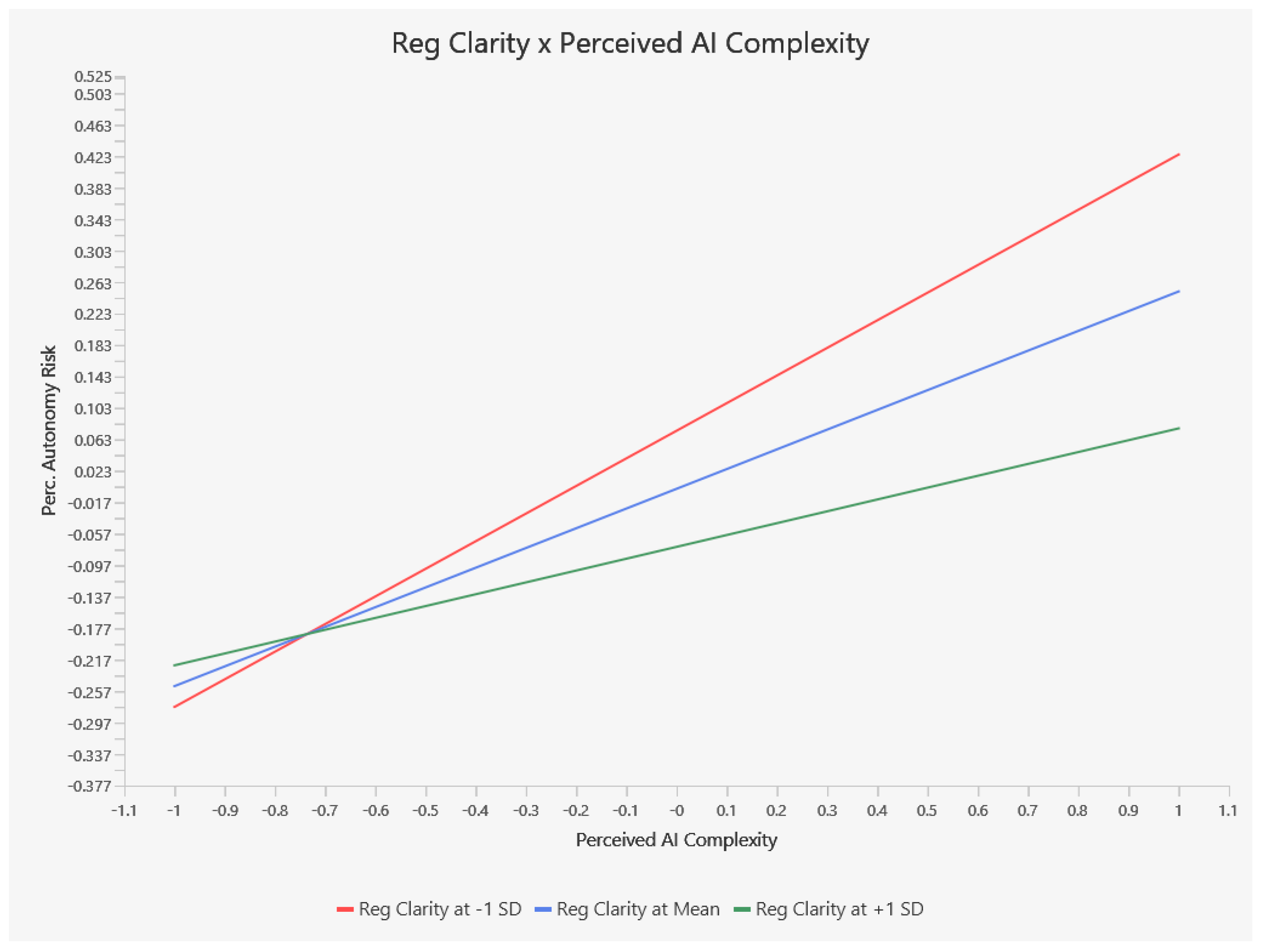
Regulatory clarity significantly moderates the relationship between Perceived AI Complexity and Perceived Autonomy Risk (β = −0.100, p = 0.008), indicating that the positive association between complexity and autonomy-related concerns becomes weaker when educators perceive clearer institutional and regulatory guidance regarding AAI use. This finding suggests that governance structures, policy frameworks, and explicit operational guidelines may help educators manage the uncertainty associated with complex, delegation-capable AI systems, thereby reducing the extent to which technical complexity translates into perceived risk (Al-Emran, 2023).
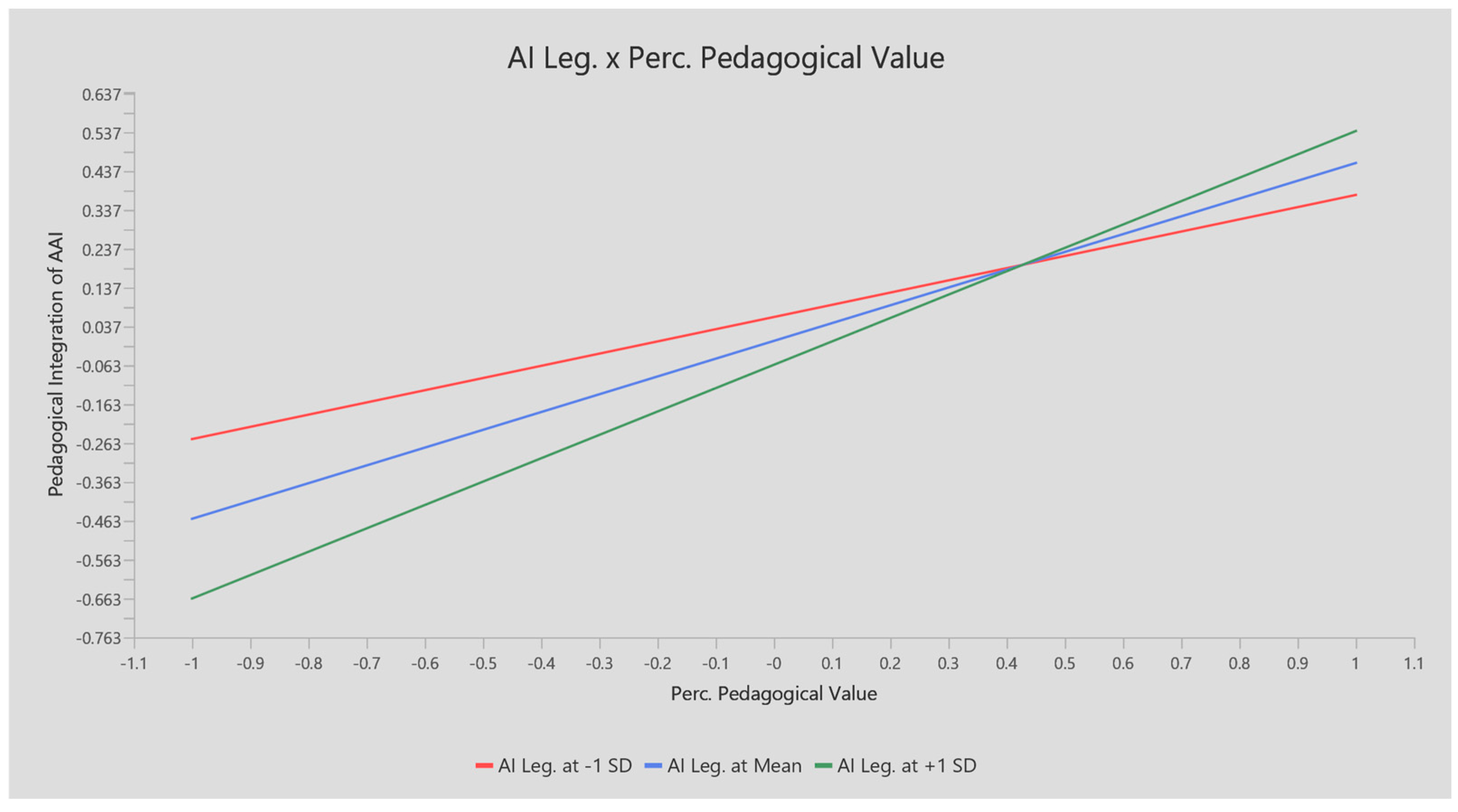
Similarly, AI Legitimacy positively moderates the relationship between Perceived Pedagogical Value and Pedagogical Integration of AAI (β = 0.144, p < 0.001). This result suggests that when AAI is perceived as professionally appropriate and socially endorsed within educational communities, educators are more likely to translate positive evaluations of pedagogical value into sustained instructional integration. The finding is consistent with legitimacy-based explanations of technology acceptance and institutional conformity, which emphasise the importance of normative support in shaping behavioural commitment (Suchman, 1995; Lowry et al., 2025).
Importantly, the direct effects of Regulatory Clarity (β = −0.074, p = 0.062) and AI Legitimacy (β = −0.061, p = 0.054) remain statistically non-significant, indicating that these constructs function primarily as contextual enablers rather than independent drivers of pedagogical integration. Their influence is therefore better understood as shaping the strength of existing relationships within the value–risk framework.
Simple-slope interpretations further reinforce these conclusions. Higher levels of regulatory clarity attenuate the positive association between perceived AI complexity and autonomy-related risk, whereas stronger perceptions of AI legitimacy amplify the positive association between pedagogical value and pedagogical integration. The simple-slope analysis further indicates that the effect of perceived AI complexity on autonomy risk is substantially weaker under conditions of high regulatory clarity than under low regulatory clarity. Likewise, the positive influence of perceived pedagogical value on pedagogical integration becomes considerably stronger when AI legitimacy is perceived to be high, highlighting the role of normative acceptance in translating perceived benefits into instructional practice.
Figure 2 and Figure 3 present the interaction effects and simple-slope relationships associated with regulatory clarity and AI legitimacy, respectively, thereby providing a more intuitive interpretation of the moderating mechanisms.

4.3.5. Multi-Group Analysis Results

To evaluate the robustness and generalisability of the proposed framework across different respondent groups, measurement invariance and multi-group analyses (MGA) were conducted using the MICOM (Measurement Invariance of Composite Models) procedure and Bootstrap MGA in SmartPLS. Two theoretically relevant subgroup comparisons were examined: (1) Global North versus Global South educators and (2) respondents with low versus high prior generative AI experience.
The MICOM procedure established compositional invariance across virtually all constructs in both comparisons. For the Global North and Global South groups, original correlations ranged from 0.981 to 1.000, with non-significant permutation p-values, thereby satisfying the requirements for compositional invariance. Equality of means and variances was also supported, indicating full measurement invariance across geographic contexts. These findings suggest that respondents from different regional and institutional environments interpreted the focal constructs in comparable ways.
Similarly, for the generative AI experience comparison, compositional invariance was achieved for nearly all constructs, with correlations ranging from 0.923 to 1.000. Although Perceived Autonomy Risk exhibited a significant permutation result (p = 0.013), equality of means and variances remained supported. Accordingly, partial measurement invariance was established, which remains sufficient for conducting meaningful multi-group comparisons within the PLS-SEM framework.
Subsequent Bootstrap MGA revealed no statistically significant differences across any structural paths for either comparison group, with all two-tailed p-values exceeding the 0.05 threshold. These findings indicate that the proposed dual-pathway mechanism linking institutional capability, perceived complexity, pedagogical value, autonomy risk, and pedagogical integration operates consistently across both geographic contexts and varying levels of prior generative AI experience. Table 6 below shows the MGA results.
Overall, these results strengthen the external validity and robustness of the proposed framework by demonstrating that the underlying value–risk evaluation process remains structurally stable across diverse educational, cultural, and experiential settings. The consistency of the findings across Global North and Global South contexts further suggests that the pedagogical integration of AAI may be governed by common evaluative mechanisms despite differences in institutional environments and technological maturity.

4.3.6. Endogeneity Assessment

To assess potential endogeneity, the Gaussian copula procedure proposed by Hult et al. (2018) was employed. This approach enables the detection of unobserved confounding by examining whether the inclusion of copula terms materially alters the estimated structural relationships.
The results indicate limited evidence of endogeneity within the proposed model. The copula terms associated with Institutional AI Capability → Perceived Autonomy Risk (β = −0.006, p = 0.962), Institutional AI Capability → Perceived Pedagogical Value (β = 0.082, p = 0.370), Perceived AI Complexity → Perceived Autonomy Risk (β = 0.244, p = 0.090), Perceived AI Complexity → Perceived Pedagogical Value (β = −0.201, p = 0.291), Perceived Pedagogical Value → Perceived Autonomy Risk (β = 0.057, p = 0.559), and Perceived Autonomy Risk → Pedagogical Integration of AAI (β = −0.192, p = 0.299) were all statistically non-significant. These findings suggest that unobserved confounding is unlikely to materially affect the majority of the hypothesised relationships.
However, one notable exception concerns the relationship between Perceived Pedagogical Value and Pedagogical Integration of AAI. Although the Gaussian copula term for this relationship was statistically significant (GC β = 0.249, p = 0.001), indicating the possibility of residual endogeneity, the copula-adjusted structural coefficient decreased from the original estimate (β = 0.405) to β = 0.153 and was no longer statistically significant (p = 0.120). This finding suggests that the relationship between perceived pedagogical value and pedagogical integration may be more sensitive to unobserved influences than the remaining structural paths. Accordingly, this association should be interpreted with caution, and future longitudinal or experimental research is needed to examine its causal stability more conclusively.
Overall, the Gaussian copula analysis supports the robustness of the proposed framework, as most structural relationships remained unaffected after accounting for potential endogeneity (Hult et al., 2018). Nevertheless, the direct relationship between Perceived Pedagogical Value and Pedagogical Integration appears comparatively less robust, indicating that this specific association may be influenced by unobserved factors. While the broader dual-pathway framework remains supported, this relationship should be interpreted with greater caution until validated through longitudinal or experimental research designs. Table 7 below shows the endogeneity assessment results.
Although most copula-adjusted coefficients remained broadly consistent with the original estimates, the relationship between Perceived Pedagogical Value and Pedagogical Integration showed a noticeable reduction in magnitude and was no longer statistically significant after adjustment. Consequently, this path should be interpreted with greater caution than the remaining structural relationships. Overall, the evidence suggests that endogeneity concerns are limited and do not substantially undermine the explanatory robustness of the proposed model. Nonetheless, future research employing longitudinal designs, experimental approaches, or objective behavioural measures would further strengthen causal inference and reduce the possibility of unobserved confounding in studies of agentic AI integration.

5. Discussion

This study advances the discourse on agentic AAI by shifting the analytical focus from adoption and continuance towards pedagogical integration—the depth, consistency, and instructional embedding of delegation-capable systems in teaching practice—conceptualised as a dynamic value–risk trade-off process (Feng et al., 2025). In an environment of ambient AI availability, the empirically meaningful variation no longer lies in whether educators continue to use AI but in how they integrate it into instructional decision-making (Cukurova, 2026; Silalahi et al., 2026). Unlike ECM-IS and other continuance-centred models that typically treat value and risk as independent determinants, the findings suggest that these dimensions are cognitively interconnected, with perceived pedagogical value being associated with lower autonomy-related risk perceptions (W. Li, 2025). This perspective positions pedagogical integration as a process-oriented phenomenon rather than a static outcome, offering a more comprehensive understanding of how educators evaluate and adapt to autonomy-enabled systems.
Central to the findings is the identification of a dual-pathway mechanism that captures the simultaneous evaluation of enabling and constraining forces. The results suggest that educators do not assess AAI systems solely on the basis of functional benefits but also consider the implications of delegating instructional responsibilities. This dual evaluation reflects a broader cognitive balancing process in which pedagogical benefits are weighed against concerns related to autonomy, accountability, and uncertainty. By conceptualising AAI use as a delegation-based evaluation problem, the study extends prior research on assistive technologies and highlights the distinctive considerations introduced by systems capable of autonomous, multi-step execution (Shulner-Tal et al., 2025; Pikhart & Al-Obaydi, 2025).
A key insight emerging from this study is the role of institutional AI capability as both an enabler and a source of stability within this evaluative process. Institutional support, in the form of infrastructure, training, and governance mechanisms, is positively associated with perceptions of pedagogical value and negatively associated with autonomy-related concerns. This pattern suggests that institutional environments shape not only the availability of technological resources but also how educators interpret and manage issues associated with instructional delegation (Erdmann & Toro-Dupouy, 2025). In this regard, the findings align with institutional theory by indicating that organisational support may function as a cognitive reference point through which educators interpret both the opportunities and uncertainties associated with agentic technologies.
In contrast, perceived AI complexity emerges as an important constraining factor within the proposed framework. When educators perceive AAI systems as cognitively demanding or difficult to manage, their ability to recognise and enact pedagogical affordances may be reduced, while uncertainty and perceived risk may become more salient. This finding aligns with research on system opacity and unpredictability, which suggests that difficulties in understanding autonomous processes correspond to lower confidence in technology-enabled delegation (Cetinkaya & Krämer, 2026). Importantly, the influence of complexity appears to operate through evaluative mechanisms rather than through direct behavioural effects, indicating that complexity primarily affects pedagogical integration by shaping how educators perceive value and risk.
One of the notable contributions of this study is the identification of a cross-pathway relationship between perceived pedagogical value and perceived autonomy risk. The findings indicate that higher perceptions of pedagogical value are associated with lower levels of autonomy-related concern, suggesting that educators who recognise stronger instructional benefits may be more inclined to view system autonomy as a manageable pedagogical feature rather than solely as a source of uncertainty (Singh & Paiva, 2025). Rather than implying a deterministic process, this relationship points to the possibility that positive instructional evaluations correspond to more favourable interpretations of autonomous capabilities. Such a mechanism offers a dynamic perspective on technology evaluation in which perceptions of benefits and concerns are cognitively intertwined.
At the same time, it is important to acknowledge that alternative explanations remain plausible. Although the present framework adopts a theory-driven ordering in which pedagogical value precedes autonomy-risk assessments, the reverse relationship may also exist, whereby higher perceptions of risk influence educators’ evaluations of pedagogical value. The cross-sectional design does not permit empirical verification of temporal ordering, and future longitudinal or experimental studies should compare competing causal structures to examine how value and risk perceptions co-evolve over time in relation to agentic AI use.
Building upon this perspective, the serial mediation results further support the notion of a layered evaluation process. Rather than being associated with isolated factors, pedagogical integration appears to correspond to a sequence of cognitive assessments in which institutional and system-level conditions are linked to perceptions of pedagogical value, which are subsequently associated with autonomy-related concerns and instructional integration. This suggests that engagement with autonomous systems may represent an evolving process shaped by prior evaluations and contextual influences rather than a single adoption decision.
An important clarification concerns the nature of the risk construct examined in this study. The analysis focuses specifically on perceived autonomy risk, reflecting educators’ subjective concerns regarding issues such as instructional control, accountability, privacy, and the implications of delegating tasks to autonomous systems. The study does not measure objective privacy breaches, actual execution errors, or verifiable accountability failures. Consequently, the findings should be interpreted as capturing educators’ perceptions and interpretations of potential risks rather than demonstrating the existence or magnitude of such outcomes. Future research incorporating behavioural, institutional, or system-level data could further examine the relationship between perceived and objectively observable forms of autonomy-related risk.
The role of contextual boundary conditions further refines the proposed mechanism by situating it within broader institutional and normative environments. Regulatory clarity is associated with a weaker relationship between perceived complexity and autonomy-related concerns, suggesting that formal guidance and governance structures may help educators interpret and manage the implications of autonomous instructional systems (Colonna, 2026). Similarly, AI legitimacy corresponds to a stronger association between perceived pedagogical value and pedagogical integration by reinforcing the social and professional acceptability of agentic technologies (Şen et al., 2026). These findings indicate that educators’ evaluations of AAI are embedded within broader governance frameworks and normative expectations, highlighting the importance of contextual alignment in supporting pedagogical integration.
Finally, the consistency of the dual-pathway mechanism across different levels of AI experience and geographic contexts provides evidence regarding the robustness of the proposed framework. The absence of significant structural differences between Global North and Global South samples suggests that the underlying value–risk evaluation process may operate similarly across diverse institutional environments (Silalahi et al., 2026). Nevertheless, this observation should be interpreted cautiously given the purposive sampling strategy and uneven subgroup sizes. While contextual differences may influence the strength or manifestation of specific relationships, the overall pattern of findings aligns with the proposition that educators across regions engage in comparable cognitive evaluations when considering the pedagogical integration of AAI.
Overall, the findings position the value–risk trade-off as a mechanism-oriented framework for understanding pedagogical integration of AAI, offering an alternative perspective to traditional adoption models that pay limited attention to autonomy and delegation dynamics. By integrating affordance theory, institutional theory, and automation risk perspectives, the study provides a process-oriented explanation of how educators navigate the opportunities and concerns associated with autonomy-enabled systems. Rather than depicting pedagogical integration as a simple consequence of perceived usefulness or satisfaction, the framework emphasises the interplay among value perceptions, autonomy-related concerns, and contextual influences, thereby offering a theoretically grounded lens for examining the evolving role of agentic AI in higher education.

6. Implications

6.1. Implications for Theory

Building on the empirical findings and the proposed dual-pathway framework, this study offers several theoretical contributions that advance the understanding of AAI in higher education. Specifically, the implications extend beyond traditional adoption models by introducing a process-oriented and contextually embedded perspective on pedagogical integration of AAI. The key theoretical contributions are structured as follows:

6.1.1. From Continuance to Integration: A Delegation-Based Value–Risk Trade-Off

This study contributes to a growing strand of research that moves beyond adoption- and continuance-centred models toward an account of how AI becomes embedded in instructional practice. In an environment of ambient AI availability, the meaningful variance no longer lies in whether educators use AAI but in how deeply and reliably they integrate it into teaching, assessment, and workflow delegation (Cukurova, 2026; Saleem, 2026). Theorising pedagogical integration explicitly as a delegation-based value–risk trade-off, this study extends ECM-IS (Bhattacherjee, 2001) by reconceptualising the outcome variable and supplementing the unidimensional satisfaction–continuance pathway with a dual-pathway mechanism in which value perceptions are associated with autonomy-related risk evaluations. Whereas ECM-IS explains continuance of assistive technologies through expectation confirmation, the proposed framework provides a process-oriented explanation of integration depth in delegation-capable systems through a contextually embedded value–risk mechanism (Feng et al., 2025). This shift offers a more behaviourally realistic account of how educators navigate autonomy-enabled systems and positions integration as a process grounded in delegation and control rather than a static outcome.

6.1.2. Extending Post-Adoption Theory to Delegation-Capable AI

The study further contributes to post-adoption literature by extending rather than replacing traditional continuance perspectives such as ECM-IS. Conventional post-adoption models explain sustained technology use primarily through expectation confirmation, perceived usefulness, and satisfaction (Bhattacherjee, 2001). However, the findings of this study suggest that pedagogical integration of delegation-capable AI systems involves simultaneous evaluations of instructional value and autonomy-related concerns. In this sense, pedagogical integration represents a deeper form of post-adoption engagement characterised by routinised instructional embedding, workflow delegation, and institutional normalisation. The proposed framework therefore broadens existing continuance perspectives by accommodating the distinctive affordances and constraints associated with autonomous educational technologies, thereby providing a more suitable theoretical lens for understanding agentic AI in higher education contexts.

6.1.3. Advancing a Dual-Pathway Process Mechanism

Secondly, the study develops and provides empirical support for a dual-pathway mechanism with cross-path dependency, extending existing technology evaluation frameworks from static predictors to process-based explanations of sustained engagement. The findings are consistent with the proposition that perceived pedagogical value is associated with lower autonomy-related concerns, suggesting that educators who recognise stronger instructional benefits may interpret system autonomy as a manageable pedagogical feature rather than solely as a source of uncertainty (W. Li, 2025). Although the temporal ordering adopted in this study is theoretically motivated rather than empirically established, the proposed structure offers a process-oriented explanation of how enabling and constraining forces may jointly shape pedagogical integration.

6.1.4. Embedding Agentic AI Evaluation in Institutional Contexts

Thirdly, by integrating institutional capability, regulatory clarity, and AI legitimacy, the study situates AAI evaluation within broader organisational and normative contexts. Institutional AI capability enables value realisation while simultaneously mitigating autonomy-related risk, whereas regulatory clarity and AI legitimacy shape how these evaluations translate into sustained engagement (Erdmann & Toro-Dupouy, 2025; Colonna, 2026). This contribution extends institutional theory by demonstrating that technology evaluation is co-determined by structural support and social endorsement.

6.1.5. Extending Affordance Theory Through Cross-Pathway Effects

The study further extends affordance theory by demonstrating that affordance realisation is not solely determined by user–technology interaction but is conditioned by institutional capability and mediated through risk evaluation. While traditional affordance perspectives emphasise perceived action possibilities, the findings show that these possibilities remain latent without adequate infrastructural, policy, and training support. Moreover, identifying a cross-pathway relationship between perceived pedagogical value and perceived autonomy risk offers a significant theoretical insight, suggesting that value perceptions may shape how educators interpret system autonomy and associated uncertainties (Singh & Paiva, 2025).

6.1.6. Reconceptualising Risk in Agentic Educational Technologies

The study also contributes by conceptualising autonomy risk as a perceived evaluative construct rather than an objective indicator of technical failures, privacy breaches, or accountability violations. This distinction is theoretically important because educators’ behavioural responses are likely to depend primarily on their interpretations of delegated autonomy rather than on the actual occurrence of adverse events. Consequently, future theoretical models of educational AI may benefit from explicitly differentiating perceived autonomy risk from objective system risk and examining how these two forms of risk interact and evolve over time. Such distinctions may offer richer explanations of pedagogical integration in increasingly autonomous educational environments.

6.1.7. Demonstrating Cross-Context Robustness of the Value–Risk Mechanism

Lastly, the demonstration of multi-group invariance across Global North and Global South contexts provides preliminary evidence regarding the contextual robustness of the proposed framework. Despite contextual differences in effect strength, the absence of structural variation indicates that the underlying value–risk mechanism operates in a broadly consistent manner across diverse institutional environments (Silalahi et al., 2026). Rather than implying universal generalisability, these findings suggest that the proposed framework possesses relevance across varied educational contexts while acknowledging the limitations associated with purposive online recruitment and differences in institutional resources, governance structures, and technological ecosystems.

6.2. Implications for Practice

The findings hold substantial practical significance for university leaders, policymakers, and educational technology developers seeking to promote responsible and pedagogically meaningful integration of agentic AI in higher education.

6.2.1. For University Leaders: Strengthening Institutional AI Capability as a Strategic Priority

Given that institutional AI capability demonstrated the largest effect on perceived pedagogical value (f2 = 0.964), universities should regard AI capability development as a strategic pedagogical investment rather than a purely technological initiative. Effective integration requires structured onboarding processes aligned with delegation requirements, targeted faculty training, clear governance policies, and robust technical support systems. Such investments not only enhance perceived instructional value but are also associated with lower autonomy-related concerns, thereby generating cumulative institutional benefits (Erdmann & Toro-Dupouy, 2025). Establishing cross-functional AI units that integrate pedagogy, technology, ethics, and governance can further support coherent implementation. Embedding AI capability within long-term institutional strategies, rather than relying on ad hoc initiatives, may contribute to more sustainable pedagogical integration.

6.2.2. Reframing Faculty Development Around AI Delegation Competencies

The findings suggest that educators evaluate AAI not merely as content-generation tools but as systems capable of instructional delegation and autonomous task execution. Consequently, faculty development initiatives should move beyond basic prompt-engineering workshops and focus on delegation competencies, including workflow design, human oversight, accountability mechanisms, and ethical monitoring of autonomous instructional processes. Such training may help educators translate perceived pedagogical value into deeper instructional integration while reducing autonomy-related concerns. Developing educator competencies around collaborative human–AI workflows may therefore become an essential component of future academic development programmes.

6.2.3. For Educational Technology Developers: Reducing Complexity as a Barrier to Sustained Engagement

Perceived complexity constitutes a significant constraint on pedagogical integration. Developers of educational technologies should prioritise intuitive interfaces that facilitate task specification, workflow management, and educator oversight. Institutions may likewise adopt phased implementation approaches that begin with low-complexity use cases, allowing educators to develop accurate mental models before engaging with more autonomous applications. This approach addresses cognitive opacity as an important source of perceived risk (Cetinkaya & Krämer, 2026). Adaptive onboarding systems, contextual prompts, explainable AI functionalities, and continuous user-feedback mechanisms may further reduce cognitive burden and improve usability.

6.2.4. Designing Human-in-the-Loop Governance and Risk Communication Strategies

Educators’ concerns regarding errors, data privacy, and the potential loss of instructional control reflect legitimate uncertainties associated with autonomous systems. Institutions should therefore establish transparent protocols for data governance, error management, and accountability. Importantly, human-in-the-loop governance models that preserve educator oversight over assessment, feedback generation, and high-stakes instructional decisions should remain central to implementation strategies. The findings indicate that perceived autonomy risk remains a significant barrier to pedagogical integration, suggesting that transparent oversight arrangements may help educators interpret AI autonomy as a manageable pedagogical feature rather than a threat to professional authority (Pikhart & Al-Obaydi, 2025). Collaborative development of governance frameworks with faculty members may further strengthen trust and sustained engagement.

6.2.5. For Policymakers: Leveraging Regulatory Clarity and AI Legitimacy

Regulatory clarity and the legitimacy of AAI serve as important contextual enablers of pedagogical integration. Well-defined governance frameworks reduce uncertainty and transform compliance requirements into facilitators of responsible innovation. Policymakers should therefore develop educational AI guidelines that explicitly address instructional delegation, educator accountability, ethical oversight, and student data protection (Colonna, 2026). Educational accreditation systems may also incorporate AI governance principles and digital pedagogy competencies to support institution-wide adoption. Concurrently, universities can strengthen AI legitimacy by formally recognising AI-enabled teaching innovations, incentivising responsible experimentation, and embedding AI literacy within professional development initiatives. Alignment between institutional practices and broader regulatory frameworks may further enhance trust and acceptance.

6.2.6. Tailoring Strategies for Resource-Diverse Educational Contexts

Although the structural relationships identified in this study operate consistently across Global North and Global South settings, institutional resources, governance structures, and technological ecosystems may differ considerably across contexts. The findings therefore suggest that locally adapted governance frameworks, contextual faculty training programmes, and incremental implementation strategies may be particularly important for supporting pedagogical integration in resource-diverse educational environments (Islam et al., 2026). Strengthening institutional resilience through collaborative partnerships, targeted investments, and context-sensitive capacity-building initiatives may contribute to more equitable and sustainable AI integration across higher education systems.

7. Limitations and Future Research

Despite its contributions, this study is subject to several limitations that provide avenues for future research. First, the cross-sectional design constrains causal inference and does not permit empirical verification of the temporal ordering proposed in the dual-pathway framework. Although the hypothesised relationships are grounded in affordance theory, institutional theory, and automation risk perspectives, alternative explanations remain plausible. In particular, perceptions of autonomy-related risk may also influence educators’ evaluations of pedagogical value rather than following the sequencing proposed in the present model. Future longitudinal, panel, and experimental studies are needed to examine how value and risk perceptions co-evolve over time and to compare competing causal structures underlying the pedagogical integration of agentic AI (Hair & Alamer, 2022). Certain disciplinary and regional subgroups, including Business educators (n = 14) and respondents from the MENA region (n = 6), were relatively small and should therefore be interpreted with caution. Future research should seek broader representation across underrepresented educational and geographic contexts.
Second, the purposive online sampling strategy may have introduced self-selection bias by attracting educators who are more digitally confident, interested in artificial intelligence, or predisposed towards experimenting with emerging educational technologies. Although this approach ensured meaningful exposure to delegation-capable AI systems, the findings should be interpreted as reflecting informed evaluations among educators with validated AAI experience rather than the broader higher education population. Future studies could employ probability-based sampling approaches and investigate institutions characterised by different levels of digital maturity and AI readiness to strengthen the external validity and contextual applicability of the findings (Podsakoff et al., 2024).
Third, while the sample encompassed respondents from diverse Global North and Global South contexts, certain regional and disciplinary subgroups remained relatively small, particularly those from the MENA region and business education. Consequently, subgroup-specific interpretations should be treated with caution, and broader contextual generalisations remain tentative. Future research should pursue more balanced cross-cultural and disciplinary samples to examine how institutional environments, governance arrangements, and professional norms influence the pedagogical integration of agentic AI across heterogeneous educational settings (DiMaggio & Powell, 1983).
Fourth, the study relied exclusively on self-reported perceptions of pedagogical value, autonomy-related risk, and pedagogical integration. Accordingly, the findings capture educators’ subjective evaluations rather than directly observed instructional practices or objectively measured educational outcomes. Moreover, the study examines perceived autonomy risk, including concerns regarding accountability, privacy, and instructional control, rather than actual occurrences of execution failures, data breaches, or governance violations. Future research should incorporate classroom observations, learning analytics, digital trace data, institutional usage records, and student performance indicators to investigate the relationship between perceived and objective manifestations of pedagogical integration within agentic AI environments (Parasuraman & Riley, 1997).
Finally, the present study adopts an educator-centred perspective and therefore does not incorporate the views of students, institutional leaders, instructional designers, or educational technology developers. The pedagogical integration of agentic AI is inherently a multi-actor and institutionally embedded process involving interactions among diverse stakeholders operating within broader systems of governance, legitimacy, and professional norms. Future studies should therefore employ multi-level and multi-stakeholder designs to investigate how different actors collectively shape perceptions of pedagogical value, autonomy-related risk, legitimacy, and instructional delegation. Such efforts would contribute to a more holistic understanding of how agentic AI becomes embedded within contemporary higher education ecosystems (Suchman, 1995).

Author Contributions

Conceptualization, R.R. and S.M.; methodology, S.M.; software, S.M.; validation, R.R., K.-Y.T. and P.N.; formal analysis, S.M.; investigation, R.R. and S.M.; resources, R.R. and P.N.; data curation, S.M.; writing—original draft preparation, S.M. and R.R.; writing—review and editing, R.R., S.M., K.-Y.T. and P.N.; visualization, S.M.; supervision, R.R. and P.N.; project administration, R.R.; funding acquisition, P.N. All authors have read and agreed to the published version of the manuscript.

Funding

The article publication charges of this study were partly supported by the Ministry of Science and Technology of Taiwan under contract number NSTC 115-2410-H-005-011-MY2. The author Kai-Yu Tang is also currently affiliated with the Innovation and Development Center of Sustainable Agriculture at National Chung Hsing University. This work was also financially supported by the “Innovation and Development Center of Sustainable Agriculture” from The Featured Areas Research Center Program within the framework of the Higher Education Sprout Project by the Ministry of Education (MOE) in Taiwan.

Institutional Review Board Statement

The study was conducted in accordance with the Declaration of Helsinki and approved by the Institute Ethical Review Committee, Amrita School of Business, Amrita Vishwa Vidyapeetham, Amaravati Campus (protocol code ERB-ASB-2025-050).

Informed Consent Statement

Informed consent was obtained from all individual participants included in the study. Respondents were assured of anonymity and confidentiality, and they had the option to withdraw from the survey at any stage.

Data Availability Statement

The datasets generated and/or analysed during the current study are available from the corresponding author on reasonable request.

Conflicts of Interest

The authors declare that there are no conflicts of interest regarding the publication of this paper.

Appendix A. Survey Instrument, Screening Protocol, and Measurement Items

Appendix A.1. Participant Information and Consent

You are invited to participate in a research study examining educators’ perceptions and pedagogical integration of agentic artificial intelligence (AAI) systems in higher education teaching. Agentic AI refers to artificial intelligence systems capable of autonomously executing multi-step tasks with limited real-time human supervision.
Your participation is voluntary, and all responses will remain anonymous and confidential. The data collected will be used solely for academic research purposes. There are no right or wrong answers; we are interested in your genuine perceptions and experiences regarding AI-enabled teaching systems.
By proceeding with this survey, you indicate your informed consent to participate in the study.
For the purpose of this study:
Agentic artificial intelligence (AAI) refers to AI systems capable of autonomously planning, executing, and managing multi-step tasks with minimal real-time human intervention. Unlike traditional generative AI systems that primarily respond to prompts, agentic AI systems can independently perform delegated workflows and make operational decisions within predefined boundaries.

Appendix A.2. Conceptual Differentiation and Screening Logic

Because users frequently confuse general artificial intelligence (AI), generative AI (GenAI), and agentic artificial intelligence (AAI) systems, a structured conceptual differentiation protocol was incorporated prior to construct measurement. The objective was to ensure that respondents possessed at least a minimal validated understanding and exposure to agentic AI systems characterised by autonomous multi-step task execution and delegated workflow capability.
The screening procedure consisted of four sequential stages: (1) awareness validation; (2) conceptual differentiation; (3) usage-status classification; and (4) behavioural verification. Respondents were required to distinguish autonomous agentic AI systems from prompt-based generative AI tools prior to inclusion in the final sample.
Section A. Awareness and Conceptual Understanding
Q1. Before today, have you heard the term “agentic AI”?
  • Yes, I understand what it is
  • Heard the term, unsure of meaning
  • No, this is new to me
Q2. Approximately how many agentic AI tools or systems have you heard of?
  • 0
  • 1–2
  • 3–4
  • 5–6
  • More than 6
Q3. Which statement best describes agentic AI?
  • AI that works independently after setup to complete multi-step tasks
  • AI that mainly generates content from prompts
  • Not sure
Q4. What best describes your current usage status of agentic AI?
  • I currently use agentic AI
  • I tried it but stopped using it
  • I have never used agentic AI
Section B. Behavioural Verification Items (Current/Prior Users Only)
Please indicate which of the following activities you have personally performed using agentic AI systems.
ItemYesNo
Delegated a multi-step workflow to AI
Allowed AI to autonomously execute instructional tasks after setup
Used AI systems that independently completed teaching-related processes
Used AI systems capable of autonomous sequencing of decisions or actions
Responses were aggregated to generate a behavioural verification count ranging from 0 to 4, which was used during sample validation and screening.
Respondents failing conceptual differentiation checks or demonstrating inconsistencies between reported awareness and verified behavioural exposure were excluded during data screening to minimise construct contamination between generative AI and agentic AI systems.

Appendix A.3. Demographic and Professional Profile

Section C. Respondent Profile
Q5. What is your country of residence?
(Open-ended)
Q6. Geographic region (Auto-coded)
  • North America
  • Europe
  • East/Southeast Asia
  • South Asia
  • Sub-Saharan Africa
  • Latin America
  • Oceania
  • Middle East and North Africa (MENA)
Q7. Global classification (Auto-coded)
  • Global North
  • Global South
Q8. Gender
  • Male
  • Female
  • Non-binary
  • Prefer not to say
Q9. Institution type
  • Public/Government-funded
  • Private
  • International
Q10. Primary teaching discipline
  • Humanities & Arts
  • Social Sciences
  • Natural Sciences
  • Engineering & Technology
  • Health Sciences
  • Business & Management
  • Education
  • Other
Q11. How many years have you been teaching in higher education?
  • Less than 2 years
  • 2–5 years
  • 6–10 years
  • 11–20 years
  • More than 20 years
Q12. How would you rate your overall comfort with technology?
1 = Very uncomfortable
2 = Uncomfortable
3 = Neutral
4 = Comfortable
5 = Very comfortable
Q13. Do you currently use regular generative AI tools (e.g., ChatGPT, Claude) in teaching?
  • Yes, regularly
  • Yes, occasionally
  • No, but I have tried them
  • No, never used them
Q14. Internet quality at your institution
  • Consistently reliable
  • Mostly reliable with occasional issues
  • Frequently unreliable
  • Very limited
Q15. Primary device used for teaching
  • University-provided computer/system
  • Personal computer/laptop
  • Tablet
  • Primarily smartphone

Appendix A.4. Core Measurement Scales Used in the Final Structural Model

Only constructs retained in the final structural model are presented as core measurement scales below. Each construct is accompanied by a brief operational definition and a note indicating its theoretical anchors and the literature from which the items were adapted, in alignment with the theoretical scaffolding developed in §2 of the main manuscript.
Response Format
All construct items were operationalised using Likert-type scales. Following instrument refinement and pilot validation, the final constructs retained in the structural model were measured using seven-point Likert scales ranging from:
1 = Strongly Disagree
2 = Disagree
3 = Somewhat Disagree
4 = Neutral
5 = Somewhat Agree
6 = Agree
7 = Strongly Agree
Institutional AI Capability (IAC)
Operational definition: The extent to which the educator’s institution provides infrastructure, training, governance, and policy support sufficient to enable effective engagement with agentic AI systems.
Adapted from Erdmann and Toro-Dupouy (2025) and Denford et al. (2025); grounded in institutional theory (DiMaggio & Powell, 1983; Scott, 2013).
CodeMeasurement Item
IAC1My institution has IT staff who could support AI implementation
IAC2Clear policies exist about using AI in teaching at my institution
IAC3Training on AI tools is available to me
IAC4Reliable infrastructure is available for AI tools to function effectively
Perceived AI Complexity (PAIC)
Operational definition: The cognitive and operational demands the educator faces when configuring, supervising, and managing agentic AI systems for instructional tasks.
Adapted from Cetinkaya and Krämer (2026) and Xing and Jiang (2025); grounded in affordance theory (Gibson, 1977) and the multi-faceted perceived-risk perspective on system opacity (Featherman & Pavlou, 2003).
CodeMeasurement Item
PAIC1Setting up agentic AI to work on my behalf would be straightforward [R]
PAIC2I would find it easy to explain what I want the AI to do [R]
PAIC3Learning to use agentic AI would take too much effort
PAIC4Managing an AI that acts independently would be confusing
Perceived Pedagogical Value (PPV)
Operational definition: The educator’s reflective judgement that agentic AI tangibly improves teaching effectiveness, instructional quality, student interaction, and workload efficiency—the cognitive endpoint of affordance enactment.
Adapted from Feng et al. (2025) and Xu et al. (2025); grounded in affordance theory (Gibson, 1977) and the post-acceptance reassessment construct in ECM-IS (Bhattacherjee, 2001).
CodeMeasurement Item
PPV1Agentic AI would save me significant time compared to doing tasks manually
PPV2Agentic AI would help me accomplish teaching tasks I currently struggle with
PPV3Using agentic AI would improve the quality of my teaching
PPV4Agentic AI would give me more time to focus on student interaction
Perceived Autonomy Risk (PAR)
Operational definition: The educator’s apprehension that delegating instructional tasks to a semi-autonomous system may produce execution errors, compromise student data, erode instructional authority, or attract professional scrutiny.
Adapted from Pikhart and Al-Obaydi (2025) and Park (2026); grounded in the multi-faceted perceived-risk perspective (Featherman & Pavlou, 2003) and the human–automation literature on autonomy, control, and accountability (Parasuraman & Riley, 1997; Kellogg et al., 2020).
CodeMeasurement Item
PAR1I feel uncertain about trusting agentic AI to handle teaching tasks without constant supervision
PAR2I worry about AI making mistakes when acting independently
PAR3I am concerned about student data privacy with agentic AI
PAR4I fear losing control over my teaching if I rely on agentic AI
Regulatory Clarity (RC)
Operational definition: The educator’s perception of well-defined, accessible policy frameworks governing agentic AI use in education at the institutional and national levels.
Adapted from Colonna (2026); contextualised against the institutional governance literature on AI in higher education.
CodeMeasurement Item
RC1Clear regulations exist about AI use in education in my country
RC2I understand the legal implications of using agentic AI with student data
RC3My government provides guidelines on educational AI use
AI Legitimacy (AIL)
Operational definition: The extent to which the educator perceives agentic AI use in teaching as socially endorsed, professionally appropriate, and normatively accepted within their institutional and disciplinary context.
Adapted from Şen et al. (2026) and Zagami (2026); grounded in legitimacy theory (Suchman, 1995) within the institutional-theory tradition.
CodeMeasurement Item
AIL1Using agentic AI for teaching is professionally acceptable in my context
AIL2Delegating teaching tasks to AI aligns with teaching norms in my institution
AIL3Educational innovation involving AI is valued in my institution
Pedagogical Integration of AAI
Operational definition: The extent to which educators consistently embed agentic AI within teaching, assessment, feedback generation, and broader instructional workflows as a routinised and pedagogically meaningful component of professional practice. The construct captures the depth, consistency, and institutionalisation of AI-supported instructional activities rather than simple intentions for continued use.
Adapted from Limayem et al. (2007) and contextualised for pedagogical integration of agentic AI in higher education. Although some indicators reflect routinised engagement, the construct extends beyond traditional continuance perspectives by emphasising instructional embedding and habitual pedagogical use.
CodeMeasurement Item
PIAI1I intend to continue using agentic AI regularly in my teaching activities
PIAI2Agentic AI has become integrated into my teaching workflow
PIAI3I rely on agentic AI for multiple instructional activities
PIAI4Agentic AI is becoming essential to my teaching practices

Appendix A.5. Behavioural Usage Profiling and Validation Questions

The following items were used to validate respondent exposure to agentic AI systems and to profile patterns of continuance engagement, autonomy delegation, and instructional integration.
BU1. How frequently do you currently use agentic AI in your teaching?
  • Daily
  • 3–5 times per week
  • 1–2 times per week
  • 2–3 times per month
  • Monthly or less
BU2. Approximately how many teaching-related tasks do you currently perform using agentic AI?
  • 1
  • 2
  • 3
  • 4
  • 5
  • 6 or more
BU3. For the task you use agentic AI MOST for, how much independence do you give the AI?
  • Suggestions only
  • Takes actions but I approve each one
  • Works independently and I review afterward
BU4. How essential is agentic AI to your current teaching activities?
1 = Not essential at all
2 = Slightly essential
3 = Moderately essential
4 = Essential
5 = Extremely essential
BU5. How do you primarily access agentic AI tools?
  • Personal paid subscription
  • Institutional subscription
  • Free tier/trial access
  • Open-source tools
These items were used for behavioural profiling and were not included as reflective indicators in the final PLS-SEM model.

Appendix A.6. Intention to Use (Non-Users Only)

Please indicate your level of agreement with the following statements.
CodeMeasurement Item
IU1I intend to use agentic AI in my teaching within the next 6 months
IU2I plan to explore agentic AI tools for at least one teaching task
IU3I would recommend colleagues experiment with agentic AI systems

Appendix A.7. Notes on Instrument Development and Validation

  • All constructs were adapted from prior literature and contextualised for agentic artificial intelligence in higher education, with theoretical anchoring in IS continuance theory (Bhattacherjee, 2001; Limayem et al., 2007), affordance theory (Gibson, 1977), the multi-faceted perceived-risk perspective (Featherman & Pavlou, 2003), and institutional theory (DiMaggio & Powell, 1983; Scott, 2013), as detailed in Section 2 of the main manuscript.
  • Items were explicitly framed around autonomous, multi-step AI systems to avoid conceptual overlap with conventional generative AI technologies.
  • Items marked [R] were reverse-coded prior to analysis.
  • The questionnaire underwent expert review followed by pilot testing with 30 respondents prior to final deployment.
  • Screening and behavioural verification items were included to ensure conceptual differentiation between generative AI familiarity and validated exposure to agentic AI systems.
  • Only respondents demonstrating minimum conceptual understanding of agentic AI were retained for final analysis.
  • The final validated sample used in the study consisted of 338 respondents after screening for conceptual consistency, behavioural verification, and response completeness.

References

  1. Abdelazim, A., Al Breiki, M., & Khlaif, Z. N. (2025). AI in education: The mediating role of perceived trust in adoption decisions of school leaders. Education and Information Technologies, 30(15), 20943–20975. [Google Scholar] [CrossRef]
  2. Al-Emran, M. (2023). Beyond technology acceptance: Development and evaluation of technology-environmental, economic, and social sustainability theory. Technology in Society, 75, 102383. [Google Scholar] [CrossRef]
  3. Alfiras, M. I. I., Emran, A. Q., & Mohamed, A. M. (2025). Ethics and governance of generative AI in education: A systematic review on responsible adoption. Discover Education, 5, 37. [Google Scholar] [CrossRef]
  4. Anomah, S. (2025). Assessing the institutional readiness and capacity for AI adoption in public audit institutions in developing countries: Evidence from Ghana. Telematics and Informatics Reports, 20, 100260. [Google Scholar] [CrossRef]
  5. Baig, M. I., & Yadegaridehkordi, E. (2025). Factors influencing academic staff satisfaction and continuous usage of generative artificial intelligence (GenAI) in higher education. International Journal of Educational Technology in Higher Education, 22(1), 5. [Google Scholar] [CrossRef]
  6. Becker, J. M., Cheah, J. H., Gholamzade, R., Ringle, C. M., & Sarstedt, M. (2023). PLS-SEM’s most wanted guidance. International Journal of Contemporary Hospitality Management, 35(1), 321–346. [Google Scholar]
  7. Bhattacherjee, A. (2001). Understanding information systems continuance: An expectation-confirmation model. MIS Quarterly, 25(3), 351–370. [Google Scholar] [CrossRef]
  8. Cetinkaya, N. E., & Krämer, N. (2026). Between transparency and trust: Identifying key factors in AI system perception. Behaviour & Information Technology, 45(5), 840–854. [Google Scholar]
  9. Colonna, L. (2026). Artificial Intelligence in Education (AIED): Towards more effective regulation. European Journal of Risk Regulation, 17(1), 161–181. [Google Scholar]
  10. Cukurova, M. (2026). Agency as a system property in human—AI interaction in education. British Journal of Educational Technology, 57, 889–1188. [Google Scholar] [CrossRef]
  11. Denford, J. S., Dawson, G. S., & Desouza, K. C. (2025). Unraveling the Nexus between national culture and AI plan development and AI readiness: Insights from a configurational analysis. Government Information Quarterly, 42(4), 102078. [Google Scholar] [CrossRef]
  12. DiMaggio, P. J., & Powell, W. W. (1983). The iron cage revisited: Institutional isomorphism and collective rationality in organizational fields. American Sociological Review, 48(2), 147–160. [Google Scholar] [CrossRef]
  13. Erdmann, A., & Toro-Dupouy, L. (2025). The influence of the institutional environment on AI adoption in universities: Identifying value drivers and necessary conditions. European Journal of Innovation Management, 28(9), 4365–4398. [Google Scholar] [CrossRef]
  14. Featherman, M. S., & Pavlou, P. A. (2003). Predicting e-services adoption: A perceived risk facets perspective. International Journal of Human-Computer Studies, 59(4), 451–474. [Google Scholar] [CrossRef]
  15. Feng, J., Yu, B., Tan, W. H., Dai, Z., & Li, Z. (2025). Key factors influencing educational technology adoption in higher education: A systematic review. PLoS Digital Health, 4(4), e0000764. [Google Scholar] [CrossRef] [PubMed]
  16. García-López, I. M., & Trujillo-Liñán, L. (2025, June). Ethical and regulatory challenges of generative AI in education: A systematic review. In Frontiers in education (Vol. 10, p. 1565938). Frontiers Media SA. [Google Scholar]
  17. Gibson, J. J. (1977). The theory of affordances (Vol. 1, pp. 67–82). Hilldale. [Google Scholar]
  18. Hair, J., & Alamer, A. (2022). Partial Least Squares Structural Equation Modeling (PLS-SEM) in second language and education research: Guidelines using an applied example. Research Methods in Applied Linguistics, 1(3), 100027. [Google Scholar] [CrossRef]
  19. Hult, G. T. M., Hair, J. F., Proksch, D., Sarstedt, M., Pinkwart, A., & Ringle, C. M. (2018). Addressing endogeneity in international marketing applications of partial least squares structural equation modeling. Journal of International Marketing, 26(3), 1–21. [Google Scholar] [CrossRef]
  20. Islam, M. A., Rahman, M., Dal Mas, F., Haque, S. E., & Hani, U. (2026). Navigating institutional and capability barriers in agentic artificial intelligence adoption: Evidence from small and medium enterprises in Bangladesh. VINE Journal of Information and Knowledge Management Systems, 1–25. [Google Scholar] [CrossRef]
  21. Kang, J., Xu, X., & Yan, L. (2025). Leveraging affordances of immersive technology-supported collaborative learning (ITCL): A systematic review. Education and Information Technologies, 30(1), 607–647. [Google Scholar]
  22. Kellogg, K. C., Valentine, M. A., & Christin, A. (2020). Algorithms at work: The new contested terrain of control. Academy of Management Annals, 14(1), 366–410. [Google Scholar] [CrossRef]
  23. Khanfar, A. A., Kiani Mavi, R., Iranmanesh, M., & Gengatharen, D. (2025). Factors influencing the adoption of artificial intelligence systems: A systematic literature review. Management Decision, 63(10), 3727–3755. [Google Scholar] [CrossRef]
  24. Kock, N. (2017). Common method bias: A full collinearity assessment method for PLS-SEM. In Partial least squares path modeling: Basic concepts, methodological issues and applications (pp. 245–257). Springer International Publishing. [Google Scholar]
  25. Li, W. (2025). A study on factors influencing designers’ behavioral intention in using AI-generated content for assisted design: Perceived anxiety, perceived risk, and UTAUT. International Journal of Human–Computer Interaction, 41(2), 1064–1077. [Google Scholar]
  26. Li, Z., & Zhang, W. (2025). Technology in education: Addressing legal and governance challenges in the digital era. Education and Information Technologies, 30(7), 8413–8443. [Google Scholar]
  27. Limayem, M., Hirt, S. G., & Cheung, C. M. (2007). How habit limits the predictive power of intention: The case of information systems continuance1. MIS Quarterly, 31(4), 705–737. [Google Scholar] [CrossRef]
  28. Liu, N. (2025). Exploring the factors influencing the adoption of artificial intelligence technology by university teachers: The mediating role of confidence and AI readiness. BMC Psychology, 13(1), 311. [Google Scholar] [CrossRef] [PubMed]
  29. Lowry, M. R., Lowry, P. B., Chatterjee, S., Moody, G. D., & Richardson, V. J. (2025). Achieving strategic alignment between business and information technology with information technology governance: The role of commitment to principles and Top Leadership Support. European Journal of Information Systems, 34(4), 610–635. [Google Scholar]
  30. Mai, W. (2024). Adoption of artificial intelligence and organizational performance in higher education institutions in China. International Journal of Knowledge Management, 21(1), 1–19. [Google Scholar] [CrossRef]
  31. Oc, Y., Gonsalves, C., & Quamina, L. T. (2025). Generative AI in higher education assessments: Examining risk and tech-savviness on student’s adoption. Journal of Marketing Education, 47(2), 138–155. [Google Scholar]
  32. Parasuraman, R., & Riley, V. (1997). Humans and automation: Use, misuse, disuse, abuse. Human Factors, 39(2), 230–253. [Google Scholar] [CrossRef]
  33. Park, E. (2026). Trust, risk, and usability: Examining students’ use behaviour of generative artificial intelligence tools in higher education. Behaviour & Information Technology, 1–13. [Google Scholar] [CrossRef]
  34. Pikhart, M., & Al-Obaydi, L. H. (2025). Reporting the potential risk of using AI in higher Education: Subjective perspectives of educators. Computers in Human Behavior Reports, 18, 100693. [Google Scholar] [CrossRef]
  35. Podsakoff, P. M., MacKenzie, S. B., Lee, J. Y., & Podsakoff, N. P. (2003). Common method biases in behavioral research: A critical review of the literature and recommended remedies. Journal of Applied Psychology, 88(5), 879–903. [Google Scholar] [CrossRef] [PubMed]
  36. Podsakoff, P. M., Podsakoff, N. P., Williams, L. J., Huang, C., & Yang, J. (2024). Common method bias: It’s bad, it’s complex, it’s widespread, and it’s not easy to fix. Annual Review of Organizational Psychology and Organizational Behavior, 11(1), 17–61. [Google Scholar] [CrossRef]
  37. Ringle, C. M., Wende, S., & Becker, J.-M. (2024). SmartPLS 4. SmartPLS. Available online: https://www.smartpls.com (accessed on 1 March 2026).
  38. Saleem, I. (2026). Agentic artificial intelligence in business higher education—A bibliometric analysis to highlight the current insights and future trends. Higher Education, Skills and Work-Based Learning, 16(1), 219–236. [Google Scholar]
  39. Scott, W. R. (2013). Institutions and organizations: Ideas, interests, and identities. Sage Publications. [Google Scholar]
  40. Shulner-Tal, A., Kuflik, T., Kliger, D., & Mancini, A. (2025). Who made that decision and why? Users’ perceptions of human versus AI decision-making and the power of explainable-AI. International Journal of Human–Computer Interaction, 41(7), 4230–4247. [Google Scholar]
  41. Silalahi, A. D. K., Riantama, D., & Phuong, D. T. T. (2026). Redefining socio-technical systems for generative AI in education: Evaluating its impact on continuance intention. Journal of Science and Technology Policy Management, 1–30. [Google Scholar] [CrossRef]
  42. Singh, S., & Paiva, J. (2025). The role of AI characteristics and their influence on higher education students’ continuance intention to use GenAI tools. Information Discovery and Delivery. [Google Scholar] [CrossRef]
  43. Suchman, M. C. (1995). Managing legitimacy: Strategic and institutional approaches. Academy of Management Review, 20(3), 571–610. [Google Scholar] [CrossRef]
  44. Şen, E., Vaněček, D., & Adnan, M. (2026). Balancing regulation and innovation: The need for agile AI governance in higher education—A cross-country study. Studies in Higher Education, 1–18. [Google Scholar] [CrossRef]
  45. Üzüm, B., Elçiçek, M., & Pesen, A. (2025). Development of teachers’ perception scale regarding artificial intelligence use in education: Validity and reliability study. International Journal of Human–Computer Interaction, 41(5), 2776–2787. [Google Scholar]
  46. Wang, C., Du, Y., & Zou, B. (2026). Learners’ acceptance and use of multimodal artificial intelligence (AI)-generated content in AI-mediated informal digital learning of English. International Journal of Applied Linguistics, 36(1), 927–940. [Google Scholar]
  47. Wang, J., Huang, C., Yan, S., Xie, W., & He, D. (2025). When young scholars cooperate with LLMs in academic tasks: The influence of individual differences and task complexities. International Journal of Human–Computer Interaction, 41(8), 4624–4639. [Google Scholar]
  48. Xing, J., & Jiang, Q. (2025). Factors influencing user experience in AI chat systems–a satisfaction study based on factor analysis and linear regression. Kybernetes, 54(10), 5441–5481. [Google Scholar]
  49. Xu, T., Liu, Y., Jin, Y., Qu, Y., Bai, J., Zhang, W., & Zhou, Y. (2025). From recorded to AI-generated instructional videos: A comparison of learning performance and experience. British Journal of Educational Technology, 56(4), 1463–1487. [Google Scholar]
  50. Yan, Y., & Liu, H. (2025). Ethical framework for AI education based on large language models. Education and Information Technologies, 30(8), 10891–10909. [Google Scholar]
  51. Zagami, J. (2026). Co-designing AI-enhanced careers education: A design-based approach to sustainable career ecosystems. Education + Training, 1–11. [Google Scholar] [CrossRef]
  52. Zheng, W., Ma, Z., Sun, J., Wu, Q., & Hu, Y. (2025). Exploring factors influencing continuance intention of pre-service teachers in using generative artificial intelligence. International Journal of Human–Computer Interaction, 41(16), 10325–10338. [Google Scholar]
Figure 1. Conceptual model with hypothesis.
Education 16 01161 g001
Figure 2. Interaction effect of Regulatory Clarity on the relationship between Perceived AI Complexity and Perceived Autonomy Risk.
Education 16 01161 g002
Figure 3. Interaction effect of AI Legitimacy on the relationship between Perceived Pedagogical Value and Pedagogical Integration of AAI.
Education 16 01161 g003
Table 1. Final Sample Profile.
VariableCategoryNo. (%)
Global ContextGlobal North203 (60.1%)
Global South135 (39.9%)
RegionNorth America100 (29.6%)
Europe74 (21.9%)
East/Southeast Asia42 (12.4%)
Sub-Saharan Africa33 (9.8%)
South Asia28 (8.3%)
Oceania21 (6.2%)
Latin America18 (5.3%)
MENA6 (1.8%)
GenderMale203 (60.1%)
Female123 (36.4%)
Non-binary10 (3.0%)
Prefer not2 (0.6%)
Institution TypePublic215 (63.6%)
Private100 (29.6%)
International23 (6.8%)
DisciplineNatural Sciences80 (23.7%)
Engineering60 (17.8%)
Health58 (17.2%)
Social Sciences30 (8.9%)
Humanities28 (8.3%)
Education27 (8.0%)
Other21 (6.2%)
Business14 (4.1%)
Teaching Experience11–20 years94 (27.8%)
2–5 years87 (25.7%)
6–10 years83 (24.6%)
<2 years41 (12.1%)
>20 years33 (9.8%)
Tech ComfortLow (1–2)110 (32.5%)
Moderate (3)122 (36.1%)
High (4–5)106 (31.4%)
GenAI ExperienceLow118 (34.9%)
High220 (65.1%)
Current GenAI UseRegular82 (24.3%)
Occasional138 (40.8%)
Tried86 (25.4%)
Never32 (9.5%)
Internet QualityReliable161 (47.6%)
Mostly107 (31.7%)
Unreliable51 (15.1%)
Limited19 (5.6%)
Primary DeviceLaptop178 (52.7%)
University system108 (32.0%)
Smartphone31 (9.2%)
Tablet21 (6.2%)
Table 2. Measurement Model: Reliability, Validity and Descriptives with Significance.
ConstructItemLoadingVIFt-ValueCI [2.5%, 97.5%]Mean (SD)Skewness (Kurtosis)
AI Legitimacy (AIL)AIL10.8331.8914.72[0.689, 0.906]4.769 (1.684)−0.384 (−0.805)
AIL20.851216.58[0.727, 0.907]4.497 (1.827)−0.276 (−0.911)
AIL30.9262.2732.7[0.885, 0.973]4.695 (1.630)−0.407 (−0.507)
Institutional AI Capability (IAC)IAC10.8912.7977.09[0.867, 0.912]4.592 (1.715)−0.274 (−0.776)
IAC20.8742.5764.35[0.843, 0.896]4.278 (1.734)−0.198 (−0.839)
IAC30.8942.8787.14[0.872, 0.912]4.393 (1.885)−0.268 (−1.020)
IAC40.8492.2249.62[0.811, 0.878]4.796 (1.645)−0.339 (−0.761)
Perceived AI Complexity (PAIC)PAIC10.8842.6873.79[0.857, 0.905]4.044 (1.843)−0.048 (−1.041)
PAIC20.8422.1847.75[0.801, 0.871]4.352 (1.692)−0.162 (−0.775)
PAIC30.8962.8774.03[0.870, 0.917]4.464 (1.881)−0.207 (−1.090)
PAIC40.8832.5276.7[0.858, 0.903]4.136 (1.759)−0.097 (−0.889)
Perceived Autonomy Risk (PAR)PAR10.8312.0247.65[0.792, 0.861]3.976 (1.766)−0.042 (−0.955)
PAR20.862.2162.7[0.828, 0.883]4.175 (1.826)−0.040 (−1.031)
PAR30.852.1153.9[0.815, 0.877]4.408 (1.639)−0.191 (−0.741)
PAR40.8672.364.26[0.838, 0.891]4.068 (1.838)0.049 (−1.042)
Perceived Pedagogical Value (PPV)PPV10.8942.8375.81[0.869, 0.915]4.941 (1.622)−0.473 (−0.665)
PPV20.8872.7576.54[0.862, 0.907]4.692 (1.796)−0.474 (−0.758)
PPV30.8892.7180.92[0.865, 0.909]5.115 (1.543)−0.490 (−0.722)
PPV40.8812.6768.99[0.852, 0.902]4.772 (1.797)−0.494 (−0.754)
Regulatory Clarity (RC)RC10.9092.582.22[0.885, 0.928]4.278 (1.823)−0.214 (−0.955)
RC20.8692.1350.16[0.828, 0.896]4.077 (1.862)−0.044 (−1.055)
RC30.92.4675.23[0.872, 0.920]4.420 (1.708)−0.142 (−0.824)
Pedagogical Integration of AAI (PIA)PIAI10.8462.0248.93[0.805, 0.875]4.503 (1.877)−0.308 (−0.997)
PIAI20.8211.8445.78[0.782, 0.854]4.225 (1.763)−0.059 (−0.938)
PIAI30.8221.9640.35[0.777, 0.858]4.370 (1.787)−0.189 (−0.914)
PIAI 40.8612.1663.5[0.830, 0.884]4.678 (1.597)−0.448 (−0.474)
Table 3. Discriminant Validity and HTMT Confidence Intervals (below).
Discriminant Validity (HTMT Criteria)
AI LegitimacyInstitutional AI CapabilityPerc. Autonomy RiskPerc. Pedagogical ValuePerceived AI ComplexityReg. ClarityPedagogical Integration of AAI
AI Legitimacy
Institutional AI Capability0.370
Perc. Autonomy Risk0.3200.677
Perc. Pedagogical Value0.3410.7570.833
Perceived AI Complexity0.1880.2020.5760.556
Reg. Clarity0.4670.4220.4570.4450.295
Pedagogical Integration of AAI0.1890.6810.8400.8240.5280.426
Discriminant Validity (Fornell–Larcker Criteria)
AI LegitimacyInstitutional AI CapabilityPerc. Autonomy RiskPerc. Pedagogical ValuePerceived AI ComplexityReg. ClarityPedagogical Integration of AAI
AI Legitimacy0.871
Institutional AI Capability0.3270.877
Perc. Autonomy Risk−0.282−0.6030.852
Perc. Pedagogical Value0.3020.687−0.7450.888
Perceived AI Complexity−0.167−0.1830.514−0.5050.876
Reg. Clarity0.4070.376−0.4010.400−0.2620.893
Pedagogical Integration of AAI0.1670.600−0.7310.731−0.4660.3710.838
Table 4. Bootstrapped HTMT Confidence Intervals.
HTMT Confidence IntervalsOriginal Sample (O)Sample Mean (M)2.50%97.50%
Pedagogical Integration of AAI <-> Institutional AI Capability0.6810.6810.6020.753
Perceived AI Complexity <-> Institutional AI Capability0.2020.2010.0950.311
Perceived AI Complexity <-> Pedagogical Integration of AAI0.5280.5270.4230.621
Perceived Autonomy Risk <-> Institutional AI Capability0.6770.6760.6080.739
Perceived Autonomy Risk <-> Pedagogical Integration of AAI0.840.8390.7890.886
Perceived Autonomy Risk <-> Perceived AI Complexity0.5760.5750.4810.66
Perceived Pedagogical Value <-> Institutional AI Capability0.7570.7570.70.81
Perceived Pedagogical Value <-> Pedagogical Integration of AAI0.8240.8240.770.872
Perceived Pedagogical Value <-> Perceived AI Complexity0.5560.5560.4680.637
Perceived Pedagogical Value <-> Perceived Autonomy Risk0.8330.8330.7850.876
Table 5. Direct Effects and Moderation Results.
PathDirect (β)tpIndirect (β)tp95% CI
CORE ANTECEDENTS → MEDIATORS → OUTCOME
Institutional AI Capability → Perc. Pedagogical Value0.60918.552<0.001
Institutional AI Capability → Perc. Autonomy Risk−0.2485.107<0.001−0.2717.079<0.001[−0.350, −0.201]
Institutional AI Capability → Pedagogical Integration of AAI0.45415.035<0.001[0.392, 0.510]
Perceived AI Complexity → Perc. Pedagogical Value−0.37711.448<0.001
Perceived AI Complexity → Perc. Autonomy Risk0.2425.479<0.0010.1686.174<0.001[0.119, 0.226]
Perceived AI Complexity → Pedagogical Integration of AAI−0.31712.265<0.001[−0.368, −0.266]
MEDIATOR CHAIN (CORE MECHANISM)
Perc. Pedagogical Value → Perc. Autonomy Risk−0.4457.870<0.001
Perc. Pedagogical Value → Pedagogical Integration of AAI0.4058.285<0.0010.1786.681<0.001[0.131, 0.235]
Perc. Autonomy Risk → Pedagogical Integration of AAI−0.3998.840<0.001
SERIAL MEDIATION PATHS (KEY CONTRIBUTION)
Institutional AI Capability → PPV → PAR → PIA0.1086.411<0.001[0.079, 0.146]
Perceived AI Complexity → PPV → PAR → PIA−0.0675.465<0.001[−0.095, −0.047]
Perc. Pedagogical Value → PAR → PIA0.1786.681<0.001[0.131, 0.235]
Perceived AI Complexity → PAR → PIA−0.0974.360<0.001[−0.146, −0.057]
Institutional AI Capability → PAR → PIA0.0993.990<0.001[0.054, 0.152]
CONTROL VARIABLES
Gen AI Exp → Pedagogical Integration of AAI0.1504.256<0.0010.0582.3040.021[0.009, 0.106]
Gen AI Exp → Perc. Autonomy Risk−0.0411.1360.256−0.0311.9500.051[−0.064, 0.000]
Discipline → Pedagogical Integration of AAI−0.0310.4370.6620.0671.3720.170[−0.030, 0.163]
Discipline → Perc. Autonomy Risk−0.0060.0850.933−0.0491.6090.108[−0.109, 0.009]
Teaching Exp → Pedagogical Integration of AAI−0.0471.4280.153−0.0251.0060.315[−0.074, 0.024]
MARKER VARIABLE (CMB CHECK)
Primary Device → Pedagogical Integration of AAI0.0080.2410.8090.0170.6810.496[−0.031, 0.069]
Primary Device → Perc. Autonomy Risk−0.0431.2980.1940.0000.0050.996[−0.033, 0.030]
Table 6. MGA Results for Gen AI Experience and Geographic Context.
ComparisonStructural PathDifference1-Tailed p-Value2-Tailed p-Value
Global North (n = 203) vs. Global South (n = 135)
AI Legitimacy → Pedagogical Integration of AAI−0.0940.9130.174
Institutional AI Capability → Perc. Autonomy Risk0.1130.1330.266
Institutional AI Capability → Perc. Pedagogical Value−0.0150.5920.816
Perc. Autonomy Risk → Pedagogical Integration of AAI0.1170.1150.230
Perc. Pedagogical Value → Perc. Autonomy Risk−0.1090.8270.347
Perc. Pedagogical Value → Pedagogical Integration of AAI0.0630.2570.514
Perceived AI Complexity → Perc. Autonomy Risk−0.0210.5870.827
Perceived AI Complexity → Perc. Pedagogical Value−0.0080.5440.911
Reg. Clarity → Perc. Autonomy Risk−0.0060.5290.942
Gen AI Experience (Low = 118; High = 220)
AI Legitimacy → Pedagogical Integration of AAI−0.0720.8140.371
Institutional AI Capability → Perc. Autonomy Risk−0.0670.7500.500
Institutional AI Capability → Perc. Pedagogical Value−0.0480.7490.501
Perc. Autonomy Risk → Pedagogical Integration of AAI−0.0390.6530.695
Perc. Pedagogical Value → Perc. Autonomy Risk0.1580.0880.175
Perc. Pedagogical Value → Pedagogical Integration of AAI0.0010.4910.983
Perceived AI Complexity → Perc. Autonomy Risk0.0740.2310.463
Perceived AI Complexity → Perc. Pedagogical Value0.0230.3810.763
Reg. Clarity → Perc. Autonomy Risk−0.0160.5710.859
Table 7. Endogeneity Assessment using the Gaussian Copula approach.
PathsPath Coeff.T-Statsp Values
Institutional AI Capability -> Perc. Autonomy Risk−0.2411.7310.083
Institutional AI Capability -> Perc. Pedagogical Value0.5274.8830
Perc. Autonomy Risk -> Pedagogical Integration of AAI−0.2291.2050.228
Perc. Pedagogical Value -> Perc. Autonomy Risk−0.5094.490
Perc. Pedagogical Value -> Pedagogical Integration of AAI0.1531.5560.12
Perceived AI Complexity -> Perc. Autonomy Risk0.0030.020.984
Perceived AI Complexity -> Perc. Pedagogical Value−0.1971.040.298
GC (Institutional AI Capability) -> Perc. Autonomy Risk−0.0060.0480.962
GC (Institutional AI Capability) -> Perc. Pedagogical Value0.0820.8960.37
GC (Perceived AI Complexity) -> Perc. Autonomy Risk0.2441.6960.09
GC (Perceived AI Complexity) -> Perc. Pedagogical Value−0.2011.0550.291
GC (Perc. Pedagogical Value) -> Perc. Autonomy Risk0.0570.5850.559
GC (Perc. Pedagogical Value) -> Pedagogical Integration of AAI0.2493.2090.001
GC (Perc. Autonomy Risk) -> Pedagogical Integration of AAI−0.1921.0380.299
Disclaimer/Publisher’s Note: The statements, opinions and data contained in all publications are solely those of the individual author(s) and contributor(s) and not of MDPI and/or the editor(s). MDPI and/or the editor(s) disclaim responsibility for any injury to people or property resulting from any ideas, methods, instructions or products referred to in the content.