Recognizing, Honoring, and Nurturing Diverse Talents: Enabling Young People to Thrive in the World of the 21st Century


Abstract
“As we navigate the complex environmental, social and economic changes of the 21st century, it is crucial for students to be innovative, enterprising and to use critical and creative thinking purposefully.” (OECD, 2024, Foreword) |
1. Purpose
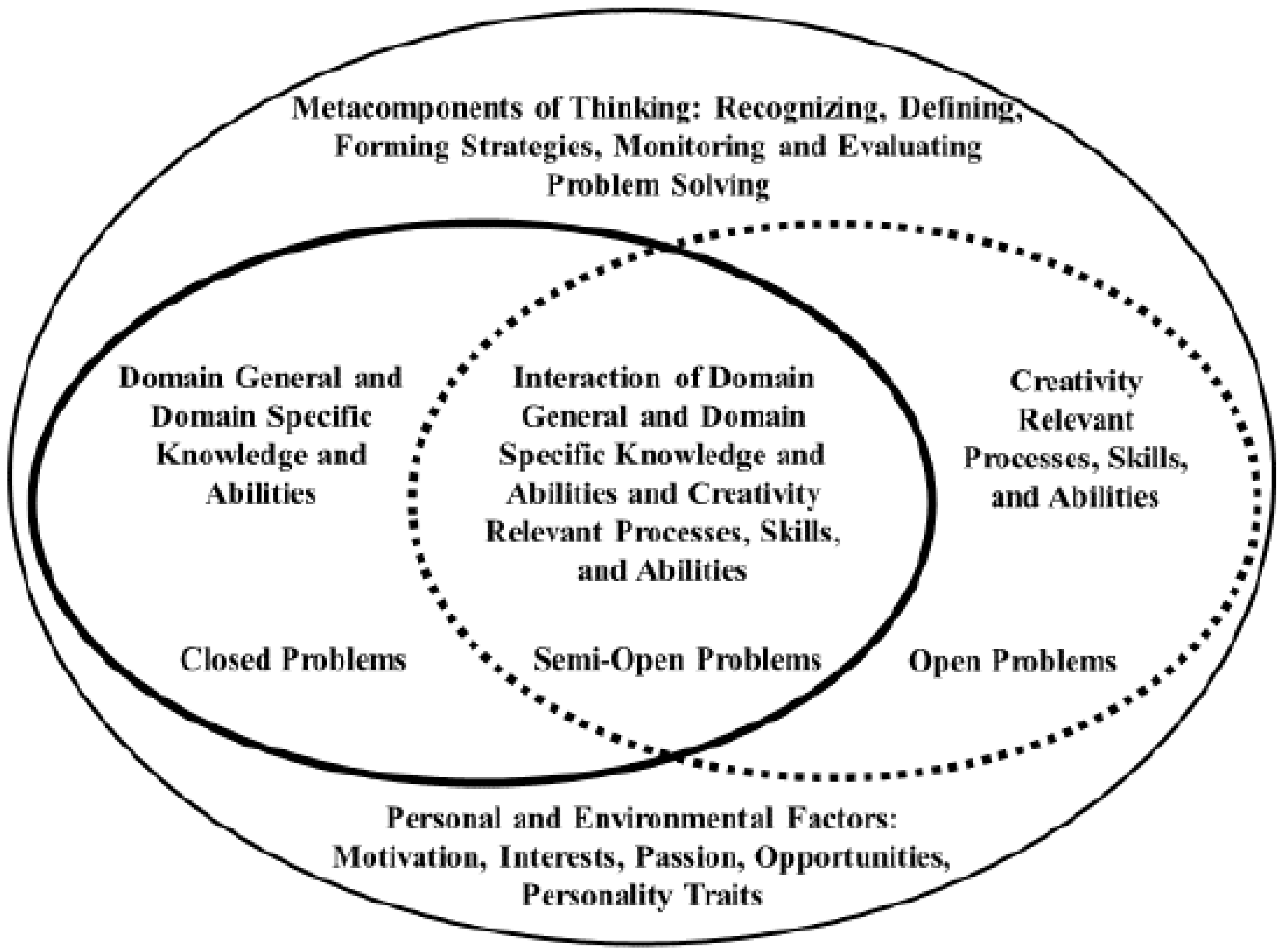
2. A Conceptual Framework, Research Summary, and Practices to Develop Creativity and Creative Problem Solving
2.1. Conceptual Framework
2.2. Definition of Exceptional Talent
2.3. Research Methods for Developing the Ways to Recognize and Nurture Talents
2.4. Summary of Results of Research on Indicators of Talents
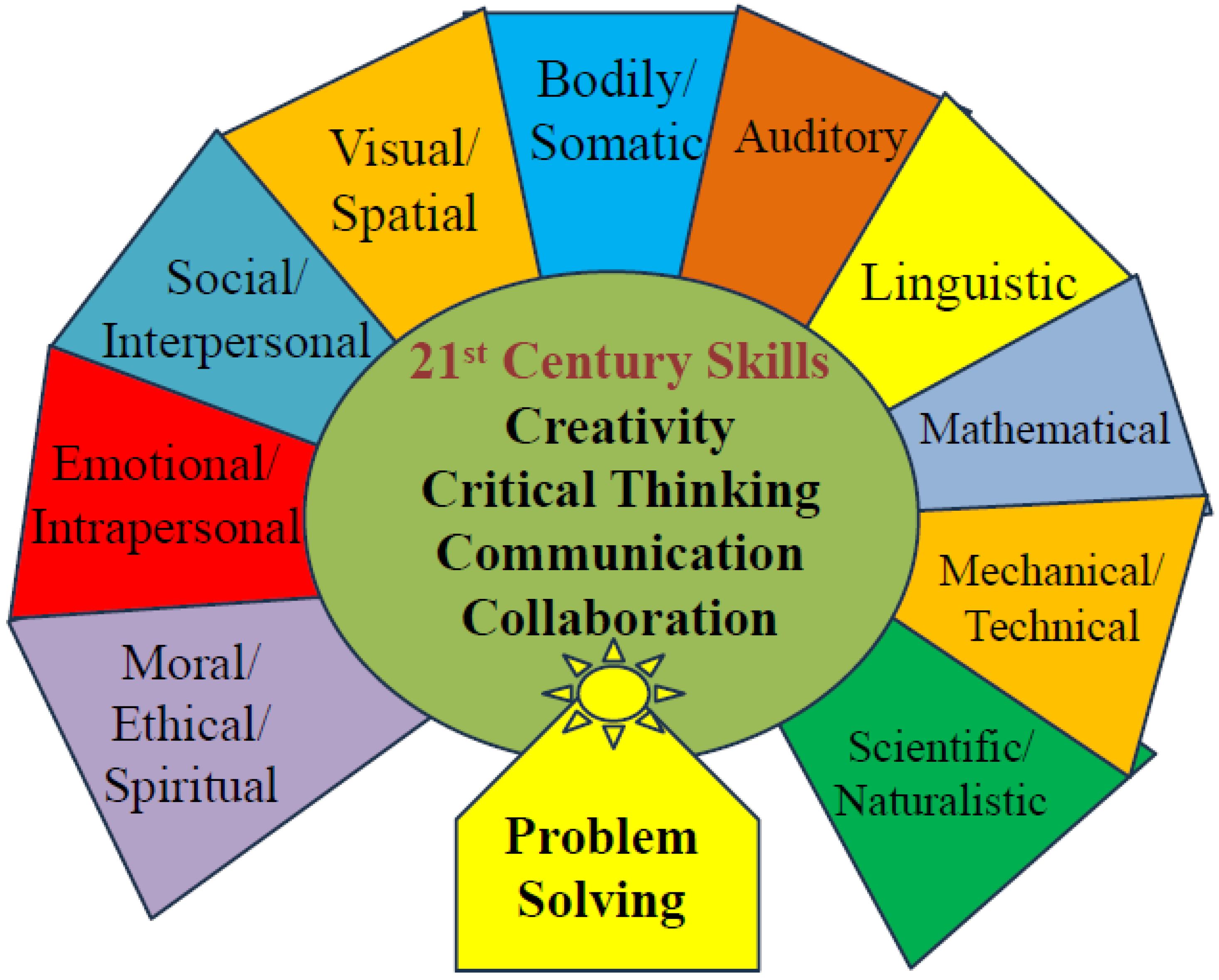
2.4.1. The Ten Diverse Talents in the Prism of Learning
2.4.2. Igniting Talents in the Prism of Learning
3. Methods for Igniting, Recognizing and Nurturing Diverse Talents in Inclusive Classrooms
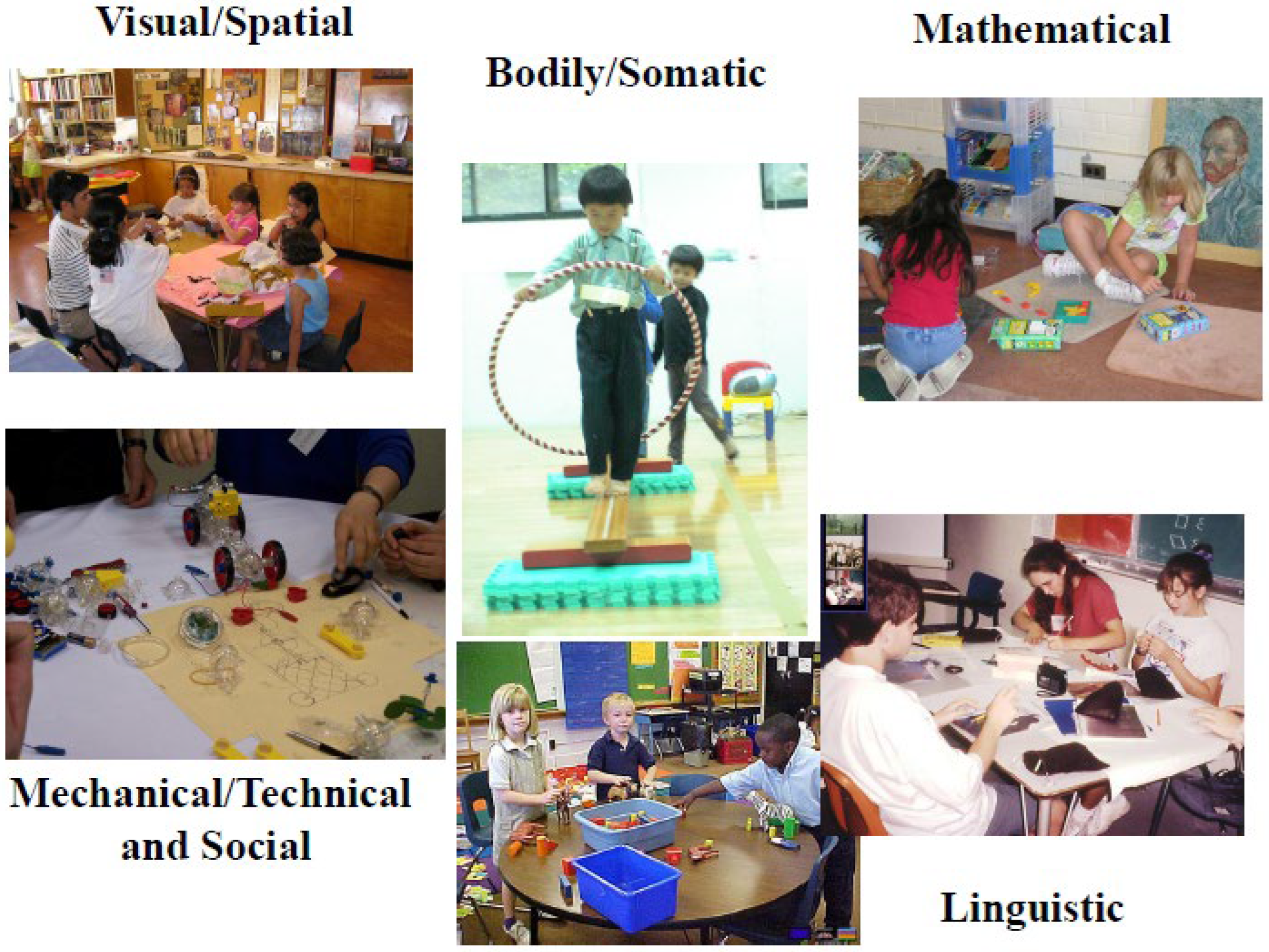
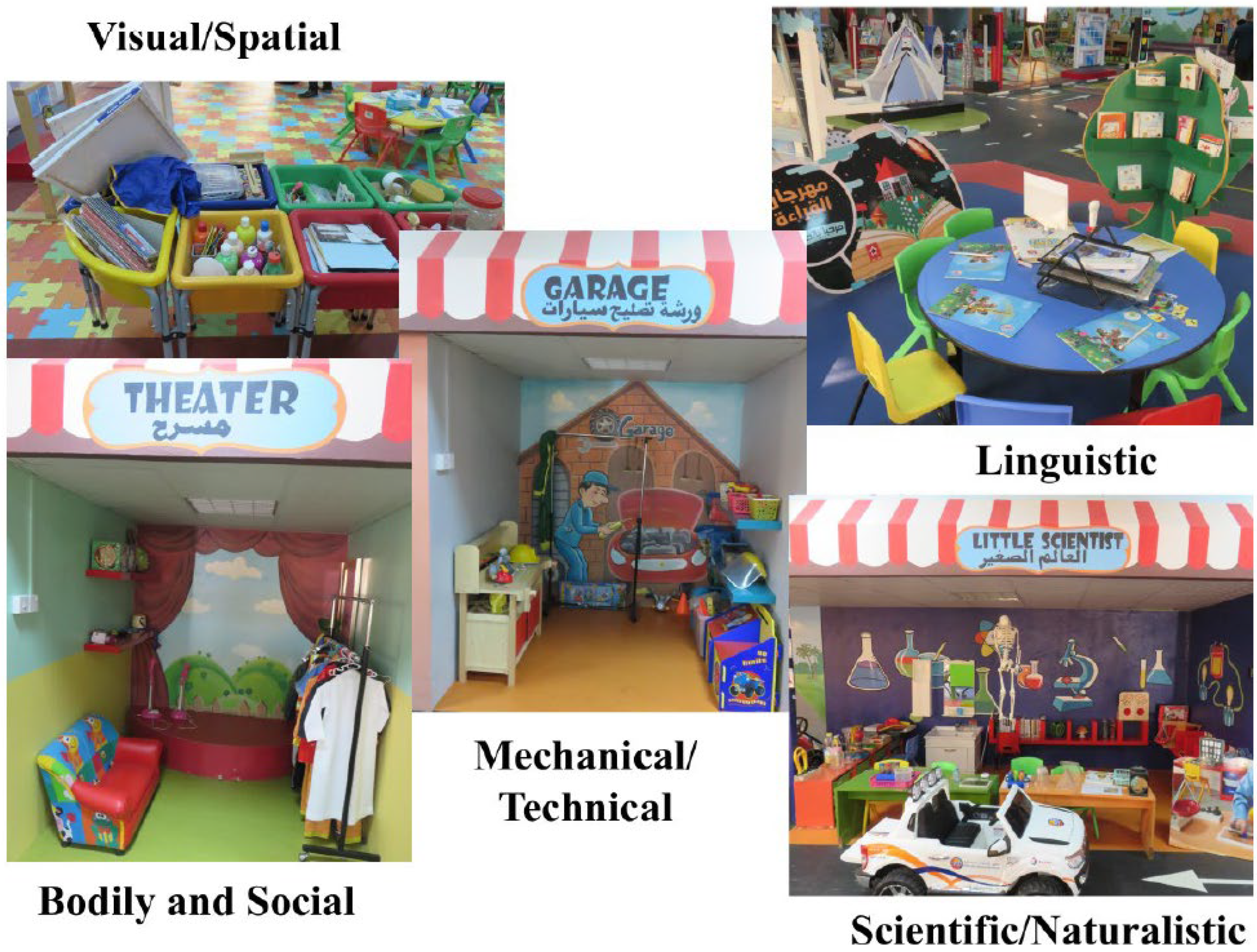
3.1. Centers for Exploration and Talent Development
3.1.1. A Practical Guide for Implementing Centers for Talent Exploration and Development
3.1.1.1. General Guidelines for Centers
- No worksheets are allowed!
- Materials must be engaging and developmentally appropriate for the students.
- Materials must be versatile and have the potential to be used in many different ways and to make a variety of constructions.
- If tasks are suggested, they must be open-ended, such as “make a model of an ecosystem” in the scientific/naturalistic center or “make a machine or vehicle that moves on its own power” in the mechanical/technical center.
- Make sure students know the task is suggested and not required unless it is part of an assessment.
- Have cameras and recorders in centers or generally available for use in documenting students’ activities and products.
- Have students keep journal and portfolio records of their participation in centers. These records are helpful for honoring, describing, and nurturing talents.
- In addition to reviewing journals and portfolios, be sure to observe students‘ motivation as they participate in various centers and presentations about their products.
3.1.1.2. Recommendations for Individual Centers: Auditory
3.1.1.3. Recommendations for Individual Centers: Bodily/Somatic
3.1.1.4. Recommendations for Individual Centers: Emotional/Intrapersonal
3.1.1.5. Recommendations for Individual Centers: Linguistic
3.1.1.6. Recommendations for Individual Centers: Mathematical
3.1.1.7. Recommendations for Individual Centers: Mechanical/Technical
3.1.1.8. Recommendations for Individual Centers: Moral/Ethical/Spiritual
3.1.1.9. Recommendations for Individual Centers: Scientific/Naturalistic
3.1.1.10. Recommendations for Individual Centers: Social/Interpersonal
3.1.1.11. Recommendations for Individual Centers: Visual/Spatial
3.1.1.12. Motivation: The Spark That Ignites Talents and 21st Century Skills
3.2. Talent Development Principles
- Content: Include a variety of content, especially that of interest to students with varied talents; when possible, connect this content to the required curriculum.
- Processes: Ask questions requiring higher levels of thinking; ask open-ended questions; ask students to give evidence of their reasoning; use varied processes; and encourage and facilitate group interaction.
- Products: Present real problems to solve (e.g., problems that are real and relevant to students’ lives); enable and facilitate methods for products to be presented to real audiences; expect products to be transformations, not copies, of existing products; and allow and encourage students to select the formats for their products.
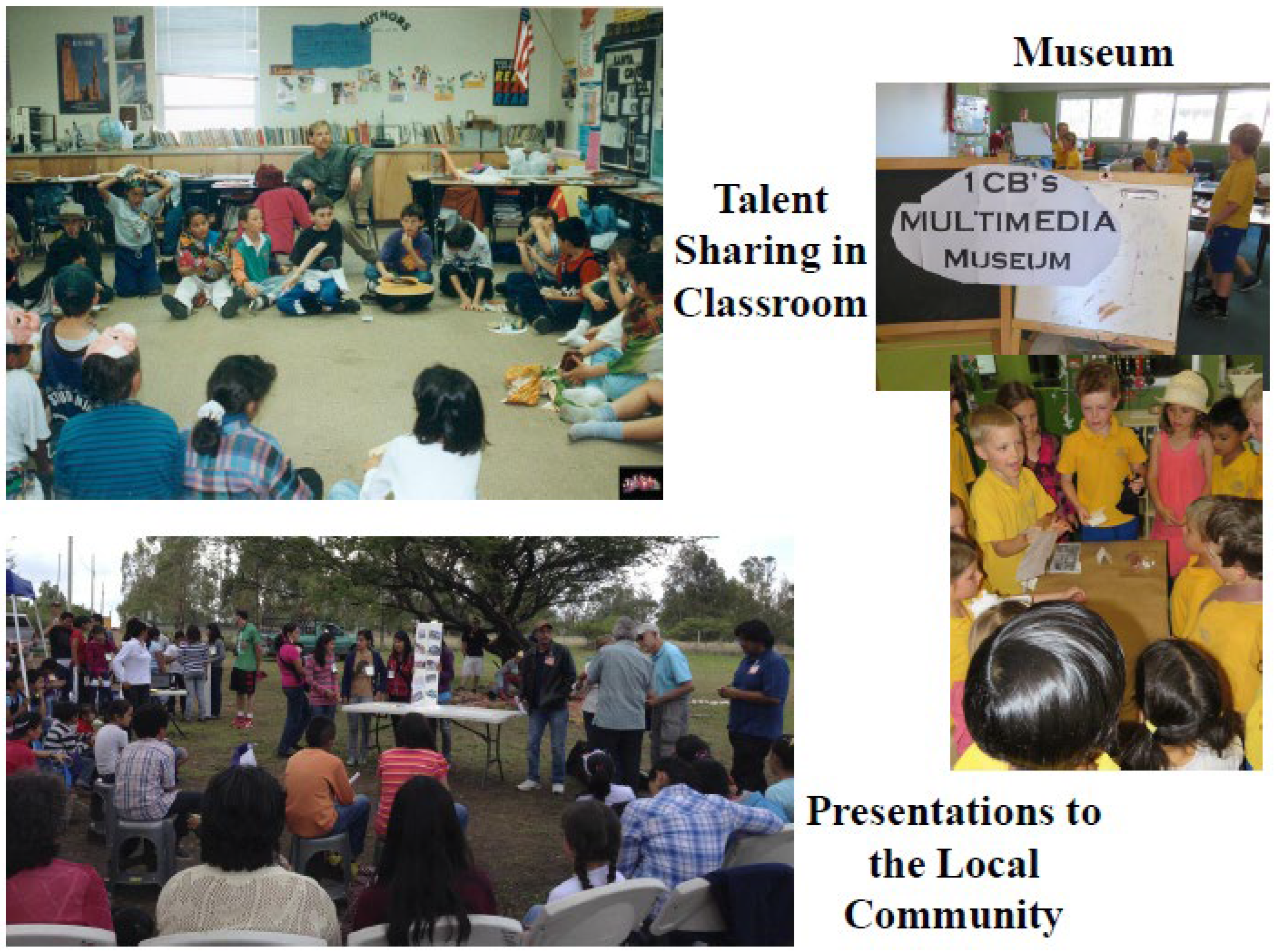
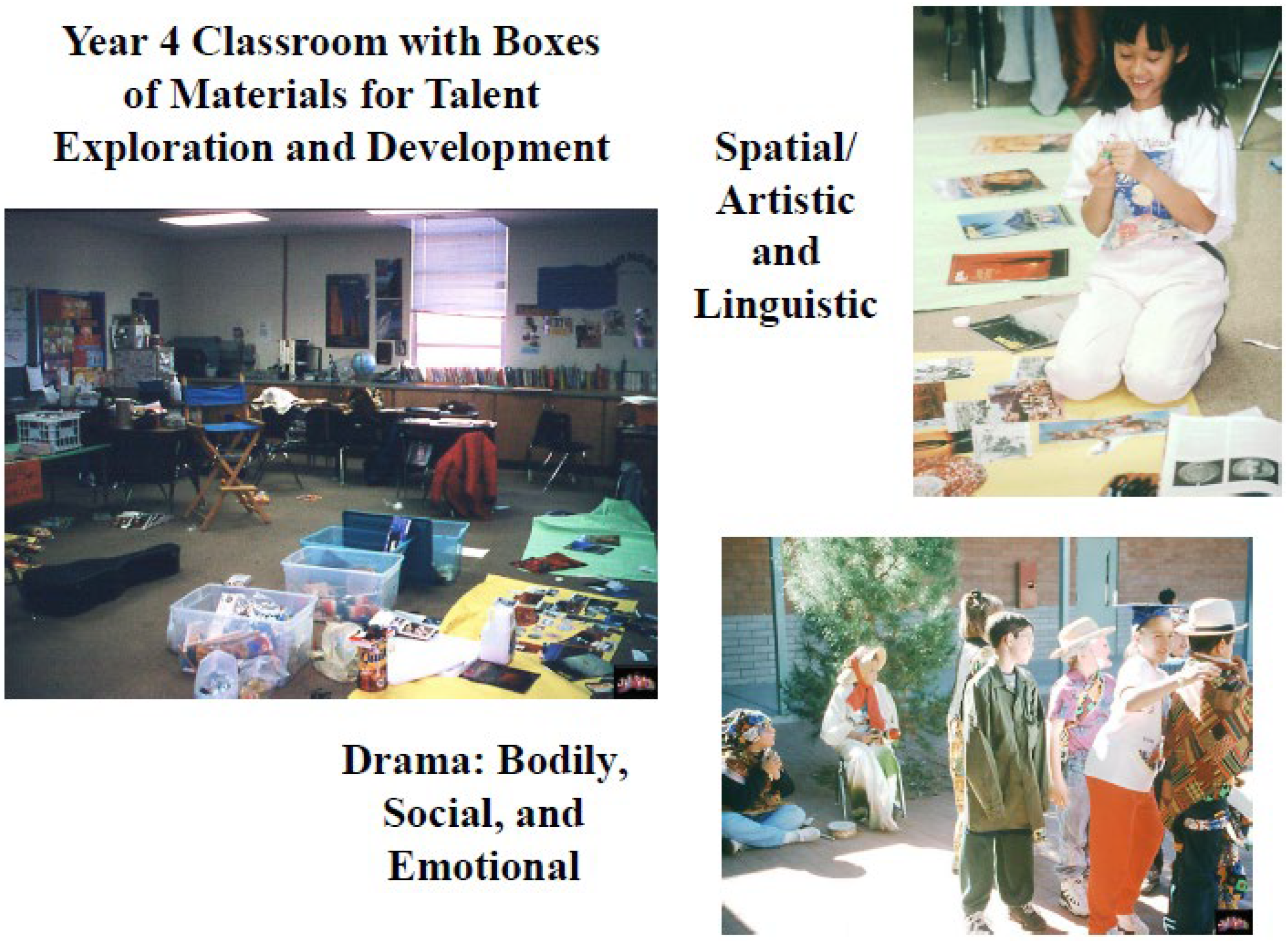
- Learning Environments: Design classrooms with a complexity of materials and groupings, and allow high mobility inside and outside the classroom.
3.3. Combining Talent Development Centers and Principles for Talent Development
3.3.1. Content
3.3.2. Processes
3.3.3. Products
3.3.4. Learning Environments
4. Summary and Conclusions
Funding
Institutional Review Board Statement
Informed Consent Statement
Data Availability Statement
Conflicts of Interest
References
- ACARA. (2012). Critical and creative thinking continuum across stages of schooling. In The Australian curriculum (Version 4.0). Australian Curriculum and Reporting Authority. Available online: https://www.acara.edu.au/curriculum (accessed on 30 March 2026).
- ADOBE. (2013). Barriers to creativity in education: Educators and parents grade the system. ADOBE Publications. Available online: https://danielschristian.com/learning-ecosystems/2013/08/21/barriers-to-creativity-in-education-educators-and-parents-grade-the-system-adobe/ (accessed on 30 March 2026).
- Alfaiz, F., Pease, R., & Maker, C. J. (2020). Culturally responsive assessment of physical science skills and abilities: Development, field testing, implementation, and results. Journal of Advanced Academics, 31(3), 298–328. [Google Scholar] [CrossRef] [Scilit]
- Alhusaini, A. A., & Maker, C. J. (2018). Who is gifted? The stability of scores on the DISCOVER assessment and the Raven’s progressive matrices in Diné gifted children. Turkish Journal of Giftedness and Education, 8(2), 114–142. Available online: https://theeducationjournals.com/index.php/talent/article/view/64 (accessed on 30 March 2026).
- Amabile, T. M. (1996). Creativity in context. Westview Press. [Google Scholar]
- Amabile, T. M. (2013). Componential theory of creativity. In E. H. Kessler (Ed.), Encyclopedia of management theory (pp. 134–139). Sage. [Google Scholar]
- Ambrose, D. (2012). Battling creaticide: An interview with David C. Berliner. Roeper Review, 34(2), 77–80. [Google Scholar] [CrossRef] [Scilit]
- Ambrose, D. (2017a). Interdisciplinary exploration supports Sternberg’s expansion of giftedness. Roeper Review, 39(3), 178–182. [Google Scholar] [CrossRef] [Scilit]
- Ambrose, D. (2017b). Interdisciplinary invigoration of creativity studies. The Journal of Creative Behavior, 51(4), 348–351. [Google Scholar] [CrossRef] [Scilit]
- Anuruthwong, U. (2002). Exploring center: Ignition key to children’s potential and thinking. In U. Anuruthwong, S. Hiranburana, & C. Piboonchoil (Eds.), Igniting children’s potentials and creativity: Proceedings of the 7th Asia-pacific conference on giftedness (pp. 92–93). Center for the Gifted and Talented, Srinakharinwirot University. [Google Scholar]
- Audretsch, D. B., & Thurik, A. R. (2000). Capitalism and democracy in the 21st century: From the managed to the entrepreneurial economy. Journal of Evolutionary Economics, 10(1), 17–34. [Google Scholar] [CrossRef] [Scilit]
- Audretsch, D. B., & Thurik, A. R. (2001). What is new about the new economy: Sources of growth in the managed and entrepreneurial economies. Industrial and Corporate Change, 10(1), 267–315. [Google Scholar] [CrossRef] [Scilit]
- Bahar, A. K., Can, I., & Maker, C. J. (2024). What does it take to be original? A domain-specific exploration of mathematical problem solving. Thinking Skills and Creativity, 53(2), 101592. [Google Scholar] [CrossRef] [Scilit]
- Bahar, A. K., Maker, C. J., & Scherbakova, A. (2021). The role of teachers’ implementation of the Real Engagement in Active Problem Solving (REAPS) model in developing creative problem solving in mathematics. Australasian Journal of Gifted Education, 30(2), 26–39. [Google Scholar] [CrossRef] [Scilit]
- Barbot, B., Besancon, M., & Lubart, T. (2016). The generality-specificity of creativity: Exploring the structure of creative potential with EPoC. Learning and Individual Differences, 52, 178–187. [Google Scholar] [CrossRef] [Scilit]
- Baum, S. M., Renzulli, J. S., & Hebert, T. P. (1999). Reversing underachievement: Creative productivity as a systematic intervention. Gifted Child Quarterly, 39(4), 224–235. [Google Scholar] [CrossRef] [Scilit]
- Baum, S. M., Schader, R. M., & Owen, S. V. (2021). To be gifted and learning disabled: Strength-based strategies for helping twice-exceptional students with LD, ADHD, ASD, and more. Routledge. [Google Scholar]
- Begay, H., & Maker, C. J. (2007). When geniuses fail…Na-Dine (Navajo) conception of giftedness. In S. N. Phillipson, & M. McCann (Eds.), Conceptions of giftedness: Socio-cultural perspectives (pp. 127–168). Lawrence Erlbaum Associates. [Google Scholar] [CrossRef] [Scilit]
- Berliner, D. (2012). Narrowing curriculum, assessments, and conceptions of what it means to be smart in the U.S. schools: Creaticide by design. In How dogmatic beliefs harm creativity and higher-level thinking. Routledge. [Google Scholar]
- Berman, S., & Korsten, P. (2010). Capitalizing on complexity: Insights from the global chief executive officer study. IBM. [Google Scholar]
- Bransford, J., Brown, A. L., & Cocking, R. R. (2000). How people learn: Brain, mind, experience, and school (expanded ed.). National Academy Press. [Google Scholar]
- Brownlee, K., Rawana, E. P., & MacArthur, J. (2012). Implementation of a strengths-based approach to teaching in an elementary school. Journal of Teaching and Learning, 8(1), 1–12. [Google Scholar] [CrossRef] [Scilit]
- Dai, D. Y., & Chen, F. (2013). Three paradigms of gifted education: In search of conceptual clarity in research and practice. Gifted Child Quarterly, 57(3), 151–168. [Google Scholar] [CrossRef] [Scilit]
- Dowrick, C. (2025). Artistic expression, self-worth, and mental health: Pathways to dignity. Academia Mental Health and Well-Being, 2(4), 1–7. [Google Scholar] [CrossRef] [Scilit]
- Drake, S., & Reid, J. (2021). Thinking now: Transdisciplinary thinking as a disposition. Academia Letters, 387. [Google Scholar] [CrossRef] [Scilit]
- Ford, D. Y. (2021). Multicultural gifted education. Routledge. [Google Scholar]
- Frasier, M. M., Hunsaker, S. L., Lee, J., Mitchell, S., Cramond, B., Krisel, S., Garcia, J. H., Martin, D., Frank, E., & Finley, V. S. (1995). Core attributes of giftedness: A foundation for recognizing the gifted potential of economically disadvantaged students (RM95210). University of Connecticut, The National Research Center on the Gifted and Talented. [Google Scholar]
- Frasier, M. M., & Passow, A. H. (1994). Toward a new paradigm for identifying talent potential (Research Monograph 94112). University of Connecticut, The National Research Center on the Gifted and Talented. [Google Scholar]
- Gallagher, S. A. (2015). The role of problem based learning in developing creative expertise. Asia-Pacific Educational Review, 16, 225–235. [Google Scholar] [CrossRef] [Scilit]
- Gallagher, S. A., & Gallagher, J. J. (2013). Using problem-based learning to explore unseen academic potential. Interdisciplinary Journal of Problem-Based Learning, 7(1), 111–131. [Google Scholar] [CrossRef] [Scilit]
- Gardner, H. (1983). Frames of mind: The theory of multiple intelligences. Basic Books. [Google Scholar]
- Getzels, J. W., & Csikszentmihalyi, M. (1967). Scientific creativity. Science Journal, 3(9), 80–84. Available online: http://psycnet.apa.org/record/1967-16699-001 (accessed on 30 March 2026).
- Getzels, J. W., & Csikszentmihalyi, M. (1976). The creative vision: A longitudinal study of problem finding in art. Wiley. [Google Scholar]
- Glaser, R., & Chi, M. T. H. (1988). Overview. In M. T. H. Chi, R. Glaser, & M. J. Farr (Eds.), The nature of expertise (pp. xv–xxviii). Lawrence Erlbaum. [Google Scholar]
- Goings, R. B., & Ford, D. Y. (2018). Investigating the intersection of poverty and race in gifted education journals: A 15-year analysis. Gifted Child Quarterly, 62(1), 25–36. [Google Scholar] [CrossRef] [Scilit]
- Goleman, D. (1998). Working with emotional intelligence. Bantam. [Google Scholar]
- Greene, A. K., Dougé, M. C., & Maki, K. E. (2025). State definitions, policies, and practices ofgGifted and talented identification: What difference does a decade make? Gifted Child Quarterly, 69(4), 333–350. [Google Scholar] [CrossRef] [Scilit]
- Guignard, J. H., Kermarrec, S., & Tordjman, S. (2016). Relationships between intelligence and creativity in gifted and non-gifted children. Learning and Individual Differences, 52, 209–215. [Google Scholar] [CrossRef] [Scilit]
- Kim, K. H. (2005). Can only intelligent people be creative? A meta-analysis. Journal of Secondary Gifted Education, 16(2–3), 57–66. [Google Scholar] [CrossRef] [Scilit]
- Kincheloe, J. L. (2004). Multiple intelligences reconsidered (Vol. 278). Peter Lang Publishing Inc. [Google Scholar]
- Krathwohl, D. R. (2002). A revision of Bloom’s Taxonomy. Theory into Practice, 41(4), 212–218. [Google Scholar] [CrossRef] [Scilit] [PubMed]
- Kuo, C. C., Maker, C. J., & Su, F.-L. (2011). Cultivating problem solving abilities in gifted preschoolers. Gifted Educational International, 27(3), 311–326. [Google Scholar] [CrossRef] [Scilit]
- Kuo, C. C., Maker, C. J., Su, F.-L., & Hu, C. (2010). Identifying young gifted children and cultivating problem solving abilities and multiple intelligences. Learning and Individual Differences, 20(4), 365–379. [Google Scholar] [CrossRef] [Scilit]
- Lori, A. A. (1998). Storytelling and personal traits: Investigating the relationship between children’s storytelling ability and their interpersonal and intrapersonal traits. Gifted Education International, 13, 175–184. [Google Scholar] [CrossRef] [Scilit]
- Loughran, J. (2010). What expert teachers do: Enhancing professional knowledge for classroom practice. Allen & Unwin. [Google Scholar]
- Lubart, T. I., Zenasni, F., & Barbot, B. (2013). Creative potential and its measurement. International Journal for Talent Development and Creativity, 1(2), 41–50. Available online: https://files.eric.ed.gov/fulltext/EJ1301375.pdf (accessed on 30 March 2026).
- Maker, C. J. (1978). Successful handicapped adults: Their perceptions of significant events, causes, and effects [Unpublished doctoral dissertation]. University of Virginia.
- Maker, C. J. (1982). Curriculum development for the gifted. Pro-Ed. [Google Scholar]
- Maker, C. J. (1993). Creativity, intelligence, and problem-solving: A definition and design for crosscultural research and measurement related to giftedness. Gifted Education International, 9(2), 68–77. [Google Scholar] [CrossRef] [Scilit]
- Maker, C. J. (1994). Authentic assessment of problem solving and giftedness in secondary school students. Journal of Secondary Gifted Education, 2(1), 19–29. Available online: https://eric.ed.gov/?q=learning+and+multiple+and+representations&pg=17914&id=EJ497602 (accessed on 30 March 2026).
- Maker, C. J. (1996). Identification of gifted minority students: A national problem, needed changes, and a promising solution. Gifted Child Quarterly, 40(1), 41–50. [Google Scholar] [CrossRef] [Scilit]
- Maker, C. J. (2005). The DISCOVER project: Improving assessment and curriculum for diverse gifted learners (Senior Scholars Series Monograph). National Research Center on the Gifted and Talented. Available online: https://eric.ed.gov/?id=ED505483 (accessed on 30 March 2026).
- Maker, C. J. (2016). Recognizing and developing spiritual abilities through real-life problem solving. Gifted Education International, 32(3), 271–306. [Google Scholar] [CrossRef] [Scilit]
- Maker, C. J. (2020). Identifying exceptional talent in science, technology, engineering, and mathematics: Increasing diversity and assessing creative problem-solving. Journal of Advanced Academics, 31(3), 161–210. [Google Scholar] [CrossRef] [Scilit]
- Maker, C. J. (2021). Exceptional talent in the 21st century context: Conceptual framework, definition, assessment, and development. Gifted Education International, 37(2), 158–198. [Google Scholar] [CrossRef] [Scilit]
- Maker, C. J. (2025). Recognizing the ten “faces” of giftedness: A key to success in the 21st century context. Vision, 36(1), 9–14. Available online: https://vagtc.org.au/product/vision-magazine-volume-36-no-1-2025-the-diverse-faces-of-giftedness-digital/ (accessed on 30 March 2026).
- Maker, C. J. (2026). Creative problem solving: Integrating intellectual giftedness and creative giftedness within and across diverse domains. Gifted Education International, 42(1), 79–101. [Google Scholar] [CrossRef] [Scilit]
- Maker, C. J., Alhusaini, A. A., Pease, R., Zimmerman, R., & Alamiri, F. Y. (2015). Developing creativity, talents, and interests across the lifespan: Centers for creativity and innovation. Turkish Journal of Giftedness and Education, 5(2), 83–109. Available online: https://theeducationjournals.com/index.php/talent/article/view/37 (accessed on 30 March 2026).
- Maker, C. J., & Anuruthwong, U. (2003). The miracle of learning: The prism model. In Proceedings of the 15th biennial world conference of the world council for gifted and talented students. World Council for Gifted and Talented Students. [Google Scholar]
- Maker, C. J., & Bahar, A. K. (2024). Talent development in inclusive classrooms: An analysis of student growth. The Australasian Journal of Gifted Education, 33(2), 28–56. [Google Scholar] [CrossRef] [Scilit]
- Maker, C. J., & Bahar, A. K. (2025). Observation: Unlocking, assessing, and nurturing creative problem solving. Frontiers in Psychology, 16, 1540501. [Google Scholar] [CrossRef] [Scilit] [PubMed]
- Maker, C. J., Bahar, A. K., Pease, R., & Alfaiz, F. A. (2023). DISCOVERing and nurturing creative problem solving in young children: An exploratory study. Journal of Creativity, 33, 100053. [Google Scholar] [CrossRef] [Scilit]
- Maker, C. J., Bahar, K., Alfaiz, F. S., & Pease, R. (2022). Developing and assessing creative scientific talent that is transformational through Real Engagement in Active Problem Solving (REAPS). Australasian Journal of Gifted Education, 31(1), 5–21. [Google Scholar] [CrossRef] [Scilit]
- Maker, C. J., Muammar, O., & Jo, S. M. (2008). Development of Creativity: The influence of traditional and non-traditional pedagogy. Learning and Individual Differences, 18(4), 402–417. [Google Scholar] [CrossRef] [Scilit]
- Maker, C. J., & Pease, R. (2008). DISCOVER and TASC in a summer program for gifted students. Gifted Education International, 24(2/3), 323–328. [Google Scholar] [CrossRef] [Scilit]
- Maker, C. J., & Pease, R. (2020). Developing literacy through strength-based education: The discovering intellectual strengths and capabilities while observing varied ethnic responses (DISCOVER) approach. In D. Knoell (Ed.), The question mark. The Newsletter of the International Literacy Association (ILA) Special Interest Group on Gifted and Talented. [Google Scholar]
- Maker, C. J., & Pease, R. (2021). Igniting, cultivating, extending, and strengthening exceptional talent through real engagement in active problem solving. Australasian Journal of Gifted Education, 30(2), 5–25. [Google Scholar] [CrossRef] [Scilit]
- Maker, C. J., Rogers, J. A., Nielson, A. B., & Bauerle, P. A. (1996). Multiple intelligences, problem solving, and diversity in the general classroom. Journal for the Education of the Gifted, 19(4), 437–460. [Google Scholar] [CrossRef] [Scilit]
- Maker, C. J., & Schiever, S. W. (2010). Curriculum development and teaching strategies for gifted learners (3rd ed.). Pro-Ed. [Google Scholar]
- Maker, C. J., Zimmerman, R., Bahar, A. K., & In-Albon, C. (2021). The influence of real engagement in active problem solving on deep learning: An important component of exceptional talent in the 21st century context. Australasian Journal of Gifted Education, 30(2), 40–63. [Google Scholar] [CrossRef] [Scilit]
- Maker, C. J., & Zimmerman, R. H. (2020). Concept maps as assessments of expertise: Understanding of the complexity and interrelationships of concepts in science. Journal of Advanced Academics, 31(3), 254–297. [Google Scholar] [CrossRef] [Scilit]
- Nichols, S., & Berliner, D. C. (2007). Collateral damage: How high-stakes testing corrupts America’s schools. Harvard Education Press. [Google Scholar]
- Nielson, A. B. (1994). Traditional identification: Elitist, racist, sexist? new evidence. CAG Communicator: The Journal of the California Association for the Gifted, 25(3), 18–19, 26–31. Available online: https://eric.ed.gov/?id=ED378782 (accessed on 30 March 2026).
- OECD. (2022). Thinking outside the box: The PISA 2022 creative thinking assessment. Available online: https://issuu.com/oecd.publishing/docs/thinking-outside-the-box (accessed on 30 March 2026).
- OECD. (2024). PISA 2022 results (volume III): Creative minds, creative schools (PISA). OECD Publishing. [Google Scholar] [CrossRef] [Scilit]
- Oke, A., Munshi, N., & Walumbwa, F. O. (2009). The influence of leadership on innovation processes and activities. Organizational Dynamics, 38(1), 50–64. [Google Scholar] [CrossRef] [Scilit]
- Olszewski-Kubilius, P. (2024). Where are we now with the implementation of the talent development framework for gifted students and where do we go in the future? Education Sciences, 14, 932. [Google Scholar] [CrossRef] [Scilit]
- Paynter, J. L. (2021). Teach to develop talent: How to motivate and engage tomorrow’s innovators today. Corwin. [Google Scholar]
- Pease, R., Vuke, M., Maker, C. J., & Muammar, O. M. (2020). A practical guide for implementing the STEM assessment results in classrooms: Using strength-based reports and real engagement in active problem solving. Journal of Advanced Academics, 31(3), 367–406. [Google Scholar] [CrossRef] [Scilit]
- Plucker, J. A., Callahan, C. M., & Tomchin, E. M. (1996). Wherefore art thou, multiple intelligences? Alternative assessments for identifying talent in ethnically diverse and low income students. Gifted Child Quarterly, 40(2), 81–91. [Google Scholar] [CrossRef] [Scilit]
- Reid, C., Udall, A., Romanoff, B., & Algozzine, B. (1999). Comparison of traditional and problem solving assessment criteria. Gifted child Quarterly, 43, 244–251. [Google Scholar] [CrossRef] [Scilit]
- Reis, S. M., & Renzulli, J. S. (2010). Is there still a need for gifted education? An examination of current research. Learning and Individual Differences, 20(4), 308–317. [Google Scholar] [CrossRef] [Scilit]
- Renzulli, J. S. (1978). What makes giftedness? Reexamining a definition. Phi Delta Kappan, 60, 180–184. [Google Scholar] [CrossRef] [Scilit]
- Renzulli, J. S. (2021). The major goals of gifted education and talent development programs. Academia Letters, 2585. [Google Scholar] [CrossRef] [Scilit]
- Riley, T., Webber, M., & Sylva, K. (2017). Real engagement in active problem solving for Māori boys: A case study in a New Zealand secondary school. Gifted and Talented International, 32(2), 75–86. [Google Scholar] [CrossRef] [Scilit]
- Rogers, J. A. (1998). Refocusing the lens: Using observation to assess and identify gifted learners. Gifted Education International, 12(3), 129–144. [Google Scholar] [CrossRef] [Scilit]
- Romanoff, B. S., Algozzine, B., & Nielson, A. B. (2009). Achievement of African American and Caucasian students referred and placed or not placed in gifted programs. Journal for the Education of the Gifted, 33(2), 156–175. [Google Scholar] [CrossRef] [Scilit]
- Ronksley-Pavia, M. (2015). A model of twice-exceptionality: Explaining and defining the apparent paradoxical combination of disability and giftedness in childhood. Journal for the Education of the Gifted, 38(3), 318–340. [Google Scholar] [CrossRef] [Scilit]
- Rooks, D. L., & Maker, C. J. (2009). Inquiry: A teaching approach for gifted visually impaired learners. Gifted Education International, 25, 172–187. [Google Scholar] [CrossRef] [Scilit]
- Sak, U. (2021). The Fuzzy Conception of Giftedness. In R. J. Sternberg, & D. Ambrose (Eds.), Conceptions of giftedness and talent (pp. 371–392). Palgrave Macmillan. [Google Scholar] [CrossRef] [Scilit]
- Sak, U., & Maker, C. J. (2003). The long-term predictive validity of a performance-based assessment used to identify gifted CLD students. In Proceedings of the 15th biennial world conference of the world council for gifted and talented students. World Council for Gifted and Talented Students. [Google Scholar]
- Sak, U., & Maker, C. J. (2005). Divergence and convergence of mental forces of children in open and closed mathematical problems. International Education Journal, 6(2), 252–260. Available online: https://files.eric.ed.gov/fulltext/EJ854978.pdf (accessed on 30 March 2026).
- Sarouphim, K. M. (1999). DISCOVER: A promising alternative assessment for the identification of gifted minorities. Gifted Child Quarterly, 43(4), 244–251. [Google Scholar] [CrossRef] [Scilit]
- Sarouphim, K. M. (2000). Internal structure of DISCOVER: A performance-based assessment. Journal for the Education of the Gifted, 23(3), 314–317. Available online: http://eric.ed.gov/?id=EJ609790 (accessed on 30 March 2026).
- Sarouphim, K. M. (2001). DISCOVER: Concurrent validity, gender differences, and identification of minority students. Gifted Child Quarterly, 45, 130–138. [Google Scholar] [CrossRef] [Scilit]
- Sarouphim, K. M. (2002). DISCOVER in high school: Identifying gifted Hispanic and Native American students. The Journal of Secondary Gifted Education, 14, 30–38. [Google Scholar] [CrossRef] [Scilit]
- Sarouphim, K. M. (2004). DISCOVER in middle school: Identifying gifted minority students. Prufrock Journal, 15(2), 61–69. [Google Scholar] [CrossRef] [Scilit]
- Sarouphim, K. M. (2009). The use of a performance assessment for identifying gifted Lebanese students: Is DISCOVER effective? Journal for the Education of the Gifted, 33(2), 275–295. [Google Scholar] [CrossRef] [Scilit]
- Sarouphim, K. M., & Maker, C. J. (2010). Ethnic and gender differences in identifying gifted students: A multicultural analysis. International Education, 39(2), 42–56. Available online: https://eric.ed.gov/?id=EJ930085 (accessed on 30 March 2026).
- Siegle, D., McCoach, B., & Roberts, A. (2017). Why I believe I achieve determines whether I achieve. High Ability Studies, 28(1), 59–72. [Google Scholar] [CrossRef] [Scilit]
- Silvia, P. J. (2015). Intelligence and creativity are pretty similar after all. Educational and Psychological Review, 27, 599–606. [Google Scholar] [CrossRef] [Scilit]
- Sisk, D. A. (2016). Spiritual intelligence: Developing higher consciousness revisited. Gifted Education International, 32(3), 194–208. [Google Scholar] [CrossRef] [Scilit]
- Sternberg, R. J. (1999). Intelligence as developing expertise. Contemporary Educational Psychology, 24, 359–375. [Google Scholar] [CrossRef] [Scilit] [PubMed]
- Sternberg, R. J. (2005). WICS: A Model of positive educational leadership comprising wisdom, intelligence, and creativity synthesized. Educational Psychology Review, 17(3), 191–262. [Google Scholar] [CrossRef] [Scilit]
- Sternberg, R. J. (2017). ACCEL: A new model for identifying the gifted. Roeper Review, 39(3), 152–169. [Google Scholar] [CrossRef] [Scilit]
- Sternberg, R. J. (2020). Transformational giftedness: Rethinking our paradigm for gifted education. Roeper Review, 42(4), 230–240. [Google Scholar] [CrossRef] [Scilit]
- Stevenson, D. H., & Starkweather, J. A. (2010). PM critical competency index: IT execs prefer soft skills. International Journal of Project Management, 28, 663–671. Available online: https://www.sciencedirect.com/science/article/abs/pii/S0263786309001410 (accessed on 30 March 2026). [CrossRef] [Scilit]
- Subotnik, R. F., Olszewski-Kubilius, P., & Worrell, F. (2011). Rethinking giftedness and gifted education: A proposed direction forward based on psychological science. Psychological Science in the Public Interest, 12(1), 3–54. [Google Scholar] [CrossRef] [Scilit] [PubMed]
- Thurik, A. R., Stam, E., & Audretsch, D. B. (2013). The rise of the entrepreneurial economy and the future of dynamic capitalism. Technovation, 33(8–9), 302–310. [Google Scholar] [CrossRef] [Scilit]
- Torrance, E. P. (1962). Guiding creative talent. Prentice Hall. [Google Scholar]
- Torrance, E. P. (1969). Creative positives of disadvantaged children and youth. Gifted Child Quarterly, 13(2), 71–81. [Google Scholar] [CrossRef] [Scilit]
- Wallace, B., Maker, C. J., Cave, D., & Chandler, S. (2004). Thinking skills and problem-solving: An inclusive approach. David Fulton Publishers. [Google Scholar]
- Webber, M., Riley, T., Sylva, K., & Scobie-Jennings, E. (2018). The Ruamano project: Raising expectations, realising community aspirations and recognising gifted potential in Māori boys. The Australian Journal of Indigenous Education. Advance online publication. [Google Scholar] [CrossRef] [Scilit]
- White, J. (1998). Do Howard Gardner’s multiple intelligences add up? Institute of Education, University of London. [Google Scholar]
- Wu, I.-C., Pease, R., & Maker, C. J. (2021). General education teachers’ perceptions of the Real Engagement in Active Problem Solving (REAPS) model. Australasian Journal of Gifted Education, 30(2), 64–79. [Google Scholar] [CrossRef] [Scilit]
- Yu, C.-H., & Kuo, C.-C. (2026). Factors influencing experiences in gifted education and talent development from childhood to adulthood. Education Sciences, 16(2), 230. [Google Scholar] [CrossRef] [Scilit]
- Zimmerman, R. H., Maker, C. J., & Alfaiz, F. S. (2020). Culturally responsive assessment of life science skills and abilities: Development, field testing, implementation, and results. Journal of Advanced Academics, 31(3), 329–366. [Google Scholar] [CrossRef] [Scilit]




| Qualities of Sounds | Characteristics of Songs or Chants |
|---|---|
| Voice has high quality (e.g., pure, accurate pitch) Sounds include combinations of tones Sounds include combinations of rhythms | Song or chant
|
| Types of Movements Created | Qualities of Movements |
|---|---|
| Creates original poses Creates original dance(s) Creates other balance poses or movements | Movements are
|
| Types of Emotions Identified | Characteristics of Expressions of Emotions |
|---|---|
| Emotions are related to pictures Emotions are atypical Identifies reasons for emotions | Identified or demonstrated behavior is consistent with the elicited emotion Action described or demonstrated shows management of emotion(s) |
| Language and Processes to Observe | Characteristics of Stories |
|---|---|
| Gives descriptions easily and fluently Gives detailed descriptions Chooses colorful or unusual adjectives and adverbs Changes voice to represent different characters Makes complex sentences (e.g., many words, many phrases, many parts of speech) | Includes action, feelings, humor, or visual images Original story has a plot Story has a beginning, middle, and end structure Story has an ending that is consistent with the story Story has a surprise ending that is plausible |
| Behaviors Showing Observation of Attributes | Characteristics of Products Made |
|---|---|
Notices
| Groups have 2, 3, or 4 consistent attributes (e.g., color, shape, size, thickness, and various combinations of attributes) Shapes are accurate and have many tangram or pattern block pieces Items made with origami paper are original |
| Behaviors while Constructing Products | Characteristics of Constructions |
|---|---|
| Uses the principles of energy transfer to construct gears, robots, vehicles, and machines Motorized gears and other motorized parts are powered by motors and function as part of the mechanical construction Makes a gear train, robot, vehicle, or machine | Mechanical constructions are unique Mechanical constructions are complex and made with many pieces Mechanical constructions function in effective, multiple, and/or unique ways |
| Behaviors to Observe | Characteristics of Descriptions |
|---|---|
| Talks about fairness, honesty, sharing, love, and other positive ethical principles Talks about kindness (e.g., helping others, protecting others) Talks about correcting wrong behavior | Includes characteristics that go beyond the physical Refers to spiritual principle(s) Describes actions and qualities of a good person (e.g., love, kindness, forgiveness, not harming others or the environment) |
| Behaviors to Observe | Characteristics of Groupings |
|---|---|
| Creates a real or imagined ecosystem with many connected components Makes connections among items and events (such as natural disasters) in the environment Makes connections between the environment and the things in it Makes many groups | Groups are based on
|
| What the Student Does | What the Student Says |
|---|---|
| Shows interest in and/or listens to children and/or observers Shows kindness to others (e.g., gives help, gives away pieces, gives hints) Cooperates with others in a nonverbal way (e.g., accepts the placing of an added piece) Shows patience Organizes others to complete the task Observes that everyone is participating and no one is left out Tries to resolve a conflict Finds ways to include others (offers a piece of the material being used) | Makes positive comments to others Encourages others Identifies emotion(s) shown by others Cooperates with others verbally (e.g., agreeable with others’ ideas, uses “us”, “we” “let’s”) Responds to others Directs others in a positive way (talks with others, makes offers) Identifies own behavior and its impact on others and the group work |
| Behaviors to Observe | Characteristics of Products |
|---|---|
| Notices color and shape of materials Includes many pieces Includes many types of pieces Adds details when constructing Tries to make construction stand on its own | Construction
|
| Non-Verbal Behaviors to Observe | Verbal Behaviors to Observe |
|---|---|
| Shows involvement in task (focuses on own work rather than that of others, not easily distracted) Works continuously Persists on tasks or activities Increases in motivation or enjoyment as problems increase in open-endedness Follows through to completion Does not want to quit even when others have finished Shows non-verbal enjoyment of task or activity (smiling, laughing, playing) | Talks about enjoying the task Talks about wanting to do it again |
Disclaimer/Publisher’s Note: The statements, opinions and data contained in all publications are solely those of the individual author(s) and contributor(s) and not of MDPI and/or the editor(s). MDPI and/or the editor(s) disclaim responsibility for any injury to people or property resulting from any ideas, methods, instructions or products referred to in the content. |
© 2026 by the author. Licensee MDPI, Basel, Switzerland. This article is an open access article distributed under the terms and conditions of the Creative Commons Attribution (CC BY) license.
Share and Cite
Maker, C.J. Recognizing, Honoring, and Nurturing Diverse Talents: Enabling Young People to Thrive in the World of the 21st Century. Educ. Sci. 2026, 16, 1157. https://doi.org/10.3390/educsci16071157
Maker CJ. Recognizing, Honoring, and Nurturing Diverse Talents: Enabling Young People to Thrive in the World of the 21st Century. Education Sciences. 2026; 16(7):1157. https://doi.org/10.3390/educsci16071157
Chicago/Turabian StyleMaker, C. June. 2026. "Recognizing, Honoring, and Nurturing Diverse Talents: Enabling Young People to Thrive in the World of the 21st Century" Education Sciences 16, no. 7: 1157. https://doi.org/10.3390/educsci16071157
APA StyleMaker, C. J. (2026). Recognizing, Honoring, and Nurturing Diverse Talents: Enabling Young People to Thrive in the World of the 21st Century. Education Sciences, 16(7), 1157. https://doi.org/10.3390/educsci16071157