Article

The Associations Between Instructional Leadership Skills, Practice, Self-Efficacy, and Professional Well-Being for Early Learning and K-12 Leaders in the United States

1
Educational Leadership and Policy Studies, University of Oklahoma, Tulsa, OK 74135, USA
2
Educational Leadership and Policy Studies, University of Houston, Houston, TX 77004, USA
3
Department of Instructional Leadership, and Academic Curriculum, University of Oklahoma, Norman, OK 73019, USA
*
Author to whom correspondence should be addressed.
Educ. Sci. 2026, 16(7), 1094; https://doi.org/10.3390/educsci16071094
Submission received: 22 November 2025 / Revised: 2 June 2026 / Accepted: 23 June 2026 / Published: 8 July 2026

Abstract

Leaders in the United States in both the ECE and K-12 sectors often feel underprepared for the role, particularly in the area of instructional leadership. Perceived deficits in preparation can be harmful to the self-efficacy essential for leaders’ job engagement and role longevity. The purpose of this paper is to investigate the relationships between leadership skills, instructional leadership practice and self-efficacy, and professional well-being via a structural equation modeling framework with over 1000 leaders nationally in both the K-12 and ECE sectors. Findings demonstrate a good fit for our conceptual model and positive associations between leadership skills, efficacy, and instructional leadership practice. Leader efficacy was also strongly related to improved professional well-being, as measured by job satisfaction, isolation, burnout, and intent to leave.

1. Introduction

Across center-based (Early Care and Education [ECE]) and K-12 early childhood settings in the United States, leaders face multiple demands and pressures from myriad stakeholders all vying for leaders’ time and resources. Key among these demands is the need for leaders to maintain clear focus on instructional leadership strategies that translate to improvements in teaching, learning, and organizational outcomes (Doromal & Markowitz, 2023; Grissom & Loeb, 2011; Sheng et al., 2017; Sebastian et al., 2019). Juggling all of these responsibilities comes with significant psychological and professional effort and risk (Berkovich & Eyal, 2015) and, not surprisingly, educational leaders across contexts experience high levels of stress and often feel overwhelmed (McCormick Center for Early Childhood Leadership, 2003; F. Wang et al., 2023), leading to burnout, job dissatisfaction, loss of efficacy, and thoughts of leaving (DeMatthews et al., 2021; Ford et al., 2024; Skaalvik, 2023; Su-Keene et al., 2024; Yildirim & Sait Dinc, 2019).
Navigating such wide-ranging responsibility and challenge requires a complex interplay of knowledge, skills, and beliefs that support successful enactment of leadership strategies (Bandura, 1993, 1997; Doromal & Markowitz, 2023; Federici & Skaalvik, 2011; Hesbol, 2019; Tschannen-Moran & Gareis, 2004, 2007). However, leaders in both the ECE and K-12 fields often feel underprepared for the role, particularly in the area of instructional leadership (Douglass, 2017; Ford et al., 2025b; Gibbs, 2024). Historically in the U.S., K-12 principals were primarily building, financial, and human resource managers, not instructional leaders (Honig & Rainey, 2020). The growing complexity of the role, in addition to the slow pace of change, finds a significant number of school principals still feeling underprepared as instructional leaders (Bloom et al., 2005). Similarly, in ECE, leaders feel considerably less prepared for their position, particularly in the area of instructional leadership (Brown et al., 2024) and have few formalized pathways for preparation (e.g., only 27% of ECE directors felt prepared for their administrative work; Douglass, 2017; Ford et al., 2024; McCormick Center for Early Childhood Leadership, 2003). Perceived deficits in preparation can be harmful for the self-efficacy essential for job engagement and role longevity (Federici & Skaalvik, 2011, 2012). Being able to bring skills to bear on challenges is essential to the growth of self-efficacy and is directly related to those aspects of their jobs on which leaders tend to focus, including instructional leadership (Skaalvik, 2020).
A growing body of international studies, including in Norway, Sweden, and the Netherlands, along with cross-national analyses using the Teaching and Learning International Survey (TALIS), have underscored that leaders’ instructional leadership is associated with leaders’ professional outcomes (Brauckmann & Pashiardis, 2011; Federici & Skaalvik, 2012; Hallinger, 2011; Organization for Economic Co-operation and Development [OECD], 2018). These findings suggest that the relationship between instructional leadership and leader-related outcomes extends beyond U.S. settings and holds across varied policy and organizational contexts. However, this literature has largely focused on K–12 systems, with limited attention to early childhood education and to leaders’ own well-being.
Thus, the purpose of this paper is to investigate the relationships between leadership skills, instructional leadership practice, self-efficacy and professional well-being via a structural equation modeling framework with over 1000 leaders in the United States, both the K-12 and ECE sectors. We defined professional well-being as people’s feelings about their work and/or job (Centers for Disease Control and Prevention, 2018) and conceptualize it as a holistic and multidimensional construct capturing both positive and negative work experiences and perceptions, including job satisfaction, intent to leave, isolation, and emotional exhaustion (Collie et al., 2020; Hakanen et al., 2006; Hall-Kenyon et al., 2014; Kwon et al., 2021). The following questions framed the current study: (1) What leadership skills do leaders bring to their work? (2) What effects do these leadership skills have on leaders’ self-reported instructional leadership practices, self-efficacy, and overall professional well-being?

2. Conceptual Framework

2.1. Instructional Leadership Across K-12 and Early Childhood Settings

Both center-based and K-12 early childhood leaders practice instructional leadership, but what constitutes leader instructional leadership in educational settings varies both by role and by setting (Doromal & Markowitz, 2023). In the K-12 literature, understandings and definitions of principal instructional leadership have evolved over time to include a variety of activities, namely: (a) developing and facilitating a school vision/mission for learning; (b) building a school culture around student learning (protecting teacher instructional time, providing professional development, promoting academic press, encouraging collaboration and the building of professional community, (c) managing the learning environment and instructional program (supervising instruction and providing feedback, coordinating curriculum, providing planning time, monitoring student progress), (d) working with/mobilizing families and the community members around school learning and goals (Council of Chief State School Officers, 2008; Hallinger & Murphy, 1985).
What constitutes instructional leadership from a center director and/or ECE context, however, is not as well-established. Kirby et al. (2021) point to five categories of leadership practice (i.e., in their words, “what leaders do”) which are expected to influence a range of positive outcomes—all of which map pretty closely onto broader understandings of leader instructional leadership found in the literature: establishing and implementing a shared vision; promoting/enabling high quality teaching and classroom quality; sustaining a culture of respect, collaboration, and continuous learning; promoting family and community partnerships, and establishing/managing organizational structures which facilitate the above four practices. Although instructional leadership responsibilities in ECE settings remain underexamined, an important commonality that has emerged between K-12 and ECE contexts is the role of leaders in creating supportive working conditions for teachers, both directly and indirectly (Doromal & Markowitz, 2023; Sheng et al., 2017). In addition to positive effects related to student learning documented in the K-12 literature (Sebastian et al., 2019; Sheng et al., 2017), instructional leadership has also been associated with other important improvement indicators such as teacher retention across both K-12 and ECE settings (Boyce & Bowers, 2018; Doromal & Markowitz, 2023; Markowitz et al., 2026).

2.2. Leadership Skills to Support Instructional Leadership Practice

Not surprisingly, research on those skills that characterize effective leaders aligns well with many of those practices of instructional leaders in a variety of school settings, including ECE (Douglass, 2018; Klevering & McNae, 2018). Good leaders need to be able to articulate their vision and values and build consensus on shared values that will guide their work. They need to set high expectations for the work of their employees, but also lead by example and have respect, demonstrate competence, and have integrity (Bryk & Schneider, 2002). These aspects of an organizational culture provide optimal conditions for it to take risks and engage in continuous improvement (Bryk & Schneider, 2002; Bryk et al., 2015). They must develop conditions in their organization that build trust and self-determination in their employees by providing them with autonomy to make decisions but also structure and support to do so in ways that are aligned with the vision and shared values (Ryan & Deci, 2017). Finally, leaders must take time to grow the capacities of the organization and the individuals that comprise it and recognize successes, individual contributions, and positive growth toward shared goals (Kouzes & Posner, 2010).

2.3. Instructional Leadership Capacity and Self-Efficacy

Given the knowledge and skills required for effective instructional leadership, an important consideration is leaders’ perceived capacity to engage in this work. Across both center-based and K-12 settings, leaders have indicated that they do not always feel prepared for all aspects of their role (Mahfouz, 2020), which points to ongoing learning needed to meet the various demands of the job (Bosire et al., 2023; Doromal & Markowitz, 2023). Importantly, perceptions of professional preparation are influential in shaping leaders’ self-efficacy beliefs (Tschannen-Moran & Gareis, 2007). Self-efficacy is integral to leadership practice because it reflects leaders’ beliefs about their capacity to enact practices to meet desired goals (Bandura, 1997; Tschannen-Moran & Gareis, 2007). Self-efficacy serves as an important link between the knowledge and skills leaders possess and their enacted instructional leadership practice, as these beliefs shape decision-making and behaviors in the face of organizational challenges and demands (Bandura, 1993, 1997; Federici & Skaalvik, 2011; Hesbol, 2019; Tschannen-Moran & Gareis, 2004, 2007). Self-efficacy is also shaped by experience, including prior successes (Bandura, 1997; Hesbol, 2019; Tschannen-Moran & Gareis, 2004, 2007), further illustrating the complex interplay between leadership capacity and enacted practice, as efficacy beliefs both influence and are influenced by leadership strategies and actions. Because self-efficacy beliefs are also situated within and influenced by contextual factors and interpersonal dynamics (Tschannen-Moran & Gareis, 2007) and they can influence how leaders interpret or attribute challenges (Hesbol, 2019; Tschannen-Moran & Gareis, 2007), they serve as an important mediator of the relationship between challenges or demands faced by leaders and leader well-being (Federici & Skaalvik, 2011; Ford et al., 2024).

2.4. Instructional Leadership Practice and Well-Being

Although the accountability movement and emphasis on student learning outcomes have prompted a focus on instructional leadership practice, particularly for K-12 leadership (Hallinger, 2010; Hallinger et al., 2020), instructional leadership does not encompass the full range of roles, responsibilities, and skills required of educational leaders (Doromal & Markowitz, 2023; Grissom & Loeb, 2011; Sebastian et al., 2019; Sheng et al., 2017). While leaders across both K-12 and ECE center settings are expected to balance managerial and instructional roles (Grissom & Loeb, 2011; Sheng et al., 2017), the wide scope of managerial responsibilities is perhaps more pronounced for early childhood leaders (Doromal & Markowitz, 2023). Not only can the weight of responsibility for student and organizational success be isolating (Bauer & Silver, 2018; Doyle Fosco, 2022), but the demands placed on early childhood leaders have increased workloads and elongated the work day (Ford et al., 2025a; Fuller et al., 2018). At the same time, educational leaders across sectors face constraints on their authority or decision-making (DeMatthews et al., 2021; Fuller et al., 2018), adding another layer of complexity to their work. Without adequate resources and support, the daily stressors faced by leaders can compromise their well-being, leading to burnout and turnover (DeMatthews et al., 2021; Ford et al., 2024; Mahfouz, 2020).
Further, while relationship-building is an important component of leaders’ work that can support professional well-being (Bosire et al., 2023; Doyle Fosco, 2022), there are also stressors associated with navigating these stakeholder relationships (Mahfouz, 2020; F. Wang, 2025). Often overlooked are the emotional job demands or “affective labor” of educational leadership (McKay et al., 2024, p. 673), which take up a great deal of time and can be draining (F. Wang et al., 2023). For example, as reported in a recent survey of PK-8 principals, addressing increased student emotional challenges, such as behavior and mental health issues, has become a heightened concern (Fuller et al., 2018), likely negatively impacting leaders’ own emotional well-being (F. Wang, 2025). Furthermore, the relational nature of leadership—which involves confronting challenging situations while attending to the needs, concerns, and well-being of multiple stakeholders—requires emotional investment (McKay et al., 2024) that can lead to compassion fatigue (Bosire et al., 2023; Mahfouz, 2020).

2.5. Linking Self-Efficacy, Instructional Leadership Practice, and Well-Being

Studies within and outside the U.S. have examined the relationship between principal self-efficacy—including self-efficacy for instructional leadership (Skaalvik, 2020)—and well-being outcomes. These studies have found a positive relationship between leader self-efficacy and well-being outcomes such as professional well-being (Özdemir et al., 2024), work engagement (Federici & Skaalvik, 2011; Skaalvik, 2020), and job satisfaction (Bauer & Silver, 2018). Moreover, leader self-efficacy is negatively related to ill-being indicators such as burnout, intention to leave (Bauer & Silver, 2018), and emotional exhaustion, a specific dimension of burnout (Skaalvik, 2020). Despite this growing body of literature demonstrating the effects of leader self-efficacy on well-being, the linkages between instructional leadership self-efficacy, enacted practice, and leader well-being remain underexamined, particularly in the context of early childhood leadership. Much of the extant literature on instructional leadership effects has focused on outcomes and supports for teachers (e.g., Chen & Yin, 2025; Karakus et al., 2026; Liu et al., 2025; C. Wang et al., 2025), including teacher well-being, but has not attended to affective outcomes for the leaders engaged in this work. Given the complex interplay between self-efficacy and leadership practice (Bandura, 1993, 1997; Doromal & Markowitz, 2023; Federici & Skaalvik, 2011; Hesbol, 2019; Tschannen-Moran & Gareis, 2004, 2007)—and the demands placed on early childhood leaders to enact instructional leadership while balancing other leadership responsibilities (Doromal & Markowitz, 2023; Grissom & Loeb, 2011; Mahfouz, 2020; Sebastian et al., 2019; Sheng et al., 2017)—it is important to understand how this dimension of their work contributes to their own well-being outcomes.

2.6. Testing a Model of Instructional Leadership Skills, Practice, Self-Efficacy, and Professional Well-Being

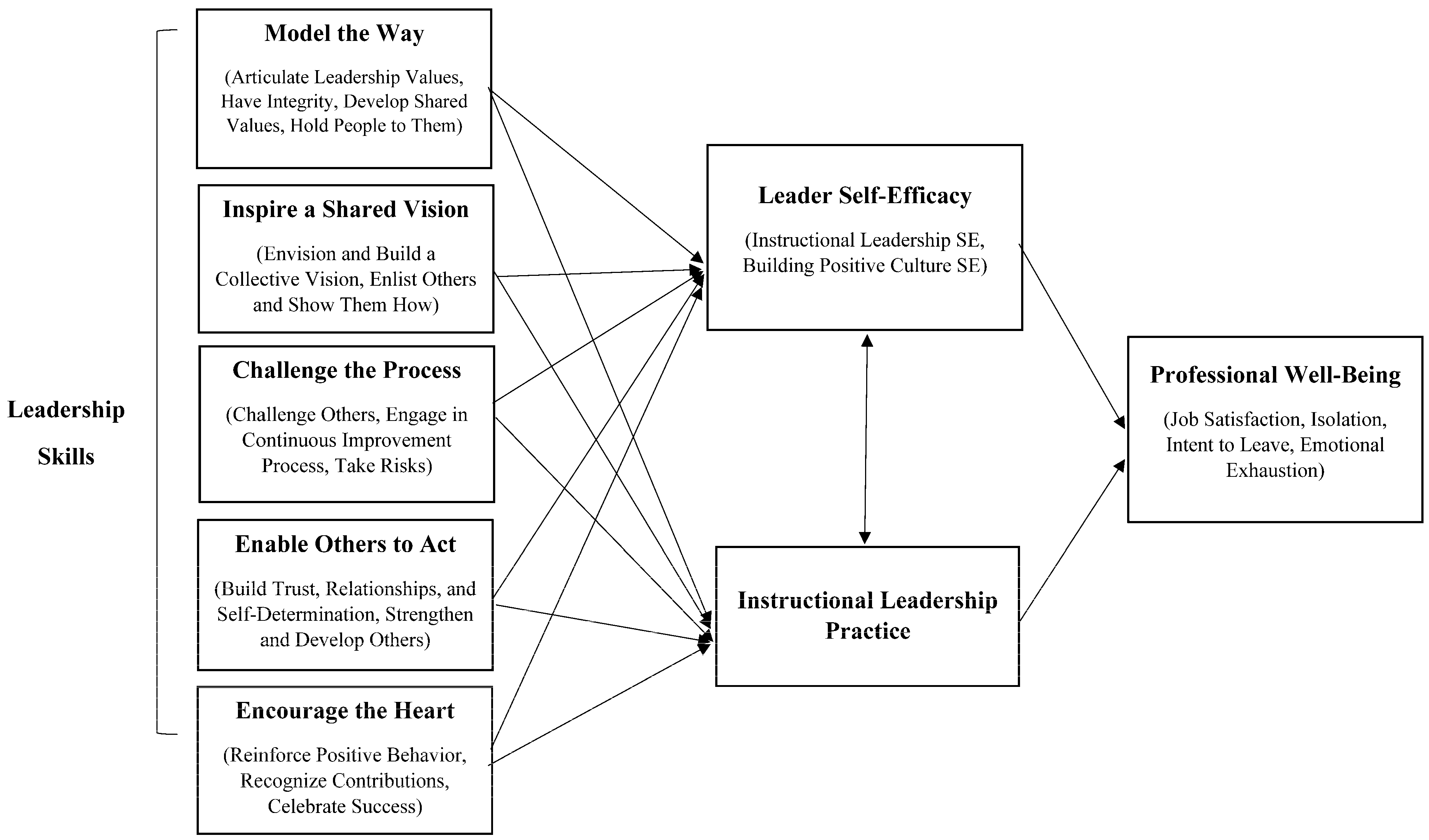
The ExCELS theory of change, a comprehensive theory of ECE leadership, preparation, practice, and its consequences (Douglass et al., 2023), was used in this study to guide the development of a set of testable relationships between leadership skills, instructional leadership practice, self-efficacy, and professional well-being across K-12 and ECE contexts (see Figure 1). The ExCELS team, in their systematic review of the leadership literature, outlined three key elements of understanding quality leadership for improvement: (1) defining who leaders are based on who participates in key leadership activities in the center; (2) what leaders bring to leadership including their education, training, knowledge and skills, and (3) what leaders do to improve a variety of student, teacher, leader, and center outcomes (Kirby et al., 2021). In the context of our study, then, “what leaders bring” was our measure of leadership skills; “what leaders do,” on the other hand, was captured by our measure of instructional leadership practice as well as our relevant leader outcomes, self-efficacy and professional well-being.
A wide body of literature spanning K-12 and, increasingly, the ECE literature has demonstrated how the direct and indirect supports provided by leaders contribute to organizational improvement and outcomes, including student learning and teacher retention (Boyce & Bowers, 2018; Doromal & Markowitz, 2023; Grissom & Loeb, 2011; Markowitz et al., 2026; Sebastian et al., 2019). However, the demands and challenges associated with the managerial and instructional leadership roles required to promote organizational success can be isolating (Bauer & Silver, 2018; Doyle Fosco, 2022) and create stressful conditions that negatively impact leader well-being, resulting in burnout and turnover (DeMatthews et al., 2021; Ford et al., 2025a; Mahfouz, 2020; F. Wang, 2025). Given the pressure and multiple responsibilities placed on early childhood leaders, understanding how leaders perceive their leadership skills and capacity, as well as their enacted practices, could contribute to our understanding of leader well-being outcomes. In particular, because self-efficacy captures how leaders translate beliefs about their capacity to enact effective practices in the context of organizational demands and challenges (Bandura, 1997; Doromal & Markowitz, 2023; Federici & Skaalvik, 2011; Hesbol, 2019; Tschannen-Moran & Gareis, 2004, 2007), it might help explain differences in early childhood leader well-being outcomes.
Engagement in activities aligned with instructional leadership has been associated with a wide-range of teacher and school outcomes across K-12 research (Bryk & Schneider, 2002; Ford et al., 2019; Grissom et al., 2021; Hitt & Tucker, 2016) and, though still emerging ECE contexts (Doromal & Markowitz, 2023; Ford et al., 2025b), including teacher self-efficacy (Cansoy & Parlar, 2018). Self-efficacy can help explain why leaders persist in effective strategies and decision-making in the face of organizational pressures and challenges, as well as the levels of stress and anxiety they experience (Federici & Skaalvik, 2011; Tschannen-Moran & Gareis, 2007). Moreover, understanding leaders’ perceptions of their practice might be important because previous successes and/or mastery experiences with respect to instructional leadership can support self-efficacy beliefs (Bandura, 1997; Tschannen-Moran & Gareis, 2007). When teacher and school outcomes improve as a result of autonomous, skill-based leader actions, leader efficacy is likely to improve (Federici & Skaalvik, 2011). Principal efficacy is, in turn, associated with increased engagement, job satisfaction, and decreased burnout and intent to leave (Federici & Skaalvik, 2012; Skaalvik, 2020). This relationship between self-efficacy and well-being outcomes has been established specifically for instructional leadership self-efficacy; research points to a positive association with work engagement (Federici & Skaalvik, 2011), lower levels of emotional exhaustion, and is indirectly associated with motivation to leave the profession (Skaalvik, 2020).
Taken together, despite the important role of leaders’ roles in schools, emerging attention to leader well-being, and an extensive body of literature linking leadership practices to organizational and staff outcomes, there remains a significant gap in the literature at the intersection of leadership skills and practices, self-efficacy, and professional well-being, especially within ECE. To address this gap, in this study, we examined the relationships among leadership skills, instructional leadership practice, self-efficacy, and professional well-being with a large sample of U.S. leaders in both the ECE and K-12 settings.

3. Method

A research team collected national data on ECE and K-12 building leaders’ well-being and working conditions, including demands, resources, and support. After IRB approval (IRB#: 14409), e-mail invitations to participate were sent to school leaders’ e-mails compiled from state databases and those of a private data firm. The sample frame generated from these combined lists consisted of 139,658 leaders across both ECE and K-12 sectors. Participation was voluntary and consisted of completing a consent form and a questionnaire. Qualtrics was used to organize and administer the 40-question survey, which included a comprehensive set of measures aligned with our conceptual framework above (discussed below). The survey required an average of 30 min to complete, and 30 participating leaders were randomly chosen to receive a small incentive ($50) in the form of a gift card for their participation.
The survey, which was administered at the end of the 2022–2023 school year (May to June 2023), yielded 1069 valid survey responses from eligible participants representing all 50 states and the District of Columbia. These responses included 405 identifying as early childhood education leaders in a variety of for-profit, non-profit and Head Start/Early Head Start childcare centers (39% of sample) and 632 identifying as K-12 leaders in a variety of charter, private and public school settings (61%). For ECE leaders, we collected but did not include family childcare home leaders (n = 32) in this analysis, given that they are often the only care providers in the setting. This left a final analytical sample of 1037 leaders for analysis. School leaders eligible for this study served in a variety of formal leadership titles/positions, such as principals or center directors, associate directors/assistant principals, headmasters, and executive directors.
Sample demographics are provided in Table 1, separated by sector (ECE or K-12). In aggregate, leaders’ ages ranged from 23 to 80 years (M = 50.76, SD = 8.90). Participating leaders were predominantly female (77.9%) and, in terms of racial and ethnic background, were approximately 76.8% Caucasian, 12.2% African American, 1.1% Native American, 6.9% Hispanic, 0.9% Asian/Pacific Islander and 1% reporting a multiracial or biracial identity. The educational backgrounds of participants were varied. Approximately 7.7% of the sample held an Associate’s degree (including a Child Development Associate’s) or less, including about 1.9% who did not hold any degree. Approximately 17.9% had a Bachelor’s degree, and approximately 72.5% had a Master’s degree or higher. The number of years that the participating leaders have worked as leaders ranged from less than a year to 57 years (M = 16.81 years, SD = 9.75). The median wage for all leaders in the sample was $90,000.

4. Measures

Below is a brief description of the key measures used in the present study, whose descriptive statistics are provided in Table 1. Table 2 presents zero-order correlations among items. Measure details, scaling, and reliability are summarized in Appendix A.
Leadership skills: Our measure of “what leaders bring” from our conceptual framework was captured via the Leadership Practices Inventory [LPI] (Posner & Kouzes, 1988). The LPI was developed to measure the Five Practices of Exemplary Leadership framework, a transformational leadership model also developed by Kouzes and Posner (2017). The LPI comprises two forms: one for a leader’s self-report (LPI-Self) and the second for others’ reports of a leader (LPI-Observer). For this study, only the LPI self-report was used because the Observer report requires 5–10 supervisors who know the leader to complete the inventory. This framework contains five subscales: Model the Way, Inspire a Shared Vision, Challenge the Process, Enable Others to Act, and Encourage the Heart. Each subscale has six items, with a total of 30 items across subscales on a 10-point scale: almost never (1) to almost always (10). The scale has been previously validated and has strong internal reliability across diverse samples both within and outside the United States, with Cronbach’s alphas ranging from 0.78 to 0.95 (Malone et al., 2021). Due to the contexts of prior use and validation, Malone et al. (2021) concluded that the LPI, while developed for the K-12 context, could be used in the ECE context without needing adaptation. Permission to use the LPI Self Scale in our research was granted by Wiley and Sons, Inc., through a license.
Instructional leadership practice: Our measure of “what leaders do” was captured via a first-order measure of instructional leadership, which includes a variety of activities outlined above in the literature review. The items we developed were based upon this typology and therefore asked leaders how often weekly they engage in the following activities: (a) leadership tasks and meetings (including strategic planning, developing school improvement plans, culture building activities, managing human resource and personnel issues such as hiring); (b) curriculum and teaching-related tasks and meetings (including developing and/or coordinating curriculum, teaching, classroom observations, teacher/child/student evaluation, mentoring teachers, providing/coordinating PD); (c) student/child interactions (including counseling and conversations outside structured learning activities, student disciplinary/behavior issues); (d) Parent/guardian interactions (including parent/family engagement and student/child recruitment); (e) interactions with the local and regional community, businesses, and industry; and (f) other. Responses of “other” consisted of the following activities: covering classrooms/teaching, coaching and mentoring, staff development, building relationships with other centers/sites, fundraising (grant writing), building maintenance, and cooking and cleaning. Responses were on a scale from 1 (I never or almost never do this) to 6 (I almost always do this). Additionally, these categories were collected from model survey items about leader activities and tasks in the literature, such as the National Teacher and Principal Survey (U.S. Department of Education, National Center for Education Statistics, 2021) and the TALIS 2018 Principal Questionnaire (Organization for Economic Co-operation and Development [OECD], 2018). Once assembled, two experts in the field of ECE and K-12 leadership examined the categories and descriptions for face validity. These six items were summed into a composite score for instructional leadership with a range from 6 to 36 and a reliability of α = 0.753.
Leader self-efficacy: The instructional leadership self-efficacy scale consists of two subscales: (a) efficacy in building a positive center culture and (b) efficacy in instructional leadership. These were adapted from the Principal Self-Efficacy Scale [PSES] (Tschannen-Moran & Gareis, 2004), in particular the “Efficacy for Instructional Leadership” and “Efficacy for Moral Leadership” dimensions. Because our study spanned center-based and elementary/primary early childhood leaders, the scales were modified to be more inclusive of what leadership efficacy in both contexts might look like. Existing items that were retained were modified from “school” to “center/school,” and “school personnel” was changed to “staff.” Other items were added to the dimensions to improve focus on ECE/K-12 leadership challenges in building school/center culture, such as managing conflict and ensuring good staff communication (Ford et al., 2025a; Jeon et al., 2025). This modified scale has been previously validated with a test/retest reliability of 0.905/0.851 for the positive center culture scale and 0.891/0.890 for the instructional leadership efficacy scale (Kwon et al., 2026). Each subscale has five items, with a total of 10 items across subscales on a 9-point scale. The scale of responses ranges from “None at all” (1) to “A Great Deal” (9).
Professional well-being: Four dimensions of professional well-being and ill-being were included. Those were job satisfaction (Organization for Economic Co-operation and Development [OECD], 2018), intent to leave (Meyer et al., 1993), isolation (UCLA Loneliness Scale for work settings; Dussault & Thibodeau, 1997; Russell et al., 1978, 1980) and the emotional exhaustion subscale of the Maslach Burnout Inventory (MBI-ES; Maslach et al., 1996).

Analytical Approach

To test our conceptual model of leadership skills, instructional leadership practice, self-efficacy, and professional well-being, we employed a structural equation modeling (SEM) approach using maximum likelihood estimation with missing values (mlmv) in Stata 15SE. Missing data in our sample were very small and limited to random item non-response; they were under 1% for all measures. In testing our model, we considered the following covariates as potential controls: (a) ECE or K-12 leader status, (b) years of experience and (c) educational level and income. Of these statistical controls, ECE/K12 status and years of experience improved model fit.
We first conducted confirmatory factor analyses (CFAs) of the professional well-being latent measure. Due to being only a two-factor model and thus under-identified, the factor loadings of instructional leadership efficacy, the other latent factor in the model, were examined. Factor loadings for all latent variables included in the measurement model needed to be at or above 0.5 (Costello & Osborne, 2005). Furthermore, measurement invariance between the K-12 and ECE samples was determined by examining differences in factor loadings and fit statistics (when available). There were no substantial differences in these measures for study latent constructs.
Once the measurement components of the model were established, the path component was largely theory-driven as outlined in our conceptual model (noted in Figure 1) but included additional direct paths from skills to professional well-being. These added paths were largely exploratory as there was little literature to guide their inclusion or exclusion. We first tested our hypothesized model with all these paths included. From here, we employed a model trimming approach (Kline, 2015) based upon the results of the saturated model, eliminating non-significant paths step-by-step and examining model and fit statistics along the way. The loadings of building positive center culture (for leader efficacy) and job satisfaction (for professional well-being) were constrained to one. Finally, to further validate our model and also determine if any significant differences existed between the ECE and K-12 samples in model structure, we separated the samples and ran our final fitted model on each sample separately and compared model fit statistics. A group goodness-of-fit test by the ECE/K-12 leader was also conducted with the whole sample model.

5. Results

Beginning with our first research question, leaders’ reports of leadership skills/practice varied by skill type and by sector (K-12 or ECE), though no significant differences were found between sectors. For ECE leaders, Inspiring a Shared Vision was the lowest average of the reported skills, M = 47.44, SD = 8.78, but had the highest variance of all the measures. On the other hand, ECE leaders reported the highest average score for Enabling Others, with considerably lower variance in response across participants, M = 52.61, SD = 5.79. In general, leaders’ instructional leadership practices averaged between “sometimes” and “fairly often” on the captured practices, M = 22.36, SD = 4.91.
As for K-12 leaders, Inspiring a Shared Vision also had the lowest average of the reported skills (M = 48.26, SD = 7.83) and the highest variance. They also reported the highest average score for Enabling Others, with the lowest variance (M = 53.16, SD = 4.72). In general, K-12 leaders’ instructional leadership practices also averaged between “sometimes” and “fairly often” on the captured practices (M = 21.97, SD = 4.45).
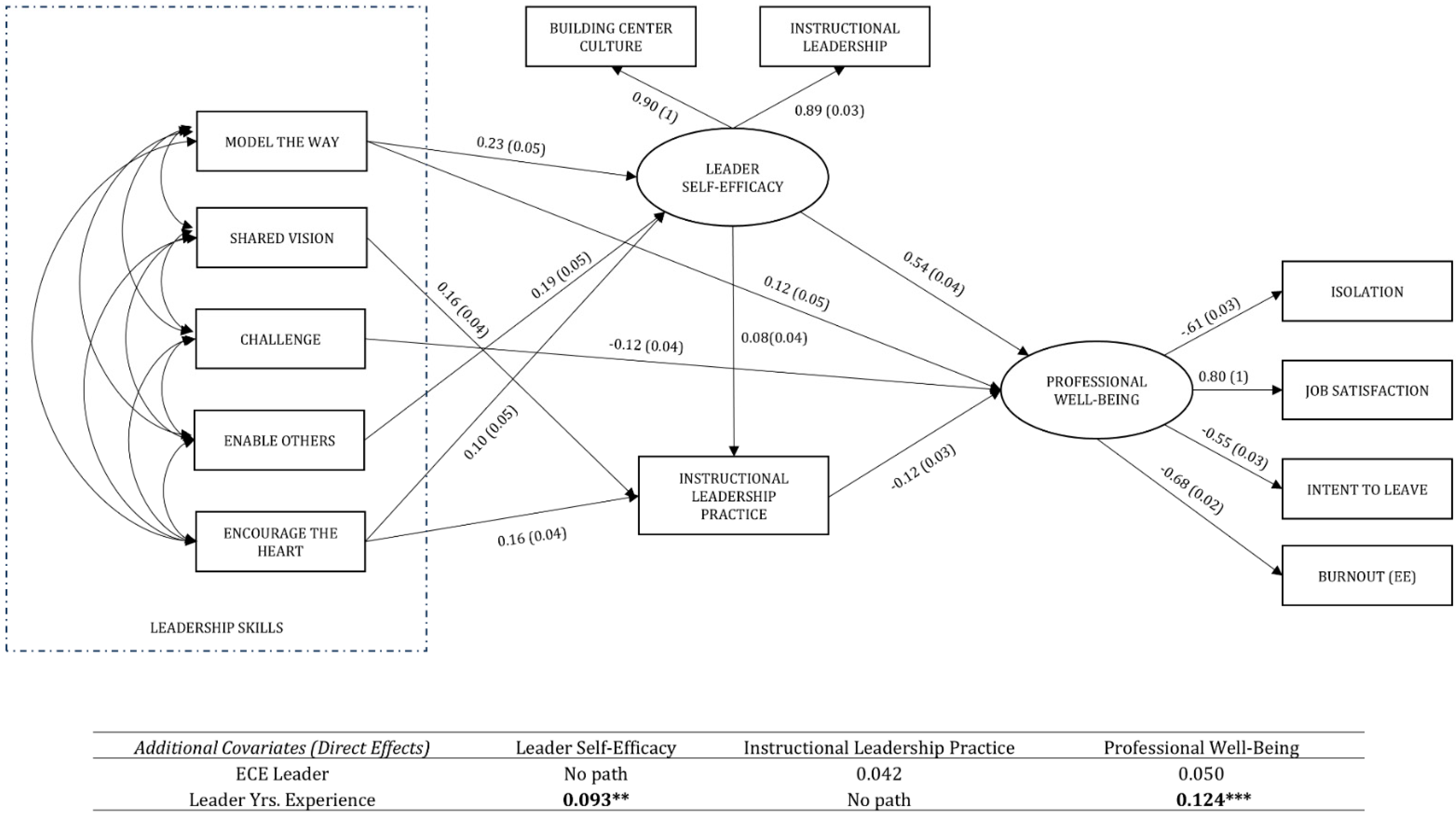
To answer our second and final research question, we tested our posited conceptual model by means of SEM techniques. Figure 2 and Table 3 present our final structural model of leadership skills, instructional leadership practice, leader self-efficacy, and professional well-being (as measured by job satisfaction, intent to leave, isolation, and emotional exhaustion). Findings demonstrate a good to adequate model fit: χ 2 = 211.44, df = 50, p < 0.001, CFI = 0.942, RMSEA = 0.056 [0.048−0.064], pclose = n.s. The model explained 25% of the variance in leader self-efficacy, 12% of the variance in instructional leadership practice, and 35% of the variance in professional well-being.
In examining the effects of leadership skills on instructional leadership practice, self-efficacy, and professional well-being, we examined the total effects (the sum of all direct and indirect effects) of each on these endogenous variables. The largest total effect on instructional leadership practice was Encourage the Heart, β = 0.169, SE = 0.026, p < 0.01, followed by Shared Vision, β = 0.158, SE = 0.024, p < 0.01, at around a sixth of a standard deviation. For leader self-efficacy, the largest total effect was Model the Way, β = 0.228, SE = 0.042, p < 0.01, and Enable Others, β = 0.187, SE = 0.046, p < 0.01. The largest total effects of leadership skills on professional well-being were Model the Way, β = 0.241, SE = 0.005, p < 0.01, and Challenge the Process, β = −0.115, SE = 0.003, p < 0.05, followed by Enable Others, β = 0.100, SE = 0.003, p < 0.01. In terms of direct effects of leadership skills, the effect of Model the Way on leader self-efficacy was the largest of the direct effects, β = 0.228, SE = 0.053, p < 0.01. Notably, only Challenge the Process and Model the Way had direct effects on professional well-being; Shared Vision, Enable Others, and Encourage the Heart only had indirect effects on professional well-being through leader self-efficacy and instructional leadership practice.
Other notable effects were the structural components between the endogenous variables, instructional leadership practice, self-efficacy, and professional well-being. First, it was notable that the best-fitting direction for the path between efficacy and instructional leadership practice was in this aforementioned direction, though the effect was small at less than a tenth of a standard deviation, β = 0.083, SE = 0.035, p < 0.05. Next, the strongest path in the entire model was between leader self-efficacy and professional well-being at over half a standard deviation, 0.544, SE = 0.005, p < 0.01. Finally, the relationship between instructional leadership practice and professional well-being was negative, β = −0.120, SE = 0.004, p < 0.01.
In terms of our other covariates included in the model, leader years of experience had a positive effect on self-efficacy, β = 0.093, SE = 0.031, p < 0.01, and professional well-being, β = 0.124, SE = 0.032, p < 0.01. There were no significant differences in instructional leadership practices, β = 0.042, SE = 0.029, p = n.s., nor professional well-being, β = 0.050, SE = 0.032, p = n.s., between early care and education (ECE) leaders and K-12 leaders. To further validate our model and also determine if any significant differences existed between the ECE and K-12 samples in model structure, we separated the samples and ran our final fitted model on each sample separately. No changes in paths improved model fit to any significant degree. The K-12 sample model fit slightly better, χ 2 = 96.670, df = 45, p < 0.001, CFI = 0.946, RMSEA = 0.053 [0.039−0.068], pclose = n.s., than the ECE model, χ 2 = 134.46, df = 45, p < 0.001, CFI = 0.951, RMSEA = 0.056 [0.045−0.067], pclose = n.s. Finally, to further examine measurement invariance across the ECE and K-12 samples, a group goodness-of-fit test revealed SRMR values of 0.044 for the ECE and 0.046 for the K-12 sample, indicating good fit for both groups.

6. Discussion

In this study, we tested a framework that connected what skills leaders bring to their work, what they do with those skills in terms of their instructional leadership practice, and how these two aspects of instructional leadership are tied to important leader outcomes such as self-efficacy and professional well-being (satisfaction, intent to leave, burnout, and isolation). The test of our conceptual model revealed a good fit, both for K-12 and ECE leaders, suggesting that having strong leadership skills greatly improves leaders’ self-efficacy around building center culture and instructional leadership and is also associated with improvements in job satisfaction and reduced feelings of isolation, burnout, and thoughts of leaving. In particular, our findings revealed that the strongest direct relationship in the model was the association between leader self-efficacy and professional well-being—a finding supported by the prior literature (Federici & Skaalvik, 2012; Skaalvik, 2020; Su-Keene et al., 2024). What instructional leadership activities leaders actually report engaging in on a weekly basis were also positively associated with leader self-efficacy, suggesting a potential feedback loop where the enactment of leader skills helps to build leader self-efficacy, which then, in turn, could potentially deepen the frequency of engagement in instructional leadership activities in their center or school. Directionally, our model suggested that the path from self-efficacy to instructional leadership practice was the better-fitting path; however, this could just be a limitation of our model, which is only able to capture one direction in what is likely a feedback loop between practice and efficacy.
However, we do know that being a leader who is thoroughly committed to and engaged in meaningful change in their center or school, while rewarding, is nevertheless difficult and challenging work, and this can exact a toll on well-being. It is therefore not surprising to see that the direct effects of instructional leadership practice on professional well-being were negative, as well as many of the indirect paths through instructional leadership practice. Because instructional leadership models gained prominence with the accountability movement (Hallinger, 2010; Hallinger et al., 2020), this finding might reflect pressure and stress associated with responsibility for improving student learning outcomes (Mahfouz, 2020). Moreover, while instructional leadership represents an increasingly prominent dimension of leaders’ work, early childhood leaders in particular are faced with additional, wide-ranging responsibilities (Doromal & Markowitz, 2023) that contribute to a heavy workload (Ford et al., 2025b). Thus, these findings might reflect that leaders who invest heavily in instructional leadership practices experience competing time and workload demands that result in increased leader stress and, as a result, decreased job satisfaction as well as increased burnout and intent to leave (i.e., professional well-being; Mahfouz, 2020; Skaalvik, 2023). Put simply, it is possible that workload, role expectations, and resource limitations might all be potential moderators of the relationship between instructional leadership practice and professional well-being.
Furthermore, the particular leadership skill Challenge the Process, characterized by pushing others to perform and engaging in meaningful improvement and risk-taking, was negatively associated with professional well-being. This, too, is well supported by the literature, which has long acknowledged that meaningful change is not without conflict, struggle, frustration, and setbacks (Achinstein, 2002; Aleman, 2009; Uline et al., 2003) and highlights the importance of trust to facilitate so-called “high-risk” change activities in schools (Bryk & Schneider, 2002; Kochanek, 2005).
Also notable in the study was how the different leadership skills were associated with the outcomes of self-efficacy, instructional leadership practice, and professional well-being. For example, Model the Way was the strongest predictor of leader self-efficacy and professional well-being, including the only other direct effect on professional well-being in the model. This is perhaps not surprising, as we have long known that good leaders need to be able to articulate and build consensus on shared values that guide collective work. Moreover, they need to set high expectations for the work of teachers and staff, but also lead by example and have respect, demonstrate competence, and have integrity (Bryk & Schneider, 2002; Louis & Kruse, 1995). Additionally, Inspire a Shared Vision, a leadership skill characterized by building a collective vision, enlisting others and showing them how, was the strongest predictor of instructional leadership practice. Considering that the best way to enlist others and put the vision into practice is to model those behaviors as a leader yourself, this finding is perhaps not too surprising and has broad support in the literature (Bass, 1985). Finally, Enabling Others, as a leadership skill, stood out among the skills as associated with self-efficacy. Perhaps one of the more difficult aspects of leadership is the need to trust your staff to do the needed work and to delegate tasks accordingly, which includes continual development of staff skills and autonomy (Ryan & Deci, 2017). This seems to be a “high-risk, high-reward” skill whereby leaders who are successful in delegating responsibility are going to experience reduced workloads, gains in self-efficacy, and productivity (Baker & Murphy, 2022).
Finally, on the question of whether or not there are differences in leadership skills and instructional practice among K-12 and ECE leaders, there was little evidence—no significant differences were found between groups on the instructional leadership skill domains, nor on instructional leadership practice. Furthermore, separate tests of the final model using each sample revealed no clear distinctions or changes in model fit. Taken together, these findings are indeed notable because a lingering concern is that leadership preparation is quite limited in the ECE context (Douglass, 2017; Ford et al., 2025a; Gibbs, 2024), and this implies that skills would be lower relative to K-12, where preparation pathways and programs are more abundant. To a degree, these findings also address a lingering question in the field of whether or not educational leadership is educational leadership regardless of sector or if there are important distinctions with implications for educational research, policy, and practice. However, it is important to exercise caution with these conclusions given that leadership skills were self-reported.

6.1. Implications for Policy and Practice

The obvious implication of this work is to emphasize the continual development of leadership skills in the service of school/center improvement, success, and also the well-being of the leaders themselves. A substantial number of leaders in both the ECE and K-12 sectors feel underprepared for their roles, and this has implications for pre-service leader preparation programs, succession planning and/or leader socialization, as well as ongoing professional development for practicing leaders (Douglass, 2017; Ford et al., 2025a; Gibbs, 2024). This is particularly the case for ECE leaders, for whom it is well-known that there are few formal pathways to the role and little preparation once in it (Douglass, 2017; Ford et al., 2025a). Challenging work requires strong supports to ensure success, and key supports for leaders are structures to provide ongoing leadership development, support from colleagues, and the autonomy to enact the vision they believe is critical to success (Ford et al., 2020, 2024; Ryan & Deci, 2017). Every leader (and educator more broadly) deserves the chance to experience the psychic rewards of seeing their persistent efforts to improve themselves and their school/center come to fruition through successes, big and small. In particular, “small wins” can go a long way to reducing imposter syndrome as well as building needed self-efficacy to sustain the work (Weick, 1984) and, in turn, ensure that good leaders remain in the profession. Findings from this study, coupled with gaps in the literature in this area, suggest that to better understand and effectively provide support for leader well-being, future research should further examine the relationship between instructional leadership practice and leader well-being while considering the influence of self-efficacy. Building on U.S. and international studies on leader self-efficacy (Bauer & Silver, 2018; Federici & Skaalvik, 2011; Özdemir et al., 2024; Skaalvik, 2020), greater attention to enacted instructional leadership practice across diverse settings can promote a more contextualized understanding of how to address early childhood leaders’ workplace demands and stressors.

6.2. Limitations

While this study provides important insights into the collective relationships among leaders’ skills, instructional leadership practice, self-efficacy, and professional well-being, it is important to recognize some limitations and their implications for future research. First is that this study relies solely on self-reported data. As mentioned, the Leadership Practices Inventory has both a self-assessment and an observational component, which was not used due to the need for multiple assessors. Leaders themselves, like teachers, are likely not the best judges of their practice, and there is also likely an element of social desirability bias to such assessments. Furthermore, because this study spans leadership practice in the K-12 and ECE sectors and comparative measurement of leadership and well-being phenomena across these sectors is new, it remains unclear whether or not there are sector-specific self-report tendencies. Future studies should consider incorporating inter-rater reliability, external assessments of leadership practice and skills to ensure a more accurate measure of leadership capacity and practice.
Another limitation relates to the study design and modeling approach. Because this study relies on cross-sectional data, and even though it employed a structural equation modeling approach, relationships still cannot be interpreted as causal. Furthermore, because leadership skills and practices can fluctuate from day to day, week to week, and year to year, they are best captured over time. Future studies might examine alternative models of these relationships but also incorporate longitudinal data to form a more comprehensive understanding of these phenomena.
Finally, there is some evidence from recent prior studies that the ECE and K-12 sectors differ substantially in the context and practice of leadership (Ford et al., 2025b, 2025c). In this study, we found few, if any, differences in leadership skills and practice among ECE and K-12 leaders. However, future studies are needed to examine, in particular, the skills and development of leaders in the ECE sector, as this sector is understudied (Ford et al., 2025a) in comparison to the K-12 sector. These studies are needed to provide information critical to sound leadership development policy and practice.

7. Conclusions

Being a building leader, whether in K-12 or early childhood education, is demanding, challenging work. Educational leaders at all levels need knowledge and skills to meet these challenges, but they need the resources and support to do so also. As is evidenced in this study, such efforts have strong potential to improve leader well-being, which directly translates into improved leader retention, an ongoing issue for schools and centers alike (Doyle Fosco et al., 2023; Snodgrass Rangel, 2018). Better supporting leaders means giving them the tools to more effectively support the learning and social growth of both teachers and children. In particular, our findings highlight the importance of new policies and practices focused on improving ECE leader preparation, which has been noted as uneven and sparse (Douglass, 2017; Kirby et al., 2021). These findings, in tandem with other recent findings calling for a reduction in leader demands (Ford et al., 2024), have the potential to bring about significant change in leader preparation, practice, and well-being for leaders in all sectors and settings.

Author Contributions

T.G.F.: Writing—original draft, Writing—review & editing, Formal analysis, Methodology, Supervision, Project Administration, Methodology, Funding acquisition, Data curation, Conceptualization. A.W.: Writing—original draft, Writing—review & editing, Conceptualization. K.-A.K. Writing—original draft, Writing—review & editing, Methodology, Conceptualization, Funding acquisition. L.L.: Writing—original draft, Writing—review & editing. All authors agree to be accountable for all aspects of the work in ensuring that questions related to the accuracy or integrity of any part of the work are appropriately investigated and resolved. All authors have read and agreed to the published version of the manuscript.

Funding

The authors would like to acknowledge generous seed funding from the OU Jeannine Rainbolt College of Education as well as Dr. Kyong-Ah Kwon and the Drusa Cable Chair Endowment.

Data Availability Statement

The participants of this study did not give written consent for their data to be shared publicly, so, due to the sensitive nature of the research, supporting data is not available.

Conflicts of Interest

The authors declare no conflict of interest.

Appendix A. Measures

Table A1. Description of measures used in the study.
ConstructSubscalesInstrumentsInstrument CharacteristicsPsychometric Properties
Leadership SkillsModel the Way

Inspire a Shared Vision

Challenge the Process

Enable Others to Act

Encourage the Heart
Leadership Practices Inventory Self Report [LPI Self] (Posner & Kouzes, 1988)This framework contains five subscales: Model the Way, Inspire a Shared Vision, Challenge the Process, Enable Others to Act, and Encourage the Heart. Each subscale has six items, with a total of 30 items across subscales on a 10-point scale: almost never (1) to almost always (10). Model Subscale: α = 0.79

Inspire Subscale: α = 0.87

Challenge Subscale: α = 0.86

Enable Subscale: α = 0.82

Encourage Subscale: α = 0.89

Prior Studies
α = 0.78–0.95
(Malone et al., 2021)
Instructional Leadership PracticeTeacher and Principal Survey (U.S. Department of Education, National Center for Education Statistics, 2021) and the TALIS 2018 Principal Questionnaire (Organization for Economic Co-operation and Development [OECD], 2018).Leaders were asked how often, weekly, they engage in the following activities: (a) leadership tasks and meetings; (b) curriculum and teaching-related tasks and meetings; (c) student/child interactions; (d) Parent/guardian interactions; (e) interactions with the local and regional community, businesses, and industry; and (f) other. Responses of “other” consisted of the following activities: covering classrooms/teaching, coaching and mentoring, staff development, building relationships with other centers/sites, fundraising (grant writing), building maintenance, and cooking and cleaning. Responses were summed on a scale from 1 (I never or almost never do this) to 6 (I almost always do this).α = 0.75
Leader Self-EfficacyInstructional Leadership SE
(IL SE)


Building Positive Culture SE
(PCC SE)
Adapted from the Principal Self-Efficacy Scale [PSES] (Tschannen-Moran & Gareis, 2004)The instructional leadership self-efficacy scale consists of two subscales: a) efficacy in building a positive center culture and b) efficacy in instructional leadership, which were adapted from the Principal Self-Efficacy Scale’s [PSES] (Tschannen-Moran & Gareis, 2004) “Efficacy for Moral Leadership” and “Efficacy for Instructional Leadership” dimensions respectively. Each subscale has five items, with a total of 10 items across subscales on a 9-point scale. The scale of responses ranges from “None at all” (1) to “A Great Deal” (9). Test/Retest Reliability
IL SE: 0.89/0.89
PCC SE: 0.90/0.85
(Kwon et al., 2026).

Current Study:
IL SE: α = 0.90
PCC SE: α = 0.86
Professional Well-BeingJob satisfactionTALIS 2018 Principal Survey (Organization for Economic Co-operation and Development [OECD], 2018)
6 items adapted from the OECD’s TALIS 2018 principal survey that ask participants about their feelings toward their current school, job, and chosen profession. Participants were asked to rate how true each statement was of their work on a 5-point scale: 1 (strongly disagree) to 5 (strongly agree).

α = 0.85


α = 0.73


Internal consistency (0.89 to 0.94) and test–retest reliability
(r = 0.73).
Current study, α = 0.86
Intent to leave


Isolation
Organizational Commitment Questionnaire (Meyer et al., 1993)


UCLA Loneliness Scale for work settings (Dussault & Thibodeau, 1997; Russell et al., 1978, 1980)
4 items from the OCQ that ask participants to indicate how likely it is that they would leave their school or the teaching profession in the next year on a scale of 1 (definitely not) to 6 (definitely).

10-item measure that asks participants about their feelings of loneliness and social isolation on a 4-point scale: 1 (never) to 4 (often)
Emotional Exhaustion(MBI-ES; Maslach et al., 1996)Adapted 4-item Emotional Exhaustion subscale of the Maslach Burnout Inventory that asks participants about feelings of being emotionally overextended and exhausted by their work on a scale of 0 (never) to 6 (every day).α = 0.88

References

  1. Achinstein, B. (2002). Conflict amid community: The micropolitics of teacher collaboration. Teachers College Record, 104(3), 421–455. [Google Scholar] [CrossRef]
  2. Aleman, E., Jr. (2009). Leveraging conflict for social justice: How “leadable” moments can transform school culture. Journal of Cases in Educational Leadership, 12(4), 1–16. [Google Scholar] [CrossRef]
  3. Baker, E. L., & Murphy, S. A. (2022). Delegation: A core leadership skill. Journal of Public Health Management and Practice, 28(4), 430–432. [Google Scholar] [CrossRef] [PubMed]
  4. Bandura, A. (1993). Perceived self-efficacy in cognitive development and functioning. Educational Psychologist, 28(2), 117–148. [Google Scholar] [CrossRef] [PubMed]
  5. Bandura, A. (1997). Self-efficacy: The exercise of control. Freeman. [Google Scholar]
  6. Bass, B. M. (1985). Leadership: Good, better, best. Organizational Dynamics, 13(3), 26–40. [Google Scholar] [CrossRef]
  7. Bauer, S. C., & Silver, L. (2018). The impact of job isolation on new principals’ sense of efficacy, job satisfaction, burnout and persistence. Journal of Educational Administration, 56(3), 315–331. [Google Scholar] [CrossRef]
  8. Berkovich, I., & Eyal, O. (2015). Educational leaders and emotions: An international review of empirical evidence 1992–2012. Review of Educational Research, 85(1), 129–167. [Google Scholar] [CrossRef]
  9. Bloom, G., Castagna, C., Moir, E., & Warren, B. (2005). Blended coaching: Skills and strategies to support principal development. Corwin. [Google Scholar]
  10. Bosire, J. P. O., Gallagher, K. C., Garrett, A. L., & Babchuk, W. (2023). Early childhood leadership well-being: A phenomenological examination of workplace stress and supports. Journal of Early Childhood Research, 21(4), 412–425. [Google Scholar] [CrossRef]
  11. Boyce, J., & Bowers, A. J. (2018). Toward an evolving conceptualization of instructional leadership as leadership for learning: Meta-narrative review of 109 quantitative studies across 25 years. Journal of Educational Administration, 56(2), 161–182. [Google Scholar] [CrossRef]
  12. Brauckmann, S., & Pashiardis, P. (2011). A validation study of the leadership styles of principals in different educational contexts: Evidence from Germany and Cyprus. International Journal of Educational Management, 25(1), 11–32. [Google Scholar]
  13. Brown, C. P., Reyes, P., McKenzie, L. C., DeMatthews, D. E., & Woulfin, S. L. (2024). Principals’ instructional leadership and support needs in prekindergarten and kindergarten: A case study in Texas. AERA Open, 10(1), 1–20. [Google Scholar] [CrossRef]
  14. Bryk, A. S., Gomez, L. M., Grunow, A., & LeMahieu, P. G. (2015). Learning to improve: How America’s schools can get better at getting better. Harvard Education Press. [Google Scholar]
  15. Bryk, A. S., & Schneider, B. (2002). Trust in schools: A core resource for improvement. Russell Sage Foundation. [Google Scholar]
  16. Cansoy, R., & Parlar, H. (2018). Examining the relationship between school principals’ instructional leadership behaviors, teacher self-efficacy, and collective teacher efficacy. International Journal of Educational Management, 32(4), 550–567. [Google Scholar] [CrossRef]
  17. Centers for Disease Control and Prevention. (2018). Well-being concepts. Available online: https://www.cdc.gov/hrqol/wellbeing.htm (accessed on 5 April 2025).
  18. Chen, C., & Yin, H. (2025). Investigating the relationship between instructional leadership and teacher well-being: A moderated mediation analysis of PISA 2022. International Journal of Educational Research, 133, 102699. [Google Scholar] [CrossRef]
  19. Collie, R. J., Malmberg, L.-E., Martin, A., Sammons, P., & Morin, A. J. S. (2020). Examination of teachers’ workplace demands and resources: Links with work-related well-being. Frontiers in Psychology, 11, 626. [Google Scholar] [CrossRef] [PubMed]
  20. Costello, A. B., & Osborne, J. W. (2005). Best practices in exploratory factor analysis: Four recommendations for getting the most from your analysis. Practical Assessment, Research and Evaluation, 10(7), 1–9. [Google Scholar]
  21. Council of Chief State School Officers. (2008). Educational leadership policy standard: ISLLC 2008 as adopted by the national policy board for educational administration. Available online: http://www.ccsso.org/Documents/2008/Educational_Leadership_Policy_Standards_2008.pdf (accessed on 6 June 2025).
  22. DeMatthews, D., Carrola, P., Reyes, P., & Knight, D. (2021). School leadership burnout and job-related stress: Recommendations for district administrators and principals. The Clearing House: A Journal of Educational Strategies, Issues and Ideas, 94(4), 159–167. [Google Scholar] [CrossRef]
  23. Doromal, J. B., & Markowitz, A. J. (2023). Following the leader: Associations between leader support and teacher retention in child care settings. Early Childhood Research Quarterly, 65, 250–260. [Google Scholar] [CrossRef]
  24. Douglass, A. (2017). Leading for change in early care and education: Cultivating leadership from within. Teachers College Press. [Google Scholar]
  25. Douglass, A. (2018). Redefining leadership: Lessons from an early education leadership development initiative. Early Childhood Education Journal, 46(4), 387–396. [Google Scholar] [CrossRef]
  26. Douglass, A., Kirby, G., & Malone, L. (2023, May). Theory of change of early care and education leadership for quality improvement. Early Childhood Snapshot, OPRE Report #2023-097. Office of Planning, Research, and Evaluation, Administration for Children & Families, U.S. Department of Health and Human Services. [Google Scholar]
  27. Doyle Fosco, S. L. (2022). Educational leader wellbeing: A systematic review. Educational Research Review, 37, 100487. [Google Scholar] [CrossRef]
  28. Doyle Fosco, S. L., Brown, M. A., & Schussler, D. L. (2023). Factors affecting educational leader wellbeing: Sources of stress and self-care. Educational Management Administration & Leadership, 53(3), 582–601. [Google Scholar] [CrossRef]
  29. Dussault, M., & Thibodeau, S. (1997). Professional isolation and performance at work of school principals. Journal of School Leadership, 7(5), 521–536. [Google Scholar] [CrossRef]
  30. Federici, R. A., & Skaalvik, E. M. (2011). Principal self-efficacy and work engagement: Assessing a Norwegian principal self-efficacy scale. Social Psychology of Education, 14, 575–600. [Google Scholar] [CrossRef]
  31. Federici, R. A., & Skaalvik, E. M. (2012). Principal self-efficacy: Relations with burnout, job satisfaction and motivation to quit. Social Psychology of Education, 15, 295–320. [Google Scholar] [CrossRef]
  32. Ford, T. G., Amirault, C., Chapman, S., Domitrovich, C., & Lloyd-Jones, B. (2025a). It starts at the top: Investing in healthy leaders, leadership, and ECE workplaces. Young Children, 80(3), 20–27. [Google Scholar]
  33. Ford, T. G., Kwon, K., Lavigne, A., & McHugh, T. (2024). Testing a holistic framework of early care and education and K–12 leaders’ working conditions and well-being. AERA Open, 10(1), 1–18. [Google Scholar] [CrossRef]
  34. Ford, T. G., Kwon, K., Lavigne, A., & McHugh, T. (2025b). The working conditions and well-being of early childhood leaders in the U.S. Early Childhood Education Journal, 53, 1435–1450. [Google Scholar] [CrossRef]
  35. Ford, T. G., Lavigne, A., Fiegener, A., & Si, S. (2020). Understanding district support for leader development and success in the accountability era: A review of the literature using social- cognitive theories of motivation. Review of Educational Research, 90(2), 264–307. [Google Scholar] [CrossRef]
  36. Ford, T. G., Olsen, J. J., Khojasteh, J., Ware, J. K., & Urick, A. (2019). Effects of leader support for teacher psychological needs on teacher burnout, commitment, and intent to leave. Journal of Educational Administration, 57(6), 615–634. [Google Scholar] [CrossRef]
  37. Ford, T. G., Su-Keene, E., Wilson, A., & Kwon, K. (2025c). Leading well: How working conditions shape early childhood leaders’ sleep quality and well-being. Advance online publication. Educational Management, Administration, and Leadership. [Google Scholar] [CrossRef]
  38. Fuller, E. J., Young, M. D., Richardson, S., Pendola, A., & Winn, K. M. (2018). The prek-8 school leader in 2018: A 10-year study. National Association of Elementary School Principals. Available online: https://www.naesp.org/sites/default/files/NAESP%2010-YEAR%20REPORT_2018.pdf (accessed on 5 June 2025).
  39. Gibbs, L. (2024). Cultivating leadership in early childhood education and care: Trouble, complexity and promise. Routledge. [Google Scholar] [CrossRef]
  40. Grissom, J. A., Egalite, A. J., & Lindsay, C. A. (2021). What great principals really do. Educational Leadership, 78(7), 21–25. [Google Scholar]
  41. Grissom, J. A., & Loeb, S. (2011). Triangulating principal effectiveness: How perspectives of parents, teachers, and assistant principals identify the central importance of managerial skills. American Educational Research Journal, 48(5), 1091–1123. [Google Scholar] [CrossRef]
  42. Hakanen, J. J., Bakker, A. B., & Schaufeli, W. B. (2006). Burnout and work engagement among teachers. Journal of School Psychology, 43(6), 495–513. [Google Scholar] [CrossRef]
  43. Hallinger, P. (2010). Developing instructional leadership. In Developing successful leadership (pp. 61–76). Springer. [Google Scholar]
  44. Hallinger, P. (2011). Leadership for learning: Lessons from 40 years of empirical research. Journal of Educational Administration, 49(2), 125–142. [Google Scholar] [CrossRef]
  45. Hallinger, P., Gümüş, S., & Bellibaş, M. Ş. (2020). ‘Are principals instructional leaders yet?’ A science map of the knowledge base on instructional leadership, 1940–2018. Scientometrics, 122(3), 1629–1650. [Google Scholar] [CrossRef]
  46. Hallinger, P., & Murphy, J. (1985). Assessing the instructional management behavior of principals. Elementary School Journal, 86(2), 217–247. [Google Scholar] [CrossRef]
  47. Hall-Kenyon, K. M., Bullough, R. V., MacKay, K. L., & Marshall, E. E. (2014). Preschool teacher well-being: A review of the literature. Early Childhood Education Journal, 42(3), 153–162. [Google Scholar] [CrossRef]
  48. Hesbol, K. A. (2019). Principal self-efficacy and learning organizations: Influencing school improvement. International Journal of Educational Leadership Preparation, 14(1), 33–51. [Google Scholar]
  49. Hitt, D. H., & Tucker, P. D. (2016). Systematic review of key leader practices found to influence student achievement: A unified framework. Review of Educational Research, 86(2), 531–569. [Google Scholar] [CrossRef]
  50. Honig, M. I., & Rainey, L. (2020). Supervising principals for instructional leadership: A teaching and learning approach. Harvard Education Press. [Google Scholar]
  51. Jeon, L., Charlot-Swilley, D., Varghese, C. A., Li, S., & Byun, S. (2025). Leading the way: Strategies for fostering organizational well-being in early childhood education. Young Children, 80(3), 28–34. [Google Scholar]
  52. Karakus, M., Toprak, M., & Chen, J. (2026). Demystifying the impact of educational leadership on teachers’ subjective well-being: A bibliometric analysis and literature review. Educational Management Administration & Leadership, 54(2), 363–387. [Google Scholar] [CrossRef]
  53. Kirby, G., Douglass, A., Lyskawa, J., Jones, C., & Malone, L. (2021). Understanding leadership in early care and education: A literature review. (OPRE Report 2021-02). Office of Planning, Research, and Evaluation, Administration for Children & Families, U.S. Department of Health and Human Services. [Google Scholar]
  54. Klevering, N., & McNae, R. (2018). Making sense of leadership in early childhood education: Tensions and complexities between concepts and practices. Journal of Educational Leadership, Policy and Practice, 33(1), 5–17. [Google Scholar] [CrossRef]
  55. Kline, R. B. (2015). Principles and practice of structural equation modeling (4th ed.). Guilford Press. [Google Scholar]
  56. Kochanek, J. R. (2005). Building trust for better schools: Research-based practices. Corwin Press. [Google Scholar]
  57. Kouzes, J. M., & Posner, B. Z. (2010). The five practices of exemplary leadership (2nd ed.). John Wiley & Sons. [Google Scholar]
  58. Kouzes, J. M., & Posner, B. Z. (2017). A coach’s guide to developing exemplary leaders: Making the most of the leadership challenge and the leadership practices inventory (LPI). John Wiley & Sons. [Google Scholar]
  59. Kwon, K., Ford, T. G., Cheema, C., Kile, M., Wang, H., Tsotsoros, J., Randall, K., Lloyd-Jones, B., Castle, S., Jang, S., Jung, Y. J., Lee, H., Kim, S. G., Sorrels, B., Wang, L., Horm, D. M., & Jang, W. (2026). Head Start staff well-being: Early impact results from a cluster randomized control trial (RCT) of the Happy Teacher Wellness Intervention. Early Childhood Research Quarterly, 76, 74–86. [Google Scholar] [CrossRef]
  60. Kwon, K., Ford, T. G., Jeon, L., Malek-Lasater, A. D., Ellis, N. D., Randall, K., Kile, M. S., & Salvatore, A. (2021). Testing a holistic conceptual framework for early childhood teacher well-being. Journal of School Psychology, 86, 178–197. [Google Scholar] [CrossRef] [PubMed]
  61. Liu, P., Thien, L. M., Song, H., & Wang, X. (2025). The effects of instructional leadership on teacher well-being: The mediating roles of professional learning community and teacher self-efficacy. Educational Studies, 51(4), 638–660. [Google Scholar] [CrossRef]
  62. Louis, K. S., & Kruse, S. D. (1995). Professionalism and community: Perspectives on reforming urban schools. SAGE Publications Ltd. [Google Scholar]
  63. Mahfouz, J. (2020). Principals and stress: Few coping strategies for abundant stressors. Educational Management Administration & Leadership, 48(3), 440–458. [Google Scholar] [CrossRef]
  64. Malone, L., Albanese, S., Jones, C., Xue, Y., Kirby, G., & Douglass, A. (2021). Compendium of existing measures for understanding leadership in early care and education (OPRE Report 2021-220). Office of Planning, Research, and Evaluation, Administration for Children and Families, U.S. Department of Health and Human Services. [Google Scholar]
  65. Markowitz, A. J., Doromal, J. B., & Yabiku, T. Y. (2026). Links among early childhood leadership, teacher-child interaction quality, and teacher retention. Early Childhood Research Quarterly, 74, 117–135. [Google Scholar] [CrossRef]
  66. Maslach, C., Jackson, S. E., & Leiter, M. P. (1996). Maslach burnout inventory manual. Consulting Psychologists Press. [Google Scholar]
  67. McCormick Center for Early Childhood Leadership. (2003). Leadership transitions: What do directors experience? McCormick Center for Early Childhood Leadership Publications. Available online: https://digitalcommons.nl.edu/mccormickcenter-pubs/46 (accessed on 9 September 2024).
  68. McKay, A., MacDonald, K., & Longmuir, F. (2024). The emotional intensity of educational leadership: A scoping review. International Journal of Leadership in Education, 28, 673–695. [Google Scholar] [CrossRef]
  69. Meyer, J. P., Allen, N. J., & Smith, C. A. (1993). Commitment to organizations and occupations: Extension and test of a three-component conceptualization. Journal of Applied Psychology, 78(4), 538–551. [Google Scholar] [CrossRef]
  70. Organization for Economic Co-operation and Development (OECD). (2018). Teaching and learning international survey (TALIS): Principal questionnaire. Available online: http://www.oecd.org/education/school/TALIS-2018-MS-Principal-Questionnaire-ENG.pdf (accessed on 12 December 2025).
  71. Özdemir, S., Sezgin, F., Kılınç, A. Ç., Erdoğan, O., & Turan Bora, H. (2024). Unveiling the associations between principal self-efficacy, openness to change and transformational leadership: The mediating role of well-being. Journal of Educational Administration, 62(5), 528–544. [Google Scholar] [CrossRef]
  72. Posner, B. Z., & Kouzes, J. M. (1988). Development and validation of the leadership practices inventory. Educational and Psychological Measurement, 48(2), 483–496. [Google Scholar] [CrossRef]
  73. Russell, D., Peplau, L. A., & Cutrona, C. E. (1980). The revised UCLA loneliness scale: Concurrent and discriminant validity evidence. Journal of Personality and Social Psychology, 39(3), 472–480. [Google Scholar] [CrossRef] [PubMed]
  74. Russell, D., Peplau, L. A., & Ferguson, M. L. (1978). Developing a measure of loneliness. Journal of Personality Assessment, 42(3), 290–294. [Google Scholar] [CrossRef] [PubMed]
  75. Ryan, R. M., & Deci, E. L. (2017). Self-determination theory: Basic psychological needs in motivation, development, and wellness. Guilford Press. [Google Scholar] [CrossRef]
  76. Sebastian, J., Allensworth, E., Wiedermann, W., Hochbein, C., & Cunningham, M. (2019). Principal leadership and school performance: An examination of instructional leadership and organizational management. Leadership and Policy in Schools, 18(4), 591–613. [Google Scholar] [CrossRef]
  77. Sheng, Z., Wolff, L., Kilmer, L., & Yager, S. (2017). School administration manager: Redefining the principal’s role as an instructional leader. Journal of School Leadership, 27(1), 119–142. [Google Scholar] [CrossRef]
  78. Skaalvik, C. (2020). School principal self-efficacy for instructional leadership: Relations with engagement, emotional exhaustion and motivation to quit. Social Psychology of Education, 23(2), 479–498. [Google Scholar] [CrossRef]
  79. Skaalvik, C. (2023). Emotional exhaustion and job satisfaction among Norwegian school principals: Relations with perceived job demands and job resources. International Journal of Leadership in Education, 26(1), 75–99. [Google Scholar] [CrossRef]
  80. Snodgrass Rangel, V. (2018). A review of the literature on principal turnover. Review of Educational Research, 88(1), 87–124. [Google Scholar] [CrossRef]
  81. Su-Keene, E. J., DeMatthews, D. E., & Keene, A. C. (2024). Principal work stress and its relationship with mental health, sleep quality, and leadership self-efficacy: An exploratory mixed-methods approach. Leadership and Policy in Schools, 25, 108–126. [Google Scholar] [CrossRef]
  82. Tschannen-Moran, M., & Gareis, C. R. (2004). Principals’ sense of efficacy: Assessing a promising construct. Journal of Educational Administration, 42(5), 573–585. [Google Scholar] [CrossRef]
  83. Tschannen-Moran, M., & Gareis, C. R. (2007). Cultivating principals’ self-efficacy: Supports that matter. Journal of School Leadership, 17(1), 89–114. [Google Scholar] [CrossRef]
  84. Uline, C. L., Tschannen-Moran, M., & Perez, L. (2003). Constructive conflict: How controversy can contribute to school improvement. Teachers College Record, 105(5), 782–816. [Google Scholar] [CrossRef]
  85. U.S. Department of Education, National Center for Education Statistics. (2021). National Teacher and Principal Survey. National Center for Education Statistics.
  86. Wang, C., Huang, X., Siklander, S., & Xu, P. (2025). Unlocking the relationship between instructional leadership, psychological well-being, and teacher job crafting. International Journal of Educational Management, 39(5), 1156–1176. [Google Scholar] [CrossRef]
  87. Wang, F. (2025). Emotional well-being of school principals: Exploring enhancement and risk factors. Journal of Educational Administration, 63(3), 224–238. [Google Scholar] [CrossRef]
  88. Wang, F., Pollock, K., & Hauseman, C. (2023). Time demands and emotionally draining situations amid work intensification of school principals. Educational Administration Quarterly, 59(1), 112–142. [Google Scholar] [CrossRef]
  89. Weick, K. E. (1984). Small wins: Redefining the scale of social problems. American Psychologist, 39(1), 40–49. [Google Scholar] [CrossRef]
  90. Yildirim, F., & Sait Dinc, M. (2019). Factors influencing burnout of the principals: A pilot study in Flemish schools of Belgium. Economic Research, 32(1), 3538–3553. [Google Scholar] [CrossRef]
Figure 1. Hypothesized model of the relationships between leadership skills, practice, self-efficacy and professional well-being.
Education 16 01094 g001
Figure 2. SEM of ECE/K-12 leadership skills, practice, self-efficacy, and professional well-being. *** p < 0.001, ** p < 0.01, * p < 0.05. Note. Leadership skills were measured via the Leadership Practices Inventory (Posner & Kouzes, 1988). Standardized regression weights and observed information matrix (OIM) standard errors are reported. Leadership self-efficacy center culture, job satisfaction constrained to 1. All structural paths significant p < 0.05. Model fit statistics: χ 2 = 211.44, df = 50, p < 0.001, CFI = 0.942, RMSEA = 0.056 [0.048−0.064], pclose = n.s.
Education 16 01094 g002
Table 1. Characteristics of leaders in ECE and K-12 settings and study descriptive statistics.
CategoriesK-12ECE
(n = 632)(n = 405)
M or % (SD)M or % (SD)
Leader Characteristics
Female 65.9%96.8%
Leaders by School/Center Type
 ECE: Childcare Center (non-profit)--48.9%
 ECE: Childcare Center (for-profit)--37.8%
 ECE: Head Start/Early Head Start--12.8%
 K-12: Public School (traditional)73.3%--
 K-12: Public School (charter)7.9%--
 K-12: Private School (religious)12.5%--
 K-12: Private School (non-sectarian)4.8%--
 K-12 Full-Time Virtual School (charter, district, or private)1.1%--
Leader Race
 Asian or Pacific Islander0.65%1.3%
 Black or African American11.9%12.9%
 Hispanic or Latinx6.4%7.9%
 Multiracial or Biracial2.7%1.1%
 Native American or Alaskan Native1.3%0.79%
 White or Caucasian77%76%
Leader Age (in years)50.51(7.84)51.46(10.3)
Prior Experience
 As Educational Leader (number of years)14.91% (8.43)19.81 (10.87)
School/Center Characteristics
 Rural center/school27.1%24.6%
 Suburban center/school43.9%49.4%
 Urban center/school29%26.1%
School SES
 Mostly low SES40.6%32.1%
 Mostly middle SES21.7%24.3%
 Mostly high SES9.9%10.1%
 Mixed SES27.7%33.4%
Leadership Skills
 LPI: Model the Way Subscale (6–60)51.26 (5.65)50.97 (6.34)
 LPI: Shared Vision Subscale (6–60)48.26 (7.83)47.44 (8.78)
 LPI: Challenge the Process Subscale (6–60)48.93 (7.03)47.96 (8.07)
 LPI: Enable Others Subscale (6–60)53.16 (4.72)52.61 (5.79)
 LPI: Encourage the Heart (6–60)50.14 (7.35)50.48 (7.63)
Endogenous Variables: Instructional Leadership Practice, Self-Efficacy, and Professional Well-being
 Instructional Leadership Practice (4–36)21.97 (4.45)22.36 (4.80)
 Leadership Self-Efficacy: Instructional Leadership (5–45)36.77 (6.11)37.49 (5.65)
 Leadership Self-Efficacy: Building Center Culture (5–45)37.98 (5.14)38.11 (5.41)
 Job Satisfaction (1–5)4.21 (0.77)4.31 (0.73)
 Intent to Leave (4–20)10.11 (4.12)8.51 (4.03)
 Isolation (1–4)1.97 (0.58)1.99 (0.61)
 Emotional Exhaustion (0–6)3.18 (1.55)2.95 (1.69)
Table 2. Zero-order correlations for study variables.
1234567891011
1. LPI Skills: Model the Way-----
2. LPI Skills: Shared Vision Subscale0.77 **-----
3. LPI Skills: Challenge the Process0.77 **0.86 **-----
4. LPI: Skills: Enable Others 0.76 **0.67 **0.71 **-----
5. LPI Skills: Encourage the Heart0.76 **0.71 **0.67 **0.71 **-----
6. Instructional Leadership Practice0.30 **0.30 **0.29 **0.28 **0.31 **-----
7. LSE: Instructional Leadership 0.37 **0.33 **0.33 **0.35 **0.36 **0.21 **-----
8. LSE: Building Center Culture0.44 **0.35 **0.35 **0.43 **0.39 **0.18 **0.81 **-----
9. PWB: Job Satisfaction0.22 **0.15 **0.13 **0.19 **0.19 **0.050.44 **0.40 **-----
10. PWB: Intent to Leave−0.05−0.03−0.00−0.07 *−0.030.03−0.20 **−0.17 **−0.47 **-----
11. PWB: Isolation−0.22 **−0.16 **−0.13 **−0.23 **−0.19 **−0.05−0.41 **−0.38 **−0.46 **0.33 **-----
12. PWB: Emotional Exhaustion−0.13 **−0.10 **−0.10 **−0.08 *−0.11 **0.07 *−0.31 **−0.26 **−0.54 **0.40 **0.42 **
** p < 0.01, * p < 0.05. Note. LPI = Leadership Practices Inventory; LSE = Leader Self-Efficacy; PWB = Professional Well-being.
Table 3. Direct and indirect effects for SEM predicting leader professional well-being.
Path (Direct Effects)βSEp
Instructional Leadership Practice ON
 Leader Self-Efficacy0.0830.0350.019
 Shared Vision0.1580.0420.000
 Encourage the Heart 0.1600.0420.000
 ECE Leader0.0420.0290.144
Leader Self-Efficacy ON
 Model the Way0.2280.0530.000
 Enable Others0.1870.0500.000
 Encourage the Heart0.1030.0480.032
 Years of Experience as a Leader0.0930.0310.002
Professional Well-Being ON
 Instructional Leadership Practice−0.1200.0330.000
 Leader Self-Efficacy0.5440.0350.000
 Model the Way0.1190.0500.019
 Challenge−0.1150.0480.017
 ECE Leader0.0500.0320.122
 Years of Experience as a Leader0.1240.0320.000
Path (Indirect Effects)βSEp
Instructional Leadership Practice ON
 Model the Way0.0180.0070.040
 Enable Others0.0160.0060.044
 Encourage the Heart0.0080.0030.115
 Years of Experience as a Leader0.0070.0020.062
Professional Well-Being ON
 Leader Self-Efficacy−0.0100.0000.058
 Model the Way0.1220.0030.000
 Shared Vision−0.0180.0000.009
 Enable Others0.1000.0030.000
 Encourage the Heart0.0360.0020.186
 ECE Leader−0.0050.0040.175
 Years of Experience as a Leader0.0500.0010.003
Path (Total Effects)βSEp
Instructional Leadership Practice ON
 Leader Self-Efficacy0.0830.0350.020
 Model the Way0.0190.0070.040
 Shared Vision0.1580.0240.000
 Enable Others0.0150.0260.044
 Encourage the Heart0.1690.0260.000
 ECE Leader0.4030.2760.144
 Years of Experience as a Leader0.0070.0020.062
Leader Self-Efficacy ON
 Model the Way0.2280.0420.000
 Enable Others0.1870.0460.000
 Encourage the Heart0.1030.0310.032
 Years of Experience as a Leader0.0930.0150.002
Professional Well-Being ON
 Instructional Leadership Practice−0.1200.0040.000
 Leader Self-Efficacy0.5440.0050.000
 Model the Way0.2410.0050.000
 Shared Vision−0.0190.0000.009
 Challenge−0.1150.0030.018
 Enable Others0.1000.0030.000
 Encourage the Heart0.0350.0020.186
 ECE Leader0.0440.0400.167
 Years of Experience as a Leader0.1740.0020.000
CovariancesEstimateSEp
Model the Way WITH
 Shared Vision0.7720.0120.000
 Challenge0.7660.0130.000
 Enable Others0.7630.0130.000
 Encouraging the Heart0.7580.0130.000
 ECE Leader−0.0240.0310.441
 Years of Experience as a Leader0.0900.0310.004
Shared Vision WITH
 Challenge 0.8580.0080.000
 Enable Others0.6680.0170.000
 Encourage the Heart0.7100.0150.000
 ECE Leader−0.0490.0310.114
 Years of Experience as a Leader0.0620.0310.044
Challenge WITH
 Enable Others 0.7040.0150.000
 Encourage the Heart0.6730.0170.000
 ECE Leader−0.0640.0300.040
 Years of Experience as a Leader0.0570.0310.067
Enable Others WITH
 Encourage the Heart0.7130.0150.000
 ECE Leader−0.0520.0310.095
 Years of Experience as a Leader0.0730.0310.019
Encourage the Heart WITH
 ECE Leader0.0210.0310.484
 Years of Experience as a Leader0.1180.0310.000
ECE Leader WITH
 Years of Experience as a Leader0.2440.0290.000
Note. Standardized regression weights reported. OIM (observed information matrix) standard errors are reported.
Disclaimer/Publisher’s Note: The statements, opinions and data contained in all publications are solely those of the individual author(s) and contributor(s) and not of MDPI and/or the editor(s). MDPI and/or the editor(s) disclaim responsibility for any injury to people or property resulting from any ideas, methods, instructions or products referred to in the content.