Article

Beyond the Single Story: How Preservice Teachers Curate Primary Sources in Early Education

Department of Teaching and Learning, University of South Florida, Tampa, FL 33620, USA
*
Author to whom correspondence should be addressed.
Educ. Sci. 2026, 16(7), 1057; https://doi.org/10.3390/educsci16071057
Submission received: 17 May 2026 / Revised: 26 June 2026 / Accepted: 1 July 2026 / Published: 2 July 2026

Abstract

This qualitative content analysis investigates how preservice teachers (PSTs) curate primary sources in early childhood and elementary social studies contexts, revealing the ideological implications of their instructional choices. Drawing on 347 selections submitted by 103 PSTs in a scaffolded, inquiry-based assignment, the study analyzes whether selections perpetuate dominant cultural narratives or reflect counternarratives and culturally sustaining practices. Findings indicate that while nearly half of all sources aligned with White, male, Eurocentric perspectives, a significant subset engaged historically marginalized voices, suggesting emergent but uneven commitments to inclusive representation. Selections varied in depth of reflection, often shaped by archival access, curricular constraints, and unexamined pedagogical habits. Grounded in Critical Educational Theory, Reflective Teaching Practices, and Culturally Sustaining Pedagogy, the study highlights the ideological weight of source selection and the need for teacher preparation programs to scaffold reflective, justice-oriented engagement with historical materials. These findings contribute to ongoing conversations about equity, civic responsibility, and culturally responsive teaching in early social studies education.

1. Introduction

Primary sources offer powerful opportunities to foster historical inquiry and deepen student understanding in social studies classrooms. They support the development of visual, media, and disciplinary literacies, encouraging learners to connect with the past through authentic materials (Bober, 2019; Waring, 2021). Engaging with primary sources promotes critical thinking and analytical skills, offering opportunities for students to interrogate historical narratives and recognize multiple perspectives (Berson & Berson, 2014; Berson & Berson, 2024). However, effectively integrating these sources into early education settings requires nuanced pedagogical strategies that many preservice teachers (PSTs) find challenging to master.
PSTs play a vital role in shaping young learners’ historical understanding through their instructional decisions—particularly the selection of primary sources, which can enhance authenticity, foster engagement, and deepen connections to content (Bickford et al., 2020; Cummings, 2019; Lawrence et al., 2019). While previous research has examined how PSTs use primary sources in instruction, fewer studies have explored how they curate and justify those sources for early education. This gap is critical, as source selection shapes not only what is taught but also how children come to understand whose histories are worth learning.
The act of selecting primary sources is never neutral. It is inherently ideological, shaping which histories are emphasized, whose voices are heard, and what perspectives are legitimized in the classroom (Bober, 2019; Sleeter, 2011; Thornton, 2005). Source selection functions as a form of curricular gatekeeping—one that either reinforces dominant narratives or opens space for counter-narratives and diverse identities. While teacher preparation programs increasingly emphasize equity and culturally responsive pedagogy, research shows that many PSTs continue to rely on familiar, White-centered historical figures and sanitized stories, particularly when sourcing instructional materials (Berson & Berson, 2014; Neumann, 2010; Quinn & Hakim, 2023). These patterns reveal the persistence of dominant cultural narratives and highlight the need for more intentional preparation to disrupt them.
This inquiry is especially urgent in early childhood and elementary education, where social studies is frequently marginalized in favor of reading and math (Fitchett & Heafner, 2010; Hubbard, 2013). Yet it is precisely in these formative years that children begin constructing their understandings of history, identity, and belonging. The primary sources that educators introduce—and those they omit—play a foundational role in shaping these early civic imaginations.
While many PSTs enter the profession with a desire to challenge exclusionary narratives (Milner, 2010), they often struggle to access the tools, confidence, or frameworks needed to translate that aspiration into practice. Archival databases commonly used in teacher education frequently privilege Eurocentric, male-dominated content, and PSTs are rarely taught how to navigate or critique these curated collections (Bober, 2019; Parkhouse, 2018). As a result, even well-intentioned candidates may unintentionally reproduce dominant perspectives in their curriculum design.
To better understand these instructional choices, this study analyzed 347 primary source selections submitted by 103 PSTs enrolled in an undergraduate social studies methods course. Through a scaffolded, inquiry-based assignment, participants engaged in structured activities rooted in culturally sustaining pedagogy and reflective teaching practices, selecting primary sources and articulating their instructional rationale. These artifacts offer insight into how PSTs conceptualize representation, inclusion, and historical voice in early education classrooms. Our study also contributes to the broader discourse on culturally responsive teaching by examining the interplay between PSTs’ sociocultural backgrounds, their engagement with primary sources, and their instructional decision-making processes (Gay, 2018, 2023; Hammond, 2014; Paris, 2012, 2021).
Grounded in three interrelated frameworks—Critical Educational Theory (Beyer, 2001; Fook, 2015), Reflective Teaching Practices (Dewey, 1933/1986; Schön, 1983; Zeichner, 2008), and Culturally Sustaining Pedagogy (Paris, 2012; Paris & Alim, 2017)—our study examines how teacher candidates engage with primary sources and construct narratives about the past. The work is guided by the following research question: To what extent do the primary sources selected by PSTs represent diverse perspectives and contribute to inclusive education in PreK–6 social studies teaching activities?

2. Literature Review

Preservice teachers (PSTs) enter classrooms amid increasing demands for inclusive, equity-centered instruction that reflects the cultural, historical, and linguistic diversity of their students (Banks, 2020; Berson & Berson, 2019; Gay, 2018; Quinn & Hakim, 2023). Social studies education, in particular, holds promise for fostering historical understanding and civic engagement through materials that surface multiple perspectives and lived experiences (Barton & Levstik, 2004; Morgan & Rasinski, 2012; Wineburg, 2001). Yet, PSTs often struggle to translate principles of equity into tangible instructional practices, especially in early education contexts where social studies is frequently marginalized and devalued in the curriculum (Fitchett & Heafner, 2010; Hubbard, 2013). While teacher education programs emphasize historical thinking and inquiry, they frequently underemphasize the representational consequences of what PSTs choose to teach and why (Martell, 2022; Neumann, 2010; Nowell & Fisher, 2023).

2.1. Preservice Teachers and the Challenge of Representation

PSTs play a central role in shaping how students encounter the past and understand themselves within it. Multicultural education provides a foundational framework for honoring diversity and fostering student belonging (Banks, 2020), but successfully implementing this vision requires teacher candidates to critically examine their positionality, challenge dominant narratives, and select instructional materials that reflect a broad range of identities and histories (Gay, 2018; Howard, 2010; Parkhouse, 2018). Despite these expectations, research has consistently shown that many PSTs default to assimilationist approaches, often due to lack of preparation, fear of controversy, or uncertainty about what inclusive practice looks like in action (Howard & Milner, 2021; Martell & Stevens, 2019; Sleeter, 2011). These tendencies are especially pronounced when it comes to sourcing classroom materials—an area often treated as technical rather than ideological. Recent work further underscores this concern. Jerasa et al. (2026), for example, examine how preservice teachers curate and use anti-bias and culturally sustaining text collections, reinforcing the need to understand material selection as a pedagogical and ideological act rather than a neutral instructional task.

2.2. Primary Sources as Opportunity and Oversight

Primary sources hold the potential to deepen historical inquiry, develop critical thinking, and provide entry points into marginalized perspectives (Barton & Levstik, 2004; Levstik & Barton, 2011; Wineburg, 2001). Engaging students with authentic artifacts enables them to examine multiple viewpoints and question whose voices are emphasized or omitted in traditional narratives (Berson & Berson, 2014; Morgan & Rasinski, 2012). In early education, these materials can help students build historical empathy and civic reasoning (Berson et al., 2017; Torrez & Waring, 2009).
However, research on primary sources in teacher education tends to focus on how PSTs use them—not how they select or justify them. The process of curation—deciding which sources to include and why—has received limited scholarly attention, despite its central role in shaping historical representation in the classroom (Quinn & Hakim, 2023; Waring & Cruz, 2024). This oversight is consequential. As Thornton (2005) asserts, teachers function as curricular gatekeepers, determining which narratives are legitimized and which are silenced. Without explicit scaffolding, PSTs may unconsciously reinforce dominant narratives by relying on familiar figures, sanitized stories, or what appears “neutral” in mainstream archives (Loewen, 1995; Morowski & McCormick, 2017; Salinas et al., 2016). Even well-intentioned choices can reproduce exclusionary histories that marginalize Black, Indigenous, immigrant, LGBTQ+, and other historically underrepresented communities (Berson et al., 2019; Nowell & Fisher, 2023).
Recent scholarship continues to emphasize the importance of inquiry-based preparation in helping PSTs develop disciplinary literacy in social studies. Guo’s (2026) study of elementary preservice teachers’ disciplinary literacy development suggests that inquiry-based projects can support PSTs’ reflective and epistemological thinking, use of data sources, and engagement with disciplinary language. Importantly, Guo also found that PSTs’ personal, cultural, and social backgrounds shaped how they interpreted history and approached historical research, aligning with this study’s attention to identity, source selection, and representation.

2.3. Instructional Constraints and Curricular Habits

Several structural barriers contribute to PSTs’ challenges with inclusive source curation. Social studies instruction is often deprioritized in early grades, limiting both exposure and instructional time (CCSSO, 2018; Fitchett & Heafner, 2010; NCSS, 2025). Within this constrained environment, PSTs may lack access to diverse, high-quality resources or feel uncertain about how to teach complex histories in developmentally appropriate ways (Martell, 2022; Oigara, 2024).
Studies also show that many teacher candidates experience discomfort or hesitation when engaging with materials related to race, protest, or systemic inequality—often fearing backlash from parents or communities (Van Hover & Hicks, 2006; Waring & Torrez, 2010). Even when PSTs seek out diverse perspectives, their selection criteria may remain superficial. Heroification, vague notions of relatability, or token inclusion often replace deeper analyses of power, context, or resistance (Rodríguez & Swalwell, 2025; Zeichner, 2008). Quinn and Hakim (2023) found that many PSTs turn to Google for images and inadvertently choose materials that align with dominant narratives or lack historical depth. Without clear models or evaluative tools, the act of source selection becomes performative rather than transformative (Fook, 2015; Howard, 2010).
Archival structures compound these challenges. Despite the increasing availability of digital collections, many widely used repositories, including those commonly recommended in teacher education, overrepresent White, male, Eurocentric perspectives while underrepresenting culturally sustaining voices (Bober, 2019; Parkhouse, 2018). This imbalance fosters a false sense of comprehensiveness and reinforces the perception that dominant narratives are inherently more accessible or pedagogically “safe” (Paris & Alim, 2017). Without explicit preparation to interrogate archival silences, PSTs may internalize these skewed representations as natural or inevitable. Recent scholarship on educational equity and primary sources also calls attention to the politics of archival access and openness. Schwier et al. (2026) extend this conversation by positioning archives as educational spaces where equity must be actively designed for, not assumed through digitization or availability alone. This reinforces the need for teacher preparation programs to help PSTs interrogate not only the sources they find, but also the archival systems that make some histories more visible, searchable, and usable than others.

2.4. Framing the Gap

While prior research affirms the value of primary sources, reflective pedagogy, and multicultural education, few studies have examined how PSTs make decisions about source selection in early childhood and elementary settings. Most existing scholarship has prioritized classroom implementation, student engagement, or inquiry strategies. Missing is a focused investigation into the rationale PSTs offer for their primary source selections—and how these choices reflect, resist, or reproduce dominant cultural narratives. This study addresses that gap by analyzing how preservice teachers select and explain their use of primary sources, offering insights into the intersection of representation, pedagogy, and ideology in the early social studies classroom.
Collectively, this literature suggests that primary source selection is not a neutral instructional decision, but an act of curricular gatekeeping shaped by access, representation, assumptions about historical significance, and beliefs about what young learners should know. Because PSTs must navigate questions of power, inclusion, cultural relevance, and pedagogical purpose when selecting sources, this study draws on Critical Educational Theory, Reflective Teaching Practices, and Culturally Sustaining Pedagogy to examine how those decisions are made and justified.

3. Theoretical Framework

Our study draws upon three interrelated frameworks—Critical Educational Theory (CET), Reflective Teaching Practices, and Culturally Sustaining Pedagogies (CSP)—to explore how PSTs engage with primary sources in ways that either challenge or reinforce dominant cultural narratives. Each framework addresses a distinct dimension of primary source curation. CET provides tools for examining how power, exclusion, and dominant historical narratives are reproduced through curricular materials. Reflective Teaching Practices illuminate how PSTs make and justify instructional decisions and challenge them to examine and question their assumptions and pedagogical responsibilities. CSP supports analysis of whether selected sources affirm cultural identities, community knowledge, and living traditions rather than treating diversity as an additive curricular feature. Together, these frameworks offer a multi-dimensional lens for analyzing how primary source selection and instructional decision-making intersect with power, cultural representation, and equity in early education.

3.1. Critical Educational Theory: Linking Education and Power

CET challenges the assumption that education is neutral or apolitical. Instead, it frames education as a space deeply embedded in power relations, where knowledge is constructed through dominant ideologies that often marginalize certain histories, perspectives, and identities (Beyer, 2001; Fook, 2015). CET urges educators to interrogate curriculum and pedagogy for the ways they maintain systemic inequities. In our study, CET illuminates how PSTs may reproduce dominant narratives, particularly white, settler, and Eurocentric ones, through their source selection, even when situated in coursework grounded in equity. It also reveals how structural constraints such as digital archive content, curriculum mandates, and time limitations may restrict access to counternarratives (Picower, 2009). By attending to the ideological weight of primary source curation, CET helps expose how seemingly benign instructional decisions are entangled in broader discourses of power and exclusion.

3.2. Reflective Teaching Practices: Developing Critical Awareness

The ability to critically reflect on one’s own choices and assumptions is essential to disrupting habitual or dominant instructional patterns. Drawing from Dewey’s (1933/1986) conception of reflection as purposeful inquiry, Schön’s (1983) notions of reflection-in-action and reflection-on-action, and Zeichner’s (2008) call for socially engaged reflection, we frame reflection not as an isolated skill, but as a continuous and situated process of meaning-making. In the context of this study, PSTs were asked not only to select sources but to justify those choices—requiring them to articulate their intentions, pedagogical priorities, and imagined impact on students. Through this reflective task, we were able to observe moments of critical interrogation, surface-level justification, or, in some cases, pedagogical uncertainty. Reflective Teaching Practices enable analysis of the depth, coherence, and ideological positioning embedded in those justifications, revealing how PSTs make sense of their role as curriculum gatekeepers and cultural narrators.

3.3. Culturally Sustaining Pedagogies: Centering Diversity and Identity

CSP builds on Ladson-Billings’ (1995) framework of Culturally Relevant Pedagogy by advancing the goal of sustaining, rather than simply recognizing, cultural pluralism within schools. CSP emphasizes the need to support the ongoing linguistic, cultural, and epistemological practices of historically marginalized communities (Paris, 2012; Paris & Alim, 2017). It calls for educators to critically assess how classroom materials—including historical images and texts—represent identity, agency, and resistance. In our study, CSP provides a framework for analyzing whether PSTs selected sources that not only diversify representation but also affirm students’ lived experiences and cultural legacies. It helps us assess whether sources reinforce deficit framings or uplift community resilience, and whether student identities are reflected through a lens of dignity and complexity. Moreover, CSP invites a critique of archives themselves as curated spaces that often omit, flatten, or tokenize non-dominant voices.

3.4. Intersections of the Frameworks: A Holistic Approach

These three frameworks—CET, Reflective Teaching Practices, and CSP—offer distinct but complementary insights into how PSTs engage with primary sources. CET offers a macro-structural view, helping us identify how societal power structures influence the availability and legitimacy of certain historical narratives. Reflective Teaching Practices foreground the micro-level processes through which PSTs interrogate their own positionalities, assumptions, and instructional decisions. CSP bridges these dimensions by providing actionable strategies and evaluative criteria for selecting materials that sustain, rather than erase, cultural identities.
Together, these frameworks emphasize three interconnected dimensions: (1) the systemic forces that privilege dominant narratives using CET (Beyer, 2001; Fook, 2015); (2) the individual capacity of PSTs to examine and disrupt those narratives through reflection (Schön, 1983; Zeichner, 2008); and (3) the intentional practices needed to affirm and sustain diverse cultural identities in the elementary classroom using CSP (Ladson-Billings, 1995; Paris & Alim, 2017). This integrated lens allows us to interpret PSTs’ primary source selections not simply as curriculum design decisions, but as sites of ideological negotiation and potential acts of resistance.

4. Methods

This study employed a qualitative content analysis design (Saldaña, 2016), grounded in CET, Reflective Teaching Practices, and CSP, to examine how PSTs engaged in instructional decision-making through the selection and justification of primary sources. Content analysis was selected for its ability to identify patterns, codes, and themes in artifacts of practice, making it well-suited to uncover the ideological and pedagogical orientations embedded in instructional curation (Miles et al., 2013; Tracy, 2010). Data were drawn from two scaffolded assignments in an undergraduate social studies methods course for early childhood and elementary education majors.

4.1. Participants

Participants were 103 preservice teachers enrolled in a teacher preparation program at a large public university in the southeastern United States between Fall 2022 and Spring 2024. The sample reflects national trends in teacher education (National Center for Education Statistics, 2023), comprising predominantly female (n = 101, 98%) and White (n = 69, 67%) candidates. Additional participants identified as Hispanic (n = 22), Black (n = 6), Asian or Pacific Islander (n = 5), and Native American (n = 1). At the time of the study, none had formal instruction in primary source pedagogy. Although many had encountered primary sources in K–12 classrooms or college coursework, few had been asked to critically select or evaluate them in relation to identity, representation, or inclusion.
The research received IRB exemption status and analyzed only anonymized data submitted as part of course requirements. No individual identifiers were retained, and demographic data were collected through standard program documentation to explore potential relationships between participant identity and patterns of primary source selection.

4.2. Instructional Intervention

The instructional design consisted of two phases, integrated into the course to model and scaffold inclusive, inquiry-based use of primary sources. In Phase One, students completed the TPS BASICS program, a Library of Congress-funded series of asynchronous modules introducing strategies for locating, analyzing, and ethically using primary sources created by the Teaching with Primary Sources Eastern Region Program at Waynesburg University. Across the TPS BASICS activities, PSTs explored a variety of Library of Congress collections and instructional resources, including Primary Source Sets, the Free to Use and Reuse collection, the Prints and Photographs division, portrait collections, and materials available through the TPS Network. PSTs were encouraged to select sources that connected to their interests, the needs of learners they served, local curriculum, or relevant standards. Although PSTs had the autonomy to select sources from other repositories, the Library of Congress served as the primary archive emphasized during instruction. Instruction also integrated structured tools such as the Circle of Viewpoints routine (Harvard Project Zero), Reading Portraits (National Portrait Gallery), and the Question Formulation Technique (QFT). Participants completed guided reflections to support meaning-making and metacognitive engagement.
In Phase Two, participants selected a primary source and designed an interdisciplinary curriculum web that integrated social studies with other content areas. The curriculum web prompt asked PSTs to choose one primary source that could serve as an anchor for a PreK-6 interdisciplinary social studies learning experience and to identify how that source could connect social studies with additional content areas. PSTs discussed and reflected on their source selections through written responses and peer interactions, focusing on instructional purpose, representation, and potential classroom use. These reflections provided essential insight into how PSTs interpreted their roles as instructional decision-makers.
This scaffolded sequence—from foundational exploration to applied instructional design—enabled participants to engage in both theoretical and practical dimensions of inclusive primary source use. Their submitted artifacts and reflections provide a window into how PSTs’ decisions aligned with culturally responsive, inquiry-based frameworks.

4.3. Data Sources

Data consisted of two instructional artifacts submitted in the social studies methods course: (1) TPS source selection activities, including reflective prompts and practice tools, and (2) curriculum web assignments, in which participants selected a primary source and designed integrated instructional plans. These artifacts offered both content and metacognitive perspectives on PSTs’ instructional choices by documenting the sources they selected, the instructional purposes they imagined for those sources, and, when available, their rationales for classroom use. TPS BASICS activities were used as instructional scaffolding rather than as a primary analytic data source. These activities introduced PSTs to locating, analyzing, citing, and reflecting on primary sources, thereby providing important context for understanding the preparation and reflective processes leading into the curriculum web assignment.
In total, 347 primary source selections were analyzed, including 286 images, 16 documents, 15 maps, five artifacts, four audio clips, three pieces of sheet music, two videos, and 16 comprehensive source sets. Source types were exported from the university’s LMS and anonymized. Demographic information was linked to each selection using MAXQDA’s document variables to explore trends across racial/ethnic identity.

4.4. Data Analysis

This study employed a qualitative content analysis approach (Saldaña, 2016), and data were analyzed through an iterative, multi-cycle coding process using MAXQDA 24 software. The analysis was guided by the study’s theoretical frameworks and sought to identify how PSTs’ source selections and rationale statements reflected ideological and pedagogical orientations related to cultural representation, power, and inquiry. CET guided analysis of dominant narratives, power relations, historical silences, and archival exclusions. Reflective Teaching Practices informed analysis of how PSTs justified their source selections, including the extent to which their rationales demonstrated critical consideration of representation, historical significance, and pedagogical purpose. CSP guided attention to whether sources affirmed cultural identities, sustained community knowledge, and supported cultural continuity, or whether diversity was treated as an additive curricular feature. Together, these frameworks enabled analysis of both the selected sources and the reasoning PSTs used to justify their instructional choices.
The coding process was iterative and involved multiple stages to support analytical rigor and confirmability. Codes emerged through a hybrid process, drawing from both deductive elements aligned with the research question and inductive insights from participant data. To ensure rigor, we employed strategies to enhance credibility, confirmability, and theoretical alignment, including collaborative coding, analytic memoing, and triangulation across data sources and frameworks (Lincoln & Guba, 1985). Multiple members of the research team participated in the coding process. Coding decisions were discussed collaboratively throughout analysis, with discrepancies resolved through discussion and reference to the study’s theoretical frameworks. Analytic memos documented emerging interpretations, category refinements, and areas of ambiguity, providing an audit trail that supported consistency and confirmability across coding cycles.

4.4.1. First-Cycle Coding

We began with a combination of Descriptive Coding and Process Coding (Saldaña, 2013). Descriptive coding identified the basic attributes of each primary source, including its format (e.g., image, map, artifact), historical context, and subject matter. Concurrently, Process Coding captured the implicit instructional moves suggested by each selection, such as “reinforcing dominant narrative,” “foregrounding resistance,” or “affirming student identity.”
Simultaneous coding was used when sources aligned with multiple interpretive frames, particularly across the dominant narrative, counternarrative, and culturally sustaining categories.
  • A primary source featuring Abraham Lincoln, for example, was coded as a dominant narrative source, due to its centering of a White, male, Euro-American historical figure commonly featured in traditional curricula.
  • A source highlighting Harriet Tubman was coded as a counternarrative, as it disrupted the White-male normative by foregrounding the resistance and contributions of a Black woman.
  • A Día de los Muertos altar photo was classified as a culturally sustaining source, as it affirmed ongoing cultural identity, language, and tradition—particularly those relevant to the backgrounds of many of our participants’ future students.
  • Some sources, such as those featuring Eleanor Roosevelt, were simultaneously coded as both dominant narrative and counternarrative. While Roosevelt’s status as a prominent White political figure aligns with dominant narratives, her advocacy for women and civil rights positions her within counternarrative discourses—especially when PSTs interpreted her legacy in relation to gender equity.
Participant rationales, when provided, were essential in clarifying ambiguous selections, especially when sources could plausibly be read through multiple lenses. These rationales provided insight into how PSTs interpreted the cultural and historical significance of their chosen materials.

4.4.2. Second-Cycle Coding and Theme Development

In the second phase, we employed Pattern Coding (Miles et al., 2013) to cluster first-cycle codes into thematic groupings that reflected broader trends in participants’ narrative preferences and historical framing. These patterns were then refined using Focused Coding (Saldaña, 2016) to emphasize the most conceptually salient and frequently recurring themes. This iterative process produced six final categories as outlined in Table 1.
The full corpus of 347 selections was retained in the analysis. Of these, 246 selections fell into the three focal interpretive categories—dominant narrative sources, counternarrative sources, and culturally sustaining sources—which most directly addressed the study’s research question about whether PSTs’ selections reproduced dominant narratives or moved toward counternarrative and/or culturally sustaining representations. The remaining 101 selections were categorized as geographical/environmental sources (n = 29), comprehensive source sets (n = 13), or other sources (n = 59). These categories were included in the overall coding structure but analyzed in less depth because they did not provide sufficient interpretive evidence to classify them as dominant, counternarrative, or culturally sustaining.
We ensured analytic rigor and confirmability through collaborative coding sessions, iterative category refinement, and extensive analytic memoing. Discrepancies in coding were discussed in relation to theoretical frameworks, returning frequently to participants’ rationales, when provided, to anchor interpretations. This attention to both the source content and the pedagogical intentions behind each selection allowed us to more accurately map how PSTs engaged with historical narratives, positionality, and cultural representation. Table 1 presents the coding schema, definitions, and representative primary sources analyzed in the study.
Our coding categories were grounded in the foundational work of multicultural and social studies education scholars, including Banks (1993, 2004, 2020), Gay (2018, 2023), Ladson-Billings (1995, 2014), and Salinas et al. (2016). Their frameworks helped guide our distinctions between dominant narratives, counternarratives, and culturally sustaining selections. In ambiguous cases, participant rationales were essential in determining emphasis. Coding decisions were refined collaboratively through multiple rounds of review and analytic memoing, ensuring consistency and alignment with the study’s critical and culturally sustaining theoretical commitments.

5. Findings

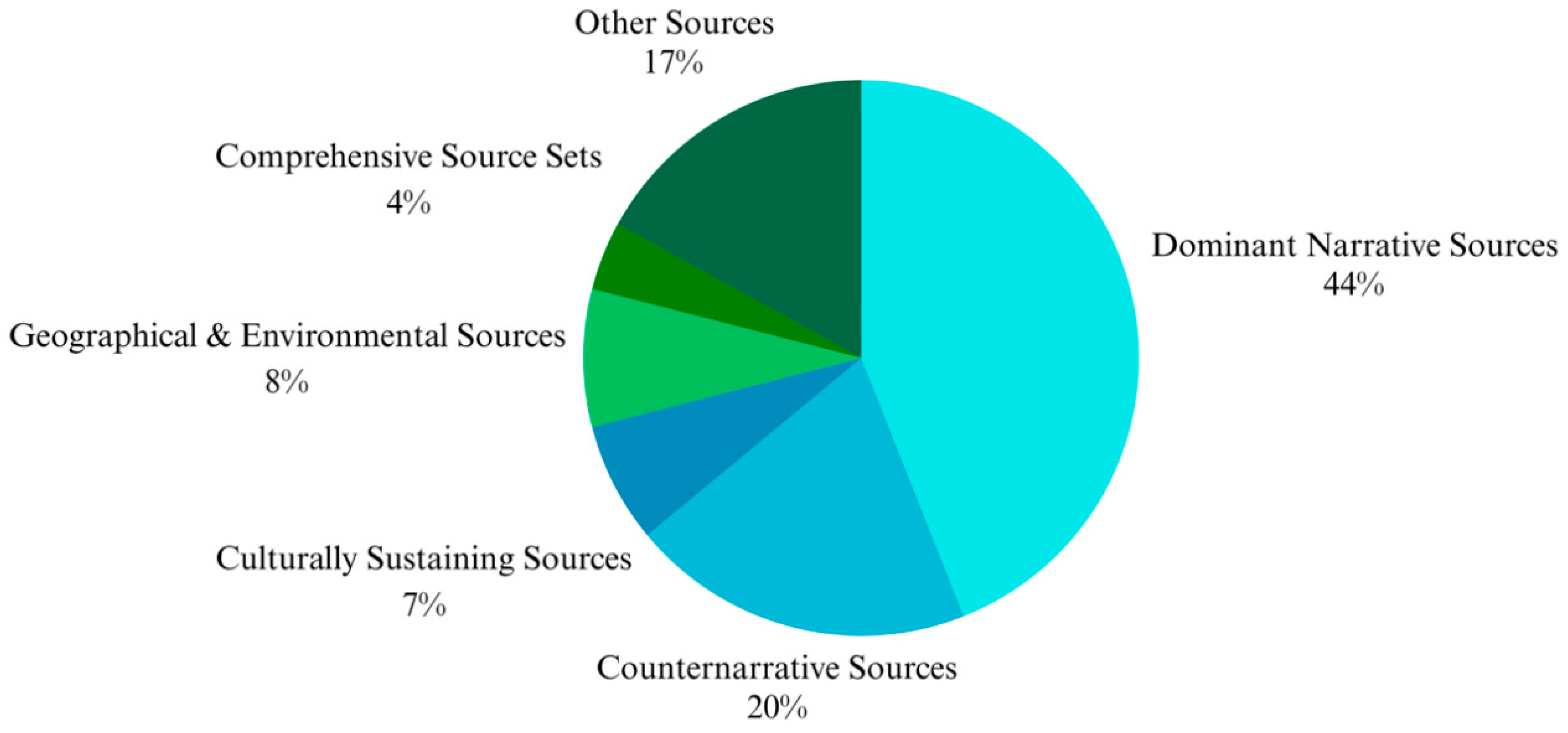
Analysis of the 347 primary source selections yielded six categories: Dominant Narrative Sources, Counternarrative Sources, Culturally Sustaining Sources, Geographical and Environmental Sources, Comprehensive Source Sets, and Other Sources. Figure 1 displays the distribution of selections across these categories, providing an overview of patterns in PSTs’ source choices. Percentages reported in the findings are based on the full corpus of 347 source selections unless otherwise noted and are used descriptively to illustrate patterns within the dataset rather than to support statistical or generalizable claims. While all six categories are reported for transparency, the analysis focuses primarily on dominant narrative, counternarrative, and culturally sustaining sources because these categories most directly address the study’s research question concerning representation and the reproduction or disruption of dominant cultural narratives.

5.1. Dominant Narratives

The first theme, Dominant Narratives, included primary sources aligned with hegemonic historical perspectives that portray U.S. history as a linear, celebratory account centered on the accomplishments of White, male figures (Foster, 2006; Loewen, 1995; Picower, 2009; VanSledright, 2008). These selections accounted for 153 sources, representing 44% of the full corpus and 62% of the 246 selections categorized as dominant narrative, counternarrative, or culturally sustaining. Frequently selected individuals included George Washington, Abraham Lincoln, Dwight D. Eisenhower, Walt Whitman, and Alexander Hamilton. Classroom imagery often featured White children, further reinforcing normative depictions of education and belonging.
In many cases, participants did not provide a written rationale for their selection. Although participants were expected to provide written rationales, not all submitted complete explanations for their selections. These absences were not read as disinterest or failure. Instead, the lack of explanation became analytically useful: dominant narrative sources were often submitted without comment, suggesting they were viewed as “neutral,” “safe,” or self-evident choices. This pattern is consistent with scholarship suggesting that instructional decisions often emerge from familiar curricular habits rather than deliberate exclusion (Beyer, 2001; Fook, 2015).
When rationales were included, they often reflected surface-level or engagement-based reasoning. For example, one participant selected an image of Alexander Hamilton, writing, “I would utilize this to ‘connect’ with him, to learn more about his background and to get to know him better. Deeper thinking will result from this.” Another participant chose a photo of Roosevelt’s Rough Riders, with the image centralized around White males, describing it as an opportunity to explore bravery. A third selected a photo of White children playing baseball and commented, “Students could connect with this because of their interest in sports.” While these responses showed efforts to promote relevance or student engagement, they rarely addressed the representational implications of foregrounding White male experiences—thereby unintentionally reproducing dominant historical framings (Epstein & Shiller, 2005).
Other participants described selecting sources based on familiarity or novelty in ways that reinforced dominant narratives. One participant chose an older photo of children, explaining, “I picked this set because I believe that it would be interesting to compare the children now to how they would dress and what they would play with many years ago.” This response emphasized surface-level curiosity rather than critical or cultural analysis, reflecting a common pattern among participants.
Taken together, these patterns do not imply intentional reproduction of exclusionary narratives. Rather, they reflect how dominant sources may be selected by default—shaped by systemic gaps in archival representation, limited instructional time, and the absence of structured opportunities for critical reflection. In this way, dominant narratives persist not solely through overt choices, but also through habitual and unexamined instructional moves that reinforce Whiteness as the historical norm (Harris, 1993; Sleeter, 2017).

5.2. Counternarratives and Culturally Sustaining Sources

The second and third focal themes of Counternarrative Sources and Culturally Sustaining Sources captured primary source selections that disrupted dominant historical narratives and foregrounded marginalized communities. Drawing on Solórzano and Yosso’s (2002) framework, counternarratives challenge majoritarian perspectives by centering voices historically excluded from mainstream histories. Culturally sustaining sources, per Paris and Alim (2017), affirm living cultural traditions, languages, and epistemologies, positioning identity not as a fixed trait but as a resource for ongoing educational engagement. Together, these two categories comprised 93 source selections (27% of the full corpus): 69 selections (20%) were coded as counternarratives and 24 selections (7%) as culturally sustaining.
Many PSTs made intentional efforts to amplify underrepresented voices. Examples included a photograph of African American sponge divers in Tarpon Springs, imagery from Día de los Muertos, a woman casting her vote, and protest materials from the Civil Rights Era. These sources opened space for historical inquiry into labor, identity, resistance, and civic action—particularly when PSTs offered interpretive rationale. One participant, for instance, selected an image from the Gay and Proud collection and wrote, “As we learn about one of the first pride demonstration marches, students can develop… questions about the Stonewall Riots.” This justification directly linked the image to protest, resistance, and LGBTQ+ history, signaling a strong grasp of counter-storytelling’s pedagogical potential.
Other participants selected Indigenous-focused sources, such as images of the Seminole Tribe and handmade dolls, and place-based sources like the Robinson Trueblood Swimming Pool, built for Black children during segregation. These examples suggested moments when PSTs moved beyond traditional civics content to address issues of exclusion, access, and community resilience.
However, not all diverse selections reflected deep critical engagement. Some rationales focused on relatability or aesthetic qualities rather than sociopolitical context. For instance, one PST selected an image of Louis Armstrong but focused on his “amused facial expression” and musical performance without acknowledging his significance within Black cultural or civil rights history. Similarly, while participants frequently included depictions of women and children, most featured White subjects, limiting representational range even when deviating from canonical sources. These patterns align with Zeichner’s (2008) concept of shallow reflection and echo Salinas et al.’s (2016) finding that efforts at inclusion often remain confined within dominant racial frames.
In some cases, the rationale was absent altogether—again, a product of the assignment design, not participant disinterest. Yet this absence further complicated efforts to distinguish between symbolic inclusion and transformative intent. For this reason, diverse selections were analyzed not only for their surface representation but also for how participants framed their purpose and potential classroom use.
Despite being less prevalent than dominant selections, counternarrative and culturally sustaining sources were evident across a wide range of submissions. In many cases, they were accompanied by thoughtful rationales that connected the material to student identity, resistance, or cultural continuity. In others, the absence of critical framing or the focus on superficial qualities limited the transformative potential of the source. This variability highlights differing levels of engagement with the historical and pedagogical significance of these sources within the context of the assignment.

5.3. Additional Source Types: Spatial, Set-Based, and Unclassified Materials

While the findings emphasize selections categorized as dominant narratives, counternarratives, or culturally sustaining sources, the remaining 101 source selections (29% of the full corpus) fell into three additional categories: 29 Geographical and Environmental Sources (8%), 13 Comprehensive Source Sets (4%), and 59 Other Sources (17%). Although less central to the study’s research question, these selections provide additional insight into PSTs’ instructional reasoning and emerging engagement with historical materials.
Geographical and environmental sources, such as maps, landscapes, and settlement images, were often selected without explicit reflection on how spatial representations carry ideological weight. For example, several PSTs chose colonial-era maps, including the 1507 Waldseemüller map, without acknowledging their role in reinforcing Eurocentric perspectives or erasing Indigenous presence. While these sources hold potential for rich historical inquiry, participants generally framed them in terms of novelty or geographic interest, rather than engaging with questions of power, land, and coloniality (Helfenbein & Taylor, 2009).
Participants who selected comprehensive source sets, which are curated collections from institutions like the Library of Congress, appeared to value historical breadth. Some engaged these collections critically, noting how different voices experienced the same events. Others offered broad, general descriptions without analyzing whose perspectives were included or absent. The use of full sets suggested a recognition of narrative complexity but also revealed variation in how thoroughly that complexity was examined.
Finally, a range of sources, including oral histories, object photographs, and miscellaneous artifacts, did not align with other categories but demonstrated creative instructional possibilities. Some participants used these materials to gesture toward cultural pluralism or community engagement. However, as with other themes, a large portion of these selections lacked accompanying rationale, making it difficult to assess their pedagogical intent. The absence of required justification in the assignment structure complicates interpretation, but the pattern of minimal commentary itself became analytically meaningful, often marking a default rather than a deliberate curricular act.
Together, these selections highlight both the creative potential and the missed opportunities present in PSTs’ early interactions with primary sources—especially when reflection, scaffolding, or critical framing is limited.

6. Discussion

This study’s findings reveal a persistent reliance on dominant historical narratives, inconsistent engagement with counternarrative and culturally sustaining sources, and notable variation in source selection patterns across demographic groups. While six thematic categories emerged, this discussion centers on the three most analytically aligned with the study’s theoretical frameworks: dominant narratives, cultural identity and curricular choices, and emergent awareness of culturally sustaining practice. This pattern of findings suggests that source selection is not merely a technical act of locating classroom materials; it is an ideological and reflective practice through which PSTs decide whose histories are made visible, whose voices are treated as authoritative, and which narratives are positioned as appropriate for young learners.

6.1. Reinforcing the Norm

Despite coursework emphasizing culturally responsive teaching, many PSTs in this study selected primary sources that reproduced dominant, White-centered narratives. Dominant narrative selections substantially outnumbered both counternarrative and culturally sustaining selections, reflecting what Zeichner (2008) describes as limited reflective practice. Many participants offered no rationale for their selections, and those who did often referenced relatability or familiarity without critical engagement—an analytical finding that both echoes and extends concerns raised by Loewen (1995) and Foster (2006). Thus, the issue was not simply which sources appeared in the corpus, but how rarely dominant sources were interrogated as positioned, partial, or ideologically loaded.
Across these dominant narrative selections, PSTs often treated canonical figures and traditional classroom imagery as neutral or universally appropriate starting points for young learners. Critical Educational Theory (Beyer, 2001; Fook, 2015) helps explain how such choices, though seemingly innocuous, can reproduce ideological assumptions that privilege Eurocentric perspectives while marginalizing others. Similarly, Gay’s (2018) concept of the comfort curriculum illustrates how familiar materials can avoid historical complexity by affirming dominant cultural norms rather than inviting students to examine exclusion, segregation, or historical absence.
Importantly, the absence of rationale was not interpreted as a lack of interest or effort. Although many participants provided written rationales, the assignment emphasized how selected sources would be used instructionally rather than requiring explicit justification for why those particular sources were chosen. Consequently, explanations of source selection were often brief or absent, and when provided, they typically focused on instructional application rather than the reasoning underlying the selection itself. This pattern became analytically meaningful: without explicit opportunities to interrogate the ideological dimensions of historical representation, dominant narratives frequently emerged as default curricular choices. As Sleeter (2011) argues, deeply embedded curricular traditions often frame certain stories as self-evident, requiring little justification unless explicitly questioned. Jerasa et al. (2026) similarly demonstrate that preservice teachers require explicit pedagogical support to curate anti-bias and culturally sustaining materials.
From the perspective of Reflective Teaching Practices (Dewey, 1933/1986; Schön, 1983), the concern is not simply that PSTs selected familiar figures or events, but that these selections were rarely accompanied by consideration of whose experiences were absent, how sources might be contextualized, or what additional perspectives would be needed to complicate historical narratives. These findings reinforce the view that curriculum is never neutral but is shaped by decisions about whose knowledge is represented and whose voices remain peripheral. Consistent with Culturally Sustaining Pedagogy (Paris & Alim, 2017), the findings further suggest that diversifying curricular materials alone is insufficient if dominant historical narratives remain largely unquestioned.
Preparing PSTs to curate primary sources critically therefore requires more than teaching instructional strategies; it requires structured opportunities to examine why particular sources are selected, whose perspectives they privilege, and how those choices shape historical understanding. Rather than reflecting isolated instructional oversights, these dominant selections illustrate how source curation can reproduce longstanding historical narratives when critical reflection is absent. Positioning source selection itself as an explicit site of inquiry, critical examination, and pedagogical decision-making may better prepare PSTs to challenge rather than reproduce dominant historical narratives in their future classrooms.

6.2. Cultural Identity and Curricular Choice

Drawing on the demographic data presented in Table 2, the findings suggest that participants’ cultural identities may have influenced, but did not determine, their primary source selections. Because several demographic groups were small, these patterns should not be interpreted as evidence of fixed group differences or statistically meaningful comparisons. Rather, they provide exploratory insight into how identity may function as one lens through which PSTs judge historical significance, representation, and relevance. These trends resonate with what Banks (2004) and Howard (2010) describe as the cultural mediation of pedagogy—the idea that educators’ experiences and social identities shape how they interpret what is pedagogically meaningful or historically significant. Guo’s (2026) work on preservice teachers’ disciplinary literacy development in social studies similarly suggests that PSTs’ personal, cultural, and social backgrounds influence how they interpret historical content and engage in inquiry.
Within these limits, the demographic patterns are useful for considering identity as an interpretive lens rather than a deterministic characteristic. Some PSTs selected sources that invited student-led narration, cultural continuity, or inquiry into historically marginalized experiences. When framed in this way, culturally specific sources aligned with Culturally Sustaining Pedagogy because they positioned culture not merely as a historical artifact but as a living lens through which students interpret their world (Paris & Alim, 2017). The pedagogical significance of these sources rested not only in who or what they represented, but also in whether PSTs framed them as opportunities to examine voice, agency, and cultural meaning.
Some selections also reflected what Ladson-Billings (2014) describes as counter-hegemonic curricular insight, particularly when PSTs centered community life, place-based memory, or histories of exclusion and resilience. Given the small subgroup sizes, however, these patterns should be viewed as avenues for future investigation rather than as stable differences across demographic groups.
At the same time, the findings caution against treating identity as a proxy for critical pedagogy. Dominant narratives were not absent from non-White participants’ selections, and counternarrative or culturally sustaining selections were not limited to participants from marginalized groups. Even when PSTs selected diverse sources, some rationales remained superficial or disconnected from the cultural or political significance of the material. This supports Zeichner’s (2008) concept of shallow reflection and aligns with Fook’s (2015) claim that instructional habits are shaped by broader institutional and curricular norms, not personal identity alone.
These findings reveal a layered reality: cultural identity can inform source selection, but it does not guarantee critical disruption. Without explicit scaffolding and reflective practice, even well-intentioned PSTs—regardless of background—may replicate the curricular silences they hope to challenge. As such, identity should be understood as one lens through which sources are interpreted, not as a proxy for critical pedagogy. For teacher education, this underscores the importance of supporting all candidates, particularly those from historically dominant cultural groups, in critically examining how their curricular choices engage diverse histories through intentional, equity-centered frameworks.

6.3. From Representation to Resistance

As Ladson-Billings (1995) argues, culturally relevant pedagogy requires teachers to engage critically with curricular materials and challenge dominant historical narratives. Although most participants selected dominant narrative sources, a smaller but meaningful subset selected counternarrative or culturally sustaining sources. These selections suggest that some PSTs were beginning to move beyond Eurocentric, celebratory histories toward more inclusive and critically informed approaches to primary source curation. However, the depth of reflection varied considerably.
Counternarrative sources, defined as materials that disrupt majoritarian historical perspectives (Solórzano & Yosso, 2002), frequently highlighted histories of protest, resistance, and exclusion. Rather than simply diversifying the historical record, the strongest selections invited students to examine how dominant narratives are constructed, whose voices have been marginalized, and how communities have challenged those exclusions. In these cases, PSTs demonstrated movement toward the kind of critical reflection described by Zeichner (2008), particularly when they connected historical representation to issues of power, agency, and historical silencing. Some participants also demonstrated a willingness to extend these conversations into elementary classrooms, selecting sources that foregrounded racial justice, civic activism, gender, sexuality, and other topics that are often minimized in early social studies curricula.
Even within these promising selections, however, critical reflection remained uneven. Some rationales framed marginalized individuals as inspirational figures without acknowledging the broader structural inequities, political organizing, or collective resistance that shaped their historical significance. This pattern aligns with Zeichner’s (2008) concept of shallow reflection and with Rodríguez and Swalwell’s (2025) critique of the “heroification” of social justice actors, whereby complex struggles are reduced to individual achievement. In other instances, participants avoided discussing race, racism, or systemic injustice altogether, suggesting that colorblind interpretive habits may limit the transformative potential of otherwise powerful instructional materials (Bonilla-Silva, 2002).
Culturally sustaining selections, consistent with Paris and Alim’s (2017) framework, emphasized the ongoing cultural identities, traditions, languages, and community knowledge of historically marginalized groups. Their significance lay not simply in representing diverse communities, but in positioning culture as living, relational, and integral to students’ identities and experiences. Nevertheless, these selections represented only a small proportion of the corpus. While some PSTs framed culture as dynamic and foundational to curriculum, many continued to approach it as additive, celebratory, or peripheral rather than as central to historical inquiry and classroom learning.
Paris and Alim (2017) argue that culturally sustaining pedagogy requires more than the inclusion of diverse perspectives; it demands a sustained commitment to maintaining the languages, literacies, and cultural practices of historically marginalized communities. The findings suggest that many PSTs had not yet moved beyond representational inclusion toward that broader pedagogical commitment. Preparing teachers to make this shift therefore requires structured opportunities to examine not only which primary sources are selected, but also how those sources are framed, contextualized, and connected to students’ lived experiences. Without intentional reflection on historical narratives, positionality, and the ideological dimensions of curricular materials, PSTs may remain positioned between well-intentioned representation and genuinely transformative practice.

6.4. Designing Around Absence

The prevalence of dominant narrative selections should not be interpreted solely as a product of individual instructional choices. Rather, the findings point to broader structural conditions that shape how PSTs locate, evaluate, and curate primary sources. Although participants were introduced to culturally sustaining pedagogies and inquiry-based instructional approaches, their decisions remained influenced by the archival, instructional, and institutional contexts in which those choices were made.
One important influence is the composition of widely used digital archives, including those maintained by the Library of Congress. Although these collections provide unparalleled access to historical materials, they continue to reflect longstanding patterns of preservation that disproportionately privilege Eurocentric, White, and male-centered narratives. As Loewen (1995) and Beyer (2001) argue, access to archives does not necessarily provide equitable access to historically marginalized perspectives. Familiar sources therefore become easier to locate, recognize, and integrate into instruction, while counternarrative and culturally sustaining materials often require more intentional searching and contextualization. Schwier et al. (2026) similarly argue that educational equity cannot be assumed simply because historical collections have been digitized. Preparing PSTs to work critically with digital archives therefore requires explicit attention to issues of visibility, preservation, searchability, and historical absence.
The instructional design of the assignment also shaped participants’ decision-making. While PSTs were encouraged to consider how primary sources could support classroom learning, they were not consistently prompted to explain why particular sources were selected, what alternatives were considered, or how their choices represented historical voice and power. As a result, many rationales emphasized instructional usefulness, engagement, or curricular alignment rather than representational significance. This pattern is consistent with Zeichner’s (2008) description of limited reflective practice and with Fook’s (2015) argument that instructional decisions are frequently shaped by established curricular norms that appear neutral or self-evident unless deliberately questioned.
Finally, broader conditions within elementary education may also influence source selection. Social studies continues to receive comparatively limited instructional time in many elementary classrooms (Fitchett & Heafner, 2010; CCSSO, 2018), encouraging PSTs to rely on familiar historical narratives they perceive as easier to integrate with literacy instruction and state standards. Martell and Stevens (2019) argue that equity-oriented teaching requires repeated opportunities to rehearse difficult curricular decisions rather than assuming those practices will emerge naturally. The findings suggest that this type of rehearsal should extend beyond analyzing primary sources to include critically navigating archives, evaluating representation, and justifying source selection.
Rather than viewing dominant narrative selections as evidence of individual shortcomings, the findings point to the interaction of archival representation, instructional design, and broader curricular expectations. Preparing PSTs to curate primary sources critically therefore requires attention not only to the materials they select, but also to the systems that make some histories more visible, accessible, and readily teachable than others.

7. Implications

This study extends existing scholarship on culturally responsive social studies education by examining how PSTs curate and justify primary source selections. Rather than focusing solely on classroom implementation, the findings illuminate how source curation itself functions as a reflective and ideological practice. Because the study was conducted within a single methods course at one institution, the implications that follow are framed as course-level design considerations rather than broad programmatic recommendations.

7.1. Implications for Teacher Education

This study highlights the importance of preparing PSTs to approach primary source curation as an intentional, justice-oriented pedagogical practice rather than simply a process of locating instructional materials. While previous scholarship has documented the persistence of Eurocentric narratives in social studies curricula (Gay, 2018; Sleeter, 2017), our findings illuminate how those narratives may be reproduced—or disrupted—through the everyday decisions PSTs make when selecting historical sources. These decisions were often shaped by the availability of curricular resources, patterns of archival representation, and limited opportunities for explicit reflection on source selection.
One implication is the need to frame primary source curation as both an ideological and pedagogical act. Many PSTs selected familiar or seemingly “neutral” sources without articulating why those sources were appropriate or whose perspectives they privileged or excluded. Drawing on Banks’ (1993) critique of additive multiculturalism, teacher preparation should move beyond encouraging the inclusion of diverse materials toward helping PSTs critically interrogate how source selection itself reproduces or challenges dominant historical narratives.
Teacher education programs can support this work by embedding structured opportunities for critical source curation throughout social studies methods coursework. Comparative analyses of dominant and counternarrative sources, examination of archival silences, and the intentional curation of supplementary materials can help PSTs develop more sophisticated approaches to historical representation. Reflective prompts should encourage candidates to justify not only how they would use a source instructionally, but also why it was selected, what perspectives it includes or omits, and how it positions students to understand history. Within interdisciplinary assignments, these reflective practices can help PSTs examine how questions of representation, power, and historical voice extend across social studies, literacy, the arts, and other elementary content areas.
Teacher educators also have an important role in modeling how to work critically with incomplete, biased, or contested historical sources. Although this study did not examine enacted teaching in classrooms or policy-constrained contexts, modeling critical curation can help PSTs recognize that instructional decisions shape historical understanding, civic identity, and students’ perceptions of whose experiences matter within the curriculum.

7.2. Navigating Curricular and Policy Constraints

Implementing these pedagogical shifts requires acknowledging the broader educational contexts in which PSTs will teach. The longstanding marginalization of social studies in elementary education, coupled with increased emphasis on reading and mathematics (Berson & Camicia, 2013; Pace, 2011), can limit opportunities for inquiry-based and justice-oriented history instruction. In addition, state standards and evolving policy contexts may constrain how teachers address marginalized histories or controversial topics. Although this study did not examine policy implementation directly, the findings suggest that PSTs would benefit from explicit preparation for selecting and justifying inclusive primary sources within existing curricular expectations.
One promising approach is to integrate critical primary source curation into interdisciplinary instruction. Embedding primary source inquiry within literacy, science, or the arts can create opportunities for meaningful historical investigation while supporting required curricular goals. Such integration, however, should extend beyond using diverse sources to enrich existing lessons. Instead, interdisciplinary instruction should encourage PSTs to examine how primary source selection shapes historical representation, challenges dominant narratives, and amplifies perspectives that have been historically marginalized (Paris & Alim, 2017).
Future research should investigate how teacher preparation programs can better support PSTs in aligning counternarrative and culturally sustaining sources with state standards and local curriculum expectations. Examining whether explicit instruction in source curation and standards alignment increases candidates’ confidence and intentionality would provide valuable guidance for teacher educators seeking to prepare PSTs for increasingly complex curricular and policy environments.

7.3. Cultivating Critical Consciousness as Civic Practice

At its core, primary source curation is both a pedagogical and civic responsibility. The historical sources teachers select influence how students understand the past, whose experiences are represented, and how relationships among history, identity, and power are constructed. This responsibility is especially significant in early childhood and elementary classrooms, where foundational understandings of history and belonging begin to take shape.
The findings suggest that preparing PSTs to curate primary sources critically requires more than developing instructional competence. It also requires cultivating the habits of reflective inquiry needed to question whose voices are represented, whose perspectives are omitted, and how curricular decisions shape students’ historical understanding. As Zeichner (2008) argues, reflective practice extends beyond instructional technique to include ongoing examination of the assumptions, values, and positionalities that inform pedagogical decision-making.
Developing this critical consciousness positions primary source curation as an opportunity to foster not only historical inquiry but also equity, civic understanding, and democratic engagement. Preparing PSTs to approach source selection in this way may better equip them to create classrooms where multiple histories are examined, diverse perspectives are valued, and young learners are encouraged to engage thoughtfully with the complexities of the past.

7.4. Limitations and Directions for Future Research

While this study offers important insights, several limitations should be acknowledged. First, the study was conducted within a single undergraduate social studies methods course at one institution. Consequently, the findings are context-specific and are not intended to be broadly generalizable across teacher preparation programs. The participant sample was predominantly White and female, reflecting national trends in elementary teacher education (National Center for Education Statistics, 2023). Given the well-documented influence of teacher identity on curricular decision-making (Howard, 2010; Ladson-Billings, 1995), future research involving more demographically diverse samples may reveal different patterns of primary source selection and pedagogical reasoning.
A second limitation concerns the data collected to examine participants’ decision-making. Although PSTs were expected to complete written reflections, the assignments did not consistently require explicit justification for why particular primary sources were selected. As a result, some participants provided rich explanations of their instructional reasoning, whereas others offered limited rationale. Rather than indicating disinterest, this variation reflects an important design consideration for both teacher education and future research: primary source curation should be treated as an explicit object of reflection rather than an implicit instructional decision.
Future research should examine how PSTs’ approaches to primary source curation develop across teacher preparation and into classroom practice. Longitudinal studies could investigate whether explicit instruction in critical source curation leads to more intentional, inclusive, and reflective instructional decision-making during clinical experiences and the early years of teaching. Intervention studies might also explore the impact of structured approaches to source selection, reflective justification, and archival inquiry on PSTs’ pedagogical reasoning. Comparative research across teacher preparation programs—and across differing curricular and policy contexts—would further strengthen understanding of how institutional environments influence the ways future teachers select, interpret, and justify historical sources.

7.5. Final Thoughts

This study suggests that preparing PSTs to work with primary sources requires more than teaching instructional strategies or expanding access to diverse historical materials. It requires helping future teachers recognize that primary source curation is itself a reflective, ideological, and pedagogical practice. The sources teachers choose—and the ways they frame those sources—shape students’ opportunities to engage in historical inquiry, encounter multiple perspectives, and develop a more inclusive understanding of the past. Preparing PSTs to make these decisions intentionally can strengthen historical thinking, cultural responsiveness, and civic learning in early childhood and elementary classrooms.
In a time when historical narratives and educational content are increasingly contested, preparing PSTs to curate primary sources critically is both a pedagogical and democratic imperative. Primary source curation is never neutral; it influences whose histories become visible, whose perspectives are legitimized, and whose experiences remain marginalized. By positioning source curation as an explicit focus of teacher preparation, educators can better equip future teachers to move beyond the single story and create classrooms where historical inquiry is grounded in multiple perspectives, critical reflection, and meaningful engagement with the complexities of the past.

Author Contributions

Conceptualization, I.R.B. and M.J.B.; Methodology, I.R.B. and M.J.B.; Formal analysis, P.G.S. and I.R.B.; Data curation, P.G.S.; Writing—original draft, P.G.S.; Writing—review and editing, P.G.S., I.R.B. and M.J.B.; Supervision, I.R.B. and M.J.B.; Funding acquisition, I.R.B. and M.J.B. All authors have read and agreed to the published version of the manuscript.

Funding

This work was generously funded by the Library of Congress Teaching with Primary Sources Program, Grant# GA21C0117.

Institutional Review Board Statement

According to the University of South Florida Institutional Review Board, the proposed activity did not constitute research involving human subjects as defined by DHHS and FDA regulations; therefore, this study was exempted from ethical approval and IRB review was not required.

Informed Consent Statement

Signed informed consent is not required because the University of South Florida Institutional Review Board determined that the proposed activity did not constitute research involving human subjects as defined by DHHS and FDA regulations. However, participants were provided with a verbal informed consent script describing the purpose and procedures of the project, the voluntary nature of participation, confidentiality protections, potential risks and benefits, and compensation details, and participants verbally agreed to participate prior to involvement in the project.

Data Availability Statement

The data supporting the findings of this study are not publicly available due to confidentiality and privacy considerations related to the protection of student information and educational records.

Conflicts of Interest

The authors declare no conflict of interest.

References

  1. Banks, J. A. (1993). The canon debate, knowledge construction, and multicultural education. Educational Researcher, 22(5), 4–14. [Google Scholar] [CrossRef] [Scilit]
  2. Banks, J. A. (2004). Multicultural education: Historical development, dimensions, and practice. In J. A. Banks, & C. A. M. Banks (Eds.), Handbook of research on multicultural education (2nd ed., pp. 3–29). Jossey-Bass. [Google Scholar]
  3. Banks, J. A. (2020). Approaches to multicultural curriculum reform. In J. A. Banks, & C. A. McGee Banks (Eds.), Multicultural education: Issues and perspectives (10th ed., pp. 137–157). Wiley. [Google Scholar]
  4. Barton, K. C., & Levstik, L. S. (2004). Teaching history for the common good. Routledge. [Google Scholar]
  5. Berson, I. R., & Berson, M. J. (2014). Developing multiple literacies of young learners with digital primary sources. In W. B. Russell (Ed.), Digital social studies (pp. 45–60). Information Age Publishing. [Google Scholar]
  6. Berson, I. R., & Berson, M. J. (2019). Disrupting perspectives on civic education for children and youth in a multicultural society. Multicultural Perspectives, 21(2), 75–76. [Google Scholar] [CrossRef] [Scilit]
  7. Berson, I. R., & Berson, M. J. (2024). Cultivating wonder: A design-based approach to elevating social studies in the early years. The New Educator, 20(3–4), 221–241. [Google Scholar] [CrossRef] [Scilit]
  8. Berson, I. R., Berson, M. J., Dennis, D. V., & Powell, R. (2017). Leveraging literacy: Research on critical reading in the social studies. In M. M. Manfra, & C. M. Bolick (Eds.), Handbook of social studies research (pp. 414–439). Wiley-Blackwell. [Google Scholar]
  9. Berson, I. R., Berson, M. J., & López de Méndez, A. (2019). Images, civic identity, and cultural narratives of Puerto Rico: Using intertextual articulation to develop culturally responsive practices. Multicultural Perspectives, 21(2), 85–90. [Google Scholar] [CrossRef] [Scilit]
  10. Berson, I. R., & Camicia, S. (2013). Early childhood social studies: A national study of challenges and promising practices. In J. Passe, & P. G. Fitchett (Eds.), The status of social studies: View from the field (pp. 65–76). Information Age Publishing. [Google Scholar]
  11. Beyer, L. E. (2001). The value of critical perspectives in teacher education. Journal of Teacher Education, 52(2), 151–163. [Google Scholar] [CrossRef] [Scilit]
  12. Bickford, J. H., Clabough, J., & Taylor, T. N. (2020). Fourth-graders’ reading, thinking, and writing about historical sources. Social Studies Research and Practice, 15(1), 57–82. [Google Scholar]
  13. Bober, T. (2019). Elementary educator’s guide to primary sources: Strategies for teaching (1st ed.). Libraries Unlimited. [Google Scholar] [CrossRef] [Scilit]
  14. Bonilla-Silva, E. (2002). The linguistics of color blind racism: How to talk nasty about blacks without sounding “racist”. Critical Sociology, 28(1–2), 41–64. [Google Scholar] [CrossRef] [Scilit]
  15. Council of Chief State School Officers [CCSSO]. (2018). The marginalization of social studies. Available online: https://www.socialstudies.org/sites/default/files/civic-seal/Marginalization%20of%20Social%20Studies%20Infographic-20.pdf (accessed on 2 October 2024).
  16. Cummings, R. D. (2019). Justice then and now: Engaging students in critical thinking about justice and history. The Social Studies, 110(6), 281–292. [Google Scholar] [CrossRef] [Scilit]
  17. Dewey, J. (1986). How we think: A restatement of the relation of reflective thinking to the educative process. In J. A. Boydston (Ed.), The later works of John Dewey, 1925–1953 (Vol. 8, pp. 105–352). Southern Illinois University Press. (Original work published 1933). [Google Scholar]
  18. Epstein, T., & Shiller, J. (2005). Perspective matters: Social identity and the teaching and learning of national history. Social Education, 69(4), 201–204. [Google Scholar]
  19. Fitchett, P. G., & Heafner, T. L. (2010). A national perspective on the effects of high-stakes testing and standardization on elementary social studies marginalization. Theory & Research in Social Education, 38(1), 114–130. [Google Scholar] [CrossRef] [Scilit]
  20. Fook, J. (2015). Reflective practice and critical reflection. In J. Lishman (Ed.), Handbook for practice learning in social work and social care: Knowledge and theory (3rd ed., pp. 440–454). Jessica Kingsley Publishers. [Google Scholar]
  21. Foster, S. (2006). Whose history? Portrayal of immigrant groups in U.S. history textbooks, 1800–Present. In S. J. Foster, & K. A. Crawford (Eds.), What shall we tell the children? International perspectives on school history textbooks (pp. 155–178). Information Age Publishing. [Google Scholar]
  22. Gay, G. (2018). Culturally responsive teaching: Theory, research, and practice (3rd ed.). Teachers College Press. [Google Scholar]
  23. Gay, G. (2023). Educating for equity and excellence: Enacting culturally responsive teaching. Teachers College Press. [Google Scholar]
  24. Guo, D. (2026). Developing pre-service teachers’ disciplinary literacy skills in social studies: An inquiry-based project. The New Educator. [Google Scholar] [CrossRef] [Scilit]
  25. Hammond, Z. L. (2014). Culturally responsive teaching and the brain: Promoting authentic engagement and rigor among culturally and linguistically diverse students. Corwin Press. [Google Scholar]
  26. Harris, C. (1993). Whiteness as property. Harvard Law Review, 106(8), 1707–1791. [Google Scholar] [CrossRef] [Scilit]
  27. Helfenbein, R. J., & Taylor, L. H. (2009). Critical geographies in/of education: Introduction. Educational Studies, 45(3), 236–239. [Google Scholar] [CrossRef] [Scilit]
  28. Howard, T. C. (2010). Why race and culture matter in schools: Closing the achievement gap in America’s classrooms. Teachers College Press. [Google Scholar]
  29. Howard, T. C., & Milner, H. R. (2021). Teacher preparation for urban schools. Routledge. [Google Scholar]
  30. Hubbard, J. (2013). Social studies marginalization: Examining the effects on K-6 pre-service teachers and students. The Journal of Social Studies Research, 37(3), 137–150. [Google Scholar] [CrossRef] [Scilit]
  31. Jerasa, S., Ura, S. K., Chapman, B., Kaufman, B., & Pirolla, T. (2026). Teaching through content area texts: Exploring how preservice teachers curate and use anti-bias and culturally sustaining collections. Teaching and Teacher Education, 176, 105542. [Google Scholar] [CrossRef] [Scilit]
  32. Ladson-Billings, G. (1995). Toward a theory of culturally relevant pedagogy. American Educational Research Journal, 32(3), 465–491. [Google Scholar] [CrossRef]
  33. Ladson-Billings, G. (2014). Culturally relevant pedagogy 2.0: A.k.a. the remix. Harvard Educational Review, 84(1), 74–84. [Google Scholar] [CrossRef] [Scilit]
  34. Lawrence, S. A., Langan, E., & Maurer, J. (2019). Using primary sources in content areas to increase disciplinary literacy instruction. The Language and Literacy Spectrum, 29(1), 1–18. [Google Scholar]
  35. Levstik, L. S., & Barton, K. C. (2011). Doing history: Investigating with children in elementary and middle schools (4th ed.). Routledge. [Google Scholar]
  36. Lincoln, Y. S., & Guba, E. G. (1985). Naturalistic inquiry. SAGE Publications. [Google Scholar]
  37. Loewen, J. W. (1995). Lies my teacher told me: Everything your American history textbook got wrong. The New Press. [Google Scholar]
  38. Martell, C. C. (2022). A longitudinal study of beginning elementary teachers’ beliefs and inquiry-based practices in the history classroom. Teacher Development, 26(5), 627–643. [Google Scholar] [CrossRef] [Scilit]
  39. Martell, C. C., & Stevens, K. M. (2019). Culturally sustaining social studies teachers: Understanding models of practice. Teaching and Teacher Education, 86, 102897. [Google Scholar] [CrossRef] [Scilit]
  40. Miles, M. B., Huberman, A. M., & Saldaña, J. (2013). Qualitative data analysis: A methods sourcebook (3rd ed.). SAGE Publications. [Google Scholar]
  41. Milner, H. R. (2010). Start where you are, but don’t stay there: Understanding diversity, opportunity gaps, and teaching in today’s classrooms. Harvard Education Press. [Google Scholar]
  42. Morgan, D. N., & Rasinski, T. V. (2012). The power and potential of primary sources. The Reading Teacher, 65(8), 584–594. [Google Scholar] [CrossRef] [Scilit]
  43. Morowski, D., & McCormick, T. (2017). Did it count? Preservice teachers’ reflections on historical thinking skills in methods courses. Social Studies Research and Practice, 12(3), 13–21. [Google Scholar]
  44. National Center for Education Statistics. (2023). Characteristics of public school teachers. Condition of education. U.S. Department of Education, Institute of Education Sciences. Available online: https://nces.ed.gov/programs/coe/indicator/clr (accessed on 13 January 2025).
  45. National Council for the Social Studies. (2025). Powerful, purposeful teaching and learning in elementary social studies: A position statement of National Council for the Social Studies. Social Studies and the Young Learner, 37(3), 26–32. [Google Scholar]
  46. Neumann, D. J. (2010). “What is the text doing?” Preparing pre-service teachers to teach primary sources effectively. The History Teacher, 43(4), 489–511. [Google Scholar]
  47. Nowell, S. D., & Fisher, R. R. (2023). Using primary sources to foster difficult dialogues. Journal of Folklore and Education, 10(2), 265–271. [Google Scholar]
  48. Oigara, J. (2024). Integrating primary sources into the elementary social studies classroom. In Proceedings of the society for information technology & teacher education international conference, Las Vegas, NV, USA, 25–29 March 2024 (pp. 1863–1867). Association for the Advancement of Computing in Education (AACE). [Google Scholar]
  49. Pace, J. L. (2011). The complex and unequal impact of high stakes accountability on untested social studies. Theory & Research in Social Education, 39(1), 32–60. [Google Scholar] [CrossRef] [Scilit]
  50. Paris, D. (2012). Culturally sustaining pedagogy: A needed change in stance, terminology, and practice. Educational Researcher, 41(3), 93–97. [Google Scholar] [CrossRef] [Scilit]
  51. Paris, D. (2021). Culturally sustaining pedagogies and our futures. The Educational Forum, 85(4), 364–376. [Google Scholar] [CrossRef] [Scilit]
  52. Paris, D., & Alim, H. S. (Eds.). (2017). Culturally sustaining pedagogies: Teaching and learning for justice in a changing world. Teachers College Press. [Google Scholar]
  53. Parkhouse, H. (2018). Pedagogies of naming, questioning, and demystification: A study of two critical U.S. history classrooms. Theory & Research in Social Education, 46(2), 277–317. [Google Scholar] [CrossRef] [Scilit]
  54. Picower, B. (2009). The unexamined whiteness of teaching: How white teachers maintain and enact dominant racial ideologies. Race Ethnicity and Education, 12(2), 197–215. [Google Scholar] [CrossRef] [Scilit]
  55. Quinn, A. M., & Hakim, A. (2023). Straight to the sources: Analyzing elementary preservice teachers’ use of primary sources. The Journal of Social Studies Research, 47(3–4), 210–229. [Google Scholar]
  56. Rodríguez, N. N., & Swalwell, K. (2025). Social studies for a better world: An anti-oppressive approach for elementary educators (2nd ed.). Routledge. [Google Scholar]
  57. Saldaña, J. (2013). The coding manual for qualitative researchers (2nd ed.). SAGE Publications. [Google Scholar]
  58. Saldaña, J. (2016). The coding manual for qualitative researchers (3rd ed.). SAGE Publications. [Google Scholar]
  59. Salinas, C., Blevins, B., & Sullivan, C. C. (2016). Critical historical thinking: When official narratives collide with other narratives. Multicultural Perspectives, 18(4), 226–234. [Google Scholar]
  60. Schön, D. A. (1983). The reflective practitioner: How professionals think in action. Basic Books. [Google Scholar]
  61. Schwier, C., Flynn, K., Billeaudeaux, B., Stecklein, H. J., & Bibens, H. (2026). Openness in the archives: Educational equity and primary sources. Portal: Libraries and the Academy, 26(2), 337–361. [Google Scholar] [CrossRef] [Scilit]
  62. Sleeter, C. E. (2011). The academic and social value of ethnic studies: A research review. National Education Association. [Google Scholar]
  63. Sleeter, C. E. (2017). Critical race theory and the whiteness of teacher education. Urban Education, 52(2), 155–169. [Google Scholar] [CrossRef] [Scilit]
  64. Solórzano, D. G., & Yosso, T. J. (2002). Critical race methodology: Counter-storytelling as an analytical framework for education research. Qualitative Inquiry, 8(1), 23–44. [Google Scholar] [CrossRef] [Scilit]
  65. Thornton, S. J. (2005). Teaching social studies that matters: Curriculum for active learning. Teachers College Press. [Google Scholar]
  66. Torrez, C. F., & Waring, S. M. (2009). Elementary school students, artifacts and primary sources: Learning to engage in historical inquiry. Social Studies Research and Practice, 4(2), 79–86. [Google Scholar] [CrossRef] [Scilit]
  67. Tracy, S. J. (2010). Qualitative quality: Eight “big-tent” criteria for excellent qualitative research. Qualitative Inquiry, 16(10), 837–851. [Google Scholar] [CrossRef] [Scilit]
  68. Van Hover, S., & Hicks, D. (2006). “They know it’s not high school”: The implementation of a ninth-grade state-mandated world geography test. Theory & Research in Social Education, 34(3), 329–356. [Google Scholar]
  69. VanSledright, B. (2008). Narratives of nation-state, historical knowledge, and school history education. Review of Research in Education, 32(1), 109–146. [Google Scholar] [CrossRef] [Scilit]
  70. Waring, S. M. (2021). Integrating primary and secondary sources into teaching: The SOURCES framework for authentic investigation. Teachers College Press. [Google Scholar]
  71. Waring, S. M., & Cruz, N. (2024). Using SOURCES to examine and understand immigrants’ journeys to the United States through Ellis Island. The Social Studies, 115(2), 47–64. [Google Scholar] [CrossRef] [Scilit]
  72. Waring, S. M., & Torrez, C. A. (2010). Using digital primary sources to teach historical perspective to preservice teachers. Contemporary Issues in Technology and Teacher Education, 10(3), 294–308. [Google Scholar]
  73. Wineburg, S. S. (2001). Historical thinking and other unnatural acts: Charting the future of teaching the past. Temple University Press. [Google Scholar]
  74. Zeichner, K. M. (2008). A critical analysis of “reflection” as a goal for teacher education. Educação & Sociedade, 29(103), 535–554. [Google Scholar] [CrossRef] [Scilit]
Figure 1. Primary Sources Organized by Theme.
Education 16 01057 g001
Table 1. Coding Categories and Definitions with Sample Primary Sources.
Code CategoryDefinitionExample of Primary Source
Dominant Narrative SourcesCenters White, male, Eurocentric figures or perspectives; reinforces traditional power structures.Portrait of George Washington; Photo of White students in a 1900s classroom
Counternarrative SourcesHighlights voices traditionally marginalized in dominant historical accounts.Photo of African American sponge divers; Image of Zora Neale Hurston; Photo of the Little Rock Nine walking to school under guard, LGBTQ protest image
Culturally Sustaining SourcesAffirms and supports the cultural identities of students and communities, including ongoing traditions and resistance.Día de los Muertos altar photo; Images of Seminole Native America Tribe
Geographical & Environmental SourcesMaps, landscapes, and spatial representations that contextualize events. 1507 Waldseemüller map; Map of Seminole territories
Comprehensive Source SetsMulti-perspective collections that include various voices and artifacts.Library of Congress’s baseball set
Other SourcesPrimary sources that did not clearly align with the other categories but supported inquiry or critical engagement.Image of a Florida citrus billboard
Table 2. Primary Sources Organized by Theme and Demographics.
GroupWhite
n = 69
Hispanic
n = 22
Black
n = 6
AAPI
n = 5
Native American
n = 1
Dominant Narrative Sources111
(48%)
27
(35%)
8
(40%)
6
(38%)
1
(25%)
Counternarrative Sources39
(17%)
22
(28%)
5
(25%)
1
(6%)
1
(25%)
Culturally Sustaining Sources14
(6%)
6
(8%)
2
(10%)
2
(13%)
1
(25%)
Other66
(29%)
22
(29%)
5
(25%)
7
(44%)
1
(25%)
Totals2307720164
Disclaimer/Publisher’s Note: The statements, opinions and data contained in all publications are solely those of the individual author(s) and contributor(s) and not of MDPI and/or the editor(s). MDPI and/or the editor(s) disclaim responsibility for any injury to people or property resulting from any ideas, methods, instructions or products referred to in the content.