Article

Supporting Students’ Perspective-Taking Through an Operationalised Competency Model: Insights from an Intervention in Geography Education


Institute of Geography Education, University of Cologne, 50931 Cologne, Germany
*
Author to whom correspondence should be addressed.
Educ. Sci. 2026, 16(6), 936; https://doi.org/10.3390/educsci16060936 (registering DOI)
Submission received: 23 April 2026 / Revised: 3 June 2026 / Accepted: 4 June 2026 / Published: 12 June 2026
(This article belongs to the Section Education and Psychology)

Abstract

The ability to take another person’s perspective is a valuable skill in today’s society, fostering a better understanding of complex issues involving differing viewpoints. Although this competency is also central in geography education, there has been little analysis of students’ perspective-taking, and no method has been proposed to teach it effectively in geography classes. Therefore, the objective of this study was to analyse and systematically foster students’ competency in perspective-taking using a developed competency model. The study was situated within a pre- and post-test control group design (14 secondary students in the experimental group; 15 in the control group). Quantitative pre- and post-test data showed minimal changes in students’ perspective-taking competency, which underlines the complexity of the competency and supports the article´s focus on the intervention itself to gain deeper insights into how competent secondary students are in this regard, as well as how they engaged with and reflected on the guided perspective-taking tasks. Overall, the intervention results showed that the students demonstrated a high level of perspective-taking competency when guided by respective tasks. Furthermore, the students self-reported that they were able to cope with the given tasks. The operationalised model could therefore help students to understand perspective-taking and can support them to develop perspective-taking competency.

1. Introduction

Perspective-taking is an essential component of social competency as well as a key ability for democratic participation in heterogeneous societies (McGarry et al., 2021; Reinhardt, 2004), where it allows discourse in which different points of view can be considered. The ability to take someone else’s perspective is essential in a variety of situations where understanding is required, empathy is necessary or differing opinions must be accepted (Duncker, 2005). Particularly for complex conflicts, perspective-taking demonstrates that there is no single correct perspective but rather a range of perceptions and truths, which are always bound to a certain perspective (Hales, 2020; Ataeian, 2013; Reuber, 2001, 2000). Perspective-taking therefore enables us to deal with conflicts constructively and to work out problems collaboratively (Rizkalla et al., 2008), because the ability to take someone else’s perspective can result in a more positive attitude towards others and greater willingness to make concessions (Gehlbach et al., 2015); in addition, it fosters a deeper understanding of the feelings and thought processes of others (Healey & Grossman, 2018; Walker, 1980; Enright & Lapsley, 1980). In general, taking another person’s perspective has been shown to promote empathy and reduce stereotypes (Skorinko & Sinclair, 2013; Galinsky & Moskowitz, 2000) and could be regarded as the basis for higher-level moral reasoning (Eisenberg et al., 2005). Furthermore, an increased capacity for perspective-taking is closely associated with enhanced social skills (McGarry et al., 2021). These findings clearly highlight the importance of perspective-taking in society. However, they do not address the question of how perspective-taking could be systematically fostered, especially in educational settings. Studies conducted in educational contexts, such as research on historical perspective-taking (Huijgen et al., 2014, 2017), have also primarily focused on assessing perspective-taking through standardised tests rather than examining how this competency can be fostered. Overall, the analyses are often limited to the outcome of the experiment or intervention using short essays, self-evaluations or standardised tests, with less attention paid to the actual fostering of perspective-taking abilities. An approach that examines the process of guided interventions in classroom settings could therefore provide a deeper understanding of how perspective-taking can be effectively promoted.
In geography, the ability to consider multiple perspectives is particularly important, as the subject frequently addresses social issues without a single, definitive solution. It is essential to consider different perspectives when addressing complex issues such as climate change, sustainable development, resource conflict or migration. These challenges require a multifaceted approach to identify different solutions that align with the diverse needs of society. For instance, in a construction project in a mountain forest (Reuschenbach, 2007), local residents may prioritise the preservation of natural landscapes and recreational value; the construction company may emphasise infrastructural development and economic feasibility, while environmental organisations may focus on biodiversity conservation and the protection of fragile ecosystems. Such configurations illustrate that geographical challenges are inherently multifaceted and cannot be comprehended or resolved from a single viewpoint. In order to gain a comprehensive understanding, it is essential to consider a range of norms, perceptions and interests (Budke et al., 2015). This requires the ability of perspective-taking. Research findings further support the assumption that students deal with such issues in different ways. Recent research (S. Doğru & Yüzbaşıoğlu, 2023), for example, has highlighted variations in the conceptual understanding of climate change among middle school students. While these differences relate primarily to conceptual knowledge rather than the perspective-taking ability itself, they nevertheless demonstrate the complexity of socio-scientific issues and the variability in how students interpret and structure such problems. This underlines the importance of instructional approaches that actively engage learners with a variety of perspectives and interpretations.
However, there has been little research on students’ perspective-taking competency in the field of geography education. It has been used in studies as a method for field trips (Böing & Sachs, 2009) or as a way to capture actors’ perceptions of space (Schrüfer et al., 2016). However, there has been no systematic and targeted fostering and analysis of this competency to date. Particularly in geography education, there is also a lack of consistent links between theoretical modelling, support-oriented tasks and valid evaluation methods regarding the competency of perspective-taking.
Therefore, the present study addresses this gap by applying a theoretically grounded competency structure model of perspective-taking (Vasiljuk & Budke, 2021) to analyse secondary students’ perspective-taking competency in geography education. In this model, perspective-taking is considered as a complex cognitive process. The model was operationalised through tasks aligned with each of its dimensions, allowing for the analysis of how students applied perspective-taking during the intervention. The intervention was embedded in a pre- and post-test control group design, with fourteen students in the experimental group and fifteen students in the control group. Both groups addressed the same geographical topic (Mount Everest). While the experimental group worked with tasks based on the competency model of perspective-taking, the control group did not receive this model-based task intervention. The pre- and post-tests were used as part of the overall study design to capture potential changes in students’ perspective-taking competency. However, the primary analytical focus of this article is how students engaged with the guided tasks across the different dimensions of the competency model within the intervention. Thereby, students’ task evaluations and their perceived coping abilities regarding their own perspective-taking competency were additionally analysed using Likert-scale self-assessments. By concentrating on the intervention and students’ evaluation, the study offers deeper insights into how perspective-taking can be systematically fostered in geography education, supporting the respective development of this key competency.
Therefore, this article aims to answer the following three research questions:
How do students demonstrate perspective-taking competency across different dimensions within the intervention setting, as captured by the operationalised competency model?
How do secondary students assess the tasks of the operationalised model?
To what extent do students evaluate their ability to cope with the applied tasks?
In the following section, we first briefly present the developed competency model and previous research findings on promoting perspective-taking competency. We then present the methodological design of the intervention study and show how the competency model was operationalised for the intervention itself. At this point, it should be noted that the aim was not to develop items that would meet the criteria of test theory, but rather to gain initial insights into whether students’ perspective-taking competency could be enhanced by using guided tasks. After this, the results are then presented and discussed. Finally, conclusions are derived based on the results of the intervention study.

2. Theoretical Background

In the following section, we present the theoretical background, with the model for perspective-taking in geography education (Vasiljuk & Budke, 2021), being presented initially. It was developed to assess students’ competency in perspective-taking and provided the foundation for the intervention study. Afterwards, previous research findings regarding the fostering of perspective-taking competency will be presented, as these results formed the basis for the preparation of the intervention study.

2.1. Competency Model of Perspective-Taking in Geography Education

The ability to take different perspectives is essential in today’s society (Healey & Grossman, 2018). As it is not possible to have an absolute view on an object, conflict or issue, conscious perspective-taking can show us different ways of viewing (Hales, 2020; Ataeian, 2013). Perspective-taking allows us to better understand the thoughts, aims and feelings of others (Healey & Grossman, 2018; Batson et al., 1997; Underwood & Moore, 1982; Walker, 1980; Enright & Lapsley, 1980). Perspective-taking is also essential in geography education as the discipline itself is perspectival (Schuler et al., 2017). Understanding the dynamics and diversity of space, for example, requires different viewpoints, methods and scales. Thereby, (geographical) space can be analysed, interpreted and discussed in different ways (Larsen & Harrington, 2020; Balteanu & Dogaru, 2011). In geography, perspective-taking can be seen as a way of thinking that makes it possible to look at a (geographical) topic from different points of view and to depict the pluralistic ‘nature of reality’ (Rhode-Jüchtern, 1996, p. 5). An awareness of pluralism is also relevant when analysing the relations between power and space, as well as the actions of actors, as it assumes a constructivist worldview that includes subjective conceptions of space and views of conflict (Reuber, 2000, 2001). Perspective-taking is particularly relevant here, as it can show that there are different perspectives on conflicts, which do not have to or cannot be declared right or wrong (Reuber, 2000, 2001). Instead, perspective-taking can help to understand the thoughts and aims of others. It can also help to ethically evaluate actions and to develop a basic awareness of how to discuss moral issues (Ermann & Redepenning, 2010; Smith, 2001). It also plays an important role in intercultural learning, because understanding others can only be achieved if perspective-taking is encouraged (Heiser, 2013; Thierer, 2008). If geography lessons are limited to the material objects of space, it is not possible for students to understand others (Thierer, 2008). Therefore, acting subjects with respective perspectives should be emphasised (Thierer, 2008). Perspective-taking can reveal one’s own prejudices and cause one to critically question one’s own perspective (Heiser, 2013). It is also necessary when promoting reflective map literacy (Gryl, 2010). It allows for a differentiated view of the content presented and allows us to gain a critical distance from our own perspectives (Gryl, 2010; Häcker & Rihm, 2005).
Principally, perspective-taking is a complex human social–cognitive ability (Jääskeläinen & Kosonogov, 2023) that is not clearly defined in the literature, as there are different approaches depending on the discipline (Cigala et al., 2014). The competency has not been clearly defined in geography education either. The different conceptualisations and definition approaches were systematically addressed in a separate publication (Vasiljuk & Budke, 2021). Based on the relevant theories, concepts and models, we defined perspective-taking and developed a competency model of perspective-taking for geography education (Vasiljuk & Budke, 2024).
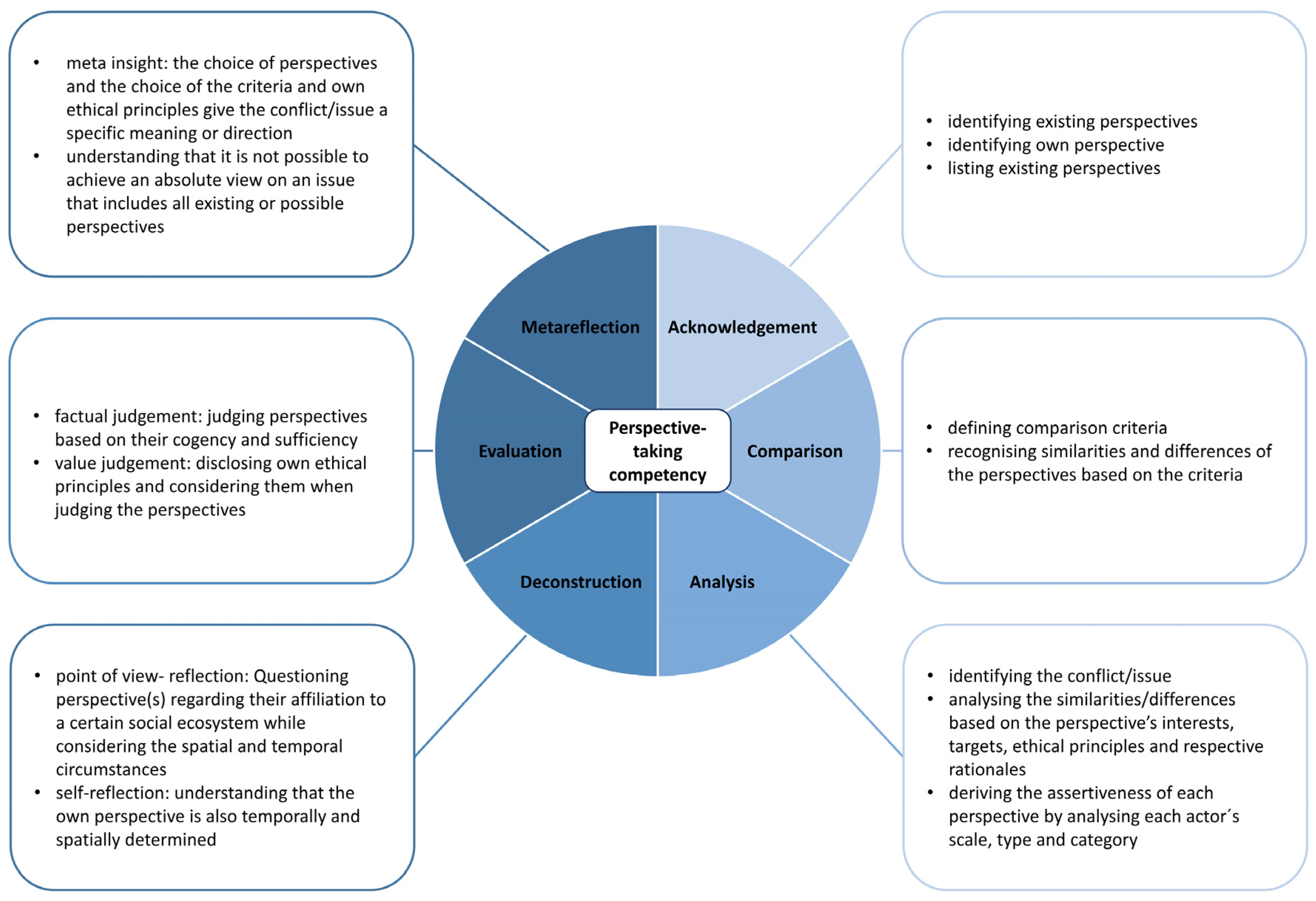
In this regard, perspective-taking is defined as a complex process to understand and reflect on different viewpoints, including one’s own point of view, by identifying, comparing and analysing perspectives in a criteria-based manner, deconstructing them, forming fact-based and value-based judgements and enabling meta-reflection. The competency model makes it possible to capture the complex competency in different dimensions (Fleischer et al., 2013; Klieme et al., 2007). The developed model consists of six dimensions that define the competency of perspective-taking, which are considered equally relevant (see Figure 1).
The six dimensions are now briefly explained (see Table 1). For further information, please refer to the article providing a detailed description of the model derivation (Vasiljuk & Budke, 2021).
The model was applied by analysing articles from practice journals of geography education from German-speaking countries to identify which dimensions of perspective-taking are enhanced by the tasks in lesson concepts (Vasiljuk & Budke, 2021). The results showed that the tasks scarcely promoted competency-oriented geography teaching in terms of perspective-taking. However, there is currently limited insight into the perspective-taking competencies of secondary students. Therefore, the objective of this study is to analyse how competent secondary students are in the different dimensions of perspective-taking.

2.2. Empirical Findings Regarding Fostering Perspective-Taking Competency

This section presents empirical findings relevant to the development of the research design of the conducted intervention study.
In general, perspective-taking is linked to Theory of Mind (Birch et al., 2017). Theory of Mind (ToM) is a complex cognitive but important socialability to understand one’s own and others’ thoughts and actions. Hofmann et al. (2016) analysed different training programmes regarding ToM that had been tested in controlled studies between 1977 and 2015. Initially, 757 papers were identified, and 32 papers were used for the meta-analysis. The meta-analysis of the studies showed that ToM training can promote children’s ability to understand, interpret and be aware of both their own and others’ perceptions, thoughts and emotions (Hofmann et al., 2016). The quantitative meta-analysis revealed that targeted training in ToM can effectively enhance children’s perspective-taking skills. Thereby, longer sessions and shorter training periods can lead to better results. However, the training itself was not analysed, which makes it difficult to identify which training elements are important in developing the children’s skills. Furthermore, Hofmann et al. (2016) argue that a precise analysis of the intervention type is also essential to ensure the implementation of appropriate approaches.
Gehlbach et al. (2015) analysed, in their intervention, how different types of social perspective-taking affect outcomes. This concept refers to the process by which an individual learns about another person’s viewpoint. The study utilised a range of approaches, varying the participants’ knowledge and information regarding the perspective. A computer-based simulation with 842 participants was used as the method. The outcomes were measured using a self-report scale with four categories (e.g., motivation). The results of the social perspective-taking study indicated that perspective-taking can lead to positive relationships if information (e.g., values and priorities of the perspective) is provided to learn about the other person’s perspective. When instructions without such further information are given, social perspective-taking is not very effective. The study demonstrated that instructions and materials are also an important part of fostering perspective-taking. However, further analysis during the intervention is necessary to understand perspective-taking in a more qualitative way, because the utilised self-report scales were not sufficient to provide an in-depth understanding of perspective-taking during the intervention process.
In their study, Cho et al. (2021) investigated the extent to which students used different perspectives in their essays for perspective-taking. They were asked to write an essay based on two newspaper articles. The analysis of 195 essays showed that students primarily wrote from their own perspectives and rarely considered other perspectives. The results also indicated that a higher level of perspective-taking competency is linked to better writing quality. Nevertheless, the students did not receive a systematic intervention to enable them to understand multiple perspectives or consider how different perspectives could be considered in the writing process. Therefore, Cho et al. (2021) highlight that fostering perspective-taking through targeted strategies can support students in developing their abilities to take different perspectives in writing.
In three different experiments, Galinsky and Moskowitz (2000) demonstrated that perspective-taking can promote empathy by reducing stereotypes and bias in social judgements. In two of the experiments, participants were asked to write a narrative essay about an elderly man. One group received no further instructions (control condition). A second group was asked to avoid stereotypical views (suppression condition), while a third group was instructed to adopt the perspective of the older man (perspective-taking condition). Participants in the control group wrote more stereotypical essays than those in the suppression and perspective-taking groups. In addition, the results indicated that, while the initial suppression of stereotypes may appear to be a strategy for reducing prejudice, it can nevertheless reinforce the activation and expression of stereotypes. Conversely, adopting the perspectives of others can result in a reduction in both expression and cognitive accessibility. Skorinko and Sinclair (2013) adapted the experiments and confirmed the results. They also noted that, when the perspective for perspective-taking is stereotypical, the perspective-taker is engaged in stereotyping. As the different experiments considered various aspects in addition to perspective-taking, the participants were given only a few minutes to complete the essay. To truly foster perspective-taking, longer sessions are necessary. Nevertheless, both studies show that awareness of perspective-taking can reduce social stereotypes and promote respective understanding. For an intervention study, awareness of perspective-taking and the perspectives used in the material are particularly relevant in analysing perspective-taking competency.
Huijgen et al. (2014) tested an instrument for measuring history perspective-taking (HPT) and applied it in a follow-up study (Huijgen et al., 2017). The objective of the study was to assess students’ ability to contextualise the actions of people in the past in the context of history perspective-taking (HPT) and to analyse their reasoning (Huijgen et al., 2017). The results showed that students performed well when engaging in HPT and using different reasoning strategies to perform HPT. While the study provides valuable insights from HPT, it does not offer a systematic approach to promoting perspective-taking. Overall, the empirical results show that perspective-taking can be promoted but that appropriate materials, instructions and settings are important.
A study of geography education analysed how students could perceive space from different perspectives (Schrüfer et al., 2016). In this regard, teaching materials were developed and two lessons were held. Students participated in group interviews and completed questionnaires to evaluate the lessons and their outcomes. The results of the study showed that students accepted that their views of unfamiliar situations differed from those of others. However, they found it more difficult to accept that their views of a familiar situation could differ from those of others. As part of a geographical field trip, students were asked to adopt different perspectives in a role-playing game (Böing & Sachs, 2009). The results showed that this method is suitable for avoiding a pro–con view and for achieving an awareness of the complexity of human geographical processes. The findings indicate that perspective-taking is also a relevant skill in geography education, with the objective of understanding and reflecting on other perspectives. However, students were not guided in perspective-taking, nor did the authors analyse how perspective-taking can be fostered. In geography education, students’ perspective-taking competency has not yet been analysed based on a competency model. Instead, empirical studies have focused on classical geographical skills such as systems thinking (Brockmüller & Siegmund, 2020; Cox et al., 2019; R. Mehren et al., 2015) or spatial thinking (Bette & Schubert, 2015; Lee & Bednarz, 2012).
In order to address the identified gaps, the developed competency model was operationalised into a set of instructional tasks and applied in a guided intervention, which will be presented in the following section.

3. Methodology

We conducted a quasi-experimental intervention study with a pre–post control group design to investigate the following research questions:
How do students demonstrate perspective-taking competency across different dimensions within the intervention setting, as captured by the operationalised competency model?
How do secondary students assess the tasks of the operationalised model?
To what extent do students evaluate their ability to cope with the applied tasks?
We first present the participants, the sampling procedures and the research design of the intervention study, followed by the applied tasks from the developed competency model, as well as the data analysis.

3.1. Participants and Sampling Procedure

Two secondary school classes in Germany (Cologne) participated in this study. All participants were enrolled in an advanced elective geography class: “Leistungskurs Geographie”. The study followed a quasi-experimental design in which the participants were not randomly assigned to either the intervention or control group. Instead, the intact classes were arbitrarily assigned either to the experimental or the control group. In total, 29 school students participated in this study. There were 14 students (gender: six female students, seven male students, 1 gender-diverse student) in the experimental group and 15 (gender: six female students, nine male students) in the control group, aged between 15 years and 17 years. Originally, 32 students participated. However, due to illness, not all 32 students were able to take part in both the pre-test and post-test as well as the intervention. Therefore, only the results of the 29 students who were present on all days were analysed. The students and their parents were informed in advance about the study, to which they had given their consent. All tests and data were anonymised for analysis.

3.2. Research Design

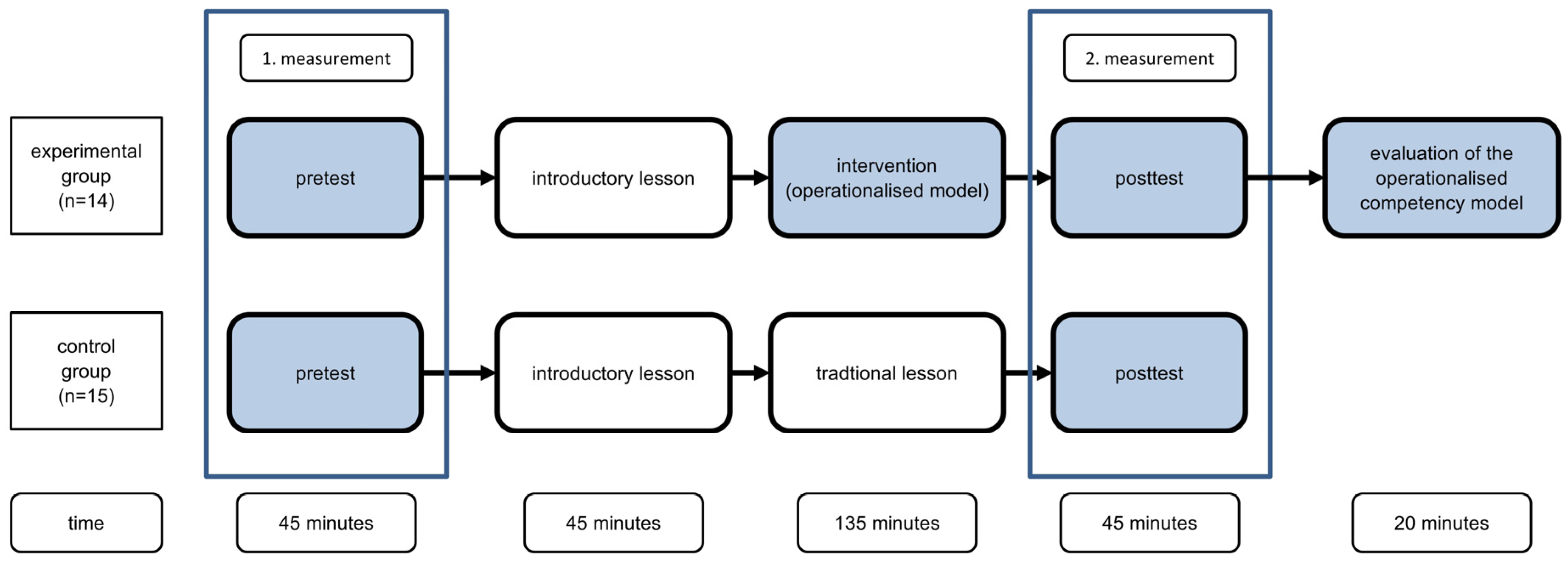
The intervention study followed a quasi-experimental design with a non-randomised control group pre-test–post-test design. The pre- and post-tests were used to provide descriptive information about students’ competency at the beginning and end of the study. However, the primary focus remained on the intervention itself (see Figure 2).
Before the intervention, the students received an introduction to the geographical topic (Mount Everest) to provide sufficient background information for the subsequent tasks, so that they were not unable to adopt a perspective in the intervention due to a lack of knowledge (Mayer & Wellnitz, 2014). In the intervention, the students were asked the following overall question: should ascending Mount Everest be prohibited? In the material, the following four actors gave their views on this in an interview: an Austrian environmental consultant, a German hobby mountaineer, a Nepalese government advisor working in the Nepalese Ministry of Tourism and a Sherpa who guided tourists up Mount Everest. Based on Gehlbach et al. (2015) and Skorinko and Sinclair (2013) (see Section 2), we ensured that relevant information about their perspectives (e.g., values and priorities) was provided. The material was developed and didacticised based on authentic sources to avoid a stereotypical perspective. In order to minimise the influence of the teacher during the intervention, the students were given written learning materials and work instructions to complete individually.
The experimental group was instructed with small tasks to answer the overall question and to enhance the competency of perspective-taking. The tasks were derived from the perspective-taking competency model (Vasiljuk & Budke, 2021). The students had 135 min to complete 16 tasks and to answer the overall question (Vasiljuk & Budke, 2024). According to the students, this time was sufficient.
After the post-test, the students in the experimental group were asked to provide feedback on the tasks. For each operationalised dimension, two statements were given: “The tasks are understandable” and “It was easy for me to complete the task”. Students were asked to respond to both statements for each dimension by ticking the respective box on a 5-point Likert scale with the following possible answers: strongly agree, agree, undecided, disagree, strongly disagree. In addition, students could write further open-ended responses for each dimension. When analysing the data, the response categories were converted into numbers in order to calculate the mean and standard deviation.
The intervention study was carried out between 26 October 2021 and 2 November 2021. All materials, including the pre-test and post-test, as well as the introductory lesson, the intervention and the conventional lessons, were checked for comprehensibility and adapted with the help of two student assistants.

3.3. Operationalisation of the Competency Model of Perspective-Taking in the Intervention

Perspective-taking competency has not yet been analysed in geography education based on a competency model. Therefore, the competency model for perspective-taking (Vasiljuk & Budke, 2021) was applied and operationalised for the intervention. It has been operationalised in different task formats to capture students’ competency (Grünkorn & Krüger, 2012).
At this point, we refer to our article where the operationalised tasks and materials are presented in detail (Vasiljuk & Budke, 2024). In the following, we show only one example of operationalisation for each dimension (see Table 2).
When we converted the dimensions into tasks, we tried to consider theoretical aspects and empirical results. In general, a systematic approach is needed to understand multiple perspectives (Cho et al., 2021). Currently, no systematic approach is used in geography education to capture perspective-taking competency (Vasiljuk & Budke, 2021). Therefore, we decided to systematically convert each dimension into precise tasks that allowed the students to determine what was required of them (Jordan et al., 2006). We developed generalised tasks that could be used for different topics and tried to ensure that all six dimensions were as consistent as possible with the geography education standards (DGfG, 2020, 2014). On the one hand, this can help in understanding the tasks, as the students already have knowledge of the different action verbs. For example, the “evaluation” dimension of the competency model requires students to disclose their own ethical principles and to consider them when judging the perspectives (see Figure 1). This is similar to the explanation of the operator “assess” in the Educational Standards for Geography. Students should here “[a]nalyse the internal coherence and suitability of given statements or claims, forms of presentation in relation to specific issues” (DGfG, 2014, p. 31). Therefore, we used the operator “assess” for this dimension of the competency model. On the other hand, Mori and Cigala (2016) also showed, in their intervention study, that it is helpful if the procedures fit the school context in which the intervention takes place. As students work with tasks all the time, we considered the different action verbs of the geography education standards that are used in geography lessons.

3.4. Data Analysis

The study is based on the collection of qualitative data using mainly open-ended questions in the intervention itself (Vasiljuk & Budke, 2024). The answers to these questions were analysed by qualitative content analysis according to Mayring (2015) and Kuckartz (2018). The responses were then categorised and assigned a quantitative value (0, 1, 2, 3 points) using a coding manual created deductively. These quantified data were then analysed using descriptive statistics.
For the coding manual, we applied the model of perspective-taking. We considered all six dimensions of the model and reduced each dimension (category) into smaller evaluation items (subcategory) based on the respective criteria. The coding manual contained a total of 24 deductive items derived from the perspective-taking model and was used to analyse both the intervention and the pre- and post-tests.
In the following, the coding manual is explained using the dimensions “acknowledgement” (see Table 3) and “analysis” (see Table 4). All statements were created in the native language of the German students in the intervention study. They were translated into English by the authors. The complete coding manual is provided in Supplementary Materials.
For the dimension “acknowledgement” (see Table 3), the scoring is explained using the criterion “identifying perspectives” (=subcategory). This scoring method was used for 16 of 24 items. If no perspective was identified (=0 perspectives), 0 points were awarded. If one perspective was identified, the participants received 1 point. If more than one but less than all perspectives were identified, 2 points were awarded. If all perspectives were identified, participants received 3 points. We also analysed whether the answers were explicit or implicit. However, the subdivision (explicit/implicit) was not decisive for the scoring.
There were also subcategories for which only one point was awarded. For example, in the subcategory “identifying the conflict” within the “analysis” dimension (see Table 4), students either identified the conflict and received 1 point or received 0 points if they could not identify it. In general, 8 of 24 items were graded 0 if absent and 1 if present in the answers.
The students could obtain a maximum of 56 points. The distribution of points across the dimensions is outlined in Table 5.
It should be noted that the points assigned to each dimension do not represent weighting with respect to difficulty but merely a count based on the respective criteria within each dimension. As different maximum scores applied to the individual dimensions (see Table 5), the scores achieved within each dimension were standardised relative to the respective maximum possible score. Based on the underlying competency structure model, which conceptualises all six dimensions as equally important aspects of perspective-taking competency, the dimension-specific standardised values were combined using equal weighting to form an overall index.
To ensure the reliability of our scoring, we calculated the intra-rater agreement on 50% of the intervention and 50% of the pre- and post-tests of the experimental group (with a 3-monthly interval between ratings).
Overall, we obtained a Cohen’s Kappa of 0.955 for the intervention, a Cohen’s Kappa of 0.863 for the pre-test and a Cohen’s Kappa of 0.901 for the post-test in the experimental group. All three Kappa coefficients indicated a high level of agreement, which could be classified as almost perfect (Landis & Koch, 1977).
After the intervention, the students were asked to provide feedback on the tasks used in the intervention. The survey consisted of 12 items, each with a 5-point Likert scale. The responses were analysed descriptively. The means and standard deviations were calculated to capture how the students assessed the tasks and their own performance in the task. The aim of the analysis was to determine to what extent the students were able to cope with the tasks and to identify trends in their self-assessments.

3.5. Limitations of the Study

One limitation of this study lies in its conceptual and methodological focus on the criterion-based operationalisation of perspective-taking competency. Within the study framework, the competency is analysed via a points system with predefined criteria based on the underlying competency model (Vasiljuk & Budke, 2021). In selected cases, the results are supplemented by specific responses from the students. The aim is to extend the numerical scoring system in order to provide a clearer illustration of the underlying competency. On the one hand, this approach enables a structured, transparent and comparable analysis of students’ responses. It also allows for a more detailed analysis of how well students meet the requirements of the operationalised competency model. On the other hand, this procedure reduces the complexity of the construct of perspective-taking.
Furthermore, it is important to consider the influence of factors that may not be directly attributable to the perspective-taking competency itself. In this regard, students’ general writing competence and their familiarity with school-based task formats could be key considerations. Such factors may contribute to the achieved scores without necessarily reflecting the intended competency. Therefore, future research should complement this approach with additional qualitative methods (e.g., video-based analyses, recordings of classroom interactions or think-aloud protocols) in order to capture the underlying processes of perspective-taking in a more differentiated way and to further refine the operationalisation of the competency model.
It also should be considered that the task design (Vasiljuk & Budke, 2024) and the coding manual were derived from the same theoretical framework (Vasiljuk & Budke, 2024). While this conceptual coherence ensures a high degree of alignment between competency definition, operationalisation (task requirements) and the assessment criteria, it also carries the risk of circular validation logic. Future research should therefore include more multi-method validation approaches to strengthen the construct validity and to capture the multifaceted nature of perspective-taking competency more thoroughly.
We selected advanced geography students (“Leistungskurs Geographie”) for our study because it could be assumed that they had a high level of subject-specific interest, which may have supported their motivation and engagement during the intervention. Moreover, although it was not possible to completely exclude fluctuations in concentration and fatigue during the intervention, we tried to reduce such effects in this way due to the assumption that the advanced students were used to longer and cognitively demanding learning situations. In fact, the students’ detailed work on the tasks suggests that fatigue or fluctuations in concentration were indeed minimal. After the intervention had been completed, we asked the students for their opinions. The students indicated that the study duration was appropriate and that they were engaged throughout. However, the issue of social desirability must be considered at this point as well. Nonetheless, this sampling decision also limits the transferability of the findings to other school types or age groups.
Despite these limitations, the study still offers initial systematic insights into the operationalisation and analysis of perspective-taking competency and provides a basis for further methodological and theoretical development in future research.

4. Results

Overall, the results of the pre- and post-tests showed few changes in students’ competency of perspective-taking before and after the intervention (see Table 6).
In the experimental group, the mean values were low in the pre-test (M = 0.28) and post-test (M = 0.27). In contrast, the results of the intervention phase (M = 0.68) indicate that students were able to successfully apply perspective-taking. Moreover, no significant differences were identified in the control group during the comparison of the pre-test (M = 0.29) and post-test (M = 0.27). Overall, neither the experimental group nor the control group showed any discernible changes in the pre–post comparisons, suggesting that the effects of the intervention are not reflected in the data. For this reason, and due to the task-oriented focus of the analysis of the competency in the present article, the test results are not discussed further here. Consequently, the subsequent analysis focuses on the intervention itself, examining how students engaged with the guided tasks and the competence that they showed in the different dimensions.
After this, we briefly discuss how the students assessed the operationalised model and how they rated themselves regarding their own abilities in terms of coping with the tasks. This approach provides insights into how perspective-taking can be systematically fostered in geography education.

4.1. Results of the Use of the Operationalised Competency Model in the Intervention

In the following, the results are presented for each dimension of the model of perspective-taking. It should be noted that all students were able to reproduce the overall question (should ascending Mount Everest be prohibited?) as required by the perspective-taking model.
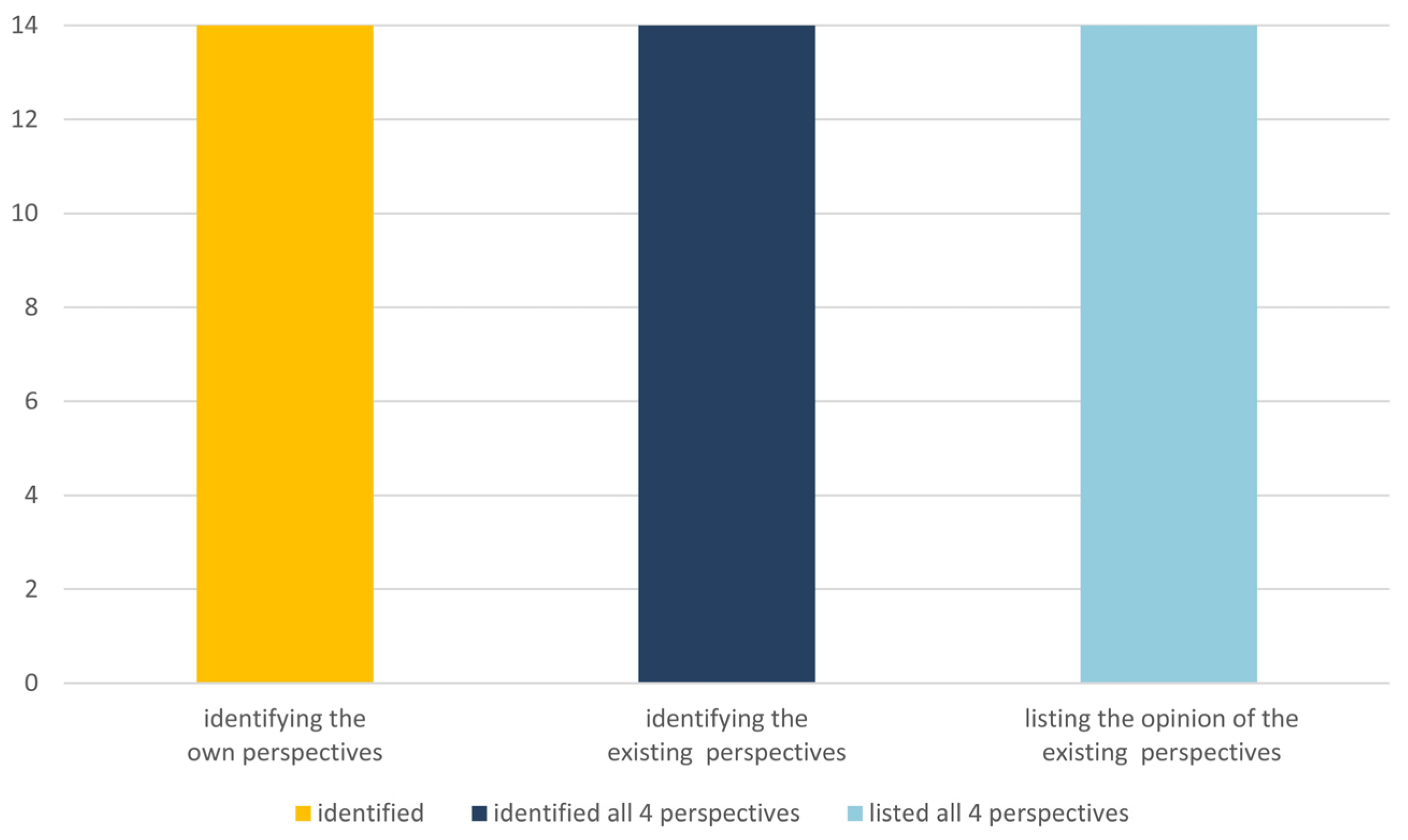
Acknowledgement Dimension: Overall, the students had no difficulty with the dimension of “acknowledgement” in the competency model (see Figure 3).
All students were able to identify and describe their own perspectives on the issue, as in the following example, in which the student declares himself against climbing: “In my opinion, the ascending of Mount Everest should be prohibited. The most important point for me is that the ascent is extremely dangerous and many climbers and Sherpas risk their lives” (EG-12, intervention). The students were also able to identify all four existing perspectives from the material, and they were able to list the actors’ opinions.
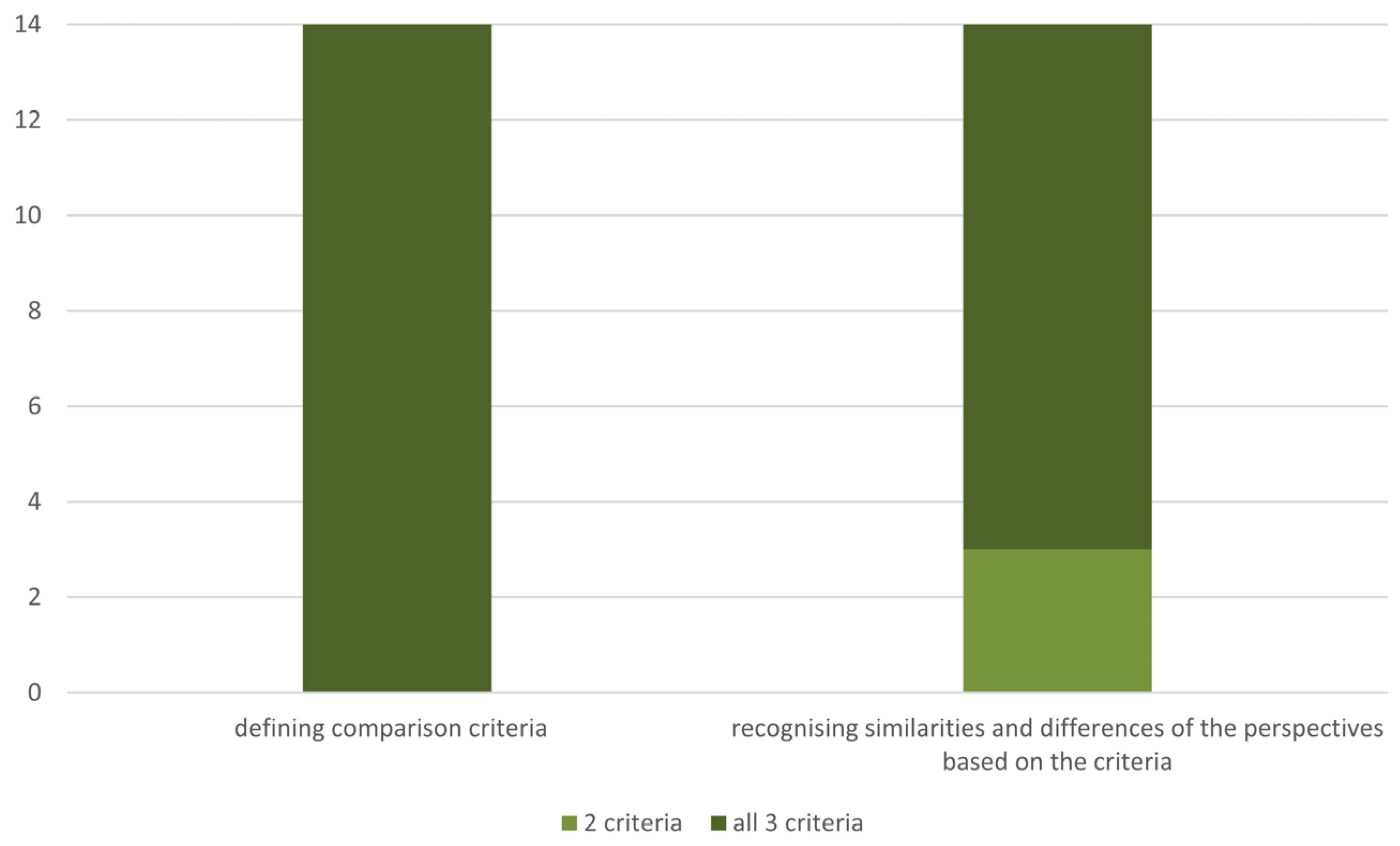
Comparison Dimension: Students were able to apply the dimension of “comparison” from the competency model well (see Figure 4).
All students were able to define the three required criteria to compare the perspectives with each other. They used criteria such as “environment, safety of the Sherpa, tourism as a source of income” (EG-8, intervention) and “working conditions of the Sherpa, environmental problems, economic importance/tourism” (EG-2, intervention).
Based on the criteria, almost all students were able to identify similarities and differences between the different perspectives. Although three students defined the criteria, they were not able to identify similarities and differences between the different perspectives based on the three chosen criteria.
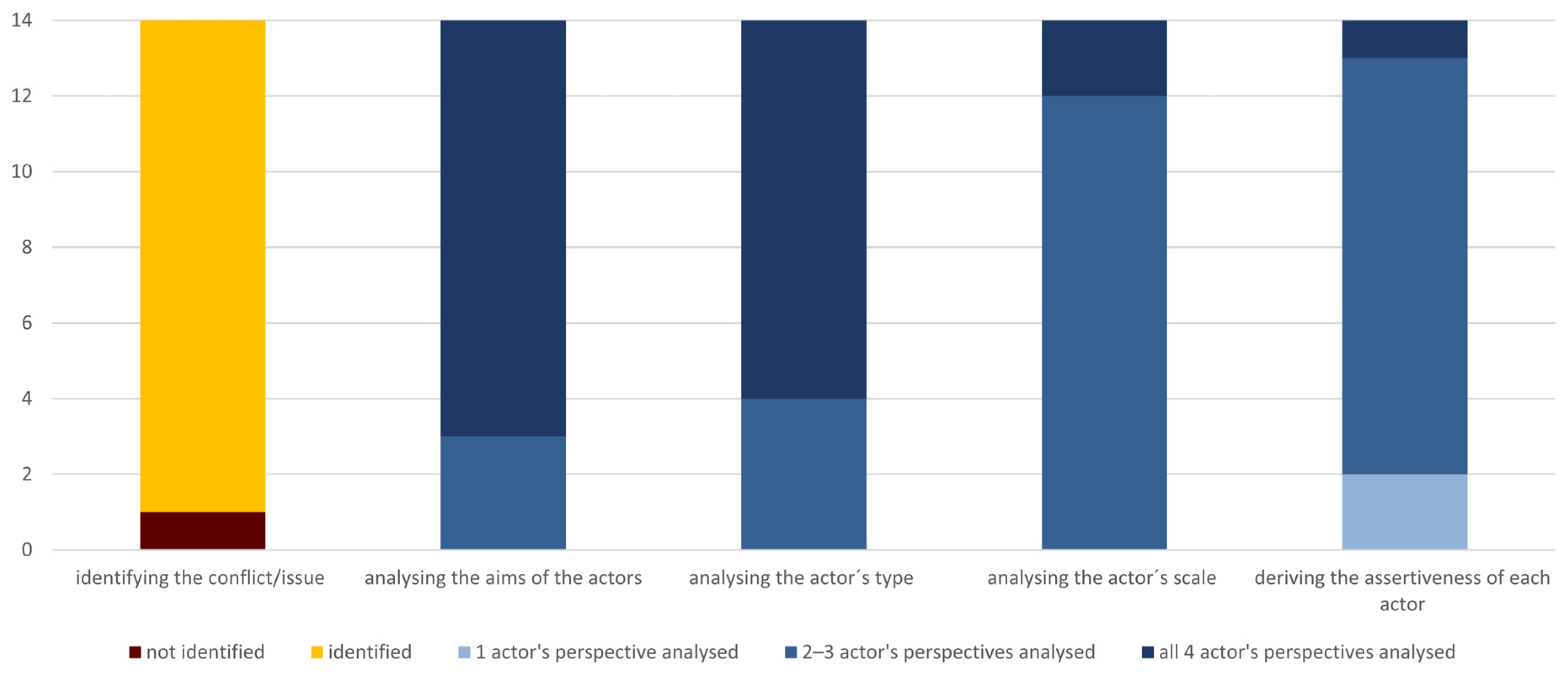
Analysis dimension: Overall, students applied the dimension of “analysis” from the competency model well but struggled with some aspects (see Figure 5).
Almost all students were able to identify the conflict, as in the following example: “The conflict is that the safety of the Sherpa and the protection of the environment are opposed to the sporting ambition and the important source of income” (EG-3, intervention). Students were also able to correctly identify and describe the aims of the different actors, as in the following example: “Gabrielle Schätzer [Austrian environmental consultant] is pursuing the goal of forbidding the ascent of Mount Everest, mainly because of ecological aspects” (EG-13, intervention). Almost all students were also able to analyse each actor’s type, whether it was an individual actor or a complex actor.
However, not all students were able to correctly analyse the scales of all actors. While they were able to correctly assign the perspectives of the local actor (Nepalese Sherpa) and the national actor (Nepalese government advisor), about a third of the students had difficulty in assigning the perspectives of the hobby mountaineer and the environmental consultant in terms of the actor’s scale.
The students also had some difficulty in correctly analysing the assertiveness of the actors regarding their interests. While the assertiveness of the complex actors (Nepalese government advisor and Austrian environmental advisor) was almost always correctly determined, the students had difficulty in correctly analysing the assertiveness of the individual actors (Nepalese Sherpa and German hobby mountaineer). More than half of the students had difficulty in correctly analysing the assertiveness of the German hobby mountaineer, and more than four-fifths of the students had difficulty in correctly analysing the assertiveness of the Nepalese Sherpa. Overall, both actors were attributed a much higher level of assertiveness, e.g., “rather high assertiveness assertiveness/very high assertiveness” (EG-5, intervention), than they actually had.
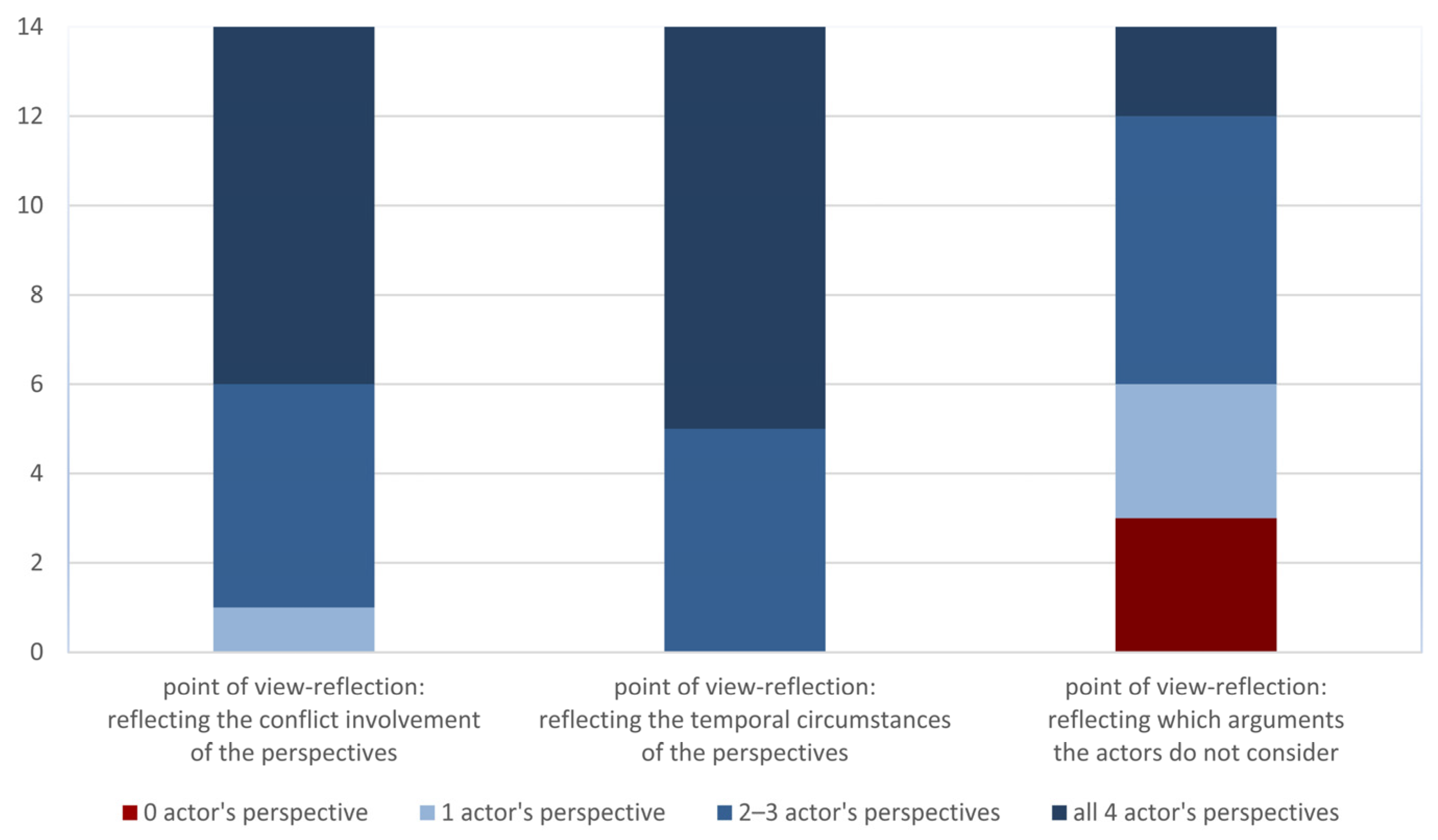
Deconstruction dimension (point of view reflection): Overall, students had some difficulty in applying the dimension of “deconstruction” from the competency model and in deconstructing the perspectives (see Figure 6).
More than half of the students were able to correctly identify the temporal perspectives of all actors. While the temporal perspectives of the Austrian environmental consultant, the Nepalese government advisor and the Nepalese Sherpa were almost always correctly assigned, about a quarter of the students had difficulty in assigning the correct temporal perspective to the German hobby mountaineer.
Almost half of the students were able to correctly identify the conflict involvement of all actors. In particular, the Austrian environmental consultant, the German hobby mountaineer and the Nepalese Sherpa were almost all correctly analysed in terms of their conflict involvement, as in the following example: “He is personally affected. He works as a Sherpa, i.e., he guides the mountaineers up the mountain” (EG-4, intervention). Meanwhile, around two-fifths of the students had difficulty in correctly identifying the conflict involvement of the Nepalese government advisor.
In general, students had some difficulty in reflecting on how the actors considered the arguments of others in their argumentation. When asked how the actors—for example, the Sherpa in Nepal—considered the arguments of others, a fifth of the students were unable to answer this question, giving only one-word answers such as “yes” (EG-8, intervention) or “partly” (EG-11, intervention). Nevertheless, more than half of the students were able to reflect on two or three actors in this respect, as in the following example, in which the student reflected on how the environmental consultant considered the arguments of others: “Rather a lot, she uses the argument of the economy and sporting ambition. She discusses the economic aspect a bit more, while she seems to have difficulties understanding the other actors when it comes to the sporting ambition aspect” (EG-6, intervention).
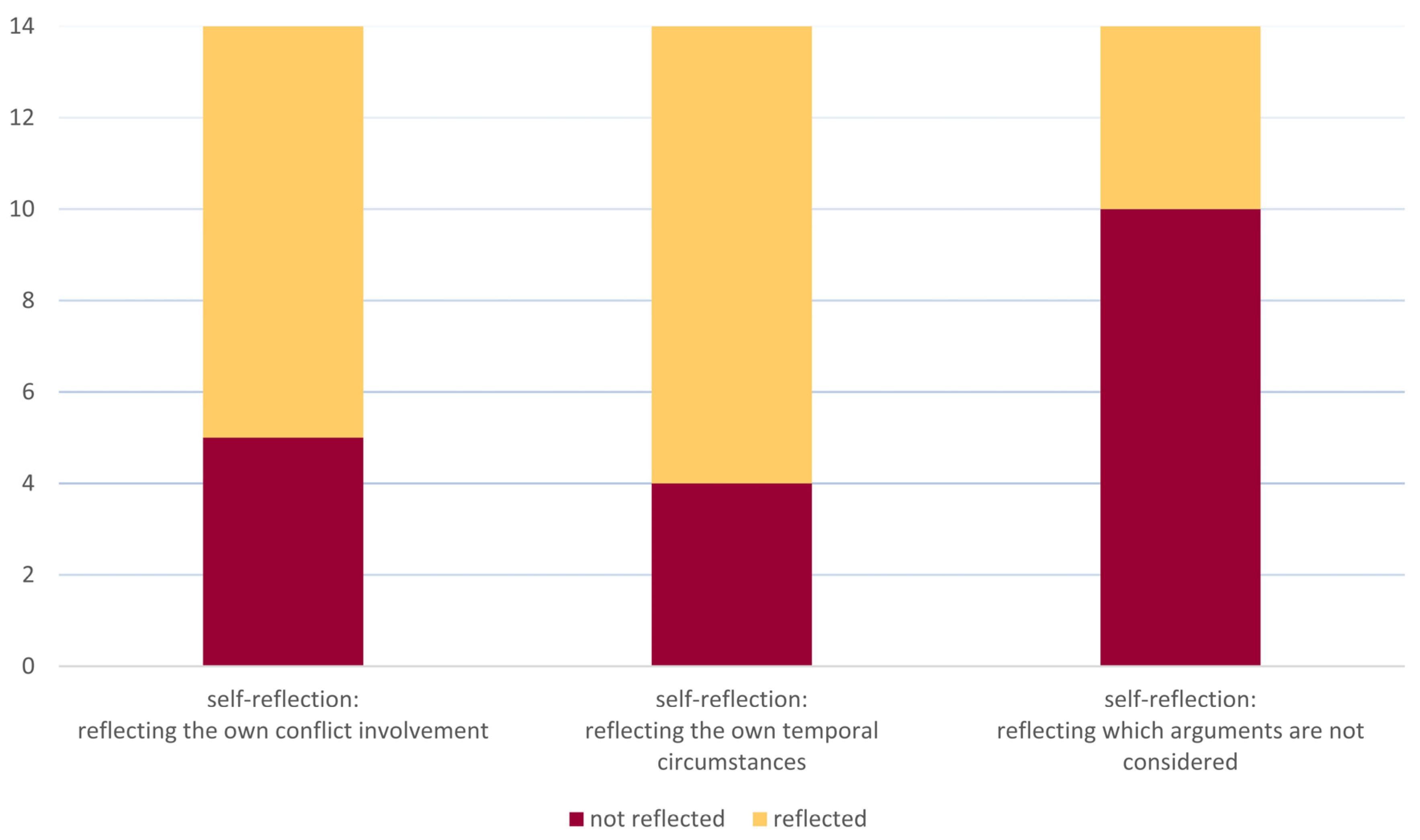
Deconstruction dimension (self-reflection): The results for the self-reflection dimension (see Figure 6) are very similar to the results for the point of view reflection (see Figure 7).
More than half of the students were able to correctly determine the temporal perspectives of their own points of view, and almost half of the students were able to identify the conflict involvement for their own perspectives. For example, in the following statement, the student explains his minor involvement: “I am not directly involved because I am not a local and have no intention of ascending the mountain” (EG-11, intervention). However, the students had some difficulty in reflecting on how they considered other actors’ arguments in their argumentation. More than half of the students did not answer the question of how they had considered other arguments in their argumentation, although all students had formulated their own opinions at the beginning (see results for the “acknowledgement” dimension). A third of the students gave either one-word answers such as “yes” (EG-9, intervention) or answered, “I consider all arguments” (EG-14, intervention), even though they had not considered the arguments of other actors.
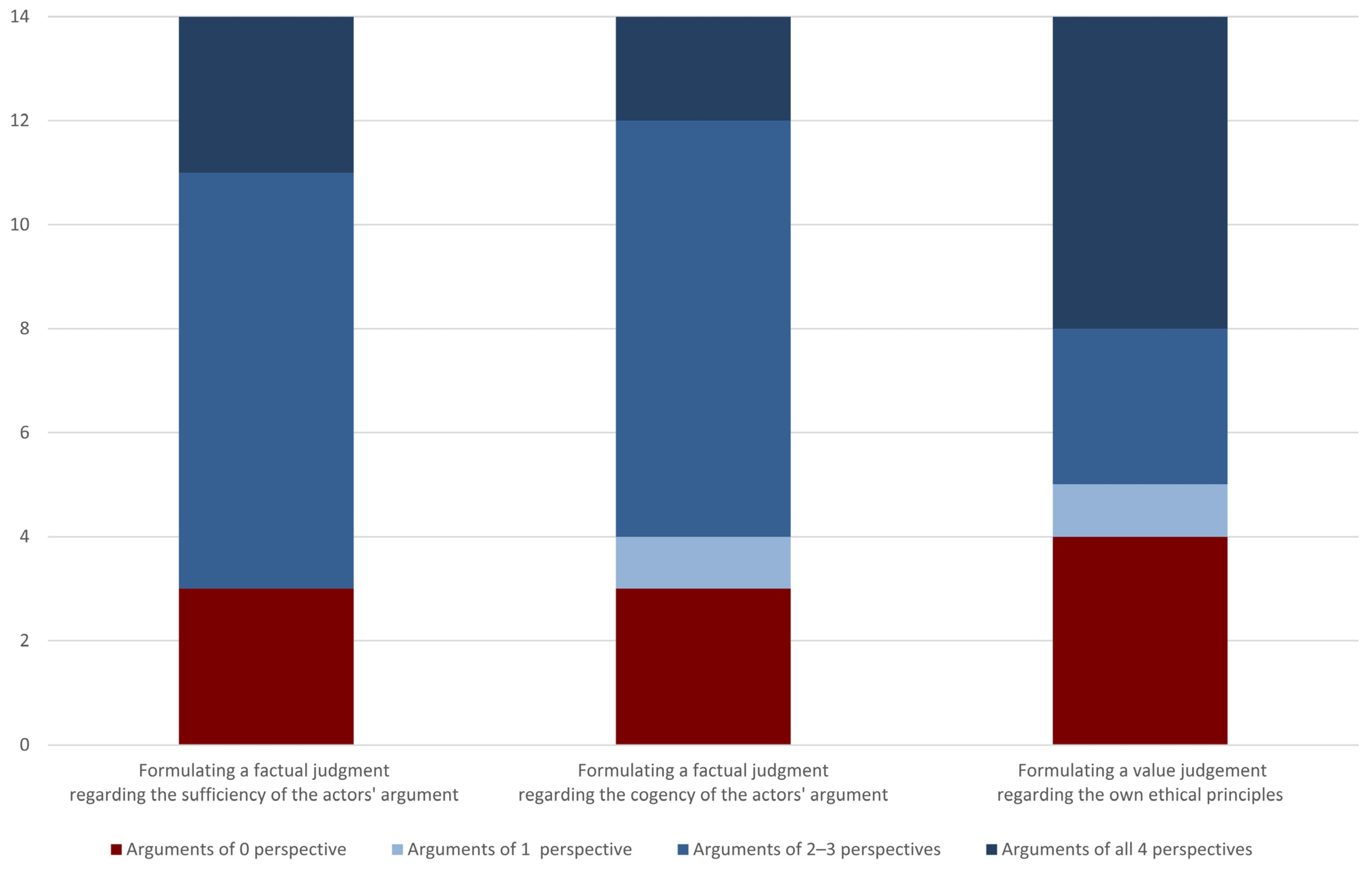
Evaluation dimension: Overall, the students were able to apply the “evaluation” dimension of the competency model well (see Figure 8).
More than half of the students judged the arguments of two or three actors in terms of sufficiency and cogency, as in the following example: “Regarding the conflict […], the actors’ arguments are judged as follows. Starting with the environmental aspect, which was mentioned by all four actors, the seriousness of the problem can be underlined. In particular, the statement of the Sherpa confirms the magnitude of the problem. I therefore consider the tasks and efforts of GS [Gabrielle Schätzer, Austrian environmental consultant] to be extremely appropriate. However, I find her call for a ban on ascending the mountain inadequate and falsifiable. After all, Nepal depends on the ascent of the mountain as it is a huge source of income for them” (EG-13, intervention). In this example, the student judges the Austrian environmental consultant’s argument based on the appropriateness of the argument, i.e., whether there is a legitimate purpose for the proposed action (banning the ascent of Mount Everest) and whether the argument is cogent. In contrast, a fifth of the students did not judge the actors’ arguments in terms of sufficiency and cogency. Only three students judged the arguments of all four actors in terms of sufficiency, and only two students judged the arguments of all four actors in terms of cogency.
Almost two thirds of the students judged the arguments of two or three actors in relation to their own ethical principles, as in the following example: “From an ethical point of view, the ascent is simply irresponsible, because the culture of the Nepalese is being disregarded, nature is being destroyed and the Sherpas are risking their lives every year. It is a difficult situation because Nepal lives from tourism and it is a very important source of income. However, I think an alternative source of income must be found that does not exploit the Sherpas, destroy nature and disrespect the culture. I don’t see the aspect of sporting ambition or purpose in life at all, because so many mountaineers and Sherpas lose their lives and it’s just far too dangerous. If you’re looking for adrenaline, you should choose something else. So yes, climbing Mount Everest should be prohibited” (EG-8, intervention). About a quarter of the students could not assess the actors’ arguments in terms of their own ethical principles. However, almost half of the students were able to assess the arguments of all four actors regarding their own ethical principles.
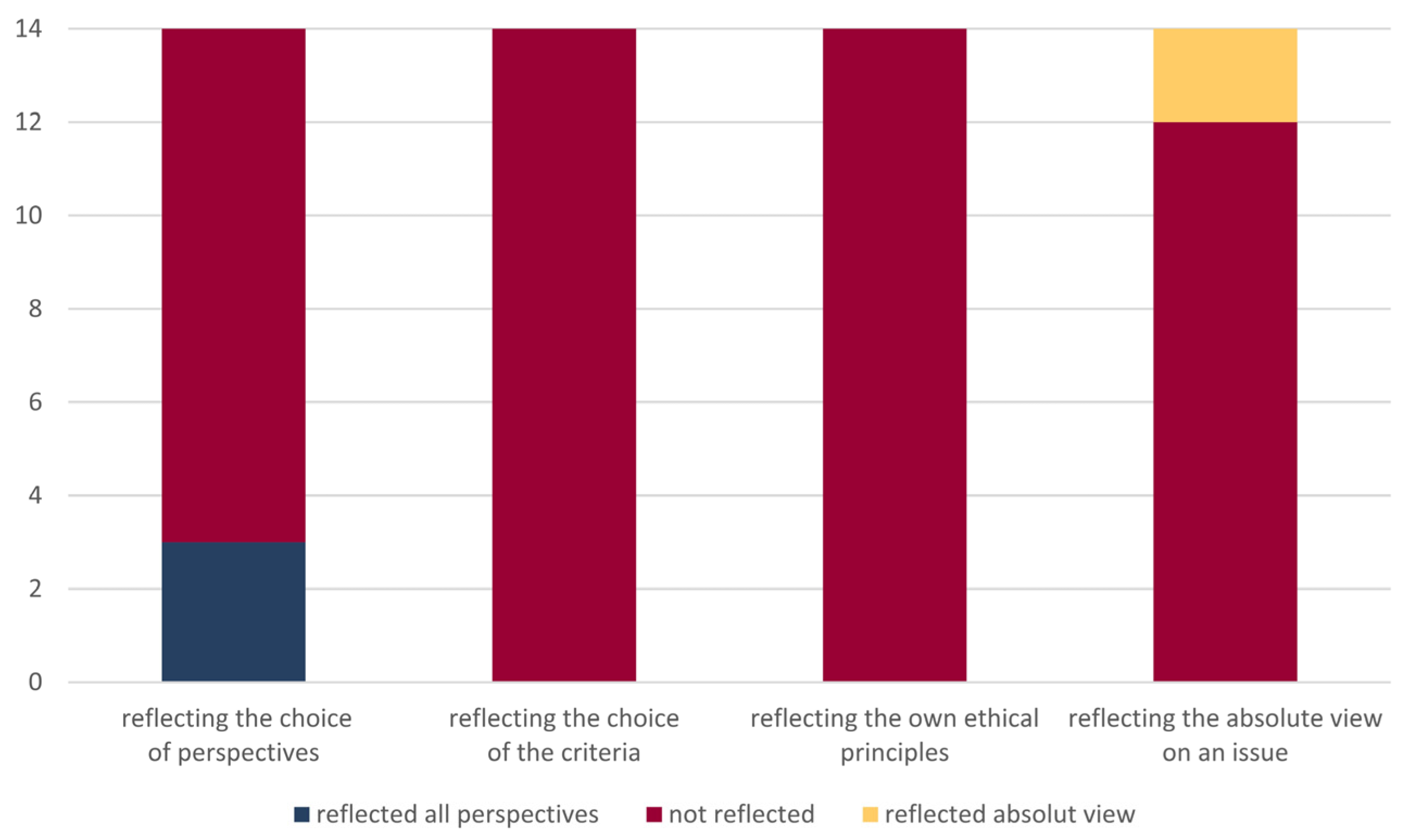
Meta-reflection dimension: The students had considerable difficulty in applying the “meta-reflection” dimension of the competency model (see Figure 9).
Only a few students questioned the choice of perspective in relation to the overall question they had to answer, as in the following example: “I think the question can only be answered moderately. In order to answer the question more reliably, I would have needed more material or some more actors, e.g., more environmental consultants and many more mountaineers or relatives of the deceased, villagers living below Mount Everest and environmental consultants from Nepal, not from Austria” (EG-4, intervention). None of the students questioned their own chosen criteria, nor did they question their own ethical principles. Only two students questioned the absolute view on an issue, as in the following example: “The question cannot be answered completely and definitively because there are more people involved and therefore it can only be answered theoretically” (EG-14, intervention). Five-sixths of the students did not question the possibility of considering the issue in an absolute view.

4.2. Students’ Assessments of the Tasks and Evaluations of Their Abilities to Cope with Them

At the end of the intervention, the students in the experimental group were asked to rate the tasks and how well they coped with them. A 5-point Likert scale was used for the responses. The response categories are explained in Section 3. In total, 13 out of 14 students gave feedback, and one student could not complete the feedback form. Overall, the students indicated that they felt that they could cope well with the derived tasks (see Table 7).
They had no difficulty in understanding any of the dimensions or derived tasks and were able to complete the tasks. They also rated the tasks as easy to complete. Only the evaluation and deconstruction dimensions were rated as more difficult than the other tasks.
The students’ own self-assessments indicated that they had no difficulty in applying the tasks derived from the perspective-taking model.

5. Discussion

In this study, we analysed how competent secondary students were in performing the competency of perspective-taking, as well as how the use of the operationalised perspective-taking model in the intervention affected students’ perspective-taking competency and how secondary school students dealt with the operationalised model during the intervention.
We used a competency model for perspective-taking that was divided into six dimensions (Vasiljuk & Budke, 2021) as a basis for capturing students’ competency. To enhance the students’ perspective-taking competency, each dimension of the model was systematically transformed into tasks (Vasiljuk & Budke, 2024). The operationalised competency model was then used in an intervention study with 14 secondary students from Germany using a quasi-experimental design.
In general, most secondary students in our study showed low performance in perspective-taking in the pre-test as well as in the post-test. In contrast, the results of the intervention showed that the students had a high level of competency in perspective-taking in most dimensions when gradually guided through the tasks, indicating that such incremental implementation helped to instruct them on perspective-taking. Consequently, the application of the tasks is suitable for supporting the learning process through scaffolding (Vygotsky, 1978). This suggests that the intervention may have primarily fostered perspective-taking within the structured learning environment, while the independent transfer of these processes to the post-test setting appeared to remain challenging for some students.
Overall, the results indicate that perspective-taking is a complex cognitive process. It requires students to monitor, control and understand the cognitive process so that meta-cognition can be achieved (Schraw & Moshman, 1995; Brown, 1987; Flavell, 1979). For the lasting promotion of perspective-taking, it is therefore necessary that students are aware of the different dimensions of the competency so that they can adopt the competency on their own. Since it has different dimensions, it would be possible to gradually develop the competency of perspective-taking so that students can adopt it step by step. In this context, results regarding Theory of Mind training programs have shown that longer sessions, as well as the number of sessions, have a greater effect than longer training periods (Hofmann et al., 2016). Furthermore, the intervention lasted 135 min in the classroom setting. Consequently, it can be inferred that the allocated time was not sufficient for the secondary students to develop a lasting understanding of perspective-taking, despite their responses in the intervention study indicating that the time was deemed sufficient. Therefore, perspective-taking tasks should be continuously integrated into geography lessons over a longer period of time so that students repeatedly practise and internalise the underlying cognitive processes. Through repeated practice, students can learn to gradually transform externally guided processes of perspective-taking into self-regulated competency.
Overall, the gradual guidance through the tasks helped the students to complete perspective-taking in general very well. Nevertheless, in some dimensions, they had difficulty in adopting perspective-taking.
Many aspects of the “analysis” dimension were completed well by the students, although they were not able to correctly identify the assertiveness of all involved actors. These difficulties may be related to students’ limited knowledge of (political) structures, possible decision-making processes and mechanisms of (social) control. This finding supports the assumption that perspective-taking requires knowledge of the respective actors, which has also been highlighted in previous studies (Gehlbach et al., 2015). More broadly, this finding aligns with a fundamental principle of educational psychology, which states that learners’ comprehension and evaluation of complex subjects is influenced by their existing knowledge, prior experiences and the available information sources (Bittermann et al., 2023; Dochy et al., 1999; West & Fensham, 1974). Prior knowledge provides a foundation for interpreting new information and developing informed judgments. However, the impact of prior knowledge can also be dependent on its quality and structure, and it may also involve misconceptions (Brod, 2021). This finding is further supported by studies demonstrating that students’ comprehension of particular subjects is influenced by their conceptual knowledge, as well as their sources of information (M. S. Doğru, 2022).
Therefore, a lack of knowledge regarding the values, goals and priorities of the actors and their contexts may restrict students’ abilities to differentiate between perspectives, particularly in terms of their relative influence and decision-making capacity. Weißeno et al. (2010) pointed out that considering the power of actors by analysing the constellation of actors is not often done in (political) lessons. Particularly in geography, when talking about spaces, students must be able to analyse and correctly capture the power potentials of actors to avoid misconceptions (Reuber, 2000, 2001). Therefore, it could be helpful to discuss political systems with students in more detail. Furthermore, when promoting democratic skills, students can be shown that every decision-maker in the presented issue has different interests and levels of assertiveness. In this way, students can understand that there is no single solution but that different approaches must be discussed. Social problems often manifest themselves in the form of so-called wicked problems, where the information available is contradictory and decision-makers do not always follow a particular or common set of values (Buchanan, 1992; Rittel & Webber, 1973). A detailed analysis of the actors involved can reveal these complex relationships and contradictions.
Additionally, it was difficult for the students to complete the dimensions of “deconstruction” (self-reflection) and “meta-reflection”. Self-reflection can be difficult for students as it necessitates an exploration of one’s own identity, social relationships, self-concept and self-awareness, which includes recognising one’s own thoughts, feelings and values (Hart & Matsuba, 2012; Oyserman et al., 2012).
The students also had difficulty with the dimension of “meta-reflection”. Most of the students did not reflect on the choice of criteria, the choice of actors, their own ethical principles or the possibility of an absolute view on the conflict. In particular, meta-reflection can show how differently a conflict can be perceived and constructed and that objective consideration is not possible (Ataeian, 2013; Reuber, 2001). It is particularly relevant to the discourse and shows students the importance of perspective-taking competency. Moreover, meta-reflection is a crucial component of ethical reasoning in geography, as it involves evaluating the normative foundations of geographical judgements critically. This includes the questions of which actors are considered relevant, which values are prioritised and how spatial conflicts are framed in terms of power relations (Cotton, 2018). Interestingly, the students indicated in the self-assessment that they had coped well with the reflection tasks. While other dimensions, such as comparison or evaluation, are at least used in geography textbooks or lessons (Budke, 2021; Simon & Budke, 2020), reflection is rarely practised in lessons (Vasiljuk & Budke, 2021; Miri et al., 2007). It can therefore be assumed that the students were not able to judge whether reflection was performed correctly. Thus, it would be useful to work extensively with students on the reflection dimension in lessons, using precise tasks and explanations and helping them to reflect on their own competency.
In principle, the students demonstrated an understanding of the distinction between “factual judgements” and “value judgements” (dimension: evaluation), thereby indicating an ability to handle the topic’s dual complexity (M. Mehren et al., 2015; Applis & Scarano, 2014). Current social issues are characterised by a combination of factual and ethical complexity, involving both the facts themselves and the normative assessment of these issues. Encouraging students to engage with this dual complexity can help them to better understand social issues and make more cognitive decisions before deciding on a course of action (M. Mehren et al., 2015). By using factual judgement and value judgement reasoning, it is possible to demonstrate that there are both factual and ethical uncertainties depending on the facts and norms provided and utilised. In this way, the limits of factual knowledge and norms are revealed, while tolerance for ambiguity is promoted. Especially in the context of societal participation, the ability to cope with uncertainty is an important prerequisite for effective action (Bähr et al., 2024).
In addition, it can be assumed that topic knowledge and information about the different actors were helpful for the students in the intervention. Various studies have already shown that students’ knowledge of a topic is relevant to their writing performance (Evagorou et al., 2023; Kuckuck, 2015; McCutchen et al., 1997; Bereiter & Scardamalia, 1987). In particular, with regard to the “evaluation” dimension of perspective-taking competency, whereby students were required to judge the arguments of the actors, the students demonstrated a high level of competency. This outcome may also be associated with the findings of Gehlbach et al. (2015), indicating that possessing information about perspectives is also essential for effective perspective-taking.

6. Conclusions

Overall, the perspective-taking model is a suitable framework for developing and evaluating students’ perspective-takingability. While most students demonstrated a high level of perspective-taking competency during the intervention, they performed less well in the pre- and post-tests. These results suggest that the competency model and its systematic operationalisation into tasks are highly helpful in developing and enhancing students’ perspective-taking competency, while also highlighting that it is a complex competency that benefits from structured support. Thus, some of the operationalised dimensions of the competency model require more intensive teaching. It is therefore advisable to practise each dimension with the students several times, step by step, and to discuss the different dimensions individually. This will help to identify any difficulties and enable the students to discuss aspects more in depth so that they gain a lasting understanding of perspective-taking.
Furthermore, the perspective-taking competency model has been systematically operationalised into a generalised coding manual, representing a methodological advantage that enables the consistent evaluation of students’ competency. This framework can be used to analyse students’ competency at different points in the process, such as before, during and after the intervention, enabling a comprehensive evaluation of their perspective-taking skills. However, our study has only provided initial insight into how perspective-taking can be promoted in geography education. Future research could use the generalised tasks and coding manual to investigate larger cohorts, longer interventions and applications of this approach in different educational contexts, providing deeper insights regarding the competency of perspective-taking.

Supplementary Materials

The following supporting information can be downloaded at: https://www.mdpi.com/article/10.3390/educsci16060936/s1.

Author Contributions

Conceptualisation, D.V. and A.B.; Methodology, D.V. and A.B.; Validation, D.V.; Formal Analysis, D.V.; Investigation, D.V.; Data Curation, D.V.; Writing—Original Draft, D.V.; Writing—Review and Editing, A.B.; Supervision, A.B. All authors have read and agreed to the published version of the manuscript.

Funding

This research received no external funding.

Institutional Review Board Statement

The study was conducted in accordance with the Declaration of Helsinki and waivered by the Institute of Geography Education, University of Cologne.

Informed Consent Statement

Informed consent was obtained from all subjects involved in the study.

Data Availability Statement

The data presented in this study are available on request from the corresponding author. The data are not publicly available due to data protection and privacy.

Conflicts of Interest

The authors declare no conflicts of interest.

References

  1. Applis, S., & Scarano, N. (2014). Globales lernen, praktische philosophie und moralpädagogik: Eine annäherung. Geographie Aktuell und Schule, 36(208), 3–7. [Google Scholar]
  2. Ataeian, A. (2013). Vom standpunkt des erkennens: Nietzsches philosophie des perspektivismus. LIT Verlag. [Google Scholar]
  3. Balteanu, D., & Dogaru, D. (2011). Geographical perspectives on human-environment relationships and anthropic pressure indicators. Romanian Journal of Geography, 55(2), 69–80. [Google Scholar]
  4. Batson, C., Sager, K., Garst, Kang, E., Rubchinsky, M., & Dawson, K. (1997). Is empathy-induced helping due to self-other merging? Journal of Personality and Social Psychology, 73, 495–509. [Google Scholar]
  5. Bähr, I., Bonnet, A., Bracker da Ponte, E., Gebhard, U., Krieger, C., Lübke, B., & Sting, W. (2024). Uncertainty in subject matter education—Constitutive element and fruitful instructional strategy? Zeitschrift für Bildungsforschung, 14, 375–395. [Google Scholar] [CrossRef]
  6. Bereiter, C., & Scardamalia, M. (1987). The psychology of written composition. Routledge. [Google Scholar]
  7. Bette, J., & Schubert, J. C. (2015). Einstellungen von schülerinnen und schülern zu raumkonzepten der geographie. Eine empirische studie zur erfassung der lernerperspektiven. Zeitschrift für Geographiedidaktik, 43(1), 29–58. [Google Scholar] [CrossRef]
  8. Birch, S. A. J., Li, V., Haddock, T., Ghrear, S. E., Brosseau-Liard, P., Baimel, A., & Whyte, M. (2017). Perspectives on perspective taking: How children think about the minds of others. Advances in Child Development and Behavior, 52, 185–226. [Google Scholar] [CrossRef]
  9. Bittermann, A., McNamara, D., Simonsmeier, B. A., & Schneider, M. (2023). The landscape of research on prior knowledge and learning: A bibliometric analysis. Educational Psychology Review, 35, 58. [Google Scholar] [CrossRef]
  10. Böing, M., & Sachs, U. (2009). Rollenexkursionen als geographische Bühne für mehrperspektivisches handeln im raum. In M. Dickel, & G. Glasze (Eds.), Vielperspektivität und teilnehmerzentrierung–richtungsweise der exkursionsdidaktik (pp. 15–38). Praxis Neue Kulturgeographie. [Google Scholar]
  11. Brockmüller, S., & Siegmund, A. (2020). Erfassung und entwicklung von systemkompetenz–empirische befunde zu kompetenzstruktur und förderbarkeit durch den einsatz analoger und digitaler modelle. Zeitschrift für Geographiedidaktik, 48(1), 31–49. [Google Scholar]
  12. Brod, G. (2021). Toward an understanding of when prior knowledge helps or hinders learning. npj Science of Learning, 6, 24. [Google Scholar] [CrossRef] [PubMed]
  13. Brown, A. (1987). Metacognition, executive control, self-regulation, and other more mysterious mechanisms. In F. E. Weinert, & R. H. Kluwe (Eds.), Metacognition, motivation, and understanding (pp. 65–116). Lawrence Erlbaum Associates. [Google Scholar]
  14. Buchanan, R. (1992). Wicked problems in design thinking. Design Issues, 8(2), 5–21. [Google Scholar] [CrossRef] [PubMed]
  15. Budke, A. (2021). Bedeutung des argumentativen schreibens im geographieunterricht im kontext aller schreibtätigkeiten—Eine empirische studie auf der grundlage von unterrichtsbeobachtungen. In A. Budke, & F. Schäbitz (Eds.), Argumentieren und vergleichen: Beiträge aus der perspektive verschiedener fachdidaktiken (S. 131–151). LIT Verlag. [Google Scholar]
  16. Budke, A., Creyaufmüller, A., Kuckuck, M., Meyer, M., Schäbitz, F., Schlüter, K., & Weiss, G. (2015). Argumentationsrezeptionskompetenzen im vergleich der fächer geographie, biologie und mathematik. In A. Budke, M. Kuckuck, M. Meyer, F. Schäbitz, K. Schlüter, & G. Weiss (Eds.), Fachlich argumentieren lernen: Didaktische forschungen zur argumentation in den unterrichtsfächern (S. 272–297). Waxmann. [Google Scholar]
  17. Cho, M., Kim, Y. G., & Olson, C. B. (2021). Does perspective taking matter for writing? Perspective taking in source-based analytical writing of secondary students. Reading and Writing, 34(8), 2081–2101. [Google Scholar] [CrossRef]
  18. Cigala, A., Mori, A., & Fangareggi, F. (2014). Learning others’ point of view: Perspective taking and prosocial behaviour in preschoolers. Early Child Development and Care, 185(8), 1199–1215. [Google Scholar] [CrossRef]
  19. Cotton, M. D. (2018). Environmental justice as scalar parity: Lessons from nuclear waste management. Social Justice Research, 31, 238–259. [Google Scholar] [CrossRef]
  20. Cox, M., Elen, J., & Steegen, A. (2019). The use of causal diagrams to foster systems thinking in geography education: Results of an intervention study. Journal of Geography, 118(6), 238–251. [Google Scholar] [CrossRef]
  21. DGfG. (2014). Educational standards in geography for the intermediate school certificate with sample assignments. Selbstverlag DGfG. [Google Scholar]
  22. DGfG. (2020). Bildungsstandards im fach geographie für den mittleren schulabschluss mit aufgabenbeispielen. Selbstverlag DGfG. [Google Scholar]
  23. Dochy, F., Segers, M., & Buehl, M. M. (1999). The relation between assessment practices and outcomes of studies: The case of research on prior knowledge. Review of Educational Research, 69(2), 145–186. [Google Scholar] [CrossRef]
  24. Doğru, M. S. (2022). Conceptual knowledge, experiences, and sources of information secondary school students have about owls. Science Education International, 33(1), 50–55. [Google Scholar] [CrossRef]
  25. Doğru, S., & Yüzbaşıoğlu, F. (2023). Examining students’ thoughts on climate change in the context of basic concept. Research on Education and Psychology, 7(2), 300–313. [Google Scholar] [CrossRef]
  26. Duncker, L. (2005). Professionalität des zeigens: Mehrperspektivität als prinzip der allgemeinen didaktik. In L. Duncker, W. Sander, & C. Surkamp (Eds.), Perspektivenvielfalt im unterricht (pp. 9–21). Kohlhammer. [Google Scholar]
  27. Eisenberg, N., Cumberland, A., Guthrie, I. K., Murphy, B. C., & Shepard, S. A. (2005). Age changes in prosocial responding and moral reasoning in adolescence and early adulthood. Journal of Research on Adolescence, 15(3), 235–260. [Google Scholar] [CrossRef] [PubMed]
  28. Enright, R. D., & Lapsley, D. K. (1980). Social role-taking: A review of the constructs, measures, and measurement properties. Review of Educational Research, 50(4), 647–674. [Google Scholar] [CrossRef]
  29. Ermann, U., & Redepenning, M. (2010). Gute räume–schlechte räume? Zum verhältnis von moral und raum in der geographie. Geographische Revue, 12(1), 5–20. [Google Scholar]
  30. Evagorou, M., Papanastasiou, E., & Vrikki, M. (2023). What do we really know about students’ written arguments? Evaluating written argumentation skills. European Journal of Science and Mathematics Education, 11(4), 615–634. [Google Scholar] [CrossRef] [PubMed]
  31. Flavell, J. H. (1979). Metacognition and cognitive monitoring: A new area of cognitive-developmental inquiry. American Psychologist, 34(10), 906–911. [Google Scholar] [CrossRef]
  32. Fleischer, J., Koeppen, K., Kenk, M., Klieme, D., & Leutner, D. (2013). Kompetenzmodellierung: Struktur, konzepte und forschungszugänge des DFG-schwerpunktprogramms. In D. Leutner, E. Klieme, J. Fleischer, & H. Kuper (Eds.), Kompetenzmodelle zur erfassung individueller lernergebnisse und zur bilanzierung von bildungsprozessen: Aktuelle diskurse im DFG-schwerpunktprogramm (18. Sonderheft der zeitschrift für erziehungswissenschaft) (pp. 5–22). VS. [Google Scholar]
  33. Galinsky, A. D., & Moskowitz, G. B. (2000). Perspective-taking: Decreasing stereotype expression, stereotype accessibility, and in-group favoritism. Journal of Personality and Social Psychology, 78(4), 708–724. [Google Scholar] [CrossRef] [PubMed]
  34. Gehlbach, H., Marietta, G., King, A. M., Karutz, C., Bailenson, J. N., & Dede, C. (2015). Many ways to walk a mile in another’s moccasins: Type of social perspective taking and its effect on negotiation outcomes. Computers in Human Behavior, 52, 523–532. [Google Scholar] [CrossRef]
  35. Grünkorn, J., & Krüger, D. (2012). Entwicklung und evaluierung von aufgaben im offenen antwortformat zur empirischen überprüfung eines kompetenzmodells zur modellkompetenz. In U. Harms, & F. X. Bogner (Eds.), Lehr- und lernforschung in der biologiedidaktik (pp. 9–27). Studienverlag. [Google Scholar]
  36. Gryl, I. (2010). Mündigkeit durch reflexion. Überlegungen zu einer multiperspektivischen kartenarbeit. GW-Unterricht, 118, 20–37. [Google Scholar]
  37. Hales, S. D. (2020). Nietzsche’s epistemic perspectivism. In A. M. Crețu, & M. Massimi (Eds.), Knowledge from a human point of view (pp. 19–35). Springer. [Google Scholar]
  38. Hart, D., & Matsuba, M. K. (2012). The development of self-knowledge. In S. Vazire, & T. D. Wilson (Eds.), Handbook of self-knowledge (pp. 7–21). Guilford Press. [Google Scholar]
  39. Häcker, T., & Rihm, T. (2005). Professionelles lehrer(innen)handeln. Plädoyer für eine situationsbezogene wende. In G. B. Carlsburg, & I. Musteikiené (Eds.), Bildungsreform als lebensreform (baltische studien zur erziehungs- und sozialwissenschaft) (pp. 359–380). Lang. [Google Scholar]
  40. Healey, M. L., & Grossman, M. (2018). Cognitive and affective perspective-taking: Evidence for shared and dissociable anatomical substrates. Frontiers in Neurology, 9, 491. [Google Scholar] [CrossRef]
  41. Heiser, J. C. (2013). Interkulturelles lernen: Eine pädagogische grundlegung. Königshausen & Neumann. [Google Scholar]
  42. Hofmann, S. G., Doan, S. N., Sprung, M., Wilson, A., Ebesutani, C., Andrews, L. A., Curtiss, J., & Harris, P. L. (2016). Training children’s theory of mind: A meta-analysis of controlled studies. Cognition, 150, 200–212. [Google Scholar] [CrossRef]
  43. Huijgen, T., van Boxtel, C., van de Grift, W., & Holthuis, P. (2014). Testing elementary and secondary school students’ ability to perform historical perspective taking: The construction of valid and reliable measurement instruments. European Journal of Psychology of Education, 29, 653–672. [Google Scholar] [CrossRef]
  44. Huijgen, T., van Boxtel, C., van de Grift, W., & Holthuis, P. (2017). Toward historical perspective taking: Students’ reasoning when contextualizing the actions of people in the past. Theory & Research in Social Education, 45(1), 110–144. [Google Scholar] [CrossRef]
  45. Jääskeläinen, I. P., & Kosonogov, V. (2023). Perspective taking in the human brain: Complementary evidence from neuroimaging studies with media-based naturalistic stimuli and artificial controlled paradigms. Frontiers in Human Neuroscience, 17, 1051934. [Google Scholar] [CrossRef]
  46. Jordan, A., Ross, N., Kraus, S., Baumert, J., Blum, W., Neubrand, M., Löwen, K., Brunner, M., & Kunter, M. (2006). Klassifikationsschema für mathematikaufgaben: Dokumentation der aufgabenkategorisierung im COACTIV-projekt. Max-Planck-Institut für Bildungsforschung. [Google Scholar]
  47. Klieme, E., Maag Merki, K., & Hartig, J. (2007). Kompetenzbegriff und Bedeutung von Kompetenzen im Bildungswesen. In J. Hartig, & E. Klieme (Eds.), Möglichkeiten und voraussetzungen technologiebasierter kompetenzdiagnostik: Eine expertise im auftrag des bundesministeriums für bildung und forschung (pp. 5–15). BMBF. [Google Scholar]
  48. Kuckartz, U. (2018). Qualitative inhaltsanalyse: Methoden, praxis, computerunterstützung (4th ed.). Beltz Juventa. [Google Scholar]
  49. Kuckuck, M. (2015). Die rezeptionsfähigkeit von schülerinnen und schülern bei der bewertung von argumentationen im geographieunterricht am beispiel von raumbezogenen konflikten. Zeitschrift für Geographiedidaktik, 43(4), 263–284. [Google Scholar]
  50. Landis, J. R., & Koch, G. G. (1977). The measurement of observer agreement for categorical data. Biometrics, 33, 159–174. [Google Scholar] [CrossRef]
  51. Larsen, T. B., & Harrington, J. (2020). Enhancing powerful geography with human-environment geography. Research in Geographic Education, 22(1), 43–62. [Google Scholar]
  52. Lee, J., & Bednarz, R. (2012). Components of spatial thinking: Evidence from a spatial thinking ability test. Journal of Geography, 111(1), 15–26. [Google Scholar] [CrossRef]
  53. Mayer, J., & Wellnitz, N. (2014). Die entwicklung von kompetenzstrukturmodellen. In D. Krüger, I. Parchmann, & H. Schecker (Eds.), Methoden in der naturwissenschaftsdidaktischen forschung (pp. 19–29). Springer. [Google Scholar]
  54. Mayring, P. (2015). Qualitative inhaltsanalyse: Grundlagen und techniken. Beltz. [Google Scholar]
  55. McCutchen, D., Francis, M., & Kerr, S. (1997). Revising for meaning: Effects of knowledge and strategy. Journal of Educational Psychology, 89(4), 667–676. [Google Scholar] [CrossRef]
  56. McGarry, K. A., West, M., & Hogan, K. F. (2021). Perspective-taking and social competency in adults. Advances in Cognitive Psychology, 17(2), 129–135. [Google Scholar] [CrossRef] [PubMed]
  57. Mehren, M., Mehren, R., Ohl, U., & Resenberger, C. (2015). Die doppelte komplexität geographischer themen: Eine herausforderung für schüler und lehrer. Geographie Aktuell und Schule, H. 216/37, 4–11. [Google Scholar]
  58. Mehren, R., Rempfler, A., Ulrich-Riedhammer, E. M., Buchholz, J., & Hartig, J. (2015). Validierung eines kompetenzmodells zur geographischen systemkompetenz. In I. Gryl, A. Schlottmann, & D. Kanwischer (Eds.), Mensch: Umwelt: System–Theoretische grundlagen und praktische beispiele für den geographieunterricht (pp. 61–81). Waxmann. [Google Scholar]
  59. Miri, B., David, B.-C., & Uri, Z. (2007). Purposely teaching for the promotion of higher-order thinking skills: A case of critical thinking. Research in Science Education, 37, 353–369. [Google Scholar] [CrossRef]
  60. Mori, A., & Cigala, A. (2016). Perspective taking: Training procedures in developmentally typical preschoolers. Different intervention methods and their effectiveness. Educational Psychology Review, 28, 267–294. [Google Scholar] [CrossRef]
  61. Oyserman, D., Elmore, K., & Smith, G. (2012). Self, self-concept, and identity. In M. R. Leary, & J. P. Tangney (Eds.), Handbook of self and identity (pp. 69–104). Guilford Press. [Google Scholar]
  62. Reinhardt, S. (2004). Demokratie-kompetenzen. In W. Edelstein, & P. Fauser (Eds.), Beiträge zur demokratiepädagogik. Eine schriftenreihe des BLK-programms “demokratie lernen & leben” (pp. 1–27). DIPF. Available online: https://www.pedocs.de/volltexte/2008/163/pdf/Reinhardt.pdf (accessed on 15 March 2026).
  63. Reuber, P. (2000). Die politische geographie als handlungsorientierte und konstruktivistische teildisziplin–angloamerikanische theoriekonzepte und aktuelle forschungsfelder. Geographische Zeitschrift, 88(1), 36–52. [Google Scholar]
  64. Reuber, P. (2001). Möglichkeiten und grenzen einer handlungsorientierten politischen geographie. In P. Reuber, & G. Wolkersdorfer (Eds.), Politische geographie. Handlungsorientierte ansätze und critical geopolitics (pp. 77–92). Selbstverlag des Geographischen Instituts der Universität Heidelberg. [Google Scholar]
  65. Reuschenbach, M. (2007). Bergwald ist schutzwald! Die bedeutung des bergwaldes auf postern und in einem rollenspiel verdeutlichen. Geographie Heute, 251, 8–16. [Google Scholar]
  66. Rhode-Jüchtern, T. (1996). Welt erkennen durch perspektivenwechsel. Praxis Geographie, 4, 4–9. [Google Scholar]
  67. Rittel, H. W. J., & Webber, M. M. (1973). Dilemmas in a general theory of planning. Policy Sciences, 4, 155–169. [Google Scholar] [CrossRef]
  68. Rizkalla, L., Wertheim, E. H., & Hodgson, L. K. (2008). The roles of emotion management and perspective taking in individuals’ conflict management styles and disposition to forgive. Journal of Research in Personality, 42(6), 1594–1601. [Google Scholar] [CrossRef]
  69. Schraw, G., & Moshman, D. (1995). Metacognitive theories. Educational Psychology Review, 7(4), 351–371. [Google Scholar] [CrossRef]
  70. Schrüfer, G., Obermaier, G., & Schwarze, S. (2016). Raumwahrnehmung aus unterschiedlichen perspektiven am beispiel tansania–empirische untersuchungen und konsequenzen für den geographieunterricht. GW-Unterricht, 142/143(2–3), 91–101. [Google Scholar] [CrossRef]
  71. Schuler, S., Vankan, L., & Rohwer, G. (2017). Denken lernen mit geographie. Methoden 1. Westermann. [Google Scholar]
  72. Simon, M., & Budke, A. (2020). How geography textbook tasks promote comparison competency—An international analysis. Sustainability, 12(20), 8344. [Google Scholar] [CrossRef]
  73. Skorinko, J. L., & Sinclair, S. A. (2013). Perspective taking can increase stereotyping: The role of apparent stereotype confirmation. Journal of Experimental Social Psychology, 49, 10–18. [Google Scholar] [CrossRef]
  74. Smith, D. (2001). Geography and ethics: Progress, or more of the same? Progress in Human Geography, 25(2), 261–268. [Google Scholar] [CrossRef]
  75. Thierer, A. (2008). Fremdverstehen im geographieunterricht–theoretische überlegungen und unterrichtspraktische folgerungen. In A. Budke (Ed.), Interkulturelles lernen im geographieunterricht (pp. 137–149). Universitätsverlag Potsdam. [Google Scholar]
  76. Underwood, B., & Moore, B. (1982). Perspective-taking and altruism. Psychological Bulletin, 91, 143–173. [Google Scholar] [CrossRef]
  77. Vasiljuk, D., & Budke, A. (2021). Multiperspectivity as a process of understanding and reflection: Introduction to a model for perspective-taking in geography education. European Journal of Investigation in Health, Psychology and Education, 11(2), 529–545. [Google Scholar] [CrossRef]
  78. Vasiljuk, D., & Budke, A. (2024). Förderung der kompetenz zum perspektivenwechsel mittels aufgabenstellungen im unterricht für geographie und wirtschaftliche bildung. GW-Unterricht, 175, 43–57. [Google Scholar] [CrossRef]
  79. Vygotsky, L. S. (1978). Interaction between learning and development. In L. S. Vygotsky, & M. Cole (Eds.), Mind in society: The development of higher psychological processes (pp. 79–91). Harvard University Press. [Google Scholar]
  80. Walker, L. J. (1980). Cognitive and perspective-taking prerequisites for moral development. Child Development, 51(1), 131–139. [Google Scholar] [CrossRef]
  81. Weißeno, G., Detjen, J., Juchler, I., Massing, P., & Richter, D. (2010). Konzepte der politik–ein kompetenzmodell. Wochenschau Verlag. [Google Scholar]
  82. West, L. H. T., & Fensham, P. J. (1974). Prior knowledge and the learning of science: A review of Ausubel’s theory of this process. Studies in Science Education, 1(1), 61–81. [Google Scholar] [CrossRef]
Figure 1. Competency structure model for perspective-taking (Vasiljuk & Budke, 2021).
Education 16 00936 g001
Figure 2. Design of the intervention study (the analysed and presented data are highlighted blue; authors’ own design).
Education 16 00936 g002
Figure 3. Results of the dimension “acknowledgement”, N = 14.
Education 16 00936 g003
Figure 4. Results of the dimension “Comparison”, N = 14.
Education 16 00936 g004
Figure 5. Results of the dimension “analysis”, N = 14.
Education 16 00936 g005
Figure 6. Results of the dimension “deconstruction”, point of view reflection, N = 14.
Education 16 00936 g006
Figure 7. Results of the dimension “deconstruction”, self-reflection, N = 14.
Education 16 00936 g007
Figure 8. Results of the dimension “evaluation”, N = 14.
Education 16 00936 g008
Figure 9. Results of the dimension “meta-reflection”, N = 14.
Education 16 00936 g009
Table 1. Explanation of the different dimensions of the model of perspective-taking.
Dimension in the Competency ModelDefinition of the Dimension
AcknowledgementPerspective-taking requires the competency to acknowledge perspectives. This means to identify existing perspectives, to identify one’s own perspective and to list these perspectives.
ComparisonPerspective-taking requires the competency to compare perspectives. Criteria for comparison should be defined so that similarities and differences can be identified.
AnalysisPerspective-taking requires the competency to analyse different perspectives to understand a conflict or issue. Therefore, the conflict or issue should be identified. Moreover, perspectives should be analysed based on the perspective’s interests, targets, ethical principles, rationales and assertiveness (by analysing each actor’s scale, type and category).
DeconstructionPerspective-taking requires the competency to question the perspective(s) involved, as well as one’s own perspective. Thus, perspectives should be deconstructed, considering the spatial and temporal circumstances and their affiliations with a social ecosystem.
EvaluationPerspective-taking requires the competency to evaluate a conflict/issue. Arguments should be considered on both a factual and a value basis. In factual judgement, arguments are judged based on their cogency and sufficiency, and, in value judgement, arguments are judged based on one’s own ethical principles.
Meta-reflection Perspective-taking requires the competency to consider an issue/conflict and its perspectives through meta-sight. Therefore, to achieve meta-reflection, the choice of perspectives, the choice of the criteria and one’s own ethical principles should be reflected on. Meta-reflection also helps to understand that it is not possible to arrive at an absolute view of an issue that includes all existing or possible perspectives.
Table 2. Derived tasks based on the competency model (selection of one example per dimension).
Dimension in the Competency ModelCriteria in the Competency ModelDerived Task for the Students’ Material
Required in all dimensions: overall questionReproducing the overall questionName the overall question.
AcknowledgementIdentifying own perspectiveDescribe your own opinion in relation to the overall question.
Comparison Defining comparison criteria Define your comparison criteria.
AnalysisIdentifying the conflict/issueExplain in a few sentences what the conflict is.
Deconstruction: point of view reflectionQuestioning perspective(s) regarding their affiliation with a certain social ecosystem while considering the spatial and temporal circumstances Explain in what way the actors are directly affected by the conflict.
Evaluation: value judgementDisclosing own ethical principles and considering them when judging the perspectivesAssess the conflict regarding the overall question.
Meta-reflection Meta-insight: the choice of perspectives and criteria and one’s own ethical principles give the conflict/issue a specific meaning or directionBe critical and reflective: Based on the material, to what extent can the overall question be fully or completely answered?
Table 3. Presentation of the coding and scoring using the example of the dimension “acknowledgement” as a category and the criterion “listing existing perspectives” as a subcategory.
SubcategoryDefinition of
the Subcategory
Coding RulesConsidering
0 Perspectives
Considering
1 Perspective
Considering Several PerspectivesConsidering All PerspectivesExample of Student Response (Considering All Perspectives)
Listing existing perspectivesThe existing perspectives are named.Students correctly name the existing perspectives.
Explicit: The perspectives are named explicitly.
Implicit: The perspectives are indirectly named.
No perspectives are mentioned.One perspective among the existing perspectives is named correctly.More than 1 perspective and less than all of the existing perspectives are named correctly.All existing perspectives are named correctly.I choose the organisation NRW Fluthilfe […] First I excluded the organisation One World […] then I excluded the organisation Helfende Hand […]”
(EG-2, pre-test, example for explicit, own translation)
Points0123
Table 4. Presentation of the coding and scoring using the example of the dimension “analysis” as a category and the criterion “identifying the conflict/issue” as a subcategory.
SubcategoryDefinition of
the Subcategory
Coding RulesConsidering the ConflictConsidering the ConflictExamples of Student Response (Considering the Conflict)
Identifying the conflict/issueThe conflict is described/identified.Students correctly describe what the conflict is about or identify the conflict.
Explicit: The conflict is explicitly described/identified.
Implicit: The conflict is indirectly described/identified.
The conflict is not described/
identified.
The conflict is described/
identified.
The conflict is over whether or not the ascent of Mount Everest should be banned.” (EG-4, intervention, explicit).
Points01
Table 5. Capturing the competency of perspective-taking: the list of dimensions and their respective points.
Dimension in the Competency ModelPoints per Dimension
Acknowledgement8
Comparison 6
Analysis13
Deconstruction 12
Evaluation9
Meta-reflection 8
Total56 (maximum number of points)
Table 6. Descriptive statistics of the standardised, dimensionally equally weighted overall index for the experimental group (EG, N = 14) and control group (CG, N = 15).
GroupPart of the Intervention StudyMean
EGPre-test0.28
EGPost-test0.27
EGIntervention0.68
CGPre-test0.29
CGPost-test0.27
Note: Values are reported as the mean of the standardised, dimensionally equally weighted overall index (scale 0–1).
Table 7. Results of student feedback on the tasks used in the intervention; 5-point Likert scale (1 = strongly agree, 2 = agree, 3 = undecided, 4 = disagree, 5 = strongly disagree), N = 13.
ItemMeanStandard Deviation
Acknowledgement: The tasks are understandable.1.770.599
Acknowledgement: It was easy for me to complete the task.1.920.641
Comparison: The tasks are understandable.1.920.494
Comparison: It was easy for me to complete the task.1.850.376
Analysis: The tasks are understandable.2.000.577
Analysis: It was easy for me to complete the task.2.000.577
Deconstruction: The tasks are understandable.2.000.816
Deconstruction: It was easy for me to complete the task.2.310.751
Evaluation: The tasks are understandable.2.150.899
Evaluation: It was easy for me to complete the task.2.460.776
Meta-reflection: The tasks are understandable.2.150.987
Meta-reflection: It was easy for me to complete the task.2.151.068
Disclaimer/Publisher’s Note: The statements, opinions and data contained in all publications are solely those of the individual author(s) and contributor(s) and not of MDPI and/or the editor(s). MDPI and/or the editor(s) disclaim responsibility for any injury to people or property resulting from any ideas, methods, instructions or products referred to in the content.