Supporting Students’ Perspective-Taking Through an Operationalised Competency Model: Insights from an Intervention in Geography Education


Abstract
1. Introduction
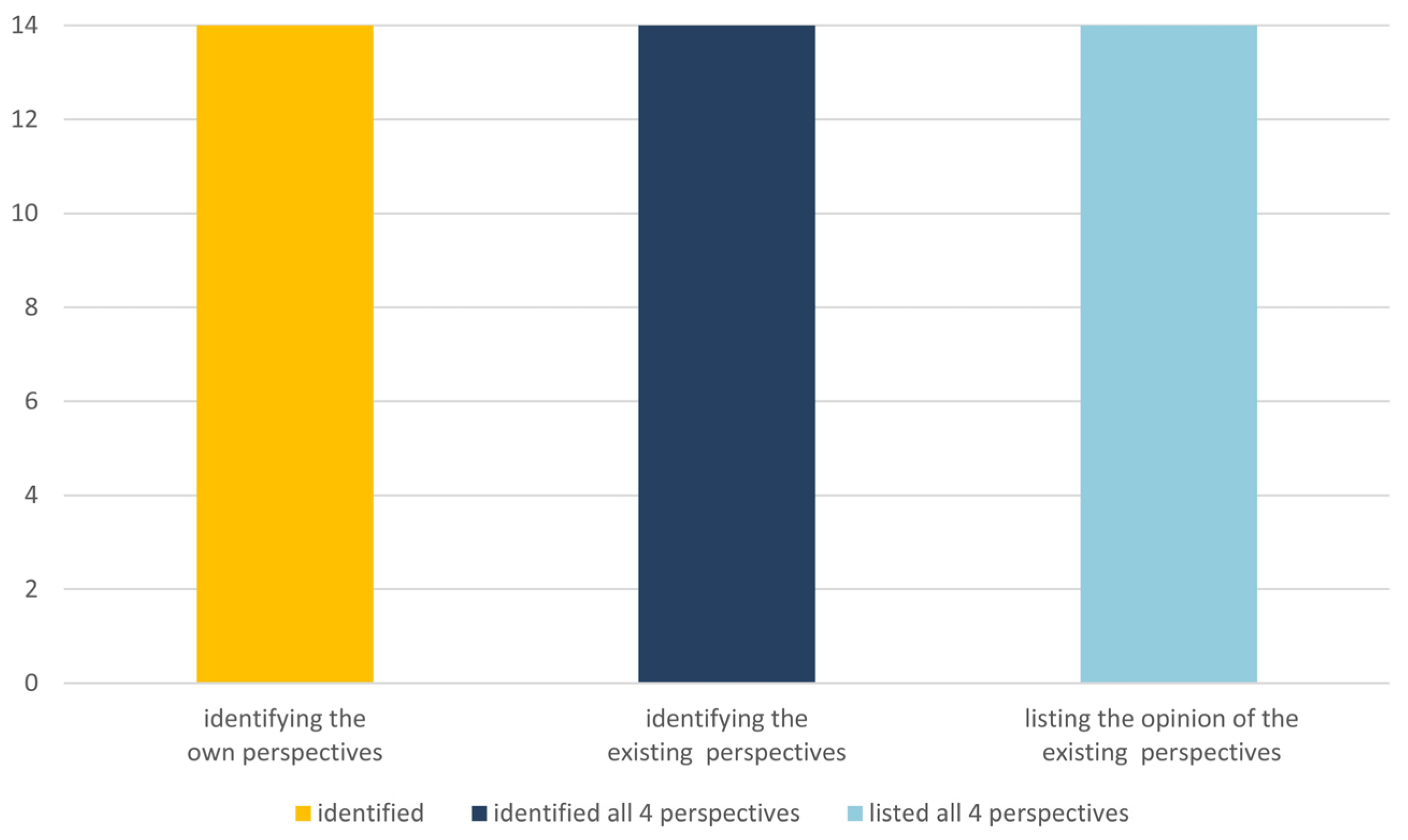
How do students demonstrate perspective-taking competency across different dimensions within the intervention setting, as captured by the operationalised competency model?
How do secondary students assess the tasks of the operationalised model?
To what extent do students evaluate their ability to cope with the applied tasks?
2. Theoretical Background
2.1. Competency Model of Perspective-Taking in Geography Education
2.2. Empirical Findings Regarding Fostering Perspective-Taking Competency
3. Methodology
How do students demonstrate perspective-taking competency across different dimensions within the intervention setting, as captured by the operationalised competency model?
How do secondary students assess the tasks of the operationalised model?
To what extent do students evaluate their ability to cope with the applied tasks?
3.1. Participants and Sampling Procedure
3.2. Research Design
3.3. Operationalisation of the Competency Model of Perspective-Taking in the Intervention
3.4. Data Analysis
3.5. Limitations of the Study
4. Results
4.1. Results of the Use of the Operationalised Competency Model in the Intervention
4.2. Students’ Assessments of the Tasks and Evaluations of Their Abilities to Cope with Them
5. Discussion
6. Conclusions
Supplementary Materials
Author Contributions
Funding
Institutional Review Board Statement
Informed Consent Statement
Data Availability Statement
Conflicts of Interest
References
- Applis, S., & Scarano, N. (2014). Globales lernen, praktische philosophie und moralpädagogik: Eine annäherung. Geographie Aktuell und Schule, 36(208), 3–7. [Google Scholar]
- Ataeian, A. (2013). Vom standpunkt des erkennens: Nietzsches philosophie des perspektivismus. LIT Verlag. [Google Scholar]
- Balteanu, D., & Dogaru, D. (2011). Geographical perspectives on human-environment relationships and anthropic pressure indicators. Romanian Journal of Geography, 55(2), 69–80. [Google Scholar]
- Batson, C., Sager, K., Garst, Kang, E., Rubchinsky, M., & Dawson, K. (1997). Is empathy-induced helping due to self-other merging? Journal of Personality and Social Psychology, 73, 495–509. [Google Scholar]
- Bähr, I., Bonnet, A., Bracker da Ponte, E., Gebhard, U., Krieger, C., Lübke, B., & Sting, W. (2024). Uncertainty in subject matter education—Constitutive element and fruitful instructional strategy? Zeitschrift für Bildungsforschung, 14, 375–395. [Google Scholar] [CrossRef]
- Bereiter, C., & Scardamalia, M. (1987). The psychology of written composition. Routledge. [Google Scholar]
- Bette, J., & Schubert, J. C. (2015). Einstellungen von schülerinnen und schülern zu raumkonzepten der geographie. Eine empirische studie zur erfassung der lernerperspektiven. Zeitschrift für Geographiedidaktik, 43(1), 29–58. [Google Scholar] [CrossRef]
- Birch, S. A. J., Li, V., Haddock, T., Ghrear, S. E., Brosseau-Liard, P., Baimel, A., & Whyte, M. (2017). Perspectives on perspective taking: How children think about the minds of others. Advances in Child Development and Behavior, 52, 185–226. [Google Scholar] [CrossRef]
- Bittermann, A., McNamara, D., Simonsmeier, B. A., & Schneider, M. (2023). The landscape of research on prior knowledge and learning: A bibliometric analysis. Educational Psychology Review, 35, 58. [Google Scholar] [CrossRef]
- Böing, M., & Sachs, U. (2009). Rollenexkursionen als geographische Bühne für mehrperspektivisches handeln im raum. In M. Dickel, & G. Glasze (Eds.), Vielperspektivität und teilnehmerzentrierung–richtungsweise der exkursionsdidaktik (pp. 15–38). Praxis Neue Kulturgeographie. [Google Scholar]
- Brockmüller, S., & Siegmund, A. (2020). Erfassung und entwicklung von systemkompetenz–empirische befunde zu kompetenzstruktur und förderbarkeit durch den einsatz analoger und digitaler modelle. Zeitschrift für Geographiedidaktik, 48(1), 31–49. [Google Scholar]
- Brod, G. (2021). Toward an understanding of when prior knowledge helps or hinders learning. npj Science of Learning, 6, 24. [Google Scholar] [CrossRef] [PubMed]
- Brown, A. (1987). Metacognition, executive control, self-regulation, and other more mysterious mechanisms. In F. E. Weinert, & R. H. Kluwe (Eds.), Metacognition, motivation, and understanding (pp. 65–116). Lawrence Erlbaum Associates. [Google Scholar]
- Buchanan, R. (1992). Wicked problems in design thinking. Design Issues, 8(2), 5–21. [Google Scholar] [CrossRef] [PubMed]
- Budke, A. (2021). Bedeutung des argumentativen schreibens im geographieunterricht im kontext aller schreibtätigkeiten—Eine empirische studie auf der grundlage von unterrichtsbeobachtungen. In A. Budke, & F. Schäbitz (Eds.), Argumentieren und vergleichen: Beiträge aus der perspektive verschiedener fachdidaktiken (S. 131–151). LIT Verlag. [Google Scholar]
- Budke, A., Creyaufmüller, A., Kuckuck, M., Meyer, M., Schäbitz, F., Schlüter, K., & Weiss, G. (2015). Argumentationsrezeptionskompetenzen im vergleich der fächer geographie, biologie und mathematik. In A. Budke, M. Kuckuck, M. Meyer, F. Schäbitz, K. Schlüter, & G. Weiss (Eds.), Fachlich argumentieren lernen: Didaktische forschungen zur argumentation in den unterrichtsfächern (S. 272–297). Waxmann. [Google Scholar]
- Cho, M., Kim, Y. G., & Olson, C. B. (2021). Does perspective taking matter for writing? Perspective taking in source-based analytical writing of secondary students. Reading and Writing, 34(8), 2081–2101. [Google Scholar] [CrossRef]
- Cigala, A., Mori, A., & Fangareggi, F. (2014). Learning others’ point of view: Perspective taking and prosocial behaviour in preschoolers. Early Child Development and Care, 185(8), 1199–1215. [Google Scholar] [CrossRef]
- Cotton, M. D. (2018). Environmental justice as scalar parity: Lessons from nuclear waste management. Social Justice Research, 31, 238–259. [Google Scholar] [CrossRef]
- Cox, M., Elen, J., & Steegen, A. (2019). The use of causal diagrams to foster systems thinking in geography education: Results of an intervention study. Journal of Geography, 118(6), 238–251. [Google Scholar] [CrossRef]
- DGfG. (2014). Educational standards in geography for the intermediate school certificate with sample assignments. Selbstverlag DGfG. [Google Scholar]
- DGfG. (2020). Bildungsstandards im fach geographie für den mittleren schulabschluss mit aufgabenbeispielen. Selbstverlag DGfG. [Google Scholar]
- Dochy, F., Segers, M., & Buehl, M. M. (1999). The relation between assessment practices and outcomes of studies: The case of research on prior knowledge. Review of Educational Research, 69(2), 145–186. [Google Scholar] [CrossRef]
- Doğru, M. S. (2022). Conceptual knowledge, experiences, and sources of information secondary school students have about owls. Science Education International, 33(1), 50–55. [Google Scholar] [CrossRef]
- Doğru, S., & Yüzbaşıoğlu, F. (2023). Examining students’ thoughts on climate change in the context of basic concept. Research on Education and Psychology, 7(2), 300–313. [Google Scholar] [CrossRef]
- Duncker, L. (2005). Professionalität des zeigens: Mehrperspektivität als prinzip der allgemeinen didaktik. In L. Duncker, W. Sander, & C. Surkamp (Eds.), Perspektivenvielfalt im unterricht (pp. 9–21). Kohlhammer. [Google Scholar]
- Eisenberg, N., Cumberland, A., Guthrie, I. K., Murphy, B. C., & Shepard, S. A. (2005). Age changes in prosocial responding and moral reasoning in adolescence and early adulthood. Journal of Research on Adolescence, 15(3), 235–260. [Google Scholar] [CrossRef] [PubMed]
- Enright, R. D., & Lapsley, D. K. (1980). Social role-taking: A review of the constructs, measures, and measurement properties. Review of Educational Research, 50(4), 647–674. [Google Scholar] [CrossRef]
- Ermann, U., & Redepenning, M. (2010). Gute räume–schlechte räume? Zum verhältnis von moral und raum in der geographie. Geographische Revue, 12(1), 5–20. [Google Scholar]
- Evagorou, M., Papanastasiou, E., & Vrikki, M. (2023). What do we really know about students’ written arguments? Evaluating written argumentation skills. European Journal of Science and Mathematics Education, 11(4), 615–634. [Google Scholar] [CrossRef] [PubMed]
- Flavell, J. H. (1979). Metacognition and cognitive monitoring: A new area of cognitive-developmental inquiry. American Psychologist, 34(10), 906–911. [Google Scholar] [CrossRef]
- Fleischer, J., Koeppen, K., Kenk, M., Klieme, D., & Leutner, D. (2013). Kompetenzmodellierung: Struktur, konzepte und forschungszugänge des DFG-schwerpunktprogramms. In D. Leutner, E. Klieme, J. Fleischer, & H. Kuper (Eds.), Kompetenzmodelle zur erfassung individueller lernergebnisse und zur bilanzierung von bildungsprozessen: Aktuelle diskurse im DFG-schwerpunktprogramm (18. Sonderheft der zeitschrift für erziehungswissenschaft) (pp. 5–22). VS. [Google Scholar]
- Galinsky, A. D., & Moskowitz, G. B. (2000). Perspective-taking: Decreasing stereotype expression, stereotype accessibility, and in-group favoritism. Journal of Personality and Social Psychology, 78(4), 708–724. [Google Scholar] [CrossRef] [PubMed]
- Gehlbach, H., Marietta, G., King, A. M., Karutz, C., Bailenson, J. N., & Dede, C. (2015). Many ways to walk a mile in another’s moccasins: Type of social perspective taking and its effect on negotiation outcomes. Computers in Human Behavior, 52, 523–532. [Google Scholar] [CrossRef]
- Grünkorn, J., & Krüger, D. (2012). Entwicklung und evaluierung von aufgaben im offenen antwortformat zur empirischen überprüfung eines kompetenzmodells zur modellkompetenz. In U. Harms, & F. X. Bogner (Eds.), Lehr- und lernforschung in der biologiedidaktik (pp. 9–27). Studienverlag. [Google Scholar]
- Gryl, I. (2010). Mündigkeit durch reflexion. Überlegungen zu einer multiperspektivischen kartenarbeit. GW-Unterricht, 118, 20–37. [Google Scholar]
- Hales, S. D. (2020). Nietzsche’s epistemic perspectivism. In A. M. Crețu, & M. Massimi (Eds.), Knowledge from a human point of view (pp. 19–35). Springer. [Google Scholar]
- Hart, D., & Matsuba, M. K. (2012). The development of self-knowledge. In S. Vazire, & T. D. Wilson (Eds.), Handbook of self-knowledge (pp. 7–21). Guilford Press. [Google Scholar]
- Häcker, T., & Rihm, T. (2005). Professionelles lehrer(innen)handeln. Plädoyer für eine situationsbezogene wende. In G. B. Carlsburg, & I. Musteikiené (Eds.), Bildungsreform als lebensreform (baltische studien zur erziehungs- und sozialwissenschaft) (pp. 359–380). Lang. [Google Scholar]
- Healey, M. L., & Grossman, M. (2018). Cognitive and affective perspective-taking: Evidence for shared and dissociable anatomical substrates. Frontiers in Neurology, 9, 491. [Google Scholar] [CrossRef]
- Heiser, J. C. (2013). Interkulturelles lernen: Eine pädagogische grundlegung. Königshausen & Neumann. [Google Scholar]
- Hofmann, S. G., Doan, S. N., Sprung, M., Wilson, A., Ebesutani, C., Andrews, L. A., Curtiss, J., & Harris, P. L. (2016). Training children’s theory of mind: A meta-analysis of controlled studies. Cognition, 150, 200–212. [Google Scholar] [CrossRef]
- Huijgen, T., van Boxtel, C., van de Grift, W., & Holthuis, P. (2014). Testing elementary and secondary school students’ ability to perform historical perspective taking: The construction of valid and reliable measurement instruments. European Journal of Psychology of Education, 29, 653–672. [Google Scholar] [CrossRef]
- Huijgen, T., van Boxtel, C., van de Grift, W., & Holthuis, P. (2017). Toward historical perspective taking: Students’ reasoning when contextualizing the actions of people in the past. Theory & Research in Social Education, 45(1), 110–144. [Google Scholar] [CrossRef]
- Jääskeläinen, I. P., & Kosonogov, V. (2023). Perspective taking in the human brain: Complementary evidence from neuroimaging studies with media-based naturalistic stimuli and artificial controlled paradigms. Frontiers in Human Neuroscience, 17, 1051934. [Google Scholar] [CrossRef]
- Jordan, A., Ross, N., Kraus, S., Baumert, J., Blum, W., Neubrand, M., Löwen, K., Brunner, M., & Kunter, M. (2006). Klassifikationsschema für mathematikaufgaben: Dokumentation der aufgabenkategorisierung im COACTIV-projekt. Max-Planck-Institut für Bildungsforschung. [Google Scholar]
- Klieme, E., Maag Merki, K., & Hartig, J. (2007). Kompetenzbegriff und Bedeutung von Kompetenzen im Bildungswesen. In J. Hartig, & E. Klieme (Eds.), Möglichkeiten und voraussetzungen technologiebasierter kompetenzdiagnostik: Eine expertise im auftrag des bundesministeriums für bildung und forschung (pp. 5–15). BMBF. [Google Scholar]
- Kuckartz, U. (2018). Qualitative inhaltsanalyse: Methoden, praxis, computerunterstützung (4th ed.). Beltz Juventa. [Google Scholar]
- Kuckuck, M. (2015). Die rezeptionsfähigkeit von schülerinnen und schülern bei der bewertung von argumentationen im geographieunterricht am beispiel von raumbezogenen konflikten. Zeitschrift für Geographiedidaktik, 43(4), 263–284. [Google Scholar]
- Landis, J. R., & Koch, G. G. (1977). The measurement of observer agreement for categorical data. Biometrics, 33, 159–174. [Google Scholar] [CrossRef]
- Larsen, T. B., & Harrington, J. (2020). Enhancing powerful geography with human-environment geography. Research in Geographic Education, 22(1), 43–62. [Google Scholar]
- Lee, J., & Bednarz, R. (2012). Components of spatial thinking: Evidence from a spatial thinking ability test. Journal of Geography, 111(1), 15–26. [Google Scholar] [CrossRef]
- Mayer, J., & Wellnitz, N. (2014). Die entwicklung von kompetenzstrukturmodellen. In D. Krüger, I. Parchmann, & H. Schecker (Eds.), Methoden in der naturwissenschaftsdidaktischen forschung (pp. 19–29). Springer. [Google Scholar]
- Mayring, P. (2015). Qualitative inhaltsanalyse: Grundlagen und techniken. Beltz. [Google Scholar]
- McCutchen, D., Francis, M., & Kerr, S. (1997). Revising for meaning: Effects of knowledge and strategy. Journal of Educational Psychology, 89(4), 667–676. [Google Scholar] [CrossRef]
- McGarry, K. A., West, M., & Hogan, K. F. (2021). Perspective-taking and social competency in adults. Advances in Cognitive Psychology, 17(2), 129–135. [Google Scholar] [CrossRef] [PubMed]
- Mehren, M., Mehren, R., Ohl, U., & Resenberger, C. (2015). Die doppelte komplexität geographischer themen: Eine herausforderung für schüler und lehrer. Geographie Aktuell und Schule, H. 216/37, 4–11. [Google Scholar]
- Mehren, R., Rempfler, A., Ulrich-Riedhammer, E. M., Buchholz, J., & Hartig, J. (2015). Validierung eines kompetenzmodells zur geographischen systemkompetenz. In I. Gryl, A. Schlottmann, & D. Kanwischer (Eds.), Mensch: Umwelt: System–Theoretische grundlagen und praktische beispiele für den geographieunterricht (pp. 61–81). Waxmann. [Google Scholar]
- Miri, B., David, B.-C., & Uri, Z. (2007). Purposely teaching for the promotion of higher-order thinking skills: A case of critical thinking. Research in Science Education, 37, 353–369. [Google Scholar] [CrossRef]
- Mori, A., & Cigala, A. (2016). Perspective taking: Training procedures in developmentally typical preschoolers. Different intervention methods and their effectiveness. Educational Psychology Review, 28, 267–294. [Google Scholar] [CrossRef]
- Oyserman, D., Elmore, K., & Smith, G. (2012). Self, self-concept, and identity. In M. R. Leary, & J. P. Tangney (Eds.), Handbook of self and identity (pp. 69–104). Guilford Press. [Google Scholar]
- Reinhardt, S. (2004). Demokratie-kompetenzen. In W. Edelstein, & P. Fauser (Eds.), Beiträge zur demokratiepädagogik. Eine schriftenreihe des BLK-programms “demokratie lernen & leben” (pp. 1–27). DIPF. Available online: https://www.pedocs.de/volltexte/2008/163/pdf/Reinhardt.pdf (accessed on 15 March 2026).
- Reuber, P. (2000). Die politische geographie als handlungsorientierte und konstruktivistische teildisziplin–angloamerikanische theoriekonzepte und aktuelle forschungsfelder. Geographische Zeitschrift, 88(1), 36–52. [Google Scholar]
- Reuber, P. (2001). Möglichkeiten und grenzen einer handlungsorientierten politischen geographie. In P. Reuber, & G. Wolkersdorfer (Eds.), Politische geographie. Handlungsorientierte ansätze und critical geopolitics (pp. 77–92). Selbstverlag des Geographischen Instituts der Universität Heidelberg. [Google Scholar]
- Reuschenbach, M. (2007). Bergwald ist schutzwald! Die bedeutung des bergwaldes auf postern und in einem rollenspiel verdeutlichen. Geographie Heute, 251, 8–16. [Google Scholar]
- Rhode-Jüchtern, T. (1996). Welt erkennen durch perspektivenwechsel. Praxis Geographie, 4, 4–9. [Google Scholar]
- Rittel, H. W. J., & Webber, M. M. (1973). Dilemmas in a general theory of planning. Policy Sciences, 4, 155–169. [Google Scholar] [CrossRef]
- Rizkalla, L., Wertheim, E. H., & Hodgson, L. K. (2008). The roles of emotion management and perspective taking in individuals’ conflict management styles and disposition to forgive. Journal of Research in Personality, 42(6), 1594–1601. [Google Scholar] [CrossRef]
- Schraw, G., & Moshman, D. (1995). Metacognitive theories. Educational Psychology Review, 7(4), 351–371. [Google Scholar] [CrossRef]
- Schrüfer, G., Obermaier, G., & Schwarze, S. (2016). Raumwahrnehmung aus unterschiedlichen perspektiven am beispiel tansania–empirische untersuchungen und konsequenzen für den geographieunterricht. GW-Unterricht, 142/143(2–3), 91–101. [Google Scholar] [CrossRef]
- Schuler, S., Vankan, L., & Rohwer, G. (2017). Denken lernen mit geographie. Methoden 1. Westermann. [Google Scholar]
- Simon, M., & Budke, A. (2020). How geography textbook tasks promote comparison competency—An international analysis. Sustainability, 12(20), 8344. [Google Scholar] [CrossRef]
- Skorinko, J. L., & Sinclair, S. A. (2013). Perspective taking can increase stereotyping: The role of apparent stereotype confirmation. Journal of Experimental Social Psychology, 49, 10–18. [Google Scholar] [CrossRef]
- Smith, D. (2001). Geography and ethics: Progress, or more of the same? Progress in Human Geography, 25(2), 261–268. [Google Scholar] [CrossRef]
- Thierer, A. (2008). Fremdverstehen im geographieunterricht–theoretische überlegungen und unterrichtspraktische folgerungen. In A. Budke (Ed.), Interkulturelles lernen im geographieunterricht (pp. 137–149). Universitätsverlag Potsdam. [Google Scholar]
- Underwood, B., & Moore, B. (1982). Perspective-taking and altruism. Psychological Bulletin, 91, 143–173. [Google Scholar] [CrossRef]
- Vasiljuk, D., & Budke, A. (2021). Multiperspectivity as a process of understanding and reflection: Introduction to a model for perspective-taking in geography education. European Journal of Investigation in Health, Psychology and Education, 11(2), 529–545. [Google Scholar] [CrossRef]
- Vasiljuk, D., & Budke, A. (2024). Förderung der kompetenz zum perspektivenwechsel mittels aufgabenstellungen im unterricht für geographie und wirtschaftliche bildung. GW-Unterricht, 175, 43–57. [Google Scholar] [CrossRef]
- Vygotsky, L. S. (1978). Interaction between learning and development. In L. S. Vygotsky, & M. Cole (Eds.), Mind in society: The development of higher psychological processes (pp. 79–91). Harvard University Press. [Google Scholar]
- Walker, L. J. (1980). Cognitive and perspective-taking prerequisites for moral development. Child Development, 51(1), 131–139. [Google Scholar] [CrossRef]
- Weißeno, G., Detjen, J., Juchler, I., Massing, P., & Richter, D. (2010). Konzepte der politik–ein kompetenzmodell. Wochenschau Verlag. [Google Scholar]
- West, L. H. T., & Fensham, P. J. (1974). Prior knowledge and the learning of science: A review of Ausubel’s theory of this process. Studies in Science Education, 1(1), 61–81. [Google Scholar] [CrossRef]





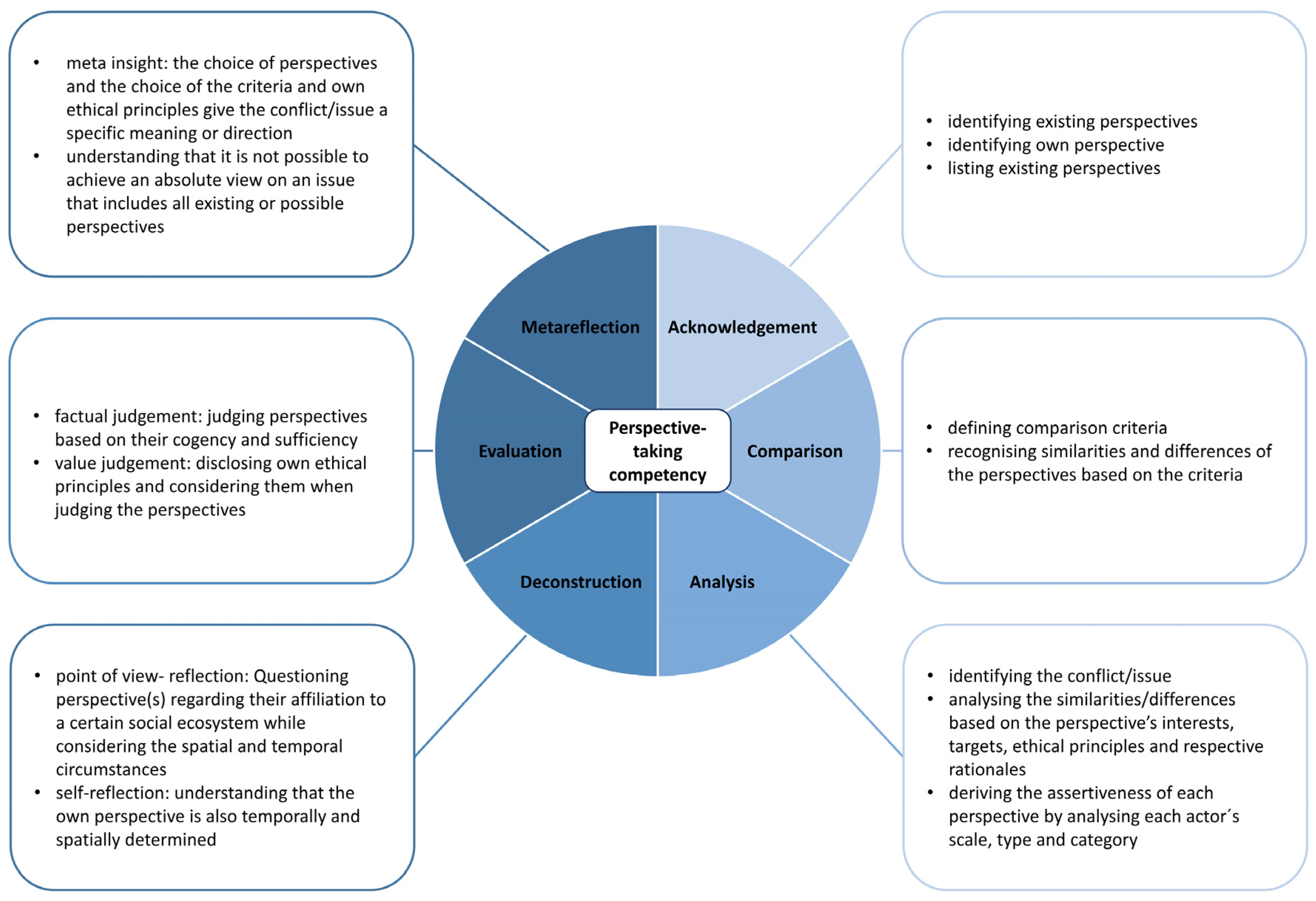
| Dimension in the Competency Model | Definition of the Dimension |
|---|---|
| Acknowledgement | Perspective-taking requires the competency to acknowledge perspectives. This means to identify existing perspectives, to identify one’s own perspective and to list these perspectives. |
| Comparison | Perspective-taking requires the competency to compare perspectives. Criteria for comparison should be defined so that similarities and differences can be identified. |
| Analysis | Perspective-taking requires the competency to analyse different perspectives to understand a conflict or issue. Therefore, the conflict or issue should be identified. Moreover, perspectives should be analysed based on the perspective’s interests, targets, ethical principles, rationales and assertiveness (by analysing each actor’s scale, type and category). |
| Deconstruction | Perspective-taking requires the competency to question the perspective(s) involved, as well as one’s own perspective. Thus, perspectives should be deconstructed, considering the spatial and temporal circumstances and their affiliations with a social ecosystem. |
| Evaluation | Perspective-taking requires the competency to evaluate a conflict/issue. Arguments should be considered on both a factual and a value basis. In factual judgement, arguments are judged based on their cogency and sufficiency, and, in value judgement, arguments are judged based on one’s own ethical principles. |
| Meta-reflection | Perspective-taking requires the competency to consider an issue/conflict and its perspectives through meta-sight. Therefore, to achieve meta-reflection, the choice of perspectives, the choice of the criteria and one’s own ethical principles should be reflected on. Meta-reflection also helps to understand that it is not possible to arrive at an absolute view of an issue that includes all existing or possible perspectives. |
| Dimension in the Competency Model | Criteria in the Competency Model | Derived Task for the Students’ Material |
|---|---|---|
| Required in all dimensions: overall question | Reproducing the overall question | Name the overall question. |
| Acknowledgement | Identifying own perspective | Describe your own opinion in relation to the overall question. |
| Comparison | Defining comparison criteria | Define your comparison criteria. |
| Analysis | Identifying the conflict/issue | Explain in a few sentences what the conflict is. |
| Deconstruction: point of view reflection | Questioning perspective(s) regarding their affiliation with a certain social ecosystem while considering the spatial and temporal circumstances | Explain in what way the actors are directly affected by the conflict. |
| Evaluation: value judgement | Disclosing own ethical principles and considering them when judging the perspectives | Assess the conflict regarding the overall question. |
| Meta-reflection | Meta-insight: the choice of perspectives and criteria and one’s own ethical principles give the conflict/issue a specific meaning or direction | Be critical and reflective: Based on the material, to what extent can the overall question be fully or completely answered? |
| Subcategory | Definition of the Subcategory | Coding Rules | Considering 0 Perspectives | Considering 1 Perspective | Considering Several Perspectives | Considering All Perspectives | Example of Student Response (Considering All Perspectives) |
|---|---|---|---|---|---|---|---|
| Listing existing perspectives | The existing perspectives are named. | Students correctly name the existing perspectives. Explicit: The perspectives are named explicitly. Implicit: The perspectives are indirectly named. | No perspectives are mentioned. | One perspective among the existing perspectives is named correctly. | More than 1 perspective and less than all of the existing perspectives are named correctly. | All existing perspectives are named correctly. | “I choose the organisation NRW Fluthilfe […] First I excluded the organisation One World […] then I excluded the organisation Helfende Hand […]” (EG-2, pre-test, example for explicit, own translation) |
| Points | 0 | 1 | 2 | 3 | |||
| Subcategory | Definition of the Subcategory | Coding Rules | Considering the Conflict | Considering the Conflict | Examples of Student Response (Considering the Conflict) |
|---|---|---|---|---|---|
| Identifying the conflict/issue | The conflict is described/identified. | Students correctly describe what the conflict is about or identify the conflict. Explicit: The conflict is explicitly described/identified. Implicit: The conflict is indirectly described/identified. | The conflict is not described/ identified. | The conflict is described/ identified. | “The conflict is over whether or not the ascent of Mount Everest should be banned.” (EG-4, intervention, explicit). |
| Points | 0 | 1 | |||
| Dimension in the Competency Model | Points per Dimension |
|---|---|
| Acknowledgement | 8 |
| Comparison | 6 |
| Analysis | 13 |
| Deconstruction | 12 |
| Evaluation | 9 |
| Meta-reflection | 8 |
| Total | 56 (maximum number of points) |
| Group | Part of the Intervention Study | Mean |
|---|---|---|
| EG | Pre-test | 0.28 |
| EG | Post-test | 0.27 |
| EG | Intervention | 0.68 |
| CG | Pre-test | 0.29 |
| CG | Post-test | 0.27 |
| Item | Mean | Standard Deviation |
|---|---|---|
| Acknowledgement: The tasks are understandable. | 1.77 | 0.599 |
| Acknowledgement: It was easy for me to complete the task. | 1.92 | 0.641 |
| Comparison: The tasks are understandable. | 1.92 | 0.494 |
| Comparison: It was easy for me to complete the task. | 1.85 | 0.376 |
| Analysis: The tasks are understandable. | 2.00 | 0.577 |
| Analysis: It was easy for me to complete the task. | 2.00 | 0.577 |
| Deconstruction: The tasks are understandable. | 2.00 | 0.816 |
| Deconstruction: It was easy for me to complete the task. | 2.31 | 0.751 |
| Evaluation: The tasks are understandable. | 2.15 | 0.899 |
| Evaluation: It was easy for me to complete the task. | 2.46 | 0.776 |
| Meta-reflection: The tasks are understandable. | 2.15 | 0.987 |
| Meta-reflection: It was easy for me to complete the task. | 2.15 | 1.068 |
Disclaimer/Publisher’s Note: The statements, opinions and data contained in all publications are solely those of the individual author(s) and contributor(s) and not of MDPI and/or the editor(s). MDPI and/or the editor(s) disclaim responsibility for any injury to people or property resulting from any ideas, methods, instructions or products referred to in the content. |
© 2026 by the authors. Licensee MDPI, Basel, Switzerland. This article is an open access article distributed under the terms and conditions of the Creative Commons Attribution (CC BY) license.
Share and Cite
Vasiljuk, D.; Budke, A. Supporting Students’ Perspective-Taking Through an Operationalised Competency Model: Insights from an Intervention in Geography Education. Educ. Sci. 2026, 16, 936. https://doi.org/10.3390/educsci16060936
Vasiljuk D, Budke A. Supporting Students’ Perspective-Taking Through an Operationalised Competency Model: Insights from an Intervention in Geography Education. Education Sciences. 2026; 16(6):936. https://doi.org/10.3390/educsci16060936
Chicago/Turabian StyleVasiljuk, Dina, and Alexandra Budke. 2026. "Supporting Students’ Perspective-Taking Through an Operationalised Competency Model: Insights from an Intervention in Geography Education" Education Sciences 16, no. 6: 936. https://doi.org/10.3390/educsci16060936
APA StyleVasiljuk, D., & Budke, A. (2026). Supporting Students’ Perspective-Taking Through an Operationalised Competency Model: Insights from an Intervention in Geography Education. Education Sciences, 16(6), 936. https://doi.org/10.3390/educsci16060936