Empirical Restructuring of Planning Education Under Spatial Data Science Intervention

Abstract
1. Introduction
- (RQ1) To what extent does a curriculum restructuring driven by spatial data science alter the learning trajectories and competency profiles of urban planning students?
- (RQ2) What is the empirical efficacy of introducing PBL mechanisms in enhancing graduates’ core employability within data-intensive professional sectors?
2. Theoretical Background and Literature Review
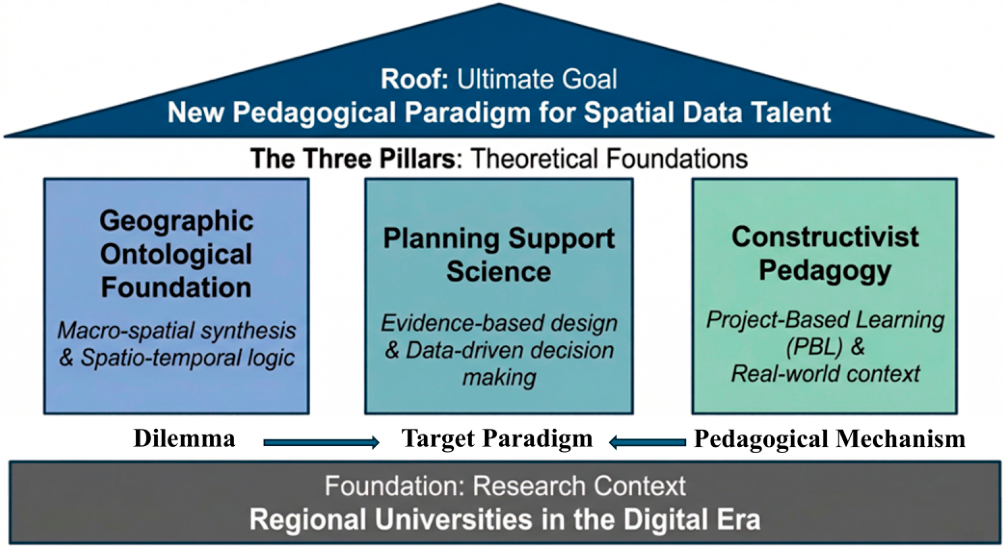
2.1. Theoretical Framework
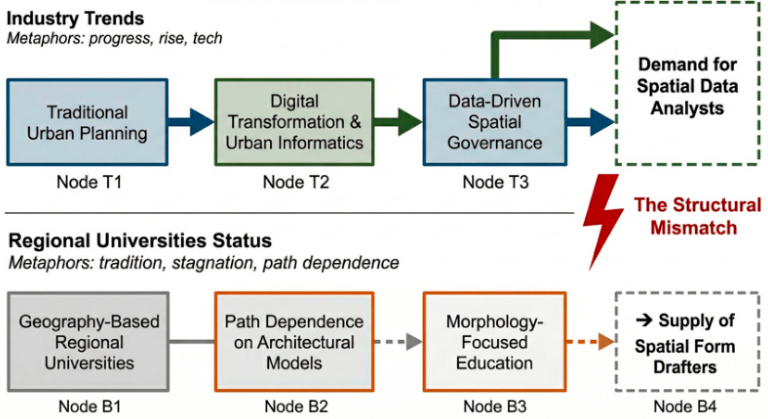
2.2. Path Dependence and Isomorphic Dilemmas in Traditional Planning Education
2.3. The Paradigm Shift Towards Planning Support Science
2.4. Constructivism and PBL in Addressing Wicked Problems
3. Materials and Methods
3.1. Research Context and Participants
3.2. Pedagogical Intervention: Curriculum Redesign and Cyberinfrastructure
3.3. Instructional Operationalization: PBL and Collaborative Mechanisms
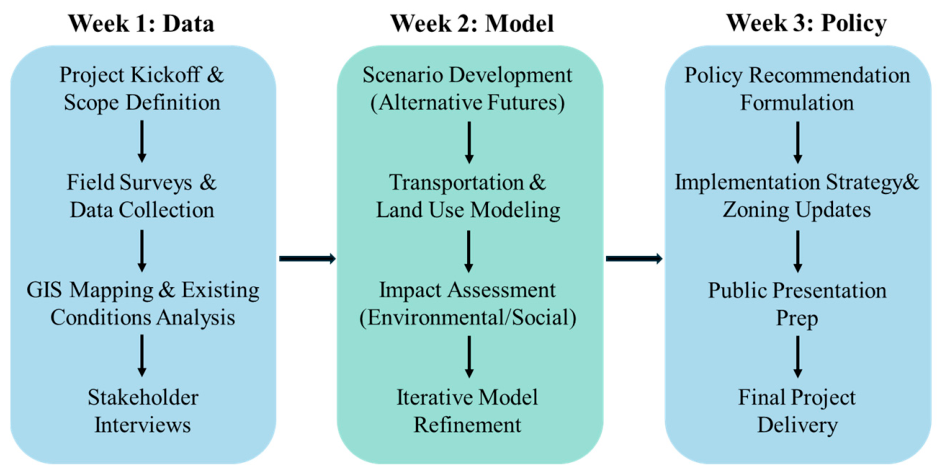
3.4. A Concrete Pedagogical Case Study: The Urban Renewal Studio
3.5. Data Collection Framework and Assessment Models
- (1)
- Data Acquisition and Structuring Capability (30%): Assesses the subject’s completeness in independently executing multi-source data crawling, cleaning, and spatial database construction tailored to specific complex planning issues.
- (2)
- Algorithmic Logic and Spatial Robustness (40%): Evaluates the goodness-of-fit of the selected spatial statistical models (e.g., Spatial Autocorrelation, Geographically Weighted Regression [GWR]) to professional demands, as well as the robustness and mathematical rigor of the model inference.
- (3)
- Decision Efficacy and Policy Translation (30%): Examines the logical coherence in translating quantitative analytical conclusions into practically feasible spatial intervention guidelines or public policies.
4. Results
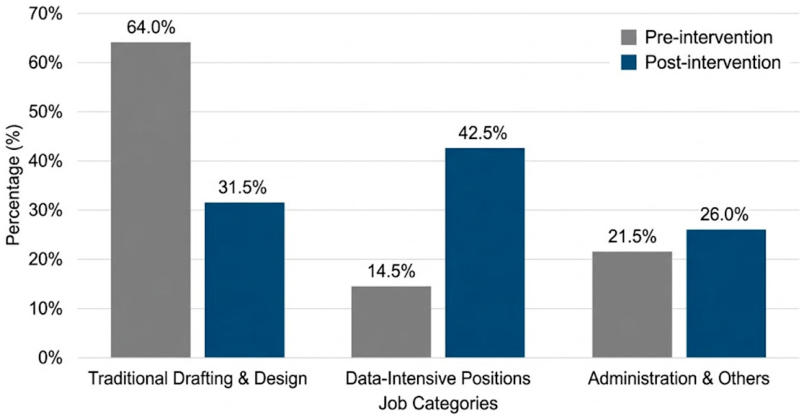
4.1. Macro Dimension: Structural Shifts in Employment Trajectories
4.2. Meso Dimension: Externalization of Practical Engineering Competence
4.3. Micro Dimension: Cognitive Restructuring of Learning Outcomes
4.4. Micro Dimension: Enhancement of Self-Efficacy in Complex Engineering Tasks
5. Discussion
5.1. Mechanisms for Overcoming Resource Constraints and Epistemological Barriers
5.2. Broader Implications for Regional Universities
5.3. Limitations and Future Work
6. Conclusions
Author Contributions
Funding
Institutional Review Board Statement
Informed Consent Statement
Data Availability Statement
Conflicts of Interest
Appendix A
Detailed Demographic Characteristics of the Subject Sample

| Characteristic | Total Tracking Sample (N = 275) | Survey Sub-Sample (N = 147, Class of 2021) |
|---|---|---|
| Gender | ||
| Male | 132 (48.0%) | 71 (48.3%) |
| Female | 143 (52.0%) | 76 (51.7%) |
| High School Academic Background | ||
| Science/STEM Track | 185 (67.3%) | 98 (66.7%) |
| Arts/Humanities Track | 90 (32.7%) | 49 (33.3%) |
| Prior Programming Experience (Pre-intervention) | ||
| None | 242 (88.0%) | 129 (87.8%) |
| Basic (e.g., introductory courses) | 33 (12.0%) | 18 (12.2%) |
Appendix B
Appendix B.1. Detailed Demographic Characteristics of the Subject Sample
Appendix B.2. Exemplars of Real-World PBL Projects
Appendix C
Self-Efficacy Questionnaire Instrument
- I am confident in identifying the correct types of open-source data (e.g., POI, NTL, LBS) required for a specific planning issue.
- I am confident in writing Python scripts to crawl or batch-download spatial data.
- I am confident in cleaning messy, unstructured data and resolving coordinate system conflicts.
- 4.
- I am confident in selecting the most appropriate spatial statistical model (e.g., GWR, Spatial Autocorrelation) for a given analytical goal.
- 5.
- I am confident in debugging errors when running spatial analysis algorithms.
- 6.
- I am confident in interpreting the mathematical robustness and statistical significance of my spatial models.
- 7.
- I am confident in effectively communicating my algorithmic logic to team members who lack programming backgrounds.
- 8.
- I am confident in translating quantitative analytical results into actionable urban planning policies.
- 9.
- I am confident in defending the scientific validity of my data-driven design against traditional morphological critiques.
- 10.
- I feel confident when given a project brief that lacks specific constraints or predefined methodologies.
- 11.
- I am confident in my ability to continuously iterate my analytical framework when initial data outcomes contradict my hypotheses.
Appendix D
Extended Statistical Results (Effect Sizes)
| Cognitive Dimension | Traditional Cohort (M ± SD) | Reform Cohort (M ± SD) | t-Value | df | p-Value | Cohen’s d |
|---|---|---|---|---|---|---|
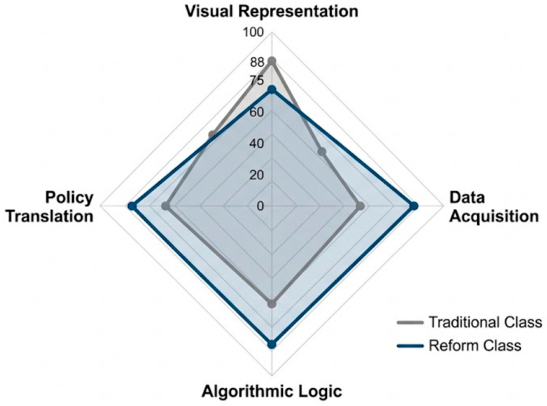
| Visual Aesthetics and Representation | 88.0 ± 5.2 | 75.0 ± 6.8 | −17.82 | 273 | <0.001 | −2.15 |
| Algorithmic Logic and Spatial Robustness | 62.0 ± 8.4 | 85.5 ± 4.8 | 15.62 | 273 | <0.001 | 3.42 |
| Decision Efficacy and Policy Translation | 65.0 ± 7.5 | 82.0 ± 6.1 | 12.45 | 273 | <0.001 | 2.48 |
| Self-Efficacy Dimension | Pre-Test (M ± SD) | Post-Test (M ± SD) | t-Value | df | p-Value | Cohen’s d |
|---|---|---|---|---|---|---|
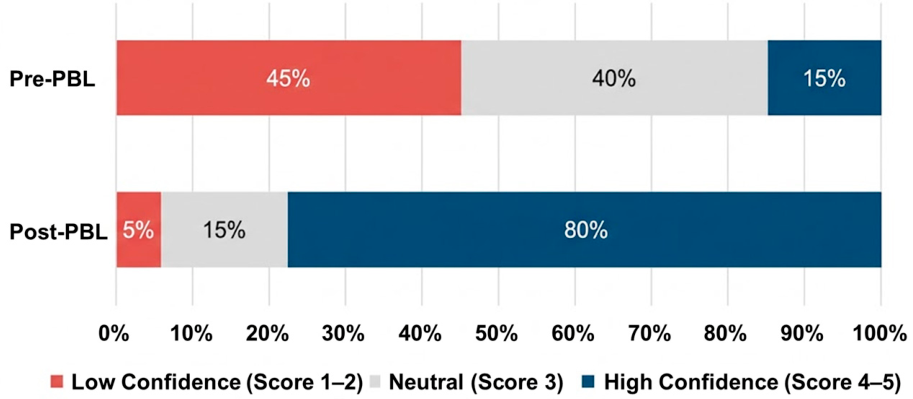
| Overall Comprehensive Score | 2.85 ± 0.72 | 4.35 ± 0.55 | 24.38 | 146 | <0.001 | 2.34 |
| Multi-Source Data Cleaning | 2.30 ± 0.85 | 4.10 ± 0.60 | 25.12 | 146 | <0.001 | 2.45 |
| Cross-Disciplinary Collaboration | 2.65 ± 0.80 | 4.45 ± 0.50 | 28.55 | 146 | <0.001 | 2.68 |
Appendix E
The “Data–Model–Policy” Three-Dimensional Evaluation Rubric
| Dimension (Weight) | Excellent (90–100 pts) | Competent (75–89 pts) | Needs Improvement (<75 pts) |
|---|---|---|---|
| Data Acquisition & Structuring (30%) | Autonomously crawls, cleans, and structures complex, multi-source data. Resolves all spatial projection and topological errors. | Uses provided or easily accessible data. Basic cleaning is completed with minor topological inaccuracies. | Relies solely on secondary reports. Fails to structure data spatially or resolve basic data conflicts. |
| Algorithmic Logic & Spatial Robustness (40%) | Selects highly appropriate models (e.g., GWR, Network Analysis). Demonstrates clear mathematical understanding and conducts sensitivity analysis. | Applies standard models (e.g., basic spatial overlay) correctly, but lacks deeper validation or sensitivity checks. | Misapplies spatial algorithms. Ignores statistical significance or correlation assumptions. |
| Decision Efficacy & Policy Translation (30%) | Seamlessly translates quantitative findings into highly feasible, localized spatial interventions. Policy proposals are directly backed by data evidence. | Proposes logical spatial interventions, but the linkage between the data output and the final policy is somewhat generic. | Proposed designs or policies are disconnected from the data analysis, reverting to subjective, experience-based design. |
References
- Allam, Z., & Dhunny, Z. A. (2019). On big data, artificial intelligence and smart cities. Cities, 89, 80–91. [Google Scholar] [CrossRef]
- Anacker, K. B. (2024). The evolution of the four eras of urban planning education in the United States. Journal of Planning Education and Research, 44(4), 2294–2304. [Google Scholar] [CrossRef]
- Atman Uslu, N., Yildiz Durak, H., & Ay, G. M. (2022). Comparing reflective and supportive scaffolding in 3D computer-aided design course: Engineering students’ metacognitive strategies, spatial ability self-efficacy, and spatial anxiety. Computer Applications in Engineering Education, 30, 1454–1469. [Google Scholar] [CrossRef]
- Boeing, G. (2020). The right tools for the job: The case for spatial science tool-building. Transactions in GIS, 24(5), 1299–1314. [Google Scholar] [CrossRef]
- Boeing, G., Batty, M., Jiang, S., & Schweitzer, L. (2021). Urban analytics: History, trajectory, and critique. Social Science Electronic Publishing. [Google Scholar]
- Cai, Y. J., & Johannes, M. (2015). The use of institutional theory in higher education research. In Theory and method in higher education research III (pp. 1–25). Emerald. [Google Scholar]
- Cai, Y. Z. (2025). Evolving from rules to learning in urban modeling and planning support systems. Urban Science, 9(12), 508. [Google Scholar] [CrossRef]
- Chen, J., Kolmos, A., & Du, X. (2020). Forms of implementation and challenges of PBL in engineering education: A review of literature. European Journal of Engineering Education, 46(1), 90–115. [Google Scholar] [CrossRef]
- Cheng, P., Fan, Y., Tang, H., Liu, K., Wu, S., Zhu, G., Jiang, P., & Guo, W. (2024). Research review on land development rights and its implications for China’s national territory spatial planning. Heliyon, 10(15), e35227. [Google Scholar] [CrossRef] [PubMed]
- Dalton, L. C. (2001). Weaving the fabric of planning as education. Journal of Planning Education & Research, 20(4), 423–436. [Google Scholar]
- DiMaggio, P. J., & Powell, W. W. (1983). The iron cage revisited: Institutional isomorphism and collective rationality in organizational fields. American Sociological Review, 48(2), 147–160. [Google Scholar] [CrossRef]
- Drummond, W. J., & French, S. P. (2008). The future of GIS in planning: Converging technologies and diverging interests. Journal of the American Planning Association, 74(2), 161–174. [Google Scholar] [CrossRef]
- Duffy, T. M. (Ed.). (1992). Constructivism and the technology of instruction: A conversation. Lawrence Erlbaum Associates. [Google Scholar]
- Fan, J., & Li, P. (2009). The scientific foundation of major function oriented zoning in China. Journal of Geographical Sciences, 19(5), 515–531. [Google Scholar] [CrossRef]
- Frank, A. I. (2006). Three decades of thought on planning education. Journal of Planning Literature, 21(1), 15–67. [Google Scholar] [CrossRef]
- Friedmann, J. (1996). The core curriculum in planning revisited. Journal of Planning Education and Research, 15(2), 89–104. [Google Scholar] [CrossRef]
- Garousi, V., Pfahl, D., Fernandes, J. M., Felderer, M., Mäntylä, M. V., Shepherd, D., Arcuri, A., Coşkunçay, A., & Tekinerdogan, B. (2019). Characterizing industry-academia collaborations in software engineering: Evidence from 101 projects. Empirical Software Engineering, 24(4), 2540–2602. [Google Scholar] [CrossRef]
- Ge, D., & Lu, Y. (2021). A strategy of the rural governance for territorial spatial planning in China. Journal of Geographical Sciences, 31(9), 1349–1364. [Google Scholar] [CrossRef]
- Geertman, S., Allan, A., Pettit, C., & Stillwell, J. (2017). Introduction to ‘Planning support science for smarter urban futures’. In International conference on computers in urban planning & urban management. Springer. [Google Scholar]
- Geertman, S., & Stillwell, J. (2020). Planning support science: Developments and challenges. Environment and Planning B: Urban Analytics and City Science, 47(8), 1326–1342. [Google Scholar] [CrossRef]
- Geertman, S., & Witte, P. (2024). From PSScience to digital planning: Steps towards an integrated research and practice agenda for digital planning. Computers, Environment and Urban Systems, 114, 102183. [Google Scholar] [CrossRef]
- Göçmen, Z. A., & Ventura, S. J. (2010). Barriers to GIS use in planning. Journal of the American Planning Association, 76(2), 172–183. [Google Scholar] [CrossRef]
- Hadiyana, T., & Ji-Hoon, S. (2024). Ai-driven urban planning: Enhancing efficiency and sustainability in smart cities. ITEJ (Information Technology Engineering Journals), 9(1), 23–35. [Google Scholar] [CrossRef]
- Innes, J. E., & Booher, D. E. (2010). Planning with complexity: An introduction to collaborative rationality for public policy. Planning Theory and Practice, 11(4), 623–626. [Google Scholar]
- Jonassen, D. H. (1991). Objectivism versus constructivism: Do we need a new philosophical paradigm? Educational Technology Research & Development, 39(3), 5–14. [Google Scholar]
- Kandt, J., & Batty, M. (2021). Smart cities, big data and urban policy: Towards urban analytics for the long run. Cities, 109, 102992. [Google Scholar] [CrossRef]
- Karvonen, A., Cook, M., & Haarstad, H. (2020). Urban planning and the smart city: Projects, practices and politics. Urban Planning, 5(1), 65–68. [Google Scholar] [CrossRef]
- Kokotsaki, D., Menzies, V., & Wiggins, A. (2016). Project-based learning: A review of the literature. Improving Schools, 19, 267–277. [Google Scholar] [CrossRef]
- Kong, L., Liu, Z., & Wu, J. (2020). A systematic review of big data-based urban sustainability research: State-of-the-science and future directions. Journal of Cleaner Production, 273, 123142. [Google Scholar] [CrossRef]
- Lai, Y., & Lavi, R. (2025). Problem structuring in urban science education: Why, what, and how. Frontiers of Urban and Rural Planning, 3(1), 13. [Google Scholar] [CrossRef]
- Liu, C., Huang, Y., Liu, Z., & Wu, Z. (2025). Progress of urban informatics in urban planning research, education, and practice. Urban Informatics, 4(1), 6. [Google Scholar] [CrossRef]
- Liu, Y., & Zhou, Y. (2021). Territory spatial planning and national governance system in China. Land Use Policy, 102, 105288. [Google Scholar] [CrossRef]
- Malczewski, J. (2004). GIS-based land-use suitability analysis: A critical overview. Progress in Planning, 62(1), 3–65. [Google Scholar] [CrossRef]
- Miucin, S., & Fedorova, A. (2018). Data-driven spatial locality. In Proceedings of the international symposium on memory systems (pp. 243–253). ACM. [Google Scholar]
- Mohammed, W. (2021). Teaching geographic information systems within the landscape architecture and planning curriculum. Academia Letters, 789. [Google Scholar] [CrossRef]
- Olesen, K. (2018). Teaching planning theory as planner roles in urban planning education. Higher Education Pedagogies, 3(1), 23–39. [Google Scholar] [CrossRef]
- Prince, M. J., & Felder, R. M. (2006). Inductive teaching and learning methods: Definitions, comparisons, and research bases. Journal of Engineering Education, 95(2), 123–138. [Google Scholar] [CrossRef]
- Rittel, H. W., & Webber, M. M. (1973). Dilemmas in a general theory of planning. Policy Sciences, 4(2), 155–169. [Google Scholar] [CrossRef]
- Robert, G. (2015). Smart cities: Moving beyond urban cybernetics to tackle wicked problems. Cambridge Journal of Regions, Economy & Society, 8(1), 79–92. [Google Scholar]
- Shah, S., Modi, P., & Shah, H. (2019). Big data analysis in urban planning. International Journal of Engineering Research and Technology, 8(10), 355–359. [Google Scholar]
- Singleton, A., & Arribas-Bel, D. (2021). Geographic data science. Geographical Analysis, 53(1), 61–75. [Google Scholar] [CrossRef]
- Stuart, D. (2015). The data revolution: Big data, open data, data infrastructures and their consequences. Online Information Review, 39(2), 272. [Google Scholar] [CrossRef]
- Termeer, C., Dewulf, A., & Biesbroek, R. (2019). A critical assessment of the wicked problem concept: Relevance and usefulness for policy science and practice. Policy and Society, 38(2), 167–179. [Google Scholar] [CrossRef]
- Wang, K., & Hu, J. (2023). Thoughts and exploration of spatial planning system in the new era. Frontiers of Urban and Rural Planning, 1(1), 3. [Google Scholar] [CrossRef] [PubMed]
- Wesely, J., & Allen, A. (2019). De-colonising planning education? exploring the geographies of urban planning education networks. Urban Planning, 4(4), 139–151. [Google Scholar] [CrossRef]
- Yuan, M. (2024). The computable city: Histories, technologies, stories, predictions. Journal of the American Planning Association, 90(4), 805–806. [Google Scholar] [CrossRef]


| Theoretical Perspective | Key Literature | Core Arguments and Pedagogical Implications |
|---|---|---|
| 1. Overcoming Path Dependence and Isomorphic Dilemmas | DiMaggio and Powell (1983); Anacker (2024); Karvonen et al. (2020); Boeing et al. (2021) | Core Argument: Regional universities often replicate traditional architecture-centric paradigms, leading to a disconnect with modern smart city data realities. Implication: Planning programs must “unlearn” physical-form obsession, redefine assessment metrics, and adopt open-source computational ecosystems to build unique analytical competencies. |
| 2. The Paradigm Shift towards Planning Support Science (PSS) | Geertman and Stillwell (2020); Kandt and Batty (2021); Hadiyana and Ji-Hoon (2024) | Core Argument: Stock-oriented urban governance demands an ontological shift from static visual mapping to dynamic, predictive, and AI-driven methodologies. Implication: Education must transition students from morphological drafters to data-driven analysts by embedding spatial data science and machine learning for scenario simulation. |
| 3. Constructivism and PBL in Addressing Wicked Problems | Termeer et al. (2019); Lai and Lavi (2025); Olesen (2018); Wesely and Allen (2019) | Core Argument: “Wicked problems” in urban planning cannot be solved via didactic instruction; they require active cognitive construction in unstructured contexts. Implication: Project-Based Learning (PBL) using real-world civic data is essential. It bridges the gap between algorithmic mechanics, cross-disciplinary policy translation, and social equity. |
| Curriculum Module Level | Traditional Curriculum System (Old Version) | Big Data-Empowered New Curriculum System (New Version) | Core Reform Directions and Characteristics |
|---|---|---|---|
| Foundational Layer (Professional Basics) | Physical Geography, Human Geography, CAD Basics, Descriptive Geometry | Added/Deepened: Spatial Statistics, Python and Spatial Data Scraping, Database Basics | Shift from “drafting tools” to “data logic and algorithmic thinking”. Substantial reduction in traditional mechanical drafting hours. |
| Integration Layer (Professional Core) | Urban Geography, Principles of Urban Planning, Basic GIS Operations | Upgraded/Added: Urban Big Data Analysis and Application, Technologies for Territorial Spatial “Double Evaluations”, Digital Twins and Smart Cities | strengthening the cutting-edge interdisciplinary fusion of “Geography + Data + Planning”. |
| Empowerment Layer (Design Practice) | Master Planning, Detailed Planning (Emphasizes physical spatial refinement; relies on subjective experience) | Data-driven Master Planning Studio, Urban Renewal Studio Based on Quantitative Evaluation | Data-driven Design. Mandating prerequisite data analysis phases; replacing subjective conception with quantitative deduction. |
| Employment Sector and Position Types | Pre-Intervention Baseline (Class of 2022 and Earlier) | Post-Intervention Cohort (Classes 2023–2025) | Sectoral Trend |
|---|---|---|---|
| Traditional Physical Planning and Design (e.g., Masterplan Drafter, Architectural Assistant) | 68.4% | 32.5% | Significant Decline |
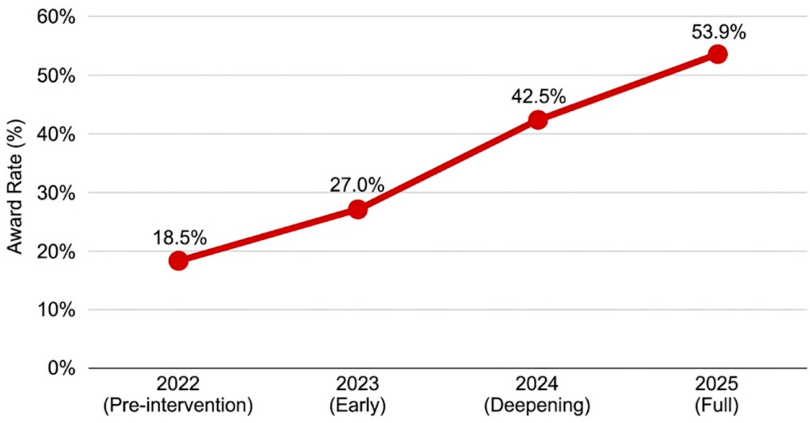
| Data-Intensive Analytical Positions (e.g., GIS Analyst, Urban Data Consultant, Smart City Strategist) | 14.5% | 42.5% | Pronounced Growth |
| Public Sector and Governance (e.g., Natural Resources Bureau, City Management) | 13.1% | 21.5% | Moderate Increase |
| Others/Unrelated Fields | 4.0% | 3.5% | Stable |
Disclaimer/Publisher’s Note: The statements, opinions and data contained in all publications are solely those of the individual author(s) and contributor(s) and not of MDPI and/or the editor(s). MDPI and/or the editor(s) disclaim responsibility for any injury to people or property resulting from any ideas, methods, instructions or products referred to in the content. |
© 2026 by the authors. Licensee MDPI, Basel, Switzerland. This article is an open access article distributed under the terms and conditions of the Creative Commons Attribution (CC BY) license.
Share and Cite
Zhai, L.; Wang, X.; Zhang, J.; Qi, P. Empirical Restructuring of Planning Education Under Spatial Data Science Intervention. Educ. Sci. 2026, 16, 932. https://doi.org/10.3390/educsci16060932
Zhai L, Wang X, Zhang J, Qi P. Empirical Restructuring of Planning Education Under Spatial Data Science Intervention. Education Sciences. 2026; 16(6):932. https://doi.org/10.3390/educsci16060932
Chicago/Turabian StyleZhai, Lixiang, Xiaoqian Wang, Jingjing Zhang, and Peng Qi. 2026. "Empirical Restructuring of Planning Education Under Spatial Data Science Intervention" Education Sciences 16, no. 6: 932. https://doi.org/10.3390/educsci16060932
APA StyleZhai, L., Wang, X., Zhang, J., & Qi, P. (2026). Empirical Restructuring of Planning Education Under Spatial Data Science Intervention. Education Sciences, 16(6), 932. https://doi.org/10.3390/educsci16060932