Article

Empirical Restructuring of Planning Education Under Spatial Data Science Intervention
College of Resources and Environmental Sciences, Gansu Agricultural University, Lanzhou 730070, China
*
Author to whom correspondence should be addressed.
Educ. Sci. 2026, 16(6), 932; https://doi.org/10.3390/educsci16060932 (registering DOI)
Submission received: 17 April 2026 / Revised: 5 June 2026 / Accepted: 8 June 2026 / Published: 11 June 2026

Abstract

Driven by the digital transformation of territorial spatial governance, traditional urban planning is irreversibly shifting towards a data-driven empirical paradigm. However, constrained by mimetic isomorphism and path dependence, many geography-based regional universities remain trapped in an educational dilemma: they overemphasize morphological representation while marginalizing quantitative decision-making, fostering a structural mismatch between graduate competencies and industry demands. To explore a systematic pathway out of this dilemma, this study chronicles a three-year pedagogical intervention utilizing a mixed-methods design with a historical control cohort (N = 275) within the urban planning program of Gansu Agricultural University—a regional institution situated in a less-developed frontier where territorial renewal demands macro-spatial synthesis over aesthetic forms. The intervention strategically redefined the graduate competency profile as “spatial data analysts”, constructing a pedagogical model comprising foundational algorithmic training, cross-disciplinary faculty collaboration, and real-world Project-Based Learning (PBL), coupled with a restructured, evidence-based evaluation system. Longitudinal tracking and quantitative analyses indicate a structural alignment with elevated educational efficacy. At the macro level of employment trajectories, the proportion of graduates securing knowledge-intensive data positions experienced a structural shift, rising from a baseline of 14.5% to 42.5%, reflecting an enhanced capacity to capitalize on expanding societal demands. At the meso level of practical competence, the award rate in high-level professional competitions increased by 35.4%. At the micro cognitive level, the new evaluation mechanism is associated with a successful redirection of students’ cognitive resources toward algorithmic logic and policy translation (p < 0.001) while highly significantly enhancing their self-efficacy in tackling complex, wicked engineering problems (p < 0.001). Rather than isolating pure causal mechanics, this study interprets these systemic gains as a contextual realignment of academic supply. It provides a context-sensitive, reproducible methodological reference for cultivating professional distinctiveness and reshaping the spatial planning education system in the digital era.

1. Introduction

Driven by the transition of territorial spatial governance from incremental expansion to qualitative stock optimization (Ge & Lu, 2021; Wang & Hu, 2023), coupled with the deconstruction of traditional empiricist paradigms by Urban Informatics (Yuan, 2024), the urban planning profession is rapidly advancing into an era of data-driven rational decision-making (Geertman & Witte, 2024). This shift not only necessitates fine-grained evaluations based on multi-source spatio-temporal data in planning practice but also fundamentally reshapes the industry’s competency expectations for interdisciplinary professionals (Allam & Dhunny, 2019; Geertman et al., 2017). It marks a transition from conventional physical form designers to decision-support analysts equipped with both cognitive insights into spatial evolution and advanced spatial computation skills.
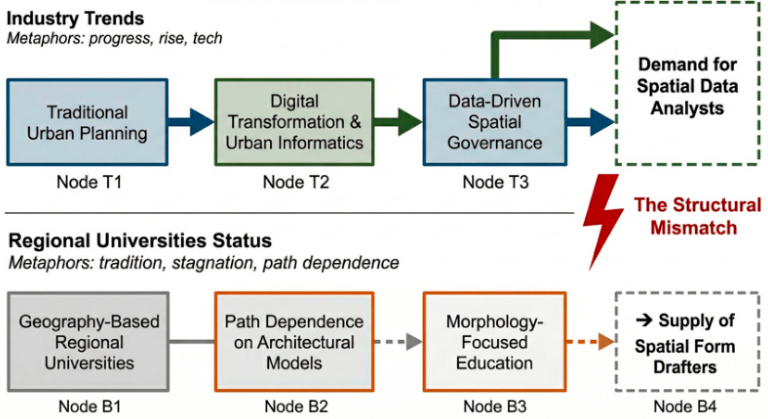
However, faced with this structural evolution in competency models, many regional universities—particularly those anchoring their urban planning programs in geography—have fallen into a profound identity dilemma. Constrained by prolonged path dependence, these institutions (which often lack the historical dominance of traditional architecture schools) frequently resort to replicating the conventional engineering pedagogical paradigm which overemphasizes morphological design while neglecting quantitative analysis (DiMaggio & Powell, 1983). Given their lack of deep architectural heritage, this imitative strategy directly strips their graduates of comparative advantage in the modern job market. To navigate this impasse, some institutions have attempted to embed technical courses, such as “Big Data in Urban Planning”, into their curricula. The persistent misalignment between the data-intensive requirements of the modern industry and the morphology-centered traditional curriculum creates a structural “competency gap.” Figure 1 delineates the divergence between industry expectations and academic output, highlighting the urgency of the systemic intervention proposed in this study. Empirical observations indicate that such interventions frequently encounter a “theory-practice disconnect” (Innes & Booher, 2010). Big data courses are often reduced to isolated software training sessions, failing to serve as methodological engines within the core spatial design studios. Technical training divorced from tangible spatial governance contexts risks degenerating into technological solutionism (Robert, 2015), yielding students who have mastered algorithmic tools but remain incapable of deciphering complex socio-spatial issues (Lai & Lavi, 2025). Furthermore, deficiencies within regional universities in foundational infrastructure—such as interdisciplinary faculty expertise and access to dynamic, high-precision datasets—further exacerbate the disconnect between the depth of algorithmic modeling and the inherent complexity of planning decisions.
Situated within the macro-context of paradigm shifts in engineering education, this study aims to explore the digital transformation pathways for planning education in regional comprehensive universities. Anchored in the “macro-spatial synthesis” inherent to geography, this research seeks to bridge the theory–praxis gap between scientific data literacy and engineering design practice (Dalton, 2001). Drawing upon three years of longitudinal tracking data from a pedagogical reform at Gansu Agricultural University, this study proposes a competency framework centered on “spatial data mining and mechanism diagnosis”. It restructures a modular curriculum encompassing “foundational algorithms, data fusion, and decision empowerment” while specifically validating the synergistic efficacy of Project-Based Learning (PBL) in cross-disciplinary training. Consequently, this study addresses the following two core research questions (RQs):
  • (RQ1) To what extent does a curriculum restructuring driven by spatial data science alter the learning trajectories and competency profiles of urban planning students?
  • (RQ2) What is the empirical efficacy of introducing PBL mechanisms in enhancing graduates’ core employability within data-intensive professional sectors?

2. Theoretical Background and Literature Review

2.1. Theoretical Framework

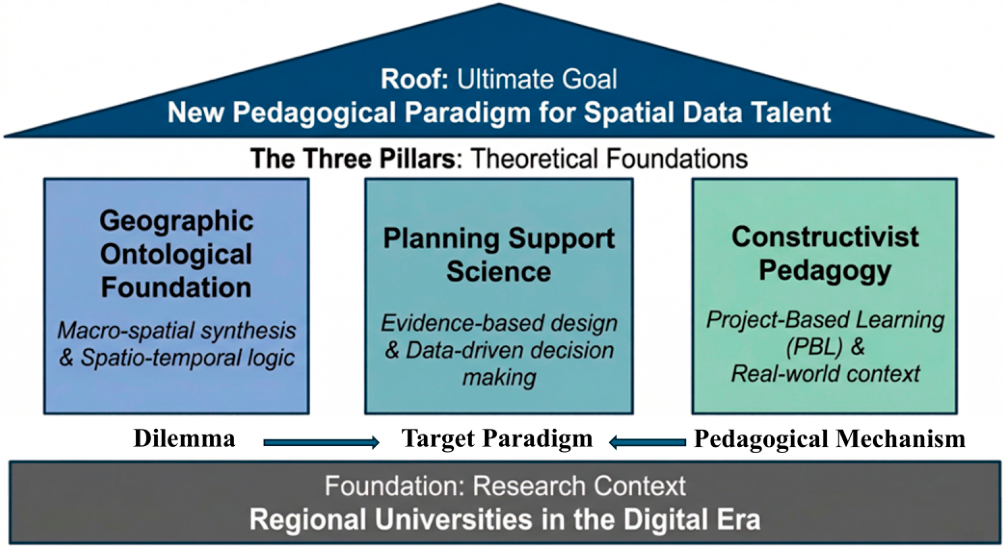
Amid the dual contexts of territorial spatial planning system restructuring and educational digitization, the underlying epistemology of urban planning is undergoing a profound transition from empiricism to positivism (Y. Z. Cai, 2025). To decipher the institutional barriers facing non-traditional regional universities in talent cultivation and to explore pathways for a pedagogical paradigm shift, this study consciously avoids ad hoc, singular perspectives. Instead, it constructs a comprehensive analytical framework (Figure 2) that organically integrates three interdependent dimensions: organizational sociology (Path Dependence), disciplinary epistemology (Planning Support Science), and instructional methodology (Constructivist PBL). This multi-dimensional approach provides a rigorous, holistic lens to systematically diagnose the institutional inertia restraining regional universities and to deduce the specific mechanisms required to dismantle it.

2.2. Path Dependence and Isomorphic Dilemmas in Traditional Planning Education

Historically, urban planning education in China has been heavily constrained by a morphological-technical paradigm centered on architecture (Anacker, 2024). Contemporary critical studies in planning education reveal that traditional engineering models tend to privilege physical spatial forms while largely suspending the empirical analysis of complex urban systems’ operational mechanisms (Frank, 2006). For regional universities establishing planning programs rooted in geography, navigating the uncertainties of disciplinary legitimacy during their formative stages often leads to profound path dependence (Y. J. Cai & Johannes, 2015). In organizational sociology, this manifests as typical “mimetic isomorphism”—the inertial replication of form-focused curricula from established, elite architectural schools, rather than the evolution of independent methodologies grounded in their own disciplinary foundations.
This path-locking engenders a systemic misalignment in competency output. On the one hand, within the context of traditional physical spatial design, these institutions, limited by their historical heritage, struggle to compete effectively with established engineering universities. The overwhelming volume of drafting exercises further compresses the space for theoretical reflection, preventing students from translating their parent discipline’s (geography’s) natural comparative advantages in macro-scale analysis. Escaping this mimetic isomorphism requires more than superficial curriculum tweaking; it demands a deliberate “unlearning” of architecture-centric paradigms. As Karvonen et al. (2020) argue, regional universities must pivot toward localized geographic contexts to cultivate niche analytical competencies. This conceptual shift highlights a broader pedagogical necessity: redefining the evaluation metrics of planning education. Rather than prioritizing aesthetic design outcomes, contemporary pedagogy increasingly advocates for assessing empirical problem-solving capabilities grounded in spatial data (Boeing, 2020)—a departure from traditional path dependence. A more insidious barrier lies in the cognitive disconnect within the curriculum system. Although foundational stages universally cover geography and Geographic Information Systems (GIS), spatial analytical thinking is frequently marginalized upon entering advanced design courses (Studios) (Mohammed, 2021). Accompanying the permeation of “Urban Informatics”, some universities have mechanically appended Big Data and advanced GIS modules; however, divorced from specific spatial governance logic, these computational technologies often regress into mere “software operational drills” (C. Liu et al., 2025).
As national strategies pivot towards a stock-governance era centered on ecological baseline control and fine-grained urban renewal, industry demand for interdisciplinary professionals equipped with spatio-temporal data modeling capabilities has expanded exponentially (Boeing et al., 2021; Kong et al., 2020). Nevertheless, graduates constrained by the aforementioned path dependence remain anchored in 2D drafting and 3D rendering, rendering them ill-equipped to respond to the processing demands of high-dimensional urban operational data. The structural contradiction between the supply side’s overreliance on graphic representation and the demand side’s urgent need for data-driven empiricism has emerged as the core obstacle restricting the sustainable development of planning education in these institutions.

2.3. The Paradigm Shift Towards Planning Support Science

To dismantle the aforementioned isomorphic dilemma, non-traditional universities must fundamentally reconstruct their educational pathways at the epistemological level. Currently, the “Scientificization” of planning practice signifies a substantive paradigm shift from traditional, experience-driven blueprint planning toward Planning Support Science (PSS) (Geertman et al., 2017). Grounded in the disciplinary base of geography and driven by spatial data science (Singleton & Arribas-Bel, 2021), this transition not only aligns ontologically with the demands of modern planning but also constructs a distinct competitive barrier for students in the stock-oriented job market.
This paradigm evolution is deeply rooted in the isomorphism of macro-spatial synthetic thinking. The new era of territorial spatial planning relies heavily on holistic ecological control and cross-regional coordination (Y. Liu & Zhou, 2021; Wang & Hu, 2023). Compared to the bottom-up, micro-parcel deduction typical of traditional architecture, geography’s top-down, macro-spatial perspective interfaces more accurately with the overarching frameworks of national strategies (Fan & Li, 2009). Crucially, the transition toward stock-oriented urban governance is not merely a change in planning scale but an ontological shift that demands dynamic, predictive methodologies. The contemporary evolution of Planning Support Science mirrors this shift by moving beyond static analytical mapping to integrate big data analytics and long-term predictive models (Kandt & Batty, 2021). In highly complex urban regeneration scenarios, intuitive deliberation is increasingly giving way to Artificial Intelligence-driven methodologies (Hadiyana & Ji-Hoon, 2024). This capacity to quantitatively simulate socioeconomic and ecological impacts prior to implementation fundamentally solidifies the indispensable role of data-driven empiricism in modern planning. Furthermore, spatio-temporal computational engines constitute the foundational methodology for data-driven planning (Miucin & Fedorova, 2018). Urban big data is intrinsically situated within multi-dimensional spatio-temporal systems. Consequently, Geographic Information Science (GIS) and Remote Sensing (RS) are no longer confined to static visual mapping; they have ascended as core analytical engines for spatial aggregation, network topology resolution, and dynamic scenario simulation (Allam & Dhunny, 2019; Geertman & Stillwell, 2020). The extensive accumulation of geographic institutions in spatial statistics and database management provides a robust disciplinary foundation for students to execute dimensionality reduction and algorithmic modeling on complex urban data.
Based on this premise, implementing an asymmetric competition strategy becomes imperative: strategically resetting the core competency profile from passive “morphological drafters” to “spatial data analysts and decision-support think tanks” (Malczewski, 2004). Under this paradigm, the pedagogical logic must de-emphasize excessive intervention in micro-architectural facades and pivot toward the quantitative elucidation of spatial evolution mechanisms. This includes employing Python 3.9 and machine learning algorithms to process multi-source heterogeneous data (e.g., LBS, POI) to predict urban vitality distribution. Professionally, it necessitates a precise targeting of highly data-dependent domains, such as diagnosing urban transit resilience and spatial equity in public services (Shah et al., 2019), monitoring the spatio-temporal evolution of urban sprawl using high-resolution remote sensing and nighttime light (NTL) data, and delineating ecological security patterns based on multi-criteria overlay algorithms (Kandt & Batty, 2021). In these complex empirical scenarios, the utility of traditional workflows reliant on intuitive deliberation diminishes precipitously, thus reserving expansive strategic space for novel planning professionals to establish their irreplaceable professional value.

2.4. Constructivism and PBL in Addressing Wicked Problems

Merely appending technical modules to the curriculum inventory cannot actualize a substantive leap from “cartographic representation” to “support science”. Traditional didactic teaching proves particularly inadequate when cultivating higher-order computational thinking (Jonassen, 1991). Frontier research in modern engineering education reform indicates that Constructivist Learning Theory provides the epistemological guidance for this transition (Prince & Felder, 2006). Constructivism posits that professional knowledge cannot be passively indoctrinated; rather, it must be actively generated and constructed by learners through interactions within complex, real-world contexts (Duffy, 1992).
Urban planning frequently grapples with highly complex “wicked problems” (Termeer et al., 2019), which dictates that the educational model must possess sufficient tolerance for reality and exploratory capacity (Kandt & Batty, 2021; Rittel & Webber, 1973). Project-Based Learning (PBL), as the most representative practical framework of constructivism (Chen et al., 2020), emphasizes anchoring the cognitive process within unstructured, real-world engineering challenges (Lai & Lavi, 2025). Confronting these unstructured realities is what bridges the gap between algorithmic mechanics and actionable policy. Rather than operating in sterilized computational environments, students engaged in data-driven PBL are forced to navigate genuine urban renewal conflicts, which has been shown to substantially enhance their capacity to grapple with the multifaceted demands of the next generation of planning practice (Olesen, 2018).
In the educational context of spatial data science, PBL exhibits irreplaceable methodological advantages: Operationally, by introducing uncleaned, multi-source anonymized data and authentic urban governance conflicts, PBL forcibly ejects students from the comfort zone of software demonstrations, compelling them to independently navigate the chaotic data ecosystem to complete the logical closed-loop of “data acquisition–model construction–policy translation”. More profoundly, embedding PBL within open-source civic data frameworks serves an ethical function. It empowers students not only to refine their algorithmic proficiency but to critically conceptualize and mitigate the social equity issues inherent in algorithmic governance (Wesely & Allen, 2019).
Cognitively, PBL simulates the interdisciplinary collaborative nature of data-driven professional operations, wherein localized project scenarios effectively stimulate students’ critical thinking and team negotiation skills (Kokotsaki et al., 2016). Therefore, embedding PBL as the core instructional mechanism in the curriculum reconstruction is an inevitable pedagogical pathway to ensure that spatial data science theories are tangibly translated into capabilities for complex spatial decision-making.
To systematically synthesize the theoretical framework and recent scholarly discourse discussed above, Table 1 categorizes the key literature driving the pedagogical paradigm shift in urban planning education.
In synthesis, the three theoretical pillars discussed above—Path Dependence, Planning Support Science (PSS), and Constructivist PBL—do not operate in isolation but constitute a highly interdependent logical framework driving this pedagogical reform. Path Dependence diagnoses the core institutional dilemma: the inertial reliance on outdated, architecture-centric models that structurally marginalize spatial data literacy in regional universities. To dismantle this inertia, the paradigm shift toward PSS defines the target epistemological objective, strategically realigning the educational focus toward the data-driven, predictive analytical competencies required by modern stock-oriented urban governance. Ultimately, Constructivist PBL serves as the essential pedagogical mechanism. It acts as the crucial bridge that translates the abstract epistemological ambitions of PSS into concrete instructional realities. By actively immersing students in unstructured, real-world civic data conflicts, the PBL framework effectively navigates the transition from the inherited constraints of path dependence to the empowered, analytical proficiency envisioned by PSS.

3. Materials and Methods

To address the systemic barriers inherent in traditional planning education models, this study adopted an empirical Action Research approach. By establishing spatial data science as the core methodology, we systematically reconstructed the graduate competency profiles, curricular structures, and assessment criteria at Gansu Agricultural University. This section details the experimental context, operationalized variables, and data collection framework of the pedagogical intervention, aiming to provide a reproducible empirical baseline for the paradigm shift in engineering education (Chen et al., 2020).

3.1. Research Context and Participants

In tandem with the digital transformation of spatial governance, the core competency model for planning professionals is evolving from physical morphological design toward spatio-temporal data analysis. To test a novel pedagogical paradigm adapted to this evolution, this study designated the Human Geography and Urban Planning program at the College of Resources and Environmental Sciences, Gansu Agricultural University, as the empirical site for educational reform. This program possesses a typical geographical science foundation; historically, its pedagogical model exhibited pronounced systemic deficiencies when interfacing with computationally intensive spatial tasks.
The intervention program commenced in 2022, with the primary objective of reconstructing the graduate competency profile from “morphological drafters” to interdisciplinary decision-makers equipped with comprehensive spatial computation capabilities. The longitudinal tracking sample comprised the entire cohort of graduates from the classes of 2023 to 2025 who fully participated in the intervention protocol (Total Sample N = 275). Through three years of continuous action tracking, we systematically evaluated the translational efficacy of this competency restructuring within the real-world employment ecosystem.

3.2. Pedagogical Intervention: Curriculum Redesign and Cyberinfrastructure

As the core variable in operationalizing the educational intervention, the curriculum restructuring focused on deconstructing the knowledge frameworks reliant on intuitive design and deeply embedding data science into foundational and core professional modules. Table 2 outlines the evolutionary trajectory of the curriculum system before and after the intervention.
At the operational implementation level, the pedagogical intervention was bifurcated into two progressive phases, supplemented by a fundamental overhaul of the hardware environment:
Phase 1: Resetting Foundational Computational Thinking. Referencing the latest syllabus standards of the Association of European Schools of Planning (AESOP) and the evolving consensus on the essential components of planning education (Friedmann, 1996), the reform protocol systematically reduced contact hours for traditional graphical courses such as descriptive geometry and engineering drafting, actively introducing quantitative prerequisite courses like Python, Spatial Data Crawling and Spatial Statistics. Taking the 2022 experimental cohort as an example, the credit proportion of data-foundation modules was structurally increased from 8% to 15.5%. Traditional software demonstration sessions were transformed into in-depth lectures on spatial network analysis and algorithmic modeling principles, thereby establishing a cognitive baseline for processing spatial relationships through computational thinking (Miucin & Fedorova, 2018; Mohammed, 2021).
Phase 2: Data-Driven Design Practicum. Within core studios such as Master Planning and Urban Regeneration, an Evidence-Based Design (EBD) paradigm was introduced. This phase established rigorous procedural thresholds: before initiating any physical spatial interventions, subject groups were required to independently conduct quantitative diagnoses of spatial mechanisms utilizing multi-source heterogeneous data (e.g., Location-Based Services [LBS] trajectories, Points of Interest [POI]), thereby replacing empiricist conjecture regarding current conditions.
To support the aforementioned computationally intensive teaching, the research team implemented the development of a cross-disciplinary spatial data platform. By dismantling the hardware barriers between Geographic Information Science (GIScience) and Urban Planning laboratories, and introducing cloud-rendering clusters alongside open-source urban computing frameworks, we established a Cyberinfrastructure for Urban Analytics—integrating “data foundation, computational support, and model operation” (Stuart, 2015). This platform provided the necessary computational bandwidth and experimental sandboxes for the crawling, cleaning, and dynamic simulation of complex spatial data (Drummond & French, 2008), effectively operationalizing the theoretical framework of the computable city within a pedagogical context (Yuan, 2024).

3.3. Instructional Operationalization: PBL and Collaborative Mechanisms

The transformation of the curricular structure urgently requires congruent pedagogical scenarios. To sever the disconnect between classroom theory and complex governance practice, this study established Project-Based Learning (PBL) as the core intervention mechanism. The implementation of PBL directly correlates with highly unstructured, real-world engineering challenges, forcing students to autonomously explore problem boundaries within raw empirical data. Over the intervention cycle, the research team fully integrated 12 authentic projects—such as the “Quantitative Assessment of Facility Service Blind Spots in the Main Urban Area” and the “Spatio-Temporal Construction of County-level Ecological Networks”—into core courses, achieving a 100% coverage rate for the PBL model (SI).
To address the experiential limitations of full-time faculty at the frontiers of data science, the execution of PBL embedded a cross-sector dual-mentor collaborative mechanism (Innes & Booher, 2010; Chen et al., 2020). The college systematically assembled a mentor matrix comprising experts from Human Geography, Urban Planning, and Computer Science. During core practicum hours, engineers from provincial land planning institutes and smart city operation enterprises were introduced to guide 30% of the practical instruction. This dual-driven model of “university-led algorithmic lectures + industry-controlled decision-making” effectively bridged the technological gap between academic instruction and cutting-edge data engineering practice (Garousi et al., 2019).

3.4. A Concrete Pedagogical Case Study: The Urban Renewal Studio

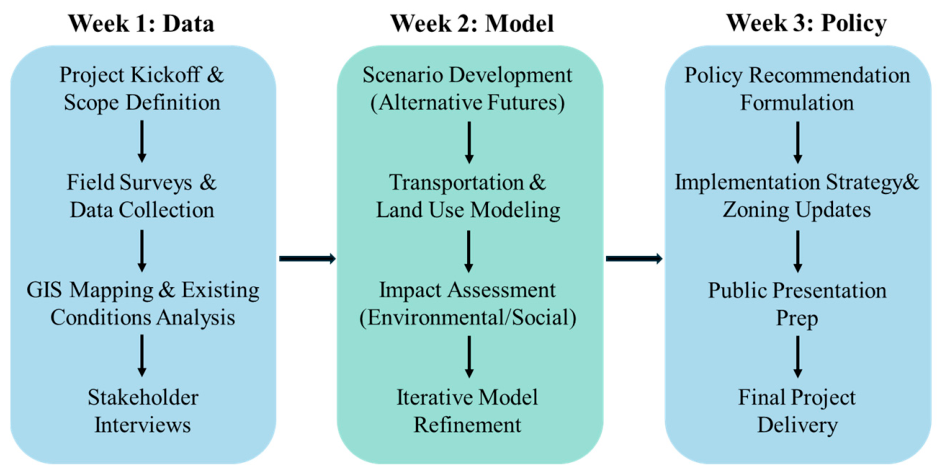
To transparently demonstrate the specific implementation process of the spatial data science-empowered pedagogical paradigm, this section details a representative 3-week Project-Based Learning (PBL) module derived from the “Urban Renewal Studio.” The module centers on the real-world engineering challenge of “Quantitative Diagnosis of Spatial Vitality and Public Service Equity” in the main urban area. The instructional process was executed through a rigorous three-phase workflow:
Week 1: Multi-source Data Acquisition and Structuring (The “Data” Phase). Moving away from traditional pre-packaged site CAD files, students were required to independently construct the empirical database. Under the guidance of mentors, student groups utilized Python-based web crawlers and open APIs to harvest highly granular urban data. Specifically, students acquired Points of Interest (POI) data to capture commercial and civic facility distributions, alongside high-resolution Nighttime Light (NTL) imagery and Location-Based Services (LBS) population heatmaps to represent baseline socio-economic vitality. The primary deliverable for this week was a cleaned, standardized spatial database, pushing students out of their comfort zones into authentic data ecosystems.
Week 2: Algorithmic Modeling and Spatial Diagnosis (The “Model” Phase). Transitioning from data to intelligence, students applied spatial computational tools to diagnose underlying urban mechanisms. Students utilized Python 3.9 (e.g., Pandas, GeoPandas) for data fusion and ArcGIS 10.6 for spatial statistical modeling. By executing Kernel Density Estimation (KDE) on POI data, Bivariate Spatial Autocorrelation, and multi-criteria network analysis on OpenStreetMap (OSM) road grids, students quantitatively measured the accessibility and spatial equity of existing public services. During this week, traditional subjective “site impressions” were entirely replaced by rigorous algorithmic deductions.
Week 3: Evidence-Based Design Output and Policy Translation (The “Policy” Phase). In the final phase, students were tasked with translating their quantitative findings into concrete physical planning interventions. Instead of producing traditional, aesthetically driven masterplan renderings, the deliverables shifted to Evidence-Based Design (EBD) outputs. Students produced precise “Spatial Vitality Diagnosis Maps,” “Service Blind-Spot Identification Drawings,” and targeted “Urban Regeneration Strategy Blueprints” that directly mitigated the algorithmic deficits identified in Week 2. This process completed the logical closed-loop of bridging computational analytics with tangible spatial governance.
To synthesize this instructional approach, Figure 3 illustrates the operational flowchart of this PBL module.

3.5. Data Collection Framework and Assessment Models

To validate the empirical efficacy of the intervention model, this study constructed a three-dimensional data collection and assessment framework encompassing macro-level employment trajectories, meso-level competition performance, and micro-level course evaluations.
At the macro and meso dimensions, the research team utilized historical graduate destination registration systems and regular in-depth interviews with employers to longitudinally track proportional shifts in the subject sample toward knowledge-intensive data positions (e.g., urban health diagnostics, stock optimization assessments). Operationally, this study classified ‘data-intensive positions’ strictly as roles where the primary daily function verified by employer contracts involves spatial statistical analysis, GIS modeling, or algorithmic urban governance, rather than conventional architectural drafting. Concurrently, review feedback from professional competitions, such as the Provincial Urban and Rural Social Survey and the “Challenge Cup”, was collected to quantitatively ascertain the statistical variance in award rates between data-driven submissions and traditional cartographic projects.
At the micro course evaluation dimension, to rectify the evaluative bias in traditional Studios that over-relied on visual aesthetic representation, the study established a “Data–Model–Policy” three-dimensional quantitative scoring model for both formative and summative assessments. This model assigned weights based on the following criteria:
(1)
Data Acquisition and Structuring Capability (30%): Assesses the subject’s completeness in independently executing multi-source data crawling, cleaning, and spatial database construction tailored to specific complex planning issues.
(2)
Algorithmic Logic and Spatial Robustness (40%): Evaluates the goodness-of-fit of the selected spatial statistical models (e.g., Spatial Autocorrelation, Geographically Weighted Regression [GWR]) to professional demands, as well as the robustness and mathematical rigor of the model inference.
(3)
Decision Efficacy and Policy Translation (30%): Examines the logical coherence in translating quantitative analytical conclusions into practically feasible spatial intervention guidelines or public policies.
This evaluation system constituted a rigid constraint, designed to regulate and verify the students’ actual capacity output as they evolved from subjective deliberation to evidence-based decision-making.
At the micro student level, this study developed and implemented the Spatial Data Engineering Self-Efficacy (SDESE) Scale. Utilizing a 5-point Likert scale, the instrument encompasses four core evaluative dimensions: (1) multi-source data acquisition and cleaning; (2) algorithmic modeling and spatial logic; (3) cross-disciplinary collaboration and policy translation; and (4) comprehensive confidence in tackling wicked problems. In this empirical study, the scale demonstrated excellent internal consistency (Pre-test α = 0.89, Post-test α = 0.92), ensuring the robustness of the measurement outcomes (Atman Uslu et al., 2022). (Refer to Appendix C and Appendix D for the full instrument and extended statistical parameters).

4. Results

Based on the longitudinal tracking of graduates from the classes of 2023 to 2025, disciplinary competition outcomes, and academic performance in core courses, this section systematically reports the pedagogical efficacy of the spatial data science intervention. To address the overarching research questions, the empirical results are articulated across three dimensions: employment trajectories (RQ2), practical competence, and cognitive restructuring (RQ1).

4.1. Macro Dimension: Structural Shifts in Employment Trajectories

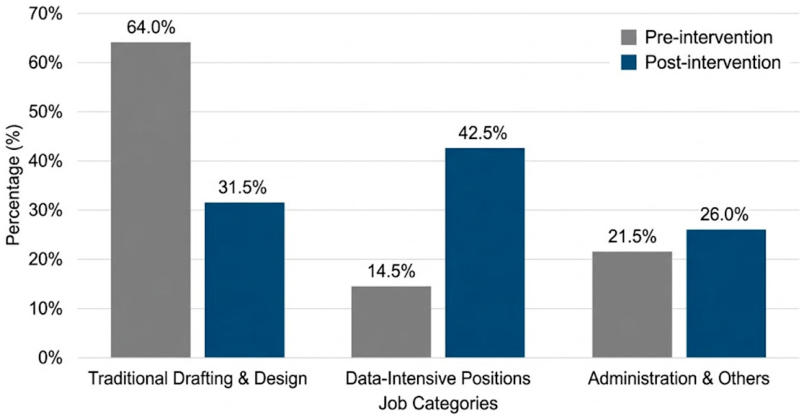
A comparative analysis of graduate destinations before and after the intervention, utilizing the historical employment tracking system, reveals a substantive structural transformation associated with the pedagogical reform (Figure 4). Prior to the intervention (establishing the class of 2022 and earlier cohorts as the baseline), the majority of graduates from this program gravitated toward traditional grassroots architectural design institutes, primarily engaging in basic graphical drafting.
Following the comprehensive implementation of the novel curriculum system, the proportion of graduates securing data-intensive positions exhibited a pronounced upward trajectory. Specifically, within the experimental cohort, the proportion of graduates employed in knowledge-intensive roles—such as urban health examinations, stock optimization assessments, and spatial data analysis—from a pre-intervention baseline of 14.5% to 42.5%. Table 3 provides a granular sectoral breakdown of these career placements. This statistical shift signifies that the core employment destinations of graduates are progressively transitioning from singular morphological design toward emerging technological frontiers, including natural resource informatics and smart city operations.

4.2. Meso Dimension: Externalization of Practical Engineering Competence

The integration of Project-Based Learning (PBL) was designed to enhance students’ comprehensive capacities to navigate authentic, wicked problems. This study extracted evaluation results from the 2022–2025 Provincial Urban and Rural Social Survey and the “Challenge Cup” competitions to serve as objective metrics for this competency.
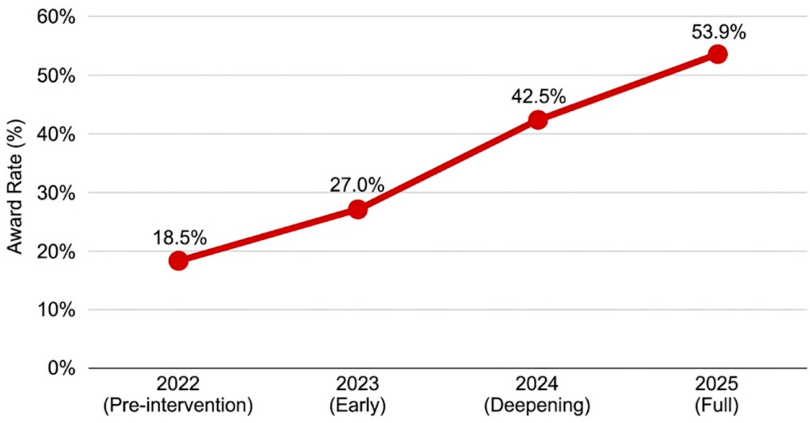
Statistical outcomes demonstrate that within equivalent competition tracks, the intervention groups—which proactively integrated open-source Points of Interest (POI) and nighttime light (NTL) remote sensing data, utilizing quantitative diagnostics to replace empirical conjecture—saw their acquisition rate of premium awards (provincial first prize and above) escalate from 18.5% in the 2022 traditional cartographic cohort to 53.9%, marking an absolute increase of 35.4% (Figure 5). This objective performance within the competitive dimension validates the effective translation of the Evidence-Based Design (EBD) paradigm, suggesting that equipping students with spatial data science tools can offer a competitive advantage in solving real-world, unstructured planning problems.

4.3. Micro Dimension: Cognitive Restructuring of Learning Outcomes

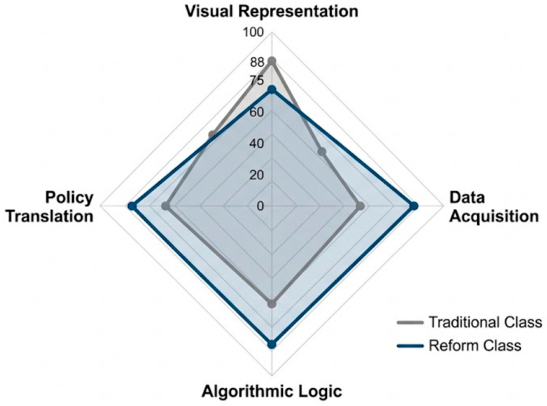
To investigate the restructuring effects on learning outcomes articulated in RQ1, the research team conducted an independent samples t-test on the grade distributions between the traditional Studio and the data-driven Studio. Under the traditional evaluation system, students’ scores were highly concentrated in the “Visual Aesthetics and Representation” dimension (M = 88.0, SD = 5.2) while exhibiting pronounced weakness in the “Spatial Logical Analysis” dimension (M = 62.0, SD = 8.4).
Following the incorporation of the “Data–Model–Policy” three-dimensional scoring rubric, the academic grade distribution of the intervention group demonstrated a significant offset (Figure 6). Data analysis revealed that the intervention cohort scored significantly higher in the “Algorithmic Logic and Spatial Robustness” dimension (M = 85.5, SD = 4.8) than the historical control group (t273 = 15.62, p < 0.001). Concurrently, performance in the “Decision Efficacy and Policy Translation” dimension (M = 82.0, SD = 6.1) also exhibited a highly significant improvement (t273 = 12.45, p < 0.001).
This restructuring of academic outcomes indicates that the novel assessment mechanism effectively guided students to reallocate their cognitive resources from foundational image rendering to higher-order data deduction and policy analysis.

4.4. Micro Dimension: Enhancement of Self-Efficacy in Complex Engineering Tasks

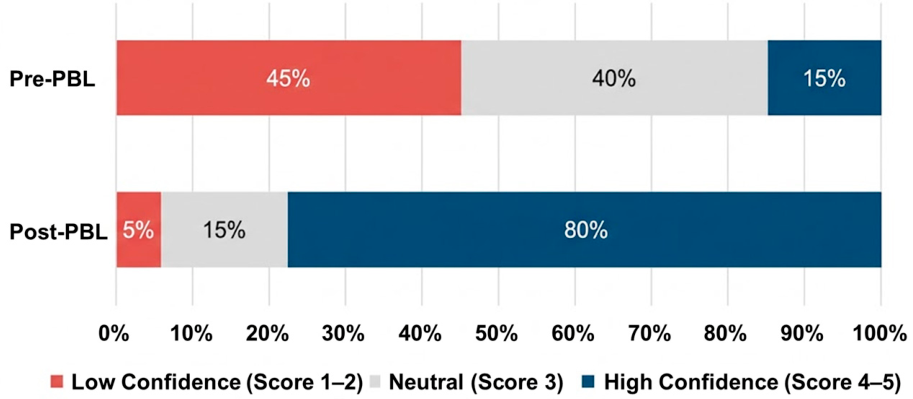
The pedagogical intervention not only elevated objective academic performance but also fundamentally reshaped students’ intrinsic psychological cognition through authentic PBL practicums. Paired samples t-test results based on the SDESE Scale revealed that when confronting authentic urban governance challenges lacking explicit project briefs, students’ comprehensive self-efficacy scores escalated significantly from a pre-intervention mean of 2.85 (SD = 0.72) to a post-intervention mean of 4.35 (SD = 0.55). This substantial growth (t146 = 24.38, p < 0.001) was accompanied by a large effect size (Cohen’s d = 2.34).
To properly contextualize the magnitude of this effect size, it is necessary to consider the cohort’s baseline characteristics. As documented in Table A1, approximately 88% of the participating students entered the program with no prior programming experience or formal computational training. This initial absence of technical literacy naturally constrained their pre-intervention self-efficacy scores. Consequently, this pedagogical transition from computational fundamentals to the implementation of Python-based data collection and spatial modeling within a PBL environment facilitated a significant cognitive progression. Therefore, the observed statistical variance aligns with the expected educational outcomes of introducing spatial data science into a traditionally non-computational student cohort, rather than indicating an inflation of the data.
Across the sub-dimensions of the scale, the data exhibited an asymmetric growth pattern: subjects registered the most drastic score increments in two highly demanding sub-dimensions—“Multi-Source Data Cleaning” and “Cross-Disciplinary Technological Collaboration”—reaching 45% and 52% respectively (Cohen’s d > 2.4) (Figure 7). Specifically, in concrete task items such as “independently constructing Python crawling scripts” and “interpreting the robustness of algorithmic logic”, students’ confidence indices achieved a substantive leap from “unconfident” to “highly confident”.
The significant variance in the quantitative data indicates that PBL practicums based on authentic, anonymized data, coupled with industry mentor intervention, served as a constructive mechanism to alleviate the “technological anxiety” toward foundational algorithms typically observed in traditional planning students, propelling their psychological state when tackling complex, wicked problems from passive reception to active knowledge construction.

5. Discussion

The quantitative analyses in Section 4 confirm that the spatial data science intervention significantly optimized students’ cognitive structures and self-efficacy when tackling complex, wicked problems at the micro level while concurrently aligning graduate competency profiles with the macro-level societal demand for data-intensive positions (42.5%). The attainment of these manifest outcomes is fundamentally the result of the synergistic evolution of the college’s underlying cyberinfrastructure (Stuart, 2015), interdisciplinary knowledge networks, and evaluation-driven mechanisms. This section aims to move beyond surface-level metrics to analyze the mechanistic variables driving this enhancement in educational efficacy while distilling universally applicable insights for similar non-traditional regional universities.

5.1. Mechanisms for Overcoming Resource Constraints and Epistemological Barriers

A prerequisite for the significant enhancement in students’ data processing capabilities and engineering confidence lies in the pedagogical system’s successful dismantling of institutional constraints—namely, hardware silos and faculty homogeneity.
In the dimension of hardware support, the high computational demands of urban computing often constitute a prohibitive barrier for regional universities. The present case deconstructed the physical isolation between geography and urban planning by implementing a strategy of “intensive resource integration and cloud empowerment”. The Cyberinfrastructure for Urban Analytics, constructed upon cloud-rendering clusters and open-source computational frameworks, provided a complex sandbox environment at a remarkably low marginal cost. The consolidation of this computational foundation directly explains the experimental group’s ability to fluently operationalize multi-source spatial data. By providing a low-cost, high-performance sandbox, the intervention effectively dismantled the primary barriers to GIS use in planning (Göçmen & Ventura, 2010), such as limited hardware access and the cognitive load associated with complex data cleaning. Consequently, students evolved from being passive software users to active spatial data engineers, as reported in Section 4.2.
In the dimension of cognitive network construction, the interdisciplinary faculty matrix effectively mitigated the “technological anxiety” prevalent in traditional educational systems. Regarding the significant surge in students’ self-efficacy (reaching a mean of 4.35, with the largest margins in “cross-disciplinary collaboration” and “data cleaning”) detailed in Section 4.4, the internal mechanism can be attributed to the cognitive scaffolding provided by the mentor matrix (human geography, urban planning, and computer science). Computer science instructors encapsulated the underlying algorithms, thereby reducing the initial cognitive load of technological barriers, while planning and geography instructors decoded the mechanisms to ensure the effective translation of algorithmic logic into spatial interventions (Kandt & Batty, 2021). Furthermore, industry–academia collaborative teaching, propelled by educational reform funds, facilitated the reciprocal enhancement of the faculty’s own data literacy, ensuring the closed-loop operation of the entire pedagogical intervention logic.

5.2. Broader Implications for Regional Universities

The intervention logic of this study not only validates the feasibility of transforming geography-based universities but also offers a theoretical rationale for other regional institutions trapped in mimetic isomorphism to circumvent redundant curricular competition.
Regarding strategic positioning, executing an asymmetric differentiation strategy is the core pathway to reconstructing professional heterogeneity (niche differentiation). Confronted with the historical accumulation of elite architectural schools in physical spatial design, regional universities must proactively pivot their capacity-building focus. As revealed by the empirical data (Section 4.1), de-emphasizing micro-scale morphological design and anchoring the core cultivation profile to “spatial data analysts and decision-support professionals” precisely matches the urgent demand for data-driven empiricism in the stock-governance era. Expanding professional boundaries into specialized sub-fields—such as urban health examinations, spatial resilience assessments, and multi-criteria ecological security quantification (Cheng et al., 2024)—effectively avoids the saturation within the traditional morphological design market (Y. Z. Cai, 2025; Drummond & French, 2008), establishing a definitive comparative advantage (Kong et al., 2020).
The intrinsic logic underpinning this strategic positioning lies in the strategic leveraging of the ontological alignment of native disciplines. The transformation of regional universities must be grounded in the scientific or engineering baselines of their parent disciplines. In this case, the elevation of students’ quantitative deduction capabilities profoundly relies on geography’s macro-spatial synthetic thinking and cross-scalar regional cognition. This top-down scientific foundation equips students with a cognitive framework for comprehending complex systems (Fan & Li, 2009), while their accumulation in Geographic Information Science (GIScience) constitutes the technological advantage for algorithmic applications. Other institutions with agricultural, forestry, or economic backgrounds could similarly adopt this modular logic of “cross-disciplinary foundation + digital technology empowerment” to develop reform paradigms with local characteristics.
To ensure the ultimate materialization of strategy and theory, the reconstruction of the evaluation system constitutes the final pedagogical mechanism. The washback effect in educational psychology posits that assessment criteria directly shape learners’ cognitive allocation. The highly significant reversal in student grade distributions detailed in Section 4.3 (a decline in visual representation scores alongside a highly significant surge in algorithmic logic and policy translation scores, p < 0.001) substantially corroborates this. The intense reliance of traditional Studios on visual aesthetics tends to discipline students into mechanical drafters; conversely, advancing the evaluation focus to the quantitative decision-deduction process of “data acquisition, algorithmic logic, and policy translation” establishes an unavoidable, rigid constraint. This systemic restructuring of evaluation orientation is the fundamental guarantee for compelling students to evolve from empiricist deliberation to evidence-based decision-making, ultimately ensuring the rigorous coupling of graduate output specifications with the modern digital governance system.

5.3. Limitations and Future Work

Critically, while this longitudinal study observes a pronounced upward trajectory in graduates securing data-intensive positions, attributing this macro-level employment shift solely to the pedagogical intervention is logically flawed. Methodologically, this research adopts a quasi-experimental historical control design rather than a concurrent randomized control group, which makes it difficult to entirely rule out cohort effects or the general dissemination of data science competencies among the broader student population. Given the absence of a concurrent control group, the methodological focus of this study naturally shifts from isolating causal mechanics to exploring how pedagogical practices can be contextually aligned with specific regional and disciplinary landscapes. Furthermore, Graduate employment trajectories are inevitably influenced by confounding variables, most notably broader macroeconomic trends and the rapidly shifting societal demand for data-literate professionals. As national spatial governance transitions into a digitalized, stock-oriented era, the industry inherently generates an exponential demand for spatial data analysts. Consequently, this macro-structural evolution serves as a powerful external catalyst. The increased employment rate should be interpreted as a contextual validator—demonstrating that the revised curriculum successfully aligned academic supply with evolving societal demand—rather than a strict, isolated dependent variable of the pedagogical reform. Therefore, to accurately evaluate the actual impact of the spatial data science paradigm, this study asserts that its primary scientific contribution lies in the measurable inward transformations of the learners.
Beyond the aforementioned confounding context of societal demand, this study faces explicit methodological boundaries. First, utilizing a historical control design rather than a concurrent randomized control group makes it difficult to entirely rule out cohort effects. However, this specific regional context provides a valuable setting for the study. Regional universities with geography and agriculture backgrounds represent a foundational tier of planning education; they often operate with different resource allocations compared to metropolitan architectural institutions, making their institutional path dependence a relevant subject for pedagogical observation. Examining the educational adjustments here provides a practical reference for similar institutions. Furthermore, the local dimension of Gansu Province—characterized by extensive territorial spaces, fragile ecological environments, and a transition toward stock-oriented rural–urban optimization—naturally aligns with macro-spatial synthesis rather than micro-scale morphological design. Therefore, implementing the spatial data science curriculum here allows us to evaluate how leveraging a parent discipline’s (geography’s) multi-scalar regional focus can address specific local governance needs.
Second, while the SDESE scale demonstrated strong internal consistency within our sample, it lacks broader external validation and pilot testing across diverse demographic profiles. Consequently, while the spatial data cultivation model constructed in this study provides an empirical baseline for the pedagogical paradigm evolution in regional universities, its cross-regional and cross-disciplinary external validity requires cautious assessment. To rigorously isolate pedagogical efficacy from regional variables, future research must incorporate multi-center, simultaneous comparative studies across different geographical and institutional contexts.
Addressing the epistemological revolution brought by Generative Artificial Intelligence (GenAI) and exploring a new pedagogical ecology of Human–AI Collaboration in planning constitute the primary agenda for future research. Accompanied by the non-linear evolution of Large Language Models (LLMs) and multimodal generative technologies, the underlying logic of engineering education is undergoing reconstruction. On the one hand, it is imperative to investigate the scaffolding role of LLM-assisted coding in foundational spatial computation courses. AI intervention necessitates a shift in learning behaviors from low-level syntax memorization toward higher-order Prompt Engineering and algorithmic logic deconstruction. This synergy will drastically lower the threshold for processing complex spatial elements. On the other hand, there is an urgent need to quantitatively assess the intervention effects of image generation models (e.g., Stable Diffusion) on cognitive resource reallocation. As foundational morphological rendering and visual layout achieve automation, future studies should focus on how to guide students in precisely allocating their liberated cognitive bandwidth toward irreplaceable, critical thinking processes, such as mechanism diagnosis and policy evaluation.
Furthermore, subsequent research should endeavor to distill modular paradigms of cross-disciplinary integration and conduct multi-center, cross-institutional longitudinal validations. Beyond the geographical foundation, exploring heterogeneous coupling models—such as an “agricultural/forestry foundation + ecological carbon sink computation” or an “economics foundation + industrial spatial quantification”—will provide a more universally applicable methodological reference for a broader range of regional universities seeking to break through educational quality bottlenecks within the contexts of Emerging Engineering and Emerging Science paradigms.
Finally, it is essential to consider alternative interpretations of the observed improvements. While our quantitative results demonstrate the efficacy of the spatial data science intervention, the gains could potentially be influenced by a ‘novelty effect’—a phenomenon where enthusiasm for new technology temporarily inflates student engagement and performance. Additionally, as this was not a randomized controlled trial, the potential for self-selection bias cannot be fully discounted; students with a higher pre-existing interest in emerging technologies may have engaged more deeply with the data-intensive curriculum. To account for these possibilities, we suggest that future research integrate longitudinal control variables, such as baseline digital literacy assessments and standardized measures of academic motivation, to more effectively isolate the pedagogical impact from these confounding factors. These adaptations are critical for refining the model’s transferability across diverse institutional contexts.

6. Conclusions

Situated within the dual contexts of the paradigm shift in territorial spatial planning and the digital transformation of engineering education, this study analyzes the mechanistic barriers confronting non-traditional regional universities in planning talent cultivation. Drawing upon a longitudinal pedagogical reform experiment and multi-dimensional tracking conducted at Gansu Agricultural University, this research yields the following core conclusions at both the theoretical and empirical levels.
A differentiated competitive strategy constitutes the fundamental logic for reshaping the core competitiveness of graduates from regional universities. Confronted with traditional disciplinary barriers, strategically reconstructing the talent competency profile from “physical spatial drafters” to “spatial data analysts and decision-support assistants” effectively establishes professional heterogeneity. While empirical data indicates that the proportion of graduates from the intervention group entering data-intensive positions achieved a structural shift from 14.5% to 42.5%, we acknowledge that this trajectory is fundamentally catalyzed by the level shifting societal demand for spatial governance in the stock-optimization era. Thus, we conclude that the pedagogical reform acted as a crucial structural bridge, empowering students with the precise analytical agility required to capitalize on these macro-trends. Importantly, the effectiveness of this educational transition is closely tied to the local characteristics of the institution. In regional contexts managing expansive territorial and ecological responsibilities, aligning the curriculum with geography-based macro-spatial analysis provides a contextually appropriate developmental direction.
The core driving force underpinning this strategic transformation lies in the systemic intervention of the spatial data science pedagogical model. By embedding foundational algorithmic baselines, establishing interdisciplinary dual-mentor collaborative mechanisms, and implementing Project-Based Learning (PBL), this model substantively bridges the disconnect between scientific data literacy and engineering design practice. Quantitative analyses further confirm (p < 0.001) that the rigid evaluative constraints established by the “Data–Model–Policy” framework facilitated the reallocation of students’ cognitive resources from foundational image rendering to higher-order logical deduction. Ultimately, this internal cognitive elevation constitutes the most direct and scientifically validated outcome of the educational intervention. However, given the context-dependent nature of this reform—grounded in specific disciplinary foundations—the implementation of this model in other institutional or international settings requires careful, context-sensitive adaptation. Rather than a direct replication, this study offers a transferable methodological framework that provides a starting point for non-traditional regional universities to explore pathways toward transcending institutional bottlenecks in the digital era.

Author Contributions

Conceptualization, L.Z. and X.W.; methodology, L.Z., X.W. and J.Z.; investigation, L.Z. and J.Z.; data curation, X.W., J.Z. and P.Q.; writing—original draft preparation, L.Z.; writing—review and editing, X.W. and J.Z.; visualization, X.W.; project administration, L.Z. and P.Q.; funding acquisition, L.Z. All authors have read and agreed to the published version of the manuscript.

Funding

This research was funded by Doctoral Research Startup Fund Recruitment of Gansu Agricultural University, grant number 223051.

Institutional Review Board Statement

The study was conducted in accordance with the Declaration of Helsinki, and approved by Ethics Committee of Gansu Agricultural University (protocol code 2022-ETH-NO.005 and date of approval is 1 September 2022).

Informed Consent Statement

Informed consent was obtained from all subjects involved in the study.

Data Availability Statement

The data are available from the corresponding author upon reasonable request.

Conflicts of Interest

The authors declare no conflicts of interest.

Appendix A

Detailed Demographic Characteristics of the Subject Sample

To provide a comprehensive understanding of the research context, Table A1 details the demographic background of the longitudinal tracking sample (N = 275) and the specific cohort (N = 147) that participated in the self-efficacy survey. In China, regional universities often admit students from both science/engineering and arts/humanities tracks into spatial planning programs, which historically exacerbates the “technological anxiety” addressed in this study.
Table A1. Demographic profiles of the participating students.
CharacteristicTotal Tracking Sample
(N = 275)
Survey Sub-Sample
(N = 147, Class of 2021)
Gender
Male132 (48.0%)71 (48.3%)
Female143 (52.0%)76 (51.7%)
High School Academic Background
Science/STEM Track185 (67.3%)98 (66.7%)
Arts/Humanities Track90 (32.7%)49 (33.3%)
Prior Programming Experience (Pre-intervention)
None242 (88.0%)129 (87.8%)
Basic (e.g., introductory courses)33 (12.0%)18 (12.2%)

Appendix B

Appendix B.1. Detailed Demographic Characteristics of the Subject Sample

To operationalize the “Data–Model–Policy” framework, the Cyberinfrastructure for Urban Analytics incorporated specific open-source and commercial software stacks. The transition from the traditional to the reformed curriculum is characterized by the following toolset shifts: Traditional Stack (Phased out/Reduced): AutoCAD 2018 (2D drafting), SketchUp pro 2018 (3D morphological modeling), Photoshop 19 (visual rendering). Reformed Data Science Stack (Introduced/Emphasized): Python 3.9 (Pandas, GeoPandas, OSMnx for data crawling and cleaning), QGIS 3.36 and ArcGIS 10.6 (spatial statistics and topological analysis), and specialized packages (e.g., Space Syntax for network analysis, Fragstats for ecological metrics).

Appendix B.2. Exemplars of Real-World PBL Projects

During the core Studio courses, 12 authentic projects were introduced. Below are two primary exemplars that students engaged with during the intervention:
Project Exemplar 1: Quantitative Assessment of Facility Service Blind Spots in the Main Urban Area. Students were provided with over 500,000 anonymized Location-Based Services (LBS) check-in records and Points of Interest (POI) data. They were tasked with using spatial clustering algorithms (e.g., DBSCAN) to identify mismatched zones between public service provision and actual population vitality, subsequently proposing optimized facility layout policies.
Project Exemplar 2: Spatio-Temporal Construction of County-level Ecological Networks. Utilizing high-resolution remote sensing imagery and Digital Elevation Models (DEM), students applied the Minimum Cumulative Resistance (MCR) model to extract ecological corridors and delineate ecological security boundaries for a county undergoing rapid urbanization.

Appendix C

Self-Efficacy Questionnaire Instrument

The Spatial Data Engineering Self-Efficacy (SDESE) Scale was developed for this study to measure students’ confidence in handling complex, unstructured planning problems before and after the Project-Based Learning (PBL) intervention. The instrument employs a 5-point Likert scale ranging from 1 (Strongly Disagree/Completely Unconfident) to 5 (Strongly Agree/Highly Confident).
Instructions provided to students: Please indicate your current level of confidence in independently executing the following tasks when faced with a real-world, unstructured urban governance problem.
Dimension 1: Multi-Source Data Acquisition and Cleaning
  • I am confident in identifying the correct types of open-source data (e.g., POI, NTL, LBS) required for a specific planning issue.
  • I am confident in writing Python scripts to crawl or batch-download spatial data.
  • I am confident in cleaning messy, unstructured data and resolving coordinate system conflicts.
Dimension 2: Algorithmic Modeling and Spatial Logic
4.
I am confident in selecting the most appropriate spatial statistical model (e.g., GWR, Spatial Autocorrelation) for a given analytical goal.
5.
I am confident in debugging errors when running spatial analysis algorithms.
6.
I am confident in interpreting the mathematical robustness and statistical significance of my spatial models.
Dimension 3: Cross-Disciplinary Collaboration and Policy Translation
7.
I am confident in effectively communicating my algorithmic logic to team members who lack programming backgrounds.
8.
I am confident in translating quantitative analytical results into actionable urban planning policies.
9.
I am confident in defending the scientific validity of my data-driven design against traditional morphological critiques.
Dimension 4: Handling Unstructured “Wicked” Problems
10.
I feel confident when given a project brief that lacks specific constraints or predefined methodologies.
11.
I am confident in my ability to continuously iterate my analytical framework when initial data outcomes contradict my hypotheses.
(Note: The internal consistency of the scale was robust, with Cronbach’s α = 0.89 for the pre-test and α = 0.92 for the post-test.)

Appendix D

Extended Statistical Results (Effect Sizes)

In the main text (Section 4.3 and Section 4.4), significance levels (p-values) were reported. Table A2 and Table A3 provide the extended statistical parameters, including degrees of freedom and effect sizes (Cohen’s d). In educational intervention research, reporting effect sizes is critical to demonstrate the practical magnitude of the intervention.
Table A2. Independent samples t-test results for cognitive dimension scores (Traditional vs. Reform Cohorts).
Cognitive DimensionTraditional Cohort (M ± SD)Reform Cohort (M ± SD)t-Valuedfp-ValueCohen’s d
Visual Aesthetics and Representation88.0 ± 5.275.0 ± 6.8−17.82273<0.001−2.15
Algorithmic Logic and Spatial Robustness62.0 ± 8.485.5 ± 4.815.62273<0.0013.42
Decision Efficacy and Policy Translation65.0 ± 7.582.0 ± 6.112.45273<0.0012.48
(Note: A Cohen’s d > 0.8 indicates a large effect size, underscoring the massive shift in cognitive resource reallocation induced by the intervention.).
Table A3. Paired samples t-test results for Self-Efficacy scores (Pre- vs. Post-PBL Intervention, N = 147).
Self-Efficacy DimensionPre-Test (M ± SD)Post-Test (M ± SD)t-Valuedfp-ValueCohen’s d
Overall Comprehensive Score2.85 ± 0.724.35 ± 0.5524.38146<0.0012.34
Multi-Source Data Cleaning2.30 ± 0.854.10 ± 0.6025.12146<0.0012.45
Cross-Disciplinary Collaboration2.65 ± 0.804.45 ± 0.5028.55146<0.0012.68

Appendix E

The “Data–Model–Policy” Three-Dimensional Evaluation Rubric

To operationalize the rigid constraint of the new evaluation system (discussed in Section 3.4 and Section 5.2), the faculty utilized the following standardized rubric for assessing final Studio projects.
Table A4. The Evidence-Based Studio Assessment Rubric.
Dimension (Weight)Excellent (90–100 pts)Competent (75–89 pts)Needs Improvement (<75 pts)
Data Acquisition & Structuring (30%)Autonomously crawls, cleans, and structures complex, multi-source data. Resolves all spatial projection and topological errors.Uses provided or easily accessible data. Basic cleaning is completed with minor topological inaccuracies.Relies solely on secondary reports. Fails to structure data spatially or resolve basic data conflicts.
Algorithmic Logic & Spatial Robustness (40%)Selects highly appropriate models (e.g., GWR, Network Analysis). Demonstrates clear mathematical understanding and conducts sensitivity analysis.Applies standard models (e.g., basic spatial overlay) correctly, but lacks deeper validation or sensitivity checks.Misapplies spatial algorithms. Ignores statistical significance or correlation assumptions.
Decision Efficacy & Policy Translation (30%)Seamlessly translates quantitative findings into highly feasible, localized spatial interventions. Policy proposals are directly backed by data evidence.Proposes logical spatial interventions, but the linkage between the data output and the final policy is somewhat generic.Proposed designs or policies are disconnected from the data analysis, reverting to subjective, experience-based design.

References

  1. Allam, Z., & Dhunny, Z. A. (2019). On big data, artificial intelligence and smart cities. Cities, 89, 80–91. [Google Scholar] [CrossRef]
  2. Anacker, K. B. (2024). The evolution of the four eras of urban planning education in the United States. Journal of Planning Education and Research, 44(4), 2294–2304. [Google Scholar] [CrossRef]
  3. Atman Uslu, N., Yildiz Durak, H., & Ay, G. M. (2022). Comparing reflective and supportive scaffolding in 3D computer-aided design course: Engineering students’ metacognitive strategies, spatial ability self-efficacy, and spatial anxiety. Computer Applications in Engineering Education, 30, 1454–1469. [Google Scholar] [CrossRef]
  4. Boeing, G. (2020). The right tools for the job: The case for spatial science tool-building. Transactions in GIS, 24(5), 1299–1314. [Google Scholar] [CrossRef]
  5. Boeing, G., Batty, M., Jiang, S., & Schweitzer, L. (2021). Urban analytics: History, trajectory, and critique. Social Science Electronic Publishing. [Google Scholar]
  6. Cai, Y. J., & Johannes, M. (2015). The use of institutional theory in higher education research. In Theory and method in higher education research III (pp. 1–25). Emerald. [Google Scholar]
  7. Cai, Y. Z. (2025). Evolving from rules to learning in urban modeling and planning support systems. Urban Science, 9(12), 508. [Google Scholar] [CrossRef]
  8. Chen, J., Kolmos, A., & Du, X. (2020). Forms of implementation and challenges of PBL in engineering education: A review of literature. European Journal of Engineering Education, 46(1), 90–115. [Google Scholar] [CrossRef]
  9. Cheng, P., Fan, Y., Tang, H., Liu, K., Wu, S., Zhu, G., Jiang, P., & Guo, W. (2024). Research review on land development rights and its implications for China’s national territory spatial planning. Heliyon, 10(15), e35227. [Google Scholar] [CrossRef] [PubMed]
  10. Dalton, L. C. (2001). Weaving the fabric of planning as education. Journal of Planning Education & Research, 20(4), 423–436. [Google Scholar]
  11. DiMaggio, P. J., & Powell, W. W. (1983). The iron cage revisited: Institutional isomorphism and collective rationality in organizational fields. American Sociological Review, 48(2), 147–160. [Google Scholar] [CrossRef]
  12. Drummond, W. J., & French, S. P. (2008). The future of GIS in planning: Converging technologies and diverging interests. Journal of the American Planning Association, 74(2), 161–174. [Google Scholar] [CrossRef]
  13. Duffy, T. M. (Ed.). (1992). Constructivism and the technology of instruction: A conversation. Lawrence Erlbaum Associates. [Google Scholar]
  14. Fan, J., & Li, P. (2009). The scientific foundation of major function oriented zoning in China. Journal of Geographical Sciences, 19(5), 515–531. [Google Scholar] [CrossRef]
  15. Frank, A. I. (2006). Three decades of thought on planning education. Journal of Planning Literature, 21(1), 15–67. [Google Scholar] [CrossRef]
  16. Friedmann, J. (1996). The core curriculum in planning revisited. Journal of Planning Education and Research, 15(2), 89–104. [Google Scholar] [CrossRef]
  17. Garousi, V., Pfahl, D., Fernandes, J. M., Felderer, M., Mäntylä, M. V., Shepherd, D., Arcuri, A., Coşkunçay, A., & Tekinerdogan, B. (2019). Characterizing industry-academia collaborations in software engineering: Evidence from 101 projects. Empirical Software Engineering, 24(4), 2540–2602. [Google Scholar] [CrossRef]
  18. Ge, D., & Lu, Y. (2021). A strategy of the rural governance for territorial spatial planning in China. Journal of Geographical Sciences, 31(9), 1349–1364. [Google Scholar] [CrossRef]
  19. Geertman, S., Allan, A., Pettit, C., & Stillwell, J. (2017). Introduction to ‘Planning support science for smarter urban futures’. In International conference on computers in urban planning & urban management. Springer. [Google Scholar]
  20. Geertman, S., & Stillwell, J. (2020). Planning support science: Developments and challenges. Environment and Planning B: Urban Analytics and City Science, 47(8), 1326–1342. [Google Scholar] [CrossRef]
  21. Geertman, S., & Witte, P. (2024). From PSScience to digital planning: Steps towards an integrated research and practice agenda for digital planning. Computers, Environment and Urban Systems, 114, 102183. [Google Scholar] [CrossRef]
  22. Göçmen, Z. A., & Ventura, S. J. (2010). Barriers to GIS use in planning. Journal of the American Planning Association, 76(2), 172–183. [Google Scholar] [CrossRef]
  23. Hadiyana, T., & Ji-Hoon, S. (2024). Ai-driven urban planning: Enhancing efficiency and sustainability in smart cities. ITEJ (Information Technology Engineering Journals), 9(1), 23–35. [Google Scholar] [CrossRef]
  24. Innes, J. E., & Booher, D. E. (2010). Planning with complexity: An introduction to collaborative rationality for public policy. Planning Theory and Practice, 11(4), 623–626. [Google Scholar]
  25. Jonassen, D. H. (1991). Objectivism versus constructivism: Do we need a new philosophical paradigm? Educational Technology Research & Development, 39(3), 5–14. [Google Scholar]
  26. Kandt, J., & Batty, M. (2021). Smart cities, big data and urban policy: Towards urban analytics for the long run. Cities, 109, 102992. [Google Scholar] [CrossRef]
  27. Karvonen, A., Cook, M., & Haarstad, H. (2020). Urban planning and the smart city: Projects, practices and politics. Urban Planning, 5(1), 65–68. [Google Scholar] [CrossRef]
  28. Kokotsaki, D., Menzies, V., & Wiggins, A. (2016). Project-based learning: A review of the literature. Improving Schools, 19, 267–277. [Google Scholar] [CrossRef]
  29. Kong, L., Liu, Z., & Wu, J. (2020). A systematic review of big data-based urban sustainability research: State-of-the-science and future directions. Journal of Cleaner Production, 273, 123142. [Google Scholar] [CrossRef]
  30. Lai, Y., & Lavi, R. (2025). Problem structuring in urban science education: Why, what, and how. Frontiers of Urban and Rural Planning, 3(1), 13. [Google Scholar] [CrossRef]
  31. Liu, C., Huang, Y., Liu, Z., & Wu, Z. (2025). Progress of urban informatics in urban planning research, education, and practice. Urban Informatics, 4(1), 6. [Google Scholar] [CrossRef]
  32. Liu, Y., & Zhou, Y. (2021). Territory spatial planning and national governance system in China. Land Use Policy, 102, 105288. [Google Scholar] [CrossRef]
  33. Malczewski, J. (2004). GIS-based land-use suitability analysis: A critical overview. Progress in Planning, 62(1), 3–65. [Google Scholar] [CrossRef]
  34. Miucin, S., & Fedorova, A. (2018). Data-driven spatial locality. In Proceedings of the international symposium on memory systems (pp. 243–253). ACM. [Google Scholar]
  35. Mohammed, W. (2021). Teaching geographic information systems within the landscape architecture and planning curriculum. Academia Letters, 789. [Google Scholar] [CrossRef]
  36. Olesen, K. (2018). Teaching planning theory as planner roles in urban planning education. Higher Education Pedagogies, 3(1), 23–39. [Google Scholar] [CrossRef]
  37. Prince, M. J., & Felder, R. M. (2006). Inductive teaching and learning methods: Definitions, comparisons, and research bases. Journal of Engineering Education, 95(2), 123–138. [Google Scholar] [CrossRef]
  38. Rittel, H. W., & Webber, M. M. (1973). Dilemmas in a general theory of planning. Policy Sciences, 4(2), 155–169. [Google Scholar] [CrossRef]
  39. Robert, G. (2015). Smart cities: Moving beyond urban cybernetics to tackle wicked problems. Cambridge Journal of Regions, Economy & Society, 8(1), 79–92. [Google Scholar]
  40. Shah, S., Modi, P., & Shah, H. (2019). Big data analysis in urban planning. International Journal of Engineering Research and Technology, 8(10), 355–359. [Google Scholar]
  41. Singleton, A., & Arribas-Bel, D. (2021). Geographic data science. Geographical Analysis, 53(1), 61–75. [Google Scholar] [CrossRef]
  42. Stuart, D. (2015). The data revolution: Big data, open data, data infrastructures and their consequences. Online Information Review, 39(2), 272. [Google Scholar] [CrossRef]
  43. Termeer, C., Dewulf, A., & Biesbroek, R. (2019). A critical assessment of the wicked problem concept: Relevance and usefulness for policy science and practice. Policy and Society, 38(2), 167–179. [Google Scholar] [CrossRef]
  44. Wang, K., & Hu, J. (2023). Thoughts and exploration of spatial planning system in the new era. Frontiers of Urban and Rural Planning, 1(1), 3. [Google Scholar] [CrossRef] [PubMed]
  45. Wesely, J., & Allen, A. (2019). De-colonising planning education? exploring the geographies of urban planning education networks. Urban Planning, 4(4), 139–151. [Google Scholar] [CrossRef]
  46. Yuan, M. (2024). The computable city: Histories, technologies, stories, predictions. Journal of the American Planning Association, 90(4), 805–806. [Google Scholar] [CrossRef]
Figure 1. The structural mismatch between data-driven industry demands and morphology-focused planning education in regional universities.
Education 16 00932 g001
Figure 2. The theoretical framework of the spatial data science-empowered pedagogical paradigm.
Education 16 00932 g002
Figure 3. The operational flowchart of PBL module.
Education 16 00932 g003
Figure 4. Shifts in employment trajectories pre-and post-pedagogical intervention.
Education 16 00932 g004
Figure 5. Growth trend of high-level competition awards from 2022 to 2025.
Education 16 00932 g005
Figure 6. Comparison of student competency profiles before and after curriculum reform.
Education 16 00932 g006
Figure 7. Student self-efficacy in handling complex spatial data tasks (Likert scale results).
Education 16 00932 g007
Table 1. Summary of Key Literature on the Paradigm Shift in Planning Education.
Theoretical PerspectiveKey LiteratureCore Arguments and Pedagogical Implications
1. Overcoming Path Dependence and Isomorphic DilemmasDiMaggio and Powell (1983);
Anacker (2024);
Karvonen et al. (2020);
Boeing et al. (2021)
Core Argument: Regional universities often replicate traditional architecture-centric paradigms, leading to a disconnect with modern smart city data realities.
Implication: Planning programs must “unlearn” physical-form obsession, redefine assessment metrics, and adopt open-source computational ecosystems to build unique analytical competencies.
2. The Paradigm Shift towards Planning Support Science (PSS)Geertman and Stillwell (2020);
Kandt and Batty (2021);
Hadiyana and Ji-Hoon (2024)
Core Argument: Stock-oriented urban governance demands an ontological shift from static visual mapping to dynamic, predictive, and AI-driven methodologies.
Implication: Education must transition students from morphological drafters to data-driven analysts by embedding spatial data science and machine learning for scenario simulation.
3. Constructivism and PBL in Addressing Wicked ProblemsTermeer et al. (2019);
Lai and Lavi (2025);
Olesen (2018);
Wesely and Allen (2019)
Core Argument: “Wicked problems” in urban planning cannot be solved via didactic instruction; they require active cognitive construction in unstructured contexts.
Implication: Project-Based Learning (PBL) using real-world civic data is essential. It bridges the gap between algorithmic mechanics, cross-disciplinary policy translation, and social equity.
Table 2. Topological Comparison of the Curriculum System Before and After the Intervention.
Curriculum
Module Level
Traditional Curriculum System
(Old Version)
Big Data-Empowered New Curriculum System
(New Version)
Core Reform Directions and Characteristics
Foundational Layer
(Professional Basics)
Physical Geography,
Human Geography,
CAD Basics,
Descriptive Geometry
Added/Deepened:
Spatial Statistics,
Python and Spatial Data Scraping,
Database Basics
Shift from “drafting tools” to “data logic and algorithmic thinking”.
Substantial reduction in traditional mechanical drafting hours.
Integration Layer
(Professional Core)
Urban Geography,
Principles of Urban Planning,
Basic GIS Operations
Upgraded/Added:
Urban Big Data Analysis and Application,
Technologies for Territorial Spatial “Double Evaluations”,
Digital Twins and Smart Cities
strengthening the cutting-edge interdisciplinary fusion of “Geography + Data + Planning”.
Empowerment Layer
(Design Practice)
Master Planning,
Detailed Planning
(Emphasizes physical spatial refinement; relies on subjective experience)
Data-driven Master Planning Studio,
Urban Renewal Studio Based on Quantitative Evaluation
Data-driven Design. Mandating prerequisite data analysis phases; replacing subjective conception with quantitative deduction.
Table 3. Sectoral Breakdown of Graduate Employment Trajectories.
Employment Sector and Position TypesPre-Intervention Baseline (Class of 2022 and Earlier)Post-Intervention Cohort (Classes 2023–2025)Sectoral Trend
Traditional Physical Planning and Design
(e.g., Masterplan Drafter, Architectural Assistant)
68.4%32.5%Significant Decline
Data-Intensive Analytical Positions
(e.g., GIS Analyst, Urban Data Consultant, Smart City Strategist)
14.5%42.5%Pronounced Growth
Public Sector and Governance
(e.g., Natural Resources Bureau, City Management)
13.1%21.5%Moderate Increase
Others/Unrelated Fields4.0%3.5%Stable
Disclaimer/Publisher’s Note: The statements, opinions and data contained in all publications are solely those of the individual author(s) and contributor(s) and not of MDPI and/or the editor(s). MDPI and/or the editor(s) disclaim responsibility for any injury to people or property resulting from any ideas, methods, instructions or products referred to in the content.