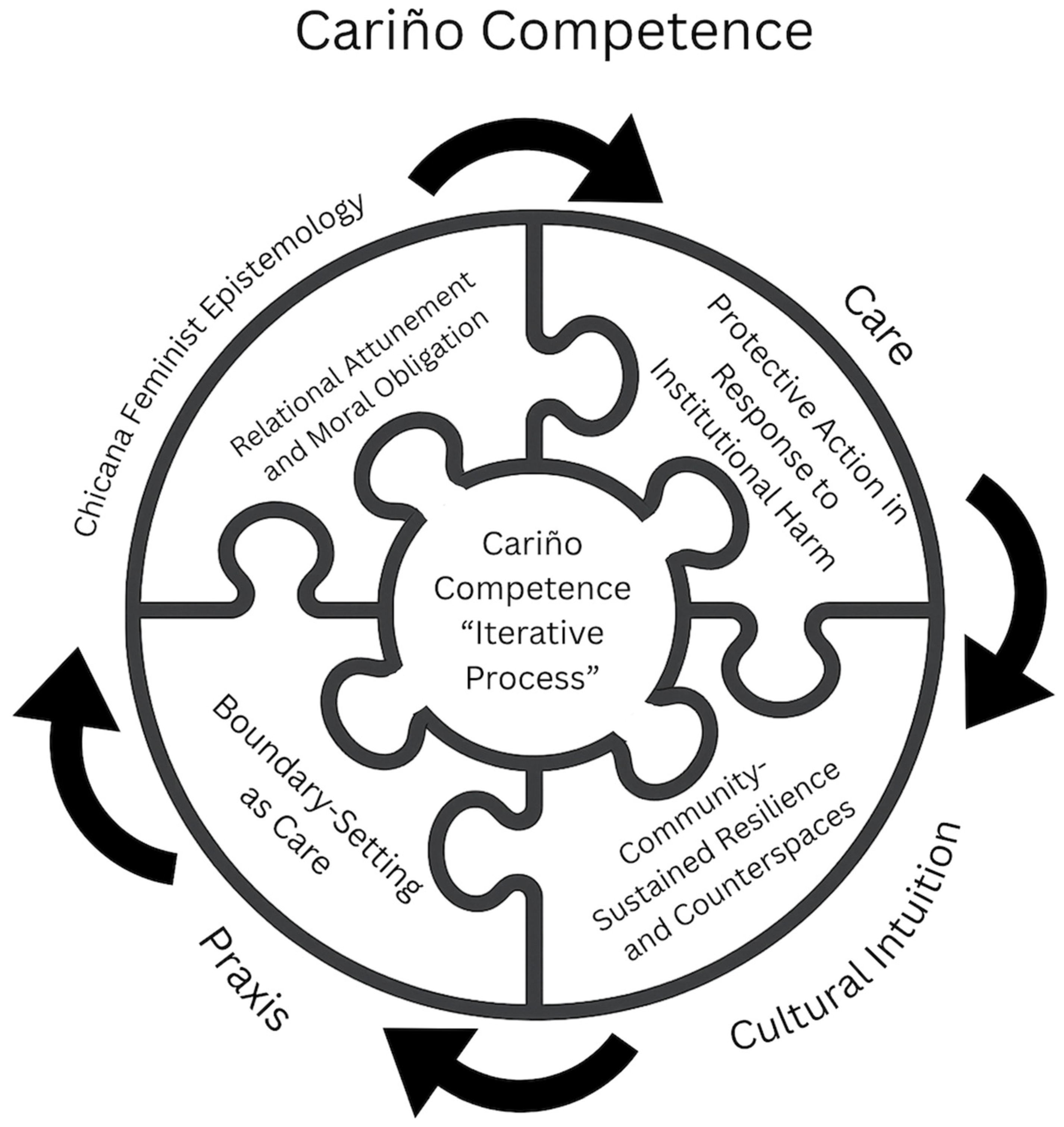
Cariño Competence in STEM: Women of Color Leadership as Cultural Intuition Praxis

Abstract
1. Introduction
2. Relevant Literature
2.1. Equity Leadership as Identity-Embedded and Culturally Situated Praxis
2.2. Structural Inequities and the Burden of Equity Labor in STEM Leadership
2.3. Counterspaces and Collective Infrastructures for Leadership Sustainability
2.4. Conceptual and Theoretical Framework
3. Methodology
3.1. Research Design
3.2. Research Context and Participants
3.3. Data Collection and Analysis
3.4. Trustworthiness and Reflexivity
3.5. Positionality Statements
4. Findings: The Emergence of Cariño Competence in STEM Leadership
4.1. Cariño Competence 1: Relational Attunement Grounded in Moral Obligation
4.1.1. Student-Anchored Moral Commitment
4.1.2. Ethical Reflexivity
4.1.3. Relational Listening
4.2. Cariño Competence 2: Protective Action in Response to Institutional Harm
4.2.1. Calling Out Dominant Whiteness and Structural Misalignment
4.2.2. Buffering Institutional Harm: Creating Relational Shields
4.2.3. Data as Shield—Proactively Safeguarding Equity Through Evidence
4.2.4. Counter-Surveillance: Naming Mistrust and Racialized Harm
4.3. Cariño Competence 3: Boundary-Setting as Care
4.4. Cariño Competence 4: Creating Counterspaces as Relational Scaffolds for Leadership Resilience
5. Discussion: Advancing Culturally Grounded STEM Leadership Through Cariño Competence
5.1. Relational Attunement
5.2. Protective Action
5.3. Boundary-Setting
5.4. Community-Sustained Resilience
6. Implications
6.1. Policy Implications
6.2. Implications for Future Research
Author Contributions
Funding
Institutional Review Board Statement
Informed Consent Statement
Data Availability Statement
Acknowledgments
Conflicts of Interest
| 1 | We capitalize terms such as Women of Color, Students of Color, and Professionals of Color to recognize these as collective political identities shaped by racialization and structural inequities (Crenshaw, 2021; Delgado Bernal et al., 2018). |
References
- Abraham, T. H., Finley, E. P., Drummond, K. L., Haro, E. K., Hamilton, A. B., Townsend, J. C., Littman, A. J., & Hudson, T. (2021). A method for developing trustworthiness and preserving richness of qualitative data during team-based analysis of large data sets. American Journal of Evaluation, 42(1), 139–156. [Google Scholar] [CrossRef] [Scilit]
- Acevedo, N., Nunez-Rivera, S., Casas, Y., Cruz, E., & Rivera, P. (2021). Enacting spiritual activism to develop a sense of belonging: Latina community college students choosing and persisting in STEM. Journal of Women and Gender in Higher Education, 14(1), 59–78. [Google Scholar] [CrossRef] [Scilit]
- Anzaldúa, G. (1987). Borderlands/La frontera: The new mestiza. Aunt Lute Books. [Google Scholar]
- Bensimon, E. M. (2007). The underestimated significance of practitioner knowledge in the scholarship on student success. The Review of Higher Education, 30(4), 441–469. [Google Scholar] [CrossRef] [Scilit]
- Bensimon, E. M. (2018). Reclaiming racial justice in equity. Change: The Magazine of Higher Learning, 50(3–4), 95–98. [Google Scholar] [CrossRef] [Scilit]
- Bensimon, E. M. (2020). The case for an anti-racist stance toward paying off higher education’s racial debt. Change: The Magazine of Higher Learning, 52(2), 7–11. [Google Scholar] [CrossRef] [Scilit]
- Bensimon, E. M., Dowd, A. C., Stanton-Salazar, R., & Dávila, B. A. (2019). The role of institutional agents in providing institutional support to Latinx students in STEM. The Review of Higher Education, 42(4), 1689–1721. [Google Scholar] [CrossRef] [Scilit]
- Charmaz, K. (2014). Constructing grounded theory (2nd ed.). Sage Publications. [Google Scholar]
- Chen, Y. W., & Lawless, B. (2025). “I felt too involved in something that I didn’t know how to deal with”: Navigating emotional labor as “immigrant” women in US Academia. International Journal of Qualitative Studies in Education, 38(1), 127–140. [Google Scholar] [CrossRef] [Scilit]
- Choi, Y. H. (2024). Master narratives and resistance narratives: How women of color on community college STEM education pathways push back. Community College Review, 52(3), 263–288. [Google Scholar] [CrossRef] [Scilit]
- Collins, K. H., Price, E. F., Hanson, L., & Neaves, D. (2020). Consequences of stereotype threat and imposter syndrome: The personal journey from STEM-practitioner to STEM-educator for four women of color. Taboo: The Journal of Culture and Education, 19(4), 10. [Google Scholar]
- Crenshaw, K. (2021). Demarginalizing the intersection of race and sex: A black feminist critique of antidiscrimination doctrine, feminist theory and antiracist politics. Droit et Société, 108, 465. [Google Scholar] [CrossRef] [Scilit]
- Curry, K. A. (2021). Caring as political praxis: Reclaiming cariño in education. Teachers College Press. [Google Scholar]
- DeCuir-Gunby, J. T., Johnson, O. T., Womble Edwards, C., McCoy, W. N., & White, A. M. (2020). African American professionals in higher education: Experiencing and coping with racial microaggressions. Race Ethnicity and Education, 23(4), 492–508. [Google Scholar] [CrossRef] [Scilit]
- De La Cruz Albizu, D. (2024). Intersectional approaches to leadership identity development: Supporting diverse aspiring educational leaders. Education Sciences, 14(12), 1274. [Google Scholar] [CrossRef] [Scilit]
- Delgado Bernal, D. (1998). Using a Chicana feminist epistemology in educational research. Harvard Educational Review, 68(4), 555–583. [Google Scholar] [CrossRef] [Scilit]
- Delgado Bernal, D. (2020). Disrupting epistemological boundaries: Reflections on feminista methodological and pedagogical interventions. Aztlán: A Journal of Chicano Studies, 45(1), 155–169. [Google Scholar] [CrossRef] [Scilit]
- Delgado Bernal, D., Huber, L. P., & Malagón, M. C. (2018). Bridging theories to name and claim a critical race feminista methodology. In Understanding critical race research methods and methodologies (pp. 109–121). Routledge. [Google Scholar]
- Dobbs, C. L., & Leider, C. M. (2021). “Does this happen to everyone?”: Women professors of color reflect on experiences in the academy. International Journal of Qualitative Studies in Education, 36(7), 1371–1385. [Google Scholar] [CrossRef] [Scilit]
- Erickson, F. (1986). Qualitative methods in research on teaching. In M. C. Wittrock (Ed.), Handbook of research on teaching (3rd ed., pp. 119–161). Macmillan. [Google Scholar]
- Erickson, F. (1998). Qualitative research methods for science education. In International handbook of science education (pp. 1133–1173). Kluwer. [Google Scholar]
- Estrada, C., Felix, E. R., Vedar, E. N. R., & Perez, E. J. (2024). Latina community college presidents: Drawing from cultural intuition to disrupt leadership norms in higher education. Education Sciences, 15(1), 35. [Google Scholar] [CrossRef] [Scilit]
- Freire, P. (1970). Pedagogy of the oppressed. Seabury. [Google Scholar]
- Fuselier, N., & Beatty, C. C. (2023). Social identities and leadership identity development. New Directions for Student Leadership, 2023(178), 45–54. [Google Scholar] [CrossRef] [Scilit]
- García, C. T. (2023). Chicana Feminist Epistemology in higher education. Research Encyclopedia of Education. [Google Scholar]
- Gordon, H. R., Willink, K., & Hunter, K. (2024). Invisible labor and the associate professor: Identity and workload inequity. Journal of Diversity in Higher Education, 17(3), 285. [Google Scholar] [CrossRef] [Scilit]
- Guthrie, K. L., & Beatty, C. C. (2022). Centering socially just leadership: An integrated model for contextualizing leadership learning. Journal of Leadership Studies, 16(3), 22–27. [Google Scholar] [CrossRef] [Scilit]
- Hall, N., & Johnson, J. M. (2025). Belonging among Black women DEI leaders post the 2020 social justice movement. Education Sciences, 15(8), 1002. [Google Scholar] [CrossRef] [Scilit]
- Jones, S. M., & Kee, C. (2021). The invisible labor of diversity educators in higher education. The SoJo Journal, 7(1), 35–50. [Google Scholar]
- Khalifa, M. A., Gooden, M. A., & Davis, J. E. (2016). Culturally responsive school leadership: A synthesis of the literature. Review of Educational Research, 86(4), 1272–1311. [Google Scholar] [CrossRef] [Scilit]
- Kim, E., & Ishimaru, K. L. (2025). Centering identity and multilingualism in educational leadership preparation programs. Education Sciences, 15(11), 1435. [Google Scholar] [CrossRef] [Scilit]
- Kim, T., & Ishimaru, A. M. (2025). On our own terms: Asian diasporic onto-epistemologies of educational leadership as radical relationality. International Journal of Qualitative Studies in Education, 1–24. [Google Scholar] [CrossRef] [Scilit]
- King, N. S., Peña-Telfer, L., & Earls, S. (2023). “The work I do matters”: Cultivating a STEM counterspace for Black girls through social-emotional development and culturally sustaining pedagogies. Education Sciences, 13(7), 754. [Google Scholar] [CrossRef] [Scilit]
- Liera, R., & Desir, S. (2023, July). Taking equity-mindedness to the next level: The equity-minded organization. In Frontiers in education (Vol. 8, p. 1199174). Frontiers Media SA. [Google Scholar]
- Lincoln, Y. S., & Guba, E. A. (1985). Naturalist inquiry. Sage. [Google Scholar]
- Mahatmya, D., Grooms, A. A., Young Kim, J., McGinnis, D., & Johnson, E. (2022). Burnout and race-related stress among BIPOC women K–12 educators. Journal of Education Human Resources, 40(1), 58–89. [Google Scholar] [CrossRef] [Scilit]
- Martinez, M. A. (2025). Living and leading in Nepantla: An expansive ontological and epistemological approach to educational leadership. Journal of Educational Administration and History, 57(4), 379–399. [Google Scholar] [CrossRef] [Scilit]
- McGee, E. O. (2020). Interrogating structural racism in STEM higher education. Educational Researcher, 49(9), 633–644. [Google Scholar] [CrossRef] [Scilit]
- McGee, E. O., & Bentley, L. (2017). The troubled success of Black women in STEM. Cognition and Instruction, 35(4), 265–289. [Google Scholar] [CrossRef] [Scilit]
- McGee, E. O., Morton, T. R., White, D. T., & Frierson, W. (2023). Accelerating racial activism in STEM higher education by institutionalizing equity ethics. Teachers College Record, 125(9), 108–139. [Google Scholar] [CrossRef] [Scilit]
- McGee, E. O., & Stovall, D. O. (2026). STEM’s dirty secret: How grit and resilience mask systemic racism. Educational Theory, 76(1), 57–68. [Google Scholar] [CrossRef] [Scilit]
- McNair, T. B., Bensimon, E. M., & Malcom-Piqueux, L. (2020). From equity talk to equity walk: Expanding practitioner knowledge for racial justice in higher education. John Wiley & Sons. [Google Scholar]
- Miles, M. L., Agger, C. A., Roby, R. S., & Morton, T. R. (2022). Who’s who: How “women of color” are (or are not) represented in STEM education research. Science Education, 106(2), 229–256. [Google Scholar] [CrossRef] [Scilit]
- Morales, S., Flores, A. I., Gaxiola Serrano, T. J., & Delgado Bernal, D. (2023). Feminista pláticas as a methodological disruption: Drawing upon embodied knowledge, vulnerability, healing, and resistance. International Journal of Qualitative Studies in Education, 36(9), 1631–1643. [Google Scholar] [CrossRef] [Scilit]
- Muhs, G. G. Y., Niemann, Y. F., Gonzales, C. G., & Harris, A. P. (Eds.). (2020). Presumed incompetent II: Race, class, power, and gender in academia. Routledge. [Google Scholar]
- Naeem, M., Ozuem, W., Howell, K., & Ranfagni, S. (2023). A step-by-step process of thematic analysis to develop a conceptual model in qualitative research. International Journal of Qualitative Methods, 22, 16094069231205789. [Google Scholar] [CrossRef] [Scilit]
- Nagda, B. R. A., & Roper, L. D. (2019). Reimagining leadership development for social change through critical dialogue practices. New Directions for Student Leadership, 2019(163), 117–136. [Google Scholar] [CrossRef] [Scilit] [PubMed]
- Nganga, C., Jamison, K., & Shepard, S. (2025). Transforming knowledge into Praxis in equity and justice-oriented educational leadership. Journal of Research on Leadership Education, 20(3), 347–371. [Google Scholar] [CrossRef] [Scilit]
- Niemann, Y. F. (2012). Lessons from the experiences of Women of Color working in academia. In G. G. y. Muhs, Y. F. Niemann, C. G. Gonzales, & A. P. Harris (Eds.), Presumed incompetent: The intersections of race and class for women in academia (pp. 345–362). Utah State University Press. [Google Scholar]
- Nkrumah, T., & Scott, K. A. (2022). Mentoring in STEM higher education: A synthesis of the literature to (re) present the excluded women of color. International Journal of STEM Education, 9(1), 50. [Google Scholar] [CrossRef] [Scilit]
- Noddings, N. (1984). Caring: A feminine approach to ethics and moral education. University of California Press. [Google Scholar]
- Ong, M., Smith, J. M., & Ko, L. T. (2018). Counterspaces for women of color in STEM higher education: Marginal and central spaces for persistence and success. Journal of Research in Science Teaching, 55(2), 206–245. [Google Scholar] [CrossRef] [Scilit]
- Patton, M. Q. (2015). Qualitative research & evaluation methods: Integrating theory and practice (4th ed., pp. 273–290). Sage Publications, Inc. [Google Scholar]
- Pearson, F., Rodriguez-Arroyo, S., & Gutiérrez, G. (2021). Cariño pedagogy: A framework of corazón. Journal of Curriculum, Teaching, Learning and Leadership in Education, 6(1), 82. [Google Scholar]
- Pérez Huber, L. P., Gonzalez, T., Robles, G., & Solórzano, D. G. (2021). Racial microaffirmations as a response to racial microaggressions: Exploring risk and protective factors. New Ideas in Psychology, 63, 100880. [Google Scholar] [CrossRef] [Scilit]
- Poon, O. A. (2023). “Think about it as decolonizing our minds”: Spaces for critical race pedagogy and transformative leadership development. In The misrepresented minority (pp. 294–310). Routledge. [Google Scholar]
- Ray, V. (2019). A theory of racialized organizations. American Sociological Review, 84(1), 26–53. [Google Scholar] [CrossRef] [Scilit]
- Rendón, L., Nora, A., Bledsoe, R., & Kanagala, V. (2020). Científcos Latinxs: Uncovering the counter-story of success in STEM. In S. J. Paik, S. M. Kula, J. J. González, & V. V. González (Eds.), High-achieving Latino students: Successful pathways toward college and beyond (pp. 159–177). IAP Information Age Publishing. [Google Scholar]
- Roby, R. S., Udoh, E. E., Williams, M. R., Hunter, A. E., Wardin, A. M., Miles, M. L., & Morton, T. (2022). # SayHerName: Anchoring black feminist epistemologies at the crux of postsecondary STEM culture. Journal of Women and Minorities in Science and Engineering, 28(3), 83–99. [Google Scholar]
- Rocha, J., Coronella, T., Reyes, M., & Romasanta, L. (2024). The value of scholar-practitioner cultural intuition in transforming educational systems. International Journal of Qualitative Studies in Education, 37(6), 1752–1771. [Google Scholar] [CrossRef] [Scilit]
- Sánchez, B., Salazar, C., & Guerra, J. (2021). “I feel like I have to be the whitest version of myself”: Experiences of early career Latina higher education administrators. Journal of Diversity in Higher Education, 14(4), 592. [Google Scholar] [CrossRef] [Scilit]
- Settles, I. H., Jones, M. K., Buchanan, N. T., & Brassel, S. T. (2022). Epistemic exclusion of women faculty and faculty of color: Understanding scholar (ly) devaluation as a predictor of turnover intentions. The Journal of Higher Education, 93(1), 31–55. [Google Scholar] [CrossRef] [Scilit]
- Solórzano, D. G. (2024). My journey to this place called the RAC: Reflections on a movement in critical race thought and critical race hope in higher education. In Critical race theory and qualitative methods (pp. 87–98). Routledge. [Google Scholar]
- Strauss, A., & Corbin, J. (1998). Basics of qualitative research: Techniques and procedures for developing grounded theory (2nd ed.). Sage Publications, Inc. [Google Scholar]
- Ueda, N., Kezar, A., Holcombe, E., Vigil, D., & Harper, J. (2024). Emotional labor: Institutional responsibility and strategies to offer emotional support for leaders engaging in diversity, equity, and inclusion work. AERA Open, 10, 23328584241296092. [Google Scholar] [CrossRef] [Scilit]
- Valdez, V. E., & Amoakoh, J. (2025). Critical reflection & the fostering of community-centric authentic cariño to transform in-service teachers’ engagement with multilingual communities. The Urban Review, 57(5), 1457–1476. [Google Scholar]
- Valenzuela, A. (1999). Subtractive schooling: U.S.-Mexican youth and the politics of caring. State University of New York Press. [Google Scholar]
- Woods, J. C., Jr., Lane, T. B., Huggins, N., Leggett Watson, A., Jan, F. T., Johnson Austin, S., & Thomas, S. (2024). Structural impediments impacting early-career women of color STEM faculty careers. Education Sciences, 14(6), 581. [Google Scholar] [CrossRef] [Scilit]
- Yin, R. K. (2018). Case study research and applications: Design and methods (6th ed.). Sage; State University of New York Press. [Google Scholar]
- Yosso, T. J. (2005). Whose culture has capital? A critical race theory discussion of community cultural wealth. Race Ethnicity and Education, 8(1), 69–91. [Google Scholar] [CrossRef] [Scilit]
- Yosso, T. J., & Hanchett Hanson, M. (2026). Creativity and community cultural wealth: A discussion with Tara Yosso. In Creative contexts: Our worlds as actors in the dynamics of change (pp. 179–200). Springer Nature Switzerland. [Google Scholar]


| CODE | CODE Definition | Theme | THEME Definition |
|---|---|---|---|
| (1a) Student-Centered Moral Anchor | Centering students as the “why” behind decisions. This can include a reference to a similar lived experience. | 1. Relational Attunement as Moral Obligation | Leadership practices through which Women of Color attune to the lived realities of students, colleagues, and community members, grounding decisions in ethical responsibility rather than procedural compliance. |
| (1b) Ethical Reflexivity | Naming moral responsibility, ethics, or obligation. This can include self-interrogation of impact. | ||
| (1c) Relational Listening | Adjusting leadership actions based on relational awareness, an attention to others’ lived experiences and relationship building. | ||
| (2a) Buffering Institutional Failure | Intervening when systems cause harm | 2. Protective Action in Response to Institutional Harm | Acts of intervention, buffering, or resistance enacted when institutional structures, leadership, or grant systems fail to protect students, staff, or equity goals. |
| (2b) Calling Out Dominant Whiteness | Challenging dominant/white institutional norms | ||
| (2c) Data as Shield | Creating safeguards (e.g., documentation, data protection) as evidence of impact or to protect credibility. | ||
| (2d) Counter-Surveillance | Naming mistrust, false accusations, or racialized harm | ||
| (3a) Resisting Extractive Leadership | Capacity Assertion—naming experiences overwork/excessive labor without adequate pay. Refusal as Ethical Action—framing boundaries as care, not disengagement; self-care Racialized Labor Awareness—explicit resistance to exploitation; Burnout narratives | 3. Boundary-Setting as Care | Leadership practices that resist extractive labor expectations by setting boundaries as an ethical act of self-preservation and collective sustainability. |
| (4a) Women of Color Counterspaces | Naming intentional (counter)spaces as survival or reliance on relationships for collective meaning/sense making. | 4. Community-Sustained Resilience and Counterspaces | The cultivation of networks, counterspaces, and collective care among Women of Color that sustain leadership resilience and protect against institutional harm. |
Disclaimer/Publisher’s Note: The statements, opinions and data contained in all publications are solely those of the individual author(s) and contributor(s) and not of MDPI and/or the editor(s). MDPI and/or the editor(s) disclaim responsibility for any injury to people or property resulting from any ideas, methods, instructions or products referred to in the content. |
© 2026 by the authors. Licensee MDPI, Basel, Switzerland. This article is an open access article distributed under the terms and conditions of the Creative Commons Attribution (CC BY) license.
Share and Cite
Rocha, J.; Arellano, L., Jr.; Rodriguez, M.A.; Murillo, J.C. Cariño Competence in STEM: Women of Color Leadership as Cultural Intuition Praxis. Educ. Sci. 2026, 16, 930. https://doi.org/10.3390/educsci16060930
Rocha J, Arellano L Jr., Rodriguez MA, Murillo JC. Cariño Competence in STEM: Women of Color Leadership as Cultural Intuition Praxis. Education Sciences. 2026; 16(6):930. https://doi.org/10.3390/educsci16060930
Chicago/Turabian StyleRocha, Janet, Lucy Arellano, Jr., Margarita Anahi Rodriguez, and Juan Carlos Murillo. 2026. "Cariño Competence in STEM: Women of Color Leadership as Cultural Intuition Praxis" Education Sciences 16, no. 6: 930. https://doi.org/10.3390/educsci16060930
APA StyleRocha, J., Arellano, L., Jr., Rodriguez, M. A., & Murillo, J. C. (2026). Cariño Competence in STEM: Women of Color Leadership as Cultural Intuition Praxis. Education Sciences, 16(6), 930. https://doi.org/10.3390/educsci16060930