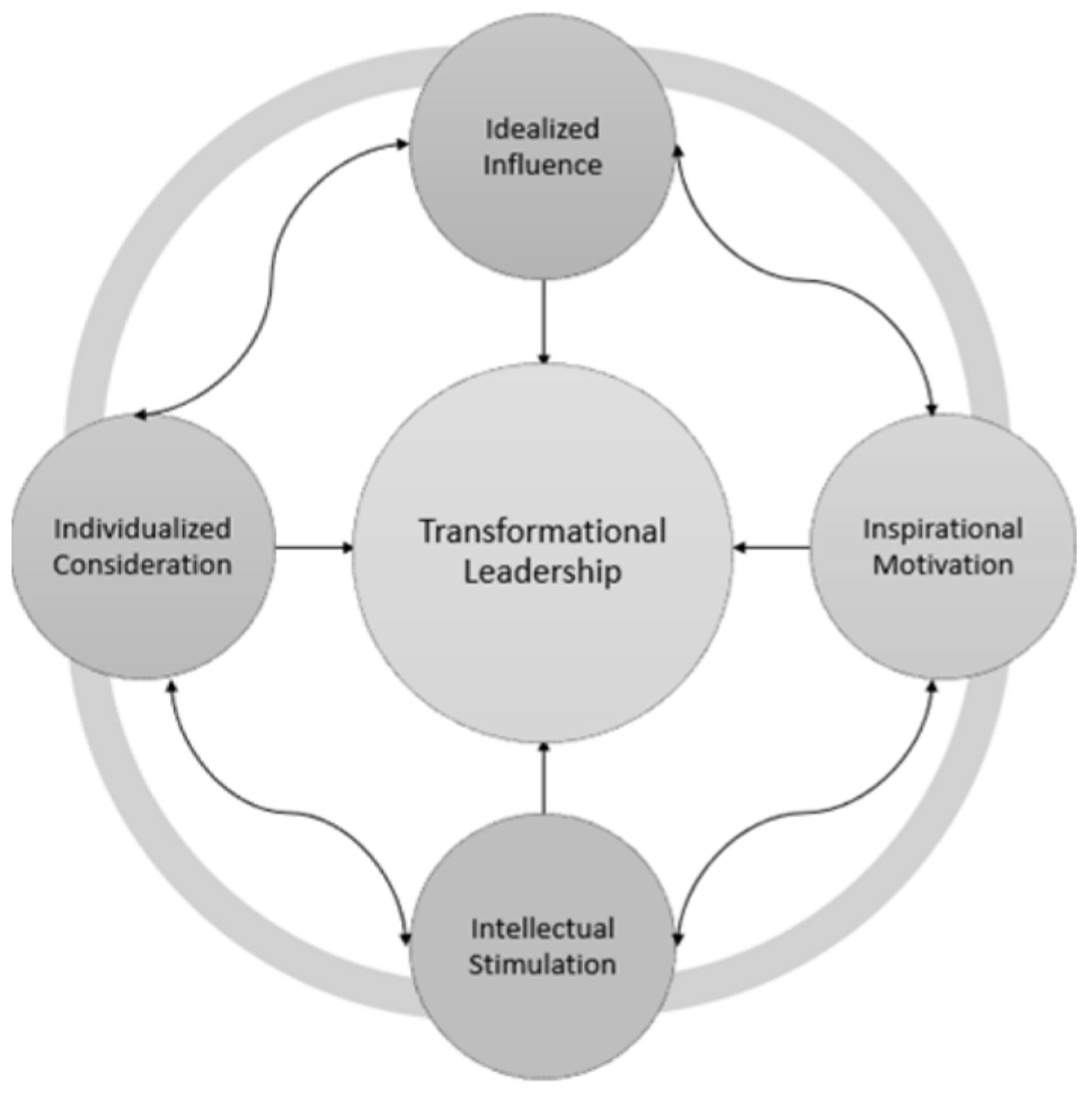
Transformational Leadership in Higher Education: A Motivation–Ability–Opportunity Perspective

Abstract
1. Introduction
2. Conceptual Foundations of TL in HE
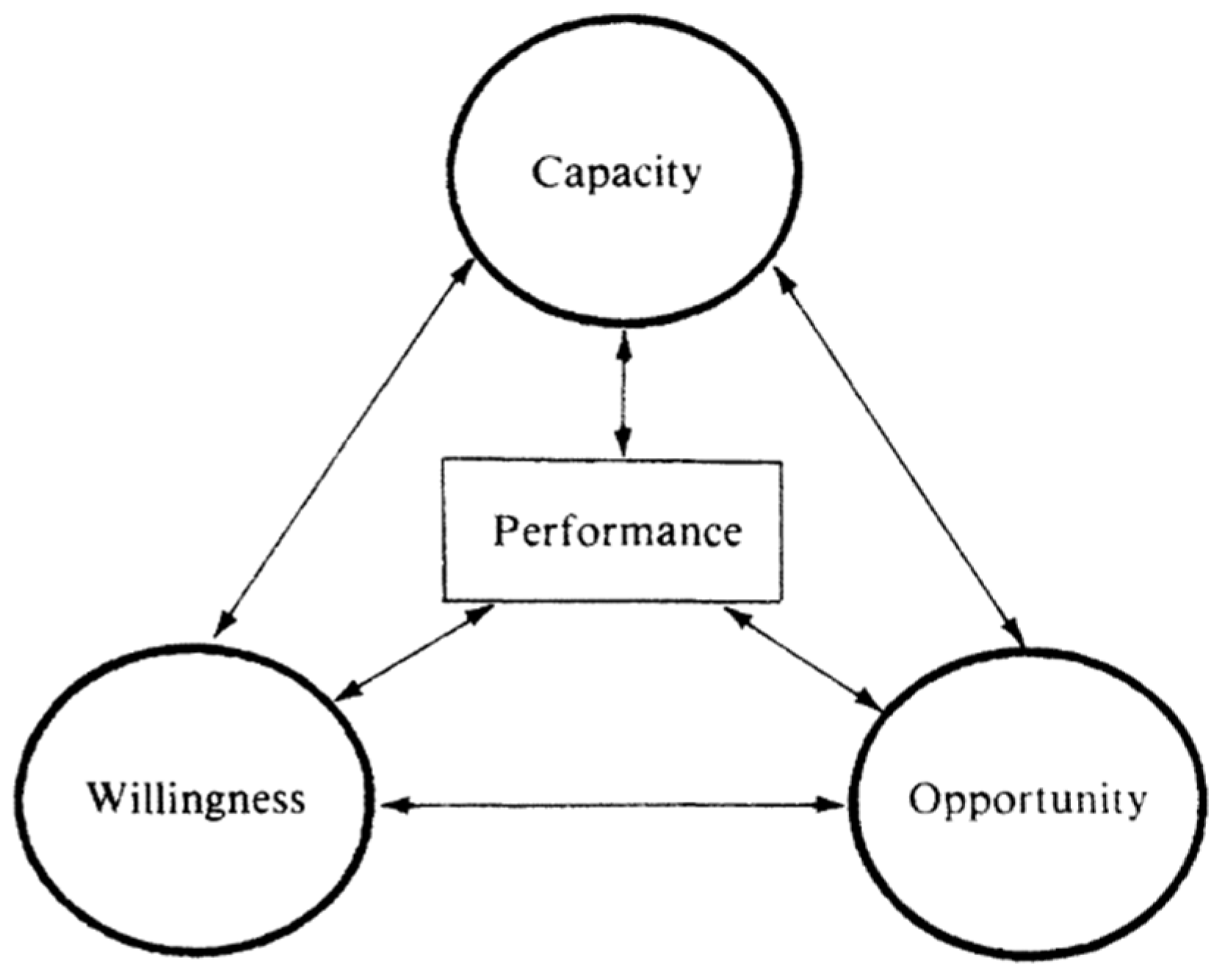
3. Analytical Lens: The MAO Framework
4. Methods
4.1. Research Design
4.2. Framework Development
- Title and abstract screening excluded papers unrelated to TL or HE.
- Full-text examination retained studies explicitly analysing TL—conceptually or empirically—within HE settings.
- Theoretical sufficiency testing ensured that each paper contained adequate conceptual elaboration to support abductive synthesis through the MAO framework.
- Title, Journal, Author(s)/Year
- Aim and Methodology (including sample, instruments, and analytic technique)
- Context (region, HE level, and actor group)
- Definition or conceptualisation of TL
- Strengths or theoretical contributions
- Limitations and critiques
- Contingency factors moderating TL effectiveness
- Mapping to the MAO dimensions
- Dependent variable or outcome measure
4.3. Mitigating Bias and Ensuring Trustworthiness
- Iterative memoing and audit trails documented analytic decisions;
- Cross-source triangulation verified theme convergence;
- Explicit linkage of codes to source citations maintained traceability;
- Within-study coherence was evaluated for each included article.
5. Findings
5.1. Descriptive Profile of the Synthesis Sample
5.2. Strengths of TL in HE
5.3. Limitations of TL in HE
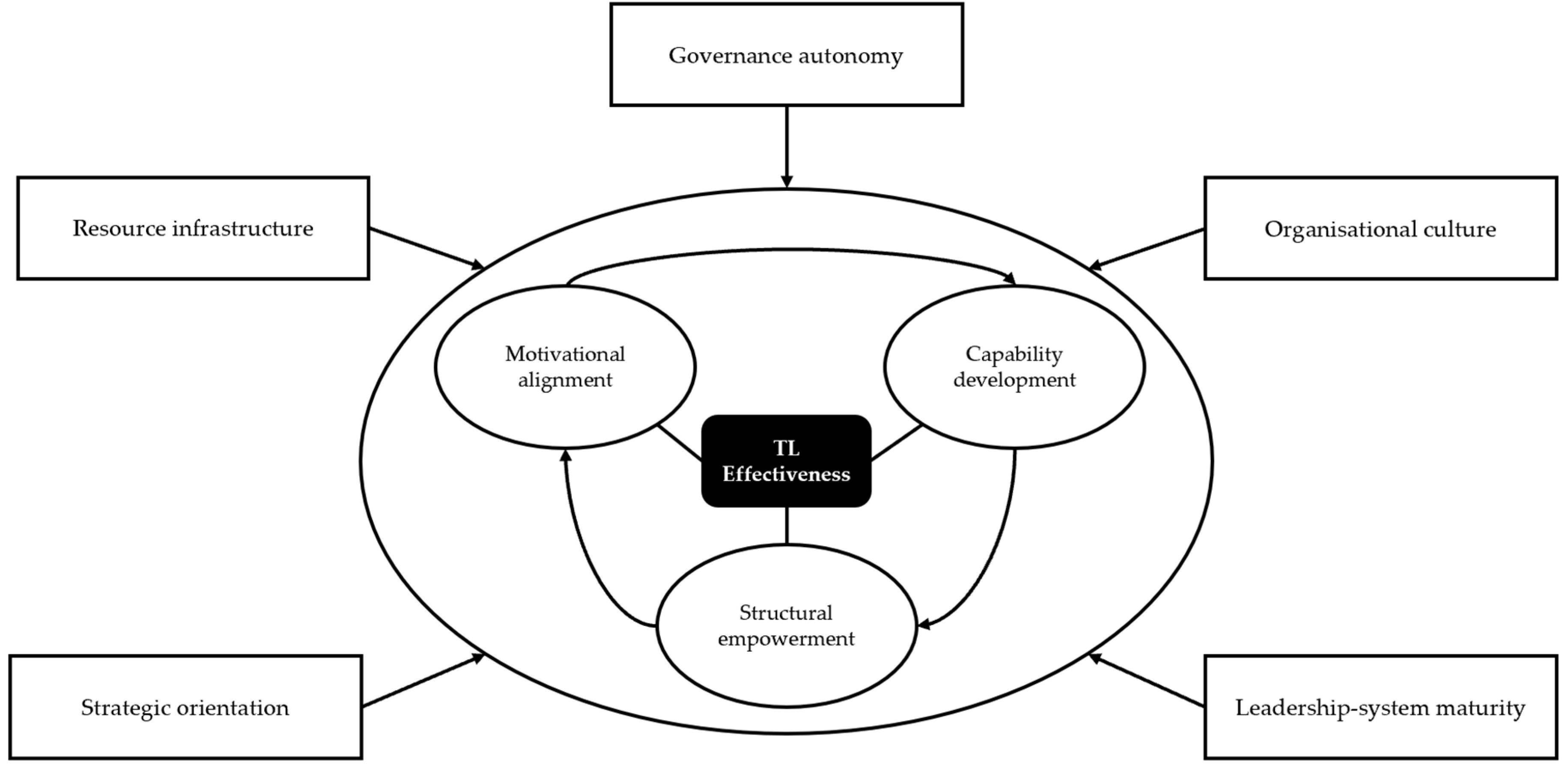
5.4. Contingency Factors Influencing TL Effectiveness
5.5. Integrative Framework
6. Illustrative Configurations from the Synthesis Sample
6.1. Innovation and Research Renewal
6.2. Teaching and Leadership Development
6.3. Participative Strategic Leadership
7. Limitations and Future Research
8. Conclusions
Supplementary Materials
Funding
Institutional Review Board Statement
Informed Consent Statement
Data Availability Statement
Conflicts of Interest
References
- Al-Aamri, M. S. H., Soliman, M., & Ponniah, L. S. (2024). Influencers of academic staff performance in higher education: The role of motivation, transformational leadership and involvement in strategic planning. Journal of Applied Research in Higher Education, 16(5), 1355–1372. [Google Scholar] [CrossRef] [Scilit]
- Al-Husseini, S., & Elbeltagi, I. (2016). Transformational leadership and innovation: A comparison study between Iraq’s public and private higher education. Studies in Higher Education, 41(1), 159–181. [Google Scholar] [CrossRef] [Scilit]
- Al-Husseini, S., Elbeltagi, I., & Moizer, J. (2021). Transformational leadership and innovation: The mediating role of knowledge sharing amongst higher education faculty. International Journal of Leadership in Education, 24(5), 670–689. [Google Scholar] [CrossRef] [Scilit]
- Al-Mansoori, S., & Koç, M. (2019). Transformational leadership, systems, and intrinsic motivation impacts on innovation in higher education institutes. Sustainability, 11(15), 4072. [Google Scholar] [CrossRef] [Scilit]
- Appelbaum, E., Bailey, T., Berg, P., & Kalleberg, A. L. (2000). Manufacturing advantage: Why high-performance work systems pay off. Cornell University Press. [Google Scholar]
- Bass, B. M. (1985). Leadership and performance beyond expectations. Free Press. [Google Scholar]
- Bass, B. M., & Avolio, B. J. (1994). Improving organizational effectiveness through transformational leadership. SAGE Publications. [Google Scholar]
- Bass, B. M., & Riggio, R. E. (2006). Transformational leadership (2nd ed.). Lawrence Erlbaum Associates Publishers. [Google Scholar]
- Bellibaş, M. Ş., Kılınç, A. Ç., & Polatcan, M. (2021). The moderation role of transformational leadership in the effect of instructional leadership on teacher professional learning and instructional practice: An integrated leadership perspective. Educational Administration Quarterly, 57(5), 793–830. [Google Scholar] [CrossRef] [Scilit]
- Bin Bakr, A. M., & Alfayez, H. A. (2022). Transformational leadership and the psychological empowerment of female leaders in Saudi higher education: An empirical study. Higher Education Research & Development, 41(6), 1805–1817. [Google Scholar] [CrossRef] [Scilit]
- Birnbaum, R. (1991). How colleges work: The cybernetics of academic organization and leadership. John Wiley & Sons. [Google Scholar]
- Blumberg, M., & Pringle, C. D. (1982). The missing opportunity in organizational research: Some implications for a theory of work performance. Academy of Management Review, 7(4), 560–569. [Google Scholar] [CrossRef] [Scilit]
- Bolden, R., Petrov, G., & Gosling, J. (2009). Distributed leadership in higher education: Rhetoric and reality. Educational Management Administration & Leadership, 37(2), 257–277. [Google Scholar] [CrossRef] [Scilit]
- Burns, J. M. (1978). Leadership. Harper & Row. [Google Scholar]
- Bush, T. (2020). Theories of educational leadership and management (5th ed.). SAGE Publications. [Google Scholar]
- Durach, C. F., Kembro, J., & Wieland, A. (2017). A new paradigm for systematic literature reviews in supply chain management. Journal of Supply Chain Management, 53(4), 67–85. [Google Scholar] [CrossRef] [Scilit]
- Elrehail, H., Emeagwali, O. L., Alsaad, A., & Alzghoul, A. (2018). The impact of transformational and authentic leadership on innovation in higher education: The contingent role of knowledge sharing. Telematics and Informatics, 35(1), 55–67. [Google Scholar] [CrossRef] [Scilit]
- Etomes, E. E., Nsor, C. A., & Agbor, E. E. (2025). Transformational leadership for sustainable productivity in higher education institutions of Cameroon. Higher Education, 90(3), 521–538. [Google Scholar] [CrossRef] [Scilit]
- Evers, C. W., & Lakomski, G. (2012). Leadership for learning: A philosophical analysis. Bloomsbury Academic. [Google Scholar]
- Gioia, D. A., Corley, K. G., & Hamilton, A. L. (2013). Seeking qualitative rigor in inductive research: Notes on the Gioia methodology. Organizational Research Methods, 16(1), 15–31. [Google Scholar] [CrossRef] [Scilit]
- Gotsch, M. L., & Schögel, M. (2023). Addressing the privacy paradox on the organizational level: Review and future directions. Management Review Quarterly, 73, 263–296. [Google Scholar] [CrossRef] [Scilit]
- Habeeb, R. U., & Eyupoglu, S. Z. (2024). Strategic planning, transformational leadership and organizational performance: Driving forces for sustainability in higher education in Nigeria. Sustainability, 16(11), 4348. [Google Scholar] [CrossRef] [Scilit]
- Hallinger, P. (2018). Bringing context out of the shadows of leadership. Educational Management Administration & Leadership, 46(1), 5–24. [Google Scholar] [CrossRef] [Scilit]
- Jiang, K., Lepak, D. P., Hu, J., & Baer, J. C. (2012). How does human resource management influence organizational outcomes? A meta-analytic investigation of mediating mechanisms. Academy of Management Journal, 55(6), 1264–1294. [Google Scholar] [CrossRef] [Scilit]
- Kellner, A., Cafferkey, K., & Townsend, K. (2019). Ability, motivation and opportunity theory: A formula for employee performance? In K. Townsend, K. Cafferkey, A. M. McDermott, & T. Dundon (Eds.), Elgar introduction to theories of human resources and employment relations (pp. 311–323). Edward Elgar Publishing. [Google Scholar] [CrossRef] [Scilit]
- Kovács, G., & Spens, K. M. (2005). Abductive reasoning in logistics research. International Journal of Physical Distribution & Logistics Management, 35(2), 132–144. [Google Scholar] [CrossRef] [Scilit]
- Lamm, K. W., Sapp, L. R., Randall, N. L., & Lamm, A. J. (2021). Leadership development programming in higher education: An exploration of perceptions of transformational leadership across gender and role types. Tertiary Education and Management, 27(4), 297–312. [Google Scholar] [CrossRef] [Scilit] [PubMed]
- Leithwood, K., & Jantzi, D. (2005). Transformational leadership. In B. Davies (Ed.), The essentials of school leadership (pp. 31–43). SAGE Publications. [Google Scholar]
- Leithwood, K., Louis, K. S., Anderson, S., & Wahlstrom, K. (2004). How leadership influences student learning. The Wallace Foundation. Available online: https://wallacefoundation.org/report/how-leadership-influences-student-learning (accessed on 2 June 2026). [CrossRef] [Scilit]
- Lincoln, Y. S., & Guba, E. G. (1985). Naturalistic inquiry. SAGE Publications. [Google Scholar]
- Liu, H., Cutcher, L., & Grant, D. (2015). Doing authenticity: The gendered construction of authentic leadership. Gender, Work & Organization, 22(3), 237–255. [Google Scholar] [CrossRef] [Scilit]
- Marginson, S. (2016). The dream is over: The crisis of Clark Kerr’s California idea of higher education. University of California Press. [Google Scholar]
- Meng, Q. (2022). Analysis of the relationship between transformational leadership and educational management in higher education based on deep learning. Computational Intelligence and Neuroscience, 2022, 7208072. [Google Scholar] [CrossRef] [Scilit]
- Nguyen, T. M. L., Nguyen, P. V., & Nguyen, T. T. (2025). Employee informal coaching and job performance in higher education: The role of perceived organizational support and transformational leadership. PLoS ONE, 20(1), e0312345. [Google Scholar] [CrossRef] [Scilit]
- Northouse, P. G. (2016). Leadership: Theory and practice (7th ed.). SAGE Publications. [Google Scholar]
- Owusu-Agyeman, Y. (2021). Transformational leadership and innovation in higher education: A participative process approach. International Journal of Leadership in Education, 24(5), 695–714. [Google Scholar] [CrossRef] [Scilit]
- Ritchie-Dunham, S., Martínez-Fernández, M. A., Rodríguez, I., & Escudero, A. (2023). Advancing sustainability leadership by shifting relational ‘agreement structures’: A transformational higher education change program. Journal of Integrative Environmental Sciences, 20(1), 2190385. [Google Scholar] [CrossRef] [Scilit]
- Robinson, V. M. J., Lloyd, C. A., & Rowe, K. J. (2008). The impact of leadership on student outcomes: An analysis of the differential effects of leadership types. Educational Administration Quarterly, 44(5), 635–674. [Google Scholar] [CrossRef] [Scilit]
- Sarmento, A., & Riana, I. G. (2024). Lecturer performance in higher education: Transformational leadership, knowledge sharing, change adaptability and its relationship. Pegem Journal of Education and Instruction, 14(1), 261–269. [Google Scholar] [CrossRef] [Scilit]
- Siemsen, E., Roth, A. V., & Bala, H. (2008). How motivation, opportunity, and ability drive knowledge sharing: The MOA model of knowledge-sharing behavior. Journal of Operations Management, 26(3), 426–445. [Google Scholar] [CrossRef] [Scilit]
- Tambaip, A., Kambuaya, T., & Wambrauw, M. (2023). Higher education transformational leadership in Papua: Analysis of behavioral and competency aspects. Eurasian Journal of Educational Research, 23(103), 267–278. [Google Scholar]
- Tapsir, S., Ahmad, N. H., & Mohd-Yusoff, Y. (2025). Transformational leadership, Green HRM and top management commitment: Pathways to sustainability in Malaysian higher education. Journal of Applied Research in Higher Education, 17(2), 10–20. [Google Scholar] [CrossRef] [Scilit]
- Torraco, R. J. (2005). Writing integrative literature reviews: Guidelines and examples. Human Resource Development Review, 4(3), 356–367. [Google Scholar] [CrossRef] [Scilit]
- Tourish, D., Craig, R., & Amernic, J. (2010). Transformational leadership education and agency perspectives in business school pedagogy: A marriage of inconvenience? British Journal of Management, 21(s1), S40–S59. [Google Scholar] [CrossRef] [Scilit]
- Wen, R., & Harms, P. D. (2025). Transformational leadership transitions and employees’ entrepreneurial behavior in higher education institutions: A fuzzy-set qualitative comparative analysis. International Journal of Leadership in Education, 1–29. [Google Scholar] [CrossRef] [Scilit]
- Westen, W., & Graça, M. (2026). Managerial identity work: A systematic literature review with a conceptual model. Management Review Quarterly, 76, 61–89. [Google Scholar] [CrossRef] [Scilit]


| Contingency Domain | Primary MAO Dimension Affected | Mechanism of Influence | Empirical Illustrations |
|---|---|---|---|
| Governance autonomy | Opportunity | Decision latitude; participative structures; decentralisation | Al-Aamri et al. (2024); Wen and Harms (2025) |
| Resource infrastructure | Ability | Professional-learning access; workload moderation | Nguyen et al. (2025); Etomes et al. (2025) |
| Organisational culture | Motivation, Opportunity | Value congruence; relational trust; gendered norms | Elrehail et al. (2018); Bin Bakr and Alfayez (2022) |
| Leadership-system maturity | Ability, Opportunity | Institutionalisation of TL routines; succession planning | Sarmento and Riana (2024); Ritchie-Dunham et al. (2023) |
| Strategic orientation | Motivation | Mission alignment; authenticity of strategic goals | Etomes et al. (2025); Tourish et al. (2010) |
Disclaimer/Publisher’s Note: The statements, opinions and data contained in all publications are solely those of the individual author(s) and contributor(s) and not of MDPI and/or the editor(s). MDPI and/or the editor(s) disclaim responsibility for any injury to people or property resulting from any ideas, methods, instructions or products referred to in the content. |
© 2026 by the author. Licensee MDPI, Basel, Switzerland. This article is an open access article distributed under the terms and conditions of the Creative Commons Attribution (CC BY) license.
Share and Cite
Fayezi, S. Transformational Leadership in Higher Education: A Motivation–Ability–Opportunity Perspective. Educ. Sci. 2026, 16, 903. https://doi.org/10.3390/educsci16060903
Fayezi S. Transformational Leadership in Higher Education: A Motivation–Ability–Opportunity Perspective. Education Sciences. 2026; 16(6):903. https://doi.org/10.3390/educsci16060903
Chicago/Turabian StyleFayezi, Sajad. 2026. "Transformational Leadership in Higher Education: A Motivation–Ability–Opportunity Perspective" Education Sciences 16, no. 6: 903. https://doi.org/10.3390/educsci16060903
APA StyleFayezi, S. (2026). Transformational Leadership in Higher Education: A Motivation–Ability–Opportunity Perspective. Education Sciences, 16(6), 903. https://doi.org/10.3390/educsci16060903