Review

Transformational Leadership in Higher Education: A Motivation–Ability–Opportunity Perspective
School of Management, Adelaide University, Adelaide 5000, Australia
Educ. Sci. 2026, 16(6), 903; https://doi.org/10.3390/educsci16060903

Submission received: 7 April 2026 / Revised: 12 May 2026 / Accepted: 3 June 2026 / Published: 5 June 2026

Abstract

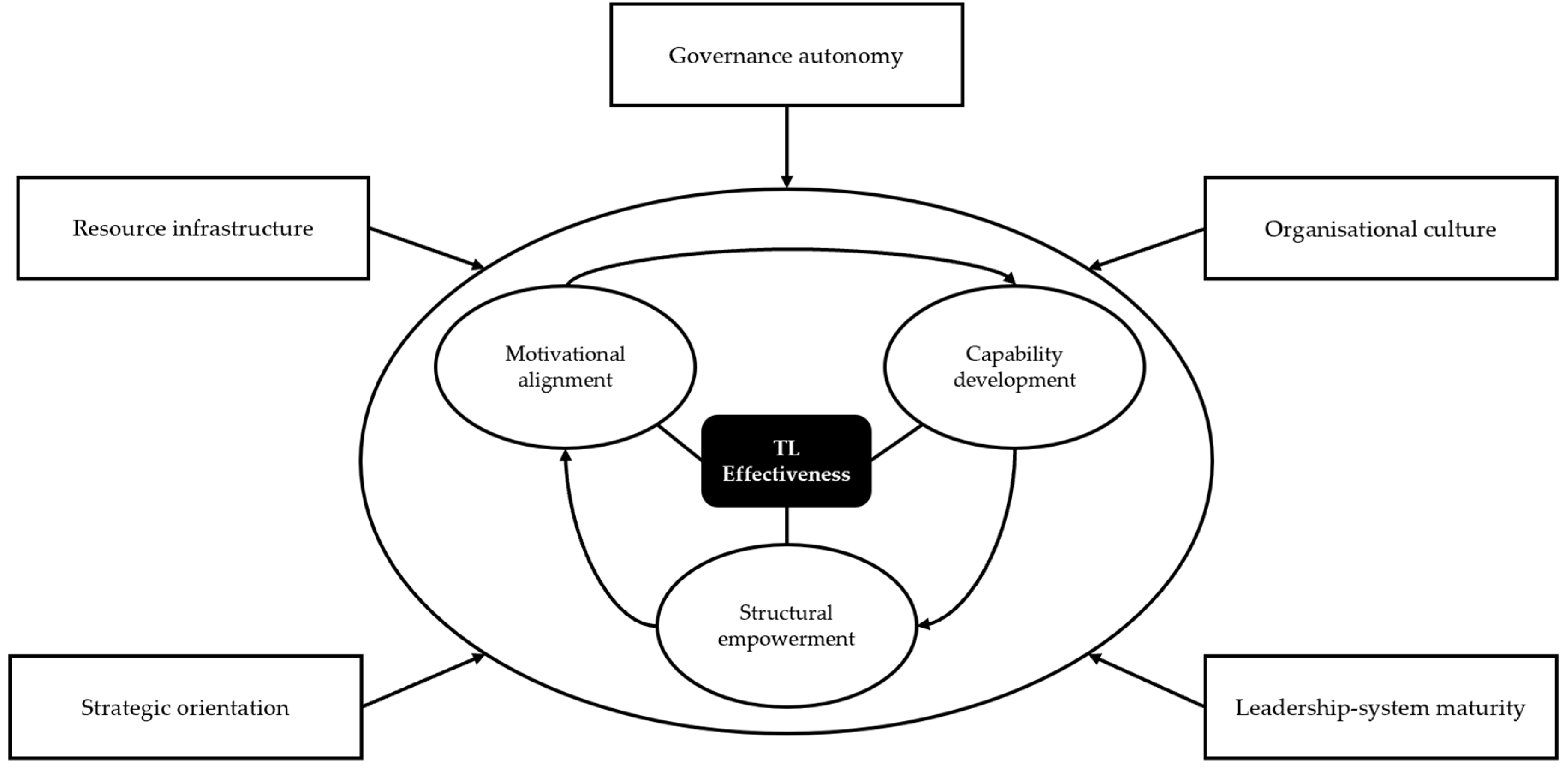
Transformational leadership (TL) remains a dominant framework in educational leadership, yet its effectiveness appears inconsistent across institutional contexts, including higher education (HE). This study develops a contingent explanation of TL using the Motivation–Ability–Opportunity (MAO) lens. Drawing on an integrative review of 19 empirical studies, the analysis examines how TL practices interact with organisational conditions to produce transformational or symbolic outcomes. The findings indicate that TL operates through three interdependent mechanisms: motivational alignment, capability development, and structural empowerment. However, these mechanisms are fragile and contingent upon contextual factors including governance autonomy, resource infrastructure, organisational culture, leadership-system maturity, and strategic orientation. When these conditions are aligned, TL fosters sustained engagement, innovation, and institutional learning. When they are misaligned, TL can devolve into rhetorical or symbolic practice, generating cynicism and inertia. The study contributes to the theory and practice of leadership in HE by reconceptualising TL as a conditional system rather than a universally effective leadership style, highlighting the importance of organisational context in enabling or constraining leadership impact.
Keywords: transformational leadership; higher education; motivation–ability–opportunity; leadership effectiveness; educational leadership transformational leadership; higher education; motivation–ability–opportunity; leadership effectiveness; educational leadership