1. Introduction and Literature Review
There is near global consensus that Science, Technology, Engineering, and Mathematics (STEM) education and workforce participation are crucial for national development, economic productivity, and, most importantly, societal wellbeing (
English, 2020;
Freeman et al., 2019;
Tytler, 2020). This importance is reflected in the rapid growth rates of STEM occupations relative to non-STEM occupations and their increasing proportional contributions to global economies (
Bacovic et al., 2022;
MacDonald et al., 2026;
NSC, 2021;
STA, 2023), although the impacts on localised and regional economies are more mixed (
Stewart, 2018). These trends are unlikely to abate as the fourth industrial revolution continues through the ubiquitous utilisation of big data, artificial intelligence and other emerging technologies (
Chaka, 2023). However, the expanding importance of STEM is undermined by longstanding reports of stagnation and decline in the interest, achievement and participation of students in core STEM subjects (
Pressick-Kilborn & Prescott, 2021;
Tytler et al., 2008). The challenge of ensuring lifelong engagement amongst all citizens and opportunities to participate economically in a world growing more dependent on STEM remains a foundational “wicked problem” in STEM education research (
Chappell et al., 2025).
Despite extensive research into STEM aspirations and participation, much of the existing literature remains focused on the future-oriented intentions of young people, rather than the retrospective experiences of STEM professionals. As a result, STEM career development is still frequently interpreted through implicitly linear “pipeline” assumptions that do not adequately capture the complexity and non-linearity of contemporary STEM career trajectories, particularly in non-metropolitan contexts. To address this issue, the following sections first examine the conceptual complexity of STEM learning and careers as a necessary foundation upon which to review existing research on STEM aspirations and career influences. The paper then presents the limited existing incorporation of STEM professionals in the wider STEM education research literature, before presenting the theoretical grounding, a summary of the stakeholder (STEM professionals) and context (non-metropolitan) gaps, and the research question.
Reasoned definitions of STEM learning and STEM careers are vital cornerstones for this paper. STEM disciplines should be integrated in ways that transform learning beyond disciplinary boundaries to enable learners to solve problems in open-ended ways by applying skills and knowledge in authentic settings (
MacDonald et al., 2019;
Roehrig et al., 2021). Similarly, STEM careers are often defined in the broadest terms as the direct or indirect application of science, technology, engineering and/or mathematics knowledge and skills through higher-order thinking, creative problem solving, and collaboration (
Byars-Winston, 2014;
Halim et al., 2018). Definitions of STEM careers have expanded to include supporting roles, such as educators, non-traditional entrepreneurial STEM work, and skilled technical workforces that do not require university qualifications (
Byars-Winston, 2014;
H. G. Clark et al., 2024). At the same time, the nature and availability of STEM careers is changing quickly over time (
Deming & Noray, 2018), in accordance with wider trends of fragmentation and disjointed career trajectories in broader economies (
Atalay et al., 2020). Such nebulous, yet still necessarily inclusive, definitions of STEM learning and careers understandably leave students with limited or misconstrued understandings of STEM careers, often exacerbated by the absence of STEM career role models in minority or rural communities (
Grimes et al., 2019;
Jiang et al., 2024). This conceptual breadth complicates simplistic understandings of STEM career pathways and further challenges linear pipeline assumptions underpinning much STEM participation discourse.
Research has identified a myriad of influential STEM career factors, but has not yet fully captured how these factors relate to one another or are experienced over the course of a career. Indeed, early educational experiences and personal interests/dispositions can predict individuals’ openness to pursuing STEM careers (
DeWitt et al., 2013;
Tai et al., 2006), but they tell us little about if and how these factors relate to actual STEM career trajectories. Research and theory have also highlighted the importance of self-efficacy and broader outcome expectancies, often relating to financial reward and positive societal impact (
Abe & Chikoko, 2020;
Halim et al., 2018;
Lent et al., 1994;
Mansour, 2025;
Zhou & Shirazi, 2025). While core factors have been repeatedly identified in the broader academic literature (
Mansour, 2025;
Zhou & Shirazi, 2025), identification alone cannot capture the complex ways that these factors interact and are experienced by individuals over time and across different contexts. Such diversity and complexity have been central to recent criticisms of the “leaky STEM pipeline” framing, as it presents an artificial sense of linearity, or a false dichotomy of progression or absence, that does not reflect modern lives or careers, STEM or otherwise (
Huffmyer et al., 2022;
Stets et al., 2017).
To fully understand the nature of STEM careers, it is imperative that the future-facing aspirations, or lack thereof, of students are complemented by more retrospective insights from individuals who have entered STEM careers themselves. Research including STEM novice teachers (
Wang et al., 2018) and non-STEM adult citizens (
Scheitle & Ecklund, 2017) provide some insights into K-12 STEM journeys that do not necessarily translate to STEM careers. Conversely, a subset of research explores professional experiences and identities within STEM careers in ways that seldom make explicit connections to individuals’ worlds and experiences outside of their professional roles (
Simpson & Bouhafa, 2020;
Simpson et al., 2021;
Tripp & Liu, 2024). The incorporation of STEM professionals into educational research typically occurs through their contributions to targeted STEM programs for young people (e.g.,
Harmon & Wilborn, 2016;
Redmond & Gutke, 2020) rather than via insights into their personal journeys and experiences leading towards and engaging in STEM careers. This leaves the perspectives of STEM professionals in a surprisingly fragmented and marginalised position within STEM education and career aspiration research. This gap is particularly acute in non-metropolitan educational research, as a recent review of 229 STEM education research outputs found that only 63 STEM professionals were clearly denoted data sources from over 19,000 students and over 6500 teachers (
Deehan et al., 2025). This research will address the central stakeholder gap (STEM professionals) and a secondary context gap (non-metropolitan education) by examining rurally educated STEM professionals’ perspectives of the factors and experiences that influenced their learning and career journeys. Accordingly, this study aims to examine how STEM professionals educated in non-metropolitan settings retrospectively perceive and describe the factors and experiences that shaped their STEM career trajectories. The following section will provide a theoretical grounding for the investigation of rurally educated STEM professionals’ ratings and experiences of factors in relation to their career journeys.
1.1. Factors Influencing STEM Careers: A Theoretical Grounding
An array of contemporaneous literature reviews, models, and empirical research outputs have contributed to the conceptualisation and delineation of the complex, inter-related factors that influence individuals’ pursuit of and persistence within STEM careers (
López et al., 2023;
Mansour, 2025). A recent systematic mapping of 253 studies exploring the factors influencing STEM career choices found that, amongst the 127 studies with explicit theoretical framing, Social Cognitive Career Theory (SCCT) and Expectancy–Value Theory (EVT) were by far the most prominent theories in the field (
López et al., 2023). SCCT posits that career decisions are predominantly driven by individuals’ self-efficacy beliefs, outcome expectations and personal goals in ways that are mediated by contextual supports and barriers (
Byars-Winston, 2014;
Lent et al., 1994). EVT complements SCCT by expanding outcome expectancy with task value, which is based upon interest, importance, utility and cost (
Eccles & Wigfield, 2002). Recent iterations of EVT have emphasized the situated, sociocultural and dynamic natures of core EVT expectancies and values by integrating contextual, temporal, and interpersonal influences (
Eccles & Wigfield, 2023,
2024). Bronfenbrenner’s Ecology Systems Theory (BEST) (
Bronfenbrenner, 1979) offers important context by positioning individuals and STEM career prospects within nested systems of influence: microsystem (family, school), mesosystem (interconnections among settings), exosystem (indirect environments like parents’ workplaces), macrosystem (cultural and societal influences), and chronosystem (changes over time).
SCCT and EVT are not competing frameworks, but rather can be considered as conceptually compatible theories that emphasise complementary elements of STEM career development. Both theories are grounded in social cognitive perspectives that position individuals’ beliefs, interpretations, and experiences as central to educational and career decision making (
Eccles & Wigfield, 2002,
2024;
Jiang et al., 2024). SCCT’s emphasis on self-efficacy beliefs closely aligns with EVT’s expectancies for success. Further to this point, SCCT outcome expectations present a clear conceptual overlap with EVT’s subjective task values, particularly utility value relating to career stability, financial reward, and lifestyle considerations (
Eccles & Wigfield, 2002;
Abe & Chikoko, 2020;
Zhou & Shirazi, 2025). EVT further enriches SCCT by incorporating attainment value and identity alignment, helping to explain why individuals may feel capable of STEM learning yet still not be drawn to STEM careers personally or culturally (
Eccles & Wigfield, 2024;
Dou & Cian, 2022). Together, SCCT and EVT provide a useful integrated framework for examining how personal, social, cultural and economic factors interact over time within STEM career trajectories.
Like prior research in this space (
Mansour, 2025;
Zhou & Shirazi, 2025), the author has opted to group key factors for conceptual distinction and operationalisation, whilst acknowledging interactions and connections to theory. I present four key factor groupings relevant to the STEM career trajectories of rurally educated STEM professionals, namely personal, social, cultural and economic factors. The brief descriptions below are complemented by a framework of 10 distinct, yet related, STEM career influence factors that are defined and aligned to the four factor groupings and relevant theory in
Supplementary Material File S1.
Personal. The personal sphere of influence encompasses intrinsic motivations and self-referential beliefs about interest, value, and competency that can move individuals away from or towards STEM careers. Personal factors that can positively influence STEM career uptake include, but are not limited to, self-efficacy (
Lent et al., 2017), identities (
Dou & Cian, 2022), and outcome expectancies (
Jiang et al., 2024).
Social. Social factors emphasize specific interpersonal support systems and networks that act as contextual supports or barriers for STEM career pursuit and persistence. Although proximal socialisers cannot be extrapolated from their situated sociocultural contexts (
Eccles & Wigfield, 2024), research has shown that parents, family, peers, and teachers can all influence STEM engagement and subsequent career pursuit in complex and often powerful ways (
Stefani, 2024;
Tey et al., 2020;
Yean & Chin, 2026).
Cultural. Cultural factors encompass the often unspoken and implicit norms, expectations and shared beliefs that influence both individuals and collective beliefs and actions. Cultural factors are often intersectional (gender, ethnicity, cultural, etc.), varied in scale (global, national and local), and subject to change over time (
Mansour, 2025;
Sahin et al., 2018). For example, STEM education can be enhanced with inclusion of rural and indigenous cultures for more effective situated and culturally responsive learning (
Castagno et al., 2023;
Morris et al., 2021).
Economic. Economic incentives include both financial remuneration and lifestyle factors directly associated with employment in STEM fields. Understandably, direct financial incentives play a significant role in STEM career choices across national and socioeconomic groups (
Abe & Chikoko, 2020;
Mark, 2016;
Zhou & Shirazi, 2025). Non-financial benefits, such as work–life balance, workplace culture, alignment with personal values, and wellbeing, influence individuals’ pursuit and maintenance of STEM careers (
Franco et al., 2020;
Martínez-León et al., 2018).
This four-factor structure, based on an integration of SCCT and EVT with connection to BEST, was selected for the sake of a developmental and process-oriented perspective well suited to investigating the complexity and non-linearity of STEM career trajectories (
Halim et al., 2018;
López et al., 2023). Unlike more static person–environment fit models, such as Holland’s Theory of Career Choice, this structure enables researchers to examine how STEM interests, confidence, identities, and values evolve through learning experiences and contextual influences over time (
Jiang et al., 2024;
Stefani, 2024). Similarly, while broader lifespan models such as Super’s Career Development Theory provide useful developmental overviews, SCCT and EVT offer more explicit explanatory mechanisms for how self-efficacy, socialisation, identity, and subjective value shape STEM career decisions at critical educational and occupational junctures (
Mark, 2016;
Halim et al., 2018).
1.2. Gaps and Research Question
This study addresses three intersecting gaps in the literature:
- (1)
The relative marginalisation of STEM professionals within STEM career research;
- (2)
The limited attention given to non-metropolitan STEM career trajectories;
- (3)
The continued dominance of implicitly linear pipeline framings of STEM participation.
To contribute to our progression beyond the increasingly anachronistic, artificially linear notion of the “STEM pipeline” (
Huffmyer et al., 2022;
Mansour, 2025), the research presented in this paper will address a primary stakeholder gap (STEM professionals) and a secondary context gap (non-metropolitan settings). Although robust, our understanding of careers in STEM education research predominantly emphasises the aspirations of young people who have yet to pursue and enter STEM professions (
López et al., 2023;
Zhou & Shirazi, 2025). The post compulsory-education years have previously only been addressed through the perspectives of adults with or without STEM careers (
Scheitle & Ecklund, 2017) or the focused contributions of STEM professionals to targeted STEM learning programs (
Redmond & Gutke, 2020). This leaves a clear temporal gap, as the career reflections and perspectives of STEM professionals are needed to complement the career aspirations of students if we are to develop the knowledge needed to address the wicked problem of STEM disengagement in an increasingly STEM-dependent world (
Chappell et al., 2025). Specifically, the study also explores whether different forms of influence appear to contribute differently to the establishment and maintenance of STEM career trajectories.
It is also important to note that non-metropolitan settings are relatively marginal both in STEM education and career research (
Deehan et al., 2025;
Gan et al., 2024;
López et al., 2023;
Zhou & Shirazi, 2025). It is imperative that more non-metropolitan STEM education research be disseminated to ensure ecologically validity, as approximately 45% of the global population are living in non-metropolitan areas (
United Nations, 2018,
2021). Although there is considerable variance in the nature and definition of non-metropolitan communities (
Hawley et al., 2016;
Welsh, 2025), it can be stated that the nature and interplay of personal, social, cultural and economic factors in such settings can vary greatly from those of metropolitan centres (
Nelson et al., 2021). Indeed, non-metropolitan areas tend towards fewer economic and social resources, often influenced by population decline, and rely on more traditional sectors, such as agriculture and mining (
Kettler et al., 2016;
Welsh, 2025). STEM career trajectories can also vary also in accordance with observed cultural, structural and achievement differences in rural, regional and remote communities (
Cardak et al., 2017;
Cuervo & Acquaro, 2018;
Halsey, 2018). The research question is the following:
- -
How does a sample of STEM professionals, educated in non-metropolitan settings, rate and describe the factors that they perceive as influential in their STEM career journeys?
2. Methodology
A cross-sectional survey was used to collect mixed data from STEM professionals in reflection of a parallel convergent mixed-method design (
Creswell & Creswell, 2018). Participants were invited to provide open, qualitative reflections on their STEM career journeys before being invited to quantitatively rate and qualitatively reflect upon how they perceive a framework comprised of 10 factors as having influenced their STEM career journeys. This method reflects a distal, pragmatic research approach designed to facilitate participation in a minimally invasive fashion. The inclusion of a priori list of theory- and literature-informed factors enables differences to be ascertained, whilst the qualitative elements enable nuance, depth and differing perspectives to be considered. Charles Sturt University provided ethics clearance for this project (H23900).
2.1. Recruitment and Sample
The target population was self-identified STEM professionals, including people employed in ways that utilise STEM skills consistently, and who profess to have been educated, fully or in part, in non-metropolitan settings. Non-probabilistic recruitment approaches, including social media sharing, network dissemination and snowballing, were used from January to December 2024, to yield a sample of 79 STEM professionals educated in non-metropolitan areas. Recruitment materials containing a brief study description and survey link were disseminated through social media engagement, professional networks, and sharing amongst broader community and STEM-related networks.
Participants’ identified professions and jobs were coded in accordance with the Occupation Standard Classification for Australia (OSCA) (
ABS, 2024). Nearly half of the sample were employed in Health fields (n = 38), with Trades and Technical fields (n = 11), Science (n = 8), Education (n = 8), Data Analysis and/or Research (n = 7), Engineering (n = 4), and Information and Communication Technologies (ICT) (n = 3) all reflected in the sample. Curiously, despite STEM being traditionally male-dominated (
Buck et al., 2020;
Kiernan et al., 2023), more females (n = 63) were included in the sample than males (n = 16). The achieved sample composition, including the predominance of female participants and respondents working in health-related STEM fields, should be considered as an interpretive lens when examining which influences appeared most salient in retrospective accounts of STEM career development.
2.2. Mixed-Method Survey
In addition to the demographic questions regarding education background and professional roles, participants provided data through a series of questions designed for them to rate and reflect upon the factors they perceive as influencing their STEM careers. For the sake of fuller context and to avoid undue influence of the researcher’s conceptualisation of STEM career factors, participants were invited to respond to an open prompt regarding their previous educational and professional experiences: “Tell us a bit about your STEM education and work experiences. How did you get where you are now?”
The participants were then invited to rate a series of identified 10 STEM career factors on a scale from 0 to 10, with 0 meaning not at all influential and 10 meaning very influential. These factors were financial/economic incentive, lifestyle, local and community culture, national and global culture, parents/family, peers, personal interest/ability, primary/elementary education, secondary/high school education, and teacher(s). These factors are described fully in
Supplementary Material File S1. Respondents were then invited to expand on their ratings, via the following prompt, “
For the items you rated highly, please elaborate on how you feel these factors impacted your STEM career journey”.
2.3. Data Analyses
Descriptive statistics were calculated (i.e., means and standard deviations) to determine the relative perceived levels of influence for each of the 10 factors across the sample. To examine whether participants differentiated between the ten STEM career influence factors, a repeated-measures ANOVA was conducted on within-person ratings. As the rating scale was 0–10, it was justifiable to treat the data as interval data, consistent with common practice in educational and social-science research involving Likert scales and multiple-response points (
Sullivan & Artino, 2013;
Wu & Leung, 2017). Bonferroni-adjusted post hoc pairwise comparisons were subsequently conducted to identify statistically significant differences between factors (see
Supplementary Material File S2).
To further investigate statistically significant differences between the perceived influence ratings of the ten STEM career factors,
t-tests were utilised as points where significant differences were identified through post hoc pairwise comparisons derived from the repeated-measures ANOVA. There were no violations of the dependent variable, statistical outlier, and approximate normality of distribution assumptions for the repeated-measures ANOVA or
t-tests (
Pallant, 2020). Cohen’s d effect sizes were calculated to determine the magnitude of observed differences. Bonferroni corrections were applied to reduce the risk of Type I error.
The qualitative data were analysed holistically in accordance with the iterative and reflexive principles of thematic analysis (
Braun & Clarke, 2019). All qualitative responses were coded in QSR NVIVO 12. Initially, the ten career factors underpinning the quantitative analyses served as a priori framework. This helped to mitigate researcher bias by providing some quantification of the relative prominence of each of the 10 priori factors (presented in
Supplementary Material File S1), according to the number of contributing respondents. Following this stage, iterative reviews of the qualitative data were conducted to identify emergent patterns, relationships, and themes extending beyond the original framework. Themes were refined through repeated comparison across participant responses and discussion with a critical friend during the collaborative sensemaking process.
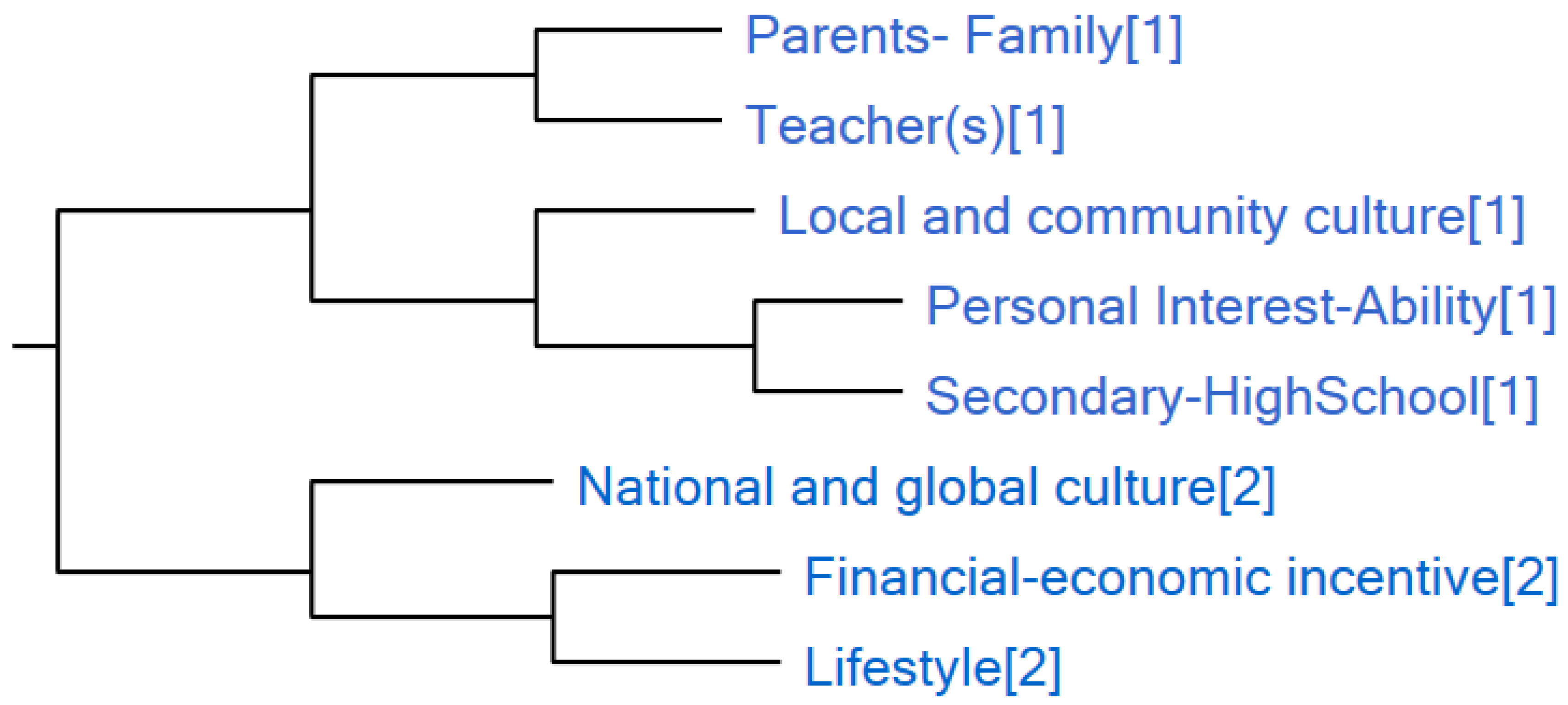
Cluster analyses were also conducted to explore the relationships amongst the priori factors within individual participant responses. Nodes representing the ten theoretical career influence factors were cross-tabulated to determine overlap patterns, and NVivo’s similarity metrics (i.e., Jaccard’s similarity coefficients) and cluster visualization tools were used to generate dendrograms illustrating relational proximity amongst codes. The decision was taken to exclude peers and primary Education from the cluster analysis, as they were mentioned fewer than 10 times qualitatively and were isolated from other factors. A two-cluster structure contextualised the quantitative findings by revealing how participants described interconnected influences within their STEM career journeys.
Emergent themes were also identified through multiple reviews of the qualitative dataset that broadened the understanding of participants’ STEM career journeys; these included circumstantial impediments (n = 23), career changes and alternate pathways (n = 20), and real-world experiences–events (n = 12).
A process of collaborative sensemaking was initiated amongst the author and a critical friend to ensure interrater reliability (
T. Clark et al., 2021). A random sample of ten responses were coded independently, after initial discussions, to an acceptable agreement rate of over 90% (
Miles & Huberman, 1984). For clarity, the agreement rate refers to the percentage of instances in which sections of qualitative data were coded against the same theme by both the author and a critical friend during a review of a random sample of ten participant responses. Disagreements were resolved through discussion leading to consensus. Furthermore, Jaccard’s similarity coefficients calculated during the cluster analyses were used to investigate potential redundancy in coding. The delineation of themes was deemed sufficient, as the highest coefficient detected between personal interest/ability and secondary/high school (0.55) was well below the duplicate threshold (1.00).
3. Results
The results will first show how the participants rated the STEM career-influence factors quantitatively, prior to delving into how they describe their STEM career journeys qualitatively.
3.1. Non-Metropolitan STEM Professionals’ Ratings of STEM Career-Influence Factors (Quantitative)
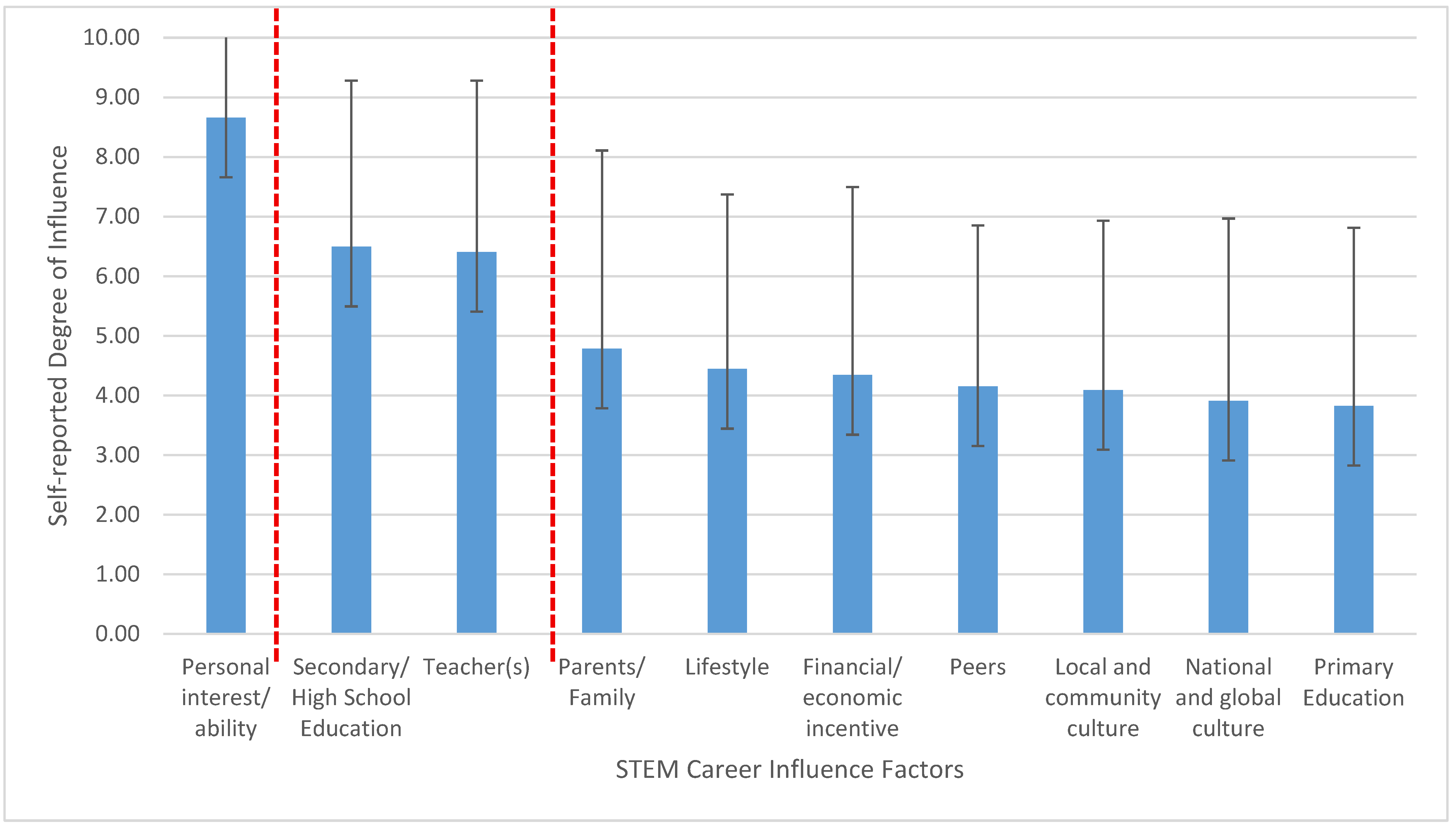
Analysis of reported career influences indicates that intrinsic and micro-school level factors were perceived to be the most influential on participants’ STEM career pathways.
Figure 1 presents the variables in descending order of reported importance, alongside means and standard deviations. Notably, personal interest/ability (M = 8.66, SD = 1.45) had the highest level of perceived influence, ahead of secondary/high school education (M = 6.49, SD = 2.79) and teachers (M = 6.41, SD = 2.88), both of which were the only two other variables to score an average of 5 or over. Many distal factors beyond school and self were perceived to be less influential, including parents/family (M = 4.78, SD = 3.32), lifestyle (M = 4.44, SD = 2.93), financial/economic incentive (M = 4.34, SD = 3.15), peers (M = 4.15, SD = 2.70), local and community culture (M = 4.09, SD = 2.84), and national and global culture (M = 3.91, SD = 3.06). Curiously, primary education was perceived to be the least influential (M = 3.82, SD = 2.99).
A repeated-measures ANOVA was conducted to examine within-group differences across the 10 STEM career influence factors. As Mauchly’s test indicated that the assumption of sphericity had been violated, χ2(44) = 122.9, p < 0.001, Greenhouse–Geisser corrected values are reported. The repeated-measures ANOVA identified statistically significant differences across the ten STEM career influence factors, Greenhouse–Geisser corrected F(6.29, 490.40) = 34.22, p < 0.001, η2 = 0.305.
Bonferroni-adjusted post hoc pairwise comparisons demonstrated a clear pattern of differentiation between factors (see
Supplementary Material File S2). Subsequent
t-tests reveal a hierarchy of perceived importance. The red dotted lines in
Figure 1 denote statistically significant differences between factors. Indeed, the difference in reported influence between personal interest/ability and secondary/high school education was both significant (t(78) = 6.13,
p < 0.001) and of a large magnitude (Cohen’s d = 0.98). This indicates that personal factors are perceived to be significantly more influential than any other factor. Direct education factors in secondary/high school education and teachers form a clear second tier, as evidenced by the statistically significant (t(78) = 3.28,
p = 0.001) and moderate (Cohen’s d = 0.52) gap between teachers and parents/family. The lower cluster of seven factors appears to form a third tier, as there is no significant difference between the fourth most influential factor (i.e., parents/family) and the least influential (i.e., primary education) (t(78) = 1.91,
p = 0.058).
3.2. Cluster Analysis of Qualitative Data
The cluster analyses produced a two-cluster structure that broadly reflected the theoretical divide between SCCT, underpinned by personal, social and cultural factors, and EVT, which focuses more on economic incentives (see
Figure 2). Cluster one draws on the more proximal SCCT factors that appear to contribute to the establishment of STEM trajectories, whereas cluster two includes economic and wider cultural influences that contribute to the maintenance of STEM career trajectories. The prominence of the themes contained within cluster one (STEM trajectory establishment), including personal interest/ability (n = 53), secondary/high school (n = 49), teachers (n = 27), and parents/family (n = 24), triangulated with respondents’ quantitative data in ways that reinforced the importance of support, verbal persuasion, and learning experiences per SCCT within micro- and meso-systems. It is unsurprising that personal interest and ability and secondary/high school were the most overlapping themes. Indeed, a scientist in her early 30s succinctly described how her own initial interest was further developed through a positive high school experience: “
I was already interested in science, but I had a great teacher in high school who fostered my learning and development”. Others expressed similar sentiments, but viewed success in high school as more of an extension of personal traits (e.g., “
Always had an interest in health and science and was good at maths in school”). Within this cluster, local and community cultural themes often linked to familial experiences beyond formal educational experiences. A registered nurse described how family history and community needs influenced her career trajectory: “
Family and community due to previous family member working in health care and the need for more nurses in my community”. The importance of broader social networks was articulated by the overlap of parent–family and teacher themes. Indeed, the qualitative data showed that teachers could both consolidate family STEM trajectories (i.e., “
My dad is an engineer, my grandfather was an early computer scientist. My HS had some amazing science teachers, and one very excellent maths teacher”) and open STEM pathways to complement positive education cultures within families (“
amazing high school science teachers—parents engaged in education with a curiosity for the world”).
The second cluster (STEM trajectory resilience and maintenance) was composed of more distal economic and cultural factors (i.e., EVT), financial/economic incentive (n = 15) and lifestyle (n = 16), and national and global culture (n = 10), which are more associated with the BEST exo- and macro-systems. The relative frequency of these themes across the qualitative dataset was much lower than those contained within cluster one, which builds upon the quantitative findings and suggests respondents perceive more direct experiences/factors as being more influential in their STEM career trajectories. Despite forming a cluster pairing and being clearly associated in EVT, financial/economic incentives and lifestyle factors were only dual coded in 19.23% of included participant responses. These economic factors did overlap for some respondents. For example, an ICT project analyst was motivated by both the pay rate and the long-term physical viability of her chosen career: “I wanted a career that paid well, that would have many job opportunities in the future and something I could do when I’m old and my body can’t handle physical work as much”. The separate financial incentive responses tended towards phrases such as “reliable employment” and “better income for my family”, in ways that suggested pragmatic career orientations. Flexibility (“Australian nurses can work anywhere in the world”), locations (“Ability to work anywhere”) and the nature of work (“I could be outside doing fieldwork”) were key lifestyle sub-themes. Both contemporary and longstanding national global and cultural factors emerged in the qualitative data. Indeed, health challenges and COVID-19 were influential for some respondents, as one health professional stated: “Covid highlighted the valued role nurses play”. Conversely, one nurse provided a powerful articulation of how cultural norms and her own interests influenced her career path: “At the time, girls were expected to work in “female” professions. There was a cultural norm that nursing was such a profession. However, I loved my science subjects and was tossing up between nursing and biochemistry. I chose nursing”.
3.3. Other Emergent Themes
Respondents also extended their answers beyond the robust, albeit limited, priori framework, as the thematic analyses revealed a series of a priori themes that directly relate to their STEM career trajectories:
Circumstantial impediments (n = 23) were reported to have impacted career trajectories in ways that directly contradict the clean, linear pathways often associated with the STEM pipeline. For some of these rurally educated STEM professionals, issues of access (“we weren’t offered any specialised subjects”) and teaching quality (“Bad teachers in year 9/10 which undermined the foundations of future maths courses”) did harm, without derailing, their career trajectories. One STEM professional described how her STEM pathway led her away from her home and local community: “Very limited university choice when I went to university so had to opt to leave my hometown. To get work after university I moved to Sydney, you can’t be picky as a graduate when somewhere offers you a job you take it”. Others described acute personal challenges such as job loss (“I’ve been made redundant three times, so I’ve had to move from town to town”), bullying (“In my apprenticeship I wasn’t treated well by my peers and learnt a lot of myself. Bullying and harassment”), and mental health crises (“having significant mental health difficulties as a teen”), which influenced their STEM career trajectories.
Career changes and alternate pathways (n = 20) showed that STEM career trajectories for some were fluid and driven by opportunities that they did not anticipate earlier in their lives. An early-career medical laboratory technician described her pivot from pure science, due to sparse job opportunities, “
job opportunities once I was done were not super easy to find so I applied to become a pathology collection/Lab Assistant in order to get my foot in the door”. Another respondent described her career opportunity at university as almost unintentional: “
Started working in pathology during uni a bit by accident but haven’t left!”. Persistence was key for a nurse who originally wished to pursue medicine: “
I just wanted to do medicine always, and didn’t finish [high school] so found a different way to get in”. One technical officer working in plant and soil science described his own complex journey, where he left and returned to university in a way that defies the linear STEM pipeline:
“I went to a university in [the city] to study chemistry, drank heavily and worked too much, dropped out and went to work construction and warehousing jobs. Then I had a quarter life crisis, went to a university bridging program which got me interested in biology and conservation.”
Real world experiences–events (n = 12) complement the broad systems and stakeholders by exploring incidental critical events, or defined series of events, which respondents ascribe to their STEM career trajectories. Early-life engagements with STEM professions appears to shape early intentions, as one health professional noted: “I also have broken a couple of bones and making trips to the ED opened my eyes to the nurses and healthcare professionals”. Another STEM professional described how a school visit and follow-up field work defined her education and career path: “It was a visit from the local council’s environment officer, then fieldwork, that encouraged me to pursue STEM at uni and beyond”. Non-school experiences can also catalyse STEM engagement, “My general interest and skill largely came from growing up on a farm with machines that I wanted to understand”. Another participant described how the COVID-19 pandemic afforded the opportunity to pursue her passion: “a global pandemic that forced me to close my business was the final push I needed to apply for my degree”.
4. Discussion
The findings presented in this paper have provided useful insights into the STEM career journeys of a sample of rurally educated STEM professionals, which necessarily extend our understanding of STEM careers beyond the future-facing aspirations of young people. In accordance with foundational theories of SCCT (
Byars-Winston, 2014;
Lent et al., 1994) and EVT (
Eccles & Wigfield, 2023,
2024), quantitative findings showed that personal interest/ability was rated as the most influential career factor, with a large, statistically significant difference gap between any other factor. Although exploratory, this suggests it may be worthwhile to prioritise personal traits and dispositions, despite the challenges in operationalisation, particularly relative to academic achievement. Interestingly, secondary/high school and teacher(s) formed a second-level influence tier. This reinforces existing research that has highlighted the strong, predictive relationship between high school STEM engagement and post-school STEM career trajectories (
Reinhold et al., 2018;
Nitzan-Tamar & Kohen, 2022). Within this sample, personal, social and cultural factors functioning within individuals’ microsystems (
Bronfenbrenner, 1979) were perceived as highly influential in ways that appear to validate the strong focus on secondary STEM education in the wider literature (e.g.,
Deehan et al., 2025;
Thibaut et al., 2018). While limited by the non-generalisability of the sample, these findings indicate that policies and interventions relating to STEM career pathways should consider focusing primarily, but not exclusively, on students, teachers and secondary schools.
Curiously, the findings show a level of complexity, as parents and family were perceived as less influential than teachers in a statistically significant, moderately large way. This was a curious finding, as parents are not only central to the provision of social support, persuasion, and establishing career expectancies and values that underpin SCCT and EVT, respectively (
Byars-Winston, 2014;
Eccles & Wigfield, 2002;
López et al., 2023), but their traits have long been dominant predictors of learning outcomes and career progression within and beyond STEM (
Ma et al., 2016;
Šimunović & Babarović, 2021). Parents were something of an outlier, as they were grouped with the remaining six factors in a lesser third tier of influence, including economic factors (lifestyle and financial/economic incentive), more distal cultural factors (local and community culture and national and global culture), primary education, and peers. It is important to note that no factors were deemed to not be influential, and that there are many reasonable speculative interpretations of these findings that require further research, such as perception bias limiting how earlier or distal factors are understood by the participants. Alternatively, it may be that more attention is needed to maximise the potential influence of different factors or, more likely, that there are complex relationships amongst the factors, wherein lesser influences are foundational to the stronger influencing factors to which the qualitative findings allude.
Indeed, the qualitative findings highlight some of the relationships among the distinct factors as part of a two-cluster structure which builds upon the quantitative findings and is clearly congruent with the predominant theories underpinning STEM career-trajectory research. The findings point toward a bifurcated pattern in which some influences appear to be more important in the formation of STEM trajectories (cluster one—STEM trajectory establishment), whereas others relate to more distal economic and cultural factors that contribute to resilience within and maintenance of STEM career trajectories over time (cluster two—STEM trajectory resilience and maintenance). This bifurcation may reflect the complementary explanatory strengths of SCCT and EVT. Proximal developmental influences associated with self-efficacy, learning experiences, and social persuasion appear particularly important in establishing STEM career trajectories, whereas EVT-related factors, including utility, cost and lifestyle, appear more influential in shaping the long-term maintenance and sustainability of STEM careers.
The meso- and micro-factors presented in cluster one reflect the more proximal personal, social and cultural factors that underpin SCCT (
Castagno et al., 2023;
Dou & Cian, 2022;
Jiang et al., 2024;
Yean & Chin, 2026). This may suggest that, for this group, core STEM career aspirations were developed when personal traits and attitudes were positively influenced by school, community and familial experiences (
Dorrance-Hall et al., 2025;
Halim et al., 2018;
Tey et al., 2020;
Zhou & Shirazi, 2025). A tentative implication is that efforts to establish STEM career pathways should prioritize secondary schooling contexts in ways that reflect individual STEM interests. Conversely, the economic and cultural forces within the BEST exo- and macro-systems reflected in cluster two may serve to reinforce or undermine STEM career trajectories, as financial and lifestyle factors can influence individuals in and out of STEM career pathways in complex ways over the course of a working life.
In rural, regional and remote contexts, secondary schools and teachers may take on heightened importance because other forms of STEM exposure, pathway visibility, or professional role-modelling are less consistently available (
Gan et al., 2024;
Pelletier, 2024;
Murphy et al., 2025). Where local STEM careers are less visible or more narrowly represented, school may function as a particularly important site for career mediation (
Deehan et al., 2025;
Reinhold et al., 2018;
Nitzan-Tamar & Kohen, 2022). At the same time, the STEM career trajectories may be influenced by rural conditions in distinctive ways. Participants’ accounts of leaving hometowns, accepting available jobs, negotiating limited local opportunities, and moving through indirect routes into STEM all suggest that rural STEM career development reflects a complex interplay of the social, personal, cultural and economic factors presented in this paper and the wider literature (
Cardak et al., 2017;
Cuervo & Acquaro, 2018;
Nelson et al., 2021;
Mansour, 2025). The non-linear and complex interplay amongst these factors is seldom explicitly reflected fully in academic literature and wider discourse, which often considers economic factors alone (
Abe & Chikoko, 2020;
Zhou & Shirazi, 2025) or presents a myopic focus on formal STEM education (
Deehan et al., 2024;
Deehan et al., 2025;
López et al., 2023). Future research may benefit from examining the grey space between major educational and employment events to fully and meaningfully understand how STEM career trajectories are established and maintained in non-metropolitan contexts. These findings coalesce with existing literature and theory to suggest that the rural context does not merely provide a backdrop to STEM careers, but actively conditions both the generation and the sustainability of those careers.
The complexity of STEM career trajectories was further elucidated in the emergent qualitative themes. Circumstantial impediments, alternate pathways, and real-world experiences all point away from a simplistic pipeline model wherein young people move directly into STEM careers, often through universities, after experiencing valuable STEM learning in their formative years (
Huffmyer et al., 2022;
Stets et al., 2017). Career changes, family choices, emergent opportunities, online study choices, non-academic career pathways, and non-university learning spaces collectively challenge linear interpretations of the pipeline model (
Atalay et al., 2020;
Deming & Noray, 2018;
Mansour, 2025). This paper adds to a corpus of evidence indicating that the linear view of career progression may insufficiently capture the lived experiences of STEM professionals. In this study, participants did not describe a uniformly ordered progression from school interest to STEM qualification to stable STEM employment. Instead, many described interruption, redirection, serendipity, constrained choice, and adaptation. Some were pushed into alternate pathways by limited opportunity, redundancy, bullying, poor teaching, mental health difficulties, or local constraints. Others encountered decisive real-world experiences that shifted their trajectories in unexpected ways. These accounts reinforce growing critiques of pipeline thinking by showing that STEM career development is often contingent, recursive, and negotiated, rather than linear and cumulative. The bifurcated interpretation offered here may help explain this non-linearity: developmental influences may orient individuals toward STEM, but evaluative influences and life circumstances shape whether, where, and how that orientation is maintained.
Taken together, the findings suggest that efforts to strengthen rural STEM career participation should be multi-faceted and coordinated, but also conceptually distinct, in ways that reflect our developing understanding of rural STEM-career trajectories. School-level support, ranging from systemic change to isolated events, may enhance skills, awareness, interest or knowledge (
Deehan et al., 2024;
Demirkol et al., 2022;
Reinhold et al., 2018;
Thibaut et al., 2018), but they are unlikely to be sufficient alone. Indeed, strong school STEM experiences are likely to be strengthened when accompanied by wider changes to how STEM is defined and represented across stakeholder groups, including community members and industry partners (
Byars-Winston, 2014;
H. G. Clark et al., 2024;
Deehan et al., 2025,
Deehan et al., 2026). We need to ensure that high-quality STEM learning experiences that nurture interest, confidence and learning for young people are supplemented by improvements to the practical conditions that make STEM pathways visible, attainable, and sustainable outside of metropolitan centres. Interest in STEM should be seen as a catalyst, rather than an endpoint (
Australian Government Department of Industry, Science and Resources, 2025), as young people need to be able to imagine and experience a viable life within and alongside STEM. This would require moves beyond often unevaluated awareness campaigns (
McKinnon, 2022) to pathway diversity, community connections, place-based learning, and clearer articulation of the many ways STEM work can be pursued within and beyond traditional urban-professional trajectories (
Castagno et al., 2023;
Deehan et al., 2026;
Harmon & Wilborn, 2016;
Morris et al., 2021).
4.1. Directions for Future Research
Future research is needed to explore STEM professionals’ conceptualisations of their career trajectories across different nations, genders, geographical contexts, and fields of employment. In particular, it would be worthwhile conducting longitudinal research to investigate the development, possible decline, and interplay of the STEM career establishment and maintenance factors that accord with SCCT and EVT, respectively. Large-scale longitudinal surveys could be complemented by richer ethnographic case-study approaches, to better understand the interplay of factors influencing STEM career journeys. Further to this point, it would also be worthwhile to explore the typically unseen perspectives of individuals who have left, paused, or otherwise deviated from their STEM career trajectories. While more research into non-metropolitan STEM learning and career journeys is needed to ensure meaningful action and representation in academic literature and wider discourse, it may also be necessary to explore STEM career arcs within metropolitan settings without succumbing to comparative deficit framing (
Guenther et al., 2023;
McNamee et al., 2026).
4.2. Broader Implications
The broader implication of this study is that rural STEM career development should be understood as encompassing both schooling and post-schooling factors, where career trajectories are catalysed and ideally maintained. The findings reinforce the existing evidence that impactful secondary school teaching is foundational to the cultivation of interest, confidence and early competence in STEM learning (
Deehan et al., 2024,
2025;
Demirkol et al., 2022;
Reinhold et al., 2018). At the same time, they also show that STEM futures must be practically imaginable and sustainable if they are to be pursued. For policymakers and educators, this suggests that strengthening rural STEM participation requires more than encouraging students to like STEM subjects or aspire to STEM careers. It also requires attention to the material and social conditions that shape whether STEM careers are experienced as realistic, worthwhile, and compatible with life in or beyond rural communities.
For schools, the findings highlight the outsized importance of teachers and secondary educational experiences in shaping STEM trajectories. For systems and policymakers, they point toward the need for place-based, community-centred STEM pathways that account for mobility demands, labour-market visibility, and the uneven distribution of STEM opportunities. Indeed, the academic literature is replete with evidence, case studies and examples highlighting how community- and place-based approaches can be effectively implemented with support across stakeholder groups, including schools, industries, community groups, and universities (
Hobbs & Kelly, 2020;
Timko et al., 2023). For rural communities, the findings suggest value in making local STEM contributions more visible, not only through traditional professional roles, but also through technical, health, agricultural, environmental, and community-based forms of STEM work.
4.3. Limitations
This exploratory study is subject to several limitations. First, the sample was non-probabilistic and relatively small, which prevents generalisability. This issue is compounded by the unintended over-representation of female STEM professionals working in health and technical fields. While this is undeniably useful in a field historically marred by gender imbalance (
Buck et al., 2020;
Kiernan et al., 2023), it leaves clear gaps in terms of males and in important fields such as engineering and ICT. Second, the data are retrospective and therefore shaped by the limits of individual memory, selective salience and interpretive narrative reconstructions. Participants may have foregrounded influences that were more memorable or more easily articulated within the constraints of this research project, while under-reporting factors that were earlier, more indirect, or less consciously recognised. This may be especially relevant to the relatively modest ratings for parents/family and primary education. This is not to say that the perspectives of participants are inaccurate or wrong, but rather that they represent singular stakeholder perspectives on complex STEM career journeys viewed through a singular temporal lens. Finally, while the priori factor framework was useful for conceptual clarity, theoretical grounding and mixed-method integration, it may also have constrained the range of influences foregrounded by participants. The instrument design and sequencing and emergent themes partly address this limitation, but future research using more open-ended or longitudinal designs may reveal additional dynamics not captured within the present framework.
5. Conclusions
This study set out to make a necessary retrospective contribution to our incomplete understanding of STEM career trajectories, particularly beyond our metropolitan centres. By extension, this contributes to the broader wicked problem of dwindling STEM engagement in increasingly STEM-dependent economies and societies. Quantitative findings signalled tiers of perceived influence, with personal traits/dispositions sitting above secondary schools and teachers as the most influential. While perceived as less influential, other social, cultural and economic drivers were still reported to have influenced the career trajectories of the sample of 79 rurally educated STEM professionals. Qualitative findings signalled a bifurcated structure within their hierarchy, as the STEM-trajectory establishment themes (i.e., secondary school, teachers, personal traits) were more prominent and distinct from the STEM-trajectory resilience and maintenance themes (i.e., economic incentives, lifestyle factors, broader cultures). Emergent themes of circumstantial impediments, alternate pathways, and real-world experiences also contest implicit assumptions of linear career-progression pipelines. If rural STEM participation is to be strengthened, it will not be enough to cultivate interest in STEM at school. It will also be necessary to ensure that STEM futures are visible, attainable, and sustainable within the lived realities of non-metropolitan communities.
Conceptually, the findings suggest that STEM career trajectories may be better understood as involving related, but distinct, phases of trajectory establishment and trajectory maintenance. Influences associated with SCCT, including self-efficacy, learning experiences, and social persuasion, appeared particularly important in shaping orientation toward STEM career pathways. Additionally, EVT-related factors, including utility, lifestyle and remuneration, appeared more closely associated with long-term resilience and maintenance of STEM careers. Therefore, rather than operating as competing explanations, SCCT and EVT may offer complementary insights into different dimensions and stages of STEM career development over time. By extension, the findings suggest that rural STEM participation is not simply a question of aspiration alone, but a more complex milieu of different forms of influence interacting over time to establish, sustain, interrupt and reshape STEM career trajectories.