
Article

Bridging the Attitude–Behavior Gap: Implications from a Governance Perspective for Education for Sustainable Development

1
Center for Business Ethics, Faculty of Economics and Business, Goethe University Frankfurt am Main, Theodor-W.-Adorno-Platz 4, 60323 Frankfurt, Germany
2
Department of Business Administration, iba University of Cooperative Education, Poststraße 4-6, 64293 Darmstadt, Germany
3
Business Education, Faculty of Economics and Business, Goethe University Frankfurt am Main, Theodor-W.-Adorno-Platz 4, 60323 Frankfurt, Germany
*
Author to whom correspondence should be addressed.
Educ. Sci. 2026, 16(6), 875; https://doi.org/10.3390/educsci16060875
Submission received: 31 January 2026 / Revised: 14 May 2026 / Accepted: 27 May 2026 / Published: 2 June 2026

Abstract

Sustainability challenges are frequently characterized by a persistent attitude–behavior gap, particularly within competitive frameworks. This phenomenon is exemplified by voluntary carbon offsetting in aviation, where passengers’ stated willingness to pay consistently exceeds their actual transactional behavior. Prevailing strategies in Education for Sustainable Development (ESD) typically address this discrepancy by either reinforcing individual value systems or advocating for post-capitalist shifts to circumvent market competition. Given the inherent limitations of both approaches, this paper delineates an alternative conceptual path. By transposing a research framework from the field of institutional ethics to the domain of ESD, we aim to integrate this perspective into the academic ESD discourse and facilitate its practical implementation. We present a simple game-theoretic ESD model from which we derive specific guidelines for practical application. We contend that sustainability issues are best addressed by restructuring the ‘rules of the game.’ Consequently, this necessitates a strategic shift in ESD: prioritizing the analysis of incentive structures, governance mechanisms and their modification over a sole reliance on individual motivational drivers.

1. Introduction

The dominant paradigm of Education for Sustainable Development (ESD) rests on the idea that learners should be enabled to make well-reasoned decisions in light of complex societal challenges. ESD aims to empower individuals to make decisions for the present and the future, and to seek compromises in the face of inevitable goal conflicts. Likewise, ESD is expected to facilitate a comprehensive engagement with the different dimensions of the guiding idea of sustainable development and its conflicts, tensions, and dilemmas (de Haan, 2010; Kastrup, 2013; Kopnina, 2011). At its core, ESD seeks to raise learners’ awareness that individual behavior may contribute to achieving the 17 Sustainable Development Goals (United Nations, 2015), and to reconcile collective sustainability objectives with individual preferences.
This normative orientation draws heavily on a tradition of individual moral education inspired by Aristotelian virtue ethics. The underlying expectation is that fostering certain virtues will shape learners’ dispositions, thereby promoting sustainable decisions across everyday and professional contexts.
In this paper, we will argue that this virtue-ethical focus of ESD has considerable strengths in contexts characterized by face-to-face relationships and relatively small, cohesive communities in which shared norms can—and should—be cultivated. However, the approach exhibits significant limitations when transferred directly to large-scale, anonymous social systems, such as democratic policies or competitive markets, where individual motivations and aggregated social outcomes are systematically decoupled. In such systems, virtuous intentions alone may be insufficient or, under certain conditions to be discussed below, even counterproductive to generate collectively desirable, sustainable outcomes.
A particularly salient example is the economic infeasibility that often accompanies ecological or social sustainability strategies. Firms willing to incur higher costs for environmentally friendly production may suffer competitive disadvantages compared to less sustainable competitors and may, over time, be crowded out of the market (Homann, 2006). As a result, sustainability efforts can conflict with the structural logic of competition, which is at the heart of both democracy and markets, generating persistent tensions between environmental or social concerns and economic and democratic viability (cf. Altmann, 2025).
This dilemma has become a central challenge for ESD and should therefore be addressed and hopefully overcome within ESD itself. To contribute to this discussion, we present a governance approach developed over recent decades in business ethics (Pies et al., 2009; Beckmann et al., 2014; Pies & Valentinov, 2023; Minnameier, 2025a) and apply it to the field of ESD.
The following Section 2 provides a critical analysis of two predominant, yet antithetical, paradigms within ESD. The first focuses on the cultivation of individual values and sustainable dispositions, while the second adopts a more systemic–political orientation, often leaning toward anti-capitalist frameworks and advocating for radical structural transformation. Recognizing that both approaches possess distinct merits and limitations, Section 3 proposes an integrative synthesis. In Section 3.1, we examine the ambivalence of competition within modern society and its specific implications for sustainability objectives, distinguishing between “race to the top” and “race to the bottom” dynamics. Subsequently, Section 3.2 utilizes the empirical case of carbon-neutral aviation to demonstrate how the well-documented attitude–behavior gap may be bridged through sustainable governance mechanisms. These arguments are further elucidated via a simplified game-theoretic ESD model. In Section 4, we delineate the practical implications of this framework for enhancing the efficacy of ESD. This article concludes with a synthesis of the overarching argument, a critical discussion of the core thesis, and a brief outlook on future research.

2. Pathways of Education for Sustainable Development

ESD certainly is a heterogeneous field that encompasses multiple, partially overlapping strands, including (key-)competency-based approaches (Wiek et al., 2011; Wilhelm et al., 2019), systems thinking-oriented approaches (Eichentopf & Kasperidus, 2025; Frey et al., 2025; Green et al., 2022), socio-scientific issues (SSI)-0based education (Högström et al., 2025; Presley et al., 2013), and critical or political conceptions of sustainability education (including bio-political perspectives on ESD; Bylund et al., 2022; postcolonial perspectives on ESD; De Oliveira Andreotti & De Souza, 2014; trans-humans perspectives on ESD; Gough, 2018). While these strands differ in their epistemological and normative assumptions, they jointly shape contemporary ESD discourse. The present paper focuses on a specific tendency within this broader landscape that emphasizes individual moral development and virtue-ethical interpretations of sustainability education.
Against this background, a growing body of research points to a recurrent discrepancy between sustainability-related awareness and observable sustainable behavior. This phenomenon is commonly discussed as the discrepancy theorem (Rebmann & Slopinski, 2018) and, in a more specific form, as an attitude–behavior gap (Loerwald, 2025; see also Gräsel, 2018). While individuals may indicate a general inclination or intention to act sustainably, their actual behavior frequently does not fully align with these intentions (Weber et al., 2022). Similar tensions can be observed at the organizational level. Hahn et al. (2015), for instance, describe the inherent “tensions in corporate sustainability” arising from a multitude of economic, ecological, and social objectives (p. 297, see also Pies et al., 2021). In response, ESD scholars frequently emphasize the importance of enabling learners to develop a deeper sensitivity toward sustainability-related trade-offs and to engage in and to endure goal conflicts (Weber et al., 2022). To address this issue, two broad strategies have been proposed.
A first strand of approaches argues that ESD should focus more strongly on reinforcing learners’ existing sustainability-related values, preferences and epistemic beliefs. Rebmann and Slopinski (2018) stress that ESD should systematically and integrally take epistemic cognitions into account. This perspective is also reflected in the competency model for sustainability management proposed by Seeber et al. (2019), which identifies four key components: (i) epistemological beliefs toward sustainability, (ii) attitudes, values, and perceived norms, (iii) sustainability-related self-efficacy, and (iv) motivation and interest toward sustainability. The underlying premise is that strengthening sustainability-related preferences and epistemic cognitions enables individuals to act sustainably even when faced with constraints.
However, this approach entails certain challenges. If individuals or organizations attempt to behave sustainably despite existing disincentives, they risk exploitation and may eventually harm themselves, particularly when competitors opt for less sustainable, but cost-saving and therefore economically more viable strategies (Homann, 2006; Pies et al., 2021). As a result, actors may remain trapped in a state of dissonance between economically prudent behavior and sustainable aspirations. This tension is not merely theoretical. It also has measurable psychological consequences.
Empirical research indicates that sustainability-related goal conflicts can trigger negative emotional responses such as frustration or resignation. These affects may, in turn, influence subsequent behavior in ways that are counterproductive for sustainability. Studies on “deliberate not-knowing” (Arfini, 2019; Arfini & Magnani, 2021; Hertwig & Engel, 2016) show that individuals may avoid information or adopt willful ignorance as a coping strategy to protect themselves from the emotional strain of sustainability dilemmas. Similarly, Grund et al. (2024) identify a “paralysis of action” triggered by overwhelming emotional strain, a finding supported by earlier work on affective barriers to sustainable action (see also Coffey et al., 2021). Thus, an educational strategy that primarily targets attitudes and epistemic beliefs may inadvertently contribute to emotional overload, avoidance behavior, or reduced agency among learners.
Alongside these psychological considerations, logical objections have been raised. Tamminga and Hindriks (2020) argue that it may constitute a logical fallacy to infer individual obligations directly from collective ones. As they put it, “[i]f a collective has a collective obligation to bring about a particular state of affairs, then it might be that no individual in the collective has an individual obligation to bring about the state of affairs” (p. 1085). Instead, they propose differentiating between individual obligations and obligations as a member of a collective. This distinction connects directly with broader questions of discourse formation and governance, themes that are central to our governance approach and will be elaborated in the subsequent section.
A second class of approaches seeks to address the structural constraints that hinder sustainable behavior at both the individual and organizational level. Proponents of this view advocate for reshaping the economic and political system, for instance through political regulation or central planning to compensate for market failures, or through post-growth or degrowth strategies aimed at reducing environmental pressures. It is argued that ESD places too much emphasis on learners’ roles as consumers (Wheeler, 2023), thereby tacitly accepting and confirming, instead of questioning and challenging, the logic of the capitalist system. From this perspective, ESD should adopt a more political orientation, potentially anti-capitalist in its thrust.
This stance highlights the limitations of a solely value-based ESD with its focus on individual moral development within structures that might systematically undermine sustainable behavior. However, proposals that implicitly or explicitly advocate for non-capitalist, eventually centrally planned (e.g., Olk et al., 2023; Saito, 2023) economic alternatives encounter notable challenges. The historical experience with centrally planned economies suggests that such systems tend to be economically inefficient, environmentally unsustainable, and democratically problematic. Classical theories suggesting that central planning in the economic sphere may, in principle, be incompatible with competition in the political sphere, i.e., democracy (von Hayek, 1939, 1968; Polanyi, 1948) remain unfalsified to this day. From a sustainability perspective, these shortcomings may have significant implications: inefficiency could hinder the resolution of environmental problems, innovation might be constraint, and the concentration of political power raises concerns regarding democratic legitimacy. Furthermore, critiques of growth often rely on a narrow, primarily quantitative understanding of growth which may not fully capture the complexity of contemporary debates in economics. In this context, Alfano (2014, p. 1) argues that “economic growth […] as a general improvement in quality of life, as opposed to a mere quantitative increment in production” can remain compatible with sustainability-oriented objectives.
Taken together, while this second class of approaches effectively highlights the structural barriers to sustainable behavior, the proposed solutions involve significant risks and limitations that need careful consideration in evaluating their feasibility as a foundation for ESD. As both classes of approaches offer important insights, but also face important shortcomings, we propose a framework with a focus on sustainable governance which seeks to address and overcome these limitations.

3. The Sustainable Governance Approach

As argued above, competition can often hinder sustainable behavior, particularly when individuals, organizations, and political actors find it difficult to prioritize sustainability due to high individual costs while the benefits are distributed to the general public. Following a detailed analysis of this issue in Section 3.1, Section 3.2 demonstrates how modifying regulatory “rules of the game” can redirect market competition from a barrier into a driver of sustainability goals.

3.1. The Ambivalence of Competition

Competition is ubiquitous on Earth because resources are scarce, meaning that our goals cannot be fully achieved, and our desires never entirely fulfilled. Scarcity leads to trade-offs or conflict over the allocation of limited resources. By definition, scarcity is undesirable. However, although competition is closely linked to scarcity, it would be an oversimplification to regard competition as inherently negative. Competition for a limited resource obviously harms the competitors directly. The more of a scarce resource one competitor obtains, the less remains for the others. From the competitors’ perspective, competition seems like a zero-sum game.
But there are potential side-effects on other parties. Under certain conditions, competition can benefit others, namely the competitors’ interaction partners on the other side of a “market”. For example, consumers can benefit from competition among retailers, as it prevents them from increasing prices and/or lowering quality. Similarly, retailers benefit from competition between their suppliers, such as food manufacturers, who, in turn, benefit from competition between farmers, who benefit from competition among suppliers of agricultural equipment, and so on. Generalizing this argument, we can say that we are all suffering from that specific competition in which we are directly involved as a competitor, while simultaneously benefitting from all the other competitions (plural) between all our interaction partners for all goods, services and other things that humans can exchange. In this sense, a social contract on the simultaneous implementation of competition on more than one market could very well be a positive-sum game: no one has a self-interest in exposing themselves to competitive pressure while all other members of that society continue to accumulate market power and form cartels or reap monopoly profits. However, if all agree to expose themselves to competition, everyone could be better off, compared to the status quo ante with less or no competition (cf. Wockenfuß, 2013, pp. 2–3).
Competition is not always naturally there, but it can be designed and created in many different realms of society. e.g., it is seen as the central social innovation that marked the transition from pre-modern to modern societies by North et al. (2009). They characterize pre-modern societies as “limited access orders” (LAOs), in which people were assigned fixed rights and duties depending on their identity in terms of gender, status, religious affiliation, etc. They contrast this with a new, modern “open access order” (OAO), which might recall the “open society” (Popper, 1945). The theory provides a framework for empirical, cliometric research (Murphy, 2023). According to North et al., the OAO has first evolved in the United Kingdom and continental Europe in the 19th century and has now spread to most parts of the world. It is characterized by the introduction of competition into more and more social subsystems, opening these up for anyone who wishes to challenge the long-established office holders, market leaders, etc., who until then had ruled by virtue of privilege (and therefore not for the common good). Competition was introduced in agriculture through the emancipation of peasants (making them entrepreneurs), in commerce and industry through freedom of trade, in politics through competition for political office (democracy), in the courts through the rule of law with legal representation of both parties to a dispute, in academia through freedom of research and teaching, and likewise in the visual arts, literature, journalism, etc.
While these examples highlight the positive aspects of competition, competition is by no means always productive for society as a whole; it can also be counterproductive. Baumol (1975), see also Baumol and Blackman (1991) first distinguished, in a purely economic context at that time, between competition that is organized as a “race to the top” (favoring results that are desirable for society as a whole) and competition as a “race to the bottom” (favoring results that are collectively undesirable). For example, competition might bring about pollution from companies attempting to cut costs to gain a competitive edge, clientelism in politics, or doping in sports.
The concept of competition presented here is influenced by economic theory, but we advocate a broad application in the social sciences. Indeed, the perspective can be applied to all human (and even some non-human, cf. Bshary & Noë, 2023) behavior, if only there are interactions between two relatively homogenous groups of individuals “exchanging” two relatively homogenous commodities or services against each other. Such a broad application of the concept is particularly valuable for ESD, as sustainability itself is a rather comprehensive concept that also encompasses a wide range of social, economic and environmental problems—as reflected in the seventeen SDGs and their respective sub-targets. At the same time, it is useful to distinguish between competition as a “race to the bottom” or a “race to the top,” because game theory enables us to identify situations of the first type and modern business ethics helps us to transform them into situations of the second.
Game theory offers a framework for understanding these dynamics, particularly through the well-known “prisoners’ dilemma” (Luce & Raiffa, 1989; Nash, 1951), which describes how individuals acting in their own self-interest may unintentionally harm themselves collectively due to the interdependence of their actions. While game theory as such is usually meant as a purely positive analysis in the sense of modeling reality and predicting outcomes (“equilibria”), business ethics makes a different, more normative use of such models: it uses the prisoners’ dilemma as an heuristic tool (Petrick & Pies, 2007) to identify situations of collective self-harm in order to then design and propose better “rules of the game” that would bring about other and better outcomes for all players (Homann, 2006; Pies et al., 2009; Beckmann et al., 2014; Pies & Valentinov, 2023).
In other words, the prisoners’ dilemma sheds light on situations where discrepancy problems (e.g., manifested as attitude–behavior gaps) arise, which we see frequently in the field of sustainability policy, but which we have not been particularly successful in addressing with previous ESD approaches. More importantly, it suggests ways in which the “rules of the game” can be changed to facilitate “gains from cooperation” or, in our case, to foster more sustainable behavior. The following section presents a model and detailed example illustrating how this approach can be applied to sustainability problems.

3.2. The Example of CO2-Compensated Flights

The Sustainable Development Goals (SDGs) were formally adopted by all 193 member states of the United Nations in 2015. However, the progress made since then falls far short of the targets set. According to the United Nations’ SDG Index (Sachs et al., 2025), overall progress worldwide has actually slowed down since 2019. The authors attribute this to the effects of the COVID-19 pandemic. But even if the pandemic is treated as a one-off (negative) effect and the earlier, somewhat more favorable trend is continued, the outlook is not very encouraging. Sachs et al. (2025, p. viii) assess this as follows: “Global commitment to the SDGs is strong: 190 out of 193 countries have presented national action plans for advancing sustainable development”, which contrasts with their finding that “[o]n average globally, the SDGs are far off-track. At the global level, none of the 17 goals are currently on course to be achieved by 2030. Conflicts, structural vulnerabilities, and limited fiscal space impede SDG progress in many parts of the world” (Sachs et al., 2025, p. viii).
Such an attitude–behavior gap can be observed not only on a global, highly aggregated level, but rather seems to be characteristic of many sustainability issues (Carrington et al., 2010; Kollmuss & Agyeman, 2002). For illustrative purposes, we will focus here on one phenomenon that has been well researched empirically: CO2 offsetting in aviation.
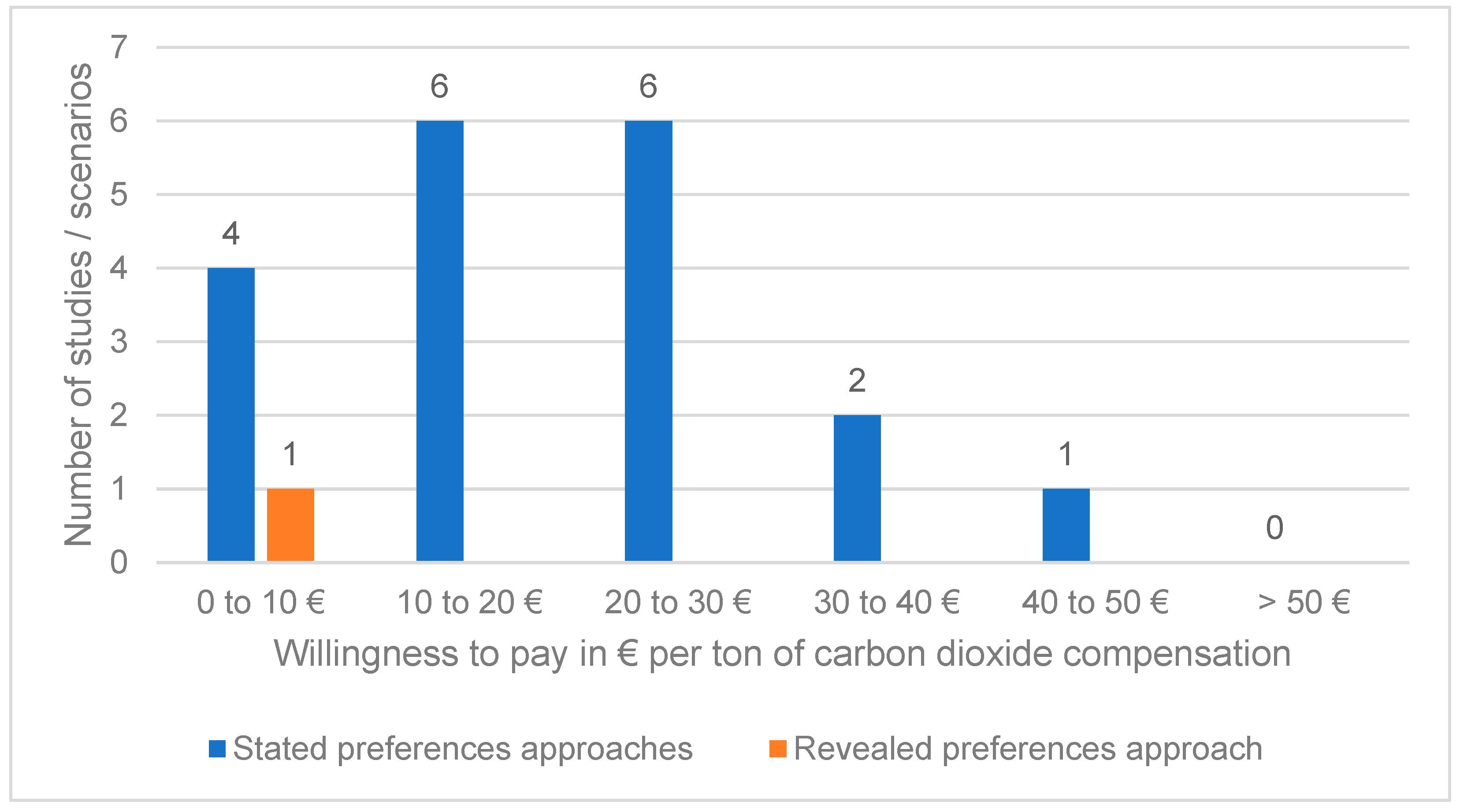
In environmental sciences, numerous attempts have been undertaken to determine airline passengers’ willingness to pay for voluntary CO2 compensation. These studies are usually based on surveys, i.e., on a hypothetical stated preferences approach. E.g., participants are asked whether they would be willing to pay a surcharge for CO2 offsetting for a flight and, if so, how much. Berger et al. (2022) evaluate 13 of these studies. The stated willingness to pay varies depending on the sample, type of flight, type of compensation, and specific question, but in 13 of the 19 scenarios examined, it ranges between 10 and 30 euros per ton of CO2 (lower in four scenarios and higher in three).
Berger et al. contrast these findings with their own study, which is based on a revealed preferences approach, i.e., on the payments effectively made for CO2 compensation from over 60,000 flight bookings with a Swiss airline. This comparison reveals an attitude–behavior gap: despite significantly higher figures in stated preferences surveys, the actual voluntary payment per ton of CO2 compensation averages only around 1 euro, and the median willingness to pay is even zero, meaning that more than half of the passengers have decided not to pay anything for CO2 compensation. These findings align with previous controlled laboratory studies conducted by Löschel et al. (2013). In Figure 1, we compile the results of the stated preferences surveys analyzed by Berger et al. into groups and show them in blue. In orange, we contrast this with the revealed preferences analysis from Berger et al. It seems that in hypothetical surveys, passengers tend to indicate a higher willingness to pay for CO2 compensation than they actually have.
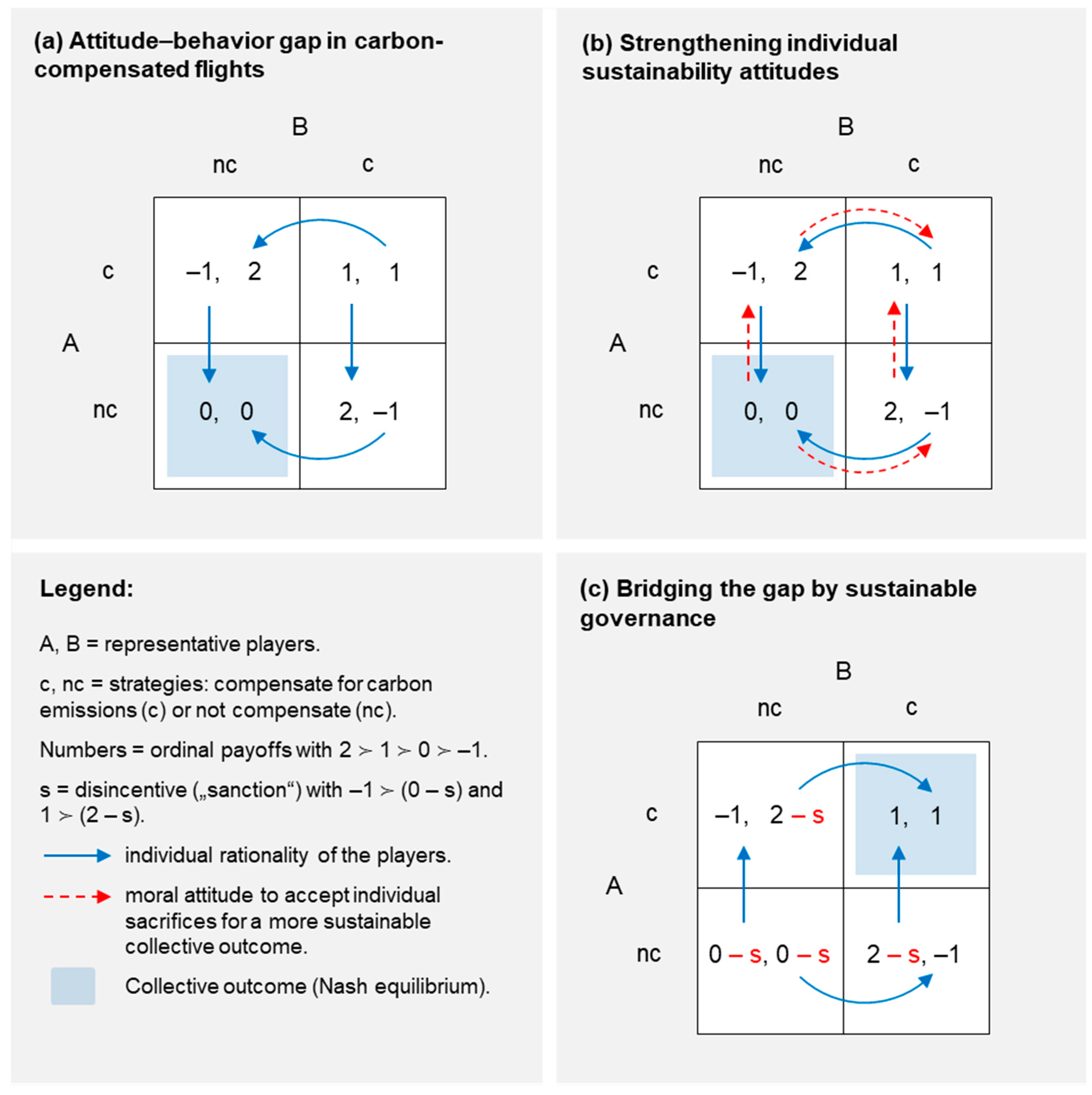
This attitude–behavior gap can now be explained using the prisoners’ dilemma model introduced earlier, which we illustrate in Figure 2a. To keep the model as simple as possible, we show only two players, A and B. However, these players shall be understood as representatives for a larger group of individuals, in this case, the passengers. They have two possible strategies: compensating for carbon emissions (c) or not compensating (nc). Four strategy combinations are possible, as shown in the four cells of the matrix. The individual desirability of each strategy combination is indicated by (ordinal) payoffs, with 2 ≻ 1 ≻ 0 ≻ −1. The first payoff in each strategy combination applies to player A and the second for player B.
If both players act according to their individual self-interest (represented by blue, solid arrows), no one will individually and voluntarily compensate, because the individual cost is higher than the individual benefit (the marginal effect of an individual compensation on global climate will be close to zero). This makes not compensating the dominant strategy. The outcome of the game is the Pareto-inferior Nash equilibrium in the lower left cell of the matrix. This is an equilibrium of collective self-harm. Although both players have always decided in their own best interests, the collective outcome (0, 0) is worse than the Pareto optimum in the upper right cell, in which both players would be better off (1, 1).
Relating this to the attitude–behavior gap, many people may be aware that climate change (and other sustainability challenges) needs to be solved and that they would benefit from a solution. Psychologically, the solution may indeed hold value to them and, in theory, they would also be willing to make sacrifices or contributions to achieve it. However, in a social dilemma situation, this attitude alone may not be enough to overcome the prevailing incentive structure. We have illustrated this in Figure 2b with the help of dotted red arrows. They shall indicate moral beliefs and attitudes that contradict the incentive structure of the game, enshrined in the payoff structure, but not being strong enough to overcome it.
It is worth noting that under specific circumstances, social dilemma situations like in the prisoners’ dilemma game can very well be overcome, e.g., by means of shared moral norms. This is typically the case in small communities with face-to-face relationships and repeated cooperation, like a couple, a family, a team in sports or a class at school. Under such circumstances, shared norms are usually enforced with (often tacit and non-written) rules creating (non-monetary) incentives and disincentives such as praise and criticism, promotion or demotion in a social hierarchy, or the threat of future non-cooperation (cf. Minnameier, 2025b, pp. 190–191). If asked to, we would model these implicit incentives governing small communities by changing the payoff structure, like in Figure 2c. However, as the group size increases, interactions become more anonymous and potentially one-shot, which makes informal enforcement mechanisms lose their effectiveness. For example, when booking a flight online, we do not even encounter most of our interaction partners at the airline nor the vast number of people who are equally affected by our individual decision to compensate or not for the emissions of our flight (the whole world population of roughly 8.5 billion will be affected). Given that many sustainability issues do involve large and anonymous groups, Figure 2b is intended to shed light precisely on those cases where informal mechanisms are insufficient to address the underlying social dilemmas. In these situations, more formal governance is required.
We have illustrated our more formal sustainable governance approach in Figure 2c, introducing a new variable s, which represents a “sanction” or dis-incentive. This way, we are applying a pattern first developed by Pies et al. in the corporate citizenship context (Pies et al., 2009, p. 384) specifically to ESD. If s is large enough to make the sustainable strategy (c) individually more attractive than the unsustainable one (nc), and if s applies equally to all players, the logic of the situation changes. The solid blue arrows indicating the individual cost–benefit calculation of the players shift direction, thereby also changing the collective outcome, which is no longer the Pareto-inferior strategy combination in the lower-left cell of the matrix, but the Pareto-superior Nash equilibrium in the upper-right cell. This outcome benefits all players if their collective carbon compensation strategy has a positive ecological effect that is large enough to outweigh the individual contributions.
Note that the solution modeled in Figure 2c could also be achieved through positive incentives or benefits, making the compensation strategy more attractive for all players. This would lead to the same result, and is therefore not discussed in detail here.
This example is intended to show that many sustainability issues take the form of a social dilemma, and that in such cases it is more promising to improve the “rules of the game” than to try to change people and their individual values, motives, and attitudes. However, the governance mechanism in the form of the variable s in Figure 2c has only been modeled in a very abstract, general form. When applying this perspective to concrete sustainability problems, the new “rules of the game” should be explained in more detail.
In the case of intra-European flights, these have been integrated in the European Emissions Trading System (EU ETS 1) since the beginning of 2012. Further, in 2021, the Carbon Offsetting and Reduction Scheme for International Aviation (CORSIA) was introduced, which is a global market-based measure developed by the International Civil Aviation Organization (ICAO). Unlike a CO2 tax, emissions trading systems are quantity-based instruments that precisely target total emissions by issuing a politically determined amount of tradable emission allowances. Their market price indicates the marginal costs of CO2 avoidance.
This is where competition comes into the picture again, but this time in its sustainable form of a “race to the top”: From the perspective of an airline, the ability to save CO2 now reduces costs because unused allowances can be sold or do not need to be purchased in the first place. In other words, helping the environment has been transformed from a competitive disadvantage (“race to the bottom”) to a competitive advantage (“race to the top”) by introducing the EU ETS and similar schemes as sustainable governance mechanisms.
If many sustainability problems take the form of such a social dilemma, and if they cannot be overcome by merely strengthening individual values, epistemic cognitions or attitudes, but only by more formal governance mechanisms, this has substantial implications for ESD.

4. Implications for ESD

From the sustainable governance perspective outlined here, a set of implications for ESD can be derived. In elaborating these implications, we draw on a governance approach developed in business ethics (Pies et al., 2009, 2014; Pies & Valentinov, 2023; Pies, 2025; Minnameier, 2025b). Taken together, these contributions provide a framework for explaining the often-invoked concept of Gestaltungskompetenz in the context of ESD (de Haan & Harenberg, 1999; Barth, 2021). Following, Barth (2021) defines Gestaltungskompetenz as the forward-looking capacity to actively participate in shaping and transforming the future of the societies in which one lives, guided by the principles of sustainable development (p. 35). Against this background, the central question becomes which target dimensions such competences should address in order to successfully guide processes of societal transformation.
From a sustainable governance perspective, Gestaltungskompetenz relevant to ESD can be systematically assigned to three analytical levels identified by the above-mentioned “ordonomic approach”: the level of concrete interaction (“the basic game”), the meta-level of rule-setting (e.g., democratic politics), and the level of discourse in which these rules are negotiated and legitimized.
At the first level, the focus lies on identifying problems of collective action. This requires an understanding of social dilemma structures and the ways in which individual rational behavior may lead to collectively undesirable outcomes. Accordingly, our approach emphasizes the importance of equipping learners with the conceptual and analytical literacy necessary to recognize such dilemmas and to act competently within competitive markets and democratic societies, including an awareness of how existing institutional arrangements shape incentives and collective outcomes.
The second level concerns the setting and modification of rules. Here, sustainability issues are understood as fundamentally collective, political problems in a broad sense that can only be addressed through coordinated changes to institutional frameworks. This entails governance-related knowledge and the ability to initiate and evaluate rule-setting processes aimed at transforming the “rules of the game” in such a way that alternative social equilibria emerge: equilibria that can be plausibly interpreted as being mutually beneficial from the perspective of all “players”, thereby contributing to sustainable development.
However, the design and transformation of rules presuppose discursive processes that adhere to democratic principles. Thus, at the third level, this perspective extends beyond shaping a more sustainable world and its institutional arrangements to include the shaping of the discursive rules under which rule-setting itself takes place. This process requires discursive competences on the part of participants, including the ability to articulate and justify arguments, to persuade others through reasons rather than power, to remain open to counterarguments, and to acknowledge that other actors may legitimately pursue their own interests that might diverge from one’s own.
Adopting this perspective on ESD implies that educational goals related to sustainability may require recalibration. As Minnameier (2025a, 2025b) argues, ESD should place greater emphasis on fostering learners’ capacity for reflective judgment and informed reasoning, enabling them to critically engage with economic and societal governance structures rather than presuming normatively predetermined sustainability orientations.

5. Conclusions

This paper sets out to reassess prevailing conceptions of Education for Sustainable Development (ESD) in light of persistent discrepancies between sustainability-related intentions and observable behavior. Starting from the dominant normative understanding of ESD, which emphasizes individual decision-making competence and moral orientation, we argued that such an approach—while valuable in small-scale, face-to-face contexts reaches its limits in large, anonymous social systems such as global markets. More structurally oriented, politico-economic approaches, by contrast, rightly highlight systemic constraints on individual sustainable behavior, yet often underestimate the functional role of competition in modern society and face serious objections when advocating for non-competitive or post-capitalist alternatives.
The central thesis of this paper is therefore that ESD should recalibrate its educational aims from primarily fostering individual sustainability virtues toward enabling learners to develop reflective judgment and governance-related reasoning competences that allow them to critically engage with and actively shape the institutional conditions of sustainable development. Rather than encouraging individuals to act sustainably despite competitive pressures, ESD should empower them to participate in processes of detecting social dilemmas (level 1), engaging in rule setting (level 2) and discourse shaping (level 3). We think that advancing ESD along the general lines proposed here offers a promising pathway for reconnecting normative sustainability aspirations with the structural constraints of modern societies, without abandoning either democratic principles or the productive potential of competition.
However, this contribution is certainly not without limitations. Our analysis is predominantly theoretical and relies on a few illustrative empirical examples to demonstrate the plausibility of the sustainable governance approach. Moreover, the focus on competition and governance mechanisms may understate the relevance of different cultural contexts, which we have excluded from the analysis to outline the approach as such, but which would certainly have to be (re)included for more in-depth analysis of particular applications.
We are aware that the perspective developed in this paper departs from established strands within the Education for Sustainable Development (ESD) discourse. Rather than aligning with dominant approaches, it is intended to broaden the analytical and normative horizons of the field by integrating insights from economics and business ethics into pedagogical debates, thereby opening up new avenues within the discourse of ESD.

Author Contributions

Conceptualization, C.A. and R.H.; methodology, C.A. and R.H.; formal analysis, C.A.; investigation, C.A. and R.H.; writing—original draft preparation, C.A. and R.H.; writing—review and editing, C.A. and R.H.; visualization, C.A. All authors have read and agreed to the published version of the manuscript.

Funding

This research received no external funding.

Data Availability Statement

No new data were created or analyzed in this study.

Acknowledgments

The authors would like to thank Gerhard Minnameier for his helpful comments on earlier versions of this article.

Conflicts of Interest

The authors declare no conflicts of interest.

Abbreviations

The following abbreviations are used in this manuscript:
CORSIACarbon Offsetting and Reduction Scheme for International Aviation
ESDEducation for Sustainable Development
EU ETSEuropean Union Emissions Trading System
ICAOInternational Civil Aviation Organization
LAOLimited Access Order
OAOOpen Access Order
SDGsSustainable Development Goals

References

  1. Alfano, M. (2014). Economic growth. In A. C. Michalos (Ed.), Encyclopedia of quality of life and well-being research. Springer. [Google Scholar]
  2. Altmann, C. (2025). Nachhaltigkeit und Demokratie. Ein ordonomischer Beitrag zur Aufklärung des aktuellen Diskurses um die United Nations Sustainable Development Goals (SDGs). In G. Minnameier (Ed.), Ordonomik und Bildung: Verantwortung für die moderne Gesellschaft (pp. 217–242). wbv. [Google Scholar] [CrossRef]
  3. Arfini, S. (2019). Ignorant cognition. A philosophical investigation of the cognitive features of not-knowing. Springer Nature. [Google Scholar]
  4. Arfini, S., & Magnani, L. (2021). Embodied irrationality? Frontiers in Psychology, 12, 769591. [Google Scholar] [CrossRef]
  5. Barth, M. (2021). Bildung für nachhaltige Entwicklung. In T. Schmohl, T. Philipp, & J. Schabert (Eds.), Handbuch transdisziplinäre Didaktik (pp. 35–44). Transcript. [Google Scholar] [CrossRef]
  6. Baumol, W. J. (1975). Business responsibility and economic behavior. In E. S. Phelps (Ed.), Altruism, morality, and economic theory (pp. 45–56). Russel Sage Foundation. Available online: http://www.jstor.org/stable/10.7758/9781610446792.7 (accessed on 9 May 2026).
  7. Baumol, W. J., & Blackman, S. A. (1991). Perfect markets and easy virtue: Business ethics and the invisible hand (1st ed.). Blackwell. [Google Scholar]
  8. Beckmann, M., Hielscher, S., & Pies, I. (2014). Commitment strategies for sustainability: How business firms can transform trade-offs into win–win outcomes. Business Strategy and the Environment, 23(1), 18–37. [Google Scholar] [CrossRef]
  9. Berger, S., Kilchenmann, A., Lenz, O., & Schlöder, F. (2022). Willingness-to-pay for carbon dioxide offsets: Field evidence on revealed preferences in the aviation industry. Global Environmental Change, 73, 102470. [Google Scholar] [CrossRef]
  10. Bshary, R., & Noë, R. (2023). A marine cleaning mutualism provides new insights in biological market dynamics. Philosophical Transactions of the Royal Society B, 378(1876), 20210501. [Google Scholar] [CrossRef]
  11. Bylund, L., Hellberg, S., & Knutsson, B. (2022). ‘We must urgently learn to live differently’: The biopolitics of ESD for 2030. Environmental Education Research, 28(1), 40–55. [Google Scholar] [CrossRef]
  12. Carrington, M. J., Neville, B. A., & Whitwell, G. J. (2010). Why ethical consumers don’t walk their talk: Towards a framework for understanding the gap between the ethical purchase intentions and actual buying behaviour of ethically minded consumers. Journal of Business Ethics, 97(1), 139–158. [Google Scholar] [CrossRef]
  13. Coffey, Y., Bhullar, N., Durkin, J., Islam, M. S., & Usher, K. (2021). Understanding eco-anxiety: A systematic scoping review of current literature and identified knowledge gaps. The Journal of Climate Change and Health, 3, 100047. [Google Scholar] [CrossRef]
  14. de Haan, G. (2010). The development of ESD-related competencies in supportive institutional frameworks. International Review of Education, 56, 315–328. [Google Scholar] [CrossRef]
  15. de Haan, G., & Harenberg, D. (1999). Bildung für eine nachhaltige Entwicklung. Gutachten zum Programm. BLK. [Google Scholar] [CrossRef]
  16. De Oliveira Andreotti, V., & De Souza, L. M. T. M. (2014). Postcolonial perspectives on global citizenship education. Routledge. [Google Scholar]
  17. Eichentopf, I.-M., & Kasperidus, H. D. (2025). Integrating technology assessment, systems thinking, and system dynamics in sustainability education: The need for an interdisciplinary framework. International Journal of Educational Research Open, 9, 100535. [Google Scholar] [CrossRef]
  18. Frey, S., Beege, M., Renkl, A., & Riess, W. (2025). The impact of system models on systems thinking in the context of climate change in elementary school. Systems, 13, 220. [Google Scholar] [CrossRef]
  19. Gough, A. (2018). Working with/in/against more-than-human environmental sustainability education. On Education. Journal for Research and Debate, 1(2). [Google Scholar] [CrossRef]
  20. Gräsel, C. (2018). Umweltbildung. In R. Tippelt, & B. Schmidt-Hertha (Eds.), Handbuch Bildungsforschung (pp. 1093–1109). Springer Fachmedien. [Google Scholar] [CrossRef]
  21. Green, C., Molloy, O., & Duggan, J. (2022). An empirical study of the impact of systems thinking and simulation on sustainability education. Sustainability, 14, 394. [Google Scholar] [CrossRef]
  22. Grund, J., Singer-Brodowski, M., & Büssing, A. G. (2024). Emotions and transformative learning for sustainability: A systematic review. Sustainability Science, 19(1), 307–324. [Google Scholar] [CrossRef]
  23. Hahn, T., Pinkse, J., Preuss, L., & Figge, F. (2015). Tensions in corporate sustainability: Towards an integrative framework. Journal of Business Ethics, 127(2), 297–316. [Google Scholar] [CrossRef]
  24. Hertwig, R., & Engel, C. (2016). Homo ignorans: Deliberately choosing not to know. Perspectives on Psychological Science, 11, 359–372. [Google Scholar] [CrossRef]
  25. Homann, K. (2006). Competition and morality. Wittenberg Center for Global Ethics. Available online: https://www.wcge.org/images/wissenschaft/publikationen/DP_2006-4_Homann_-_Competition_and_Morality_o.pdf (accessed on 26 May 2026).
  26. Högström, P., Gericke, N., Wallin, J., & Bergman, E. (2025). Teaching socioscientific issues: A systematic review. Science & Education, 34, 3079–3122. [Google Scholar] [CrossRef]
  27. Kastrup, J. (2013). Leitlinien für die didaktische Gestaltung der Berufsbildung für eine nachhaltige Entwicklung anhand von Beispielen aus der Ernährung und Hauswirtschaft. bwp@ Spezial 6—Hochschultage Berufliche Bildung 2013. wbv. [Google Scholar]
  28. Kollmuss, A., & Agyeman, J. (2002). Mind the Gap: Why do people act environmentally and what are the barriers to pro-environmental behavior? Environmental Education Research, 8(3), 239–260. [Google Scholar] [CrossRef]
  29. Kopnina, H. (2011). Revisiting Education for Sustainable Development (ESD): Examining anthropocentric bias through the transition of environmental education to ESD. Sustainable Development, 22(2), 73–83. [Google Scholar] [CrossRef]
  30. Loerwald, D. (2025). Ordonomik und ökonomische Bildung. In G. Minnameier (Ed.), Ordonomik und Bildung. Verantwortung für die moderne Gesellschaft (pp. 65–106). wbv. Available online: https://www.pedocs.de/volltexte/2025/33326/pdf/Minnameier_2025_Ordonomik_und_Bildung.pdf (accessed on 26 May 2026).
  31. Löschel, A., Sturm, B., & Vogt, C. (2013). The demand for climate protection—Empirical evidence from Germany. Economics Letters, 118(3), 415–418. [Google Scholar] [CrossRef]
  32. Luce, R. D., & Raiffa, H. (1989). Games and decisions: Introduction and critical survey. Courier Corporation. [Google Scholar]
  33. Minnameier, G. (Ed.). (2025a). Ordonomik und Bildung: Verantwortung für die moderne Gesellschaft. wbv. [Google Scholar] [CrossRef]
  34. Minnameier, G. (2025b). Ordonomik und ökonomische Theorie der Moral: Eine kritische verhältnisbestimmung. In G. Minnameier (Ed.), Ordonomik und Bildung. Verantwortung für die moderne Gesellschaft (pp. 175–200). wbv. [Google Scholar]
  35. Murphy, R. H. (2023). Measuring open access orders. Journal of Institutional Economics, 19(5), 618–634. [Google Scholar] [CrossRef]
  36. Nash, J. (1951). Non-cooperative games. Annals of Mathematics, 54(2), 286–295. [Google Scholar] [CrossRef]
  37. North, D. C., Wallis, J. J., & Weingast, B. R. (2009). Violence and social orders: A conceptual framework for interpreting recorded human history. Cambridge University Press. [Google Scholar] [CrossRef]
  38. Olk, C., Schneider, C., & Hickel, J. (2023). How to pay for saving the world: Modern monetary theory for a degrowth transition. Ecological Economics, 214, 107968. [Google Scholar] [CrossRef]
  39. Petrick, M., & Pies, I. (2007). In search for rules that secure gains from cooperation: The heuristic value of social dilemmas for normative institutional economics. European Journal of Law and Economics, 23(3), 251–271. [Google Scholar] [CrossRef]
  40. Pies, I. (2025). Ordonomik als Beitrag zur politischen und moralischen Bildung. In G. Minnameier (Ed.), Ordonomik und Bildung. Verantwortung für die moderne Gesellschaft (Vol. 45, pp. 13–48). wbv. [Google Scholar] [CrossRef]
  41. Pies, I., Beckmann, M., & Hielscher, S. (2014). The political role of the business firm: An ordonomic concept of corporate citizenship developed in comparison with the Aristotelian idea of individual citizenship. Business & Society, 53(2), 226–259. [Google Scholar] [CrossRef]
  42. Pies, I., Hielscher, S., & Beckmann, M. (2009). Moral commitments and the societal role of business: An ordonomic approach to corporate citizenship. Business Ethics Quarterly, 19(3), 375–401. [Google Scholar] [CrossRef]
  43. Pies, I., Schreck, P., & Homann, K. (2021). Single-objective versus multi-objective theories of the firm: Using a constitutional perspective to resolve an old debate. Review of Managerial Science, 15(3), 779–811. [Google Scholar] [CrossRef]
  44. Pies, I., & Valentinov, V. (2023). Trade-offs in stakeholder theory: An ordonomic perspective. Social Responsibility Journal, 20(5), 975–997. [Google Scholar] [CrossRef]
  45. Polanyi, M. (1948). Planning and spontaneous order. Manchester School, 16(3), 237–268. [Google Scholar] [CrossRef]
  46. Popper, K. R. (1945). The open society and its enemies (1st ed.). Routledge & Kegan Paul. Available online: http://archive.org/details/in.ernet.dli.2015.59272 (accessed on 26 May 2026).
  47. Presley, M. L., Sickel, A. J., Muslu, N., Merle-Johnson, D., Witzig, S. B., Izci, K., & Sadler, T. D. (2013). A framework for socio-scientific issues based education. Science Educator, 22(1), 26–32. [Google Scholar]
  48. Rebmann, K., & Slopinski, A. (2018). Zum Diskrepanztheorem der (Berufs-)Bildung für eine nachhaltige Entwicklung. In J. Schlicht, & U. Moschner (Eds.), Berufliche Bildung an der Grenze zwischen Wirtschaft und Pädagogik: Reflexionen aus Theorie und Praxis (pp. 73–90). Springer Fachmedien. [Google Scholar] [CrossRef]
  49. Sachs, J. D., Lafortune, G., Fuller, G., & Iablonovski, G. (2025). Sustainable development report 2025: Financing sustainable development to 2030 and mid-century. Dublin University Press. [Google Scholar] [CrossRef]
  50. Saito, K. (2023). Marx in the Anthropocene: Towards the idea of degrowth communism (1st ed.). Cambridge University Press. [Google Scholar] [CrossRef]
  51. Seeber, S., Michaelis, C., Repp, A., Hartig, J., Aichele, C., Schumann, M., Anke, J. M., Dierkes, S., & Siepelmeyer, D. (2019). Assessment of competences in sustainability management. Analyses to the construct dimensionality. Zeitschrift für Pädagogische Psychologie, 33(2), 148–158. [Google Scholar] [CrossRef]
  52. Tamminga, A., & Hindriks, F. (2020). The irreducibility of collective obligations. Philosophical Studies: An International Journal for Philosophy in the Analytic Tradition, 177(4), 1085–1111. [Google Scholar] [CrossRef] [PubMed]
  53. United Nations. (2015). Transforming our world: The 2030 agenda for sustainable development: A/RES/70/1. United Nations. Available online: https://digitallibrary.un.org/record/3923923?v=pdf (accessed on 26 May 2026).
  54. von Hayek, F. A. (1939). Freedom and the economic system. University of Chicago Press. [Google Scholar] [CrossRef]
  55. von Hayek, F. A. (1968). Der Wettbewerb als Entdeckungsverfahren. In F. A. von Hayek (Ed.), Freiburger Studien (pp. 249–265). Mohr Siebeck. [Google Scholar]
  56. Weber, S., Off, M., Kreuzer, C., & Bley, S. (2022). “What a feeling”—Emotionale Ansprache von Auszubildenden zur Förderung nachhaltigen Konsumverhaltens. In C. Michaelis, & F. Berding (Eds.), Berufsbildung für nachhaltige Entwicklung: Umsetzungsbarrieren und interdisziplinäre Forschungsfragen (Vol. 39). wbv. [Google Scholar]
  57. Wheeler, K. (2023). Educating children as sustainable citizen-consumers: A qualitative content analysis of sustainability education resources. Journal of Moral Education, 52(4), 453–473. [Google Scholar] [CrossRef]
  58. Wiek, A., Withycombe, L., & Redman, C. L. (2011). Key competencies in sustainability: A reference framework for academic program development. Sustainability Science, 6(2), 203–218. [Google Scholar] [CrossRef]
  59. Wilhelm, S., Förster, R., & Zimmermann, A. B. (2019). Implementing competence orientation: Towards constructively aligned education for sustainable development in university-level teaching-and-learning. Sustainability, 11(7), 1891. [Google Scholar] [CrossRef]
  60. Wockenfuß, C. (2013). Entwicklungskonkurrenz: Ein ordonomischer Beitrag zur Förderung von Demokratie und Good Governance in Entwickungsländern. wvb. [Google Scholar]
Figure 1. Stated preferences surveys tend to overestimate effective willingness to pay for carbon-offsetting. Source: own representation based on the findings of Berger et al. (2022).
Education 16 00875 g001
Figure 2. Attitude–behavior gap and attempts to overcome it by sustainable attitudes or sustainable governance. Own representation based on Pies et al. (2009, p. 384).
Education 16 00875 g002
Disclaimer/Publisher’s Note: The statements, opinions and data contained in all publications are solely those of the individual author(s) and contributor(s) and not of MDPI and/or the editor(s). MDPI and/or the editor(s) disclaim responsibility for any injury to people or property resulting from any ideas, methods, instructions or products referred to in the content.