Technological Acceptance, Motivation and Attitudes Towards Digital Assessment in Secondary Education Using Augmented Reality: Development and Preliminary Validation of a Scale for AR-STEM Contexts


Abstract
1. Introduction
2. Materials and Methods
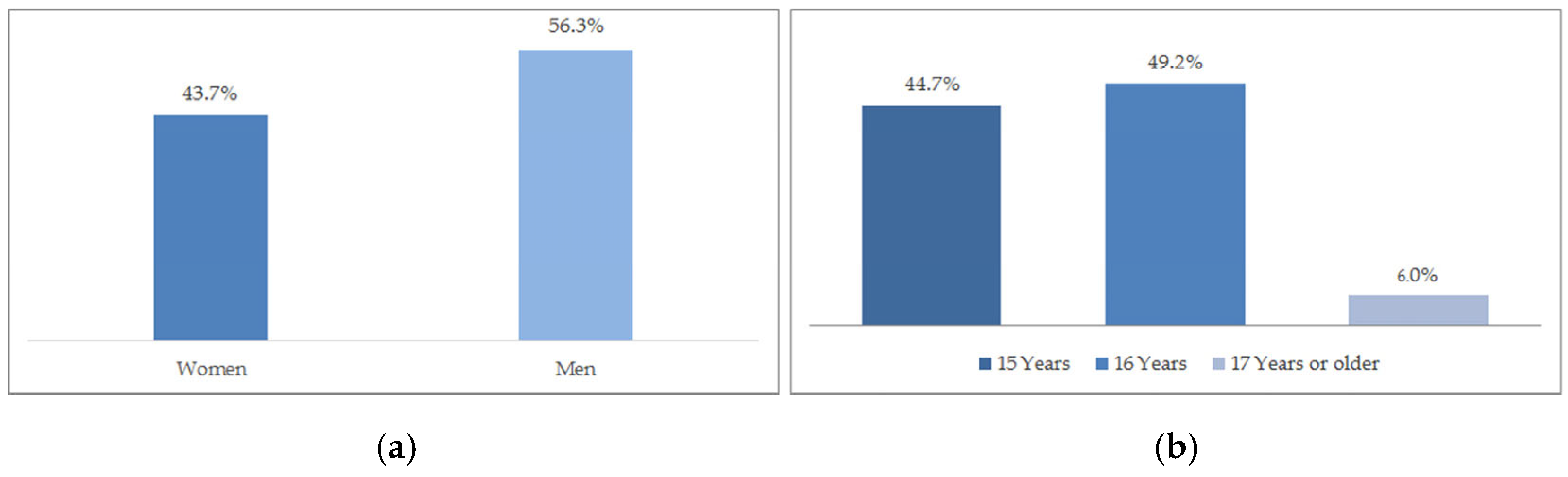
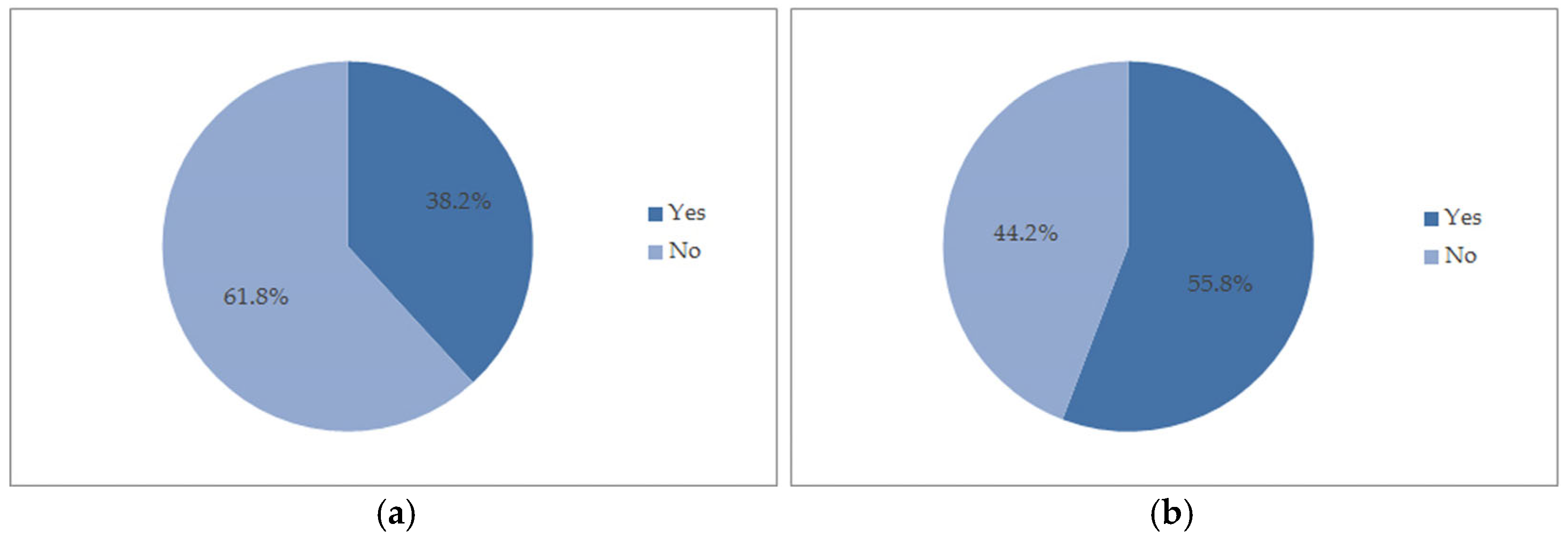
2.1. Study Typology and Sample
2.2. Procedure
- The Technology Acceptance Model (TAM), established by Davis (1989) and widely used in research on technology acceptance (Venkatesh et al., 2003) for the Degree of Technology Acceptance dimension. This, in turn, comprises the Perceived Usefulness indicator (four items) and the Perceived Ease of Use indicator (three items).
- A third dimension was also added, initially called Degree of Understanding, consisting of the Ease of Understanding indicator (six items).
2.3. The Instrument
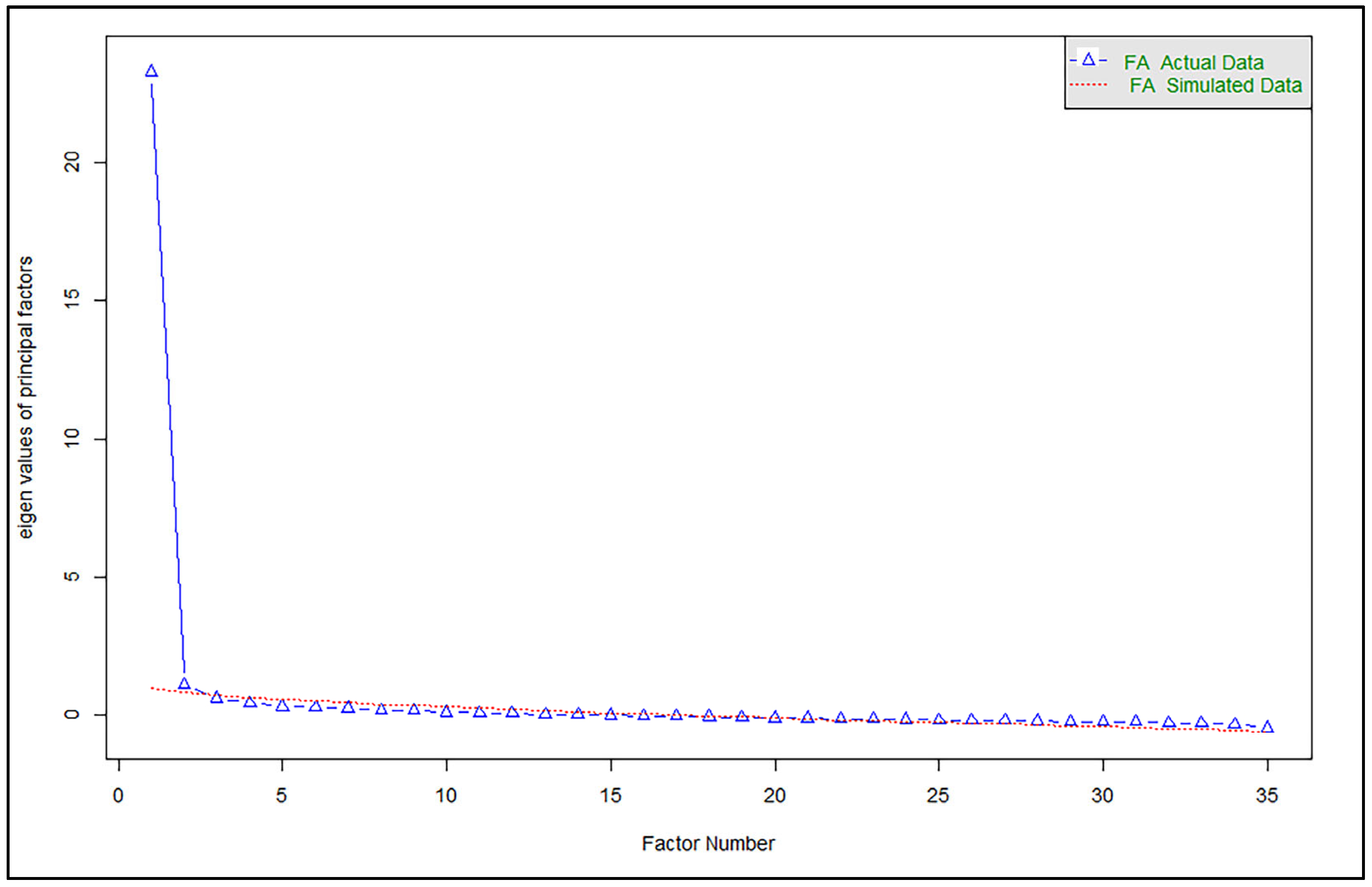
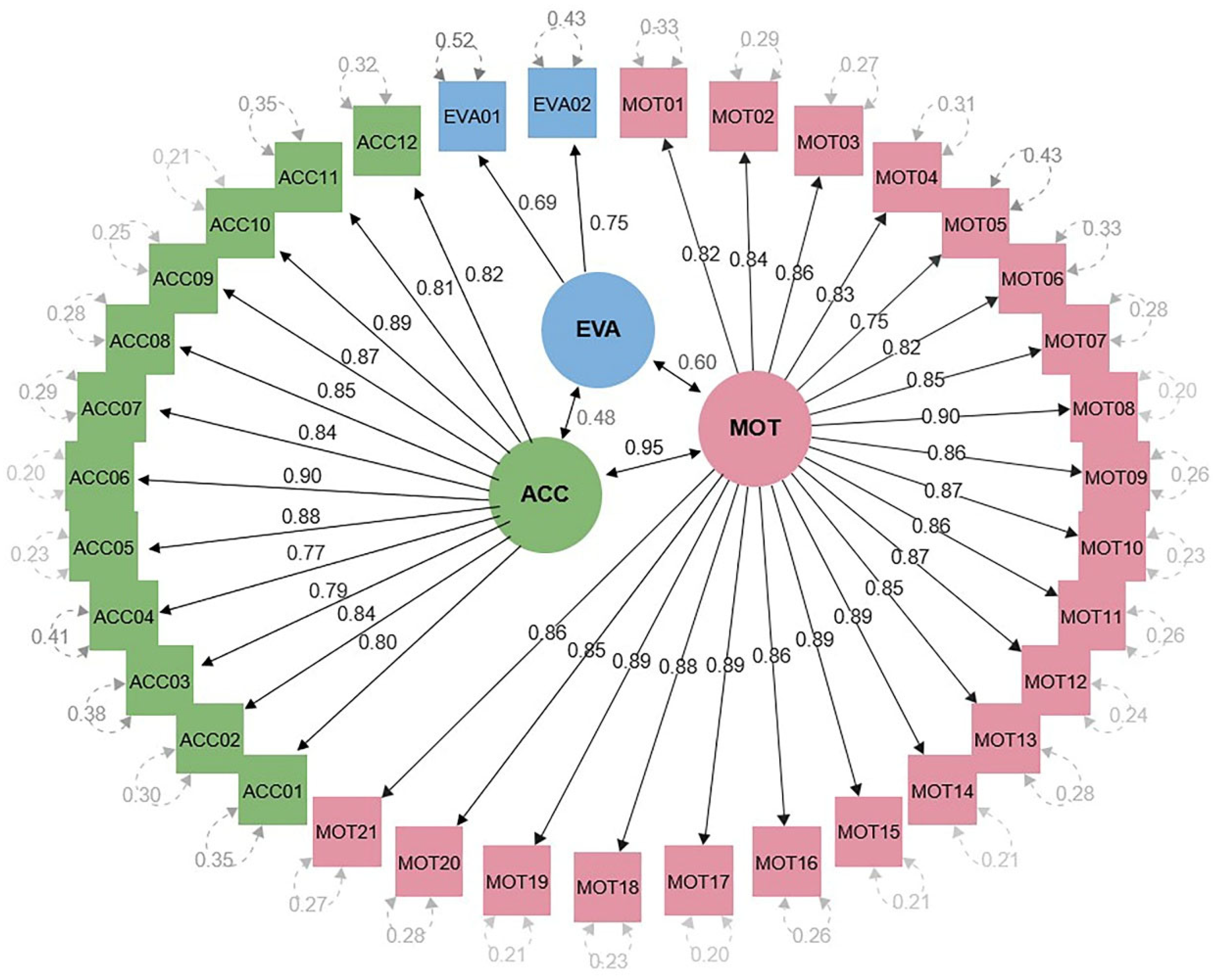
3. Results
4. Discussion
5. Future Directions
6. Conclusions
Author Contributions
Funding
Institutional Review Board Statement
Informed Consent Statement
Data Availability Statement
Acknowledgments
Conflicts of Interest
Appendix A

| Item | Abbreviation | Statement |
|---|---|---|
| Item 01 | MOT01 | The Augmented Reality (AR) app I used in class helped me focus on the concept it explained. |
| Item 02 | MOT02 | The AR app I used in class can help me get a better grade on the exam. |
| Item 03 | ACC01 | This methodology using an AR app really caught my attention. |
| Item 04 | MOT03 | This AR methodology helps me understand the concepts it explains. |
| Item 05 | ACC02 | Overall, I find this methodology interesting. |
| Item 06 | ACC03 | I think using this methodology is useful for my academic training. |
| Item 07 | MOT04 | The content of the AR app I used seems quite accurate. |
| Item 08 | MOT05 | When I downloaded the AR app, I had the impression that it would help me better understand the concept it explained. |
| Item 09 | ACC04 | I’m confident that I could easily pass an exam on the key concept the AR app explains. |
| Item 10 | ACC05 | While using the app, I felt it could be useful. |
| Item 11 | ACC06 | When I used the app, I was confident that I would learn what I needed to know about the concept it explained. |
| Item 12 | ACC07 | I find the AR app I used in class useful and engaging. |
| Item 13 | ACC08 | Overall, I enjoyed using this AR app. |
| Item 14 | ACC09 | I’m happy to be able to learn with this AR app. |
| Item 15 | ACC10 | The app helped me understand the concept it explains quite well. |
| Item 16 | MOT06 | I consider the academic results I obtained after using this app satisfactory. |
| Item 17 | MOT07 | I think it’s important to have an AR app like the one I used in class to better understand some key concepts. |
| Item 18 | MOT08 | I find the content of the app I used important. |
| Item 19 | MOT09 | I think understanding the content of the AR app will help me improve my exam grade. |
| Item 20 | ACC11 | I believe that for an AR app to be relevant to my learning, it also needs to be easy to use. |
| Item 21 | EVA01 | I think it’s important to take the exam online. |
| Item 22 | MOT10 | Using this AR app allows me to better understand some important key concepts. |
| Item 23 | MOT11 | I believe that, overall, the AR app I used can be useful. |
| Item 24 | MOT12 | Using AR apps would motivate me in the learning process. |
| Item 25 | MOT13 | I think I could achieve better results if teachers used AR apps. |
| Item 26 | EVA02 | I think I can get a better grade if I take the exam online. |
| Item 27 | ACC12 | It was easy to learn how to use the application. |
| Item 28 | MOT14 | Its ease of use made it easier for me to understand the concept. |
| Item 29 | MOT15 | When the application is easy to use, my results improve. |
| Item 30 | MOT16 | I find the ease of use satisfactory. |
| Item 31 | MOT17 | Using AR can make it easier for me to understand. |
| Item 32 | MOT18 | It can help me improve my academic results. |
| Item 33 | MOT19 | This technology helps me understand the teacher clearly. |
| Item 34 | MOT20 | I understood the concept better with AR than with a book. |
| Item 35 | MOT21 | I understood it better with AR than with a video. |
Appendix B
| Item | Theoretical Factor | Primary Factor | Primary Loading | Secondary Loading | Absolute Difference | Communality (h2) | Complexity |
|---|---|---|---|---|---|---|---|
| ACC11 | ACC | PA1 | 1.031 | 0.217 | 0.814 | 0.745 | 1.089 |
| ACC08 | ACC | PA1 | 0.974 | 0.079 | 0.896 | 0.758 | 1.020 |
| ACC07 | ACC | PA1 | 0.933 | 0.235 | 0.698 | 0.774 | 1.173 |
| ACC03 | ACC | PA3 | 0.846 | 0.054 | 0.792 | 0.710 | 1.013 |
| EVA02 | EVA | PA2 | 0.863 | 0.306 | 0.557 | 0.403 | 1.253 |
| EVA01 | EVA | PA2 | 0.595 | 0.148 | 0.447 | 0.253 | 1.125 |
| MOT03 | MOT | PA3 | 0.920 | 0.154 | 0.766 | 0.868 | 1.096 |
| MOT02 | MOT | PA3 | 0.731 | 0.207 | 0.525 | 0.783 | 1.159 |
| MOT18 | MOT | PA2 | 0.649 | 0.198 | 0.451 | 0.812 | 1.253 |
| MOT21 | MOT | PA2 | 0.648 | 0.227 | 0.421 | 0.767 | 1.256 |
| MOT07 | MOT | PA2 | 0.628 | 0.270 | 0.358 | 0.751 | 1.359 |
| MOT01 | MOT | PA3 | 0.627 | 0.256 | 0.370 | 0.719 | 1.325 |
Appendix C
| Factor | Subdimension | Item | Statement |
|---|---|---|---|
| EVA | Equity | EVA/FAI1 | I believe that the digital assessment applied was fair to all students. |
| EVA/FAI2 | The digital assessment evaluated my learning without favoring those with more technological experience. | ||
| Usability | EVA/USE1 | The assessment tool was easy to use during the test. | |
| EVA/USE2 | I was able to complete the digital assessment without any technical issues that affected my academic performance. | ||
| Accessibility | EVA/ACC1 | The digital assessment was accessible to me (device, connection, display options). | |
| EVA/ACC2 | The digital assessment offered options (font size, clarity, navigation) that facilitated my response. | ||
| Anxiety | EVA/ANX1 | I felt at ease while taking the digital assessment. | |
| EVA/ANX2 | I felt safe and in control during the digital assessment. | ||
| Ethics/trust | EVA/TRU1 | I trust that the results of the digital assessment reflect my actual performance. | |
| EVA/TRU2 | I believe that digital assessment reduces dishonest or unethical practices. | ||
| Usefulness of feedback | EVA/FBK1 | The digital assessment provided me with useful information for improvement. | |
| EVA/FBK2 | Thanks to the information received, I better understood my mistakes and the aspects to improve. |
Appendix D
| ID Item | Abrev | Item | Planned Construction | PA1 | PA2 | PA3 | EFA Factor | EFA Load | Second EFA Load | Delta EFA | CFA Factor | CFA Load |
|---|---|---|---|---|---|---|---|---|---|---|---|---|
| Item 01 | MOT01 | The Augmented Reality (AR) app I used in class helped me focus on the concept it explained. | Motivation | 0.241275739 | −0.002923951 | 0.596114606 | PA3 | 0.596114606 | 0.241275739 | 0.354838867 | Motivation | 0.747426595 |
| Item 02 | MOT02 | The AR app I used in class can help me get a better grade on the exam. | Motivation | −0.053106039 | 0.241471286 | 0.705328533 | PA3 | 0.705328533 | 0.241471286 | 0.463857247 | Motivation | 0.791569298 |
| Item 03 | ACC01 | This methodology using an AR app really caught my attention. | Acceptance | 0.403227644 | −0.164384132 | 0.56027751 | PA3 | 0.56027751 | 0.403227644 | 0.157049865 | Acceptance | 0.753825811 |
| Item 04 | MOT03 | This AR methodology helps me understand the concepts it explains. | Motivation | −0.1198654 | 0.122372018 | 0.903034466 | PA3 | 0.903034466 | 0.122372018 | 0.780662448 | Motivation | 0.786734776 |
| Item 05 | ACC02 | Overall, I find this methodology interesting. | Acceptance | 0.4892383 | −0.225797958 | 0.552369676 | PA3 | 0.552369676 | 0.4892383 | 0.063131376 | Acceptance | 0.782656272 |
| Item 06 | ACC03 | I think using this methodology is useful for my academic training. | Acceptance | 0.050863752 | −0.046486284 | 0.7946354 | PA3 | 0.7946354 | 0.050863752 | 0.743771647 | Acceptance | 0.719257841 |
| Item 07 | MOT04 | The content of the AR app I used seems quite accurate. | Motivation | 0.24746441 | 0.096795901 | 0.519893405 | PA3 | 0.519893405 | 0.24746441 | 0.272428996 | Motivation | 0.775658431 |
| Item 08 | MOT05 | When I downloaded the AR app, I had the impression that it would help me better understand the concept it explained. | Motivation | −0.059205075 | 0.32058321 | 0.53080957 | PA3 | 0.53080957 | 0.32058321 | 0.210226361 | Motivation | 0.707257807 |
| Item 09 | ACC04 | I’m confident that I could easily pass an exam on the key concept the AR app explains. | Acceptance | 0.37482183 | 0.209494485 | 0.169442612 | PA1 | 0.37482183 | 0.209494485 | 0.165327345 | Acceptance | 0.708187455 |
| Item 10 | ACC05 | While using the app, I felt it could be useful. | Acceptance | 0.441360342 | 0.18280521 | 0.273216612 | PA1 | 0.441360342 | 0.273216612 | 0.16814373 | Acceptance | 0.839939854 |
| Item 11 | ACC06 | When I used the app, I was confident that I would learn what I needed to know about the concept it explained. | Acceptance | 0.445803704 | 0.238659028 | 0.225143936 | PA1 | 0.445803704 | 0.238659028 | 0.207144676 | Acceptance | 0.847151577 |
| Item 12 | ACC07 | I find the AR app I used in class useful and engaging. | Acceptance | 0.915696502 | −0.200944576 | 0.101617343 | PA1 | 0.915696502 | 0.200944576 | 0.714751925 | Acceptance | 0.831254729 |
| Item 13 | ACC08 | Overall, I enjoyed using this AR app. | Acceptance | 1.005044141 | −0.063811164 | −0.114123548 | PA1 | 1.005044141 | 0.114123548 | 0.890920594 | Acceptance | 0.835539381 |
| Item 14 | ACC09 | I’m happy to be able to learn with this AR app. | Acceptance | 0.787159829 | −0.003385843 | 0.065301581 | PA1 | 0.787159829 | 0.065301581 | 0.721858248 | Acceptance | 0.844910062 |
| Item 15 | ACC10 | The app helped me understand the concept it explains quite well. | Acceptance | 0.437662694 | 0.216827959 | 0.238143973 | PA1 | 0.437662694 | 0.238143973 | 0.199518721 | Acceptance | 0.835226705 |
| Item 16 | MOT06 | I consider the academic results I obtained after using this app satisfactory. | Motivation | 0.285538902 | 0.459339986 | 0.10874844 | PA2 | 0.459339986 | 0.285538902 | 0.173801084 | Motivation | 0.799239603 |
| Item 17 | MOT07 | I think it’s important to have an AR app like the one I used in class to better understand some key concepts. | Motivation | 0.181914115 | 0.683233904 | 0.004070044 | PA2 | 0.683233904 | 0.181914115 | 0.50131979 | Motivation | 0.808552813 |
| Item 18 | MOT08 | I find the content of the app I used important. | Motivation | 0.470485126 | 0.173259476 | 0.285161663 | PA1 | 0.470485126 | 0.285161663 | 0.185323462 | Motivation | 0.855991562 |
| Item 19 | MOT09 | I think understanding the content of the AR app will help me improve my exam grade. | Motivation | 0.236785704 | 0.621441568 | 0.034641259 | PA2 | 0.621441568 | 0.236785704 | 0.384655864 | Motivation | 0.830199732 |
| Item 20 | ACC11 | I believe that for an AR app to be relevant to my learning, it also needs to be easy to use. | Acceptance | 0.961365557 | −0.184157632 | 0.015144083 | PA1 | 0.961365557 | 0.184157632 | 0.777207924 | Acceptance | 0.798769845 |
| Item 21 | EVA01 | I think it’s important to take the exam online. | Assessment | −0.162142956 | 0.521908307 | 0.044085854 | PA2 | 0.521908307 | 0.162142956 | 0.359765351 | Evaluation | 0.605176948 |
| Item 22 | MOT10 | Using this AR app allows me to better understand some important key concepts. | Motivation | 0.424109181 | 0.471038446 | 0.009083812 | PA2 | 0.471038446 | 0.424109181 | 0.046929265 | Motivation | 0.841934776 |
| Item 23 | MOT11 | I believe that, overall, the AR app I used can be useful. | Motivation | 0.520445775 | 0.31659319 | 0.051819716 | PA1 | 0.520445775 | 0.31659319 | 0.203852586 | Motivation | 0.823077231 |
| Item 24 | MOT12 | Using AR apps would motivate me in the learning process. | Motivation | 0.557928589 | 0.445689324 | −0.105831713 | PA1 | 0.557928589 | 0.445689324 | 0.112239264 | Motivation | 0.841203598 |
| Item 25 | MOT13 | I think I could achieve better results if teachers used AR apps. | Motivation | 0.379514709 | 0.623729202 | −0.136872524 | PA2 | 0.623729202 | 0.379514709 | 0.244214493 | Motivation | 0.814587084 |
| Item 26 | EVA02 | I think I can get a better grade if I take the exam online. | Assessment | −0.230755252 | 0.740394495 | −0.056523979 | PA2 | 0.740394495 | 0.230755252 | 0.509639243 | Evaluation | 0.773786879 |
| Item 27 | ACC12 | It was easy to learn how to use the application. | Acceptance | 0.595604596 | −0.024517428 | 0.234957523 | PA1 | 0.595604596 | 0.234957523 | 0.360647072 | Acceptance | 0.758950962 |
| Item 28 | MOT14 | Its ease of use made it easier for me to understand the concept. | Motivation | 0.439560903 | 0.408463444 | 0.076643384 | PA1 | 0.439560903 | 0.408463444 | 0.031097459 | Motivation | 0.866071454 |
| Item 29 | MOT15 | When the application is easy to use, my results improve. | Motivation | 0.28484034 | 0.494635683 | 0.142088715 | PA2 | 0.494635683 | 0.28484034 | 0.209795342 | Motivation | 0.859492718 |
| Item 30 | MOT16 | I find the ease of use satisfactory. | Motivation | 0.531202104 | 0.233092567 | 0.121212516 | PA1 | 0.531202104 | 0.233092567 | 0.298109537 | Motivation | 0.825429926 |
| Item 31 | MOT17 | Using AR can make it easier for me to understand. | Motivation | 0.118495478 | 0.638333676 | 0.173614122 | PA2 | 0.638333676 | 0.173614122 | 0.464719553 | Motivation | 0.862683024 |
| Item 32 | MOT18 | It can help me improve my academic results. | Motivation | 0.03534197 | 0.710494082 | 0.173276217 | PA2 | 0.710494082 | 0.173276217 | 0.537217865 | Motivation | 0.847527647 |
| Item 33 | MOT19 | This technology helps me understand the teacher clearly. | Motivation | 0.443243461 | 0.480293513 | −0.00250358 | PA2 | 0.480293513 | 0.443243461 | 0.037050051 | Motivation | 0.870879174 |
| Item 34 | MOT20 | I understood the concept better with AR than with a book. | Motivation | 0.37275775 | 0.418401773 | 0.098238407 | PA2 | 0.418401773 | 0.37275775 | 0.045644022 | Motivation | 0.826456361 |
| Item 35 | MOT21 | I understood it better with AR than with a video. | Motivation | 0.144926426 | 0.731501844 | 0.00529655 | PA2 | 0.731501844 | 0.144926426 | 0.586575418 | Motivation | 0.82353913 |
References
- Abeywardena, I. S. (2023). OXREF: Open XR for education framework. The International Review of Research in Open and Distributed Learning, 24(3), 185–206. [Google Scholar] [CrossRef] [Scilit]
- Aiken, L. (1980). Content validity and reliability of single items or questionnaires. Educational and Psychological Measurement, 40(4), 955–959. [Google Scholar] [CrossRef] [Scilit]
- Brown, M., McCormack, M., Reeves, J., Brooks, C., Grajek, G., Alexander, B., Bali, M., Bulger, S., Dark, S., Engelbert, N., Gannon, K., Gauthier, A., Gibson, D., Gibson, R., Lundin, B., Veletsianos, G., & Weber, N. (2020). 2020 EDUCAUSE horizon report, teaching and learning edition. EDUCAUSE. Available online: https://bit.ly/3NEgnB5 (accessed on 24 September 2025).
- Cabero, J., & Barroso, J. (2013). La utilización del Juicio de experto para la evaluación de TIC: El coeficiente de competencia experta. Bordón. Revista de Pedagogía, 65(2), 25–38. [Google Scholar] [CrossRef] [Scilit]
- Cabrera-Nguyen, P. (2010). Author guidelines for reporting scale development and validation results in the Journal of the Society for Social Work and Research. Journal of the Society for Social Work and Research, 1(2), 99–103. [Google Scholar] [CrossRef] [Scilit]
- Crogman, H. T., Cano, V. D., Pacheco, E., Sonawane, R. B., & Boroon, R. (2025). Virtual reality, augmented reality, and mixed reality in experiential learning: Transforming educational paradigms. Education Sciences, 15(3), 303. [Google Scholar] [CrossRef] [Scilit]
- Davis, F. D. (1989). Perceived usefulness, perceived ease of use, and user acceptance of information technology. MIS Quarterly, 13(3), 319–340. [Google Scholar] [CrossRef] [Scilit] [PubMed]
- Delgado, S. (2021). Diseño, desarrollo y validación de un modelo metodológico educativo basado en software inmersivo de realidad aumentada como recurso didáctico. Mejora en el aprendizaje de ciencias en educación secundaria [Doctoral dissertation, Camilo José Cela University]. Publications Service of the Camilo José Cela University. Available online: https://bit.ly/4ayNHTP (accessed on 10 October 2025).
- Delgado-Rodríguez, S., Carrascal Domínguez, S., & García-Fandiño, R. (2023a). Design, development and validation of an educational methodology using immersive augmented reality for STEAM education. Journal of New Approaches in Educational Research, 12(1), 19–39. [Google Scholar] [CrossRef] [Scilit]
- Delgado-Rodríguez, S., Carrascal Domínguez, S., & García-Fandiño, R. (2023b). Grado de aceptación de los sistemas de evaluación digitales adaptados al uso de recursos tecnológicos educativos basados en Realidad Aumentada. Revista Latinoamericana De Tecnología Educativa-RELATEC, 22(2), 135–148. [Google Scholar] [CrossRef] [Scilit]
- Doğru, M. S., Yüzbaşıoğlu, F., & Arpaci, I. (2025a). A bibliometric trend analysis of augmented reality in STEM education. Innovations in Education and Teaching International, 62(6), 1933–1948. [Google Scholar] [CrossRef] [Scilit]
- Doğru, M. S., Yüzbaşıoğlu, F., & Arpaci, I. (2025b). The effect of interactive videos enhanced with pop-up questions on teacher candidates’ learning performance in science. Research in Science & Technological Education, 43(1), 312–327. [Google Scholar] [CrossRef] [Scilit]
- Dou, G., & Feng, Y. (2025). Psychometric validation of the information technology acceptance scale for Chinese high school teacher. Frontiers in Education, 10, 1678302. [Google Scholar] [CrossRef] [Scilit]
- Fabrigar, L. R., Wegener, D. T., MacCallum, R. C., & Strahan, E. J. (1999). Evaluating the use of exploratory factor analysis in psychological research. Psychological Methods, 4(3), 272–299. [Google Scholar] [CrossRef]
- Fernández-Hernández, J.-L., Herranz-Hernández, P., & Segovia-Torres, L. (2022). Validación cruzada sobre una misma muestra: Una práctica sin fundamento. R.E.M.A. Revista Electrónica de Metodología Aplicada, 24(1), 38–40. [Google Scholar] [CrossRef] [Scilit]
- Gandolfi, E., & Ferdig, R. E. (2025). Exploring the relationship between motivation and augmented reality presence using the augmented reality presence scale (ARPS). Educational Technology Research and Development, 73, 793–814. [Google Scholar] [CrossRef] [Scilit]
- Garzón, J., Pavón, J., & Baldiris, S. (2019). Systematic review and meta-analysis of augmented reality. Virtual Reality, 23, 447–459. [Google Scholar] [CrossRef] [Scilit]
- Goretzko, D., Siemund, K., & Sterner, P. (2024). Evaluating model fit of measurement models in confirmatory factor analysis. Educational and Psychological Measurement, 84(1), 123–144. [Google Scholar] [CrossRef] [Scilit] [PubMed]
- Hair, J., Black, W., Babin, B., & Anderson, R. (2018). Multivariate data analysis (8th ed.). Cengage Learning, EMEA. [Google Scholar]
- Hu, L. T., & Bentler, P. M. (1999). Cutoff criteria for fit indexes in covariance structure analysis: Conventional criteria versus new alternatives. Structural Equation Modeling: A Multidisciplinary Journal, 6(1), 1–55. [Google Scholar] [CrossRef] [Scilit]
- Huang, S.-L., & Shih, C.-T. (2025). Object presence: Conceptualization and scale development. International Journal of Human-Computer Interaction, 1–21. [Google Scholar] [CrossRef] [Scilit]
- Johnson, H., McNally, S., Rolfe, H., Ruiz-Valenzuela, J., Savage, R., Vousden, J., & Wood, C. (2019). Teaching assistants, computers and classroom management. Labour Economics, 58, 21–36. [Google Scholar] [CrossRef] [Scilit]
- Keller, J. (2010). Motivational design for learning and performance. The ARCS model approach. Springer. [Google Scholar]
- Köroğlu, M. (2025). Pioneering virtual assessments: Augmented reality and virtual reality adoption among teachers. Education and Information Technologies, 30, 9901–9948. [Google Scholar] [CrossRef] [Scilit]
- Lampropoulos, G., & Evangelidis, G. (2025). Learning analytics and educational data mining in augmented reality, virtual reality, and the metaverse: A systematic literature review, content analysis, and bibliometric analysis. Applied Sciences, 15(2), 971. [Google Scholar] [CrossRef] [Scilit]
- Lampropoulos, G., Keramopoulos, E., Diamantaras, K., & Evangelidis, G. (2023). Integrating augmented reality, gamification, and serious games in computer science education. Education Sciences, 13(6), 618. [Google Scholar] [CrossRef] [Scilit]
- Li, G., Luo, H., Chen, D., Wang, P., Yin, X., & Zhang, J. (2025). Augmented reality in higher education: A systematic review and meta-analysis of the literature from 2000 to 2023. Education Sciences, 15(6), 678. [Google Scholar] [CrossRef] [Scilit]
- Lorenzo-Seva, U., & Ferrando, P. J. (2013). FACTOR 9.2: A comprehensive program for fitting exploratory and semiconfirmatory factor analysis and IRT models. Applied Psychological Measurement, 37(6), 497–498. [Google Scholar] [CrossRef] [Scilit]
- López-Aguado, M., & Gutiérrez-Provecho, L. (2019). Cómo realizar e interpretar un análisis factorial exploratorio utilizando SPSS. REIRE Revista d’Innovació I Recerca En Educació, 12(2), 1–14. [Google Scholar] [CrossRef] [Scilit]
- Magaña, E. C., Ariza, A. C., Ruiz-Palmero, J., & Guillén-Gámez, F. D. (2025). Virtual, augmented, and mixed reality in the University environment: An analysis of scientific production. Journal of New Approaches in Educational Research, 14, 8. [Google Scholar] [CrossRef] [Scilit]
- Nieto, E. (2016). El papel de las tecnologías en el desarrollo de los aprendizajes y en la mejora del rendimiento académico. In M. Rodríguez, E. Nieto, & R. Sumozas (Eds.), Las tecnologías en educación. Hacia la calidad educativa (pp. 17–33). Síntesis. [Google Scholar]
- Organisation for Economic Cooperation and Development (OECD). (2015). Students, computers and learning: Making the connection. PISA, OECD Publishing. [Google Scholar] [CrossRef] [Scilit]
- Peikos, G., & Sofianidis, A. (2024). What is the future of augmented reality in science teaching and learning? An exploratory study on primary and pre-school teacher students’ views. Education Sciences, 14(5), 480. [Google Scholar] [CrossRef] [Scilit]
- Peterson, R. A. (1994). A meta-analysis of Cronbach’s coefficient alpha. Journal of Consumer Research, 21(2), 381–391. [Google Scholar] [CrossRef] [Scilit]
- Prasetya, F., Fortuna, A., Samala, A. D., Rawas, S., Mystakidis, S., Syahril, Waskito, Primawati, Wulansari, R. E., & Kassymova, G. K. (2024). The impact of augmented reality learning experiences based on the motivational design model: A meta-analysis. Social Sciences & Humanities Open, 10, 100926. [Google Scholar] [CrossRef] [Scilit]
- Sakr, A., & Abdullah, T. (2024). Virtual, augmented reality and learning analytics impact on learners, and educators: A systematic review. Education and Information Technologies, 29, 19913–19962. [Google Scholar] [CrossRef] [Scilit]
- Sáez, J. (2017). Investigación educativa. Fundamentos teóricos, procesos y elementos prácticos (1st ed.). UNED. [Google Scholar]
- Scherer, R., Siddiq, F., & Tondeur, J. (2020). All the same or different? Revisiting measures of teachers’. Computers & Education, 143, 103656. [Google Scholar] [CrossRef] [Scilit]
- Schmitt, T., Sass, D., Chappelle, W., & Thompson, W. (2018). Selecting the “Best” factor structure and moving measurement validation forward: An illustration. Journal of Personality Assessment, 100(4), 345–362. [Google Scholar] [CrossRef] [Scilit]
- Siu, O., Lui, K. F. H., Huang, Y., Ng, T. K., & Yeung, W. L. V. (2024). An efficient, reliable and valid assessment for affective states during online learning. Scientific Reports, 14, 15768. [Google Scholar] [CrossRef] [Scilit] [PubMed]
- Spiteri, M., & Chang Rundgren, S. N. (2020). Literature review on the factors EFActing primary teachers’ use of digital technology. Technology, Knowledge and Learning, 25(1), 115–128. [Google Scholar] [CrossRef] [Scilit]
- Sun, J., & Liao, T. (2025). Designing adaptive feedback systems for managing cognitive load in augmented reality. Design Science, 11, e49. [Google Scholar] [CrossRef] [Scilit]
- Sungur, K., & Ateş, H. (2023). An examination of the effect of technology-based STEM education training in the framework of technology acceptance model. Education and Information Technologies, 28, 8761–8787. [Google Scholar] [CrossRef] [Scilit]
- Tat, O., & Kiliç, A. F. (2024). Electronic assessment anxiety scale: Development, validity and reliability. Turkish Online Journal of Distance Education, 25(4), 17–32. [Google Scholar] [CrossRef] [Scilit]
- Tawil, S. (2020). Six months into a crisis: Reflections on international efforts to harness technology to maintain the continuity of learning. UNESCO. Available online: https://bit.ly/48v6ihK (accessed on 21 October 2025).
- Venkatesh, V., Morris, M. G., Davis, G. B., & Davis, F. D. (2003). User acceptance of information technology: Toward a unified view. MIS Quarterly, 27(3), 425–478. [Google Scholar] [CrossRef] [Scilit]
- Zhang, Y., Feijoo-Garcia, M. A., Gu, Y., Popescu, V., Benes, B., & Magana, A. J. (2024). Virtual and augmented reality in science, technology, engineering, and mathematics (STEM) education: An umbrella review. Information, 15(9), 515. [Google Scholar] [CrossRef] [Scilit]



| Framework | Dimensions | Indicators | Ítems |
|---|---|---|---|
| IMMS/ARCS | Level of Motivation | Attention | 1–4 |
| Confidence | 5–7 | ||
| Satisfaction | 8–10 | ||
| Relevance | 11–13 | ||
| TAM | Level of Acceptance of AR Technology | Perceived Usefulness | 14–17 |
| Perceived Ease of Use | 18–20 | ||
| Perceived comprehension | Level of Understanding of Key Concepts | Perceived Ease of Understanding of Key Concepts | 21–26 |
| Item | Appropriateness and Relevance | Adequacy and Clarity |
|---|---|---|
| V | V | |
| 1 | 0.8 | 0.7 |
| 2 | 0.8 | 0.7 |
| 3 | 0.8 | 0.7 |
| 4 | 0.7 | 0.5 |
| 5 | 0.7 | 0.7 |
| 6 | 0.7 | 0.6 |
| 7 | 0.8 | 0.8 |
| 8 | 0.8 | 0.7 |
| 9 | 0.8 | 0.8 |
| 10 | 0.8 | 0.9 |
| 11 | 0.9 | 0.9 |
| 12 | 0.8 | 0.6 |
| 13 | 0.8 | 0.8 |
| 14 | 0.8 | 0.8 |
| 15 | 0.6 | 0.4 |
| 16 | 0.8 | 0.7 |
| 17 | 0.8 | 0.7 |
| 18 | 0.8 | 0.5 |
| 19 | 0.8 | 0.8 |
| 20 | 0.8 | 0.6 |
| 21 | 0.8 | 0.6 |
| 22 | 0.8 | 0.6 |
| 23 | 0.8 | 0.6 |
| 24 | 0.9 | 0.9 |
| 25 | 0.8 | 0.8 |
| 26 | 0.8 | 0.8 |
| Indicator | Item | Abbrev. | M ± SD | Internal Consistency | Correlations | ||||
|---|---|---|---|---|---|---|---|---|---|
| Alpha | ω | Item-Total | MOT | ACC | EVA | ||||
| Attention | Item 1 | MOT01 | 3.55 ± 1.23 | 0.979 | 0.980 | 0.753 | 0.737 | 0.742 | 0.313 |
| Item 2 | MOT02 | 3.30 ± 1.18 | 0.979 | 0.980 | 0.794 | 0.789 | 0.758 | 0.350 | |
| Item 3 | ACC01 | 3.90 ± 1.10 | 0.979 | 0.980 | 0.728 | 0.706 | 0.743 | 0.247 | |
| Item 4 | MOT03 | 3.58 ± 1.15 | 0.979 | 0.980 | 0.799 | 0.780 | 0.785 | 0.349 | |
| Item 5 | ACC02 | 3.90 ± 1.12 | 0.979 | 0.980 | 0.746 | 0.715 | 0.777 | 0.260 | |
| Item 6 | ACC03 | 3.61 ± 1.17 | 0.979 | 0.981 | 0.710 | 0.698 | 0.700 | 0.278 | |
| Item 7 | MOT04 | 3.68 ± 1.05 | 0.979 | 0.980 | 0.782 | 0.767 | 0.769 | 0.314 | |
| Confidence | Item 8 | MOT05 | 3.35 ± 1.18 | 0.979 | 0.981 | 0.705 | 0.701 | 0.664 | 0.349 |
| Item 9 | ACC04 | 3.33 ± 1.21 | 0.980 | 0.981 | 0.693 | 0.674 | 0.684 | 0.333 | |
| Item 10 | ACC05 | 3.53 ± 1.22 | 0.979 | 0.980 | 0.822 | 0.808 | 0.810 | 0.315 | |
| Item 11 | ACC06 | 3.41 ± 1.16 | 0.979 | 0.980 | 0.836 | 0.821 | 0.813 | 0.373 | |
| Satisfaction | Item 12 | ACC07 | 3.67 ± 1.18 | 0.979 | 0.980 | 0.766 | 0.724 | 0.823 | 0.256 |
| Item 13 | ACC08 | 3.61 ± 1.20 | 0.979 | 0.980 | 0.781 | 0.747 | 0.815 | 0.281 | |
| Item 14 | ACC09 | 3.52 ± 1.27 | 0.979 | 0.980 | 0.793 | 0.758 | 0.828 | 0.305 | |
| Item 15 | ACC10 | 3.42 ± 1.17 | 0.979 | 0.980 | 0.818 | 0.806 | 0.800 | 0.314 | |
| Item 16 | MOT06 | 3.43 ± 1.13 | 0.979 | 0.980 | 0.778 | 0.791 | 0.707 | 0.380 | |
| Relevance | Item 17 | MOT07 | 3.45 ± 1.16 | 0.979 | 0.980 | 0.787 | 0.800 | 0.706 | 0.439 |
| Item 18 | MOT08 | 3.47 ± 1.14 | 0.979 | 0.980 | 0.850 | 0.842 | 0.826 | 0.317 | |
| Item 19 | MOT09 | 3.36 ± 1.18 | 0.979 | 0.980 | 0.811 | 0.821 | 0.738 | 0.425 | |
| Item 20 | ACC11 | 3.73 ± 1.17 | 0.979 | 0.980 | 0.746 | 0.713 | 0.787 | 0.249 | |
| Item 21 | EVA01 | 3.08 ± 1.30 | 0.981 | 0.982 | 0.361 | 0.359 | 0.309 | 0.468 | |
| Perceived Usefulness | Item 22 | MOT10 | 3.43 ± 1.19 | 0.979 | 0.980 | 0.830 | 0.829 | 0.777 | 0.418 |
| Item 23 | MOT11 | 3.52 ± 1.18 | 0.979 | 0.980 | 0.818 | 0.805 | 0.800 | 0.335 | |
| Item 24 | MOT12 | 3.45 ± 1.19 | 0.979 | 0.980 | 0.830 | 0.824 | 0.785 | 0.414 | |
| Item 25 | MOT13 | 3.47 ± 1.16 | 0.979 | 0.980 | 0.794 | 0.799 | 0.724 | 0.449 | |
| Item 26 | EVA02 | 3.13 ± 1.22 | 0.981 | 0.982 | 0.401 | 0.422 | 0.303 | 0.468 | |
| Perceived Ease of Use | Item 27 | ACC12 | 3.91 ± 1.12 | 0.979 | 0.981 | 0.745 | 0.732 | 0.737 | 0.281 |
| Item 28 | MOT14 | 3.60 ± 1.19 | 0.979 | 0.980 | 0.846 | 0.854 | 0.788 | 0.370 | |
| Item 29 | MOT15 | 3.46 ± 1.17 | 0.979 | 0.980 | 0.837 | 0.848 | 0.770 | 0.388 | |
| Item 30 | MOT16 | 3.67 ± 1.13 | 0.979 | 0.980 | 0.814 | 0.814 | 0.780 | 0.306 | |
| Perceived Ease for Understanding Key Concepts | Item 31 | MOT17 | 3.46 ± 1.19 | 0.979 | 0.980 | 0.836 | 0.857 | 0.753 | 0.377 |
| Item 32 | MOT18 | 3.33 ± 1.21 | 0.979 | 0.980 | 0.823 | 0.842 | 0.736 | 0.424 | |
| Item 33 | MOT19 | 3.59 ± 1.16 | 0.979 | 0.980 | 0.844 | 0.861 | 0.767 | 0.388 | |
| Item 34 | MOT20 | 3.46 ± 1.16 | 0.979 | 0.980 | 0.813 | 0.818 | 0.760 | 0.360 | |
| Item 35 | MOT21 | 3.45 ± 1.23 | 0.979 | 0.980 | 0.795 | 0.816 | 0.704 | 0.425 | |
| Dimension | α | ω | AVE | CR | Correlation | |||
|---|---|---|---|---|---|---|---|---|
| Motivation | Acceptance | Evaluation | Overall | |||||
| Motivation | 0.977 | 0.977 | 0.966 | 0.701 | - | 0.910 | 0.454 | 0.989 |
| Acceptance | 0.954 | 0.954 | 0.689 | 0.526 | 0.880 | - | 0.358 | 0.957 |
| Evaluation | 0.637 | 0.638 | 0.983 | 0.735 | 0.463 | 0.329 | - | 0.482 |
| Overall | 0.981 | 0.982 | - | - | 0.984 | 0.938 | 0.473 | - |
| Dimension | Indicator | Estimate (95% CI) | Std. Estimate |
|---|---|---|---|
| Motivation | MOT01 | 0.918 (0.772 to 1.065) | 0.746 |
| MOT02 | 0.953 (0.815 to 1.091) | 0.801 | |
| MOT03 | 0.917 (0.783 to 1.050) | 0.795 | |
| MOT04 | 0.816 (0.692 to 0.939) | 0.778 | |
| MOT05 | 0.833 (0.691 to 0.976) | 0.708 | |
| MOT06 | 0.896 (0.767 to 1.026) | 0.798 | |
| MOT07 | 0.936 (0.803 to 1.069) | 0.808 | |
| MOT08 | 0.972 (0.845 to 1.099) | 0.855 | |
| MOT09 | 0.983 (0.848 to 1.118) | 0.830 | |
| MOT10 | 0.998 (0.863 to 1.132) | 0.841 | |
| MOT11 | 0.971 (0.835 to 1.106) | 0.823 | |
| MOT12 | 1.005 (0.870 to 1.141) | 0.841 | |
| MOT13 | 0.945 (0.810 to 1.080) | 0.813 | |
| MOT14 | 1.032 (0.899 to 1.164) | 0.866 | |
| MOT15 | 1.006 (0.875 to 1.137) | 0.859 | |
| MOT16 | 0.936 (0.806 to 1.066) | 0.826 | |
| MOT17 | 1.031 (0.898 to 1.164) | 0.865 | |
| MOT18 | 1.028 (0.892 to 1.164) | 0.851 | |
| MOT19 | 1.006 (0.878 to 1.135) | 0.869 | |
| MOT20 | 0.957 (0.824 to 1.091) | 0.826 | |
| MOT21 | 1.017 (0.875 to 1.158) | 0.824 | |
| Acceptance | ACC01 | 0.834 (0.702 to 0.965) | 0.757 |
| ACC02 | 0.878 (0.746 to 1.009) | 0.782 | |
| ACC03 | 0.841 (0.699 to 0.983) | 0.717 | |
| ACC04 | 0.864 (0.716 to 1.013) | 0.711 | |
| ACC05 | 1.024 (0.887 to 1.161) | 0.842 | |
| ACC06 | 0.969 (0.84 to 1.099) | 0.844 | |
| ACC07 | 0.985 (0.851 to 1.119) | 0.834 | |
| ACC08 | 1.000 (0.864 to 1.136) | 0.835 | |
| ACC09 | 1.070 (0.928 to 1.213) | 0.845 | |
| ACC10 | 0.979 (0.847 to 1.111) | 0.838 | |
| ACC11 | 0.932 (0.796 to 1.067) | 0.798 | |
| ACC12 | 0.834 (0.702 to 0.967) | 0.757 | |
| Evaluation | EVA01 | 0.765 (0.551 to 0.979) | 0.593 |
| EVA02 | 0.961 (0.737 to 1.186) | 0.792 |
Disclaimer/Publisher’s Note: The statements, opinions and data contained in all publications are solely those of the individual author(s) and contributor(s) and not of MDPI and/or the editor(s). MDPI and/or the editor(s) disclaim responsibility for any injury to people or property resulting from any ideas, methods, instructions or products referred to in the content. |
© 2026 by the authors. Licensee MDPI, Basel, Switzerland. This article is an open access article distributed under the terms and conditions of the Creative Commons Attribution (CC BY) license.
Share and Cite
Delgado-Rodríguez, S.; Carrascal-Domínguez, S.; García-Fandiño, R. Technological Acceptance, Motivation and Attitudes Towards Digital Assessment in Secondary Education Using Augmented Reality: Development and Preliminary Validation of a Scale for AR-STEM Contexts. Educ. Sci. 2026, 16, 870. https://doi.org/10.3390/educsci16060870
Delgado-Rodríguez S, Carrascal-Domínguez S, García-Fandiño R. Technological Acceptance, Motivation and Attitudes Towards Digital Assessment in Secondary Education Using Augmented Reality: Development and Preliminary Validation of a Scale for AR-STEM Contexts. Education Sciences. 2026; 16(6):870. https://doi.org/10.3390/educsci16060870
Chicago/Turabian StyleDelgado-Rodríguez, Santiago, Silvia Carrascal-Domínguez, and Rebeca García-Fandiño. 2026. "Technological Acceptance, Motivation and Attitudes Towards Digital Assessment in Secondary Education Using Augmented Reality: Development and Preliminary Validation of a Scale for AR-STEM Contexts" Education Sciences 16, no. 6: 870. https://doi.org/10.3390/educsci16060870
APA StyleDelgado-Rodríguez, S., Carrascal-Domínguez, S., & García-Fandiño, R. (2026). Technological Acceptance, Motivation and Attitudes Towards Digital Assessment in Secondary Education Using Augmented Reality: Development and Preliminary Validation of a Scale for AR-STEM Contexts. Education Sciences, 16(6), 870. https://doi.org/10.3390/educsci16060870