Pedagogical Innovation in Engineering Education Through KW Analysis and Benchmark Validation of Collaborative Assessments


Abstract
1. Introduction
2. Theoretical Framework and the Literature Review
2.1. Pedagogical Framework: Social Constructivism and Differentiated Assessment
2.2. Module Assessment Framework and Delivery
3. Methodology
4. Results
4.1. Descriptive Analysis of MEQ Questions
4.2. Descriptive Analysis of MEQ Themes
4.3. Statistical Analysis
4.4. Cohen’s Analysis
5. Discussions
5.1. General Discussions
5.2. Implications
5.3. Implications for Institutional Policy
6. Conclusions
Author Contributions
Funding
Institutional Review Board Statement
Informed Consent Statement
Data Availability Statement
Conflicts of Interest
Appendix A
References
- Al-Khatib, M., Alkhatib, A., Talhami, M., Kashem, A. H. M., Ayari, M. A., & Choe, P. (2024). Enhancing engineering students’ satisfaction with online learning: Factors, framework, and strategies. Frontiers in Education, 9, 1445885. [Google Scholar] [CrossRef]
- Ashwin, P., Boud, D., Coate, K., Hallett, F., Keane, E., Krause, K.-L., Leibowitz, B., MacLaren, I., McArthur, J., McCune, V., & Tooher, M. (2020). Reflective teaching in higher education. Reflective teaching (2nd ed., p. 351). Printed in Great Britain. Bloomsbury Academic. [Google Scholar]
- Black, P., & Wiliam, D. (2009). Developing the theory of formative assessment. Educational Assessment, Evaluation and Accountability, 21(1), 5–31. [Google Scholar] [CrossRef]
- Boud, D., & Falchikov, N. (2006). Aligning assessment with long-term learning. Assessment & Evaluation in Higher Education. [Google Scholar]
- Boud, D., & Molloy, E. (2013). Feedback in higher and professional education: Understanding it and doing it well. Routledge. [Google Scholar]
- Bowyer, J., & Chambers, L. (2017). Evaluating blended learning: Bringing the elements together. Research Matters: A Cambridge Assessment Publication, 23, 17–26. [Google Scholar]
- Brady, D. (2020). What is the ideal team size for a working team? Available online: https://totalteambuilding.com.au/ideal-team-size/ (accessed on 10 March 2026).
- Brame, C. J., & Biel, R. (2015). Test-enhanced learning: The potential for testing to promote greater learning in undergraduate science courses. CBE—Life Sciences Education, 14(2), es4. [Google Scholar] [CrossRef]
- Brookfield, S. D. (2017). Becoming a critically reflective teacher. A practical guide to the essential practice that builds better teachers. John Wiley & Sons. [Google Scholar]
- Burke, A. (2011). Group work: How to use groups effectively. The Journal of Effective Teaching, 11(2), 87–95. [Google Scholar]
- Byrne, C. (2020). What determines perceived graduate employability? Exploring the effects of personal characteristics, academic achievements, and graduate skills in a survey experiment. Studies in Higher Education, 47, 159–176. [Google Scholar] [CrossRef]
- Cain, T. (2015a). Teachers’ engagement with published research: Addressing the knowledge problem. Curriculum Journal, 26(3), 488–509. [Google Scholar] [CrossRef]
- Cain, T. (2015b). Teachers’ engagement with research texts: Beyond instrumental, conceptual or strategic use. Journal of Education for Teaching, 41(5), 478–492. [Google Scholar] [CrossRef]
- Cain, T., Brindley, S., Brown, C., Jones, G., & Riga, F. (2019). Bounded decision-making, teachers’ reflection and organisational learning: How research can inform teachers and teaching. British Educational Research Journal, 45(5), 1072–1087. [Google Scholar] [CrossRef]
- Chou, P.-N., & Chang, C.-C. (2018). Small or large? The effect of group size on engineering students’ learning satisfaction in project design courses. Eurasia Journal of Mathematics, Science and Technology Education, 14(5), 1693–1704. [Google Scholar] [CrossRef]
- Darling-Hammond, L., & McLaughlin, M. W. (1995). Policies that support professional development in an era of reform. The Phi Delta Kappan, 76(8), 597–604. [Google Scholar] [CrossRef]
- Davis, G. B. (1993). Tools for teaching (p. 58). Jossey-Bass Publishers. [Google Scholar]
- Deardorff, D. K. (2009). The SAGE handbook of intercultural competence. SAGE Publications. [Google Scholar]
- Easley, J., Strawderman, L., Babski-Reeves, K., Bullington, S., & Smith, B. (2021). Perceived quality factors in higher education. Quality in Higher Education, 27(3), 306–323. [Google Scholar] [CrossRef]
- Erbil, D. G. (2020). A review of flipped classroom and cooperative learning method within the context of vygotsky theory. Frontiers in Psychology, 11, 1157. [Google Scholar] [CrossRef]
- Euler, D., & Kühner, P. (2017). Problem-based assignments as a trigger for developing ethical and reflective competencies. Interdisciplinary Journal of Problem-Based Learning, 11(2), 2. [Google Scholar] [CrossRef]
- Fairhurst, N., Koul, R., & Sheffield, R. (2023). Students’ perceptions of their STEM learning environment. Learning Environments Research, 26, 977–998. [Google Scholar] [CrossRef] [PubMed]
- Fisher, M. R., Jr., & Bandy, J. (2019). Assessing student learning. Vanderbilt University Center for Teaching. [Google Scholar]
- Freeman, S., Eddy, S. L., McDonough, M., Smith, M. K., Okoroafor, N., Jordt, H., & Wenderoth, M. P. (2014). Active learning increases student performance in science, engineering, and mathematics. Proceedings of the National Academy of Sciences USA, 111(23), 8410–8415. [Google Scholar] [CrossRef]
- Fuller, A., Munro, A., & Rainbird, H. (2010). Workplace learning in context. Routledge. [Google Scholar]
- Fung, D. (2017). A connected curriculum for higher education. UCL Press. [Google Scholar]
- Gardner, H. (2006). Multiple intelligences: New horizons (p. 59). Basic Books. [Google Scholar]
- Gibbs, G. (2010). Using assessment to support student learning. Oxford Learning Institute. [Google Scholar]
- González-Marcos, A., Alba-Elías, F., Navaridas-Nalda, F., & Ordieres-Meréc, J. (2016). Student evaluation of a virtual experience for project management learning: An empirical study for learning improvement. Computers & Education, 102, 172–187. [Google Scholar] [CrossRef]
- Hammersley-Fletcher, L., & Hanley, C. (2016). The use of critical thinking in higher education in relation to the international student: Shifting policy and practice. British Educational Research Journal, 42(6), 978–992. [Google Scholar] [CrossRef]
- Hattie, J. (2009). Visible learning: A synthesis of over 800 meta-analyses relating to achievement. Routledge. [Google Scholar]
- Higher Education Statistics Agency (HESA). (2023). Higher education student statistics. Available online: www.hesa.ac.uk (accessed on 15 January 2026).
- Kerr, C. (1994). Higher education cannot escape history: Issues for the twenty-first century. SUNY Series Frontiers in Education. State University of New York Press. [Google Scholar]
- Khalid, I. L., Abdullah, M. N. S., & Fadzil, H. (2025). A systematic review: Digital learning in STEM education. Journal of Advanced Research in Applied Sciences and Engineering Technology, 51(1), 98–115. [Google Scholar] [CrossRef]
- Kolmos, A. (1996). Reflections on project work and problem-based learning. European Journal of Engineering Education, 21(2), 141–148. [Google Scholar] [CrossRef]
- Lambert, C., & Ashwin, P. (2021). Using student feedback to reflect on authentic PBL (aPBL) in undergraduate engineering education. Journal of Problem-Based Learning, 8(1), 4–12. [Google Scholar] [CrossRef]
- Leask, B. (2015). Internationalizing the curriculum. Routledge. [Google Scholar]
- Leeder, C., & Shah, C. (2016). Practicing critical evaluation of online sources improves student search behaviour. The Journal of Academic Librarianship, 42(4), 459–468. [Google Scholar] [CrossRef]
- Lewin, K. (1946). Action research and minority problems. Journal of Social Issues, 2(4), 34–46. [Google Scholar] [CrossRef]
- Maceiras, R., Feijoo, J., Alfonsin, V., & Perez-Rial, L. (2025). Effectiveness of active learning techniques in knowledge retention among engineering students. Education for Chemical Engineers, 51, 1–8. [Google Scholar] [CrossRef]
- Medway, D., Roper, S., & Gillooly, L. (2018). Contract cheating in UK higher education: A covert investigation of essay mills. British Educational Research Journal, 44(3), 393–418. [Google Scholar] [CrossRef]
- Muppala, S. P. R., & Chandramohan, B. (2019, June 13–14). A quantitative approach to problem-based-learning based on a questionnaire: A model for student learning outcomes (a case study). 3rd EuroSoTL Conference (pp. 693–699, ISBN 978-84-1319-033-4), Bilbao, Spain. [Google Scholar]
- Muppala, S. P. R., & Chandramohan, B. (2020). Classroom research in large cohorts: An innovative approach based on questionnaires and scholarship of teaching and learning on multiple-intelligences. Journal of Education and Learning, 9(3), 106–122. [Google Scholar] [CrossRef]
- Muppala, S. P. R., & Chandramohan, B. (2021). Development of a learning model for large class cohorts to strengthen learning outcomes of students based on differentiated instruction. Education Quarterly Reviews, 4(1), 168–172. [Google Scholar] [CrossRef]
- Nicol, D. J., & Macfarlane-Dick, D. (2006). Formative assessment and self-regulated learning: A model and seven principles of good feedback practice. Studies in Higher Education, 31(2), 199–218. [Google Scholar] [CrossRef]
- Northouse, P. G. (2022). Leadership theory and practice (9th ed., p. 6). SAGE Publications, Inc. [Google Scholar]
- OECD. (2013). Assessment of higher education learning outcomes feasibility study report: Volume 2—Data analysis and national experiences. OECD Publishing. [Google Scholar]
- Parks, R. F., Lowry, P. B., Wigand, R. T., Agarwal, N., & Williams, T. L. (2018). Why students engage in cyber-cheating through a collective movement: A case of deviance and collusion. Computers & Education, 125, 308–326. [Google Scholar] [CrossRef]
- Rodríguez, M. F., Nussbaum, M., Yunis, L., Reyes, T., Alvares, D., Joublan, J., & Navarrete, P. (2022). Using scaffolded feedforward and peer feedback to improve problem-based learning in large classes. Computers & Education, 182, 104446. [Google Scholar] [CrossRef]
- Rotgans, J., Rajalingam, P., Ferenczi, M., & Low-Beer, N. (2018). A students’ model of team-based learning. Health Professions Education, 5(4), 294–302. [Google Scholar] [CrossRef]
- Saeed, N., & Mohamedali, F. (2022). A study to evaluate students’ performance, engagement, and progression in higher education based on feedforward teaching approach. Education Sciences, 12(1), 56. [Google Scholar] [CrossRef]
- Scholkmann, A. (2020). Why don’t we all just do the same? Understanding variation in PBL implementation from the perspective of translation theory. Interdisciplinary Journal of Problem-Based Learning, 14(2). [Google Scholar] [CrossRef]
- Smith, M. K., Wood, W. B., Adams, W. K., Wieman, C., Knight, J. K., Guild, N., & Su, T. T. (2009). Why peer discussion improves student performance on in-class concept questions. Science, 323(5910), 122–124. [Google Scholar] [CrossRef]
- Soledad, I. M., Gregorio, R., & David, B. (2020). The quality of assessment tasks as a determinant of learning. Assessment & Evaluation in Higher Education, 46(6), 943–955. [Google Scholar] [CrossRef]
- Springer, L., Stanne, M., & Donovan, S. (1999). Effects of small-group learning on undergraduates in science, mathematics, engineering and technology: A meta-analysis. Review of Educational Research, 69(1), 21–52. [Google Scholar] [CrossRef]
- Sutherland, D., Warwick, P., & Anderson, J. (2019). What factors influence student satisfaction with module quality? A comparative analysis in a UK business school context. The International Journal of Management Education, 17(3), 100312. [Google Scholar] [CrossRef]
- Theobald, E. J., Hill, M. J., Tran, E., Agrawal, S., Arroyo, E. N., Behling, S., Chambwe, N., Cintrón, D. L., Cooper, J. D., Dunster, G., Grummer, J. A., Hennessey, K., Hsiao, J., Iranon, N., Jones, L., Jordt, H., Keller, M., Lacey, M. E., Littlefield, C. E., … Freeman, S. (2020). Active learning narrows achievement gaps for underrepresented students in undergraduate science, technology, engineering, and math. Proceedings of the National Academy of Sciences USA, 117(12), 6476–6483. [Google Scholar] [CrossRef] [PubMed]
- Tomlinson, M. (2012). Graduate employability: A review of conceptual and empirical themes. Higher Education Policy, 25, 407–431. [Google Scholar] [CrossRef]
- Tran, V. D. (2019). Does cooperative learning increase students’ motivation in learning? International Journal of Higher Education, 8(5), 12–30. [Google Scholar] [CrossRef]
- Tussupbekova, A., Karstina, S., & Mussenova, E. (2025). A structural approach to the assessment and development of engineering students’ professional skills. Frontiers in Education, 10, 1661526. [Google Scholar] [CrossRef]
- Twyman, J. S., & Heward, W. L. (2018). How to improve student learning in every classroom now. International Journal of Educational Research, 87, 78–90. [Google Scholar] [CrossRef]
- Valdés Guajardo, R., Dominguez, A., & Zavala, G. (2025, March 23–26). Collaborative learning in engineering education: Fostering 21st-century skills. 2025 IEEE Engineering Education World Conference (EDUNINE), Montevideo, Uruguay. [Google Scholar] [CrossRef]
- van Harsel, M., Hoogerheide, V., Verkoeijen, P., & van Gog, T. (2021). Effects of different sequences of examples and problems on learning. Learning and Instruction, 73, 101460. [Google Scholar] [CrossRef]
- Vygotsky, L. S. (1978). Mind in society: The development of higher psychological processes. Harvard University Press. [Google Scholar]
- Wasley, P. (2006). Underrepresented students benefit most from ‘engagement’. The Chronicle of Higher Education, 53(13), A39. [Google Scholar]
- Wheeley, E., Klieve, H., & Clark, L. (2022). Developing reflection and critical thinking in a leadership education course: Leading learning and change. Studies in Higher Education, 47(12), 2575–2589. [Google Scholar] [CrossRef]
- Wieman, C. (2017). Improving how universities teach science: Lessons from the science education initiative. Harvard University Press. [Google Scholar]
- Wieser, C. (2018). Evidence and its integration into teacher knowledge: Foucaultian perspectives to link research knowledge and teaching. Journal of Education for Teaching, 44(5), 637–650. [Google Scholar] [CrossRef]
- Zlatkin-Troitschanskaia, O., Hartig, J., Goldhammer, F., & Krstev, J. (2021). Students’ online information use and learning progress in higher education—A critical literature review. Studies in Higher Education, 46(10), 1996–2021. [Google Scholar] [CrossRef]



| MEQ Theme | 2020/21 | 2021/22 | 2022/23 | ||||||
|---|---|---|---|---|---|---|---|---|---|
| N | M | SD | N | M | SD | N | M | SD | |
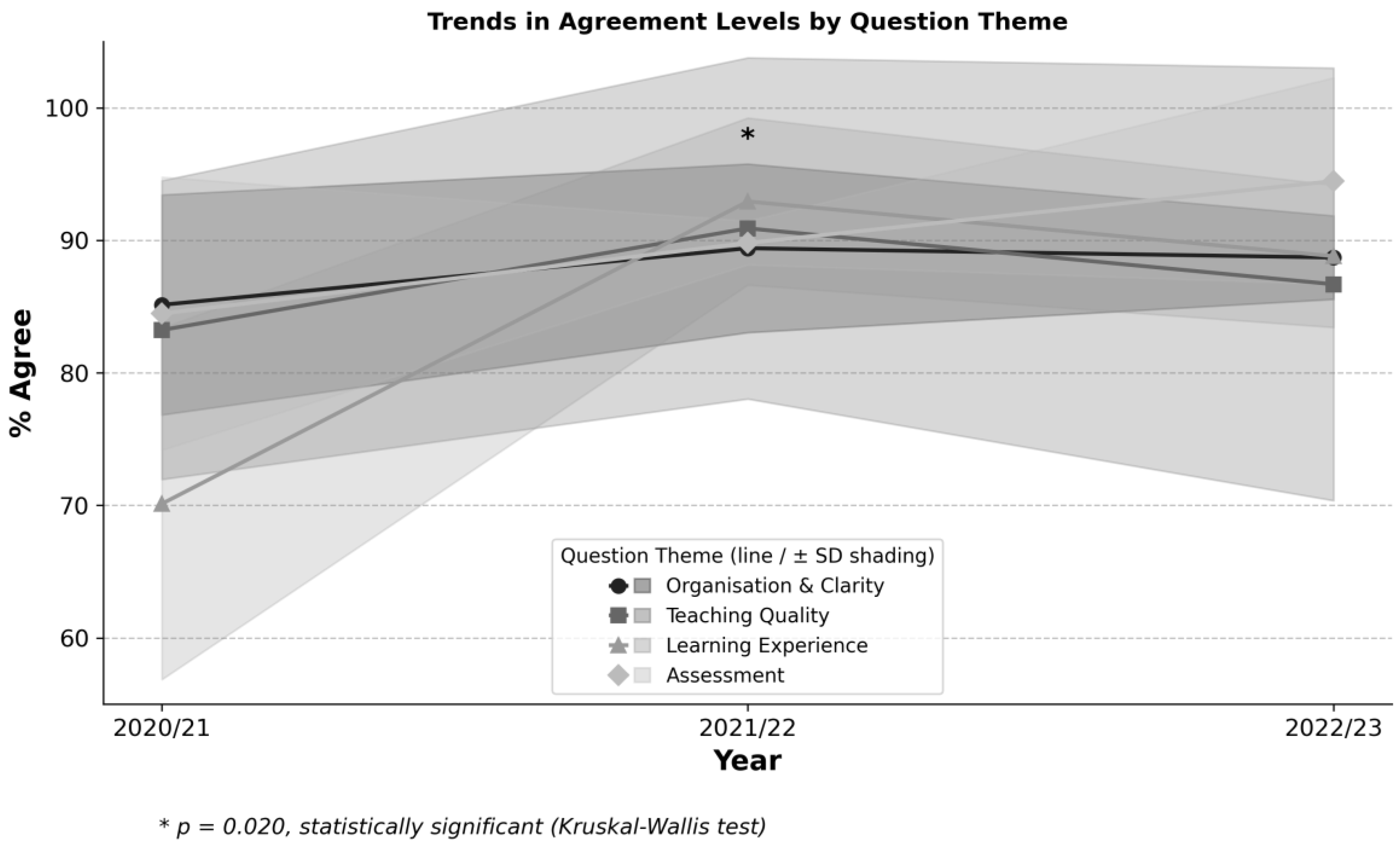
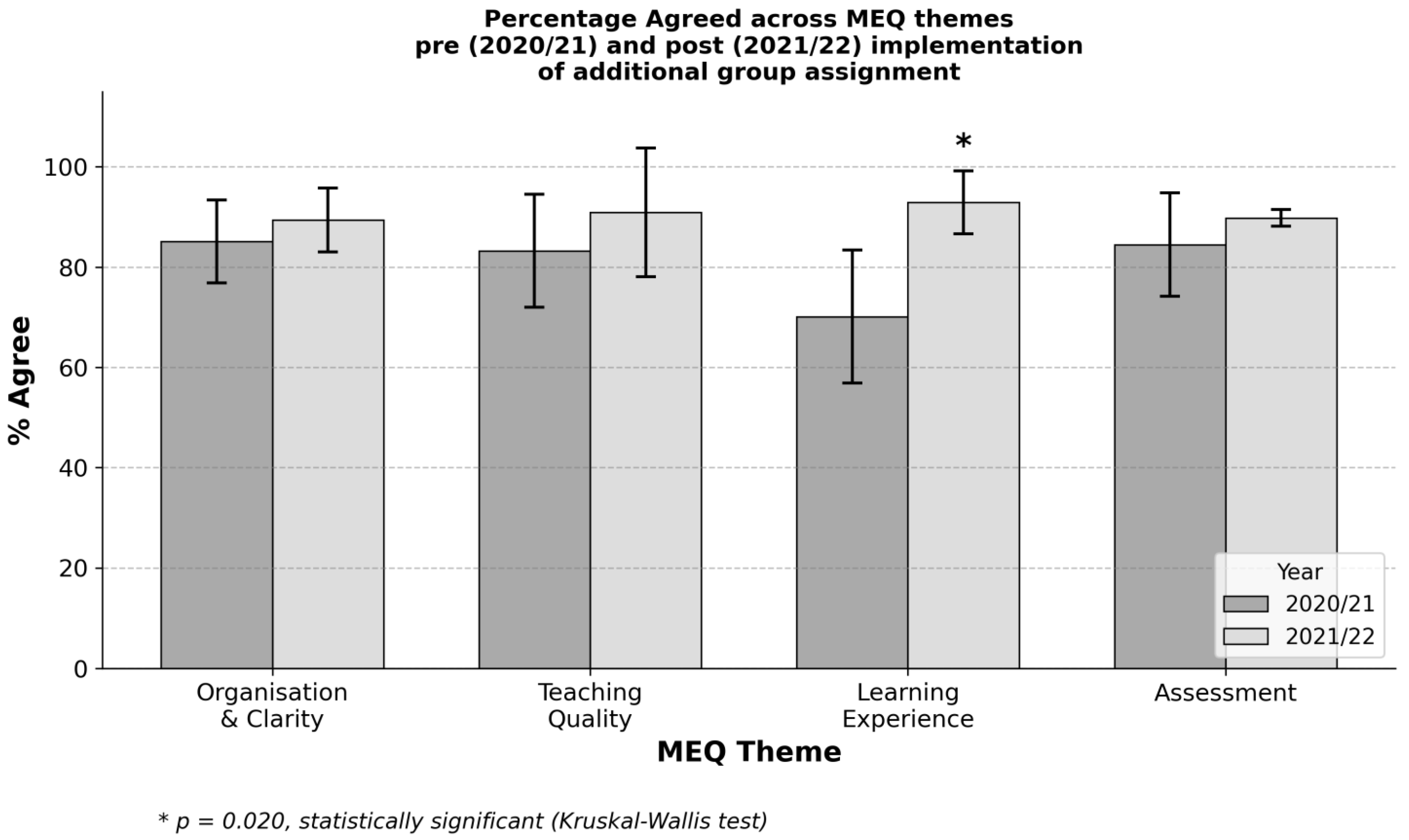
| Assessment | 38 | 84.47 | 10.30 | 33 | 89.80 | 1.65 | 31 | 94.47 | 7.79 |
| Learning Experience | 37 | 70.12 | 13.26 | 33 | 92.93 | 6.30 | 31 | 88.80 | 5.37 |
| Organisation and Clarity | 38 | 85.13 | 8.30 | 33 | 89.40 | 6.36 | 31 | 88.70 | 3.15 |
| Teaching Quality | 37 | 83.23 | 11.27 | 33 | 90.90 | 12.87 | 31 | 86.68 | 16.32 |
| Theme | Cohen’s d | Effect Size | Meaning |
|---|---|---|---|
| Assessment | 0.72 | Medium | Moderate improvement |
| Learning Experience | 2.20 | Very large | Dramatic improvement |
| Teaching Quality | 0.63 | Medium | Moderate improvement |
| Organisation and Clarity | 0.56 | Medium | Moderate improvement |
| MEQ Theme | Kruskal–Wallis Statistics | p-Value |
|---|---|---|
| Organisation and Clarity | 0.221 | 0.639 |
| Teaching Quality | 0.882 | 0.348 |
| Learning Experience | 5.400 | 0.020 * |
| Assessment | 0.067 | 0.796 |
| Literature | Study Setting | Satisfaction Metric |
|---|---|---|
| present study | Intl eng module | Pre: 70.12% Agree → Post: 92.93% |
| Chou and Chang (2018) | Eng project design groups, n = 480 | Skill development M = 3.925 (~78%); Group learning M = 3.015 (~60%); Small groups > large (F = 5.47, p < 0.05) |
| Al-Khatib et al. (2024) | Online eng learning, n = 263 | Overall M = 3.445 (~69%); Interaction M = 3.245 (~65%) |
| Saeed and Mohamedali (2022) | Eng personalised module | Pass rate 70% → 92% (+22%) [MEQ satisfaction improved AY2018–19 vs. prior] |
| Maceiras et al. (2025) | Eng active (Jigsaw/video) | Videos: ~90% satisfaction (Likert 4–5); Jigsaw: 53% |
| Sutherland et al. (2019) | Business modules (eng proxy), 25 k responses | Overall satisfaction R2 ~ 0.9; Teaching β = 0.46 |
Disclaimer/Publisher’s Note: The statements, opinions and data contained in all publications are solely those of the individual author(s) and contributor(s) and not of MDPI and/or the editor(s). MDPI and/or the editor(s) disclaim responsibility for any injury to people or property resulting from any ideas, methods, instructions or products referred to in the content. |
© 2026 by the authors. Licensee MDPI, Basel, Switzerland. This article is an open access article distributed under the terms and conditions of the Creative Commons Attribution (CC BY) license.
Share and Cite
Muppala, S.P.R.; Khazaeinejad, P.; Butt, E. Pedagogical Innovation in Engineering Education Through KW Analysis and Benchmark Validation of Collaborative Assessments. Educ. Sci. 2026, 16, 857. https://doi.org/10.3390/educsci16060857
Muppala SPR, Khazaeinejad P, Butt E. Pedagogical Innovation in Engineering Education Through KW Analysis and Benchmark Validation of Collaborative Assessments. Education Sciences. 2026; 16(6):857. https://doi.org/10.3390/educsci16060857
Chicago/Turabian StyleMuppala, Siva P. R., Payam Khazaeinejad, and Egle Butt. 2026. "Pedagogical Innovation in Engineering Education Through KW Analysis and Benchmark Validation of Collaborative Assessments" Education Sciences 16, no. 6: 857. https://doi.org/10.3390/educsci16060857
APA StyleMuppala, S. P. R., Khazaeinejad, P., & Butt, E. (2026). Pedagogical Innovation in Engineering Education Through KW Analysis and Benchmark Validation of Collaborative Assessments. Education Sciences, 16(6), 857. https://doi.org/10.3390/educsci16060857