1. Introduction
Immersive virtual reality (VR) is increasingly recognised as a powerful educational tool that enhances professional preparation by providing realistic and interactive environments for skill practice. In the context of Initial Teacher Education (ITE), VR is gaining popularity as a way to improve preservice teachers’ (PSTs’) readiness for their professional placements. The persistent theory–practice divide in teacher education remains a global challenge, with preservice teachers often feeling underprepared for complex classroom realities (
Hong et al., 2025;
Mello & Van der Merwe, 2026). Professional experience is central to teacher education, allowing PSTs to apply their knowledge, develop pedagogical skills, and build confidence under the guidance of experienced educators (
Hillyar et al., 2025;
Pendergast et al., 2022). However, preparing PSTs, particularly international students, for their first placement presents significant challenges. Many face uncertainties regarding cultural norms, classroom expectations, and responsive teaching practices (
Devi et al., 2026).
International students often face challenges as they adjust to new educational cultures and classroom environments while also meeting professional expectations. Teacher educators, therefore, need pedagogical approaches that make professional expectations visible and support the transition from coursework to practice in more robust ways (
Hong et al., 2025;
Mello & Van der Merwe, 2026). In Australian early childhood (EC) settings, PSTs are expected to respond to both children’s verbal and nonverbal communication, regulate emotions, and implement relational pedagogies aligned with local standards of care, behaviour guidance, and inclusion. For international postgraduate PSTs, these expectations can increase uncertainty and anxiety, limiting opportunities to practise pedagogical decision-making and hindering the development of confidence during early placement experiences (
Lee et al., 2025).
Practice-based teacher education emphasises the importance of real-world experience, reflection, and the gradual application of essential teaching skills before PSTs begin their classroom placements. Mixed-reality simulations provide authentic, low-risk environments in which preservice teachers can rehearse teaching practices without impacting real learners (
Dalinger et al., 2020), while practice-based learning approaches are increasingly positioned as one way to address the theory–practice divide in teacher education (
Mello & Van der Merwe, 2026). In these simulations, PSTs interact with virtual avatar children in simulated classrooms, making real-time decisions related to behaviour management and instructional strategies. This structure allows PSTs to develop skills at their own pace, repeat scenarios, and learn from mistakes without impacting actual learners, supporting the development of professional judgement rather than surface-level performance.
Contemporary VR platforms increasingly adopt a human-in-the-loop design approach (
Lindberg & Jönsson, 2023). The role of simulation specialists is central to maintaining fidelity, as they dynamically shape avatar responses in real time to reflect authentic classroom interactions (
Mello & Van der Merwe, 2026). This approach allows the complexity of behaviour to be tailored to PSTs’ readiness, helping manage cognitive load while maintaining challenge. Unlike static case studies, mixed-reality simulations enable authentic, low-risk rehearsal in which unpredictability can be sustained without consequences for real learners (
Dalinger et al., 2020). Unlike scripted case studies or peer role-play, VR requires PSTs to make immediate decisions and respond to unpredictable child behaviours, supporting the transfer of theoretical learning into practice (
Finn et al., 2020;
Goff, 2023). Research also suggests that the emotional intensity and complexity of VR scenarios can be calibrated to create safe yet challenging learning environments (
Gresele et al., 2025).
A key advantage of VR is its ability to provide standardised, repeatable practice scenarios featuring avatar children. This enables PSTs to test strategies, receive feedback, self-evaluate, and refine their practice without risking harm to actual learners (
Arriagada-Hernández et al., 2025). A growing body of research suggests that VR simulations can support preservice teachers’ development of classroom management skills, confidence, and authentic learning experiences. However, outcomes are often uneven and dependent on pedagogical design (
Hong et al., 2025). Simulation platforms also support approximations of practice by allowing PSTs to rehearse pedagogical decision-making in scaffolded environments (
Ledger et al., 2022). VR also facilitates vicarious learning by allowing international PSTs to observe peers or facilitators model effective teaching strategies (
Arriagada-Hernández et al., 2025), which is particularly valuable for international PSTs unfamiliar with Australian EC contexts. Immediate, targeted feedback from teacher educators functions as verbal persuasion, strengthening PSTs’ beliefs in their capacity to manage classroom interactions. At the same time, the psychologically safe nature of VR supports emotional regulation in complex situations (
Goff, 2023). However, research also highlights challenges, including limited transfer of learning, technological constraints, and inconsistent pedagogical integration (
Hong et al., 2025;
Ledger et al., 2022).
Foulger (
2020) argues that integrating technology into teacher preparation programmes is essential to developing PSTs’ capacity to use technology effectively and with confidence. In this study, VR is conceptualised not merely as a tool, but as a form of technology infusion embedded across curriculum, pedagogy, and assessment. This positions immersive simulation as part of a broader programme design in which technology shapes how professional learning is organised, enacted, and evaluated. This position aligns with the Technological Pedagogical Content Knowledge (TPACK) framework proposed by
Koehler and Mishra (
2008), which emphasises the integration of technological, pedagogical, and content knowledge. In this sense, the design of VR learning experiences in ITE is not only technological, but pedagogical and epistemic, requiring careful alignment between what PSTs are learning, how they rehearse practice, and how that learning is assessed. Teacher educators play a critical role in modelling effective technology use, designing technologically enriched curricula, and inspiring PSTs to adopt innovative practices (
Jin et al., 2023). Adaptive simulations that closely mirror professional teaching contexts further support PSTs’ ability to translate theory into practice (
Davis et al., 2022).
While VR integration in ITE continues to expand, much existing research has focused on primary, secondary, and special education contexts. A smaller but growing body of literature examines immersive and mixed-reality simulations in early childhood teacher education (ECITE). Recent synthesis and empirical work suggest that simulation can support confidence, classroom decision-making, and opportunities for authentic rehearsal, particularly when learning is scaffolded through repeated practice and feedback (
Hong et al., 2025;
Ledger et al., 2022;
Samuelsson et al., 2022). Similarly,
Goff (
2023) reports improvements in classroom management, behaviour guidance, instructional clarity, and responsiveness to children’s behaviour. Using Bandura’s four sources of self-efficacy as a theoretical framework,
Goff (
2023) highlights the need for further research examining the contribution of VR-simulated practicum experiences to PST self-efficacy and preparedness for early childhood contexts internationally. At the same time, outcomes should not be overstated, as gains in confidence are often uneven, context-sensitive, and shaped by the quality of pedagogical integration rather than by the technology alone (
Hong et al., 2025). Collectively, this emerging literature suggests that VR holds particular promise for EC PSTs, whose work relies heavily on emotional attunement, responsiveness, and relational pedagogy.
In the Australian context, VR is increasingly relevant to national priorities aimed at preparing “classroom-ready” graduates (
Australian Institute for Teaching and School Leadership, 2023). Research indicates that immersive simulations support the development of essential professional skills, including classroom management, instructional decision-making, communication, and cultural responsiveness. These benefits are especially evident during periods of placement disruption, such as those experienced during the COVID-19 pandemic (
Dalinger et al., 2020;
Sasaki et al., 2020). Despite this growing body of work, limited research has examined how VR supports PSTs’ mental, emotional, and practical readiness for placement through a theoretically robust lens such as self-efficacy (
Davis et al., 2022;
Gundel & Piro, 2021).
The simulation used in this study is more accurately described as a human-in-the-loop mixed-reality simulation (Mursion
®). However, I retain the term VR when referring to the broader literature. To address this gap, this study examines how immersive simulation creates pedagogical and emotional conditions that support self-efficacy-related learning among international postgraduate PSTs preparing for their first professional placement in Australian early childhood settings. In doing so, it builds on wider work in simulation-based teacher education while remaining attentive to the more specific challenges faced by international early childhood cohorts in Australian contexts (
Hong et al., 2025;
Lee et al., 2025). The paper contributes to the special issue by showing how mixed-reality simulation can be embedded as part of a coherent ITE design rather than treated as a discrete innovation. Rather than presenting VR as an isolated intervention, it positions immersive simulation as one way teacher education programmes can connect curriculum, pedagogy, assessment, and reflective practice within increasingly digital, practice-based learning environments. However, less is known about how human-in-the-loop mixed-reality simulation supports self-efficacy-related learning for international postgraduate preservice teachers preparing for placement in Australian early childhood settings. Accordingly, this study addresses the following research question:
How does human-in-the-loop mixed-reality simulation support self-efficacy-related learning among international postgraduate preservice teachers preparing for their first professional placement in Australian early childhood settings?
4. Data Analysis
Data analysis was conducted through a rigorous and iterative qualitative process. Initially, two authors independently analysed the video data and observations to apply codes across all data sources. The analysis combined deductive coding informed by Bandura’s four sources of self-efficacy with inductive coding that captured emergent interactional patterns, tensions, and pedagogical moves that were not fully explained by the framework alone. The authors then met to compare interpretations, reconcile coding differences, and collaboratively develop a shared codebook. This process supported consistency and analytical transparency. The initial phase of analysis was guided by Bandura’s four sources of self-efficacy: mastery experiences, vicarious experiences, verbal persuasion, and physiological/affective states as a theoretical framework (
Bandura, 1977). A thematic analysis approach was employed, involving systematic coding, categorisation, and the identification of emerging themes, with particular attention to PSTs’ interactions captured in video data and how raw excerpts were progressively interpreted into codes, sub-themes, and broader analytic claims.
Analysis was ongoing and reflexive. During subsequent meetings, the authors revisited and refined codes and themes, explicitly interrogating potential researcher bias and discussing how our roles as teacher educators may have shaped interpretation. Video data were particularly valuable because they enabled repeated, close analysis of interaction, pacing, hesitation, response timing, and repair, rather than relying solely on retrospective self-report. This process also enabled the identification of learning opportunities afforded by immersive VR experiences that may support PSTs’ development of self-efficacy. Across four teaching blocks, the study also informed iterative refinement of the programme across cohorts. Themes were refined to align with the research questions, with a particular focus on how immersive VR simulation fostered PSTs’ mental, practical, and professional readiness for their first placement through enhanced self-efficacy.
To ensure trustworthiness, methodological triangulation was applied. Themes were required to recur across at least two of the three data sources (video recordings, PSTs’ in-class feedback and observations) and to appear in more than one video group. Patterns identified in only a single data source or group were retained as sub-themes or analytic memos until further corroboration occurred. Emergent codes, categories, and themes were interpreted in relation to the research questions and the study’s implications. Finally, elements of Bandura’s four sources of self-efficacy (
Bandura, 1977) were used to categorise themes related to PSTs’ immersive VR teaching and learning experiences, particularly those associated with confidence building, cultural understanding, and reflective practice.
Section 5 presents the three main themes identified, and the research data helped us create a framework that integrates practice-based, theoretical, and technological knowledge.
5. Findings
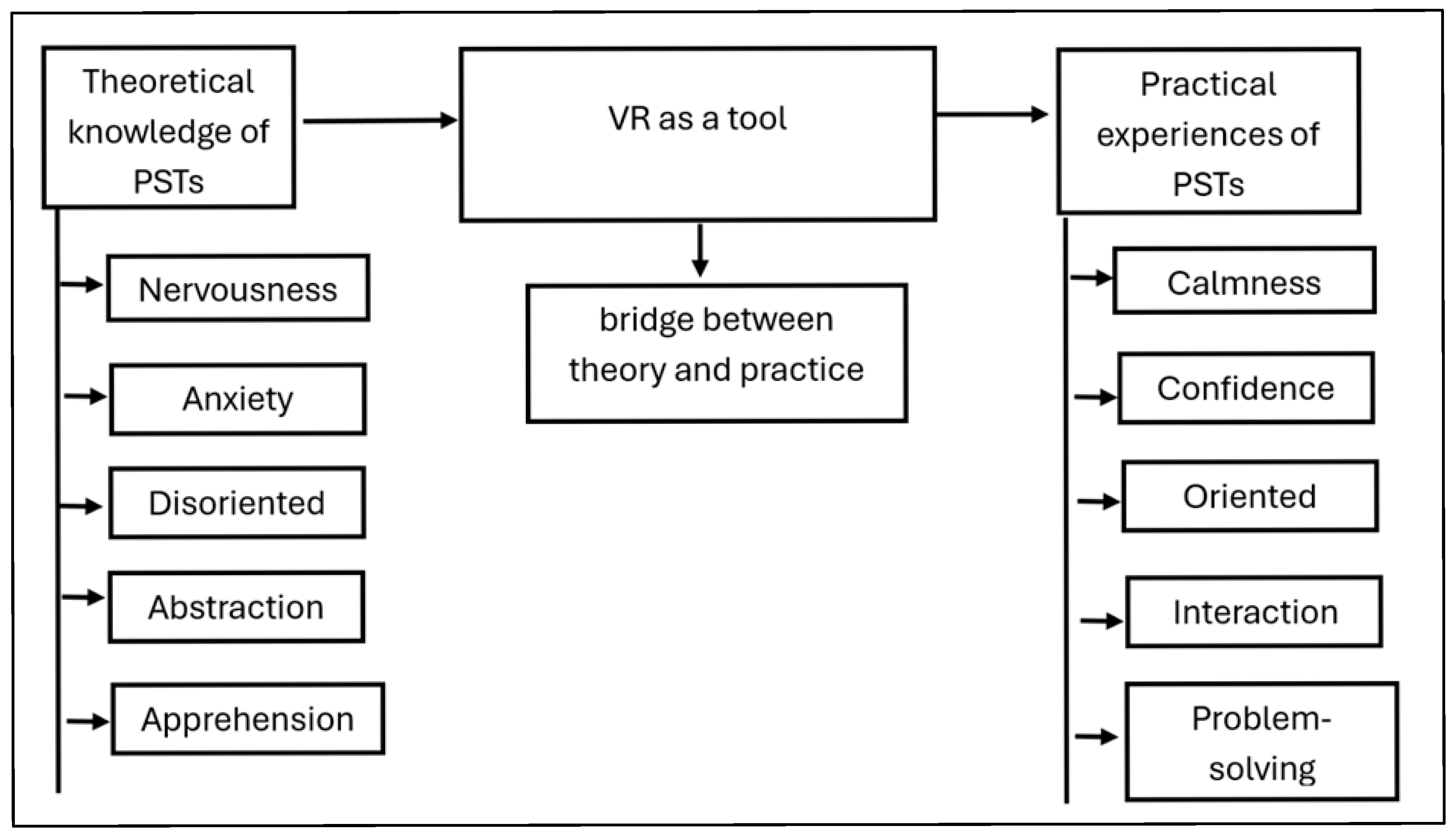
Three key themes emerged from the thematic analysis: (a) the connection between VR, social–emotional learning (SEL), and self-confidence; (b) the perceived benefits of integrating VR into teaching and learning; and (c) the relationship between pedagogy, innovation, and the use of VR in education. Together, these themes show not a simple upward trajectory, but a process marked by hesitation, revision, and increasingly deliberate pedagogical action. As illustrated in
Figure 1, PSTs moved between discomfort, experimentation, feedback, and more confident reflective practice, with each theme capturing a distinct aspect of that process.
5.1. Theme 1: From Anxiety to Relational Regulation: SEL as a Mechanism for Efficacy-Related Learning
Analysis of PSTs’ reflections revealed a trajectory in which emotional responses to the VR experience shifted from self-focused anxiety to confident, relationally attuned engagement. Initial interactions were characterised by nervousness, disorientation, and concern about “saying the right thing,” reflecting heightened self-monitoring at the outset of the simulation. Early expressions such as “It’s nervous” (V1, 11:37) captured this affective state. However, scaffolded debriefing by the specialised trainer (“It’s OK. We had a good conversation with the children,” V1, 11:46) supported PSTs to reinterpret arousal as manageable rather than inhibiting. As the interaction progressed, PSTs articulated this emotional recalibration explicitly, noting that “It was better than we expected… still got some work to do” (V1, 12:21–12:28) and expressing forward-looking confidence (“I think we can do better next time,” V1, 12:31). These reflections indicate a shift from performance anxiety toward an expectation of growth through practice.
As PSTs’ interactional fluency increased, so too did indicators of self-confidence and professional self-worth. This was evident in their capacity to offer concrete feedforward suggestions, such as the need for “more organisation to lead them to the final results” (V1, 12:39–13:02). Importantly, PSTs began to articulate links between their own emotional regulation and children’s participation, noting that nervousness could inadvertently limit children’s engagement and require deliberate strategies to sustain interest and inclusion. Such comments demonstrate emerging SEL awareness, as PSTs recognised the reciprocal relationship between teacher affect and children’s communicative opportunities.
These cognitive and emotional shifts were mirrored in practice. During moments of conflict or heightened energy among the avatar children, PSTs employed calm, prosocial language that named emotions, de-escalated tension, and redirected attention to shared norms. Statements such as “We like playing fine together, but we don’t want to hurt each other because we’re friends, right?” (V1, 4:07) and “Please be nice with each other” (V1, 9:06) illustrate growing competence in emotionally responsive classroom discourse. These brief but purposeful interventions reflect an increasing capacity to translate SEL principles into action within the simulated environment.
PSTs also demonstrated heightened relational sensitivity through acts of personalisation. One participant reflected, “Maybe remember their name is important because I pronounced one of the kids’ names incorrectly” (V1, 18:29), indicating awareness of how small interactional details shape relationships. Similarly, PSTs acknowledged children’s everyday disclosures (e.g., “Mummy doesn’t let me have the Coke or lemonade”) with validating responses such as “OK, we understand your point” (V1, 10:19–10:24). These moments mark a shift from self-preoccupation toward other orientation, signalling increased empathy and relational attunement.
Collectively, the data illustrate an emotional and professional learning arc in which PSTs moved from uncertainty to ease, from internal worry to relational engagement, and from avoidance to confident presence. At the same time, this movement was not linear. Some PSTs remained hesitant, missed interactional cues, or required repeated prompting before shifting from self-focus to child-centred responsiveness. These moments of strain are important because they show that efficacy-related learning in simulation involved effort, uncertainty, and revision rather than immediate success. This progression, supported by the VR environment and guided reflection, underpinned PSTs’ developing readiness to transfer SEL-formed strategies into professional placement contexts.
5.2. Theme 2: Bridging the Theory–Practice Gap in Classroom Management and Inclusion
This theme captures how PSTs used VR simulations to develop practical classroom management and inclusive interaction strategies. PSTs consistently described the simulations as authentic and as a safe bridge between coursework and classroom practice, often comparing VR favourably with their prior expectations. The simulations enabled PSTs to rehearse multiple challenging interactional moments, such as managing conflict, silence, silliness, and imaginative tangents, within iterative cycles of practice, reflection, and re-engagement. Several PSTs referred to reviewing recordings of their sessions to identify effective strategies and areas for improvement, indicating that VR supported learning through observation of their own and others’ practice.
Across simulations, PSTs demonstrated increased attention to turn-taking, pacing, and behaviour guidance. Many noticed early patterns of conversational dominance, with one PST observing, “Most of the time is one child carrying off the conversation” (V4, 18:03). In response, PSTs adopted strategies aimed at promoting equitable participation, including explicit turn-allocation such as “one each” and collective framing (“Everyone is a winner,” V3). PSTs also refined their use of classroom norms, shifting toward concise, positively framed expectations (e.g., “Please be nice,” V3, 9:06). Changes were observed in lesson pacing, including movement directly into the activity following children’s introductions (V3, 2:28), followed in later rehearsals by deliberate pausing to listen before responding.
PSTs identified and adjusted behaviour guidance strategies over successive rehearsals. For example, conditional or extrinsic incentives (e.g., “If you don’t sit properly, you’re not going to get a big ice cream,” V6) were replaced with neutral redirection and acknowledgement of effort. During peer debriefs, these shifts were summarised as adopting a facilitative stance, with one participant stating, “Just ask them more questions rather than ask us” (V6, 12:46–12:53).
The simulations exposed PSTs to a range of child participation styles, including quiet listeners, highly enthusiastic contributors, and playful boundary-testing behaviours. PSTs practised strategies for inviting quieter children into the interaction, such as direct but gentle prompts (e.g., “Do you want to say something, Mateo?”), while also structuring enthusiastic participation through turn-taking routines to ensure space for all children. PSTs refined question design over time, moving from abstract prompts to more concrete formulations. For instance, when asked, “Do you think this is important for you guys?” an avatar responded, “I don’t know” (V7, 7:18–7:32), prompting PSTs to adjust subsequent questioning.
PSTs also extended conversations related to environmental responsibility by building on children’s contributions, using prompts such as “We need to take care of the trees” (V8, 11:11) and “Pick up your rubbish” (V8, 11:27). In addition, they practised sustaining imaginative contributions that had initially been redirected. Examples included validating and extending children’s imaginative statements (e.g., “I rode my bike to the moon,” V6, 6:51–7:05; “I created a monster, its name is Bob,” followed by “It’s a cool monster,” V6, 6:46; “I named it Bob,” V6, 5:51). Across rehearsals, PSTs increasingly used affirmation and follow-up to remain with children’s ideas rather than closing them down.
Overall, the VR rehearsals provided PSTs with observable opportunities to practise and refine classroom interaction strategies, resulting in a set of concrete approaches for managing participation, behaviour, and diverse communicative contributions. Analytically, this theme shows that simulation did more than help PSTs “bridge theory and practice.” It made interactional judgement visible and revisable in real time, allowing PSTs to test, abandon, and refine strategies within the same pedagogical cycle. This theme aligns with Bandura’s verbal persuasion, mastery experiences, and physiological/affective states.
5.3. Theme 3: From Reflection to Pedagogical Revision: Technology as Infrastructure for Repeatable Practice
Analysis of the dataset indicates a consistent shift from affective response to pedagogical action during VR-supported teaching rehearsals. Preservice teachers (PSTs) used debrief sessions to analyse their instructional moves and identify a specific change for subsequent attempts. One PST reflected, “I am sitting and analysing my work… I learned things about myself,” capturing a broader pattern in which reflection was oriented toward immediate pedagogical adjustment rather than general self-evaluation.
PSTs demonstrated increased alignment between pedagogical intention and instructional language across successive rehearsals. Instances of abstract or developmentally misaligned questioning were identified and revised, for example, reframing prompts from “How would you connect with that playground?” to “What do you like about this place?” Similarly, PSTs recognised moments where children’s imaginative contributions were prematurely redirected (e.g., “Let’s go back to the picture”, V9, 6:51–7:05) and subsequently practised sustaining these ideas long enough to include peers before returning to the instructional focus (e.g., “It’s a cool monster”, V9, 6:46). These adjustments were explicitly linked to feedback received during debriefs and enacted in subsequent attempts.
The data also show changes in classroom management and motivational strategies. PSTs identified ethical and relational concerns associated with reward-based approaches. They replaced these with inclusive routines, such as consistent naming, structured turn-taking, and verbal acknowledgement of children’s contributions. These practices were trialled, reviewed, and refined within the same VR session or across repeated simulations.
Across cases, a recurrent cycle was evident: PSTs named an emotional or interactional challenge, attempted a pedagogical strategy, received specific feedback, and reattempted the strategy with modification. Over time, reflective language shifted from first-person affective statements (e.g., “I’m nervous”) to professional problem-solving terminology (e.g., simplify, slow down, invite one at a time, acknowledge feelings, link back to purpose). This pattern indicates the development of pedagogically focused self-regulation within a technology-mediated repeatable teaching environment.
The three themes together illustrate a coherent transformation. Social–emotional learning highlights PSTs’ progression from apprehension to empathy and self-regulation. The perceived advantages showcase specific management and differentiation strategies that were practised safely in VR. Meanwhile, the alignment of pedagogy and innovation demonstrates how PSTs utilised the technology to support EC goals rather than overshadow them. By the final cycles, they were able to articulate practical routines that are ready for placement, such as using names for inclusion, validating feelings, inviting individual participation, briefly staying with imagination, simplifying questions, and connecting back to the learning goals. Taken together, these findings suggest that immersive simulation created a concentrated pedagogical environment in which multiple sources of efficacy information were encountered, interpreted, and acted on within the same cycle of practice. These reflect both emotional growth and pedagogical intentionality.
6. Discussion
This study contributes to emerging VR research in teacher education by showing that immersive simulation functions not only as a rehearsal tool but also as an integrated pedagogical environment. It operationalises multiple sources of self-efficacy within a single, repeatable learning cycle. Rather than claiming direct measurement of efficacy change, the study examines how international PSTs enacted, interpreted, and revised self-efficacy-related practices through interaction with avatar children, guided feedback, and structured reflection. In this sense, the value of mixed-reality simulation lies not simply in confidence-building. It lies in how it compresses mastery, modelling, persuasion, and affective regulation into one pedagogical space. For the special issue, the paper offers a grounded account of how technology infusion can be organised programmatically, not just technically, so that immersive tools support pedagogical judgement, reflective practice, and professional readiness within ITE.
Across the three themes, the findings point to a more specific argument than simple alignment with Bandura. The simulation environment accelerated the movement between emotional responses, pedagogical actions, feedback, and re-attempts. This matters because Bandura’s sources are often discussed as analytically distinct, whereas in this study, they were experienced by PSTs as relationally entangled and pedagogically simultaneous. In early childhood contexts, where communication, affect, responsiveness, and interactional timing are central, this compression appears especially significant.
In Theme 1, the journey of preservice teachers (PSTs) from initial nervousness to composed, purposeful interaction highlights the transformative potential of immersive virtual reality (VR) in fostering self-efficacy-related learning, as outlined by
Bandura (
1977). Initially, these PSTs experienced a sense of arousal often described as “nervousness.” However, this feeling was not simply eliminated; rather, it was reframed through targeted brief practice sessions and structured debriefings. These interventions created an environment where PSTs could experience manageable success even under pressure. What is especially important here is that affective regulation was not separate from pedagogical development. In this study, learning to remain calm, listen, and respond relationally was itself part of becoming able to act pedagogically in EC settings.
As PSTs engaged with avatar children, they developed a more deliberate interactional stance. They used calming language, empathic acknowledgement, and clearer relational framing to manage conflict and sustain participation. This extends Bandura’s framework in an EC direction by showing that efficacy-related learning in early childhood is not only individual or cognitive. It is also embodied, relational, and interactional. PSTs were not merely building private beliefs about competence. They were learning how competence is enacted through tone, timing, emotional regulation, and responsiveness to children in the moment.
This interpretation extends broader research showing that short, coached mixed-reality simulations can support efficacy-related development when they combine enactment, observation, feedback, and opportunities for reattempt (
Samuelsson et al., 2022;
Hong et al., 2025). At the same time, the field cautions that many reported gains are based on self-reported confidence. Such gains do not necessarily indicate sustained pedagogical change over time (
Hong et al., 2025). The significance of the present data, then, is not that they prove stable efficacy change. It is that they reveal how PSTs moved from nervousness toward empathy, timing, and interactional control within a structured early childhood rehearsal environment. The observed SEL trajectory from disorientation to enjoyment, confidence, and professional behaviour, therefore, extends current work on simulation-based learning by showing that efficacy-related development in ECITE is inseparable from relational pedagogy, affective regulation, and interactional responsiveness. It also reinforces the need to interpret such gains through pedagogical design rather than through technological novelty alone (
Hong et al., 2025;
Samuelsson et al., 2022).
Theme 2 further shows that simulation did more than provide safe practice. It made pedagogical judgement observable and revisable. PSTs could see when questioning was too abstract, when participation became uneven, or when behavioural responses closed down interaction rather than extending it. This matters theoretically because the environment did not simply confirm prior knowledge. It exposed the fragility of that knowledge in action and created conditions for immediate repair. For international PSTs, this was particularly important because the challenge was not only the technique, but also learning how pedagogical decisions are culturally and interactionally realised within Australian early childhood settings.
This finding reinforces a central point in the literature: the value of VR is not inherent to the technology itself. It is produced through pedagogical design, scaffolding, and integration into teacher education programmes (
Hong et al., 2025). Simulation platforms matter because they make decision-making visible through approximations of practice, allowing PSTs to rehearse, review, and revise responses within a controlled environment (
Ledger et al., 2022).
In this study, visibility was crucial for surfacing differentiation, turn-taking, questioning, and culturally responsive communication that might otherwise have remained abstract in coursework. Rather than showing simply that VR is useful for classroom management, these findings indicate that mixed-reality rehearsal supported efficacy-related learning by making behaviour guidance, participation management, and interactional clarity available for immediate revision. This extends work positioning simulation as a structured form of deliberate practice in teacher education, where repeated rehearsal, targeted feedback, and refinement occur within a controlled pedagogical environment (
Gravett et al., 2023). The pedagogical value of the environment lay in its repeatability and in the speed with which PSTs could test, evaluate, and modify their responses before entering placement.
Theme 3 underscores that the contribution of innovation depends on how tightly it is pedagogically organised. In this study, recorded lessons, peer feedback, and repeated rehearsal did more than accompany the technology. They turned the technology into a structured mechanism for noticing, reflection, and pedagogical revision. This helps explain why PSTs were able to move from affective reactions toward more deliberate professional language and action. The use of short practice cycles, regular opportunities for reflection, and consistent integration of technology supported pedagogical refinement. It also strengthened PSTs’ confidence in working within digitally mediated teaching environments. For PSTs preparing for early childhood settings, this is significant because technology did not displace relational pedagogy. It enabled repeated rehearsal of the relational, communicative, and interactional work required by EC teaching (
Lindberg & Jönsson, 2023;
Australian Institute for Teaching and School Leadership, 2023).
Our research aligns with
Foulger’s (
2020) assertion that teacher educators need to integrate technological knowledge (TK), pedagogical knowledge (PK), and content knowledge (CK) into a cohesive framework known as Technological-Pedagogical-Content Knowledge (TPACK). This comprehensive approach not only enhances teaching methodologies but also deepens PSTs’ understanding of technology, enabling them to bridge the gap between theoretical knowledge and classroom practice (
Arriagada-Hernández et al., 2025). Ultimately, by developing a holistic understanding of TPACK and effectively utilising technology, teachers can create enriched learning environments that foster student engagement, collaboration, and equity (
Jin et al., 2023;
Llanos Ruiz et al., 2025).
While virtual reality is often positioned as a discrete innovation or supplementary learning tool, this study’s findings illustrate how immersive simulation can serve as a programme-wide technology infusion within initial teacher education, rather than a standalone intervention. Technology infusion refers to the systematic and purposeful integration of digital tools across curriculum, pedagogy, and assessment. In other words, technology becomes embedded in how professional learning is designed, enacted, and evaluated (
Foulger, 2020). In this study, VR was not introduced as a novel activity. It was embedded early in a core unit and revisited across multiple teaching blocks, allowing preservice teachers (PSTs) to engage in repeated cycles of enactment, feedback, reflection, and re-enactment. This study extends simulation-based ITE research by demonstrating how mixed-reality simulation can serve as a pedagogical infrastructure within ECITE rather than as a one-off confidence-building intervention.
This programmatic design aligns VR use with broader ITE goals, including the development of pedagogical judgement, emotional regulation, and professional language, rather than positioning technology as content in its own right. By standardising interactional scenarios while allowing adaptive responses through human-in-the-loop facilitation, VR enabled consistent access to high-quality practice opportunities across cohorts, supporting equity and scalability at the programme level. Across four teaching blocks, the study also informed iterative refinement of the programme across cohorts. Repeated exposure also contributed to PSTs’ technology self-efficacy, normalising the use of digital pedagogies and reducing reliance on ad hoc or individualised technology adoption. These findings position mixed-reality simulation as a scalable model for the future of teacher preparation in technology-rich learning environments. They also suggest that its value depends on sustainable integration within course design, staffing, and assessment, rather than on one-off adoption. For future ITE design, this means immersive simulation is most powerful when embedded as part of a coherent, programme-wide approach to rehearsing practice, reflection, and feedback.
From a curriculum perspective, immersive simulation functioned as a connective thread across theory, practice, and reflection, operationalising Technological Pedagogical Content Knowledge (TPACK) through authentic rehearsal rather than abstract discussion. This approach demonstrates how a purposeful infusion of technology can enhance coherence across an early childhood ITE programme, ensuring that digital tools support, rather than compete with, relational and pedagogical priorities. As such, VR offers a sustainable model for programme-wide technology integration that prepares PSTs not only to teach effectively, but also to engage confidently with technology-rich professional environments.
This study is especially significant for international PSTs, who often face two intertwined challenges in professional preparation: enacting essential teaching practices and adapting to the language, routines, and educational expectations of a new context (
Lee et al., 2025). The findings sharpen this discussion by showing that early successes in mixed-reality rehearsal, such as resolving classroom conflict or engaging a previously quiet child, can shift PSTs from anxiety toward more deliberate pedagogical decision-making. This extends broader work on simulation as a strategic practice by showing how scaffolded rehearsal can support readiness for practice in culturally unfamiliar early childhood contexts (
Dalinger et al., 2020;
Gravett et al., 2023;
Hong et al., 2025).
VR technology offers consistent and repeatable opportunities for PSTs to practice, reflect, and refine crucial interpersonal skills. Across the wider literature, these simulations are valued for providing low-risk, feedback-rich environments in which PSTs can test interactional strategies, revisit decisions, and prepare for the communicative demands of placement (
Dalinger et al., 2020;
Gravett et al., 2023;
Hong et al., 2025). In our own context, this is particularly relevant for PSTs with limited familiarity with local classroom cultural norms, where simulation can make expectations more visible before practicum (
Lee et al., 2025). The relevance of this study is particularly pronounced in the Australian educational context, where there is a strong emphasis on “classroom-ready” priorities. These priorities incentivise reliable pre-practicum preparation that focuses on rehearsing skills related to classroom communication, interaction, and cultural responsiveness (
Australian Institute for Teaching and School Leadership, 2023;
Sasaki et al., 2020).
By concentrating specifically on the interactional demands placed on early childhood educators, this study fills a noticeable gap in the literature, which has traditionally been centred on primary and secondary education settings. Our research demonstrates how VR can scaffold crucial elements of effective teaching, including responsive interaction, emotional attunement, and relational pedagogy, specifically tailored to support international cohorts of PSTs. This approach not only enriches their professional practice but also enhances their overall effectiveness in diverse classrooms.