Review

Systemic Coherence for Non-Linear Pedagogy and Integral Development in School Physical Education: An Interpretive Synthesis and Teacher Education Framework

by
Heng Yeow Yap
and
Jernice Sing Yee Tan
*
Physical Education and Sport Science Department, National Institute of Education, Nanyang Technological University, Singapore 637616, Singapore
*
Author to whom correspondence should be addressed.
Educ. Sci. 2026, 16(6), 850; https://doi.org/10.3390/educsci16060850
Submission received: 4 April 2026 / Revised: 15 May 2026 / Accepted: 21 May 2026 / Published: 28 May 2026

Abstract

School physical education (PE) has often relied on linear progressions in which teachers demonstrate, pupils practise prescribed techniques, and achievement is judged through visible reproduction of preferred movement forms. Non-linear pedagogy (NLP) and the constraints-led approach (CLA) offer an alternative ecological-dynamics rationale for supporting pupils’ integral development, including motor competence, adaptable movement capability, and dispositions for lifelong physical activity and physical literacy. However, existing review work has not sufficiently explained why principled NLP/CLA designs remain unevenly enacted across ordinary school PE systems. We conducted a theory-informed interpretive synthesis drawing on critical interpretive synthesis and thematic synthesis. A structured English-language search of ERIC, SPORTDiscus, Scopus, and Google Scholar (2010–2025) was combined with title-and-abstract screening, full-text assessment, backward and forward citation chaining, and purposive retention of foundational or Singapore-context records, and reporting was strengthened through PRISMA-like transparency aids adapted to interpretive synthesis. The final coded corpus comprised 36 included sources: 9 empirical studies, 3 reviews, 9 conceptual or practitioner texts, 6 theoretical or critical sources, 4 review-method papers, and 5 Singapore policy, context, or professional-learning documents used as an illustrative policy lens. Through iterative coding, descriptive theme development, and analytical integration, we identified six coherence domains shaping enactment: teacher beliefs and knowledge; curriculum and lesson structure; assessment and accountability; systemic and resource constraints; professional development ecosystems; and stakeholder and cultural factors. These domains informed a Systemic Coherence Framework spanning micro, meso, and macro levels. The synthesis suggests that assessment coherence may be a high-leverage condition because it links curriculum legitimacy, reporting, and teacher defensibility, but its comparative influence across domains remains a hypothesis for future empirical testing. The framework is offered as an analytic heuristic rather than a prescriptive model and is intended to help researchers, teacher educators, school leaders, and policy actors diagnose where curriculum intent, assessment language, professional learning, and organisational routines support or inhibit ecologically informed practice.

1. Introduction

School physical education (PE) is increasingly expected to support pupils’ integral development: motor competence, adaptable movement capability, meaningful engagement, and dispositions for lifelong physical activity and physical literacy (Beni et al., 2017; Rutkauskaite et al., 2024). These ambitions are often articulated as holistic or whole-child aims, yet they are pursued within institutional arrangements that prize safety, predictability, coverage, and auditability. Pedagogical innovations are therefore judged not only by their learning rationale, but also by their fit with timetables, reporting routines, facilities, and wider accountability expectations.
Non-linear pedagogy (NLP) and the constraints-led approach (CLA) are influential because they provide a coherent account of learning for such aims. In ecological dynamics, learning is understood as the emergence of functional perception-action couplings as learners explore affordances shaped by interacting individual, task, and environmental constraints (Chow et al., 2007; Renshaw et al., 2010; Correia et al., 2019; Renshaw & Chow, 2019). The issue for schools is not whether this account is theoretically plausible, but why principled design ideas so often fail to become routine practice under everyday school conditions.
In classroom terms, high-quality NLP is more specific than generic “game play” or loosely supervised discovery. Teachers identify a movement problem linked to the intended learning, preserve key informational features of the performance environment, manipulate constraints such as space, player numbers, rules, equipment, or scoring conditions, and use brief demonstrations, prompts, and questioning to orient learners’ attention to relevant information (Pinder et al., 2011; Correia et al., 2019; Renshaw & Chow, 2019). Progress is then judged within the representative task through the quality of decisions, adaptations, and functional solutions, not only through reproduction of one ideal technique form. This matters because critiques of minimally guided instruction rightly remind us that novices often need clear structure, modelling, and scaffolded support (Kirschner et al., 2006; Rosenshine, 2012). The relevant contrast is therefore not between structure and no structure, but between different ways of structuring learning in PE.
School PE operates within conservative institutional logics. Technique-oriented instruction and predictable routines persist because they help teachers manage large groups, limited time, shared spaces, and the need to make progress visible. More broadly, recent PE scholarship on models-based practice shows that pedagogical innovation is rarely sustained by theoretical merit alone; it also depends on time, collegial support, and organisational fit (Casey & Bjørke, 2024). Implementation accounts that foreground individual teacher willingness can, therefore, mis-specify the unit of analysis.
A persistent source of confusion is the term constraints. Within ecological dynamics, constraints are designable boundary conditions that shape information and invite particular action possibilities (Chow et al., 2007; Renshaw et al., 2010; Renshaw & Chow, 2019). Within schooling, constraints usually refer to limiting conditions such as time, facilities, class size, and accountability. When these meanings are conflated, constraints-led pedagogy can be caricatured either as unstructured activity or as an impractical ideal. Clarifying the distinction is important because it affects what teachers treat as legitimate design decisions and how practice is justified under scrutiny.
We propose systemic coherence as the organising construct. In this article, systemic coherence means the degree of alignment between NLP design logic and the institutional conditions that shape what is feasible, legitimate, teachable, assessable, and defensible in school PE. Classroom task design sits inside curriculum structures, assessment and accountability routines, professional learning arrangements, safety governance, and stakeholder expectations about what “good PE” looks like (Ball, 2003; Coburn, 2003). Implementation research indicates that complex practices diffuse slowly unless capability, opportunity, and motivation are developed together and supported by aligned system signals (Damschroder et al., 2009; Fixsen et al., 2005). For NLP, coherence has to be achieved across micro (teacher practice and learner task design), meso (department, school, and professional learning routines), and macro (policy, curriculum, assessment, and accountability signals) levels. We are not arguing that NLP should replace all more explicit or structured approaches in PE; rather, we seek to clarify the conditions required when schools want to use NLP credibly for integral-development aims.
This review addresses a specific scientific gap. Recent review work has examined pedagogical models in PE and broader teacher or coach perceptions of game-based and constraints-led pedagogies (Casey & Bjørke, 2024; Richardson et al., 2024), but the literature has not yet been organised around the system-level coherence conditions that make NLP/CLA feasible, assessable, and legitimate in school PE and PETE. This article, therefore, makes three contributions. First, it synthesises reported tensions and enabling conditions for implementing NLP and CLA in school PE and PETE. Second, it translates these into a Systemic Coherence Framework that specifies micro-, meso-, and macro-level coherence requirements. Third, it uses Singapore as an illustrative policy lens to show how coherence tensions become visible in a centrally governed, high-accountability system with explicit PE syllabi and structured professional learning.
The objective of the review was to generate an explanatory framework for understanding how institutional conditions support or inhibit NLP/CLA enactment in school PE and PETE. The paper addresses two guiding questions: (1) What coherence tensions and enabling conditions are reported in relation to implementing NLP and CLA in school PE and PETE? (2) How can these be organised into a multi-level framework that supports coherent curriculum, assessment, and professional learning design without diluting ecological-dynamics principles?

2. Materials and Methods

2.1. Review Design and Review Questions

We undertook a theory-informed interpretive synthesis drawing primarily on critical interpretive synthesis (CIS) and thematic synthesis because our questions were explanatory and framework-generating rather than effect-estimating. CIS is appropriate when the literature is heterogeneous in design, uneven in empirical maturity, and conceptually diffuse, and when the goal is to build an explanatory account rather than aggregate comparable intervention effects (Dixon-Woods et al., 2006; Grant & Booth, 2009; Barnett-Page & Thomas, 2009). Thematic synthesis contributed a transparent analytic route from coded text to descriptive themes and then to analytical themes (Thomas & Harden, 2008). The review addressed two linked questions: (1) What tensions and enabling conditions are reported in relation to implementing NLP and CLA in school PE and PETE? (2) How can these be organised into a multi-level coherence framework without diluting ecological-dynamics principles?
Our analytic focus was systemic coherence: the fit between NLP design principles and the institutional conditions that shape what is feasible, legitimate, teachable, and assessable in school PE.
Searching, sampling, critique, and analysis were treated as linked and recursive, consistent with CIS (Dixon-Woods et al., 2006). At the same time, to make the synthesis legible to readers accustomed to more structured evidence reviews, the manuscript was reported with reference to PRISMA 2020, PRISMA-S, and ENTREQ as transparency aids rather than as determinants of synthesis logic (Tong et al., 2012; Page et al., 2021; Rethlefsen et al., 2021). Reflexivity was handled explicitly: the authors work in PE teacher education and are broadly sympathetic to ecological dynamics, so the audit trail was used to distinguish empirical recurrence from conceptual clarification, implementation theory, and policy or context signals, and we actively sought tension-rich or potentially disconfirming material, including accounts of implementation difficulty, conceptual slippage, performative pressure, and the continuing value of more explicit teaching in some circumstances.

2.2. Eligibility Criteria

Eligibility was framed around setting, pedagogical focus, contribution to the review questions, and document type. We included records that focused on school PE or PETE and did at least one of four things: (a) reported empirical or review evidence on enactment, teacher perceptions, student response, assessment, curriculum, professional learning, or implementation; (b) clarified NLP, CLA, or ecological-dynamics design principles in ways directly relevant to school practice; (c) provided implementation or system theory needed to interpret recurring tensions in the PE/PETE literature; or (d) supplied authoritative Singapore syllabus, policy, or professional-learning documentation for the illustrative policy lens. We excluded records focused exclusively on elite or high-performance coaching without explicit school-PE implications, along with papers on game-based, discovery, or inquiry approaches that did not engage constraints-led or ecological-dynamics design in a way relevant to the review questions. The main structured search targeted English-language records published between 2010 and 2025. No country restriction was applied to the literature sources; Singapore documents were retained only for the illustrative policy lens. Records predating 2010 could still be retained if later identified through citation chaining or purposive inclusion and judged foundational or contextually necessary. Supplementary Table S1 summarises the eligibility logic.

2.3. Information Sources and Search Strategy

Information sources were ERIC, SPORTDiscus, Scopus, and Google Scholar. The formal structured search was completed in November 2025. Search strings combined three concept blocks: (i) NLP, CLA, and ecological-dynamics terms (e.g., “non-linear pedagogy”, “constraints-led approach”, “ecological dynamics”, and “representative learning design”); (ii) educational-setting terms (e.g., “physical education”, “school physical education”, PETE, and teacher*); and (iii) implementation or system terms (e.g., curriculum, assessment, accountability, implement*, enact*, professional development, professional learning, and policy). Google Scholar was used as a supplementary search source rather than a stand-alone database, consistent with guidance that it is best used as an adjunct in evidence reviews and can help locate grey or poorly indexed material (Haddaway et al., 2015). Journal Citation Reports was not searched because it is a journal-level citation metric and a journal evaluation source, not a bibliographic database designed for topic-based retrieval of individual studies. Representative final search templates reconstructed from the surviving audit trail are reported in Supplementary Table S2.

2.4. Screening, Source Selection, and Audit Trail

Searching and source selection proceeded in two linked phases. Phase 1 comprised scoping and query refinement, structured searching, title-and-abstract screening, and full-text assessment. Phase 2 comprised backward citation searching, forward citation tracking, and purposive inclusion of foundational or contextual records identified as necessary during analysis. This design is consistent with CIS, which allows an initial structured search to be combined with later purposive or theoretical sampling when the aim is explanation and framework building rather than effect aggregation (Dixon-Woods et al., 2006; Barnett-Page & Thomas, 2009). Reviews of complex evidence likewise show that supplementary methods such as snowballing can contribute substantially to relevant-source identification (Greenhalgh & Peacock, 2005).
The surviving audit trail supports a transparent reconstruction of the review architecture, the final corpus, and the evidentiary role of included records, but it does not support a fully count-complete PRISMA flow from every early scoping query through every later chaining iteration. We therefore report an adapted PRISMA-like workflow summary rather than a retrofitted count-based flow diagram. Supplementary Figure S1 and Table S3 distinguish the main structured-search stage, relevance screening, full-text assessment, additional source identification, and final corpus assembly, while Supplementary Tables S4 and S5 profile the corpus and map included records. The final coded corpus comprised 36 included sources: 31 literature sources and 5 Singapore policy, context, or professional-learning documents. Of these 36 sources, 23 were published within the main structured-search window, and 13 predated 2010 but were retained because they provided foundational conceptual, implementation, methodological, or Singapore-context support. Within the 31 literature sources, there were 9 empirical studies, 3 reviews, 9 conceptual or practitioner texts, 6 theoretical or critical sources, and 4 review-method papers. Additional methodological and reporting-guidance citations used to justify and report the review were not counted within the 36-source coded corpus and are itemised separately in Supplementary Table S6.

2.5. Data Charting, Coding, and Analytical Synthesis

For each included source, we charted bibliographic details, publication year, country or policy setting, source type, participant group or sample characteristics (where applicable), pedagogical focus, school or PETE relevance, and claims relevant to barriers, enablers, or institutional conditions shaping enactment. Analysis proceeded in three stages. First, text segments relevant to enactment were coded inductively and deductively in a constant-comparison mode, drawing on thematic coding principles (Braun & Clarke, 2006; Thomas & Harden, 2008). Initial codes included teacher control, task representativeness, curriculum compression, assessment defensibility, facility access, mentoring, professional learning design, safety governance, and stakeholder legitimacy.
Second, related codes were clustered into descriptive themes. Third, these descriptive themes were iteratively refined into six analytical coherence domains by asking what primary mechanism of misalignment each cluster represented and by checking proposed domains against overlapping or potentially disconfirming cases across the corpus. In a further interpretive step, the six domains were translated into micro-, meso-, and macro-level coherence requirements and then into the Systemic Coherence Framework. This sequence, from coding to descriptive themes to analytical integration, is reported in the manuscript and supported by the audit materials in Supplementary File S1.

2.6. Evidentiary Use, Weighting, and Limits

Different source types were used for different purposes rather than being treated as interchangeable evidence. Empirical studies and reviews grounded recurring tensions and enabling conditions. Conceptual and theoretical sources were used mainly to interpret mechanisms, clarify design principles, and connect recurring tensions across system levels. The four review-method papers informed review design and analysis but were not weighted as substantive evidence for the six coherence domains. Singapore syllabus, policy, and professional-learning documents were used only to illustrate system signals in Section 3.8 and were not treated as evidence of classroom effects.
We did not use a formal checklist-based critical appraisal to exclude records and did not undertake quantitative vote counting. This choice reflected the framework-generating purpose of the review and the heterogeneity of the corpus. Instead, we recorded source type, context, and stated limitations for empirical papers; interpreted lower-confidence claims cautiously; and gave greatest analytical weight to claims that recurred across empirical and review sources or were needed to explain such recurrence. The resulting domains should therefore be read as analytical themes rather than frequency counts, and the framework should be read as an explanatory heuristic rather than a validated causal model or scoring instrument.

3. Results

The review architecture, eligibility logic, and final corpus profile are summarised in Supplementary Figure S1 and Tables S1–S6. The final coded corpus comprised 36 included sources. Empirical and review papers most directly informed recurrent tensions around design translation, curriculum time, assessment fit, feasibility, professional learning, and legitimacy. Conceptual, theoretical, and policy sources were then used to interpret why those tensions recur and how they connect across system levels. The six domains reported below are therefore analytical themes rather than frequency-ranked factors. They are analytically distinct by primary mechanism but practically overlapping: teacher beliefs and knowledge concerns design competence; curriculum and lesson structure concerns time and sequencing; assessment and accountability concerns evidence and reporting; systemic and resource constraints concern feasibility and safety; professional development ecosystems concern sustained capability building; and stakeholder and cultural factors concern legitimacy.

3.1. Teacher Beliefs and Knowledge

The central tension in this domain concerns what counts as “good teaching” and professional competence in PE. In many schools, competence is read through visible teacher control, rapid correction, predictable routines, and easily audited progress. Under these conditions, representative and exploratory tasks can appear risky, inefficient, or insufficiently instructional (Ball, 2003; Richardson et al., 2024).
Teachers may therefore narrow tasks to reduce behavioural uncertainty, increase prescriptive instruction, or treat variability as error to be removed rather than information to be explored.
Where enactment is more robust, teachers can explain why variability is purposeful, scale tasks developmentally, and distinguish constraint-led design from both generic activity-based lessons and laissez-faire discovery. Atencio et al. (2014) show how primary teachers can structure exploration through deliberate constraint manipulation, while Moy et al. (2015) indicate that carefully designed non-linear approaches in PETE can support motivational outcomes. Conceptual clarification also matters: when teachers have stable language for representative learning design, constraint manipulation, and perception-action coupling, they are better able to justify practice under scrutiny (Renshaw et al., 2016; Renshaw & Chow, 2019).
In practical terms, this domain requires shared design heuristics, department-level opportunities to make reasoning visible, and system messages that legitimise exploratory teaching as intentional rather than as “less teaching” (Table 1). Its connection with the other domains is direct: without teacher design competence, curriculum flexibility, representative assessment, and professional learning support cannot be translated into credible lessons.

3.2. Curriculum and Lesson Structure

The coherence tension here lies between curriculum coverage logics and the temporal demands of non-linear learning. NLP is strengthened when teachers can revisit a small number of movement problems, observe emerging behaviour, adjust constraints, and refine tasks across lessons (Chow, 2013; Renshaw & Chow, 2019). Many school schedules and schemes of work, however, favour rapid topic turnover and linear progressions because these are easier to timetable, report, and compare.
When time is fragmented, lesson structures often drift towards decontextualised skill blocks and short drills that fit predictable routines. This weakens representativeness and limits the feedback loops through which learners attune to information in game-like or performance contexts (Pinder et al., 2011).
Millar et al. (2021) show that sustained collaboration time within departments can support deeper integration of contemporary skill acquisition approaches, suggesting that curriculum coherence is partly an issue of work organisation rather than teacher preference alone. This domain, therefore, links the micro-level design of repeated representative tasks to meso-level schemes of work and macro-level signals about whether depth, adaptation, and revisiting are valued.

3.3. Assessment and Accountability

This domain concerns formal criteria, evidence routines, reporting, and accountability structures. It is analytically distinct from stakeholder legitimacy (Section 3.6), which concerns how pedagogies are interpreted by students, parents, and leaders. The central tension here is between assessment practices that privilege technique form or prescribed movement patterns and pedagogical aims that value decision making, adaptability, and functional performance under constraints. Where assessment remains anchored to decontextualised technique, teachers are pulled back towards drill-based instruction even when they accept NLP principles (Millar et al., 2021).
Several sources suggest that assessment is especially influential because it specifies what teachers can defend as evidence of learning. In performative contexts, teachers may select safer and more controllable tasks that generate clear marks, even if those tasks dilute representativeness and narrow learning (Ball, 2003). From an ecological dynamics perspective, coherence requires that success criteria recognise functional solutions, including perceiving relevant information, selecting actions, and adapting under pressure. That aligns with formative assessment principles, but feasibility remains a challenge in large classes and short lessons (Wiliam, 2018). Work on teacher feedback in PE further suggests that assessment practice is uneven and closely tied to professional judgement, supporting the need for targeted, context-embedded learning rather than generic assessment training (Mackinney, 2025).
For example, assessment criteria in a games unit could credit how pupils perceive space, adapt decisions under changing defender numbers, and justify tactical choices within a modified game, rather than only whether they reproduce a pre-specified technique in isolation. Accordingly, this domain may connect classroom design to moderation, reporting, and wider accountability signals more directly than most others, although its comparative primacy remains a proposition for future testing (Table 1).

3.4. Systemic and Resource Constraints

The coherence tension in this domain concerns feasibility and representativeness. NLP depends on representative learning environments, yet school PE is often constrained by limited space, shared facilities, equipment availability, scheduling rigidity, and risk management norms (Jenkinson & Benson, 2010; McNeill et al., 2009). These conditions can push teaching towards simplified tasks that are easier to supervise but weaker in informational fidelity.
The issue is not simply a lack of resources; it is the interaction between resources and governance. When safety and discipline are treated as external constraints that override learning design, representativeness is often the first casualty. Atencio et al. (2014) provide examples of bounded exploration that remains manageable under ordinary school conditions, and Roberts et al. (2019) argue that constraints-led pedagogy can support physical literacy aims in primary PE when teachers deliberately scale tasks to everyday space, equipment, and safety realities. For example, a crowded shared space can be redesigned through small-sided games, clear movement zones, equipment substitutions, and explicit role constraints so that informational features of the task remain visible while safety risks are contained. The practical question is therefore whether schools build safety and logistics into representative design, or whether they treat them as reasons to abandon it altogether (Table 1).

3.5. Professional Development Ecosystems

Professional learning is a coherence domain because NLP requires more than awareness; it requires repeated opportunities to design, enact, observe, and refine tasks. The tension is between short-term workshop provision and the longer practice development needed to build design competence and confidence. Guskey (2002) argues that teacher beliefs often shift after teachers see improved student responses, implying that professional learning should be anchored in supported trials rather than front-loaded persuasion.
Implementation research reinforces this point by emphasising that capability, opportunity, and motivation must be developed together and sustained in local systems (Fixsen et al., 2005; Damschroder et al., 2009). When professional development is disconnected from school routines and assessment demands, teachers may acquire terminology without acquiring the conditions to enact it.
Evidence from school-based work indicates that collaborative design cycles, observation, and coached enactment support deeper integration of contemporary skill acquisition approaches (Millar et al., 2021; Richardson et al., 2024). In Singapore, subject-specific infrastructure such as the Physical Education and Sports Teacher Academy can potentially support school-embedded inquiry and shared assessment language aligned with NLP principles (Physical Education and Sports Teacher Academy, 2025). Education Sciences evidence on community-of-practice professional development points in the same direction: sustained, theory-informed collaboration appears more promising than one-off dissemination (Milton et al., 2025). A practical cycle might involve co-planning one representative task, teaching it, collecting short evidence of student decisions, moderating the evidence with colleagues, and then revising the constraints for the next lesson. This domain, therefore, turns on whether professional learning builds repeatable design routines rather than simply expanding activity repertoires (Table 1).

3.6. Stakeholder and Cultural Factors

Whereas Section 3.3 addressed formal assessment architecture, this domain concerns the cultural legitimacy of PE practice. Students, parents, school leaders, and departments shape what is perceived as rigorous, responsible, and educationally worthwhile. In high-accountability cultures, rigour is often equated with visible repetition, direct instruction, and risk minimisation, while exploratory learning can be misread as a lack of teaching or weak discipline (Wong et al., 2020).
This tension operates through professional sensemaking and public visibility. Teachers manage not only learning, but also impressions of competence. Under performativity pressures, they may select pedagogies that are legible to observers and defensible to parents, even if those pedagogies are less aligned with integral-development aims. This domain connects especially strongly with assessment and professional learning: practices become culturally legitimate when teachers can explain the learning purpose, show credible evidence, and receive consistent signals from leaders and policy documents.

3.7. Systemic Coherence Framework

Across domains, the synthesis indicates that implementing NLP is best understood as a systemic coherence problem. Coherence refers to the alignment between the pedagogical design logic of NLP—representative tasks, deliberate constraint manipulation, and adaptive movement learning—and the institutional conditions that make those practices feasible, assessable, teachable, and legitimate. Representative design refers to preserving the informational features of the performance environment that learners need to perceive and act upon; it does not mean reproducing full adult sport or removing structure. The six domains are separated to clarify mechanisms of misalignment, but they should be read relationally rather than as independent variables.
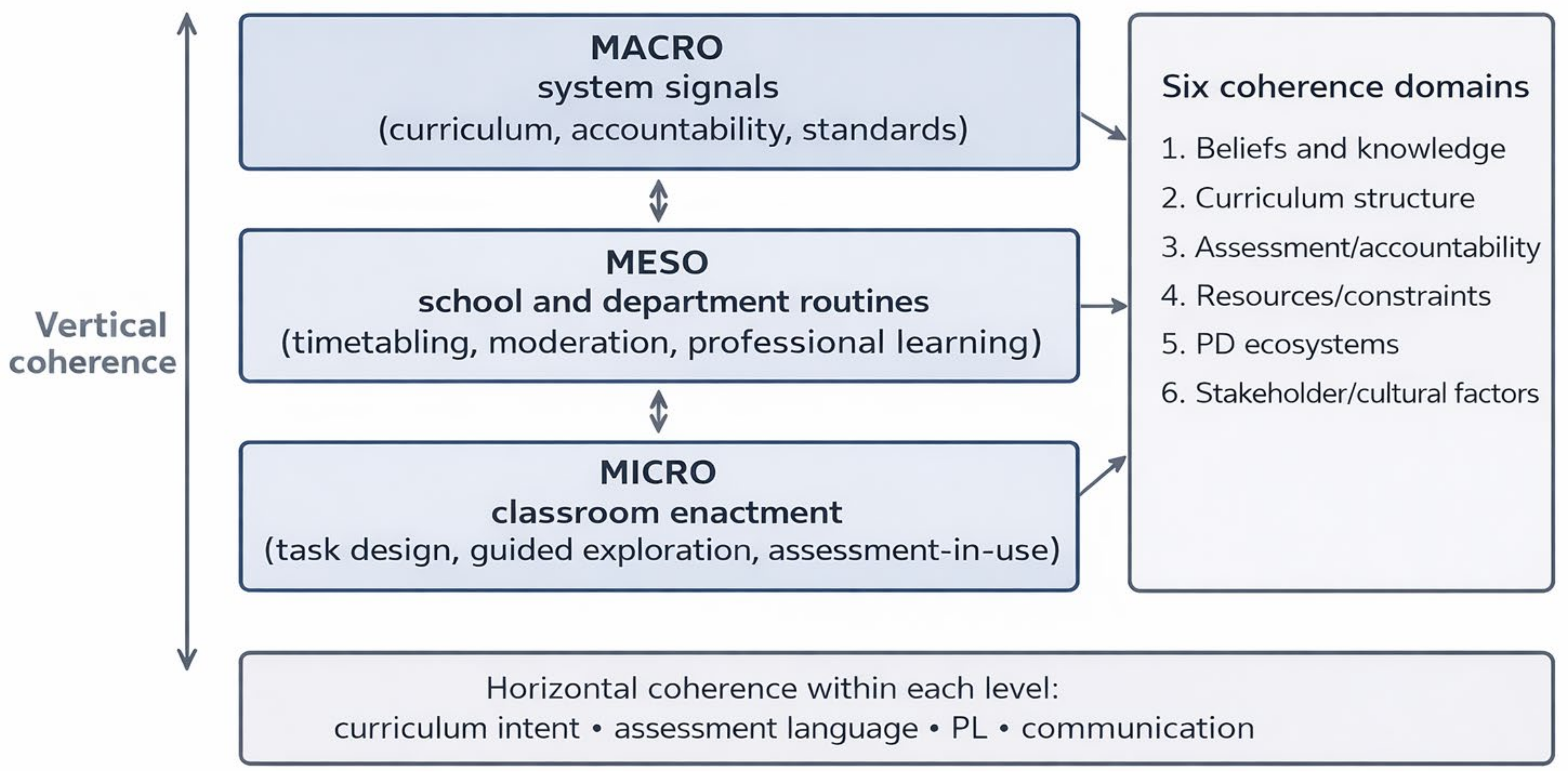
Implementation frameworks emphasise that complex practices diffuse slowly unless capability, opportunity, and motivation are supported together and sustained over time (Damschroder et al., 2009; Fixsen et al., 2005). On that basis, the framework offered here advances three working propositions rather than a firm causal ranking. First, assessment coherence may function as a high-leverage condition because it links what counts as learning to reporting, accountability, and teacher defensibility. Second, professional learning needs to build design reasoning—how and why constraints are manipulated to shape affordances and integral-development outcomes—rather than merely add activities to teachers’ repertoires. Third, curriculum, timetabling, safety, and communication signals need to create organisational room for iterative representative design. Figure 1 provides a schematic overview of the framework, and Table 1 operationalises these propositions as coherence conditions across domains and levels, with parenthetical row labels marking each domain’s primary mechanism. It is intended as an analytic heuristic to diagnose misalignment and generate research questions, not as a prescriptive checklist or a settled theory of causal primacy.

3.8. Singapore as an Illustrative Policy Context

This section does not present a primary-data case study or a comprehensive policy analysis. Instead, it uses publicly available syllabi, policies, and professional-learning documents together with the secondary Singapore PE scholarship to illustrate how coherence tensions become visible in a centrally governed system. Such systems make coherence issues easier to see because curriculum statements, professional learning architectures, and accountability routines are more formalised and widely shared. The Singapore lens, therefore, functions as an analytic illustration of the framework, not as evidence that the framework has been validated in Singapore.
Singapore’s PE syllabi articulate aims around meaningful learning through movement, holistic development, and engagement with the environment (Ministry of Education Singapore, 2014, 2024). These aims are broadly compatible with ecological-dynamics thinking, but translation into routine lesson design depends on how learning outcomes are operationalised, assessed, and timetabled. Singapore scholarship has identified structural features that can narrow this translation work, including lesson duration, timetabling, and facility-related constraints (McNeill et al., 2009; Chia, 2007). Wider assessment norms may also shape what teachers and stakeholders read as rigour and comparability (Wong et al., 2020). For instance, if curriculum language values adaptive movement but school reporting privileges stable technique display, teachers may experience a coherence gap between what the syllabus invites and what assessment routines make defensible.
At the same time, Singapore’s subject-specific professional learning infrastructure—including the Physical Education and Sports Teacher Academy—offers a potential system lever for developing shared design language, moderated assessment practices, and school-embedded inquiry (Physical Education and Sports Teacher Academy, 2025). A department-level example would be a professional learning cycle in which teachers adapt a common invasion-game task for different facility conditions, agree on evidence of decision making and functional movement, and moderate samples across classes. The value of the Singapore lens in this article is therefore illustrative: it shows how policy intent, professional learning, assessment discourse, and organisational routines can pull together or apart. The framework is designed to help diagnose those tensions, not to claim that the Singapore system has been comprehensively evaluated here.

4. Discussion

This synthesis reframes uneven uptake of NLP in school PE as a coherence problem rather than as a simple matter of individual teacher preference or deficiency. The main contribution is not to prove that one domain overrides all others, but to show how recurrent tensions documented in the literature cluster around six interacting conditions: translation of design principles, curriculum time, assessment fit, feasibility, professional learning, and legitimacy. Empirical and review papers identified these recurring tensions, while conceptual and theoretical sources helped explain why they persist and how they connect across system levels.
Within that pattern, assessment and accountability appear especially influential because they shape what teachers can observe, justify, moderate, and report. This does not mean that the present synthesis establishes assessment as the single decisive causal factor across all systems. Rather, it suggests a working hypothesis: when assessment criteria remain technique-dominant or strongly audit-driven, even sympathetic teachers are likely to revert towards more controllable and defensible tasks. Future empirical work should test this proposition directly against other domains instead of assuming it.
The argument also needs to be read alongside alternative pedagogical traditions. More explicit and tightly structured teaching can be pedagogically appropriate when teachers need to establish safety routines, orient novices to unfamiliar equipment or rules, reduce excessive complexity, or secure rapid initial success (Kirschner et al., 2006; Rosenshine, 2012). Likewise, broader work on models-based practice suggests that pedagogical innovation in PE generally depends on organisational fit, longer time horizons, and teacher support, not only on the intrinsic merits of a given model (Casey & Bjørke, 2024). Our claim is therefore narrower than advocacy accounts sometimes imply. High-quality NLP should not be confused with minimal guidance or pedagogical laissez-faire. It still depends on deliberate task architecture, clear success criteria, timely prompts, occasional demonstration, and careful scaffolding. The issue is not whether PE should be structured, but what forms of structure best serve particular learning aims.

Implications for Integral Development and Teacher Education

From an integral-development perspective, NLP is not simply a method for teaching isolated skills. It offers a design stance for cultivating adaptable movement capability, decision making, and meaningful engagement in activity contexts that more closely resemble the demands of participation beyond school. This aligns with broader arguments about physical literacy and meaningful PE, where progress is understood as embodied, relational, and context-sensitive rather than reducible to one technical template (Beni et al., 2017; Roberts et al., 2019; Rutkauskaite et al., 2024). However, these outcomes are hard to sustain when assessment rubrics, reporting routines, and lesson structures privilege stable, easily displayed forms.
For PETE and school-based professional development, the practical implication is a shift from activity prescription to design reasoning. Teachers need repeated opportunities to explain what counts as progress in ecological terms, justify constraint manipulations in relation to learning aims, and rehearse assessment and communication practices that make exploratory learning defensible to students, parents, and leaders. Teacher education, mentoring, departmental moderation, and curriculum leadership are therefore not ancillary supports; they are primary coherence mechanisms that determine whether NLP remains a workshop idea or becomes part of routine practice.
For researchers, the framework invites study designs that treat implementation outcomes—including feasibility, acceptability, adaptation, fidelity, and legitimacy—as substantive objects of inquiry alongside learner outcomes. Comparative work across systems with differing accountability arrangements would be especially valuable because it could test whether the same coherence tensions recur and whether some domains, including assessment, are more influential under governance conditions.

5. Limitations and Future Research

This article used a PRISMA-informed interpretive synthesis to build a coherence-focused framework rather than to estimate intervention effects or exhaustively map every publication related to ecological dynamics. The corpus combined empirical, review, conceptual, theoretical, methods, and policy sources because the review question was explanatory rather than effect-oriented. That mix was appropriate for framework generation, but it means the framework is more interpretive than confirmatory. The empirical implementation literature in school PE remains modest relative to the conceptual literature, and we did not formally appraise study quality or weight claims quantitatively.
We addressed those limitations by making the review architecture more explicit: Supplementary File S1 reports the eligibility criteria, representative search templates, adapted PRISMA-like workflow summary, corpus profile, included-source audit, and additional methodological/reporting citations used to justify the review write-up. Even so, the surviving audit trail does not support a count-complete PRISMA flow from the earliest scoping queries through all iterative additions, so the study should be read as a transparently reported interpretive synthesis rather than as a conventional systematic review of intervention effects. We also made source roles explicit: empirical and review papers grounded recurring tensions, conceptual and theoretical sources clarified mechanisms, review-method papers informed the synthesis process, and Singapore documents were used only to illustrate system signals. To mitigate interpretive bias, we used the audit trail to distinguish empirical recurrence from conceptual extension and actively retained tension-rich material on implementation difficulty, conceptual slippage, accountability pressure, and the continuing value of explicit teaching. The six domains should not be read as frequency counts, and the framework should not be treated as a validated causal model. Singapore was handled as an illustrative policy lens, not as a systematic case study. We did not collect primary data and cannot infer direct policy effects on classroom practice.
Future research should operationalise coherence as an empirical construct. Priorities include implementation studies that track coherence across micro, meso, and macro levels alongside feasibility and acceptability; direct examination of whether assessment coherence is more influential than other domains under high-accountability conditions; development and validation of assessment approaches that value decision making and functional performance within representative tasks; and evaluation of professional learning designs that build repeatable task-design routines through coached enactment, moderation, and collaborative inquiry.

6. Conclusions

NLP, grounded in ecological dynamics, offers a coherent rationale for designing learning as adaptive, situated, and responsive to information in representative contexts. In school PE, however, enactment is shaped by institutional conditions that reward predictability, efficiency, and outcomes that are straightforward to audit. These conditions can pull practice back towards linear progressions and technique-display criteria even when curriculum statements signal broader developmental aims.
By synthesising the literature into six coherence domains and translating them into a micro-meso-macro heuristic, this article reframes NLP uptake as an ecosystem-level design problem. The framework is intended to help researchers, teacher educators, school leaders, and policy actors diagnose where curriculum intent, assessment language, organisational routines, professional learning, and stakeholder communication support or inhibit ecologically informed practice. Assessment and accountability appear especially influential because they shape what teachers can defend and what systems count, but that proposition should now be treated as a target for empirical testing rather than as a settled conclusion. More broadly, the paper argues that if schools want representative, ecologically informed learning in support of integral-development aims, the wider system has to make that work pedagogically legitimate and practically possible.

Supplementary Materials

The following supporting information can be downloaded at: https://www.mdpi.com/article/10.3390/educsci16060850/s1, Supplementary File S1: PRISMA-like review audit materials, workflow summary, and included-source map. All references cited in the Supplementary Materials are listed in the “References” section.

Author Contributions

Conceptualization, H.Y.Y. and J.S.Y.T.; Methodology, H.Y.Y. and J.S.Y.T.; Validation, H.Y.Y.; Formal analysis, H.Y.Y. and J.S.Y.T.; Investigation, H.Y.Y.; Data curation, H.Y.Y.; Writing—original draft, H.Y.Y.; Writing—review & editing, H.Y.Y. and J.S.Y.T. All authors have read and agreed to the published version of the manuscript.

Funding

This research received no external funding.

Institutional Review Board Statement

Not applicable.

Informed Consent Statement

Not applicable.

Data Availability Statement

Supplementary File S1 contains the eligibility criteria, representative search templates, adapted workflow summary, final corpus profile, included-source audit, and additional methodological/reporting citations used to strengthen methodological transparency. No new datasets were generated or analysed during the current study.

Acknowledgments

During the preparation of this manuscript, the authors used a generative artificial intelligence tool, Google Gemini 2.5 Pro, to assist with language editing, structural refinement, and the preparation of visual materials, including figures, diagrams, and graphics. All AI-assisted outputs were critically reviewed, revised, and validated by the authors before submission. The authors take full responsibility for the accuracy, originality, interpretation, and integrity of the manuscript and all associated materials.

Conflicts of Interest

The authors declare no conflicts of interest.

Abbreviations

The following abbreviations are used in this manuscript:
CLAConstraints-Led Approach
MOEMinistry of Education (Singapore)
NLPNonlinear Pedagogy
PEPhysical Education
PESTAPhysical Education & Sports Teacher Academy (Singapore)
PETEPhysical education teacher education

References

  1. Atencio, M., Chow, J. Y., Tan, W. K. C., & Lee, C. Y. M. (2014). Using a complex and nonlinear pedagogical approach to design practical primary physical education lessons. European Physical Education Review, 20(2), 244–263. [Google Scholar] [CrossRef]
  2. Ball, S. J. (2003). The teacher’s soul and the terrors of performativity. Journal of Education Policy, 18(2), 215–228. [Google Scholar] [CrossRef]
  3. Barnett-Page, E., & Thomas, J. (2009). Methods for the synthesis of qualitative research: A critical review. BMC Medical Research Methodology, 9, 59. [Google Scholar] [CrossRef]
  4. Beni, S., Fletcher, T., & Ní Chróinín, D. (2017). Meaningful experiences in physical education and youth sport: A review of the literature. Quest, 69(3), 291–312. [Google Scholar] [CrossRef]
  5. Braun, V., & Clarke, V. (2006). Using thematic analysis in psychology. Qualitative Research in Psychology, 3(2), 77–101. [Google Scholar] [CrossRef]
  6. Casey, A., & Bjørke, L. (2024). Teachers’ experiences of enacting pedagogical models and models-based practice: A systematic mixed study review. Physical Education and Sport Pedagogy. Advance online publication. [Google Scholar] [CrossRef]
  7. Chia, M. (2007). PRIDE for PLAY: Personal responsibility in daily effort for participation in lifelong activity for youths. A Singaporean context. Journal of Sports Science and Medicine, 6(3), 374–383. [Google Scholar]
  8. Chow, J. Y. (2013). Nonlinear learning underpinning pedagogy: Evidence, challenges, and implications. Quest, 65(4), 469–484. [Google Scholar] [CrossRef]
  9. Chow, J. Y., Davids, K., Button, C., Shuttleworth, R., Renshaw, I., & Araújo, D. (2007). The role of nonlinear pedagogy in physical education. Review of Educational Research, 77(3), 251–278. [Google Scholar] [CrossRef]
  10. Coburn, C. E. (2003). Rethinking scale: Moving beyond numbers to deep and lasting change. Educational Researcher, 32(6), 3–12. [Google Scholar] [CrossRef]
  11. Correia, V., Carvalho, J., Araújo, D., Pereira, E., & Davids, K. (2019). Principles of nonlinear pedagogy in sport practice. Physical Education and Sport Pedagogy, 24(2), 117–132. [Google Scholar] [CrossRef]
  12. Damschroder, L. J., Aron, D. C., Keith, R. E., Kirsh, S. R., Alexander, J. A., & Lowery, J. C. (2009). Fostering implementation of health services research findings into practice: A consolidated framework for advancing implementation science. Implementation Science, 4, 50. [Google Scholar] [CrossRef]
  13. Dixon-Woods, M., Cavers, D., Agarwal, S., Annandale, E., Arthur, A., Harvey, J., Hsu, R., Katbamna, S., Olsen, R., Smith, L., Riley, R., & Sutton, A. J. (2006). Conducting a critical interpretive synthesis of the literature on access to healthcare by vulnerable groups. BMC Medical Research Methodology, 6, 35. [Google Scholar] [CrossRef] [PubMed]
  14. Fixsen, D. L., Naoom, S. F., Blase, K. A., Friedman, R. M., & Wallace, F. (2005). Implementation research: A synthesis of the literature. University of South Florida, Louis de la Parte Florida Mental Health Institute, National Implementation Research Network. [Google Scholar]
  15. Grant, M. J., & Booth, A. (2009). A typology of reviews: An analysis of 14 review types and associated methodologies. Health Information and Libraries Journal, 26(2), 91–108. [Google Scholar] [CrossRef]
  16. Greenhalgh, T., & Peacock, R. (2005). Effectiveness and efficiency of search methods in systematic reviews of complex evidence: Audit of primary sources. BMJ, 331(7524), 1064–1065. [Google Scholar] [CrossRef] [PubMed]
  17. Guskey, T. R. (2002). Professional development and teacher change. Teachers and Teaching: Theory and Practice, 8(3), 381–391. [Google Scholar] [CrossRef]
  18. Haddaway, N. R., Collins, A. M., Coughlin, D., & Kirk, S. (2015). The role of Google Scholar in evidence reviews and its applicability to grey literature searching. PLoS ONE, 10(9), e0138237. [Google Scholar] [CrossRef]
  19. Jenkinson, K. A., & Benson, A. C. (2010). Barriers to providing physical education and physical activity in Victorian state secondary schools. Australian Journal of Teacher Education, 35(8), 1–17. [Google Scholar] [CrossRef]
  20. Kirschner, P. A., Sweller, J., & Clark, R. E. (2006). Why minimal guidance during instruction does not work: An analysis of the failure of constructivist, discovery, problem-based, experiential, and inquiry-based teaching. Educational Psychologist, 41(2), 75–86. [Google Scholar] [CrossRef]
  21. Mackinney, R. (2025). Examining the use of verbal teacher feedback in physical education lessons. Education Sciences, 15(5), 568. [Google Scholar] [CrossRef]
  22. McNeill, M., Lim, B. S. C., Wang, C. K. J., Tan, W. K. C., & MacPhail, A. (2009). Moving towards quality physical education: Physical education provision in Singapore. European Physical Education Review, 15(2), 201–223. [Google Scholar] [CrossRef]
  23. Millar, S.-K., Chow, J. Y., Gleeson, M., & Cleaver, M. (2021). Teachers’ perceptions of applying contemporary skill acquisition approaches in high school physical education. Frontiers in Sports and Active Living, 3, 775423. [Google Scholar] [CrossRef] [PubMed]
  24. Milton, D., Bryant, A., Appleton, P. R., & Duda, J. L. (2025). Using the principles from community of practice: Developing sustainable professional development programmes in physical education. Education Sciences, 15(6), 713. [Google Scholar] [CrossRef]
  25. Ministry of Education Singapore. (2014). Physical education syllabus: Primary, secondary and pre-university. Available online: https://www.lianhuapri.moe.edu.sg/files/Learning/physical_education_syllabus_2014.pdf (accessed on 4 February 2026).
  26. Ministry of Education Singapore. (2024). Physical education syllabus (primary, secondary and pre-university). Available online: https://www.moe.gov.sg/api/media/5ebed2f3-0779-481a-a7a9-fc76259c1226/2024-Physical-Education-Primary-Secondary-and-PreUniversity-Syllabus.pdf (accessed on 4 February 2026).
  27. Moy, B., Renshaw, I., & Davids, K. (2015). The impact of nonlinear pedagogy on physical education teacher education students’ intrinsic motivation. Physical Education and Sport Pedagogy, 21(5), 517–538. [Google Scholar] [CrossRef]
  28. Page, M. J., McKenzie, J. E., Bossuyt, P. M., Boutron, I., Hoffmann, T. C., Mulrow, C. D., Shamseer, L., Tetzlaff, J. M., Akl, E. A., Brennan, S. E., Chou, R., Glanville, J., Grimshaw, J. M., Hróbjartsson, A., Lalu, M. M., Li, T., Loder, E. W., Mayo-Wilson, E., McDonald, S., … Moher, D. (2021). The PRISMA 2020 statement: An updated guideline for reporting systematic reviews. BMJ, 372, n71. [Google Scholar] [CrossRef]
  29. Physical Education and Sports Teacher Academy. (2025). Professional development framework for PE and sports teachers. Available online: https://pesta.moe.edu.sg/pesta/professional-development/professional-development-framework-for-pe-and-sports-teachers/ (accessed on 26 December 2025).
  30. Pinder, R. A., Davids, K., Renshaw, I., & Araújo, D. (2011). Representative learning design and functionality of research and practice in sport. Journal of Sport and Exercise Psychology, 33(1), 146–155. [Google Scholar] [CrossRef]
  31. Renshaw, I., Araújo, D., Button, C., Chow, J. Y., Davids, K., & Moy, B. (2016). Why the constraints-led approach is not teaching games for understanding: A clarification. Physical Education and Sport Pedagogy, 21(5), 459–480. [Google Scholar] [CrossRef]
  32. Renshaw, I., & Chow, J. Y. (2019). A constraint-led approach to sport and physical education pedagogy. Physical Education and Sport Pedagogy, 24(2), 103–116. [Google Scholar] [CrossRef]
  33. Renshaw, I., Chow, J. Y., Davids, K., & Hammond, J. (2010). A constraints-led perspective to understanding skill acquisition and game play: A basis for integration of motor learning theory and physical education praxis? Physical Education and Sport Pedagogy, 15(2), 117–137. [Google Scholar] [CrossRef]
  34. Rethlefsen, M. L., Kirtley, S., Waffenschmidt, S., Ayala, A. P., Moher, D., Page, M. J., Koffel, J. B., & PRISMA-S Group. (2021). PRISMA-S: An extension to the PRISMA Statement for reporting literature searches in systematic reviews. Systematic Reviews, 10, 39. [Google Scholar] [CrossRef]
  35. Richardson, S. J., McRobert, A. P., Vinson, D., Cronin, C. J., Lee, C., & Roberts, S. J. (2024). Systematic review of sport coaches’ and teachers’ perceptions and application of game-based and constraints-led pedagogy: A qualitative meta-study. Quest, 76(1), 113–134. [Google Scholar] [CrossRef]
  36. Roberts, W. M., Newcombe, D. J., & Davids, K. (2019). Application of a constraints-led approach to pedagogy in schools: Embarking on a journey to nurture physical literacy in primary physical education. Physical Education and Sport Pedagogy, 24(2), 162–175. [Google Scholar] [CrossRef]
  37. Rosenshine, B. (2012). Principles of instruction: Research-based strategies that all teachers should know. American Educator, 36(1), 12–39. [Google Scholar]
  38. Rutkauskaite, R., Baravykiene, J., Maciuleviciene, E., & Sukys, S. (2024). Physical literacy of physical education teachers and the application of physical literacy components during physical education classes. Education Sciences, 14(12), 1391. [Google Scholar] [CrossRef]
  39. Thomas, J., & Harden, A. (2008). Methods for the thematic synthesis of qualitative research in systematic reviews. BMC Medical Research Methodology, 8, 45. [Google Scholar] [CrossRef]
  40. Tong, A., Flemming, K., McInnes, E., Oliver, S., & Craig, J. (2012). Enhancing transparency in reporting the synthesis of qualitative research: ENTREQ. BMC Medical Research Methodology, 12, 181. [Google Scholar] [CrossRef]
  41. Wiliam, D. (2018). Embedded formative assessment. Solution Tree Press. [Google Scholar]
  42. Wong, H. M., Kwek, D., & Tan, K. (2020). Changing assessments and the examination culture in Singapore: A review and analysis of Singapore’s assessment policies. Asia Pacific Journal of Education, 40(4), 433–457. [Google Scholar] [CrossRef]
Figure 1. Schematic overview of the Systemic Coherence Framework, showing vertical alignment across micro, meso, and macro levels and the six coherence domains shaping implementation.
Education 16 00850 g001
Table 1. Systemic coherence conditions for implementing non-linear pedagogy to support integral development in school physical education: micro-meso-macro alignment across domains.
Coherence
Domain
Micro
(Teacher Practice)
Meso
(School & Professional Learning)
Macro
(System/Policy Signals)
Teacher beliefs and knowledge (design competence)Teachers define a movement problem; adjust space, numbers, rules, equipment, or scoring to channel exploration; use prompts, questions, and brief demonstration to orient attention; and can explain why variability is purposeful.Co-planning, observation, and mentoring routines make design reasoning visible; departments examine task representativeness, questioning, and learner responses.PETE, induction, and curriculum guidance use consistent ecological-dynamics language and exemplars; exploration is legitimise as intentional teaching.
Curriculum and lesson structure (time and sequencing)Units revisit a small number of recurring movement problems; tasks are adapted across lessons rather than replaced; time is reserved for reflection and refinement.Schemes of work allow adaptive sequencing; collaboration time supports co-planning and review; timetabling and facility routines reduce transition loss.Curriculum guidance legitimises depth, revisiting, and flexible sequencing; policy signals value adaptable performance and whole-child learning, not coverage alone.
Assessment and accountability (evidence and reporting)Success criteria emphasise functional performance, decisions, and adaptation within representative tasks; for example, pupils justify when to pass, dribble, or create space under changing defender numbers rather than only reproduce an isolated technique.Shared rubrics and moderation define quality beyond technique form; departments use feasible evidence routines such as short observation notes, video samples, or common task exemplars that protect teacher defensibility.Accountability discourse allows exploratory learning and representative assessment; endorsed exemplars avoid technique-only proxies for rigour or quality.
Systemic and
resource
constraints (feasibility and safety)
Safety boundaries are embedded in task rules, zones, roles, and contact conditions; constrained spaces are redesigned as small-sided representative tasks rather than converted automatically into decontextualised drills.Reliable access to spaces and equipment is protected where possible; departments use quick setup routines and contingency task versions so representativeness survives ordinary logistical limits.Resourcing and safety guidance treat facilities and risk as pedagogical design issues; system examples show how representative practice can be adapted under common constraints.
Professional
development ecosystems (capability building)
Teachers use design-enact-review cycles with their own classes; simple records of constraint changes and learner responses inform revision.Professional learning cycles include co-planning, coached enactment, observation, and moderation of student evidence; teachers revisit the same movement problem across lessons rather than collecting disconnected activities.Professional learning policy rewards sustained inquiry, networks, and exemplars; messages align with curriculum and assessment priorities rather than one-off workshop logic.
Stakeholder and cultural factors (legitimacy and rigour)Learning intentions and why variability is purposeful are made explicit to students; routines socialise exploration norms and safe risk-taking.Leaders and departments use consistent messages about PE purposes; communication with parents makes learning visible through shared criteria, portfolios, or snapshots.System communication frames PE as educative, developmental, and assessable in more than technical terms; accountability does not penalise exploratory pedagogy.
Note. The table operationalises interpretive findings from the synthesis. The parenthetical row descriptors identify the primary mechanism emphasised in each domain. The framework is intended as an analytic heuristic rather than a validated scoring instrument.
Disclaimer/Publisher’s Note: The statements, opinions and data contained in all publications are solely those of the individual author(s) and contributor(s) and not of MDPI and/or the editor(s). MDPI and/or the editor(s) disclaim responsibility for any injury to people or property resulting from any ideas, methods, instructions or products referred to in the content.