Article

Reframing Gendered Leadership in STEM Higher Education: Comparative Insights on Power, Progression, and Institutional Disruption

by
Anderson O. Akponeware
1,*,
Sandra Chukwudumebi Obiora
2,
Mercy Ogunnusi
1,
Temitope Omotayo
1,
Kudirat Ayinla
3,
Regina E. Turkson
4,
Agnes Adom-Konadu
5 and
Vanessa B. Sappor
4
1
School of Built Environment, Engineering and Computing, Leeds Beckett University, Leeds LS2 8AG, UK
2
Leeds Business School, Leeds Beckett University, Leeds LS1 3HE, UK
3
School of Architecture, Building and Civil Engineering, Loughborough University, Loughborough LE11 3TU, UK
4
Department of Computer Science and Information Technology, School of Physical Sciences, College of Agriculture and Natural Sciences, University of Cape Coast, Cape Coast 00233, Ghana
5
Department of Mathematics, School of Physical Sciences, College of Agriculture and Natural Sciences, University of Cape Coast, Cape Coast 00233, Ghana
*
Author to whom correspondence should be addressed.
Educ. Sci. 2026, 16(6), 841; https://doi.org/10.3390/educsci16060841
Submission received: 7 April 2026 / Revised: 13 May 2026 / Accepted: 19 May 2026 / Published: 27 May 2026
(This article belongs to the Special Issue Experiences for Educational Equalities in Higher Education)

Abstract

This study examined how gender-based leadership in Science, Technology, Engineering and Mathematics (STEM) higher education (HE) is understood, managed, and reappraised within the contrasting settings of the UK and Ghana. A comparative qualitative approach was deployed in the study using insights from twenty semi-structured interviews comprising women STEM academics, and four focus groups consisting of two mixed staff UK-Ghana, and two Ghana student groups. The study adopted Braun and Clarke’s reflexive thematic method, combined with an abductive, cross-context reading to grasp both convergence and difference in participants’ perspectives. Findings produced three inter-connected themes: Power and Prestige in academic leadership, Progression Pathways and Barriers, and Institutional Disruption and Emerging Change Agents. Emerging tides of change such as deliberate recruitment of women, sponsorship beyond traditional mentoring, fairer decision-making panels, and flexible work arrangements, were also found to help recast leadership as more relational, inclusive, and dynamic. While both contexts shared structural roots of inequity, their emphasis diverged. In the UK, policy frameworks often outpaced cultural change; in Ghana, resource limitations remained pressing. This investigation develops an empirically grounded, cross-context articulation of the Power-Progression-Disruption framework, showing how gendered power, progression barriers, and institutional change practices interact to shape STEM leadership, and concludes with a set of adaptable strategies.

1. Introduction

Gender disparities in science, technology, engineering, and mathematics (STEM) in higher education (HE) institutions remain deeply rooted worldwide (AdvanceHE, 2024; HESA, 2025). Although there have been growing efforts over the last few decades to institute and promote equity, diversity and inclusion (EDI) initiatives, a persistent gender divide continues to characterise senior academic and institutional leadership, predominantly in research-intensive and patriarchal fields (Azizi et al., 2022; Gander & Sharafizad, 2025). Much of what is known about gender and leadership in HE has been produced within Western contexts, focusing primarily on women’s individual strategies for progression and resilience (Burkinshaw & White, 2017; O’Connor, 2018). While such studies have extended understanding of the lived experiences of women, they have often underexplored the broader institutional and cultural setups that sustain inequality. Leadership is neither neutral nor purely merit-based; it is rooted in systems of power, organisational prestige, and gendered expectations of competence. Within STEM disciplines, leadership pathways are predominantly influenced by disciplinary hierarchies and reward systems that privilege research output over mentoring, teaching, and collaboration, activities that remain skewed along gendered lines (S. Acker, 2012). Consequently, equality interventions frequently focus on individual-level solutions, such as training or mentoring, while leaving unopposed the institutional architectures that create exclusion.
Research from developing countries, particularly within Sub-Saharan Africa, has shed light on the intersectional nature of gendered leadership inequities, showing how resource limitations, cultural practices, and colonial legacies shape women’s access to senior positions (Manuh et al., 2007; Morley, 2013). However, limited comparative scholarship connects experiences across western and developing regions to examine how different HE systems legitimise, maintain, or challenge gendered hierarchies. Comparative inquiry holds value because it reveals how structural and cultural dynamics interact across contexts, that is, how systemic constraints in one setting and cultural drivers in another can collaboratively inform strategies for transformative change.
Drawing on empirical evidence from the UK–Ghana STEM-PULSE project, this paper addresses the aforementioned gap by examining gendered leadership in STEM HE through three interlinked constructs derived inductively from the data: (i) gendered leadership, (ii) progression, and (iii) institutional disruption. Together, these constructs or themes provide an analytical framework for understanding how gendered power operates within STEM leadership, how progression is enabled or hindered, and how institutional practices can be reframed to foster transformative change. These constructs were not predefined but evolved through iterative analysis as interview and focus-group data from both contexts revealed recurring experiences of exclusion, constrained advancement, and emerging practices of resistance. Through an abductive analytical process, moving between empirical codes and theoretical perspectives, these patterns were refined into the three constructs that underpin this paper.
Leadership in STEM HE is widely shaped by masculinised norms of authority and visibility, embedded within organisational inequality regimes that normalise who is seen as ‘leadership material’ and whose expertise is legitimised (J. Acker, 2006; Eagly & Carli, 2007). These prestige cultures and informal networks reproduce access asymmetries for women, particularly in research-intensive environments (Morley, 2013; Wajcman, 2004). Globally, women constitute approximately 33% of researchers, with recent UNESCO data indicating a range of 31.7% to 33.7%, highlighting their continued underrepresentation across the research pipeline (UNESCO, 2024). Sector data underscore the problem: despite extensive equality initiatives, women remain under-represented at senior academic levels in the UK, especially in STEM where women occupy only 30.8% of professorial positions, despite constituting almost half (48.6%) of academic staff overall (AdvanceHE, 2024; House of Commons Science & Technology Committee, 2023). In sub-Saharan Africa, Ghana, women constitute only 8% of professors in public universities, highlighting their severe under-representation at senior academic levels (ESSA, 2021).
Across 2020/21 to 2024/25 HESA data (HESA, 2026), gender inequality in UK STEM persists markedly, with women consistently comprising only around 21–22% in Engineering and Technology and approximately 24–27% in Computing, showing minimal structural change. Similarly, women remain significantly underrepresented in STEM across Sub-Saharan Africa, with participation rates estimated at around 21% in STEM education and fewer than 30% of tertiary engineering graduates being female in many countries, highlighting persistent structural inequalities in access and progression (Ojong & Kareem, 2025; United Nations, 2024). These persistent disparities in women’s participation in STEM across both the UK and Sub-Saharan Africa point to deeper structural inequities, suggesting that leadership exclusion is not merely a pipeline issue but a reflection of how power is distributed and how legitimacy is constructed and recognised within academic institutions. Taken together, these intersecting patterns of underrepresentation suppress the recognition of women’s STEM identities, thereby excluding them from the very criteria through which academic authority is constructed and making leadership a site where power determines whose expertise is recognised as legitimate. This study therefore interrogates gendered leadership as a problem of power and legitimacy, examining how symbolic and structural dynamics across UK and Ghanaian institutions construct, gatekeep, and contest leadership identities in STEM.
Notwithstanding formal promotion frameworks, progression into senior STEM leadership frequently stalls at the intersection of opaque criteria, discretionary evaluation, and uneven access to sponsorship and visibility (Guarino & Borden, 2017; O’Connor, 2019). Empirical evidence indicates that, conditional on research quality and discipline, women are less likely to be promoted than men, with the gap most pronounced at earlier career transitions (Czech et al., 2024). Meanwhile, disproportionate internal service loads and informal gatekeeping, often invisible in performance metrics, divert time away from promotable work (Guarino & Borden, 2017). Globally, the STEM pipeline itself remains fragile, with women comprising only circa 35% of STEM graduates and progress stagnant over the past decade (UNESCO, 2025). This study investigates progression as a socially mediated process, analysing how formal criteria and informal mechanisms (including sponsorship versus mentoring) enable or constrain women’s trajectories into leadership across the two national systems (Cutter et al., 2024).
Incremental reform has often produced procedural compliance without substantive culture change in STEM HE (Armstrong & Sullivan, 2025; Tzanakou & Pearce, 2019). Recognising that lasting equity requires shifts in organisational logics, we conceptualise institutional disruption as intentional interventions that unsettle entrenched hierarchies, through transparent decision points, diversified panels, care, compatible work design, sponsorship architectures, and accountability dashboards (Ely & Meyerson, 2000; Kalpazidou Schmidt et al., 2020). We situate these levers within current policy architectures: the UK’s UKRI EDI Strategy frames systemic change as a sector-wide endeavour (UKRI, 2023), while Ghana’s (Affirmative action (gender equality) act, 2024) introduces progressive representation targets and compliance mechanisms. This study seeks to identify and compare emergent practices of disruption, from policy instruments to everyday micro-politics, that can reconfigure leadership cultures in STEM higher education across contrasting institutional landscapes.
Situating these three constructs namely gendered leadership, progression, and institutional disruption, in dialogue is essential because existing scholarship often treats them in isolation, focusing either on individual resilience strategies or on policy compliance without interrogating the cultural and structural interplay that sustains inequity (J. Acker, 2006; O’Connor, 2019; Tzanakou & Pearce, 2019). This study addresses that gap by examining how power relations, career advancement mechanisms, and emergent change practices intersect to shape leadership opportunities in STEM higher education. Through a comparative lens on the UK and Ghana, the research seeks to illuminate the systemic and symbolic forces that reproduce exclusion and to identify actionable levers for gender-transformative change. In doing so, it contributes to feminist leadership theory and organisational change literature by reframing leadership not as a static position but as a culturally mediated process embedded within institutional architectures (Ely & Meyerson, 2000; Morley, 2013).
The study is guided by three research questions:
  • RQ I. How do power dynamics shape women’s leadership experiences in STEM higher education across the UK and Ghana?
  • RQ II. What mechanisms enable or constrain women’s progression into leadership roles?
  • RQ III. How do emerging practices of institutional disruption challenge gendered hierarchies and foster transformative change?
The paper proceeds as follows. Section 2 reviews theoretical and empirical literature on gender, leadership, and institutional transformation in higher education, identifying conceptual gaps. Section 3 describes the study’s methodology. Section 4 presents the findings structured around three thematic domains: power and prestige, progression pathways, and institutional disruption; derived from cross-context analysis. Section 5 discusses these findings in relation to existing theories of leadership and organisational change, while also highlighting the wider research implications. Section 6 presents the study’s conclusions, while Section 7 addresses the study’s limitations and proposes directions for future research.

2. Theoretical Background

2.1. Understanding Gendered Leadership in Higher Education

Leadership within higher education (HE) is often portrayed as a neutral and meritocratic endeavour, where advancement is assumed to result primarily from individual capability and performance. However, feminist scholars have long contested this assumption, demonstrating that leadership in HE is profoundly gendered, shaped by power relations, institutional cultures, and historically masculinised notions of prestige (S. Acker, 2012; O’Connor, 2018). Within STEM disciplines in particular, leadership is entangled with patriarchal traditions that link authority, rationality, and technical competence to masculinity (Faulkner, 2007; Wajcman, 2004). This enduring association positions scientific expertise as a masculine domain and continues to structure who occupies leadership roles, how authority is exercised, and what leadership behaviours are perceived as legitimate. Gendered leadership can thus be understood as both a social construction and a manifestation of gendered organisational logic. Eagly and Carli (2007) characterise women’s advancement as navigating a “labyrinth” of systemic bias, in which evaluative standards and organisational norms privilege masculine ideals of leadership. Within STEM, this labyrinth deepens: productivity measures, competitive reward systems, and expectations of uninterrupted career trajectories reinforce exclusionary norms that disadvantage those whose career paths are shaped by caregiving, uneven workload allocation, or limited access to visibility (Van Den Brink & Benschop, 2012). Leadership thereby operates not only as an outcome of individual merit but as a mechanism that reproduces gendered power across institutional levels.
Institutional culture serves as a critical mediator in this process. Morley (2013) conceptualises universities as “gender regimes”, that is, systems of practice and discourse that sustain male dominance through both material and symbolic means. These regimes are reinforced by everyday routines: committee compositions, nomination procedures, and informal decision-making networks that subtly privilege those already aligned with dominant norms. Even where equity policies exist, their impact is often curtailed by organisational inertia and the persistence of hidden cultural codes that reward conformity to masculinised standards of excellence (White & O’Connor, 2017). In this sense, leadership in higher education is less an individual attribute than a reflection of institutionalised gendered hierarchies.

2.2. Feminist and Intersectional Perspectives on Leadership

Feminist leadership theories challenge conventional understandings of leadership as a position of formal authority. They conceptualise leadership instead as a relational and process-oriented phenomenon embedded within wider structures of power. Ely et al. (2011) argue that leadership development cannot be divorced from the gendered organisational systems in which it takes place; focusing solely on individual deficits obscures the structural and cultural roots of inequality. Intersectional feminism further extends this argument by recognising that leadership experiences are shaped by the interplay of gender with race, class, and geography (Bilimoria & Liang, 2012; Crenshaw, 2006).
Intersectionality is especially salient in comparative work that spans national and cultural boundaries, such as the UK–Ghana analysis in this study. Gendered leadership must be understood in relation to the socio-cultural and institutional contexts that sustain it. Whereas UK universities often grapple with issues of prestige hierarchies and performative accountability systems (Deem, 2009), Ghanaian higher education faces constraints linked to resource scarcity, patriarchal social expectations, and colonial legacies that shape institutional governance (Manuh et al., 2007). Both settings highlight the ways in which gender interacts with local conditions, economic structures, cultural values, and historical legacies, all of which help to shape who leads and under what terms. An intersectional approach therefore reframes leadership inequities not as isolated gender gaps but as outcomes of intersecting and layered systems of privilege and constraint. At the same time, feminist scholarship foregrounds women’s agency within these constraints. Women leaders in STEM often occupy contradictory positions, performing both competence and care, authority and collaboration (O’Neil & Hopkins, 2015). These tensions can produce creative strategies of adaptation and resistance. The notion of “tempered radicalism” (Meyerson & Scully, 1995) captures this duality: women work within existing systems while subtly subverting their norms. Leadership thus emerges as a potential site for disruption as much as for conformity.

2.3. Progression and the Gendered Leadership Pipeline

The persistent under-representation of women in senior STEM leadership roles is frequently described through the metaphor of the “leaky pipeline” (Shaw & Stanton, 2012). Although widely used, the “leaky pipeline” metaphor risks oversimplifying gendered career trajectories by implying a linear attrition model. Recent global evidence of long-term stagnation in women’s STEM participation (UNESCO, 2025) highlights that the issue lies in institutional architectures and cultural norms rather than mere leakage along a single pathway. Progression, therefore, is less a linear career trajectory than a socially mediated process negotiated within institutional power dynamics.
Promotion criteria in academia continue to privilege research productivity and external grant income, often at the expense of teaching, administration, or pastoral work, these being areas disproportionately undertaken by women (S. Acker & Armenti, 2004). In STEM domains, where research income and publication output are critical success criteria, women’s progression is often hampered by reduced access to networks and funding (Guarino & Borden, 2017). Moreover, the masculinised culture of scientific achievement contributes to what has been termed a “chilly climate” (Hall & Sandler, 1982), in which exclusionary behaviours and implicit bias hinder women’s participation and sense of belonging. In the UK, initiatives such as the Athena SWAN Charter have sought to address these inequalities by promoting institutional self-assessment and accountability (Caffrey et al., 2016). However, studies indicate variable outcomes, with impact largely contingent on leadership commitment rather than formal compliance (Ovseiko et al., 2017). In Ghana, similar efforts have been made through gender mainstreaming policies and mentorship schemes, yet their effectiveness remains constrained by limited funding and inconsistent institutional support (National Council for Tertiary Education, n.d.). The comparison underscores that equality frameworks, however well-designed, must be translated into meaningful practice if they are to dismantle structural barriers to women’s progression.
Career advancement also entails psychological and cultural dimensions. Organisational climate, role modelling, and perceived institutional support significantly shape aspirations for leadership (Airini et al., 2011). Stereotype threat, implicit bias, and lack of recognition undermine self-efficacy and visibility, often leading women to self-select out of leadership pathways. The gendered leadership pipeline is thus maintained not only through formal structures but through internalised perceptions of what leadership requires and rewards.

2.4. Institutional Transformation and the Dynamics of Change

While literature has extensively documented inequality, comparatively less attention has been paid to how institutions change, or resist change, toward gender equity. Organisational change theory provides a valuable lens for understanding these dynamics. Kuhn’s (1951) three-stage model of unfreezing, changing, and refreezing conceptualises transformation as a cyclical process involving the destabilisation of established norms, the introduction of new practices, and the consolidation of change. Although rooted in mid-20th-century organisational psychology, the model remains influential due to its conceptual clarity and adaptability (Burnes & Cooke, 2013).
In the context of STEM leadership, transformation requires unfreezing ingrained assumptions about merit and competence. Ely and Meyerson (2000) advocate a gender-in-the-organisation approach that targets the structural causes of inequality rather than perceived deficits in women. This perspective aligns with the concept of institutional disruption emerging from the present study, which emphasises intentional efforts to challenge established power dynamics through transparency, inclusive networks, and alternative evaluative criteria. Transformation thus operates across both formal structures, such as policies and charters, and informal cultures, including norms, narratives, and micro-politics. Context mediates how such transformation unfolds. In the UK, structural incentives for addressing gender inequity have been developed through policy instruments like EDI frameworks, Athena SWAN, and the Research Excellence Framework (REF) (Kalpazidou Schmidt et al., 2020). However, critics note that these frameworks risk bureaucratisation when procedural compliance overshadows cultural change (Armstrong & Sullivan, 2025; Tzanakou & Pearce, 2019). In Ghana, reform efforts are often externally funded and locally adapted through university gender units or professional networks such as the Association of African Universities (AAU). However, these efforts must contend with resource limitations and entrenched patriarchal norms that continue to define academic authority (Adongo et al., 2023).

2.5. The Role of Power and Prestige in STEM Leadership

Power remains a foundational concept for understanding leadership in STEM higher education. Drawing on Foucault (1980), power can be understood as relational rather than hierarchical; exercised through everyday practices, discourses, and interactions that normalise certain forms of authority while excluding others. In the STEM context, prestige cultures amplify these dynamics. The valuation of research excellence, global visibility, and competitive grant acquisition creates a symbolic economy that privileges profiles more accessible to men (Blackmore, 2014). Leadership reproduction frequently occurs through homosocial selection, a process described by Kanter (1977), whereby those in power identify successors who resemble themselves. This cycle reinforces masculine norms of competence and authority, often marginalising women and other underrepresented groups. For those who attain leadership, the resulting environment may foster tokenism and pressure to assimilate rather than transform (Morley, 2013). Understanding the circulation of power and prestige is therefore essential for explaining both the resilience of gendered hierarchies and the potential leverage points for disruption.

2.6. Institutional Disruption as a Catalyst for Gender-Transformative Change

The concept of institutional disruption has gained traction in feminist and organisational studies as a way to describe processes that unsettle dominant systems of power. In this study, institutional disruption is used as an analytic term to describe practices that unsettle the taken-for-granted rules, routines, and evaluative norms through which gendered hierarchies are reproduced in STEM higher education. It is not treated as separate from the wider literature on institutional change. Rather, it builds on work showing that institutional transformation involves shifts in organisational templates, value commitments, and power relations (Greenwood & Hinings, 1996). It is also closely aligned with the notion of institutional work, particularly actors’ purposive efforts to create, maintain, or disrupt institutions (Lawrence & Suddaby, 2006). However, the term is used here to foreground the gender-transformative dimension of such work. In this sense, institutional disruption differs from the broader concept of social innovation, which often refers to new solutions to social needs across sectors; here, the emphasis is on changing institutionalised gendered practices within higher education organisations. Unlike reform, which seeks to adjust existing structures, disruption aims to destabilise them to create new configurations of equity and inclusion (Datnow et al., 2023). Within higher education, disruption manifests through initiatives such as feminist leadership collectives, advocacy networks, or counter-narratives that challenge the supposed neutrality of merit and excellence.
Empirical research demonstrates that acts of disruption can emerge both from within institutions and from their margins. Diab et al. (2024) document how women leaders in African universities mobilise alliances and relational leadership to resist patriarchal constraints. In the UK, collective action among women leaders has influenced promotion frameworks and diversified leadership pipelines (English & Braybrook, 2025). Disruption, therefore, is not purely oppositional; it involves creative reimagining and reinvention of institutional norms. Conceptually, disruption aligns with transformative learning theory, which emphasises cultural and structural change rather than surface-level adjustments (Mezirow, 2000). In STEM HE, such disruption entails questioning epistemic hierarchies, whose knowledge counts and whose leadership styles are legitimised, and embedding mechanisms such as gender audits, transparent recruitment, and accountability dashboards to make inequities visible and actionable.

2.7. Comparative Perspectives and Conceptual Gaps

The UK and Ghana present contrasting yet complementary settings for exploring gendered leadership and institutional change. In the UK, gender equity has become an established policy agenda supported by government oversight and funding frameworks. However, persistent disparities remain, particularly in STEM, where policy achievements have not fully translated into cultural transformation (Armstrong & Sullivan, 2025; Kalpazidou Schmidt et al., 2020). In Ghana, although women’s participation in higher education has expanded significantly, representation in senior roles remains minimal. Studies attribute this to intersecting cultural and structural factors, including gendered expectations, family responsibilities, and historically male-dominated institutional cultures (Acquah et al., 2020). Some participants suggested that leadership in Ghanaian higher education may be inflected with communal expectations, though this claim requires further empirical investigation beyond the present data. Together, these cases reveal how gendered leadership is simultaneously localised and globally resonant. The UK experience demonstrates how formal frameworks can drive structural accountability but risk superficiality, while the Ghanaian case underscores the importance of cultural transformation and mentorship. Comparative analysis therefore enables transversal learning, showing that sustainable change requires both structural reform and cultural reconfiguration.
Taken together, this comparative review also exposes several conceptual gaps that inform the present study. First, while gender and leadership in higher education have been widely examined, STEM-specific analyses remain scarce, particularly outside Western contexts. Second, progression is often framed as an individual challenge rather than a collective, institutionally mediated process. Third, organisational change research has yet to fully integrate feminist perspectives on how institutions resist and internalise gender-transformative reform. Addressing these gaps, this study develops an empirically grounded reconceptualisation of leadership in STEM higher education around three interconnected constructs: gendered leadership, progression, and institutional disruption. Through comparative qualitative analysis of data from the UK and Ghana, it seeks to illuminate how gendered power operates within higher education institutions and how it can be strategically disrupted. In doing so, the study contributes to the theorisation of feminist leadership and institutional transformation, offering a cross-context perspective that advances both scholarship and practice in gender equity within STEM.

3. Materials and Methods

3.1. Research Design and Philosophical Orientation

The study employed a qualitative, comparative, abductive design to examine how gendered leadership in STEM higher education (HE) is understood, enacted, and contested in the United Kingdom and Ghana. Rather than documenting under-representation alone, the design sought to generate an empirically grounded reframing around three constructs namely gendered leadership, progression, and institutional disruption.
Situated within a constructivist–interpretivist paradigm (Lincoln & Guba, 1985), leadership is treated as socially produced through interactions, meanings, and organisational discourse. Abductive reasoning (Timmermans & Tavory, 2012) guided movement between data and theory: provisional interpretations were iteratively refined against the material and relevant scholarship. The UK–Ghana comparison offered both contrast and complementarity; the UK reflects a mature policy infrastructure for gender equity, while Ghana illustrates policy awareness under tighter resource and cultural constraints. Studying both contexts illuminates how similar mechanisms take shape under different institutional architectures.
The sample comprised 20 semi-structured interviews and four focus groups, sized prospectively by monitoring for both code and meaning saturation in line with qualitative research standards (Guest et al., 2006; Hennink et al., 2017). In our study, code saturation emerged by the 8th to 10th interview per site, with later interviews refining nuance, whereas the mixed staff and student focus groups enhanced triangulation and increased information power for cross-context comparison (Malterud et al., 2016). Given the comparative UK-Ghana design, meaning saturation was treated more cautiously. Later interviews and focus groups did not substantially change the thematic structure but deepened interpretation by clarifying how shared patterns, such as informal networks, care responsibilities, and opaque progression processes, were experienced differently across contexts. In this sense, the study approached meaning saturation through cross-source and cross-context refinement rather than through repetition alone (Hennink et al., 2017). Reporting followed COREQ and SRQR guidelines to ensure transparency (O’Brien et al., 2014; Tong et al., 2007). Interviews were conducted by trained members of the UK-Ghana research team (mixed gender), all experienced in qualitative methods. No prior supervisory relationship existed with participants; reflexive memos documented positionality and rapport. Data were audio-recorded, transcribed verbatim, anonymised, and stored on encrypted drives under institutional ethics protocols. All transcripts were anonymised and assigned consistent identifiers to ensure traceability with confidentiality. UK interviewees: 01_UK-10_UK; Ghana interviewees: P1_GH-P10_GH. Mixed staff focus-group participants used room-based labels (FG-R1:P##, FG-R2:P##) and FG-PL:P## for the plenary. Ghana student groups were summarised and cited as SFG1-summary and SFG2-summary. Transcripts were checked for accuracy and linguistic clarity; brief descriptive summaries captured narrative arcs and context.

3.2. Rationale for Focus Groups and Segmentation

Focus groups served both triangulation and explanatory functions within the abductive design. Mixed UK–Ghana staff groups enabled cross-institutional sense-making of leadership culture and decision points; Ghanaian student groups captured pipeline perceptions, role-model visibility, and leadership aspirations. This segmentation delivered vertical triangulation (leaders ↔ early-career ↔ students) and horizontal triangulation (UK ↔ Ghana), producing a layered view of how gendered opportunity is constructed and resisted across the student-to-staff continuum. Table 1 summarises the rationale for the participant segmentation.

3.3. Data Collection

3.3.1. Participants and Sampling

Data formed part of the UK–Ghana STEM-PULSE project. Purposive sampling ensured diversity across discipline, seniority, and leadership involvement (Patton, 2015). Participants represented core STEM fields including computing, engineering, physical sciences, and life sciences. All interviewees were women, reflecting the study’s focus on gendered leadership experiences; this was an intentional criterion to capture lived realities of under-represented groups. Focus groups comprised mixed-gender participants: two UK–Ghana staff groups included both males and females (total n = 12; 5 males, 7 females), while two Ghanaian student groups (n = 12) also reflected gender diversity (6 men, 6 women). This composition enabled vertical triangulation between leaders, early-career academics, and students, as well as horizontal comparison across UK and Ghana contexts. Table 2 below shows the profile of interviewees who participated in the semi-structured interviews.

3.3.2. Protocols and Piloting

Interview and focus-group guides were co-developed by the UK-Ghana team, then piloted with five academics (two from each partner institution) plus one external UK academic acting as gender/qualitative methods adviser (average experience: 8 years). The pilot assessed question clarity, cognitive load, construct alignment (to the three study constructs), thematic flow, and language sensitivity around gender and power. It also reviewed face validity and checked that prompts elicited lived experience without leading participants.
Pre-pilot items emphasising personal aspiration/confidence (e.g., “Could you share your aspirations within STEM?”) were revised to foreground organisational structures and practices. Final prompts included: “How would you describe leadership culture in your department or institution?”; “What factors support or hinder women’s progression into leadership roles?”; and “Can you identify initiatives or moments that have challenged existing norms of leadership?” Interviews were held online or in person, lasted 50–60 min, were audio-recorded with consent, and transcribed verbatim. Overall, the study generated circa 20 h of interview data and circa 8 h of focus-group data.

3.4. Analytical Framework: Reflexive Thematic and Cross-Context Analysis

3.4.1. Reflexive Thematic Analysis

Analysis followed Braun and Clarke’s reflexive approach (Braun & Clarke, 2006; Braun & Clarke, 2019) and consisted of (i) Familiarisation (repeated reading and note-taking); (ii) Coding (inductive, sentence-level codes linked to leadership, gender, progression, change); (iii) Initial themes (clustering related codes); (iv) Review (testing coherence and distinctiveness, merging where necessary); (v) Define/name (sharpening the conceptual focus); and (vi) Write-up (integrating themes with the research questions). The process was deliberately interpretive; theory informed reading, yet codes remained grounded in the text. Iteration across phases led to the three higher-order constructs used to organise the findings.

3.4.2. Comparative Synthesis, Reflexivity and Positionality

Distinguishing analyses from the UK and Ghana preceded a cross-case synthesis to locate convergences, divergences, and transferable mechanisms. Illustrative patterns included: shared informalism and prestige dynamics; UK policy-culture gaps; Ghana resource and maternity-support constraints. A comparative matrix supported transparency and later mapping to Table 3, Table 4, Table 5 and Table 6. The UK-Ghana research team comprised different genders, nationalities, institutional homes, and disciplinary lenses. Positionality shaped field access, rapport, and interpretation. Reflexive journals and analytic memos documented assumptions, emotional responses, and interpretive pivots. Peer debriefings and joint coding sessions were used to test alternative readings and temper single-site bias. Power asymmetries in cross-national collaboration were openly discussed to maintain equitable authorship and decision-making.

3.5. Ensuring Trustworthiness

Credibility and robustness were addressed through data triangulation (interviews; staff and student focus groups; two countries); peer debriefing across sites; thick description to support transferability; and a documented audit trail (coding logs, theme revisions, analytic decisions). Limited member validation occurred through dissemination events where preliminary interpretations were sense-checked with participants.

4. Results

Table 3 below summarises the code > subtheme > construct (theme) scaffolding and anchored extracts from the interviews and focus-groups analysis; Table 4 provides a cross-context triangulation of the findings; Table 5 analysis the mechanisms of institutional disruption; and Table 6 presents the convergence-divergence-transferability synthesis of the findings.

4.1. Power and Prestige in STEM Leadership

4.1.1. Systemic Barriers and Informal Exclusion

Participants across both contexts described leadership access as filtered through prestige hierarchies and tightly knit, male-dominant networks (see Table 3, leadership ceiling; informal networks). UK academics noted how senior opportunities “tend to go to the same group of people” (04_UK) and that “men get invited into networks where decisions are made” (09_UK). Ghanaian interviewees echoed this pattern structurally: “Committees are dominated by men … same people on promotion panels” (P6_GH) and, at institutional scale, “In my school … 18 faculty leaders, only one female” (P3_GH). Mixed staff focus groups affirmed everyday selection biases, for example “Bias is definitely there … some employers prefer to employ men” (FG-PL: P03); while student summaries pointed to “default male reps; closed networks” (SFG1-summary). Together, these accounts trace a chain from committee composition and informal invitations to credibility signalling and nomination practices that advantage men. The triangulation in Table 4 (Power & Prestige > Informal/cultural exclusion) shows this mechanism operating consistently across UK and Ghana, with visible consequences for who is considered “leadership material.Table 6 lists diversifying panels and rotating membership as transferable levers.

4.1.2. Gendered Norms and Institutional Culture

Leadership was repeatedly narrated as symbolically masculine, with women positioned as dependable “organisers” (this pattern is later interpreted in the Discussion through the concept of ‘academic housework’, where necessary but undervalued institutional labour becomes gendered and weakly rewarded) rather than strategic leaders (see Table 3, gendered expectations; credibility burden). UK staff observed: “Women are seen as good organisers, not leaders” (05_UK), while Ghanaian interviewees described a prevailing cultural script positioning men as default leaders, for instance “Leadership … culturally we expect the man” (P3_GH); and a persistent need to “prove” competence (P2_GH). These accounts are reinforced in the mixed focus groups: participants described girls who choose maths as being labelled “masculine,” and women aspiring to leadership as “daring to challenge men” (FG-R2:P03). Student focus-group discussions reflected these dynamics at a more everyday level. As one summary noted, “boys are automatically nominated as team leads,” while women who showed confidence were often criticised as “too strict,” and those favouring collaboration were dismissed as “too soft” (SFG2-summary). The cross-source triangulation in Table 4 (Power & Prestige as drivers of Informal/cultural exclusion; and Visibility & role models) shows how symbolic coding intersects with selection moments, shaping perceptions of fit and legitimacy. Table 6 identifies culture-targeted levers, with these being allyship, bias briefings at decision points, and visibility infrastructures, to counter the default masculine template of leadership.

4.1.3. Visibility and Role-Model Scarcity

Visibility emerged as a structural and symbolic mechanism reproducing prestige asymmetries (see Table 3, visibility scarcity). UK participants highlighted the absence of women at the apex: “My school has never had a female Head of School … 25 years” (10_UK); while Ghanaian colleagues reported similarly thin representation: “For twenty years we never had a woman in physics … only recently we hired one” (P4_GH). Mixed staff groups connected cohort composition to staff profiles: “In computing … very few women … and that appears in staff too” (FG-R1:P01). Students linked low visibility to aspiration and legitimacy: “Few female HoDs/Deans; leadership ‘not for women’,” (SFG2-summary). As Table 4 (Visibility & role models) shows, the scarcity signal travels along the pipeline, shaping expectations about who leads and whose authority is normalised. Participants suggested practical countermeasures (see Table 6): regular public profiling of women leaders, inclusive speaker rosters, and transparent dashboards on representation. By normalising women’s presence in visible executive roles, institutions can recalibrate the perceived template of leadership and widen the nomination pool.

4.2. Progression Pathways and Barriers

4.2.1. Work–Life Conflict and the Gendered Time Economy

Accounts across datasets depicted academic time as structurally incompatible with many women’s care responsibilities, producing delayed or foregone leadership (see Table 3, care work/time penalty). UK interviewees described deferral: “I had to look after my boys … leadership will come later” (01_UK), with others noting a steady pull into non-promotable tasks that fragment time (05_UK). Ghanaian participants emphasised intensified burdens amid fewer supports: “Raising a family and trying to rise in STEM takes a lot from the woman” (P4_GH). The mixed staff focus groups made the time regime tangible; “Women doctors work 72 h … it hinders family” (FG-R2:P02); and students recognised the same deterrents: “Long-hours culture; out-of-hours demands deter women” (SFG1-summary). As synthesised in Table 4 (Progression: Care-work/time penalties), these pressures compound over the career cycle, limiting eligibility and availability for leadership preparation and stretch roles. Table 6 points to transferable remedies: care-compatible workload models, predictable scheduling around peaks, and institutionalised flexibility that protects research/leadership capacity rather than trading it away.

4.2.2. Maternity, Return, and Anticipatory Bias

Progression is also constrained by policy gaps and anticipatory discrimination (see Table 3, maternity-leave limitation; opaque promotion). UK participants reported hiring and allocation shaped by assumptions: “There’s always an assumption women will take maternity … and it affects hiring” (08_UK); and cultures where “policy exists … but culture stays the same” (04_UK). Ghanaian colleagues pointed to structural limits as illustrated by “Three months maternity leave … not enough; need childcare at the workplace” (P3_GH), with knock-on effects on research continuity and nomination for leadership tracks. Mixed focus groups linked these conditions to attrition at senior stages: “Hostile environments … limit progression to senior positions” (FG-PL: P02). Table 4 (Progression: Maternity/return and process opacity) shows how anticipatory bias interacts with inadequate supports to generate “sticky floors1.” Students’ proposals, such as ‘publish criteria’, ‘create short leadership micro-credentials’ (SFG2-summary), aim to reduce information deficits that magnify return penalties. Table 6 underscores the portability of remedies: strengthen leave/childcare supports and ensure return-to-leadership pathways are explicit, resourced, and time-protected.

4.2.3. Process Opacity and Stalled Promotion

Participants in both contexts described promotion as procedurally unclear and culturally discretionary, with cumulative effects on women’s leadership trajectories (see Table 3, opaque promotion). In the UK, “Promotion cultures can be hostile; biases go unchecked” (04_UK), a perception that discretionary criteria and informal reputational talk can outweigh documented achievement. In Ghana, “Promotion criteria are not clear … delays progression” (P7_GH), with committee composition and information access shaping outcomes. Mixed staff groups recommended practical fixes as per the comment “Make decision points fair; diversify panels” (FG-R1:P04); and students connected transparency to readiness: “Publish criteria; micro-credentials for leadership readiness” (SFG2-summary). Table 4 consolidates these reports under Progression shaping process opacity, while Table 6 identifies transferable levers: public criteria and timelines, gender-balanced/rotating panels, and workload models that ring-fence time for promotable work. Together, these steps target the key friction points where otherwise strong candidates stall, creating a clearer runway from mid-career credibility to senior leadership consideration.

4.3. Institutional Disruption and Emerging Change Agents

4.3.1. Intentional Representation

One of the clearest forms of disruption involved deliberate efforts to reshape who is recognized, and who feels entitled, to occupy leadership positions (see Table 3, intentional hiring). Several Ghanaian interviewees spoke of institutional decisions that “prioritise female applications … to correct imbalance” (P4_GH), while participants in the mixed staff focus groups described tangible practices, such as “We intentionally hired a female … to motivate students” (FG-R2:P02). These actions were not viewed as tokenistic or symbolic but as purposeful attempts to shift long-standing assumptions about competence and belonging within academic hierarchies.
Students also read such appointments as powerful signals: visible female leaders in senior meetings and public events made leadership seem within reach rather than reserved for a select few (SFG1-summary). As illustrated in Table 4 (Disruption: intentional representation), these initiatives rarely stand alone; they typically intersect with broader reforms around transparency, selection panels, and accountability, creating small but cumulative shifts in institutional culture. Table 6 highlights portability: intentional representation, tied to public criteria and monitored through KPIs, helps break recursive loops of invisibility, expands nomination pools, and legitimises women’s authority in spaces historically coded as male.

4.3.2. Sponsorship, Advocacy, and Pipeline Redesign

Participants consistently distinguished sponsorship2, that is, door-opening advocacy, from traditional mentoring, arguing the former is necessary to counter networked gatekeeping (see Table 3, sponsorship over mentoring). A Ghanaian interviewee captured the distinction: “Mentoring is fine, but without advocacy you stay in the same place” (P6_GH); students called for “sponsorship, not just mentoring … open doors” (SFG2-summary). UK accounts explaining why policy alone does not shift outcomes, reinforce the need to intervene within decision structures (allocations, nominations, panel invitations). Mixed focus groups suggested pairing sponsorship with transparent criteria and gender-balanced panels (FG-R1:P04). Table 4 (Disruption: sponsorship & transparent criteria) triangulates these points, and Table 6 lists them as transferable mechanisms. Re-designing the pipeline around sponsorship moves from advice-giving to power-sharing, addressing the credibility and access deficits identified under Power & Prestige and the progression bottlenecks mapped in Progression.

4.3.3. Bias-Safe Decision Points and Early Socialisation

Gatekeeping moments, such as hiring, workload allocation, promotion, were repeatedly named as loci where bias manifests and compounds (see Table 3, bias at decision points; early socialisation). UK participants described anticipatory bias at entry: “There’s always an assumption women will take maternity … affects hiring” (08_UK); while Ghanaian colleagues emphasised committee dominance: “same people on promotion panels” (P6_GH). Mixed focus groups urged procedural remedies: “Make decision points fair; diversify panels” (FG-R1:P04), and drew attention to imagery: “Where are the women? We need that image in schools and media” (FG-PL: P01). Student summaries trace how early nomination practices (e.g., “boys as natural leaders”) seed later authority expectations (SFG1-summary). The cross-source pattern is consolidated in Table 4 (Disruption: early socialisation & imagery; sponsorship & transparent criteria), with Table 6 emphasising transferable levers: bias-aware panel processes, rotation, and a visibility infrastructure spanning curricula and outreach. Addressing these nodes directly targets the places where the cumulative advantage of men is routinely reproduced.

4.4. Comparative Synthesis: Convergences, Divergences, Mechanisms

4.4.1. Convergences

Across both systems, three reinforcing patterns recur (see Table 4, all POWER/PROGRESSION/DISRUPTION rows; overview in Table 3). First, prestige is gendered: informal networks and committee compositions skew male, normalising men as decision-makers and women as dependable “organisers.” This combination of informalism, symbolic coding, and visibility gaps, depresses women’s leadership legitimacy even where formal equality policies exist (cross-refer Table 3, informal networks; gendered expectations; visibility scarcity). Second, progression frictions operate through gendered temporal pressures, where care burdens, long-hours norms, and return penalties, are compounded by process opacity around criteria, panels, and nominations (see Table 4, Care-work/time penalties and Maternity/return & opacity rows). Third, disruption levers repeatedly named across data sources cluster around intentional representation, sponsorship, bias-safe decision points, and visibility infrastructure (see Table 5 for mechanisms). The core convergence, therefore, is not a single barrier but a systemic alignment of cultural signals, temporal constraints, and procedural ambiguity that consistently narrows the pool perceived as “leadership material,” regardless of national context.

4.4.2. Divergences

While mechanisms rhyme across settings, emphases differ (see Table 4, comparisons within each row; summarised in Table 6, Divergent patterns). In the UK, participants foreground retention and culture: women enter STEM at higher rates yet encounter hostile climates, reputational gatekeeping, and “sticky floors” around senior promotions. Policy scaffolding exists but is experienced as unevenly enacted, producing a pronounced policy-culture gap (cross-refer Table 3, opaque promotion; credibility burden). In Ghana, the salience shifts earlier in the pipeline: thin entry cohorts, male-dominated committees, short maternity leave, and childcare gaps create structural scarcity before senior thresholds are reached (see Table 4, Visibility & role models; Care-work/time penalties; Maternity/return & opacity). Mixed-staff and student inputs add texture: UK accounts stress mid-career exit and collegial climate; Ghana accounts stress entry scarcity and structural support deficits. The practical implication is that entry-versus-retention problems require differentiated emphases in intervention design, even where some intervention mechanisms overlap, such as targeted sponsorship, gender-balanced decision panels, care-compatible workload design, and visibility initiatives.

4.4.3. Transferable Mechanisms

Despite contextual differences, the evidence supports a compact set of portable levers (see Table 5 mechanisms; consolidated in Table 6, Transferable mechanisms). Structural levers: (a) intentional representation in hiring/admissions tied to published criteria; (b) care-compatible work design (extended leave options, predictable scheduling, childcare partnerships); and (c) transparent progression architecture (public criteria, timelines, workload models that ring-fence promotable work). Cultural levers: (d) bias-safe decision points: diverse, rotating panels with briefings at recruitment/promotion gates; (e) allyship frameworks for senior men and unit leads to counter informalism. Pipeline/visibility levers: (f) sponsorship (beyond mentoring) to open doors into networks and stretch roles; (g) visibility infrastructure (regular profiling, speaker rosters, leadership office hours, student-facing exemplars). These levers directly target the precise frictions surfaced in Table 3 and Table 4 (informalism, time penalties, opacity) and are repeatedly named by interviewees, mixed-FG participants, and students, offering a replicable toolbox that can be staged and monitored via local KPIs.

4.5. Synthesis of Findings

Section 4.1, Section 4.2, Section 4.3 and Section 4.4 show that gendered leadership in STEM HE is reproduced through mutually reinforcing dynamics of Power & Prestige, Progression, and Institutional Disruption. Using reflexive thematic analysis with abductive comparison, we traced a transparent chain from first-order codes to sub-themes and constructs (themes) (Table 3), then stress-tested patterns across UK/Ghana interviews, mixed staff focus groups, and student focus-group summaries (Table 4). Under Power & Prestige, informal networks, masculine cultural coding, and visibility scarcity normalise men as decision-makers. Under Progression, gendered temporal pressures (care burdens, long-hours norms, return penalties) interacts with process opacity to stall advancement. Institutional Disruption is visible where actors deploy intentional representation, sponsorship/advocacy, bias-safe decision points, transparent criteria, care-compatible work design, and visibility infrastructure; these empirically grounded mechanisms are catalogued in Table 5. The comparative synthesis (Table 6) clarifies convergences (shared informalism, time/opacity frictions), divergences (UK emphasis on retention and culture; Ghana emphasis on entry scarcity and structural supports), and transferable levers that travel across systems. Collectively, the results provide a rigorous, triangulated evidence base for a conceptual reframing of gendered leadership and inform the theoretical and policy implications explored in Section 5.

5. Discussion

5.1. Reinterpreting Gendered Leadership Through Power, Progression, and Disruption

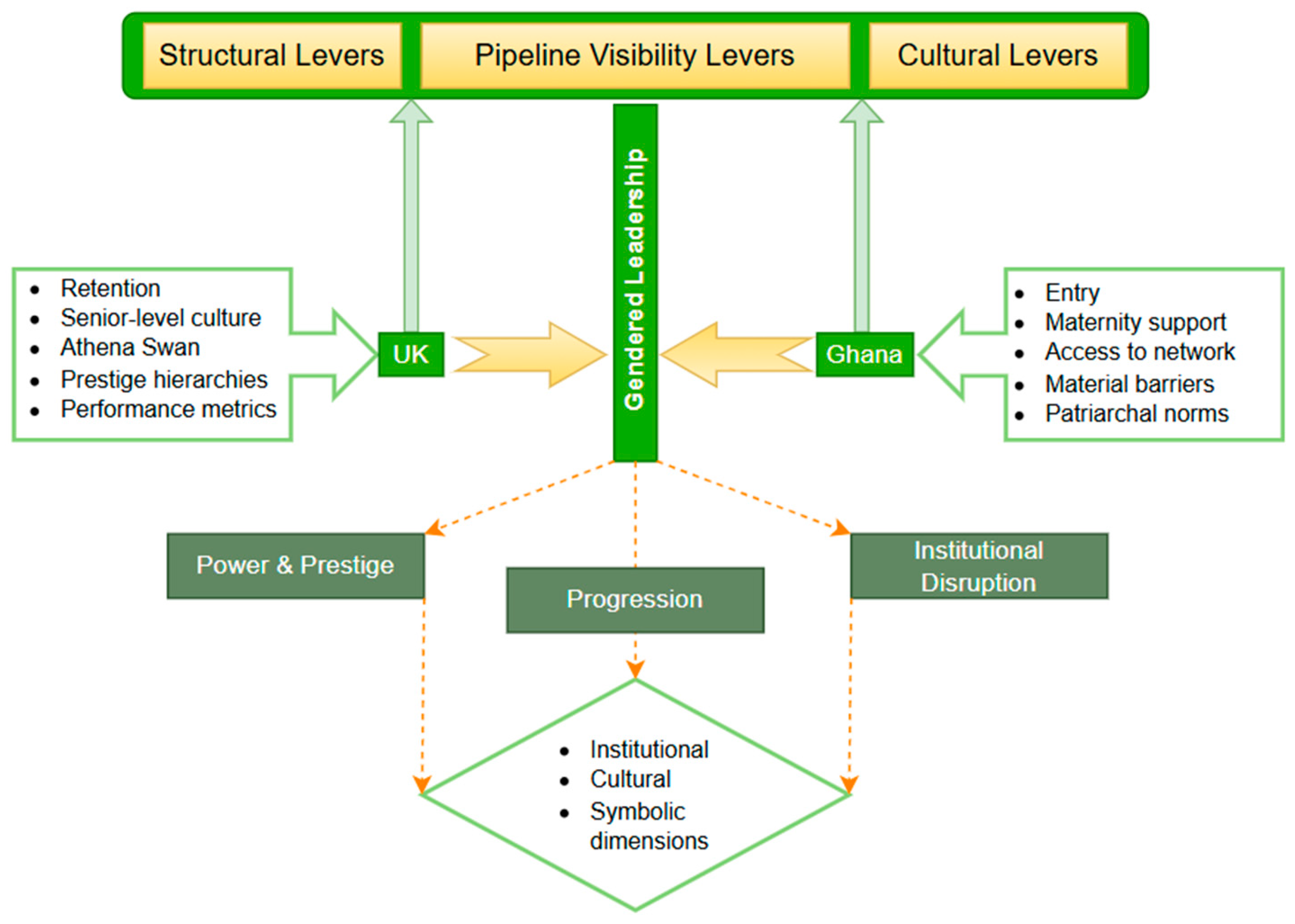
This study set out to understand how gendered leadership in STEM higher education is constructed, lived, and potentially transformed across the UK and Ghana. The three themes emerging from the analysis, namely ‘Power and Prestige’, ‘Progression’, and ‘Institutional Disruption’ are conceptualised in Figure 1 and discussed in this section. These themes form an interlinked framework rather than separate categories. Together, they capture the institutional, cultural, and symbolic dimensions through which gender operates within leadership (Connell, 1987).
The findings show that gendered leadership persists through both visible and invisible practices. Under Power and Prestige, legitimacy was linked to visibility, networks, and unspoken hierarchies, mirroring Bourdieu’s (1990) idea of habitus, where capital circulates unevenly and tends to reproduce itself. Leadership, still equated with masculine authority, was described by one participant as “culturally, we expect the man” (P3_GH), echoing Morley’s (2013) view that academic prestige often conceals patriarchal continuity. Others noted that credibility remains unevenly granted: men are assumed capable, women must constantly prove they belong (O’Connor, 2019).
Under Progression, the evidence pointed to a gendered time economy, such as, caregiving pressures, anticipatory bias, and opaque promotion systems, which sustain what Van Den Brink and Benschop (2012) call “gendered gatekeeping.” The findings also resonate strongly with the literature on academic housework, which describes the uneven allocation of low status but institutionally necessary tasks such as pastoral care, administration, mentoring, committee service, and student support. Macfarlane and Burg (2019) argue that women professors are often drawn into this “housework trap”, where their contribution is valued morally but not rewarded proportionately in promotion or leadership selection. Similarly, Heijstra et al. (2017) show that academic housework can operate as a double-edged mechanism: it increases institutional visibility and collegial legitimacy but diverts time from research outputs and strategic activities that carry greater promotion value. This helps explain why participants in the present study described women as “good organisers” while men were more readily recognised as leaders. Academic housework therefore functions as a hidden progression barrier, linking everyday workload allocation to the reproduction of gendered leadership hierarchies.
Furthermore, many describe working within institutions where policy statements on equality coexist with informal habits that privilege continuity and convenience over fairness. These daily inequities mirror J. Acker’s (2006) “inequality regimes,” where meritocracy masks structural advantage. Institutional Disruption, by contrast, revealed glimpses of change. Participants mentioned intentional hiring, sponsorship, and “bias-safe” decision points as subtle but significant shifts (see Table 5). Rather than simple add-ons, these practices rewire assumptions about who should lead and what leadership looks like. As Ely et al. (2011) argue, transformation occurs not when women adapt to the system but when the system itself learns to accommodate different models of leadership; collaborative, relational, and becomes care-informed.
The three constructs reveal how symbolic authority, procedural opacity, and emergent reform coexist. Reframing leadership through this triad highlights that meaningful change requires both redesigning of institutional structures and reimagining of leadership identities.

5.2. Comparing the UK and Ghana: Convergences and Divergences

Despite very different institutional histories, both countries display strikingly similar gendered architectures. Informal networks, credibility gaps, and time penalties recur across contexts (see Table 6). The distinction lies mainly in where the obstacles appear. As shown in Figure 1 presented earlier, in the UK, challenges cluster around retention and senior-level culture; in Ghana, they begin earlier, around entry, maternity support, and access to networks. This pattern echoes what Crossley (2009) calls contextual isomorphism: comparable structures, differently expressed. UK universities have sophisticated policy frameworks such as Athena Swan, yet many participants noted that “policy exists … but culture stays the same” (04_UK), thus capturing Ahmed’s (2012) critique of performative compliance and reflecting a widely documented gap between procedural compliance and substantive cultural transformation. Despite frameworks such as Athena SWAN and institutional EDI strategies, women remain significantly under-represented in senior STEM leadership roles (AdvanceHE, 2024). UK Parliamentary scrutiny similarly notes that diversity initiatives often fail to shift entrenched norms, resulting in performative compliance rather than systemic change (House of Commons Science & Technology Committee, 2023). In Ghana, by contrast, the policies are fewer but their intent more direct. Initiatives like “prioritising female applications … to correct imbalance” (P4_GH) suggest early structural steps toward rebalancing representation.
These contrasts illustrate that gender inequity is less about national wealth than institutional reproduction. The same forces, bias in evaluation, invisible care burdens, old-boy networks, manifest through different channels. In Ghana, material barriers and patriarchal norms dominate; in the UK, prestige hierarchies and performance metrics reinforce exclusion more subtly (Burkinshaw, 2015; O’Connor, 2019). Each reflects a distinct expression of Connell’s (1987) gender order: the former material, the latter symbolic. What emerges, then, is a shared grammar of inequality, translated into different institutional dialects. Recognising this overlap allows for “transversal learning” (Tikly, 2019), where lessons from one setting illuminate possibilities in another.

5.3. Leadership Reframed: Towards Gender-Transformative Cultures

The results point to a wider rethinking of leadership itself. Leadership, in this reframed sense, is not a role bestowed but a relationship performed. The mechanisms under Institutional Disruption, such as intentional representation, sponsorship, transparent panels, and bias-safe decision points, show that equity advances when institutions redesign norms, not just train individuals. This resonates with Fitzgerald’s (2013) work on feminist leadership, which advocates transformation rather than inclusion into unchanged systems. Participants’ emphasis on “sponsorship, not just mentoring” (SFG2-summary) aligns with Ibarra et al. (2010), who argue that sponsorship actively transfers social capital, countering gatekeeping networks. Likewise, intentional hiring, as illustrated thus “We hired a woman to motivate students” (FG-R2:P02), reassigns symbolic value, helping normalise women’s visibility in authority (Morley, 2014).
However, cultural change cannot rest on representation alone. Without procedural redesign, visible women risk becoming emblematic tokens (Ahmed, 2012). Lasting transformation requires combining representation with care-compatible working models and accountability mechanisms that reshape how leadership success is measured. Ely et al. (2011) describe this as system-level transformation, where both policy and culture evolve together. Ultimately, this study suggests that leadership in STEM HE should be viewed as a collective ecosystem rather than an individual climb, where advocacy, sponsorship, and transparency reinforce each other. The “pipeline problem” thus reframes as a “legitimacy problem”: who is seen, who is heard, and whose trajectory the institution makes possible.

5.4. Implications for Policy and Practice

The evidence identifies three broad domains of change (see Table 6):
Structural levers address practical barriers to progression.
Both settings require care-compatible workloads, predictable timetables, and equitable parental leave. For Ghana, reform of HR policy to extend maternity provisions (“three months leave,” P3_GH) is critical. Current legislation under the Labour Act (2003) provides only 12 weeks of maternity leave with minimal institutional childcare provision. We acknowledge that implementation feasibility differs markedly between the two contexts. In Ghana, even modest structural reforms (e.g., extended maternity leave) require institutional budget reallocation; incremental, donor-supported pilots may be a realistic first step. The recently enacted Affirmative action (gender equality) act (2024) sets ambitious targets, including 30% representation of women in decision-making positions by 2026 and mandatory gender policies within one year of enactment. Aligning institutional HR reforms with these statutory requirements will be essential for sustainable equity.
Cultural levers unsettle the masculine template of leadership.
Training, bias-awareness sessions, and visible male allyship at senior levels redistribute responsibility for equity. UK institutions may deepen Athena Swan’s cultural reach, while Ghanaian universities might embed gender champions within departmental structures to sustain everyday accountability.
Pipeline and visibility levers widen how leadership is imagined.
Sponsorship networks, micro-credential programmes, and visibility dashboards create a sense of attainable leadership. Students’ calls for “visible senior women” (SFG2-summary) highlight how symbolic presence shapes aspiration.
Overall, cross-context policy learning is possible. Ghana can adapt UK frameworks through localisation; UK institutions, conversely, can draw on Ghana’s straightforward, resource-led strategies linking gender targets to recruitment and promotion. As Greenwood and Hinings (1996) note, sustainable reform grows when embedded in local routines rather than imposed externally.

5.5. Theoretical and Empirical Contributions

The contribution of the Power–Progression–Disruption framework does not lie in treating power, progression, or institutional change as wholly new concepts. Rather, its value lies in bringing these dimensions into an interactive, empirically grounded and cross-context framework for analysing gendered STEM leadership. Building on feminist organisational and higher education scholarship (J. Acker, 2006; Morley, 2013), the framework shows how power relations shape progression pathways, how constrained progression reproduces gendered leadership hierarchies, and how practices of institutional disruption may unsettle these dynamics in context-specific ways. Theoretically, it extends J. Acker’s (2006) concept of gendered organisations by illustrating how prestige hierarchies, care–time economies, and visibility regimes interact to sustain inequality across different STEM environments. The proposed Power-Progression-Disruption framework offers an integrative model for understanding how inequities are both reproduced and contested within institutional systems. The Power–Progression–Disruption framework also differs from career-centred models such as the Kaleidoscope Career Model, which explains how individuals adjust career decisions around authenticity, balance, and challenge over time (Mainiero & Sullivan, 2005). While this lens is valuable for understanding women’s career choices, the PPD framework shifts attention from individual career recalibration to institutional dynamics. It foregrounds how gendered power shapes progression systems and how disruptive practices may reconfigure the organisational conditions under which leadership becomes possible. Crucially, it positions disruption as an internal and iterative process, that is, emerging from within the very structures that sustain inequality, rather than an externally imposed reform. Empirically, the study expands the geographical reach of gender-in-HE research by placing UK and Ghanaian experiences in dialogue. This comparative lens enriches what Mama (2003) describes as transnational feminist scholarship, highlighting how leadership practices are socially negotiated rather than universally defined. Methodologically, the research demonstrates how reflexive thematic analysis, combined with abductive synthesis, can connect grounded narratives to higher-order conceptual insights. In doing so, it offers both a theoretical bridge and a practical framework for examining gender-transformative leadership across diverse higher education contexts.

6. Conclusions

This study set out to explore how gendered leadership in STEM higher education unfolds within and across the UK and Ghana. Using interviews and focus-group discussions with academic staff and students, the analysis examined three interconnected dimensions: power and prestige, progression, and institutional disruption, that together offer a comparative, empirically grounded reframing of leadership as a relational, culturally situated, and institutionally mediated phenomenon. This study makes three significant contributions. Theoretically, it advances feminist leadership scholarship by introducing the Power–Progression–Disruption framework, which integrates cultural, structural, and change dynamics. Empirically, it extends the geographical scope of STEM leadership research through a UK–Ghana comparison, revealing transferable mechanisms for equity. Practically, it offers a set of actionable strategies, transparent criteria, care-compatible work design, sponsorship, and visibility infrastructures, aligned with UKRI EDI and Ghana’s Affirmative Action Act. Together, these contributions provide a roadmap for institutions seeking gender-transformative leadership cultures.
Across both contexts, power was found to circulate through prestige hierarchies, informal networks, and visibility economies that position men as the assumed leaders and women as dependable organisers. Male-dominated committees, reputational gatekeeping, and the scarcity of visible role models collectively diminish women’s perceived legitimacy and restrict nomination pools. In the UK, participants highlighted cultural hostility within senior decision-making spaces and a gap between policy and practice. In Ghana, the challenge centred more on pipeline shortages and entrenched committee dominance. In both settings, symbolic cues, who looks like a leader, remain a powerful determinant of access and authority.
Career progression continues to be shaped by a gendered economy of time: long-hours cultures, care responsibilities, and interruptions linked to maternity and return-to-work transitions all converge with opaque promotion systems and discretionary panels. Such frictions compound across careers, steering women towards service and teaching roles that, while essential, rarely lead to advancement. Enabling progression therefore demands both cultural and procedural shifts, namely, transparent promotion criteria, gender-balanced panels, predictable timelines, and workloads designed to protect time for research and strategic leadership. Signs of disruption are evident in institutions that act intentionally on representation and legitimacy. Examples include targeted hiring to redress imbalance, sponsorship that opens networks beyond mentoring, and bias-aware decision points supported by diverse, well-briefed panels. Visibility infrastructures, such as public profiles, conference rosters, leadership open hours, and student-facing exemplars, also help normalise women’s authority. These efforts are most effective when enacted together, reshaping who is seen, who is supported, and how leadership itself is imagined: less as an individual attribute and more as a collective institutional capability.
Bringing together UK and Ghanaian perspectives, this study shows that gendered leadership inequity is sustained at the intersection of symbolic power, temporal constraint, and procedural opacity; yet it is far from immutable. Structural and cultural interventions can, and do, open cracks within established systems. Collectively, these findings respond to the study’s three research questions by demonstrating how power dynamics shape leadership experiences, identifying mechanisms that constrain or enable progression, and highlighting emerging practices of institutional disruption that can foster gender-transformative change. The findings suggest a practical, context-sensitive set of levers: intentional representation anchored to clear criteria, active sponsorship, rotating and bias-safe panels, care-compatible work design, and sustained visibility strategies. When pursued collectively and measured through locally relevant indicators, these interventions can expand leadership pathways, redistribute institutional prestige, and support a lasting shift toward gender-transformative leadership cultures in STEM higher education. To ensure impact, institutions should embed a monitoring framework that tracks KPIs on representation, progression, retention, panel composition, and workload allocation, aligning with UKRI EDI action plans and Ghana’s Affirmative Action compliance certificates.

7. Limitations and Directions for Future Research

As with most qualitative research, the findings reflect depth over breadth. The sample, 20 interviews and four focus groups, cannot represent every institutional variation. Nor did the study explore other intersecting factors such as race or disability, which merit closer attention (Crenshaw, 2006). Finally, while several disruption mechanisms were identified, their long-term outcomes remain untested. Longitudinal and mixed-method follow-ups could trace whether interventions like sponsorship or childcare provision translate into retention or promotion gains. Future research might also examine how digitalisation and AI-driven management tools reshape leadership practices and visibility metrics. Despite such limits, this comparative approach offers a practical and conceptual scaffold for examining gender equity in STEM leadership, showing not just where inequity resides, but how everyday institutional disruptions can begin to erode it from within.

Author Contributions

Conceptualization, A.O.A., S.C.O., T.O. and R.E.T.; Methodology, A.O.A., S.C.O. and T.O.; Software, K.A.; Validation, R.E.T.; Formal analysis, T.O., A.A.-K. and V.B.S.; Investigation, A.O.A., S.C.O. and R.E.T.; Resources, S.C.O., T.O., K.A. and A.A.-K.; Data curation, A.O.A., S.C.O. and M.O.; Writing—original draft, A.O.A., M.O. and K.A.; Writing—review & editing, T.O. and K.A.; Visualization, M.O., A.A.-K. and V.B.S.; Supervision, A.O.A., S.C.O., R.E.T. and A.A.-K.; Project administration, A.O.A. and M.O.; Funding acquisition, A.O.A., S.C.O., R.E.T. and A.A.-K. All authors have read and agreed to the published version of the manuscript.

Funding

This research was funded by British Council’s Going Global Partnerships programme, grant number GEP2024-056.

Institutional Review Board Statement

The study was conducted in accordance with the Declaration of Helsinki, and the protocol was approved by the Local Research Ethics Co-ordinator of Leeds Beckett University (Application Ref: 143698) on 21 January 2025.

Informed Consent Statement

Informed consent was obtained from all subjects involved in the study.

Data Availability Statement

The data presented in this study are available on request from the corresponding author due to ethical restrictions related to participant confidentiality and the sensitive nature of the qualitative data, which include anonymised but potentially identifiable interview and focus-group transcripts.

Acknowledgments

The authors wish to acknowledge the support of the British Council’s Going Global Partnerships programme, whose funding made this research possible. We also extend our appreciation to the contracting institution, Leeds Beckett University, United Kingdom, and our collaborative partner, the University of Cape Coast, Ghana, for their commitment and cooperation throughout the project. Special thanks are due to the UK and Ghana gender advisor partners for their valuable guidance and contributions during the study.

Conflicts of Interest

The authors declare no conflicts of interest.

Notes

1
Understood as a condition in which women, despite being promoted at comparable rates to men, experience smaller wage gains and remain concentrated at the lower ends of pay scales within higher job grades (Booth et al., 2003).
2
Following Ibarra et al. (2010), we define sponsorship as active advocacy by senior individuals who nominate candidates for stretch assignments, protect them from reputational risk, and leverage their own networks to open access to decision-making arenas. Sponsorship differs from mentoring in its focus on power-sharing and career acceleration rather than advice and reflection.

References

  1. Acker, J. (2006). Inequality regimes: Gender, class, and race in organizations. Gender & Society, 20(4), 441–464. [Google Scholar] [CrossRef]
  2. Acker, S. (2012). Chairing and caring: Gendered dimensions of leadership in academe. Gender and Education, 24(4), 411–428. [Google Scholar] [CrossRef]
  3. Acker, S., & Armenti, C. (2004). Sleepless in academia. Gender and Education, 16(1), 3–24. [Google Scholar] [CrossRef]
  4. Acquah, J. M., Odekyi, D. M., & Obeng, K. K. (2020). Challenges to women in educational leadership. International Journal of Humanities, Social Sciences and Education, 7(1), 103–120. [Google Scholar] [CrossRef]
  5. Adongo, A. A., Dapaah, J. M., & Azumah, F. D. (2023). Gender and leadership positions: Understanding women’s experiences and challenges in patriarchal societies in Northern Ghana. International Journal of Sociology and Social Policy, 43(11–12), 1114–1137. [Google Scholar] [CrossRef]
  6. AdvanceHE. (2024). Equality in higher education: Staff statistical report 2024. Available online: https://www.advance-he.ac.uk/news-and-views/equality-higher-education-staff-statistical-report-2024 (accessed on 24 November 2025).
  7. Affirmative action (gender equality) act. (2024). Available online: https://www.purc.com.gh/attachment/735270-20241129071158.pdf (accessed on 24 November 2025).
  8. Ahmed, S. (2012). On being included: Racism and diversity in institutional life. Duke University Press. [Google Scholar]
  9. Airini, Collings, S., Conner, L., McPherson, K., Midson, B., & Wilson, C. (2011). Learning to be leaders in higher education: What helps or hinders women’s advancement as leaders in universities. Educational Management Administration & Leadership, 39(1), 44–62. [Google Scholar] [CrossRef]
  10. Armstrong, J., & Sullivan, A. (2025). A critical analysis of Athena Swan as a policy-scoring scheme. British Educational Research Journal, 51(1), 225–243. [Google Scholar] [CrossRef]
  11. Azizi, H., Abdellatif, W., Nasrullah, M., Ali, S., Ding, J., & Khosa, F. (2022). Leadership gender disparity in the fifty highest ranking North American universities: Thematic analysis under a theoretical lens. Postgraduate Medical Journal, 98(1163), 705–709. [Google Scholar] [CrossRef]
  12. Bilimoria, D., & Liang, X. (2012). Gender equity in science and engineering: Advancing change in higher education. Routledge. [Google Scholar]
  13. Blackmore, J. (2014). ‘Wasting talent’? Gender and the problematics of academic disenchantment and disengagement with leadership. Higher Education Research & Development, 33(1), 86–99. [Google Scholar] [CrossRef]
  14. Booth, A. L., Francesconi, M., & Frank, J. (2003). A sticky floors model of promotion, pay, and gender. European Economic Review, 47(2), 295–322. [Google Scholar] [CrossRef]
  15. Bourdieu, P. (1990). The logic of practice (Reprinted). Stanford University Press. [Google Scholar]
  16. Braun, V., & Clarke, V. (2006). Using thematic analysis in psychology. Qualitative Research in Psychology, 3(2), 77–101. [Google Scholar] [CrossRef]
  17. Braun, V., & Clarke, V. (2019). Reflecting on reflexive thematic analysis. Qualitative Research in Sport, Exercise and Health, 11(4), 589–597. [Google Scholar] [CrossRef]
  18. Burkinshaw, P. (2015). Higher education, leadership and women vice chancellors: Fitting in to communities of practice of masculinities. Palgrave Macmillan. [Google Scholar]
  19. Burkinshaw, P., & White, K. (2017). Fixing the women or fixing universities: Women in HE leadership. Administrative Sciences, 7(3), 30. [Google Scholar] [CrossRef]
  20. Burnes, B., & Cooke, B. (2013). Kurt lewin’s field theory: A review and re-evaluation. International Journal of Management Reviews, 15(4), 408–425. [Google Scholar] [CrossRef]
  21. Caffrey, L., Wyatt, D., Fudge, N., Mattingley, H., Williamson, C., & McKevitt, C. (2016). Gender equity programmes in academic medicine: A realist evaluation approach to Athena SWAN processes. BMJ Open, 6(9), e012090. [Google Scholar] [CrossRef] [PubMed]
  22. Connell, R. (1987). Gender and power: Society, the person, and sexual politics. Stanford University Press. [Google Scholar]
  23. Crenshaw, K. W. (2006). Intersectionality, identity politics and violence against women of color. Kvinder, Køn & Forskning. [Google Scholar] [CrossRef]
  24. Crossley, M. (2009). Rethinking context in comparative education. In R. Cowen, & A. M. Kazamias (Eds.), International handbook of comparative education (pp. 1173–1187). Springer. [Google Scholar] [CrossRef]
  25. Cutter, C. M., Griffith, K. A., Settles, I. H., Stewart, A. J., Kerr, E. A., Feldman, E. L., & Jagsi, R. (2024). Gender differences in faculty perceptions of mentorship and sponsorship. JAMA Network Open, 7(2), e2355663. [Google Scholar] [CrossRef]
  26. Czech, A., Olarreaga, M., & Peila, O. (2024). Gender gap in faculty promotion. PLoS ONE, 19(11), e0313311. [Google Scholar] [CrossRef] [PubMed]
  27. Datnow, A., Yoshisato, M., Macdonald, B., Trejos, J., & Kennedy, B. C. (2023). Bridging educational change and social justice: A call to the field. Educational Researcher, 52(1), 29–38. [Google Scholar] [CrossRef]
  28. Deem, R. (2009). Leading and managing contemporary UK universities: Do excellence and meritocracy still prevail over diversity? Higher Education Policy, 22(1), 3–17. [Google Scholar] [CrossRef]
  29. Diab, R., Kalele, P., Bulani, M., Boateng, F. K., & Mukeshimana, M. (2024). Gender perspectives on academic leadership in African universities. International Journal of African Higher Education, 10(2), 138–159. [Google Scholar] [CrossRef]
  30. Eagly, A. H., & Carli, L. L. (2007). Through the labyrinth: The truth about how women become leaders. Harvard Business School Press. [Google Scholar]
  31. Ely, R. J., Ibarra, H., & Kolb, D. M. (2011). Taking gender into account: Theory and design for women’s leadership development programs. Academy of Management Learning & Education, 10(3), 474–493. [Google Scholar] [CrossRef]
  32. Ely, R. J., & Meyerson, D. E. (2000). Theories of gender in organizations: A new approach to organizational analysis and change. Research in Organizational Behavior, 22, 103–151. [Google Scholar] [CrossRef]
  33. English, V., & Braybrook, K. (2025). Women’s leadership development through higher education. International Journal of Educational Studies, 8(6), 82–92. [Google Scholar] [CrossRef]
  34. ESSA. (2021). Unlocking the potential of female leadership in tertiary education. Available online: https://essa.ninamisaroadvocates.com/node/1721 (accessed on 25 November 2025).
  35. Faulkner, W. (2007). ‘Nuts and bolts and people’: Gender-troubled engineering identities. Social Studies of Science, 37(3), 331–356. [Google Scholar] [CrossRef]
  36. Fitzgerald, T. (2013). Women leaders in higher education (1st ed.). Routledge. [Google Scholar] [CrossRef]
  37. Foucault, M. (1980). Power/knowledge: Selected interviews and other writings 1972–1977. Pantheon Books. [Google Scholar]
  38. Gander, M., & Sharafizad, F. (2025). Progressing gender equity in senior leadership: A systematic literature review. Gender in Management: An International Journal, 40(2), 352–369. [Google Scholar] [CrossRef]
  39. Greenwood, R., & Hinings, C. R. (1996). Understanding radical organizational change: Bringing together the old and the new institutionalism. The Academy of Management Review, 21(4), 1022. [Google Scholar] [CrossRef]
  40. Guarino, C. M., & Borden, V. M. H. (2017). Faculty service loads and gender: Are women taking care of the academic family? Research in Higher Education, 58(6), 672–694. [Google Scholar] [CrossRef]
  41. Guest, G., Bunce, A., & Johnson, L. (2006). How many interviews are enough?: An experiment with data saturation and variability. Field Methods, 18(1), 59–82. [Google Scholar] [CrossRef]
  42. Hall, R. M., & Sandler, B. R. (1982). The classroom climate: A chilly one for women? Association of American College. Available online: https://eric.ed.gov/?id=ED215628 (accessed on 25 November 2025).
  43. Heijstra, T. M., Steinthorsdóttir, F. S., & Einarsdóttir, T. (2017). Academic career making and the double-edged role of academic housework. Gender and Education, 29(6), 764–780. [Google Scholar] [CrossRef]
  44. Hennink, M. M., Kaiser, B. N., & Marconi, V. C. (2017). Code saturation versus meaning saturation: How many interviews are enough? Qualitative Health Research, 27(4), 591–608. [Google Scholar] [CrossRef] [PubMed]
  45. HESA. (2025). Higher education staff statistics: UK, 2023/24. Available online: https://www.hesa.ac.uk/news/28-01-2025/sb270-higher-education-staff-statistics (accessed on 25 November 2025).
  46. HESA. (2026). What do HE students study? Available online: https://www.hesa.ac.uk/data-and-analysis/students/what-study#characteristics (accessed on 26 November 2025).
  47. House of Commons Science & Technology Committee. (2023). Diversity and inclusion in STEM (Fifth report of session 2022–2023). UK Parliament. Available online: https://www.sciencecentres.org.uk/resources/promoting-diversity-and-inclusion-stem-engagement/house-of-commons-science-and-technology-committee-diversity-and-inclusion-in-stem/ (accessed on 26 November 2025).
  48. Ibarra, H., Carter, N. M., & Silva, C. (2010). Why men still get more promotions than women. Harvard Business Review, 88(9), 80–86. [Google Scholar]
  49. Kalpazidou Schmidt, E., Ovseiko, P. V., Henderson, L. R., & Kiparoglou, V. (2020). Understanding the Athena SWAN award scheme for gender equality as a complex social intervention in a complex system: Analysis of Silver award action plans in a comparative European perspective. Health Research Policy and Systems, 18(1), 19. [Google Scholar] [CrossRef]
  50. Kanter, R. M. (1977). Men and women of the corporation. Basic Books. [Google Scholar]
  51. Kuhn, M. H. (1951). LEWIN, KURT. Field theory of social science: Selected theoretical papers. (Edited by Dorwin Cartwright.) Pp. xx, 346. New York: Harper & Brothers, 1951. $5.00. The ANNALS of the American Academy of Political and Social Science, 276(1), 146–147. [Google Scholar] [CrossRef]
  52. Labour Act, Act 651. (2003). Available online: https://ghalii.org/akn/gh/act/2003/651/eng@2003-10-10 (accessed on 26 November 2025).
  53. Lawrence, T. B., & Suddaby, R. (2006). Institutions and institutional work. In S. Clegg, C. Hardy, T. Lawrence, & W. Nord (Eds.), The SAGE handbook of organization studies (pp. 215–254). SAGE Publications, Ltd. [Google Scholar] [CrossRef]
  54. Lincoln, Y. S., & Guba, E. G. (1985). Naturalistic inquiry. Sage. [Google Scholar]
  55. Macfarlane, B., & Burg, D. (2019). Women professors and the academic housework trap. Journal of Higher Education Policy and Management, 41(3), 262–274. [Google Scholar] [CrossRef]
  56. Mainiero, L. A., & Sullivan, S. E. (2005). Kaleidoscope careers: An alternate explanation for the “opt-out” revolution. Academy of Management Perspectives, 19(1), 106–123. [Google Scholar] [CrossRef]
  57. Malterud, K., Siersma, V. D., & Guassora, A. D. (2016). Sample size in qualitative interview studies: Guided by information power. Qualitative Health Research, 26(13), 1753–1760. [Google Scholar] [CrossRef]
  58. Mama, A. (2003). 5—Restore, reform but do not transform: The gender politics of higher education in Africa. Journal of Higher Education in Africa, 1(1), 101–125. [Google Scholar] [CrossRef]
  59. Manuh, T., Gariba, S., & Budu, J. (2007). Change & transformation in Ghana’s publicly funded universities: A study of experiences, lessons & opportunities. James Currey; Woeli Publishing Services. [Google Scholar]
  60. Meyerson, D. E., & Scully, M. A. (1995). Crossroads tempered radicalism and the politics of ambivalence and change. Organization Science, 6(5), 585–600. [Google Scholar] [CrossRef]
  61. Mezirow, J. (2000). Learning as transformation: Critical perspectives on a theory in progress. Jossey-Bass. [Google Scholar]
  62. Morley, L. (2013). Women and higher education leadership: Absences and aspirations. Leadership Foundation for Higher Education. [Google Scholar]
  63. Morley, L. (2014). Lost leaders: Women in the global academy. Higher Education Research & Development, 33(1), 114–128. [Google Scholar] [CrossRef]
  64. National Council for Tertiary Education. (n.d.). National gender equality and social inclusion (GESI) strategy and action plan for teacher education 2020–2025. National Council for Tertiary Education. [Google Scholar]
  65. O’Brien, B. C., Harris, I. B., Beckman, T. J., Reed, D. A., & Cook, D. A. (2014). Standards for reporting qualitative research: A synthesis of recommendations. Academic Medicine, 89(9), 1245–1251. [Google Scholar] [CrossRef] [PubMed]
  66. O’Connor, P. (2018). Introduction to special issue on gender and leadership and a future research agenda. Education Sciences, 8(3), 93. [Google Scholar] [CrossRef]
  67. O’Connor, P. (2019). Gender imbalance in senior positions in higher education: What is the problem? What can be done? Policy Reviews in Higher Education, 3(1), 28–50. [Google Scholar] [CrossRef]
  68. Ojong, A. S., & Kareem, E. (2025). Advancing equity in STEM education for girls in sub-Saharan Africa: A systematic review through an intersectional lens. American Journal of STEM Education, 13, 57–84. [Google Scholar] [CrossRef]
  69. O’Neil, D. A., & Hopkins, M. M. (2015). The impact of gendered organizational systems on women’s career advancement. Frontiers in Psychology, 6, 905. [Google Scholar] [CrossRef]
  70. Ovseiko, P. V., Chapple, A., Edmunds, L. D., & Ziebland, S. (2017). Advancing gender equality through the Athena SWAN charter for women in science: An exploratory study of women’s and men’s perceptions. Health Research Policy and Systems, 15(1), 12. [Google Scholar] [CrossRef] [PubMed]
  71. Patton, M. Q. (2015). Qualitative research & evaluation methods: Integrating theory and practice. SAGE Publications, Inc. [Google Scholar]
  72. Shaw, A. K., & Stanton, D. E. (2012). Leaks in the pipeline: Separating demographic inertia from ongoing gender differences in academia. Proceedings of the Royal Society B: Biological Sciences, 279(1743), 3736–3741. [Google Scholar] [CrossRef] [PubMed]
  73. Tikly, L. (2019). Education for sustainable development in Africa: A critique of regional agendas. Asia Pacific Education Review, 20(2), 223–237. [Google Scholar] [CrossRef]
  74. Timmermans, S., & Tavory, I. (2012). Theory construction in qualitative research: From grounded theory to abductive analysis. Sociological Theory, 30(3), 167–186. [Google Scholar] [CrossRef]
  75. Tong, A., Sainsbury, P., & Craig, J. (2007). Consolidated criteria for reporting qualitative research (COREQ): A 32-item checklist for interviews and focus groups. International Journal for Quality in Health Care, 19(6), 349–357. [Google Scholar] [CrossRef]
  76. Tzanakou, C., & Pearce, R. (2019). Moderate feminism within or against the neoliberal university? The example of Athena SWAN. Gender, Work & Organization, 26(8), 1191–1211. [Google Scholar] [CrossRef]
  77. UKRI. (2023). UKRI’s equality, diversity and inclusion strategy: Research and innovation by everyone, for everyone. Available online: https://www.ukri.org/publications/ukris-equality-diversity-and-inclusion-strategy/ukris-equality-diversity-and-inclusion-strategy-research-and-innovation-by-everyone-for-everyone/ (accessed on 27 November 2025).
  78. UNESCO. (2024). The gender gap in science: Status and trends. Available online: https://unesdoc.unesco.org/ark:/48223/pf0000388805 (accessed on 27 November 2025).
  79. UNESCO. (2025). Status and trends of women in science: New insights and sectoral perspectives 2025. Available online: https://unesdoc.unesco.org/ark:/48223/pf0000393768 (accessed on 27 November 2025).
  80. United Nations. (2024). Empowering girls in Africa to embrace STEM. Available online: https://africarenewal.un.org/en/magazine/empowering-girls-africa-embrace-stem (accessed on 27 November 2025).
  81. Van Den Brink, M., & Benschop, Y. (2012). Slaying the seven-headed dragon: The quest for gender change in Academia. Gender, Work & Organization, 19(1), 71–92. [Google Scholar] [CrossRef]
  82. Wajcman, J. (2004). TechnoFeminism. Polity. [Google Scholar]
  83. White, K., & O’Connor, P. (Eds.). (2017). Gendered success in higher education: Global perspectives. Palgrave Macmillan. [Google Scholar]
Figure 1. An illustration of the Power–Progression–Disruption Framework. Solid arrows indicate the directional relationships between contextual influences, leadership dynamics, and intervention levers across the UK and Ghana, while dashed arrows represent the interaction between the three framework dimensions and their institutional, cultural, and symbolic manifestations.
Education 16 00841 g001
Table 1. Participant segmentation rationale.
GroupRationale
UK staff interviewsCapture institutional logics, cultures, and leadership pathways within a mature policy ecosystem (EDI, Athena Swan)
Ghana staff interviewsSurface context-specific constraints and cultural/structural barriers in an emerging EDI institutional landscape
Mixed UK–Ghana staff FGEnable cross-context comparison and knowledge exchange in real time, validating transferability and identifying shared levers for change
Ghana student FGCapture lived experiences of emerging STEM talent and future leadership pipeline perceptions, including informal culture in classrooms, placement selection, and early leadership experiences
Table 2. Profile of interviewees.
CountryS/NAge RangeGenderEthnic CharacteristicsRoleYears of Experience
UKP1_UK35–44FemaleBlack AfricanLecturer17
P2_UK35–44FemaleAsian VietnameseLecturer4
P3_UK35–44FemaleBlack AfricanSenior Lecturer12
P4_UK45–54FemaleBritish MuslimSenior Lecturer15
P5_UK45–54FemalePrefer not to sayCourse Director25
P6_UK15–24FemaleArab EgyptianResearch Associate1
P7_UK35–44FemaleAsian, BangladeshiLecturer14
P8_UK35–44FemaleBlack AfricanResearch Assistant1
P9_UK35–44FemaleAsian BritishSenior Lecturer14
P10_UK55+FemaleAfrican CaribbeanSenior Lecturer32
GhanaP1_GH35–44FemaleBlack AfricanAssistant Lecturer3
P2_GH35–44FemaleBlack AfricanSenior Lecturer6
P3_GH45–54FemaleBlack African/AkanSenior Lecturer16
P4_GH35–44FemaleBlack African/AkanLecturer7
P5_GH35–44FemaleBlack AfricanLecturer6
P6_GH35–44FemaleBlack AfricanLecturer12
P7_GH25–34FemaleBlack AfricanAssistant Lecturer1
P8_GH45–54FemaleBlack AfricanSenior Lecturer19
P9_GH35–44FemaleBlack AfricanLecturer13
P10_GH35–44FemaleBlack AfricanTeaching Associate13
‘Age range’ and ‘Ethnic characteristics’ were included in the table to document participant diversity and ensure transparency in sampling; these attributes were not used as analytic variables in this study. Recruitment proceeded via institutional networks. Information sheets and consent forms set out purpose, confidentiality, and voluntary participation.
Table 3. Analytical framework: from first-order codes to overarching constructs.
First-Order CodeSub-ThemeConstructIllustrative Extract (with Participant ID)
Leadership ceilingSystemic barriers to leadershipPower & PrestigeMy school has never had a female Head of School … 25 years.” (10_UK) // “In my school … 18 faculty leaders, only one female.” (P3_GH)
Informal networksHidden curriculum/social capitalPower & PrestigeMen get invited into networks where decisions are made.” (09_UK) // “Committees are dominated by men … same people on promotion panels” (P6_GH)
Visibility scarcityAbsence of female role modelsPower & PrestigeIn computing … very few women … and that appears in staff too.” (FG-R1:P01) // “For twenty years we never had a woman in physics … only recently we hired one” (P4_GH)
Care-work/time penaltyFamily and caring burdenProgressionI had to look after my boys … leadership will come later.” (01_UK) // “Raising a family and trying to rise in STEM takes a lot from the woman.” (P4_GH)
Maternity-leave limitationStructural policy constraintProgressionThere’s always an assumption women will take maternity … and it affects hiring.” (08_UK) // “Three months maternity leave … not enough … need childcare at the workplace.” (P3_GH)
Opaque promotionTransparency/process opacityProgressionPolicy exists … but culture stays the same.” (04_UK) // “Promotion criteria are not clear … delays progression” (P7_GH)
Gendered expectationsCultural coding of leadershipPower & PrestigeWomen are seen as good organisers, not leaders.” (05_UK) // “Leadership … culturally we expect the man.” (P3_GH)
Credibility burdenDouble bind/respectability politicsPower & PrestigeWomen need to prove they’re capable … men don’t.” (07_UK) // “People doubt the capability of women in STEM leadership.” (P2_GH)
Work–life conflictLong-hours norm and retentionProgressionIt’s easier here to get into STEM, but difficult to return after family breaks.” (FG-R2:P01) // “Women doctors work 72 h before break … hinders family” (FG-R2:P02)
Intentional hiringRepresentation leversInstitutional DisruptionWe intentionally hired a female … to motivate students.” (FG-R2:P02) // “We prioritise female applications … to correct imbalance.” (P4_GH)
Early socialisationVisibility and role-model exposureInstitutional DisruptionIn my class of 25 … maybe two or three females.” (FG-R2:P01) // “Girls feel they are daring to challenge men by choosing STEM.” (FG-R2:P03)
Sponsorship over mentoringPipeline mechanism for changeInstitutional DisruptionWe need sponsorship, not just mentoring … somebody to open doors.” (SFG2-summary) // “Mentoring is fine, but without advocacy you stay in the same place.” (P6_GH)
Table 4. Cross-context evidence matrix (UK–Ghana-FG triangulation).
Construct: Sub-ThemeUK Interview Evidence (IDs)Ghana Interview Evidence (IDs)Mixed Staff FG (Verbatim)Student FG (Verbatim)Brief Interpretive Memo
POWER & PRESTIGE: Informal/cultural exclusionMen get invited into networks where decisions are made.” (09_UK)Committees are dominated by men … same people on promotion panels.” (P6_GH)Bias is definitely there … some employers prefer to employ men.” (FG-PL: P03)Default male reps; closed networks.” (SFG1-summary)The data suggest that informal networks and prestige cultures may help sustain male authority across both contexts.
POWER & PRESTIGE: Visibility & role modelsMy school has never had a female Head of School … 25 years.” (10_UK)In my school … 18 faculty leaders, only one female.” (P3_GH)In computing … very few women … and that appears in staff too.” (FG-R1:P01)Few female HoDs/Deans; leadership ‘not for women’.” (SFG2-summary)Participants’ accounts indicate that limited visibility of women leaders may constrain aspiration and reinforce male-coded assumptions about leadership.
PROGRESSION: Care-work/time penaltiesI had to look after my boys … leadership will come later.” (01_UK)Raising a family and trying to rise in STEM takes a lot from the woman.” (P4_GH)Women doctors work 72 h … it hinders family.” (FG-R2:P02)Long-hours culture; out-of-hours demands deter women.” (SFG1-summary)The evidence points to a gendered organisation of time that appears to affect women’s progression and readiness for leadership opportunities.
PROGRESSION: Maternity/return and process opacityThere’s always an assumption women will take maternity … affects hiring.” (08_UK)Three months maternity leave … not enough; need childcare at the workplace.” (P3_GH)Hostile environments … limits progression to senior positions.” (FG-PL: P02)Publish criteria; micro-credentials for leadership readiness.” (SFG2-summary)These accounts suggest that anticipatory bias, weak support structures, and opaque criteria may combine to produce “sticky floors” in career progression.
INSTITUTIONAL DISRUPTION: Intentional representation-We prioritise female applications … to correct imbalance.” (P4_GH)We intentionally hired a female … to motivate students.” (FG-R2:P02)Visibility matters; office hours from senior women.” (SFG1-summary)The data indicate that targeted representation may help unsettle existing norms and broaden perceptions of who can lead.
INSTITUTIONAL DISRUPTION: Early socialisation & imagery--Where are the women? We need that image in schools and media.” (FG-PL: P01)Few women in cohorts; boys seen as natural leaders.” (SFG1-summary)Participants’ reflections suggest that early visibility and role-model exposure may influence longer-term STEM leadership aspirations.
INSTITUTIONAL DISRUPTION: Sponsorship & transparent criteriaPromotion cultures can be hostile; biases go unchecked.” (04_UK)Promotion criteria are not clear … delays progression.” (P7_GH)Make decision points fair; diversify panels.” (FG-R1:P04)We need sponsorship, not just mentoring … open doors.” (SFG2-summary)The evidence suggests that sponsorship and published criteria may help reduce the effects of informal gatekeeping and opaque progression processes.
Table 5. Mechanisms of institutional disruption.
MechanismUK QuoteGhana QuoteMixed FG/Student EvidenceAnalytic Note
Intentional hiring/representation-We prioritise female applications … to correct imbalance.” (P4_GH)We intentionally hired a female … to motivate students.” (FG-R2:P02)Visible appointments signal belonging; counters prestige/visibility deficits.
Publish criteria & transparent progressionPromotion cultures can be hostile; biases go unchecked.” (04_UK)Promotion criteria are not clear … delays progression.” (P7_GH)Make decision points fair; diversify panels.” (FG-R1:P04)Procedural clarity reduces discretion; panel diversity normalises fairness.
Care-compatible work design (leave/childcare/flexibility)I had to look after my boys … leadership will come later.” (01_UK)Three months maternity leave … not enough; need childcare at the workplace.” (P3_GH)Long-hours culture and travel burdens deter women.” (SFG1-summary)Redesign time/leave infrastructure to maintain leadership pipelines.
Sponsorship (beyond mentoring)Policy exists … but culture stays the same.” (04_UK)Mentoring is fine, but without advocacy you stay in the same place.” (P6_GH)We need sponsorship, not just mentoring … open doors.” (SFG2-summary)Door-opening advocacy counters networked gatekeeping and credibility burdens.
Bias-safe decision points (training, criteria, diverse panels)There’s always an assumption women will take maternity … affects hiring.” (08_UK)Committees are dominated by men … same people on promotion panels.” (P6_GH)Hostile environments … limit progression to senior positions.” (FG-PL: P02)Make bias visible at gates; rebalance panels to disrupt default preferences.
Visibility infrastructure & early socialisation--Where are the women? We need that image in schools and media.” (FG-PL: P01); “Few female HoDs/Deans; leadership ‘not for women’.” (SFG2-summary)Early imagery and regular exposure cultivate aspiration and legitimacy for women leaders.
Table 6. Convergence–Divergence–Transferable Mechanisms.
Construct (Theme)Convergent Patterns (UK & Ghana)Divergent Patterns (Context-Specific Emphases)Transferable Mechanisms (Actionable Levers)
Power & PrestigeMale-coded authority and prestige hierarchies normalise scarce women leaders.
Informal networks and closed committees reproduce access.
Low visibility/role models depress aspiration and legitimacy.
UK: Emphasis on retention and culture/hostility around senior decision spaces.
Ghana: Emphasis on entry/pipeline scarcity and male-dominated committees at faculty/college level.
Public visibility infrastructure (profiles, speaker rosters, dashboards).
Diversify decision panels; rotate committee membership.
Anti-bias briefing at gatekeeping nodes.
Progression (Pathways & Barriers)Care/time economy penalises women (family, long-hours norms).
Anticipatory maternity bias and process opacity impede progression.
Admin/pastoral “organiser” roles siphon time from promotable work.
UK: Stronger policy scaffolding but culture-policy gap; “toxic” climates cited for mid-career exit.
Ghana: Structural supports thinner (e.g., short maternity leave, childcare gaps); promotion criteria perceived opaque.
Care-compatible work design (extended leave, on-site/partner childcare, flexible timetables).
Publish criteria and timelines; transparent workload models.
Sponsorship (beyond mentoring) tied to promotion milestones.
Institutional Disruption (Change Agents)Intentional representation (hiring/admissions) viewed as catalyst.
Cross-level allyship valued (including men in power).
Students call for sponsorship, visibility, micro-credentials for leadership.
UK: Culture-change emphasis (bias-safe promotion boards, retention focus).
Ghana: Structural levers emphasised (priority hiring, admissions cut-offs, committee diversification).
Dual-track strategy: (1) Structural-intentional hiring/admissions, criteria transparency; (2) Cultural-allyship frameworks, bias training at decision points.
Early socialisation: visible women leaders in curricula/outreach.
Monitor via KPIs (representation, progression, retention).
Disclaimer/Publisher’s Note: The statements, opinions and data contained in all publications are solely those of the individual author(s) and contributor(s) and not of MDPI and/or the editor(s). MDPI and/or the editor(s) disclaim responsibility for any injury to people or property resulting from any ideas, methods, instructions or products referred to in the content.