Article

Mind the Gap: Teacher Knowledge, Classroom Reality, and Early Literacy Instruction

1
Education Department, School of Humanities, Social Sciences and Law, University of Dundee, Dundee DD1 4HN, UK
2
School of Education, University of Glasgow, Glasgow G3 6NH, UK
3
School of Psychology, University of Dundee, Dundee DD1 4HN, UK
*
Author to whom correspondence should be addressed.
Educ. Sci. 2026, 16(6), 843; https://doi.org/10.3390/educsci16060843
Submission received: 1 April 2026 / Revised: 28 April 2026 / Accepted: 20 May 2026 / Published: 27 May 2026

Abstract

Purpose: This mixed-methods study examined how teachers implement evidence-based components of beginning reading, how this relates to teachers’ literacy knowledge levels, and teachers’ own views on classroom practice. Method: An online survey reached 507 teachers (mean age = 40 years) who taught reading in the first three years of schooling, with quantitative items measuring the reported frequency of five instructional strands and open-ended questions eliciting qualitative data on classroom practice. An optional TULIP test assessed knowledge of phonological awareness, phonics/encoding, fluency, oral language, and comprehension (n = 122). Data were analysed with repeated-measures ANOVA, linear mixed-effects modelling, and inductive content analysis. Results: Many respondents reported adopting core code-based routines, modelling phoneme awareness, and integrating phonics into daily lessons. However, systematic phonics and spelling instruction, two essential elements of the science of reading, were found to be applied inconsistently. Some classrooms were combining evidence-based elements with traditional whole-word practices. Average TULIP knowledge accuracy was 66%. The mixed-effects model showed that phonics knowledge interacted with instruction, where high-knowledge teachers allocated more time to phonics and word structure than low-knowledge peers. Qualitative themes, including societal constraints, structural/resource pressures, and limited transfer from initial teacher education into practice, explained why evidence-aligned practice is inconsistently realised. Conclusions: While the teachers endorsed core code-based routines, systematic phonics with aligned decodable texts and spelling instruction were implemented unevenly. Enhancing early literacy outcomes will require coordinated policy; sustained professional learning that addresses the identified knowledge gaps in phonics, encoding, and oral language; and access to evidence-based resources.

1. Introduction

A project initiated by the Organisation for Economic Co-operation and Development (OECD, 2022; Schlicht-Schmälzle et al., 2024) is investigating the impact of research on educational policy and practice by mapping processes designed to encourage more interaction between these sectors. In the field of literacy, there is an extensive interdisciplinary research literature, referred to as the ‘science of reading’ (for a review, see Snowling et al., 2022), which contains evidence with the potential to inform professional practice and curriculum design across educational levels and component elements (e.g., word identification, word production/spelling, reading fluency, text comprehension, reading for pleasure, motivation/engagement). Nevertheless, persistent barriers appear to obstruct research–practice exchange around literacy. One issue is that the research literature does not appear easily accessible to this target audience (Burnett et al., 2022). Another is that, despite interest in collaboration and coproduction, the precise mechanisms by which practice can influence and keep pace with the ever-expanding research literature remain to be fully identified.
To explore this research–practice gap, the present study examines early literacy instruction. Despite the many positive instances of links between research, policy, and practice (see, for example, Edovald & Nevill, 2021), the question of how to begin to teach children to read still has the capacity to divide opinion in education (Castles et al., 2018), highlighting that the consensus in the research literature is not mirrored in educational practice. The present study therefore reviews research evidence on early literacy development and, with this evidence in mind, surveys practising teachers to capture their experience of delivering early reading instruction. The results present the teachers’ own report of the instructional methods used in contemporary practice, the knowledge base they work from, the availability of resources, and their own feelings about teaching efficacy in relation to early reading. The aims are to determine the alignment between research and practice and to identify any areas where research findings are not reaching practice in order to initiate further discussion.
Surveying teachers is central to this inquiry because classroom-level decisions about early reading instruction (what is taught, how, and with which resources) are made by teachers rather than by policymakers or researchers. Without direct evidence from teachers themselves, it is difficult to know the extent to which the methods supported in the research literature are being practiced, what constraints teachers face in implementing them, and where further professional support might be beneficial. Teachers’ accounts of their own practice therefore offer a uniquely informative window on the research–practice gap, complementing policy analyses and observational studies of classroom instruction.

2. Literature Review

2.1. Key Skills in Early Literacy

The controversy known as the ‘reading wars’ refers to an old debate between advocates of two contrasting approaches to early reading instruction: systematic phonics versus whole-language (Castles et al., 2018). The essence of this debate was whether young children needed to be directly taught the relationship between letters and sounds in written words (phonics; e.g., Chall, 1967) or whether phonics was not required and children should instead be encouraged to make informed guesses about the written words on the basis of textual information and context (whole-language; e.g., Goodman, 1967). As the references indicate, this debate originated over half a century ago and has been intensively studied in the intervening years. The research evidence now unequivocally shows that young children who are taught to read using a phonics approach show greater growth in reading words and understanding written text than those taught using non-phonics approaches (for literature reviews, see Adams, 1990; National Reading Panel, 2000; Rose, 2006; Castles et al., 2018).
Knowing that the phonics approach is supported by rigorous scientific research is important evidence for policy and practice. Teachers responsible for a class of beginning readers require a solid knowledge base encompassing core research content and pedagogical expertise to implement best practices effectively (Hudson et al., 2021). Research will, therefore, be presented to summarise what is known about early literacy development and effective teaching methods. Too often, the research on reading has been interpreted in a polarised fashion, emphasising only one pedagogical approach, which ultimately does not do justice to the complex range of skills required for reading development. Throughout, we will take the view that there are aspects of learning which require continuous intervention and others that require time-sensitive intervention to support children on their journey to becoming literate (Duncan, 2024).
Learning to read begins long before children enter formal schooling. Through their home literacy environment (HLE), many children develop an enjoyment and understanding of stories and become familiar with books and print, giving them an advantage in vocabulary, reading motivation, and reading comprehension on school entry (Hood et al., 2008; Inoue et al., 2018; Sénéchal et al., 2017; Van Steensel, 2006; Torppa et al., 2022). Evidence suggests that these early HLE experiences may be part of a continuous (informal and formal) educational process, which is beneficial for language development and reading enjoyment into adulthood (see the meta-analysis by Mol & Bus, 2011). Preschool education also exerts an important influence on later literacy which is additional to that of the HLE (Melhuish et al., 2008). However, what constitutes quality in terms of preschool provision is less well understood. Initial findings highlight features such as teachers’ use of complex vocabulary and strategies to extend children’s speech and understanding during play and (dialogic) shared book reading (Cabell et al., 2015; Dickinson & Porche, 2011; Flack et al., 2018). Improvements in language and exposure to nursery rhymes and songs in the HLE and preschool education appear to lay a foundation for literacy by strengthening children’s vocabulary and sensitivity to speech sounds (Carroll et al., 2003; Hoyne & Egan, 2022).
Although the literature shows positive effects of these early experiences on later reading, these effects do not operate in isolation from the successful acquisition of skills known as emergent literacy skills. Emergent literacy skills, such as phoneme awareness, letter knowledge, and vocabulary, are critical steps along the path to reading comprehension (Inoue et al., 2018). To understand how these early skills translate into reading comprehension, the simple view of reading (SVR; Gough & Tunmer, 1986; Hoover & Tunmer, 2018) offers a helpful framework. According to the SVR, reading comprehension involves two components: word reading and language comprehension. At the start of the reading journey, children lack sufficient skill to be able to read written text for understanding. Although a child who enjoys having stories read to them, has good language skills, and knows something about how books ‘work’ is well prepared to begin reading on school entry, the inability to read the written words in the text represents a huge obstacle to early progress in reading. Until the child can read the individual words on the page, the SVR shows that they cannot move forward independently to discover more about reading and to make sense of the text in books. For this reason, there is a time sensitive need to teach children how to decode the written words on the page at the beginning of formal reading instruction. Lervåg et al. (2017) provided evidence for the importance of establishing word decoding skills in the initial years of reading development. Children who learned how to decode words accurately early on in this period showed the most progress in reading comprehension, and once word decoding skill was established, listening comprehension took over as the stronger predictor of subsequent improvement in reading comprehension. For other children whose word decoding remained poor, the study demonstrated that progress in reading comprehension was slower and highly constrained by these word reading difficulties.
Further research gives more detail about what is involved for a young child in this critical step of learning to decode words. In an alphabetic script like English, having an understanding that the written letter symbols represent the sounds of spoken language improves learning for young children and even for adults (Rastle et al., 2021). Among children, evidence shows that phoneme awareness (i.e., hearing the small sounds in speech like the /k/ sounds in the word ‘king’) and letter–sound knowledge are closely related to early word reading (Duncan et al., 2013; Melby-Lervåg et al., 2012). However, neither of these skills alone is sufficient for children to learn to decode words. Instead, it is the combination of these two aspects of knowledge, known as the ‘alphabetic principle’ (Byrne & Fielding-Barnsley, 1989), that has the most powerful effect on word-level reading progress (Hulme et al., 2012). Ehri (2014) describes several phases in the gradual emergence of decoding skill as levels of phoneme awareness and letter–sound knowledge increase. Children begin with a very basic level of skill where they are able to make links between the initial letter in words and the corresponding phoneme. As knowledge increases, this ability becomes more established, initially extending to include the initial and final letters and their sounds, before children can systematically work their way through short words to link letters with phonemes in decoding words.
Learning to decode early on begins the process of a child gaining independence in reading, reducing the need for a teacher to be there to identify novel written words for them. Specifically, word decoding skills allow children to become ‘self-teachers’ (Share, 2004), enabling them to use their decoding skills to decipher words in text. This has added benefits for the child by highlighting the sequence of letters in familiar words, which builds reading fluency and draws attention to word-specific spelling patterns (Li & Wang, 2023; Share, 2004).
In addition to decoding, spelling (or encoding) is a critical and complementary skill in early literacy development. Encoding involves translating spoken sounds into written form. Encoding relies on the same underlying knowledge of letter–sound correspondences as needed to decode accurately (Ehri, 2000). Research shows that developing proficiency in encoding can reinforce decoding skills and vice versa, as they mutually support the internalisation of orthographic patterns (Ehri, 2014). As children learn to spell, they become more attuned to the sequence of sounds and letters within words, which further enhances their word recognition and decoding skills (Hulme et al., 2012). Therefore, just as decoding is essential for reading comprehension, encoding plays a crucial role in helping children consolidate their understanding of the relationship between sounds and written symbols, which, in turn, fosters greater independence and fluency in reading and writing tasks (Graham & Santangelo, 2014; Harris et al., 2017).
Research consistently demonstrates that spelling and reading rely on shared underlying representations of phonology, orthography, and morphology, with early spelling requiring more precise and fully specified knowledge of phoneme-grapheme correspondences (Conrad et al., 2019; Ehri, 2000, 2014, 2020). Theoretical models of reading and writing demonstrate the interactive and dynamic relationship between encoding and decoding processes (Kim, 2020; Perfetti & Hart, 2002).

2.2. Translational Research on Instruction Methods

The literature describing how literacy skills develop has prompted other researchers to investigate the corresponding instructional methods that provide children with the best start in learning to read. Decades of research has converged on a set of evidence-based practices that effectively support young learners’ early reading acquisition. This literature has been drawn together in a series of influential meta-analyses and systematic reviews which highlight the critical role of systematic, explicit phonics instruction.
In the meta-analysis undertaken by the U.S. National Reading Panel (National Reading Panel, 2000, p. 92), the following definition is provided ‘Systematic phonics instruction typically involves explicitly teaching students a prespecified set of letter–sound relations and having students read text that provides practice using these relations to decode words’ [i.e., decodable texts]. The findings demonstrate that systematic phonics instruction is a more effective method of early reading instruction than non-systematic or no-phonics methods (Ehri et al., 2001). Specifically, among the 38 studies analysed, systematic phonics produced significant improvements in word reading accuracy, decoding, and spelling, particularly when introduced in the first two years of reading instruction (U.S. kindergarten and first grade), (Ehri et al., 2001), confirming the time-sensitive nature of this instruction. These gains were observed among normally developing children, as well as among those at risk for reading problems.
Research consistently shows that structured phonics programmes outperform those without systematic instruction (Ehri et al., 2001; Petscher et al., 2020; Torgerson et al., 2019). Long-term benefits of this approach have also been reported. Johnston et al. (2012) followed the progress of children longitudinally after they had experienced either synthetic phonics or a mixed-methods approach (including analytic phonics) to initial reading instruction, finding that the children who were taught using synthetic phonics showed superior word reading, spelling, and reading comprehension five years later. Importantly, there was no evidence that reliance on a synthetic phonics approach disadvantaged the children’s reading of irregular words. Petscher et al. (2020) identify compelling evidence for strong effects of systematic phonics across diverse populations, including English language learners and children with reading disabilities.
Spelling instruction is considered an integral component of an effective systematic phonics programme, with spelling facilitating stronger orthographic memory than word reading alone (Conrad et al., 2019; Henbest & Apel, 2017; Lane et al., 2025). A study by Rastle and colleagues demonstrated that explicit instruction in encoding supports reading development, particularly in the early stages of acquisition (Rastle et al., 2021; see also the meta-analytic review by Graham & Santangelo, 2014). When learners are taught to spell through explicit progressive instruction that mirrors the sequence of phonics teaching, they are required to analyse spoken words at the phoneme level and map these units to graphemes, a process that strengthens phonemic awareness and the proficiency necessary for developing automaticity and fluency (Kim et al., 2018; Moats, 2020). In the early stages of literacy development, spelling functions as a powerful form of speech-to-print practice, requiring children to generate spellings rather than recognise them, thereby deepening their understanding of orthography and facilitating stronger mental representations of words through orthographic mapping (Moats, 2020). At-risk readers, namely, those with weaker phonological processing (e.g., dyslexic readers), benefit more significantly from structured opportunities to practice encoding, as spelling makes gaps in knowledge visible and teachable, which is particularly important early on before reading failure makes engagement and progress instructionally and psychologically more challenging (Bowers & Bowers, 2018; Galuschka et al., 2020). The meta-analysis by Galuschka et al. (2020) confirmed that phonics-based spelling instruction had the strongest benefits for struggling readers still acquiring the foundational skills of phoneme–grapheme and grapheme–phoneme mapping and was more effective for spelling than interventions that teach memorisation strategies.

2.3. Implementation in Practice

Given the range of commercial and freely available instructional programmes which now contain a phonics element, it is important for teachers to be able to identify the programmes which adhere most closely to effective systematic phonics strategies, including factors such as the critical instructional components and the optimal timing for delivery. The literature has been slower to unpack and experimentally test each individual component of systematic phonics due to a focus on comparing the effectiveness of this method with other types of reading instruction. Johnston and Watson (2004) found that teaching children from the start about letter sounds in all positions in words together with practice in the sounding and blending of these letters (synthetic phonics) produced better reading and spelling outcomes than initially teaching children only about the letter sounds at the beginning of words and leaving instruction about letters in other positions until later (analytic phonics). The review by Petscher et al. (2020) emphasises the evidence in favour of explicit, systematic instruction, in particular, the teaching of phonemic awareness (blending, segmenting) alongside letter–sound knowledge has been shown to lead to notable improvements in decoding new words (see also Duncan et al., 2013).
Opportunities for practicing decoding words using decodable texts are typically part of systematic phonics programmes (National Reading Panel, 2000), providing children with a meaningful context in which to develop their decoding skills (Ehri, 2020). However, the effectiveness of this component of systematic phonics has only recently begun to be more widely investigated, and even now, some studies still examine the use of decodable texts in isolation rather than the intended use of decodable texts in conjunction with a systematic phonics programme. The meta-analysis by Murphy Odo (2024) highlights this limitation in the literature, as only 44% of studies reviewed used decodable texts in conjunction with phonics instruction as the primary tool for teaching reading. Nevertheless, the meta-analysis revealed that the use of decodable texts had small to moderate effects on word reading and on the independent decoding of new words, with effect sizes varying by study design. Decodable readers are thought to be particularly effective in the initial phases of phonics acquisition, but as children become proficient in phonics strategies for decoding, the need for decodable readers is likely to subside (Castles et al., 2018; Ehri & Flugman, 2018). Decisions about the use of decodable texts should be based on student decoding proficiency rather than elapsed instructional time (Petscher et al., 2020; National Reading Panel, 2000), but further research is needed to provide teachers with criteria for taking these decisions (Castles et al., 2018; Dilgard et al., 2022).
Both decoding and encoding practice are considered essential components of systematic phonics instruction to establish foundational literacy skills. Instruction should allow children to practise their skills in phoneme–grapheme mapping, and emerging phonological awareness is a strong predictor of spelling proficiency (Furnes & Samuelsson, 2010). Children will master reading faster than spelling, since word-specific representations in memory do not have to be as detailed for decoding compared to encoding, and this is particularly characteristic of at-risk or struggling readers, especially those with phonological weaknesses such as dyslexia (Chandler et al., 2025). Nevertheless, in the early stages of acquisition, spelling is very important for reading development, as the two skills reinforce each other to support understanding of the alphabetic principle (Furnes et al., 2024).
In their review, Petscher et al. (2020) conclude that systematic phonics forms the foundational backbone upon which other literacy skills, such as fluency, vocabulary, and comprehension, can develop. While learning to decode and encode is time-sensitive and foundational, best practice also continuously fosters oral vocabulary, listening comprehension reading for enjoyment, and critical thinking about text (Duncan, 2024; Ehri et al., 2001; Petscher et al., 2020). Strategies include reading aloud, modelling question-asking, retelling, predicting, and explicit vocabulary instruction (Capin et al., 2025; Petscher et al., 2020; Vaughn et al., 2022). Research suggests comprehension improves when children receive direct teaching on monitoring meaning and employing basic comprehension strategies, even in the early grades (Kamil et al., 2008; Shanahan et al., 2010).
Although the evidence summarised above is drawn predominantly from English-speaking contexts, reflecting the large volume of research conducted in the USA, UK, Australia, and New Zealand, cross-linguistic studies support the centrality of phonological awareness, letter–sound knowledge, and explicit code-based instruction for early reading in alphabetic scripts more broadly. Longitudinal and comparative work across languages, including French, Spanish, Greek, Portuguese, Icelandic, and the Scandinavian languages, indicates that these same foundational components predict early reading outcomes, even where orthographic depth differs (Duncan et al., 2013; Furnes & Samuelsson, 2010; Furnes et al., 2024). Similarly, meta-analyses of spelling and phonics interventions have drawn on studies conducted in German and other European languages, suggesting that the principles of explicit, systematic instruction generalise across alphabetic languages, although the relative pace and emphasis may vary by orthographic depth (Galuschka et al., 2020).

2.4. Teacher Training and Knowledge

Even the strongest curriculum can falter if teachers lack specialised training. The complexity of effective reading instruction, and the preparation it requires, has long been underestimated (Moats, 2020). Implementing evidence-based practices such as structured phonics demands educators who understand both the rationale and the method. Importantly, mentoring to support teachers’ implementation of systematic phonics programmes has been shown to not only benefit children’s reading outcomes but also to increase teacher knowledge (Ehri & Flugman, 2018). International interest has grown in how well initial teacher education and professional development opportunities prepare teachers in terms of knowing why and how to teach early reading. Investigations of this question date back at least twenty years to when concerns were being raised about how to support teachers to keep pace with new instructional methods in view of the emerging consensus about the effectiveness of phonics reading instruction (National Reading Panel, 2000). A large-scale study by Bos et al. (2001) in the USA highlighted gaps in teacher knowledge about core concepts in phonics instruction, including definitions of terms such as phonological awareness and practical skills such as being unable to segment the phonemes in monosyllabic words. Comparison among teachers found the highest levels of knowledge in those who worked with struggling readers and the lowest levels in those who had just completed training. Nevertheless, all groups scored less than 65% in core knowledge despite strong agreement among these groups that teachers of early reading should know how to teach phonics.
This pattern continues in more recent research, where teacher knowledge has been linked to instructional fidelity, a feature of high-quality phonics programmes (Lane et al., 2025). Groups of students training to become primary teachers in Canada, the UK (England), New Zealand, and the USA scored an average of 67% or less on a test of basic language concepts (Washburn et al., 2016). This finding aligns with studies of more experienced teachers in Australia (57%; Stark et al., 2016), Canada (54%; Parrila et al., 2023), and the USA (53%; Kehoe & McGinty, 2024), although measures vary across studies, and cross-country comparisons should therefore be interpreted with caution. Breaking down these survey results into categories provides some insight into areas of strength and gaps in teacher knowledge. Although statistical verification was not conducted in Washburn et al.’s (2016) study, the UK (England) group appeared to have better knowledge of terms used in phonics instruction than those related to phonological or phoneme awareness, which was the opposite pattern seen in Canada, the USA, and New Zealand. All groups showed low levels of morphological understanding. Generally, responses requiring definitions or practical skills related to phoneme awareness and phonics instruction showed high variability (e.g., Stark et al., 2016; Washburn et al., 2016). Student teachers in the USA with a similar pattern of knowledge were also found to be poorly informed about developmental dyslexia, as most believed common myths regarding the nature of dyslexia (Washburn et al., 2011).
In studies examining teachers’ self-confidence in their language and literacy knowledge, most teachers lacked confidence, and those who were confident attributed this to their teaching experience or professional development (Stark et al., 2016). However, such teachers also tend to rate their teaching abilities as ‘very good’ or report feeling ‘well prepared’ for teaching, except when teaching struggling readers, where their ability was rated lower, as ‘moderate’ or only ‘adequately prepared’ (Kehoe & McGinty, 2024; Parrila et al., 2023; Stark et al., 2016). The disconnect between knowledge and teaching self-efficacy can also influence lesson planning, resulting in low levels of adaptive teaching and weak targeting of early reading components (Kehoe & McGinty, 2024).
Efforts to establish the implications of teacher knowledge gaps for literacy outcomes have been hindered by methodological weaknesses, including small sample sizes, ceiling effects, or insufficient detail about teaching quality (Parrila et al., 2023; Podhajski et al., 2009; Puliatte & Ehri, 2018). Nevertheless, some indicative findings have emerged. Piasta et al. (2009) found that the more time that teachers with high knowledge spent on explicit decoding instruction in the classroom, the more children’s (n = 437) word reading skills improved. This relationship was not evident for teachers with lower levels of knowledge. Porter et al. (2024) investigated the impact of teacher knowledge on the reading outcomes of 9640 students across 512 teachers. Teachers’ knowledge of early language and literacy reliably predicted students’ gains in foundational reading skills. While relevant for early literacy development, the knowledge base assessed did not predict reading comprehension outcomes, suggesting that other types of teacher knowledge become important for supporting reading comprehension instruction. Together, these results suggest that effective teachers of early literacy are those who possess a highly specialised understanding of relevant concepts, which equips them to foster student growth in essential reading skills.

2.5. The Present Study

Our study surveys current practice and knowledge of literacy among teachers working in the first three years of schooling (Primary 1–3) in Scotland in the United Kingdom. The aims are to investigate the alignment between research and practice in a UK setting and to provide teachers with a voice in early literacy classroom practice.
Using the research literature, the survey is designed to inquire about the use of common classroom practices that have varying degrees of research support. Teacher knowledge about the key components of evidence-based instructional practices is also investigated. Finally, to give voice to teachers’ experiences of delivering early literacy instruction, a series of open-ended questions elicits the teachers’ reports of the instructional methods used in contemporary practice, the knowledge base they work from, the availability of resources, and their feelings about teaching efficacy in relation to early literacy.
The study aims to answer the following research questions:
  • What are the current practices in teaching reading and literacy in schools?
  • What is the relationship between teachers’ knowledge and their pedagogical practice?

3. Method

This study used a quantitative cross-sectional survey design, collecting data over 11 weeks from November 2023 to January 2024. An online questionnaire was distributed to closed UK primary teacher groups on Facebook and on X (formerly Twitter). Permissions were obtained from group administrators prior to posting the survey link. The largest of the Facebook groups contacted had approximately 36,000 members at the time of distribution, providing broad reach. A voluntary response sampling method was used, with participants providing informed consent. Since the distribution primarily relied on social media membership, coverage bias toward digitally active teachers is possible. The survey was also distributed to the researchers’ direct contacts and networks of primary teachers.

3.1. Participants

Out of 1584 initial responses, incomplete surveys and ineligible participants (e.g., from England, Wales, or non-primary teachers) were excluded. Duplicate entries were identified and removed using IP addresses and demographic data, resulting in 953 valid responses from primary school teachers in Scotland. Of these, 507 teachers were identified as teaching early primary years (P1–P3), forming the analytic sample reported below. As the focus of the current study was to be on Scottish primary teachers, the optimal sample size was calculated based on the 24,468 primary school teachers in Scotland (Scottish Government, 2024). As teacher-level data are not disaggregated by year level of teaching, we conservatively estimated that 50% of primary teachers reported by the Scottish Government (2024) were responsible for teaching in the first three years of literacy instruction (P1–P3), resulting in an estimated population of 12,234. With a 95% confidence level and a ±5% margin of error, the required minimum sample size was 373 participants, calculated using the standard finite population correction formula.
The knowledge module was optional; nonetheless, the 122 teachers who completed it did not differ from the 385 non-completers in gender, age, years of experience, class size, professional-development history, or school-level SIMD quintile (all p > 0.05). This demographic comparability supports treating the subsample as representative of the wider participant pool for analyses involving teacher knowledge.

3.2. Instruments

The survey questionnaire consisted of three sections:
Demographics and Teaching Experience: Questions about participants’ backgrounds and teaching experience.
Frequency of Literacy Teaching and Resource Use: To assess teacher practice, items related to the frequency and types of literacy instruction and resources used were administered. The items on literacy instruction corresponded with the Knowledge of Evidence-Based Literacy Instructional Practices Assessment Instrument that followed. Teachers were asked to report their frequency of key evidence-based instructional practices in the five instructional areas of phonological awareness; phonics, encoding, and decoding; fluency; oral language/vocabulary; and reading comprehension, along with their use of instructional strategies across these literacy domains that are not evidence-based. A Phonics Index and Word Structure Index were created for evidence-based practices; for non-evidence-based practices a Whole Word index was created (see Section 4.1). It would be hoped that teacher adopt whole-language approaches rarely but given the history of reading instruction and the ongoing challenges in translating research to practice, this instrument facilitated a measure of the frequency of such practices.
Knowledge of Evidence-Based Literacy Instructional Practices: To assess teacher knowledge, the Survey of Teacher Understanding of Evidence-Based Literacy Instructional Practices (TULIP) by Hall et al. (2024) was used. The TULIP survey evaluates teacher knowledge in five key areas: phonological awareness; phonics, decoding, and encoding; reading fluency; oral language; and reading comprehension. The instrument consisted of 55 multiple-choice items, with most questions assessing content knowledge and a subset focusing on pedagogical content knowledge. The initial validation of the TULIP scale demonstrated good reliability, with a Cronbach’s alpha of 0.926.
Knowledge scores for the five key areas were calculated using proportion correct scores, representing the percentage of correct answers per domain. For example, a teacher answering 7 out of 10 items in phonics would receive a score of 0.70. An overall TULIP score, representing the proportion of correct answers across all survey items, provided a comprehensive measure of overall literacy knowledge. Prior to full distribution, the survey was piloted with a small group of primary teachers, and minor wording adjustments were made in response to their feedback to improve clarity and ensure relevance to practice.

3.3. Ethical Considerations

Ethical approval was obtained from the University of Dundee. All participation was voluntary. Informed consent was obtained from all participants, ensuring confidentiality and anonymity of responses.

3.4. Data Analysis

Quantitative data were analysed using IBM SPSS Statistics Version 29. Composite index scores for each instructional domain were computed as the mean of relevant Likert items (e.g., phonics index = mean of Q34–Q36, Q46). Descriptive statistics (frequencies, means, SDs) summarised demographics and knowledge scores. To explore variation in teachers’ reported frequency of use across specific literacy-related practices, we conducted a repeated-measures ANOVA using questionnaire items comprising each index category. Where the assumption of sphericity was violated, Greenhouse–Geisser corrections were applied. Missing-data inspection showed increasing non-response in later items, suggesting survey fatigue. Essential variables with missing values were handled by listwise deletion (final n = 472); non-essential items were excluded from analyses. The repeated-measures ANOVA required complete data on all five practice indices, so listwise deletion was applied for that exploratory analysis (retained, n = 472 teachers; no significant demographic differences vs. excluded cases, all p > 0.10).
The repeated-measures ANOVA, therefore, served as an overall description of how frequently each strand is taught across the full cohort. In contrast, the mixed model addressed our second research question, whether reported practice differs as a function of teachers’ literacy knowledge, while maximising usable data from the optional knowledge module. Instructional practice (five indices) served as a within-teacher repeated factor, and knowledge group (high vs. low literacy knowledge) as a between-teacher factor. Random intercepts were specified for teachers (variance components structure). Residuals were modelled with a first-order autoregressive matrix, AR(1), which converged without warnings (–2 REML LL = 1 252.67). Sensitivity checks using unstructured, compound symmetry, and diagonal residual structures produced the same pattern of fixed-effect significance; therefore, AR(1) results are reported below. Type-III F-tests used Satterthwaite df, and Bonferroni-adjusted comparisons of estimated marginal means (EMMs) were requested.
Qualitative analysis was carried out for the free-text responses to the final item: ‘Please use the space below to share any information you would like to share about your classroom experiences and practice, along with national policy and practice, in the teaching of reading and literacy’. We used interpretational qualitative analysis (IQA), an inductive content analysis approach, to build a thematic framework (Côté et al., 1993; Patton, 2002). The main process was an inductive analysis with no pre-decided categories for the data, as has been successfully established in the research literature: a grounded theory approach (Scanlan et al., 1989, 1991). Responses from P1 to P3 teachers were split into upper (n = 37) and lower (n = 24) TULIP quartiles. Each response was read repeatedly to gain familiarity (Lally, 2007). Meaning units were tagged with descriptive codes; identical or related tags were collapsed through constant comparison (Côté et al., 1993; Scanlan et al., 1989). For high-knowledge teachers, 79 meaning units were systematically identified initially, expanding to 109 after second-cycle coding. For low-knowledge teachers, 73 units were initially identified, with the final coding resulting in 82. High-knowledge teachers produced 58 units on barriers and 51 on practice; low-knowledge teachers produced 53 on barriers and 29 on practice.

4. Results

4.1. Participant Demographics

A total of 507 early primary school (P1–P3) teachers participated in this study. The sample was predominantly female (97%), with a mean age of 40.35 years (SD = 10.35) and an average teaching experience of 13.79 years (SD = 9.56). Class sizes averaged 23.62 students (SD = 4.60). The majority of respondents (90%) reported having participated in some form of professional development related to reading or writing since qualifying as a teacher, although only 46% felt ‘very’ or ‘extremely’ prepared to monitor and assess literacy for all learners in their classrooms. The Scottish Index of Multiple Deprivation (SIMD; Scottish Government, 2020) indicated substantial diversity in school settings, with 27% of teachers working in SIMD 1 schools (most deprived) and 15% in SIMD 5 schools (least deprived). See Table 1 for further demographic details.

4.1.1. Research Question 1: What Are the Current Practices in Teaching Reading and Literacy?

Quantitative Overview of Classroom Practices
To address Research Question 1, we employed a convergent mixed-methods framework (Creswell & Plano Clark, 2017) combining quantitative survey items on instructional frequency with open-ended responses to explore current classroom practices in reading instruction.
Phonics Instruction: A repeated-measures ANOVA confirmed a significant difference in frequency across practices, F(2.11, 851.31) = 56.11, p < 0.001, partial η2 = 0.12. Results indicated that teachers reported frequent use of phoneme awareness modelling (M = 4.5) and activities where students manipulate phonemes (M = 4.3), with less frequent use of decodable texts aligned with phonics instruction (M = 3.9) (see Table 2).
Whole Word and Word Structure Instruction: A repeated-measures ANOVA revealed significant variation in reported instruction of word structure F(2, 624) = 108.89, p < 0.001, partial η2 = 0.26. Structured spelling rule instruction (Q59, M = 3.9) was significantly more frequent than morphology (Q50, M = 2.9) or orthographic conventions (Q49, M = 3.0) (see 4).
Introducing sight words in context (Q39, M = 4.0) was significantly more common than explicitly teaching them as whole units (Q40, M = 3.4), F(1, 405) = 94.68, p < 0.001, partial η2 = 0.19. Nearly three-quarters of respondents indicated that they frequently or very frequently introduced sight words during reading, whereas a majority reported using explicit whole-word instruction frequently or very frequently (see Table 3 and Table 4).
Vocabulary and Comprehension: A repeated-measures ANOVA revealed significant variation in reported vocabulary strategies F(1.89, 607.59) = 649.83, p < 0.001; teachers most frequently reported strategies that involved contextual use of new words (Q65, M = 4.1), while rote memorisation of definitions (Q66, M = 1.9) was used least (see Table 5).
Similarly, significant variation emerged in reported reading comprehension strategies, F(2.90, 881.46) = 12.84, p < 0.001. Follow-up Bonferroni-adjusted pairwise comparisons indicated that teaching the main idea (Q71, M = 3.56) was reported significantly more often than question generation (Q72, M = 3.18), p < 0.05. Monitoring (Q70, M = 3.42) differed significantly from both, while summarising (Q73, M = 3.40) did not differ significantly from monitoring or main idea but was reported more than question generation (see Table 6).
Qualitative Analysis of Classroom Practices
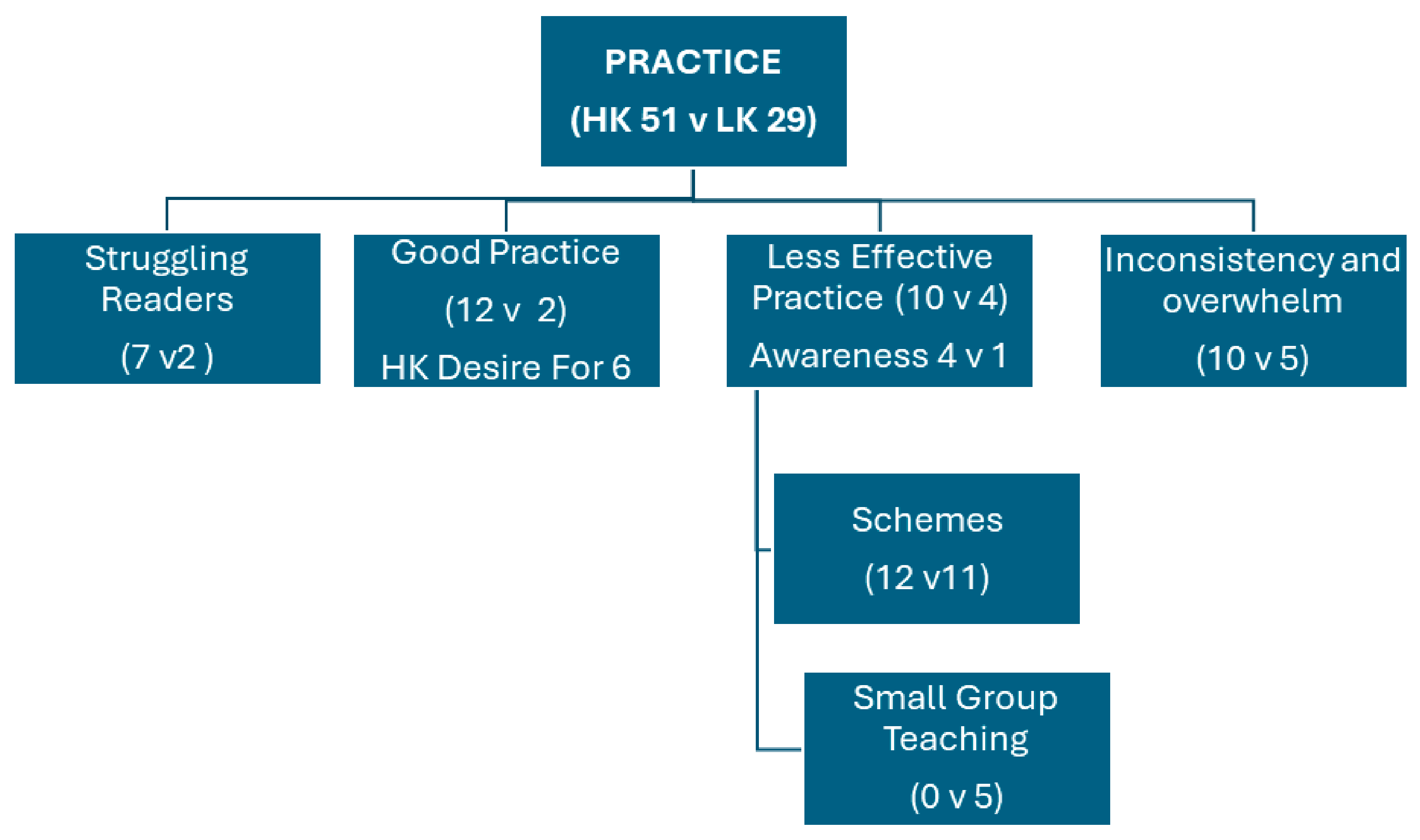
When teachers were asked to share their views on classroom practices, the qualitative data highlighted the significance of the perceived barriers teachers face in effective classroom practice. Teachers were much more focused on the barriers to practice, with 111 meaning units about barriers compared to 80 meaning units on practice itself. Many teachers also voiced their sense of frustration and failure in being unable to teach all the children in their class to read (See Figure 1).
Classroom practices
Qualitative themes identified from the free-text responses were a commitment and desire from teachers to provide effective reading instruction but a sense of failure and overwhelm in not having the knowledge, skills, and training to do so in practice, particularly for those children who are most at risk:
‘I can identify when readers are struggling but do not yet have the right skills and experience to help them so left feeling deflated and like I’m failing.’
(LK 11)
and
‘I left my PGDE [Postgraduate Diploma in Teacher Education] not having a clue about how to teach reading because I wasn’t taught … It was how to teach spelling that set me on my SSP [Systematic Synthetics Phonics] journey since experienced teachers were vague in their answers when I asked them…’
(HK 17)
Inconsistency was a strong theme from the analysis of practice comments. The data demonstrated the lack of availability and implementation of aligned decodable readers to practise phonics skills and that the teachers felt the need for more. In the free-text responses, teachers described using multiple resources simultaneously, including phonics schemes, levelled readers, sight-word lists, and a variety of commercially published reading programmes. The highest number of text units in relation to practice were about the use of commercially produced schemes in the classroom. The variety of schemes used locally and nationally was seen as problematic for effective practice. Teachers reported the following:
‘There are so many different schemes/ways of doing things that it leaves you feeling overwhelmed and disengaged.’
(LK 11)
‘….need to make the teaching of reading the phonological approach the only way to teach reading as it’s based on research. Too many different ways being used, should be uniform …’
(HK 8)
Several participants described outdated methods as best practice or were using mandated schemes which were not evidence-based:
‘I now realise how deficient … (Mandated Local Authority Scheme) is. Decoding is regarded as a deficit (‘X relies on sounding-out’) and you’ll never hear the words encoding or segmenting either, unless you’re having a secret conversation with another closeted SSP believer.’
(LK 3)
Comments like these demonstrate the use of unevidenced resources, training, and schemes in practice and teachers who have been trained or who learned through these in schools and who consider them to be good practice. Furthermore, multiple schemes appeared to be used at times in a patchwork of approaches rather than with a focus on systematic structured phonics:
‘We’ve moved to [Scheme D] in the last few years, and the quality of reading instruction and comprehension has plummeted. We used to use [Scheme A] and [Scheme B], alongside [Scheme C] for teaching sounds. Now we rely on [Scheme D], a programme whose early reading includes no punctuation, no capital letters, no interesting characters, no continuity [Scheme A] is out of date, but children love the characters and stories and developed far better overall reading/ comprehension skills using this.’
(HK17)
The qualitative data also highlighted examples of good practice in classrooms and a clear desire from teachers to improve outcomes for their students:
‘I try to implement a love for reading through choral reading groups, paired with a reading buddy in class (mixed ability—providing feedback to their peers about their expression, fluency).’
(LK 6)
‘Fostering a love of ‘reading’ is part of our daily life in our class. We begin with a morning circle and children are encouraged to take a book to look at and share, we use the school library each week, we have a daily story and discuss.’
(HK 4)
‘My classroom practice for teaching reading and writing is mainly through the phonics based approach of [Scheme E]. Very heavy emphasis on phonics, segmenting and blending. We are play based for large chunks of the day but also have explicit instruction in Literacy every day.’
(HK 23)
Barriers to practice
Inductive coding yielded three barrier themes: (a) societal constraints outside the school, (b) structural and resource pressures inside the system, and (c) limited transfer of research into teacher preparation and professional training in practice. Of the barrier units tagged in the data set, 54% referenced structural issues, 29% societal factors, and 17% knowledge-transfer gaps.
Societal constraints
Teachers frequently pointed to home environments, screen time, and post-pandemic attendance as forces they cannot control:
‘Parents are also less accountable than they were years ago and there is an attitude of learning only being for school. In the not so distant past many children would come to school with some experience of reading with parents regularly and often some sound knowledge and a good vocabulary but this is becoming less so. Many also refuse to read reading books at home as this is seen as a school job. Screen time has certainly impacted this also.’
(HK 35)
Teachers felt changes in society and diversification of learning needs in children impacted their ability to teach effectively:
‘With 24 learners and 11 identified as ASN (additional support needs) I struggle to cater to the needs of those with difficulties in literacy. Attendance is a huge issue in my school.’
(LK 5)
Concerns were raised about the lessening amount of vocabulary that children enter school with, the lower literacy environments at home, and the implications of societal changes on effective classroom practice:
‘Some children come into P1 [the first year of Primary School] without having ever being introduced orally to rhyme, initial sounds etc and some children have. Those who have had a literacy rich experience prior to P1 I find have more words in their vocabulary which helps their comprehension skills and also pick up phonetic awareness initial sounds and rhyme etc much quicker than those without. The gap from day 1 of P1 can be very apparent in some children.’
(LK 18)
Structural and resource pressures
Teachers described curriculum overload, inconsistent guidance, dwindling support staff, and a lack of time and priority for literacy instruction:
‘Reading instruction is incredibly inconsistent across schools and local authorities … there is not a coherent consensus about how we [teach] reading and literacy….’
(HK 20)
‘…The amount of freedom teachers have is sometimes abused and results in a huge discrepancy between the experiences and support in learning children receive.’
(LK 19)
‘There has been a significant reduction in support while at the same time an increase in needs … while we strive to support the inclusion agenda on a shoestring budget.’
(HK 35)
Knowledge-transfer gaps
Many participants felt their initial or ongoing training in practice left them ill-equipped to meet diverse reading needs:
‘Probationers come out of university with very little knowledge of how to teach reading. Teachers are vilified for using traditional methods and are left floundering.’
(HK 21)
‘So many schools are ignoring the benefits of systematic synthetic phonics … I don’t think phonics or any teaching ‘how to read’ is done enough in ITE [Initial Teacher Education] etc.’
(HK 30)
Comments highlighted an over-reliance on schemes and uncertainty around their effectiveness. There were concerns of hidden knowledge/lack of access and self-discovery/self-teaching of new knowledge-enhancing practice, including the positive impact of evidence-based knowledge.

4.1.2. Research Question 2: What Is the Relationship Between Teachers’ Knowledge and Their Pedagogical Practice?

Quantitative Findings on Teacher Knowledge
Teacher knowledge was assessed using the TULIP measure, which was presented as an optional addition to the main survey, and it should be noted that participation was lower than in the main survey (n = 122; Table 7).
To determine whether the subsample of teachers who completed the optional knowledge section was broadly representative of the full sample, we compared distributions across the key demographic variables reported in Table 1. Chi-square and independent t-test analyses indicated no statistically significant differences between the two groups (all p > 0.05) in terms of gender, SIMD quintile of their school, age, years of teaching experience, class size, or participation in professional development related to literacy. This suggests that the subsample is demographically and professionally comparable to the broader participant pool.
The mean total knowledge score was 0.66 (SD = 0.09), indicating an average of 66% accuracy across phonological awareness, phonics (decoding/encoding), oral language, fluency, and reading comprehension.
The effect of knowledge domain was large and significant, F(3.44, 416.07) = 76.48, p < 0.001, partial η2 = 0.39 (Wilks’ Λ = 0.177, p < 0.001). Bonferroni-adjusted pairwise comparisons (all ps < 0.05) confirmed that teachers scored highest in phonological awareness (M = 0.81) and reading comprehension knowledge (M = 0.79); these two domains did not differ from one another. Knowledge of fluency (M = 0.75) was lower than phonological awareness but statistically equivalent to reading comprehension. Oral language structures (M = 0.59) exceeded phonics/decoding knowledge (M = 0.53) but fell below the three highest domains (see Table 7).
Knowledge–Practice Link
To investigate whether literacy knowledge, as measured by the TULIP, moderates instructional practice, teachers were divided into low- and high-knowledge groups using a median split on the full TULIP knowledge test. The sample median was 37. Teachers who scored at or below this value were classified as having low knowledge (n = 69), whereas those who scored above it were classified as having high knowledge (n = 53).
A linear mixed-effects model was fitted with instructional practice (five levels) as the repeated factor and knowledge group (high vs. low literacy knowledge) as the between-teacher factor. Random intercepts were specified for teachers.
A strong main effect of instructional practice emerged, F(4, 325.78) = 93.29, p < 0.001, η2p = 0.534 (Table 8). Teachers with high knowledge reported higher overall frequencies than low-knowledge peers, F(1, 112.93) = 5.76, p = 0.018, η2p = 0.049. A modest but significant practice × knowledge interaction was observed, F(4, 325.78) = 3.09, p = 0.016, η2p = 0.037.
Bonferroni-adjusted EMMs (Table 9) showed that high-knowledge teachers devoted ≈0.47 scale points more to phonics and ≈0.43 more to word structure instruction than low-knowledge teachers (ps ≤ 0.005). Differences for vocabulary, reading comprehension, and whole-word strands were non-significant (ps ≥ 0.342).
The random-intercept variance was 0.132 (SE = 0.033), indicating 13% of unexplained variance lay between teachers. AR(1) residual parameters (σ2 = 0.471; ρ = 0.018) suggested minimal autocorrelation across strands.
Results from the linear mixed-effects model showed that teachers who have greater knowledge about literacy and language, as measured by the TULIP, tend to provide more phonics and word structure instruction compared to other aspects of reading instruction. In contrast, other strands appear similar across groups. This effect accounts for approximately 5% of the variance between teachers and remains consistent regardless of the covariance structure chosen.
Qualitative Analysis of the Knowledge–Practice Gap
Inductive coding of the free-text responses (109 meaning units from the high-knowledge quartile; 82 from the low-knowledge quartile) produced three cross-cutting themes (see Table 10).
Qualitative themes paralleled the quantitative gap: High-knowledge teachers articulated a commitment to systematic phonics and word structure instruction (T1) yet still operated within mixed-method mandates (T2), while low-knowledge teachers most often voiced feelings of inadequacy (T3).
Those teachers with higher literacy knowledge highlighted the damage of lack of early intervention and the need for early increased explicit instruction and practice for at-risk readers:
‘The earlier literacy issues are identified the more chance there is of supporting children … many council policies are wait and see and don’t want to put anything in motion until P4 [the fourth year of Primary School], which in my mind is extremely unhelpful and actually detrimental to the children.’
(HK 31)
‘As a P1 teacher I feel I can identify children who are struggling and have dyslexic tendencies however no support is offered to provide additional input or resources as the children are considered too young. I have mixed feelings about this. The wait and see approach means some children will be left behind.’
(HK 2)
‘No shared understanding of how to teach, nowhere for teachers to go to be told how to do things. Every single person reinventing the wheel!’
(LK 2)
Teachers with more knowledge were more focused on training and knowledge gaps and needs, and the importance of addressing these, and teachers with less knowledge were more focused on societal and structural barriers to effective literacy provision. This highlights how increasing transfer of knowledge can professionally equip teachers in the face of perceived barriers
Along with lack of knowledge transfer and training, commercial schemes and limited resources were reasons for mixing methods:
‘We use readers that are based on sight words; however, personally, I would prefer using decodable texts that increase in difficulty with the more sounds that are taught … For some children, learning phonics and sight words that don’t conform to the rules is too much.’.
(HK 33)
‘Many teachers with responsibility for teaching beginning readers rely on commercially produced schemes as a result of lack of clear knowledge and direction on the teaching of reading that comes from all stakeholders …More use should be made of the research finding on phonemic awareness and phonic instruction for beginning readers. It should not be left to individual schools to seek out this basic of knowledge.’
(LK 23)


5. Discussion

5.1. Summary of Key Findings

This study adds to the literature by offering large-scale empirical evidence that connects teacher knowledge, reported practices, and perceived barriers to early literacy instruction within a UK context, extending findings from earlier work conducted primarily in the USA, Canada, Australia, and New Zealand (Kehoe & McGinty, 2024; Parrila et al., 2023; Stark et al., 2016; Washburn et al., 2016). In doing so, it offers a Scottish perspective to complement recent research from England, which adds to the UK evidence base and highlights the factors shaping the translation of reading research into classroom practice.
The present study aimed to investigate how teachers approach the teaching of reading and literacy, how their knowledge aligns with these practices, and the extent to which these practices reflect current research and the science of reading. Overall, the results suggest noteworthy variability in classroom practice. While many teachers report incorporating evidence-based phonemic awareness and phonics activities, systematic phonics with aligned decodable texts appear only ‘frequently’ for about 70% of respondents, and one teacher in six uses them no more than ‘moderately often.’ Aspects of reported practice which show a misalignment with established research, for example, a reliance on whole-word or mixed-methods approaches, reduces the effectiveness of early literacy instruction (Castles et al., 2018; Ehri et al., 2001; National Reading Panel, 2000). These findings echo international trends of inconsistency observed in the uptake of evidence-based methods (Burnett et al., 2022; OECD, 2022). The optional TULIP test found an average score of 66% for foundational literacy knowledge, with stronger phonological awareness and comprehension knowledge but weaker knowledge about phonics/decoding, spelling, and oral language. This pattern highlights the crucial need for targeted, practical professional development and knowledge transfer (Bos et al., 2001; Parrila et al., 2023).

5.2. Classroom Practice (RQ1)

Teachers reported a broad, yet uneven, blend of early literacy routines. Code-based activities are common, reflecting evidence-based practice: A total of 84% of respondents said they model phoneme awareness ‘frequently’ or ‘very frequently’. However, fewer (70%) teach spelling rules at least frequently, showing that some elements of systematic phonics are less secure. Decodable texts aligned with phonics instruction, central to reinforcing learning and practice of grapheme–phoneme links till mastery are in regular use for only about seven teachers in ten when it would be expected that all teachers will have pupils in their class who still need this. One in six teachers report the use of systematic phonics no more than ‘moderately often.’ The persistence of whole-word or mixed-cue methods in the remaining classrooms recalls earlier UK surveys that described a ‘patchwork’ of instructional approaches (Buckingham et al., 2014; Torgerson et al., 2019). While most teachers now incorporate phonics, for some, their implementation still lacks the structure and consistency called for in systematic phonics (Ehri et al., 2001; Johnston et al., 2012).
Activities that research locates beyond the very initial phases of literacy acquisition are indeed used less frequently by these teachers. Only 38% of teachers teach orthographic conventions at least frequently, and morphology instruction is the lowest word structure activity, with only 34% of teachers engaging their learners in this instructional practice at least frequently.
The themes that emerged from the qualitative analysis indicate that teachers acknowledge evidence-based methods but face a trio of obstacles that hinder implementation. Societal and structural barriers overlap and combine, exacerbating the difficulties. Societal factors lower the literacy capital pupils bring to school; structural constraints restrict time, resources, and staffing; and inconsistent professional training leaves teachers unsure of how to handle competing schemes. These accounts align with previous studies, which report teachers’ perceived constraints, such as a lack of resources or competing curricular demands, which limited the effective adoption of evidence-based programmes (Burnett et al., 2022; Melhuish et al., 2008).
Taken together, RQ1 shows partial alignment with the research consensus: Foundational code work is widely acknowledged, yet its implementation is diluted by mixed schemes and resource gaps. Strengthening routine access to decodable texts, updating school-level guidance, and offering hands-on coaching in systematic phonics integrated with spelling could help translate teachers’ stated intentions into consistently evidence-based practice.

5.3. Knowledge–Practice Link (RQ2)

Collectively, teachers were found to score an average of 66% on the literacy knowledge assessment (TULIP). This result was highly comparable to findings from other English-speaking nations (Australia, Canada, New Zealand, UK (England), and the USA) (Kehoe & McGinty, 2024; Parrila et al., 2023; Stark et al., 2016; Washburn et al., 2011, 2016). The mixed-effects model confirmed that teacher knowledge helps to shape what happens in early reading lessons but only in the code-focused strands. Teachers who scored above the median on the TULIP test devoted about half a scale point more time to phonics (Δ = 0.47, 95% CI [0.19, 0.75]) and to word structure work (Δ = 0.43, 95% CI [0.13, 0.73]) than did lower-knowledge colleagues, whereas vocabulary, comprehension, and whole-word routines showed no knowledge-related gap. This pattern is consistent with previous findings that a stronger command of linguistic concepts predicts greater use of explicit decoding activities (Bos et al., 2001; Parrila et al., 2023). For instance, teachers in our sample with high literacy knowledge reported using explicit multisensory phonemic awareness activities more often and showed a stronger preference for introducing letter–sound correspondences systematically, supporting the notion that ‘knowing what to do’ fosters ‘doing what is effective’ (Piasta et al., 2009).
Qualitative testimony echoes the statistical link. High-knowledge respondents often articulated the research rationale for systematic phonics, one noting, ‘So many schools are ignoring the benefits of systematic synthetic phonics … we need this explicit instruction.’ (HK 31). At the same time, structural barriers, such as mandated mixed schemes or scarce supplies of aligned decodable texts, limited their capacity to act on that knowledge, underscoring that understanding alone cannot guarantee fidelity.
In summary, improved knowledge advances instruction in decoding and encoding, but broader adoption of evidence-based practices also requires systemic supports, such as aligned curricula, sufficient materials, knowledge transfer and ongoing coaching, to turn knowledge into consistently effective classroom routines. Additionally, considering the connections between teacher knowledge and literacy outcomes among pupils (Piasta et al., 2009; Porter et al., 2024), there is a need to explore how to strengthen the links between professional qualifications, specialist knowledge, and professional learning so that teachers can stay current with the latest research.

5.4. Alignment with the Science of Reading

Taken together, the survey and free-text data suggest that classrooms are partly aligned with the cumulative evidence base reported in the academic literature. Phoneme-awareness routines are now very frequent, echoing the international pivot toward code-focused instruction (Castles et al., 2018; Ehri, 2020). Yet, two pillars of a fully systematic approach, regular use of decodable texts aligned with phonics instruction and explicit encoding instruction, remain patchy. For example, decodables reinforce new grapheme–phoneme links and encourage the use of the decoding habit to foster independence in reading (Ehri et al., 2001; McArthur et al., 2018), but one teacher in three still relies chiefly on levelled readers. Spelling instruction shows a similar gap despite evidence that encoding instruction in initial reading strengthens both encoding and decoding and long-term word memory (Chandler et al., 2025; Ehri, 2014; Furnes et al., 2024; Graham & Santangelo, 2014).
Qualitative comments point to persistent structural constraints. Teachers cited legacy ‘whole-language’ schemes, limited budgets for decodable books, and a curriculum that leaves phonics and reading and literacy delivery largely to local discretion. For instance, a significant number of participants expressed frustration over insufficient funding or support to procure decodable materials, mirroring reports from policy analyses that stress the need for sustainable resource allocation (OECD, 2021, 2022).
Furthermore, a considerable subset of teachers continues to balance explicit phonics with older, less systematic materials or to emphasise rote sight-word memorisation. As one respondent bluntly put it, ‘Too many teachers are still unaware of current research findings … More use should be made of the research findings on phonemic awareness and phonic instruction for beginning readers.’ (LK 25). According to the simple view of reading (Gough & Tunmer, 1986), children require both decoding skills and language comprehension to achieve reading comprehension. While best practice continuously fosters oral vocabulary, listening comprehension reading for enjoyment, and critical thinking about text, there is a time-sensitive need for children to learn the foundational skills of decoding and encoding at the outset of literacy instruction (Duncan, 2024; Ehri et al., 2001; Petscher et al., 2020). Thus, sporadic or inconsistent code-based instruction potentially compromises children’s progress in learning to read independently (Petscher et al., 2020; Share, 2004). The variability in practice reported in our findings underscores the need for stronger system-level guidance and resource support. National benchmarks, procurement policies, school leadership messaging, and mandated training all need to signal that systematic phonics, including aligned decodable texts and spelling instruction, are foundations of best practice.

5.5. Professional Development

Designing effective professional development requires more than simply stating that training is necessary; it must be closely tailored to the specific knowledge gaps identified among teachers and applied in a way that resonates with everyday classroom realities. Consequently, best-practice professional development should emphasise practical, hands-on strategies by modelling explicit phonics and spelling instruction, modelling the use of decodable texts and spelling practice, and guiding participants through whole-class teaching strategies, differentiation techniques, and progress monitoring (Stark et al., 2016). Such training must move beyond theoretical presentations to provide explicit demonstrations, opportunities to practise newly acquired methods, and immediate feedback (Law et al., 2025). Equally important is an ongoing support mechanism, as single-session training rarely foster enduring changes in practice; mentorship, peer collaboration, and follow-up coaching are critical for helping teachers embed new strategies into daily instruction (Podhajski et al., 2009). Furthermore, professional development must address the core areas where teachers exhibit knowledge gaps, particularly phonics, decoding and encoding knowledge, and oral language, by offering direct instruction on diagnosing children’s phonemic awareness, phonics skills, mapping phonics content to decodable readers, and integrating encoding with decoding (Puliatte & Ehri, 2018). Teachers worldwide in training and practice have demonstrated a strong desire for this knowledge and skill development (Milne & Topping, 2025; Snow et al., 2024). Evidence on effective in-service delivery suggests that programmes are most impactful when sustained across at least one academic year, combining content-focused workshops (typically delivered by external literacy specialists or university partners) with regular in-school coaching cycles and ring-fenced opportunities for teachers to practise new routines together (Ehri & Flugman, 2018; Moats, 2020). School-based leaders should be supported to develop high levels of literacy content and pedagogical knowledge so that they can take a central role in facilitating transfer of knowledge, providing mechanisms for skill practice, feedback, and development, as well as advancing quality resource provision and implementation fidelity (Lane et al., 2025). To ensure this training gains momentum, school leaders and policymakers should provide clear incentives for evidence-based practices, including allocating budgets for research-aligned teaching materials, ensuring literacy benchmarks highlight systematic phonics, decoding and encoding in early instruction, and establishing cross-school professional learning communities (OECD, 2021). To build sustainability into curriculum development and training procedures, the links between educational practice and current research need to be strengthened.

5.6. Implications, Limitations, and Directions for Future Research

The findings highlight two immediate priorities for policy and practice: (a) clearer national guidance that establishes systematic phonics, aligned decodable texts, and explicit encoding as the standard code-based approach; (b) job-embedded professional development that targets the knowledge gaps identified by the TULIP assessment. Achieving both will require sustained funding for materials, knowledge transfer, and coaching, together with school leadership that is itself supported to keep apace with the evolving pedagogical knowledge base for literacy.
The study also has limitations that outline the next steps for research. Participation was voluntary and conducted online; teachers with a strong interest in early literacy may therefore be over-represented. All classroom practice data were self-reported, so social desirability or recall bias cannot be ruled out. Additionally, our design was cross-sectional: Relationships between teacher knowledge and practice are correlational, not causal. A longitudinal design, or an intervention trial that systematically enhances teachers’ linguistic knowledge, would clarify whether improved knowledge results in measurable improvements in practice and, ultimately, in pupil outcomes (cf. Piasta et al., 2009). Finally, although open-ended responses provided valuable context, richer qualitative techniques, such as lesson observations, think-aloud teaching demonstrations, or repeated semi-structured interviews, would better capture the day-to-day constraints shaping instructional choices. Addressing these methodological gaps will strengthen the evidence base needed to fully align early literacy classrooms with the science of reading. Relatedly, the optional nature of the TULIP knowledge measure may introduce additional selection bias: Teachers who feel more confident in their literacy knowledge may have been more likely to complete it. Although demographic comparison indicated that completers and non-completers did not differ on key measured characteristics, unmeasured confidence or knowledge-related factors cannot be ruled out. A further limitation is that our demographic questionnaire did not collect data on respondents’ highest academic qualification (e.g., bachelor’s, master’s, or doctoral degree) or on the specific type, duration, or provider of any professional development they had completed. These finer-grained variables could help to explain individual differences in teacher knowledge and should be captured in future studies investigating how initial teacher education and continuing professional development interact with classroom literacy practice.

6. Conclusions

This study provides a rare insight into how teachers approach the early reading curriculum. Encouragingly, most respondents have adopted core code-based routines, modelling phoneme awareness and integrating phonics into daily lessons. However, the picture is not entirely positive when fidelity to systematic phonics procedures is examined in more detail. Systematic phonics with aligned decodable texts and integrated spelling instruction, fundamental aspects of the science of reading, are still applied inconsistently, and some classrooms still combine evidence-based elements with traditional whole-word practices. Similarly, less effective vocabulary instruction is mixed with more effective practice. The optional knowledge assessment conducted as part of this study highlights this issue: While teachers are more confident in general literacy concepts, gaps remain in the specific linguistic knowledge (advanced phonics, encoding, oral language) necessary to deliver fully research-aligned instruction.
Closing that gap will require the evident advances in adoption of code-based practices to continue with an emphasis on programme fidelity. Teachers themselves call for consistency, better transfer of the knowledge and skills necessary to teach all children to read with improved curricula, and resources. If policy, materials, and coaching can be aligned around that agenda, children are more likely to receive the consistent, evidence-based start in reading that the research record now makes possible. Although the present findings relate specifically to teaching reading in English within a UK context, the broader implications concerning teacher knowledge and the implementation of evidence-based practice are likely to be relevant to early literacy instruction across alphabetic languages more generally.

Author Contributions

Conceptualization, J.M., J.M.L. and L.G.D.; Methodology, J.M., J.M.L. and L.G.D.; Software, J.M.L. and L.G.D.; Validation, J.M.L., and L.G.D.; Formal Analysis, J.M.L., J.M. and L.G.D.; Investigation, J.M.L., L.G.D. and J.M.; Resources, L.G.D., J.M. and J.M.L.; Data Curation, J.M.L., J.M. and L.G.D.; Writing—Original Draft Preparation, L.G.D., J.M.L. and J.M.; Writing—L.G.D., J.M. and J.M.L. All authors have read and agreed to the published version of the manuscript.

Funding

This research received no external funding.

Institutional Review Board Statement

The study was conducted in accordance with the Declaration of Helsinki, and approved by Ethics Committee of the University of Dundee, reference UoD-SHSL-ED-STAFF-2023-016.

Informed Consent Statement

Informed consent was obtained from all subjects involved in the study.

Data Availability Statement

The data that support the findings of this study are available from the corresponding author upon reasonable request.

Acknowledgments

The authors would like to extend their gratitude to all the teachers who participated in this research survey: their valuable time and contributions made this research possible.

Conflicts of Interest

The authors declare no conflicts of interest.

References

  1. Adams, M. J. (1990). Beginning to read: Thinking and learning about print. MIT Press. [Google Scholar]
  2. Bos, C., Mather, N., Dickson, S., Podhajski, B., & Chard, D. (2001). Perceptions and knowledge of preservice and inservice educators about early reading instruction. Annals of Dyslexia, 51, 97–120. [Google Scholar] [CrossRef]
  3. Bowers, J. S., & Bowers, P. N. (2018). Progress in reading instruction requires a better understanding of the English spelling system. Current Directions in Psychological Science, 27(6), 407–412. [Google Scholar] [CrossRef]
  4. Buckingham, J., Beaman, R., & Wheldall, K. (2014). Why poor children are more likely to become poor readers: The early years. Educational Review, 66(4), 428–446. [Google Scholar] [CrossRef]
  5. Burnett, C., Gillen, J., Guest, I., Maxwell, B., & Thompson, T. (2022). How does research reach teachers? An agenda for investigating research mobilities in primary literacy education. Literacy. John Wiley & Sons, Inc. [Google Scholar] [CrossRef]
  6. Byrne, B., & Fielding-Barnsley, R. (1989). Phonemic awareness and letter knowledge in the child’s acquisition of the alphabetic principle. Journal of Educational Psychology, 81(3), 313–321. [Google Scholar] [CrossRef]
  7. Cabell, S. Q., Justice, L. M., McGinty, A. S., DeCoster, J., & Forston, L. (2015). Teacher–child conversations in preschool classrooms: Contributions to children’s vocabulary development. Early Childhood Research Quarterly, 30, 80–92. [Google Scholar] [CrossRef]
  8. Capin, P., Dahl-Leonard, K., Hall, C., Yoon, N. Y., Cho, E., Chatzoglou, E., Reiley, S., Walker, M., Shanahan, E., Andress, T., & Vaughn, S. (2025). Reading comprehension instruction: Evaluating our progress since Durkin’s seminal study. Scientific Studies of Reading, 29(1), 85–114. [Google Scholar] [CrossRef]
  9. Carroll, J. M., Snowling, M. J., Stevenson, J., & Hulme, C. (2003). The development of phonological awareness in preschool children. Developmental Psychology, 39(5), 913–923. [Google Scholar] [CrossRef]
  10. Castles, A., Rastle, K., & Nation, K. (2018). Ending the reading wars: Reading acquisition from novice to expert. Psychological Science in the Public Interest, 19, 5–51. [Google Scholar] [CrossRef] [PubMed]
  11. Chall, J. (1967). Learning to read: The great debate. McGraw Hill. [Google Scholar]
  12. Chandler, B. W., Toste, J. R., Novelli, C., Rodgers, D. B., & Hardeman, E. (2025). A meta-analytic review of spelling interventions for students with or at-risk for learning disabilities. Journal of Learning Disabilities, 1–28. [Google Scholar] [CrossRef]
  13. Conrad, N. J., Kennedy, K., Saoud, W., Scallion, L., & Hanusiak, L. (2019). Establishing word representations through reading and spelling: Comparing degree of orthographic learning. Journal of Research in Reading, 42(1), 162–177. [Google Scholar] [CrossRef]
  14. Côté, J., Salmela, J. H., Baria, A., & Russell, S. J. (1993). Organizing and interpreting unstructured qualitative data. The Sport Psychologist, 7(2), 127–137. [Google Scholar] [CrossRef]
  15. Creswell, J. W., & Plano Clark, V. L. (2017). Designing and conducting mixed methods research (3rd ed.). SAGE Publications. [Google Scholar]
  16. Dickinson, D. K., & Porche, M. V. (2011). Relation between language experiences in preschool classrooms and children’s kindergarten and fourth-grade language and reading abilities. Child Development, 82, 870–886. [Google Scholar] [CrossRef] [PubMed]
  17. Dilgard, C., Hodges, T. S., & Coleman, J. (2022). Phonics instruction in early literacy: Examining professional learning, instructional resources, and intervention intensity. Reading Psychology, 43(8), 541–575. [Google Scholar] [CrossRef]
  18. Duncan, L. G. (2024, September 19–27). The bigger picture—What does current literacy research tell us and where are we going? Invited Talk for Exploration Around Curriculum Core Competencies: Literacy Event, Education Scotland, Glasgow, UK. [Google Scholar]
  19. Duncan, L. G., Castro, S. L., Defior, S., Seymour, P. H. K., Baillie, S., Genard, N., Leybaert, J., Sarris, M., Porpodas, C. D., Lund, R., Sigurðsson, B., Þráinsdóttir, A. S., Sucena, A., & Serrano, F. (2013). Phonological development, native language and literacy: Variations on a theme in six European languages. Cognition, 127(3), 398–419. [Google Scholar] [CrossRef] [PubMed][Green Version]
  20. Edovald, T., & Nevill, C. (2021). Working out what works: The case of the Education Endowment Foundation in England. ECNU Review of Education, 4(1), 46–64. [Google Scholar] [CrossRef]
  21. Ehri, L. C. (2000). Learning to read and learning to spell: Two sides of a coin. Topics in Language Disorders, 20(3), 19–36. [Google Scholar] [CrossRef]
  22. Ehri, L. C. (2014). Orthographic mapping in the acquisition of sight word reading, spelling memory, and vocabulary learning. Scientific Studies of Reading, 18(1), 5–21. [Google Scholar] [CrossRef]
  23. Ehri, L. C. (2020). The science of learning to read words: A case for systematic phonics instruction. Reading Research Quarterly, 55(S1), S45–S60. [Google Scholar] [CrossRef]
  24. Ehri, L. C., & Flugman, B. (2018). Mentoring teachers in systematic phonics instruction: Effectiveness of an intensive year-long program for kindergarten through 3rd grade teachers and their students. Reading and Writing: An Interdisciplinary Journal, 31(2), 425–456. [Google Scholar] [CrossRef]
  25. Ehri, L. C., Nunes, S. R., Stahl, S. A., & Willows, D. M. (2001). Systematic phonics instruction helps students learn to read: Evidence from the National Reading Panel’s meta-analysis. Review of Educational Research, 71(3), 393–447. [Google Scholar] [CrossRef]
  26. Flack, Z. M., Field, A. P., & Horst, J. S. (2018). The effects of shared storybook reading on word learning: A meta-analysis. Developmental Psychology, 54(7), 1334–1346. [Google Scholar] [CrossRef]
  27. Furnes, B., Elwér, Å., Samuelsson, S., Treiman, R., & Olson, R. K. (2024). The stability and developmental interplay of word reading and spelling: A cross-linguistic longitudinal study from kindergarten to grade 4. Reading and Writing, 37, 2411–2428. [Google Scholar] [CrossRef]
  28. Furnes, B., & Samuelsson, S. (2010). Predicting reading and spelling difficulties in transparent and opaque orthographies: A comparison between Scandinavian and US/Australian children. Dyslexia, 16, 119–142. [Google Scholar] [CrossRef]
  29. Galuschka, K., Görgen, R., Kalmar, J., Haberstroh, S., Schmalz, X., & Schulte-Körne, G. (2020). Effectiveness of spelling interventions for learners with dyslexia: A meta-analysis and systematic review. Educational Psychologist, 55(1), 1–20. [Google Scholar] [CrossRef]
  30. Goodman, K. S. (1967). Reading: A psycholinguistic guessing game. Journal of the Reading Specialist, 6(4), 126–135. [Google Scholar] [CrossRef]
  31. Gough, P. B., & Tunmer, W. E. (1986). Decoding, reading, and reading disability. RASE: Remedial & Special Education, 7(1), 6–10. [Google Scholar] [CrossRef]
  32. Graham, S., & Santangelo, T. (2014). Does spelling instruction make students better spellers, readers, and writers? A meta-analytic review. Reading and Writing, 27, 1703–1743. [Google Scholar] [CrossRef]
  33. Hall, C., Solari, E. J., Hayes, L., Dahl-Leonard, K., DeCoster, J., Kehoe, K. F., Conner, C. L., Henry, A. R., Demchak, A., Richmond, C. L., & Vargas, I. (2024). Validation of an instrument for assessing elementary-grade educators’ knowledge to teach reading. Reading and Writing, 37, 1955–1974. [Google Scholar] [CrossRef]
  34. Harris, K. R., Graham, S., Aitken, A. A., Barkel, A., Houston, J., & Ray, A. (2017). Teaching spelling, writing, and reading for writing: Powerful evidence-based practices. TEACHING Exceptional Children, 49(4), 262–272. [Google Scholar] [CrossRef]
  35. Henbest, V. S., & Apel, K. (2017). Effective word reading instruction: What does the evidence tell us? Communication Disorders Quarterly, 39(1), 303–311. [Google Scholar] [CrossRef]
  36. Hood, M., Conlon, E., & Andrews, G. (2008). Preschool home literacy practices and children’s literacy development: A longitudinal analysis. Journal of Educational Psychology, 100(2), 252–271. [Google Scholar] [CrossRef]
  37. Hoover, W. A., & Tunmer, W. E. (2018). The simple view of reading: Three assessments of its adequacy. Remedial and Special Education, 39(5), 304–312. [Google Scholar] [CrossRef]
  38. Hoyne, C., & Egan, S. M. (2022). ABCs and 123s: A large birth cohort study examining the role of the home learning environment in early cognitive development. Journal of Experimental Child Psychology, 221, 105424. [Google Scholar] [CrossRef]
  39. Hudson, A. K., Moore, K. A., Han, B., Wee Koh, P., Binks-Cantrell, E., & Malatesha Joshi, R. (2021). Elementary teachers’ knowledge of foundational literacy skills: A critical piece of the puzzle in the Science of Reading. Reading Research Quarterly, 56(S1), S287–S315. [Google Scholar] [CrossRef]
  40. Hulme, C., Bowyer-Crane, C., Carroll, J. M., Duff, F. J., & Snowling, M. J. (2012). The causal role of phoneme awareness and letter-sound knowledge in learning to read: Combining intervention studies with mediation analyses. Psychological Science, 23, 572. [Google Scholar] [CrossRef] [PubMed]
  41. Inoue, T., Georgiou, G. K., Parrila, R., & Kirby, J. R. (2018). Examining an extended Home Literacy model: The mediating roles of emergent literacy skills and reading fluency. Scientific Studies of Reading, 22(4), 273–288. [Google Scholar] [CrossRef]
  42. Johnston, R. S., McGeown, S., & Watson, J. E. (2012). Long-term effects of synthetic versus analytic phonics teaching on the reading and spelling ability of 10 year old boys and girls. Reading and Writing, 25, 1365–1384. [Google Scholar] [CrossRef]
  43. Johnston, R. S., & Watson, J. E. (2004). Accelerating the development of reading, spelling and phonemic awareness skills in initial readers. Reading and Writing: An Interdisciplinary Journal, 17(4), 327–357. [Google Scholar] [CrossRef]
  44. Kamil, M. L., Borman, G. D., Dole, J., Kral, C. C., Salinger, T., & Torgesen, J. (2008). Improving adolescent literacy: Effective classroom and intervention practices: A practice guide (NCEE 2008-4027). National Center for Education Evaluation and Regional Assistance, Institute of Education Sciences, U.S. Department of Education. [Google Scholar]
  45. Kehoe, K. F., & McGinty, A. S. (2024). Exploring teachers’ reading knowledge, beliefs and instructional practice. Journal of Research in Reading, 47(1), 63–82. [Google Scholar] [CrossRef]
  46. Kim, Y. (2020). Interactive dynamic literacy model: An integrative theoretical framework for reading-writing relations. In Reading-writing connections: Towards integrative literacy science (pp. 11–34). Springer. [Google Scholar] [CrossRef]
  47. Kim, Y., Petscher, Y., Wanzek, J., & Al Otaiba, S. (2018). Relations between reading and writing: A longitudinal examination from grades 3 to 6. Reading and Writing, 31, 1591–1618. [Google Scholar] [CrossRef]
  48. Lally, P. S. (2007). Identity and athletic retirement: A prospective study. Psychology of Sport and Exercise, 8, 85–99. [Google Scholar] [CrossRef]
  49. Lane, H. B., Contesse, V. A., Gage, N. A., & Burns, M. K. (2025). Effect of an Instructional program in foundational reading skills on early literacy development of students in kindergarten and first grade. Reading Research Quarterly, 60, e607. [Google Scholar] [CrossRef]
  50. Law, J., Boese, K., Roy, S., Boese, A. S., & Scholes, S. (2025). Empowering future literacy instructors: The role of mastery experiences in pre-service teachers’ literacy knowledge and self-efficacy. Journal of Early Childhood Teacher Education. Early Online Publication. [Google Scholar] [CrossRef]
  51. Lervåg, A., Hulme, C., & Melby-Lervåg, M. (2017). Unpicking the developmental relationship between oral language skills and reading comprehension: It’s simple, but complex. Child Development. [Google Scholar] [CrossRef]
  52. Li, U., & Wang, M. (2023). A systematic review of orthographic learning via self-teaching. Educational Psychologist, 58(1), 35–56. [Google Scholar] [CrossRef]
  53. McArthur, G., Sheehan, Y., Badcock, N. A., Francis, D. A., Wang, H. C., Kohnen, S., & Castles, A. (2018). Phonics training for English-speaking poor readers. Cochrane Database of Systematic Reviews, 11(11), CD009115. [Google Scholar] [CrossRef]
  54. Melby-Lervåg, M., Lyster, S. A., & Hulme, C. (2012). Phonological skills and their role in learning to read: A meta-analytic review. Psychological Bulletin, 138(2), 322–352. [Google Scholar] [CrossRef]
  55. Melhuish, E. C., Phan, M. B., Sylva, K., Sammons, P., Siraj-Blatchford, I., & Taggart, B. (2008). Effects of the home learning environment and preschool center experience upon literacy and numeracy development in early primary school. Journal of Social Issues, 64, 95–114. [Google Scholar] [CrossRef]
  56. Milne, J., & Topping, K. J. (2025). Improving student teacher preparedness in reading instruction. Education Sciences, 15(1), 97. [Google Scholar] [CrossRef]
  57. Moats, L. C. (2020). Teaching reading is rocket science: What expert teachers of reading should know and be able to do. American Federation of Teachers. [Google Scholar]
  58. Mol, S. E., & Bus, A. G. (2011). To read or not to read: A meta-analysis of print exposure from infancy to early adulthood. Psychological Bulletin, 137(2), 267–296. [Google Scholar] [CrossRef] [PubMed]
  59. Murphy Odo, D. (2024). The use of decodable texts in the teaching of reading in children without reading disabilities: A meta-analysis. Literacy, 58, 267–277. [Google Scholar] [CrossRef]
  60. National Reading Panel. (2000). National institute of child health & development. National Reading Panel. Available online: https://cochranelibrary.com/cdsr/doi/10.1002/14651858.CD009115.pub3/pdf/full (accessed on 10 February 2026).
  61. OECD. (2021). Scotland’s curriculum for excellence: Into the future, implementing education policies. OECD Publishing. [Google Scholar] [CrossRef]
  62. OECD. (2022). Who cares about using education research in policy and practice?: Strengthening research engagement, educational research and innovation. OECD Publishing. [Google Scholar] [CrossRef]
  63. Parrila, R., Inoue, T., Dunn, K., Savage, R., & Georgiou, G. (2023). Connecting teachers’ language knowledge, perceived ability and instructional practices to Grade 1 students’ literacy outcomes. Reading & Writing, 37, 1153–1181. [Google Scholar] [CrossRef]
  64. Patton, M. Q. (2002). Qualitative research and evaluation methods (3rd ed.). Sage. [Google Scholar]
  65. Perfetti, C., & Hart, L. (2002). The lexical quality hypothesis. In L. Vehoeven, C. Elbro, & P. Reitsma (Eds.), Precursors of functional literacy (pp. 189–213). John Benjamins. [Google Scholar]
  66. Petscher, Y., Cabell, S. Q., Catts, H. W., Compton, D. L., Foorman, B. R., Hart, S. A., Lonigan, C. J., Phillips, B. M., Schatschneider, C., Steacy, L. M., Terry, N. P., & Wagner, R. K. (2020). How the science of reading informs 21st-century education. Reading Research Quarterly, 55(S1), S267–S282. [Google Scholar] [CrossRef]
  67. Piasta, S. B., Connor, C. M., Fishman, B. J., & Morrison, F. J. (2009). Teachers’ knowledge of literacy concepts, classroom practices, and student reading growth. Scientific Studies of Reading, 13, 224–248. [Google Scholar] [CrossRef]
  68. Podhajski, B., Mather, N., Nathan, J., & Sammons, J. (2009). Professional development in scientifically based reading instruction: Teacher knowledge and reading outcomes. Journal of Learning Disabilities, 42(5), 403–417. [Google Scholar] [CrossRef] [PubMed]
  69. Porter, S. B., Odegard, T. N., Farris, E. A., & Oslund, E. L. (2024). Effects of teacher knowledge of early reading on students’ gains in reading foundational skills and comprehension. Reading and Writing, 37, 2007–2023. [Google Scholar] [CrossRef]
  70. Puliatte, A., & Ehri, L. C. (2018). Do 2nd and 3rd grade teachers’ linguistic knowledge and instructional practices predict spelling gains in weaker spellers? Reading and Writing, 31, 239–266. [Google Scholar] [CrossRef]
  71. Rastle, K., Lally, C., Davis, M. H., & Taylor, J. S. H. (2021). The dramatic impact of explicit instruction on learning to read in a new writing system. Psychological Science, 32(4), 471–484. [Google Scholar] [CrossRef]
  72. Rose, J. (2006). Independent review of the teaching of early reading final report. U.K. Department for Education and Skills. Available online: http://dera.ioe.ac.uk/5551/2/report.pdf (accessed on 3 September 2025).
  73. Scanlan, T. K., Stein, G. L., & Ravizza, K. (1989). An in-depth study of former elite figure skaters: II. Sources of enjoyment. Journal of Sport & Exercise Psychology, 11(1), 65–83. [Google Scholar] [CrossRef]
  74. Scanlan, T. K., Stein, G. L., & Ravizza, K. (1991). An in-depth study of former elite figure skaters: III. Sources of stress. Journal of Sport & Exercise Psychology, 13(2), 103–120. [Google Scholar] [CrossRef]
  75. Schlicht-Schmälzle, R., Hill, J., Folkvord, K. A., Tharaldsen, K. B., Wargo, J., Hartmann, U., & Révai, N. (2024). Bridging the research-practice gap in education: Initiatives from 3 OECD countries. In OECD education working papers (No. 319). OECD Publishing. [Google Scholar] [CrossRef]
  76. Scottish Government. (2020). Scottish index of multiple deprivation (2020). Available online: https://www.gov.scot/collections/scottish-index-of-multiple-deprivation-2020/ (accessed on 4 August 2025).
  77. Scottish Government. (2024). Summary statistics for schools in Scotland: 2024 edition. Available online: https://www.gov.scot/publications/summary-statistics-for-schools-in-scotland-2024/ (accessed on 10 February 2026).
  78. Sénéchal, M., Whissell, J., & Bildfell, A. (2017). Starting from home: Home literacy practices that make a difference. In K. Cain, D. Compton, & R. Parrila (Eds.), Theories of reading development (pp. 383–408). John Benjamins. [Google Scholar]
  79. Shanahan, T., Callison, K., Carriere, C., Duke, N. K., Pearson, P. D., Schatschneider, C., & Torgesen, J. (2010). Improving reading comprehension in kindergarten through 3rd grade: A practice guide (NCEE 2010-4038). National Center for Education Evaluation and Regional Assistance, Institute of Education Sciences, U.S. Department of Education. [Google Scholar]
  80. Share, D. L. (2004). Orthographic learning at a glance: On the time course and developmental onset of self-teaching. Journal of Experimental Child Psychology, 87, 267–298. [Google Scholar] [CrossRef] [PubMed]
  81. Snow, P., Serry, T., Charles, E., & Barbousas, J. (2024). Build it and they will come: Responses to the provision of online science of language and reading professional learning. Australian Journal of Learning Difficulties, 29(2), 135–150. [Google Scholar] [CrossRef]
  82. Snowling, M. J., Hulme, C., & Nation, K. (Eds.). (2022). The science of reading: A handbook (2nd ed.). Wiley Blackwell. [Google Scholar] [CrossRef]
  83. Stark, H. L., Snow, P. C., Eadie, P. A., & Goldfeld, S. R. (2016). Language and reading instruction in early years’ classrooms: The knowledge and self-rated ability of Australian teachers. Annals of Dyslexia, 66, 228–254. [Google Scholar] [CrossRef]
  84. Torgerson, C., Brooks, G., Gascoine, L., & Higgins, S. (2019). Phonics: Reading policy and the evidence of effectiveness from a systematic ‘tertiary’ review. Research Papers in Education, 34(2), 208–238. [Google Scholar] [CrossRef]
  85. Torppa, M., Vasalampi, K., Eklund, K., & Niemi, P. (2022). Long-term effects of the home literacy environment on reading development: Familial risk for dyslexia as a moderator. Journal of Experimental Child Psychology, 215, 105314. [Google Scholar] [CrossRef]
  86. Van Steensel, R. (2006). Relations between socio-cultural factors, the home literacy environment and children’s literacy development in the first years of primary education. Journal of Research in Reading, 29, 367–382. [Google Scholar] [CrossRef]
  87. Vaughn, S., Gersten, R., Dimino, J., Taylor, M. J., Newman-Gonchar, R., Krowka, S., Kieffer, M. J., McKeown, M., Reed, D., Sanchez, M., St. Martin, K., Wexler, J., Morgan, S., Yañez, A., & Jayanthi, M. (2022). Providing reading interventions for students in grades 4–9 (WWC 2022007). Available online: https://whatworks.ed.gov/ (accessed on 10 February 2026).
  88. Washburn, E. K., Binks-Cantrell, E. S., Joshi, M. R., Martin-Chang, S., & Arrow, A. (2016). Preservice teacher knowledge of basic language constructs in Canada, England, New Zealand, and the USA. Annals of Dyslexia, 66, 7–26. [Google Scholar] [CrossRef] [PubMed]
  89. Washburn, E. K., Joshi, R. M., & Cantrell, E. B. (2011). Are preservice teachers prepared to teach struggling readers? Annals of Dyslexia, 61, 21–43. [Google Scholar] [CrossRef]
Figure 1. Classroom practice themes. HK = higher-knowledge teacher; LK = lower-knowledge teacher.
Education 16 00843 g001
Table 1. Demographic characteristics of lower primary teachers (P1–P3).
CategoryFrequency (n)Percentage (%)
Gender
Male91.8
Female49096.6
Non-binary/third gender61.2
Prefer to self-describe10.2
Age
21–29 years7615.0
30–39 years9118.0
40–49 years9118.0
50–59 years6112.0
60–66 years184.0
Mean age years (SD)40.35 (10.35)
Council Area
Glasgow City499.7
Aberdeenshire428.3
Edinburgh City265.1
All other regions39076.9
Teaching Experience
0–4 years7715.2
5–9 years8016.0
10–14 years11222.0
15–19 years7114.0
20–24 years418.0
25+ years12424.0
Mean years (SD)13.8 (9.7)
Class Size
Mean number of students (SD)23.6 (4.6)
Professional Development
Yes45389.9
No418.1
Unsure102.0
Scottish Index of Multiple Deprivation (SIMD)
SIMD 1 (most deprived)10327.2
SIMD 28622.7
SIMD 38923.5
SIMD 44411.6
SIMD 5 (least deprived)5715.0
Table 2. Percentage and differences in Primary 1–3 teachers’ responses to items related to phonics instruction.
ItemPractice (Abbreviated)RarelyOccas.Mod. OftenFreq.Very Freq.MSDSig. Difference
Phonics_indexComposite of Q34, Q35, Q36, Q460.23.013.136.647.04.30.82
Q34Model phoneme awareness0.93.3 5.8 30.959.14.50.79>Q35, Q36, Q46
Q35Students manipulate phonemes1.85.6 9.0 27.656.14.30.98>Q36, Q46; <Q34
Q36Explicit multisensory phoneme awareness2.910.5 15.033.338.34.01.08>Q46; <Q34, Q35
Q46Select decodable texts6.88.8 14.133.436.83.91.21<Q34, Q35
Note: Likert scale responses reported as percentages. Likert scale coded 1 = rarely … 5 = very frequently; higher means indicate more frequent use. ‘>’ indicates significantly higher mean than comparison item (p < 0.05, Bonferroni-adjusted).
Table 3. Percentage of Primary 1–3 teachers’ responses to items related to whole-word instruction.
ItemPractice (Abbreviated)RarelyOccas.Mod. OftenFreq.Very Freq.MSDSig. Difference
Whole-word indexComposite of Q39 and Q402.2 17.070.210.10.53.00.61
Q39Introduce sight words in context2.66.017.535.938.04.01.02>Q40
Q40Explicitly teach sight words as wholes13.312.416.632.525.23.41.35<Q39
Note: Likert scale responses reported as percentages. Likert scale coded 1 = rarely … 5 = very frequently; higher means indicate more frequent use 0. ‘>’ indicates significantly higher mean than comparison item (p < 0.05, Bonferroni-adjusted).
Table 4. Percentage of Primary 1–3 teachers’ responses to items related to word structure instruction.
ItemPractice (Abbreviated)RarelyOccas.Mod. OftenFreq.Very Freq.MSDSig. Difference
Structure_indexComposite of Q49, Q50, Q512.919.536.130.011.53.31.00-
Q49Teach orthographic conventions17.920.524.0 24.013.63.01.30=Q50; <Q59
Q50Teach morphology15.724.026.221.312.72.91.25=Q49; <Q59
Q59Teach spelling rules/patterns4.77.117.936.833.43.91.07>Q49, Q50
Note: Likert scale responses reported as percentages. Likert scale coded 1 = rarely … 5 = very frequently; higher means indicate more frequent use 0. ‘>’ indicates significantly higher mean than comparison item (p < 0.05, Bonferroni-adjusted).
Table 5. Percentage of Primary 1–3 teachers’ responses to items related to vocabulary instruction.
ItemPractice (Abbreviated)RarelyOccas.Mod. OftenFreq.Very Freq.MSDSig. Difference
Vocabulary_IndexComposite of Q64, Q65, Q6600.618.661.219.64.00.64-
Q64Examples and non-examples3.2 9.716.839.231.03.81.08<Q65, >Q66
Q65Use new words in context0.35.217.444.532.64.10.85>Q64, Q66
Q66Memorise definitions 49.027.213.98.71.21.91.03<Q64, Q65
Note: Likert scale responses reported as percentages. Likert scale coded 1 = rarely … 5 = very frequently; higher means indicate more frequent use. ‘>’ indicates significantly higher mean than comparison item (p < 0.05, Bonferroni-adjusted).
Table 6. Percentage of Primary 1–3 teachers’ responses to items related to reading comprehension instruction.
ItemPractice (Abbreviated)RarelyOccas.Mod. OftenFreq.Very Freq.MSDSig. Difference
Comprehension_IndexComposite of Q70, Q71, Q72, Q731.314.428.943.312.13.50.93-
Q70Comprehension monitoring5.317.027.935.913.93.41.09<Q71; >Q72; =Q73
Q71Find main idea5.811.424.340.018.53.61.11>Q70, Q72; =Q73
Q72Question generation7.918.733.228.511.73.21.12<Q70, Q71, Q73
Q73Summarising7.517.221.436.717.23.41.17>Q72; =Q70, Q71
Note: Likert scale responses reported as percentages. Higher means indicate more frequent use. ‘>’ (or ‘<’) denotes that the row mean is significantly higher (or lower) than the comparison item at p < 0.05 (Bonferroni-adjusted); ‘=’ denotes no significant difference.
Table 7. Descriptive statistics for the knowledge of teachers responsible for the first three years of literacy instruction (Primary 1–3) based on TULIP assessment.
DomainMSD95% CIPairwise Grouping 1
Phonological awareness0.810.13[0.79, 0.83]a
Reading comprehension processes0.790.21[0.75, 0.82]a b
Fluency0.750.22[0.71, 0.79]b
Oral language structures0.590.170[0.56, 0.62]c
Phonics/decoding and encoding0.530.120[0.51, 0.55]d
1 Means that share no superscript differ at p < 0.05 (Bonferroni-adjusted). Thus, teachers’ knowledge was strongest in phonological awareness and reading comprehension constructs, moderate for fluency, and weakest for phonics/decoding.
Table 8. Linear mixed model to investigate the effects of knowledge group and instructional strand: Type-III tests and effect sizes.
EffectDfnumdfdenFpη2p
Instructional practice4325.7893.29<0.0010.534
Knowledge group1112.935.760.0180.049
Practice × knowledge4325.783.090.0160.037
Table 9. Estimated marginal means by knowledge group and instructional strand.
StrandLow M (95% CI)High M (95% CI)Sig
Phonics3.99 (3.79–4.19)4.46 (4.26–4.66)0.001 *
Word-Structure3.13 (2.91–3.35)3.56 (3.34–3.78)0.005 *
Reading Comp.3.29 (3.08–3.50)3.43 (3.22–3.64)0.342
Vocabulary4.04 (3.83–4.24)4.11 (3.90–4.32)0.600
Whole-Word2.72 (2.52–2.92)2.67 (2.47–2.87)0.714
Note: * significant values indicate 95% CIs that exclude zero (Bonferroni-adjusted).
Table 10. Themes explaining the knowledge–practice gap.
Theme (Code)SummaryIllustrative Verbatim Quote
T1. Valuing explicit phonics (more common in high-knowledge teachers)High-knowledge teachers prioritise daily, systematic phonics and word structure instruction.‘My classroom practice for teaching reading and writing is mainly through the phonics-based approach of [Scheme E]. Very heavy emphasis on phonics, segmenting and blending. We are play-based for large chunks of the day but also have explicit instruction in Literacy every day.’ (HK 23)
T2. Mixed methods persist (both knowledge groups)Even advocates of systematic synthetic phonics report being required to mix levelled readers or 3-cueing with decodables. ‘We use readers that are based on sight words, however personally I would prefer using decodable texts that increase in difficulty with the more sounds that are taught … For some children learning phonics and sight words that don’t conform to the rules is too much, especially if they are struggling to retain the sounds.’ (HK 33)
T3. Feeling under-prepared (stronger in low-knowledge teachers)Teachers who lack content knowledge describe frustration at not knowing how to help strugglers. ‘I can identify when readers are struggling but do not yet have the right skills and experience to help them, so [I am] left feeling deflated and like I’m failing.’ (LK 11)
Disclaimer/Publisher’s Note: The statements, opinions and data contained in all publications are solely those of the individual author(s) and contributor(s) and not of MDPI and/or the editor(s). MDPI and/or the editor(s) disclaim responsibility for any injury to people or property resulting from any ideas, methods, instructions or products referred to in the content.