Systematic Review

Can Generative AI Feedback Effectively Enhance Learning Outcomes? A Meta-Analysis of 36 Experimental and Quasi-Experimental Studies


1
Faculty of Education, Shaanxi Normal University, Xi’an 710062, China
2
School of Culture and Education, Shaanxi University of Science and Technology, Xi’an 710062, China
3
School of Digital Media, Shenzhen Polytechnic University, Shenzhen 518055, China
*
Author to whom correspondence should be addressed.
Educ. Sci. 2026, 16(6), 816; https://doi.org/10.3390/educsci16060816
Submission received: 15 February 2026 / Revised: 14 March 2026 / Accepted: 23 March 2026 / Published: 22 May 2026

Abstract

Although generative artificial intelligence (GenAI) feedback shows promise for educational applications, its actual impact on learning outcomes and the factors influencing its effectiveness remain unclear. This study conducted a systematic review and meta-analysis to evaluate the effectiveness of GenAI feedback and identify key moderating factors. Following the PRISMA 2020 guidelines, we reviewed 36 experimental and quasi-experimental studies published between 2023 and 2025, yielding 72 effect sizes. The results revealed that GenAI feedback had a moderate positive effect on academic achievement (g = 0.61), with significant moderation by contextual factors. Subgroup analysis revealed that teaching methods significantly moderated the effectiveness of GenAI feedback, with stronger effects observed in learner-centered environments promoting active construction than in teacher-centered, receptive instruction; whereas educational level, disciplines, intervention duration, and GenAI role showed no significant moderation. A three-level random-effects model was employed to account for effect size dependencies, correcting for the underestimation of standard errors typical of conventional two-level models. Outcome dimension analysis showed that GenAI feedback had the strongest impact on cognitive outcomes, with promising but less established benefits for metacognitive development, and modest effects on non-cognitive outcomes. Future research should further clarify the roles of metacognitive and non-cognitive outcomes in GenAI feedback. In practice, GenAI feedback should serve as complementary scaffolding within constructivist pedagogies to support metacognitive development, while teacher emotional support should be preserved to foster students’ non-cognitive development.

1. Introduction

Feedback constitutes a core mechanism of effective learning, helping learners close the gap between current performance and desired goals by providing actionable information for improvement (Hattie & Timperley, 2007). Quality feedback interactions not only enhance learning outcomes but also provide teachers with insights into students’ learning processes. This enables more precise identification of instructional challenges, the adjustment of teaching behaviors, and optimization of pedagogical designs to improve teaching efficiency. However, in authentic educational settings such as large-scale enrollment courses or online learning environments, teachers often struggle to provide high-frequency, timely, and personalized feedback to individual learners. This has long posed persistent constraints on the capacity of feedback that can be provided. GenAI feedback, with its distinctive advantages of efficiency, immediacy, and personalization, has been widely adopted in digital learning contexts. For instance, ChatGPT can assist teachers in providing written feedback, reducing workload while offering instant personalized responses (J. Han & Li, 2024). Although GenAI feedback shows significant potential for alleviating teacher workload and enabling large-scale instruction, its actual impact on learning outcomes remains contested. Some studies suggest that GenAI feedback produces positive effects, enhancing learners’ academic performance (W. Hu et al., 2025).
However, some research indicates that GenAI feedback may have potential negative consequences, including diminished deep thinking due to effortless answer acquisition, cognitive offloading, weakened critical thinking, and even concerns regarding academic integrity. Given that effective feedback is moderated by multiple contextual factors, including disciplines, educational level, learner characteristics, feedback type, and timing, this study employed meta-analysis to systematically examine the overall impact of GenAI feedback on learning outcomes and reveal the mechanisms of key moderating variables. The findings will provide empirical evidence and practical guidance for educators on optimizing instructional design, enhancing students’ metacognitive awareness, and analyzing various feedback characteristics.

2. Literature Review

2.1. Educational Applications and Effects of GenAI Feedback

GenAI feedback enhances academic achievement through immediate and personalized responses. Compared with traditional teacher feedback, GenAI tools such as ChatGPT can provide immediate feedback aligned with learners’ cognitive levels. Alshammari (2025) reported that ChatGPT-enhanced Adaptive E-learning Systems achieved better learning outcomes and higher learning satisfaction. When employed as an interactive language tool, GenAI provides learners with real-time targeted feedback and personalized AI-generated exercises aligned with learning progress, yielding significant improvements in productive vocabulary knowledge and overall test performance. P. Wang et al. (2025) demonstrated that generative artificial intelligence tools enhance self-regulated learning by facilitating task planning, promoting adaptive strategy use, and deepening metacognitive reflection. The large language model-assisted alternate reality game system significantly improved students’ academic achievement and metacognitive awareness compared to conventional alternate reality game approaches. Its large language mode-driven scaffolding supported diverse learning strategies and promoted adaptive learning in STEM education (M. Wang et al., 2025). Ng et al. (2024) developed a generative AI-based self-regulated learning chatbot that significantly enhanced students’ science knowledge, engagement, and motivation, with interaction frequency predicting self-regulated learning development. In specific disciplines and task types, GenAI feedback demonstrates notable performance gains. In EFL writing instruction, using ChatGPT-generated model texts as a feedback instrument significantly improves students’ writing quality in terms of vocabulary, grammar, content, and organization. Its effectiveness is comparable to that of model texts written by teachers, provided that teachers supervise the GenAI content, demonstrating the strong potential of GenAI in providing positive evidence feedback and supporting writing instruction (Lu & Zeng, 2025).
However, when technological intervention shifts from scaffolding to cognitive offloading, it may trigger unintended adverse consequences, including reduced higher-order thinking ability and learning initiative. At the cognitive level, GenAI may lead to procrastination and reduce learning initiatives among K–12 students. In higher education, GenAI assistance for in higher-order learning and creative disciplines remains limited. Moreover, AI-generated content may contain errors that, if unverified, may lead students to accept misinformation, thereby hindering the development of critical thinking and problem-solving skills (Van Dis et al., 2023; Zhai et al., 2024). At the behavioral and motivational levels, offloading cognitive tasks (including information retrieval, logical reasoning, and content generation) to GenAI systems leads to convenience-oriented usage patterns. This dependence on GenAI tools is associated with avoidance motivation, as learners may treat ChatGPT as a shortcut to cope with academic pressure, favoring instant answers over multi-source verification and in-depth inquiry (Ye et al., 2025; Zhai et al., 2024).
These opposing perspectives are not mutually exclusive but reveal the critical moderating role of usage patterns. When GenAI feedback functions as cognitive scaffolding (e.g., metacognitive prompts and immediate error correction), its personalized advantages can be realized. However, when it becomes a cognitive substitute, it may trigger avoidance motivation and degrade cognitive skills. Future research should explore the boundary conditions for effective use, identifying which instructional designs, learning tasks, and learner cognitive levels enable a balance between technological empowerment and cognitive development.

2.2. Previous Meta-Analyses and Research Gaps

Regarding the evaluation of technical efficacy, several meta-analyses provide empirical support for the effectiveness of GenAI feedback. S. Chen and Cheung (2025) examined evidence from 57 experiments and found that GenAI feedback produced a large, statistically significant effect on overall learning outcomes (g = 0.804). Similarly, Liu et al. (2025) found a large overall effect (g = 0.857) of GenAI on learning achievement. In contrast, X. Han et al. (2025) reported only a moderate effect of GenAI on learning outcomes (g = 0.45), accompanied by extremely high heterogeneity (I2 = 95%). Ma and Zhong (2025) found that GenAI feedback had a moderate and significant effect on overall learning outcomes, with varying effects across cognitive, skill, and affective dimensions.
With respect to moderating conditions, current evidence consistently indicates that multiple contingency factors shape the effectiveness of GenAI feedback, forming complex moderation patterns. Across educational levels, Zhu et al. (2025) found that GenAI has a more pronounced impact on primary school students, particularly in supporting their intellectual and social–emotional development. Liu et al. (2025) found that GenAI had a larger effect on academic achievement in higher education (g = 0.959) relative to K–12 (g = 0.495), while its impact on learning motivation was more pronounced among K–12 learners (g = 1.651). Regarding subject domains, GenAI exhibits the highest positive effects in mathematics, science, and humanities, whereas its impact is relatively lower yet still significant in computer science and medical/nursing education (Ma & Zhong, 2025). Language learning shows the largest effect sizes, whereas improvements in metacognition remain statistically non-significant across disciplines, indicating potential limitations in GenAI’s capacity to foster metacognitive monitoring and self-regulation. (S. Chen & Cheung, 2025). With respect to the interaction approaches, Liu et al. (2025) classified GenAI interactions into text-only and mixed modalities. Text-only interactions showed a stronger impact on learning achievement (g = 1.033) than mixed interactions (g = 0.816). In addition, Ma and Zhong (2025) reported a significant interaction between disciplinary context and tool version (subject × tool type interaction); however, the main effect of tool type alone was not statistically significant.
From the perspective of collaborative mechanisms, Kaliisa et al. (2025) found that AI-generated and human feedback produced statistically comparable effects on academic performance (g = 0.25), challenging the assumption that human feedback is irreplaceable. Within technology-rich environments (TREs), Cai et al. (2023) reported that explanation feedback (g = 0.685) showed a larger effect size than the overall effect of feedback compared with the no-feedback conditions (g = 0.44). Furthermore, Gu and Yan (2025) demonstrated that students receiving teacher support during student–GenAI interactions achieved significantly larger gains (g = 1.426) than those without such support (g = 0.077), highlighting the importance of teacher support and supplementary advice in helping students effectively integrate GenAI feedback.
In summary, although existing research generally confirms GenAI’s learning potential in educational contexts, the current literature includes only a few studies that systematically examine key moderating variables such as cognition, metacognition, non-cognitive factors, teaching methods, and GenAI’s instructional role to determine conditions enabling improvements in effective outcomes. To further integrate existing empirical evidence and explain variations in the results, this study employed a meta-analysis to quantitatively synthesize relevant experimental and quasi-experimental research, systematically testing GenAI feedback’s overall effect on learning outcomes and identifying boundary conditions, thereby revealing under what contexts, for which learner types, and through which pedagogical approaches are optimal learning effects produced via GenAI feedback.

2.3. Research Questions

Based on the above rationale, this study addressed two research questions:
  • RQ1: Can GenAI feedback effectively enhance academic achievement, and what is the magnitude of this effect?
  • RQ2: What moderating variables influence the effect of GenAI feedback on learning outcomes?

3. Methods

3.1. Literature Search and Screening

3.1.1. Literature Search

This study adhered to the Preferred Reporting Items for Systematic Reviews and Meta-Analyses (PRISMA 2020) guidelines for systematic literature search, study selection, quality assessment, and data extraction (Page et al., 2021). This systematic review was registered in PROSPERO (International Prospective Register of Systematic Reviews; registration number: CRD420261299016). We retrieved empirical studies on the effectiveness of GenAI feedback from the databases Web of Science, EBSCO, and CNKI, as well as supplementary searches via Google Scholar. The search strategy was as follows: (“generative AI” OR ChatGPT OR “GPT-4” OR “large language model” OR LLM) AND (feedback) AND (learn OR teach OR education). The search covered publications from January 2023 to December 2025, yielding 2692 records exported to Zotero for screening.

3.1.2. Inclusion Criteria

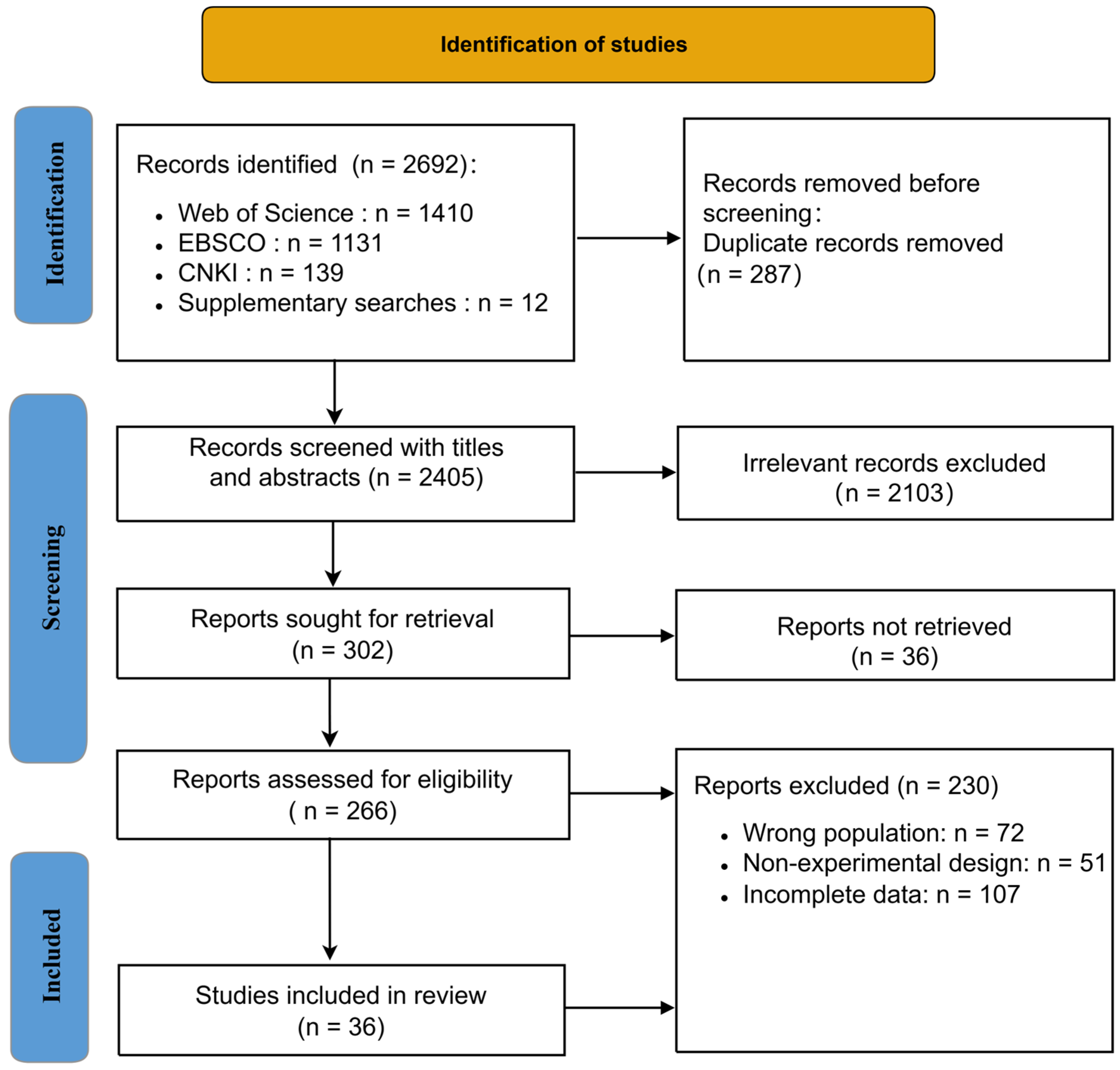
We included studies based on the following criteria: (a) participants were K-12 or college students; (b) experimental or quasi-experimental designs compared conditions with and without GenAI feedback; (c) dependent variables included at least one measure of academic performance; and (d) sufficient statistical information (means, standard deviations, and sample sizes) was provided for effect size calculation. Two independent coders (both doctoral candidates in education) conducted screening (Appendix A, Table A1). Inter-coder reliability was substantial (Cohen’s κ = 0.85), with discrepancies resolved through consensus discussion. The study selection process is illustrated in Figure 1. Grey literature (e.g., conference abstracts, reports, and unpublished dissertations) was excluded unless sufficient statistical details for effect size calculation were reported. Following screening, 36 studies met the inclusion criteria, of which three were master’s theses.
Duplicate records were first removed, followed by title and abstract screening to exclude studies that did not meet the inclusion criteria (non-AI feedback interventions, non-student populations, and non-empirical designs). A full-text review was conducted to exclude review articles and studies with incomplete data. Ultimately, thirty-six studies were included, yielding seventy-two effect sizes: thirty-nine effect sizes for academic achievement (including six effect sizes from three studies that each contributed twice), one for critical thinking, five for metacognition, and twenty-seven for non-cognitive outcomes (Table 1). Inter-coder agreement was substantial (Cohen’s κ = 0.82). Study quality was assessed using the Medical Education Research Study Quality Instrument (MERSQI), which evaluates study design, sampling, data type, assessment, analysis, and intervention description. All included studies attained mean quality scores above half of the total score.

3.2. Data Extraction and Coding

We coded 36 studies across dimensions, including region, disciplines, educational level, intervention duration, GenAI role, teaching methods, and learning outcomes (Table 2). Two doctoral candidates independently coded the studies (κ = 0.85), resolving discrepancies through team discussion. The coding framework included (a) basic information (authors, publication date, and region); (b) contextual characteristics (educational level, disciplines, intervention duration, GenAI role, teaching methods, and collaboration mode); and (c) outcome dimensions (cognitive, metacognitive, and non-cognitive outcomes). Coding results are presented in Appendix A, Table A2.
Educational Level: Based on Piaget’s theory of cognitive development, we coded educational level into three categories: elementary (concrete operational stage), secondary (formal operational stage onset), and higher education (mature formal operations). This classification allowed the developmental appropriateness of GenAI feedback to be examined across cognitive maturity levels (R. Wu & Yu, 2024).
Disciplines: Drawing on Biglan’s epistemological taxonomy (Biglan, 1973), studies were classified into three categories: (a) STEM disciplines (hard subjects: mathematics, science, and engineering), representing structured, paradigmatic knowledge with clear algorithmic procedures; (b) language and humanities (soft-pure subjects: literature, linguistics, and history), characterized by contextual interpretation and meaning construction; and (c) other professional/applied disciplines, integrating procedural skills with contextualized practice.
Intervention Duration: Based on Clark’s (1983) account of novelty effects associated with new media, which tend to dissipate as familiarity increases, educational intervention effects exhibit nonlinear time–dose relationships. Short-term interventions typically occur during the novelty effect period. Here, new technology temporarily elevates motivation, but such effects rarely persist. Medium-term interventions enter periods of stabilization as learners adapt and establish usage routines, better reflecting true cognitive gains. Long-term interventions may produce cumulative effects but carry the risk of technology fatigue or overdependence. This study categorized intervention duration into short-term (≤2 weeks), medium-term (>2 weeks and ≤12 weeks), and long-term periods (>12 weeks to ≤1 semester).
Role of GenAI: Based on the community of practice theory (Wenger, 1998), particularly the concepts of legitimate peripheral participation and the regime of competence, GenAI’s social role can be conceptualized in terms of its membership configuration within the learning community. The tutor role embodies asymmetric participation, in which GenAI occupies a core-member position and exercises gatekeeping within the regime of competence. Such asymmetry may trigger learners’ cognitive defensiveness or encourage metacognitive outsourcing. The peer role embodies symmetric participation, in which GenAI engages learners through mutual constitution and equal dialogue, potentially reducing psychological threat and promoting exploratory engagement. The assistant role is primarily an instrument of mediation rather than participating in the community of practice. These structural variations may shape learners’ cognitive engagement, emotional responses, and self-regulation. Following Díaz and Delgado’s typology, we coded the roles of GenAI to investigate how different social participation structures moderate the effectiveness of feedback (Díaz & Delgado, 2024).
Teaching Methods: Based on the constructivist continuum and cognitive load theory (Sweller et al., 2019), instructional approaches map onto distinct knowledge construction pathways and corresponding cognitive load configurations. Direct instruction, anchored in cognitive constructivism, employs advanced organizers to reduce extraneous cognitive load and support the structured assimilation of knowledge. By contrast, self-directed learning aligns with radical constructivism, emphasizing learners’ autonomous knowledge construction through metacognitive monitoring and reflection. Collaborative learning is rooted in social constructivism and leverages the zone of proximal development and scaffolding to distribute intrinsic load through distributed cognition. Inquiry-based learning draws on situated cognition theory, engaging learners in legitimate peripheral participation within communities of practice. In GenAI-supported environments, GenAI can dynamically shift between instrumental and intersubjective roles according to the cognitive demands of different methods, matching corresponding load structures and construction pathways. Therefore, Teaching methods were included as a categorical variable for subgroup analysis (C. Wang et al., 2018).
Following Xu et al. (2024), we classified outcomes into three distinct dimensions: (a) cognitive outcomes, representing knowledge acquisition and observable skill performance (e.g., academic achievement, critical thinking); (b) metacognitive outcomes, capturing learners’ monitoring, regulation, and reflection on their own cognitive processes (e.g., strategy use, self-regulated learning); and (c) non-cognitive outcomes, encompassing motivational and affective states and attitudes (e.g., self-efficacy, engagement, satisfaction). This categorization enabled the examination of differential effects of GenAI feedback across academic performance, self-regulatory processes, and affective–motivational dimensions.

3.3. Effect Size Calculation and Data Preparation

Given that the studies included employed both pretest–posttest and posttest-only designs, we applied design-specific effect size formulas to avoid information loss from excluding valid data (Morris, 2008). For studies reporting pretest–posttest data, we used the change-score method assuming a pretest–posttest correlation of r = 0.60 (Morris & DeShon, 2002); for posttest-only studies, we applied the traditional standardized mean difference method. Both designs were converted to Hedges’ g through a small-sample correction to ensure cross-study comparability. Sensitivity analyses showed that effect size estimates varied by less than 0.07 when assumed correlations fluctuated within the range of 0.50–0.75, demonstrating the robustness of the results for the choice of r.

3.4. Data Analysis

3.4.1. Three-Level Meta-Analytic Model

Traditional meta-analyses typically assume effect sizes are independent. However, educational research often simultaneously measures learners’ multidimensional performance, creating statistical dependencies. Direct application of traditional aggregation methods violates the assumption of independence. Therefore, we employed a three-level random-effects model to handle statistical dependence among multidimensional outcomes within studies (Cheung, 2014). The model comprises three levels: Level 1 (sampling error), Level 2 (within-study variation), and Level 3 (between-study variation). Separate intercepts were specified to estimate effect sizes for cognitive, metacognitive, and non-cognitive dimensions. The intraclass correlation coefficient (ICC) quantifies within-study dependence; when ICC approximates zero, the model is reduced to a traditional two-level structure. On the other hand, a significant ICC indicates the necessity of the three-level model. Effect sizes and sampling variances were calculated using Morris’s (2008) change-score standardization method, assuming a pretest–posttest correlation of 0.60. All models were estimated using restricted maximum likelihood (REML).

3.4.2. Heterogeneity Assessment and Moderator Analysis

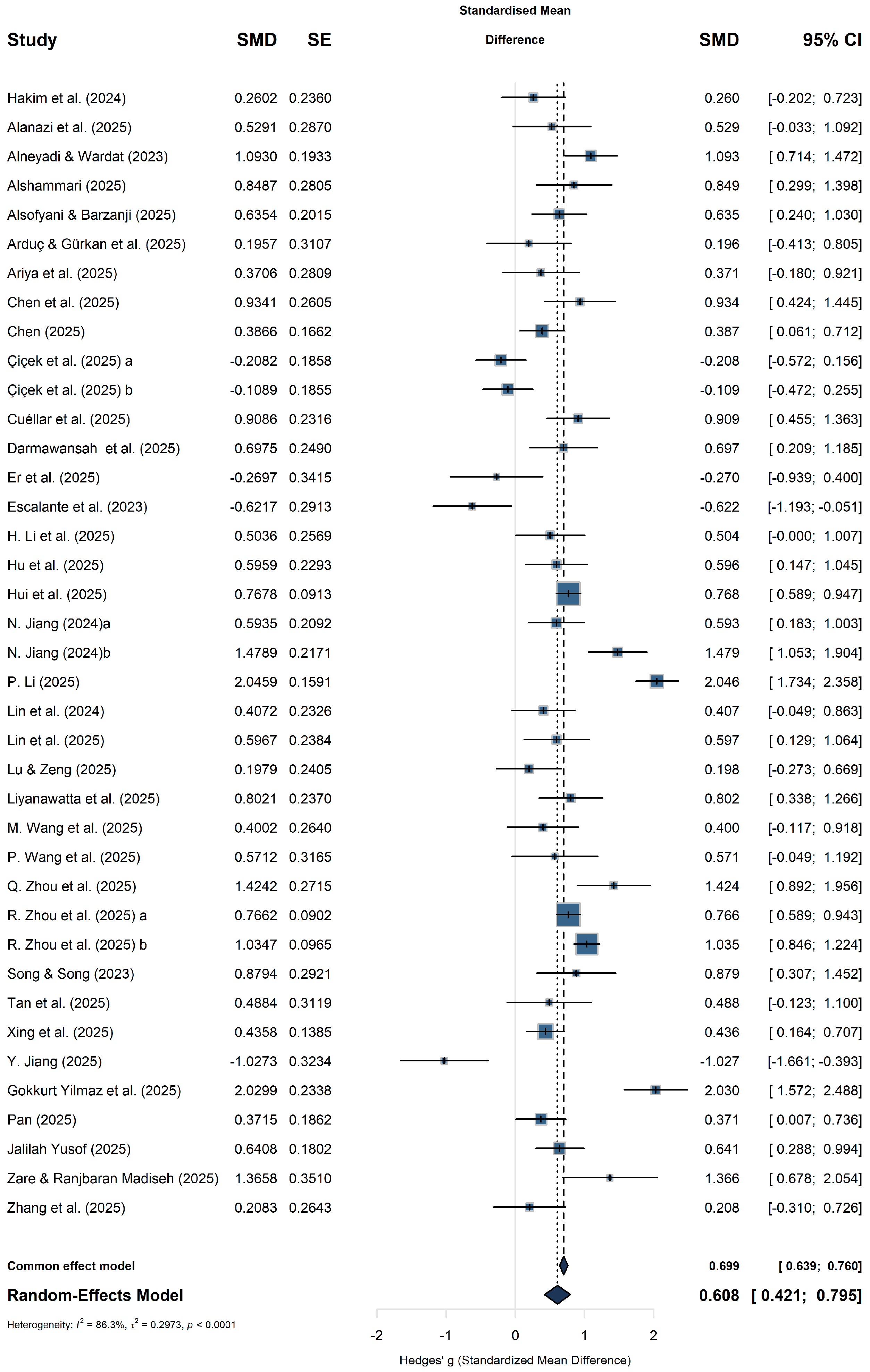
All analyses were conducted in R 4.5.2 using RStudio, primarily employing the metafor package for meta-analysis and visualization. Given that research on educational intervention exhibits substantial variation in sample characteristics, intervention duration, and measurement instruments, we employed random-effects models (Borenstein et al., 2021) to account for true between-study heterogeneity. We assessed heterogeneity via Cochran’s Q test and I2 statistics. The Q statistic tests determine whether between-study variance significantly exceeds zero, whereas I2 describes the proportion of total variance attributable to heterogeneity: 25%, 50%, and 75% indicate low, moderate, and high heterogeneity respectively (Higgins et al., 2003). The corresponding forest plots are provided in Appendix B, Figure A1. To explore sources of heterogeneity, we conducted subgroup analyses and meta-regression examining educational level, disciplines, intervention duration, the role of GenAI, and teaching methods. As shown in Appendix A, Table A3, the teaching methods significantly moderated the effect sizes (p < 0.05), while the differences for educational level, disciplines, intervention duration, and role of GenAI were not significant.

3.4.3. Publication Bias Assessment

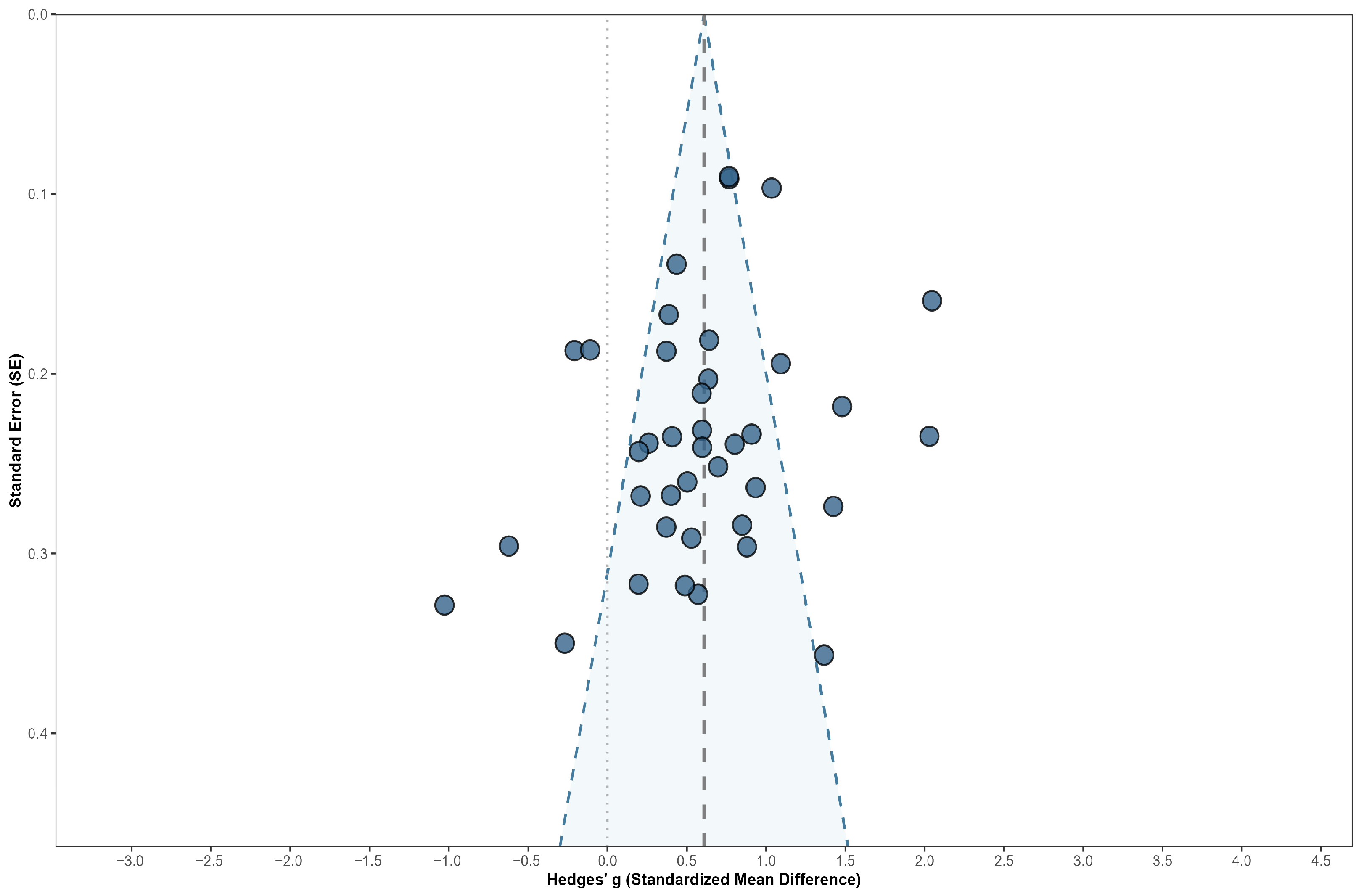
Publication bias, whereby studies with positive results are preferentially published, may lead to samples inadequately representing the research population, potentially inflating pooled effects. We assessed potential publication bias using funnel plots, Egger regression tests, Rosenthal’s fail-safe N, and trim-and-fill methods (Duval & Tweedie, 2000; Egger et al., 1997; Rosenthal, 1979). A visual funnel plot inspection revealed some asymmetry (Figure 2), suggesting potential small-study effects. Egger’s regression test detected no significant publication bias (intercept = −1.75, SE = 1.08, p = 0.113). However, given the observed visual asymmetry, small-study effects cannot be entirely ruled out. To evaluate the impact of potential publication bias, we calculated Rosenthal’s fail-safe N. Results showed that N = 5269, meaning 5269 null-effect studies would be needed to render the current results non-significant (p > 0.05). This value substantially exceeds the standard robustness threshold of 5k + 10 = 190 (where k = 36) recommended by Rosenthal (1979), indicating that the observed effect is highly unlikely to be solely due to publication bias. Trim-and-fill sensitivity analysis indicated that 10 studies were imputed for a symmetric distribution, yielding an adjusted effect size of g = 0.84 (95% CI [0.63, 1.04]), which exceeded the original estimate. This reverse asymmetry pattern suggests that the main analysis effect estimate may be conservative, and the true GenAI feedback effect could be stronger than observed. Thus, even accounting for potential publication bias, the positive effect of GenAI feedback remains robust, with the adjusted estimate reinforcing the conclusion of a meaningful beneficial effect. However, the presence of visual asymmetry warrants cautious interpretation.

3.4.4. Sensitivity Analyses

We conducted sensitivity analyses to assess the robustness of pooled estimates to data uncertainty and methodological specifications, including leave-one-out diagnostics, correlation coefficient sensitivity analyses, and comparisons between fixed-effect and random-effects models.
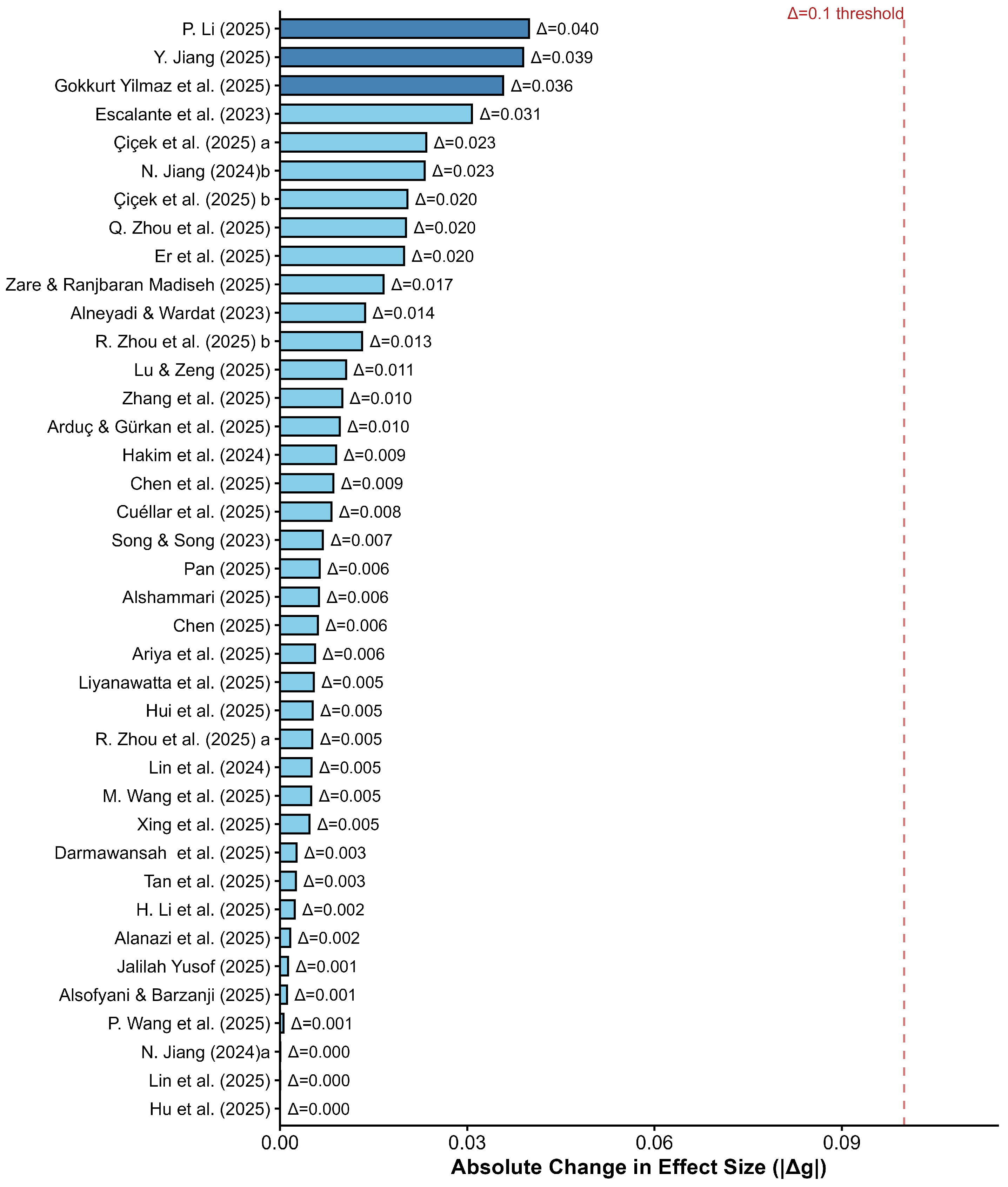
Sequential removal of each of the 36 studies (Appendix B, Figure A2) showed that pooled effect sizes ranged from 0.57 to 0.65, with a maximum change of Δg = 0.04, which is well below the predefined robustness threshold of 0.10. The direction of the effect remained consistent.
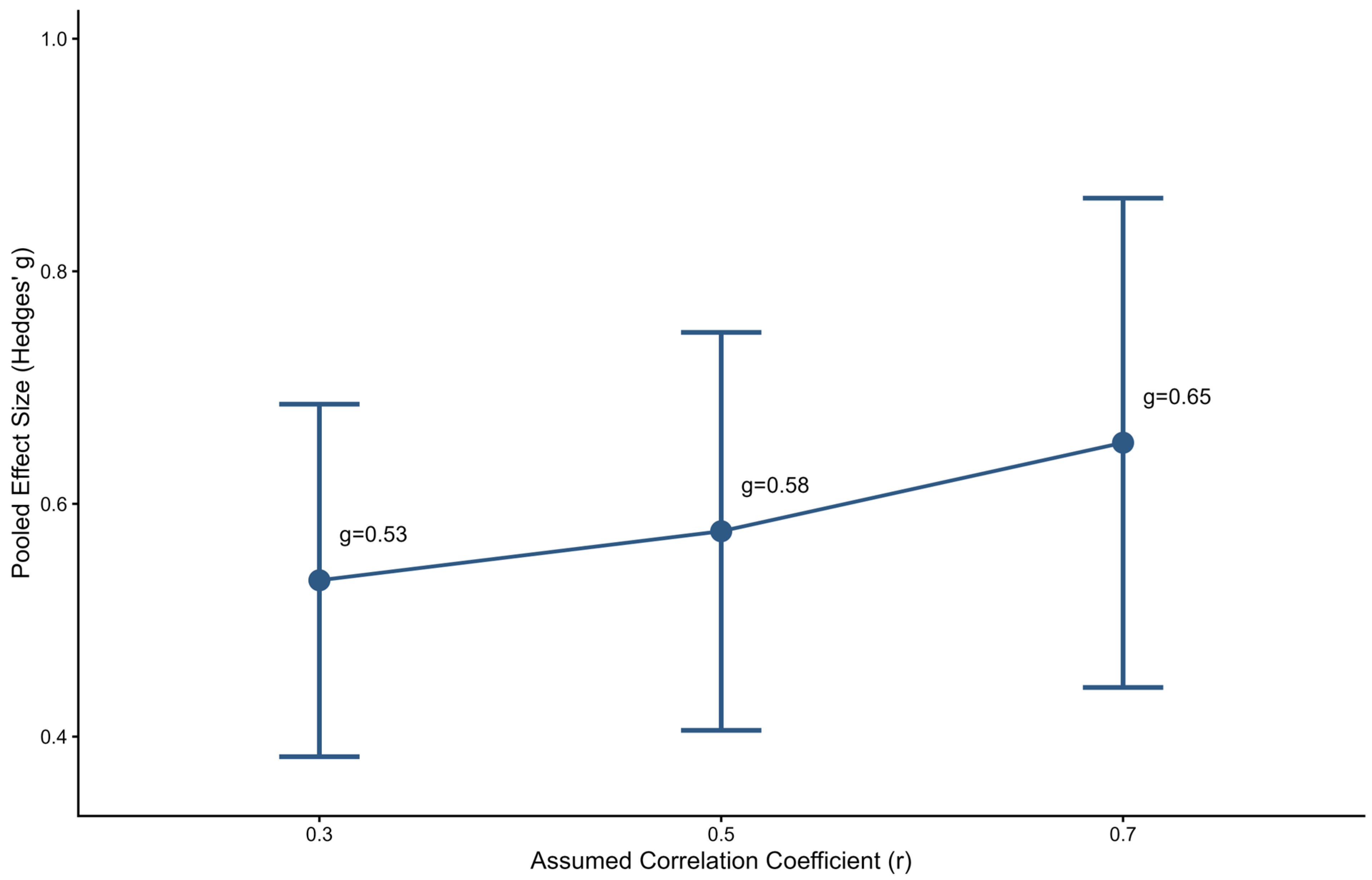
For pretest–posttest designs, baseline analyses used r = 0.60, yielding g = 0.61 (Appendix B, Figure A3). When r = 0.50 and r = 0.70 were applied, effect sizes were g = 0.58 and g = 0.65, respectively. Although effect sizes varied across r values (Δg = 0.07), all remained moderate in magnitude (g > 0.50) and statistically significant, indicating that assumptions about the correlation coefficient did not materially alter the conclusions.
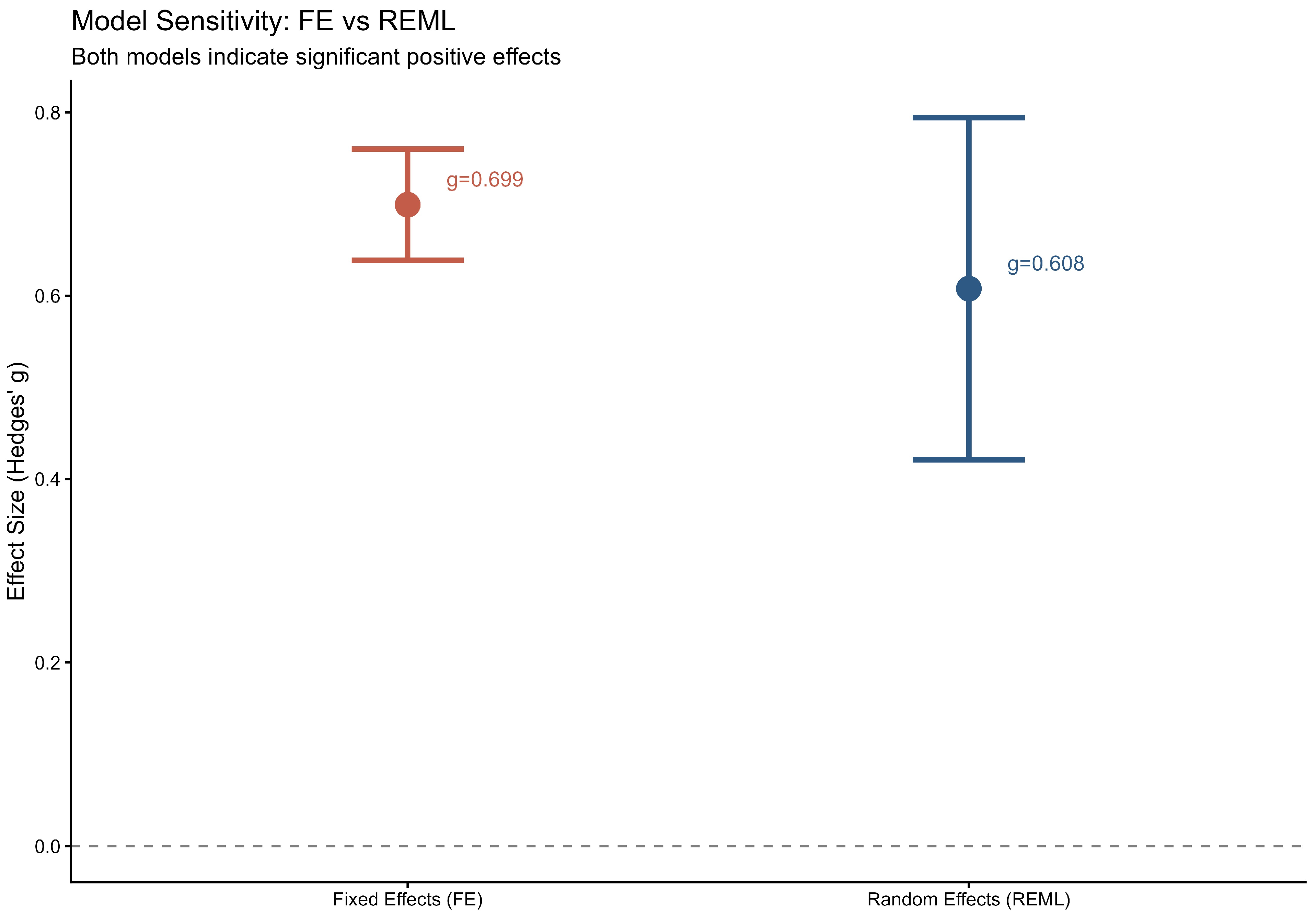
Comparisons between fixed-effect and random-effects models produced effect sizes of g = 0.70 and g = 0.61, respectively, with only a small difference (Δg = 0.09) (Appendix B, Figure A4). Both models yielded statistically significant positive effects, indicating that the choice of statistical model did not alter the overall conclusions.

4. Results

This study first analyzed the effect sizes and moderator effects of GenAI feedback on academic achievement (36 studies, 39 effect sizes); it then examined its overall impact on learning outcomes, including cognitive, metacognitive, and non-cognitive dimensions (36 studies, 72 effect sizes).

4.1. Effects of GenAI Feedback on Academic Achievement

This meta-analysis revealed that GenAI feedback yielded a moderate positive effect on academic achievement (g = 0.61, 95% CI [0.42, 0.80], k = 36, N = 4538). Detailed statistics are summarized in Table 3, and the corresponding forest plots are provided in Appendix B, Figure A1. However, substantial heterogeneity was observed (I2 = 86.3%), with significant between-study variance (τ2 = 0.30). These results warranted further investigation into the sources of heterogeneity.
To explain the observed heterogeneity, subgroup analyses were conducted based on educational level, disciplines, intervention duration, the role of GenAI, teaching method, and Collaboration Mode. Detailed results of the subgroup analyses are reported in Appendix A, Table A3. The results indicated that teaching methods (p = 0.026) significantly moderated academic achievement; conversely, between-group differences across educational level, disciplines, and intervention duration were not statistically significant.
Teaching Method Moderation. Teaching methods significantly moderated the effectiveness of feedback generated by GenAI (p = 0.026). Collaborative learning produced the largest effect (g = 0.71, 95% CI [0.51, 0.91], m = 7), closely followed by self-directed learning (g = 0.68, 95% CI [0.42, 0.94], m = 25). In contrast, inquiry-based learning (g = 0.34, 95% CI [−0.07, 0.74], m = 6) and direct instruction (g = −0.27, 95% CI [−0.96, 0.42], m = 1) showed smaller effects, with the latter not reaching statistical significance (confidence interval spanning zero). GenAI feedback demonstrated stronger benefits in contexts that emphasize active student learning, while limited effects were found in direct instruction.
Although the role of GenAI and its effects on outcomes were non-significant (p = 0.186), descriptive differences were observed: peer (g = 0.77, 95% CI [0.40, 1.15], m = 2) and assistant (g = 0.68, 95% CI [0.47, 0.89], m = 30) roles showed larger effects than tutor role (g = 0.24, 95% CI [−0.23, 0.71], m = 7). The comparison of peer role is exploratory (m = 2) and should be interpreted with caution.
Other Potential Moderators. Between-group differences across educational levels were non-significant (p = 0.48). The effect size was largest for secondary education (g = 0.82, m = 8), followed by university (g = 0.56, m = 30) and elementary levels (g = 0.40, m = 1). However, the elementary subgroup included only one study, which limits the strength of the evidence. Moderation by disciplines was non-significant (p = 0.969), with similar effects for language (g = 0.64, m = 17) and STEM subjects (g = 0.59, m = 12). Differences in intervention duration were also non-significant (p = 0.668). Descriptively, larger effects were observed for long-term interventions (≥12 weeks, g = 0.84, m = 6) than for medium-term (>2 weeks and ≤12 weeks, g = 0.59, m = 26) and short-term interventions (≤2 weeks, g = 0.49, m = 7).

4.2. Effects of GenAI Feedback on Learning Outcomes

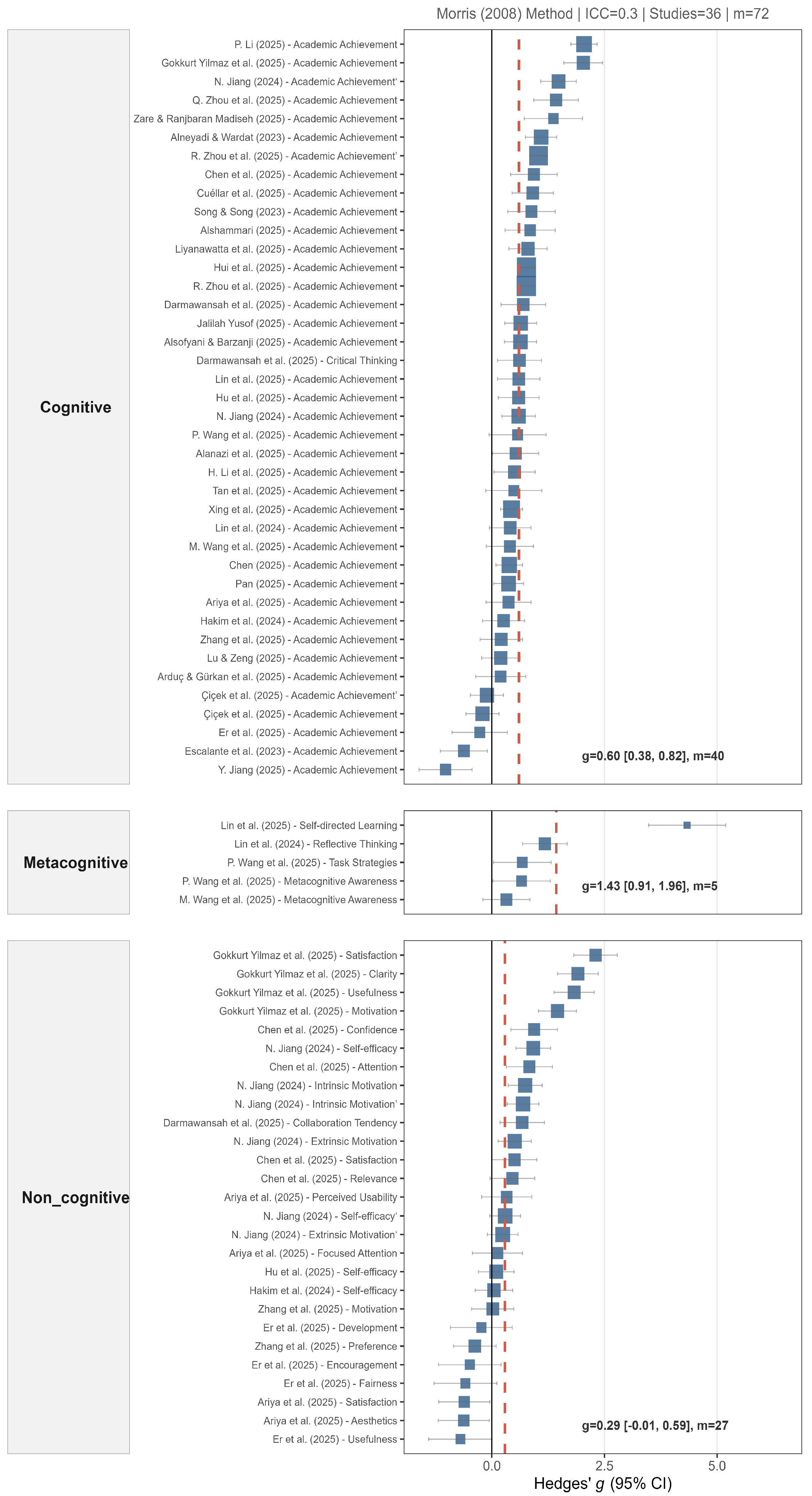
Three-level random-effects models revealed that GenAI feedback has differential effects across learning outcome dimensions (Appendix B, Figure A5). Among the 36 included studies (m = 72 effect sizes), the cognitive dimension (academic achievement, knowledge mastery) demonstrated a robust positive effect, with a pooled g = 0.60 (95% CI [0.38, 0.82], m = 40). This indicates that GenAI feedback effectively promotes learners’ construction of knowledge and development of cognitive skills. Notably, the metacognitive dimension (self-directed learning, reflective thinking, and metacognitive awareness) showed a relatively high point estimate based on limited evidence (g = 1.43, 95% CI [0.91, 1.96], m = 5).
Therefore, this result should be considered exploratory, suggesting that GenAI feedback may have potential advantages for promoting self-monitoring and strategy adjustments rather than constituting a definitive conclusion. In contrast, non-cognitive dimensions (learning motivation, self-efficacy, and satisfaction) showed small-to-moderate pooled effects (g = 0.29, 95% CI [−0.01, 0.59], m = 27). For non-cognitive outcomes, the pooled effect was small and not statistically significant (g = 0.29, 95% CI [−0.01, 0.59]), with the confidence interval crossing zero. This suggests that GenAI feedback has limited or context-dependent effects on motivation, self-efficacy, and satisfaction. Although metacognitive point estimates (g = 1.43) exceeded cognitive estimates (g = 0.60) by approximately 0.84, considering the former’s extremely small sample (m = 5) and high heterogeneity (I2 = 78.3%), this difference may reflect sampling error. It should not be over-interpreted as a true effect difference. Additionally, ICC = 0.30 indicates that approximately 30% of total variance stems from within-study effect size dependencies (i.e., clustering from single studies reporting multiple outcomes), supporting the use of a three-level model to avoid underestimating standard errors.

5. Discussion

5.1. Responses to the First Research Question

The results of the current study support a statistically significant, moderate positive effect of GenAI feedback on academic achievement (g = 0.61, 95% CI [0.42, 0.80]). This finding aligns with recent syntheses (Ma & Zhong, 2025), which similarly reported positive effects of AI-assisted feedback. Additionally, the beneficial impact extends to cognitive, metacognitive, and non-cognitive learning outcomes.
While GenAI produced moderate overall gains in academic achievement, students benefited to markedly different degrees. Such variability in individual benefits appears attributable to learner-specific differences in prior knowledge, motivation, and digital self-regulation skills (Zimmerman, 2002). Some students may have experienced cognitive overload due to task complexity (Sweller, 1988), whereas others may have developed passive dependence on GenAI feedback without genuine internalization. Such findings underscore that the effectiveness of GenAI feedback is moderated by students’ self-regulated readiness to learn and depth of cognitive engagement, rather than being uniformly beneficial (Y.-H. Hu et al., 2025). While GenAI tools such as GASA can enhance reflective thinking and reduce cognitive load during experiential learning (Lin et al., 2024), the same study cautions that over-reliance on such technological aids may weaken interpersonal collaboration and diminish learners’ autonomy in critical thinking.
However, realizing such interactive potential requires a fundamental shift in GenAI roles. Teachers should attend to the instructional communication, reconceptualizing students as active participants in feedback cycles rather than as passive recipients of GenAI information. In the human–AI interaction process, teachers should position GenAI as an auxiliary tool rather than a primary content generator, guiding students to leverage its capabilities for information retrieval and structural optimization while actively selecting, integrating, and organizing information based on their own understanding. This process cultivates independent thinking and critical analysis skills, ensuring that students lead the content creation process to maintain academic integrity and avoid over-dependence on AI tools (Tan et al., 2025). Furthermore, teachers should assume a crucial guiding role in deep and substantive interactions, demonstrating and facilitating discussions to help students effectively use GenAI tools and develop critical thinking skills to analyze AI-provided feedback and suggestions, avoiding blind acceptance (Y. Jiang, 2025).
Teaching methods significantly moderated the effectiveness of GenAI feedback. Collaborative and self-directed learning contexts achieved large effect sizes, substantially exceeding those of inquiry-based learning and direct instruction. This pattern demonstrates GenAI feedback’s context-dependent nature: in paradigms emphasizing active learning, GenAI functions as dynamic scaffolding, effectively supporting knowledge internalization; in direct instruction, GenAI risks degenerating into a content delivery tool, with personalized advantages offset by standardized teaching, potentially increasing redundant cognitive load (Sweller et al., 2019). In collaborative learning environments, the integration of GenAI feedback not only fosters deeper engagement but also facilitates knowledge transfer through interactive learning. Effective management of cognitive load is crucial in these settings, as it helps minimize unnecessary processing and optimizes learning-related cognitive processing, ensuring that these demands remain within the learners’ available cognitive capacity. Notably, inquiry-based learning had moderate effects, possibly due to the higher demands of open-ended questions on GenAI’s factual accuracy. When learners explore unstructured problems, the risk of GenAI hallucination may undermine the credibility of feedback (Van Dis et al., 2023). Furthermore, integrating GenAI feedback into pedagogy enhances individual learning experiences and creates personalized learning opportunities. Its core is focused on active inquiry into knowledge rather than passive reception of facts, highlighting the importance of learner autonomy and thereby fostering autonomous and discovery-based learning (O’Keeffe, 2021; Zare & Ranjbaran Madiseh, 2025).
While the moderating role of GenAI was non-significant, the advantages of non-authoritative roles emerged: peer and assistant effects both exceeded tutor effect. From the perspective of the community of practice theory (Wenger, 1998), this difference stems from varying participation symmetry: tutors occupy roles of knowledge and authority, potentially triggering learner cognitive defense or metacognitive offloading. By contrast, peers/assistants, who have collaborative roles in distributed cognition, reduce psychological threat, allowing learners to explore and correct mistakes in safe contexts. Notably, this interpretation regarding peer role should be treated with caution, given the limited evidence base (m = 2). Empirical findings by Y. Pan (2025) reveal that GenAI feedback benefits from peer negotiation to achieve superior educational benefits, confirming the efficacy of complementary GenAI roles in cultivating effective feedback.
Educational level, disciplines, and intervention duration did not yield significant moderation effects. Descriptively, secondary schools (g = 0.82) outperformed universities (g = 0.56), whereas elementary schools showed weaker effects (g = 0.40). Notably, the elementary school finding rests on a single study and should be interpreted with caution. While disciplinary epistemologies suggest differential potential for GenAI, the present meta-analysis revealed no significant differences in effect sizes between STEM and language learning contexts (g = 0.59 vs. 0.64, p > 0.05). This discrepancy between theoretical expectation and empirical observation requires nuanced interpretation. Although the moderating effect of intervention duration was not statistically significant, descriptively, larger effects were observed for long-term interventions (≥12 weeks, g = 0.84, m = 6) than medium-term (>2 weeks and ≤12 weeks, g = 0.59, m = 26) and short-term interventions (≤2 weeks, g = 0.49, m = 7). Unlike the novelty effect hypothesis, which predicts diminishing returns over time (Clark, 1983), our findings demonstrate sustained or enhanced efficacy in long-term interventions. This pattern aligns with Vygotsky’s (1978) Zone of Proximal Development framework, wherein GenAI functions as a cognitive scaffold that requires sustained support that is gradually internalized into self-regulated learning strategies.

5.2. Responses to the Second Research Question

Three-level random-effects models further revealed the differential effect patterns of GenAI feedback across cognitive, metacognitive, and non-cognitive dimensions: cognitive robustness, metacognitive scaffolding potential, and non-cognitive moderation.
Firstly, the cognitive dimension demonstrated a statistically reliable moderate positive effect (g = 0.60). GenAI feedback facilitates open-ended, interactive dialogues, delivers personalized guidance, and scaffolds complex reasoning processes. This finding contradicts apprehensions that GenAI impedes critical thinking development through fostering reliance or attenuating interpersonal learning. Instead, it suggests that GenAI may facilitate deeper cognitive engagement through mechanisms such as personalized feedback and adaptive scaffolding (J. Wu et al., 2025; Zhan et al., 2025), operating via self-regulated learning processes (M. Pan et al., 2025).
Secondly, the forest plot shows substantial dispersion in metacognitive effect sizes. Lin et al. (2025) reported a large effect size for self-directed learning (SDL), which deviates markedly from the other included studies. This outlier may reflect unique instructional design or measurement features in their study. Because only five studies currently inform the metacognitive effect estimate, these results should be treated as preliminary and exploratory. Lin et al. (2025) demonstrated that GPT-based, metacognition-oriented interventions can substantially improve learners’ SDL by implementing an execution–assessment–reflection cycle. The authors further argued that GenAI feedback enhances learning performance, with metacognition as the central mechanism driving SDL gains. By contrast, Fan et al. (2025) reported that GenAI technologies can encourage learners to over-rely on tools and foster metacognitive laziness, which may impede self-regulation and deeper engagement. Although GenAI can improve performance in short-term tasks, it may not enhance intrinsic motivation, knowledge acquisition, or knowledge transfer. Together, these findings call for a reevaluation of learning in an increasingly AI-mediated educational environment. In particular, promoting students’ critical AI literacy is essential to uphold their agency in human–AI collaboration (C. Wang, 2025).
Finally, the effect of GenAI feedback on learners’ noncognitive outcomes is context dependent and, overall, ranges from weak to moderate positive, with low robustness and vulnerability to novelty effects and measurement-context interference. GenAI can facilitate cognitive focus through intuitive natural-language interactions, contributing to perceived ease of use. Its capabilities in simulating classroom scenarios enhance perceived usefulness, which supports behavioral intentions to adopt the technology. Concurrently, practice with GenAI-simulated students increases self-efficacy through mastery experiences, while expanding educators’ instructional tools (M. Li et al., 2025). By contrast, social presence theory suggests that noncognitive development depends on sustained social interaction and emotional connection. While most current GenAI feedback remains text-based and lacks paralinguistic emotional cues, its impact on learners’ affective states is double-edged: it may reduce social anxiety associated with human evaluation, yet potentially falls short in providing emotional scaffolding for deep frustration or stress compared to human teachers. GenAI feedback can speed up cognitive processing but often remains superficial, focusing on grammar, spelling, and other shallow aspects and thus failing to foster the deep learning that teacher feedback promotes. Furthermore, the opacity of large language models raises concerns regarding reproducibility and bias (Van Dis et al., 2023), potentially eroding the reliability of emotional and motivational support. Excessive reliance on GenAI can also prompt students to uncritically replicate outputs. Consequently, educational practice should shift from passive acceptance of GenAI output to an active, student-centered construction model that requires students to engage critically while using GenAI as a catalyst for higher-order thinking (Tian et al., 2025). Practically, teachers need to increase students’ GenAI literacy, supply corrective feedback in areas where GenAI is weak (such as emotional value) and integrate human and machine feedback in a coordinated way. Looking ahead, embedding emotional frameworks in GenAI design and combining these systems with blended learning models could foreground the teacher’s role in emotional regulation and enable cognitive–emotional synergy, thereby maximizing the educational benefits of GenAI (X. Han et al., 2025).

6. Implications and Future Directions

6.1. Implications for Instructional Implementers

Educators should leverage GenAI feedback as adaptive scaffolding within constructivist pedagogies, including project-based learning, flipped classrooms, and inquiry-based environments. We recommend incorporating structured GenAI-assisted inquiry phases into instructional sequences and using GenAI’s real-time responsiveness to promote independent problem-solving among students. Furthermore, educators should reconceptualize the division of cognitive labor between humans and GenAI. Teachers should view GenAI feedback as complementary scaffolding, not a substitute for instruction. At the metacognitive level, preliminary evidence suggests that graduated fading techniques may help shift monitoring responsibilities from GenAI to students; however, this recommendation warrants validation given the limited current evidence base (m = 5). At the non-cognitive level, the irreplaceable role of human interaction needs to be preserved in fostering emotional and social development.

6.2. Recommendations for Educational Researchers

First, learning analytics need to trace fine-grained human–AI interaction processes and model the relationship between collaboration depth and learning outcomes, specifically addressing whether human–AI collaboration fosters durable self-regulation relative to AI-only feedback rather than merely transient performance effects. Second, the long-term sustainability of AI-assisted metacognitive gains requires investigation, particularly regarding whether these effects persist and transfer to autonomous learning capacities after scaffold withdrawal.

6.3. Recommendations for Technology Developers

Intelligent tutoring systems should incorporate human-in-the-loop interfaces by (a) implementing oversight mechanisms within affective computing modules that automatically prompt instructor intervention when atypical emotional states are detected, and (b) designing transparent feedback architectures that clearly indicate to learners whether feedback is AI-generated or instructor-validated. This approach can preserve both transparency and pedagogical authority in the feedback process. Future research should prioritize cross-cultural validation and long-term sustainability assessments to address the current evidence gaps in metacognitive scaffolding.

7. Conclusions

7.1. Major Findings

This meta-analysis indicates that GenAI feedback significantly improves overall academic achievement (g = 0.61, 95% CI [0.42, 0.80]). One implementation feature emerged as a critical boundary condition: teaching methods (p = 0.026), whereby constructivist pedagogies (self-directed and collaborative learning) produced significant medium-to-large effects, whereas inquiry-based learning and direct instruction did not.
However, sensitivity analyses across learning outcome dimensions revealed differential robustness. Cognitive effects proved to be robust (g = 0.60, m = 40), while metacognitive gains, though substantial (g = 1.43), were based on limited evidence (m = 5) and warrant cautious interpretation. Non-cognitive impacts were marginal, with effect sizes approaching practical insignificance (g = 0.29, 95% CI [−0.01, 0.59]). These patterns suggest that GenAI’s educational utility is hierarchically bounded; it is strongest as an independent cognitive tool, promising but preliminary as a metacognitive scaffold, and limited as a standalone affective intervention.

7.2. Major Contributions

This study makes three key contributions. First, by synthesizing state-of-the-art empirical research from 2023 to 2025, it highlights the rapid evolution of GenAI educational applications and offers timely, evidence-based insights. Second, it extends beyond academic achievement to encompass cognitive, metacognitive, and non-cognitive learning outcomes, providing a comprehensive evidence base for educational decision-making. Third, methodologically, it addresses a critical limitation in extant syntheses by standardizing mixed designs (pretest–posttest/posttest-only) and employing three-level meta-analytic models that consider effect-size dependencies (ICC = 0.30), thereby correcting the standard error underestimation that is inherent in conventional two-level approaches and substantially enhancing the validity of the findings.

7.3. Limitations

This study has several limitations. First, despite adherence to PRISMA guidelines, the comprehensive retrieval of relevant studies in the literature proved challenging. The final sample comprised only 36 studies, which may compromise the precision and reliability of the estimates. Future research should expand data sources and employ diverse methodologies to examine the effects of GenAI feedback on educational outcomes with greater precision. Second, the geographic distribution of included studies was heavily concentrated in Asia, which limits the generalizability of findings to other educational contexts. Third, the metacognitive finding (g = 1.43) is based on four studies with high heterogeneity (I2 = 78.3%); as such, results are exploratory pending further empirical validation. Fourth, subgroup analyses explained limited heterogeneity, most of the variance remained unexplained. Beyond this, other moderators (e.g., task types, feedback levels) also require investigation to better account for residual variance.

Author Contributions

Conceptualization, Y.H. and W.Z.; methodology, Y.H. and W.Z.; software, Y.H.; validation, Y.H., W.Z. and S.C.; formal analysis, Y.H. and M.C.; investigation, Y.H., W.Z. and S.C.; resources, Y.H. and W.Z.; data curation, Y.H. and M.C.; writing—original draft preparation, Y.H.; writing—review and editing, Y.H. and W.Z.; visualization, Y.H. and S.C.; supervision, W.Z.; project administration, Y.H. and W.Z.; funding acquisition, W.Z. and M.C. All authors have read and agreed to the published version of the manuscript.

Funding

This research was funded by the Major Project commissioned by the Institute of Curriculum and Textbook Research, Ministry of Education: “A Prospective Study on Artificial Intelligence Empowering Curriculum and Textbook Development” (Grant No. JCSZD2024KCZX007). This research was also supported by the National Natural Science Foundation of China (Grant No. 62277027).

Institutional Review Board Statement

This study is a meta-analysis and systematic review of previously published literature. It did not involve direct interaction with human subjects or the collection of new primary data. Therefore, separate ethical approval or individual informed consent forms were not required for this secondary analysis. Our inclusion criteria required all primary studies included to have declared ethical compliance and obtained informed consent from their participants, in accordance with applicable institutional ethical standards.

Informed Consent Statement

Not applicable.

Data Availability Statement

No new original data were generated in this meta-analysis. All data used in the analysis were sourced from the public literature and academic databases, including Web of Science, China National Knowledge Infrastructure (CNKI), and EBSCO, with supplementary retrieval via Google Scholar (search period: January 2023 to December 2025).

Acknowledgments

During the data coding and analysis phase, the artificial intelligence tool Kimi 2.5 assisted with text extraction and initial categorization. All coding results were subsequently verified manually by the authors, who accept full responsibility for the research design, data interpretation, and conclusions.

Conflicts of Interest

The authors declare that they have no competing interests.

Appendix A

Table A1. Literature search strategy.
ComponentDescription
DatabasesWeb of Science, EBSCOCNKI, Supplementary searches: Google Scholar
Time Frame January 2023 to December 2025
Search StrategyIntervention(“generative AI” OR ChatGPT OR “large language model” OR LLM) AND (feedback OR “automated feedback” OR “AI feedback” OR “intelligent feedback”)
Comparison(teacher OR teachers OR instructors OR peer OR peers OR classmate OR classmates OR “human feedback” OR “traditional feedback” OR “written feedback” OR “expert feedback” OR control)
Outcome(“learning outcome” OR “learning outcomes” OR achievement OR performance OR “academic performance”)
Study Design(experiment OR experimental OR “randomized controlled trial”OR RCT OR “quasi-experimental” OR “controlled trial”)
Additional SourcesSnowballing; Manual screening of reference lists; Forward citation tracking
Table A2. Document coding list.
No.StudyGradeSubjectInstructionalRegionGenAI RoleTeaching MethodsEffect
1Hakim et al. (2024)UniversityOthersLongAsiaAssistantSelf-directedC, N
2Alshammari (2025)UniversitySTEMLongEuropeAssistantSelf-directedC
3Alanazi et al. (2025)UniversitySTEMMediumAsiaAssistantSelf-directedC
4Alneyadi and Wardat (2023)SecondarySTEMMediumAsiaAssistantSelf-directedC
5Alsofyani and Barzanji (2025)UniversityLanguageMediumAsiaAssistantSelf-directedC
6Arduç and Gürkan (2025)SecondarySTEMMediumAsiaAssistantSelf-directedC, N
7Ariya et al. (2025)UniversityOthersShortAsiaAssistantSelf-directedC
8J. Chen et al. (2025)UniversityOthersShortAsiaTutorSelf-directedC, N
9Y. Chen (2025)SecondaryLanguageMediumAsiaAssistantInquiry-basdC
10Çiçek et al. (2025) aUniversityOthersShortAsiaAssistantInquiry-basedC
11Çiçek et al. (2025) bUniversityOthersShortAsiaAssistantInquiry-basedC
12Cuéllar et al. (2025)UniversityOthersLongEuropeAssistantSelf-directedC
13Darmawansah et al. (2025)UniversityLanguageMediumAsiaPeerCollaborativeC, N
14Er et al. (2025)UniversitySTEMLongAsiaTutorDirect instructionC, N
15Escalante et al. (2023)UniversityLanguageMediumNorth AmericaAssistantSelf-directedC
16H. Li et al. (2025)UniversityLanguageMediumAsiaAssistantInquiry-basedC
17W. Hu et al. (2025)UniversityLanguageShortAsiaTutorCollaborativeC, N
18Hui et al. (2025)UniversityOthersMediumAsiaAssistantSelf-directedC
19N. Jiang (2024) aSecondaryLanguageMediumAsiaAssistantSelf-directedC, N
20N. Jiang (2024) bSecondaryLanguageMediumAsiaAssistantSelf-directedC, N
21P. Li (2025)SecondaryLanguageLongAsiaAssistantSelf-directedC
22Lin et al. (2024)UniversitySTEMMediumAsiaAssistantCollaborativeC, M
23Lin et al. (2025)UniversitySTEMMediumAsiaAssistantSelf-directedC, M
24Lu and Zeng (2025)SecondaryLanguageMediumAsiaTutorSelf-directedC
25Liyanawatta et al. (2025)UniversityLanguageMediumAsiaAssistantCollaborativeC
26M. Wang et al. (2025)PrimarySTEMMediumAsiaTutorInquiry-basedM
27P. Wang et al. (2025)UniversityLanguageMediumAsiaAssistantSelf-directedC, M
28Q. Zhou et al. (2025)UniversityLanguageLongAsiaAssistantSelf-directedC
29R. Zhou et al. (2025) aUniversitySTEMShortAsiaAssistantCollaborativeC
30R. Zhou et al. (2025) bUniversitySTEMShortAsiaAssistantCollaborativeC
31Song and Song (2023)UniversityLanguageMediumAsiaPeerSelf-directedC
32Tan et al. (2025)UniversityOthersMediumAsiaAssistantSelf-directedC
33Xing et al. (2025)SecondarySTEMMediumNorth AmericaAssistantSelf-directedC
34Y. Jiang (2025)UniversityLanguageMediumAsiaTutorSelf-directedC
35Gokkurt Yilmaz et al. (2025)UniversityOthersShortAsiaAssistantSelf-directedC, N
36Y. Pan (2025)UniversitySTEMMediumAsiaAssistantCollaborativeC
37Jalilah Yusof (2025)UniversityOthersMediumAsiaTutorSelf-directedC
38Zare and Ranjbaran Madiseh (2025)UniversityLanguageMediumAsiaAssistantInquiry-basedC
39Zhang et al. (2025)UniversityLanguageMediumAsiaAssistantSelf-directedC, N
Note: C = Cognitive; M = Metacognitive; N = Non-cognitive. Letters (a, b) indicate multiple independent effect sizes extracted from the same study.
Table A3. Subgroup analysis of moderating variables.
Adjustment Variables Effect Size and 95% Confidence IntervalIntergroup Effect
Category of VariablesmgSE95% CIQBdfP
Educational LevelUniversity300.560.10[0.35, 0.76]1.4620.481
Secondary80.820.24[0.35, 1.29]
Primary10.400.27[−0.12, 0.92]
Others100.600.20[0.21, 1.00]0.0620.969
STEM120.590.10[0.39, 0.79]
Language170.640.18[0.3, 0.99]
Intervention DurationLong60.840.34[0.17, 1.51]0.8120.668
Medium260.590.11[0.37, 0.80]
Short70.490.19[0.12, 0.87]
GenAI RoleAssistant300.680.11[0.47, 0.89]3.3720.186
Tutor70.240.24[−0.23, 0.71]
Peer20.770.19[0.4, 1.15]
Teaching MethodsSelf-directed250.680.13[0.42, 0.94]9.2630.026
Collaborative70.710.10[0.51, 0.91]
Inquiry-based60.340.21[−0.07, 0.74]
Direct instruction1−0.270.35[−0.96, 0.42]

Appendix B

Figure A1. Forest plot of effect size (Hedges’ g). Note: Squares represent individual study effect sizes, and horizontal lines indicate 95% confidence intervals. The size of the squares reflects study weights. The diamond represents the pooled effect size under the random-effects model. Letters (a, b) indicate multiple independent effect sizes extracted from the same study. (Alanazi et al., 2025; Alneyadi & Wardat, 2023; Alshammari, 2025; Alsofyani & Barzanji, 2025; Arduç & Gürkan, 2025; Ariya et al., 2025; J. Chen et al., 2025; Y. Chen, 2025; Çiçek et al., 2025; Cuéllar et al., 2025; Darmawansah et al., 2025; Er et al., 2025; Escalante et al., 2023; Gokkurt Yilmaz et al., 2025; Hakim et al., 2024; W. Hu et al., 2025; Hui et al., 2025; Jalilah Yusof, 2025; N. Jiang, 2024; Y. Jiang, 2025; H. Li et al., 2025; P. Li, 2025; Lin et al., 2024, 2025; Liyanawatta et al., 2025; Lu & Zeng, 2025; Y. Pan, 2025; Song & Song, 2023; Tan et al., 2025; M. Wang et al., 2025; P. Wang et al., 2025; Xing et al., 2025; Zare & Ranjbaran Madiseh, 2025; Zhang et al., 2025; Q. Zhou et al., 2025; R. Zhou et al., 2025).
Education 16 00816 g0a1
Figure A3. Sensitivity analysis of pre–post correlation (r). Note: Points show pooled effect sizes (Hedges’ g) across assumed r values; error bars indicate 95% confidence intervals.
Education 16 00816 g0a3
Figure A4. Model sensitivity: fixed-effects vs. random effects (REML). Note: Points show pooled effect sizes (Hedges’ g); error bars indicate 95% confidence intervals. The grey dashed line denotes the null effect (g = 0). Both models yielded significant positive effects.
Education 16 00816 g0a4

References

  1. Alanazi, S. M., Elmotri, B., Khamis, G. S., & Darem, A. A. (2025). Assessing the efficacy of ChatGPT’s automated corrective feedback in enhancing students’ writing proficiency. International Journal of Advanced and Applied Sciences, 12(2), 205–214. [Google Scholar] [CrossRef]
  2. Alneyadi, S., & Wardat, Y. (2023). ChatGPT: Revolutionizing student achievement in the electronic magnetism unit for eleventh-grade students in emirates schools. Contemporary Educational Technology, 15(4), ep448. [Google Scholar] [CrossRef]
  3. Alshammari, M. T. (2025). An investigation into ChatGPT-enhanced adaptive E-learning systems. TEM Journal, 14, 503–510. [Google Scholar] [CrossRef]
  4. Alsofyani, A. H., & Barzanji, A. M. (2025). The effects of ChatGPT-generated feedback on Saudi EFL learners’ writing skills and perception at the tertiary level: A mixed-methods study. Journal of Educational Computing Research, 63(2), 431–463. [Google Scholar] [CrossRef]
  5. Arduç, M. A., & Gürkan, G. (2025). Bridging the gap: How chatgpt enhances assessment to close learning gaps in middle school. Information Technologies and Learning Tools, 109(5), 87–101. [Google Scholar] [CrossRef]
  6. Ariya, P., Wongwan, N., Intawong, K., & Puritat, K. (2025). Assessing learning outcomes in immersive virtual reality with and without generative AI-powered virtual npcs: A comparative analysis in a museum context. Education and Information Technologies, 30(16), 23189–23212. [Google Scholar] [CrossRef]
  7. Biglan, A. (1973). The characteristics of subject matter in different academic areas. Journal of Applied Psychology, 57(3), 195–203. [Google Scholar] [CrossRef]
  8. Borenstein, M., Hedges, L. V., Higgins, J., & Rothstein, H. R. (2021). Introduction to meta-analysis (2nd ed.). Wiley. [Google Scholar]
  9. Cai, Z., Gui, Y., Mao, P., Wang, Z., Hao, X., Fan, X., & Tai, R. H. (2023). The effect of feedback on academic achievement in technology-rich learning environments (TREs): A meta-analytic review. Educational Research Review, 39, 100521. [Google Scholar] [CrossRef]
  10. Chen, J., Mokmin, N. A. M., & Su, H. (2025). Integrating generative artificial intelligence into design and art course: Effects on student achievement, motivation, and self-efficacy. Innovations in Education and Teaching International, 62(5), 1431–1446. [Google Scholar] [CrossRef]
  11. Chen, S., & Cheung, A. C. K. (2025). Effect of generative artificial intelligence on university students’ learning outcomes: A systematic review and meta-analysis. Educational Research Review, 49, 100737. [Google Scholar] [CrossRef]
  12. Chen, Y. (2025). Application of generative artificial intelligence in junior high school English composition feedback [Master’s thesis, Nanchang University]. [Google Scholar] [CrossRef]
  13. Cheung, M. W.-L. (2014). Modeling dependent effect sizes with three-level meta-analyses: A structural equation modeling approach. Psychological Methods, 19(2), 211–229. [Google Scholar] [CrossRef] [PubMed]
  14. Clark, R. E. (1983). Reconsidering research on learning from media. Review of Educational Research, 53(4), 445–459. [Google Scholar] [CrossRef]
  15. Cuéllar, Ó., Contero, M., & Hincapié, M. (2025). Personalized and timely feedback in online education: Enhancing learning with deep learning and large language models. Multimodal Technologies and Interaction, 9(5), 45. [Google Scholar] [CrossRef]
  16. Çiçek, F. E., Ülker, M., Özer, M., & Kıyak, Y. S. (2025). ChatGPT versus expert feedback on clinical reasoning questions and their effect on learning: A randomized controlled trial. Postgraduate Medical Journal, 101(1195), 458–463. [Google Scholar] [CrossRef]
  17. Darmawansah, D., Rachman, D., Febiyani, F., & Hwang, G.-J. (2025). ChatGPT-supported collaborative argumentation: Integrating collaboration script and argument mapping to enhance EFL students’ argumentation skills. Education and Information Technologies, 30(3), 3803–3827. [Google Scholar] [CrossRef]
  18. Díaz, B., & Delgado, C. (2024). Artificial intelligence: Tool or teammate? Journal of Research in Science Teaching, 61(10), 2575–2584. [Google Scholar] [CrossRef]
  19. Duval, S., & Tweedie, R. (2000). A nonparametric “trim and fill” method of accounting for publication bias in meta-analysis. Journal of the American Statistical Association, 95(449), 89–98. [Google Scholar] [CrossRef]
  20. Egger, M., Smith, G. D., Schneider, M., & Minder, C. (1997). Bias in meta-analysis detected by a simple, graphical test. BMJ, 315(7109), 629–634. [Google Scholar] [CrossRef]
  21. Er, E., Akçapınar, G., Bayazıt, A., Noroozi, O., & Banihashem, S. K. (2025). Assessing student perceptions and use of instructor versus AI-generated feedback. British Journal of Educational Technology, 56(3), 1074–1091. [Google Scholar] [CrossRef]
  22. Escalante, J., Pack, A., & Barrett, A. (2023). AI-generated feedback on writing: Insights into efficacy and ENL student preference. International Journal of Educational Technology in Higher Education, 20(1), 57. [Google Scholar] [CrossRef]
  23. Fan, Y., Tang, L., Le, H., Shen, K., Tan, S., Zhao, Y., Shen, Y., Li, X., & Gašević, D. (2025). Beware of metacognitive laziness: Effects of generative artificial intelligence on learning motivation, processes, and performance. British Journal of Educational Technology, 56(2), 489–530. [Google Scholar] [CrossRef]
  24. Gokkurt Yilmaz, B. N., Ozbey, F., & Yilmaz, B. E. (2025). Effect of artificial intelligence-assisted personalized feedback on radiographic diagnostic performance of dental students: A controlled study. BMC Medical Education, 25(1), 1403. [Google Scholar] [CrossRef]
  25. Gu, J., & Yan, Z. (2025). Effects of GenAI interventions on student academic performance: A meta-analysis. Journal of Educational Computing Research, 63(6), 1460–1492. [Google Scholar] [CrossRef]
  26. Hakim, V. G. A., Paiman, N. A., & Rahman, M. H. S. (2024). Genie-on-demand: A custom AI chatbot for enhancing learning performance, self-efficacy, and technology acceptance in occupational health and safety for engineering education. Computer Applications in Engineering Education, 32(6), e22800. [Google Scholar] [CrossRef]
  27. Han, J., & Li, M. (2024). Exploring ChatGPT-supported teacher feedback in the EFL context. System, 126, 103502. [Google Scholar] [CrossRef]
  28. Han, X., Peng, H., & Liu, M. (2025). The impact of GenAI on learning outcomes: A systematic review and meta-analysis of experimental studies. Educational Research Review, 48, 100714. [Google Scholar] [CrossRef]
  29. Hattie, J., & Timperley, H. (2007). The power of feedback. Review of Educational Research, 77(1), 81–112. [Google Scholar] [CrossRef]
  30. Higgins, J. P. T., Thompson, S. G., Deeks, J. J., & Altman, D. G. (2003). Measuring inconsistency in meta-analyses. BMJ, 327(7414), 557–560. [Google Scholar] [CrossRef]
  31. Hu, W., Gong, R., Wu, S., & Li, Y. (2025). A conversational agent based on contingent teaching model to support collaborative learning activities: Impacts on students’ learning performance, self-efficacy and perceptions. Educational Technology Research and Development, 73(5), 3341–3372. [Google Scholar] [CrossRef]
  32. Hu, Y.-H., Yu, H.-Y., & Hsieh, C.-L. (2025). Can pedagogical agent-based scaffolding boost information problem-solving in one-on-one collaborative learning with a virtual learning companion? Education and Information Technologies, 30(18), 25853–25880. [Google Scholar] [CrossRef]
  33. Hui, V., Guan, S., & Feng, X. (2025). Development and quasi-experimental evaluation of a large language model-based automated feedback system for nursing innovation pitches. Nurse Education in Practice, 90, 104672. [Google Scholar] [CrossRef]
  34. Jalilah Yusof, I. (2025). ChatGPT-assisted retrieval practice and exam scores: Does it work? Journal of Information Technology Education: Research, 24, 008. [Google Scholar] [CrossRef]
  35. Jiang, N. (2024). Impact of generative artificial intelligence feedback on middle school students’ English writing motivation and ability [Master’s thesis, Hubei University]. [Google Scholar] [CrossRef]
  36. Jiang, Y. (2025). Interaction and dialogue: Integration and application of artificial intelligence in blended mode writing feedback. The Internet and Higher Education, 64, 100975. [Google Scholar] [CrossRef]
  37. Kaliisa, R., Misiejuk, K., López-Pernas, S., & Saqr, M. (2025). How does artificial intelligence compare to human feedback? A meta-analysis of performance, feedback perception, and learning dispositions. Educational Psychology, 46(1), 80–111. [Google Scholar] [CrossRef]
  38. Li, H., Wang, Y., Luo, S., & Huang, C. (2025). The influence of GenAI on the effectiveness of argumentative writing in higher education: Evidence from a quasi-experimental study in China. Journal of Asian Public Policy, 18(2), 405–430. [Google Scholar] [CrossRef]
  39. Li, M., Pan, C., Zhang, W., Ling, J., Sun, J., Liu, X., Niu, Q., & Zhu, J. (2025). Enhancing pre-service teachers training with AI-simulated students: Providing realistic classroom experiences without impacting real learners. Interactive Learning Environments, 1–18. [Google Scholar] [CrossRef]
  40. Li, P. (2025). Effects of ChatGPT-assisted feedback on high school English writing [Master’s thesis, Sichuan Normal University]. [Google Scholar] [CrossRef]
  41. Lin, C.-J., Lee, H.-Y., Wang, W.-S., Huang, Y.-M., & Wu, T.-T. (2024). Enhancing reflective thinking in STEM education through experiential learning: The role of generative AI as a learning aid. Education and Information Technologies, 30(5), 6315–6337. [Google Scholar] [CrossRef]
  42. Lin, C.-J., Wang, W.-S., Lee, H.-Y., Li, P.-H., Huang, Y.-M., & Wu, T.-T. (2025). Advancing self-directed learning in STEM education: Integrating GPT-based learning aid with multimodal learning analytics. Journal of Research on Technology in Education, 1–19. [Google Scholar] [CrossRef]
  43. Liu, X., Guo, B., He, W., & Hu, X. (2025). Effects of generative artificial intelligence on K-12 and higher education students’ learning outcomes: A meta-analysis. Journal of Educational Computing Research, 63(5), 1249–1291. [Google Scholar] [CrossRef]
  44. Liyanawatta, M., Yang, S.-H., Cai, M.-Y., Yu, S.-Y., Wang, J.-H., Chang, C.-K., & Chen, G.-D. (2025). Integrating the virtual drama-based embodied learning environment with GenAI agents in the classroom to enhance students’ learning effectiveness for career readiness. Education and Information Technologies, 31(2), 537–566. [Google Scholar] [CrossRef]
  45. Lu, D., & Zeng, Y. (2025). Exploring the use of ChatGPT-generated model texts as a feedback instrument: EFL students’ text quality and perceptions. Innovation in Language Learning and Teaching, 1–21. [Google Scholar] [CrossRef]
  46. Ma, N., & Zhong, Z. (2025). A meta-analysis of the impact of generative artificial intelligence on learning outcomes. Journal of Computer Assisted Learning, 41(5), e70117. [Google Scholar] [CrossRef]
  47. Morris, S. B. (2008). Estimating effect sizes from pretest-posttest-control group designs. Organizational Research Methods, 11(2), 364–386. [Google Scholar] [CrossRef]
  48. Morris, S. B., & DeShon, R. P. (2002). Combining effect size estimates in meta-analysis with repeated measures and independent-groups designs. Psychological Methods, 7(1), 105–125. [Google Scholar] [CrossRef] [PubMed]
  49. Ng, D. T. K., Tan, C. W., & Leung, J. K. L. (2024). Empowering student self-regulated learning and science education through ChatGPT: A pioneering pilot study. British Journal of Educational Technology, 55(4), 1328–1353. [Google Scholar] [CrossRef]
  50. O’Keeffe, A. (2021). Data-driven learning—A call for a broader research gaze. Language Teaching, 54(2), 259–272. [Google Scholar] [CrossRef]
  51. Page, M. J., McKenzie, J. E., Bossuyt, P. M., Boutron, I., Hoffmann, T. C., Mulrow, C. D., Shamseer, L., Tetzlaff, J. M., Akl, E. A., Brennan, S. E., Chou, R., Glanville, J., Grimshaw, J. M., Hróbjartsson, A., Lalu, M. M., Li, T., Loder, E. W., Mayo-Wilson, E., McDonald, S., … Moher, D. (2021). The PRISMA 2020 statement: An updated guideline for reporting systematic reviews. International Journal of Surgery, 88, 105906. [Google Scholar] [CrossRef]
  52. Pan, M., Lai, C., & Guo, K. (2025). Effects of GenAI-empowered interactive support on university EFL students’ self-regulated strategy use and engagement in reading. The Internet and Higher Education, 65, 100991. [Google Scholar] [CrossRef]
  53. Pan, Y. (2025). Leveraging generative AI powered rubric-indexed feedback as a formative assessment strategy for enhancing medical English education. Discover Computing, 28(1), 284. [Google Scholar] [CrossRef]
  54. Rosenthal, R. (1979). The file drawer problem and tolerance for null results. Psychological Bulletin, 86(3), 638–641. [Google Scholar] [CrossRef]
  55. Song, C., & Song, Y. (2023). Enhancing academic writing skills and motivation: Assessing the efficacy of ChatGPT in AI-assisted language learning for EFL students. Frontiers in Psychology, 14, 1260843. [Google Scholar] [CrossRef]
  56. Sweller, J. (1988). Cognitive load during problem solving: Effects on learning. Cognitive Science, 12(2), 257–285. [Google Scholar] [CrossRef]
  57. Sweller, J., Van Merriënboer, J. J. G., & Paas, F. (2019). Cognitive architecture and instructional design: 20 years later. Educational Psychology Review, 31(2), 261–292. [Google Scholar] [CrossRef]
  58. Tan, S., Deng, Q., Wei, Q., Zhu, X., & Li, S. (2025). The application of flipped classroom integrated with ChatGPT in improving graduate education on choroidal melanoma. Journal of Cancer Education. [Google Scholar] [CrossRef]
  59. Tian, S., Wang, D., Wang, J., & Zhong, W. (2025). Empowering GenAI with a guidance-based approach in MTPE learning: Effect on student translators’ cognitive process, final translation quality and learning motivation. The Interpreter and Translator Trainer, 19(3–4), 379–404. [Google Scholar] [CrossRef]
  60. Van Dis, E. A. M., Bollen, J., Zuidema, W., Van Rooij, R., & Bockting, C. L. (2023). ChatGPT: Five priorities for research. Nature, 614(7947), 224–226. [Google Scholar] [CrossRef]
  61. Vygotsky, L. S. (1978). Mind in society: The development of higher psychological processes. Harvard University Press. [Google Scholar]
  62. Wang, C. (2025). Exploring students’ generative AI-assisted writing processes: Perceptions and experiences from native and nonnative English speakers. Technology, Knowledge and Learning, 30(3), 1825–1846. [Google Scholar] [CrossRef]
  63. Wang, C., Dong, Q., & Wu, F. (2018). Meta-analysis of the effect of mobile learning on learning effectiveness. Distance Education Journal, 36(2), 67–75. [Google Scholar] [CrossRef]
  64. Wang, M., Zhu, J., Hwang, G., Chang, S., Yang, Q., & Zhang, D. (2025). Boosting student engagement in STEM: Integrating large language model-based virtual agents into alternate reality games. Journal of Computer Assisted Learning, 41(6), e70139. [Google Scholar] [CrossRef]
  65. Wang, P., Liu, T., Yang, Y., & Xiang, X. (2025). Optimizing self-regulated learning: A mixed-methods study on GAI ’s impact on undergraduate task strategies and metacognition. British Journal of Educational Technology, bjet.70018. [Google Scholar] [CrossRef]
  66. Wenger, E. (1998). Communities of practice: Learning, meaning, and identity. Cambridge University Press. [Google Scholar]
  67. Wu, J., Wang, J., Lei, S., Wu, F., & Gao, X. (2025). The impact of metacognitive scaffolding on deep learning in a GenAI-supported learning environment. Interactive Learning Environments, 33(9), 5166–5183. [Google Scholar] [CrossRef]
  68. Wu, R., & Yu, Z. (2024). Do AI chatbots improve students learning outcomes? Evidence from a meta-analysis. British Journal of Educational Technology, 55(1), 10–33. [Google Scholar] [CrossRef]
  69. Xing, W., Song, Y., Li, C., Liu, Z., Zhu, W., & Oh, H. (2025). Development of a generative AI-powered teachable agent for middle school mathematics learning: A design-based research study. British Journal of Educational Technology, 56(5), 2043–2077. [Google Scholar] [CrossRef]
  70. Xu, X., Wang, X., Zhang, Y., & Zheng, R. (2024). Applying ChatGPT to tackle the side effects of personal learning environments from learner and learning perspective: An interview of experts in higher education. PLoS ONE, 19(1), e0295646. [Google Scholar] [CrossRef]
  71. Ye, J.-H., Zhang, M., Nong, W., Wang, L., & Yang, X. (2025). The relationship between inert thinking and ChatGPT dependence: An I-PACE model perspective. Education and Information Technologies, 30(3), 3885–3909. [Google Scholar] [CrossRef]
  72. Zare, J., & Ranjbaran Madiseh, F. (2025). Personalized L2 argumentative writing instruction through GenAI-enhanced corpus-based language pedagogy: An intervention study. Computer Assisted Language Learning. [Google Scholar] [CrossRef]
  73. Zhai, C., Wibowo, S., & Li, L. D. (2024). The effects of over-reliance on AI dialogue systems on students’ cognitive abilities: A systematic review. Smart Learning Environments, 11(1), 28. [Google Scholar] [CrossRef]
  74. Zhan, Y., Boud, D., Dawson, P., & Yan, Z. (2025). Generative artificial intelligence as an enabler of student feedback engagement: A framework. Higher Education Research & Development, 44(5), 1289–1304. [Google Scholar] [CrossRef]
  75. Zhang, L., Li, L., Jiang, J., & Zou, B. (2025). Exploring the impact of diverse feedback sources on learners’ performance, motivation, and preference in a translation course: Tutor, peer, and GPT insight. Thinking Skills and Creativity, 59, 102042. [Google Scholar] [CrossRef]
  76. Zhou, Q., Hashim, H., & Sulaiman, N. A. (2025). Integrating AI chatbots in informal digital English learning: Impacts on listening competencies in Chinese higher education. Education and Information Technologies, 30(18), 27031–27059. [Google Scholar] [CrossRef]
  77. Zhou, R., Liu, Y., Sun, L., & Zhu, S. (2025). Enhancing operating system education with a generative AI-supported boppps model: An empirical study. Computer Applications in Engineering Education, 33(6), e70114. [Google Scholar] [CrossRef]
  78. Zhu, Y., Liu, Q., & Zhao, L. (2025). Exploring the impact of generative artificial intelligence on students’ learning outcomes: A meta-analysis. Education and Information Technologies, 30(11), 16211–16239. [Google Scholar] [CrossRef]
  79. Zimmerman, B. J. (2002). Becoming a self-regulated learner: An overview. Theory Into Practice, 41(2), 64–70. [Google Scholar] [CrossRef]
Figure 1. PRISMA diagram.
Education 16 00816 g001
Figure 2. Funnel plot for publication bias assessment. Note: Points represent individual effect sizes; dashed lines indicate the pooled effect and 95% confidence limits.
Education 16 00816 g002
Table 1. Literature screening criteria.
Screening StageInclusion CriteriaExclusion CriteriaRecords
IdentificationDatabases: Web of Science, EBSCO, CNKI; Supplementary searches: Google Scholar; Published between 2023 and 2025; English or ChineseDuplicate records (n = 287);Input: 2692
Output: 2405
Titles/AbstractsGenAI feedback in education; Experimental/quasi-experimental design; Student samples (K-12 and higher education)Irrelevant records (n = 2103):
No GenAI feedback component; Qualitative/correlational designs;
Non-educational contexts.
Input: 2405
Output: 302
RetrievalFull-text articles sought for eligibility assessmentReports not retrieved (n = 36)Input: 302
Output: 266
Full TextComplete effect size data (means and SDs); Control group; MERSQI ≥ 15Reports excluded (n = 230):
Wrong population: n = 72
Non-experimental design: n = 51
Incomplete data: n = 107
Input: 266
Output: 36
Table 2. Specific coding criteria.
DimensionCategoryDescriptionReferences
Educational LevelPrimaryElementary school students(R. Wu & Yu, 2024)
SecondaryJunior high school or senior high school students
CollegeCollege students
DisciplinesLanguageEnglish, Chinese(Biglan, 1973)
STEMSTEM, Physics, Computer Science, and Mathematics
OthersDisciplines outside the main categories
Intervention
Duration
Short≤2 weeks(Clark, 1983)
Medium>2 weeks and ≤12 weeks
Long>12 weeks to 1 semester
Teaching MethodsSelf-directedLearning where students control their learning path(C. Wang et al., 2018; Sweller et al., 2019)
CollaborativeGroup work toward shared goals and collective knowledge construction
Inquiry-basedLearning driven by asking questions and solving problems
Direct Instruction Teacher led lecture based knowledge transmission
GenAI RoleAssistantSupplementary support(Díaz & Delgado, 2024; Wenger, 1998)
PeerCollaborative learning partner
TutorPrimary instructor
Learning OutcomesCognitiveKnowledge acquisition and observable performance(Xu et al., 2024)
MetacognitiveMonitoring and regulation of learning
Non-cognitiveMotivation and affective development
Table 3. Overall effect size of GenAI feedback on academic achievement.
Effect ModelHedges’ gkStandard Error95% (CI)Heterogeneity Test Result
LowerUpperQdfI2p
Random0.608360.0990.4210.795277.373886.30%<0.0001
Note: k = number of studies; CI = confidence interval; Q = Cochran’s Q statistic; df = degrees of freedom; I2 = heterogeneity statistic; p = p-value; m = number of effect sizes.
Disclaimer/Publisher’s Note: The statements, opinions and data contained in all publications are solely those of the individual author(s) and contributor(s) and not of MDPI and/or the editor(s). MDPI and/or the editor(s) disclaim responsibility for any injury to people or property resulting from any ideas, methods, instructions or products referred to in the content.