1. Introduction
The new wave of technological revolution is profoundly reshaping the global competitive landscape, driving a systemic transformation of educational paradigms. With the advancement of national strategies such as “Emerging Engineering Education” (
Zuo et al., 2025) and the growing emphasis on STEAM education (
Aguilera & Ortiz-Revilla, 2021;
Perignat & Katz-Buonincontro, 2019), engineering education has extended from higher education into the K-12 continuum (
Tu, 2006). Consequently, the cultivation of engineering literacy has transcended traditional technical skills training, moving toward a deep integration of “value shaping, thinking formation, and ability cultivation.”
Basic education serves as the foundation for cultivating innovative talents, and the implementation of engineering education at this level depends critically on teachers (
Gu, 2023). As the future mainstay of basic education, pre-service teachers’ own engineering literacy directly determines their ability to facilitate interdisciplinary practices such as project-based learning (
Ramírez de Dampierre et al., 2024) and to meet the demands of new curriculum standards. However, the teacher education programs examined in this study—representing leading normal universities—have long focused on subject knowledge and teaching skills, generally neglecting the systematic cultivation of engineering literacy among pre-service teachers.
Despite growing policy attention and the emergence of isolated initiatives in some normal universities, systematic cultivation of engineering literacy in Chinese teacher education remains underdeveloped. According to official statistics from the
Ministry of Education of the People’s Republic of China (
2024), professionally trained teachers for technology-related courses in K-12 schools account for less than 6% of the total in-service teacher workforce, underscoring the urgency of strengthening engineering literacy in teacher preparation. Existing research has primarily focused on engineering students or the general university population (
Zhou et al., 2016), with little attention to pre-service teachers specifically.
To address these gaps, this study examines the current practices and predicaments in cultivating engineering literacy among pre-service teachers in leading Chinese normal universities, analyzes the underlying causes of these predicaments and proposes a systematic breakthrough framework. Specifically, this study seeks to answer the following research questions:
RQ1: What are the key predicaments in cultivating engineering literacy among pre-service teachers in leading Chinese normal universities?
RQ2: What underlying factors contribute to these predicaments at the ideological, institutional, and resource levels?
RQ3: How can a systematic framework be developed to address these interconnected challenges?
3. Research Design and Methodology
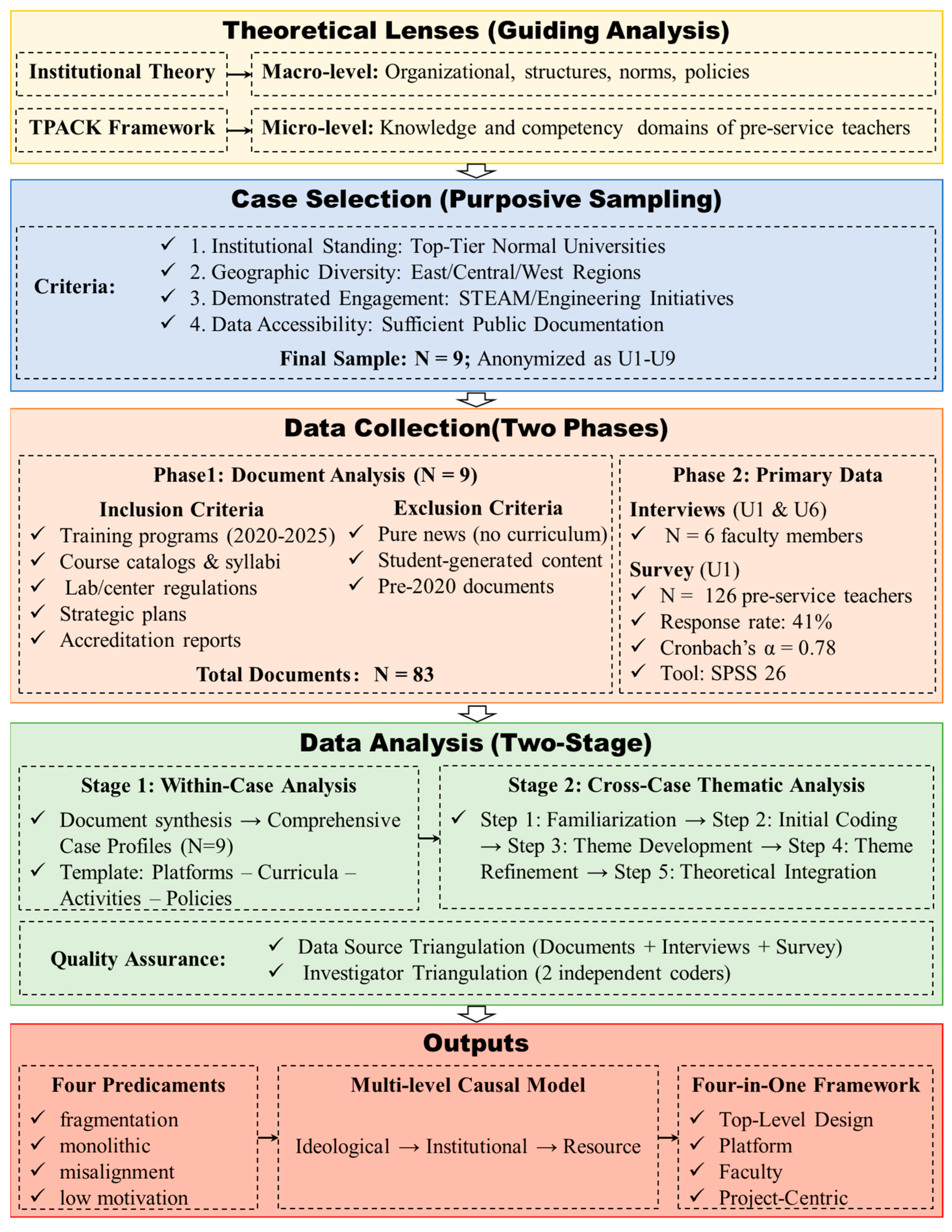
The overall research design is illustrated in
Figure 1, which shows how the theoretical lenses of Institutional Theory and TPACK guided the case selection, data collection, and multi-stage analytical process that culminates in the Four-in-One framework.
3.1. Case Selection
A purposive sampling strategy was employed based on four explicitly defined criteria (
Figure 1):
Institutional Standing: Universities classified as “Double First-Class” or key provincial universities in teacher education, ensuring a baseline level of resources and policy attention.
Geographic Diversity: Institutions were selected from six major economic regions of China (East, South, North, Central, Southwest) to capture regional variations in educational policy and industrial resources.
Demonstrated Engagement: Evidence of at least one laboratory, makerspace, or specialized course offering related to engineering/STEAM education in publicly available documents from 2020–2025.
Data Accessibility: Availability of comprehensive, publicly accessible online documents (strategic plans, course catalogs, laboratory regulations).
The final sample (U1–U9) includes six institutions from Eastern developed regions and three from Central/Western regions. Their annual education research budgets are relatively sufficient, representing a spectrum of well-resourced institutions. This selection explicitly focuses on leading universities; findings should not be generalized to other Chinese normal institutions without caution.
3.2. Data Collection
This study employed multiple data sources to triangulate findings. Data collection proceeded in two phases. For clarity, we first specify the unit of analysis. The primary unit of analysis is the institution-level engineering literacy cultivation system—the integrated set of policies, curricula, platforms, and activities a university has designed (explicitly or implicitly) for its pre-service teachers. Within each case (university), we examined multiple embedded sub-units: (a) formal curriculum (course catalogs), (b) extracurricular activities (workshops, competitions), (c) physical platforms (laboratories, makerspaces), and (d) institutional policies (strategic plans, credit requirements). Cross-case synthesis then focused on comparing these institution-level systems to identify common predicaments and patterns. The two phases of data collection are as follows.
3.2.1. Document Data Collection (Primary, Full Sample)
Document data constituted the primary data source for the cross-case analysis. Data were collected across four categories—physical platforms, curricular offerings, extracurricular activities, and institutional policies—by systematically searching official university websites from June to December 2025. The following inclusion and exclusion criteria were applied to ensure relevance and rigor:
Inclusion Criteria: Official training program documents and curriculum plans (2020–2025 academic years); laboratory/center regulations and operational guidelines issued by university administration; course syllabi and descriptions listed in official course catalogs; institutional strategic plans addressing teacher education reform or engineering/STEAM education; accreditation self-study reports containing information on practice-based learning facilities.
Exclusion Criteria: Pure news announcements or promotional materials lacking substantive curriculum detail; student-generated content (e.g., club activity reports without institutional endorsement); documents predating 2020 (to ensure currency with post-pandemic educational reforms); duplicate documents hosted across multiple sub-sites (only the most authoritative version retained).
Applying these criteria, a total of 83 documents were retained for analysis across the nine institutions.
3.2.2. Supplemental Interview and Survey Data (Sub-Sample for Depth)
To capture stakeholder perspectives not available in documents—particularly student motivation and faculty-perceived challenges—supplemental primary data were collected from a subset of the nine universities.
Interviews: Semi-structured interviews (see
Supplementary Materials) were conducted with 6 faculty members from U1 and U6. Participants included course instructors (
n = 2), makerspace/lab managers (
n = 2), and teacher education program coordinators (
n = 2). Interviews lasted 45–60 min, were conducted via video conference, recorded with consent, and transcribed verbatim.
Survey: An online questionnaire (see
Supplementary Materials) was administered to pre-service teachers at U1, yielding 126 valid responses (response rate: 41%). The survey measured perceptions of engineering literacy relevance, motivation, barriers, and self-assessed competence.
Given the exploratory nature of this study, the questionnaire was developed specifically for this research context. Content validity was established through expert review by three faculty members specializing in teacher education and engineering pedagogy. Internal consistency for the 12-item Likert scale was assessed using Cronbach’s alpha, yielding a coefficient of 0.78, indicating acceptable reliability for exploratory research (
Nunnally & Bernstein, 1994). We acknowledge that further psychometric validation with larger, more diverse samples is warranted.
Descriptive statistics were calculated using IBM SPSS Statistics (Version 25.0). Open-ended responses were thematically analyzed following the same five-step procedure described in
Section 3.3. These supplemental data are intended for triangulation and depth, not for statistical generalization to the full nine-university sample.
3.3. Data Analysis
Data analysis followed the two-phase approach depicted in
Figure 1, combining within-case and cross-case analysis (
R. K. Yin, 2018). Within-case analysis synthesized collected documents into comprehensive case profiles using the standardized template. Cross-case thematic analysis (
Braun & Clarke, 2021) followed the five-step process outlined in
Figure 1, with sample codes and theme development as summarized. The identified themes were further organized into a multi-level causal model.
To ensure transparent mapping between theoretical constructs and empirical evidence, each predicament was operationalized with specific indicators drawn from document analysis. Curriculum fragmentation was indicated by (a) no prerequisite requirements, (b) no mandatory credit core, and (c) stand-alone electives. Monolithic training models by (a) dominance of short-term/voluntary activities and (b) low participation rates. Resource misalignment by (a) equipment designed for engineering majors, (b) absence of K-12 materials, and (c) competition-focused orientation. Low student motivation by (a) low relevance scores (survey), (b) open-ended responses showing disconnect, and (c) absence of teaching-framing in course materials. These indicators guided the thematic analysis steps that follow.
The process of thematic analysis involved:
Step 1: Familiarization. Both researchers independently read all case profiles to gain an overall understanding of the data.
Step 2: Initial Coding. Open coding was conducted to label segments of text relevant to challenges, practices, or contextual factors. Codes were generated inductively from the data. A sample of initial codes included: “scattered course offerings,” “no credit requirements,” “equipment mismatch,” “low student interest,” “lack of engineering faculty,” “no cross-departmental coordination.”
Step 3: Theme Development. Codes were grouped into candidate themes through iterative discussion. For example, codes such as “scattered course offerings,” “no coherent curriculum sequence,” and “lack of compulsory courses” converged into the theme of “curriculum fragmentation.”
Step 4: Theme Refinement. Themes were reviewed against the original data to ensure they accurately reflected the case profiles. Disagreements between the two researchers were resolved through consensus, with a third researcher consulted when necessary.
Step 5: Theoretical Integration. The identified themes were further organized into a multi-level causal model, distinguishing between manifested predicaments and their underlying causes (multi-level causal model). The construction of the multi-level causal model followed the logic of explanation building in multiple-case study research (
R. Yin et al., 2018). The initial themes—four manifested predicaments and their potential antecedents—were iteratively compared across the nine cases to identify consistent causal patterns. We employed a theoretical replication strategy: when a specific antecedent (e.g., ideological ambiguity) was present in all cases exhibiting a particular predicament (e.g., curriculum fragmentation), and absent or attenuated in cases where the predicament was less severe, this strengthened our confidence in the posited causal link. The resulting cascade model—whereby ideological ambiguity undermines institutional commitment, which in turn constrains resource allocation, ultimately producing the observed predicaments—was further refined by mapping each level onto the three pillars of
Scott’s (
2013) institutional theory. This analytical move ensures that the model is both empirically grounded in the cross-case patterns and theoretically coherent.
To enhance trustworthiness, data source triangulation was achieved through multiple document types per case, and investigator triangulation was employed through independent coding and peer debriefing sessions. Two researchers independently coded all case profiles. Inter-coder reliability was assessed using Cohen’s Kappa on 20% of the data, yielding κ = 0.81. The final coding scheme with definitions and examples is provided in
Appendix B.
3.4. Trustworthiness
Several strategies were employed to ensure the trustworthiness of findings (
R. K. Yin, 2018):
Data Source Triangulation. Multiple types of documentary evidence (strategic plans, course catalogs, training program documents, center regulations) were collected for each case. For the sub-sample (U1 and U6), documentary evidence was triangulated with interview and survey data to corroborate emerging themes.
Investigator Triangulation. Two researchers independently coded all case profiles using the thematic analysis procedures described in
Section 3.3. Coding discrepancies were resolved through consensus discussion, with a third researcher consulted when agreement could not be reached. Regular peer debriefing sessions were conducted to challenge emerging interpretations and guard against confirmation bias.
Causal Model Validation. The multi-level causal model was subjected to two additional validation strategies. First, we conducted rival explanation analysis: for each proposed causal link (e.g., “ideological ambiguity → institutional deficiency”), we actively searched the case profiles for evidence of alternative explanations (e.g., cases where institutional deficiency existed without ideological ambiguity). No disconfirming pattern was found across the nine cases, strengthening the posited causal direction. Second, the model was cross-checked against the theoretical frameworks to ensure conceptual coherence between the empirically derived themes and the theoretical constructs adopted in the study. Any discrepancies were discussed and resolved within the research team.
4. Findings
This section presents the findings from the cross-case thematic analysis of the nine normal universities.
Table 2 provides a condensed cross-case comparison of the four predicaments across all nine institutions, synthesizing evidence from document analysis, interviews, and survey data. Severity ratings (High, Moderate, Low) are assigned based on triangulated evidence; where direct stakeholder data were unavailable, ratings are noted as limited or not assessed. The analysis reveals four interrelated predicaments that collectively characterize the current state of engineering literacy cultivation among pre-service teachers in China. These predicaments—curriculum fragmentation, monolithic training models, resource misalignment, and low student motivation—are not isolated phenomena but rather interconnected manifestations of deeper systemic issues. The following
Section 4.1,
Section 4.2,
Section 4.3 and
Section 4.4 elaborate on each predicament with detailed case evidence, while
Section 4.5 traces their underlying causes across ideological, institutional, and resource levels.
4.1. Curriculum Fragmentation: A Scattered Landscape
Analysis of curricular offerings across the nine universities revealed a pervasive pattern of fragmentation. Rather than forming a coherent, progressive sequence, engineering-related courses were predominantly offered as isolated general electives, extracurricular workshops, or short-term intensive training sessions. This fragmented configuration prevents students from developing the integrated knowledge and systematic thinking essential for engineering literacy.
At U2, courses such as “AIGC: Theory, Creation, and Challenges,” “Large Model Applications,” and “Future is Here: Intelligent Robot Development and Application” were available as standalone general electives. While these courses introduced students to cutting-edge technologies, they lacked prerequisite requirements, sequential progression, or articulation with subsequent advanced offerings. Similarly, U5 provided “Design Thinking and Innovation,” “Science, Technology, and Engineering Ethics,” and “STEM Teaching and Learning” as disconnected general education courses without a unifying curricular framework. U8 offered “Maker Education” and “Robotics Education” as electives, but these existed in isolation from foundational engineering concepts or pedagogical application courses.
The absence of a structured curriculum pathway—from foundational engineering concepts to advanced pedagogical applications—was evident across all cases. No institution in the sample had established a mandatory, credit-bearing curriculum sequence dedicated to engineering literacy. Courses were almost universally elective, with participation dependent on individual student interest rather than institutional requirement.
This fragmentation contrasts sharply with the systematic curriculum structures recommended in the engineering education literature.
Chen and Jin (
2023) emphasize the importance of modular course clusters that scaffold learning from foundational knowledge to integrated application. Similarly, international research on STEM teacher preparation highlights the necessity of coherent curriculum pathways that connect disciplinary content with pedagogical methods (
Kelley & Knowles, 2016;
Nadelson et al., 2013). The scattered offerings observed across Chinese normal universities fall short of these standards, undermining the cultivation of systematic thinking and design capabilities that are core to engineering literacy.
4.2. Monolithic Training Models: Shallow Engagement and Limited Reach
Beyond curriculum fragmentation, the analysis revealed a second predicament: the predominance of monolithic training models characterized by shallow engagement and limited student reach. Engineering literacy cultivation was primarily channeled through extracurricular activities, competitions, and short-term workshops—formats that, by their voluntary nature, fail to ensure universal exposure or systematic competency development.
Document analysis across the nine cases indicated that the most common cultivation activities included robotics competitions, maker fairs, 3D printing workshops, and summer camps. For instance, U1 organized extracurricular workshops on “3D Modeling and Design,” “UAV Flight Control and Data Acquisition,” and “Robot Programming and Control.” While these activities provided hands-on exposure to engineering technologies, their short duration (typically one to three days) limited opportunities for iterative design processes or deep engagement with engineering thinking.
U1 hosted a “Maker Education” summer program, but such intensive formats reached only a small subset of students. The participation scale for extracurricular activities across all universities was consistently limited, with enrollment caps typically ranging from 20 to 50 students per activity. Given total undergraduate enrollments in the tens of thousands at these institutions, the reach of such activities represents a fraction of the pre-service teacher population. The shallow engagement pattern was further corroborated by faculty interviews. One instructor at U1 commented on the competition-focused model: “The robotics competition team gets 80% of our lab resources, but that serves only about 20 highly motivated students. The rest of our pre-service teachers rarely step into the makerspace.”
When engineering-related content was incorporated into formal curricula, it often assumed superficial forms due to insufficient instructional time. U4 offered “IT Applications in Education” as a general elective, but the course allocated only two credit hours per week—insufficient for the hands-on, iterative trial-and-error processes that characterize authentic engineering practice. U6 provided “Integration of IT and Physics Teaching” as an elective, but the course focused primarily on theoretical discussions of technology integration rather than extended engineering design projects.
This pattern of shallow engagement reflects a fundamental tension between the nature of engineering learning and the constraints of traditional teacher education formats. Engineering literacy development requires sustained engagement with design problems, multiple cycles of prototyping and testing, and reflection on failure (
Dym et al., 2005;
Katehi et al., 2009). Short-term workshops and credit-limited courses, by their structure, cannot accommodate these pedagogical requirements. As a result, even when students participate in engineering-related activities, their learning often remains at the level of technical familiarity rather than deep competency development.
4.3. Resource Misalignment: Platforms and Equipment Detached from Pre-Service Teacher Needs
A third predicament emerged from the analysis of physical and curricular resources: a systematic misalignment between available platforms and the specific needs of pre-service teachers. Engineering training centers, makerspaces, and laboratories were often established with engineering majors as the primary target audience, resulting in equipment and projects that were either too advanced for pre-service teachers or irrelevant to their future teaching contexts.
Across the nine universities, patterns of platform construction varied considerably, yet a common theme of “misalignment” persisted. At U3, the Engineering Training Center was equipped with CNC machines, laser cutters, and industrial-grade manufacturing equipment. While these facilities served engineering majors well, the equipment’s complexity and scale made it difficult for pre-service teachers to engage meaningfully within limited course time. Moreover, the projects offered through the center—such as precision machining and thermal system analysis—bore little connection to the teaching scenarios pre-service teachers would encounter in K-12 classrooms.
Conversely, lightweight, modular equipment and project kits tailored for K-12 teaching contexts were notably scarce. U9 constructed a “Modern Engineering Training Center” that included 3D printing and laser cutting facilities, yet the center lacked age-appropriate materials, lesson plan templates, or project examples that pre-service teachers could directly adapt for their future students. U8 established a “Comprehensive Experimental Teaching Center for Liberal Arts,” but its focus on humanities and social science applications limited its relevance to engineering education. The case of U7 further illustrates the challenge of platform orientation. Its “Fashion Design and Engineering Practice Teaching Center” focused primarily on aesthetic education—handicrafts, makeup, and photography—rather than engineering practice. While serving fashion majors effectively, the center offered limited opportunities for pre-service teachers to engage with engineering design or technology-based projects. This case exemplifies the conceptual ambiguity identified at the ideological level: the inclusion of “engineering” in the platform name did not translate into meaningful engineering practice opportunities for the broader pre-service teacher population.
The functional orientation of these platforms further exacerbated the misalignment. In several cases, platforms were explicitly positioned as “competition incubators” rather than “inclusive teaching platforms.” At U3, the engineering training center prioritized support for student teams participating in national robotics competitions. While such competitions generate visible outcomes and institutional recognition, they concentrate resources on a small number of highly motivated students while leaving the broader pre-service teacher population underserved.
This resource misalignment has been documented in prior research on engineering education in teacher preparation contexts. Studies suggest that effective engineering literacy cultivation requires not only access to appropriate equipment but also carefully designed project libraries, curriculum resources, and pedagogical supports tailored to future teachers’ needs (
Cunningham & Carlsen, 2014;
Hsu et al., 2011). The absence of such resources in the cases examined represents a significant barrier to meaningful integration of engineering into teacher education.
4.4. Low Student Motivation: Perceived Irrelevance and Disconnect from Professional Scenarios
The fourth predicament identified in the analysis concerns student motivation: pre-service teachers frequently perceived engineering literacy as irrelevant to their professional identities and future careers. This perception, compounded by a disconnect between course content and authentic teaching scenarios, resulted in low intrinsic motivation and limited engagement with available learning opportunities.
Document analysis revealed a recurring theme of “perceived irrelevance.” Across course catalogs, activity descriptions, and institutional reports, there was little evidence of explicit framing that connected engineering literacy to pre-service teachers’ future roles. Students were rarely exposed to arguments about why engineering thinking matters for elementary science teaching, why design-based learning is relevant for subject instruction, or how engineering literacy supports the implementation of new curriculum standards. In the absence of such framing, students defaulted to conventional understandings of their professional identity—as future language, mathematics, or social studies teachers—for whom engineering appears peripheral.
While document analysis revealed the structural underpinnings of low motivation, primary data collected from the sub-sample provided direct empirical corroboration. A survey administered to pre-service teachers at U1 (N = 126) confirmed this perception quantitatively. When asked “How relevant is engineering literacy to your future teaching career?” on a 5-point scale (1 = not at all, 5 = extremely), the mean score was 2.1, with 68% of respondents selecting 1 or 2. Open-ended responses revealed recurring themes: “I’m an English major, why do I need to learn coding?” and “These workshops feel like a different world—they don’t show me how to use any of this in a primary school classroom.” These findings directly support the document-based inference of low motivation and highlight the critical gap between skill training and pedagogical application. Furthermore, the survey asked students to rank barriers to engagement (multiple choices allowed). The top three were: “Lack of clear connection to my subject area”, “Too technically difficult with no teaching context”, and “No credit or graduation requirement.”
Insights from faculty interviews at U1 and U6 reinforced these survey findings. Interviewees observed that students often view engineering-related activities as extracurricular hobbies rather than core professional development. One faculty member at U6 noted: “Students sign up for the robotics workshop because it sounds fun, but when we ask them to design a lesson plan around it, they lose interest. They don’t see the bridge to their future classroom.” This convergence of document analysis, survey data (U1), and interview data (U1 & U6) suggests that low motivation is a significant barrier where stakeholder perspectives were examined. While the survey data are limited to a single institution and cannot be generalized to the full nine-university sample, the consistency between the U1 findings and the broader document analysis suggests that the motivational deficit is likely not an isolated phenomenon but rather a systemic symptom of the curricular and resource misalignments described earlier.
4.5. Underlying Causes: A Multi-Level Causal Model
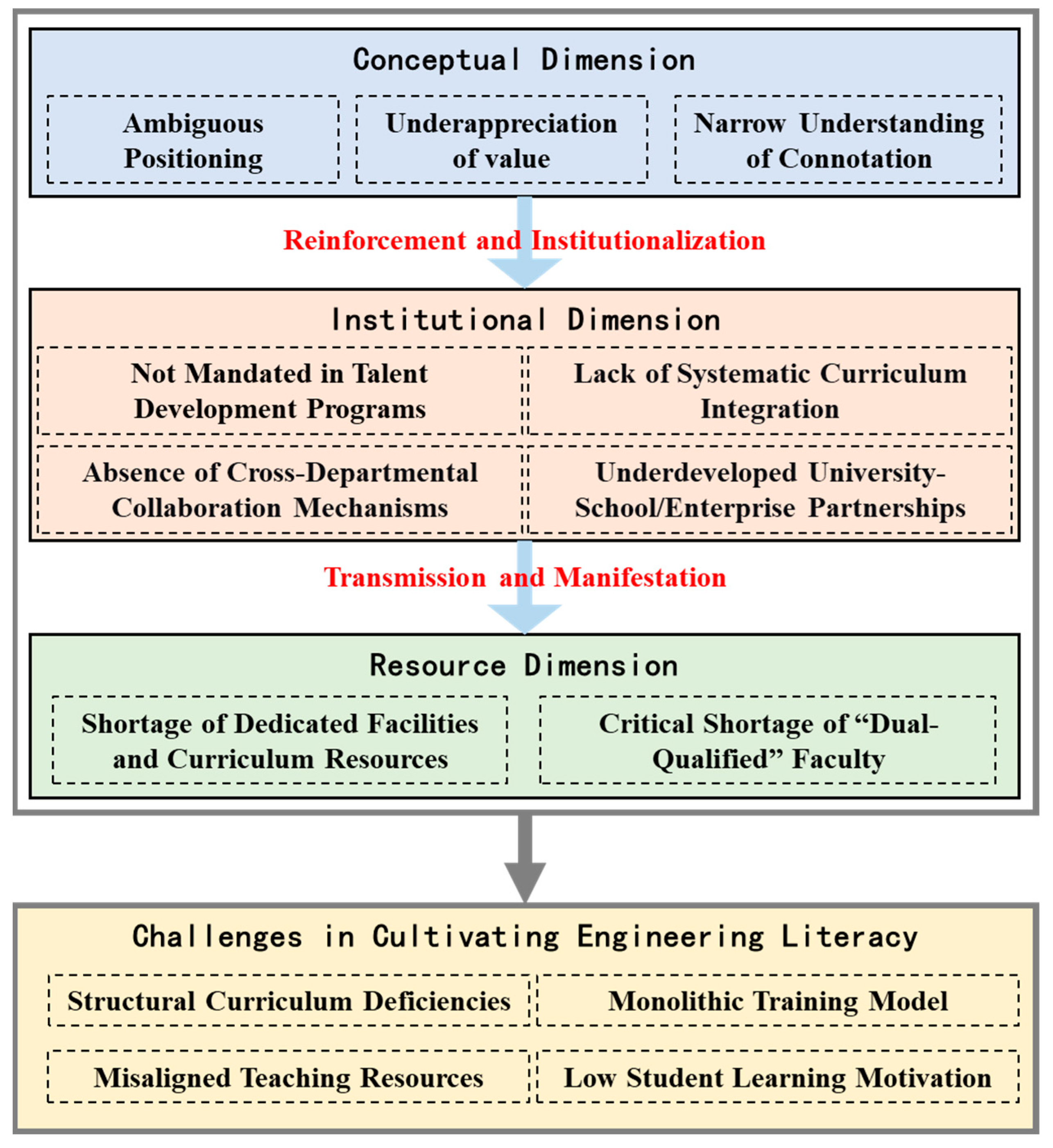
The four predicaments described above—curriculum fragmentation, monolithic training models, resource misalignment, and low student motivation—are not independent problems but rather manifestations of deeper systemic issues. Through iterative analysis, these issues were organized into a multi-level causal model (
Figure 2) that distinguishes between manifested predicaments and their underlying causes across ideological, institutional, and resource levels.
4.5.1. Ideological Level: Cognitive Ambiguity and Positioning Bias
At the ideological level, the analysis revealed a fundamental ambiguity regarding the purpose and positioning of engineering literacy cultivation. While policy documents and strategic plans occasionally referenced “innovation” and “interdisciplinary competencies,” there was little evidence of a shared, institution-wide understanding of what engineering literacy means for pre-service teachers and why it matters.
The core question—“Are we cultivating engineers or cultivating teachers who understand engineering?”—remained unresolved across all cases. When engineering literacy was discussed, it was often conflated with technical skill acquisition, such as learning to operate machinery or write code. This narrow interpretation neglects the broader dimensions of engineering literacy—systems thinking, design thinking, engineering ethics, and the ability to translate engineering concepts into effective instruction—that are most relevant for future teachers. This pattern of narrow conceptualization is not unique to the Chinese context;
Ginzburg et al. (
2025) similarly found that preservice teachers internationally tend to grasp engineering aims and methods while overlooking its social, ethical, and institutional dimensions.
This cognitive ambiguity translated directly into positioning bias. Without a clear conceptual framework, engineering literacy cultivation was treated as an “add-on” rather than a core competency. It appeared in strategic documents as an aspiration but was rarely embedded in graduation requirements, faculty evaluation systems, or resource allocation priorities. The absence of consensus on the value and meaning of engineering literacy for pre-service teachers left cultivation efforts vulnerable to individual interest and institutional whim.
4.5.2. Institutional Level: Absence of Top-Level Design and Collaborative Mechanisms
The ambiguity at the ideological level was institutionalized in the form of deficient top-level design and fragmented governance structures. Across the nine cases, engineering literacy cultivation was characterized by an absence of:
Mandatory curriculum requirements: No institution had embedded engineering literacy as a core competency in undergraduate training programs across all majors. The absence of credit requirements meant that cultivation activities remained elective and optional, with no institutional mechanism ensuring universal exposure.
Systematic curriculum frameworks: In the absence of top-level curriculum design, course offerings emerged in ad hoc fashion, driven by individual faculty interests or external funding opportunities. This resulted in the scattered, non-sequential course landscapes described in
Section 4.1.
Cross-departmental coordination mechanisms: Responsibility for engineering literacy cultivation was fragmented across colleges (education, science, engineering), administrative units (Academic Affairs Office, training centers), and extracurricular platforms. No institutional mechanism existed to coordinate curriculum planning, resource allocation, or faculty development across these units. As a result, efforts were duplicated in some areas while gaps remained in others.
University–school–enterprise partnerships: Sustainable collaboration models with K-12 schools and technology enterprises were notably absent. While some universities hosted occasional guest lectures or site visits, these interactions were episodic rather than systemic. This isolation from authentic educational contexts and technological frontiers limited the relevance of training content and the professional socialization of pre-service teachers.
These institutional deficiencies align with broader research on organizational change in higher education, which emphasizes that without formal structures and processes to support new initiatives, innovations remain peripheral and unsustainable (
Kezar & Eckel, 2002).
4.5.3. Resource Level: Dual Shortage of Dedicated Facilities and Dual-Qualified Faculty
The ideological and institutional deficiencies ultimately cascaded into tangible resource constraints, representing the most immediate barriers to effective cultivation.
Hardware and curriculum resource shortage: While several universities had constructed engineering training centers, these facilities were predominantly designed for engineering majors. Equipment configurations (CNC machines, industrial-grade manufacturing tools) and project libraries (precision machining, thermal system analysis) were ill-suited for pre-service teachers. Conversely, lightweight, modular equipment and project kits tailored for K-12 teaching scenarios—such as educational robotics, sensor-based inquiry kits, and design thinking materials—were consistently lacking across cases. Accompanying curriculum resources, including textbooks, project libraries, lesson plans, and assessment tools, were virtually non-existent.
Dual-qualified faculty shortage: The most critical resource constraint identified across all cases was the absence of faculty possessing both engineering competence and pedagogical expertise. Existing education faculty typically lacked engineering backgrounds, limiting their capacity to guide students through authentic engineering practice. Conversely, engineering faculty, while possessing technical expertise, were often unfamiliar with educational principles, the characteristics of pre-service teachers, or the contexts of K-12 education. Faculty with truly “dual” qualifications—able to integrate engineering practice with pedagogical transformation—were extremely rare.
This faculty shortage created a vicious cycle: even when universities recognized the need for engineering literacy cultivation and allocated resources for curriculum development, they lacked qualified personnel to design and deliver meaningful learning experiences. The shortage also perpetuated the shallow, skill-focused approaches documented in
Section 4.2, as faculty lacking pedagogical expertise naturally defaulted to teaching technical skills—the dimension of engineering literacy most familiar to them.
4.6. Summary of Findings
The cross-case analysis reveals that engineering literacy cultivation in leading Chinese normal universities is characterized by four interrelated predicaments: curriculum fragmentation, monolithic training models, resource misalignment, and low student motivation. These manifested challenges trace their origins to deeper issues at the ideological level (cognitive ambiguity and positioning bias), institutional level (absence of top-level design and collaborative mechanisms), and resource level (shortage of dedicated facilities and dual-qualified faculty). Together, these factors form a multi-level causal cascade (
Figure 2) in which ideological ambiguity undermines institutional commitment, which in turn constrains resource allocation, ultimately producing the observed predicaments in curriculum, training models, resources, and student engagement.
6. Four-in-One Framework
The multi-level causal model articulated in
Section 4.5 (
Figure 2) demonstrates that the observed predicaments are not discrete problems amenable to piecemeal solutions. Drawing on Institutional Theory (
Scott, 2013), the cascade from ideological ambiguity to institutional deficiency to resource scarcity indicates that sustainable change requires simultaneous intervention at multiple levels. Concurrently, the TPACK framework (
Mishra & Koehler, 2006) illuminates the specific knowledge deficit facing pre-service teachers: the absence of integrative Engineering Pedagogical Content Knowledge that bridges hands-on engineering practice with classroom application.
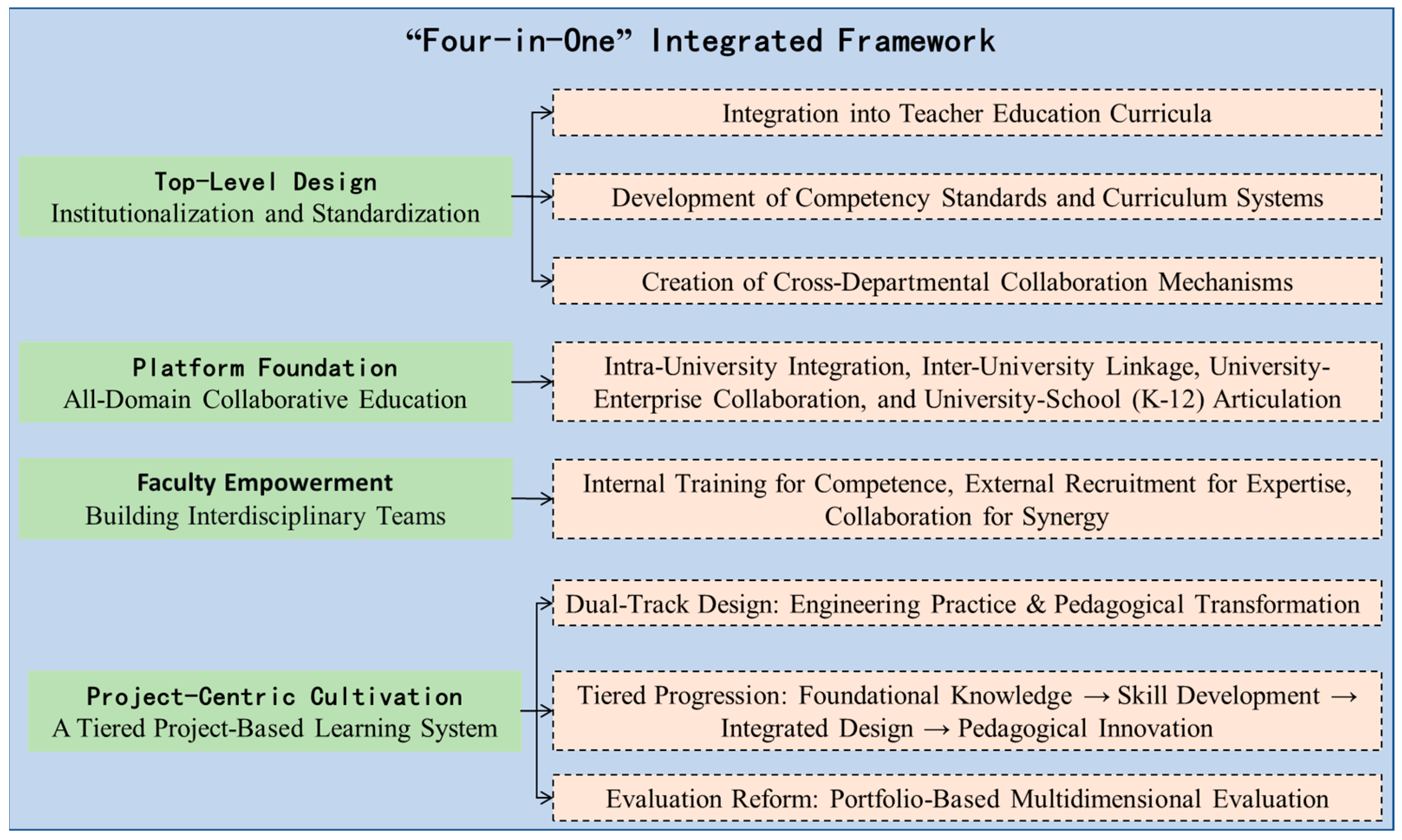
The proposed Four-in-One framework operationalizes these theoretical insights through four interdependent pillars. Drawing explicitly on
Scott’s (
2013) institutional theory, the framework is designed to intervene simultaneously across the three pillars of the institutional environment—regulative, normative, and cognitive-cultural—while also addressing the knowledge integration deficit highlighted by the TPACK framework.
Top-Level Design directly targets the regulative vacuum identified in the analysis. By establishing formal policies, competency standards, and mandatory credit requirements, this pillar creates the legal and administrative compulsion necessary for systemic adoption.
Platform Foundation and Faculty Empowerment jointly address the normative and cognitive-cultural dimensions. Building dedicated, teaching-oriented infrastructure (Platform Foundation) signals institutional commitment and reshapes expectations about what constitutes appropriate resources for teacher preparation (normative shift). Simultaneously, cultivating a corps of dual-qualified faculty (Faculty Empowerment) introduces new role models and expertise that gradually alter the taken-for-granted assumptions (cognitive–cultural shift) about who is qualified to teach engineering and what pre-service teachers are capable of learning.
Project-Centric Cultivation embodies the TPACK principle that integrated E-PCK develops through authentic, boundary-crossing practice. This pillar operationalizes the dual-track drive—engineering practice plus pedagogical transformation—which is the essential mechanism for translating institutional resources and faculty expertise into actual student competency.
The framework’s internal logic follows a sequential dependency informed by systems thinking principles: institutional commitment (Top-Level Design) enables resource integration (Platform Foundation), which, when combined with capable faculty (Faculty Empowerment), supports meaningful pedagogical practices (Project-Centric Cultivation) (
Figure 3).
6.1. Strengthen Top-Level Design: Promote the Institutionalization and Standardization of Engineering Literacy Cultivation
Targeting the core issues of ambiguous positioning and lack of top-level design, normal universities must elevate the cultivation of engineering literacy among their students to a strategic height within teacher education reform and provide institutional guarantees. This pillar directly addresses the regulative deficit identified through the institutional theory lens.
First, integrate into talent training programs. This represents a critical regulative intervention: Explicitly define engineering literacy as one of the core competency indicators for pre-service teachers’ graduation, include it in the training programs of all majors, and set corresponding credit requirements, institutionally ensuring its mandatory nature and universal coverage.
Second, develop competency standards and curriculum systems. It is recommended that normal universities directly under the Ministry of Education take the lead, jointly formulating “Competency Standards for Engineering Literacy of pre-service teachers” based on the core framework of “Cognition & Understanding—Thinking & Methods—Practical Abilities”. These standards should specify expected outcomes across three dimensions: cognition & understanding (engineering ethics, engineering culture, social value), thinking & methods (systems thinking, design thinking), and practical abilities (teaching design, hands-on operation). Guided by these standards, promote the systematic reconstruction of curriculum objectives, content, implementation, and evaluation (
Chen & Jin, 2023). Focus on constructing modular course clusters including “Engineering General Required Courses + Subject-Integrated Characteristic Courses + Project-Based Advanced Practice Courses”, forming a progressive, full-chain cultivation path. Establish diversified evaluation mechanisms, emphasizing the assessment of design thinking, problem-solving skills, teamwork, and the ability to integrate engineering into teaching design and implementation (e.g., model making, lesson plan preparation, project design, outcome presentation, teaching simulations).
Third, establish cross-departmental collaborative mechanisms. Form a special task force led by key university administrators, involving the Academic Affairs Office, Colleges of Education, Science/Engineering Departments, and Training Centers. This aims to break down administrative barriers and coordinate the planning of resource construction, curriculum development, and faculty allocation, ensuring policy implementation.
6.2. Consolidate the Platform Foundation: Build an Open, Collaborative, All-Domain Education Community
To address the issues of resource scarcity and fragmented management, it is necessary to break down closed systems and construct an open, shared “all-domain education community” featuring “intra-university integration, inter-university linkage, university-enterprise collaboration, and university-school articulation”.
Intra-university integration: Integrate dispersed laboratories and makerspace resources to build an “Engineering Literacy Training Center” for all pre-service teachers. Its functional orientation should shift from a “competition workshop” to an “inclusive teaching platform”, with equipment configured to be relevant to primary/secondary school teaching scenarios.
Inter-university linkage: Establish alliances with high-level engineering universities to share courses, faculty, and laboratory resources. Mitigate the inherent weakness of normal universities in engineering through mechanisms like credit mutual recognition and online courses.
University–enterprise collaboration: Co-establish laboratories and develop teaching project packages with educational technology companies and advanced manufacturing firms. Introduce cutting-edge technology cases and industry mentors, allowing normal students to engage with authentic engineering environments.
University–school articulation: Co-build “educational practice bases” with high-quality primary and secondary schools. Utilize the real needs of these schools in STEAM education and project-based learning as the source material for normal students’ engineering practice projects, ensuring training content is closely aligned with the realities of the K-12 classroom.
6.3. Strengthen Faculty Guarantees: Cultivate an “Engineering + Education” Composite Faculty Team
Targeting the biggest bottleneck—faculty shortage—it is imperative to innovate faculty development models, cultivating a composite teacher team through “training for empowerment, recruitment for energy injection, and collaboration for synergy”.
Internal Training—Empowerment: Establish a “Faculty Engineering Literacy Development Center” to provide systematic training in engineering thinking and skills for existing education faculty, subject teachers, and lab technicians. Select faculty for visiting studies or research at enterprises or engineering universities. Recognize teaching and research achievements related to engineering education integration in professional title evaluations and performance assessments.
External Recruitment—Energy Injection: Create fast-track channels to recruit talents with engineering backgrounds and a passion for education. Flexibly hire enterprise engineers or outstanding primary/secondary school science and technology instructors as part-time mentors, injecting practical experience.
Internal-External Collaboration—Synergy: Break disciplinary boundaries to form structured teaching teams composed of education faculty, subject-specialist teachers, engineering faculty, and external mentors (including outstanding K-12 teachers). Foster knowledge complementarity and capacity co-generation through collaborative lesson planning, team teaching, and joint project supervision.
6.4. Innovate Project Carriers: Create a Tiered Project System Aimed at “Pedagogical Transformation”
Addressing the issues of a monolithic training model and disconnection from the profession requires innovating the project-centric teaching model.
“Dual-Track” Design: All engineering project training follows a design logic where the “engineering practice track” and the “pedagogical transformation track” run in parallel. Normal students must not only complete the design and fabrication of an engineering project (engineering practice) but also transform it into a lesson plan, teaching materials, or a PBL case suitable for a specific grade level and subject (pedagogical transformation).
Tiered Progression: The project system should follow a progressive path of “Foundational Knowledge → Skill Development → Integrated Design → Pedagogical Innovation”. The output goal is to build a “micro-teaching case library embeddable in K-12 curricula”, which could serve as a significant form for graduation projects or academic achievements.
Evaluation Reform: Establish a portfolio-based evaluation mechanism. Comprehensively assess students’ engineering design process and outcomes, teaching design proposals, simulated teaching performance, and reflective reports to holistically measure their engineering practice and pedagogical transformation capabilities.
6.5. Conditions for Successful Implementation
The applicability of this framework depends on several contextual factors:
Institutional readiness: Universities must have basic infrastructure and faculty capacity to initiate the proposed reforms.
Leadership commitment: Sustained support from university leadership is critical for resource allocation and cross-departmental coordination.
Resource availability: Implementation requires dedicated funding for platform construction, faculty development, and curriculum development.
External partnerships: Collaboration with K-12 schools and technology enterprises enhances the authenticity and relevance of engineering practice projects.
Future research should empirically validate the framework through pilot implementation and longitudinal evaluation across diverse institutional contexts.
6.6. An Ongoing Pilot: Preliminary Feasibility Test
To assess the framework’s actionability, an exploratory pilot is underway at one case university (U1). Aligned with the Four-in-One pillars: (a) a 2-credit compulsory course has been mandated, with credit expansion contingent on outcome evaluation; (b) a course cluster of 10 engineering literacy courses has been established, adopting a “merit-based selection and iterative refinement” dynamic; (c) five specialized laboratories have been initially constructed and are undergoing phased expansion; (d) each course is supported by cross-disciplinary teaching teams, with faculty enhancing their competencies through autonomous learning and training.
This pilot does not yet provide efficacy data. It serves as a ‘
plausibility probe’—demonstrating that the framework can be translated into concrete, adaptive institutional actions. Formal empirical validation remains a future direction (see
Section 7.2).
7. Conclusions
7.1. Findings and Contributions
This study systematically examined the predicaments in cultivating engineering literacy among pre-service teachers in nine Chinese normal universities. Through a qualitative multiple-case analysis of nine institutions, the study reveals four interrelated challenges that characterize cultivation efforts within this institutional tier: curriculum fragmentation, monolithic training models, resource misalignment, and low student motivation. These predicaments, within the sample, trace their origins to deeper issues at the ideological level (cognitive ambiguity and positioning bias), institutional level (absence of top-level design and collaborative mechanisms), and resource level (shortage of dedicated facilities and dual-qualified faculty), forming a multi-level causal cascade.
Based on these findings, this research makes three contributions to the field. First, it provides a systematic empirical account of current practices and challenges in pre-service teacher engineering literacy cultivation among leading Chinese normal universities, addressing a significant gap in the literature on this specific institutional tier. Second, it develops a multi-level causal model that explicates the systemic origins of cultivation deficits, offering a theoretical framework for understanding similar challenges in other educational contexts. Third, it proposes a Four-in-One breakthrough framework that integrates top-level design, platform foundation, faculty empowerment, and project-centric cultivation, providing a practical roadmap for institutional reform pending empirical validation.
7.2. Limitations and Future Research
Several limitations of this study should be explicitly acknowledged.
Methodological Limitations. First, while document analysis was supplemented by interview and survey data, the primary data were collected from only a subset of institutions (U1 and U6). Selection bias is an inherent concern, as the sampled institutions were all leading normal universities with relatively stronger resource bases; the predicaments identified may be even more acute in less-resourced provincial normal colleges or comprehensive universities with teacher education programs. Second, the cross-sectional nature of data collection precludes analysis of temporal changes or the long-term effectiveness of initiatives currently in nascent stages. Consequently, the findings are directly applicable only to the nine Double First-Class normal universities studied. Generalization to other institutional types—including provincial normal colleges, comprehensive universities with teacher education programs, and normal universities without engineering mandates—would require separate empirical investigation. The study is best understood as an explanatory analysis that identifies causal mechanisms (ideological ambiguity → institutional deficiency → resource scarcity → manifested predicaments) within a defined institutional tier, not a descriptive claim of representativeness for all Chinese teacher education.
Conceptual and Empirical Limitations. The Four-in-One framework proposed in
Section 6 is a conceptual model grounded in qualitative synthesis and theoretical reasoning, not an empirically validated intervention protocol. The framework’s efficacy and generalizability require rigorous testing through pilot implementation and longitudinal evaluation.
Directions for Future Research. Building on these limitations, we propose the following priority directions: (1) Empirical validation of the Four-in-One framework through quasi-experimental or design-based research in diverse institutional contexts. (2) Instrument development and psychometric validation of a standardized assessment for pre-service teachers’ engineering literacy across the three dimensions articulated in our tripartite framework. (3) Expanded sampling to include provincial normal universities and comprehensive universities to examine institutional variation. (4) Longitudinal tracking of pre-service teacher cohorts into early career years to assess sustained impact on K-12 instructional practice.