1. Introduction
From 2022, generative artificial intelligence (GenAI) systems such as ChatGPT, Claude, and Gemini have entered schools more rapidly than most prior learning technologies (
Ogunleye et al., 2024). Teachers can now generate text, images, code, assessments, and lesson materials within seconds, creating real opportunities for differentiation and reducing routine workloads (
Aguilar et al., 2025). At the same time, GenAI increases uncertainty about academic integrity, misinformation, data privacy, and the erosion of student voice (
Gruenhagen et al., 2024;
Wang et al., 2024). Large-scale U.S. evidence collected by RAND Research, for example, suggests that AI use by students and teachers has increased quickly, while school and district guidance and professional development have lagged behind (
Doss et al., 2025). This gap places teachers in a familiar but intensified position: they must decide what counts as appropriate use, what should remain off-limits, and how to protect learning goals while acknowledging that GenAI is already part of students’ everyday digital environment.
Existing empirical research on AI in education has grown quickly. However, much of the early literature has centered on higher education, pre-service teachers, or single-country settings (
Yusuf et al., 2024). Reviews focused on K–12 settings emphasize that GenAI use is often teacher-mediated and involves “teacher-in-the-loop” work: teachers use the GenAI tools, filter outputs, evaluate accuracy, and redesign tasks to preserve instructional intent. Across studies, teachers report practical benefits (e.g., drafting materials, generating examples, supporting differentiation) alongside persistent concerns about cheating and deskilling. A key limitation of this emerging work is that “use” is frequently measured as a single behavior (e.g., “used AI for educational purposes”), even though classroom practices differ in visibility and accountability. This matters because teachers may experiment privately in planning long before they allow student-facing use.
When scholarship collapses these practices into one indicator, it becomes difficult to explain why teachers can be enthusiastic yet cautious, or why readiness can coexist with integrity concerns. Crucially, studies that have examined why teachers adopt or avoid AI tools point to belief-based explanations: teachers are more likely to integrate GenAI when they believe it will improve their instructional practice and when they feel capable of using it effectively (
Diliberti et al., 2024). These findings suggest that adoption is driven less by access to tools than by the confidence and outcome beliefs that teachers bring to them.
In parallel, a growing body of work argues that teachers and students need more than operational familiarity with AI tools; they require AI literacy that includes critical evaluation, ethical sense-making, and careful decision-making (
Daher, 2025;
Ocumpaugh et al., 2024,
2025). UNESCO’s AI Competency Framework for Teachers provides a globally oriented structure for assessing teachers’ capabilities in using GenAI and supporting ongoing professional learning (
UNESCO et al., 2024). Critically, these competencies are not purely individual: they are shaped by institutional support, such as access to tools, norms for acceptable use, professional learning opportunities, and policy guidance. Research on in-service teachers has consistently found that perceived institutional support operates as a key environmental condition, shaping not only what teachers believe they are permitted to do with AI, but also their confidence in doing so (
Doss et al., 2025).
Understanding that GenAI adoption operates within large educational ecosystems is especially important in international work. Cross-national comparisons remain limited, and studies often focus on a small number of countries. Yet K–12 teachers in diverse linguistic and policy contexts, including the United States, India, Qatar, Colombia, and the Philippines, face distinct constraints and opportunities. Without systematic cross-national qualitative evidence, it remains unclear whether widely cited narratives about GenAI in schooling, often derived from single-country or well-resourced educational systems, reflect a narrow set of contexts or broader patterns in how teachers navigate GenAI’s innovation and risk (
Xiu, 2024). The present study investigates how teachers across these five countries conceptualize, develop, and apply AI literacy, treating their beliefs and practices as meaningful signals of the structural supports and gaps that surround them.
1.1. AI Literacy Frameworks for K–12 Educators
AI literacy is “a set of competencies that enables individuals to critically evaluate AI technologies; communicate and collaborate effectively with AI; and use AI as a tool online, at home, and in the workplace” (
Long & Magerko, 2020). The framework is organized around five generative questions: What is AI? What can AI do? How does AI work? How should AI be used? And how do people perceive AI? Two dimensions are especially consequential for the present study. The “How does AI work?” and “How should AI be used?” questions draw a meaningful boundary between surface-level familiarity with AI tools and deeper conceptual understanding of their mechanisms, affordances, and limitations (
Ng et al., 2021). Educators with only surface familiarity may report confidence in AI use while remaining underprepared to evaluate outputs critically, recognize hallucination, or guide responsible student engagement (
Huynh et al., 2025).
Equally important for the present study is Long and Magerko’s “How do people perceive AI?” dimension. This question shifts attention from technical knowledge to interpretive meaning-making. It focuses on how educators understand and position AI within their professional contexts. Teachers’ perceptions are shaped by cultural norms, institutional expectations, language practices, and prior professional experiences. In cross-national settings, the same AI tool can be interpreted in very different ways. In some contexts, it may be seen as a threat. In others, it may function as a productivity aid, a pedagogical partner, or an ethical concern. These interpretations depend on local conditions rather than on the technology itself. This perception-oriented dimension connects directly to the belief structures that drive adoption: when the same AI tool is read as a threat in one context and a pedagogical partner in another, those readings shape the confidence and outcome expectations that determine whether integration occurs. Research consistently shows that teachers’ subjective beliefs about a technology (whether it is useful and whether they feel capable of using it) predict adoption more strongly than access alone (
Cheah et al., 2025). What teachers perceive about AI is itself culturally and institutionally produced.
More recent frameworks have extended these ideas specifically for K–12 educational contexts (
Casal-Otero et al., 2023). The TeachAI/OECD-European Commission AI Literacy Framework (
TeachAI et al., 2025) outlines competencies organized around four core domains: (1) engage with AI—understanding AI’s technical foundations and capabilities; (2) create with AI—leveraging AI systems to develop content; (3) manage AI—evaluating outputs for accuracy, bias, and appropriateness; and (4) design AI—developing AI systems to process and predict information. The framework emphasizes that “AI literacy empowers learners to understand AI and make decisions about its use in meaningful and ethical ways” and explicitly addresses the need for educator competencies that extend beyond student-facing instruction.
Furthermore, Digital Promise’s AI Literacy Framework (
Digital Promise, 2024) offers a complementary perspective, distinguishing between three modes of AI engagement: Interacting (using AI-powered systems for recommendations and decisions), Creating (leveraging AI to develop synthetic content), and Applying (developing AI systems for prediction and analysis). Critically, the framework positions “Evaluating AI” as the most essential component, encompassing technical evaluation, bias evaluation, ethics evaluation, and critical judgment. This emphasis on evaluation aligns with our interest in how teachers develop critical perspectives on AI tools rather than simply adopting them.
For teacher-specific competencies, UNESCO’s AI Competency Frameworks for Teachers and Students (2024) provide structured guidance, while the ETS (Educational Testing Service) research team (
UNESCO et al., 2024) has developed assessment frameworks grounded in social constructivist principles. Their approach emphasizes that AI literacy should be “taught through engagement, reflection, and contextually grounded dialogue,” recognizing that “AI tools and platforms are not neutral, but rather they shape and are shaped by learners’ experiences.” This theoretical grounding is particularly relevant to cross-cultural studies, as it suggests that teachers’ AI literacy development will necessarily vary with the social and institutional contexts in which they work.
1.2. Cross-Cultural Perspectives on Teacher Technology Adoption
Research on technology adoption in education has consistently found that cultural contexts shape teachers’ attitudes, behaviors, and implementation approaches.
Viberg et al. (
2025), surveying 508 K–12 teachers across six countries (Brazil, Israel, Japan, Norway, Sweden, USA), found that teachers’ trust in AI-based educational technology is influenced by Hofstede’s cultural value dimensions (including uncertainty avoidance, power distance, and collectivism versus individualism) and that individuals’ attitudes towards technology adoption differ considerably across national contexts. These findings reinforce a longstanding argument in educational technology research: that adoption frameworks developed in one national context cannot be assumed to transfer without calibration to local professional norms and institutional structures.
A particularly instructive example comes from a cross-cultural comparison of pre-service teachers in Turkey and the UAE (
Konca et al., 2025). That study applied the Technology Acceptance Model (TAM;
Davis et al., 1989) a widely used framework that identifies
perceived usefulness and
perceived ease of use as the two primary predictors of technology adoption to examine how teachers’ subjective beliefs drove their AI engagement across two national contexts. While TAM’s core constructs predicted adoption in both countries, the study found that self-efficacy, experience, and subjective norms weighted these constructs differently depending on country. This finding is significant for multi-national research: it suggests that the psychological mechanisms behind adoption are real and consistent, but that the conditions that activate or suppress them vary with cultural and institutional context.
The role of school support and resources has emerged as a critical mediating factor across multiple national contexts (
Diliberti et al., 2024;
Doss et al., 2025;
Molefi et al., 2024). Research on in-service teachers in Lesotho (
Molefi et al., 2024) found that school support and resources played a critical mediating role between teachers’ perceptions and AI acceptance. These findings point toward what social cognitive researchers (
Bandura, 2001) have described as the environmental dimension of behavioral change: that individual beliefs and institutional conditions are not independent but mutually reinforcing. Where schools actively model and endorse AI use, teachers are more likely to develop the self-efficacy and outcome expectations that drive sustained adoption; where institutional norms are absent or ambiguous, even motivated teachers may struggle to translate interest into practice.
1.3. Backstage and Frontstage AI Use in Teaching
A critical distinction that has emerged in the literature, though rarely theorized explicitly, is between teachers’ use of AI for instructional preparation (“backstage”) versus direct classroom instruction (“frontstage”) (
Gilmore, 2014). Survey data consistently shows that preparation uses dominate. A national Gallup-Walton Family Foundation survey (
Gallup & Walton Family Foundation, 2025) of U.S. K–12 teachers found that about 60% of educators used AI tools during the 2024–2025 school year. Among weekly users, the tasks most frequently reported included preparing lessons, making worksheets, and modifying instructional materials, while fewer teachers used AI for direct classroom instruction. This highlights a pattern of backstage use dominating frontstage application. Therefore, teachers tend to position AI as a “supportive tool” that reduces labor and generates ideas, rather than as a direct participant in instruction. This backstage orientation may reflect prudent caution about classroom risks, but it also raises questions about whether teachers are developing the competencies needed to guide students in direct AI engagement.
The concentration of AI use in backstage preparation contexts is not simply a matter of individual comfort or novelty. Emerging evidence suggests that structural and institutional factors actively constrain frontstage use.
Diliberti et al. (
2024)’s nationally representative survey of 1020 U.S. teachers found that the most common AI applications clustered around adapting instructional content and generating materials tasks that remain under the teacher’s individual control and require no classroom management, student privacy navigation, or real-time pedagogical judgment. A mixed-methods study of 89 U.S. teachers (
Cheah et al., 2025) similarly found that fewer than half incorporated AI into their actual educational practice, even among those who used it regularly for out-of-classroom tasks. These findings converge with qualitative evidence that teachers treat the classroom as a higher-stakes environment where the risks of AI error, student misuse, or pedagogical mismatch feel more consequential (
Doss et al., 2025).
Critically, this backstage orientation may also reflect a rational response to institutional ambiguity: where school policies on student AI use remain unclear, teachers may consciously limit frontstage integration to preserve their professional authority and avoid accountability concerns. From a TAM perspective (
Davis et al., 1989), this pattern is interpretable as a
perceived ease of use problem: classroom AI use imposes social, legal, and pedagogical demands that backstage use does not, reducing teachers’ subjective sense of competence and control in frontstage contexts. The implication for policy is significant: increasing frontstage use will require not only building teacher confidence but clarifying the institutional scaffolding and norms that make classroom AI use feel safe and pedagogically defensible.
2. Theoretical Framework
Understanding how teachers engage with generative AI across diverse national contexts require frameworks that can account for both individual psychological factors and the institutional environments in which of those factors operate. Two complementary frameworks guide our analysis: Social Cognitive Theory (SCT;
Bandura, 2001) and the Technology Acceptance Model (TAM;
Davis et al., 1989). Together, they provide an integrated account of why teacher AI adoption varies not only across individuals but across national systems and institutional contexts.
SCT positions behavior as a product of reciprocal interaction among three forces: personal factors (beliefs, self-efficacy, outcome expectations), behavioral patterns (actual practice and experimentation), and environmental conditions (institutional support, peer norms, policy context) (
Bandura, 2001). This principle of reciprocal determinism holds that these forces operate bidirectionally; teachers’ environments shape their confidence, but teachers also reshape those environments through experimentation and advocacy. Three SCT constructs are particularly consequential here. First, self-efficacy: teachers who feel confident in their ability to use AI are more likely to experiment, persist through difficulty, and exercise pedagogical judgment about when and how to use AI-generated outputs. Second, outcome expectations: teachers who believe AI will meaningfully improve learning are more likely to adopt it, while those who attribute AI’s effects to stable risks (such as inevitable plagiarism or creativity loss) may remain cautious even with access and support. Third, self-regulatory processes: teachers who set explicit professional goals around AI integration, monitor their own practice against those goals, and adjust based on observed outcomes are better positioned to move from passive tool use toward intentional competence development (
Bandura, 2001). Observational learning reinforces this trajectory: witnessing colleagues navigate AI integration successfully can strengthen vicarious self-efficacy and shape teachers’ own behavioral patterns in meaningful ways.
TAM complements this account by identifying two specific belief-based predictors of adoption: perceived usefulness (the degree to which teachers believe AI will enhance their practice) and perceived ease of use (their sense of competence and control when interacting with AI tools) (
Davis et al., 1989). Research applying TAM across national contexts has found that while these constructs consistently predict adoption, the conditions that activate or suppress them vary with cultural and institutional setting (
Konca et al., 2025). This is significant for the present study: it suggests that the same psychological mechanisms may produce divergent adoption patterns depending on the structural and cultural conditions teachers face.
Together, SCT and TAM provide an integrated account for interpreting how teachers across diverse national contexts engage with GenAI, not only in terms of what they do with it, but why they adopt, adapt, or resist it, and how their institutional surroundings shape these responses. This framing guides the following research questions:
RQ1: How do K–12 teachers in the United States, India, Qatar, Colombia, and the Philippines engage with generative AI in their teaching practice?
RQ2:What cross-national patterns emerge among teachers in five countries regarding their AI engagement?
RQ3: How do contextual factors shape the relationship between teachers’ AI adoption and AI literacy across national contexts?
3. Methodology
3.1. Participants
We used purposive, criterion-based sampling (
Olson, 2016) to recruit teachers who met predefined eligibility criteria relevant to the research questions. We recruited 26 K–12 teachers from five countries to participate in semi-structured interviews. Eligibility criteria included being over 18 and currently teaching in K–12 settings.
The sample comprised teachers from the United States (n = 7), India (n = 5), Qatar (n = 5), Colombia (n = 5), and the Philippines (n = 4). Teachers represented diverse training backgrounds, school contexts (public and private), and different subject areas. As details of teachers’ profile below, the Colombian teachers we recruited predominantly taught STEM subjects to upper grade levels (8th grade and above). Qatar’s sample included both elementary teachers and STEM teachers serving grades 9–12. Indian teachers predominantly taught grades 7 and above, including one teacher of foundational years. Philippine teachers primarily taught English to upper grades, with one biology teacher. The U.S. sample was most diverse, spanning kindergarten through 12th grade and subjects ranging from computer science to art history. All participants were assigned a unique identifier composed of their country acronym and a teacher number (e.g., CO–T1, QA–T2).
The selection of these five countries was theoretically motivated rather than random. The United States and Colombia represent Western Hemisphere contexts with distinct levels of institutional AI infrastructure; India and Qatar were selected as high-growth AI adoption contexts within South and Southwest Asia, respectively, with contrasting policy environments; and the Philippines was included as a Southeast Asian context with documented infrastructure constraints. This selection sought maximum variation in national context (
Patton, 2002) to surface how structural and cultural conditions shape teacher AI literacy across meaningfully distinct educational systems. Together, the five countries span four broad geographic and policy regions: the Western Hemisphere (United States, Colombia), South Asia (India), Southwest Asia (Qatar), and Southeast Asia (the Philippines), providing the cross-regional variation necessary to examine how structural and cultural conditions shape teacher AI literacy across meaningfully distinct educational systems. This geographic scope reflects the purposive logic of maximizing variation across regions that are comparatively underrepresented in the existing AI education literature; extending this comparative work to European and African contexts is an important direction for future research.
Participants were recruited through the WISE research network and author professional contacts in each country. Research assistants in each national context identified eligible teachers and extended invitations via email or institutional channels. Given the study’s focus on depth of understanding rather than statistical representation, we aimed for five participants per country as a pragmatic threshold consistent with interpretive qualitative research (
Creswell & Poth, 2018). The Philippines sample of four participants reflects recruitment constraints rather than a design decision; the four participants nonetheless provided rich and internally coherent accounts. We continued sampling until no substantially new codes emerged across successive interviews within each country, consistent with the principle of informational redundancy (
Guest et al., 2006).
Colombia (n = 5): Teachers represented diverse subject areas and grade levels, with most teaching STEM subjects and upper-grade levels (Grade 8 and above).
Qatar (n = 5): Teachers included those teaching elementary grades as well as STEM subjects at upper secondary levels (Grade 9 and above).
India (n = 5): Teachers predominantly taught upper-grade levels (Grade 7 and above), with one participant teaching foundational years.
Philippines (n = 4): Teachers primarily taught upper-grade levels, most commonly English, with one participant teaching biology.
United States (n = 7): Teachers represented a wide range of subject areas (e.g., general education, computer science, history, art history) and grade levels (kindergarten through Grade 9 and above).
3.2. Data Collection
The semi-structured interview protocol was designed to operationalize the study’s theoretical framework and research questions. Drawing on SCT’s triadic structure personal factors, behavioral patterns, and environmental conditions and TAM’s emphasis on perceived usefulness and ease of use, we organized the protocol into five sections: (1) background and teaching context; (2) understanding of AI literacy, targeting teachers’ self-efficacy beliefs and conceptualizations of AI competency; (3) use of generative AI tools during instructional preparation versus classroom teaching, capturing both backstage and frontstage behavioral patterns and perceived usefulness; (4) institutional context and country-specific policies, addressing the environmental conditions that SCT identifies as shaping adoption; and (5) reflections on the teacher’s role in fostering student AI literacy, eliciting outcome expectations about AI’s pedagogical impact. This structure allowed sufficient flexibility for participants and interviewers to engage in conversation while maintaining alignment with the research questions. To operationalize the distinction between backstage and frontstage AI use, the interview protocol included separate questions for each: participants were asked first about their use of generative AI in instructional preparation (e.g., drafting lesson plans, generating examples, creating assessments) and subsequently about whether and how they deployed AI tools during live classroom sessions or assigned AI-facing tasks to students. Coders applied the backstage label to accounts of teacher-only, pre-instructional AI use and the frontstage label to accounts of student-facing or in-class AI activities, consistent with Goffman’s distinction as adapted by
Gilmore (
2014). Each interview lasted 20–30 min and was conducted over Zoom during the summer and early fall of 2025. Interviews were conducted in English or Spanish by five research assistants, depending on participant preference.
3.3. Analytic Approach
Analysis followed a two-cycle coding process consistent with
Saldaña (
2021). In the first cycle, two coders independently applied open coding to all transcripts, generating initial codes directly from participants’ language and descriptions without imposing predetermined categories. Spanish-language interviews were translated prior to coding. To support analytic independence, coders conducted initial coding without access to country identifiers; participant identifiers (e.g., CO–T1) were revealed only after first-cycle codes were generated and recorded, ensuring that cross-national patterns were not inadvertently imposed during the inductive phase. This inductive process produced a provisional set of codes capturing the range of teachers’ experiences, beliefs, and practices related to generative AI. To enhance trustworthiness, the two coders then met in structured peer-debriefing sessions to review each transcript jointly, discuss sources of interpretive disagreement, and negotiate revisions to code definitions and assignments. Discrepancies were resolved through discussion until full consensus was reached on both the coding schema and its application across all transcripts (
Saldaña, 2021).
In the second cycle, we employed theoretical coding and thematic coding (
Saldaña, 2021) to organize the first-cycle codes into higher-order categories informed by the study’s theoretical framework. Theoretical coding, as
Saldaña (
2021) describes, involves integrating and synthesizing first-cycle codes by applying an overarching theoretical scheme that serves as an “umbrella” covering the analysis. Drawing on SCT and TAM, we grouped codes into six dimensions that reflect the theoretically motivated constructs outlined in the result section:
AI Integration (enacted behavioral patterns in instructional practice),
Literacy Development (self-efficacy and professional learning orientation toward AI competency),
Institutional Support (environmental conditions shaping adoption),
Ethical Awareness (outcome expectations regarding AI’s risks and responsible use),
Exploration Attitude (intrinsic motivation and willingness to experiment), and
Prompt Engineering Awareness (perceived ease of use and technical competency in AI interaction). A teacher was coded as demonstrating this dimension if they spontaneously described how they modified, refined, or strategically constructed the inputs they gave to AI tools. This included specifying things like instructional level, subject context, audience, or output format, or stating that output quality depends on input quality. Teachers who described using AI without reference to prompt construction, or who characterized AI as producing outputs independently of how they phrased their requests, were not coded as demonstrating this dimension. To enable systematic cross-country comparison, we calculated the percentage of teachers within each country sample who expressed each dimension, allowing us to visualize national patterns through radar charts that display all six dimensions simultaneously. To calculate each dimension score, we averaged the binary subcode scores (1 = present, 0 = absent) within each dimension across the two coders, then computed the proportion of teachers within each country who expressed the dimension.
3.4. Researcher Positionality
Reflexivity and researcher positionality are central to the trustworthiness of qualitative inquiry (
Lincoln & Guba, 1985). The research team comprises scholars based in the United States and Qatar, with varying degrees of familiarity with the five national contexts studied. Two team members have direct teaching experience in K–12 settings; others bring expertise in educational technology, learning analytics, and AI policy. None of the team members are K–12 teachers in the countries represented in this sample, which limits insider perspective but also reduces the risk of confirmation bias in data interpretation. Our theoretical commitments to SCT and TAM shaped the coding framework, and we acknowledge that other theoretical lenses might foreground different aspects of the data. To mitigate interpretive overreach, we prioritized participants’ own language in first-cycle coding, conducted peer debriefing across coders, and grounded all second-cycle theoretical coding in specific quotations rather than inferential summary.
4. Results
We present findings organized around the study’s three research questions.
Section 4.1 profiles each country’s AI engagement pattern (RQ1),
Section 4.2 identifies cross-national thematic patterns (RQ2), and
Section 4.3 examines how contextual factors shape the relationship between adoption and literacy (RQ3).
4.1. Country Profiles: How Teachers Engage with GenAI (RQ1)
To address RQ1, we constructed radar charts displaying each country’s profile across six theoretically derived dimensions: AI Integration, Literacy Development, Institutional Support, Ethical Awareness, Exploration Attitude, and Prompt Engineering Awareness. Values represent the percentage of teachers within each country sample who expressed the dimension. The full coding framework, including sub-codes, operational definitions, and exemplar quotes for each dimension, is presented in
Appendix A. These profiles reveal that teachers across all five countries are actively engaging with generative AI, but the shape of that engagement, which dimensions are strongest and weakest, varies markedly by national context.
4.1.1. United States
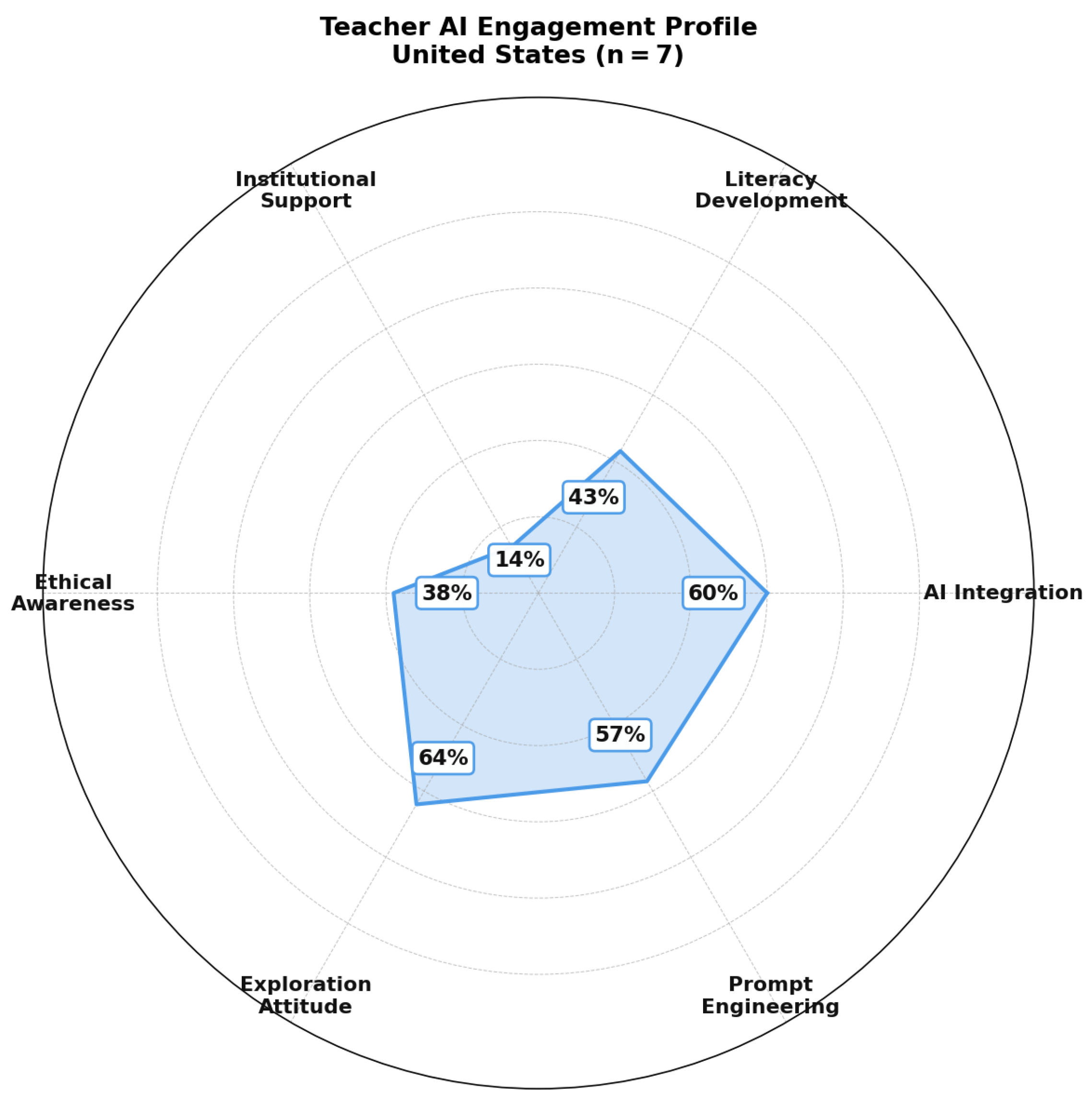
The seven U.S. teachers demonstrated strong backstage AI integration alongside a severe deficit in institutional support, producing a profile best characterized as cautious individual navigation (
Figure 1). Most teachers (6 of 7, 86%) used AI for lesson planning and described actively filtering AI outputs through their pedagogical expertise. This filtering was not passive acceptance but deliberate professional judgment. A history teacher (US–T1, Grades 6–12) described the necessity of disciplinary adaptation: “For our discipline, it’s not any assignment. It’s a history assignment. There always has to be tweaking with whatever AI creates.” A math teacher (US–T7, Grade 5) articulated a complementary division of labor: “The big lesson plan and the overall structure I would still do myself. But the details … I will try to use AI to help either save me time or generate new ideas.” These accounts suggest that U.S. teachers positioned AI as a starting point for professional judgment rather than a replacement for it.
The most distinctive feature of the U.S. profile is the near-absence of institutional support: only 14% (1 of 7) reported school-level backing for AI use the second-lowest rate after the Philippines (0%). This absence coexisted with external pressure to adopt. Two teachers at the same school described being pushed by administrators and parents: “That’s what admin wants to hear, that’s what parents want to hear … all these stakeholders are worried that their kids don’t know how to use AI” (US–T3, Computer Science, Grades 6–12). This tension, pressure to adopt without support to do so thoughtfully, distinguished the U.S. context from other countries in our sample.
Despite limited support, most U.S. teachers (6 of 7, 86%) expressed enthusiasm for exploring AI tools, though their orientation was more tempered than the universal enthusiasm observed in Colombia, Qatar, and the Philippines (all 100%). Teachers described proceeding carefully within self-imposed boundaries. A kindergarten teacher (US–T5) captured this measured openness: “I’m so open … I want to learn more … I’ve tried ChatGPT and DeepSeek … sometimes Perplexity. It’s helpful.” A computer science teacher (US–T3) described cherry-picking from AI suggestions rather than wholesale adoption: “It’s just great for generating ideas, and then I can sort of cherry-pick.”
Approximately 57% (4 of 7) demonstrated prompt engineering awareness, and 43% (3 of 7) reported teaching AI literacy to students, moderate rates that fell considerably below Colombia and the Philippines (both 100%) but exceeded India (20%). Ethical engagement was similarly moderate (57%, 4 of 7), with teachers who did raise concerns focusing primarily on source verification rather than the broader ethical reflections observed in Colombia and the Philippines. The U.S. profile suggests that teachers would benefit from professional development addressing both technical competencies and pedagogical frameworks for teaching students to engage critically with AI-generated content.
4.1.2. India
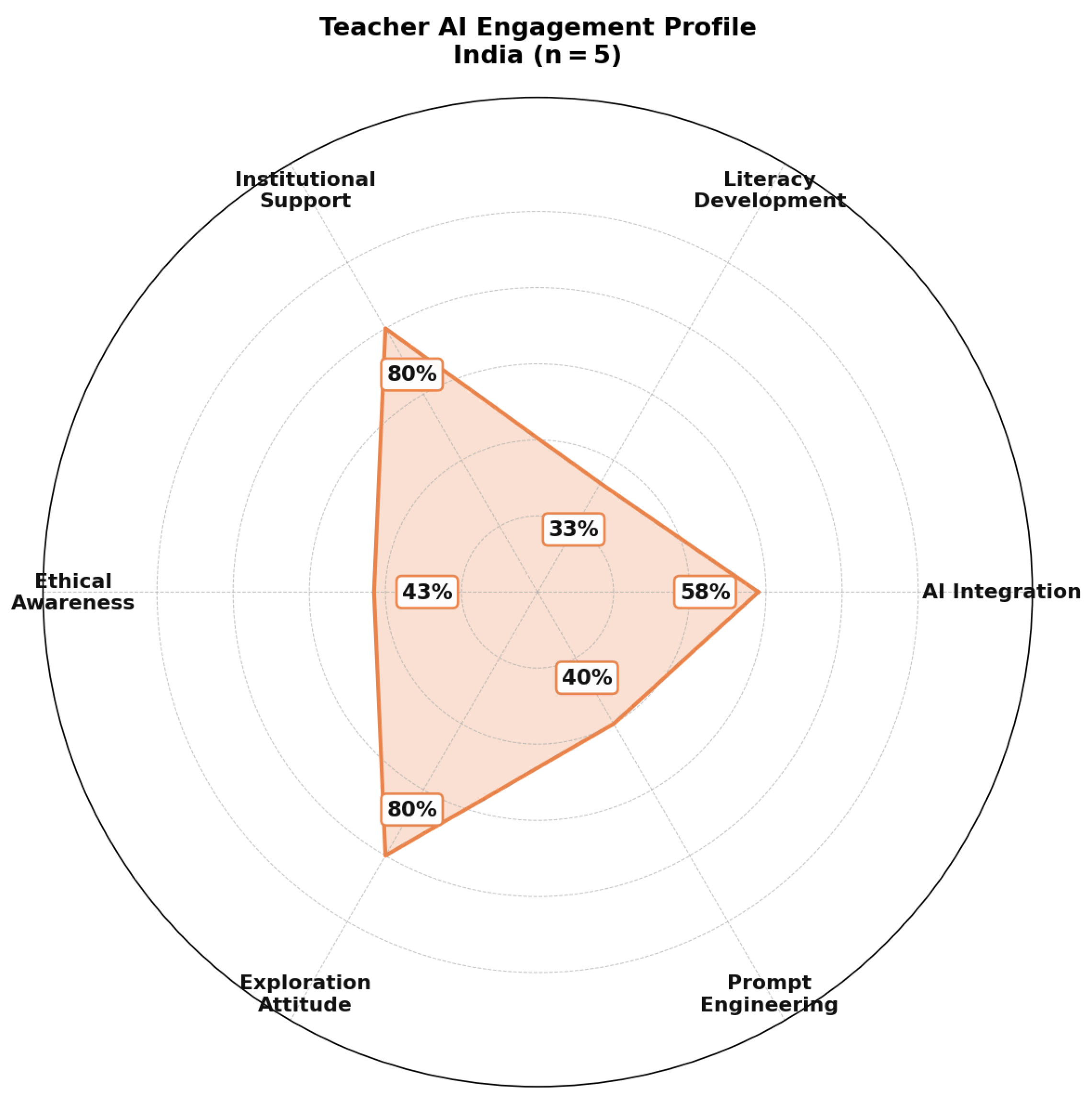
The five Indian teachers presented a distinctive triangular profile: strong peaks in institutional support and exploration attitude alongside a notable valley in prompt engineering awareness (
Figure 2).
India reported the second-highest institutional support in our sample (80%, 4 of 5), exceeded only by Qatar. Schools provided structured professional development, formal certifications, and ongoing training. One English teacher explained: “We are all certified Gemini teachers. We are all certified, you know, and into a lot of AI tools because the school keeps on upgrading us” (IN–T5, English as a Second Language, Grades 9–12). This collective approach created a professional environment in which AI use was a normalized practice: Indian teachers were the only national sample reporting zero colleague resistance to AI.
Despite this institutional backing, only 20% (1 of 5) demonstrated prompt engineering awareness, the lowest rate in our sample and dramatically below Colombia and the Philippines (both 100%). This gap is particularly striking because it coexisted with high institutional support and universal enthusiasm: all five Indian teachers expressed that AI functions as a supportive tool rather than a replacement for professional judgment. One computer science teacher stated: “I can’t say that the teachers are vanishing from the classroom, right? AI is just a support for us to make our teaching and learning more effective” (IN–T1, Computer Science, Grades 9–12). This pattern of supported but surface-level integration suggests that institutional professional development programs may emphasize tool access and general familiarity over the specific competencies required for effective AI use.
4.1.3. Qatar
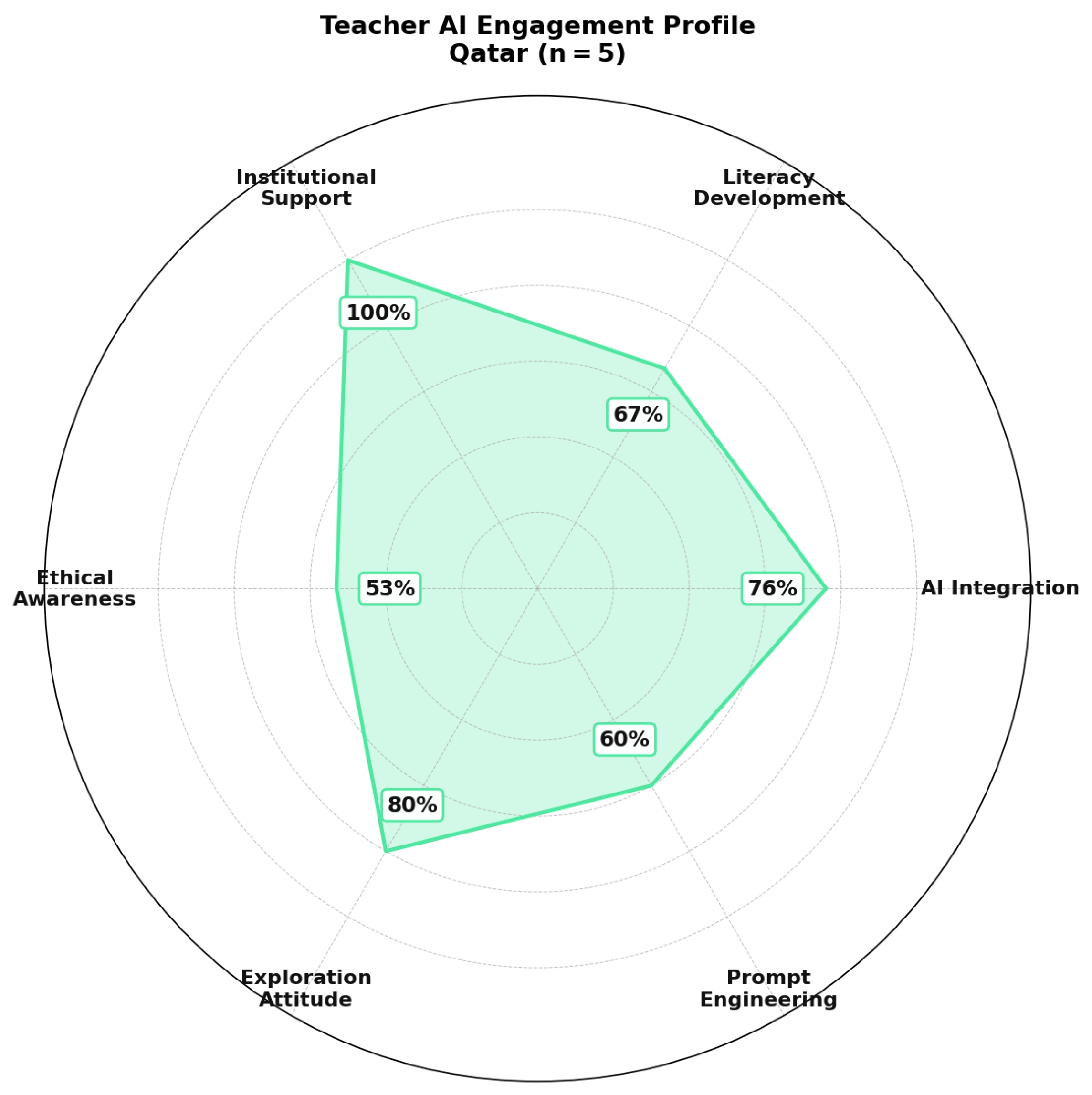
The five Qatari teachers produced the most balanced hexagonal profile in our sample, reflecting comprehensive, policy-driven AI integration (
Figure 3).
Qatar reported the highest institutional support (100%, 5 of 5). Teachers described operating within explicit organizational frameworks aligned with national educational transformation agendas. One physics teacher explained: “There are guidelines … the school is embracing AI … even QF [Qatar Foundation] wants to introduce AI in learning” (QA–T5, Physics, Grades 10–12). All five Qatari teachers used AI for lesson planning and described re-evaluating their teaching practices since AI’s emergence.
The profile’s balance was notable: moderate-to-high scores across all six dimensions, without the dramatic peaks and valleys observed in other countries. However, moderate prompt engineering awareness (60%, 3 of 5) suggests that even comprehensive institutional frameworks do not automatically produce sophisticated technical competencies, a pattern consistent with India’s profile and one that carries important implications for professional development design.
4.1.4. Colombia
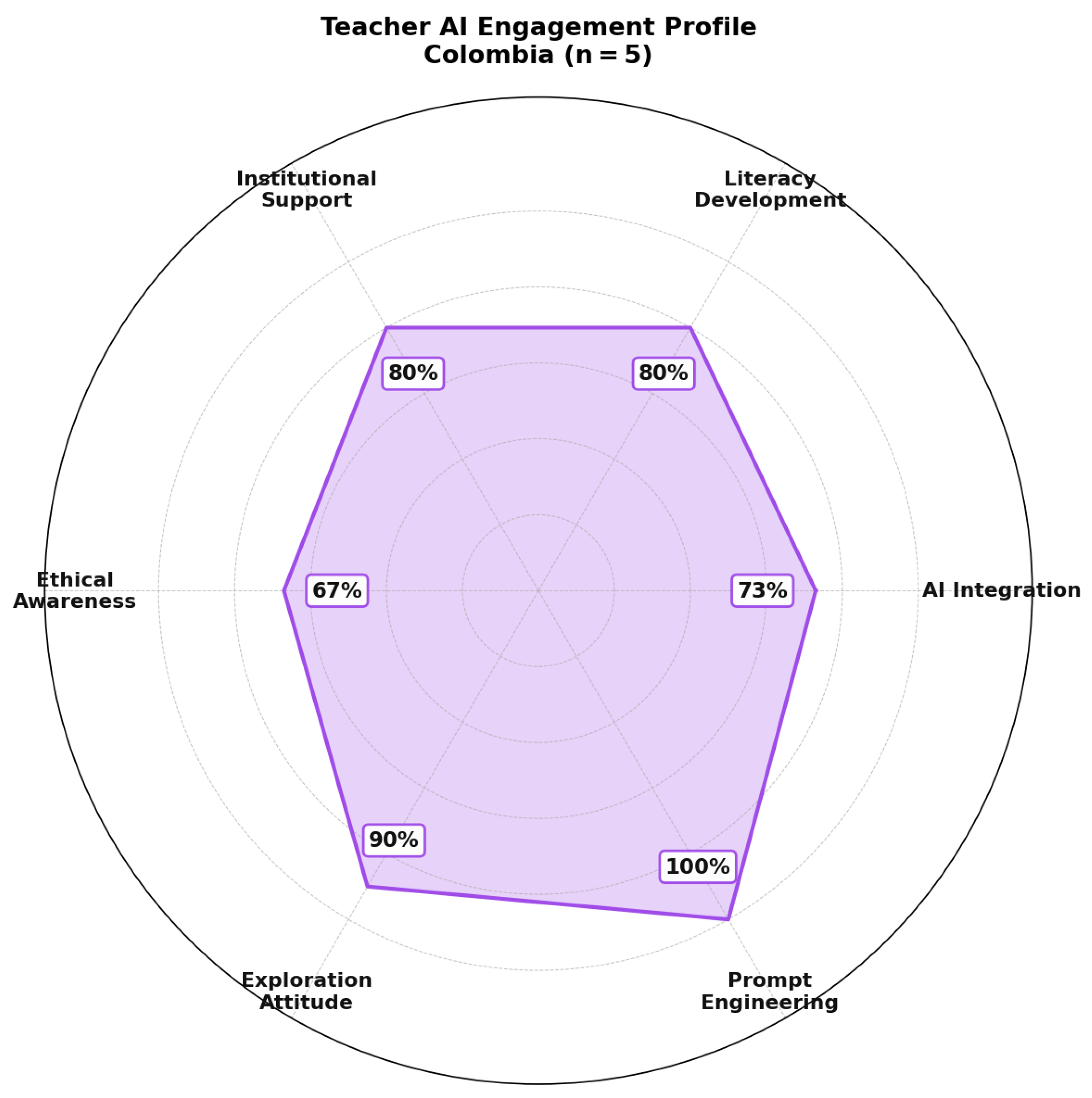
The five Colombian teachers demonstrated pronounced peaks in Prompt Engineering and Exploration Attitude, reflecting an innovation-drivenapproach to AI adoption (
Figure 4).
All five Colombian teachers (100%) demonstrated prompt engineering awareness, articulating detailed understanding of how prompt construction affects output quality. A mathematics teacher provided an instructive explanation: “We must understand that AI works through prompting, knowing how to ask the right questions for it to give me from that question what I actually want. It’s not enough to say, ‘help me plan a technology class.’ You must provide context: What do I want to achieve? How many students? Group or individual work? What topic?” (CO–T1, Math & Technology, Grades 10–11). All five Colombian teachers also reported student-facing AI projects (100%), moving AI from backstage preparation to frontstage student engagement. Despite high colleague resistance (80%, 4 of 5), these teachers functioned as innovators within professional communities where adoption remained uneven. Their success through self-directed learning positions them as among the most advanced AI practitioners in our sample.
4.1.5. Philippines
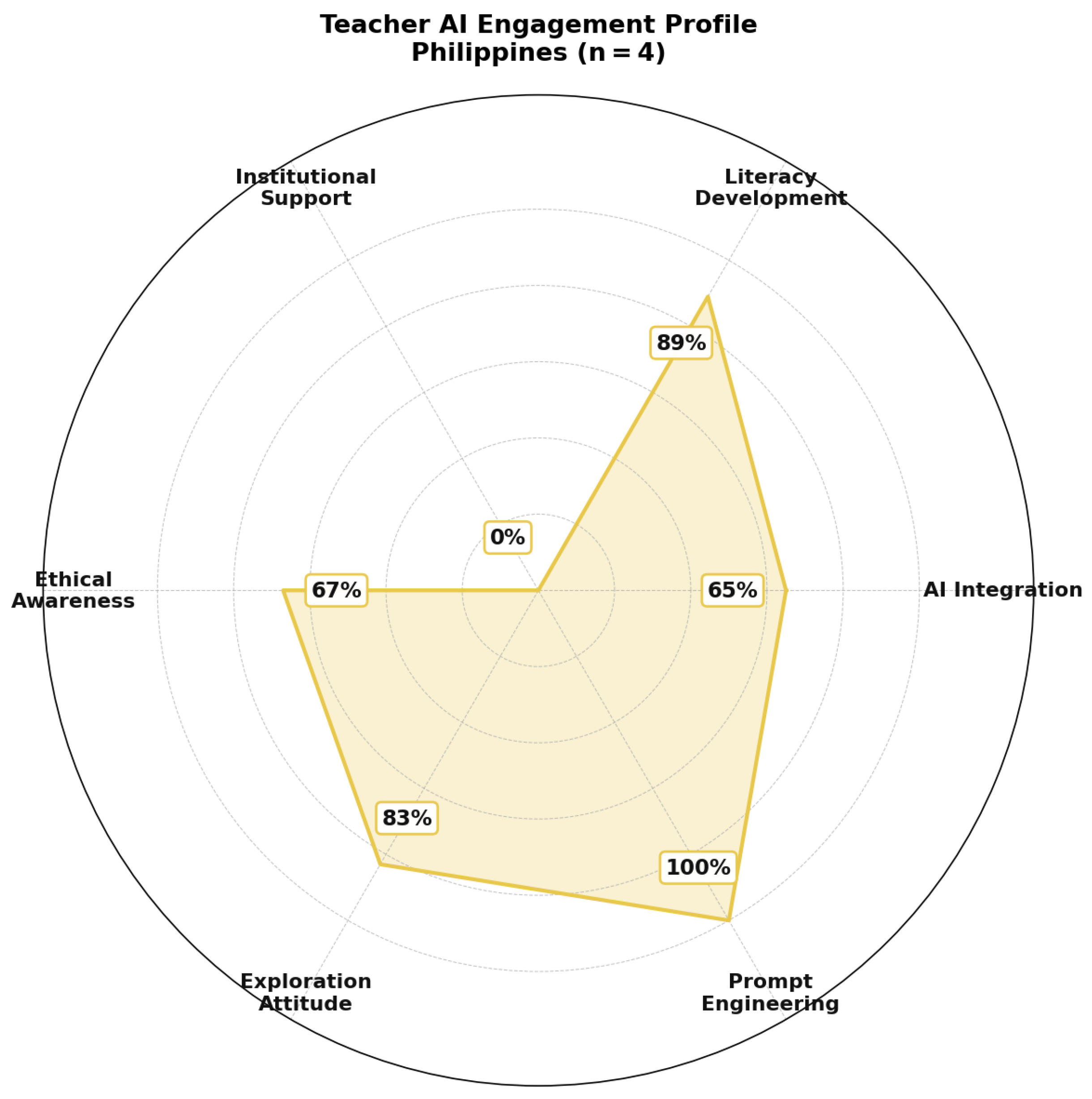
The four Filipino teachers produced the most asymmetric profile: high performance across five dimensions contrasted with zero institutional support, the most pronounced example of a support-literacy paradox in our sample (
Figure 5).
None of the four Filipino teachers reported school-level support for AI use. Teachers described fundamental infrastructure limitations: “In our school, since I work in a public school, we didn’t have access with Internet connection … we’re limited to the offline services only. But with regard also to the hardware, we have limited computers” (PH–T1, Biology, Grade 8). Despite these constraints, all four Filipino teachers achieved the highest or tied-highest scores on prompt engineering awareness (100%), ethical reflection (100%), and pedagogical balancing (100%). One English teacher explained the prompt engineering skill: “I discovered that when I use proper prompts, it provides me better information. When I provide more specific questions or instructions, the AI provides me more improved outputs” (PH–T3, English, Grades 11–12). Another teacher framed this understanding inversely: “Whenever we use the prompts, if we use not so intelligent prompts, it will also give you non-intelligent discussions or answers” (PH–T1). This bidirectional reasoning indicates sophisticated mental models of AI system behavior that appear to have developed through necessity rather than formal training, a finding with significant theoretical implications.
4.2. Exploratory Cross-National Patterns in AI Engagement (RQ2)
To address RQ2, we compared dimension scores across countries to identify convergent and divergent patterns. Four cross-national patterns appear.
4.2.1. AI Integration: Universal Backstage Use, Divergent Frontstage Practice
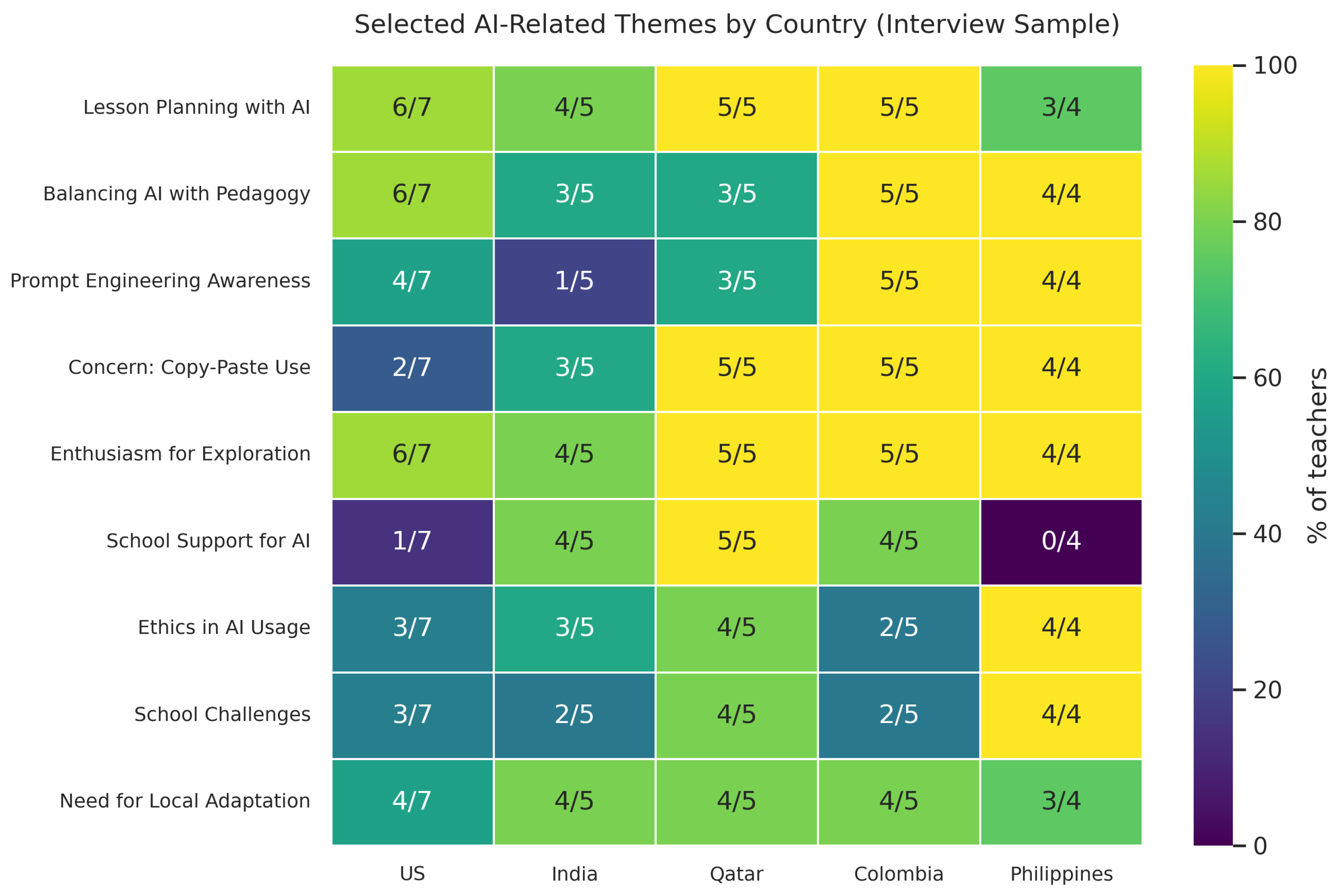
Based on these exploratory data, lesson planning with AI was near-universal across all five countries (ranging from 75% in the Philippines to 100% in Qatar and Colombia), suggesting that backstage AI use may be becoming a normalized professional practice across diverse educational systems, as shown in
Figure 6. Teachers across contexts described AI as reducing routine workloads and generating ideas that they then adapted through professional judgment.
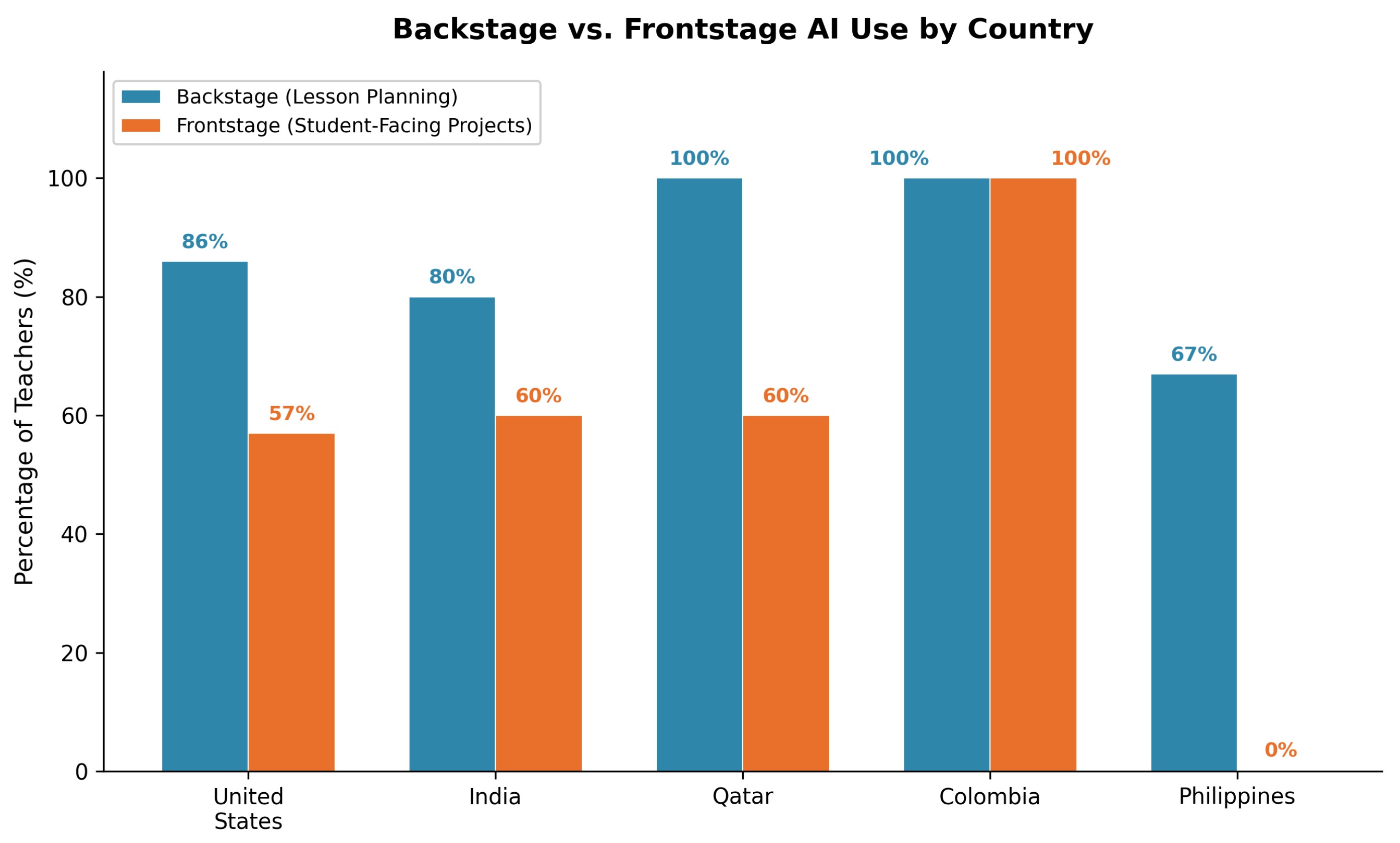
However, the transition from backstage preparation to frontstage classroom application varied substantially. As shown in
Figure 7, Colombia reported the highest rate of student-facing real-world AI projects (100%), followed by India and Qatar (both 60%), and the United States (57%). The Philippines reported no student-facing projects, a pattern attributable to infrastructure constraints rather than pedagogical reluctance. This divergence tentatively suggests that while teachers across countries have adopted AI for personal productivity, the move toward student-facing integration may depend heavily on institutional scaffolding, infrastructure, and policy clarity, factors that differ substantially across national contexts in this exploratory sample. From a Social Cognitive Theory perspective, this pattern is consistent with the proposition that environmental conditions shape behavioral enactment: backstage use, which requires only individual agency, was near-universal, whereas frontstage integration, which requires institutional enabling conditions, remained contingent on the broader organizational and infrastructural context.
4.2.2. Prompt Engineering as a Critical Differentiator
One of the study’s most consequential exploratory findings concerns the distribution of prompt engineering awareness across countries. Within this small sample, Colombia (100%, 5 of 5) and the Philippines (100%, 4 of 4) demonstrated universal recognition that effective AI use requires crafting specific, contextualized prompts. The United States (57%, 4 of 7) and Qatar (60%, 3 of 5) showed moderate awareness. India (20%, 1 of 5) reported the lowest rate.
This distribution does not follow the pattern one might expect from institutional investment. India’s low prompt engineering awareness (1 of 5, 20%) coexisted with the second-highest institutional support (80%, 4 of 5), while the Philippines’ universal awareness (4 of 4, 100%) developed without any institutional backing (0%). The asymmetry tentatively suggests that prompt engineering competency may develop more readily through self-directed, necessity-driven engagement than through formal professional development that emphasizes tool access over interaction quality, though this pattern requires replication with larger samples. Colombian teachers’ detailed articulations of prompting as pedagogical reasoning, translating instructional goals into language that AI systems can process, further suggest that this competency occupies a distinct skill domain that current training models may not adequately address. This pattern complicates TAM’s assumption that perceived ease of use is primarily a function of system design: the data suggest that ease of use may be more accurately understood as a competency acquired through sustained, self-directed practice, rather than a property conferred by the technology itself.
4.2.3. Ethical Awareness and the Copy-Paste Concern
Concern about students copying and pasting AI-generated content was near- universal in Qatar (100%, 5 of 5), Colombia (100%, 5 of 5), and the Philippines (100%, 4 of 4), moderate in India (60%, 3 of 5), and notably lower in the United States (29%, 2 of 7). This variation is particularly interesting in light of the broader ethical engagement patterns: within this exploratory sample, the Philippines and Colombia showed the highest rates of ethical reflection (both 100%), while the United States (57%, 4 of 7) and India (60%, 3 of 5) showed lower engagement.
Two qualitatively different forms of ethical engagement emerged across contexts. In Colombia and the Philippines, teachers described reflexive ethical reasoning, internal deliberation about their own relationship to AI. A Colombian teacher articulated: “Deep down there’s also a bit of internal conflict, because there’s an ethical perspective you wonder, up to what point should I rely on this?” (CO–T2). A Filipino teacher described actively teaching ethics as concrete practices: “I have also started on teaching them how to use AI ethically by not claiming what they have been writing, by citing resources, and also by checking out if the information that they do have are really correct” (PH–T1). By contrast, in Qatar and India, ethical engagement focused more on policy compliance and institutional guidelines. This distinction suggests that the source of ethical reasoning, whether internally generated or institutionally prescribed, may differ with context, even when overall ethical awareness rates appear similar. Within SCT’s framework, this divergence maps onto the distinction between self-regulatory processes grounded in personal outcome expectations and normative compliance driven by externally defined standards; the former may produce more durable ethical reasoning than the latter, though the present data do not permit causal inference on this point.
4.2.4. Exploration Attitudes and the “Tool, Not Replacement” Framing
Enthusiasm for exploring AI was high across all five countries in this sample, though with notable variation. Qatar (100%, 5 of 5), Colombia (100%, 5 of 5), and the Philippines (100%, 4 of 4) showed universal enthusiasm, while India (80%, 4 of 5) and the United States (86%, 6 of 7) were slightly more tempered. Across countries, a dominant framing positioned AI as “a tool, not a replacement” a phrase appearing almost verbatim across contexts. This shared framing served an important professional function: it preserved teachers’ sense of agency and expertise while permitting engagement with a technology that some perceived as potentially threatening.
The U.S. context stood apart in that exploration was more often described as a response to external pressure than intrinsic professional motivation. While Filipino and Colombian teachers’ enthusiasm was self-generated and persisted despite institutional absence, U.S. teachers described navigating between stakeholder expectations and personal caution, a dynamic that may produce compliance-oriented adoption rather than the deep engagement observed elsewhere. This distinction aligns with TAM’s differentiation between intrinsic perceived usefulness, grounded in the individual’s own assessment of instrumental value, and adoption motivated primarily by subjective norm or social pressure; the latter may be less likely to sustain the ongoing experimentation through which deeper AI literacy develops.
4.3. Contextual Factors Shaping Adoption and Literacy (RQ3)
RQ3 asked how contextual factors shape the relationship between teachers’ AI adoption and AI literacy across national contexts. Two cross-cutting findings emerged that challenge conventional assumptions about how institutional conditions relate to teacher competency development.
4.3.1. The Institutional Support Paradox
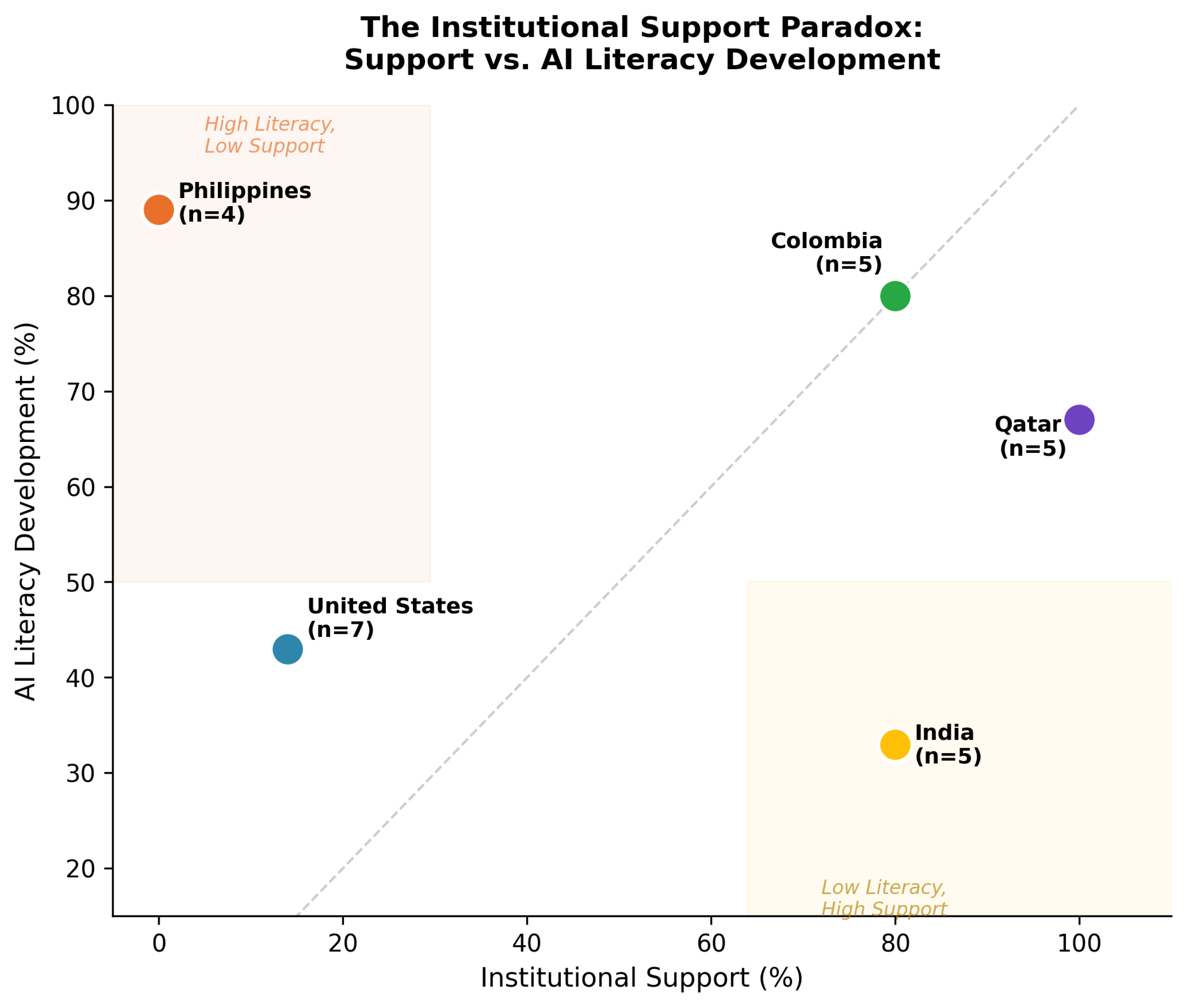
The most theoretically significant exploratory finding of this study is the non-linear relationship between institutional support and AI literacy development observed in this small sample. As shown in
Figure 8, plotting each country’s institutional support score against its AI literacy development score reveals a pattern that defies the expected positive correlation.
The Philippines (0% institutional support, 89% AI literacy development) and India (80% institutional support, 33% AI literacy development) occupy opposite corners of the support–literacy space, creating a striking inversion. Qatar (100% support, 67% literacy) and Colombia (80% support, 80% literacy) occupy intermediate positions, while the United States (14% support, 43% literacy) shows both low support and moderate literacy.
This exploratory pattern tentatively suggests that institutional support enables integration breadth, the range of contexts in which teachers apply AI but does not automatically produce literacy depth, the sophistication of teachers’ understanding of how AI systems work and how to interact with them effectively. Several mechanisms may explain this paradox. First, teachers operating under resource constraints may develop more efficient and deliberate AI interaction strategies out of necessity: when access is limited, each interaction carries higher stakes, incentivizing careful prompt construction. Second, institutional training programs may prioritize tool familiarization and compliance over the cognitive and linguistic competencies that distinguish surface from deep AI literacy. Third, self-directed learning in resource-constrained environments may produce deeper conceptual understanding because it requires teachers to construct their own mental models of AI behavior rather than following prescribed procedures.
From a theoretical perspective, this finding extends SCT’s account of environmental influence on self-efficacy. While
Bandura (
2001) emphasizes that supportive environments foster confidence and sustained practice, our data suggest that the type of environmental support matters more than its presence: institutional structures that provide access and permission without targeting specific competencies may inadvertently produce a ceiling effect on literacy development. Conversely, the Filipino teachers’ trajectory illustrates what might be termed necessity-driven self-efficacy, confidence and competence developed not through institutional scaffolding but through the demands of operating with minimal resources.
4.3.2. Infrastructure, Language, and the Shaping of Practice
Beyond institutional support, infrastructure constraints appeared to actively shape the form of AI engagement across contexts in this sample. Filipino teachers’ zero rate of student-facing AI projects reflects not pedagogical reluctance but material impossibility: without reliable internet or sufficient devices, frontstage classroom use is not viable regardless of teacher motivation. Similarly, the concentration of AI use in backstage preparation across the U.S. sample may partly reflect institutional ambiguity: where school policies on student AI use remain unclear, teachers may consciously limit frontstage integration to preserve professional authority.
The need to adapt AI outputs to local contexts was widely recognized across all countries (ranging from 75% in the Philippines to 80% in India, Qatar, and Colombia). Colombian teachers specifically flagged U.S. context bias in AI tools (40%), recognizing that generated content often reflected American cultural assumptions. Indian teachers emphasized developmental and cultural adaptation: “Our pedagogies have to be very different along with the needs of the students and the grade which I am teaching. So it’s not that I can just take it as such … we need to incorporate something which will really connect with the students” (IN–T2). This widespread recognition that AI outputs require professional transformation, rather than direct classroom application, represents a form of critical AI literacy that operated across all five contexts, regardless of institutional support levels. Language also emerged as a structural mediator: teachers in non-English-speaking contexts navigated an additional layer of adaptation, translating not only content but also prompt logic across linguistic registers, a challenge that English-dominant AI tools do not uniformly address (
Yoon et al., 2025).
5. Discussion
Taken together, the five national profiles in this exploratory sample suggest a pattern that resists simple ranking by institutional investment or technological access. Rather than a single developmental trajectory, the data suggest at least two distinct pathways to AI literacy: an institutionally scaffolded pathway, in which organizational support enables broad adoption and tool familiarity (India, Qatar), and a necessity-driven pathway, in which constrained resources appear to cultivate deeper interaction competence through self-directed practice (Philippines). Colombia occupies a distinct position, combining high institutional support with high prompt engineering awareness, suggesting that supportive environments can produce deep literacy when professional development targets interaction quality rather than tool access alone. The United States, characterized by external pressure without institutional scaffolding, represents a third condition in which adoption is driven by stakeholder expectations rather than intrinsic professional motivation. Within this exploratory sample, these cross-national differences are not reducible to economic development or infrastructure alone; they reflect the content and orientation of institutional support, the cultural framing of professional agency, and the material conditions that shape how teachers interact with AI tools in daily practice.
This study examined how 26 K–12 teachers across five countries conceptualize AI literacy and integrate generative AI into their professional practice. Three overarching findings emerged from this exploratory, qualitative study of 26 teachers. First, institutional support did not uniformly predict AI literacy depth: in this sample, teachers in the Philippines developed the most sophisticated prompt engineering competencies despite operating with zero institutional backing, while Indian teachers showed the lowest prompt engineering awareness despite strong organizational support. Second, prompt engineering awareness functioned as a critical differentiator across contexts, distinguishing teachers who engaged with AI as a skill-based practice from those who treated it as an opaque productivity tool. Third, AI integration followed a consistent backstage-to-frontstage gradient across countries, with preparation use far outpacing classroom-facing application, though the width of this gap varied substantially with national context. We discuss these findings in relation to our theoretical framework, the existing literature, and their implications for policy and professional development.
Theoretical Contribution. This study makes three contributions to theory. First, it challenges and extends SCT’s account of environmental influences on behavior. SCT’s triadic model predicts that institutional support should strengthen self-efficacy and promote sustained, skilled practice. Our data complicate this prediction: in this sample, the highest levels of institutional support (India, Qatar) were associated with broad adoption but comparatively shallow literacy, while the absence of institutional support (Philippines) was associated with more sophisticated prompt engineering competence. This suggests that SCT’s account requires a key distinction between adoption breadth(the range of contexts in which teachers use AI, reliably facilitated by organizational support) and literacy depth(the sophistication of teacher–AI interaction, which may develop more reliably through necessity-driven, self-directed practice), a distinction the original framework does not make. Second, it complicatesTAM’s perceived ease of use (PEOU) construct in generative AI contexts. TAM treats PEOU as a largely unitary predictor of behavioral intention. Our data suggest that in generative AI environments, PEOU is better understood as containing two empirically dissociable components: surface-level interface comfort(navigating tools and generating outputs) and interaction competence (crafting inputs that produce contextually appropriate results). High surface PEOU can coexist with low interaction competence, producing adoption breadth without literacy depth, a ceiling effect that TAM’s standard operationalization does not anticipate. Third, both frameworks have predominantly been tested in single-country, culturally homogeneous samples. This cross-national design demonstrates that the mechanisms linking environmental support to AI literacy are context-contingent rather than universal: the same organizational construct predicted divergent literacy outcomes across five countries, suggesting that theories of technology adoption in education must account for the cultural and structural conditions that modulate framework mechanisms.
5.1. Reconceptualizing Institutional Support
The institutional support paradox in which the Philippines (0% support, 89% AI literacy) and India (80% support, 33% AI literacy) occupied opposite corners of the support–literacy space (
Figure 8), represents the most theoretically consequential pattern in this exploratory sample. This pattern challenges a core assumption embedded in both SCT and the technology adoption literature: that supportive environments reliably foster competence and sustained engagement.
SCT’s triadic model positions environmental conditions as one of three reciprocally interacting forces shaping behavior, alongside personal factors and behavioral patterns (
Bandura, 2001). Our findings from this small, cross-national sample do not contradict this architecture, but they complicate it in an important way: the typeof environmental influence matters more than its valence. Indian teachers operated within environments that provided access, permission, and certification, conditions that SCT would predict should strengthen self-efficacy and promote sustained practice. And indeed, Indian teachers reported high confidence and universal recognition of AI as a supportive tool. Yet this confidence did not translate into the specific cognitive and linguistic competencies that characterize deep AI literacy, such as understanding how prompt construction shapes output quality. Institutional support, in this case, appeared to produce what we term integration breadth, the range of contexts in which teachers applied AI, without generating literacy depth, the sophistication of their interaction with AI systems.
The Filipino case illuminates the complementary mechanism. Operating without institutional scaffolding, Filipino teachers developed what might be characterized as necessity-driven self-efficacy: confidence and competence forged not through organizational support but through the demands of operating with constrained resources. When each AI interaction carries higher stakes due to limited access, teachers may be incentivized to develop more deliberate and efficient interaction strategies, including sophisticated prompt construction. This interpretation aligns with SCT’s recognition that mastery experiences, successful performance under challenging conditions, constitute the most potent source of self-efficacy. Filipino teachers’ mastery experiences occurred not within institutional training but within the constraints of everyday practice, producing a qualitatively different form of competence.
This finding carries implications for how researchers operationalize “support” in technology adoption studies.
Molefi et al. (
2024) found that school support and resources mediated the relationship between teacher perceptions and AI acceptance in Lesotho, and our data are consistent with this mediating role for adoption. However, our evidence suggests that adoption and literacy follow divergent developmental pathways, a divergence that current SCT and TAM applications in educational technology research largely do not recognize. Treating adoption breadth and literacy depth as interchangeable outcomes, or assuming that environmental support reliably produces both, may lead researchers to misattribute competence gaps that are actually structural artifacts of how institutional support is designed. Future research with larger samples should distinguish between these outcomes rather than treating them as a single construct, and should examine what specific features of institutional support programs, beyond access and certification, are most likely to cultivate interaction competence.
5.2. Prompt Engineering as the Perceived Ease of Use Frontier
Among the AI literacy dimensions that
Long and Magerko (
2020) identify, the “How does AI work?” question proved most consequential in differentiating teachers’ AI engagement across contexts. Prompt engineering awareness operationalizes this dimension in practice: teachers who have crossed this conceptual boundary understand AI not as a black box but as a system whose outputs respond systematically to input quality. From a TAM perspective (
Davis et al., 1989), this competency also functions as a critical indicator of perceived ease of use, one that behaves differently across national contexts in ways that extend TAM’s cross-cultural applications.
Konca et al. (
2025) found that while TAM’s core constructs predicted AI adoption across Turkey and the UAE, self-efficacy and subjective norms weighted these constructs differently by country. Our data from this exploratory sample reveal a parallel pattern at a more granular level: the specific competency that most strongly differentiated teachers’ AI engagement was not general technological confidence but the understanding that AI output quality depends on input quality. Colombia and the Philippines (both 100% awareness) treated prompting as a form of pedagogical reasoning, translating instructional goals into language that AI systems could process effectively. By contrast, India’s low prompt engineering awareness (20%) coexisted with high general AI confidence, suggesting that perceived ease of use in generative AI contexts is not a unitary construct but contains both surface-level comfort (navigating interfaces, generating outputs) and deeper interaction competence (crafting inputs that produce contextually appropriate results). TAM’s model predicts that PEOU shapes behavioral intention, which in turn drives actual use. Our data suggest this chain requires a refinement in generative AI contexts: which component of PEOU has been activated determines what kind of use results. When only surface-level comfort has been established, teachers adopt AI readily, interface navigation feels manageable, but behavioral engagement plateaus because outputs do not meet instructional needs and the underlying mechanics of effective prompting remain opaque. India’s profile may illustrate precisely this ceiling: high adoption driven by strong perceived usefulness and surface PEOU, but limited progression toward sophisticated engagement because the interaction competence dimension of PEOU was never targeted by professional development. This suggests that TAM-based interventions targeting PEOU in generative AI contexts must specify which layer of PEOU they are building, a theoretical refinement with direct implications for how professional development programs are designed and evaluated.
This distinction maps onto the AI literacy frameworks that informed our study.
Long and Magerko (
2020) distinguished between “What can AI do?” and “How does AI work?”, a boundary that separates operational familiarity from conceptual understanding. Teachers with prompt engineering awareness had crossed this boundary: they understood that AI systems respond to input structure, not just input content.
Ng et al. (
2021) similarly noted that surface-level familiarity with AI tools does not prepare educators to critically evaluate outputs or guide students toward responsible use. Our cross-national data from this small, qualitative study provide preliminary empirical support for this distinction and suggest that it may be especially consequential in professional development design: training that builds operational comfort without addressing interaction competence may produce confident but shallow AI users.
The exploratory finding that prompt engineering awareness was highest in contexts with the least institutional support (Philippines) and the most teacher-driven innovation (Colombia) further suggests that this competency may develop more readily through self-directed exploration than through structured training. This pattern is consistent with constructivist accounts of professional learning (
UNESCO et al., 2024), which emphasize that AI literacy develops “through engagement, reflection, and contextually grounded dialogue” rather than through passive instruction. Professional development programs that provide hands-on prompting practice with reflective feedback may be more effective at building this competency than programs organized around tool familiarization or compliance training.
5.3. The Backstage–Frontstage Gradient: From Personal Productivity to Pedagogical Integration
Across all five countries in this sample, teachers reported substantially higher rates of AI use for instructional preparation (backstage) than for classroom-facing instruction (frontstage). This pattern is consistent with large-scale survey evidence from the United States (
Cheah et al., 2025;
Diliberti et al., 2024;
Gallup & Walton Family Foundation, 2025) and extends it to four additional national contexts. Our qualitative data, however, reveal that the backstage–frontstage gradient is not simply a matter of individual comfort or novelty; it reflects structurally distinct risk environments that vary by national context.
Doss et al. (
2025) found that in U.S. schools, AI use by teachers has increased rapidly while institutional guidance has lagged behind, creating conditions in which teachers bear individual responsibility for navigating the risks of classroom AI integration. Our data tentatively suggest that this lag is not unique to the United States: only Qatar provided the combination of institutional endorsement, clear guidelines, and resource support that might be expected to lower the perceived risk of frontstage use. Colombia achieved high frontstage integration not through institutional scaffolding but through teacher-driven innovation, with teachers personally investing in AI tools and developing student-facing projects through individual initiative. The Philippines’ zero rate of student-facing projects reflected infrastructure impossibility rather than pedagogical reluctance. These divergent pathways observed in this exploratory sample suggest that the backstage–frontstage transition may be governed by different mechanisms in different contexts: institutional clarity in Qatar, teacher agency in Colombia, and material constraints in the Philippines.
From a TAM perspective, the backstage-to-frontstage gradient can be understood as a perceived ease of use problem. Classroom AI use imposes social, legal, and pedagogical demands, managing student interactions with AI, navigating privacy concerns, maintaining assessment integrity that backstage use does not (
Cheah et al., 2025). These demands reduce teachers’ subjective sense of competence and control in frontstage contexts, even when they feel confident using AI for personal preparation. TAM’s model specifies that PEOU mediates the relationship between technology beliefs and behavioral intention: when frontstage PEOU is suppressed by contextual demands, even teachers who hold strong perceived usefulness, genuine belief that AI would benefit their students, may not convert that conviction into classroom-facing action. The U.S. pattern adds a further TAM dimension that the framework does not typically foreground: when adoption is driven primarily by subjective norm, external pressure from administrators, colleagues, or institutional expectations, rather than by intrinsic perceived usefulness, teachers may sustain backstage use to satisfy compliance demands without developing the pedagogical motivation that would support more complex and professionally risky frontstage applications. Standard TAM models treat subjective norm as a direct predictor of behavioral intention; our data suggest that norm-driven adoption may actually suppress the deeper engagement required for frontstage literacy, because compliance-oriented use does not generate the mastery experiences through which interaction competence develops. Increasing frontstage integration will therefore require not only building teacher confidence but addressing the motivational quality of adoption, ensuring that teachers engage with AI as a pedagogical resource rather than an institutional compliance requirement.
5.4. Ethical Reasoning: Reflexive Versus Compliance-Oriented Engagement
A preliminary finding that warrants further attention is the qualitative difference in ethical engagement across contexts. While overall rates of ethical awareness were moderately high in this exploratory sample, the characterof that engagement differed in ways that carry implications for AI literacy development. Colombian and Filipino teachers demonstrated what we term reflexive ethical reasoning: internal deliberation about their own professional relationship to AI, including questions of intellectual honesty, pedagogical responsibility, and the boundaries of appropriate reliance. By contrast, ethical engagement in Qatar and India was more frequently anchored in institutional guidelines and compliance expectations.
This distinction maps onto SCT’s differentiation between externally regulated and self-regulated behavior (
Bandura, 2001), but it also points to a limitation in how that framework has been applied in AI literacy research. Most SCT-informed studies of teacher AI adoption focus on self-efficacy and outcome expectations as the primary personal factors shaping behavior, without distinguishing between the sourceof the ethical norms that govern that behavior. Our data suggest this source distinction matters: teachers whose ethical reasoning was self-generated, emerging from personal reflection rather than institutional prescription, appeared in this sample to be better positioned to navigate novel ethical situations that existing guidelines do not address. As AI capabilities continue to evolve rapidly, pre-specified compliance rules will inevitably lag behind emerging use cases. Teachers with reflexive ethical reasoning may thus possess a more adaptiveform of AI literacy, one whose durability does not depend on the currency of institutional frameworks. This finding resonates with
Huynh et al. (
2025), who argued that fostering responsible AI use requires attending to teachers’ mindsets and professional identities, not just their technical skills or awareness of policies, and suggests that SCT-informed professional development should attend not only to self-efficacy but to the regulatory orientation of teachers’ professional practice.
5.5. Alternative Explanations and Boundary Conditions
We acknowledge that individual-level variables, including years of teaching experience, subject area specialization, and school-level resource access, may partly account for observed differences in prompt engineering awareness and AI integration patterns. Similarly, cultural and linguistic factors beyond national context, such as teachers’ prior exposure to technology or professional learning communities, may have shaped how participants articulated their practices. The qualitative design of this study was not intended to isolate the effects of any single variable; rather, it sought to surface the range of conditions and mechanisms that co-occur in each national context. Future quantitative or mixed-methods research with larger samples could disentangle these factors and estimate their relative contributions to AI literacy development.
5.6. Implications for Policy and Professional Development
The findings carry differentiated implications across three audiences: classroom teachers, school leaders and administrators, and policymakers.
For Classroom Teachers. The institutional support paradox suggests that whatprofessional development teaches matters more than whether it exists. Programs that emphasize tool access, general awareness, and certification may produce broad adoption but shallow literacy. Teachers should prioritize developing prompt engineering as a pedagogical skill, not merely a technical one, by practicing the crafting, evaluation, and refinement of prompts in relation to specific instructional goals. The Colombian and Filipino teachers in this sample, who developed sophisticated prompting practices through self-directed exploration, suggest that deliberate personal practice may be as important as formal training.
For School Leaders and Administrators. The backstage–frontstage gradient indicates that expanding classroom-facing AI integration requires more than teacher training: it requires institutional scaffolding that reduces the perceived risk of frontstage use. This includes clear policies on student AI use, guidance on academic integrity in AI-augmented environments, and administrative support for teachers who experiment with student-facing applications. School leaders should resist framing AI professional development primarily around certification and tool access; the evidence from this sample suggests that programs targeting interaction quality, how teachers construct prompts and evaluate outputs, may produce deeper literacy than those focused on platform familiarity. Leaders should also recognize that teachers operating without institutional support, as in the Philippines and Colombia in this sample, may develop strong individual competencies while remaining isolated; creating communities of practice around AI pedagogy can amplify these individual innovations.
Third, the cross-national variation in ethical engagement suggests that AI ethics education should move beyond rule-based compliance toward fostering reflexive professional judgment. Rather than providing teachers with lists of acceptable and unacceptable AI uses, school leaders and instructional coaches should create opportunities for teachers to deliberate about the ethical dimensions of AI use in their specific contexts, an approach consistent with
UNESCO et al.’s (
2024) emphasis on contextually grounded dialogue.
For Policymakers. The finding that English language proficiency shapes AI engagement even in countries where it is not the primary language of instruction points to an equity concern that current AI literacy frameworks largely overlook. The TeachAI/OECD-European Commission framework (
TeachAI et al., 2025) and Digital Promise’s framework (
Digital Promise, 2024) emphasize evaluation, creation, and application competencies but do not foreground language as a mediating factor. As most generative AI tools remain English-dominant, teachers with limited English proficiency face a structural barrier to the prompting competence that our data identify as a critical differentiator (
Yoon et al., 2025). Policymakers should advocate for the development of multilingual AI tools and fund professional development that scaffolds prompt-writing practice in teachers’ home languages.
Finally, the “tool, not replacement” framing that appeared across all five countries signals a shared professional identity claim that policymakers should take seriously. Teachers consistently positioned themselves as essential mediators of AI-generated content, professionals whose contextual knowledge, pedagogical judgment, and relational expertise cannot be automated. Policies that frame AI as augmenting rather than displacing teacher expertise are likely to encounter less resistance and produce more sustainable integration than approaches perceived as diminishing professional autonomy. National AI education frameworks should explicitly acknowledge the mediating role of teacher judgment and design evaluation systems accordingly.
6. Limitations
This study has several limitations that bear directly on the interpretation of its findings.
Sample size and generalizability. The modest sample sizes (n = 4–7 per country; N = 26 total) represent a significant limitation of this work. In samples of this size, a single teacher represents between 14% and 25% of their country’s participants, meaning that individual perspectives exert considerable influence on country-level patterns. Although we did not reach our target of five teachers in the Philippines due to recruitment constraints, the four participants provided rich and internally consistent accounts. The purposive sampling strategy was designed to maximize variation in national context rather than to achieve statistical representativeness; all findings should therefore be interpreted as exploratory and theoretically informative rather than generalizable to the broader teacher population in any of the five countries. The cross-national patterns we identify, including the institutional support paradox and the backstage–frontstage gradient, warrant replication with larger, more representative samples before stronger conclusions can be drawn.
Temporal scope. Interviews were conducted in summer and early fall 2025, capturing teacher perspectives at a specific moment within a rapidly evolving technological and policy landscape. As institutional frameworks mature and AI tools continue to develop, observed patterns may shift substantially. Findings reflect a snapshot of teacher AI engagement at one point in time and may not capture how practices evolve as familiarity deepens and institutional guidance matures.
Sampling approach. Participants were recruited through purposive and snowball sampling, which may have introduced systematic bias toward teachers who are already engaged with AI and willing to discuss their practices. The country-level profiles should therefore be understood as characterizing AI-engaged teachers in each context, not the full population of K–12 teachers.
Language and cross-national comparability. Cultural and linguistic dynamics may have shaped how teachers articulated their experiences. Interviews were conducted in English and Spanish, and differences in language and communication norms may affect cross-national comparability.
Researcher positionality and coding. As noted in the methodology, all authors bring professional and cultural perspectives that may have shaped both data collection and analysis. Intercoder reliability was established on a subset of the data; however, qualitative coding inherently involves interpretive judgment that no reliability coefficient fully captures.
Future research should examine how AI literacy competencies develop over time and across shifting policy environments. Longitudinal and multi-site designs with larger, more representative samples would help clarify whether prompt engineering awareness and teacher agency deepen or transform as institutional frameworks mature.
7. Conclusions
This study examined how 26 K–12 teachers across five countries conceptualize AI literacy and integrate generative AI into their professional practice. Three contributions emerge that extend current understanding of teacher AI adoption.
First, within this exploratory sample of 26 teachers, institutional support did not uniformly predict AI literacy depth. While organizational investment enabled broader adoption, teachers operating under resource constraints, most notably in the Philippines, appeared to develop more sophisticated prompt engineering awareness than peers in well-supported systems such as India. This observed institutional support paradox complicates linear assumptions embedded in both SCT and the technology adoption literature: supportive environments may reliably predict whether teachers use AI, but not necessarily how skillfullythey engage with it. Second, prompt engineering awareness functioned as a critical differentiator across contexts. Teachers who approached prompting as a pedagogical skill, requiring specificity, contextual framing, and iterative refinement, engaged with AI in qualitatively different ways than those who treated tools as opaque content generators, suggesting that the “How does AI work?” dimension of AI literacy frameworks deserves greater emphasis in teacher education. Third, across all five countries in this sample, teachers consistently positioned themselves as pedagogical mediators of AI-generated content, filtering outputs through disciplinary knowledge, contextual awareness, and professional judgment rather than adopting or resisting AI wholesale.
These findings suggest that the field’s dominant framing of AI readiness as a function of access, training, and institutional support warrants further examination. A more complete account may need to attend to the quality of teacher–AI interaction, the conditions under which deep literacy develops, and the professional judgment that teachers exercise as they mediate between AI capabilities and classroom realities. As generative AI becomes embedded in educational systems worldwide, ensuring that teachers develop not just familiarity but genuine competence in working with these tools remains an important priority, one that may benefit from investment in practice-based professional learning, institutional scaffolding for classroom-facing use, and equity-conscious attention to the linguistic and infrastructural barriers that shape who benefits from AI’s educational potential.
Future Research. The exploratory patterns identified in this study point toward several directions for future inquiry. Most urgently, the cross-national patterns documented here, including the institutional support paradox and the backstage–frontstage gradient, require replication with larger and more representative samples. Future studies should employ mixed-methods or survey-based designs capable of testing whether the relationships observed in this qualitative sample generalize to broader teacher populations in each country. Second, longitudinal designs are needed to trace how AI literacy competencies, and prompt engineering awareness in particular, develop over time as teachers gain experience and as institutional frameworks mature. Third, future research should investigate what specific features of professional development programs, beyond tool access and certification, most effectively cultivate interaction competence; the contrast between India and the Philippines in this sample suggests this is a consequential and underexamined question. Finally, as generative AI tools evolve and as multilingual AI systems become more capable, future studies should examine whether the language-mediated barriers to prompt engineering identified here diminish or persist, and what equity implications follow for teachers working in non-English-speaking contexts. Fifth, future comparative studies should expand the geographic scope of cross-national AI literacy research to include European and African educational contexts, which are absent from the present sample. Such studies would enable more systematic testing of whether the patterns identified here (the institutional support paradox, the backstage–frontstage gradient, and the role of prompt engineering competence) hold across a wider range of policy environments, resource levels, and cultural orientations toward technology adoption in education.
Author Contributions
Conceptualization, R.L.X. and S.J.A.; Methodology, R.L.X. and S.J.A.; Validation, R.L.X.; Formal analysis, R.L.X. and A.J.M.; Investigation, S.J.A.; Writing—original draft preparation, R.L.X.; Writing—review and editing, S.J.A., A.J.M., Y.X., R.A.-S., M.J. and S.T.J.; Project administration, S.J.A.; Funding acquisition, S.J.A. All authors have read and agreed to the published version of the manuscript.
Funding
This research was supported by the World Innovation Summit for Education (WISE) and Qatar Foundation.
Institutional Review Board Statement
The study was conducted in accordance with the Declaration of Helsinki and was reviewed and approved as exempt by the Institutional Review Board of the University of Southern California (protocol code: UP-24-01033; approval date: 8 November 2024).
Informed Consent Statement
Informed consent was obtained from all subjects involved in the study.
Data Availability Statement
Restrictions apply to the availability of these data. Interview transcripts were obtained in cooperation with the World Innovation Summit for Education (WISE) and are available from the corresponding author with the permission of WISE. The following supporting materials are available upon reasonable request to the corresponding author: de-identified interview excerpts used as illustrative quotations in the manuscript, the coding schema (codebook with operational definitions and decision rules for all six analytic dimensions), and the semi-structured interview protocol. Requests for full transcripts require WISE approval.
Acknowledgments
We thank Sopiko Beriashvili for her support during this project, and the World Innovation Summit (WISE) for their financial support of this research. During the preparation of this manuscript, the author(s) used Claude 4.5 (Anthropic, 2025) for the purposes of language editing and manuscript revision. The authors have reviewed and edited the output and take full responsibility for the content of this publication.
Conflicts of Interest
The authors declare no conflicts of interest.
Appendix A. Interview Coding Framework
The six radar chart dimensions reported in the Results (
Section 4.1) are derived from a structured coding framework developed prior to data collection and applied independently by two coders across all 26 interviews. The table below presents each dimension, its constituent sub-codes, operational definitions, and a representative exemplar drawn from the corpus. Dimensions represent composite averages of their sub-code prevalence rates; non-integer percentage values in the radar charts reflect this averaging procedure.
Table A1.
Interview Coding Framework: Dimensions, Sub-codes, Definitions, and Exemplars.
Table A1.
Interview Coding Framework: Dimensions, Sub-codes, Definitions, and Exemplars.
| Dimension | Sub-Code | Definition | Exemplar Quote |
|---|
| AI Integration in Teaching Practice | Lesson planning with AI | Use of GenAI to assist in preparing class materials, activities, or assessments. | “AI can reduce teachers’ lesson planning workload by 80–90%.” |
| AI supports differentiation | Belief that AI helps address diverse learning needs across student populations. | “That’s where teacher experience matters: knowing how to help every student.” |
| Balancing AI with pedagogy | Describes filtering or adapting AI output through teacher expertise and instructional judgment. | “The teacher’s experience helps blend the AI-generated ideas with a broader educational approach.” |
| Reevaluating teaching practices | Reflects on how AI has prompted a change in the teacher’s own thinking about their practice. | “Education is evolving, it can’t remain as traditional teaching with a board and marker.” |
| Contextual adaptation | Describes the need to adapt AI-generated output to local teaching context and student needs. | “I still decide which questions fit my context.” |
| AI Literacy Development | Prompt engineering awareness | Understanding that the quality of AI output depends systematically on how prompts are designed. | “We must understand that AI works through prompting, knowing how to ask the right questions.” |
| Teaching AI literacy to students | Describes actively teaching students how AI works, its limitations, and responsible use. | “We show students how AI can make mistakes or give outdated information.” |
| Avoiding copy-paste AI use | Advocates for meaningful student engagement with AI rather than uncritical reproduction of outputs. | “Students shouldn’t see AI as a shortcut to avoid doing the work.” |
| Exploration Attitudes Toward AI | AI as tool, not replacement | Belief that AI augments the teacher’s role rather than substituting professional judgment. | “AI is the starting point, but the teacher still plays a key role.” |
| Enthusiasm for exploration | Expresses curiosity, excitement, or proactive self-directed experimentation with AI tools. | “My learning has been mostly self-taught: tinkering, exploring what’s out there, experimenting.” |
| Institutional Support | School support for AI | Describes school-level encouragement, resources, or formal structures for teacher or student AI use. | “We’ve been updating the technology curriculum annually to include AI.” |
| Curriculum updates include AI | Mentions institutional or national policy updates that formally integrate AI into the curriculum. | “The Ministry of ICT has officially approved AI use in schools.” |
| Cross-subject AI use | Describes institutionally encouraged interdisciplinary applications of AI across subject areas. | “Now AI is incorporated into ethics, language, and social studies.” |
| Student Engagement & Equity | Real-world projects using AI | Students use AI to build, design, or solve authentic problems beyond classroom exercises. | “They built a functional prototype, a smart cane for the visually impaired, to present at our school fair.” |
| Engaging students with AI | Describes AI as re-engaging students who were previously disengaged or resistant. | “What did you do to those two troublemakers? Look at them now, working hard!” |
| Access vs. utilization gap | Notes that students have access to AI-capable devices but do not use them for academic purposes. | “The problem is not access, but underutilization.” |
| Ethical Awareness | Data privacy concern | Expresses worry that AI systems retain or misuse sensitive contextual data. | “AI remembers your past prompts and builds on them, that’s a risk.” |
| Prompt framing and output ethics | Reflects on how prompt construction shapes the ethical valence of AI outputs. | “It all depends on how I ask AI, the risk lies in how we frame the prompt.” |
| Ethics in AI usage | Describes teaching or modeling ethical norms for AI use among students or colleagues. | “Copying and pasting answers from AI without reading them, that’s an ethical issue.” |
References
- Aguilar, S. J., Nye, B., Swartout, W., Macias, A., Xing, Y., & Xiu, R. L. (2025). How students and teachers worldwide are adapting to AI. EdArXiv Preprint. Available online: https://osf.io/preprints/edarxiv/wr6n3_v2 (accessed on 26 February 2026).
- Bandura, A. (2001). Social cognitive theory: An agentic perspective. Annual Review of Psychology, 52(1), 1–26. [Google Scholar] [CrossRef] [PubMed]
- Casal-Otero, L., Catala, A., Fernández-Morante, C., Taboada, M., Cebreiro, B., & Barro, S. (2023). AI literacy in K-12: A systematic literature review. International Journal of STEM Education, 10(1), 29. [Google Scholar] [CrossRef]
- Cheah, Y. H., Lu, J., & Kim, J. (2025). Integrating generative artificial intelligence in K-12 education: Examining teachers’ preparedness, practices, and barriers. Computers and Education: Artificial Intelligence, 8, 100363. [Google Scholar] [CrossRef]
- Creswell, J. W., & Poth, C. N. (2018). Qualitative inquiry and research design: Choosing among five approaches (4th ed.). SAGE Publications. [Google Scholar]
- Daher, R. (2025). Integrating AI literacy into teacher education: A critical perspective paper. Discover Artificial Intelligence, 5(1), 217. [Google Scholar] [CrossRef]
- Davis, F. D., Bagozzi, R. P., & Warshaw, P. R. (1989). Technology acceptance model. Journal of Management Science, 35(8), 982–1003. [Google Scholar]
- Digital Promise. (2024, June 18). Ai literacy: A framework to understand, evaluate, and use emerging technology. Digital Promise. Available online: https://digitalpromise.org/2024/06/18/ai-literacy-a-framework-to-understand-evaluate-and-use-emerging-technology/ (accessed on 26 February 2026).
- Diliberti, M., Schwartz, H. L., Doan, S., Shapiro, A. K., Rainey, L., & Lake, R. J. (2024). Using artificial intelligence tools in k-12 classrooms. Rand. [Google Scholar]
- Doss, C. J., Bozick, R., Schwartz, H. L., Chu, L., Rainey, L. R., Woo, A., Reich, J., & Dukes, J. (2025). AI use in schools is quickly increasing but guidance lags behind: Findings from the RAND survey panels. RAND Corporation. Available online: https://www.rand.org/pubs/research_reports/RRA4180-1.html (accessed on 26 February 2026).
- Gallup & Walton Family Foundation. (2025, June 25). The ai dividend: New survey shows ai is helping teachers reclaim valuable time. Walton Family Foundation. Available online: https://www.waltonfamilyfoundation.org/the-ai-dividend-new-survey-shows-ai-is-helping-teachers-reclaim-valuable-time (accessed on 26 February 2026).
- Gilmore, D. M. (2014). Goffman’s front stage and backstage behaviors in online education. Journal of Learning Analytics, 1(3), 187–190. [Google Scholar] [CrossRef]
- Gruenhagen, J. H., Sinclair, P. M., Carroll, J.-A., Baker, P. R., Wilson, A., & Demant, D. (2024). The rapid rise of generative AI and its implications for academic integrity: Students’ perceptions and use of chatbots for assistance with assessments. Computers and Education: Artificial Intelligence, 7, 100273. [Google Scholar] [CrossRef]
- Guest, G., Bunce, A., & Johnson, L. (2006). How many interviews are enough? An experiment with data saturation and variability. Field Methods, 18(1), 59–82. [Google Scholar] [CrossRef]
- Huynh, L., Le, T. H., Dang, B., An, B. T., Vu, C. T., & Nguyen, A. (2025). Mindset matters: Fostering teachers’ responsible AI use through professional development. Journal of New Approaches in Educational Research, 14(1), 23. [Google Scholar] [CrossRef]
- Konca, A. S., Simsar, A., Alhajji, R., & Al Mansoori, A. (2025). Cross-cultural perspectives on AI adoption in teacher education: A comparative study of pre-service teachers in Turkey and the United Arab Emirates. Interactive Learning Environments, 33(10), 5820–5846. [Google Scholar] [CrossRef]
- Lincoln, Y. S., & Guba, E. G. (1985). Naturalistic inquiry. SAGE Publications. [Google Scholar]
- Long, D., & Magerko, B. (2020). What is AI literacy? Competencies and design considerations. In Proceedings of the 2020 chi conference on human factors in computing systems (pp. 1–16). Association for Computing Machinery. [Google Scholar]
- Molefi, R. R., Ayanwale, M. A., Kurata, L., & Chere-Masopha, J. (2024). Do in-service teachers accept artificial intelligence-driven technology? The mediating role of school support and resources. Computers and Education Open, 6, 100191. [Google Scholar] [CrossRef]
- Ng, D. T. K., Leung, J. K. L., Chu, S. K. W., & Qiao, M. S. (2021). Conceptualizing AI literacy: An exploratory review. Computers and Education: Artificial Intelligence, 2, 100041. [Google Scholar] [CrossRef]
- Ocumpaugh, J., Roscoe, R. D., Baker, R. S., Hutt, S., & Aguilar, S. J. (2024). Toward asset-based instruction and assessment in artificial intelligence in education. International Journal of Artificial Intelligence in Education, 34(4), 1559–1598. [Google Scholar] [CrossRef]
- Ocumpaugh, J., Roscoe, R. D., Baker, R. S., Hutt, S., & Aguilar, S. J. (2025). Asset-based personalized learning. In Handbook of personalized learning (pp. 437–450). Routledge. [Google Scholar] [CrossRef]
- Ogunleye, B., Zakariyyah, K. I., Ajao, O., Olayinka, O., & Sharma, H. (2024). A systematic review of generative AI for teaching and learning practice. Education Sciences, 14(6), 636. [Google Scholar] [CrossRef]
- Olson, K. (2016). Essentials of qualitative interviewing. Routledge. [Google Scholar]
- Patton, M. Q. (2002). Qualitative research & evaluation methods (3rd ed.). SAGE Publications. [Google Scholar]
- Saldaña, J. (2021). The coding manual for qualitative researchers. SAGE Publications Ltd. [Google Scholar]
- TeachAI, Organisation for Economic Co-operation and Development & European Commission. (2025). AI literacy framework for primary and secondary education. OECD. Available online: https://ailiteracyframework.org (accessed on 26 February 2026).
- UNESCO, Miao, F., & Cukurova, M. (2024). AI competency framework for teachers. UNESCO. [Google Scholar] [CrossRef]
- Viberg, O., Cukurova, M., Feldman-Maggor, Y., Alexandron, G., Shirai, S., Kanemune, S., Wasson, B., Tømte, C., Spikol, D., & Milrad, M. (2025). What explains teachers’ trust in AI in education across six countries? International Journal of Artificial Intelligence in Education, 35(3), 1288–1316. [Google Scholar] [CrossRef]
- Wang, C., Aguilar, S. J., Bankard, J. S., Bui, E., & Nye, B. (2024). Writing with AI: What college students learned from utilizing ChatGPT for a writing assignment. Education Sciences, 14(9), 976. [Google Scholar] [CrossRef]
- Xiu, L. (2024). The challenges and approaches of generative artificial intelligence (GenAI) to promote educational innovation. International Journal of Computer Science and Information Technology, 4(3), 400–407. [Google Scholar] [CrossRef]
- Yoon, S. S., Ee, J., & Son, M. (2025). A critical collaborative self-study of transnational teacher educators on AI and multilingual education. Journal of Digital Learning in Teacher Education, 41, 207–221. [Google Scholar] [CrossRef]
- Yusuf, A., Pervin, N., & Román-González, M. (2024). Generative AI and the future of higher education: A threat to academic integrity or reformation? Evidence from multicultural perspectives. International Journal of Educational Technology in Higher Education, 21(1), 21. [Google Scholar] [CrossRef]
| Disclaimer/Publisher’s Note: The statements, opinions and data contained in all publications are solely those of the individual author(s) and contributor(s) and not of MDPI and/or the editor(s). MDPI and/or the editor(s) disclaim responsibility for any injury to people or property resulting from any ideas, methods, instructions or products referred to in the content. |





 ,
,