


Intersectional Disaggregated Data Practices and Leadership Interventions for Women in Higher Education: Evidence from Timor-Leste
 , ,
, ,  ,
,
Abstract
1. Background to the Study
1.1. Gender Equity and Intersectionality in Higher Education Leadership
Intersectionality Theory
2. Materials and Methods
3. Results
3.1. Participants’ Background Information
3.2. Intersectional Data Identified for Data-Informed Leadership Intervention
3.3. Leadership Interventions for Advancing Women in Higher Education Leadership in Timor-Leste
3.4. Barriers to the Collection and Use of Intersectional Disaggregated Data
3.5. Enablers of Effective Collection and Use of Intersectional Disaggregated Data
3.6. Correlation Analysis and Hypothesis Validation
4. Discussion
Implications of Study
5. Conclusions
Author Contributions
Funding
Institutional Review Board Statement
Informed Consent Statement
Data Availability Statement
Acknowledgments
Conflicts of Interest
References
- Abdu Suleiman, U., & Saxena, P. (2024). The influence of cultural diversity on core HR functions within nigeria public sector. International Journal of Religion, 5, 69–89. [Google Scholar] [CrossRef] [Scilit]
- Acev, D., Biyani, S., Rieder, F., Aldenhoff, T. T., Blazevic, M., Riehle, D. M., & Wimmer, M. A. (2025). Systematic analysis of data governance frameworks and their relevance to data trusts. Management Review Quarterly. Advanced online publication. [Google Scholar] [CrossRef] [Scilit]
- Adanlawo, E. F., Nkomo-Asare, N. Y., & Xaba, F. (2025). The influence of psychological safety on employee engagement: Sustainable development goals (SDGs) context. Journal of Lifestyle and SDGs Review, 5(8), e7282. [Google Scholar] [CrossRef] [Scilit]
- Adedokun, T., Awung, F. N., Usadolo, S. E., & Mheta, G. (2025). Language teaching and inequality issues in the use of technology in higher education: A sociological approach. Journal of African Languages & Literary Studies (JoALLS), 6(3), 71–96. [Google Scholar]
- Aithal, A., & Aithal, P. (2020). Development and validation of survey questionnaire & experimental data—A systematical review-based statistical approach. International Journal of Management, Technology, and Social Sciences (IJMTS), 5(2), 233–251. [Google Scholar]
- Alghamdi, N. A., Dunn, K., Cairns, D., & Melville, C. (2023). Utilising quantitative methods to study the intersectionality of multiple social disadvantages in women with common mental disorders: A systematic review. International Journal for Equity in Health, 22(1), 264. [Google Scholar] [CrossRef] [Scilit]
- Alharthi, F. B. (2024). Gender differences in perceptions of leadership and their influence on motivation among faculty members of Taif University. Frontiers in Psychology, 15, 1476526. [Google Scholar] [CrossRef] [Scilit]
- Alshdiefat, A. a. S., Lee, A., Sharif, A. A., Rana, M. Q., & Abu Ghunmi, N. A. (2024). Women in leadership of higher education: Critical barriers in Jordanian universities. Cogent Education, 11(1), 2357900. [Google Scholar] [CrossRef] [Scilit]
- Asia Research Centre, Universitas Indonesia. (2022). Gender equality, diversity & inclusion in higher education in ASEAN. Available online: https://arc.ui.ac.id/publikasi/gender-equality-diversity-and-inclusion-in-higher-education-in-asean/ (accessed on 16 December 2025).
- Asriati, A. (2025). The role of leadership in fostering diversity and inclusion: Insights from existing literature. Golden Ratio of Data in Summary, 5(2), 217–228. [Google Scholar] [CrossRef] [Scilit]
- Ayenalem, K. A., & Taye, M. T. (2025). Women leadership in higher education: A comparative systematic review of participation and barriers in Ethiopia and beyond. Discover Education, 4(1), 378. [Google Scholar] [CrossRef] [Scilit]
- Barling, J., & Barling, J. (2014). Gender and leadership. In The science of leadership: Lessons from research for organizational leaders. Oxford University Press. [Google Scholar]
- Bauer, G. R., Churchill, S. M., Mahendran, M., Walwyn, C., Lizotte, D., & Villa-Rueda, A. A. (2021). Intersectionality in quantitative research: A systematic review of its emergence and applications of theory and methods. SSM-Population Health, 14, 100798. [Google Scholar] [CrossRef] [Scilit]
- Bentley, C., Muyoya, C., Vannini, S., Oman, S., & Jimenez, A. (2023). Intersectional approaches to data: The importance of an articulation mindset for intersectional data science. Big Data & Society, 10(2), 20539517231203667. [Google Scholar] [CrossRef] [Scilit]
- Bernardo, B. M. V., São Mamede, H., Barroso, J. M. P., & Dos Santos, V. M. P. D. (2024). Data governance & quality management—Innovation and breakthroughs across different fields. Journal of Innovation & Knowledge, 9(4), 100598. [Google Scholar] [CrossRef] [Scilit]
- Bhopal, K., & Henderson, H. (2019). Advancing equality in higher education: An exploratory study of the Athena SWAN and Race equality charters. British Academy/Leverhulme Research Report. Centre for Research in Race and Education (CRRE). [Google Scholar]
- Bishop, J. R. (2024). The impact of social capital on overcoming systemic barriers and lack of benefit of the doubt for black women in leadership: Insights from Kamala Harris’s presidential campaign. Business Ethics and Leadership, 8(4), 123–136. [Google Scholar] [CrossRef] [Scilit]
- British Council. (2024). Status of gender equality in higher education sector: An East Asia scoping study. Available online: https://www.britishcouncil.org/research-insight/gender-scoping-study-east-asia (accessed on 24 April 2026).
- Budin-Ljøsne, I., Teare, H. J., Kaye, J., Beck, S., Bentzen, H. B., Caenazzo, L., Collett, C., D’Abramo, F., Felzmann, H., Finlay, T., Javaid, M. K., Jones, E., Katić, V., Simpson, A., & Mascalzoni, D. (2017). Dynamic consent: A potential solution to some of the challenges of modern biomedical research. BMC Medical Ethics, 18(1), 4. [Google Scholar] [CrossRef] [Scilit]
- Callender, C., & Dougherty, K. J. (2018). Student choice in higher education—Reducing or reproducing social inequalities? Social Sciences, 7(10), 189. [Google Scholar] [CrossRef] [Scilit]
- Campbell, S., Greenwood, M., Prior, S., Shearer, T., Walkem, K., Young, S., Bywaters, D., & Walker, K. (2020). Purposive sampling: Complex or simple? Research case examples. Journal of Research in Nursing, 25(8), 652–661. [Google Scholar] [PubMed]
- Chanda, T., & Ngulube, L. (2024). Women in leadership: Examining barriers to women’s advancement in leadership positions. Asian Journal of Advanced Research and Reports, 18, 273–290. [Google Scholar] [CrossRef] [Scilit]
- Clarke, M. (2011). Advancing women’s careers through leadership development programs. Employee Relations, 33(5), 498–515. [Google Scholar]
- Collins, P. H. (2019). Intersectionality as critical social theory. In The Cambridge handbook of social theory. Duke University Press. [Google Scholar]
- Correa, A., Glas, M. G., & Opara, J. (2025). Females in higher education and leadership: Insights from a multi-method approach. Frontiers in Education, 9, 1485395. [Google Scholar] [CrossRef] [Scilit]
- Crenshaw, K. W. (1989). Demarginalizing the intersection of race and sex: A black feminist critique of antidiscrimination doctrine (pp. 139–168). University of Chicago Legal Forum. [Google Scholar]
- Crimmins, G., Casey, S., & Tsouroufli, M. (2023). Intersectional barriers to women’s advancement in higher education institutions rewarded for their gender equity plans. Gender and Education, 35(6–7), 653–670. [Google Scholar] [CrossRef] [Scilit]
- Dawson, H., Lybcg, I., Mhlana, S., & Mokhema, S. (2023). Intersectionality in action: Learnings, challenges & recommendations from IDRC-supported research in the global south. Intersectionality Synthesis Report. Southern Centre for Inequality Studies, University of the Witwatersrand. Available online: https://hdl.handle.net/10539/41458 (accessed on 12 January 2026).
- Eagly, A. H., Carli, L. L., & Carli, L. L. (2007). Through the labyrinth: The truth about how women become leaders (Vol. 11). Harvard Business School Press. [Google Scholar]
- Evans, C. R., Leckie, G., Subramanian, S. V., Bell, A., & Merlo, J. (2024). A tutorial for conducting intersectional multilevel analysis of individual heterogeneity and discriminatory accuracy (MAIHDA). SSM-Population Health, 26, 101664. [Google Scholar] [CrossRef] [Scilit] [PubMed]
- Fitzgerald, T. (2013). Women leaders in higher education: Shattering the myths. Routledge. [Google Scholar]
- Fraser, J., Fahlman, D., Arscott, J., & Guillot, I. (2018). Pilot testing for feasibility in a study of student retention and attrition in online undergraduate programs. International Review of Research in Open and Distributed Learning, 19(1), 260–278. [Google Scholar] [CrossRef] [Scilit]
- Gaikwad, H., & Pandey, S. (2026). From management to leadership: A comparative analysis of leadership styles among women in academic hierarchies. Cogent Business & Management, 13(1), 2597708. [Google Scholar] [CrossRef] [Scilit]
- Gallegos, A., Londoño-Celis, W., Rodríguez Zavala, L., Mendiaz, M. G., & Teodori de la Puente, R. (2025). Analysis of female leadership trends in the context of higher education. Cogent Education, 12(1), 2486667. [Google Scholar] [CrossRef] [Scilit]
- Gallifant, J., Kistler, E. A., Nakayama, L. F., Zera, C., Kripalani, S., Ntatin, A., Fernandez, L., Bates, D., Dankwa-Mullan, I., & Celi, L. A. (2023). Disparity dashboards: An evaluation of the literature and framework for health equity improvement. The Lancet Digital Health, 5(11), e831–e839. [Google Scholar] [CrossRef] [Scilit]
- Galsanjigmed, E., & Sekiguchi, T. (2023). Challenges women experience in leadership careers: An integrative review. Merits, 3(2), 366–389. [Google Scholar] [CrossRef] [Scilit]
- Gander, M., & Sharafizad, F. (2025). Progressing gender equity in senior leadership: A systematic literature review. Gender in Management, 40(2), 352–369. [Google Scholar] [CrossRef] [Scilit]
- Ghundol, B., & Muthanna, A. (2025). Perceptions and experiences of female academics on barriers in obtaining and continuing leadership roles at higher education. International Journal of Educational Research, 130, 102534. [Google Scholar] [CrossRef] [Scilit]
- Gidage, M. (2025). Exploring the impact of diversity, equity and inclusion on ESG performance: Evidence from Indian organizations. Benchmarking: An International Journal, 1–36. [Google Scholar] [CrossRef] [Scilit]
- Gul, S., Fatima, B., & Akhtar, N. (2025). Gender equality in education: Addressing structural barriers and social norms Asian context. The Critical Review of Social Sciences Studies, 3(1), 2839–2854. [Google Scholar]
- Hankivsky, O., Grace, D., Hunting, G., Giesbrecht, M., Fridkin, A., Rudrum, S., Ferlatte, O., & Clark, N. (2014). An intersectionality-based policy analysis framework: Critical reflections on a methodology for advancing equity. International Journal for Equity in Health, 13(1), 119. [Google Scholar] [CrossRef] [Scilit] [PubMed]
- Hannan, R., Lafferty, N., & Mannix-McNamara, P. (2025). Gendered perceptions of diversity in educational leadership promotions in Irish schools: A quantitative study. Education Sciences, 15(10), 1323. [Google Scholar] [CrossRef] [Scilit]
- Harari, L., & Lee, C. (2021). Intersectionality in quantitative health disparities research: A systematic review of challenges and limitations in empirical studies. Social Science & Medicine, 277, 113876. [Google Scholar] [CrossRef] [Scilit]
- Hariadi, H., Alamsyah, N., & Yayat, Y. (2024). Intersectional Barriers to Gender Inequality in the Workplace across Race and Disability. Journal Social Civilecial, 2(1), 44–52. [Google Scholar] [CrossRef] [Scilit]
- Harris, A., & Leonardo, Z. (2018). Intersectionality, race-gender subordination, and education. Review of Research in Education, 42(1), 1–27. [Google Scholar] [CrossRef] [Scilit]
- Harrison, J. S., & Wicks, A. C. (2013). Stakeholder theory, value, and firm performance. Business Ethics Quarterly, 23(1), 97–124. [Google Scholar] [CrossRef] [Scilit]
- Harrison, T., & Freeman, J. (2025). Who leads our universities? Inside the recruitment of vice-chancellors. HEPI Policy Note 63. Higher Education Policy Institute. [Google Scholar]
- Heyes, K., Brahic, B., Ramnund-Mansingh, A., Ingram, N., Arun, S., & Seedat-Khan, M. (2023). “I cannot fall pregnant!”: Unequal bodies in South African higher education. Girlhood Studies, 16(1), 71–86. [Google Scholar] [CrossRef] [Scilit]
- Hussain, S., & Hussein, N. (2025). Minoritised migrant women in academia as translocational outsiders within: An analysis of four structures of exhaustion. Educational Review. Advanced online publication. [Google Scholar] [CrossRef] [Scilit]
- Ivanov, B. (2024). Intersectionality of gender, race, class, sexuality, disability and other social identities in shaping the experiences and opportunities of marginalized groups in Ukraine. International Journal of Gender Studies, 9, 61–74. [Google Scholar] [CrossRef] [Scilit]
- Kray, L. J., Mishra, S., Townsend, C. H., & Kennedy, J. A. (2025). Psychological drivers of gender disparities in leadership paths. Trends in Cognitive Sciences. Advanced online publication. [Google Scholar] [CrossRef] [Scilit]
- Laki, R. C., & Badon, B. O. (2024). A systematic review on the impact of gender equity on educational leadership. European Journal of Science, Innovation and Technology, 4(3), 58–67. [Google Scholar] [CrossRef] [Scilit]
- Liani, M. L., Nyamongo, I. K., Pulford, J., & Tolhurst, R. (2021). Enablers of gender equitable scientific career progression in Sub-Saharan Africa: Insights from the DELTAS Africa Initiative. AAS Open Research, 4, 42. [Google Scholar] [CrossRef] [Scilit]
- Makhanya, M. T. B. (2024). Perspective chapter: Examining the intersecting connections between intersectionality and socioeconomic inequality. In Bridging social inequality gaps-concepts, theories, methods, and tools. IntechOpen. [Google Scholar]
- Mbachu, C., Agwu, P., Obi, F., & Onwujekwe, O. (2024). Understanding and bridging gaps in the use of evidence from modeling for evidence-based policy making in Nigeria’s health system. MDM Policy & Practice, 9(1), 23814683231225658. [Google Scholar]
- Mbatha, T., van Rensburg, N. J., & Morris-Eyton, H. (2025). A systematic review investigating mentorship programmes for women in coaching and leadership roles in sport. International Journal of Sports Science & Coaching, 20(4), 1731–1748. [Google Scholar]
- Meda, R., Yusof, M. M., & Azman, A. (2025). Organisational frameworks and intersectional obstacles: Investigating gender inequality in higher education. Research Square. [Google Scholar] [CrossRef] [Scilit]
- Meyer, C., & Baogui, D. (2025). Examining the gender gap in STI policy: Addressing factors contributing to women’s underrepresentation. Sage Open, 15(1), 21582440251320769. [Google Scholar] [CrossRef] [Scilit]
- Meza-Mejia, M. d. C., Villarreal-García, M. A., & Ortega-Barba, C. F. (2023). Women and leadership in higher education: A systematic review. Social Sciences, 12(10), 555. [Google Scholar] [CrossRef] [Scilit]
- Michali, M., Ampatzoglou, A., Karachaliou, E., Malerou, K., Karamanidis, S., Argyropoulou, L., Hadjipavlou-Litina, D., & Vakali, A. (2025). The challenges of diversity and equality data in academic and research organisations. In Scientific excellence and equality at university (pp. 110–126). Routledge. [Google Scholar]
- Ministry of Education Youth and Sports. (2022). Annual report on gender representation in higher education institutions. Government of Timor-Leste.
- Morales, C. J. (2019). Intersectionality: Engaging the epistemology of leadership theory. Antioch University. [Google Scholar]
- Moreno, J. V., Marshall, D. R., Girard, A., Mitchell, N. M., Minissian, M. B., & Coleman, B. (2024). An organizational commitment to diversity, equity, inclusion, and justice: A multipronged strategic approach. Nursing Administration Quarterly, 48(1), 33–48. [Google Scholar] [CrossRef] [Scilit]
- Morley, L. (2010). Gender equity in higher education: Challenges and celebrations. International Encyclopedia of Education, 2(3), 629–635. [Google Scholar]
- Morley, L. (2014). Lost leaders: Women in the global academy. Higher Education Research & Development, 33(1), 114–128. [Google Scholar] [CrossRef] [Scilit]
- Mousa, M., Skouteris, H., Boyle, J. A., Currie, G., Riach, K., & Teede, H. J. (2022). Factors that influence the implementation of organisational interventions for advancing women in healthcare leadership: A meta-ethnographic study. eClinicalMedicine, 51, 101514. [Google Scholar] [CrossRef] [Scilit]
- Mügge, L., Montoya, C., Emejulu, A., & Weldon, S. (2018). Intersectionality and the politics of knowledge production. European Journal of Politics and Gender, 1, 17–36. [Google Scholar] [CrossRef] [Scilit]
- Mwanza, P. M. (2024). A Equity-focused monitoring and evaluation and performance of school-based health projects. The African Journal of Monitoring and Evaluation, 2(1), 99–121. [Google Scholar] [CrossRef] [Scilit]
- Mweha, M. (2025). Breaking barriers or reinforcing inequalities? A systematic review of women’s economic empowerment and financial inclusion initiatives in Zimbabwe (2020–2025): Policy gaps, feminist perspectives, and pathways to inclusive growth. International Journal of Latest Technology in Engineering Management & Applied Science, 14, 462–482. [Google Scholar] [CrossRef] [Scilit]
- Nikghadam-Hojjati, S., Marchetti, E., Gustavsson, M., Ferrada, F., Oliveira, A. I., Halvarsson Lundqvist, A., Eriksson, A. F., Matei, O., Barata, J., Kalateh, S., Božić, N., Stojanova, S., Daoudagh, S., & Kalateh, S. (2025). Gender-responsive research and innovation: Issues and initiatives. Sustainability, 17(13), 6215. [Google Scholar] [CrossRef] [Scilit]
- Niner, S. L., & Loney, H. (2020). The women’s movement in Timor-Leste and potential for social change. Politics & Gender, 16(3), 874–902. [Google Scholar]
- Okonta, V., & Nkedishu, V. (2024). Gender disparity in principal officers’ positions in Nigerian universities: Implications for educational planners and administrators. International Journal of Education, Learning and Development, 12(4), 16–37. [Google Scholar] [CrossRef] [Scilit]
- Okoronta, I., & Kylymnyuk, D. (2024). Workplace gender inequality: Assessing intersectional barriers experienced by women of colour in reaching upper management positions in the workplace. International Studies Journal, 8, 126–135. [Google Scholar]
- Pandey, A., Maheshwari, M., & Malik, N. (2025). A systematic literature review on employee well-being: Mapping multi-level antecedents, moderators, mediators and future research agenda. Acta Psychologica, 258, 105080. [Google Scholar] [CrossRef] [Scilit]
- Pascale, J., Lineback, J. F., Bates, N., & Beatty, P. (2022). Protecting the identity of participants in qualitative research. Journal of Survey Statistics and Methodology, 10(3), 549–567. [Google Scholar] [CrossRef] [Scilit]
- Paustian-Underdahl, S., Sockbeson, C., Hall, A., & Halliday, C. (2024). Gender and evaluations of leadership behaviors: A meta-analytic review of 50 years of research. The Leadership Quarterly, 35, 101822. [Google Scholar] [CrossRef] [Scilit]
- Potter, L., Zawadzki, M. J., Eccleston, C. P., Cook, J. E., Snipes, S. A., Sliwinski, M. J., & Smyth, J. M. (2019). The intersections of race, gender, age, and socioeconomic status: Implications for reporting discrimination and attributions to discrimination. Stigma and Health, 4(3), 264. [Google Scholar] [CrossRef] [Scilit]
- Pranitasari, D., & Sarmento, M. A. L. (2024). Analysis of women’s behavior and work ethic at the national level in Timor-Leste: Achieving leadership and gender equality. Jurnal Ecoment Global, 9(3), 209–226. [Google Scholar] [CrossRef] [Scilit]
- Price, C. (2025). Bringing intersectionality to the forefront: A call for transformation in UK inclusive education. International Journal of Inclusive Education. Advanced online publication. [Google Scholar] [CrossRef] [Scilit]
- Qablan, A., Tairab, H., Alkaabi, A., Opoku, M., & Takriti, R. (2025). Student attraction, persistence and retention in university STEM fields: Successes and challenges. Cogent Education, 12(1), 2498636. [Google Scholar] [CrossRef] [Scilit]
- Richardson, A. (2021). The impact of interlocking systems of oppression on the leadership and decision-making experiences of Black women in executive-level leadership positions at predominantly white public research institutions in the United States [Ph.D. thesis, Clemson University]. [Google Scholar]
- Rocha, M., Abreu, S., & Baptista, N. (2025). Gender inequality in leadership positions: A literature review. In M. Saremi (Ed.), Proceedings book of the world women studies conference-VIII, Antalya, Türkiye, 7–8 March 2025. Liberty Academic Publishers. [Google Scholar]
- Rosa, R., & Clavero, S. (2022). Gender equality in higher education and research. Journal of Gender Studies, 31, 1–7. [Google Scholar] [CrossRef] [Scilit]
- Seibert, S. E., Kraimer, M. L., & Liden, R. C. (2001). A social capital theory of career success. Academy of Management Journal, 44(2), 219–237. [Google Scholar] [CrossRef] [Scilit]
- Shen, W., & Joseph, D. (2020). Gender and leadership: A criterion-focused review and research agenda. Human Resource Management Review, 31, 100765. [Google Scholar] [CrossRef] [Scilit]
- Showunmi, V. (2020). The Importance of intersectionality in higher education and educational leadership research. Journal of Higher Education Policy And Leadership Studies, 1, 46–63. [Google Scholar] [CrossRef] [Scilit]
- Showunmi, V. (2023). Visible, invisible: Black women in higher education. Frontiers in Sociology, 8, 974617. [Google Scholar] [CrossRef] [Scilit]
- Silva, D. A. C., & Mendis, K. (2017). Male vs. female leaders: Analysis of transformational, transactional & laissez-faire women leadership styles. European Journal of Business and Management, 9, 19–26. [Google Scholar]
- UN Women & The ASEAN Secretariat. (2024). ASEAN gender outlook. Available online: https://data.unwomen.org/publications/asean-gender-outlook-2024 (accessed on 29 December 2025).
- Usmani, U. (2025). Education policy and social equity analyzing: The right to education act among marginalized communities. International Journal of Research Publication and Reviews, 6, 1283–11291. [Google Scholar] [CrossRef] [Scilit]
- Varsik, S., & Gorochovskij, J. (2023). Intersectionality in education: Rationale and practices to address the needs of students’ intersecting identities (pp. 1–95). OECD Education Working Papers No. 302. OECD. [Google Scholar] [CrossRef] [Scilit]
- Winchester, H. P., & Browning, L. (2015). Gender equality in academia: A critical reflection. Journal of Higher Education Policy and Management, 37(3), 269–281. [Google Scholar] [CrossRef] [Scilit]
- World Economic Forum. (2024). The global gender gap report 2024. Available online: https://www.weforum.org/publications/global-gender-gap-report-2024/ (accessed on 11 May 2026).
- Wulandari, W. R., & Ahmad, N. (2025). The influence of women’s leadership policy on challenges and opportunities in the digital age. Journal of Human Rights, Culture and Legal System, 5(1), 124–157. [Google Scholar] [CrossRef] [Scilit]
- Yumarni, T. (2025). Gender equality and social inclusion twin-track approach: Institutional weaknesses and promising practices for post-eruption recovery in Lumajang, Indonesia. Journal of Contemporary Governance and Public Policy, 6(2), 157–188. [Google Scholar] [CrossRef] [Scilit]
- Zeinali, Z., Muraya, K., Molyneux, S., & Morgan, R. (2021). The use of intersectional analysis in assessing women’s leadership progress in the health workforce in LMICs: A review. International Journal of Health Policy and Management, 11(8), 1262. [Google Scholar] [CrossRef] [Scilit] [PubMed]
- Zembylas, M. (2025). Bringing intersectionality and (De)Coloniality into dialogue: Theoretical insights and political pathways for decolonizing higher education. Social Sciences & Humanities Open, 12, 101772. [Google Scholar] [CrossRef] [Scilit]
- Zhao, X., Wider, W., Jiang, L., Fauzi, M. A., Tanucan, J. C. M., Lin, J., & Udang, L. N. (2024). Transforming higher education institutions through EDI leadership: A bibliometric exploration. Heliyon, 10(4), e26241. [Google Scholar] [CrossRef] [Scilit]
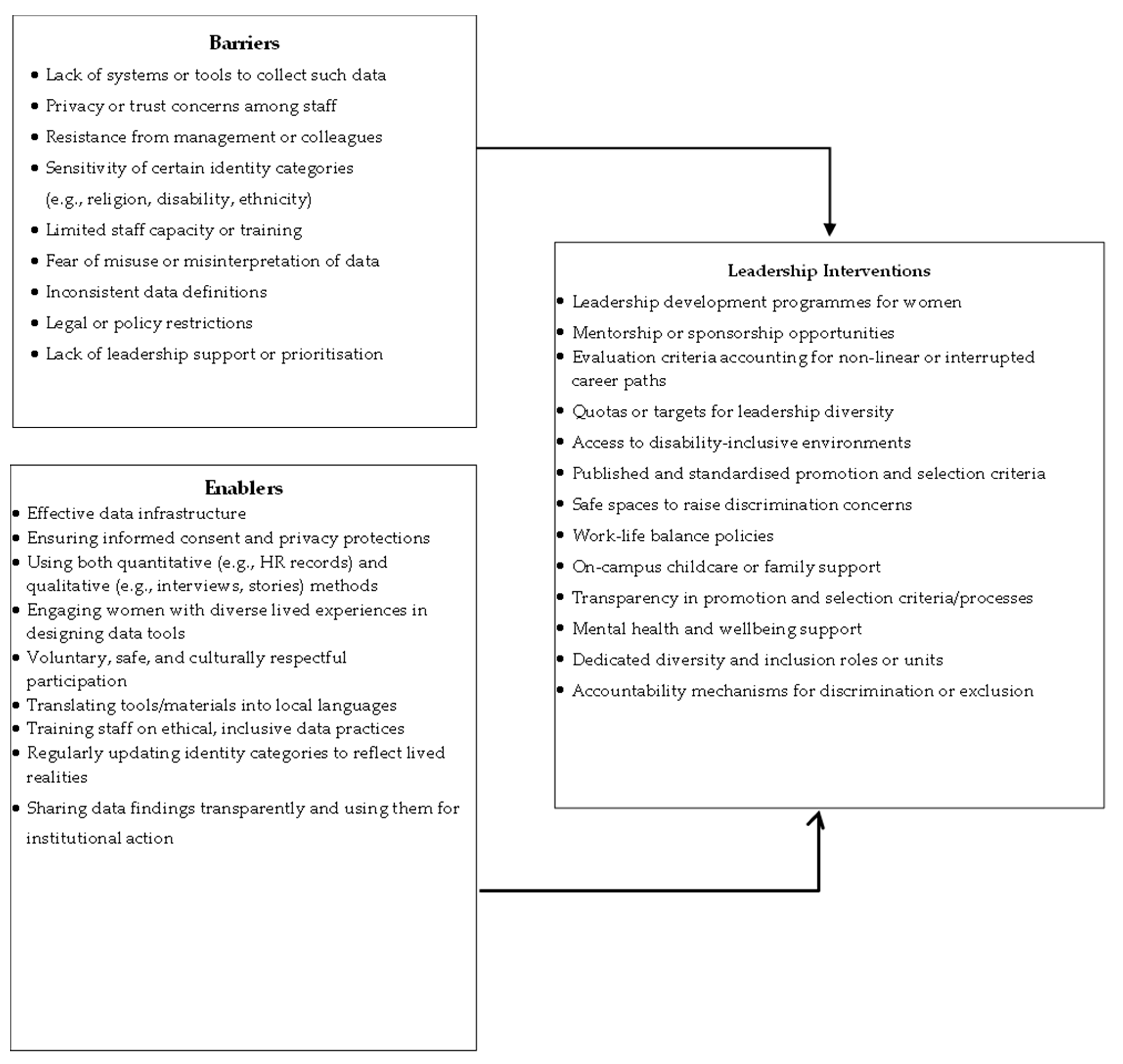
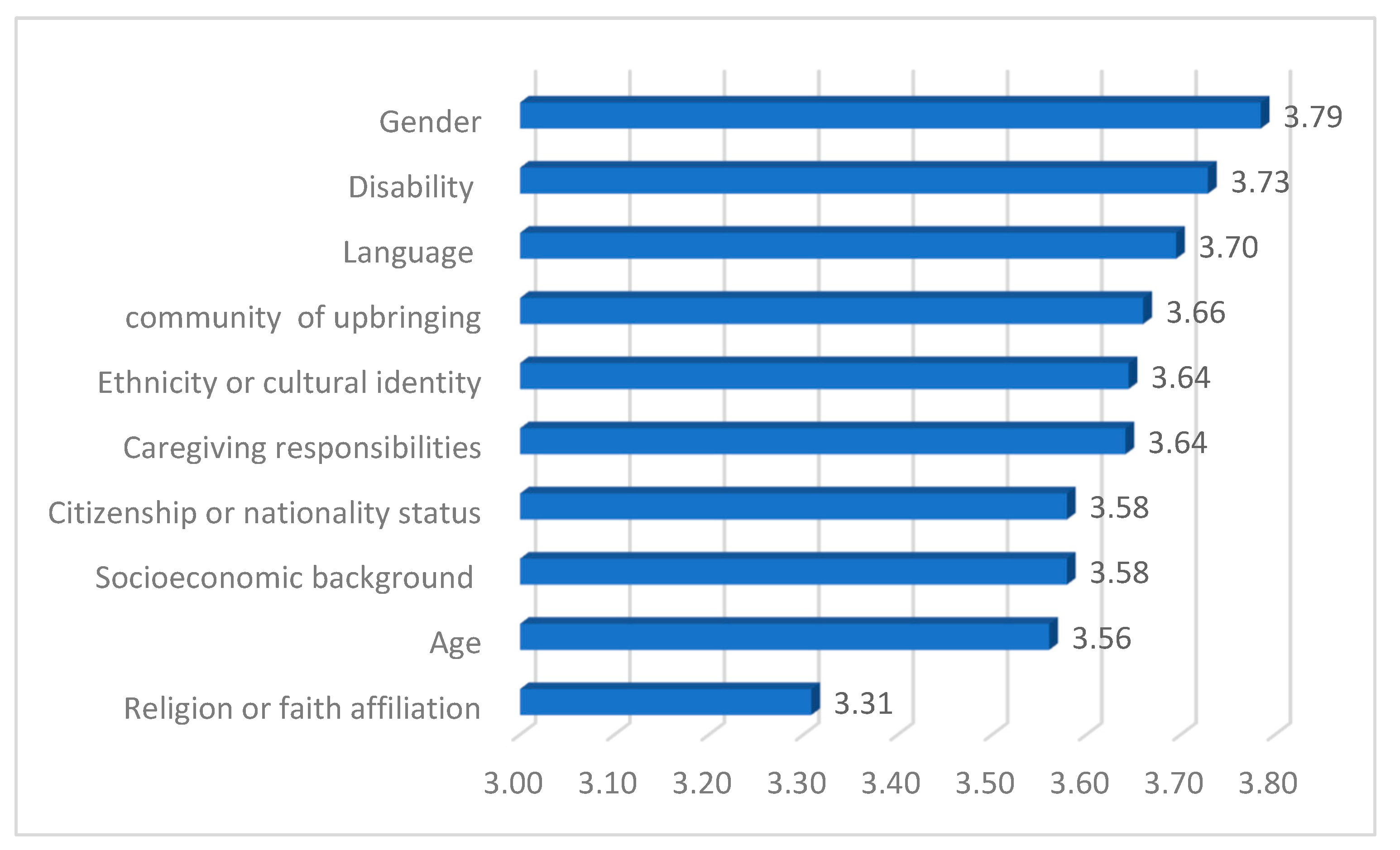

| Characteristics | Categories | Frequency | Percentage (%) |
|---|---|---|---|
| Gender | Male | 32 | 29.9 |
| Female | 75 | 70.1 | |
| Total | 107 | 100.0 | |
| Highest Educational Qualification | Bachelors | 50 | 46.7 |
| Masters | 52 | 48.6 | |
| Doctorate | 5 | 4.7 | |
| Total | 107 | 100.0 | |
| Current Role | Administrative or professional staff (e.g., HR officer, finance officer, librarian, technicians) | 18 | 16.8 |
| Administrative senior/executive leadership (e.g., director, secretary general, registrar-general) | 8 | 7.5 | |
| Early career academic (e.g., lecturer, assistant lecturer, researcher) | 33 | 30.8 | |
| Mid-career academic (e.g., senior lecturer, associate professor) | 17 | 15.9 | |
| Academic leader (e.g., Professor, head of department, dean) | 19 | 17.8 | |
| Technical or operational support staff (e.g., IT, logistics, facilities) | 10 | 9.3 | |
| Administrative middle management (e.g., office manager, unit head, program coordinator) | 2 | 1.9 | |
| Total | 107 | 100.0 | |
| Years of Experience in Higher Education | Less than 2 years | 22 | 20.6 |
| 2–5 years | 20 | 18.7 | |
| 6–10 years | 30 | 28.0 | |
| 11–15 years | 18 | 16.8 | |
| More than 15 years | 17 | 15.9 | |
| Total | 107 | 100.0 | |
| Years prior to attaining first promotion in higher education | Not yet | 40 | 37.4 |
| Less than 3 years | 19 | 17.8 | |
| 3–5 years | 34 | 31.8 | |
| 6–10 years | 10 | 9.3 | |
| More than 10 years | 4 | 3.7 | |
| Total | 107 | 100.0 |
| Code | Leadership Interventions | Mean Value | Rank | Employment Role | DF | Asymp. Sig (p) | Qualification KWH | DF | Asymp. Sig (p) |
|---|---|---|---|---|---|---|---|---|---|
| LI1 | Leadership development programmes for women | 4.50 | 1 | 2.074 | 6 | 0.913 | 5.458 | 2 | 0.065 |
| LI2 | Mentorship or sponsorship opportunities | 4.40 | 2 | 5.057 | 6 | 0.537 | 4.788 | 2 | 0.091 |
| LI3 | Evaluation criteria accounting for non-linear or interrupted career paths | 4.14 | 11 | 6.381 | 6 | 0.382 | 1.927 | 2 | 0.382 |
| LI4 | Quotas or targets for leadership diversity | 4.28 | 5 | 9.407 | 6 | 0.152 | 1.583 | 2 | 0.453 |
| LI5 | Access to disability-inclusive environments | 4.25 | 8 | 4.652 | 6 | 0.589 | 2.154 | 2 | 0.341 |
| LI6 | Published and standardised promotion and selection criteria | 4.27 | 6 | 9.903 | 6 | 0.129 | 1.379 | 2 | 0.502 |
| LI7 | Safe spaces to raise discrimination concerns | 4.26 | 7 | 10.812 | 6 | 0.094 | 2.907 | 2 | 0.234 |
| LI8 | Work–life balance policies (e.g., flexible hours, parental leave arrangements) | 4.23 | 9 | 9.177 | 6 | 0.164 | 1.751 | 2 | 0.417 |
| LI9 | On-campus childcare or family support services | 4.04 | 13 | 6.193 | 6 | 0.402 | 2.059 | 2 | 0.357 |
| LI10 | Transparency in promotion and selection criteria/processes | 4.21 | 10 | 6.312 | 6 | 0.389 | 1.914 | 2 | 0.384 |
| LI11 | Mental health and wellbeing support | 4.30 | 3 | 11.413 | 6 | 0.076 | 4.098 | 2 | 0.129 |
| LI12 | Dedicated diversity and inclusion roles or units | 4.29 | 4 | 8.575 | 6 | 0.199 | 3.471 | 2 | 0.176 |
| LI13 | Accountability mechanisms for discrimination or exclusion | 4.12 | 12 | 16.711 | 6 | 0.010 | 4.967 | 2 | 0.083 |
| N | 107 | ||||||||
| Kendall’s Wa | 0.038 | ||||||||
| Chi-Square (χ2) | 49.254 | ||||||||
| df | 12 | ||||||||
| Asymp. Sig. (p) | 0.000 | ||||||||
| Code | Barriers | Mean Value | Rank | Employment Role KWH | DF | Asymp. Sig (p) | Qualification KWH | DF | Asymp. Sig (p) |
|---|---|---|---|---|---|---|---|---|---|
| B1 | Lack of systems or tools to collect such data | 4.07 | 1 | 6.183 | 6 | 0.403 | 2.218 | 2 | 0.330 |
| B2 | Privacy or trust concerns among staff | 3.82 | 6 | 8.460 | 6 | 0.206 | 1.914 | 2 | 0.384 |
| B3 | Resistance from management or colleagues | 3.77 | 7 | 11.609 | 6 | 0.071 | 3.932 | 2 | 0.140 |
| B4 | Sensitivity of certain identity categories (e.g., religion, disability, ethnicity) | 3.74 | 8 | 3.093 | 6 | 0.797 | 1.861 | 2 | 0.394 |
| B5 | Limited staff capacity or training | 4.05 | 2 | 11.471 | 6 | 0.075 | 0.929 | 2 | 0.628 |
| B6 | Fear of misuse or misinterpretation of data | 3.84 | 5 | 9.570 | 6 | 0.144 | 1.283 | 2 | 0.527 |
| B7 | Inconsistent data definitions | 3.93 | 3 | 5.781 | 6 | 0.448 | 1.990 | 2 | 0.370 |
| B8 | Legal or policy restrictions | 3.74 | 8 | 6.753 | 6 | 0.344 | 4.808 | 2 | 0.090 |
| B9 | Lack of leadership support | 3.93 | 3 | 13.625 | 6 | 0.034 | 3.343 | 2 | 0.188 |
| N | 107 | ||||||||
| Kendall’s Wa | 0.036 | ||||||||
| Chi-Square (χ2) | 30.169 | ||||||||
| df | 8 | ||||||||
| Asymp. Sig. (p) | 0.000 | ||||||||
| Code | Enablers | Mean Value | Rank | Employment Role KWH | DF | Asymp. Sig (p) | Qualification KWH | DF | Asymp. Sig (p) |
|---|---|---|---|---|---|---|---|---|---|
| E1 | Effective data infrastructure | 4.02 | 6 | 3.866 | 6 | 0.695 | 3.719 | 2 | 0.156 |
| E2 | Ensuring informed consent and privacy protections | 4.10 | 3 | 3.011 | 6 | 0.807 | 4.633 | 2 | 0.099 |
| E3 | Using both quantitative (e.g., HR records) and qualitative (e.g., interviews, stories) methods | 4.16 | 2 | 1.025 | 6 | 0.985 | 4.266 | 2 | 0.118 |
| E4 | Engaging women with diverse lived experiences in designing data tools | 4.09 | 4 | 7.454 | 6 | 0.281 | 4.956 | 2 | 0.084 |
| E5 | Voluntary, safe, and culturally respectful participation | 4.07 | 5 | 7.328 | 6 | 0.292 | 7.922 | 2 | 0.019 |
| E6 | Translating tools/materials into local languages | 3.59 | 9 | 5.553 | 6 | 0.475 | 14.739 | 2 | 0.001 |
| E7 | Training staff on ethical, inclusive data practices | 4.18 | 1 | 2.765 | 6 | 0.838 | 4.019 | 2 | 0.134 |
| E8 | Regularly updating identity categories to reflect lived realities | 3.97 | 7 | 5.777 | 6 | 0.449 | 5.281 | 2 | 0.071 |
| E9 | Sharing data findings transparently and using them for institutional action | 3.96 | 8 | 7.615 | 6 | 0.268 | 5.086 | 2 | 0.079 |
| N | 107 | ||||||||
| Kendall’s Wa | 0.049 | ||||||||
| Chi-Square (χ2) | 41.905 | ||||||||
| df | 8 | ||||||||
| Asymp. Sig. | 0.000 | ||||||||
| LI1 | LI2 | LI3 | LI4 | LI5 | LI6 | LI7 | LI8 | LI9 | LI10 | LI11 | LI12 | LI13 | |
|---|---|---|---|---|---|---|---|---|---|---|---|---|---|
| E1 | 0.336 ** | 0.282 ** | 0.333 ** | 0.262 ** | 0.280 ** | 0.278 ** | 0.292 ** | 0.189 | 0.380 ** | 0.263 ** | 0.426 ** | 0.535 ** | 0.370 ** |
| E2 | 0.340 ** | 0.423 ** | 0.276 ** | 0.243 * | 0.432 ** | 0.372 ** | 0.412 ** | 0.303 ** | 0.355 ** | 0.354 ** | 0.464 ** | 0.384 ** | 0.325 ** |
| E3 | 0.483 ** | 0.422 ** | 0.389 ** | 0.311 ** | 0.350 ** | 0.290 ** | 0.369 ** | 0.279 ** | 0.399 ** | 0.346 ** | 0.414 ** | 0.550 ** | 0.310 ** |
| E4 | 0.431 ** | 0.421 ** | 0.335 ** | 0.310 ** | 0.448 ** | 0.392 ** | 0.426 ** | 0.307 ** | 0.407 ** | 0.368 ** | 0.322 ** | 0.460 ** | 0.340 ** |
| E5 | 0.452 ** | 0.369 ** | 0.274 ** | 0.314 ** | 0.354 ** | 0.302 ** | 0.384 ** | 0.223 * | 0.276 ** | 00.179 | 0.416 ** | 0.441 ** | 0.254 ** |
| E6 | 0.123 | 0.158 | 0.269 ** | 0.301 ** | 0.117 | 0.236 * | 0.284 ** | 0.232 * | 0.176 | 0.343 ** | 0.098 | 0.242 * | 0.372 ** |
| E7 | 0.516 ** | 0.447 ** | 0.324 ** | 0.374 ** | 0.360 ** | 0.348 ** | 0.458 ** | 0.372 ** | 0.235 * | 0.428 ** | 0.457 ** | 0.481 ** | 0.338 ** |
| E8 | 0.346 ** | 0.321 ** | 0.249 ** | 0.233 * | 0.283 ** | 0.378 ** | 0.430 ** | 0.221 * | 0.264 ** | 0.333 ** | 0.277 ** | 0.341 ** | 0.318 ** |
| E9 | 0.297 ** | 0.423 ** | 0.246 * | 0.330 ** | 0.378 ** | 0.470 ** | 0.533 ** | 0.322 ** | 0.244 * | 0.386 ** | 0.384 ** | 0.341 ** | 0.414 ** |
| B1 | 0.283 ** | 0.270 ** | 0.215 * | 0.268 ** | 0.313 ** | 0.262 ** | 0.339 ** | 0.206 * | 0.274 ** | 0.206 * | 0.387 ** | 0.331 ** | 0.179 |
| B2 | 0.227 * | 0.292 ** | 0.230 * | 0.213 * | 0.252 ** | 0.465 ** | 0.404 ** | 0.164 | 0.375 ** | 0.276 ** | 0.253 ** | 0.284 ** | 0.270 ** |
| B3 | 0.230 * | 0.229 * | 0.235 * | 0.199 * | 0.208 * | 0.425 ** | 0.354 ** | 0.183 | 0.300 ** | 0.296 ** | 0.130 | 0.338 ** | 0.244 * |
| B4 | 0.171 | 0.157 | 0.323 ** | 0.220 * | 0.281 ** | 0.348 ** | 0.285 ** | 0.129 | 0.375 ** | 0.208 * | 0.300 ** | 0.341 ** | 0.298 ** |
| B5 | 0.318 ** | 0.357 ** | 0.181 | 0.283 ** | 0.340 ** | 0.309 ** | 0.370 ** | 0.326 ** | 0.407 ** | 0.323 ** | 0.392 ** | 0.425 ** | 0.305 ** |
| B6 | 0.253 ** | 0.197 * | 0.051 | 0.135 | 0.255 ** | 0.320 ** | 0.287 ** | 0.017 | 0.304 ** | 0.023 | 0.164 | 0.261 ** | 0.080 |
| B7 | 0.101 | 0.153 | 0.150 | 0.187 | 0.289 ** | 0.273 ** | 0.313 ** | 0.193 * | 0.305 ** | 0.274 ** | 0.241 * | 0.291 ** | 0.139 |
| B8 | 0.093 | 0.156 | 0.126 | 0.252 ** | 0.273 ** | 0.326 ** | 0.202 * | 0.192 * | 0.282 ** | 0.352 ** | 0.200 * | 0.269 ** | 0.267 ** |
| B9 | 0.327 ** | 0.371 ** | 0.127 | 0.232 * | 0.289 ** | 0.339 ** | 0.300 ** | 0.258 ** | 0.425 ** | 00.183 | 0.321 ** | 0.441 ** | 0.158 |
Disclaimer/Publisher’s Note: The statements, opinions and data contained in all publications are solely those of the individual author(s) and contributor(s) and not of MDPI and/or the editor(s). MDPI and/or the editor(s) disclaim responsibility for any injury to people or property resulting from any ideas, methods, instructions or products referred to in the content. |
© 2026 by the authors. Licensee MDPI, Basel, Switzerland. This article is an open access article distributed under the terms and conditions of the Creative Commons Attribution (CC BY) license.
Share and Cite
Obi, L.I.; Umeokafor, N.; Brites da Silva, H.; Pereira, E.F.; Daniel, E. Intersectional Disaggregated Data Practices and Leadership Interventions for Women in Higher Education: Evidence from Timor-Leste. Educ. Sci. 2026, 16, 804. https://doi.org/10.3390/educsci16050804
Obi LI, Umeokafor N, Brites da Silva H, Pereira EF, Daniel E. Intersectional Disaggregated Data Practices and Leadership Interventions for Women in Higher Education: Evidence from Timor-Leste. Education Sciences. 2026; 16(5):804. https://doi.org/10.3390/educsci16050804
Chicago/Turabian StyleObi, Lovelin I., Nnedinma Umeokafor, Helio Brites da Silva, Emilia Freitas Pereira, and Emmanuel Daniel. 2026. "Intersectional Disaggregated Data Practices and Leadership Interventions for Women in Higher Education: Evidence from Timor-Leste" Education Sciences 16, no. 5: 804. https://doi.org/10.3390/educsci16050804
APA StyleObi, L. I., Umeokafor, N., Brites da Silva, H., Pereira, E. F., & Daniel, E. (2026). Intersectional Disaggregated Data Practices and Leadership Interventions for Women in Higher Education: Evidence from Timor-Leste. Education Sciences, 16(5), 804. https://doi.org/10.3390/educsci16050804

