3.1.1. Professional Learning Workshops
We report results from each of the data sources before corroborating our claim with each other. In terms of attendance, a total of 27 teachers attended the separate three-day workshops we conducted in two districts. In total, 11 out of the 12 implementing teachers attended all three days of the workshop, and a single teacher in District A missed the first day because of issues securing a substitute. During the observations of professional learning, all elements of the workshops were implemented as designed, as captured by the agenda for each day and noted in presenter or observer logs.
Teacher professional learning included working through many of the activities that students experience, including solving problems that required systematic listing and the construction of cases and arguments. Some implementing teachers struggled with the more open-ended nature of the problems they were to solve, including how to approach complex problems by considering simpler cases and linking cases that build inductively to generate a coherent, meaningful sequence. Other teachers struggled with record-keeping as they worked with manipulatives and tracked growing answers within a sequence of related problems. Although the facilitator tried to name at a high level useful strategies that would also benefit students (e.g., listing systematically, considering simpler cases, shifting representations), observers noted that for a majority of observed teachers these approaches did not appear to be familiar or easy to pick up.
That said, teacher reflection at the end of the three-day workshops did state changes in beliefs across the three focal areas of concepts, participation, and language with a sampling of reflections below, in response to the prompt, “I used to think… and now I know…” adapted from
Elmore (
2011):
“I used to think that students would become bored with lessons which don’t require exact answers and now I know that students can be challenged and engaged with problems that require thinking rather than achieving the correct answer.”
“I used to think that it is very hard to teach students who are not fluent in English, and now I know if I structure the interactions it gets easier and students might learn more.”
“I used to think I needed to give EL students all materials in their native language to participate, and now I know that EL (and all students) benefit from engagement/discussion in activities that will help them understand the concepts.”
Furthermore, the pre- and post-surveys included multiple-choice knowledge items about quality learning opportunities with English Leaners, and among the 21 respondents who had matched pre- and post-responses, the average percent correct increased by 37 percentage points, from 44% correct to 81% correct. There was substantial variation across questions; however, with by-question improvement ranging from 24% to 48%, this variation reflects greater growth in the role of language in learning (an increase from 19% to 67% correct) as compared to quality learning opportunities in general (an increase from 67% correct to 90% correct). In addition, participants changed in their beliefs as captured by Likert scale responses to statements, with the most movement in response to “English Learners need to build their basic language skills before they can understand disciplinary language.” While just over half (11 out of 21, or 52%) of matched respondents disagreed with that statement at the beginning of the workshop and none strongly disagreed; by the end of the three-day workshop a larger majority disagreed or strongly disagreed (13 out of 21, or 62%), and five respondents (24%) strongly disagreed. In short, there was evidence that the professional learning workshop changed teachers’ knowledge and beliefs.
3.1.2. Classroom Implementation of Intervention
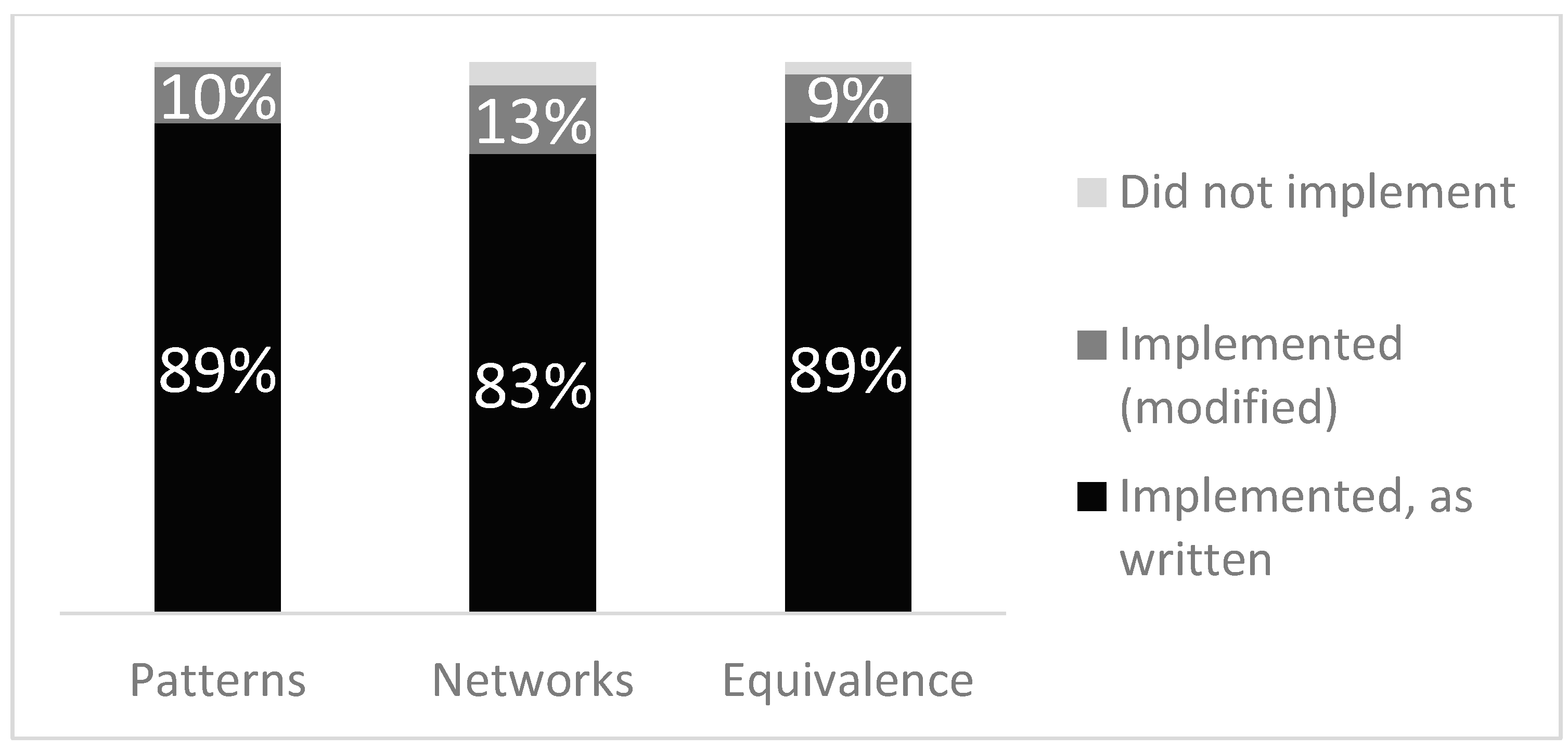
In terms of implementation with students, there was a high degree of reported implementation of the 20–30 activities within each module, with well over 80% of activities reported as “implemented, as written” by teachers (
Figure 1), where teachers reported modifications were primarily in the form of supplemental activities or media, such as icebreakers or short videos sourced from streaming services that were about the topic students were learning. Teachers also reported adding physical experiences such as climbing stairs (directly relevant to a problem context) or giving students manipulatives. One teacher wrote, “Students need dominos or real stairs to count combinations. I provided stairs right outside my class for 2 groups and dominos for other two groups. We made all possible combinations for group of 6 dominos/stairs.” (Teacher B4). This statement seems to reflect a belief that students would not be able to construct and inscribe representations of the ideas without first having a physical experience. Other reported modifications were in terms of instructional format, as some teachers reported shifting away from small group discussions and more toward whole-class presentations and discussions.
Teachers’ daily reflection questions generally expressed their desire to challenge students but also their unfamiliarity with this more ambitious, open-ended form of teaching. In some instances, teachers were surprised by the sophistication of student thinking, as with one sorting activity having to do with graphs of alphabetic codes (modulo 26).
Most groups chose to Sort and Label based only on the appearance of the graphs. Only 1 group attempted to make a distinction between the graphs that were shifted by addition as opposed to multiplication. I was particularly impressed because the group was able to confirm that one of the images was definitely shifted by multiplication because there was a point at the origin.
(Teacher B5)
For the most part, teachers faithfully reported student thinking, including trouble that students had and how the teachers tried to address these ambiguities by simplifying the task at hand or doing direct teaching of procedures or approaches. For example, one teacher reported that while the students did share the data and examples, about the number of vertices, edges, and faces of a connected graph, the relationships between those quantities were presented through a video, “After students worked individually, they were allowed to come to the whiteboard, draw their versions and count V/E/F. After the activity we watched YouTube video about Euler’s Formula.” (Teacher B4).
On the other hand, in some groups, students did do the work of discovering the formula:
Before the step it up activity students believed the pattern to be E/2 = V and V + 1 = F. After the activity the students were able to spot that the pattern better fit E − V + 1 = F.
(Teacher B6)
In other cases, although students were given the formula, they were supported to do further investigations and sense-making around the conditions under which the relation applies:
Students checked their math with the Euler’s characteristics to make sure their numbers were correct and asked for help when they were wrong. They also noticed that these numbers were no longer “correct” when the shape was broken into separate pieces. One student got −1 face and was completely amused.
(Teacher B4)
More broadly in terms of participation, teachers generally saw value in group work, such as the small group sorting tasks that generated new categories and labels. There may, however, be some ascriptions of more fixed dispositions and forms of participation, as one teacher described:
The students that are good with leading enjoyed taking the lead and explaining to their group how to do this activity. I saw a leader in each group explaining the process to their classmates.
(Teacher B10)
In terms of classroom observations, we completed 12 complete observations in the summer of 2024, of which eight aligned perfectly with the teachers’ implementation logs. There were four sessions where there were mismatches, ranging from 33% to 75% of observed activities, and all of these mismatches were classified by the observer as “implemented but modified” as opposed to “implemented, as written” reported by the teacher. The actual nature of those modifications was mixed in terms of quality.
For example, in a “Novel Ideas Only” task, students first brainstorm in small groups a list ideas in response to a prompt (in this case, “When I heard the word ‘pattern’ I think of…”) and then as a whole group they are supposed to share so that each group reads the prompt and then their list of ideas, but they do not repeat any ideas that have already been mentioned in order to encourage all groups to listen carefully. Teacher A2 in implementing this task had each small group share out one idea at a time, while still not repeating ideas, which can be much harder for students to follow in terms of flow. While she had noted that task as “implemented, as written,” we determined from the observer notes that it was modified. Because of potential issues with the flow of the activity and not knowing whether a group was done with generating new ideas, this modification did not necessarily improve the task as originally designed and written.
To give another example of modification that may not have carried out the spirit of the activity, teacher B6 was observed to implement one of the readings with the students discussing the reading after the entire passage was complete, in contrast to the modeled directions which had students periodically pause with a partner along the way in order to make sense of the text as it was unfolding. While the teacher marked this task as implemented as written, based upon observer notes we judged that it was modified, with potentially less sense-making opportunity for students.
By contrast, some modifications may have improved learning opportunities. Teacher A2 had students, after they had sorted and labeled different pictures with everyday patterns on them, go to the document camera to share their categories publicly with the whole class, requiring each student to speak. This modification may be beneficial for students, who were developing confidence to present their results to the whole class while also seeing the ideas of all the other groups.
All told, there was complete agreement between observations and logs in a large majority of cases (84% or 57 out of the 68 observed activities). From these data, we can be reasonably confident that teachers made their best efforts to implement the materials as written or intended.
In our coding and discussion of the classroom observation data, we did notice some issues within the quality of implementation, which we categorized as: proceduralizing, note-giving, inconsistency in connecting one activity the following ones, and in many cases no clear modeling of the steps and structure that students were supposed to take within relatively complicated or intricate small group activities.
While the level of discourse between students was relatively high within small groups of students, there was a large amount of inconsistency in terms of mathematical ideas being highlighted and connected to the main idea of the session of the module. This pattern was the case in the lesson observation of teacher B8, who had marked all four observed tasks as “implemented as written.” The observer noted that in the implementation, the teacher did not attend to the higher-level ideas from each task or connect one task to the next through public, whole-class discussion.
By contrast, on the higher end, in one observed session led by teacher B1, students were modeling handshakes in a variety of representations, a total of five different representational approaches were shown by the teacher to the class using a document camera (artistic sketches, circular diagrams with arrows, horizontal rows of “bumps,” arrays of counts, and matrices with checks and double-counting). Connections and correspondences between different approaches, however, were not made, a practice thought to be powerful in developing students’ mathematical understanding and whole-class discussions (
Stein et al., 2008). And in the classroom of teacher B5, who had described students’ work in sorting graphs in the context of secret alphabetic codes and invertible functions, the sorting task was observed to be a lively task in which all students contributed and their interactions were both sustained and increasingly reciprocal in terms of building on, challenging, negotiating, and co-constructing ideas and labels for different groups of graphs. These varied in focus, from overall geometrical features to the algebraic form of the underlying functions.
Finally, with regard to the writing extension activities, which were meant to be a culminating synthesis of each module’s activities, drawing upon daily reflections that students had completed throughout, teachers reported that they implemented the writing extension activities with students for a majority of the modules, with the last module most likely to be omitted given logistical issues at the end. We randomly sampled a few sections to read through student work and were able to verify that students did indeed complete writing activities. An initial analysis of the quality of their writing, however, suggested that for many of them the writing was more a flat recount of what they had done, rather than an opportunity for them to make connections across different cases or problems they had explored with an eye to other mathematical topics as we had intended. A more comprehensive analysis of the quality of student writing as related to other implementation variables is outside the scope of this article but could provide more evidence of the quality of the implementation in terms of desired student outcomes.