Systematic Review

Experiences, Perspectives, and Perceptions Regarding Employability in Higher Education in Chile: A Systematic Review (2000–2025)

by
Thierry Amigo-López
1,*,
Sebastián Silva-Alcaino
2 and
Diana Rojas-Gomez
3,*
1
Facultad de Educación y Ciencias Sociales, Universidad Andres Bello, Santiago 8370134, Chile
2
Departamento de Lingüística, Facultad de Filosofía y Humanidades, Universidad de Chile, Santiago 8380494, Chile
3
Escuela de Nutrición y Dietética, Facultad de Medicina, Universidad Andres Bello, Santiago 8370134, Chile
*
Authors to whom correspondence should be addressed.
Educ. Sci. 2026, 16(5), 795; https://doi.org/10.3390/educsci16050795 (registering DOI)
Submission received: 21 March 2026 / Revised: 9 May 2026 / Accepted: 15 May 2026 / Published: 19 May 2026

Abstract

Graduate employability is a key concern for policymakers and universities worldwide. In Chile, most research has focused on labour market outcomes, with less emphasis on students’ and graduates’ experiences and perceptions of employability during and after their studies. This article presents a systematic review of empirical studies on employability in Chilean higher education published between 2000 and 2025. The review used the PRISMA 2020 framework to systematically search four academic databases: Scopus, Web of Science, SciELO, and ERIH Plus. The initial search identified 445 records. After applying inclusion and eligibility criteria, fourteen empirical studies were selected for the final analysis. These studies were then examined using thematic content analysis. The findings show a significant increase in employability studies since 2019 and a shift toward qualitative methodologies. The literature mainly addresses four analytical dimensions: (1) education-to-work transitions and career trajectories; (2) employability resources, such as skills, credentials, and social capital; (3) institutional strategies to foster employability; and (4) structural inequalities related to gender, social origin, and institutional selectivity. The findings suggest that graduate employability in Chile is shaped by the interaction between individual resources, institutional practices, and labour market structures within a highly segmented higher education system. Additionally, the review notes a lack of longitudinal research and calls for comparative studies and institutional policies to address structural inequalities. This article contributes by advocating a relational approach to employability that links individual capital, institutional habitus, and labour market structures.

1. Introduction

The debate on employability in higher education has become a prominent feature of institutional and policy agendas in recent decades. This follows the expansion of tertiary education that began in the United States and Canada after the Second World War and later spread to Europe and the Asia–Pacific region (Brunner, 2015; Courtois, 2018; Tight, 2023). The rise of artificial intelligence has further reshaped labour market practices and structures (Carstensen & Ganz, 2025), making this landscape more complex. In this context, guidelines have linked the development of 21st-century skills to university education, with particular emphasis on employability, amid growing demand from the labour market for higher education institutions to produce graduates with the right skills (Tight, 2021). The recent OECD (2025) report argues that education systems must ensure the development of skills relevant to professional performance. In Chile, it indicates that higher levels of specialisation, such as postgraduate studies or other qualifications, are associated with better employment outcomes after completing education.
International literature reports progress in university policies and in curricular and extracurricular strategies aimed at enhancing students’ employability (modules, portfolios, mentoring, work placements, and integrated learning experiences). These involve active student participation and yield outcomes transferable to workplace contexts (Jackson et al., 2024; Lexis et al., 2025; Li et al., 2025). In Chile, teaching employability as a curricular and pedagogical focus has not yet been consolidated systematically and appears in the form of isolated, heterogeneous initiatives (Caniuqueo-Vargas et al., 2023; González et al., 2020; Orellana, 2018). Research has also mainly focused on labour market entry, employment conditions and the analysis of the actors involved (Oyarzo & Ferrada, 2024; Bogliaccini et al., 2022; Bargsted et al., 2021), while the experiences of students during their undergraduate education remain poorly documented. Consequently, a detailed and systematic characterisation of how students and graduates experience, perceive and interpret employability throughout their educational trajectories and transitions into the labour market is still lacking, particularly with regard to the relationship between the resources accumulated during higher education and the opportunities perceived as accessible under different institutional and labour market conditions.
Conceptually, the literature defining employability covers a wide range of meanings and constitutes a concept that has evolved over time. One of the most influential definitions is that proposed by Yorke (2006), who understands employability as a set of graduate achievements, skills, understandings, and attributes that enhance professional performance. Other authors view it as an economic imperative that reorients the purpose of higher education towards generating immediate and productive inputs for the economy following graduation (Tight, 2023). For Tomlinson (2012), employability is conceived as a dynamic practice in which resources acquired through formal and informal experiences interact recursively and confer positional advantages in the labour market; within this framework, the notion of fit becomes relevant, understood as the valued alignment between the individual and the job, mediated by criteria and decisions (Flanagan, 2024).
Furthermore, the sense of professional self is conceptualised as the understanding that the individual constructs regarding their capabilities, responsibilities, norms, and standards of behaviour prioritised within a specific field; in other words, it is a way of understanding the perceptions of students and graduates (Jackson, 2016). This dimension involves an exercise in self-reflection, in which the student assesses the alignment between their own values and the culture of the profession.
In this systematic review, the perception of employability is understood as an expression of that sense of professional self, reflecting how students and graduates interpret their own resources, educational pathways, and prospects for integration into specific institutional and workplace contexts. It is also considered from an adjustment perspective (Flanagan, 2024), focusing on the student experience and recognising that the accumulation of knowledge throughout higher education forms part of the graduate’s capital (Tomlinson, 2017) necessary for developing employability in various fields.
Despite growing interest in employability within Chilean higher education, existing research is fragmented across disciplines, institutional contexts and analytical approaches. While a substantial body of research has examined labour market integration, employment conditions, institutional selectivity and employability competencies, there has been little research into how students and graduates experience, perceive and interpret employability processes throughout their educational and professional trajectories. However, research into how students and graduates experience, perceive and interpret employability processes throughout their educational and professional trajectories is scarce. Consequently, a systematic synthesis of literature examining these dimensions within the Chilean higher education context is lacking.
This systematic review aims to analyse how experiences, perspectives, and perceptions regarding employability, educational trajectories, and transitions into the labour market have been examined in studies on students and graduates in Chilean higher education between 2000 and 2025. Specifically, the review identifies empirical studies indexed in Scopus, Web of Science, ERIH+, and SciELO that address employability-related experiences and labour market transitions among students and graduates in Chilean higher education. Following PRISMA criteria, the study also analyses and synthesises the selected literature in order to identify its methodological characteristics, analytical dimensions, and principal findings regarding employability, institutional practices, and structural inequalities.

2. Methodology

A qualitative systematic review was conducted to identify and analyse research on experiences, projections, and perceptions of employability in Chilean higher education between 2000 and 2025 (Timulak, 2009). Systematic reviews use standardised processes to organise and code information, aiming to assess the state of research on a given topic (Villalobos & Pereira, 2022). This study applies an adapted PRISMA 2020 (Page et al., 2021) framework to structure the search and ensure quality and transparency (Bacca et al., 2014; Sánchez Meca, 2010).

2.1. Search Strategy and Selection Criteria

The study followed three stages. First, academic articles on employability in higher education were identified through a systematic search of four international databases: Web of Science (WoS), Scopus, SciELO, and ERIH Plus. The search was conducted in December 2025, with no subsequent updates. Keywords in Spanish, English, and Portuguese included employability, higher education, student graduates, and Chile, as well as experience, perception, or perspective. Full search strings are provided in Appendix A. The search was limited to scientific articles focused on students and graduates, containing empirical data, conducted in Chile, and published between 2000 and 2025. This process yielded 445 articles.

2.2. Screening and Eligibility Process

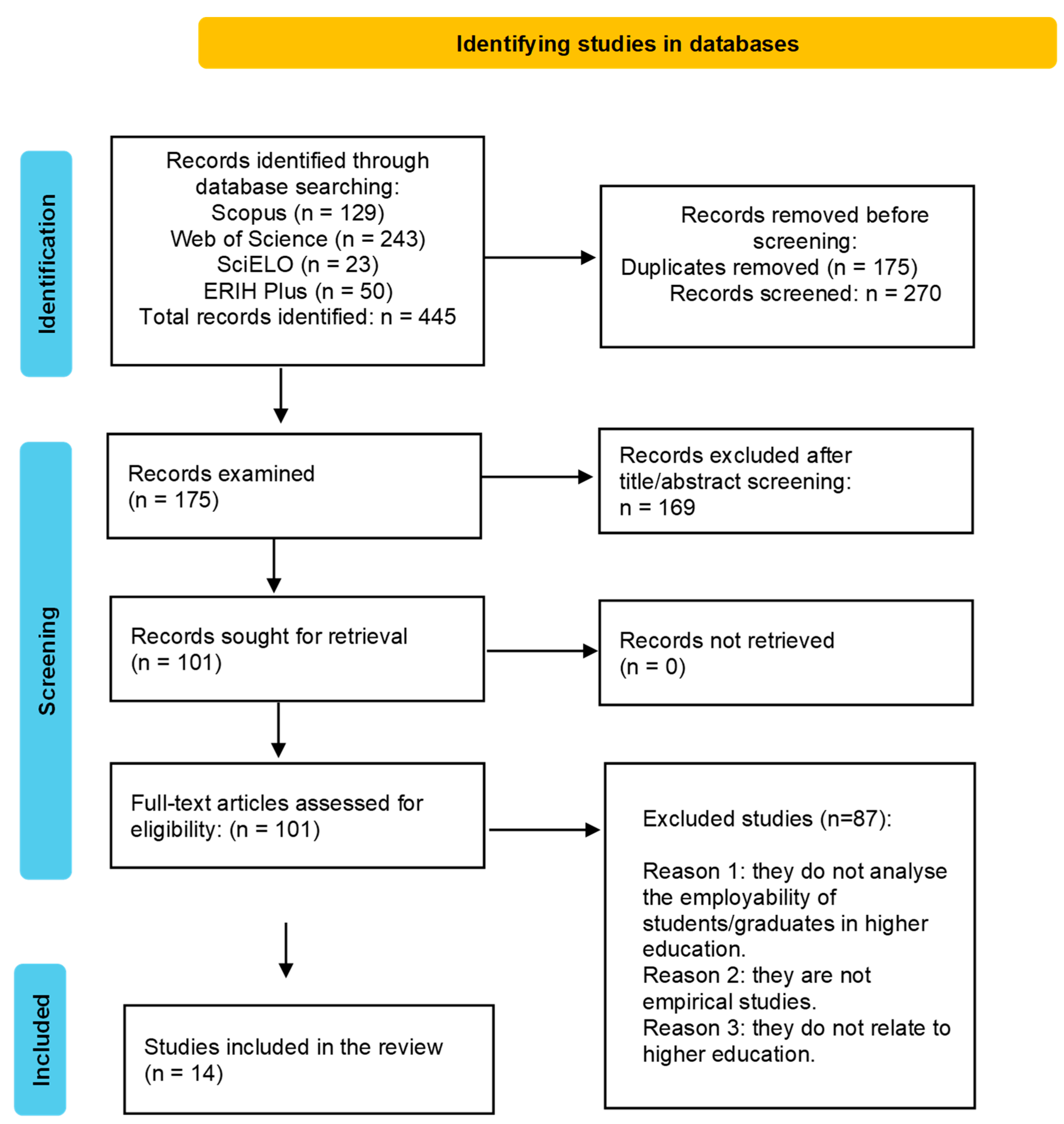
In the second stage, the total number of records was filtered according to three criteria (see Figure 1). The screening was carried out by the author in accordance with the previously defined inclusion and exclusion criteria. Firstly, duplicate publications were removed (N = 175). Secondly, titles and abstracts were reviewed to exclude documents that were not academic articles, had not been published between 2000 and 2025, or referred to other countries (N = 169). Finally, the abstracts of the remaining articles were evaluated, and studies that did not address employability, labour market transitions or related experiences and perceptions among higher education students and graduates were excluded, either directly or indirectly (N = 87). Duplicate records retrieved from different databases were identified and removed through a comparison of titles, authors, year of publication, journal source, and DOI information prior to the screening stage. Following this screening process, the systematic review included 14 academic articles (Figure 1).
The protocol followed the general principles recommended for systematic reviews in the social sciences and was used as a guiding framework for the identification, screening, and synthesis of the literature.

2.3. Data Extraction and Thematic Analysis

Information extracted from each article was systematically organised using an analytical matrix developed by the authors. This matrix incorporated variables related to publication characteristics (year, journal, authors), methodological aspects (research design, sample, data collection methods), analytical focus, principal findings, and conclusions. Subsequently, studies were compared across these categories to identify recurring patterns, conceptual similarities, and emerging themes. Through iterative thematic content analysis, findings were progressively grouped into four analytical dimensions that integrated theoretically informed categories with themes identified in the reviewed literature.

2.4. Methodological Quality Assessment

In order to provide a structured assessment of the methodological robustness of the included studies, a qualitative appraisal was conducted considering four criteria commonly used in systematic reviews of social science research:
(1)
clarity of research design,
(2)
sampling strategy and sample size,
(3)
transparency of data collection procedures, and
(4)
coherence between research questions, methods, and conclusions.
The search was limited to scientific articles focused on students and graduates, containing empirical data, conducted in Chile, and published between 2000 and 2025. Publication-year filters available in each database were applied during the search process, and this criterion was subsequently verified during the screening stage through title, abstract, and metadata review.
Each study was examined according to these criteria and classified descriptively as showing high, moderate, or limited methodological robustness. This assessment was not intended to exclude studies from the review but to contextualise the strength of the evidence and to identify potential sources of bias across the analysed literature.
Although the review followed explicit inclusion and exclusion criteria, as well as coding criteria, which were all aligned with PRISMA principles, the screening and thematic coding procedures were conducted by the author(s) without any formal inter-rater reliability analyses, such as Cohen’s Kappa or agreement coefficients. Future systematic reviews could enhance their methodological robustness by incorporating independent peer coding and formal inter-rater agreement procedures.
The information was extracted by reading each article in full and recording it in an analysis matrix developed by the authors, in which the variables defined in the coding protocol were recorded.
The selected articles were subjected to a coding and systematisation protocol. Based on the PRISMA criteria, the coding protocol considered three areas: (i) general characteristics of the article (year, publication, journal, authors); (ii) objectives and method (topics, research and analysis methods); and (iii) focus of the article (temporal scope, forms of employability analysis, conclusions and recommendations). Using the matrix, a thematic content analysis was conducted, enabling the results to be grouped into four analytical dimensions, constructed iteratively from theoretical categories and emerging patterns.

2.5. Assessment of Methodological Quality

To strengthen the methodological transparency of the review, a qualitative appraisal of the methodological robustness of each included study was conducted. The assessment followed a descriptive framework adapted from commonly used criteria in systematic reviews in the social sciences (Sánchez Meca, 2010; Villalobos & Pereira, 2022).
Four criteria were used to evaluate the methodological quality of the studies included in the review:
  • Clarity of research design: whether the study clearly specifies its methodological approach (qualitative, quantitative, or mixed methods) and the analytical procedures used.
  • Sampling strategy: if the sampling procedure is described and justified (probability, purposive, snowball, or convenience sampling).
  • Transparency of data collection methods: if the instruments and procedures used to collect data are adequately described.
  • Coherence between research questions, methods, and conclusions: whether the methodological approach is consistent with the research objectives and whether conclusions are supported by the empirical evidence presented.

3. Results

The fourteen studies included are empirical research studies conducted in Chile involving students and graduates from higher education institutions offering university and technical-vocational programmes. The initial search identified 445 records, and, following screening against the inclusion criteria, 14 articles were selected for analysis.
In terms of timing, eleven articles (78.6%) were published between 2019 and 2025, and three (21.4%) prior to 2019, indicating a recent concentration of research on employability in the Chilean context. Half of the studies are published in Q1 journals (7 out of 14; 50%), three in Q2 (21.4%), two in Q3 (14.3%), one in Q4 (7.1%), and one does not report a quartile. Eight articles are indexed in Scopus (57.1%), four in WoS (28.6%), one in ERIH+ (7.1%), and one in SciELO (7.1%). Seven journals are based in the United Kingdom (50%), three in Chile (21.4%), two in Mexico (14.3%), one in Costa Rica, and one in the Netherlands (7.1% each). Eight papers are published in English (57.1%) and six in Spanish (42.9%). In all cases, the first author’s affiliation is with Chilean higher education institutions.
Table 1 summarises the methodological and thematic characteristics of the fourteen empirical studies included in the review. For each study, the table reports the year of publication, research design, sample size and composition, data collection methods, disciplinary field, and the main analytical focus. Qualitative designs predominate (8 studies; 57.1%), followed by quantitative designs (5; 35.7%) and one mixed-methods study with a qualitative focus (7.1%). The qualitative studies utilise individual and group interviews, case studies, and content analysis. Quantitative designs rely on cross-sectional surveys, with analyses ranging from descriptive statistics and tests of association to structural equation modelling and cluster analysis.
With regard to the risk of bias, several qualitative studies use small, purposive samples (e.g., Espinoza Díaz et al., 2019, 2018; Vergara Wilson & Gallardo, 2019), which limits the generalisability of the results and raises the possibility of selection bias. Among the quantitative studies, most use cross-sectional designs based on self-reporting (Barbosa et al., 2022; Bargsted et al., 2021; Gómez-Urrutia & Royo Urrizola, 2017), meaning that the relationships found are interpreted as associations rather than causality. Only a few studies employ probability sampling (Espinoza Díaz et al., 2025a; Gómez-Urrutia & Royo Urrizola, 2017), whilst in other cases, self-selection or snowball sampling may introduce participation bias (Mora Nowrath et al., 2025).
Based on the thematic coding (see Table 2), the studies were organised into four analytical dimensions: (a) educational and labour market transitions and pathways; (b) resources for employability; (c) institutional support measures; (d) inequalities and segmentation.
The methodological quality assessment in Table 3 used four criteria: clarity of the research design, sampling strategy, transparency of data collection methods, and coherence among the research questions, methods, and conclusions. Each study was evaluated across these dimensions and classified as showing high, moderate, or limited methodological robustness. The evaluation was descriptive and aimed to contextualise the strength of the evidence rather than exclude studies from the review. Most studies show high methodological robustness, with clarity in research design and coherence between methods and conclusions. The authors conducted the evaluation through full-text reading and systematic coding using the analytical matrix developed for the review.
The main methodological differences involve using purposive and context-specific sampling strategies, especially in qualitative studies that explore experiences, meanings, and perceptions in depth. Therefore, the findings should be interpreted within the specific institutional and social contexts of each study.

3.1. Educational and Labour Market Transitions and Pathways

This section brings together studies that examine the transition from education to work and the initial pathways into the labour market, focusing on expectations, the time taken to enter the labour market, the conditions of the first job, and subsequent career changes. This section includes the works of Espinoza Díaz et al. (2024), Goñi et al. (2025), Mora Nowrath et al. (2025) and Vergara Wilson and Gallardo (2019).
Espinoza Díaz et al. (2024) analyse the experiences of university graduates entering the labour market, based on 39 semi-structured interviews conducted with graduates from various disciplines and selected universities within the Single Admission System. Using qualitative content analysis, the authors organise the narratives around three themes: entry into the labour market, earnings, and working conditions. The results describe trajectories marked by prolonged job searches, an overload of applications, informal employment, and successive adjustments to salary expectations. The recommendations aim to make these conditions transparent before students enter their degree programmes and to strengthen, during their studies, their ability to generate their own economic opportunities, particularly among graduates from working-class backgrounds.
The study by Goñi et al. (2025) focuses on 33 graduates from a non-selective technical and vocational higher education institution (Duoc UC), who are considered non-traditional students. Drawing on individual and group interviews, and using Garriott’s (2023, cited in Goñi et al., 2025) model of critical cultural wealth as a framework, the authors reconstruct the career trajectory across three stages: entry (work placements and first jobs), retention (working conditions, promotions, stability), and future prospects. At the same time, strategies of agency are identified, such as reorienting one’s career towards related fields, utilising peer networks, and obtaining additional certifications. The authors recommend that technical and vocational institutions incorporate explicit information on the labour market, strengthen quality practices, and create opportunities for collaborative work among students that foster the development of sustainable career plans.
Mora Nowrath et al. (2025) broaden the focus to long-term career trajectories by analysing the employment situation of 330 anthropologists who studied at various Chilean universities between 1990 and 2020. Through an online survey comprising closed and open-ended questions, statistical analysis and semantic co-occurrence analysis reveal a scenario of structural precariousness: nearly half of the professionals work on a fee-for-service basis, a gender pay gap is evident, and more than half of the participants state that they would choose a different career path today. Moreover, entry into the profession is described as delayed, fragmented, and heavily influenced by the lack of formal recognition of the profession. The authors highlight the need to review curricula with input from graduates, promote early work placements and internships, and establish a network of programmes to continuously monitor conditions in the labour market.
Finally, the study by Vergara Wilson and Gallardo (2019) focuses on the period immediately prior to graduation. Drawing on 19 interviews (both individual and group) with final-year and penultimate-year students from four degree programmes at the Pontificia Universidad Católica de Chile, the authors use grounded theory and graphic narrative techniques to reconstruct students’ expectations regarding their transition into the world of work. The results reveal an anticipated experience of uncertainty centred on concerns regarding a lack of work experience, the importance of networks (connections) and the weight of institutional prestige. Students develop value-adding strategies such as courses, postgraduate studies, and part-time work whilst internalising the mandate of self-entrepreneurship. These projections differ according to social background and the market position of the degree programme: those from more affluent backgrounds report a greater range of choice, whereas students from vulnerable sectors describe greater pressure not to waste their family’s investment.

3.2. Resources for Employability: Capital, Skills, and Qualifications

The second dimension brings together studies that examine the resources students and graduates draw upon to strengthen their position in the labour market: motivations for furthering their qualifications, specific and generic skills, as well as subjective resources associated with career success. This section presents the works of Espinoza Díaz et al. (2025a) on motivations for pursuing postgraduate studies, Barbosa et al. (2022) and Bargsted et al. (2021).
Espinoza Díaz et al. (2025a, 2025b) analyse, through 55 semi-structured interviews with graduates from 17 universities, the motivations for undertaking postgraduate studies in a context of credential inflation. Drawing on Self-Determination Theory and credentialism, the content analysis, supported by ATLAS.ti, distinguishes between intrinsic motivations linked to learning and extrinsic motivations linked to the pursuit of positional advantage. The results reveal two main logics: one oriented towards upward mobility, in which postgraduate study is understood as a pathway to leadership positions or more prestigious professional fields; and another of a defensive nature, in which continuing one’s studies is conceived as a mechanism to avoid job insecurity in the face of the devaluation of the undergraduate degree. The authors argue that the expansion of postgraduate education needs to be aligned with real social and productive needs and suggest investigating the employment outcomes of those pursuing these extended pathways.
Barbosa et al. (2022) examine the relationship between enterprise risk management (ERM) competencies and perceptions of work readiness among accounting students. Using an online survey administered to final-year students or recent graduates, and employing PLS-SEM structural equation modelling, the study utilises the scale developed by Prikshat et al. (2019) to measure work readiness across four dimensions: job-specific skills, communication skills, systems thinking, and political and teamwork skills. The results indicate that mastery of risk standards, particularly those associated with the Committee of Sponsoring Organizations of the Treadway Commission (COSO) framework, is positively linked to work readiness when combined with soft skills. The dimensions of governance and risk processes show no relationship with self-perceived readiness, suggesting that teaching is overly theoretical. Based on this, the authors recommend explicitly integrating technical frameworks with the development of interpersonal and ethical skills within accounting education and using the competency model to identify gaps in the curriculum.
The study by Bargsted et al. (2021) uses data from 1087 graduates of a non-selective institution and is grounded in Resource Conservation Theory. Using an online questionnaire and structural equation modelling, employability is measured in terms of competencies using the instrument developed by Van der Heijden et al. (2018, cited in Bargsted et al., 2021) (occupational expertise, anticipation and optimisation, personal flexibility, corporate sense and balance) and perceived employability using the adapted scale by Stumpf et al. (1983, cited in Bargsted et al., 2021). The results show that subjective professional success (career satisfaction) partially mediates the relationship between competencies and perceived employability, whilst objective success (salary, professional category) shows no association with this perception. For first-generation professionals, constructing a positive image of one’s own career trajectory carries more weight than external credentials in sustaining professional confidence. Based on these findings, the authors highlight the need for institutional programmes that combine skills training with opportunities for career reflection, so that graduates can recognise and manage their resources without this being interpreted by employers as a threat of staff turnover.

3.3. Institutional Support Measures and Training Guidance

The third dimension focuses on the measures taken by higher education institutions to manage employability and career integration, as well as the tensions this creates in the design of training programmes. This is the subject of the studies by Quaresma and Miranda (2023) and Espinoza Díaz et al. (2020).
Quaresma and Miranda (2023) conduct a multiple-case study at three large Chilean private universities (Universidad Andrés Bello, Universidad Autónoma and Universidad de las Américas) that cater primarily to first-generation students. Based on 31 semi-structured interviews with programme directors and graduate teams, and using content analysis, the authors describe four dimensions of professional integration practices: graduate tracking, support for entry into the labour market through career services, training in soft skills, and the development of a sense of institutional belonging. Training programmes in communication, teamwork and leadership are developed, alongside activities designed to foster loyalty and institutional pride, which seek to sustain networks of contacts that do not arise spontaneously. The authors suggest exploring this line of inquiry further by incorporating the voices of students and graduates and by comparing these practices with those of traditional public universities to understand the effects of accreditation processes on the standardisation of policies.
Espinoza Díaz et al. (2020) report on initial teacher training and the tension between preparing employable teachers and teachers who are effective at facilitating learning in schools. Drawing on semi-structured interviews with three directors of teacher training programmes and nine school heads who employ their graduates, and using narrative analysis supported by ATLAS.ti, the authors compare the competencies prioritised in the curricula with those valued in recruitment. The results indicate that schools in vulnerable contexts prioritise discipline management and emotional regulation skills, whereas elite institutions place greater value on subject-specific expertise and the cultural capital associated with highly selective universities. This segmentation shapes curricular decisions: some faculties adapt their programmes to meet the demands of specific employers, even when this may diminish the centrality of academic training. The article concludes that an excessive focus on employability—understood as adaptation to difficult working conditions—can undermine training in teaching quality and proposes strengthening disciplinary and pedagogical components, alongside studies that link training competencies with student learning.

3.4. Inequalities and Segmentation

The fourth dimension brings together studies that analyse employability and its relationship with inequalities based on social background, institutional selectivity, discipline and gender. This section presents the works of Espinoza Díaz et al. (2025a) on social capital and job quality; Espinoza Díaz et al. (2019, 2018) on psychology graduates; Salinas and Romaní (2017); and Gómez-Urrutia and Royo Urrizola (2017).
Espinoza Díaz et al. (2025b) conducted a quantitative study using a probability sample of 940 graduates from the 2015–2017 cohorts, employing an online questionnaire and latent analysis in R to construct a measure of job quality. The dependent variable comprises four indicators: salary, type of contract and working hours, fit between education and employment, and job satisfaction, from which four classes of employment are identified, ranging from precarious situations to high-quality jobs. Subsequently, separate multinomial regression models are estimated for first-generation and continuing graduates. The results indicate that social capital (measured as the frequency of contact with professionals and managers) improves the probability of accessing higher-quality jobs, but with different benefits depending on social background. Graduates from families with a university background secure high-quality jobs mainly through contacts with professionals, whilst first-generation graduates need to engage with both professionals and managers to compensate for prior disadvantages. The authors conclude that a degree does not neutralise inequalities of origin and recommend that universities serving vulnerable students institutionalise networking strategies as a form of systematic support.
The studies by Espinoza Díaz et al. (2019, 2018) examine in depth the relationship between institutional selectivity and employment outcomes for psychology graduates. In the 2019 article, based on interviews with nine graduates, perceptions of initial entry into the labour market are analysed, distinguishing between graduates from universities with high, medium and low levels of selectivity. Content analysis identifies the fulfilment of expectations, the value placed on education, the importance of institutional prestige and market conditions as key dimensions. Graduates from highly selective institutions describe faster entry into the labour market with better conditions, while those from less selective universities highlight practical shortcomings in their training and experiences of stigmatisation that lead them to rely on personal networks and favours to secure positions. The 2018 study, involving six interviewees, reinforces this assessment by conceptualising employability as a set of achievements and skills that only constitute a necessary condition for employment when combined with institutional prestige and support for entry into the labour market. In their recommendations, the authors argue that public policies must move beyond a focus on access towards equity of outcomes, addressing quality gaps between institutions and the role of prestige as a mechanism of social exclusion.
Salinas and Romaní (2017) examine the gender dimension in mining programmes through 59 interviews with first- and final-year female students in Antofagasta. Using a coding method inspired by grounded theory, the authors reconstruct career prospects in a heavily male-dominated field. The students value the economic opportunities offered by mining and are building their technical self-confidence, but they anticipate barriers linked to machismo, shift patterns incompatible with motherhood, and a lack of shared responsibility for care. Career prospects are experienced as a form of resistance that combines expectations of economic independence with a perception of inequality in the distribution of opportunities. The authors highlight the need to systematically incorporate a gender perspective into curricula and to develop gender-related skills aimed at challenging stereotypes in undergraduate education.
For their part, Gómez-Urrutia and Royo Urrizola (2017) analyse young people’s perceptions of the relationship between paid work and family life, based on a survey of 536 students from two universities in the Maule region. The questionnaire, based on Likert-type scales, gathers assessments of personal employability, willingness to be self-employed, job turnover and life priorities. The results show a growing preference for personal development and leisure time over traditional wage stability among both men and women. However, when it comes to the distribution of care tasks, gender patterns persist that assign greater responsibility to women. The authors argue that this combination of egalitarian aspirations and unequal care structures may create new vulnerabilities in a context of limited social protection and call for a review of public policies on work–life balance and shared responsibility.

4. Discussion

The Chilean studies on employability analysed the tension arising from the massification of higher education, institutional segmentation and a labour market characterised by a proliferation of qualifications alongside unstable working conditions. The studies describe pathways in which a degree does not directly translate into stability but rather marks a starting point from which students and graduates negotiate their prospects within a landscape of credential competition and institutional differentiation, in line with international discussions on credentialism, qualification and the stratification of employment opportunities (Bacevic, 2014; Tomlinson & Watermeyer, 2022).
In terms of transitions and pathways into the labour market, the studies describe entries into the market characterised by prolonged job searches, a succession of temporary jobs, freelance contracts and shifts between fields of work. Entry into the labour market is shaped by the prestige of the institution, the discipline, and access to networks, which reinforces the hierarchies already present during training. This dynamic is consistent with studies that have shown longer, reversible youth transitions punctuated by episodes of precariousness, in which the career path is constructed through successive adjustments rather than based on a single milestone of first employment (Edgar et al., 2016). In the Chilean case, the concentration of opportunities in metropolitan areas and the saturation of certain professions intensify these differences.
The dimension of motivations, aspirations, and projections regarding employability shows that the decision to continue one’s studies, to envisage entering the world of work, or to plan for a work–life balance is closely linked to experiences of uncertainty and a critical assessment of the job market. Narratives about postgraduate studies, for example, are organised around strategies to protect against the devaluation of the undergraduate degree and the search for better relative positions, rather than an exclusively academic interest. In line with the literature on credentials and strategies for adding value to one’s professional profile (Bogdány et al., 2025; Campbell et al., 2019), students develop career strategies in which additional courses, postgraduate programmes, and certifications are understood as resources for managing competition that is perceived as increasingly intense and stratified.
In terms of the resources, capital, and skills required for entering the labour market, studies show that personal networks, cultural capital and institutional prestige are linked to subjective resources such as self-efficacy, one’s perception of one’s own career path, and the ability to make sense of one’s work experience. Social capital appears to be linked not only to access to a job but also to the quality of the employment obtained, with clear differences between first-generation graduates and those whose families already have a university background. These findings resonate with frameworks that analyse the interplay between graduate capital, social capital and psychological resources in career development within segmented labour markets (Tomlinson, 2017; Tomlinson & Anderson, 2021). Added to this is the discussion on skills-based employability and perceived employability, which highlights the importance of technical and soft skills but also of how individuals themselves interpret their educational and work experience (Jackson et al., 2024; Jackson & Tomlinson, 2022).
The role of institutional conditions and employability management positions higher education institutions as intermediaries between students’ educational pathways and the labour market. The studies reviewed describe strategies for tracking graduates, placement offices, generic skills programmes and initiatives aimed at strengthening institutional loyalty. These initiatives form part of an international agenda in which employability is incorporated into quality assurance mechanisms and forms of competition between institutions (Campbell et al., 2019; Kumar et al., 2025). However, the body of work reviewed shows that such strategies are deployed in a market characterised by informal rules and selection based on prestige and personal networks, as well as segmentation by gender and social background. Institutional management, in this context, tends to partially offset initial disadvantages but does not in itself alter the structure of opportunities.
Thus, this review frames employability as a relational and dynamic process involving qualifications, educational experiences, working conditions, accumulated capital, and institutional actions. This approach aligns with perspectives that have linked employability, social justice, and the historical configuration of labour markets (Behle, 2020; Yeves et al., 2021). From a qualitative perspective, the findings suggest that labour market entry should be considered not only in terms of rates or timescales, but also in relation to the ways in which people interpret their career paths, negotiate their expectations, and redefine their life plans within unequal contexts.
The dynamics identified in the Chilean context are also reflected in findings from other higher education systems characterised by high levels of institutional stratification and massification. International studies have demonstrated the significant influence of institutional prestige, field of study, and access to social and professional networks on employability outcomes (Behle, 2020; Tomlinson & Watermeyer, 2022). Research in countries such as the United Kingdom and Australia has similarly documented that graduates from more prestigious institutions tend to experience smoother transitions into the labour market and better employment conditions. In contrast, graduates from less selective institutions often face longer job searches and more precarious career trajectories. Thus, the Chilean case reflects broader global patterns, whereby the expansion of higher education has not eliminated labour market inequalities, but rather reconfigured them through new forms of credential competition and institutional differentiation.
Beyond describing the empirical trends in the literature, this review makes a theoretical contribution to the discussion on graduate employability by integrating three analytical perspectives that frequently appear in isolation in the reviewed studies:
(1)
employability as a form of graduate capital accumulated through educational trajectories;
(2)
employability as a relational process mediated by institutional practices and labour market structures; and
(3)
employability as a subjective interpretation of professional identity and career expectations.
All in all, the review suggests that, across Chilean institutions, employability cannot be understood as either an individual attribute or an institutional outcome. Instead, it should be considered a dynamic interaction between resources, opportunities, and structural inequalities within a stratified higher education system.
Beyond describing empirical trends, these findings can also be understood using different theories about employability. Human capital theory focuses on how qualifications, skills, and experience affect job opportunities. Social capital theory looks at the value of networks, institutional reputation, and professional contacts. Relational approaches add that labour market outcomes depend not just on individual abilities, but also on institutional structures and unequal opportunities. In this view, employability is shaped by the interaction between personal resources, institutional support, and structural inequalities in higher education.

5. Conclusions

The systematic review shows that, in the Chilean context, employability is shaped at the intersection of expanding student numbers, institutional hierarchies and a labour market that combines new opportunities with persistent forms of precariousness and segmentation. The studies reviewed agree that students, graduates and degree holders build their entry into the labour market by combining structural and subjective resources and that higher education institutions have become more directly involved in managing this transition, albeit within a framework that perpetuates inequalities based on social background, gender and academic prestige.
For the field of research, the studies reviewed open up the possibility of moving towards comparative designs, trajectory-tracking studies and analyses that more explicitly integrate the categories of class, gender, territory and type of institution. For university policies and practices, the contributions gathered invite a review of policies supporting integration, the organisation of curricula and the relationship with the world of work, avoiding the reduction of employability to an individual responsibility and recognising the structural dimensions that condition students’ opportunities.
From a policy perspective, the findings suggest the need for institutional and public policies that move beyond narrow, outcome-based approaches to employability. Universities, particularly those serving first-generation and socially vulnerable students, should strengthen their systematic support mechanisms for labour market transitions. These should include mentoring, networking opportunities, graduate tracking systems and career guidance initiatives. At the same time, higher education policies must address structural inequalities related to institutional prestige, gender and social background. This recognises that employability outcomes are shaped not only by individual competencies, but also by unequal opportunities within higher education and labour markets.

6. Limitations

The review was conducted using a search strategy that combined keywords in Spanish, English and Portuguese and was applied to a limited set of databases. It was not possible to carry out a comprehensive assessment of publication bias, nor to systematically identify unindexed studies or grey literature that might have broadened the picture. Moreover, the selection of concepts focused on terms directly associated with employability, labour market entry and the transition from education to work; future studies could incorporate related and closely associated concepts, map related conceptual fields in greater detail and include other meta-search engines such as JSTOR, Taylor & Francis, or ERIC, amongst others.
The studies focused exclusively on the Chilean context, which limits the possibility of drawing comparisons with other higher education systems. Cross-sectional designs predominate in both quantitative and qualitative studies, meaning that educational trajectories are reconstructed on the basis of retrospective accounts or one-off measurements, rather than through long-term follow-ups. In several articles, samples are constructed using purposive or self-selection strategies, which limit the possibility of generalising the results beyond the groups studied.
Furthermore, a significant proportion of the studies focus on specific disciplines (psychology, education, anthropology, mining, and accounting) as well as on specific institutions (universities with varying entry requirements and technical and vocational education), meaning that other fields of study and other types of institutions are less well represented in the corpus. These factors do not invalidate the results, but they do indicate that the available understanding remains rooted in certain professional fields and specific institutional profiles, which opens up scope for extending the analysis to less-studied degree programmes and institutions.
An additional limitation relates to the manual work involved in screening and data extraction, which, although carried out in accordance with explicit criteria, always involves some margin for interpretation in the classification of studies and their allocation to analytical dimensions. A future review involving several independent reviewers, together with formal inter-rater agreement procedures, could reduce this margin and enhance the robustness of the process.
As the review focused exclusively on peer-reviewed journal articles indexed in international databases, studies reporting non-significant results or conducted in local contexts may be underrepresented. Grey literature, such as theses, institutional reports and working papers, was not systematically included. Although prioritising indexed articles was intended to ensure minimum academic quality standards, further research could incorporate additional sources to reduce publication bias and broaden the empirical basis of the analysis.
Another limitation concerns the predominance of studies conducted by a single research team, especially within the Chilean literature on employability. While these studies explore various dimensions and utilise diverse methodologies, such concentration may introduce thematic and interpretative bias in the evidence base, thereby restricting the range of conceptual perspectives included in the review.
This review was not previously registered in a repository and did not have a published protocol. It did not receive external funding, and the authors declare no conflicts of interest. The coding matrices, databases used and analysis materials are available upon request from the authors.

Author Contributions

Conceptualization, T.A.-L.; methodology, T.A.-L.; formal analysis, T.A.-L. and D.R.-G.; writing—original draft preparation, T.A.-L., D.R.-G. and S.S.-A.; writing—review and editing, S.S.-A. and D.R.-G.; funding acquisition, T.A.-L. and D.R.-G. All authors have read and agreed to the published version of the manuscript.

Funding

This research was funded by CEJ-UNAB y el Instituto de Políticas Públicas, Proyecto N° P.2024.1.

Institutional Review Board Statement

Not applicable.

Informed Consent Statement

Not applicable.

Data Availability Statement

The data analysed in this review are derived from previously published literature. All sources and datasets are cited.

Acknowledgments

Artificial Intelligence (AI)-assisted tools were used exclusively to support language editing and improve grammatical clarity when preparing the manuscript. No AI tools were used to generate empirical data, conduct the systematic review, perform the thematic analysis, or produce the findings and interpretations of the study. All analytical decisions, coding procedures, interpretations and conclusions were carried out and verified by the author(s). The authors take full responsibility for the content of the manuscript.

Conflicts of Interest

The authors declare no conflicts of interest.

Appendix A

DatabaseVariantSearch String
ScopusAdvanced searchTITLE-ABS-KEY ((empleabilidad OR “inserción laboral” OR “transición al trabajo” OR “mercado laboral” OR employability OR “graduate employability” OR “school-to-work transition” OR “labour market” OR “labour market” OR empregabilidade OR “inserção no mercado de trabalho” OR “transição escola-trabalho” OR “mercado de trabalho”) AND (“educación superior” OR universidad* OR “educación terciaria” OR “educación universitaria” OR “higher education” OR university OR universities OR “tertiary education” OR “ensino superior” OR universidade* OR “educação terciária” OR “educação universitária”) AND (“estudiantes universitarios” OR “estudiantes de educación superior” OR estudiantes OR egresados OR titulados OR graduados OR students OR “university students” OR undergraduates OR “college students” OR graduates OR alumni OR estudantes OR “estudantes universitários” OR “estudantes do ensino superior” OR egressos) AND (Chile OR Chilean* OR chileno* OR chilena* OR “contexto chileno”))
1.2. Version focused on experiences/perceptionsAñades el bloque D al final: … AND (experiencia* OR percepción* OR perspectiva* OR trayectoria* OR “trayectorias laborales” OR experience* OR perception* OR perspective* OR view* OR trajectory* OR “career trajectories” OR experiência* OR percepção* OR perspectiva* OR trajetória*))
Web of Science (WoS)
Advanced search
TS = ((empleabilidad OR “inserción laboral” OR “transición al trabajo” OR “mercado laboral” OR employability OR “graduate employability” OR “school-to-work transition” OR “labour market” OR “labour market” OR empregabilidade OR “inserção no mercado de trabalho” OR “transição escola-trabalho” OR “mercado de trabalho”) AND (“educación superior” OR universidad* OR “educación terciaria” OR “educación universitaria” OR “higher education” OR university OR universities OR “tertiary education” OR “ensino superior” OR universidade* OR “educação terciária” OR “educação universitária”) AND (“estudiantes universitarios” OR “estudiantes de educación superior” OR estudiantes OR egresados OR titulados OR graduados OR students OR “university students” OR undergraduates OR “college students” OR graduates OR alumni OR estudantes OR “estudantes universitários” OR “estudantes do ensino superior” OR egressos) AND (Chile OR Chilean* OR chileno* OR chilena* OR “contexto chileno”))
Experience-based
Igual que en Scopus, añades el bloque D antes del último paréntesis. (¿En español o inglés?)
SciELO3.1. Advanced search(empleabilidad OR “inserción laboral” OR “transición al trabajo” OR “mercado laboral” OR employability OR “graduate employability” OR “school-to-work transition” OR “labour market” OR “labou labour r market” OR empregabilidade OR “inserção no mercado de trabalho” OR “transição escola-trabalho” OR “mercado de trabalho”) AND (“educación superior” OR universidade* OR universidad* OR “ensino superior” OR “higher education” OR “tertiary education”) AND (“estudiantes universitarios” OR “estudiantes de educación superior” OR estudiantes OR egresados OR titulados OR graduados OR estudantes OR “estudantes universitários” OR “estudantes do ensino superior” OR students OR undergraduates OR graduates OR alumni) AND (Chile OR chileno* OR chilena* OR Chilean* OR “contexto chileno”)
3.2. Based on experiences/perceptions… AND (experiencia* OR percepción* OR perspectiva* OR trayectoria* OR experiência* OR percepção* OR perspectiva* OR trajetória* OR experience* OR perception* OR perspective* OR view* OR trajectory*)
ERIHPLUS
  • Advanced search
(empleabilidad OR “inserción laboral” OR “transición al trabajo” OR “mercado laboral”
OR employability OR “graduate employability” OR “school-to-work transition”
OR “labour market” OR “labour market” OR empregabilidade
OR “inserção no mercado de trabalho” OR “transição escola-trabalho”
OR “mercado de trabalho”)
AND
(“educación superior” OR universidad* OR “educación terciaria” OR “educación universitaria”
OR “higher education” OR university OR universities OR “tertiary education”
OR “ensino superior” OR universidade* OR “educação terciária” OR “educação universitária”)
AND
(“estudiantes universitarios” OR “estudiantes de educación superior” OR estudiantes
OR egresados OR titulados OR graduados
OR students OR “university students” OR undergraduates OR “college students”
OR graduates OR alumni
OR estudantes OR “estudantes universitários” OR “estudantes do ensino superior” OR egressos)
AND
(Chile OR Chilean* OR chileno* OR chilena* OR “contexto chileno”)
Source: compiled by authors.

References

  1. Bacca, J., Baldiris, S., Fabregat, R., Graf, S., & Kinshuk. (2014). Augmented reality trends in education: A systematic review of research and applications. Journal of Educational Technology & Society, 17(4), 133–149. [Google Scholar]
  2. Bacevic, J. (2014). (Education for) work sets you free: ‘Employability’ and higher education in former Yugoslavia and its successor states. European Journal of Higher Education, 4(3), 281–296. [Google Scholar] [CrossRef]
  3. Barbosa, M. W., Carrasco, S. I. M., & Abarca, P. C. R. (2022). The effect of enterprise risk management competencies on students’ perceptions of their work readiness. The International Journal of Management Education, 20(2), 100638. [Google Scholar] [CrossRef]
  4. Bargsted, M., Yeves, J., Merino, C., & Venegas-Muggli, J. I. (2021). Career success is not always an outcome: Its mediating role between competence employability model and perceived employability. Career Development International, 26(2), 119–139. [Google Scholar] [CrossRef]
  5. Behle, H. (2020). Students’ and graduates’ employability. A framework to classify and measure employability gain. Policy Reviews in Higher Education, 4(1), 105–130. [Google Scholar] [CrossRef]
  6. Bogdány, E., Cserháti, G., & Csizmadia, T. (2025). Employer insights into key competencies for human resource management graduates: A Q-methodology study. Cogent Education, 12(1), 2448885. [Google Scholar] [CrossRef]
  7. Bogliaccini, J., Madariaga, A., Rojas, M., & Marzoa, S. (2022). (Un)Employment and skills formation in Chile: An exploration of the effects of training in labour market transitions (ILO Working Paper 57). International Labour Organization. [Google Scholar] [CrossRef]
  8. Brunner, J. J. (2015). Medio siglo de transformaciones de la educación superior chilena: Un estado del arte. In A. Bernasconi (Ed.), La educación superior de Chile (1st ed., Vol. 3, pp. 21–108). Ediciones UC. Available online: http://www.jstor.org/stable/j.ctt17t76g4.4 (accessed on 10 December 2025).
  9. Campbell, M., Berni, C., Caroline, R., & Smith, J. (2019). Reimagining student employability: A case study of policy and practice transformation. Journal of Higher Education Policy and Management, 41(5), 500–517. [Google Scholar] [CrossRef]
  10. Caniuqueo-Vargas, A., Rebolledo, P. L., Vásquez, P. A., Ramos, J. C., Nahuelcura, R. O., & Barría, M. C. (2023). Training of physical education teachers in Chile: An analysis of the curricular meshes, graduation profile and labor field. Retos, 50, 876–887. [Google Scholar] [CrossRef]
  11. Carstensen, T., & Ganz, K. (2025). Gendered AI: German news media discourse on the future of work. AI & Society, 40(2), 877–889. [Google Scholar] [CrossRef]
  12. Courtois, A. (2018). ‘It doesn’t really matter which university you attend or which subject you study while abroad.’ the massification of student mobility programmes and its implications for equality in higher education. European Journal of Higher Education, 8(1), 99–114. [Google Scholar] [CrossRef]
  13. Edgar, T., Silk, K. J., Abroms, L. C., Cruz, T. B., Evans, W. D., Gallagher, S. S., Miller, G. A., Hoffman, A., Schindler-Ruwisch, J. M., & Sheff, S. E. (2016). Career paths of recipients of a master’s degree in health communication: Understanding employment opportunities, responsibilities, and choices. Journal of Health Communication, 21(3), 356–365. [Google Scholar] [CrossRef]
  14. Espinoza Díaz, O., González, L., Sandoval, L., Larrondo, Y., Corradi, B., McGinn, N., & Maldonado, K. (2024). Factors contributing to the (un)fulfilment of employment aspirations of recent Chilean university graduates. Journal of Education and Work, 37(1–4), 198–215. [Google Scholar] [CrossRef]
  15. Espinoza Díaz, O., González, L. E., McGinn, N., Sandoval, L., & Castillo, D. (2020). Should universities train teachers for employability or for effectiveness? Teaching and Teacher Education, 88, 102960. [Google Scholar] [CrossRef]
  16. Espinoza Díaz, O., González Fiegehen, L., Castillo, D., & Sandoval, L. (2019). Visión de titulados de la carrera de Psicología que acceden por primera vez al mercado laboral en Chile. Perfiles Educativos, XLI, 75–91. [Google Scholar] [CrossRef]
  17. Espinoza Díaz, O., González Fiegehen, L., Sandoval Vásquez, L., Castillo Guajardo, D., & Neut Aguayo, P. (2018). Formación universitaria e inserción laboral en Chile: Percepciones de profesionales en psicología titulados en universidades con distinto nivel de selectividad. Actualidades Investigativas en Educación, 18(3), 575–602. [Google Scholar] [CrossRef]
  18. Espinoza Díaz, O., Miranda, C., Sandoval, L., Corradi, B., Loyola, J., & McGinn, N. (2025a). The role of social capital in the job quality of Chilean university graduates. British Educational Research Journal, 51(5), 2555–2572. [Google Scholar] [CrossRef]
  19. Espinoza Díaz, O., Sandoval, L., Miranda, C., Loyola, J., Corradi, B., & McGinn, N. (2025b). When one degree isn’t enough: Analysing Chilean university graduates’ motivations for postgraduate studies. Higher Education, 12(1), 1–22. [Google Scholar] [CrossRef]
  20. Flanagan, S. (2024). It’s mainly about fit: Employability perspectives from undergraduate learners on a vocational course in England. Industry and Higher Education, 39(2), 223–233. [Google Scholar] [CrossRef]
  21. González, L., Espinoza, O., Sandoval, L., McGinn, N., & Castillo, D. (2020). The limited value of ‘employability’ as an objective in the training of psychologists: Evidence from Chile. Journal of Teaching and Learning for Graduate Employability, 11(1), 50–62. [Google Scholar] [CrossRef]
  22. Goñi, F., Quiroga, L., Venegas-Muggli, J. I., & Gallardo, G. (2025). Career development experiences: A qualitative study of graduates from a Chilean technical-professional higher education institution. International Journal of Qualitative Studies in Education, 38(2), 282–297. [Google Scholar] [CrossRef]
  23. Gómez-Urrutia, V., & Royo Urrizola, P. (2017). A new work–life balance: Gender and employment in young people’s perceptions in Chile. Journal of Youth Studies, 20(4), 503–517. [Google Scholar] [CrossRef]
  24. Jackson, D. (2016). Re-conceptualising graduate employability: The importance of pre-professional identity. Higher Education Research & Development, 35(5), 925–939. [Google Scholar] [CrossRef]
  25. Jackson, D., Lambert, C., Sibson, R., Bridgstock, R., & Tofa, M. (2024). Student employability-building activities: Participation and contribution to graduate outcomes. Higher Education Research & Development, 43(6), 1308–1324. [Google Scholar] [CrossRef]
  26. Jackson, D., & Tomlinson, M. (2022). The relative importance of work experience, extra-curricular and university-based activities on student employability. Higher Education Research & Development, 41(4), 1119–1135. [Google Scholar] [CrossRef]
  27. Kumar, A., Gawande, A., Sane, A., Kale, S., Paliwal, J., Agarwal, A., Brar, V., Saini, A., Dhaigude, R., Nimbalkar, S., & Raibagkar, S. (2025). Modelling quality assurance for placements of higher educational institutions. Quality in Higher Education, 31(2), 245–267. [Google Scholar] [CrossRef]
  28. Lexis, L., Julien, B., Nguyen, M., & Genders, S. (2025). Using ‘Me in a Minute’ to promote skills in articulating employability strengths. Journal of Teaching and Learning for Graduate Employability, 16(1), 210–234. [Google Scholar] [CrossRef]
  29. Li, I. W., Jackson, D., & Koshy, P. (2025). Student’s reported satisfaction at University: The role of personal characteristics and secondary school background. Higher Education, 89(6), 1513–1531. [Google Scholar] [CrossRef]
  30. Mora Nowrath, H., Piña Cabrera, L., Chamorro Pérez, A., & Estpiniza Araya, C. (2025). Expansión de programas académicos, incertidumbre en la empleabilidad y precarización de las condiciones laborales: Las paradojas en la formación de las ylos antropólogos en el Chile del siglo XXI. Chungara. Revista de Antropología Chilena, 57(34), e03425. [Google Scholar] [CrossRef]
  31. OECD. (2025). Education at a glance 2025: OECD indicators. OECD Publishing. [Google Scholar] [CrossRef]
  32. Orellana, N. (2018). Consideraciones sobre empleabilidad en educación superior. Calidad en la Educación, 273–291. [Google Scholar] [CrossRef]
  33. Oyarzo, M., & Ferrada, L. (2024). Exploring the impact of employment policies on wages and employability in the Chilean local labor market. Regional Science Policy & Practice, 16(7), 100048. [Google Scholar] [CrossRef]
  34. Page, M. J., McKenzie, J. E., Bossuyt, P. M., Boutron, I., Hoffmann, T. C., Mulrow, C. D., Shamseer, L., Tetzlaff, J. M., Akl, E. A., Brennan, S. E., Chou, R., Glanville, J., Grimshaw, J. M., Hróbjartsson, A., Lalu, M. M., Li, T., Loder, E. W., Mayo-Wilson, E., McDonald, S., … Alonso-Fernández, S. (2021). Declaración PRISMA 2020: Una guía actualizada para la publicación de revisiones sistemáticas. Revista Española de Cardiología, 74(9), 790–799. [Google Scholar] [CrossRef] [PubMed]
  35. Prikshat, V., Kumar, S., & Nankervis, A. (2019). Work-readiness integrated competence model: Conceptualisation and scale development. Education + Training, 61(5), 568–589. [Google Scholar] [CrossRef]
  36. Quaresma, M.-L., & Miranda, C. (2023). Prácticas universitarias de integración profesional en las universidades privadas de masa en Chile. Revista Iberoamericana de Educación Superior, 14, 3–20. [Google Scholar] [CrossRef]
  37. Salinas, P., & Romaní, G. (2017). Proyección laboral de las estudiantes mujeres en carreras mineras en la educacion superior chilena. Formación Universitaria, 10(3), 31–48. [Google Scholar] [CrossRef][Green Version]
  38. Sánchez Meca, J. (2010). Cómo realizar una revisión sistemática y un meta-análisis. Aula Abierta, 38(2), 53–64. [Google Scholar]
  39. Tight, M. (2021). Twenty-first century skills: Meaning, usage and value. European Journal of Higher Education, 11(2), 160–174. [Google Scholar] [CrossRef]
  40. Tight, M. (2023). Employability: A core role of higher education? Research in Post-Compulsory Education, 28(4), 551–571. [Google Scholar] [CrossRef]
  41. Timulak, L. (2009). Meta-analysis of qualitative studies: A tool for reviewing qualitative research findings in psychotherapy. Psychotherapy Research, 19(4–5), 591–600. [Google Scholar] [CrossRef]
  42. Tomlinson, M. (2012). Graduate employability: A review of conceptual and empirical themes. Higher Education Policy, 25(4), 407–431. [Google Scholar] [CrossRef]
  43. Tomlinson, M. (2017). Forms of graduate capital and their relationship to graduate employability. Education and Training, 59(4), 338–352. [Google Scholar] [CrossRef]
  44. Tomlinson, M., & Anderson, V. (2021). Employers and graduates: The mediating role of signals and capitals [Article]. Journal of Higher Education Policy and Management, 43(4), 384–399. [Google Scholar] [CrossRef]
  45. Tomlinson, M., & Watermeyer, R. (2022). When masses meet markets: Credentialism and commodification in twenty-first century higher education. Discourse: Studies in the Cultural Politics of Education, 43(2), 173–187. [Google Scholar] [CrossRef]
  46. Vergara Wilson, M., & Gallardo, G. (2019). ¿Cómo encontraré trabajo? Proyecciones imaginadas de transición al mundo del trabajo de estudiantes de pregrado. Psicoperspectivas, 18(3), 65–76. [Google Scholar] [CrossRef]
  47. Villalobos, C., & Pereira, S. (2022). ¿Quién, cómo y de qué se investiga en un sistema educativo mercantilizado? Un meta-análisis de la investigación sobre política educativa en el Chile post-dictadura (1990–2019). Education Policy Analysis Archives, 30, 160. [Google Scholar] [CrossRef]
  48. Yeves, J., Bargsted, M., Venegas Muggli, J. I., & Merino, C. (2021). La influencia del modelo de empleabilidad disposicional en la calidad del empleo. Un estudio sobre la transición al mercado laboral de egresados en Chile. In N. Orellana, S. Zavando, G. Gallardo, & I. Cuneo (Eds.), Educación superior y mundo del trabajo. Perspectivas teóricas, gestión y experiencias colaborativas a 10 años del encuentro BIESTRA en Chile (pp. 73–88). Fundación OCIDES. [Google Scholar]
  49. Yorke, M. (2006). Employability in higher education: What it is, what it is not. Learning and employability series 1. Available online: https://advance-he.ac.uk/knowledge-hub/employability-higher-education-what-it-what-it-not (accessed on 10 December 2025).
Figure 1. PRISMA 2020 flow diagram of the study selection process. Source: compiled by the author(s).
Education 16 00795 g001
Table 1. Characteristics of the studies included in the systematic review.
StudyResearch DesignSampleData Collection MethodField/DisciplineMain Focus
Espinoza Díaz et al. (2025b)Qualitative55 graduatesSemi-structured interviewsMultiple disciplinesPostgraduate motivations and credential inflation
Espinoza Díaz et al. (2025a)Quantitative940 graduatesOnline surveyMultiple disciplinesSocial capital and job quality
Mora Nowrath et al. (2025)Quantitative330 anthropologistsOnline surveyAnthropologyCareer trajectories and labour precariousness
Espinoza Díaz et al. (2024)Qualitative39 graduatesSemi-structured interviewsMultiple disciplinesEmployment aspirations and labour market entry
Goñi et al. (2025)Qualitative33 graduatesIndividual and group interviewsTechnical-vocational educationCareer development and transition to employment
Quaresma and Miranda (2023)Mixed methods31 university staffSemi-structured interviewsInstitutional managementInstitutional employability strategies
Barbosa et al. (2022)QuantitativeFinal-year accounting studentsOnline surveyAccountingCompetencies and work readiness
Bargsted et al. (2021)Quantitative1087 graduatesOnline surveyMultiple disciplinesCompetence employability model
Espinoza Díaz et al. (2020)Qualitative12 participantsSemi-structured interviewsTeacher educationEmployability vs teaching effectiveness
Vergara Wilson and Gallardo (2019)Qualitative19 studentsInterviews and narrative analysisMultiple disciplinesExpectations about labour market entry
Espinoza Díaz et al. (2019)Qualitative9 graduatesInterviewsPsychologyLabour market entry
Espinoza Díaz et al. (2018)Qualitative6 graduatesInterviewsPsychologyInstitutional selectivity and employability
Salinas and Romaní (2017)Qualitative59 studentsInterviewsMining engineeringGender and career expectations
Gómez-Urrutia and Royo Urrizola (2017)Quantitative536 studentsSurveyMultiple disciplinesWork–life balance perceptions
Source: compiled by author(s).
Table 2. General characteristics and topics of the included studies.
Author(s)Short TitleJournalQType of StudyJournal CountryLanguageDatabaseSummary Dimensions
Transition and CareerResources and EmployabilityInstitutional ActionsInequalities and Segmentation
1Espinoza Díaz et al. (2025b)When one degree isn’t enough…Higher Education1QualitativeNetherlandsEnglishScopus X
2Espinoza Díaz et al. (2025a)The role of social capital in the job quality…British Educational Research Journal1QuantitativeUnited KingdomEnglishScopus X
3Mora Nowrath et al. (2025)Expansión de programas académicos, incertidumbre… antropólogosChungara1QuantitativeChileSpanishWoS X
4Espinoza Díaz et al. (2024)Factors contributing to the (un)fulfilment of employment aspirations…Journal of Education and Work2QualitativeUnited KingdomEnglishWoSX
5Goñi et al. (2025)Career development experiences… technical-professional graduatesInt. Journal of Qualitative Studies in Education1QualitativeUnited KingdomEnglishERIH+X
6Quaresma and Miranda (2023)Prácticas universitarias de integración profesional…Revista Iberoamericana de Educación Superior3MixedMexicoSpanishScopus X
7Barbosa et al. (2022)The effect of enterprise risk management competencies…Int. Journal of Management Education2QuantitativeUnited KingdomEnglishWoS X
8Bargsted et al. (2021)Career success is not always an outcome…Career Development International1QuantitativeUnited KingdomEnglishWoS X
9Espinoza Díaz et al. (2020)Should universities train teachers for employability or for effectiveness?Teaching and Teacher Education1QualitativeUnited KingdomEnglishScopus X
10Vergara Wilson and Gallardo (2019)¿Cómo encontraré trabajo? Proyecciones imaginadas…Psicoperspectivas2QualitativeChileSpanishScopusX
11Espinoza Díaz et al. (2019)Visión de titulados de la carrera de Psicología…Perfiles Educativos4QualitativeMexicoSpanishScopusX
12Espinoza Díaz et al. (2018)Formación universitaria e inserción laboral en Chile…Actualidades Investigativas en EducaciónS/QQualitativeCosta RicaSpanishSciELO X
13Salinas and Romaní (2017)Proyección laboral de las estudiantes mujeres en carreras mineras…Formación Universitaria3QualitativeChileSpanishScopus X
14Gómez-Urrutia and Royo Urrizola (2017)A new work–life balance: gender and employment…Journal of Youth Studies1QuantitativeUnited KingdomEnglishScopus X
Source: compiled by author(s).
Table 3. Methodological quality assessment of the included studies.
StudyResearch Design ClaritySampling StrategyData Collection TransparencyCoherence Between Methods and ConclusionsOverall Assessment
Espinoza Díaz et al. (2025b) HighModerateHighHighHigh
Espinoza Díaz et al. (2025a) HighHighHighHighHigh
Mora Nowrath et al. (2025)HighModerateHighHighHigh
Espinoza Díaz et al. (2024)HighModerateHighHighHigh
Goñi et al. (2025)HighModerateHighHighHigh
Quaresma and Miranda (2023)HighModerateHighHighHigh
Barbosa et al. (2022)HighHighHighHighHigh
Bargsted et al. (2021)HighHighHighHighHigh
Espinoza Díaz et al. (2020)HighModerateHighHighHigh
Vergara Wilson and Gallardo (2019)HighModerateHighHighHigh
Espinoza Díaz et al. (2019)HighLimitedModerateHighModerate
Espinoza Díaz et al. (2018)HighLimitedModerateHighModerate
Salinas and Romaní (2017)HighModerateHighHighHigh
Gómez-Urrutia and Royo Urrizola (2017)HighModerateHighHighHigh
Source: compiled by author(s).
Disclaimer/Publisher’s Note: The statements, opinions and data contained in all publications are solely those of the individual author(s) and contributor(s) and not of MDPI and/or the editor(s). MDPI and/or the editor(s) disclaim responsibility for any injury to people or property resulting from any ideas, methods, instructions or products referred to in the content.